



Abstract
This study investigated the emotional and behavioral potential of counterfactual thinking within sustainable tourism. Despite the growing interest in the determinants of sustainable tourist behavior, studies hardly seek detailed cognitive explanations. Furthermore, use of selective samples, survey techniques or other data-driven methods prevent existing frameworks from establishing causal linkages to attitudes or behavior. Across two experimental studies, counterfactual thinking—a goal-oriented cognitive process—was investigated with respect to environmental attitudes and behavioral improvement. Findings provided evidence for the utility of counterfactuals in the sustainable tourism domain. Feelings for the environment of a destination may change, and intentions for sustainable behavior may improve as a consequence of counterfactual thoughts. Theoretical and practical implications were discussed for sustainable tourism and environmental behavior.
Introduction
Understanding how tourism’s various stakeholders communicate with one another in their pro-environmental engagements is crucial for achieving environmentally sustainable tourism (Byrd 2007; Farrell and Twining-Ward 2004; Hardy, Beeton, and Pearson 2002). Among these stakeholders, tourists play a key role as the main consumers of tourism products (Bardolet 2001; Swarbrooke 1999; Weaver and Lawton 2004), prompting many tourism researchers to focus on tourists’ attitudes and behaviors with regard to sustainability (e.g., Lee and Moscardo 2005; Meric and Hunt 1998; Silverberg, Backman, and Backman 1996; Uysal et al. 1994; Wurzinger and Johansson 2006). Except for a few (Weaver and Lawton 2004; McKercher et al. 2010), most of these studies have reserved their attention to specific segments in relation to the environment (such as ecotourists). This selective focus and a lack of knowledge exchange between tourism studies and environmental behavior research have been argued to limit the understanding of the fundamental facilitators/barriers to pro-environmental behavior by tourists (Dolnicar, Crouch, and Long 2007). Recently, however, emphasis has been shifting to the need to understand the “consumer” role of tourists, as well as the antecedents of this role within the context of sustainable tourism and hospitality (Baker, Davis, and Weaver 2013; M. F. Chen and Tung 2014; Gössling et al. 2012; Mair 2011; Miao and Wei 2013; Juvan and Dolnicar 2014).
Many findings regarding tourists’ and hospitality consumers’ environmental behavior—such as the lack of individual action despite positive attitudes (Budeanu 2007; Manaktola and Jauhari 2007) or issue awareness (McKercher et al. 2010), as well as the denial of personal responsibility (Becken 2007; Dodds, Graci, and Holmes 2010; Doran and Larsen 2014; Juvan and Dolnicar 2014)—attest to the infamous attitude–behavior gap that plagues perhaps all environmental domains (Kaiser, Wolfing, and Fuhrer 1999; McKenzie-Mohr 2000; Kollmuss and Agyeman 2002; Smith-Sebasto and Fortner 2010). However, certain characteristics of tourism might be exacerbating the problem through intrapersonal changes; environmental attitudes and behavior may worsen during travel compared to everyday life because of the liminoid and hedonic quality of tourism spaces (Cohen, Higham, and Reis 2013; Dolnicar and Leisch 2007, 2008; Miao and Wei 2013).
Growing scholarly attention to the psychological determinants of tourists’ environmental behavior has suggested explanatory utility from a variety of constructs such as place attachment (Cheng, Wu, and Huang 2013; Tonge et al. 2015), moral licensing (Xu, Huang, and Whitmarsh 2020) language processing (Champoux-Larsson and Cvelbar 2020), and social media use (W. Han et al. 2018). While these studies provide invaluable insight into potential solutions for the attitude–behavior gap, reliance on measured variables indicate that tourism research continues to lack a systematic approach to examine pro-environmental behavior at the individual level (Budeanu 2007; Buckley 2012). Perhaps even more evident is the lack of experimental research that rigorously investigates cognitive mechanisms and causal relationships among the determinants of pro-environmental behavior within the tourism context. Expanding body of knowledge in tourists’ sustainable behavior is indisputably valuable, but the fact that almost all of it is derived from data-driven, survey-based, or interpretivist studies limits causal inferences. Therefore, current study addresses this gap by investigating and demonstrating the predictive power of a cognitive-mechanistic model—counterfactual thinking—for sustainable behavior within the context of tourism. Counterfactual thinking is simply thinking what could have—but have not—been or happened if only something in the past had come about differently (Roese 1994). Perhaps, it is most recognizable as a regretful reaction to undesirable experiences (Kahneman and Miller 1986), even though its content can take many forms and involve a variety of feelings (Epstude and Roese 2008; Markman and McMullen 2003; McMullen, Markman, and Gavanski 1995). Research in the last few decades has shown that thinking counterfactually can influence one’s feelings and conation variedly and so potently that it may play a functional role in changing one’s behavior in order to achieve relevant goals (see Byrne 2007; Epstude and Roese 2008). Since counterfactuals can virtually be triggered in all contexts of life and, hence, adopt any mental construct as their content, counterfactual functionality may also extend to tourists’ sustainability-related attitudes and behaviors. Specifically, counterfactuals may help cultivate an emotional response to environmental realities or possibilities of a tourist destination, which in turn translate into conscious goals for sustainable behavior. Testing this assumption, the current study (1) demonstrates the functional utility of counterfactual thinking for sustainable behavior within the context of tourism, (2) provides evidence for causal relationships with greater confidence (thanks to an experimental design) between processing of environmental information and behavioral intentions for pro-environmentalism as well as affective responses, and (3) demonstrates that behavioral improvement and emotional changes due to counterfactual processing of the environment information can be absolute (i.e., compared with noncounterfactual processing) rather than relative (i.e., different forms of counterfactual thinking).
Theoretical Background: Counterfactual Thinking
Counterfactual thinking is the cognitive process of thinking alternative realities (Fessel and Roese 2007; Roese 1997), such as thinking “If I had woken up sooner (later), I would (would not) have caught the flight.” Typically, counterfactual thoughts are conditionals where something in the past is imagined to be different so that a different “now” could be experienced. Even though humanity might have long cherished the philosophic (Menzies and Beebee 2019), literary (Cowan 2010; Van der Laan 2012), or even the musical merit (Chrissochoidis et al. 2010) of this ubiquitous experience, cognitive scrutiny in the recent decades showed counterfactual thinking to be more than a whimsical exercise of the anthropic mind, but rather a functional process (Kahneman and Miller 1986; Markman et al. 1993; Roese 1994). Counterfactual thinking, or simply “counterfactuals,” help regulate one’s present affective state, or repair mood (Roese 1994). Perhaps a more important function of counterfactuals, on the other hand, is that they can facilitate behavioral improvement through goal cognition (Epstude and Roese 2008). Usually triggered by the negative affect associated with a present predicament or a narrowly avoided one (e.g., having missed a flight or almost having missed a flight), counterfactuals first identify a potential cause, or an antecedent (e.g., waking up earlier), and then activate a relevant goal (e.g., I will wake up earlier next time) to reach a more desirable state, or a consequent (e.g., catching flights), in the future. Moreover, the behavioral influences of counterfactual may not only be specific to the experienced problem (Smallman and Roese 2009) but follow global, “content-neutral” (Epstude and Roese 2008, p. 172) paths through motivational links (e.g., aiming for general timeliness after a missed flight). An important aspect of counterfactual thinking is that as a rational and effortful thought process, it builds on basic logical requirements (Byrne 2007). In particular, counterfactual contents are likely made up of past events that are considered deviating from the normal and could possibly be changed in the first place (Kahneman and Miller 1986) or falls within the limits of one’s sense of control or agency (see controllability; Roese 1997, p. 139). Additionally, the behavioral functionality of counterfactuals is expected to gravitate toward events or circumstances with a perceived probability of reoccurrence in the future (i.e., opportunity principle; Epstude and Roese 2008, p. 180).
Not all counterfactuals are created equal. One conspicuous property used to categorize counterfactuals is the direction their content take (Gleicher et al. 1990; Markman et al. 1993; Roese 1994, 1997), which renders them either upward or downward. Upward counterfactuals imagine a better alternative to what is actually experienced, such as imagining not having missed the flight after missing it in reality. Conversely, downward counterfactuals imagine an alternative worse than the current experience, such as thinking what one would do if they were not so lucky after catching the flight last minute (Roese and Morrison 2009).
While affective response is virtually immediate to any counterfactual, outcomes characterized with behavioral improvement—in other words, those directed at attaining a relevant goal—tend to depend on the valence of this affective response (Epstude and Roese 2008). Specifically, it has been shown that counterfactual thought itself should yield negative affect (such as disappointment) as a direct consequence of its reality-to-alternative comparisons in order to stimulate behavioral change (Markman et al. 1993; Roese 1994, 1997). In other words, it is the negativity sustained or amplified by the counterfactual that pushes one to pursue activated goals and eventually implement them. Imagining what could be better is likely a dispiriting exercise in contrast to downward counterfactuals which are usually followed by positive affective responses (such as feeling relieved or heartened for catching the flight at the last minute). Hence, earlier investigations of counterfactual effects on behavior often attributed desirable conative outcomes to upward counterfactuals (Gleicher et al. 1990; Markman et al. 1993; Roese 1994; McMullen, Markman, and Gavanski 1995; Boninger, Gleicher, and Strathman 1994; Roese and Olson 1997). A rather intuitive functional theorization, then, was more or less a directional predetermination; the function of downward counterfactuals was to ameliorate emotional state (e.g., repairing mood, restoring self-esteem) by means of affective contrast (Roese 1994), but the utility of upward counterfactuals extended beyond affective regulation by shaping future behavior.
The premise that direction constituted the chief determinant of counterfactual functions was challenged by a concurrent stream of studies that suggested another important dimension of counterfactuals moderating their effects: simulation mode (McMullen and Markman 2000; Markman and McMullen 2003; Markman, McMullen, and Elizaga 2008). Simulation mode, or simply mode, involves the focality of worlds (real vs. imagined) as well as their affective nature that populate the counterfactual thoughts. Accordingly, a counterfactual can be evaluative if one focuses more on the reality and affectively contrasts it with the imagined alternative, or reflective if one focuses more on the imagined alternative and affectively assimilates toward it. Mode as an independent counterfactual characteristic implied a further influence on affective outcomes, and hence behavioral consequences.
Variation in affective and behavioral effects as a consequence of the disordinal interaction between counterfactual direction and mode was developed into a model, the Reflection–Evaluation Model, by Markman and McMullen (2003) and shown to improve the explanatory potential of counterfactuals (Markman, McMullen, and Elizaga 2008; Epstude and Roese 2008; Roese and Morrison 2009). Specifically, upward counterfactuals are likely to yield negative affect provided that they are also evaluative, causing one to dwell in their reality and realize the emotional distance of their imagination. Moreover, downward counterfactuals may also generate negative affect if one becomes immersed in their imagination and its emotional atmosphere (i.e., reflection). Therefore, both counterfactual directions are characterized with a potential for behavioral change through goal activation. The model implies behavioral ineffectiveness may also be associated with either counterfactual direction, since a shift in modes reverses affective outcomes from negative to positive in upward-reflective and downward-evaluative counterfactuals. Specifically, these counterfactuals focus on the better of the two worlds, associating with its positive affective make-up. Current study adopts this model’s encapsulation of counterfactuals since it allows for testing of counterfactuals based on the interaction between two counterfactual dimensions, which increases the internal validity of a counterfactual explanation compared to a main-effect test.
The functionality of counterfactuals has been shown relevant to a diverse set of managerial, social and political domains, such as level of performance satisfaction (Medvec, Madey, and Gilovich 1995), decision making (Hett et al. 2000; Yoon and Vargas 2010; Zeelenberg and Pieters 2007; Zeelenberg et al. 1998), goal activation and intentions for self-improvement (Smallman and McCulloch 2012; Smallman and Roese 2009), communication and advertising (Krishnamurthy and Sivaraman 2002; McMullen and Markman 2000; Tal-Or et al. 2004; Nan 2008), and social marketing (Page and Colby 2003). Its application to pro-environmental settings has been surprisingly limited; examples known to authors were indirect and used measured variables (Stratham et al. 1994) or were conceptual (Ferraro 2009). Furthermore, there is no known research to authors that explicitly applies counterfactuals through the reflection-evaluation model to environmental behavior in general, let alone particular to sustainable tourism or hospitality. This lack of research had inspired an earlier attempt (Yilmaz and Ko 2015) at exploring and applying the counterfactual process to sustainable tourist behavior, albeit through a main-effect (i.e., direction) experimental design with limited internal validity.
As a seemingly uncharted research territory, the context of environmental behavior—specifically sustainable tourist behavior—may prove challenging for counterfactual investigations. A crucial element of counterfactuals that warrants such contextual considerations may pertain to their rational foundations (Kahneman and Miller 1986; Byrd 2007). In addition to the minimum requirement of being possible, sustainable tourist actions must be perceived to be within one’s reach (Roese 1997), and future must promise chances of progress (“opportunity principle”; Epstitude and Roese 2008, p. 120) for any relevant goal pursuit to take place. Therefore, examining counterfactual effects in sustainable tourism requires safeguards against threats such as personal relevance, liminality, or efficacy.
Current study is a novel and elaborate step toward the potential of counterfactuals in sustainable tourism. Manipulating both the direction and mode of counterfactuals, experimental evidence is provided for the functionality of counterfactuals for sustainable tourist behavior. A noteworthy aspect of this study is the use of control groups to measure counterfactual effects in objective terms. Contrary to other counterfactual studies, inclusion of a control group allowed the researchers determine if the differences in behavioral measures (most notably, improvements) resulting from counterfactual manipulations were indeed absolute (in comparison to the control condition) rather than relative (within treatments). In other words, control condition where the environmental situation is processed without explicit counterfactual cues helped establish the validity of a counterfactual mechanism in the environmental domain. It should be noted that the terms absolute or relative are used solely to contrast intergroup differences in this study.
Conceptual Model and Hypothesis Development
Counterfactuals can create or amplify the negative affect one experiences regarding their present state (Roese 1997), which in turn may instigate a behavioral goal to correct or better that state (Epstude and Roese 2008). However, the reflective-evaluative framework of counterfactuals (Markman and McMullen 2003; Markman, McMullen, and Elizaga 2008; McMullen and Markman 2000, 2002) indicates that both the direction and simulation mode of counterfactuals need to be considered for an accurate explanation of affective and behavioral outcomes. In order to investigate these theoretical implications in sustainable tourism, this study, first, creates a contextual setting where the natural environment—more specifically, its precarious state—is at the center of counterfactual thoughts, as opposed to the commonly studied domain of “self.” Second, affective and behavioral measures of environmental sustainability are framed to originate from a (potential) tourist’s perspective. The assumption, in lay terms, is that the chances for tourists to “feel for” the natural environment of a destination or even intend to act in an environmentally conscious manner can increase as a result of counterfactual thoughts. Furthermore, the assumed effects of counterfactuals on sustainable tourist behavior must be qualified by the negative affect emerging from the interaction between the direction and simulation mode of those counterfactuals (Figure 1).
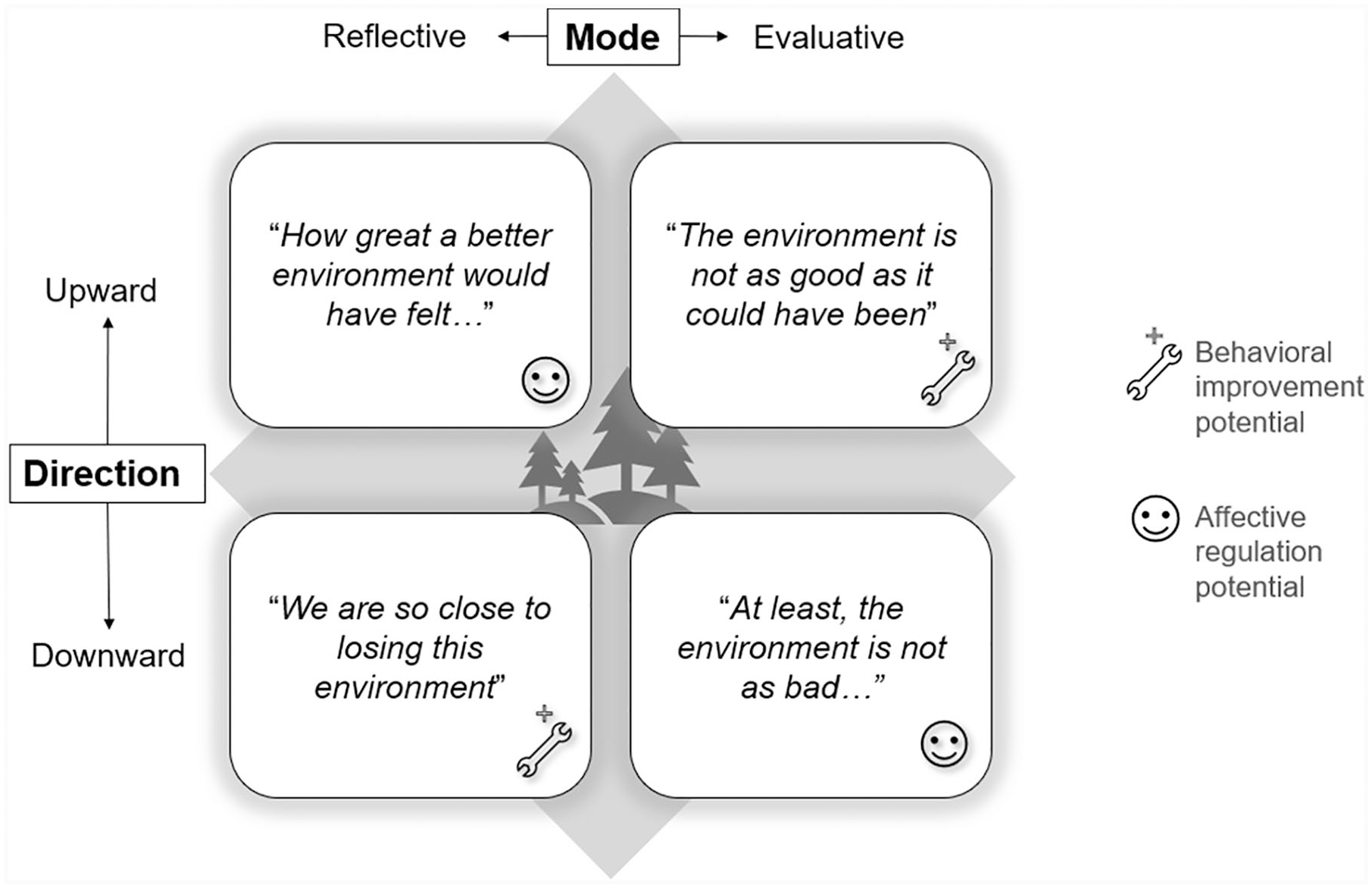
Affective and behavioral potential of environmental counterfactuals.
Negative affect associated with a counterfactual is the necessary fuel that drives one to undo or change the perceived cause of negativity (Epstude and Roese 2008; Markman and McMullen 2003). Hence, any improvement in sustainable tourist behavior that an environmental counterfactual can account for is contingent on the negativity characterizing the affective consequences of that counterfactual. In other words, the internal push to do something about a destination’s natural environment may arise as long as a counterfactual thought makes one feel bad about the environmental situation. Following this premise, negatively charged affective consequences are likely to be observed when the counterfactuals imagine a better alternative to the environmental reality of a destination without losing the focus on reality. The affective contrast caused by such an “upward-evaluative” counterfactual is likely to evoke more negative feelings associated with the current environmental state, which then lead to intentions for sustainable behavior. Moreover, negative affect and potential for improvement is similarly expected from a “downward-reflective” counterfactual—by means of affective assimilation—where the focus is on the imagined environment that is decidedly worse than the real one.
Counterfactuals that tend to cause positive affect regarding the environment are, on the other hand, expected to yield no meaningful effect on sustainable tourist behavior. Such counterfactuals may either be “upward-reflective”—when one both imagines and focuses on a better environment—or “downward-evaluative”—when the focus is on the real environment in contrast to the imagined, worse alternative. Since these counterfactuals will serve only to regulate mood (McMullen and Markman 2000; Roese 1994), that is, feel good about the environmental status quo, no meaningful intention for behavioral change is expected to be observed.
Guided by the existing literature, the current study formed a set of hypotheses to be tested regarding the effects of environmental counterfactuals on the affective and behavioral dependent measures (Figure 2). Different from previous studies, affective and behavioral influences exerted by counterfactual processing of the environmental state were hypothesized to be observed even when compared to control conditions in which the environmental state was processed noncounterfactually (or factually). For simplicity, counterfactual conditions were abbreviated as UpEval for upward-evaluative, UpRef for upward-reflective, DownEval for downward-evaluative, and DownRef for downward-reflective.
In terms of the negative affect generated with respected to the environmental state of a destination, the counterfactual conditions will display a disordinal interaction of direction and mode as the following: Hypothesis 1a: UpEval > UpRef Hypothesis 1b: DownRef > DownEval
Changes in negative affect due to environmental counterfactuals will be in absolute terms (i.e., in comparison to a non-counterfactual control condition): Hypothesis 1c: UpEval > Control Hypothesis 1d: DownRef > Control Hypothesis 1e: UpRef < Control Hypothesis 1f: DownEval < Control
In terms of the intentions for sustainable tourist behavior, the counterfactual conditions will display a disordinal interaction of direction and mode as the following: Hypothesis 2a: UpEval > UpRef Hypothesis 2b: DownRef > DownEval
Improvements in sustainable tourist behavior due to environmental counterfactuals will be in absolute terms (i.e., in comparison to a non-counterfactual control condition): Hypothesis 2c: UpEval > Control Hypothesis 2d: DownRef > Control
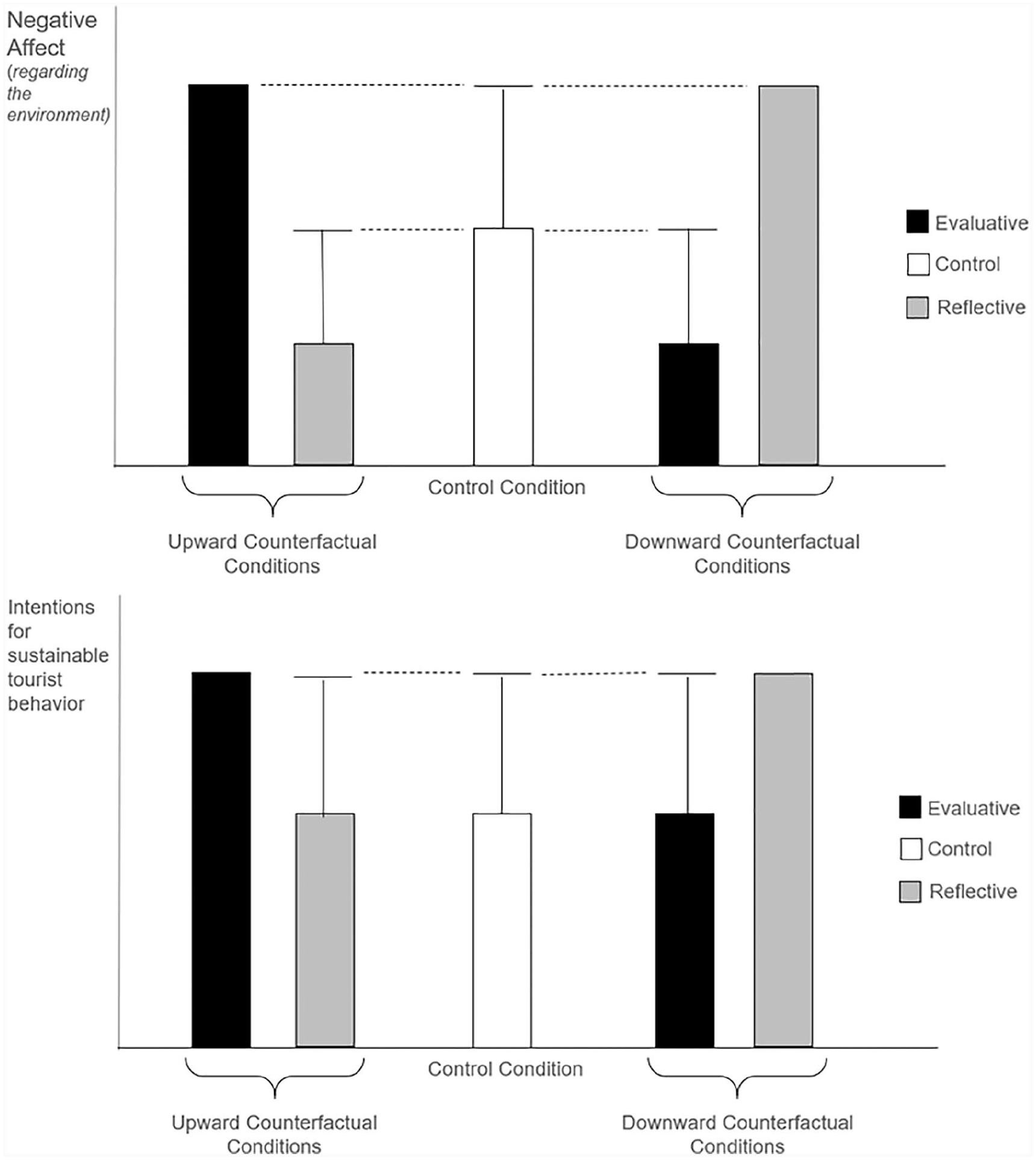
Hypothesized effects of counterfactual conditions on affective and behavioral measures.
Methodology, Experimental Procedure, and Results
The functionality of counterfactuals for sustainable behavior within the tourism context was experimentally investigated across two studies (study 1 and study 2). Specifically, study 1 is composed of two pilot experiments and experiment 1, while study 2 is composed of a pretest and experiment 2.
Baseline Methodology
True experiments with a factorial (2 × 2), between-subjects design were used in the studies. Participants were recruited through Amazon’s MTurk from the US population. Qualtrics was used to collect the data, which were analyzed in SPSS and MedCalc. Apart from certain structural and procedural differences between the studies, both experiments (experiment 1 and 2) utilized (1) counterfactual direction (upward vs. downward) and counterfactual mode (reflective vs. evaluative) as the two manipulated independent variables, (2) indicators of affect and behavioral intention as the two main dependent measures, and (3) covariates and control variables. The procedures were modified versions of the Markman et al. (1993) Markman and McMullen (2003) and Markman, McMullen, and Elizaga (2008) procedure for the Reflection-Evaluation Model. Different from their procedure, however, a control group was added in the experiments to observe counterfactual effects in absolute terms. For the main experiments, each condition had a sample size above the practical minimum (i.e., N > 20; Hair et al. 2009, p. 453). For the pairwise comparisons among the treatment and control groups, the Benjamini-Hochberg procedure was used to adjust alpha values and control against error rates. This is a correction method based on a false discovery rate, which is more suitable for theory-driven research as opposed to methods based on false positive rates such as Bonferonni (Benjamini and Hochberg 1995, 2000; Benjamini and Yekutieli 2001; Glickman, Rao, and Schultz 2014; Wilkinson 1999). This method was chosen as an alternative to the common (mal)practice of planned comparisons that ignore adjustments against type I error (Frane 2015). An instruction protocol (appendix B) was prepared in advance of the studies to objectively detect and exclude cases with failed manipulations. According to this protocol, counterfactual direction sentences that (1) were less than three, (2) did not include any meaningful words, (3) were indicative of a suspicion or guess regarding the study purpose, or (4) singularly generated counterfactuals for the opposite direction (e.g., if all three sentences in a downward condition were directionally same as the sentence “if people hadn’t littered, there’d be less pollution”) were excluded from analysis. Counterfactual mode sentences that were without any meaningful words or indicative of a suspicion or guess regarding the study purpose were also excluded from analysis. Additionally, attention check measures were incorporated into the questionnaire. On average, participants took 12–15 minutes to complete the main experiments and were paid $0.50 as compensation.
Study 1
Manipulation, measurement items, and pilot studies
The factorial, between-subject design for counterfactual manipulation (2 × 2: direction X mode) followed the Markman et al. (1993, 2003) and Markman, McMullen, and Elizaga (2008) reflective-evaluative model by employing two consecutive phases, manipulating direction (upward vs. downward) and mode (evaluative vs. reflective), respectively. Manipulation phases referred to a preceding introductory paragraph, which was meant to establish a baseline salience for the natural environment of Florida—a highly popular tourist destination in the United States. In the first phase, participants were asked to generate and write down three counterfactual sentences, particularly about “how things could have been better (upward) or worse (downward)” compared to the actual environmental state of Florida. Second phase, on the other hand, determined the focal target by asking the participants to concentrate on either the actual state of the environment (evaluative) or the imagined alternative (reflective). Second stage also required written input by asking participants to describe their current thoughts, which additionally served as instructional protocol checks. In contrast to the tests of the model in existing literature, current design included a control condition where neither of the counterfactual phases followed the introduction. However, participants in the control condition were still asked to write down their current thoughts after reading the introductory paragraph. Control procedure was meant to establish a baseline for processing the introductory information and generating thoughts about it without explicit counterfactual cues. The written thoughts in this condition similarly served as instruction checks.
To measure the affective outcomes of counterfactuals, six bipolar affect items (disappointed-relieved, discouraged-heartened, negative-positive, unhappy-happy, tense-relaxed, depressed-elated) were adopted from earlier studies (Markman, McMullen, and Elizaga 2008; Roese 1994). As a control against random answers, a filler (tired-awake) was added to the items whose positive and negative anchors also alternated on a 9-point semantic differential scale. Coding was such that scores signified the degree of negative affect.
A willingness-to-pay item was selected as a behavioral intention measure. Despite the noise (e.g., internal anchors) associated with willingness-to-pay measures (Breidert, Hahsler, and Reutterer 2006; Damschroder et al. 2007), such measures may constitute a practical proxy for value assigned to a domain that is arguably distant from “self” (i.e., the natural environment). Therefore, the measure was framed in a trade-off premise with an external anchor meant to override internal references (Simonson and Drolet 2004; Tversky and Kahneman 1974). Specifically, participants were asked the price they would be willing to pay for a “green” hotel in excess of that for a regular counterpart, after an informative sentence suggested them a made-up price differential ($20) as the market average.
As mentioned earlier, the logical structure of counterfactual thoughts indicates that the probability of counterfactual thoughts, at minimum, depends on a similarly probable or opportune future where some actions or events are perceived to be under one’s control (Epstude and Roese 2008; Kahneman and Miller 1986). The implication of these requirements for the study context, in turn, follows that any influence counterfactuals might exert on sustainable behavior depends on perceptions or beliefs of a future environment where one’s actions hold some degree of relevance, be they for better or worse. Therefore, this “controllability/opportunity” requirement for counterfactuals was operationalized using a four-item “Personal Impact” scale, which was adopted from Roberts’ (1996) Perceived Consumer Effectiveness scale with only contextual modifications. Originally a measure of belief in the effectiveness of individual consumption choices when fighting pollution (Kinnear, Taylor, and Ahmed 1974), the instrument has demonstrated versatile utility as a self-efficacy type scale specific to sustainable consumption (see Ellen, Wiener, and Cobb-Walgren 1991; Straughan and Roberts 1999; Vermeir and Verbeke 2006). Sociodemographic items (gender, age, education level, marital status, income level, occupation, ethnicity, and residence) were also included in the study as control variables. Residence was also a measure to exclude Florida residents owing to familiarity-related biases.
First pilot study (N=108) tested the effectiveness of the design (i.e., whether the current design implied an effective manipulation of counterfactual conditions), by observing the trends in affective and behavioral measures across four counterfactual conditions (excluding control condition). Despite acceptable EFA results for the six affect items (single factor, 72% variance explained, loadings > 0.69), the CFA model became satisfactory after dropping one item (χ2/df = 14.828/5 = 2.97, comparative fit index [CFI] = 0.98, standardized root mean square residual [SRMR] = 0.03, Cronbach’s α = 0.93, composite reliability [CR] = 0.93, average variance extracted [AVE] = 0.73) allowing for an average score of five items. In the two-way analysis of variance (ANOVA) results, the effect of the counterfactual interaction term (direction X mode) on the affective measure did not approach the expected significance. On reviewing participants’ written sentences (instructional checks), the evaluative condition was found as the source of ineffective manipulations. As opposed to the reflective condition, original content for this condition (adopted from Markman, McMullen, and Elizaga 2008) could not adequately stimulate a focus on actual reality, resulting in an overall assimilative tendency across all conditions. Therefore, evaluative instructions were modified such that words signifying the focal target were stronger and in capitals (e.g., ACTUAL, RIGHT NOW). Corresponding modifications were made in the reflective instructions (e.g., IMAGINING) for consistency. ANOVA results also revealed an unexpected main effect of counterfactual direction (Upward<Downward). A likely cause was the content of the introductory paragraph that was heavier on the negative aspects of Florida’s environment. High baseline negativity may backfire in the face of intensifying conditions (i.e., upward counterfactuals) especially in an environmental setting, where perceived control is arguably low. To cope, participants may prioritize mood repair by altering the direction/mode of their counterfactuals (Epstude and Roese 2008) or disengaging from the content altogether. Hence, introductory content was consolidated to be shorter and balanced between the negative and the positive aspect. Negative and positive aspects were also designed to be counterbalanced against order effects. Pilot results did not reveal the expected trends in the behavioral measure; however, this was attributed to the lack of affective outcomes since negative affect is the necessary product for counterfactuals to exert behavioral influence (Roese 1997; Eptsude and Roese 2008; Markman et al. 2003). Furthermore, the wide range of willingness-to-pay responses implied the external anchor was ineffective. Since an absolute value ($20) may still be susceptible to personal reference points (e.g., income level, familiarity with hotel prices), a percentage-based anchor (10%) was preferred for the main experiment.
Second pilot study (N=75) focused primarily on the affective outcomes of counterfactuals, following the aforementioned changes in introduction and manipulation instructions. In addition to a fifth control condition that skipped the manipulation phases, the second pilot also included an attention check question as a further measure of internal validity. An average score for the affect items was calculated as the affective measure following a satisfactory CFA model for all six affect items (χ2/df = 24.11/9 = 2.68, CFI = 0.95, SRMR = 0.04, Cronbach’s α = 0.92, CR = 0.93, AVE = 0.67) and lack of order effects from the introductory content. In terms of the counterfactual effects, two-way ANOVA revealed that the effect of the interaction term on the affective measure approached significance, F(1, 43) = 3.05, p = .088). As expected, this interaction trend was disordinal; no main effect of counterfactual direction or mode was observed, and affective scores reflected the hypothesized relationships among the four treatments. Furthermore, when compared to the control, relative positions of three of the four treatments were in line with the hypothesized trends. These results implied an effective manipulation of environmental counterfactuals in line with the Reflection–Evaluation model, and a potential for observing absolute affective changes (i.e., in comparison to the control).
Procedure of experiment 1
Each participant was randomly assigned to one of the five experimental conditions: four counterfactual treatments (UpRef, UpEval, DownRef, and DownEval) and one control condition. Before manipulations, all participants read a short paragraph on the positive and negative aspects of Florida’s natural environment (Appendix A1), whose content was counterbalanced. After the paragraph, the direction of counterfactual thinking was manipulated by randomly asking participants to write three sentences either about how Florida’s environment could be better (upward condition) or how it could be worse (downward condition), had things been done differently in the past. Once the sentences were written, the mode of counterfactuals was manipulated by randomly asking participants to focus on either the actual state of Florida’s environment (evaluative condition) or the imaginary one they just wrote about (reflective condition). Participants were once again asked to write their thoughts before rating their feelings about Florida’s environment across seven affect items. For the behavioral measure, participants first read a sentence indicating how green hotels in general charge 10% more compared to regular counterparts, and then wrote how much more (in percentage) they would be willing to pay for a green hotel in Florida. Following the Personal Impact and sociodemographic measures, participants were thanked and debriefed. A total of 202 individuals participated in the experiment.
Results and discussion
After initial screening of completed experiment questionnaires, 13 cases with failed attention, 9 with Florida residence, and 1 with unspecified residence were removed from analysis. None of the remaining cases failed the instruction check. However, a design flaw was detected in the control group, which was consequently dropped from the analysis. The final sample size was 102 composed of four experimental conditions. There were no significant order effects from the introduction. Following good fit and reliability scores for the affect items as a single measure (χ2/df = 23.02/9 = 2.56, CFI = 0.99, SRMR = 0.02; Cronbach’s α = 0.94, CR = 0.94, AVE = 0.72), an average of the item scores was calculated as the affective measure. Next, a two-way ANOVA revealed significant interaction of counterfactual direction and mode on the averaged affect score, F(1, 100) = 19.94, p < .001, but no main effects of direction, F(1, 100) = 03, p = .876, or mode, F(1, 100) = 1.426, p = .235. Pairwise comparisons showed the hypothesized counterfactual trends (UpEval>UpRef, DownRef>DownEval) confirming the expected disordinality of the interaction term (Table 1). Both comparisons incorporated Benjamini-Hochberg correction procedure. Hence, the affective hypotheses comparing treatments were supported (hypothesis 1a, hypothesis 1b).
Pairwise Comparison of the Counterfactual Effects on the Affective Measure (Negative Affect).
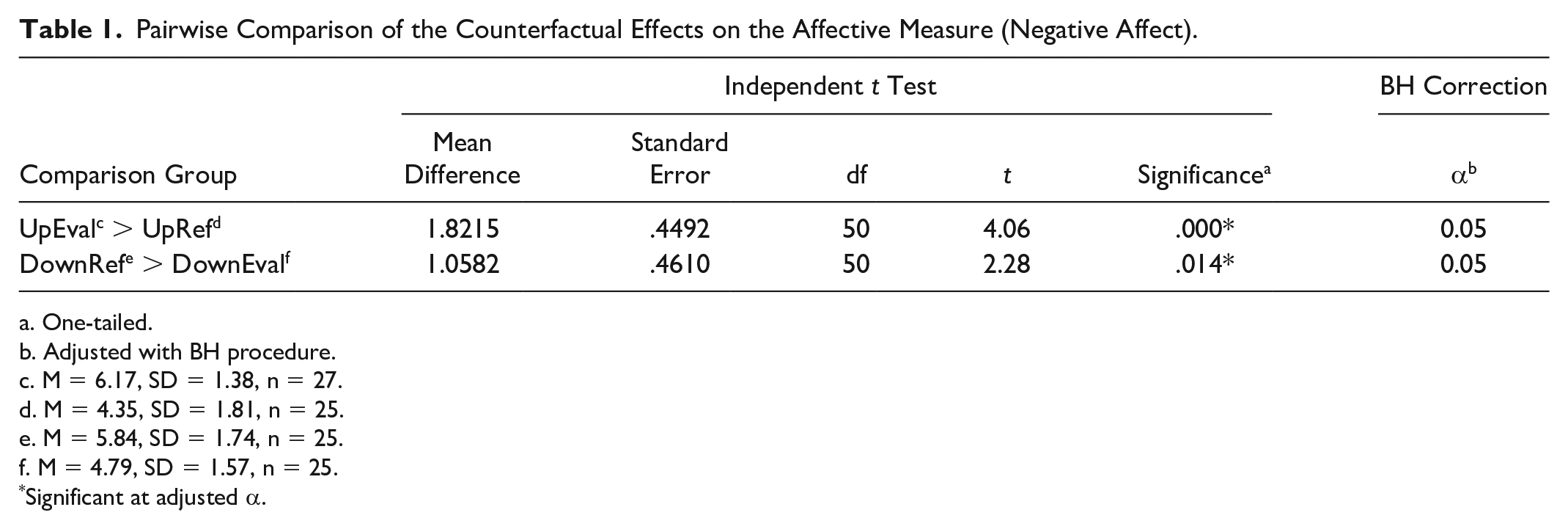
One-tailed.
Adjusted with BH procedure.
M = 6.17, SD = 1.38, n = 27.
M = 4.35, SD = 1.81, n = 25.
M = 5.84, SD = 1.74, n = 25.
M = 4.79, SD = 1.57, n = 25.
Significant at adjusted α.
Prior to examining the behavioral measure, CFA was run for the Personal Impact items. Removing a low-loading item yielded satisfactory reliability scores for the remaining three (Cronbach’s α = 0.80, CR = 0.81) as a single measure. However, this measure was removed after revealing no significant effect in a two-way analysis of covariance (ANCOVA), F(1, 99) = 0.72, p = .400, for the behavioral measure. Instead, a two-way ANOVA was conducted to test the counterfactual effects on the willingness-to-pay item. Results mirrored the disordinal counterfactual interaction only in marginal terms; direction: F(1, 100) = 0.01, p = .934; mode: F(1, 100) = 0.02, p = .903; direction X mode: F(1, 100) = 3.87, p = .052; UpEval>UpRef: t = 1.39, p = .086; DownRef>DownEval: t = 1.44, p = .080. Hence, behavioral hypotheses were not supported.
These results showed that environmental counterfactuals can influence affect as hypothesized (Figure 3). As implied by the model, neither direction nor mode of counterfactuals were adequate as a counterfactual dimension to explain affective outcomes of environmental counterfactuals. Imagining an environment better or worse than the real one may create equivalently negative or positive emotions depending on where one stands with regard to their imagination. Control condition was not included in this study; therefore, the hypotheses concerning the absolute changes in affective outcomes (Hypotheses 1c, 1d, 1e, and 1f) were not tested. These hypotheses were tested in study 2.
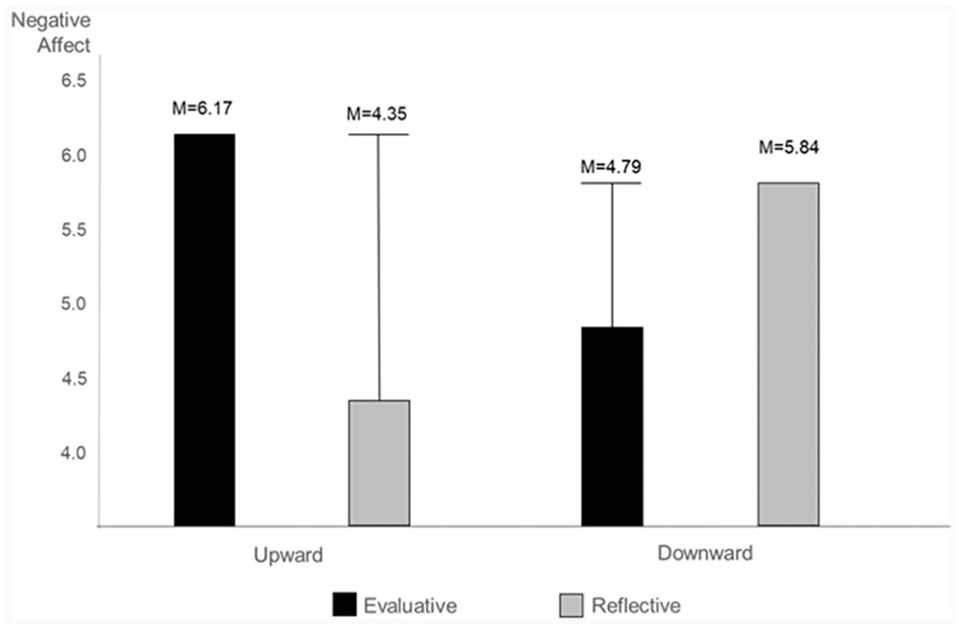
Affective outcomes of environmental counterfactuals.
While the willingness-to-pay measure did not significantly manifest the behavioral assumptions, the fact that all hypothesized directions reached marginal significance harks back to earlier doubts on its utility. As a noisy variable (Breidert, Hahsler, and Reutterer 2006), willingness to pay may be further confounded in the sustainable tourism setting where beliefs about cost-related responsibilities are blurred (Juvan and Dolnicar 2014). Problematic nature of WTP measures in the environmental sustainability context (Breidert, Hahsler, and Reutterer 2006; Damschroder et al. 2007; Völckner 2005; Dodds, Graci, and Holmes 2010; H. Han, Hsu, and Lee 2009; Manaktola and Jauhari 2007) as well as a questionable link with the counterfactual content were consequently deemed as potential barriers to observe a significant behavioral change. The second study addressed these issues in a contextually focused setting.
Study 2
Manipulation and measurement items
While environmental counterfactuals had a strong influence on affect in Study 1, this influence did not translate strongly to the behavioral measure. One possible cause was the relatively content-neutral route between the manipulation and the behavioral measure (i.e., willingness to pay extra for a green hotel following broadly environmental counterfactuals). Even though counterfactual effects may be observed across different yet motivationally linked behaviors, they are more immediate—and arguably stronger—in behaviors that make up the antecedent of the counterfactual conditional (Smallman and Roese 2009; Epstude and Roese 2008). As a corollary of this content-specific potency, increasing the contextual specificity of the counterfactual-behavior route may also increase effective strength.
Three major changes were made in the experimental design to enhance the contextual relevance. First, the introductory paragraph included additional sentences about Florida’s high popularity among tourists—including how half of them choose to stay in hotels during their visit (Florida Department of Environmental Protection 2018). Next, the instructions for the first manipulation phase were modified such that counterfactual antecedents were to stem specifically from visitor actions. Third, willingness-to-pay was replaced by new measures of sustainable tourist behavior that were characterized by higher perceived relevance to environmental sustainability. In general terms, what constitutes perceptually relevant sustainable behavior from a tourist’s perspective is undoubtedly a complex, transdisciplinary question, far beyond the scope of this study. Therefore, for this study, perceptual relevance was regarded in limited terms of cognitive fluency that might allow any counterfactual-borne goal to assume an observable form.
Pretest
A novel, two-step pretest was designed to identify behaviors perceptually relevant to the context of sustainable tourism. Rather than gaining insight into current public or industry opinions, the goal was solely to detect clues of an associative advantage on environmental impact within the subjective confines of cognition. An accommodation setting was considered suitable due to the availability of household behaviors which are likely to be perceived familiar, controllable (Roese 1997), opportune (Epstude and Roese 2008), and yet have significant environmental impact (Environmental Protection Agency 2019). Common examples of hotel guest behaviors that imply environmental sustainability were collected as a test pool (a total of 21 items). A simple, dichotomous choice task asked participants to decide whether or not behaviors in the pool have an environmental impact. The test was repeated for temporal distance (N1 = 50, N2 = 49) and post-choice importance ratings were collected only to resolve consensus conflicts between samples. The nonparametric Cochran’s Q test (Sheskin 2004) was conducted in MedCalc (a medical statistics software) to calculate a “minimum required difference” (MRD) score that, based on each sample data set, indicated the minimum choice differential for any two behaviors to be considered significantly different. MRD was then used to calculate a hypothetical threshold for consensus (100% – MRD) in each sample. Comparing behavior scores of each sample to their respective thresholds, 10 items were considered qualified as perceptually relevant: 6 behavioral items that were above the threshold in both samples and 4 discrepantly scored items that still had an above-average importance rating within the sample they fell below the threshold. The score of these items implied an associative strength when environmental impact is concerned. However, the qualified items were mostly related to one type of environmental resource (i.e., water). Therefore, two energy-related items that passed the threshold in either one sample were also selected in order to add diversity to the measures (Appendix C).
Procedure
Experiment 2 followed the same overall procedure for treatment and control conditions in Experiment 1. The only differences were (1) additional content in the introductory paragraph (Appendix A2), (2) instruction changes for first manipulation phase, and (3) 12 behavioral measures based on the pretest results. A total of 150 participants completed the experiment. An additional filter in MTurk was used to block responses from Florida.
Results and discussion
After removing 14 cases with attention failure and 3 with instruction violation, the final sample size was 133. In addition to four treatments, the sample also included the control condition. Similar to experiment 1, the introduction did not cause significant order effect. Affect items in experiment 2 were once again shown to have good fit and reliability to be averaged into a single measure (χ2/df = 17.331/9 = 1.93, CFI = 0.99, SRMR = 0.015; Cronbach’s α = 0.96, CR = 0.96, AVE = 0.78). Affective measure score for each condition were as follows: UpEval(n = 27): M = 5.47, SD = 1.84; UpRef(n = 27): M = 4.25, SD = 1.51; DownRef(n = 23): M = 6.62, SD = 2; DownEval(n = 23): M = 4.61, SD = 1.84; Control(n = 33): M = 4.77, SD = 1.53. Testing the counterfactual effects on the affective measure, a two-way ANOVA revealed the significance of the counterfactual interaction, F(1, 96) = 20.12, p < .001, with the hypothesized disordinality (UpEval>UpRef: t = 2.67, p = .005; DownRef>DownEval: t = 3.55, p = .001). In terms of absolute changes, pairwise tests also showed one condition was significant (DownRef>Control: t = 3.91, p < .001), and two were marginally significant (UpEval>Control: t = 1.6, p = .058; Control>UpRef: t = 1.33, p = .094), while one condition failed to reach significance (Control>DownEval: t = 0.363, p = .359). All comparisons of affect incorporated the Benjamini-Hochberg correction, yielding support for three affective hypotheses: 1a, 1b, and 1d. These significances confirmed the affective prerequisites for three of the four predicted behavioral outcomes, and the remaining affective prerequisite (UpEval>Control) approached significance on marginal terms. Overall, these results were considered sufficient to proceed to the testing of behavioral measures.
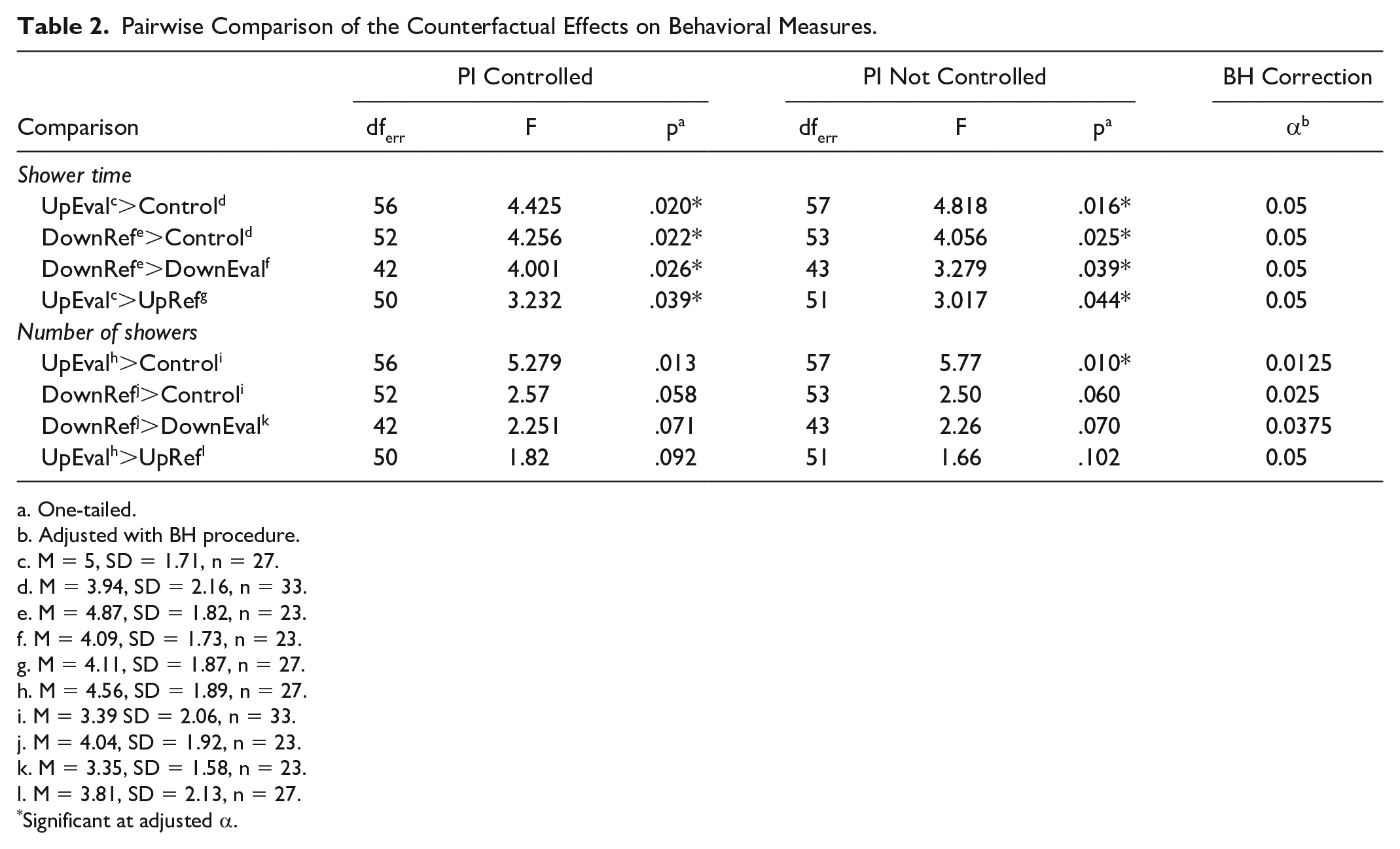
Next, a set of two-way ANCOVAs were conducted for each of the behavioral measures, including personal impact score as covariate and sociodemographic variables as control. Two measures that revealed a significant counterfactual interaction term were scrutinized for the hypothesized counterfactual effects (via univariate analyses with controls). Among these behavioral intention items, likelihood to shorten shower time showed the most compelling evidence of counterfactual influence, confirming the hypothesized disordinality among counterfactual treatments: UpEval>UpRef: F(1, 50) = 3.232, p = .039; DownRef>DownEval: F(1, 42) = 4.001, p = .026. Furthermore, counterfactuals characterized with positive behavioral change were qualified as absolute in comparison to the control: UpEval>Control: F(1, 56) = 4.425, p = .020; DownRef>Control: F(1, 52) = 4.256, p = .022. Univariate analyses also revealed no effect of PI or any other variable on these values. Benjamini-Hochberg correction confirmed that all the behavioral hypotheses—2a, 2b, 2c, and 2d—were supported for this measure (Table 2).
Pairwise Comparison of the Counterfactual Effects on Behavioral Measures.
One-tailed.
Adjusted with BH procedure.
M = 5, SD = 1.71, n = 27.
M = 3.94, SD = 2.16, n = 33.
M = 4.87, SD = 1.82, n = 23.
M = 4.09, SD = 1.73, n = 23.
M = 4.11, SD = 1.87, n = 27.
M = 4.56, SD = 1.89, n = 27.
M = 3.39 SD = 2.06, n = 33.
M = 4.04, SD = 1.92, n = 23.
M = 3.35, SD = 1.58, n = 23.
M = 3.81, SD = 2.13, n = 27.
Significant at adjusted α.
Same pattern of counterfactual effects was also observed in the measure of “likelihood to decrease the number of showers taken”; however, all significances remained marginal after Benjamini-Hochberg correction: UpEval>UpRef: F(1, 50) = 1.82, p = .092; DownRef>DownEval: F(1, 42) = 2.251, p = .071; UpEval>Control: F(1, 56) = 5.279, p = .013; DownRef>Control: F(1, 52) = 2.57, p = .058. On the other hand, removing the main effect of personal impact (PI) from the analysis rendered the behavioral improvement in upward-evaluative condition absolute (UpEval>Control: t = 5.77, p = .010) but negated the difference among upward counterfactuals (UpEval>UpRef: t = 1.66, p = 0.102). Nevertheless, lack of main effects from direction or mode, provided support forhypothesis 2c.
Three measures with some of the hypothesized counterfactual effects, which could not be attributed to a main effect of direction or mode, were (1) using reusables instead of disposable with one absolute improvement, UpEval>Control: F(1, 56) = 6.73, p = .006, one marginal improvement, DownRef>Control: F(1, 52) = 2.33, p = .067, and one marginal difference, UpEval>UpRef: F(1, 50) = 1.97, p = .083; (2) using same sheets during stay with one absolute improvement, UpEval>Control: F(1, 57) = 7.67, p = .004; and (3) recycling trash with one absolute improvement, UpEval>Control: F(1, 56) = 6.41, p = .007. Controlled variables for these three measures were: income level for (1), education level for (2), and PI for all three. All comparisons were checked with Benjamini-Hochberg correction, providing support for hypothesis 2c on three different measures. The only item implying improvement due to the main effect of counterfactual mode was decreasing blow-dryer usage, DownRef>Control: F(1, 53) = 4.18, p = .023; UpRef>Control: F(1, 57) = 3.65, p = .031; PI controlled, even though ANCOVA results did not reveal a significance, Mode: F(1, 126) = 2.63, p = .107. No BH correction was employed for this measure as it contradicted the hypothesized trends. There were no significant effects observed in the remaining behavioral measures.
Findings of experiment 2 indicate the functionality of counterfactuals in sustainable tourist behavior (Figure 4). The behavioral measure of shower time reflected all hypothesized counterfactual effects, largely mirroring the affective trends. Inclusion of a control group qualified the improvements from upward-evaluative and downward-reflective counterfactuals to be in absolute terms. A related item about the number of showers reflected the same relative and absolute trends, albeit mostly in marginal terms. These results suggest the strong perceptual relevance of water use to environmental sustainability. Significant changes on other four behaviors provided limited support for counterfactual functionality, with only consistent support for hypothesis 2c. However, the fact that all these significances were in absolute terms is in line with the long-documented potency of upward-evaluative counterfactuals (Roese 1994, 1997; Epstude and Roese 2008). Upward-evaluative counterfactuals have arguably the strongest association with negative affect, which constitutes an advantage for goal pursuit. Nevertheless, downward-reflective condition has proven equally functional on at least one item, implying that sustainable behaviors might be improved before it feels “too late.”
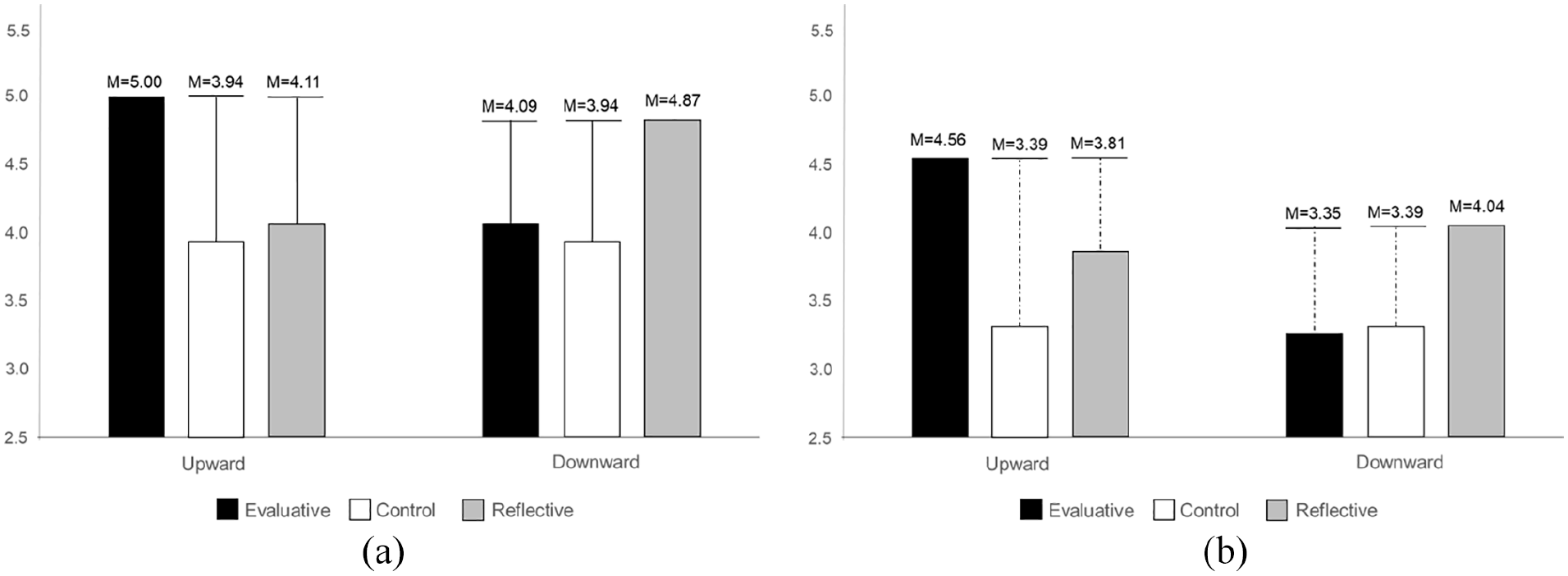
Counterfactual effects on the measures of sustainable tourist behavior. (a) Likelihood to shorten shower time. (b) Likelihood to decrease number of showers.
General Conclusion and Implications
Current pair of studies were the first to use a full-factorial, experimental design to provide evidence for the potential of counterfactuals in improving environmentally sustainable tourist behavior. To authors’ knowledge, this was also the first time a control group was added to a test of the reflection and evaluation model of counterfactuals by Markman et al. (2003) and Markman, McMullen, and Elizaga (2008). The control condition in experiment 2 allowed researchers to conclude that counterfactual influences can be in absolute terms for affective and behavioral outcomes. Therefore, the implications pertain to the theoretical foundation of counterfactuals and sustainable behavior as well as the practical domain of sustainable tourism management.
The findings showed that positive change in sustainable tourist behavior was possible for both counterfactual conditions that are associated with behavioral improvement. As a function of the directional content and the simulative focus, counterfactual processing of environmental information may elicit markedly negative, yet sympathetic emotional responses from potential tourists. Negative emotions may in turn instigate a drive for sustainable tourist action. This linkage between feelings and behavioral tendencies is noteworthy, first, in terms of pro-environmental behavior. Although perceptual biases may position environmental problems as less personal or immediate compared with other problem domains (Kahlor et al. 2006; Leiserowitz 2005), counterfactual processing of the environmental situation may still yield meaningful emotional responses and encourage action at a personal level. Second, these effects may be valid even in a tourism context where the emotional connection between the individual and the environment is further complicated, if not diminished (Cohen, Higham, and Reis 2013; Miao and Wei 2013).
Practical implications pertain to various sustainable management and marketing settings characterized by business-to-consumer (B2C) communication. As pro-environmental choices pervade all stages of travel, tourists are exposed to a variety of messages and appeals—such as those offering carbon-offset fees as flight add-ons, reduced housekeeping at hotels, replacement of disposables with biodegradables in restaurants, micro-management of waste in natural and cultural attractions, or paperless sales transactions wherever possible. Counterfactual prompts or narratives in such messages may help channel pro-environmental attitudes toward significant changes in behavior. Furthermore, counterfactuals in sustainability communication might be superior compared to other potential framing techniques because counterfactual thinking is a conscious and content-specific process. As implied by the environmental psychologist Stern (2000), adopting priming techniques that are contextually flexible but lack deliberate involvement with the issue content (e.g., social comparison prompts, opt-in/opt-out techniques) may fail to mobilize consumers, at least in the long term, who may require deliberation and an active role in sustainable initiatives. Through conscious and problem-focused thoughts, environmental counterfactuals allow for a greater sense of agency that, in turn, may reinforce the adoption of practical solutions among tourists. One such practical solution may lie in the findings for shower time—the only item to demonstrate absolute improvement on both counterfactual conditions, while improvements in other items were partial, relative, or nonsignificant. According to Environmental Protection Agency (2019), 15% of all commercial water waste in the United States comes from hotels alone, which is mostly generated in guest rooms. Hence, updating in-room messages to integrate counterfactual reasoning may bring out significant changes even when targeted at guest bathrooms alone. Moreover, the fact that significant improvement came from downward-reflective counterfactuals as well as upward-evaluative counterfactuals indicates the possibility of minimizing negative associations in a tourism service setting. Upward counterfactuals necessitating a bad and depressing framing of the current natural environment are not likely to appeal to an industry that caters to a population traveling with the prospects of relaxation, recreation, and enjoyment of local nature. Downward counterfactuals, however, would remind “what could happen” to the environment in a less anxiety-inducing manner, promoting preventive measures instead of corrective.
It should be noted that the main limitations of this study were the controlled setting and the population chosen. Participants were recruited online and instructed to actively construct counterfactuals, which may be difficult to replicate in a real tourism consumer setting. The reason for this limitation was, as previously mentioned, that the internal validity constituted the primary concern in this study so as to establish the basic effectiveness of environmental counterfactuals in a sustainable tourism context. Therefore, next steps in this line of research should prioritize field experiments in real-life tourism settings to evaluate the extent and boundary conditions of the proposed counterfactual effects. Cross-cultural studies should also be conducted to identify any sociocultural modifiers.
Supplemental Material
sj-pdf-1-jtr-10.1177_00472875211028324 – Supplemental material for Counterfactual Thinking in Sustainable Tourism Context
Supplemental material, sj-pdf-1-jtr-10.1177_00472875211028324 for Counterfactual Thinking in Sustainable Tourism Context by Semih Yilmaz, Hany Kim and Yongjae Ko in Journal of Travel Research
Footnotes
Declaration of Conflicting Interests
The author(s) declared no potential conflicts of interest with respect to the research, authorship, and/or publication of this article.
Funding
The author(s) received no financial support for the research, authorship, and/or publication of this article.

Supplemental Material
Supplemental material for this article is available online.
Author Biographies
References
Supplementary Material
Please find the following supplemental material available below.
For Open Access articles published under a Creative Commons License, all supplemental material carries the same license as the article it is associated with.
For non-Open Access articles published, all supplemental material carries a non-exclusive license, and permission requests for re-use of supplemental material or any part of supplemental material shall be sent directly to the copyright owner as specified in the copyright notice associated with the article.
