




Abstract
Disease outbreaks can severely disrupt the global tourism sector. New approaches for preventing infectious diseases from emerging and spreading are urgently needed to secure the prosperity of the tourism industry. This conceptual article proposes a comprehensive framework of interrelationships between tourism and emerging infectious disease. The conceptual framework highlights the pathways in which the tourism industry itself can potentially contribute to the emergence and spread of infectious diseases, including tourism-induced land changes, sourcing meat from intensive animal farms, global movement and close proximity of people, and high-risk sexual activities. Based on the interrelationships, the framework proposes tangible managerial action recommendations for tourism businesses and policy makers to contribute to the prevention of future disease outbreaks. This paper concludes with a research agenda on how scholars can support tourism practitioners and governments in reducing the likelihood of future epidemics and pandemics.
Introduction
Pandemics and epidemics force governments to limit the movement of people to control the disease outbreak (Fotiadis, Polyzos, and Huan 2021). The fundamental reliance of tourism on the movement of people makes this industry highly vulnerable to outbreaks of infectious diseases (Iaquinto 2020). During the COVID-19 pandemic, more than a quarter of all countries closed their borders, resulting in a loss of 74% of international arrivals and US$1.3 trillion in international tourism spending in 2020 (UNWTO 2021a). Tourism is among the industries most impacted by pandemics and epidemics because disease outbreaks trigger substantial changes within the tourism sector, forcing businesses to transform their business practices (Altinay and Kozak 2021). Assisting the tourism industry in those efforts is essential because tourism contributes substantial economic value to communities around the world: 10% of GDP and 1 in 10 jobs globally (UNWTO 2020; World Travel & Tourism Council (WTTC), n.d.).
While COVID-19 has had an unprecedented impact on tourism globally (Fotiadis, Polyzos, and Huan 2021), it is not the first infectious disease to disrupt the tourism sector. In the past two decades, Middle East respiratory syndrome (MERS), severe acute respiratory syndrome (SARS), and swine flu have affected tourism (Chen, Law, and Zhang 2021). The SARS outbreak, for example, caused a US$50 billion loss to global tourism in 2003 (WTTC 2020a). A local outbreak of swine flu led to a $US2.8 billion loss to the Mexican tourism sector in 2009 (Rassy and Smith 2013). Almost 75% of emerging infectious diseases are zoonotic in origin, which means they transmit from animals to humans (Woolhouse and Gowtage-Sequeria 2005). Zoonotic diseases develop when at least three species interact: a pathogen–a micro-organism that causes diseases–and two host species, for example a human and an animal (Karesh et al. 2012).
To date, research investigating tourism and infectious disease has primarily focused on changes in tourist behaviors in response to disease outbreaks and the negative consequences of pandemics and epidemics on the tourism industry (Chen, Law, and Zhang 2021; Zopiatis, Pericleous, and Theofanous 2021). What remains under-investigated to date, however, is the role the tourism industry could play in preventing future disease outbreaks in the long-term (Hall, Scott, and Gössling 2020). The aim of this conceptual article is to develop a comprehensive framework that identifies areas in which tourism-related activities can be linked to the underlying drivers of the development and spread of infectious diseases and propose measures tourism businesses and policy makers can adopt to reduce the risk of future disease outbreaks (see Figure 1). To develop the framework, we build on the existing scientific body of tourism and epidemiology literature, reports published by global tourism institutions, such as the UNWTO and the WTTC, the World Health Organisation (WHO) and national health services. Combining peer-reviewed with gray literature allows for the development of a comprehensive and timely conceptual framework (Pappas and Williams 2011) which is critically important to identify solutions for how tourism stakeholders can act now to help prevent future diseases outbreaks.
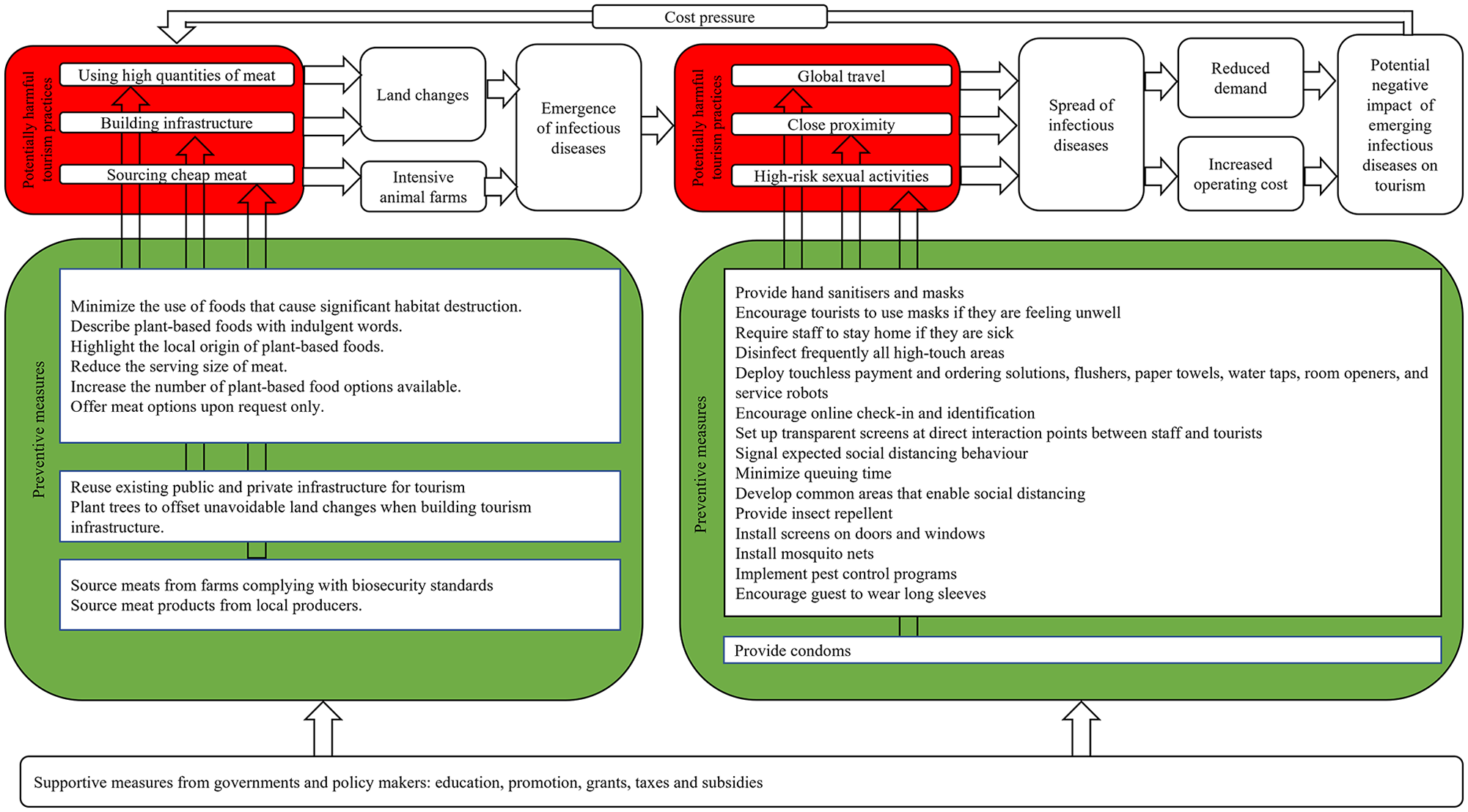
The interrelationships between tourism and infectious diseases.
The key theoretical contribution of this study is to extend the current understanding of the interrelationships between tourism and infectious diseases by demonstrating that tourism is not only negatively impacted by epidemics and pandemics as established in the existing body of literature (e.g., Chen, Law, and Zhang 2021) but can also play an active role in preventing the development and spread of infectious diseases in future. Immediate practical implications include guidance for tourism businesses and policy makers in the global tourism industry on how they can each take preventative action now to secure the growth and prosperity of the tourism industry and continue generating economic and social value for individuals, communities, and countries around the world.
The structure of this article is as follows: first, we describe the potential role of tourism in the development and spread of emerging infectious diseases based on the existing epidemiology literature. Next, we explain how emerging infectious diseases like COVID-19, SARS, and MERS have negatively impacted the tourism sector using reports from the UNWTO and WTTC as well as the scientific tourism literature. After establishing the interrelationships between tourism and emerging infectious diseases, we suggest tangible measures—informed by recommendations made by the World Heath Organisations, national health services and peer-reviewed studies—on how tourism businesses and policy makers can contribute to preventing future disease outbreaks. The paper concludes with a research agenda of how scholars can support tourism practitioners and governments in reducing the likelihood of future epidemics and pandemics. Figure 1 provides an overview.
The Potential Role of Tourism in the Development of Emerging Infectious Diseases
This section explains the interrelationships between standard tourism activities and land changes because habitat destruction is a key factor in the development of infectious diseases by increasing the interactions between people, animals, and pathogens as shown in Figure 1 (Karesh et al. 2012). We also describe how the growing tourism sector has contributed to the transition from small animal farms to industrialized feeding operations. Intensive animal farming increases the risk of infectious diseases emerging because of the high density of genetically similar animals in confined spaces (United Nations Environment Programme and International Livestock Research Institute 2020).
Tourism and Land Changes
Tourism is inseparable from local and global food production systems (Hall and Gössling 2013). Food is integral to any tourism experience (e.g., Jenkins 2018). Tourists eat not only for survival, but also to experience different cultures and to socialize (Chang, Kivela, and Mak 2010), spending an average of 25% of their travel budget on food and beverages (World Food Travel Association 2020). Tourists tend to eat more on vacation than they do at home (Cooper and Tokar 2016) because vacations create favorable conditions for overeating, including extended dining periods, easy access to food (Wansink 2004), and dining in groups (De Castro 1995). Tourists also consume more meat when dining out (Biermann and Rau 2020). Indeed, many signature dishes around the world are meat-centric: Australia is famous for its meat pies, English breakfast represents the United Kingdom, and pork knuckle is a symbol of Germany. Tourists increased demand for meat is problematic because animal agriculture accounts for 66% of food-related land changes but produces only 37% of protein and 18% of calories globally (Poore and Nemecek 2018). In Brazil, one of the leading meat producers globally, cattle-associated deforestation is responsible for 90% of land changes (Margulis 2004) and up to 41% of all deforestation in the Brazilian Amazon (Erasmus et al. 2020). The conversion of forests into hotels, restaurants and other forms of entertainment as well as to residential areas to accommodate the increasing number of people who migrate to work in the tourism sector represent also tourism-induced land changes (Lhota, Scott, and Sha 2019; Nuarsa et al. 2018).
Large scale land use change impacts biodiversity and increases contact rates between animal hosts, their microorganisms, and people. As a result, the likelihood of infectious diseases emerging also increases, as illustrated in Figure 1 (Karesh et al. 2012). This increased rate and intimacy of interaction occurs through changes in vegetation patterns, vector, and host species dynamics and microclimates (Karesh et al. 2012). Land use modifications along with changes in food production systems including agricultural practices, and wildlife hunting are responsible for the development of almost half of all the zoonotic diseases since 1940 (Keesing et al. 2010). The potential effects of altering local biodiversity on disease emergence can be illustrated using the example of the Malaysian pig industry. It expanded rapidly in the late 1990s because Singapore banned all local pork production and, as a result, demand for pork from Malaysia skyrocketed (Jones et al. 2013; Mohd Nor, Gan, and Ong 2000). Yet, the expansion of the local pig industry was poorly regulated, ultimately causing the emergence of the Nipah virus that killed 105 people (Jones et al. 2013; Mohd Nor, Gan, and Ong 2000). The emergence of Nipah is complex: the El Nino drought and smoke from slash-and-burn agriculture in Indonesia caused a decline in food sources for local flying foxes (fruit-eating bats) causing them to seek alternative food sources (Looi and Chua 2007). The practice of growing fruit trees near piggeries led to a change in flying fox behavior that brought them into contact with pigs (Looi and Chua 2007).
Tourisms and Intensive Animal Farming
Tourism businesses source a high proportion of their meat products from global markets because small local farmers, particularly in developing countries, cannot provide meat of the same quality, quantity, and price as industrialized food manufacturers in the United States or Europe (Timms 2008). Local farmers are also unable to supply major hotels, which often have standardized international menus, because they do not produce the required foods (Mao et al. 2014). A local farmer in Cambodia described this problem as follows: “Local farmers cannot supply shrimp, lobsters, meats such as beef, pork, chicken [. . .] because they don’t have farms raising these [animals] consumed by foreign tourists” (Mao et al. 2014, 678). The need of tourism businesses to source high quantities of food at the lowest price possible facilitates the transition to industrialized food systems, including intensive animal farms (Bertella 2020; Hall and Gössling 2013).
Intensive animal farms are large high-throughput single purpose systems (e.g., pigs, chickens) that breed thousands of animals at one site under highly controlled conditions with industrial feeds replacing access to forage crops (Otte et al. 2007). In the United States, more than 98% of broiler and egg chickens, turkeys, and pigs and 70% of cows lived on intensive animal farms in 2017 (Sentience Institute 2019). The living conditions in intensive farms suppress the immune system of the animals, making them receptive to diseases. To prevent diseases outbreaks, animals receive antibiotics. Approximately 73% of all antibiotics produced are used in farm animals to prevent and treat diseases (Van Boeckel et al. 2017). However, the high density of genetically similar animals in intensive farming drives pathogen transmission and allows viruses to mutate and become resistant against the antibiotics (Jones et al. 2013), contributing to one of the greatest threats to global health (WHO 2020).
Avian influenzas (bird flus), for example, are endemic in poultry production systems worldwide and represent an ever present and significant risk in terms of emergence with a steady stream of new zoonotic subtypes (Dhingra et al. 2018). The risk is particularly high in low and middle-income countries where production systems have poor infrastructure and do not adhere to stringent biosecurity measures to reduce the risk of diseases moving within and between farms. As a result, such countries record high rates of pathogen transmission and emergence of zoonoses (Council for Agricultural Science and Technology 2005; Leibler et al. 2009).
Further contributing to the facilitation of new emerging infectious diseases, intensive animal farms move live animals from the country of production to the country of consumption en masse. The proximity of live animals during transport presents an additional risk to the development of new infectious diseases. Global distribution represents a highly effective distribution pathway for emerging infectious diseases, such as highly pathogenic avian influenzas (Shi et al. 2020) and swine influenzas in the United States (Choi et al. 2015). Transitioning to more plant dominant dishes would reduce the risk of future diseases emerging (Espinosa, Tago, and Treich 2020).
The Potential Role of Tourism in Spreading Emerging Infectious Diseases
This section describes how tourism contributes to global travel, close proximity of humans, and high-risk sexual activities. We focus on these characteristics of the tourism industry because they can facilitate the spread of most emerging infectious as shown in Figure 1 (Wilson 1995).
Global Travel
The continuous growth of the international tourism sector contributes to increased human mobility (Iaquinto 2020). The number of international tourist arrivals grew from 277 million to over 1.4 billion between 1980 and 2019 (UNWTO 2021b). Increased human mobility facilitates the global transmission of emerging infectious diseases (Labonté, Mohindra, and Schrecker 2011). Between 43% and 79% of travelers visiting developing countries suffer from illnesses, including emerging infectious diseases (Angelo et al. 2017). Depending on the incubation period, an infected person can travel through multiple countries and expose local communities to diseases (Abdullah et al. 2004). Air travel, for example, was largely responsible for spreading the COVID-19 virus to 146 countries (Gössling, Scott, and Hall 2021), SARS to 28 countries (Riley et al. 2003), and MERS to 26 countries (Gardner, Chughtai, and MacIntyre 2016). Countries with higher volume of inbound and outbound tourism recorded higher number of COVID-19 cases and deaths (Farzanegan et al. 2021; Selvanathan, Jayasinghe, and Selvanathan 2021).
In addition to the growing number of international tourists, the travel patterns of tourists increase the likelihood of emerging infectious diseases spreading. The desire of tourists to experience cultures in remote areas makes tourism partially responsible for the transmission of emerging infectious diseases to every corner of the world. A tourist from the United States was the first confirmed case of COVID-19 in Bhutan (LeVine et al. 2020) and a returning traveler from the Middle East to the Republic of Korea infected 186 people, causing the greatest outbreak of MERS outside the Middle East (WHO 2015). During the 2020 summer school holidays, the COVID-19 incidence rate increased by 45% because people traveled in confined spaces, had close social contact with more and unfamiliar people, and increased mobility did not allow for effective contact tracing (Plümper and Neumayer 2021). Similarly, the spread of COVID-19 in Scandinavia was fueled by travelers returning from winter holidays in Austria and Italy (Falk and Hagsten 2021). Tourists visiting tropical regions like East and Central Africa or India were key drivers of the global spread of vector-borne diseases such as malaria and dengue fever to Western countries (Askling et al. 2005; Ratnam et al. 2013). The current International Health Regulations include an allowance for countries to require a certificate of vaccination against yellow fever prior to entry to limit its spread (WHO 2016).
Global travel has also contributed to the re-emergence of infectious diseases in countries that had previously eliminated the disease. The growing number of unvaccinated or inadequately vaccinated travelers in Europe facilitated outbreaks of measles with more than 41,000 recorded cases in 2018 (Angelo et al. 2019). International tourists acquiring measles whilst traveling in Europe can spread the disease to their home country upon their return (Angelo et al. 2019). Return travelers from Europe caused local outbreaks of measles in the United States (Center for Disease Control and Prevention 2012). Similarly, a child became infected with mumps while visiting the United Kingdom, triggering a local outbreak of mumps in the United States by attending a summer camp upon his return (High et al. 2010). Tourism, therefore, has the potential to drive the global spread of emerging infectious diseases (Iaquinto 2020).
Close Proximity of Humans
Standard tourism practices also contribute to local transmission of infectious diseases. Many tourism activities put people near one another in confined spaces: traveling on cruise ships, airplanes, trains, tour buses, or visiting hotels, restaurants or nightclubs. The proximity of humans facilitates local outbreaks of infectious diseases (Iaquinto 2020). During the COVID-19 pandemic, cruise ships and popular holiday destinations became incubators for COVID-19. In the first three months of 2020, cruise ships recorded at least 2,592 infected people and 65 deaths (da Silva 2021). One infected passenger on the Diamond Princess Ship caused an outbreak of COVID-19 with more than 600 confirmed cases and nine deaths (Mizumoto and Chowell 2020). Health authorities in Germany declared Ischgl—a famous alpine tourism destination in Austria—a risk region after at least 36 German tourists contracted COVID-19 when visiting a bar (Correa-Martínez et al. 2020).
Mega events also facilitate local disease outbreaks. Hosting the European Football Championship, for example, was partially responsible for a 5%–10% increase of COVID-19 cases because large number of people were close to one another in stadiums, bars, and buses (Marsh et al. 2021). The 2010 Olympic Winter Games in Canada (Gardy et al. 2015), an international junior football tournament in Italy (Santibanez et al. 2014), and music festivals in the United Kingdom (le Polain de Waroux et al. 2016) and Germany (Santibanez et al. 2014) led to local measles outbreaks.
High-Risk Sexual Activities
People’s perceptions of risk changes on vacation (Holm et al. 2017). Tourists, generally, appear to be more willing to take risks. Many of those risks relate directly to the potential to acquire and spread infectious diseases. Tourism experiences are “liminoid contra-normative settings offering a license for thrills, situational disinhibition, and sexual experimentation” (Berdychevsky and Gibson 2015, 78). Tourists feel less restrained than they do at home and ignore the health risks in pursuit of the pleasure associated with unprotected sex (Wickens 2003). Consuming alcohol, using drugs, partying, being enjoyment-focused, and not feeling bound by the social norms that dictate behavior at home contribute to higher-risk sexual behaviors on vacation (Berdychevsky and Gibson 2015). Between 20% and 35% of international tourists engage in casual sex. Of those, between 17% and 49% do not always use condoms (Svensson et al. 2018; Vivancos, Abubakar, and Hunter 2010). Sexually transmitted infections are common diseases among tourists who have unprotected sex, including gonorrhea, syphilis, and human immunodeficiency virus (Svensson et al. 2018; Vivancos, Abubakar, and Hunter 2010). Three international tourists in South East Asia were the first patients globally diagnosed with a new strain of antibiotic-resident gonorrhea after having unprotected sex on holidays (Meyjes 2018). Tourists who have sexual encounters with people from other countries on holidays can spread infectious diseases to parts of the world where they rarely existed before (Svensson et al. 2018) because they return home during the incubation period and unintentionally infect other sexual partners (Memish and Osoba 2006).
The Potential Negative Impacts of Emerging Infectious Diseases on the Tourism Industry
This section describes how emerging infectious diseases can disrupt the tourism industry by reducing demand and increasing operating costs. We focus on these two potential negative impacts because the typically high proportion of fixed costs tourism businesses incur makes them highly vulnerable to sudden demand drops (Graham and Harris 1999), causing severe financial distress during epidemics and pandemics (Crespí-Cladera, Martín-Oliver, and Pascual-Fuster 2021). The consequences for small and medium-sized enterprises—which account for up to 90% of all hotels (OECD 2008)—can be existential because they lack the funds to be able to prepare or survive an extended period of low demand (Kalogiannidis 2020). We provide examples of how local and global disease outbreaks have disrupted the tourism sector in the past.
Reduced Demand
To prevent the spread of infectious diseases, governments issue travel restrictions by not granting visas to visitors from countries with local disease outbreaks or by closing their borders entirely (Errett, Sauer, and Rutkow 2020). During 2020, many countries closed their borders in an attempt to contain COVID-19 (Fotiadis, Polyzos, and Huan 2021). Some international borders remained closed more than a year after the WHO declared COVID-19 a pandemic (Australian Government Department of Health 2021; New Zealand Immigration 2021). Travel restrictions reduced international arrivals by 74% in 2020, affecting as many as 120 million tourism jobs (UNWTO 2021a). The contribution of tourism to global GDP decreased from 10.4% to 5.5% from 2019 to 2020, representing a loss of US$4.5 trillion (WTTC 2021). Asia-Pacific was the most impacted region: spending from international tourists fell by 74.4%, spending by domestic tourists by 48.1%. Tourism spending in Europe and Africa halved. The number of recorded COVID-19 cases was negatively associated with tourism spending: a 10% increase in COVID-19 cases reduced revenue per available room, average daily rate and occupancy change by 0.490%, 0.103%, and 0.388% respectively (Yang, Mao, and Wen 2021). As a result, 34 million tourism jobs were lost. Airlines were forced to lay off staff, with some forced to file for bankruptcy or voluntary restructuring, including LATAM and Avianca Holding, the largest and second-largest carrier in South America, and Virgin Australia (Bloom 2020), and Virgin Atlantic filing for bankruptcy protection (Goldstein 2021).
Governments may also issue travel warnings to countries with outbreaks of infectious diseases. During the 2015 MERS outbreak in the Republic of Korea, countries that had previously experienced outbreaks of SARS, such as Hong Kong and Taiwan, issued travel warnings, reducing the number of visitors from these countries by more than 50% (Joo et al. 2019, 2019). As a result, international arrivals decreased by 2.1 million, translating to a loss of US$2.6 billion for the local tourism industry. Accommodation and foodservice providers were among the most impacted businesses, recording a loss of US$542 million and US$359 million, respectively (Joo et al. 2019).
The 2014-2016 Ebola outbreak in Guinea, Sierra Leone, and Liberia severely disrupted the local tourism sectors. Neighboring countries, such as Senegal and Côte D’Ivoire, imposed travel restrictions and the vast majority of airlines canceled their flights to the infected areas. The number of international tourists to Sierra Leone and Guinea dropped by over 40% from 2013 to 2014. In total, the Ebola outbreak caused a loss of approximately US$2.2 billion in GDP for Guinea, Liberia and Sierra Leone in 2015 (WTTC 2018). African countries without any recorded Ebola cases also experienced declines in tourism spending. Tourism numbers in Gambia, for example, fell by 60% in 2014 compared to the previous year (Hussain 2014). On average, West Africa recorded almost 8% fewer visitors in 2014 than in 2013 (WTTC 2018).
Outbreaks of SARS substantially reduced international arrivals to South East Asia in 2003 (Kuo et al. 2008). Hong Kong, for instance recorded 67.9% fewer travelers during May 2003, severely impacting on the local tourism industry (Pine and McKercher 2004). Hotel occupancy rates dropped to 20% and airlines had to reduce flight offerings in response to low demand, forcing tourism staff to take unpaid leave (Pine and McKercher 2004). The outbreak of SARS reduced tourism GDP in Hong Kong and Singapore by more than 40%, in China by 25%, and in Vietnam by 15% (WTTC 2003). Globally, SARS led to a US$30–50 billion loss to tourism businesses (WTTC 2020a). China (−US$8.5 billion), Canada (−US4.3 billion), Malaysia (−$1.4 billion), Hong Kong (−US$1.3 billion), Singapore (−US$0.2 billion), Australia (−US$0.1 billion), and Vietnam (−US$0.1 billion) recorded the greatest losses in tourism spending (Keogh-Brown and Smith 2008). In a response to the local outbreak of swine flu in Mexico in 2009, countries issued travel bans to and from Mexico. International arrivals dropped by almost 1 million between May and September 2009, corresponding with a $US2.8 billion loss for the local tourism sector (Rassy and Smith 2013).
Increased Operating Cost
Diseases outbreaks may require tourism businesses to change their standard operating procedures to adhere to government regulations. After governments lifted stay-at-home restrictions during the COVID-19 pandemic, cruise ships were encouraged to operate at 70% capacity and follow strict health regulations. Before boarding, guests must undergo temperature screenings, complete health surveys and take a COVID-19 swab test. The dining room needs to allow for social distancing and staff should serve food at buffets. On board entertainment, such as theater shows, must allow for social distancing. In some instances, this means that multiple shows must be offered (da Silva 2021). Similarly, restaurants are forced to operate at a reduced capacity to allow for social distancing and follow strict hygiene protocols (Gursoy and Chi 2020). Implementing such changes in procedures costs money, further reducing the profits of tourism businesses. The financial pressure the tourism industry is facing during pandemics and epidemics leads to a likely increase in the very behaviors that most contribute to the development of future infectious diseases: choosing suppliers that can make their product available at the lowest price. In the context of purchasing meat, this directs food providers to purchasing meat from intensive animal farms located overseas.
The Role of Tourism in Preventing (the Spread of) Future Emerging Infectious Diseases
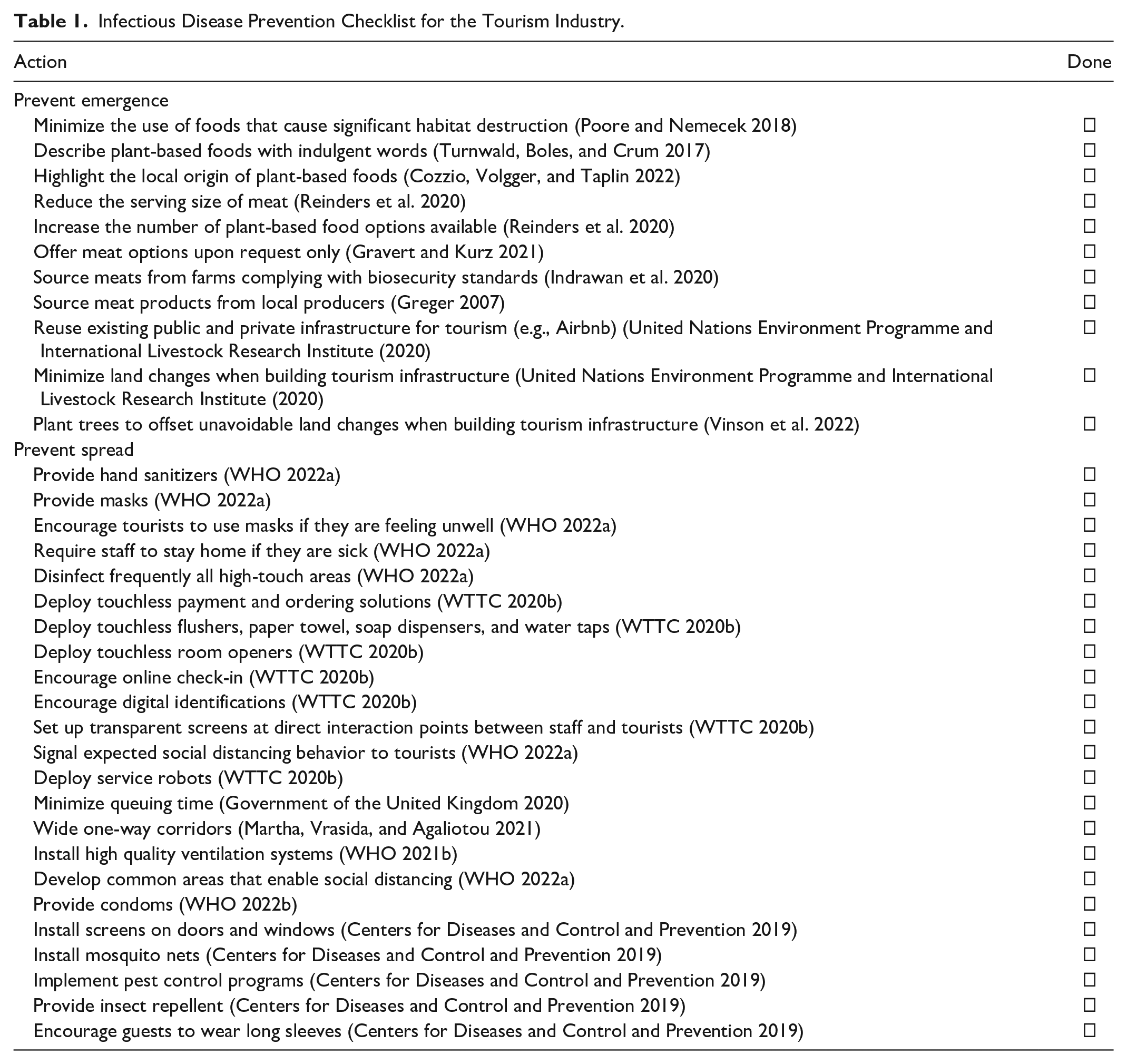
This section builds on the interrelationships between tourism and emerging infectious diseases to propose solutions how tourism businesses and policy makers can help minimize the risk of new infectious diseases developing and spreading. We discuss each solution below from a cost-benefit perspective to consider their potential economic, social, and environmental impact and summarize them in Figure 1 as well as in the checklist shown in Table 1. All recommendations are firmly grounded in published research or guidelines from the WHO and national health services.
Infectious Disease Prevention Checklist for the Tourism Industry.
Prevent Emergence
Actions targeted at reducing opportunities for infectious diseases to develop are indirect and do not lead to immediate visible results. Measures include encouraging guests to consume fewer animal products and more plant-based foods (Espinosa, Tago, and Treich 2020) because limiting meat consumption to 40 g per day could reduce the use of antibiotics in farm animals by 66% (Van Boeckel et al. 2017), and transitioning to a plant-based diet globally would reduce food’s land use by 76% (Poore and Nemecek 2018). Scientifically proven measures to increase ordering of plant-based foods include (1) describing plant-based dishes with indulgent words (Turnwald, Boles, and Crum 2017), (2) highlighting the local origin of plant-based foods (Cozzio, Volgger, and Taplin 2022), (3) reducing the serving size of meat, (4) increasing the number of plant-based options available (Reinders et al. 2020), and (5) offering meat options upon request only (Gravert and Kurz 2021). Promoting plant-based dishes by altering the menu is an effective way to minimize the risk of diseases emerging from a cost-benefit perspective: (1) Plant-based dishes can have higher profit margins than meat dishes, (2) the interventions require minimal changes to the operating procedures, (3) tourism businesses do not risk sacrificing guest satisfaction because meat dishes are still available, and (4) transitioning to more plant dominant menus provides additional environmental benefits including reduced greenhouse gas emissions and water use (Poore and Nemecek 2018) as well as health benefits (WHO 2021a).
Restaurant managers, however, express insecurities about their ability to use menu design approaches to direct ordering toward plant-based dishes (Rivera and Shani 2013). Another barrier preventing the transition to plant-based dishes is the perception that sourcing plant-based foods is expensive and preparing dishes without meat is complex and difficult (Šmugović et al. 2021). Governments can work with tourism associations to educate chefs on how to create and promote plant-based dishes (Rivera and Shani 2013). Aligning incentive systems with the need to transition to plant-based foods could also reduce meat demand from the tourism industry. This could be achieved by implementing a “zoonotic tax” or subsidizing foods such as plant-based and cultivated meats (Espinosa, Tago, and Treich 2020) and requiring plant-dominant menus as part of sustainable tourism accreditations. Governments can also deliver tourism campaigns promoting typical local plant-based foods to support tourism business in selling plant-based dishes.
Sourcing meat from farms that comply with biosecurity standards (Indrawan et al. 2020) and are geographically close to the tourism business minimizes the risk of infectious diseases emerging and spreading because animals spend less time in confined spaces with poor ventilation (Greger 2007). Sourcing locally produced meat may be more expensive, but tourism businesses can use the local origin of their meat to create a competitive advantage because consumers associate local foods with better taste and are willing to pay a premium (Feldmann and Hamm 2015). Buying meat from local farmers could also support the local economy.
Another approach the tourism industry can take that directly reduces habit destruction is to minimize land changes when building tourism infrastructure. Instead of building—often unnecessary—tourism infrastructures such as hotels, restaurants, boat docks, and visitor centers in close proximity or within wild habitats (Lhota, Scott, and Sha 2019), tourism businesses can adhere to tourism standards proposed by organizations such as the Rainforest Alliance or the Global Sustainable Tourism Council. Peer-to-peer accommodation offers another way of enabling tourism activity without requiring land to be cleared and new infrastructure to be built (Dolnicar 2018, 2021) because locals can list available but unused spaces in their existing homes to host tourists. Peer-to-peer accommodation, facilitated through online platforms such as Airbnb.com, are of particular value when destinations stage large events that are associated with a temporary but extremely high increase in demand for accommodation (Fairley, MacInnes, and Dolnicar 2021; Fairley and Dolnicar 2018). Maintaining an intact ecosystem provides not only environmental but also economic and social benefits (Balmford et al. 2002). For nature-based local tourism operators that rely on observing wildlife in their natural habitat (e.g., birds, fish, lions, elephants, koalas, whales), conserving the environment is particularly important.
Where land changes are unavoidable, the tourism industry can plant trees to offset those changes, offering alternative habitats for displaced animals (Vinson et al. 2022). Investing in tree planting initiatives also creates local jobs and therefore contributes directly to the local economy. Hotels can obtain the necessary funds to plant trees by encouraging guests to behave in environmentally friendly ways. Accor, for example, asks guests to reuse their towels and invests 50% of the savings into local bush regeneration projects (Accor, n.d.). Sixteen hotels in the Netherlands donate €5 to the Hotels for Trees Foundation to support local tree planting projects every time guests waive daily room cleaning (Hotels for Trees Foundation 2021). Changing the standard procedure to cleaning rooms upon request only also saves money (Knezevic Cvelbar, Grün, and Dolnicar 2021) that could be invested in tree planting initiatives. Reducing food waste at all you can eat buffets by inviting hotel guests to participate in a stamp collection game (Dolnicar, Juvan, and Grün 2020), using smaller plates or signs inviting guests to return to the buffet as often as they like (Kallbekken and Sælen 2013) leads to a reduction in operating costs. Overall, adopting such environmentally sustainable business practices contributes to achieving the United Nations Sustainable Development Goals (MacInnes, Grün, and Dolnicar 2022).
Prevent Spread
Actions the tourism industry can take to prevent spread of infectious diseases transmitted via droplets, vectors, or sexual contacts are now well understood by operators and tourists, with many discussed in detail in guidelines provided by industry associations such as the WTTC, the WHO and national health services. Measures include the provision of hand sanitizer, regular disinfection of all high-touch areas, the provision of masks along with encouraging guests to wear them when they feel unwell as well as requiring staff to stay home when they feel unwell (WHO 2022a). To limit the environmental harm of these measures—such as increased waste from masks—tourism businesses can provide environmentally sustainable masks which are preferred by consumers (Hartanto and Triastianti 2021). Hotels could also ask guests to leave their reusable masks in their rooms when checking out. While the provision of hand sanitizer and face masks increases operating costs, tourism businesses can leverage them as merchandise opportunity by printing their logo on them.
Additional measures that can be implemented relatively quickly and align directly with the recommendations of the WHO (2022a) include: to reduce close contacts include the transition to no-touch payment options no-touch ordering via mobile applications, and touchless flushers, paper towel, soap dispensers, and water taps, no-touch room openers and transparent protective screens at direct interaction points between staff and tourists, such as ticket counters for attractions and transport. Encouraging guests to check-in online and use digital forms of identification at airports can also reduce direct interactions between staff and tourists (WTTC 2020b). The deployment of service robots represents another approach to minimizing unnecessary contact between tourists and staff for those services that do not depend on the human interaction, including, concierge services, check-in and check-out, room cleaning and deliveries (WTTC 2020b). Governments can support tourism businesses in digitalizing their business procedures through education and providing grants.
The WHO (2022a) recommends social distancing as an effective way to prevent the transmission of infectious diseases. Tourism businesses could signal expected social distancing behavior to tourists by placing stickers on the floor to indicate to people checking into a hotel where to wait until the receptionist has finished serving the previous hotel guests. Finally, operational optimization systems could be deployed that are effective in minimizing queuing times for tourists to prevent the spread of diseases (Government of the United Kingdom, 2020), such as virtual queuing systems (Cope, Cope, and Davis 2011) and self-service kiosks (Chan et al. 2021).
In the longer term, the tourism industry may need to re-think the construction of tourism infrastructure. The COVID-19 experience—where the main transmission pathway was via respiratory droplets—highlights the importance of ventilation (WHO 2021b). Tourism businesses can improve ventilation by, for example, using better filters or air purifiers, and increasing fresh airflow in rooms and common spaces (Wong et al. 2021). Additional design measures that reduce transmission risk include wide one-way corridors to enable social distancing (Martha, Vrasida, and Agaliotou 2021) and making high touchpoint areas such as light switches and elevator buttons easy to clean and easy to operate with the elbow rather than the hand (WHO 2020).
To prevent the spread of sexually transmitted diseases, providing free condoms to guests represents an effective measure (WHO 2021b). Preventing bites from mosquitos reduces the likelihood of tourists contracting vector-borne diseases such as malaria and yellow fever. Effective prevention measures include installing screens on doors and windows and mosquito nets in areas where guests sleep outside or in rooms without screens, controlling mosquito breeding sites and adult populations, offering guests insect repellent and encouraging them to wear clothes with long sleeves (Centers for Diseases and Control and Prevention 2019).
Conclusions and Future Research
The COVID-19 pandemic has made visible to everyone the close link between infectious diseases and tourism, resulting in a substantial body of work investigating this interaction. A Google Scholar search of “tourism COVID-19” generates 116,000 results, most focusing on how the pandemic has negatively impacted the tourism industry. Few studies (e.g., Gössling 2002; Gössling, Scott, and Hall 2021; Hall, Scott, and Gössling 2020) have discussed or mentioned the potential of the tourism industry to prevent the development and spread of infectious diseases.
This study contributes to this line of investigation by proposing a conceptual framework of connections between infectious diseases and tourism in both directions, identifying tourism-induced land changes and intensive animal farming as potential contributors to the development of infectious diseases and global travel, close proximity of humans, and high-risk sexual activities as characteristics inherent to the tourism industry that can potentially spread infectious diseases around the world.
These insights have major implications for future research, highlighting the need for more investigations into how the actions of the tourism industry affect the risk of infectious diseases developing and spreading and what managers of tourism business and policy makers can do now to minimize this risk. Important areas for future research include investigating how tourism stakeholders and policy makers can work collaboratively to (1) support the transition to plant-based foods while supporting the local agriculture industry, (2) reduce land use changes when building tourism infrastructure, and (3) encourage tourists to engage in the recommended measures to prevent the spread of infectious diseases. Considering the complex nature of the emergence and transmission of infectious diseases, developing conceptual frameworks that identify the interrelationships between infectious diseases and other industries will also play an important role in reducing the likelihood of future disease outbreaks.
An aspect that has not been discussed in this article but is closely related is the issue of vaccine equity. As of the time of writing this article, 64% of people living in high-income countries have received at least one dose of the COVID-19 vaccine, compared to only 7% of people living in low-income countries (United Nations Development Program 2021). Although the tourism sector is not responsible for the substantial inequity of vaccine availability globally, it could play an active role in addressing this issue, which is highly relevant to tourists traveling to destinations with low vaccination rates. The desire to travel is associated with higher willingness to get vaccinated (Zhu, Grün, and Dolnicar 2022). It is therefore conceivable that strategies could be deployed that leverage people’s willingness to travel to direct efforts toward reducing vaccine inequity. For example, similar to carbon offsetting, schemes could be introduced where travelers donate vaccines for the people at their holiday destination. At individual level, travelers are happy to purchase travel insurance, despite the confidence of some being shaken during COVID-19 as some claims were not honored (Tan and Caponecchia 2021). Travel insurance is another vehicle that could be leveraged at individual traveler level to counteract vaccine inequity by, for example, offering a voluntary scheme where people can donate vaccines to protect themselves and other travelers in the longer term. Travel businesses can also actively support global vaccine supply. The Expedia Group and Intreprid Travel, for example, launched global vaccine equity campaigns to raise money for supporting UNICEF in providing COVID-19 vaccines to people living in developing countries (Intrepid Foundation, n.d.; Miller 2021). At national level, countries have taken several expensive measures to protect the tourism industry, including offering travel subsidies (Matsuura and Saito 2022) and offering travel vouchers (Cvelbar, Farčnik, and Ogorevc 2021). Governments, therefore, have a key role to play (Yang, Zhang, and Rickly 2021) and, indeed, it would be in their own interest to invest money into donating vaccines to countries that need it, especially those countries with a strong traveler flow between countries. The UNWTO can play a key role in facilitating collaborations between the public and private tourism sector and leverage its influence to advocate for a global distribution of vaccines. Developing approaches at individual, industry and government level to support the WHO in its efforts to reduce vaccine inequity is a critically important area of future research with immediate relevance in relation to COVID-19 and future relevance as new epidemics and pandemics develop.
Footnotes
Declaration of Conflicting Interests
The author(s) declared no potential conflicts of interest with respect to the research, authorship, and/or publication of this article.
Funding
The author(s) disclosed receipt of the following financial support for the research, authorship, and/or publication of this article: This research was supported in part by the Australian Research Council’s Laureate Fellowship scheme (Project Number FL190100143).
