




Abstract
This study aims to systematically review the place branding literature and comprehensively synthesize the academic research in this domain. Accordingly, this study examines the development of place branding research over time in terms of years of publication, publication outlets, authorship, countries, methods, and theories adopted. Further, based on the literature synthesis, this review proposes a conceptual framework by integrating the antecedents, mediators and consequences reported in the place branding literature. This study also performs a lexicometric analysis to illustrate different themes of place branding research studied over time. Finally, this study identifies under-researched areas in place branding and provides directions to advance this research in terms of theory development, context, characteristics and methodology. Overall, this review contributes to the place branding literature and provides practical implications for destination marketers and policymakers in successfully implementing place branding strategies.
Introduction
Places are branded and marketed commercially like products and services (Martin & Capelli, 2017). Branding of places helps differentiate them from others by communicating their unique value propositions (Kotler & Gertner, 2002). Place branding refers to “the development of brands for geographical locations, such as regions, cities or communities, usually intending to trigger positive associations and to distinguish the place from others” (Eshuis et al., 2013; Vuignier, 2016). Thus, places, such as countries, regions/states and cities, are planned and developed in a manner that can provide certain meaning. Competition is a key driver for places to establish and promote themselves as brands (Zenker & Braun, 2010). Places across the globe mainly compete with each other to achieve various economic, political and socio-psychological objectives (Kavaratzis & Ashworth, 2005); for example, they aim to earn more revenue from tourism, attract a greater share of international trade and foreign direct investments and gain a strong cultural identity (Kavaratzis, 2005). Therefore, just like business entities trying to improve their competitiveness in a market, places need to improve their competitiveness to attract tourists, students, investments and residents (Kasapi & Cela, 2017). This pursuit of competitiveness has resulted in the gradual evolution of the place branding domain (Lecompte et al., 2017).
Place branding has gained prominence in the marketing literature and in the travel and tourism industry (Acharya & Rahman, 2016; Chan & Marafa, 2013; Kavaratzis, 2005; Tiwari & Bose, 2013). It has been discussed in academia using diversified terms, such as “destination branding,” “place marketing,” “destination marketing,” “city branding,” “nation branding” and “region branding” (Ruiz-Real et al., 2020). Place branding helps increase the visibility of a place (Plaza et al., 2013), capturing the world’s attention to that place (Anholt, 2010; Armstrong & Kotler, 2015), which results in attracting investments and encouraging people to utilize its services, such as education, hospitality and information technology (Paliaga et al., 2010). Hence, organizations and authorities invest in resources to establish a place as a brand that generates and develops brand equity and identity and establishes a strong image for that place (Plaza et al., 2013).
The concept of place branding has gained popularity during the last two decades. Intense globalization has facilitated the movement of people, businesses, goods and information across the world, contributing to the immense popularity of place branding (Armstrong & Kotler, 2015). However, multiple views on place branding have resulted in inconsistencies regarding methodologies, theories and constructs employed in the place branding research leaving research on this domain highly jumbled and patchy. Researchers report various factors driving place branding. For example, some researchers suggest that place brand image is the main determinant of place branding (e.g., Campelo et al., 2011; Veasna et al., 2013), while others suggest that place brand personality (e.g., Boksberger et al., 2011; Hultman et al., 2017; Usakli & Baloglu, 2011) and place brand equity (e.g., Bose et al., 2016; García et al., 2012; Kladou & Kehagias, 2014) are the key determinants. Inconsistent findings of the existing studies suggest a need for a holistic view of the various factors driving consumers’ responses to place branding. Similarly, although 21 theories have been used (please refer Table 6) to study the place branding phenomenon, there is a lack of reliance on a specific set of theories. Overall, the diverse theoretical perspectives and determinant factors indicate a scatteredness of the place branding literature. Thus, despite the availability of ample literature on place branding, there is a lack of clarity on the research development in this domain. Therefore, a synthesis of the methods, theories, constructs and contexts used in place branding research will help to understand the evolution and the present state of the domain and reveal gaps in the extant place branding research to propose future research in this domain.
A systematic litareture review (SLR) is considered as an effective way of synthesizing literature on a domain, identifying under-researched areas and presenting avenues for future research (Paul & Criado, 2020; Vuignier, 2016). Accordingly, a SLR is considered appropriate to synthesize the fragmented literature on place branding to determine its current state (Ganeshkumar & Gopalakrishnan, 2013; Maseeh et al., 2021, 2021; Oguztimur & Akturan, 2016). However, comprehensive SLRs on place branding are scarce. Although Perkins et al. (2020) and Ruiz-Real et al. (2020) have synthesized place branding research, their reviews have a narrow scope: the former is not a classic SLR and the latter is a bibliometric analysis. Perkins et al.’s (2020) synthesis of the place branding literature is limited to stakeholders’ collaboration and how it can contribute to positive place branding. As such, their literature review explores strategies for collaboration among stakeholders to understand how they can best contribute to successful destination brands. Moreover, their review does not address several important themes, namely the destination’s image, brand equity, brand identity and brand personality, which are considered key drivers of successful place branding. Ruiz-Real et al.’s (2020) bibliometric analysis is limited to synthesizing the place branding literature in terms of publication years, top journals, authors and countries of publication. It is important to note that SLR and bibliometric reviews are different in their approach. While an SLR (e.g., Jebarajakirthy et al., 2021) mainly focuses on synthesizing existing literature in a domain in terms of theories, methods, constructs and contexts, and identifies gaps to suggest future research directions, bibliometric reviews mainly use statistical tools, such as “VOSviewer” and “R” to examine trends and citations (Donthu et al., 2021).
Overall, neither Perkins et al. (2020) nor Ruiz-Real et al. (2020) synthesize the place branding research in terms of methodological approaches adopted for place branding research, theoretical underpinnings used for studies in this domain, and variables widely reported. Therefore, a comprehensive review of the place branding literature is required to address the following unanswered questions: Which theoretical underpinnings and research methodologies do researchers mainly use in place branding?; and, What are the variables (antecedents, mediators and consequences) widely reported in the place branding literature? Thus, the purpose of this research is to systematically review the place branding literature, and find gaps, prospects, and future research directions. This SLR serves three specific research objectives: first, to synthesize the extant place branding literature and examine its development over the years: second, to develop a conceptual model based on the literature synthesis: and finally, to propose avenues of future research across theoretical, contextual, characteristics and methodological perspectives in place branding.
This study has relevance in both academia and industry. First, it provides the current state of the place branding literature by presenting research development in terms of publication years, study’s context, publication outlets, research methods and constructs. Second, this study proposes a conceptual framework by illustrating the antecedents, mediators and consequences of place branding, thus providing a consolidated view of place branding. Finally, this review provides future research directions that will help extend the existing body of knowledge on place branding. It is important to note that the findings of this study hold strategic significance for destination marketers and policymakers to effectively implement place branding strategies to build an appealing destination brand and attract tourists.
Methodology
Structure of the Review
SLRs might take different forms, namely a structured review, framework-based review, bibliometric review, meta-analytic review and hybrid review (Jebarajakirthy et al., 2021; Paul & Criado, 2020). This study adopts a hybrid review method combining the structured review with lexicometric analysis to synthesize the place branding literature (Adil et al., 2022; Shankar et al., 2022). A structured review provides an unbiased and transparent synthesis of the theories, contexts, constructs and methods used in the literature and proposes future research avenues (Paul & Feliciano-Cestero, 2021; Vrontis & Christofi, 2021). Thus, it is considered a superior method to synthesize the extant literature (Linnenluecke et al., 2020). Further, a lexicometric analysis (see 2.4 Lexicometric Analysis) provides a thorough analysis of the textual data demonstrating the underlying clusters and concepts within the text. Because of the rigor of a structured review in synthesizing the literature, and the effectiveness of a lexicometric analysis technique in identifying various research themes in a domain, this hybrid review integrates these two methods to provide a comprehensive synthesis of the place branding literature.
Topic Selection
According to Paul and Criado (2020), a topic on which SLR has not yet been published should be selected. If it has been published, the new SLR should provide innovative insights. Although place branding is an emerging area of research, a comprehensive SLR on this domain does not exist. Hence, a SLR is needed to synthesize the present status of literature and explore future research directions in this domain.
Search Strategy
Keywords Selection
The current SLR follows Talwar et al.’s (2020) keyword selection strategy. The selection process started by entering the term “place branding” in Google Scholar. The 26,000 results that appeared in Google Scholar were sorted based on their relevance and citation. The top 85 research papers were extracted to identify keywords. Keywords that appeared in the title, abstract and the keyword list of these research papers were listed, duplicate keywords were removed, and a consolidated list of keywords was developed (Maseeh et al., 2022; Mehta et al., 2022). Finally, these keywords were discussed with industry experts and academics who have expertise in place branding. It was found that “place branding,” “place brand,” “place marketing,” “place promotion,” “urban marketing,” “city branding,” and “destination branding” were the most frequently used keywords. These keywords were used to search for relevant published papers on various online databases.
Database Selection
Generally, three to eight databases were used by previous SLR papers for the article search (Ashaduzzaman et al., 2022; Jebarajakirthy et al., 2021; Mongeon & Paul-Hus, 2016). Accordingly, we selected eight databases including Google Scholar, ELSEVIER, Taylor and Francis, EBSCO, ProQuest, Emerald, JSTOR, and ScienceDirect. These databases are considered reliable and were frequently used in recent SLR papers (Paul, 2020).
Journal Selection and Inclusion/Exclusion Criteria
The inclusion/exclusion criteria were consistent with those set in previous SLRs (e.g., Dhaliwal et al., 2020; Jiang et al., 2020; Srivastava et al., 2020), and were in line with the recommendations of Paul and Criado (2020). Accordingly, articles that were (1) scholarly works, (2) published in a peer-reviewed journal, and 3) in the domain of place branding, were included in this review. Additionally, to maintain the quality of the review, only articles published either in a journal ranked as A* or A in the Australian Business Dean Council (ABDC) Journal Quality List were qualified for inclusion (Paul & Criado, 2020; Redine et al., 2023). Further Paul and Criado (2020) suggest including articles published in journals with an impact factor of 1.0 or above as listed in the Journal Citation Report (JCR) though they were not published in A* or A ranked journals. However, since most of the journals that published place branding research have impact factor more than 2, we followed a stricter criterion of including articles published in journals with impact factor 2.0 or more though they were not published in A* or A ranked journals.
Nine hundred forty-two articles were downloaded using the defined keywords. Of these papers, 677 articles were excluded because they were downloaded multiple times. Thereafter, the inclusion and exclusion criteria were employed to shortlist the articles. As such, out of the 265 remaining research articles, 42 articles which were not scholarly work, 31 articles which were not published in peer-reviewed journals and 39 articles which were not related to place branding were excluded, thereby leaving 153 articles. Finally, 41 articles that were not published in high-quality journals, as described previously, were excluded, leaving 112 articles for the review. Figure 1 illustrates the process of shortlisting the relevant research papers.
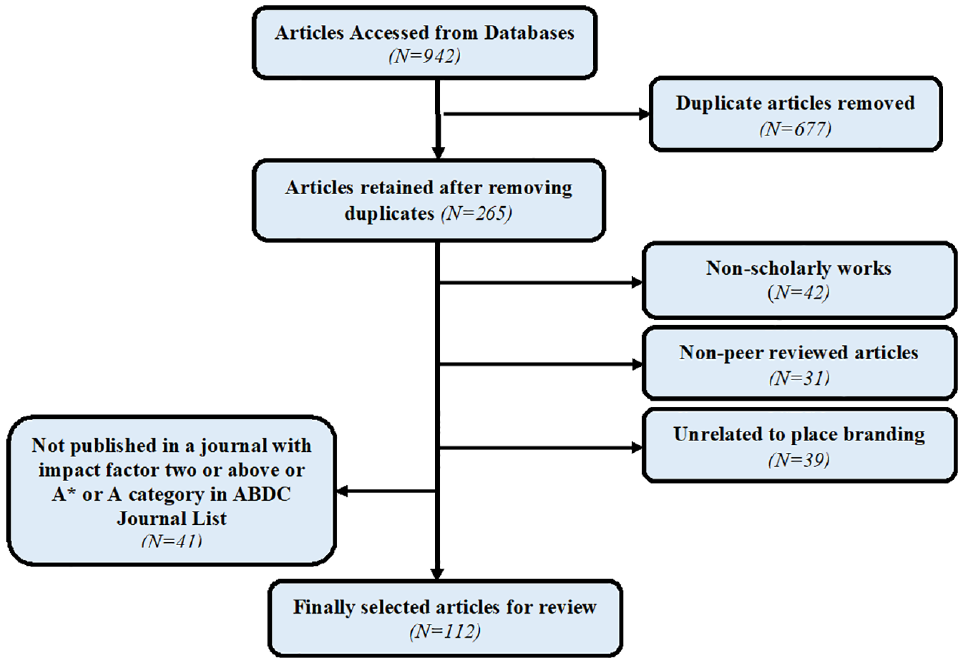
Articles inclusion and exclusion process.
Lexicometric Analysis
The current research used Iramuteq software to perform lexicometric analysis. Since lexicometric analysis connects qualitative and quantitative methods to enable researchers to perform statistical analysis to disclose the clusters of concepts in textual data (Krippendorff, 1989), it is considered an effective tool for deriving various underlying research themes in a domain. According to Mandják et al. (2019), each article was coded as a text with stated variables. The variables coded were “publication year,” “country of origin,” “research methods,” and “journal category.” The Iramuteq software provides results as “form,” which specifies words that are automatically lemmatized during the lexicometric analysis. Lemmatization is the process of converting content words, including adjectives, adverbs, nouns, and verbs, into the active form (Mandják et al., 2019). Accordingly, during lemmatization, the Iramuteq software recognizes similar words, such as “take,” “took,” and “taken” and combines them into one word, that is, “take.” These combined words that appear twice or more in the corpus are called “active forms,” whereas a word appearing only once in the corpus is designated as a “hapax.” Corpus consists of 112 published research articles selected for this SLR.
Findings and Discussion
Evolution of the Place Branding Research Over the Years
Year-Wise Publication Frequency
The year-wise progress of the place branding research is presented in Figure 2.
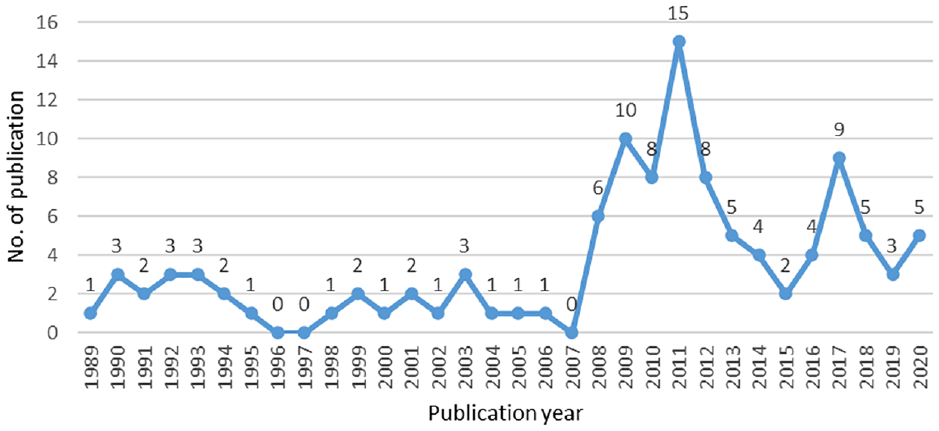
Number of publications year wise.
As depicted in Figure 2, from 1989 till 2007, one to three papers were published a year, except for 1996, 1997, and 2007 when no papers were published. However, there was a considerable increase in the number of publications in 2008 when six papers were published. This upward trend continued till 2011. A significant drop was observed in 2012. The number of publications varied between 2 and 5 papers a year from then onward except for 2017 when nine papers were published.
Overall, based on this distribution, it can be inferred that the place branding research gained momentum from 2008 onward. Based on critical observation of Figure 2, we can divide the timeline of place branding publications into two phases, that is, before 2008 and after 2008. The period before 2008 shows fewer publications (i.e., 25% of the total studies) whereas the time after 2008 shows significantly more publications (i.e., 75% of the total studies).
Themes Studied in Place Branding Literature in Different Periods—Word Cloud Analysis
Word-cloud analysis was conducted to visualize the frequently used keywords in the place branding literature in different periods (Yun et al., 2019). We divided the place branding literature into six periods, that is, 1990 to 1995, 1996 to 2000, 2001 to 2005, 2006 to 2010, 2011 to 2015, and 2016 to 2020 to perform this analysis. The abstracts of the articles in each interval were copied to WordClouds.com to perform word cloud analysis. These steps are in line with previously published SLRs (e.g. Jebarajakirthy et al., 2021). Figure 3 illustrates the output of the word cloud analysis.
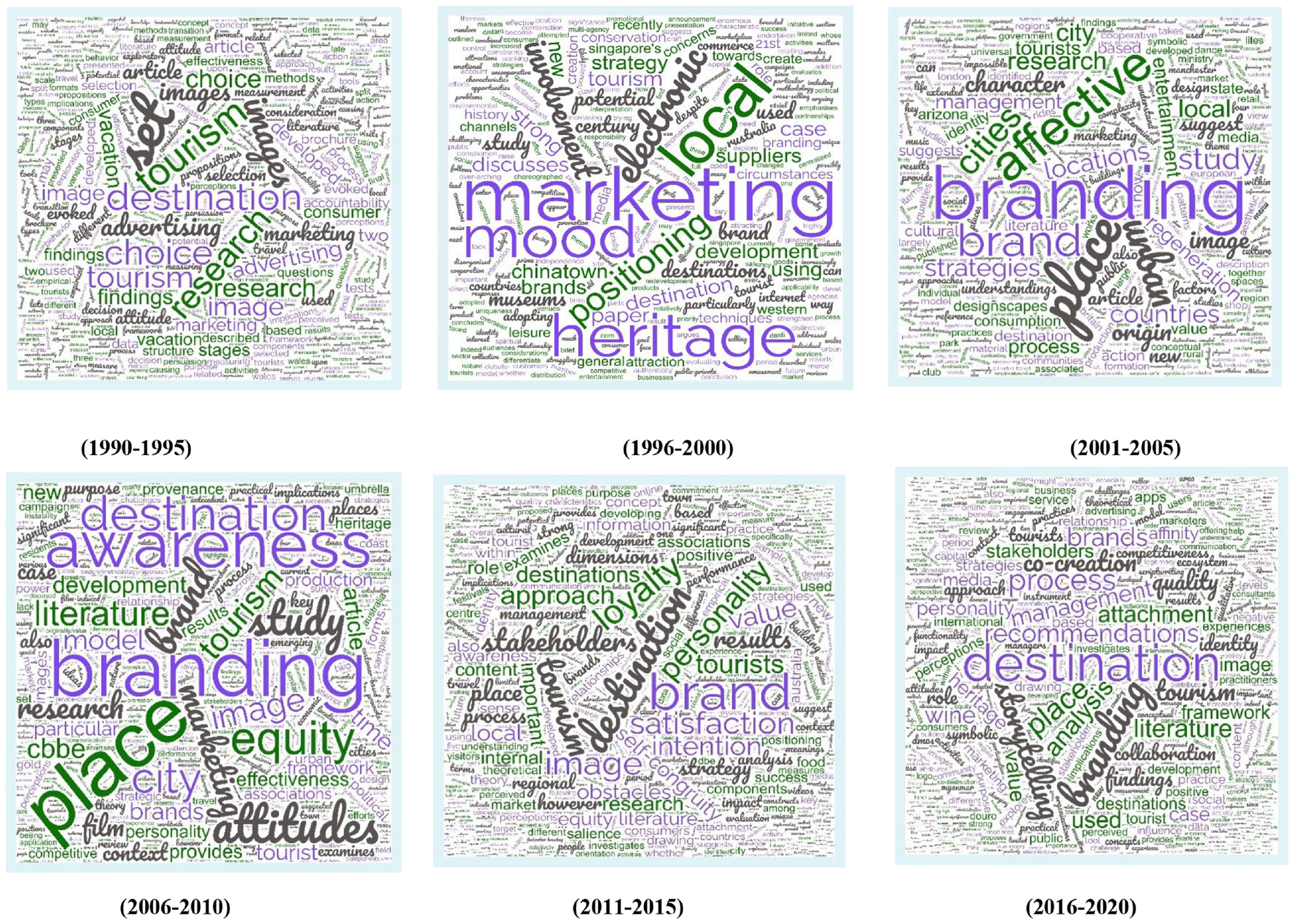
Word cloud.
The word cloud shows that words, such as “place,” “destination,” “brand,” “branding” and “tourism” are common across all the periods. Apart from these words, different keywords are prominent in different periods. During 1990 to 1995, “images,” “advertising,” “marketing,” “choice,” “selection” and “set” are the most widely recurring keywords. These words suggest that during this period, the place branding literature was mainly focused on investigating the role of marketing/advertising in building destination image that would influence consumers’ choice and the final selection of a tourism destination (J. Crompton, 1992; Um & Crompton, 1990).
During 2001 to 2005, the most prominent keywords were “strategies,” “cities,” “affective,” “locations,” “local,” “origin” and “entertainment.” These keywords suggest that, during this period, researchers focused on studying the place branding strategies adopted by specific cities to create affective associations with tourists. For example, Evans (2003) studied Prada’s branding approach of highlighting its entertainment facilities; Julier (2005) studied the branding approach of three cities namely, Barcelona, Manchester and Hull; and Patterson et al. (2003) studied the branding approach of Arizona state, which used the local origin appeal of food served in restaurants to attract tourists.
During 2006 to 2010, the most prominent keywords were “equity,” “awareness,” “image,” “customer-based brand equity (CBBE),” “marketing,” “city” and “attitudes.” These keywords indicate that during this period, the focus of place branding research shifted to the measurement of consumer-based place brand equity (Boo et al., 2009; Chen & Myagmarsuren, 2010; Pike, 2009), destination image (Daye, 2010; Kneesel et al., 2010) and exploring the factors that drive tourists’ attitudes toward a city brand (Merrilees et al., 2009).
During 2011 to 2015, words like “personality,” “self-congruity,” “image,” “intention,” “satisfaction,” “loyalty” and “stakeholders” emerged as the most prominent keywords. This shows that researchers were interested in investigating the role of destination brand personality in driving tourists’ intention to visit a destination. As such, researchers (e.g., Boksberger et al., 2011; Usakli & Baloglu, 2011) found that a stronger match between a place brand’s personality and tourists’ personality leads to higher levels of self-congruity, which drives tourists’ intention to revisit a destination and destination brand loyalty.
From 2016 to 2020, words, such as “storytelling,” “co-creation,” “collaboration,” “stakeholder management,” “identity,” “image,” “attachment” and “value” appeared as the most prominent keywords. This indicates the focus of place branding research has been on studying the effectiveness of the storytelling approach and stakeholders’ collaboration in co-creating a destination brand. The storytelling approach in the place branding literature can be inferred from the work of Youssef et al. (2019). They suggest that storytelling is an effective approach for conveying the destination brand’s identity, and it requires collaboration and co-creation of all the stakeholders. Lund et al. (2020) found that destination brands can use the storytelling approach effectively to counter the negative comments posted on social media. Further, Giannopoulos et al. (2021) suggested that stakeholders can collaborate to co-create value of a destination brand to gain prominent identity in the global tourism market.
Journals of Publication
Table 1 lists the 39 academic journals that published place branding research. Tourism Management and Journal of Travel Research published the highest number of papers that is, each published 12 papers. They are followed by Annals of Tourism Research and Journal of Marketing Management that published nine papers each. Thus, 59% of the total articles were published in only seven journals (see Table 1). Apart from the Journal of Marketing Management, the remaining six journals are focused on tourism research.
Journals and Number of Publications.
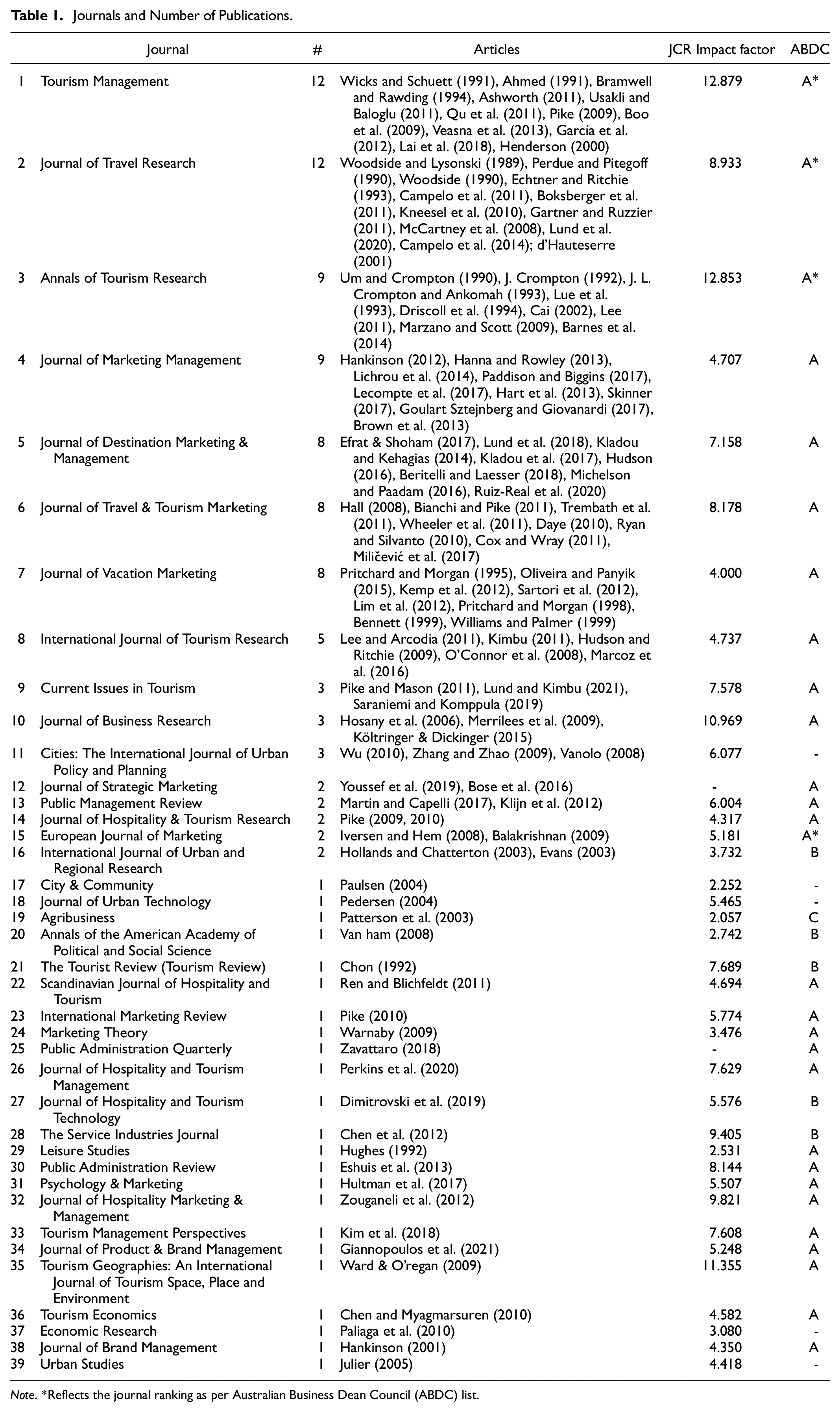
Note. *Reflects the journal ranking as per Australian Business Dean Council (ABDC) list
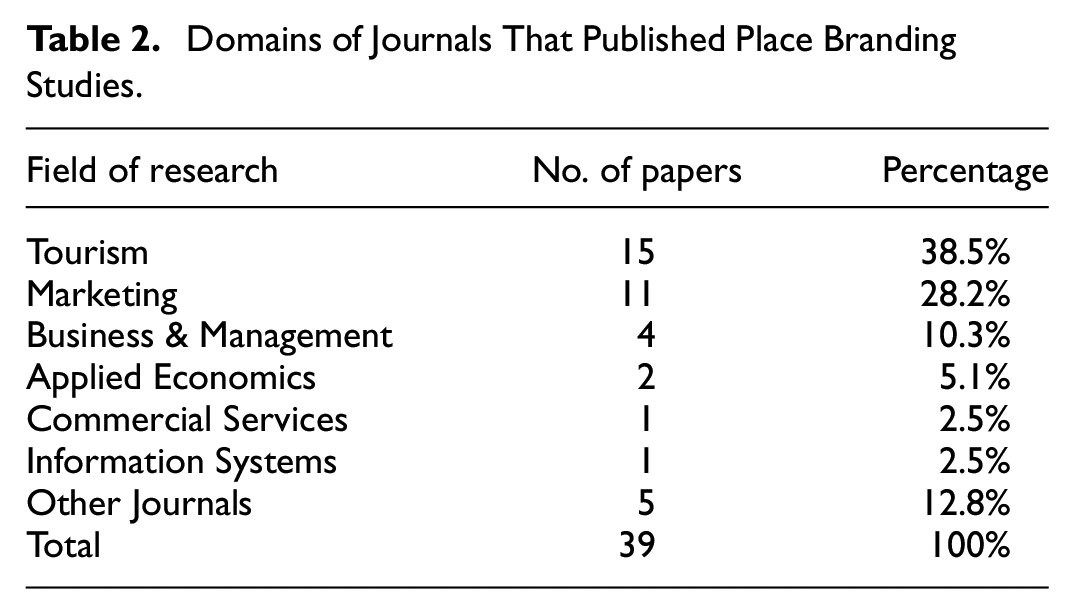
Further, the 39 journals were classified into their respective research fields. The classification of research fields followed the journal fields (e.g.,1,503—Business & Management; 1505: Marketing; 1506: Tourism) provided by the 2019 ABDC journal quality list. The journals which are not listed in ABDC (but have an impact factor of two or above) were grouped based on their aim, scope and main field of focus mentioned on their websites. As presented in Table 2, the highest number of place branding research was published in “Tourism” journals (38.5% of the total studies), followed by “Marketing” journals (28.2% of the total studies). The rest of the place branding research was published in journals belonging to “Business & Management” (10.3% of the total studies) and “Applied Economics” (5.1% of the total studies). The least number of studies were published in “Commercial Services” and “Information Systems” journals.
Domains of Journals That Published Place Branding Studies.
Authorship
Table 3 highlights the 10 most cited articles on place branding. Echtner and Ritchie’s (1993) study has the highest number of citations; that is,2,819, which is followed by Woodside and Lysonski’s (1989) article with 1964 citations, and Um and Crompton’s (1990) article with 1918 citations. Further, Qu et al.’s (2011) study has the most average citations per year (i.e., 149.4 average number of citations per year) followed by Echtner and Ritchie’s (1993) article with 108.42 citations each year on average. Although the average citations of Echtner and Ritchie’s (1993) article are lower than that of Qu et al.’s (2011) article, Qu et al.’s (2011) article is comparatively recent. Further, this average citation list suggests that Echtner and Ritchie’s (1993) article might have received the highest average citation at least until 2011; that is, until Qu et al.’s (2011) article is published.
Ten Most Cited Studies.
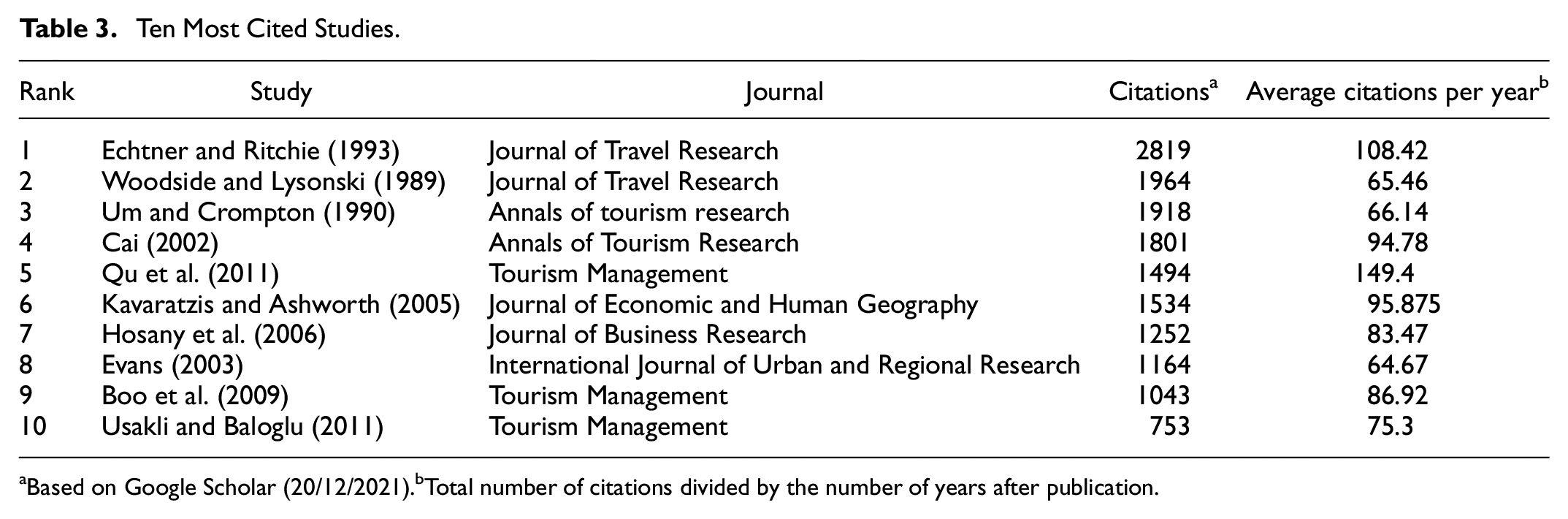
Based on Google Scholar (20/12/2021). b Total number of citations divided by the number of years after publication.
Methodological Perspectives
Research Settings
Research setting refers to the place where the data were collected and the investigation was carried out. Hence, only empirical research needs to be considered for the country-wise synthesis (Jebarajakirthy et al., 2021). Thus, 81 papers (out of the 112 papers) which were based on empirical investigations were considered for this synthesis. Country-wise distribution (shown in Table 4) shows that while 81 studies were conducted across 31 countries, Western countries take the first 10 places on the list. Especially, 41% of the research was conducted in three western countries, namely USA (14 studies), Australia (10 studies) and UK (nine studies). This distribution suggests that place branding research mainly concentrates on Western contexts.
Countries and Number of Publications.
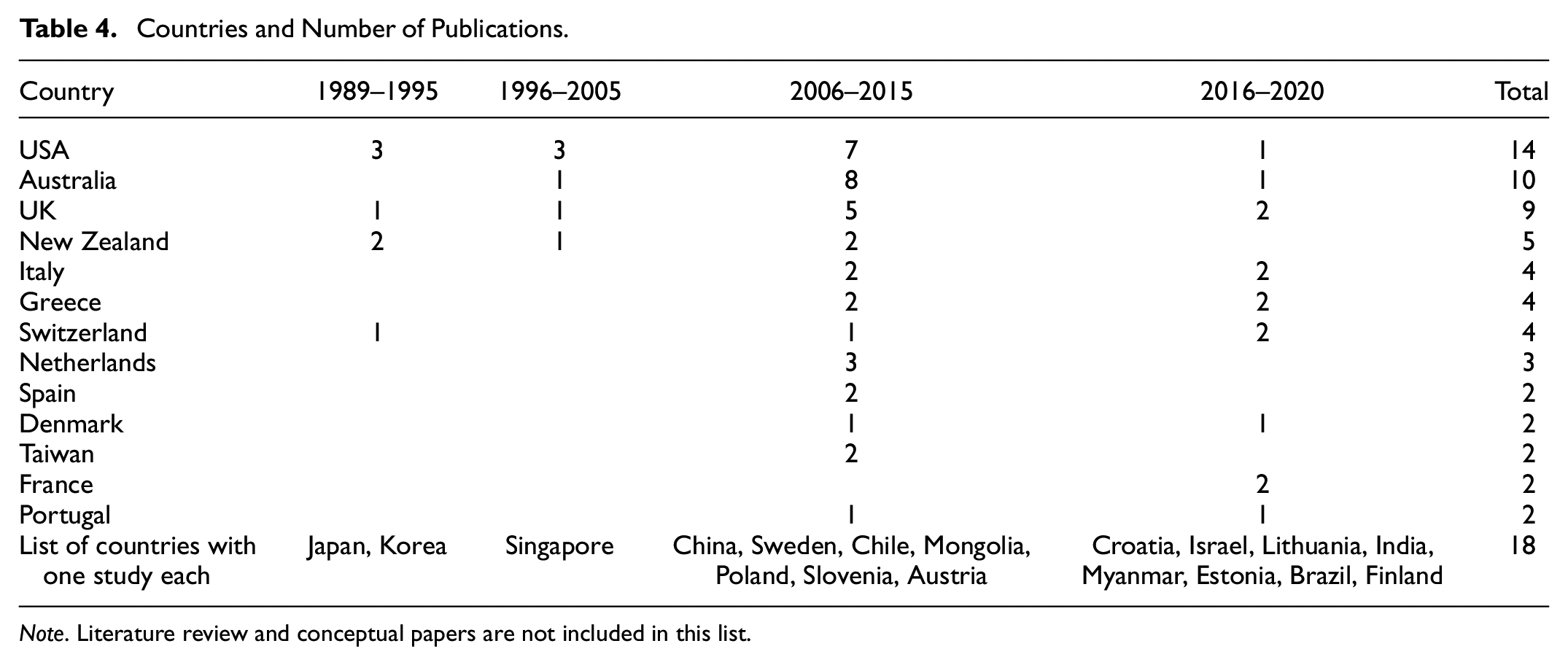
Note. Literature review and conceptual papers are not included in this list.
Research Design and Data Collection
Table 5 shows that overall, quantitative (38 studies), qualitative (28 studies) and mixed methods (14 studies) have been widely used in place branding indicating a methodological diversity in this domain. Further, conceptual papers (29 studies) have been widely published which suggests continuous conceptual advancement in place branding research.
Research Methods Used in Place Branding Research.

Articles were also synthesized based on the data collection methods (online or offline methods). Notably, regardless of the methods used, most of the empirical research (25 out of 38 survey-based studies and 27 out of 28 qualitative studies) used offline methods for data collection.
While analyzing the type of sample used in place branding research, Table 5 shows that across all the empirical studies, only four survey-based studies employed student samples, and the remaining empirical papers employed non-student samples. As place branding research is mainly carried out on travelers, students lack travel experience mainly due to their limited income. Hence, most of the empirical studies on place branding have considered non-student samples.
Results of Lexicometric Analysis
A lexicometric analysis was executed on a corpus of 112 articles included in this study. The corpus includes 796,490 occurrences of words with an average of 7,111 occurrences per text. Further, the corpus comprises 11,337 hapaxes (words which appear once) and 27,999 forms (words that occur more than once). Finally, a total of 22,823 active forms were used in the analysis.
Similarity Analysis
Similarity analysis was performed using Iramuteq software. It divides text into groups called “segments” which are further divided into “clusters” on the basis of word distribution. The word proximity in segments and recurrence of this proximity result in a map which shows an intersection between the concepts across the text in a graphical form.
A similarity analysis was run with the word “destination.” The output (Figure 4) suggests that four segments are interrelated with the main concept of “destination.” The first segment represents the “market,” which comprises words related to the attributes of a tourist destination that can be used in promoting a destination brand, such as place, city, urban, promotion, social, traditional, local, landscape, resident, life and museum. The second segment represents the concept “tourism,” which comprises words related to the development of a place as a tourist destination, such as development, infrastructure, community, economy, economic, business, national and international. The third segment represents the concept “image,” which comprises words related to the attributes that create a unique destination brand image/identity, such as food, festival and location. The fourth segment represents the concept “theme park.”
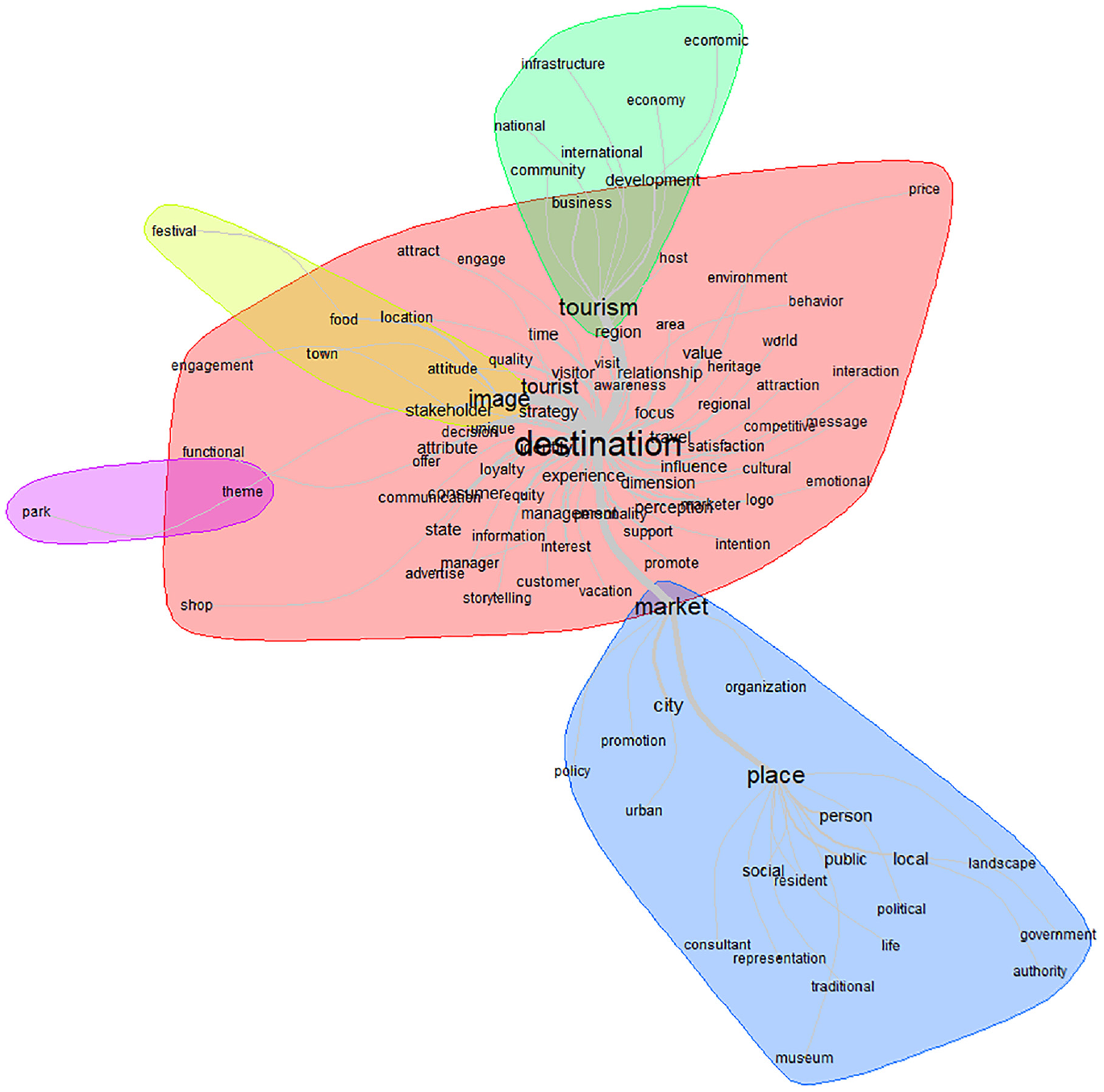
Similarity analysis.
Overall, the similarity analysis shows the key themes or focused areas of the place branding literature. Accordingly, the similarity analysis indicates that the place branding literature is inter-connected with a variety of concepts, such as brand promotion and brand image/ identity (a component of brand equity) and also focuses on the role of place branding in the development of tourism development, especially in attracting tourists to a destination brand.
Factorial Correspondence Analysis
Factorial correspondence analysis helps identify the main groups of relationships in the corpus (Reinert, 1990) through a visualization of hierarchical word clusters derived from the corpus which are presented in the form of a dendrogram. Each word cluster in a dendrogram represents a class whose nomenclature is based on the common meaning/theme (in relation to the literature) as indicated by the words grouped together in that class. Thus, a dendrogram illustrates the major themes studied in a literature domain.
The dendrogram (Figure 5) presented five classes of words in our corpus. To minimize bias, these classes were named in two stages by four scholars: two scholars working in the branding domain and the other two in tourism area. First, each scholar named each class, and then they discussed them until a consensus was reached on naming the classes. Class 1 represents words related to “attributes/anchors of place branding” such as city, town, street, heritage, event, site, historic, cultural, entertainment, nightlife and park. Class 2 is composed of words related to “consumer aspects of place branding,” such as satisfaction, loyalty, image, equity, affective, cognitive, intention, awareness, personality and perceive. Class 3 was named “research methods and analysis”, which comprises words related to research methods and analysis, such as sample, respondent, item, variables, scale, questionnaire, survey, datum, response, test, reliability and validity. Class 4 was named “stakeholders” role in place branding’, which comprises words, such as stakeholder, process, public, management, practice, understand, role, development, collaboration, engagement, government, governance, involve and approach. Class 5 comprises words related to “destination brand marketing strategies,” such as brand, product, identity, communicate, communication, differentiate, position, logo, name, message, target and market.
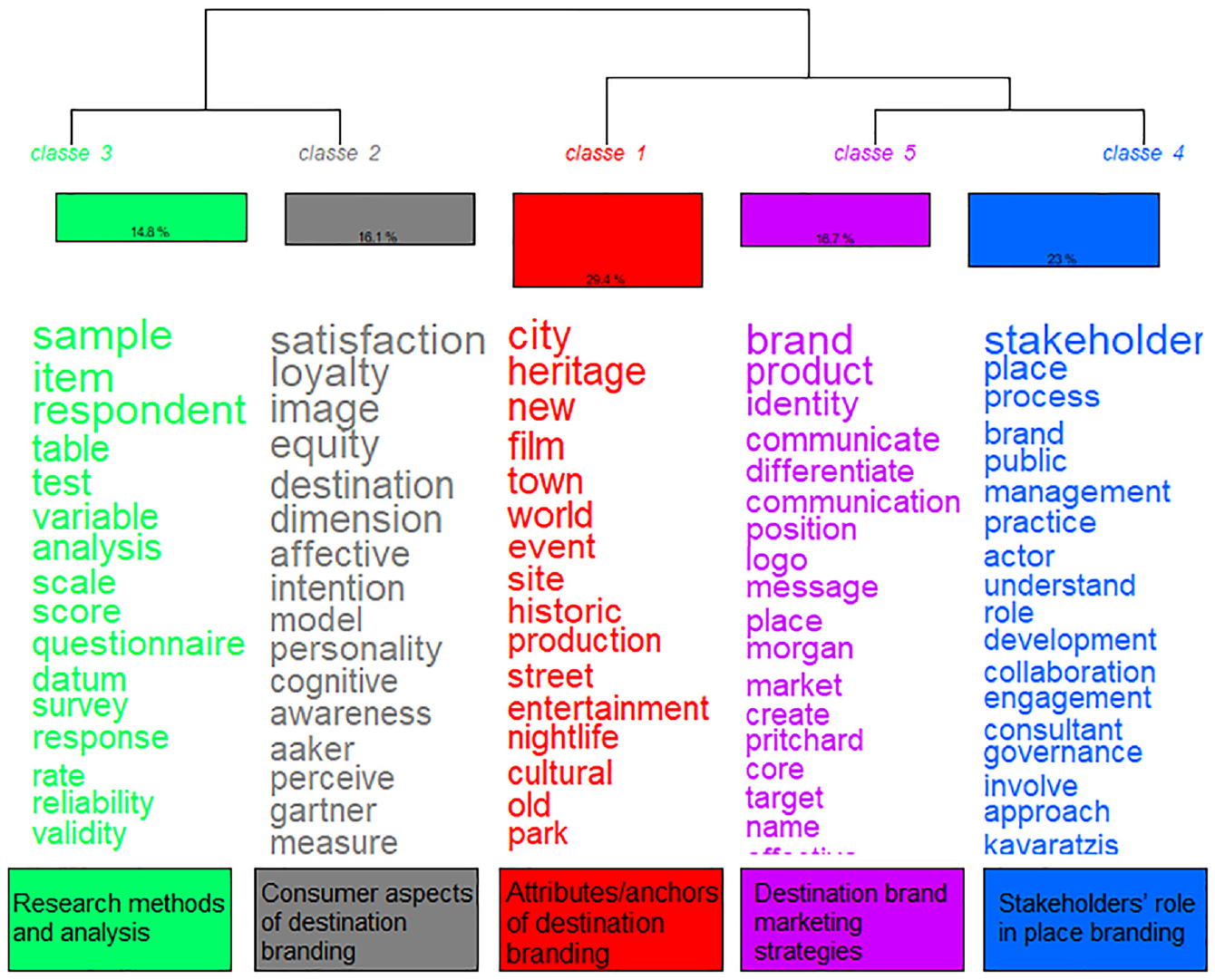
Dendograms with named clusters.
After excluding the “research methods and analysis” related cluster which is intrinsic to the review of any literature domain, we can conclude that the place branding literature focuses mainly on attributes of place brand, consumer responses to place branding, marketing strategies for place brand and stakeholders’ role in building an appealing destination brand.
Theoretical Perspectives
Theories Used in Place Branding Research
Table 6 shows that 21 theories were used in place branding research. It is interesting to note that though place branding has been studied from 1989 onward, the majority of the underpinning theories (15 out of the 21 theories) have been used in only one study each and none of the theories have been overly used. This suggests a lack of concentrated reliance on a specific set of theories in place branding. Theories used in multiple studies are explained below.
Theories used in place branding research.

Self-Congruity Theory
This theory posits that consumers prefer brands that are congruent with their personalities (Kassarjian, 1971; Sirgy & Su, 2000). Self-congruity is defined as a match between the value-expressing attributes of a brand and the self-concept of an individual (Islam et al., 2018). Self-congruity theory has been applied to six studies on place branding out of the 112 studies included in this review. Chon (1992) found that travelers’ satisfaction and dissatisfaction with a destination depend on the congruency between tourists’ self-concept and the destination’s attributes. Usakli and Baloglu (2011) articulated that an association exists between self-congruity, tourists’ intention to return to and recommend a destination, and the destination’s personality. They reported that self-congruity mediates the relationship between a destination’s personality and travelers’ intention to return/recommend the destination.
Stakeholder Theory
Introduced by Freeman (2015), stakeholder theory postulates that business managers should think about the interests of all stakeholders and maximize the wellbeing of those impacted by organizations. This theory has been applied to four studies on place branding out of the 112 studies included in this review. García et al. (2012) suggested that stakeholders, such as visitors, entrepreneurs, and local residents should work together for a successful place branding. Paddison and Biggins (2017) articulated that destination management organizations should be partnered with local community members to develop and promote place branding.
Cognitive Dissonance Theory
Cognitive dissonance theory proposed by Festinger (1957) claims that psychological tension arises when an individual’s behavior does not correspond to his or her beliefs or thoughts. Thus, consumers are driven by an inner force to maintain a state of harmony between their attitudes and behaviors, and they try to avoid a dissonance between them. In place branding, researchers have reported that customers experience cognitive dissonance while selecting a destination for travel/vacation (J. Crompton, 1992; Um & Crompton, 1990). This cognitive dissonance arises mainly due to the difference in consumers’ attitudes toward the vacation destinations selected in the later stage of decision-making compared to the set of vacation destinations considered during the early stage of decision-making (Urm & Crompton, 1990). To reduce this cognitive dissonance, consumers actively seek information from the destination marketers, such as travel agents, to evaluate the considered vacation destinations and select the best one (J. L. Crompton & Ankomah, 1993).
Associative Network Theory
Associative network theory postulates that human memory is represented through a network of interlinked nodes, and retrieval of memory depends on the strength of the associations between those nodes (Anderson, 1983; Anderson & Bower, 1979). In marketing, the concept of brand association relates to this theory. In the place branding research, Trembath et al. (2011) used the foundation of associative network theory to explain a positive linkage between a travel destination’s brand salience and tourists’ intention to revisit the destination. According to their study, destination brand salience represents tourists’ memory structure that supports the linkages between tourists’ responses to a travel destination and the cues related to the travel destination. Hence, using these cues in marketing communication can build a strong destination brand association which may effectively retrieve the destination brand salience resulting in an increased likelihood of recall in a travel purchase situation.
Attribution Theory
Attribution theory explains the causes for an individual’s behavior. This theory basically emphasizes what information people gather and how they use it to arrive at a logical decision (Fiske & Taylor, 1991, p. 23). According to Heider (1958), the causes or attributions of a behavior can be of two types: dispositional attribution (internal reason) and situational attribution (external reason). In place branding research, J. L. Crompton and Ankomah (1993) used attribution theory to explain consumers’ decision-making process around selecting a vacation destination. According to their study, consumers invest a greater amount of time and effort to get more information about a few selected vacation destinations. This investment of resources acts as dispositional attribution. Hence, consumers are more likely to select a vacation destination for which they invest more resources for gathering information.
Theory of Reasoned Action
The theory of reasoned action (TRA) postulates that behavioral beliefs determine consumers’ attitude, which in turn drives consumers’ intention to perform certain behavior (Ajzen & Fishbein, 1980). Hultman et al. (2017) used TRA in conjunction with self-congruity theory to predict consumers’ intention to visit a destination. They articulated that when consumers believe that a destination brand’s personality matches their personality, they develop positive attitudes toward the travel destination, which leads to their intention to visit/revisit the destination.
Grouping of Theories Under Different Themes in Place Branding Research
The themes identified using lexicometric analysis in section 3.5 can be better understood and interpreted using underpinnings of different theories. In other words, the theories can be grouped in line with these themes. These groupings of theories are articulated below:
“Attributes/anchors of destination branding” emerged as a major theme in the lexicometric analysis (please refer to section “3.5.2 Factorial correspondence analysis”). This theme mainly highlights using various attributes of a place, such as heritage, historical, cultural, entertainment, nightlife etc., to create destination brand image/identity. Researchers have used the underpinnings of several theories, such as associative network theory (Barnes et al., 2014; Trembath et al., 2011), signaling theory (Veasna et al., 2013), actor network theory (Ren & Blichfeldt, 2011), positioning theory (Pike & Mason, 2011), central place theory (Hart et al., 2013) and image theory (Hudson, 2016) to understand how destination brands can build a unique image/identity to attract tourists.
“Stakeholders” role in place branding’ is another major theme that emerged from the lexicometric analysis. Accordingly, researchers have applied the underpinnings of several theories, such as stakeholder theory (García et al., 2012; Goulart Sztejnberg & Giovanardi, 2017), social identity theory (Saraniemi & Komppula, 2019), legitimacy theory (Martin & Capelli, 2017), resource advantage theory and institutional theory (Giannopoulos et al., 2021) to study the importance of stakeholders’ collaboration in co-creating a destination brand’s value/identity.
Another major theme in place branding is “consumer aspects of destination branding,” which focuses on how consumers decide to visit/revisit a destination. Accordingly, studies in place branding have examined tourists’ decision-making process of selecting a destination brand. These studies have employed the underpinnings of theory of reasoned action (Trembath et al., 2011), cognitive dissonance theory (Urm & Crompton, 1990), theory of buyer behavior (J. Crompton, 1992), contrast and assimilation theory (J. Crompton, 1992), and attribution theory (J. L. Crompton & Ankomah, 1993) to study how tourists evaluate different destination brands to select the final one. Some studies (Hultman et al., 2017; Usakli & Baloglu, 2011) have also applied self-congruity theory to examine the influence of destination brand personality on tourists’ intention to visit/revisit a destination.
Frequently Discussed Variables
The second objective of this SLR is to develop a conceptual framework that integrates the antecedents, mediators and consequences reported in the place branding literature. These antecedents, mediators and consequences are listed in Table 7.
Widely Used Variables in Place Branding.
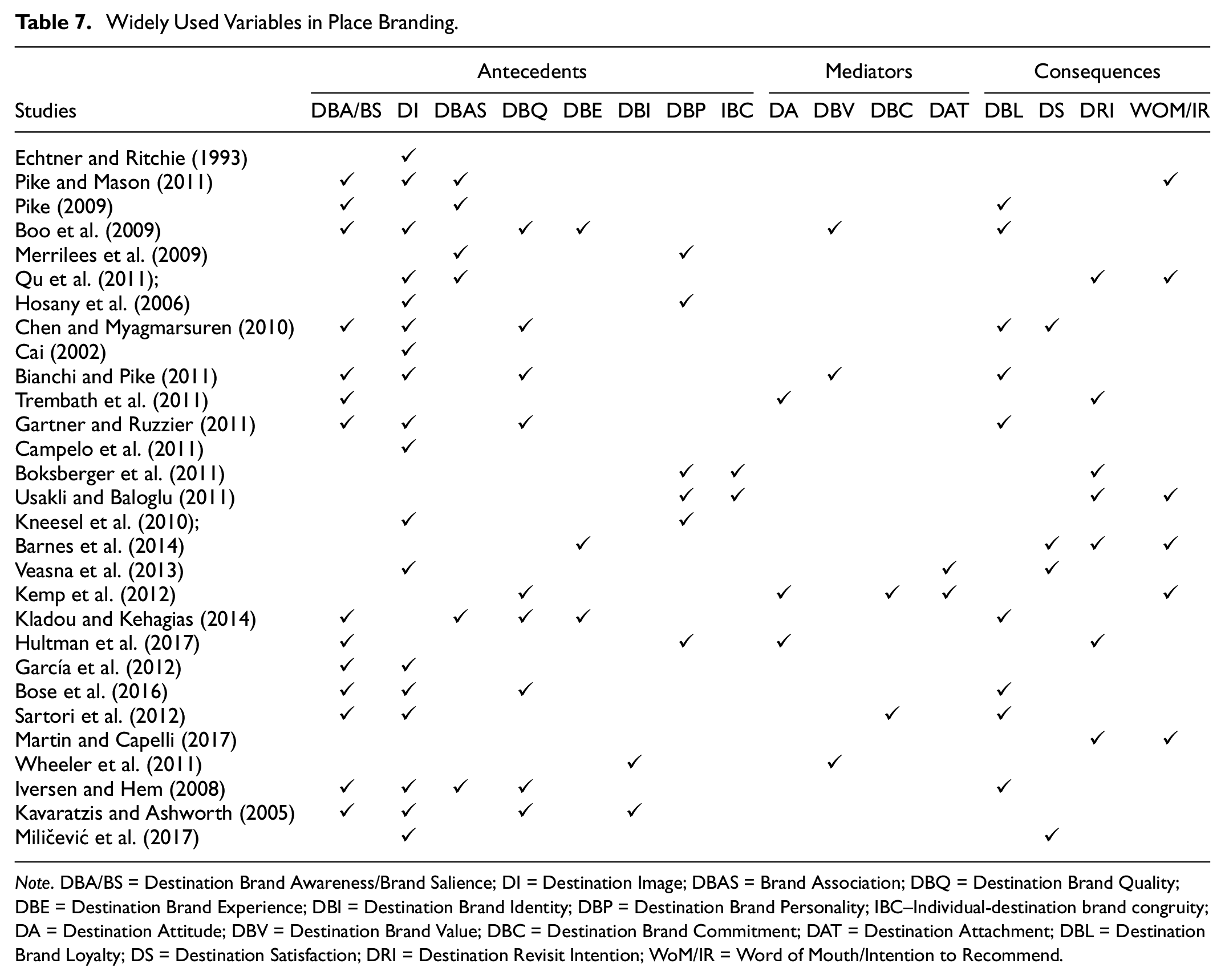
Note. DBA/BS = Destination Brand Awareness/Brand Salience; DI = Destination Image; DBAS = Brand Association; DBQ = Destination Brand Quality; DBE = Destination Brand Experience; DBI = Destination Brand Identity; DBP = Destination Brand Personality; IBC–Individual-destination brand congruity; DA = Destination Attitude; DBV = Destination Brand Value; DBC = Destination Brand Commitment; DAT = Destination Attachment; DBL = Destination Brand Loyalty; DS = Destination Satisfaction; DRI = Destination Revisit Intention; WoM/IR = Word of Mouth/Intention to Recommend.
Antecedents of Consumer Responses to Place Branding
All the antecedents that predominantly influence consumer responses to place branding can be categorized into two sets: brand equity-related factors and brand identity-related factors.
Brand Equity-Related Factors
In the marketing literature, brand equity is quite often represented as customer-based brand equity (CBBE) which is measured through the four-dimensional framework comprising brand awareness, perceived quality, brand association/brand image and brand loyalty (Aaker, 1991, 1996; Keller et al., 2015). Accordingly, in place branding research, destination/place brand equity can be measured using the dimensions including brand awareness, brand image/brand association, perceived quality and brand loyalty (Bose et al., 2016; Kladou & Kehagias, 2014). Additionally, destination brand experience is reported as an important dimension of place brand equity (Boo et al., 2009). Literature also suggests that these brand equity-related factors lead to destination brand loyalty (Boo et al., 2009; Chen & Myagmarsuren, 2010) which are discussed below.
Destination brand salience is defined as “the strength of awareness of the destination in the mind of an individual when a given travel situation is considered” (Bianchi & Pike, 2011). It is the foundation of destination brand equity (Gartner & Ruzzier, 2011) and plays a crucial role in building a place brand (Pike & Mason, 2011; Trembath et al., 2011). The next brand equity-related factors are brand association and brand image that are often used interchangeably (Bose et al., 2016). Destination image is defined as “the sum of beliefs, ideas and impressions that a person has of a destination” (J. L. Crompton, 1979). Thus, destination image represents tourists’ brand associations with a place (Qu et al., 2011). Destination image and destination brand association generate destination attachment and destination brand commitment among tourists leading to their destination satisfaction and destination brand loyalty (Sartori et al., 2012; Veasna et al., 2013).
Destination brand quality can be explained as consumers’ perceptions of a destination in terms of its performance (Boo et al., 2009), such as the availability of amenities and services (Chen & Myagmarsuren, 2010). Destination brand quality leads to destination brand value, destination attitude and destination brand commitment, which in turn lead to destination brand loyalty and positive word of mouth (Boo et al., 2009; Kemp et al., 2012). The final brand equity-related factor is destination brand experience which comprises consumers’ sensory, affective, behavioral and intellectual experiences. Destination brand experience determines destination brand value leading to destination brand loyalty and tourists’ satisfaction and their intention to revisit as well as recommend a tourist destination (Barnes et al., 2014; Boo et al., 2009).
Brand Identity-Related Factors
Brand identity is basically the way marketers want a brand to be perceived (de Chernatony & Dall’Olmo Riley, 1998). In place branding research, the brand identity-related factors include destination brand identity (Kavaratzis & Ashworth, 2005; Wheeler et al., 2011), destination brand personality (Hultman et al., 2017; Kneesel et al., 2010) and individual destination brand congruity (Boksberger et al., 2011; Usakli & Baloglu, 2011).
Destination brand identity reflects the character and distinctive value proposition (Kotler et al., 1993), which can be based on the attributes or symbolic/emotional values offered by a tourist destination (Kavaratzis & Ashworth, 2005). As a result, an effective destination brand identity leads to destination brand value (Wheeler et al., 2011). Brand personality is an integral part of brand identity (Kapferer, 1992). Accordingly, destination brand personality refers to “the set of personality traits associated with a destination” (Ekinci & Hosany, 2006). Destination brand personality positively influences tourists’ attitudes toward a destination, which leads to their intention to revisit (Hultman et al., 2017). Self-brand congruity is defined as the cognitive match between the value-expressing attributes of a brand and an individual’s self-concept (Islam et al., 2018; Sirgy et al., 1997). A stronger match between destination personality and a tourist’s personality reflects a greater self-congruity which positively influences the tourist’s intention to revisit and recommend a destination brand (Usakli & Baloglu, 2011).
Mediators
The literature suggests that destination attitude, destination brand value, destination brand commitment and destination attachment mediate the relationship between the antecedents and consequences of place branding.
Destination attitude is formed through tourists’ evaluation of a place brand (Hultman et al., 2017). Brand equity-related factors, such as perceived quality of a destination, positively influence tourists’ attitude and commitment toward the destination brand, which in turn results in positive word-of-mouth (Kemp et al., 2012). It is also observed that destination attitude mediates the relationship between destination brand personality (a brand identity-related factor) and destination revisit intention (Hultman et al., 2017).
A positive destination image, a brand equity-related factor, leads to destination attachment, which in turn results in greater destination satisfaction among tourists (Veasna et al., 2013). Further, Boo et al. (2009) suggested that destination brand value, meaning “the value for money proposition of a tourist destination,” mediates the relationship between destination brand equity and destination brand loyalty.
Consequences or Dependent Variables
The most frequently studied dependent variables in the place branding context are destination brand loyalty (Bose et al., 2016; Kladou & Kehagias, 2014), destination satisfaction (Barnes et al., 2014; Miličević et al., 2017), destination revisit intention (Barnes et al., 2014; Hultman et al., 2017; Martin & Capelli, 2017) and word-of-mouth or intention to recommend a tourist destination (Barnes et al., 2014; Martin & Capelli, 2017). Since the ultimate aim of any branding strategy is to achieve brand resonance (Keller et al., 2015) which reflects consumers’ intense loyalty for a brand, researchers have examined destination brand loyalty and destination revisit intention more widely as the consequences of place branding.
Development of an Integrated Conceptual Framework
Place branding has been studied in different contexts, such as branding of urban (Hollands & Chatterton, 2003; Kemp et al., 2012) and rural (Wheeler et al., 2011) locations or a combination of rural and urban settings (Barnes et al., 2014); and branding of a specific city (Hall, 2008; Kavaratzis & Ashworth, 2005; Usakli & Baloglu, 2011), a bigger region/state (Iversen & Hem, 2008; Martin & Capelli, 2017) and a country (Hudson, 2016). Further, as discussed in section “3.7 Frequently discussed variables,” researchers have examined diverse aspects of place branding, such as destination brand image (Ren & Blichfeldt, 2011; Veasna et al., 2013), destination brand equity (Bose et al., 2016; Kladou & Kehagias, 2014), destination brand experience (Barnes et al., 2014), destination brand personality (Hultman et al., 2017; Usakli & Baloglu, 2011) and destination brand identity (Saraniemi & Komppula, 2019). These contextual and dimensional variations present a scattered picture of the place branding literature. Therefore, integrating the frequently studied constructs in place branding in the form of a conceptual framework would present a coherent picture. This framework gives a consolidated view of the place branding literature.
Figure 6 illustrates the conceptual framework that integrates the variables studied in the place branding literature. The framework depicts that brand equity-related factors (destination brand awareness/brand salience, destination image, destination brand association, destination brand quality and destination brand experience) and brand identity-related factors (destination brand identity, destination brand personality, and individual destination brand congruity) influence consumer responses to place branding. Variables, such as destination attitude, destination brand value, destination brand commitment and destination attachment mediate the relationship between the abovementioned antecedents and consequences of place branding namely, destination brand loyalty, destination satisfaction, destination revisit intention and word of mouth/intention to recommend the place.
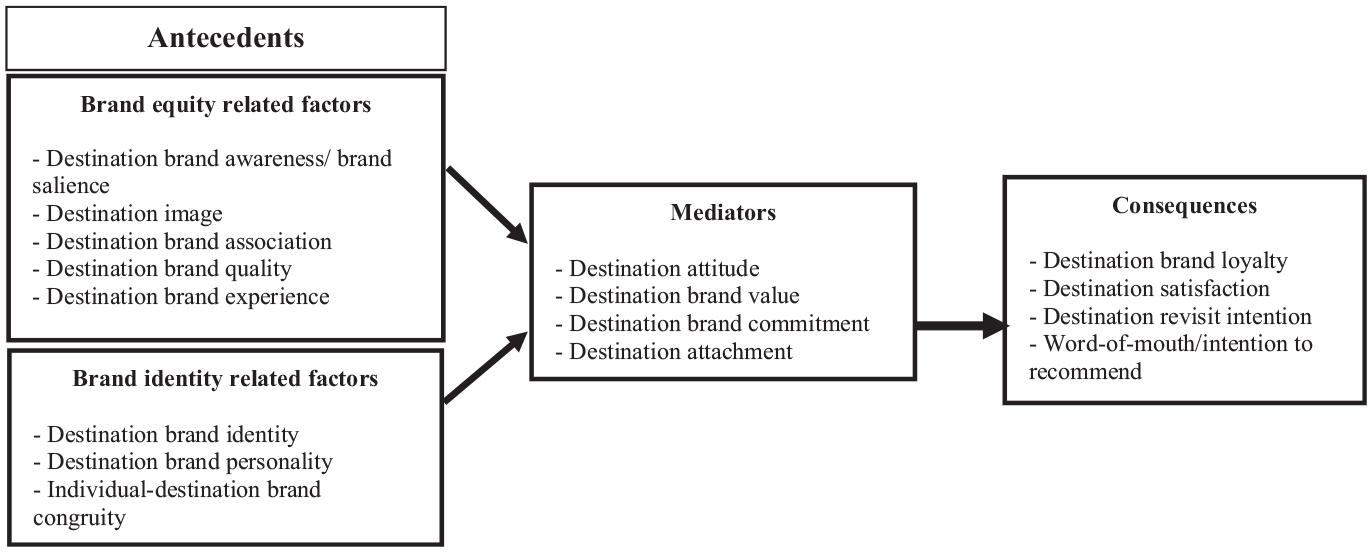
Conceptual framework—Place branding.
Future Research Directions
The third objective of this review is to propose directions for future research in the place branding area which are presented using the Theory-Context-Characteristics-Methods (TCCM) framework used by Jebarajakirthy et al. (2021) and Swain et al. (2023). This framework helps identify the underlying gaps in a research domain across four dimensions: theory development, context, characteristics and method (Srivastava et al., 2020). Accordingly, these future research directions are discussed below.
Theory Development
The synthesis of the place branding literature shows various theories used in this domain (please see Table 6). In this section, we suggest alternative theories that can be used for future research on place branding.
The place branding literature suggests that the destination brand experience plays an important role in influencing tourists’ intention to revisit a destination and their loyalty to the destination (Barnes et al., 2014; Kladou & Kehagias, 2014) as depicted in “Figure 6.” Destination brand experience can be sensory, affective, behavioral and intellectual (Kumar et al., 2013). The sensory and affective experiences relate to consumers’ moods and emotions, such as pleasure, excitement, joy and love that are evoked through sensory stimuli (Schmitt, 1999). Thus, it can be inferred that consumer emotions have an important role to play in place branding. However, researchers have rarely used any theory to understand the role of consumer emotions in place branding. One prominent theory that helps to understand consumer emotions in consumption contexts is the “Pleasure arousal dominance (P-A-D) theory.” According to this theory, the three fundamental emotions, such as pleasure, arousal and dominance are evoked among consumers when they encounter a marketing stimulus (Huang et al., 2017). Pleasure represents consumers’ feelings, such as happiness and joy; arousal represents the level of excitement, and dominance represents the feeling of freedom/autonomy (Yang et al., 2020). The P-A-D framework can be used in place branding to examine the impact of attributes/anchors of a tourist destination (treated as the stimuli) on consumers’ emotions leading to tourists’ intention to visit a particular destination.
Persuasion theory is another such theoretical approach. This theory argues that the use of logical appeal and reasoning are highly effective in influencing a person’s beliefs, attitudes, intentions and behaviors (Sparks et al., 2013). Past research finds that better-quality and more detailed explanations are more persuasive (Ajzen et al., 1996). The place branding literature suggests that consumers actively seek information from destination marketers to evaluate and select tourist destinations (J. L. Crompton & Ankomah, 1993). Hence, persuasion theory can be used in place branding research to examine the influence of information provided by the destination marketers on tourists’ attitudes toward a destination leading to their intention to visit.
Further, lexicometric analysis (Figures 4 and 5) suggests that several attributes, such as city, events, historical importance, cultural heritage, nightlife and entertainment facilities associated with a destination are important elements that act as extrinsic motivational factors for tourists to visit a destination. However, the use of theoretical perspectives is lacking in the extant place branding literature to understand how intrinsic and extrinsic motivations drive consumers’ choice of destination. One theory that can help understand this phenomenon is self-determination theory, which explains consumers’ motivation to perform a behavior. According to this theory, consumers’ motivation can be intrinsic or extrinsic (Ryan & Deci, 2000). Intrinsic motivation suggests that consumers perform certain activities which are interesting and enjoyable, whereas extrinsic motivation suggests that the external rewards or benefits of performing certain activities drive consumer behavior (Gagné & Deci, 2005). In place branding, tourists’ perceptions of a destination related to fun and enjoyable experiences can be regarded as intrinsic motivation whereas different facilities/services available at a destination can be regarded as extrinsic motivation. Hence, self-determination theory can be used to examine the influence of these intrinsic and extrinsic motivations on consumers’ intention to visit a tourist destination.
Context
The country-wise synthesis of the place branding literature (shown in Table 4) indicates that a large portion (around 65%) of empirical research on place branding was conducted in just eight Western countries namely, the USA, Australia, UK, Italy, Greece, Switzerland, Netherlands and New Zealand. This distribution questions the generalizability of the findings of the place branding research across the world, especially in non-Western countries, such as Asia, Africa and Latin America. Since the governments in many non-western countries, such as India, Thailand and the United Arab Emirates are investing heavily to establish these countries as preferred tourist destinations, future studies on place branding can be conducted in these non-western countries.
Characteristics
Tourists’ Profiling in Place Branding
Tourists’ personal characteristics, such as demographic and psychographic (e.g., personality) characteristics determine their self-congruity with a destination brand (one of the brand identity-related factors as shown in “Figure 6”) which drives their preference for a specific destination (Boksberger et al., 2011). This suggests the importance of understanding tourists’ demographic and psychographic profiles. Further, the literature suggests that destination brands can use different anchors/attributes, such as cultural or historical values (Evans, 2003; Wheeler et al., 2011), service facilities (Hall, 2008), city/urban life (Hollands & Chatterton, 2003; Vanolo, 2008), heritage (Hudson, 2016; Paddison & Biggins, 2017) and shopping venues (Hart et al., 2013) to attract tourists. The results of the lexicometric analysis (Figures 4 and 5) validate the importance of these attributes and anchors of a tourist destination in place branding. However, what type of tourists are attracted to what type of destination brand attributes remains unexplored in the place branding research. Thus, it would be interesting to conduct a study to understand the demographic and psychographic profiles of tourists who prefer different attributes of place branding.
Role of Social Media Influencers
The use of social media, such as blogs, and social networking sites have gained popularity among tourists (Pan et al., 2007). Consequently, social media influencers are used to promote tourist destinations and are encouraged to post their narratives in the form of travel blogs, photos and videos. These social media influencers are considered micro-celebrities who can influence their followers’ purchasing decisions (Lou & Yuan, 2019). However, the extant place branding literature shows a lack of focus on examining the role of social media influencers in triggering customer responses to place branding. Hence, future studies can examine how social media influencers can be effectively used to influence tourists’ decisions to visit a place.
Brand Avoidance in Place Branding
The place branding literature shows that there has been a greater focus on understanding the factors that drive tourists’ intention to visit or revisit a destination (Hultman et al., 2017; Martin & Capelli, 2017) and their destination brand loyalty (Bose et al., 2016; Kladou & Kehagias, 2014) as depicted in Figure 6. The results of the factorial correspondence analysis, presented in Figure 5 also suggests that the place branding literature has paid attention to investigating favorable consumer responses and the factors driving these responses. However, place branding research lacks focus on studying why tourists dislike certain destinations and avoid visiting them. The concepts of brand avoidance in relation to destination brand is worth investigating. Brand avoidance can be described as a stage where consumers stay away from purchasing or using a particular brand (Knittel et al., 2016). Hence, future studies on destination branding can explore the factors that lead to destination brand avoidance.
COVID-19 and Place Branding
COVID-19 has negatively impacted several businesses across the world especially tourism (Vargas, 2020) due to travel restrictions and intermittent lockdowns. Recently, countries across the globe have gradually reopened their international borders to foreign tourists. Since organizations have adapted their marketing practices to attract consumers in the new normal due to COVID-19 induced changes in the consumption patterns (Carracedo et al., 2021), place branding strategies also need to be revamped. As such, researchers (Cambra-Fierro et al., 2022; Kim et al., 2022) have examined the impact of branding strategies, such as destination brands’ logo design and communication on tourists’ preference for a destination in the post-pandemic world. The place branding literature suggests that branding strategies, such as building destination brand personality (Hultman et al., 2017) and destination brand equity (Bose et al., 2016), are key to drive tourists’ preference for a destination. Thus, a scope exists for researchers to explore the new dimensions of destination brand personality and destination brand equity that are relevant in the context of a post COVID-19 world.
Methods
Table 5 shows that a significant number of studies in place branding have used the survey method and implemented cross-sectional research design. This indicates researchers in the place branding domain have not focused on longitudinal research design. However, longitudinal studies are more useful in ascertaining the cause-and-effect relationships over time between the independent variables and outcomes. Like any other branding activity, place branding is a long-term phenomenon where destination marketers put concerted efforts into building positive attitudes in tourists toward a destination brand over time. Thus, longitudinal studies can be conducted to examine how place branding activities develop positive attitudes among tourists over time. Further, the place branding literature suggests that destination marketers can use the storytelling approach on social media to change tourists’ negative perceptions of a destination (Lund et al., 2020). This gives an opportunity to conduct longitudinal studies that can examine the efficacy of the storytelling approach in changing tourists’ negative attitudes over time.
It is also observed that the experimental approach did not receive much attention as only one study existed in the place branding literature. The growing relevance of virtual and augmented reality in marketing practices provide scope to conduct experimental research in place branding. Thus, experimental studies can be conducted in the place branding domain where the virtual reality experience of tourism destinations can be manipulated and its influence on tourists’ destination choice can be examined.
Academic and Practical Implications
Academic Implications
This study offers various academic implications. Our review reveals that despite the substantial amount of literature on place branding, this domain is highly fragmented/scattered due to multiple views and inconsistencies related to the contexts, methodologies, theories and constructs applied to place branding research. As such, this systematic review addresses a central question related to the development of place branding research in terms of the widely used methods, theories and constructs in place branding. Thus, this systematic review first presents the current state and evolution of place branding literature over the years. Especially, the word-cloud analysis provides an understanding of various themes/areas of focus in place branding research across different periods. Further, the lexicometric analysis presents a consolidated picture of these themes under five major clusters/broad themes of the place branding research.
Second, this systematic review synthesized the extant place branding literature in terms of theoretical perspectives. The theoretical synthesis shows that place branding research has evolved over the years using the underpinnings of several theories. To better understand the theoretical views, in addition to synthesizing the theories, we have grouped the theories in terms of the major themes studied in the place branding literature. Furthermore, we have recommended three alternative theories (i.e., P-A-D theory, persuasion theory and self-determination theory), which future studies can use. Overall, our review advances the theoretical foundation of place branding literature.
Our review also suggests that constructs studied in the place branding research remain scattered. Though there are a few existing reviews on place branding (e.g., Perkins et al., 2020; Ruiz-Real et al., 2020), these studies did not provide a clear understanding of relationships between the key constructs in place branding. Therefore, the third contribution of our study is made through development of the conceptual framework. This conceptual framework is the first of its kind developed by integrating widely studied variables (i.e., antecedents, mediators and consequences) in place branding. The framework shows a coherent picture of how the brand equity-related factors and brand identity-related factors drive consumers’ favorable responses to place branding.
Finally, this SLR identifies some under-researched areas in place branding and recommends specific future research directions focusing on theory, context, characteristics and methods. These various future research directions will contribute to advancing the body of knowledge in place branding.
Practical Implications
In addition to the abovementioned academic implications, this study provides practical implications for destination marketers and policymakers focused on tourism marketing. The practical implications are mainly based on the conceptual framework and lexicometric analysis. The conceptual framework clearly outlines several brand equity-related factors (destination brand awareness, image, association, quality and experience) and brand identity-related factors (destination brand identity, personality and individual-destination brand congruity), which drive consumer responses to place branding. Thus, destination marketers and policymakers need to focus on these factors to stimulate tourists’ intention to visit and recommend a destination and their loyalty to a destination. Further, lexicometric analysis highlights the importance of a place’s unique anchors/attributes, such as city life, heritage, entertainment, nightlife, and historical and cultural values, which can be communicated as points of difference for destination brand positioning.
The conceptual framework (Figure 6) suggests that destination brand awareness/salience is an important brand equity-related factor. As such, brand awareness is the first step to achieve brand equity. Thus, destination marketers need to carefully craft promotional messages and select proper media channels to effectively reach the target audience and educate them about a place. Awareness and information about a place would help a destination brand appear in the tourists’ consideration set when deciding to visit/revisit a destination. Figure 6 also depicts destination image as an important brand equity-related factor, because a positive image about a destination generates greater destination value among tourists which in turn drives their loyalty to a particular destination. Destination marketers can create an image about a destination by promoting the unique anchors/attributes (e.g., city life, heritage, historical and cultural values) that are specific to a place.
Further, the destination brand personality and individual-destination brand congruity are important brand identity-related factors that drive favorable customer responses to a place brand. Hence, destination marketers should carefully design and communicate the appeal of a place to match the personality/lifestyle of the target audience. This would strengthen the degree of congruence between tourists and a destination and help evoke positive feelings among tourists about a destination. For example, a place with beaches and water sports facilities can be symbolized as a vibrant destination to attract tourists who are spirited, adventurous and sporty. Similarly, a place offering modern city life with high-end shopping centers and transport facilities can be symbolized as a luxury vacation destination to attract tourists who seek convenience and love to lead a lavish lifestyle.
Finally, the lexicometric analysis shows “destination marketing strategies” as one of the clusters in the dendograms (Figure 5). These destination marketing strategies involve target market selection, differentiation, positioning and communication. Hence, destination marketers need to implement these strategies to market a destination brand. For example, trekkers and motorcyclists can be the most appropriate target audience to market a hill station as a destination. Accordingly, friendly mountain peaks with camping facilities can be highlighted in a marketing campaign designed to position the hill station as a trekkers’ paradise.
Limitations and Conclusion
Limitations of the Study
This study has a few limitations. First, the current SLR followed specific inclusion and exclusion criteria to select published journal articles for review. Only articles that met these criteria were included in this review. Second, this SLR considered the research papers that were published only in English. Hence, relevant papers in this domain but published in other languages might have been missed.
Conclusion
The main purpose of this systematic review was three-fold: (1) synthesizing the place branding literature to examine the development of research in this domain over time (2) developing an integrated conceptual framework of place branding, and (3) proposing the directions for future research in this domain. Accordingly, the development of place branding literature is presented in terms of publication years, publication outlets, citations, research settings, methodologies and theories. In addition, the word-cloud analysis shows that over time, the focus of place branding research has shifted from studying destination brand image to destination brand equity to stakeholder management. Further, the lexicometric analysis shows that the place branding literature revolves around five major themes, namely, attributes/anchors of destination branding, consumer aspects of destination branding, research methods and analysis, stakeholders’ role in place branding and destination brand marketing strategies. This systematic review also synthesizes the extant place branding literature to identify frequently used constructs/variables based on which the conceptual framework is developed that shows a consolidated view of place branding research. This conceptual framework illustrates that several brand equity-related factors and brand identity-related factors lead to destination attitude, brand value, attachment and commitment, which in turn drive favorable consumer responses, such as revisit intention, destination brand loyalty and positive word of mouth. In accordance with the last objective, this SLR suggested future research directions to advance the place branding literature in terms of theories, contexts, characteristics and methods. Hence, this systematic review presents a comprehensive synthesis of the extant place branding literature to present the current state of the domain and proposes the way forward.
Footnotes
Appendix
Articles Included in the Review.

| No. | Authors | Title | Journal |
|---|---|---|---|
| 1 | Woodside and Lysonski (1989) | A general model of traveller destination choice | Journal of Travel Research |
| 2 | Um and Crompton (1990) | Attitude determinants in tourism destination choice | Annals of Tourism research |
| 3 | Perdue and Pitegoff (1990) | Methods of accountability research for destination marketing | Journal of Travel Research |
| 4 | Woodside (1990) | Measuring advertising effectiveness in destination marketing strategies | Journal of Travel Research |
| 5 | Wicks and Schuett (1991) | Examining the role of tourism promotion through the use of brochures | Tourism Management |
| 6 | Ahmed (1991) | The influence of the components of a state’s tourist image on product positioning strategy | Tourism Management |
| 7 | J. Crompton (1992) | Structure of vacation destination choice sets | Annals of Tourism Research |
| 8 | Hughes (1992) | Tourism and the geographical imagination | Leisure Studies |
| 9 | Chon (1992) | The role of destination image in tourism: an extension | Tourism Review |
| 10 | J. L. Crompton and Ankomah (1993) | Choice set propositions in destination decisions | Annals of Tourism Research |
| 11 | Lue et al. (1993) | Conceptualization of multi-destination pleasure trips | Annals of Tourism Research |
| 12 | Echtner and Ritchie (1993) | The measurement of destination image: an empirical assessment | Journal of Travel Research |
| 13 | Driscoll et al. (1994) | Measuring tourists’ destination perceptions | Annals of Tourism Research |
| 14 | Bramwell and Rawding (1994) | Tourism marketing organizations in industrial cities organizations, objectives and urban governance | Tourism Management |
| 15 | Pritchard and Morgan (1995) | Evaluating vacation destination brochure images: the case of local authorities in wales | Journal of Vacation Marketing |
| 16 | Pritchard and Morgan (1998) | “Mood marketing”— The new destination branding strategy: A case study of “Wales” The Brand | Journal of Vacation Marketing |
| 17 | Bennett (1999) | Destination Marketing into the next century | Journal of Vacation Marketing |
| 18 | Tourism Destination Brands and Electronic Commerce: Towards Synergy? | Journal of Vacation Marketing | |
| 19 | Henderson (2000) | Attracting tourists to Singapore’s Chinatown: a case study in conservation and promotion | Tourism Management |
| 20 | Hankinson (2001) | Location branding: A study of the branding practices of 12 English cities | Journal of Brand Management |
| 21 | d’Hauteserre (2001) | Destination Branding in a Hostile Environment | Journal of Travel Research |
| 22 | Cai (2002) | Cooperative branding for rural destinations | Annals of Tourism Research |
| 23 | Hollands and Chatterton (2003) | Producing nightlife in the new urban entertainment economy: corporatization, branding and market segmentation | International Journal of Urban and Regional Research |
| 24 | Evans (2003) | Hard-branding the cultural city—from Prado to Prada | International Journal of Urban and Regional Research |
| 25 | Patterson et al. (2003) | Targeting tourists with state branding programs | Agribusiness |
| 26 | Pedersen (2004) | Place branding: giving the region of øresund a competitive edge | Journal of Urban Technology |
| 27 | Julier (2005) | Urban designscapes and the production of aesthetic consent | Urban Studies |
| 28 | Hosany et al. (2006) | Destination image and destination personality: an application of branding theories to tourism places | Journal of Business Research |
| 29 | Hall (2008) | Servicescapes, designscapes, branding, and the creation of place-identity: south of Litchfield, Christchurch | Journal of Travel & Tourism Marketing |
| 30 | Iversen and Hem (2008) | Provenance associations as core values of place umbrella brands: a framework of characteristics | European Journal of Marketing |
| 31 | Vanolo (2008) | The image of the creative city: some reflections on urban branding in Turin | Cities: The International Journal of Urban Policy and Planning |
| 32 | O’Connor et al. (2008) | The integration of film-induced tourism and destination branding in Yorkshire, UK | International Journal of Tourism Research |
| 33 | Van ham (2008) | Place branding: The state of the art | Annals of the American Academy of Political and Social Science |
| 34 | McCartney et al. (2008) | A strategic use of the communication mix in the destination image-formation process | Journal of Travel Research |
| 35 | Zhang and Zhao (2009) | City branding and the Olympic effect: a case study of Beijing | Cities: The International Journal of Urban Policy and Planning |
| 36 | Pike (2009) | Destination branding case study: tracking brand equity for an emerging destination between 2003 and 2007 | Journal of Hospitality and Tourism Research |
| 37 | Warnaby (2009) | Towards a service-dominant place marketing logic | Marketing Theory |
| 38 | Pike (2009) | Destination brand positions of a competitive set of near-home destinations | Tourism Management |
| 39 | Ward & O’regan (2009) | The film producer as the long-stay business tourist: rethinking film and tourism from a Gold Coast perspective | Tourism Geographies: An International Journal of Tourism Space, Place and Environment |
| 40 | Balakrishnan (2009) | Strategic branding of destinations: a framework | European Journal of Marketing |
| 41 | Hudson and Ritchie (2009) | Branding a memorable destination experience. The case of “brand Canada” | International Journal of Tourism Research |
| 42 | Marzano and Scott (2009) | Power in destination branding | Annals of Tourism Research |
| 43 | Boo et al. (2009) | A model of customer-based brand equity and its application to multiple destinations | Tourism Management |
| 44 | Merrilees et al. (2009) | Antecedents of residents’ city brand attitudes | Journal of Business Research |
| 45 | Pike (2010) | Consumer-based brand equity for Australia as a long-haul tourism destination in an emerging market | International Marketing Review |
| 46 | Ryan and Silvanto (2010) | World heritage sites: the purposes and politics of destination branding | Journal of Travel & Tourism Marketing |
| 47 | Pike (2010) | Destination branding case study: tracking brand equity for an emerging destination between 2003 and 2007 | Journal of Hospitality & Tourism Research |
| 48 | Daye (2010) | Challenges and prospects of differentiating destination brands: the case of the Dutch Caribbean islands | Journal of Travel & Tourism Marketing |
| 49 | Wu (2010) | Gated and packaged Suburbia: packaging and branding Chinese suburban residential development | Cities: The International Journal of Urban Policy and Planning |
| 50 | Kneesel et al. (2010) | Gaming destination images: implications for branding | Journal of Travel Research |
| 51 | Paliaga et al. (2010) | Methodology of valuation of cities’ brands | Economic Research-Ekonomska Istraživanja |
| 52 | Chen and Myagmarsuren (2010) | Exploring relationships between Mongolian destination brand equity, satisfaction and destination loyalty | Tourism Economics |
| 53 | Campelo et al. (2011) | Visual rhetoric and ethics in marketing of destinations | Journal of Travel Research |
| 54 | Ashworth (2011) | Place branding: glocal, virtual and physical identities, constructed, imagined and experienced | Tourism Management |
| 55 | Usakli and Baloglu (2011) | Brand personality of tourist destinations: an application of self-congruity theory | Tourism Management |
| 56 | Pike and Mason (2011) | Destination competitiveness through the lens of brand positioning: the case of Australia’s Sunshine coast | Current Issues in Tourism |
| 57 | Ren and Blichfeldt (2011) | One clear image? Challenging simplicity in place branding | Scandinavian Journal of Hospitality and Tourism |
| 58 | Qu et al. (2011) | A model of destination branding: integrating the concepts of the branding and destination image | Tourism Management |
| 59 | Lee (2011) | Role of hotel design in enhancing destination branding | Annals of Tourism Research |
| 60 | Bianchi and Pike (2011) | Antecedents of destination brand loyalty for a long-haul market: Australia’s destination loyalty among Chilean travelers | Journal of Travel & Tourism Marketing |
| 61 | Trembath et al. (2011) | Building the destination brand: an empirical comparison of two approaches | Journal of Travel & Tourism Marketing |
| 62 | Lee and Arcodia (2011) | The role of regional food festivals for destination branding | International Journal of Tourism Research |
| 63 | Kimbu (2011) | The challenges of marketing tourism destinations in the central African subregion: the Cameroon example | International Journal of Tourism Research |
| 64 | Wheeler et al., 2011 | Destination brand identity, values, and community: a case study from rural Victoria, Australia | Journal of Travel & Tourism Marketing |
| 65 | Boksberger et al. (2011) | Self-congruity theory: to what extent does it hold in tourism? | Journal of Travel Research |
| 66 | Gartner and Ruzzier (2011) | Tourism destination brand equity dimensions: renewal versus repeat market | Journal of Travel Research |
| 67 | Cox and Wray (2011) | Best practice marketing for regional tourism destinations | Journal of Travel & Tourism Marketing |
| 68 | García et al. (2012) | A destination-branding model: an empirical analysis based on stakeholders | Tourism Management |
| 69 | Zouganeli et al. (2012) | Aspects of sustainability in the destination branding process: a bottom-up approach | Journal of Hospitality Marketing & Management |
| 70 | Sartori et al. (2012) | Tourist destination brand equity and internal stakeholders: An empirical research | Journal of Vacation Marketing |
| 71 | Kemp et al. (2012) | The impact of marketing on internal stakeholders in destination branding: The case of a musical city | Journal of Vacation Marketing |
| 72 | Hankinson (2012) | The measurement of brand orientation, its performance impact, and the role of leadership in the context of destination branding: An exploratory study | Journal of Marketing Management |
| 73 | Lim et al. (2012) | The impact of social media on destination branding: Consumer-generated videos versus destination marketer-generated videos | Journal of Vacation Marketing |
| 74 | Klijn et al. (2012) | The influence of stakeholder involvement on the effectiveness of place branding | Public Management Review |
| 75 | Chen et al. (2012) | Branding Taiwan for tourism using “Decision Making Trial and Evaluation Laboratory” and “Analytic Network Process” methods | Service Industries Journal |
| 76 | Brown et al. (2013) | A brand so bad it’s good: The paradoxical place marketing of Belfast | Journal of Marketing Management |
| 77 | Hart et al. (2013) | Conceptualising town centre image and the customer experience | Journal of Marketing Management |
| 78 | Hanna and Rowley (2013) | A practitioner-led strategic place brand-management model | Journal of Marketing Management |
| 79 | Eshuis et al. (2013) | Place marketing as governance strategy: an assessment of obstacles in place marketing and their effects on attracting target groups | Public Administration Review |
| 80 | Veasna et al. (2013) | The impact of destination source credibility on destination satisfaction: the mediating effects of destination attachment and destination image | Tourism Management |
| 81 | Lichrou et al. (2014) | On the marketing implications of place narratives | Journal of Marketing Management |
| 82 | Campelo et al. (2014) | Sense of Place: The Importance for Destination Branding | Journal of Travel Research |
| 83 | Kladou and Kehagias (2014) | Assessing destination brand equity: an integrated approach. | Journal of Destination Marketing & Management |
| 84 | Barnes et al. (2014) | Destination brand experience and visitor behavior: Testing a scale in the tourism context | Annals of Tourism Research |
| 85 | Oliveira and Panyik (2015) | Content, context and co-creation: digital challenges in destination branding with references to Portugal as a tourist destination | Journal of Vacation Marketing |
| 86 | Költringer and Dickinger (2015) | Analyzing Destination Branding and Image from Online Sources—A Web Content Mining Approach | Journal of Business Research |
| 87 | Hudson (2016) | Let the journey begin (again): The branding of Myanmar | Journal of Destination Marketing & Management |
| 88 | Bose et al. (2016) | Measuring customer-based place brand equity (CBPBE): an investment attractiveness perspective | Journal of Strategic Marketing |
| 89 | Marcoz et al. (2016) | Benefits from service bundling in destination branding: the role of trust in enhancing cooperation among operators in the hospitality industry | International Journal of Tourism Research |
| 90 | Michelson and Paadam (2016) | Destination branding and reconstructing symbolic capital of urban heritage: A spatially informed observational analysis in medieval towns. | Journal of Destination Marketing & Management |
| 91 | Paddison and Biggins (2017) | Advocating community integrated destination marketing planning in heritage destinations: the case of York | Journal of Marketing Management |
| 92 | Lecompte et al. (2017) | Putting sense of place at the centre of place brand development | Journal of Marketing Management |
| 93 | Skinner (2017) | Business tourists’ perceptions of nation brands and capital city brands: a comparison between Dublin/Republic of Ireland, and Cardiff/Wales | Journal of Marketing Management |
| 94 | Miličević et al. (2017) | An investigation of the relationship between destination branding and destination competitiveness. | Journal of Travel & Tourism Marketing |
| 95 | Efrat & Shoham (2017) | Destination branding: the role of consumer affinity | Journal of Destination Marketing & Management |
| 96 | Goulart Sztejnberg and Giovanardi (2017) | The ambiguity of place branding consultancy: working with stakeholders in Rio de Janeiro | Journal of Marketing Management |
| 97 | Martin and Capelli (2017) | Region brand legitimacy: towards a participatory approach involving residents of a place | Public Management Review |
| 98 | Hultman et al. (2017) | The role of destination personality fit in destination branding: antecedents and outcomes | Psychology & Marketing |
| 99 | Kladou et al. (2017) | The role of brand elements in destination branding. | Journal of Destination Marketing & Management |
| 100 | Lunda et al. (2018) | The power of social media storytelling in destination branding | Journal of Destination Marketing & Management |
| 101 | Kim et al. (2018) | Branding destination co-creatively: A case study of tourists’ involvement in the naming of a local attraction | Tourism Management Perspectives |
| 102 | Lai et al. (2018) | A perception gap investigation into food and cuisine image attributes for destination branding from the host perspective: the case of Australia | Tourism Management |
| 103 | Beritelli and Laesser (2018) | Destination logo recognition and implications for intentional destination branding by DMOs: A case for saving money | Journal of Destination Marketing & Management |
| 104 | Zavattaro (2018) | What’s in a symbol? Big questions for place branding in public administration | Public Administration Quarterly |
| 105 | Ben Youssef et al. (2019) | Storytelling in the context of destination marketing: an analysis of conceptualisations and impact measurement | Journal of Strategic Marketing |
| 106 | Dimitrovski et al. (2019) | Wine tourism apps as wine destination branding instruments: content and functionality analysis | Journal of Hospitality and Tourism Technology |
| 107 | Saraniemi and Komppula (2019) | The development of a destination brand identity: a story of stakeholder collaboration | Current Issues in Tourism |
| 108 | Perkins et al. (2020) | Understanding the contribution of stakeholder collaboration toward regional destination branding: A systematic narrative literature review | Journal of Hospitality and Tourism Management |
| 109 | Ruiz-Real et al. (2020) | Destination branding: opportunities and new challenges | Journal of Destination Marketing & Management |
| 110 | Lund et al. (2020) | The brand value continuum: countering co-destruction of destination branding in social media through storytelling | Journal of Travel Research |
| 111 | Giannopoulos et al. (2021) | Destination branding and co-creation: a service ecosystem perspective | Journal of Product & Brand Management |
| 112 | Lund and Kimbu (2021) | Applying the Hollywood scriptwriting formula to destination branding | Current Issues in Tourism |
Declaration of Conflicting Interests
The author(s) declared no potential conflicts of interest with respect to the research, authorship, and/or publication of this article.
Funding
The author(s) received no financial support for the research, authorship, and/or publication of this article.
