




Abstract
Frontline service employees (FSEs)’ customer-oriented boundary spanning behaviors (COBSBs) are prosocial behaviors adapted to the job requirements and work environment of customer service personnel. It is a significant strategic imperative for achieving excellent performance in the tourism organizations. Building on social exchange theory, this study uncovered that inclusive leadership motivates FSEs’ COBSBs. Using hierarchical multiple regression analysis with time-lagged data, we find that inclusive leadership promotes FSEs’ COBSBs by enhancing their felt obligations. Moreover, the need for affiliation enhances the direct effect that inclusive leadership has on felt obligations and its indirect effect on FSEs’ COBSBs via felt obligations.
Introduction
The COVID-19 epidemic has posed significant challenges to achieving excellent service performance in the tourism industry and has been proven to undermine the relationship between service suppliers and customers (Farzanegan et al., 2021; Li et al., 2021; Prayag et al., 2023). At the customer-organization interface, frontline service employees (FSEs)’ customer-oriented boundary spanning behaviors (COBSBs), encompassing service delivery behavior, external representation behavior, and internal influence behavior (Podsakoff et al., 2000), are vital for tourism organizations to recover customer relationships and ensure ongoing service improvements. Firstly, FSEs’ appropriate service delivery behaviors are instrumental in shaping customer evaluations of service quality, consequently leading to customer satisfaction (Lloyd & Luk, 2011). Secondly, as the service industry is primarily people-oriented (Tasci et al., 2022), tourism organizations’ reputation and image hold significant importance to customers. FSEs act as vocal advocates, representing organizations’ image and services to outsiders. Hence, their external representation behavior plays a crucial role in creating a positive impression of the tourism organization (Bettencourt & Brown, 2003; Trybou et al., 2015). Thirdly, FSEs occupy a unique position at the interface and regularly encounter diverse and unforeseen customer needs (Bettencourt et al., 2005). This provides an opportunity for FSEs to understand evolving customer needs and identify the best strategies for satisfying their customers (Liao & Chuang, 2004). In such circumstances, FSEs’ internal influence behavior, involving the sharing of innovative ideas on service improvements with their colleagues and supervisors (Bayighomog & Arasli, 2022; Bayighomog & Araslı, 2019), can provide valuable perspectives for enhancing tourism organizations’ service policies, procedures, and practices, thus enabling continuous improvement.
In addition to its practical significance, the construct of COBSBs is comprehensive and unique, warranting further research attention. Existing studies generally classify FSEs’ service behaviors into in-role and extra-role behaviors. In-role service behavior pertains to the job responsibilities and obligations outlined in job descriptions (Park et al., 2021; Tsaur & Lin, 2004). On the other hand, extra-role service behavior denotes to discretionary behaviors that go beyond standard job requirements (Tuan, 2018). Examples of typical extra-role service behaviors include proactive customer service performance (PCSP), customer-oriented organizational citizenship behaviors (OCB), voice behavior, and service innovative behavior. PCSP entails self-starting, long-term, and consistent customer service behaviors (Ye et al., 2021). Customer-oriented OCB encompasses non-mandatory behaviors aimed at improving service delivery (Dimitriades, 2007). Voice behavior refers to FSEs voluntarily providing suggestions to enhance standardized service workflows (Liang et al., 2017). Service innovative behavior involves FSEs generating, promoting, and implementing creative service ideas to enhance service quality (Garg & Dhar, 2017). COBSBs, however, differentiates itself in two key aspects. Firstly, COBSBs is an integrated construct that simultaneously incorporates both in-role service behavior (service delivery behavior) and extra-role service behavior (external representation behavior and internal influence behavior). Secondly, going beyond existing extra-role service behaviors that primarily focus on improving service delivery, COBSBs encompass a crucial component of external representation, which is significant in cultivating a positive impression of tourism organizations among customers.
Given the significance and distinctiveness of COBSBs, studies have increasingly endeavored to explore the antecedent factors that drive service employees’ COBSBs. In this research stream, previous studies have largely focused on service employees’ personality trait (such as proactive personality and emotional intelligence) (Bayighomog & Arasli, 2022; Chien et al., 2021), workplace environment (such as sexual harassment and social undermining) (Jung & Yoon, 2020; Yoo, 2013), and job characteristics (such as role conflict, role ambiguity, and role stress) (Bettencourt & Brown, 2003; Chien et al., 2021). Despite these promising findings, however, little light has been shed on the effects of leadership on FSEs’ COBSBs. Supervisors train, assist, and assess their followers; they are the most important access to resources FSEs have in the workplace (Wong & Li, 2015). Researchers have indicated that good leading quality is a potential source for effective service and anchors the success in the service-profit chain (Armistead & Kiely, 2003; Heskett et al., 1994). Thus, it is rational to deduct that the leadership style of supervisors can be a promising antecedent for predicting FSEs’ customer-oriented service behaviors. COBSBs requires FSEs not only follow the job descriptions to deliver quality customer service, but also engage in internal and external extra-role behaviors. To stimulate such behaviors, leaders have to take more efforts in building a more motivated work environment (Wang et al., 2022). To the best of our knowledge, only three papers have detected the impacts that spiritual leadership has on FSEs’ COBSBs from the perspective of workplace spirituality (Bayighomog & Arasli, 2022; Bayighomog & Araslı, 2019; Farmanesh et al., 2021), more attention is called for further investigation on this issue.
Accordingly, this study focuses on inclusive leadership and explore its influence on COBSBs in the tourism industry context. Inclusive leadership differs from spiritual leadership in that inclusive leaders encourage diverse contributions, appreciate divergent perspectives from subordinates regardless of their positions in the organization, and are available and willing to support their subordinates (Mitchell et al., 2015; Randel et al., 2018). FSEs in tourism organizations interact frequently with customers and must deal with multiple problems (sometimes out of expectation) simultaneously (Ilkhanizadeh & Karatepe, 2018), which means they extremely need caring and assistance from the organization. Meanwhile, due to FSEs’ unique interface positions, they have opportunities to capture evolving customers’ needs and identify how to satisfy customers best (Jiang, 2020; Liao & Chuang, 2004). When their opinions are valued and welcomed by supervisors, they are more willing to share their useful experience and innovative ideas with colleagues. This would be significantly conducive to improving the overall service quality of organizations. In total, we can conclude that inclusive leadership holds particular significance in motivating FSEs to perform high-quality COBSBs.
In addition, this study addresses a possible mediating mechanism that links inclusive leadership and COBSBs by applying social exchange theory (SET). Based on SET, felt obligations, defined as a prescriptive notion that one should be concerned about the well-being of the organization, is considered as the most important factor motivating individuals to engage in discretionary activities (Blau, 1964). It has been shown that felt obligations can be cultivated when employees perceive organizational support and are provided with resources to perform their job better (Eisenberger et al., 2001). By emphasizing employees’ contributions and providing them with effective assistance regardless of their organizational status, inclusive leadership can induce employees’ beliefs that their organizations are supportive, thereby strengthening their sense of felt obligations. With this highly elicited felt obligations, FSEs in the tourism industry are inclined to reciprocate by delivering high-quality service to customers and exhibiting behaviors of external representation and internal influence. Accordingly, we posit that felt obligations is a crucial mediator translating inclusive leadership into FSEs’ COBSBs.
This study further explores the moderating effect of the need for affiliation, which refers to individuals’ inclination to establish and maintain close relationships with others (McClelland et al., 1976; O’Fallon & Butterfield, 2011). FSEs with a strong need for affiliation may be more conscious of acceptance and appreciation from inclusive leaders and make greater use of the openness, accessibility, and availability provided by leaders. Under such circumstances, employees perceive themselves as receiving more support and resources from their supervisors, thereby fostering the development of felt obligations, which in turn cultivates more COBSBs. According to the above arguments, we put forward a theoretical framework to explore the moderating effect that need for affiliation exhibits on the associations among inclusive leadership, felt obligations, and COBSBs. The integrated model is illustrated in Figure 1.
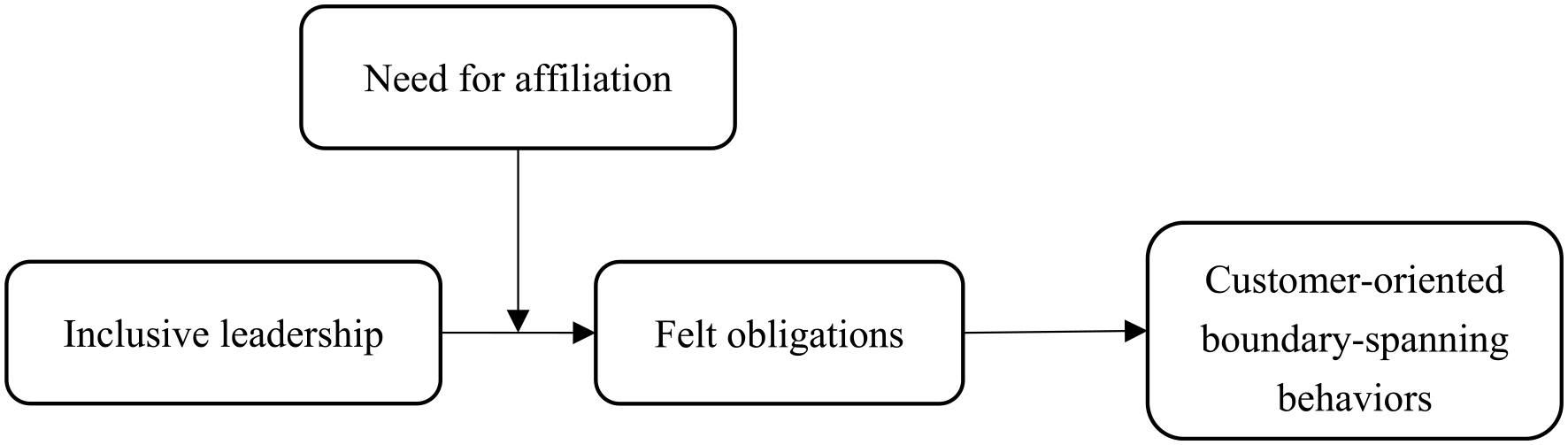
Conceptual model of this research.
Theory and Hypotheses
Inclusive Leadership
The term inclusive leadership was originally coined by Nembhard and Edmondson (2006) and has three important characteristics. First, inclusive leadership involves attending to followers’ needs, encouraging open communication, and being available and willing to offer followers assistance (Nembhard & Edmondson, 2006). Second, inclusive leadership encourages followers to believe that their divergent contributions and perspectives are fully appreciated and valued (Mitchell et al., 2015). Third, by offering possibilities for joint decision-making and ensuring justice, inclusive leadership explicitly emphasizes assisting subordinates as integral members of the group and encourages their diverse contributions, regardless of their organizational status (Randel et al., 2018).
As a type of relational leadership, inclusive leadership not only emphasizes the association between leaders and their followers but also fosters an environment that promotes the flourishing and authentic self-expression of followers within the workplace (Korkmaz et al., 2022). Considering the diversity and ever-evolving nature of customer needs in the tourism industry (Mahrous & Hassan, 2017; Vogt, 2011), the afore-mentioned attributes of inclusive leadership hold significant relevance for organizations operating in this sector. In a systematic literature review conducted by Korkmaz et al. (2022), it was found that inclusive leadership plays a significant role in predicting various positive job behaviors exhibited by employees, such as OCB (Tran & Choi, 2019), taking charge behavior (Wang et al., 2020), voice behavior (Jolly & Lee, 2021; Weiss et al., 2018), innovative work behavior (Siyal et al., 2021), knowledge sharing behavior (Lee & Lu, 2022), and leader-directed helping behavior (Randel et al., 2016). Despite these promising developments, however, few studies have investigated the effects of inclusive leadership on FSEs’ COBSBs, which are crucial for enhancing overall service performance and facilitating sustainable improvements in customer service within tourism organizations. This paper seeks to fill this vacuum by uncovering how inclusive leadership can serve as a motivating factor for FSEs’ COBSBs in the tourism industry.
Inclusive Leadership and COBSBs
COBSBs are prosocial behaviors adjusted to job demands and work environment of customer service personnel (Podsakoff et al., 2000). And it includes external representation, internal influence, and service delivery behaviors (Bettencourt et al., 2005). External representation behaviors mean that FSEs are outspoken proponents of the organization’s reputation and services to outsiders (Bowen & Schneider, 1985). Internal influence behaviors illustrate that FSEs take personal initiatives to communicate with the leaders and colleagues about evolving customer needs and promising improvements in service delivery (Zeithaml et al., 1988). Service delivery behaviors encompass the diligent, responsive, adaptable, and courteous way employees serve customers (Parasuraman et al., 1988).
In this study, we predict that inclusive leadership has positive effects on FSEs’ COBSBs. Firstly, inclusive leaders attend to followers’ needs and manifest openness, accessibility, and availability (Carmeli et al., 2010). With the support of leaders, FSEs are likely to reciprocate by displaying high-quality service delivery behaviors. Second, inclusive leaders value and express appreciation for the divergent contributions made by employees (Mitchell et al., 2015), significantly enhancing employees’ psychological safety and confidence in the workplace. Under such condition, employees may feel capable of and be willing to engage in internal influence behaviors, such as bringing fresh perspectives on customers’ needs and potential improvements for tourism organizations. Third, by showing respect and acknowledgment, inclusive leaders support FSEs as important group members (Randel et al., 2018). Being respected and supported, FSEs experience job satisfaction, happiness, and belongings (Findler et al., 2007). Satisfied employees deliver positive word-of-mouth (Parish et al., 2008) and increase their referral intention (Barnes et al., 2015), which leads to positive external representation behaviors.
Felt Obligations as a Mediator
SET offers a robust theoretical foundation for understanding the employee-employer relationships (Blau, 1964; Eisenberger et al., 1986; Roch et al., 2019). Specifically, when an organization provides an employee with favorable treatments, it fosters a sense of obligation within the employee to return with efforts to re-balance the exchange relationship with organizations (Gouldner, 1960; Rhoades & Eisenberger, 2002). Hence, felt obligation, a belief that one should be attentive to the well-being of the organization, is posited to play a significant role in linking employees’ experience in the workplace to their outcome behaviors (Chan et al., 2019; Gill, 2008).
Based on the SET, this research proposes that felt obligation is an essential mediator translating inclusive leadership into FSEs’ COBSBs. Given the hierarchy structure in organizations, leaders are generally considered as the representative of organizations (Hambrick, 2007). Hence, employees, especially FSEs, tend to develop their perceptions about organizations based on the treatments they receive from leaders (Kim et al., 2018; Otero-Neira et al., 2016). When employees receive sufficient favorable treatments from leaders, they will consider their organizations as supportive, leading to a sense of obligation to reciprocate their organizations (Eisenberger et al., 2001; Wang & Huang, 2019). In contrast, when leaders are not supportive, employees will feel less obligated to reciprocate for the organizations’ behalf (Eisenberger et al., 2001; Wang & Huang, 2019).
As discussed previously, inclusive leaders offer employees substantial favorable treatments (Nembhard & Edmondson, 2006). Specifically, inclusive leaders treat employees equally (Randel et al., 2018) and value employees’ contribution by including employees in discussions and decisions (Nembhard & Edmondson, 2006). Moreover, working as accessible and available, inclusive leaders endeavor to provide as much tangible and intangible resources as they can to help employees perform jobs better and sustainably develop their abilities (Nembhard & Edmondson, 2006). Experiencing inclusive leadership, employees will perceive that they are highly appreciated and supported by the organizations (Yu & Frenkel, 2013). Because individuals prefer balanced exchange relationship, these employees will feel indebted to the organizations. Consequently, they experience strong obligations to reciprocate and restore balance in the exchange relationship with their employers.
According to SET, when employees are in a position of wanting to fulfill the obligations resulting from the organizations’ favorable treatments, they will engage in job behaviors that are supportive of employers’ goals (Shore & Barksdale, 1998; Wang & Huang, 2019). In line with SET, we predict that the strong feeling of obligations to reciprocate resulting from inclusive leadership may drive FSEs to exhibit COBSBs. First, when feeling deeply indebted to organizations, FSEs will perform in a way that meet organizations’ expectations (Wang & Huang, 2019). Consequently, they tend to engage more in delivering high-quality customer service that are required by organizations. Second, due to the diverse and changing customer needs, extra-role service behaviors of FSEs, such as internal influence behaviors and external representation behaviors, are extremely important to the performance and sustainable development of tourism organizations (Bayighomog & Araslı, 2019; Bettencourt & Brown, 2003). However, because extra-role customer service behaviors exceed job descriptions, delivering this type of behaviors requires additional energy and involves facing uncertainty, difficulties, and challenges (Cheng & Chen, 2017). Under such circumstances, a strong internal force, such as a strong feeling of obligation to reciprocate to the organizations, is required. Along this line, it is reasonable to predict that FSEs with a strong desire to return favorable treatments to supportive organizations may be willing to extend their job roles and take the risk to perform more internal influence behaviors and external representation behaviors on the organizations’ behalf.
In summary, drawing on SET, we argue that inclusive leadership signals that the organizations are highly supportive, making FSEs experience a feeling of obligations to reciprocate to the organizations to restore the balance of exchange relationship with employers. With the strong obligations elicited by inclusive leadership, FSEs are likely to demonstrate excellent COBSBs to help the organizations attain their goals.
Need for Affiliation as a Moderator
SET indicates that the extent to which individuals value the exchanged resources can considerably affect the formation of exchange relationship and the following reciprocation (Blau, 1964). Moreover, according to the contingency perspective, employees’ traits exert a substantial influence on the extent to which leaders’ behaviors can affect them (Howell & Dorfman, 1981; Yukl, 2006). Consequently, this study concentrates on FSEs’ need for affiliation and explore its moderating effect on the beneficial effect of inclusive leadership.
The need for affiliation is defined as the tendency of individuals to establish and maintain close relationships with others (McClelland et al., 1976; O’Fallon & Butterfield, 2011). This attribute describes the extent to which individuals anticipate connection and gratification from others (Wiesenfeld et al., 2001). Individuals possessing strong affiliation need typically view themselves and others as interdependent and thus desire favorable evaluation from others (O’Fallon & Butterfield, 2011). Individuals low in this attribute consider themselves to be independent and place less emphasis on how others evaluate them (Wiesenfeld et al., 2001).
In this research, we contend that employees’ need for affiliation can enhance the beneficial effect of inclusive leadership on employee felt obligations for three reasons. First, as discussed earlier, inclusive leaders appreciate employees’ contributions and offer employees open, accessible, and available assistance (Nembhard & Edmondson, 2006). FSEs with a strong need for affiliation are more adept at perceiving the acceptance and appreciation conveyed by inclusive leaders and may view inclusive leadership as more stimulating. Second, driven by their interdependence with others (O’Fallon & Butterfield, 2011), FSEs with a strong need for affiliation tend to consult inclusive leaders when they encounter problems. Consequently, they receive enhanced support from inclusive leaders, contributing to their goal attainment and skill development. Third, to develop consonant relationships with others (McClelland et al., 1976), FSEs possessing high need for affiliation are inclined to make greater use of the openness of inclusive leaders by interacting more deeply and frequently with them. Consequently, these employees are more likely to perceive themselves as valued members of the organizations. Under such condition, FSEs with high affiliation need will perceive greater support from their organizations, resulting in enhanced obligation to reciprocate. Hence, it is logical to propose that employees with a higher need for affiliation would develop stronger felt obligations under inclusive leadership.
Based on the foregoing debate, this study suggests a research model wherein felt obligations play an intermediary role in the association of inclusive leadership with FSEs’ COBSBs, and the need for affiliation acts as a factor moderating the inclusive leadership-felt obligations relationship. Based on the premise that need for affiliation enhances inclusive leadership’s favorable impact on felt obligations, which would further promote FSEs’ COBSBs, it is reasonable to predict that inclusive leadership’s positive influence on COBSBs through felt obligations can also be amplified for FSEs possessing higher need for affiliation.
Method
Participants and Procedure
We gathered data via questionnaire surveys from six hotels located in Fuzhou and Zhengzhou, China. The respondents were FSEs who are placed at the customer-organizations interface. Our survey process comprised three phases with an interval of 1 month to prevent common method bias (Podsakoff et al., 2003). In the first phase, FSEs were asked about their need for affiliation, their perceptions of inclusive leadership, and their demographic information. In phase two, they were asked about their felt obligations. In phase three, employees provided information about their COBSBs.
Through the collaboration of human resource (HR) managers, 635 FSEs were randomly selected as respondents. We informed all respondents that our research aimed to investigate human resource management in hotels and that we would ensure confidentiality and anonymity throughout the process. They were subsequently provided with a questionnaire along with an envelope. Respondents placed their completed surveys in the sealed envelope and deposited it into a designated black box, conveniently placed within HR departments. The HR managers then sent these questionnaires to us by post. Each respondent was rewarded with a gift valued at RMB 20 upon successful completion of the questionnaires. To match the data across different time points, we allocated every participant a unique code in advance.
491 completed questionnaires (a 77.32% response rate) were received in the first phase. In the second phase, we sent 491 questionnaires to employees who had returned usable questionnaires in the first-round survey and acquired 384 completed questionnaires (a 78.21% response rate). Finally, we sent the third-round questionnaires to employees who had returned usable questionnaires in the second-round survey and received 319 completed questionnaires (an 83.07% response rate). Therefore, the final sample consisted of 319 employees. Among the 319 employees, 53.61% were female, and 71.47% had a high school degree or below. Their age was 27.37 (SD = 9.72) in average. The respondents exhibited an average job tenure of 2.58 years (SD = 3.59).
Measures
We translated English measurement scales into Chinese using the procedure suggested by Brislin (1980). Before distributing questionnaires, we made a short interview with some FSEs in the target hotels to check whether they could understand each item (Schaffer & Riordan, 2003). Following their suggestions, we made some revisions to ensure that the items were appropriate for the hospitality context. The response options ranged from 1 (strongly disagree) to 5 (strongly agree).
Inclusive Leadership
Nine items created by Carmeli et al. (2010) were employed. The items were grouped into three subscales. A sample item was: “My supervisor is attentive to new opportunities to improve work processes.” Confirmatory factor analysis (CFA) showed that the single second-order factor model fit the data well, with χ2(24) = 107.13, TLI = 0.92, CFI = 0.94, RMSEA = 0.10. The reliabilities for the three subscales were 0.85, 0.80, and 0.79, respectively, and 0.90 for the entire construct.
Need for Affiliation
O’Fallon and Butterfield’s (2011) four-item scale was adopted. The validity of this scale in a Chinese sample was verified by Zhu et al. (2017). An example item was: “When I have a choice, I try to work in a group instead of by myself.” The reliability was 0.80.
Felt Obligations
Seven items from Eisenberger et al. (2001) were adopted. An example item was: “I feel a personal obligation to do whatever I can to help my organization achieve its goals.” Its reliability was 0.90.
COBSBs
Thirteen items from Bettencourt et al. (2005) were used; these were grouped into three subdimensions. An example item was: “I follow customer service guidelines with extreme care.” The self-reported measurement of COBSBs has been widely adopted and substantially demonstrated to be effective by previous research (Bayighomog & Araslı, 2019; Chien et al., 2021). The single second-order factor model yielded a good fit with data (χ2(62) = 162.01, TLI = 0.96, CFI = 0.97, RMSEA = 0.07). The reliabilities for the three dimensions were 0.87, 0.91, and 0.93, respectively, and 0.79 for the entire construct.
Control Variables
Studies have shown that employees’ demographic characteristics (e.g., sex, age, education, and tenure in the organization) are likely to affect their work attitudes and service behavior (Li et al., 2016; Raub & Liao, 2012; L. Wu et al., 2012). We therefore controlled for these demographic variables. Furthermore, we considered the differences between hotels as a control variable to reduce the potential hotel effect.
Results
CFAs
We performed CFAs to evaluate the convergent and discriminant validity of the four focal construct, namely inclusive leadership, need for affiliation, felt obligations, and COBSBs. As Table 1 presents, the baseline model generated the best fit with the data (χ2(483) = 751.01, TLI = 0.95, CFI = 0.96, and RMSEA = 0.04), thereby demonstrating the distinctiveness of the four constructs. Moreover, all standardized factor loadings exceeded 0.50, evidencing their convergent validity.
Results of the Confirmatory Factor Analysis for the Measures of Variables Studied.
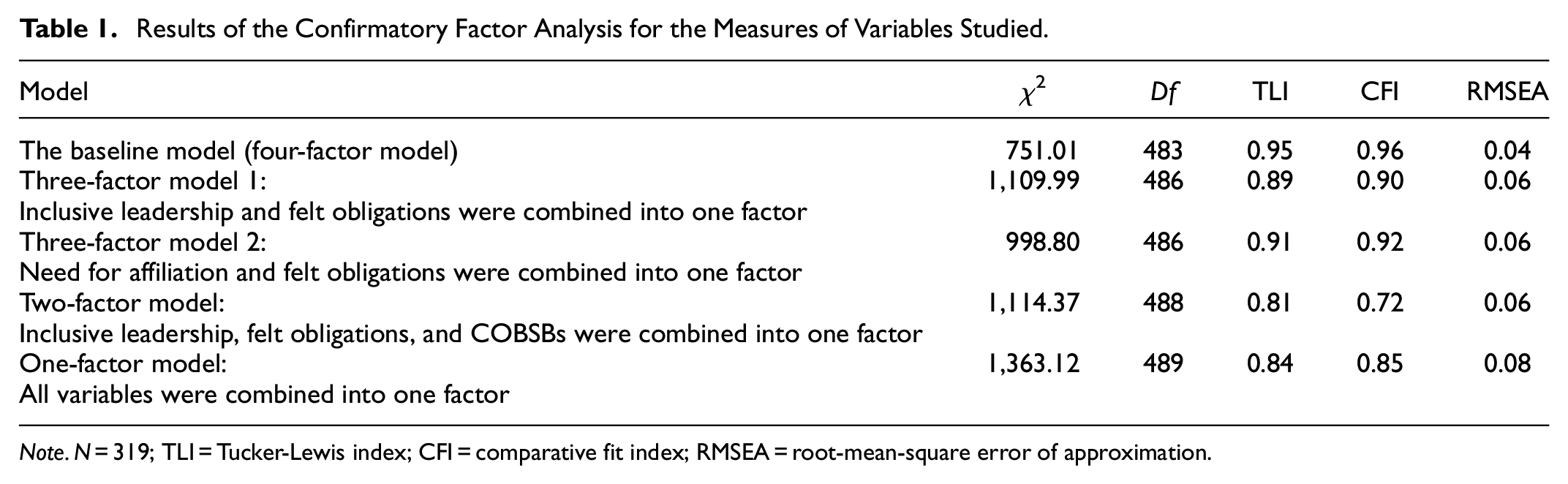
Note. N = 319; TLI = Tucker-Lewis index; CFI = comparative fit index; RMSEA = root-mean-square error of approximation.
Descriptive Statistics
The results in Table 2 revealed positive associations of inclusive leadership with felt obligations and COBSBs (r = 0.31, 0.22, p < 0.01). Moreover, felt obligations had a significant association with COBSBs (r = 0.32, p < 0.01). In addition, the average variance extracted (AVE) values of the four studied constructs were all higher than 0.50. Further, each construct’s square root of AVE value surpassed its correlation with other constructs, thereby providing supplementary evidence supporting the discriminant validity.
Means, Standard Deviations and Correlations of All Variables in the Study.

Note. N = 319; **p < 0.01 (two-tailed), *p < 0.05 (two-tailed); bracketed values on the diagonal are the square roots of the average variance extracted values of variables.
Testing of Hypotheses
Hierarchical multiple regression analyses were employed to test Hypothesis 1. Specifically, we regressed COBSBs on the control variables and inclusive leadership. As Table 3 shows, inclusive leadership was a significant predictor of COBSBs (β = 0.25, p < 0.01, Model 6), supporting Hypothesis 1.
Results of Hypotheses Testing.
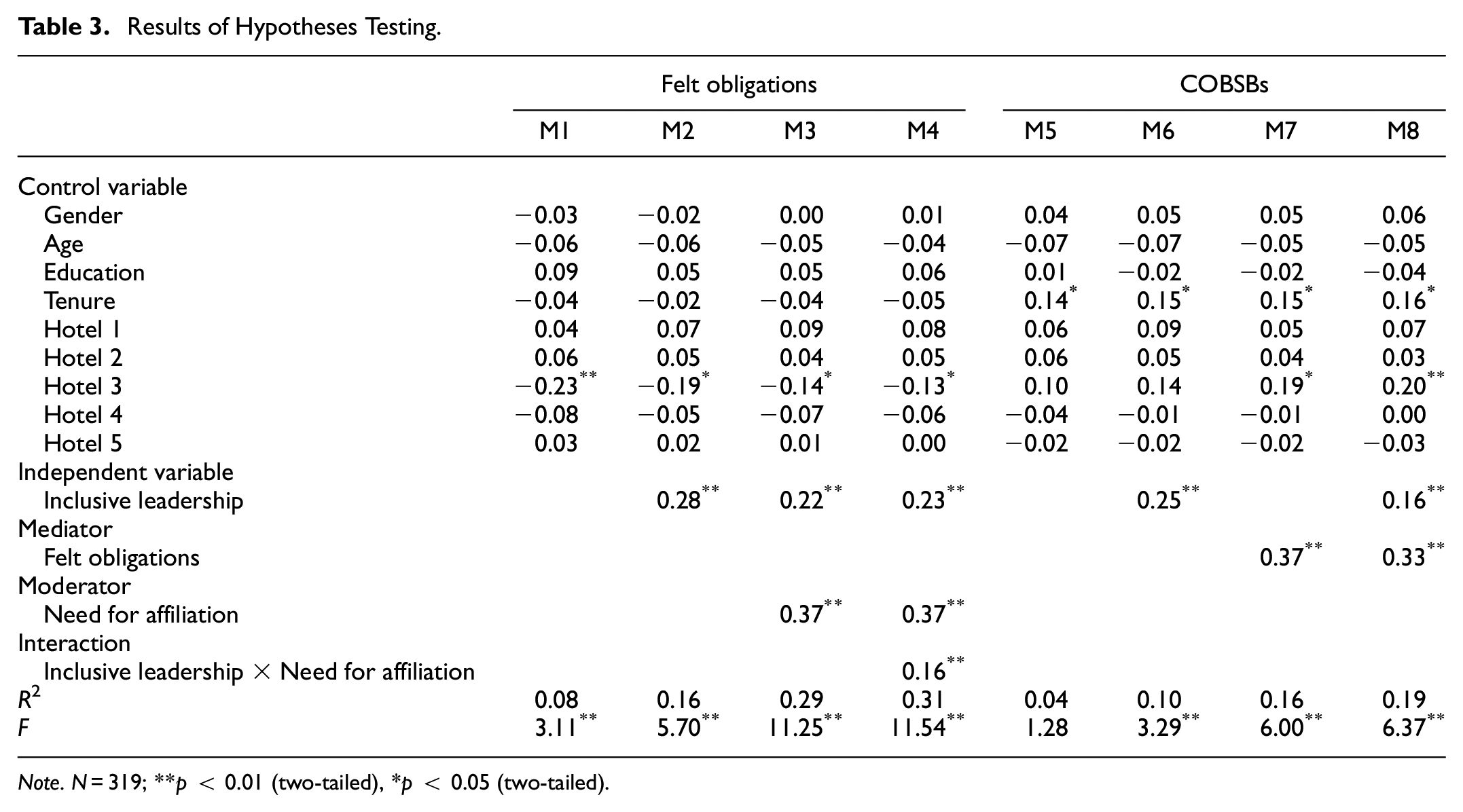
Note. N = 319; **p < 0.01 (two-tailed), *p < 0.05 (two-tailed).
To test Hypothesis 2, we first performed hierarchical regression analysis, following Baron and Kenny (1986). The results revealed that (1) inclusive leadership positively predicted COBSBs (β = 0.25, p < 0.01, Model 6); (2) inclusive leadership positively predicted felt obligations (β = 0.28, p < 0.01, Model 2); (3) felt obligations could predict the increased COBSBs (β = 0.37, p < 0.01, Model 7); and (4) when felt obligations was added to the model, the association of inclusive leadership with COBSBs was significantly reduced (β = 0.16, p < 0.01, Model 8) while felt obligations retained a significant association with COBSBs (β = 0.33, p < 0.01, Model 8). We also examined the significance of the mediation of felt obligations using the PROCESS macro (Hayes, 2013), based on a 5,000 resample bootstrapping procedure. As proposed, inclusive leadership predicted enhanced felt obligations (β = 0.22, SE = 0.05, p < 0.01). Moreover, inclusive leadership (β = 0.11, SE = 0.04, p < 0.01) and felt obligations (β = 0.24, SE = 0.04, p < 0.01) demonstrated positive associations with COBSBs. Furthermore, the results showed a significant indirect influence of inclusive leadership on COBSBs (indirect effect = 0.05, SE = 0.01, 95% CI = [0.0278, 0.0823]). Therefore, Hypothesis 2 was supported.
As Table 4 presents, the interaction of inclusive leadership with need for affiliation could predict the increased felt obligations (β = 0.23, SE = 0.07, p < 0.01). Moreover, as indicated in Figure 2, inclusive leadership’s influence on felt obligations was stronger among employees possessing high need for affiliation (β = 0.25, p < 0.01) than among those possessing low need for affiliation (β = 0.04, n.s.). Hence, Hypothesis 3 was evidenced.
PROCESS Results.
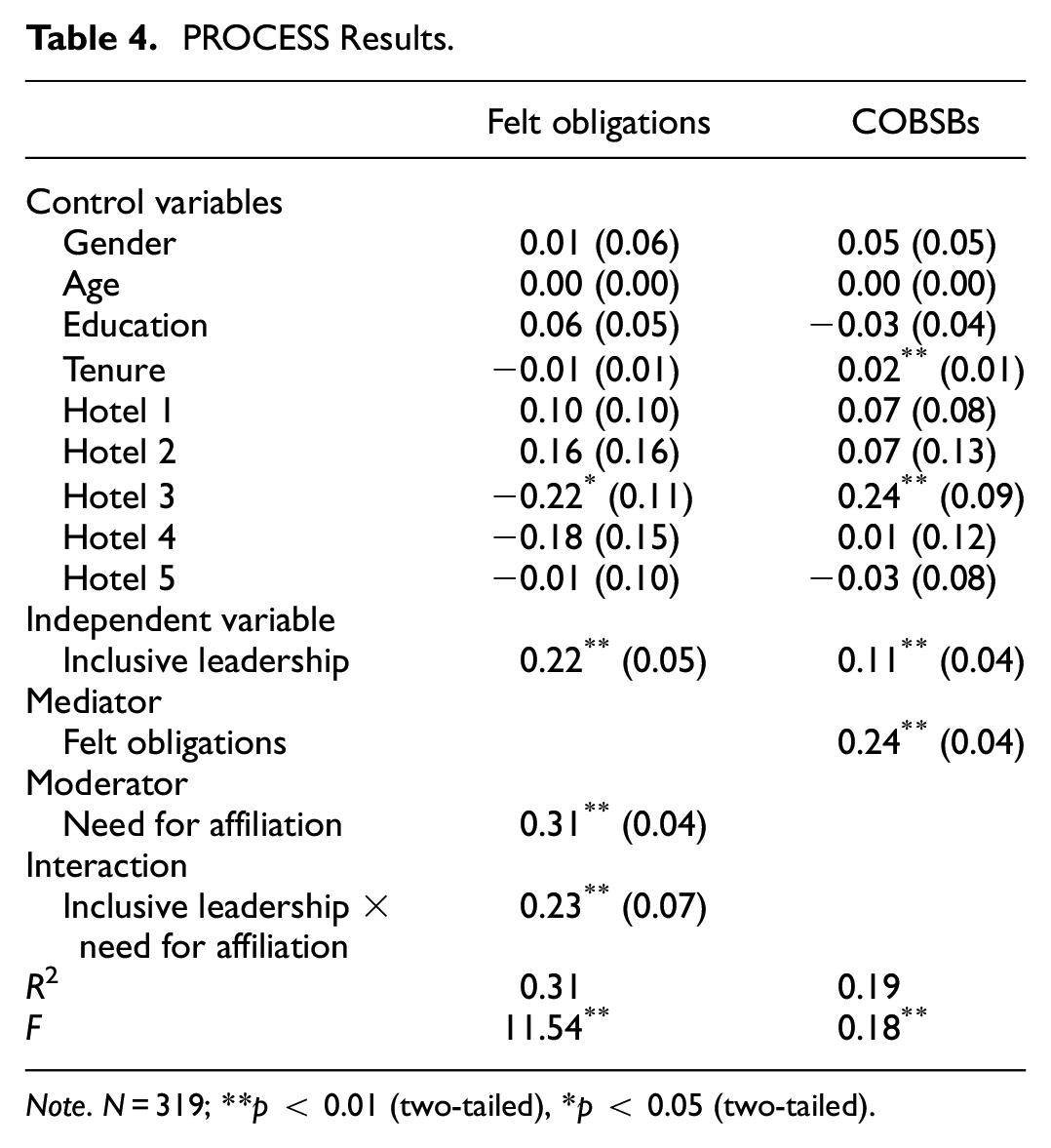
Note. N = 319; **p < 0.01 (two-tailed), *p < 0.05 (two-tailed).
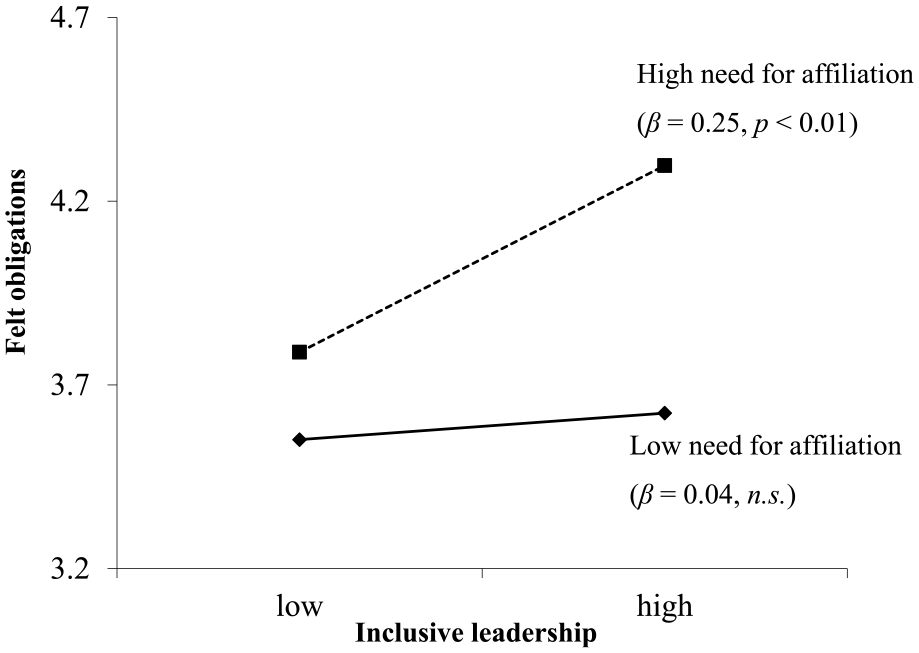
Interactive effect of inclusive leadership and need for affiliation on felt obligations.
Hypothesis 4 predicted a moderated mediating effect. The PROCESS results unveiled a significant indirect effect of inclusive leadership on COBSBs via felt obligations (index of moderated mediation = 0.05, SE = 0.02, 95% CI = [0.0142, 0.0984]). Specifically, the indirect effect was strong among employees possessing high need for affiliation (β = 0.09, SE = 0.02, 95% CI = [0.0525, 0.1349]) but not significant among employees possessing low need for affiliation (β = 0.01, SE = 0.02, 95% CI = [−0.0272, 0.0556]. Thus, Hypothesis 4 was supported (Table 5).
Conditional Indirect Effects of Inclusive Leadership on COBSBs at ±1 SD of Need for Affiliation.
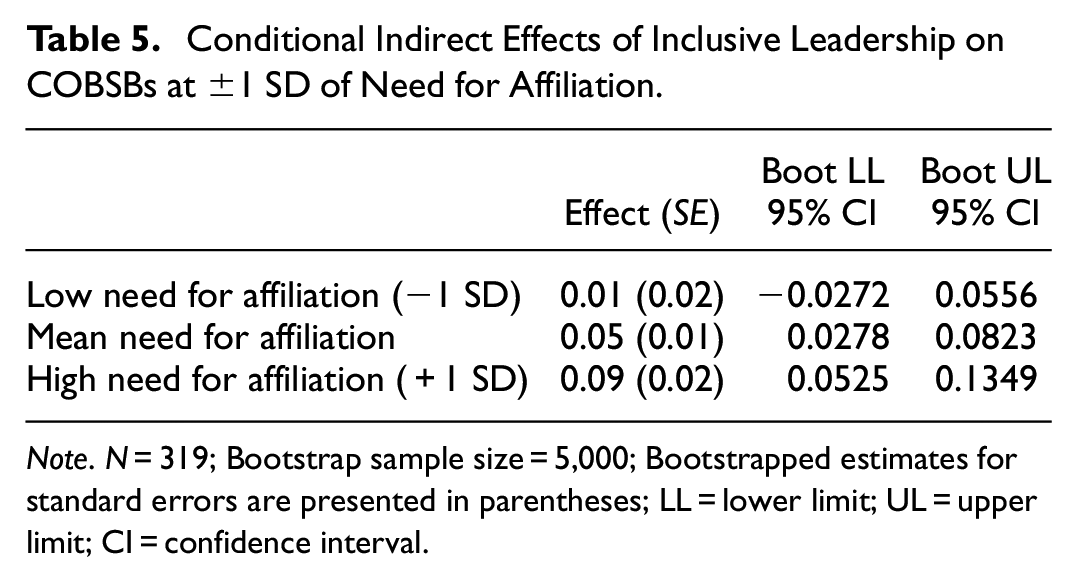
Note. N = 319; Bootstrap sample size = 5,000; Bootstrapped estimates for standard errors are presented in parentheses; LL = lower limit; UL = upper limit; CI = confidence interval.
Discussions
Recovering from the adverse impacts of the COVID-19 pandemic, tourism organizations are now in urgent need of restoring positive customer relationship and continuously improving their customer service (Farzanegan et al., 2021; Kimbu et al., 2023; Li et al., 2021; Prayag et al., 2023). As boundary spanners working at the customer-organization interface (Bettencourt et al., 2005), FSEs link customers with the tourism organization and their COBSBs, which incorporate both in-role (i.e., service delivery behavior) and extra-role service behavior (i.e., external representation behavior and internal influence behavior), contribute to the ongoing enhancement of customer service and the cultivation of strong customer relationships. Given the importance and comprehensiveness of FSEs’ COBSBs in tourism organizations, this study conducted a multi-phase survey to investigate the role of inclusive leadership in motivating FSEs’ COBSBs in the context of the tourism industry. By proposing a theoretical conceptual model based on SET, we found that inclusive leadership can promote FSEs’ COBSBs, and this relationship is influenced by felt obligations as a mediator and need for affiliation as a moderator. Specifically, inclusive leadership enhances FSEs’ felt obligations, which further promotes their COBSBs. Moreover, FSEs’ need for affiliation can strengthen the conducive influence of inclusive leadership. Inclusive leadership’s direct influence on felt obligations and indirect influence on COBSBs via felt obligations are both stronger among FSEs whose need for affiliation is higher.
Theoretical Implications
First, our study expands the understanding of COBSBs by incorporating inclusive leadership as an additional antecedent. While previous studies investigating the antecedents of employee COBSBs have dominantly focused on personality traits, workplace environments, and job characteristics (Chien et al., 2021; Jung & Yoon, 2020; Olorunsola et al., 2022; Trybou & Gemmel, 2016; Trybou et al., 2015), the effect of leadership has been underexplored. Currently, only three studies have examined the impact that spiritual leadership exerts on employee COBSBs (Bayighomog & Arasli, 2022; Bayighomog & Araslı, 2019; Farmanesh et al., 2021). This is unfortunate considering the well-established significance of leadership in predicting employees’ job behaviors (Ji et al., 2022; Lopez, 1980; Wu et al., 2013; Ye et al., 2022). Addressing this gap, this study identifies inclusive leadership as a critical factor that facilitates FSEs’ COBSBs. Our focus on inclusive leadership is of particular importance as this leadership style emphasizes leaders’ recognition of employees’ contributions and their willingness to provide support. This aspect is crucial for motivating FSEs to engage in COBSBs which require additional care and encouragement from organizations. By doing so, we provide further evidence to address the important research question of how leaders can contribute to motivating FSEs to engage in more COBSBs.
Second, our research findings also enhance the inclusive leadership literature by extending its employee behavioral outcomes to including FSEs’ COBSBs in the context of tourism industry. Many studies have paid attention to inclusive leadership and demonstrated its effect on employees’ behavior, such as OCB (Tran & Choi, 2019), taking charge behavior (Q. Wang et al., 2020), voice behavior (Jolly & Lee, 2021; Weiss et al., 2018), innovative work behavior (Siyal et al., 2021), knowledge sharing behavior (Lee & Lu, 2022), and helping behavior (Randel et al., 2016). However, above mentioned employee behavioral outcomes are quite isolated and none of them are targeted at customers, organizations, and co-workers simultaneously. After systematically reviewing inclusive leadership literature, Korkmaz et al. (2022) called for more comprehensive and context-specific theory development for future research in employee behavioral outcomes of inclusive leadership. Our paper responds to their concerns to some extent, as this study focuses on FSEs’ COBSBs, characterized as comprehensiveness for including both in-role and extra-role behaviors and targeting at customers, organizations, and co-workers simultaneously, in the specific context of tourism industry.
Third, our study contributes by proposing a social exchange relationship model to explain the effects that inclusive leadership exhibits on FSEs’ COBSBs. Building upon SET, we propose that employees’ felt obligations play a crucial mediating role. Specifically, when exposed to inclusive leadership, employees develop a heightened sense of obligation to engage in COBSBs as a reciprocal response to perceiving that their organization genuinely values and cares for them. This perspective provides valuable insights into how inclusive leadership translates into employees’ COBSBs within the tourism industry, enabling a deeper understanding of the motivation behind these behaviors. Moreover, by introducing felt obligation as a mediator, we offer additional support for the effectiveness and significance of SET in comprehending the influence of inclusive leadership (Ahmed et al., 2020; Choi et al., 2015). This contribution is pivotal for advancing research on inclusive leadership.
Lastly, this study contributes by identifying the moderating impact that employees’ need for affiliation has on the influence of inclusive leadership on FSEs’ COBSBs. Specifically, our findings indicate that under inclusive leadership, FSEs possessing high need for affiliation will experience stronger feelings of obligation, which further leads to the demonstration of high-quality COBSBs. To the best of our knowledge, only one paper has explored the boundary condition (employee self-esteem) of leadership in relation to inducing employee COBSBs (Farmanesh et al., 2021). Complementing existing studies, our study focuses on employee need for affiliation and demonstrates its potential to enhance the positive influence of inclusive leadership. Such finding reinforces the notion that individual differences are likely to impact employees’ responses to leadership (Lv et al., 2022), thus addressing another significant research question regarding which types of employees, under inclusive leadership, are more likely to exhibits high-quality COBSBs.
Managerial Implications
Given the significance of inclusive leadership in fostering COBSBs, we propose several recommendations for tourism organizations to enhance the development of inclusive leadership. Firstly, tourism organizations should leverage diverse recruitment tools, such as situational tests and psychological assessments, to identify leader candidates who demonstrate a prioritization of others’ needs, perspectives, and contributions. Secondly, tourism organizations should emphasize the importance of inclusion-related efforts. Leaders should be guided and supported in adopting inclusive behaviors and encouraged to actively engage in relevant practices. Thirdly, tourism organizations can implement a tailored and comprehensive training program for leaders, specifically focusing on developing inclusive leadership skills. The training curriculum could encompass various topics, including human relations and human orientation, aiming to guide leaders in demonstrating care, respect, and attentiveness toward their followers. Effective communication techniques, such as active listening and open dialog, should also be emphasized. Fourthly, tourism organizations could create a digital platform where leaders and employees can share their experiences regarding inclusive leadership practices. This platform would serve as a valuable space for leaders to share their practices, such as demonstrating availability when their followers encounter challenges. Additionally, employees can contribute by sharing their experiences and feelings, highlighting instances where they felt supported by their inclusive leaders. By implementing these recommendations, tourism organizations can foster an inclusive leadership culture, ultimately facilitating the development of COBSBs among employees.
Moreover, our research findings highlight the significant influence of FSEs’ felt obligations on COBSBs and emphasize the role of felt obligations in translating inclusive leadership into COBSBs. Based on these findings, we suggest that tourism organizations should promote the cultivation of FSEs’ sense of responsibility toward organizations. To this end, tourism organizations can provide appropriate incentives and resources to their employees. This can include offering work assistance, providing job-related skill training opportunities, and implementing employee incentives plans (Cheng et al., 2022). By demonstrating their commitment to supporting employees, organizations can reinforce the perception that FSEs’ contributions are valued and appreciated. Furthermore, to further validate FSEs’ perspectives and contributions, tourism organizations can empower FSEs with decision-making authority in the workplace and expand their participation in relevant activities (Wikhamn & Selart, 2019). By doing so, organizations can strengthen FSEs’ belief in organizational support, thereby further enhancing their felt obligations to engage in COBSBs.
Finally, our paper suggests that FSEs possessing high need for affiliation are more probable than others to be affected by inclusive leadership. To optimize the positive effect of inclusive leadership, leaders should pay special attention to FSEs with high need for affiliation and demonstrate more inclusiveness to promote their COBSBs. Additionally, because employees possessing low affiliation needs are less driven by inclusive leadership, leaders should adopt alternative approaches to activate their felt obligations to delivery COBSBs. Possible solutions could include training service employees to attach importance to their job and align their personal goals with organizational goals.
Limitations and Future Research Directions
First, while we employed data from two different sources at three time points, and factor analysis demonstrated that common method variance (Podsakoff et al., 2003) was not significant, the results in this study may still be biased because the data on inclusive leadership, need for affiliation, and felt obligations were all reported by FSEs. To further reduce the impacts of common method bias, subsequent studies could measure inclusive leadership using an aggregation of all team members’ evaluations and empirically analyze it at the team level.
Second, given that our data were gathered in China, it is important to acknowledge that generalizing our findings to Western nations may be challenging. Due to the significant power distance that defines Chinese culture (Yang, 1993), Chinese FSEs may be less sensitive to inclusive leader behavior. Subsequent studies could conduct cross-cultural research or control for cultural variables to confirm the generalization of our findings.
Third, although our results have provided strong support for the beneficial influence that inclusive leadership exhibits on COBSBs among FSEs, we do not know whether inclusive leadership would exert the same effects when controlling for the effect of spiritual leadership, which has been identified by previous studies (Bayighomog & Arasli, 2022; Bayighomog & Araslı, 2019; Farmanesh et al., 2021). Hence, future studies are encouraged to measure inclusive leadership and spiritual leadership in the same time point and control for spiritual leadership when testing hypotheses. This would provide valuable insights into the specific effects of inclusive leadership and help figure out the different impacts of different types of leadership.
Finally, although our results confirmed that felt obligations is a significant mediator transferring inclusive leadership to COBSBs, there may be other mediating mechanisms that can explain the processes through which inclusive leadership operates. Accordingly, we advocate subsequent research to discover the inclusive leadership-COBSBs association based on alternative theoretical foundations. For example, by showing openness, accessibility, and availability, inclusive leadership provides abundant resources (Hobfoll, 1989) to service employees. Such resources may lead service employees to engage more in customer-oriented service and thus exhibit a higher level of COBSBs. Examining such resource-based perspectives can provide a more comprehensive understanding of how inclusive leadership influences FSEs’ COBSBs.
Footnotes
Declaration of Conflicting Interests
The author(s) declared no potential conflicts of interest with respect to the research, authorship, and/or publication of this article.
Funding
The author(s) disclosed receipt of the following financial support for the research, authorship, and/or publication of this article: This work was supported by the National Natural Science Foundation of China (Grant No. 72102148); Natural Science Foundation of Guangdong Province (2023A1515011012), and Shenzhen Natural Science Fund (the Stable Support Plan Program No. 20200810161833001).
