



Abstract
In the hospitality sector, it is often believed that giving more power to customers (e.g., “the customer is king”) would enhance the service quality, customer satisfaction, and organizational performance. However, it can cause a backlash by excessively elevating the level of the customers’ perceived power, which could result in their power abuse against the employees. Based on the organizational support theory, this research argues that balancing the level of power between the customers and the employees (vs. shifting the power to the customers) can be more effective for improving the perceptions of both the current and the potential employees. The argument is empirically supported by the findings from three studies, which showed that adopting a power-balancing message positively affects the current employees’ perceived organizational support and motivates them to feel obliged to give back to the organization and also potential job applicants’ organizational attraction and the job pursuit intention.
Introduction
In the hospitality industry, one of the commonly used marketing slogans is “the customer is king,” which represents the promises of superior service quality for the customers (Min et al., 2019). By shifting the power to the customers and pushing the service employees to commit to providing a superior service quality, the use of these types of messages has been expected to bring greater customer satisfaction and ultimately organizational performance (He et al., 2011). However, it needs to be used with caution, because it can cause a backlash of excessively elevating the level of the customers’ perceived power, which can instigate unethical behaviors like putting feet on the chairs or dropping cigarette ashes on the floor at a cafeteria or a restaurant (Van Kleef et al., 2011). Recently, more severe forms of customer behaviors like mistreating service employees are increasing as the weight of the power further shifts toward the customers. For example, there have been a series of incidents in Korea where the customers mistreated the service employees by demanding to be served as their superiors or were even violent toward the employees. These types of aggressive behaviors by the customers negatively influence the employees by causing emotional exhaustion and a higher turnover intention (Huang & Miao, 2013; Karatepe, 2011a; Kim & Qu, 2018). Thus, understanding the consequences of the power imbalance between the customers and the service employees and finding solutions to such backlashes are becoming imperative both from the academic and practical perspectives.
In an attempt to address the issues that are caused by the presence of a power imbalance in the hospitality sector and to prevent the customers’ abuse of power, a Korean restaurant chain recently implemented an in-store policy of posting an announcement, which is called “A Guideline for the Fairness in Service” at the entrance of its stores. The policy states that any customers who mistreat their employees would be asked to leave the store, balancing the weight of power between the customers and its employees. This decision raised much media attention, because it goes against the common practice in the hospitality sector of granting more power to the customers. When we interviewed the CEO of this restaurant, which first adopted a power-balancing message (PBM) in Korea, 1 she insisted that the employees’ satisfaction increased and the service quality was enhanced after implementing a PBM, because the employees were putting extra effort into their positions. Furthermore, she noticed that the company had more highly talented job applicants as the company gained a positive reputation as a great place to work. If her arguments were indeed true, it would be reasonable for other service companies to adopt a PBM as well. However, the practitioners are still reluctant to adopt a PBM because they perceive a PBM as being less customer-oriented and further believe that it would lead to decreases in the service quality and customer satisfaction. 2 Thus, it is necessary to investigate the effectiveness of the power-balancing approach (i.e., balancing out the power between the customers and the service employees) from both the theoretical and managerial perspectives. Still, there is little literature that investigated the effect of the power-balancing approach on the service employees from a theoretical perspective. Hence, the goal of this research is to address this research gap and find a theoretical framework that explains the impact.
In this research, we draw on the organizational support theory (Kim et al., 2016) and suggest that the power messages influence the service employees by shifting their perceived organizational support (POS). POS refers to the extent to which employees perceive that an organization cares about their well-being and acknowledges their contributions (Rhoades & Eisenberger, 2002). The organizational support theory states that the employees’ POS positively influences the employees’ and organizational performances by enhancing their affective commitment (Kim et al., 2016).
Recent studies have investigated the various antecedents of POS and showed that an employees’ POS can be driven by factors, which include the recognition of support from supervisors (Kurtessis et al., 2017) or the perception of organizational fairness (DeConinck & Johnson, 2009). However, these antecedents are mainly restricted to the intraorganizational relationships—in other words, enhancing POS by focusing on the relationships within the organizational structure. In this study, we take a step further by suggesting that POS can also be triggered by focusing on the relationships outside of an organization, which includes the relationship between the employees and the customers. Specifically, we predict that the utilization of power messages that contain information about the power between the customers and the employees would influence the employees by shifting their POS. In addition, according to the reciprocity principle from the social exchange theory, we predict that the employees with a high POS would also be more likely to feel obligated to give back to the company by committing to the company’s performance and provide better services for the customers (Eva et al., 2018).
Meanwhile, we further predict that a PBM would have a positive effect on the job recruitment and create a positive company image and reputation, which are both positive signals for the potential applicants (DeConinck & Johnson, 2009; Kurtessis et al., 2017). Prior literature showed that the job applicants tend to be strongly attracted to and have a greater intention to pursue an opportunity with an organization that has a positive reputation (Chapman et al., 2005). We argue that the use of power messages can contribute to enhancing an organization’s reputation, which allows companies to benefit from securing high-performing applicants (Aiman-Smith et al., 2001) and reinforcing the service quality. Despite these reasonable inferences, to the best of our knowledge, there is no research that empirically tested the effect of PBM on the employees’ response and job.
Given the above discussion, the objective of this research is twofold. First, we aim to investigate how the current employees in the hospitality industry respond to the power message focused on attaining a balance in power between the employees and the customers. We posit that PBM would positively affect the employees’ POS and felt obligation to give back to the companies. Second, we further examine the impact of the power message on the potential job candidates’ responses. We predict that the prospective job applicants exposed to PBM are more likely to be attracted to the organization and have a greater intention to apply to the company in the future. With these goals, we contribute to the existing literature by showing the role of PBMs as a new form of antecedent that influences the perception and the attitude of the service employees in the hospitality sector.
Conceptual Background and Hypotheses Development
Psychological Power
Psychological power is defined as the perception of “asymmetric control over valued resources in social relations” (Magee & Galinsky, 2008, p. 1451). Past research has shown that the individuals’ perception of how much power they have can be situationally primed using different methods including exposure to power-related words (Galinsky et al., 2008), power-related role-playing tasks (Hashimoto & Karasawa, 2018), and the recall of recent power-related experiences (Min & Kim, 2013). For example, one of the seminal research studies on power by Galinsky et al. (2008) showed the participants 15 word-fragments and asked them to complete each word fragment with the first word that comes to mind. Five words among the 15 words shown to those in the high power condition were power-related (e.g., authority, boss, control, influence), whereas those in the control condition saw words unrelated to power (e.g., automobile, bass, envelope, bookmark). Hashimoto and Karasawa (2018) situationally manipulated power by having the participants play the role of either a judge or a worker where the worker had to perform the task given by the judge and the judge assesses the performance. Similarly, Min and Kim (2013) primed power by asking the participants to write about a specific situation where they had power over others (high power condition) or others had power over them (low power condition). Prior research further showed that even subtle information, such as a power message (e.g., “customers are always right”) on a menu or advertisements can prime the customers’ perception of power and influence their responses to the services (Min et al., 2019).
Prior literature showed that the individuals’ perception of power shapes the individuals’ judgments, decisions, and behaviors (Choi et al., 2018). For instance, Sembada et al. (2016) showed that people with high (vs. low) power tend to engage in self-oriented information processing and are more likely to be overconfident about their knowledge and skills. The authors showed that these people (i.e., those with high perceived power) are also more likely to adhere to their stereotypes as opposed to listening to others’ opinions and advice when making decisions. High perceived power can also decrease empathy for others, which makes people reluctant to take the perspectives of others (Galinsky et al., 2006). Subsequently, they are more likely to break social rules, such as engaging in cheating behaviors (Lammers et al., 2010). When customers perceive a greater power within their relationships with service employees, they are more likely to look down and command over them, which leads to power abuse (Guerrier & Adib, 2000).
Especially in the hospitality industries, understanding the results of psychological power perception is imperative because the interpersonal relationships between the service employees and the customers where the power is perceived are the key component that determines a company’s success (Ryu & Lee, 2013). Recent studies showed that the customer responses to service failures differ depending on the level of power they perceive. For instance, Min et al. (2019) showed that the consumers who are primed with low (vs. high) power tend to hesitate to complain about service failures, because they are more sensitive about social relationships. They are more likely to feel uncomfortable about taking social costs, such as giving bad impressions to their relationship partners, so they subsequently suppress their anger. Conversely, Sembada et al. (2016) revealed that people with high (vs. low) power are less likely to seek revenge or compensation after a single but not multiple service failure, because they evaluate the consequences of service failures to be less severe.
The existing literature showed the importance of psychological power in the hospitality setting, but these studies were mainly focused on how customers responded following power perception. They were relatively silent about how the service employees are influenced by the perception of power. Furthermore, this stream of literature was mainly focused on the situation where there is an imbalance of power between the consumers and the employees. Thus, in this research, we shift the focus to the employees’ perspectives as the service employees are the key elements of a successful hospitality operation (He et al., 2011). Also, we investigate how the employees’ responses would differ if they perceive a balanced rather than imbalanced power between themselves and the customers. Among the various antecedents of perceived power, we focus on the effect of the message frame as a situational prime that temporarily affects the individuals’ perception of power. Specifically, we examine how in-store communication messages that emphasize a balance in power between the customers and the employees (i.e., PBM) or those stressing the shifting the weight of power to customers (i.e., power-lowering messages [PLM]) influence the employees.
In the next section, we consider employees’ perception of the organizational support as a key mechanism that drives the effect of power messages.
Current Employees’ Responses to Power Messages
One of the ways that power messages influence the service employees is by changing their POS, employees’ perception of how much they think their organizations value them and care about their welfare (Rhoades & Eisenberger, 2002). According to the organizational support theory, POS increases the employees’ attitude toward the organization and the employees’ performance (Sun, 2019), and also decreases the turnover intentions (Karatepe, 2011b). Specifically, the theory suggests that the employees with a high POS are more likely to feel obligated to contribute to their organizations in return for the support they receive (Eva et al., 2018). This sense of reciprocity would enhance the employees’ performance, which subsequently would improve the organizational performance (Karatepe, 2011b).
Because of the importance of POS as a key driver of the organizational performance, a lot of prior literature has investigated the various antecedents of POS (Kurtessis et al., 2017; Sun, 2019). Among the antecedents studied by the existing literature, two common dimensions that appear across the studies are the employees’ perceptions of the supervisor support and the fairness. The perceived supervisor support refers to the employees’ perception of how well the supervisors recognize the employees’ contributions (Kurtessis et al., 2017), whereas the perceived fairness refers to the perception of how fair the organization is regarding distributing outcomes or interacting interpersonally (DeConinck & Johnson, 2009). For instance, Kurtessis et al. (2017) suggested that the employees’ POS is mainly determined by their perceptions of how well they are treated by their supervisors or coworkers, how many developmental opportunities the organization provides, or how fairly they are treated by their organizations.
However, the categories of antecedents studied in the past literature are both limited to the intraorganizational relationship. That is, the antecedents that were studied in the prior literature mainly focused on the interaction within an organization—for example, between the supervisors and the employees or among the employees. In this research, we further suggest that POS can also be enhanced by a trigger present in the relationship between the customers and the employees. Specifically, we predict that the power messages communicated to customers can further increase the employees’ POS as a new form of an antecedent.
Power messages, especially messages used to communicate a balanced power in customer–employee relationships (i.e., PBM), are closely related to the antecedents studied in the previous literature on POS (Kurtessis et al., 2017). On one hand, PBM can be considered as a form of supervisor support by engendering the employees’ perception that their supervisors value and respect them (DeConinck & Johnson, 2009; Rhoades & Eisenberger, 2002). Especially, employees are more likely to think that their organizations support them if the PBM comes directly from their supervisors because their supervisors are often considered personifications of the organization (Guchait et al., 2015). Thus, when the employees are aware of the implementation of PBM rather than PLM in their daily workplaces, they would be more likely to form a greater POS because PBM would be received as a signal of the organization showing support for its frontline service employees.
At the same time, PBM can also act as a signal of organizations’ efforts to pursue fairness, another determinant of POS. Prior literature showed that the employees perceive the level of fairness in their organizations based on three types of justices: distributive, procedural, and interactional justices (Rhoades & Eisenberger, 2002). Distributive justice refers to the equity of the outcome allocation, whereas procedural justice refers to fairness in the process that outcomes are distributed (e.g., employees’ participation). Also, interactional justice involves fairness with the interpersonal treatment, or the way employees are treated by the management (DeConinck & Johnson, 2009). In particular, PBM is closely related to the interactional justice, because PBM itself is focused on communicating how the employees should be treated from the interpersonal interactions. However, it differs from the original definition of perceived fairness because PBM involves the fairness in an interpersonal treatment, which the employees receive from the customers but not from the management. Therefore, it is necessary to investigate how this type of shift in focus influences the employees’ POS. Given the above discussion, we reach the following hypothesis.
Given the above discussion, we reach the following hypotheses.
PBM would further influence the degree of obligation that the employees feel about helping their organization to achieve its missions and goals. Specifically, PBM increases the individuals’ POS, which involves a cognitive perception of how much support they think they are receiving from the organizations, and this, in turn, generates an affective-laden mind state that motivates them to take more actions for organizational performance (Kim et al., 2016). Past research showed that POS has a positive impact on the affective commitment and the felt obligation as important predictors of the employees’ performance (Eva et al., 2018; Moon et al., 2013). Such findings align with the social exchange theory, which shows that an indebted employee feels a sense of duty to return a favor to the organization (Kurtessis et al., 2017). The effect of PBM on the felt obligation can occur through a different route. Yoo (2017) showed that the frontline employees feel more empowered to deal with the customers when the customers’ perceived power is low (vs. high) in a service relationship. This sense of empowerment further increases the employees’ affective commitment (Chiang & Jang, 2008) and ultimately the job performance (Tsui et al., 2013). Given that felt obligation is driven by the employees’ affective commitment (Kim et al., 2016), we infer that PBM can positively affect felt obligation. This leads to the following hypothesis.
Potential Employees’ Responses to Power Messages
Power messages that are communicated both within and outside an organization influence the perceptions of the potential job applicants as well as the current employees. Past research on the job recruitment has considered two types of dependent variables to understand the potential employees’ responses toward an organization, which include the organizational attraction and the job pursuit intention (Klimkiewicz & Oltra, 2017; Kumari & Saini, 2018). The two constructs are seemingly similar, but they are conceptually and empirically distinct (Aiman-Smith et al., 2001). The organizational attraction reflects the potential candidates’ attitudes toward an organization and is closely related to the organizational images and the reputations formed through an organization’s corporate social responsibility (CSR) activities, policies on diversity, or support for cultural activities (Kumari & Saini, 2018; Moorthy et al., 2017). On the other hand, the job pursuit intention reflects the potential employees’ intention to actively participate in the job recruitment process. It is directly influenced by the instrumental factors or the utilitarian factors, such as the economic benefits (e.g., expected pay, compensation, and benefits), the promotion opportunities, the location, and the working conditions (Chang & Wang, 2019). Given that attitude has often been employed as a predictor of behavior in past research, the organizational image and the reputation are likely to affect the job pursuit intention indirectly through the organizational attraction.
In this research, we propose that both the organizational attraction and the job pursuit intention would be positively influenced by utilizing a PBM as opposed to a PLM. The effect of PBM on the potential employees is mainly driven by its influence on the corporate image and reputation, because an organization’s attempt to resolve issues that involve the customers’ power abuse by adopting a PBM would be received by the job candidates as an act of CSR that contributes to the welfare of its employees (Aksak et al., 2016). Past research showed that CSR activities act as positive signals that convey the organization’s focus on ethical values that attract job applicants with high regard for social values (DeGrassi, 2019; Osburg et al., 2020). This is consistent with the social identity theory, which states that people tend to maintain and enhance their identity by belonging to a group with a positive social image (Kumari & Saini, 2018). In the context of job recruitment, a CSR activity that uses a PBM would be an effective strategic tool to develop an image that an organization is a great workplace for its employees (Ibrahim, 2017; Vercic & Coric, 2018). Such a reputation would rapidly spread out among the current employees (including job recruiters) who are affectively attached to their organizations (Eger et al., 2019). Subsequently, the job applicants would be exposed to information about a good working environment and have a greater intention to apply for a position at the organization (Aiman-Smith et al., 2001).
In sum, the organizational image and reputation would drive the effect of the organizational attraction on the job pursuit intention. Past research argued that there are three entities (i.e., people, community, and the natural environment) that are related to CSR practices in determining organizational attraction and that CSR practices associated with people (e.g., employees) particularly have the greatest impact on the job pursuit intent (Kumari & Saini, 2018; Lis, 2012). Adopting a PBM may be considered as a form of CSR practices closely related to both the current and the potential employees of an organization.
Meanwhile, as discussed above, the job pursuit intent as a behavioral construct can be directly driven by working conditions, such as the employees’ perception of safety and autonomy in a workplace (Aiman-Smith et al., 2001). PBM can send a signal to the potential job candidates that they are protected from the customers’ power abuse, and they would be able to work in a safe and comfortable environment. Moreover, the job candidates exposed to a PBM (vs. a PLM) are more likely to perceive that the organization empowers and gives autonomy to its employees in dealing with the customers, having a greater intention to pursue a job at the organization. Given the above discussion, we derived Hypothesis 3 and Hypothesis 4 below.
Overview of Studies
We test the four hypotheses through three studies. In Study 1, we examine the influence of the power message frames on the current employees’ POS and their felt obligation toward the organization (Hypothesis 10 and Hypothesis 20). Specifically, we conducted a survey using the actual employees of a restaurant that has adopted PBM. In Study 2, we further confirm the predictions for Hypothesis 10 and Hypothesis 20 with the participants who have not been previously exposed to power messages at their workplaces. By doing so, we examine if the situationally priming the perceived power of the employees still brings the same influences on POS and felt obligation. In Study 3, we investigate the consequences of adopting a power message among potential job applicants (Hypothesis 30 and Hypothesis 40). By examining how both the current employees and the potential job applicants respond to a power message, we take a broader view in understanding the role of power messages with the employee management. Figure 1 summarizes the research model and the hypothesized relationships.

Proposed Research Model
Study 1
The objective of Study 1 is to examine whether the current employees’ POS and their felt obligation toward the organization are influenced by the power message (Hypothesis 10 and Hypothesis 20). To do so, we conducted a survey that involved the current employees at a Korean premium bento-box restaurant chain, which first adopted PBM.
Procedure
A total of 67 current employees of the restaurant (47.8% male) participated in the survey. 3 The participants were asked to fill out a survey that consisted of two sections. In the first section, the participants were first shown “A Guideline for the Fairness in Service” posted on the walls of every store (see appendix, Figure A1). The guideline contained a PBM such as any customers who mistreat the employees would be asked to leave. After reading the message, they answered questions on their perception of psychological power, POS, and felt obligation toward an organization. In the subsequent section, the participants were asked to imagine that the company has decided to adopt a new message titled “A Guideline for the Outstanding Service.” The guideline contained a PLM that included it would treat its customers as its superior. 4 After reading the message, participants answered the identical set of questions as the first section.
For all of the items used in this study, the participants indicated the extent to which they agreed with each item using a 5-point Likert-type scale. All items were modified to reflect a more specific context of hospitality. The perceived level of psychological power was measured using three items from Sembada et al. (2016; e.g., “I am feeling powerful when I am providing service to the customers”). The responses for the three items were averaged to create index scores for both PBM and PLM. The POS was measured using four items from Rhoades et al. (2001; e.g., “My organization really cares about my well-being”). The responses for the four items were averaged to create index scores for both PBM and PLM. Last, the felt obligation toward their organization was measured using three items from Eisenberger et al. (2001; e.g., “I feel a personal obligation to do whatever I can to help my company to achieve its goals”). The responses for the three items were averaged to create index scores for PBM and PLM. The list of all items used and the Cronbach’s α in Study 1, Study 2, and Study 3 are shown in appendix, Table A1.
Results
A repeated-measures analysis of variance (ANOVA) on the perceived psychological power was conducted to examine whether the employees’ perception of power shifted with the change in the power message. The analysis results revealed that the employees perceived a greater level of psychological power when they are exposed to a PBM compared with a PLM, MPBM = 3.552, MPLM = 3.040, F(1, 66) = 23.716, p < .001. Next, a repeated-measures ANOVA on POS was conducted to test Hypothesis 10. The analysis results revealed a significant main effect of the power frame of the message on the employees’ POS, F(1, 66) = 19.530, p < .001. Specifically, the current employees perceived a greater level of POS when they are exposed to a PBM (MPOS = 3.511, SD = 0.903) compared with a PLM (MPOS = 2.981, SD = 0.958). Similarly, a repeated-measures ANOVA on the degree of felt obligation was conducted to test Hypothesis 20. The analysis results revealed a significant main effect of the power frame of the message on felt obligation, F(1, 66) = 1528.241, p < .001. Specifically, the current employees perceived a greater level of obligation when they are exposed to a PBM (MPBM = 3.552, SD = 0.728) compared with a PLM (MPLM = 3.040, SD = 0.890). Thus, both Hypothesis 10 and Hypothesis 20 were rejected.
Discussion
The results of Study 1 show that the use of PBM (vs. PLM) can incur a greater level of perceived POS and felt obligation among the current employees. In particular, we collected and analyzed the responses of the actual employees in the hospitality industry to different power messages, which secured a high external validity. However, although null hypotheses Hypothesis 10 and Hypothesis 20 were both rejected, it is necessary to replicate our findings in an experimental setting to add theoretical rigor. Furthermore, it is possible that the difference in POS and felt obligation may have been influenced by their long exposure to the PBM, because we used the current employers of a company that has been using a PBM as the sample for Study 1. This may have formed a chronically higher level of perceived power among the participants. Thus, it is necessary to confirm if the effect of power message is still significant among the participants who have not been exposed to the PBM. In order to address these issues, we examine the effects of power message using a between-subjects design using a group of participants from companies that do not utilize power messages.
Study 2
The goal of Study 2 was to test Hypothesis 10 and Hypothesis 20 using a between-subjects design for further support. Specifically, we examine the effect of power message on the employees’ perceptions while controlling for the effect from their potential exposure to power messages.
Procedure
Sixty-nine participants who are currently working at companies in various sectors (59.4% male) were recruited to take part in the survey. The participants were randomly assigned to one of the two experimental conditions for the power message frame (PBM vs. PLM). They were first asked to imagine that there is a communication message posted on the walls of their workplace. We used the same power message from Study 1 as the situational prime for each condition of the power message frame. After reading the message, the participants answered a set of questions regarding their perceptions of the psychological power, POS, and felt obligation using the same items from Study 1. Last, we collected the basic demographic information including their job positions and the sector they are working in. We also asked whether the organizational culture at their current companies emphasizes giving the highest priority to serving customers’ interests versus treating the customers and the employees equally (7 point scale; 1—My company gives the highest priority to fulfilling customers’ interests, 7—My company treats employees and customers equally) as a control variable (M = 3.45, SD = 1.334).
Results
As a manipulation check, a one-way analysis of covariance (ANCOVA) on the perceived power with the type of organizational culture as a covariate was conducted to assess whether the participants’ perceived level of power differed depending on the type of power message they read. A covariate was added in the analysis to control for the potential influence that the type of organizational culture that the participants’ current employers may have. The analysis results showed that those who read a PBM (vs. PLM) perceived a greater level of power, MPBM = 4.16, SD = 0.454; MPLM = 2.15, SD = 1.045; F(1, 66) = 92.678, p < .001. The main effect of the covariate was not significant, F(1, 66) = 0.016, p = .881. Furthermore, the type of organizational culture did not differ across the manipulation conditions, F(1, 67) = 2.779, p = .100, which confirmed that the participants’ previous exposure to power did not differ. Thus, the manipulation of the perceived power was successful.
Next, we tested Hypothesis 10 and Hypothesis 20 to confirm our findings from Study 1. The results from a one-way ANCOVA on POS with the type of organizational culture as a covariate revealed a significant effect of power message on the potential employees’ POS, F(1, 66) = 145.327, p < .001. The main effect of the covariate was not significant, F(1, 66) = 0.0002, p = .986. Specifically, the participants perceived a greater level of support from the organization when exposed to a PBM (MPBM = 4.15, SD = 0.515) than a PLM (MPLM = 1.98, SD = 0.857). Similarly, a one-way ANCOVA on felt obligation with the type of organizational culture as a covariate further revealed that those who read a PBM expected the employees to feel more obligated toward the company compared with those who read a PLM, MPBM = 4.24, SD = 0.405; MPLM = 2.46, SD = 0.935; F(1, 66) = 93.051, p < .001. The main effect of the covariate was significant, F(1, 66) = 10.958, p = .002. This indicates that the difference in felt obligation is not caused by the type of organizational culture that the participants are already familiar with but it is due to the type of power message that they were exposed to. Thus, both Hypothesis 10 and Hypothesis 20 were rejected.
Discussion
The results from Study 2 show that the effect of power messages on the participants’ POS and felt obligation is significant even when they are exposed to a power messages for the first time. In other words, the results suggest that the individuals’ perception of power can be situationally primed by exposing them to power messages. Especially, the fact that the effect of power messages on the participants’ POS and felt obligation is statistically significant even when the type of organizational culture for the companies that they work at is controlled further provides support for the influence that power messages can have on employees.
Study 3
The objective of Study 3 was to examine whether the power message influences the judgments of the potential job applicants about the hospitality company.
Procedure
A total of 113 Korean undergraduate students (48.7% male) completed the questionnaire in exchange for course credit. The participants were randomly assigned to one of the two experimental conditions, where the frame of the power message (PBM vs. PLM) was the manipulated factor. The participants were first asked to imagine themselves as a potential job applicant who was seeking a position in the restaurant business, and they were searching for information on a restaurant’s website that they had found from a recruitment website. They were told that as they were looking through the restaurant’s website, they came across a message that summarizes the restaurant’s philosophy in managing its services. We used the same power messages from Study 1 and Study 2 for each condition. After reading the message, the participants answered questions about the perception of the psychological power, POS, and felt obligation. Furthermore, they were asked questions about their evaluation of the restaurant, and their intention to apply for a position at the restaurant. Last, we collected the basic demographic information.
The perception of power was measured using the same items from Study 1 and Study 2 as a manipulation check. However, the wordings were rewritten to measure their perception of how much power they think the current employees of the restaurant have. For example, the item “I am feeling powerful when I am providing service to the customers” from Study 1 and Study 2 was rewritten as “The employees of this restaurant would feel powerful” so that we can measure the perception of the job applicants. Similarly, the rewritten versions of items that measure POS and felt obligation from Study 1 and Study 2 were also used to measure the participants’ perceptions of the employees of the restaurant and the restaurant itself. In addition, we measured the participants’ assessment of the organizational attraction and the job pursuit intention for the restaurant. The organizational attraction was measured using five items, and the job pursuit intention was measured using six items from Aiman-Smith et al. (2001). For all items, the participants indicated the extent to which they agreed with each item using a 7-point Likert-type scale. The responses for the items that represented each construct were averaged to create index scores for the perceived power, POS, felt obligation, organizational attraction, and the job pursuit intention (see appendix, Table A1).
Results
A one-way ANOVA on the perceived power was conducted to assess whether the participants’ perception of power for the restaurant employees differed depending on the power message frame. The analysis results showed that those who read a PBM (vs. PLM) perceived a greater level of power, MPBM = 5.62, SD = 1.078; MPLM = 2.96, SD = 1.503; F(1, 111) = 118.261, p < .001. Thus, the manipulation of perceived power was successful.
Next, we tested Hypothesis 10 and Hypothesis 20 in an experimental setting to confirm our findings from Study 1. The results of a one-way ANOVA on POS revealed a significant effect of power messages on the potential employees’ POS, F(1, 111) = 310.940, p < .001. Specifically, the participants perceived the restaurant to provide a greater level of organizational support when they were exposed to a PBM (MPBM = 5.74, SD = 1.212) than a PLM (MPLM = 2.32, SD = 0.775). Similarly, a one-way ANOVA on felt obligation further revealed that those who read a PBM expected that the employees would feel more obligated toward the restaurant compared with those who read a PLM, MPBM = 5.31, SD = 1.056; MPLM = 3.53, SD = 1.308; F(1, 111) = 63.722, p < .001. Thus, Hypothesis 10 and Hypothesis 20 were both rejected.
To test whether the participants’ attitude about the restaurant differs depending on the frame of the power message (Hypothesis 30), we conducted a one-way ANOVA on the organizational attraction. The results revealed a significant effect of the power frame of the message on the organizational attraction, F(1, 111) = 266.187, p < .001. Specifically, the participants assessed that the restaurant to be more attractive when they were exposed to a PBM (MPBM = 5.49, SD = 1.197) compared with a PLM (MPLM = 2.27, SD = 0.844). Next, we conducted an additional one-way ANOVA on the job pursuit intention for the restaurant to test whether the power message frame influences the participants’ behavioral intention (Hypothesis 40). The results showed that those who read a PBM (vs. PLM) had a greater job pursuit intention, MPBM = 5.50, SD = 1.003; MPLM = 2.83, SD = 1.069; F(1, 111) = 186.582, p < .001. Thus, null hypotheses Hypothesis 30 and Hypothesis 40 were both rejected.
Discussion
The results of Study 3 show that adopting a PBM to communicate a company’s stance on the employee management influences even the potential job applicants. This implies that a PBM not only influences the current employees’ attitudes, but also plays a critical role in forming the corporate image that is viewed by the public. Our results further indicate that one of the key dimensions that job applicants consider in the job market is how supportive a company is of its employees, and they acquire the necessary information to make assessments from the PBM.
General Discussion
Theoretical and Practical Implications
This research provides the researchers in the hospitality sector with meaningful theoretical and practical implications. Past research has been mainly interested in examining the role of POS as a significant determinant of the organizational performance and its antecedents. However, there is limited research that investigated the role of the psychological power as a driver of POS. Furthermore, to the best of our knowledge, the existing research has not examined how manipulating the level of psychological power between the employees and the customers influences the employees’ cognitive and emotional responses (i.e., POS and felt obligation). Only a few research studied how the power distance among organization members affects POS (Farh et al., 2007). Thus, we contribute to the existing research on POS by suggesting that situationally manipulated psychological power can be a prospective antecedent for POS.
Moreover, this research extends the prior literature on the effect of power in the hospitality environment by investigating how the power perception between the customers and the employees influence the employees rather than the customers. The responses of the customers and the employees to the perception of power differ, because the customers’ responses usually follow after a service failure, whereas the employees’ responses occur before the service failure occurs. However, the past literature mainly focused on understanding how the customers’ judgments or behaviors differ depending on the level of power that they think they have over the employees. Thus, we contribute to the existing literature by shifting the focus to the employees and examining how their perceptions differ depending on the perceived power.
Our findings, that employees exposed to PBM (vs. PLM) tend to exhibit a higher POS and felt obligation, further imply that the use of PBM can ultimately reduce the potential service failures. Although we do not directly demonstrate the positive influence of PBM on the service performance, we can make this inference as prior literature has already shown that POS and felt obligation motivate the employees to commit more effort for their organizations for better performances (Moon et al., 2013; Tsui et al., 2013). In other words, our findings provide an insight into how to prevent service failures before they are incurred, whereas the extant research has mainly discussed how to cope with service failures after they occur.
Meanwhile, this research is also one of the first studies that show that power messages can be used to positively influence the job seekers and their attitudes. Prior literature has considered two similar yet distinct constructs, organizational attraction and job pursuit intention, as the key determinants of the job choice among the job seekers (Aiman-Smith et al. 2001; Kumari & Saini, 2018). In particular, a company’s CSR activity has been investigated as an important factor that positively influences the organizational attraction by enhancing the corporate reputation, but such effect was not significant for the job pursuit intention (Aiman-Smith et al., 2001). However, our findings suggest that when power messages, particularly PBM, are utilized by companies as a form of CSR, both the organizational attraction and the job pursuit intention are enhanced. These differences in the findings can be attributed to the differences in the type of CSR employed. Specifically, we utilized power messages as a form of CSR focused on the ethical values (i.e., the prevention of power abuse), whereas the extant research examined various CSR activities mainly focused on the social issues or the environmental issues (e.g., green policy; De Roeck & Delobbe, 2012; Lee et al., 2013). Thus, our findings suggest that the type of CSR activities should be taken into account when investigating their effects on the job seekers.
More importantly, this research provides the practitioners in the hospitality industry with insights on how and why power messages should be used to improve organizational performance. Contrary to the existing beliefs that PBM is less effective than PLM in enhancing the employees’ customer-centric mind-set, 5 we show that implementing PBM instead of PLM may be more effective in enhancing the organizational performance. Especially, the use of PBM is important for frontline workers in the hospitality industry because these emotional laborers tend to suffer from extreme stress by being forced to control their true feelings to improve customer satisfaction (Hur et al., 2015). Furthermore, we suggest that increasing the employees’ power by adopting a PBM would incur a sense of support and commitment among the employees, which is consistent with the prior research that demonstrates that POS decreases the employee turnover by decreasing the emotional exhaustion while increasing the affective commitment (Moon et al., 2013). Subsequently, the employees would be more likely to exhibit deep acting (i.e., sincere behaviors) rather than surface acting (i.e., fake behaviors), which leads to greater customer satisfaction as well as employee satisfaction (Grandey, 2003).
This research also provides an important suggestion to the area of “employer branding,” which has been recently gaining popularity in the service sector. It refers to a set of an organization’s efforts to motivate both the current and the potential employees to think that they are working (or will work) for a great place (Tsang et al., 2011; Vercic & Coric, 2018) in order to reduce the turnover of high-performing employees and attract new outstanding employees. The researchers have been exploring approaches to successfully managing employer branding (Eger et al., 2019). By showing that PBM positively affects the current and the prospective employees’ reactions toward an organization, we suggest a new tool for effective employer branding.
Limitations and Future Research
This research has limitations that should be addressed in the future research. First, although we predicted that POS and felt obligation driven by PBM can enhance the employees’ performance and decrease the possibility of service failure, we did not directly measure the performance. Thus, it would be necessary to consider the ways to directly measure the employees’ performance and test the influences of POS and felt obligation. More important, although PBM can improve the employees’ performance, it may influence the customers’ expectations for the level of service quality as well. If the customers form a higher expectation as a result of the exposure to a PBM (vs. PLM), it would become more challenging to satisfy them. Therefore, the future research needs to consider both the customers’ perception of the service quality as well as the employees’ performance when investigating the impact of PBM.
Second, we used a sample that was exposed to a PLM as a comparison group for those exposed to PBM in this research. This could be considered a viable decision as PLM has long been used as a convention in the hospitality industry to emphasize the customer-centric orientation. However, it would be necessary to add a control group that includes a communication message without a power frame in the future research, so the consequences of both the PLM and PBM can be more closely examined. For a company that does not adopt any power messages, it would give them more relevant evidence as to why they should adopt a PBM.
Third, it is possible that the impact of power messages on the employees and job applicants may differ across cultures and institutions. For example, using samples from the state-owned enterprises in China and comparing the results from the existing research that was conducted in the western society, Zhang et al. (2012) investigated how the antecedents of POS differ across cultures. The authors showed that there are culture-specific factors that reflect the societal norms in China (e.g., an organization’s concern for an employee’s family) that significantly influence the employees’ POS. Similarly, for job applicants, the past research revealed that their job choice is significantly influenced by their attitudes toward a company’s CSR practice but only among the American and Lebanese participants but not for the Chinese participants (Dawkins et al., 2016). Since a company’s policy to adopt a PBM may be perceived as a part of the company’s CSR activity (Aksak et al., 2016), we can infer that the impact of power messages may also differ for the job applicants from different cultures. Such findings indicate that it is necessary for the future research to explore various idiosyncratic characteristics across cultures and organizations as a new set of determinants for POS.
Finally, the focus of this research was to investigate how the employees’ perceptions differ depending on the type of power message (PBM or PLM) that they are exposed to. Taking a step further, it would be interesting to investigate the time-varying impact of power messages on the employees’ perceptions. Once power messages are implemented as internal communication messages within an organization, the employees are repeatedly exposed to the messages over a long period of time. Consequently, it is possible that the impact of the power messages on the employees’ perceptions of power, organizational support, and felt obligation can shift over time. For example, the repeated exposure effect (Zajonc et al., 1974) suggests that the repeated exposure to a message influences individuals’ preference (Cox & Cox, 2002), cognitive perception (Han et al., 2020), and memory (Neil & Higham, 2020). Consequently, the repeated exposure to power messages can also have a significant influence on the employees. Future research can explore whether the effect of power messages varies over time and if so in what direction does the shift occur with time.
Conclusion
In sum, this research examines both the current and the potential employees’ responses to the utilization of power messages in the hospitality industry as a way to enhance the service quality and customer satisfaction. While prior literature has been mainly focused on how the customers respond to the use of power messages from service providers, we examined how the service employees’ perceptions of their employers are influenced. Specifically, we showed that shifting the power to the frontline service employees may be more effective for improving the service quality and the customer satisfaction by enhancing the employees’ work morale. We hope the findings of this research can pave the way for future research on this stream of research.
Footnotes
Appendix
Items Used
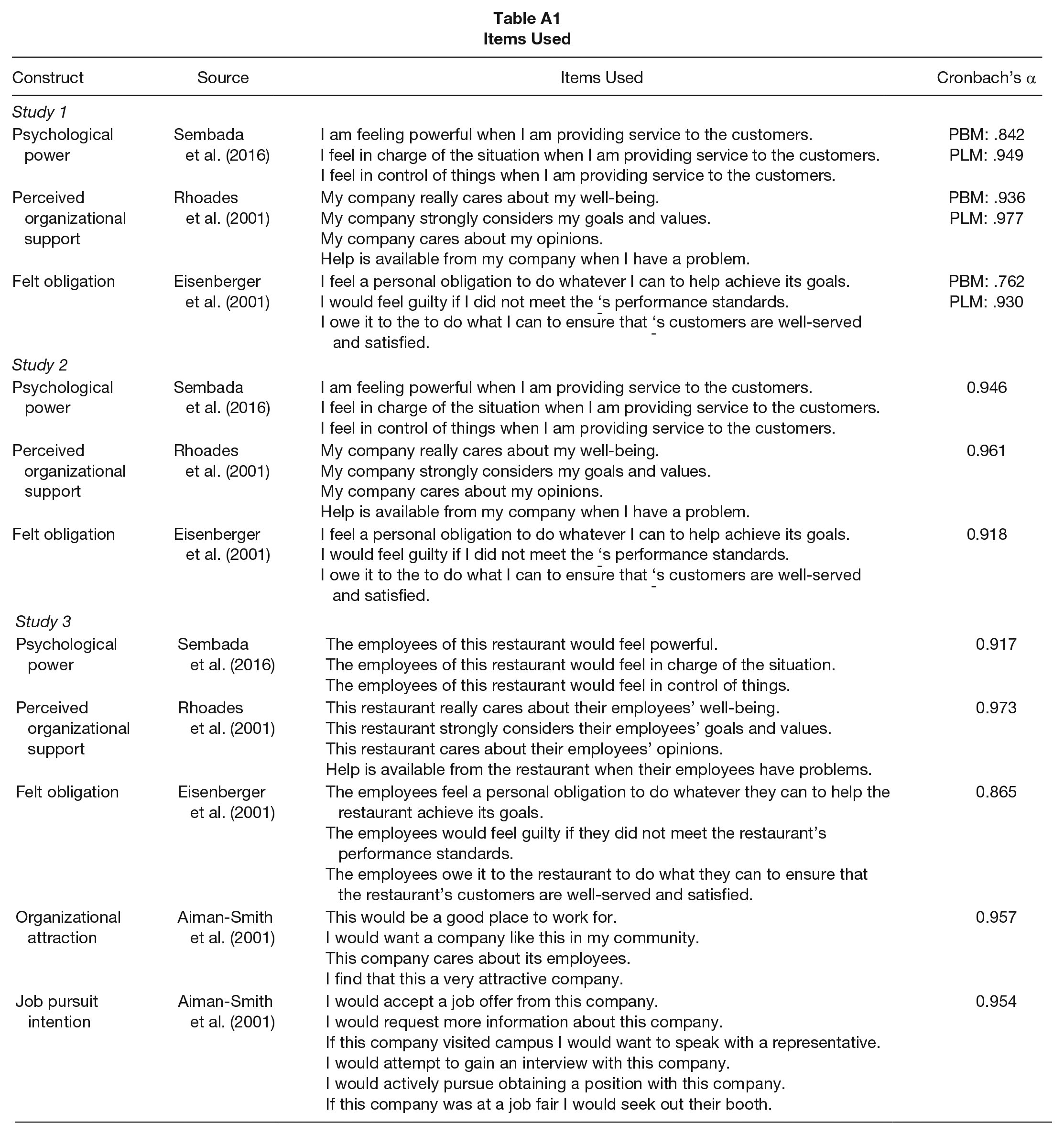
| Construct | Source | Items Used | Cronbach’s α |
|---|---|---|---|
| Study 1 | |||
| Psychological power | Sembada et al. (2016) | I am feeling powerful when I am providing service to the customers. I feel in charge of the situation when I am providing service to the customers. I feel in control of things when I am providing service to the customers. |
PBM: .842 PLM: .949 |
| Perceived organizational support | Rhoades et al. (2001) | My company really cares about my well-being. My company strongly considers my goals and values. My company cares about my opinions. Help is available from my company when I have a problem. |
PBM: .936 PLM: .977 |
| Felt obligation | Eisenberger et al. (2001) | I feel a personal obligation to do whatever I can to help achieve its goals. I would feel guilty if I did not meet the I owe it to the to do what I can to ensure that |
PBM: .762 PLM: .930 |
| Study 2 | |||
| Psychological power | Sembada et al. (2016) | I am feeling powerful when I am providing service to the customers. I feel in charge of the situation when I am providing service to the customers. I feel in control of things when I am providing service to the customers. |
0.946 |
| Perceived organizational support | Rhoades et al. (2001) | My company really cares about my well-being. My company strongly considers my goals and values. My company cares about my opinions. Help is available from my company when I have a problem. |
0.961 |
| Felt obligation | Eisenberger et al. (2001) | I feel a personal obligation to do whatever I can to help achieve its goals. I would feel guilty if I did not meet the I owe it to the to do what I can to ensure that |
0.918 |
| Study 3 | |||
| Psychological power | Sembada et al. (2016) | The employees of this restaurant would feel powerful. The employees of this restaurant would feel in charge of the situation. The employees of this restaurant would feel in control of things. |
0.917 |
| Perceived organizational support | Rhoades et al. (2001) | This restaurant really cares about their employees’ well-being. This restaurant strongly considers their employees’ goals and values. This restaurant cares about their employees’ opinions. Help is available from the restaurant when their employees have problems. |
0.973 |
| Felt obligation | Eisenberger et al. (2001) | The employees feel a personal obligation to do whatever they can to help the restaurant achieve its goals. The employees would feel guilty if they did not meet the restaurant’s performance standards. The employees owe it to the restaurant to do what they can to ensure that the restaurant’s customers are well-served and satisfied. |
0.865 |
| Organizational attraction | Aiman-Smith et al. (2001) | This would be a good place to work for. I would want a company like this in my community. This company cares about its employees. I find that this a very attractive company. |
0.957 |
| Job pursuit intention | Aiman-Smith et al. (2001) | I would accept a job offer from this company. I would request more information about this company. If this company visited campus I would want to speak with a representative. I would attempt to gain an interview with this company. I would actively pursue obtaining a position with this company. If this company was at a job fair I would seek out their booth. |
0.954 |
Acknowledgements
We thank Ms. Stella Baek, CEO of Snowfox Korea, for providing us with insights into the use of power-balancing messages in the business context as well as allowing us to collect data from employees.
The author(s) declared no potential conflicts of interest with respect to the research, authorship, and/or publication of this article.
