



Abstract
The evolution of information and communication technology has enabled travelers to access abundant information and a wide range of available products/services that may satisfy their needs or wants. However, this phenomenon also poses a challenge to travelers who have to choose from an overwhelming collection of travel products. This situation, known as the paradox of choice, may have negative outcomes. This research tested the mechanism of relationships between choice set size and perceived responses to choice overload as affected by psychological distance. Results of multiple scenario-based experimental design studies indicated a negative influence of choice set size on the choice process (e.g., choice complexity/difficulty and task difficulty) in the context of tourism-related choices. This research demonstrated the moderating effects of hypothetical and social distances on the choice process. Therefore, it extended the theory of decision-making and provided important practical implications for tourism marketing.
Introduction
Consumers are being presented with an increasing number of choices across various domains (Haynes, 2009; Scheibehenne et al., 2010); this phenomenon is described as the “variety revolution” by J. Y. Park and Jang (2013). With advances in information technology (IT), choices have proliferated, enabling consumers to easily identify a wide range of products that may satisfy their needs while simultaneously providing them with an overwhelming volume of information (Thai & Yuksel, 2017). This proliferation of choice has challenged traditional economic and psychological theories that suggest that more options are beneficial for decision-making by increasing the probability of finding a desired option (i.e., utility optimization or preference matching), the perception of control, and the intrinsic feelings of motivation (J. Y. Park & Jang, 2013; Scheibehenne et al., 2010). This notion appeared to hold true in earlier studies; however, larger choice sets at that time were still relatively small (Iyengar & Lepper, 2000) compared with the enormous amount of choice facilitated by an online search.
Studies have explored the concept of choice overload, that is, the proposed (negative) consequence of too much choice, and concluded that consumers’ choices are significantly and negatively influenced by the number of choices (I. J. Park et al., 2022), resulting in decreased motivation to choose (reduced conversion rates), reduced likelihood of committing to a choice, decrease in preference strength and choice satisfaction, and increase in regret (Giesen et al., 2014; Pan et al., 2013; J. Y. Park & Jang, 2013; Scheibehenne et al., 2009). As the number of alternatives increases, consumers may experience confusion, anxiety and inability to choose, fear of making a suboptimal choice compared with the unselected options (regret), and cognitive dissonance, particularly when options appear similar or similarly attractive (Pan et al., 2013; J. Y. Park & Jang, 2013). However, how much is too much (or in which circumstances) remains unclear (Chernev et al., 2015). A need to better understand when a large choice set will trigger negative consequences has been reported, given that evidence is mixed and may be context- or circumstance-specific (Giesen et al., 2014).
Scheibehenne et al. (2010) conducted a meta-analysis of 50 studies (published and unpublished; between 2000 and 2009) across a variety of product domains. Their results showed heterogeneity in outcomes, suggesting the presence of moderators, which warrant further investigation as suggested by the authors. In another meta-analysis, however, Chernev et al. (2015) reported that the overall effect of assortment size on choice overload remained significant when moderating variables were considered, suggesting that factors, such as culture or minor procedural differences, may have led to the conflicting results. Therefore, determining which factors moderate the occurrence of choice overload and under what conditions or contexts can particular effects be expected is important and, as yet, under-researched (J. Y. Park & Jang, 2013). Possible moderators include the categorization of products, similarities between options, time pressure (Zeike et al., 2019), self-confidence (Thai & Yuksel, 2017), whether the choice is for hedonic/experiential or utilitarian products (Basso et al., 2019), familiarity (Scheibehenne et al., 2010), and diversity of selection (Willemsen et al., 2016).
Tourism products differ from retail products because they are intangible (i.e., cannot be tried before buying and difficult to convey the offered value) and heterogeneous (i.e., services differ among providers due to human inconsistencies). They are also experiential and composite, including decisions over, for instance, where to go, when, how to get there, and with whom (Backhaus et al., 2023). Therefore, choices are riskier because knowledge of the outcome of the decision is uncertain (Golmohammadi et al., 2020; Guo et al., 2019), and thus, making choices is more stressful (Jo et al., 2022), and potentially, emotional rather than cognitive (Karl et al., 2023; Xu & Jin, 2020). In general, tourism product choices also require greater investment by the consumer (in monetary and other costs), and thus, higher involvement (Thai & Yuksel, 2017). Travel decision-making process encompasses a variety of task environments representing where, with whom, when, and how to visit destinations and what to do at a destination.
In this regard, the marketing literature has suggested that psychological distance is one of the essential determinants of how individuals construe and think of events, objects, and tasks (Trope & Liberman, 2003); it is related to construal level theory (CLT). The fundamental idea of the association between psychological distance and abstraction is that of determining the probability of people having direct experiences and exhibiting information-seeking behavior (Liberman et al., 2002; C. J. Wakslak et al., 2006). Although CLT with psychological distance has been actively explored in the tourism literature, most studies have focused on the temporal and spatial aspects (e.g., Basoglu & Yoo, 2015; Grinberger & Shoval, 2019; J. Hong & Desai, 2020; J. Kim et al., 2016, 2018; Massara & Severino, 2013; Miao & Mattila, 2013; Su et al., 2022). Studies have included the effect of psychological distance (temporal and spatial) on destination image (F. Wang et al., 2022), the effects of additional pictorial information and temporal and spatial distance on the evaluation of tourism products (Jia et al., 2021), the degree to which people engaged in visual versus verbal processing, the effect of psychological distance on the construal level (Yan et al., 2016), and whether type of appeal message and psychological distance (temporal and spatial) influence trip choices (S. Wang & Lehto, 2020). To the best of our knowledge, no study has yet investigated the moderating role of psychological distance in the perception of choice overload and its consequences in tourism.
Accordingly, the current study explores choice overload and its interaction with psychological distances, particularly hypothetical and social distances, in the context of tourism-related choices. It argues that different contexts related to travel decisions, such as whether travel is likely to take place (i.e., hypothetical distance) and familiarity of travel companions (i.e., social distance), may moderate the relationship between choice set size and travelers’ response to choice sets, reflecting the idea of choice overload. Ultimately, psychological distance influences the manner in which the choice sets of travel products are evaluated and subsequent behavior. Studying the roles of psychological distance and choice set size in tourism-related decisions provides an opportunity to advance the understanding of decision-making and CLT (Goodman & Malkoc, 2012). In the case of this study, the less-researched hypothetical and social distances are investigated in an under-researched context (i.e., tourism).
To address the aforementioned research objectives, the current work uses three experimental studies to test individual hypotheses and investigate a variety of travel products to reduce potential confounding errors in the results. The findings of this research provide important insights for tourism marketing strategies, demonstrating the dynamic mechanism of travelers’ response to choice set size in relation to different decision contexts. The current study empirically identifies the important roles played by hypothetical and social distances in travelers’ behavior and interactions with choice set size. Consequently, this research extends decision-making theory and provides tourism marketers with essential insights into developing a contextual marketing strategy.
Literature Review
Choice Overload
Unless purchases are made habitually, consumers may experience difficulty in making choices and purchase decisions, and perceptions of difficulty can lead to less satisfaction and confidence in ultimate choices (Thomas & Tsai, 2012). The literature on economics focuses on utility maximization, and it has presented the assumption that having more choice options in a product category provides consumers with advantages, increasing the chance of obtaining a more valued alternative (Jessup et al., 2009). Although it increases search costs (Greifeneder et al., 2010), a large assortment of available products allows consumers to compare options and provides a sense of overall quality distribution. This condition leads to individuals making more confident and better-informed choices (Ariely & Levav, 2000; B. E. Kahn & Lehmann, 1991), enhancing the perceived freedom of choice among consumers and their feelings of autonomy and intrinsic motivation (B. Kahn et al., 1987), ultimately improving choice satisfaction (Botti & Iyengar, 2006). However, Chen et al. (2018) suggested that assuming that the attributes of available alternatives and the options within a choice set are known to consumers is an oversimplification of underlying behavioral processes, particularly for large choice sets.
Alternative views propose that when choice is complicated by an excessive number of options, the situation is likely to generate confusion, difficulty, and complexity. Iyengar and Lepper (2000) suggested that an overabundance of choice can be demotivating, such that consumers either give up on making a choice because the pay-off magnitude does not justify the additional time (Jessup et al., 2009) or end up less satisfied with their final choice. In the tourism domain, J. Y. Park and Jang (2013) determined that the likelihood of a consumer making “no choice” increased when the number of options exceeded 22, ultimately generating a perceived sense of regret. Pan et al. (2103) found that 20 choices (of hotel) versus 5 was considered overwhelming and that consumers applied heuristics to reduce the size of the consideration set, mostly related to price or room facilities. Thai and Yuksel (2017) established self-confidence as a moderator in the relationship between choice sets and destination evaluation (as a boundary condition), with low self-confidence linked to low destination satisfaction with large choice sets.
The contradictory effects of choice set size on the choice experiences of consumers have been debated. Although the differences between attractive alternatives are reduced, the amount of product information to be evaluated increases, the choice becomes more complex, and higher cognitive effort and capability are required from consumers (Greifeneder et al., 2010; Scheibehenne et al., 2010). Scheibehenne et al. (2010) linked choice overload (product difficulty) to the approach–approach conflict, that is, the motivational dissonance felt when deciding between equally attractive options, particularly when options appear similar. In large choice sets, similarities are likely to increase as the number of options increases, making choosing more difficult because gaining an overview of options is more challenging. This situation increases the fear of making a suboptimal choice and the feeling of regret over unchosen options (Greifeneder et al., 2010; Jo et al., 2022); meanwhile, it decreases confidence in and motivation for making choices (Scheibehenne et al., 2010). When products are less familiar, which is a frequent issue in tourism-related decisions, consumers can experience difficulty in identifying attributes that should be used to make decisions. Therefore, they are unable to apply heuristics to simplify their decisions, increasing the required cognitive effort and perceived product complexity (Heitmann et al., 2007). Accordingly, the following hypothesis, which seeks to estimate the effect of choice overload in the tourism-related context, can be presented (Figure 1):
H1. Travelers with a large choice set express more negative evaluations of the choice they make from available options (choice difficulty) and the choice process (choice and product complexity) than those with a small choice set.
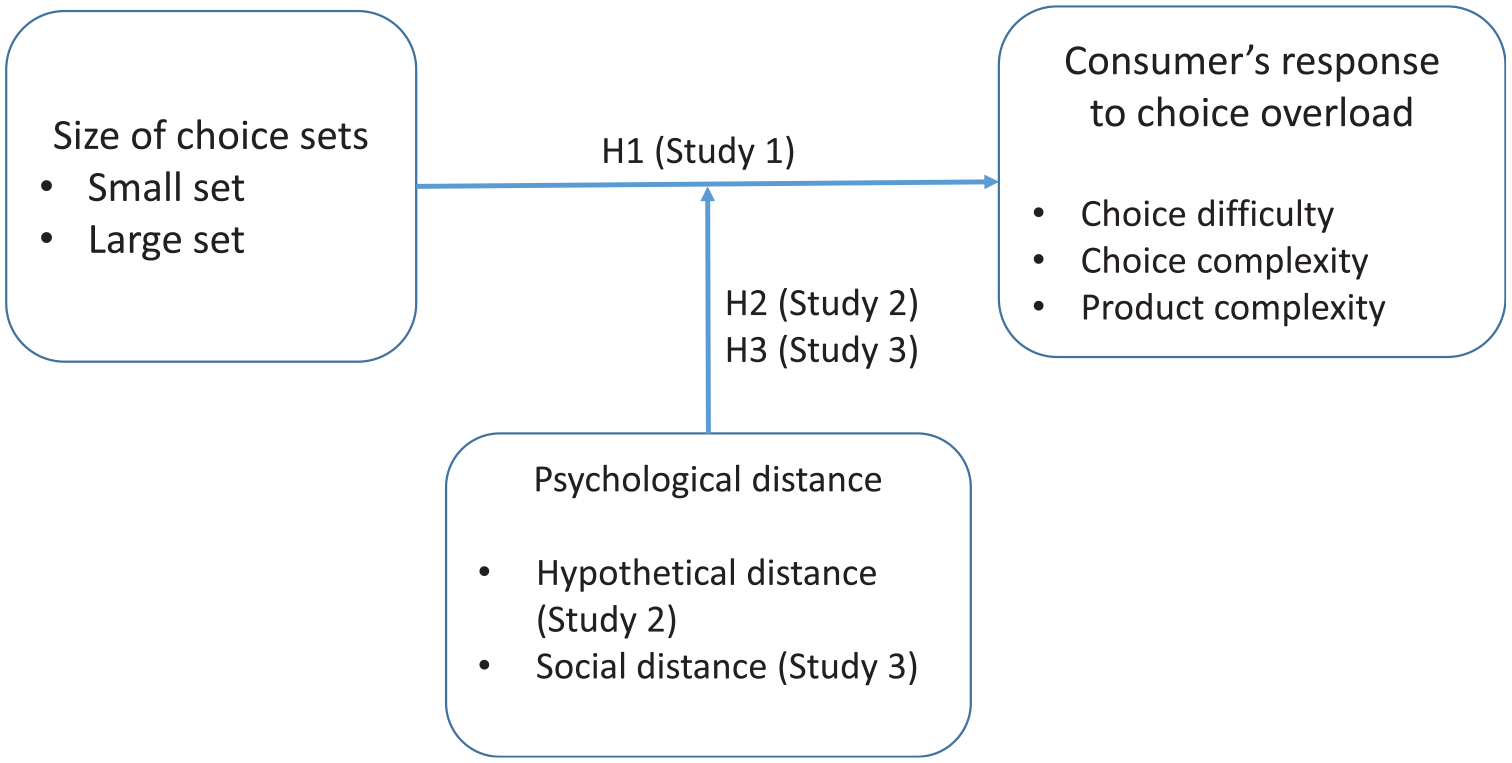
Proposed model.
Psychological Distance
CLT suggests that psychological distance is one of the crucial determinants of how individuals construe and think of events, objects, and tasks (Trope & Liberman, 2003). This distance affects consumers’ ability to process product and service information, influencing their judgment and evaluation of objects, attitudes, and behavior, including their consumption behavior (S. Kim et al., 2020; Zheng et al., 2020). Psychological distance is defined as “a subjective experience that something is close or far away from the self, here, and now” (Trope & Liberman, 2010). People apply abstract, low-level construals to represent a distant event, focusing on the primary core of the event and its desirable attributes through structured and superordinate representations. They focus less on sensory, contextual, and emotional circumstances (Karl et al., 2023), considering the trip a whole rather than concentrating on its details (Su et al., 2022). By comparison, individuals use concrete, high-level construals as representations of a proximal event, engaging with the secondary, surface level of an event and its feasibility attributes through unstructured and subordinate representations (Trope et al., 2007). Construing actions at a higher level increases attention to aspects with implications for the central meaning of an action (ends-related) compared with the (various) costs (feasibility-related) associated with “obtaining” the product (Bornemann & Homburg, 2011). In summary, CLT explains that the more psychologically distant an event is, the more it represents higher levels of abstraction.
The fundamental idea of the association between psychological distance and abstraction is that of determining the probability of people having direct experiences and exhibiting information-seeking behavior (Liberman et al., 2002; C. J. Wakslak et al., 2006), including interactions with consumers’ temporal investment in information search (Golmohammadi et al., 2020). For a proximal event, consumers search for rich and contextualizing information, perceiving an event as concrete and feasible, due to the probability that they will have a direct experience of the event. When an event is more distant, people perceive it as less available, leading to the formation of a schematic representation (or desirability) of the event and the decontextualization of details (Trope & Liberman, 2003), that is, a form of speculative thinking (L. Huang et al., 2021). Speculative thinking involves speculating about future possibilities, including instances of different psychological distances. For tourism products, consumers are frequently speculating about the benefits of visiting a destination, rather than basing their decisions on experience. Studying geographical and temporal distances, Goodman and Malkoc (2012) suggested that when an “event” is distal, fewer choices are needed because those available are likely to satisfy the same overarching goal; by contrast, proximal events lead to different perceptions depending on how similar alternatives are, with a preference for larger sets if alternatives seem less substitutable. Thus, decisions for distal “events” are based on long-term goals or value-driven; consequently, they are less variable (Bischoff et al., 2020) and risky (Breves & Schramm, 2021). H. Wang et al. (2020) also suggested that when events are distal, consumers have lower motivation and involvement in their decision-making, triggering the use of heuristics.
In general, psychological distance has four dimensions: temporal, spatial, hypothetical, and social (Trope & Liberman, 2010). Temporal distance refers to the perceived proximity of an event in time (K. Kim et al., 2008). Spatial distance refers to the degree of closeness of an object or event (Miao & Mattila, 2013). Hypothetical distance can describe the likelihood that an event will occur (the event is likely vs. unlikely), alternatives to reality (the here and now; Liberman et al., 2007), or whether something actually exists (e.g., presentation of hypothetical destinations); all these situations are linked to uncertain outcomes (F. Wang et al., 2022). Hypothetical distance has been associated with self-control, with consumers being more likely to exhibit behavior that may be construed as lack of self-control (e.g., choosing luxury goods) when hypothetical distance is distal, and thus, an “event” is unlikely (C. J. Wakslak et al., 2006). Social distance refers to the perceived proximity among social groups (Y. Hong et al., 2017). It can include the strength of relationship with traveling companion(s) and cultural distance between tourist and host (Aleshinloye et al., 2020; Su et al., 2021; Tasci et al., 2022). Xu and Jin (2020) reported that social distance affects the desire for hedonic products, such as travel products, but not for utilitarian products. Golmohammadi et al. (2020) noted that when making service decisions, consumers are likely to experience social distance (traveling companion), spatial distance (a distant destination), temporal distance (booking in advance), and hypothetical distance (likelihood of happening).
Psychological distances affect tourists’ emotional responses and satisfaction (Miao & Mattila, 2013), hotel selection (J. Kim et al., 2018), and intra-destination activities (Grinberger & Shoval, 2019). They also influence promotional strategies in the hotel industry (J. Kim et al., 2016). Several studies in the tourism context have applied the concept of psychological distance to travel planning and information search behavior. For example, Massara and Severino (2013) found that spatial distance (international vs. local/regional/national tourists) played a mediating role in forming travel experiences in relation to heritage products, and that international tourists tended to exhibit higher construal of a heritage experience than local tourists. Basoglu and Yoo (2015) reported that travelers exhibited inconsistent preferences with regard to travel decisions and temporal distance levels, with high-level construals exerting a prominent influence on travel decisions when the temporal proximity of a travel experience was distant (i.e., 6 months away vs. right now). Su et al. (2022) found that consumers who disclosed tourism goals tended to enhance their goal commitment and goal-directed behavior when temporal distance was short but not when it was long.
Recently, studies have investigated the mitigation of psychological distance effects through information presentation. Jia et al. (2021) studied temporal and spatial distances in relation to the evaluation of tourism products. They found that additional pictorial images resulted in improved product evaluations when the event was distal, but the opposite result was observed when the event was proximal. Similarly, Yan et al. (2016) found that the degree to which people engaged in visual versus verbal processing mediated the effect of psychological distance on construal level. F. Wang et al. (2022) established that an attribute appeal message was more effective than a benefit appeal message for trips in the near future or to proximate destinations.
After reviewing the relevant literature, the present study argues that although previous tourism scholars have extensively explored temporal and spatial distances, attempts to understand the roles of social and hypothetical distances in travel decision-making are less common and no previous study that investigated the moderating effects of these distances on choice overload consequences has been found. Hence, the current study focuses on the moderating effects of two less-studied dimensions of psychological distances, namely, hypothetical and social distances, on travelers’ choice evaluation.
Moderating Effects of Hypothetical and Social Distances
In the retail and restaurant settings, assortment size preference has been demonstrated to be moderated systematically by psychological distance (Goodman & Malkoc, 2012). K. Kim et al. (2008) reported separate and interactive effects on construal level and consumer evaluations. As each psychological distance was increased, construal level increased; as each psychological distance was decreased, the effects of other dimensions were increased. N. Huang et al. (2016) observed a similar effect in relation to the influence of restaurant reviews.
From the perspective of hypothetical distance, the probability of occurrence is a crucial determinant of the psychological distance of an event, and thus, it is a form of mental representation (C. Wakslak & Trope, 2009; C. J. Wakslak et al., 2006). It can also be related to whether an event or absolute distance is real or hypothetical (e.g., presentation of hypothetical destinations), and whether an event is perceived as distinct from a person’s direct experience. Most studies on hypothetical distance have focused on the probability of occurrence. An uncertain event comprises greater distance than a certain (proximal) event, implying that the lower the likelihood that an event will occur, the greater its psychological distance (Trope et al., 2007). Probability can be assumed to be related to abstraction. When an assured event becomes a direct experience (i.e., short hypothetical distance), it is considered in a concrete manner through high-level construals that stress details, along with subordinate and feasibility attributes. However, when dealing with an event that is unlikely to happen (i.e., long hypothetical distance), individuals regard it as excluded from their direct experiences, and thus, approach it with an abstract processing orientation and low-level construals that focus on superordinate goals and desirability attributes. Therefore, reducing an event’s probability leads to the event being represented by end-state (desirability) features based on values and basic beliefs. If the probability of an event increases, then the focus is on feasibility aspects (Peleg-Koriat et al., 2020). Consequently, decisions for the future are frequently more virtuous than those for the present and driven by affective concerns (Williams et al., 2014).
Social distance describes the extent to which individuals accept people outside of their own social group or community (Trope & Liberman, 2010). This acceptance level can be developed in response to feelings toward others and the degree to which a person engages in social interaction with people, reflecting the perceived difference or distance among groups/individuals. People typically act more pro-socially toward close others, attaching more emotional and value significance to benefits for friends compared with for strangers (J. Li et al., 2020), for example, increased pleasure (Laran, 2010). People who are engaged with large social distances construe a target person by using abstract and primary information, such as stereotypes and traits (Idson & Mischel, 2001). Social distance can also be regarded as affective distance, signifying the level of sympathy that a person feels for another in accordance with social relationships (Y. Hong et al., 2017) or interpersonal similarities (Liviatan et al., 2008). In this regard, social distance has been operationalized on the basis of types of personal relationship (short social distance, friends or relatives vs. long social distance, acquaintances or coworkers) (Bogardus, 1947) and frequency of interaction (Karakayali, 2009).
In the tourism context, travelers with greater psychological distance construe the abstract and increase the weighting of the desirability attributes of their trips instead of the feasibility attributes (Goodman & Malkoc, 2012). When people focus on desirability attributes and high-level construals, the desire for options, variety, and preference affirmation is also likely to be created (Todorov et al., 2007). Consequently, a preference for a large array of choices is manifested in travel decisions. Thus, when a traveler is in a situation in which he/she is unlikely to travel due to the presence of a barrier (i.e., long hypothetical distance) or goes on a trip with an unknown person (i.e., long social distance), and is confronted with a large assortment of choices, the individual feels more confident and perceives less complexity in making choices than if he/she is in a travel situation characterized by short hypothetical and social distances. Ultimately, the traveler with greater psychological distance experiences higher levels of choice satisfaction than a consumer with less psychological distance. This phenomenon probably reflects that if an event is unlikely to happen, then the choice is of less consequence. Conversely, an individual with short psychological distance focuses on feasibility attributes, implying that he/she experiences difficulty when choosing from a large choice set, which, in turn, implies a reduced preference for large choice assortments (Chernev, 2006).
In circumstances of short social distance, consumers must satisfy their own needs and those of familiar travel companions. Therefore, they are likely to consider a wider variety of product attributes, and more options will equate to more cognitive load. They may also feel a level of responsibility to their travel companions, and therefore, the choice is riskier. Accordingly, a traveler who has direct travel experience (short hypothetical distance) or goes on a trip with her/his friend weighs up concrete and feasibility concerns, and thus, encounters difficulty when making a choice from a large choice assortment. Therefore, a moderating effect of social and/or hypothetical distance is implied as follows: possible circumstances, as yet unclear, may occur, wherein the assumption that a large choice set will be desirable to tourists may not be confirmed. This moderating effect may be the result of one of two potentially contradictory effects: the trade-off between the desirability of many choices and the feasibility of evaluating them or a perception that products become more substitutable in large sets, making decision-making easier (Goodman & Malkoc, 2012) and influencing perceived choice difficulty and choice/product complexity. Thus, in a situation with greater hypothetical or social distance, travelers with a large choice set will be expected to express fewer negative evaluations (i.e., choice difficulty and complexity, and product complexity) of the choice made from available options and the choice process than those with a small choice set. Therefore, the following hypotheses are presented (Figure 1):
H2. Hypothetical distance moderates the relationship between choice set size and the evaluation of choice outcomes (i.e., perceived choice difficulty and complexity, and perceived product complexity). Specifically, travelers who have a large choice set are likely to exhibit lower levels of choice difficulty and complexity, and perceived product complexity, than those who have a small choice set of travel products when confronting long hypothetical distance.
H3. Social distance moderates the relationship between choice set size and evaluation of choice outcomes (i.e., perceived choice difficulty and complexity, and perceived product complexity). Specifically, travelers who have a large choice set are likely to present lower levels of choice difficulty and complexity, and perceived product complexity, than travelers who have a small choice set of travel products when confronting long social distance.
Accordingly, the current study explores the effects of less frequently assessed psychological distances, namely, hypothetical and social distances, in a less studied context of travel choices, which are perceived as more difficult owing to the ambiguity of outcomes. This study focuses on perceived difficulty in making a choice when purchasing travel products (choice difficulty; Scheibehenne et al., 2009), the complexity of the choice task (choice complexity; Greifeneder et al., 2010), and the evaluation task among available sets (product complexity; Heitmann et al., 2007).
Study 1
Introduction
The primary purpose of Study 1 was to test the major effect of choice set size on consumer’s responses to the choice settings proposed in Hypothesis 1. Choice set sizes were manipulated in two sets, including a small set (six alternatives) and a large set (24 alternatives), as suggested by Chernev (2003b) and Fasolo et al. (2009). In particular, J. Y. Park and Jang (2013) identified a choice overload threshold of 22 choices; above this threshold, travelers are likely to feel higher levels of choice regret and make “no choice,” as opposed to when they encounter less than 22 choices. The literature on choice overload has suggested a variety of consumers’ responses to an excessive number of choices. These consequences can be classified into two types: subjective state and behavioral outcome (Chernev et al., 2015). The current study focused on process-based indicators that described the subjective state of individuals and examined changes in consumers’ internal perceptions, such as choice/product complexity and choice difficulty (Scheibehenne et al., 2010).
Method
Subjects and Design
A total of 103 American subjects were invited to participate in an online experimental study via Amazon Turk (MTurk) for a compensation of US$ 0.40 (41.7% female; average age = 38 years; median household income = US$30,000–39,999; 67% full-time employee; 51% completed college/university). The subjects were assigned into one of two choice sets between a condition of small and large choice sets. The order of choice options was randomized to minimize the potential for a confounding effect.
Procedure
The participants were first asked to carefully read the general instructions and a brief explanation of the purpose of this study. Then, they were instructed to imagine an international pleasure trip to London (within a range of travel budgets sufficient to purchase a return-flight ticket) and asked to select what they perceived to be the best option. Specifically, once the subjects joined the experimental study, they were randomly assigned to either a small or large choice set. Moreover, the composition of choice sets and the order of choice options were completely randomized to minimize potential confounding effects from designing the experiment settings. In particular, the list of flight search results from Kayak online travel agency was obtained. Initially, 24 flight options were randomly selected for the large assortment of choice sets. Then, for each individual participant, six flight options were randomly chosen from the large assortment (see Supplemental Appendix II for details). The participants assigned to a small (or large) assortment set had identical number and setting of choice sets. Accordingly, 47 respondents (45.6%) were assigned to the small assortment with six available choices (including “none” for no choice) and asked to make a final choice. Meanwhile, 56 participants (54.4%) were assigned to the large assortment with 24 available choices (also including “none” for no choice) and asked to select the best choice. The numbers of available choices were established on the basis of relevant literature. A set of fundamental studies on choice overload designed a smaller set with six alternatives and a larger set with 24 alternatives in general goods, such as jam (Iyengar & Lepper, 2000), mobile phone (Fasolo et al., 2009), and jelly beans (Kahn & Wansink, 2004), and also travel-related products, including Caribbean vacation decisions (Chernev, 2003a) and hotel selection (Chernev, 2006). In particular, Scheibehenne et al. (2010) conducted a meta-analytic review of choice overload and reported that assortment sizes for small choice conditions had an average size of an interquartile range (IQR) of 5 to 6, while large choice sets had an IQR of 24 to 30. Furthermore, J. Y. Park and Jang (2013) presented the pattern of likelihood to make “no choice” across different numbers of available choice sets. Consistently, the result suggested that significant changes in the proportion were observed at points when the number of choices was around 3 and 20, providing supportive justification to design 6 for a small choice set and 24 for a large choice set in the current study. To avoid the pricing effect, two airline ticket prices were included, costing either US$ 779 or 799. The real names of the airlines were provided to simulate a real-life setting and ensure that the variation in product attributes was marginal. The format of the experimental stimulus was kept consistent to minimize potential confounding effects. For example, the choice options were presented in a single column for the small and large sets, with the same size and type of font and images, and consistent order and category of attribute information about airline products.
After revealing the choice options, the participants were asked to provide their responses to choice difficulty (e.g., “Making a choice was difficult for you”) for two items (Scheibehenne et al., 2009), choice complexity (e.g., “Making a choice was complex”) for two items (Greifeneder et al., 2010), product difficulty (e.g., “Obtaining an overview over the options offered was difficult”) for five items (Heitmann et al., 2007), and product complexity (e.g., “The offerings in this category were difficult to understand”) for four items (Heitmann et al., 2007). The four variables (i.e., choice difficulty and complexity, and product difficulty and complexity) were suggested as key indicators that reflect consumers’ evaluations of choice overload by Chernev et al. (2015) and Scheibehenne et al. (2010). The case wherein travelers need to evaluate a large assortment of products requires spending substantial time and effort, which may generate negative responses from individuals. Thus, the current research focused on the extent to which perceived difficulty and complexity varies in accordance with different contexts of choice settings. All measurements used a seven-point Likert scale. Finally, the participants indicated their level of familiarity with the airline options and provided their demographic information, such as gender, age, household income, and current employment. Supplemental Appendix I provides the full information regarding the measurements.
Results
Manipulation Check
Two questions were used to test manipulation. For example, “I read 6 options” and “I read 24 options.” The results supported the manipulation check. For example, the participants who were given a small assortment set presented higher mean values (M = 6.02, p < .001) in the question relating to six options but lower mean values (M = 1.87, p < .001) in the question relating to 24 options than the participants provided with a large assortment (M = 3.16 and M = 5.66, respectively).
The participants who were exposed to the large choice set responded with higher values (M = 2.41) when asked for the number of options they had taken/seen than the participants who were exposed to the smaller choice set (M = 1.68, p < .001).
Hypothesis Testing
The participants with a large choice set were significantly more likely to have higher levels of choice difficulty [M = 4.09, t (101) = −2.20, p < .05], choice complexity [M = 4.19, t (101) = −2.5, p < .05], and product complexity [M = 3.94, t (101) = −3.46 p < .001 than the participants with a small choice set (M = 3.36, 3.34, and 2.94, respectively) (see Table 1).
Comparisons of Choice-Set Size on Choice Evaluations.

p < .05. ***p < .001.
The tourism and marketing literature have claimed the importance of product familiarity in potentially influencing consumer choices (Chernev, 2003a; Mogilner et al., 2008). Accordingly, we checked the potential confounding effect of familiarity with the airline options between the two groups. The results exhibited no statistical difference, alleviating the concern on other exogenous variables (M = 2.98 and 2.89 for the small and large sets, respectively; t (101) = 0.54; p > .05) (J. Y. Park & Jang, 2013).
Study 2
Introduction
The purpose of Study 2 was to estimate the moderating effect of hypothetical distance on the relationship between choice set size and choice evaluations (Hypothesis 2). In relation with Study 1, Study 2 evaluates perceived choice/product complexity as indicators of consumers’ inner states toward different choice sets (Heitmann et al., 2007). When a traveler is in a situation wherein he/she is less likely to travel because of a barrier (i.e., long hypothetical distance), the subjects will perceive less complexity and difficulty when evaluating products and making a choice with a large choice set.
Method
Subjects and Design
Similar to Study 1, MTurk was used to design a second experimental study that targeted online American travelers. A total of 196 people participated in this study for a monetary award of US$ 0.50 upon completion (42.9% female; average age = 40 years; median household income = US$30,000–39,999; 61.7% full-time employee; 44.4% completed college/university). Subjects were randomly assigned to one of two choice sets (small vs. large) by two (hypothetical distance: nearly certain vs. nearly uncertain) between-subjects design. The order of choice options was randomized to curtail the potential of a confounding effect.
Procedure
Participants were asked to read the general instructions and a brief explanation of the purpose of this study. Consistent with Study 1, the subjects were randomly assigned to one of two choice sets (small and large sets) and the order and composition of choice sets were randomly constructed. Then, the participants were asked to imagine that they were planning a camping trip with their friends and to choose the best camping location. Apart from the two sets of choice assortments (Sela et al., 2009), the participants were also engaged in one of two different scenarios described as either nearly certain to occur or nearly certain not to occur (e.g., not going on the camping trip due to the chance of rain). The scenarios were adopted from relevant studies (Liberman et al., 2002; C. J. Wakslak et al., 2006). The high distance versions of the scenarios were briefly presented as follows: “Imagine that you are planning to go on a camping trip with your friends, assuming that the weather cooperates… You check the weather forecast and find out a 95% chance of rain for the days of the scheduled trip; that is, you will nearly certainly not go on the trip. Now, you open a camping booking website and aim to select the best option…”
A total of 82 respondents were assigned to the small assortment set (four choices), which comprised 42 participants for the short distance and 40 for the long distance. Meanwhile, 114 participants were assigned to the large assortment set (16 available choices), with an even distribution of 57 participants for both short and long hypothetical distances. Information about the camping site, such as images, consumer ratings, prices per night for two adults, and facilities, was provided to ensure that the participants could consider the details of the choices and ultimately make a final decision. Similar to Study 1, actual names and images of camping sites were provided to reflect a real-life setting. To control the potential for confounding factors, the researchers attempted to minimize the range of rental prices for camping spaces from US$ 14.20 to US$23.00 per day. Moreover, the provided consumer ratings ranged from three to five stars. The choice options were presented in paired columns for small and large sets. The same size and type of font and images were used, and the order and category of information about the choices were consistent (see Supplemental Appendix III).
After revealing the camping options, the participants were asked to provide the perceived difficulty and complexity of their choices and of the products themselves on a seven-point Likert scale (Greifeneder et al., 2010; Heitmann et al., 2007). Finally, the participants provided their demographic information, such as gender, age, household income, and current employment.
Results
Manipulation Check
The participants who were provided with a large choice set responded with higher values (M = 2.41) when asked for the number of options they had taken/seen than the participants who were provided with a small choice set [M = 1.68, t (194) = −2.27, p < .05]. Manipulation check for hypothetical distance was asked to the subjects through this statement: “How much likely are you going to go camping for the days of the scheduled trip?” in accordance with the study of C. J. Wakslak et al. (2006). The participants presented different likelihoods of the event occurring (going to a trip) [M = 4.6 for a short distance and 3.7 for long distance; t (194) = −3.16; p < .001). Similar to Study 1, the manipulation test was successful, allowing the performance of group comparisons.
Hypothesis Testing
To assess Hypothesis 2, multivariate ANOVA (MANOVA) was conducted on choice difficulty/complexity and product complexity with respect to a 2 (choice set: small vs. large) × 2 (hypothetical distance: nearly certain to occur vs. nearly certain not to occur) between-subjects design.
Group comparisons between small and large sets were initially conducted, and the results revealed significant differences. Consistent with Study 1, subjects exposed to a large choice set presented higher choice and product complexity (M = 3.58, 3.65) than subjects exposed to a small choice set [M = 3.07, t (194) = −2.07, p < .01 and M = 3.05, t (194) = −2.93, p < .01, respectively). However, the comparison was insignificant in choice difficulty (M = 3.26 for the small set and 3.58 for the large set, p > .05). The MANOVA results revealed a significant interaction effect between choice size and hypothetical distance (see Supplemental Appendix IV for the full MANOVA results). In particular, this two-way interaction was found to be significant for all the factors that reflected responses to choice overload, including choice difficulty [F(1, 192) = 19.97, p < .001], choice complexity [F(1, 192) = 18.45, p < .001], and product complexity [F(1,192) = 16.91, p < .01], supporting Hypothesis 2. Consistent with the findings of Study 1, the major effects of choice size were significant in the perceived complexities of choice [F(1,192) = 3.80, p ≤ .05] and product [F(1,192) = 7.44, p < .01)]. Consequently, a moderating effect of hypothetical distance was found on the relationship between choice set size and perceived complexities of choices and products.
The interaction plots illustrate the relationships of the three examined variables (Figures 2 and 3). When the participants were presented with a small choice set and given a short hypothetical distance (i.e., certain to occur), they exhibited lower values of choice difficulty [M = 2.88, t (97) = −2.05, p < .05) and complexity [M = 2.59, t (97) = −2.60, p < .01] and product complexity [M = 2.74, t (97) = −2.03, p < .05] than those who were exposed to long distance sets (M = 4.16, 4.08, and 4.11). However, the participants exposed to a large choice set were likely to provide lower values of perceived difficulty [M = 2.75, t (95) = 4.22, p < .001]/complexities of choice and product [M = 2.86, t (95) = 3.41, p < .001 and M = 3.00, t (95) = 3.68, p < .001] than those who were given a small choice set (M = 3.54, 3.42, and 3.28) when the event was not certain to occur (i.e., high hypothetical distance). Lastly, the ANOVA showed no significant difference across the four groups in terms of familiarity with the choice options of camping sites, tolerating the effect of a confounding variable (F = 0.11, p > .05).

The moderating effect of hypothetical distance with choice-set size on consumer evaluations.
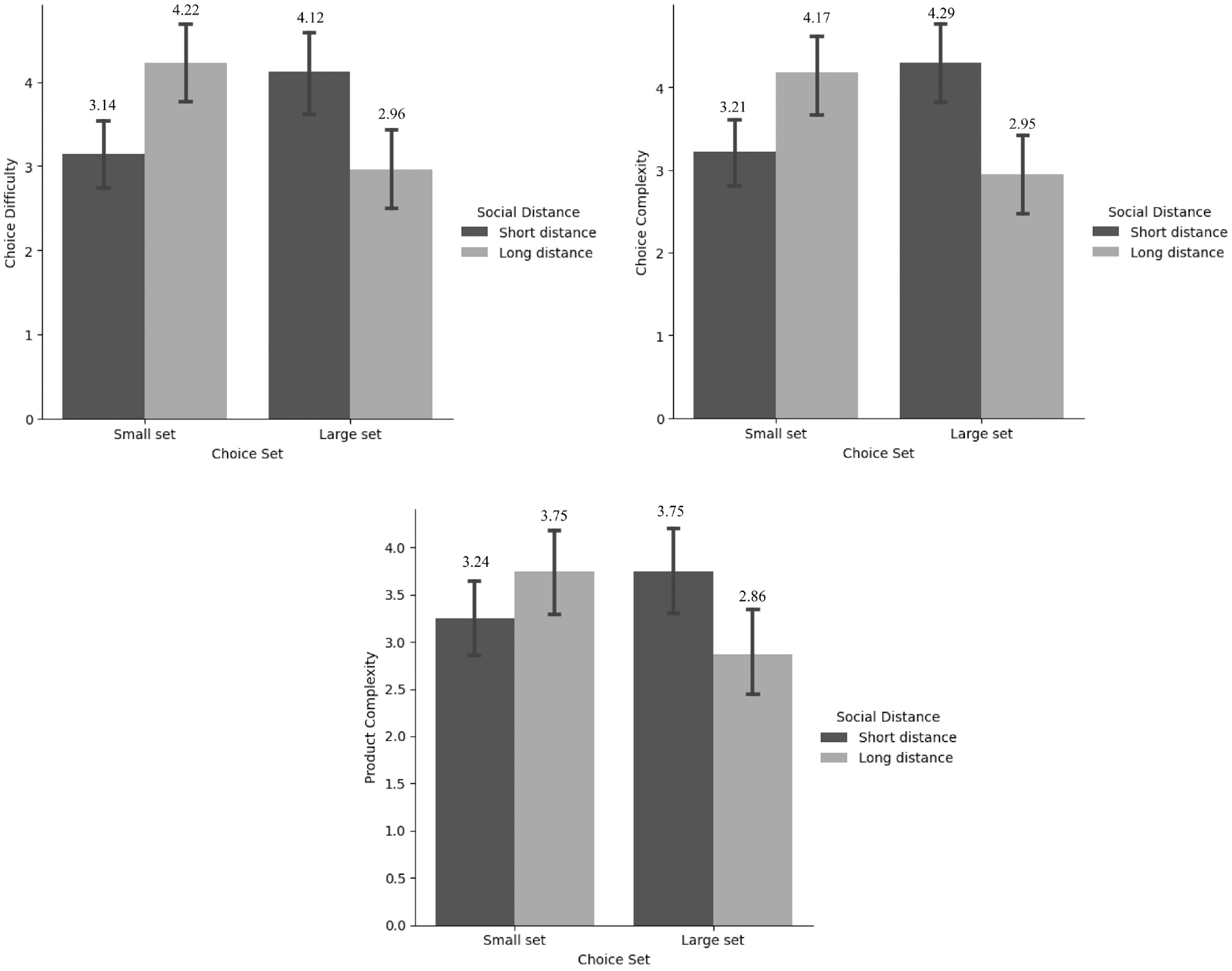
The moderating effect of social distance with choice-set size on consumer evaluations.
Table 2 presents the analyses that compared choice evaluations between hypothetical distance within small and large choice sets. The results revealed that within the small set, travelers in long hypothetical distance assessed higher choice difficulty and complexity, and product complexity than those in the short distance setting. For the large set, participants in the short hypothetical distance exhibited higher choice difficulty and complexity, and product complexity than those in the long distance.
Comparisons of Choice Evaluation Between Hypothetical Distance Within Choice Sets.

p < .05. **p < .01. ***p < .001.
Study 3
The objective of Study 3 was to test the moderating effect of social distance on the relationship of choice set size with choice difficulty and complexity, and product complexity (as proposed in Hypothesis 3).
Subjects and Design
Similar to the previous studies, online American travelers were invited to participate in an experimental study via MTurk. Monetary benefits of US$ 0.50 were offered upon completion of the study. A total of 196 participants joined the study (40.8% female; average age = 38 years; median household income = US$30,000–39,999; 63.8% full-time employee; 50.5% completed college/university). The participants were randomly assigned to one of 2 choice sets (small vs. large) × 2 (social distance: friends vs. people met through a travel community) between-subjects experimental design. The order of choice options was randomized to avoid the potential for a confounding effect.
Procedure
The participants were asked to read the instructions and the explanation of the purpose of this study. Subsequently, they were asked to imagine that they were planning a backpacking trip to Cancun, Mexico with travel companions and must choose the best hostel to stay in. Apart from the two sets of choice assortments (6 vs. 24 available choices), the participants were engaged in one of two different backpacking scenarios with different travel companions: their friends (i.e., short social distance) versus people they met through a backpacking community website (www.backpackingtogether.com) (i.e., long social distance). Built on Bogardus’ seven categories of social distance (relative, close friends, neighbors, coworkers, co-citizens, visitors, and within border) (Bogardus, 1947), Y. Hong et al. (2017) classified acquaintances from social networking sites as constituting a large social distance, while friends constitute a small social distance. The scenarios used in this study were adopted from relevant studies, such as C. Wakslak and Trope (2009) and C. J. Wakslak et al. (2006). Furthermore, descriptions of the available hostels, such as the price (US$20 per day) and consumer star ratings (at least 4 out of 5), were provided, along with images of the facilities and information about the number of beds in each hostel. The real names of hostels in Cancun, Mexico, along with actual images, were used to represent real-life examples. Such information enabled participants to choose the best options through the application of a cognitive process. Among the 195 subjects who participated in Study 3, 94 respondents were assigned to the small choice set (six available options), while 102 participants were assigned to the large choice set (24 available options). Consistent with the previous studies, the subjects were randomly assigned to one of two choice sets (small and large sets), and the order and composition of choice sets were randomly constructed. The choice options were presented in paired columns for both small and large sets. The same size and type of font and images were used, and the order and category of information about hostel choices were consistent (see Supplemental Appendix V).
After revealing the hostel options, the participants were asked to provide a measure of their perceived choice difficulty and complexity of choice and product (Greifeneder et al., 2010; Heitmann et al., 2007; Scheibehenne et al., 2009) on a seven-point Likert scale (see Supplemental Appendix I). Finally, the participants indicated their level of familiarity with hostels in Cancun and were asked to provide their demographic information.
Results
Hypothesis Testing
Consistent with Studies 1 and 2, the manipulation check of Study 3 was successfully achieved by asking a question (i.e., how close the travel companion is) to the respondents for the manipulation check of social distance (p < .05). Group comparisons between small and large sets were initially conducted, but the results did not present significant differences. Then, MANOVA was used to test Hypothesis 3 on choice difficulty and complexity, and product complexity in terms of a 2 (choice set: small vs. large) × 2 (social distance: a friend vs. a person met through a travel community website) factorial design. The MANOVA (see Supplemental Appendix VI for the full analytical results) presented a significant interaction effect between choice set size and social distance on evaluations of consumers’ choices. In particular, this two-way interaction was significant for choice difficulty (F-value = 22.03, p < .001) and complexity (F-value = 22.03, p < .001), and product complexity (F-value = 9.22, p < .01), accepting Hypothesis 3. Apart from the interaction effects, none of the other effects were significant.
To understand the associations clearly, Figure 3 shows the interaction plots. In particular, the participants in the small choice set, with long social distance (i.e., unknown travel companion) exhibited higher values of choice difficulty [M = 4.22, t (97) = −3.33, p < .01] and complexity [M = 4.17, t (97) = −2.84, p < .01], and product complexity [M = 3.75, t (97) = −1.58, p > .05] than those exposed to short social distance (i.e., a friend) (M = 3.14, 3.22, and 3.25; p < .01). However, reverse patterns were identified in the case of the large assortment group. The participants with long social distance tended to present lower levels of choice difficulty [M = 2.96, t (95) = 3.31, p < .01] and complexity [M = 2.95, t (95) = 3.77, p < .001] and product complexity [M = 2.86, t (95) = 2.69, p < .01] than those with short social distance [M = 4.12, 4.29, and 3.75; p < .01). Notably, a large difference in participants exposed to short distance was found, regardless of choice set size.
Table 3 presents the analyses that compared choice evaluations between social distance within small and large choice sets. The results are consistent with the findings from hypothetical distance. That is, travelers in long hypothetical distance assessed higher choice difficulty and complexity, and product complexity in the small choice set. The participants in short hypothetical distance exhibited higher choice difficulty and complexity, and product complexity than those in long distance from the perspective of a large assortment set.
Comparisons of Choice Evaluation Between Social Distance Within Choice Sets.

p < .01. ***p < .001.
Discussion
This study identified a negative influence of choice set size on choice evaluation in the context of tourism-related choices in accordance with a scenario-based experimental design protocol, assessing an influence of choice overload. Moreover, the results demonstrated the moderating effects of hypothetical and social distances (as components of psychological distances) on choice evaluation. To our knowledge, this work is the only published study in tourism to accomplish this objective. Consumers with a large choice set had significantly more positive responses to choice overload for long psychological distance, whereas consumers with a small choice set had significantly more positive responses to choice overload with short social distance. This finding may support the notion that when choosing for others and for self, more attributes should be considered to make the correct choice, increasing cognitive load and favoring smaller choice sets. Therefore, this study extends the literature on influences on decision-making and choice overload, particularly in the tourism-related domain. It identifies moderators that explain why choice overload effects can be contextual. These results can be placed on the same line as the arguments proposed earlier, which suggested that more options are desirable to those with long psychological distance because of their focus on the abstract and desirability attributes of their trips (Goodman & Malkoc, 2012). Moreover, the reduced likelihood that the trip will occur increases confidence in and reduces the perceived complexity of a decision. By contrast, travelers with a decision context of short psychological distance focus more on feasibility attributes (Chernev, 2006), implying that these individuals experience difficulty when choosing from a large choice set, which, in turn, signifies a reduced preference for large choice assortments (Chernev, 2006). Thus, a traveler with a high likelihood of going on a trip (short hypothetical distance) or who goes on a trip with his/her friends (short social distance) weighs up concrete and feasibility concerns, and consequently, encounters difficulty when making a choice from a large choice assortment. This finding may reflect that such decisions are perceived as riskier, and that consumers perceive the need to justify their decision (to themselves and to close others) or that their self-concept can be undermined by a wrong choice. Similarly, Iyengar and Lepper (2000) suggested that consumers experience greater decision aversion when making choices for others, and in such circumstances, the negative consequences of choice overload may increase. This assertion is similar to the results of Schaffrath et al. (2018), who suggested that accountability for purchases may be linked to the negative effects of a large assortment size in a business-to-business context, and Korhonen et al. (2018), who found an interactive effect between assortment size and accountability on decision quality with hedonic products. In the latter study, informal accountability, which may be evident in short social distances, was associated with greater choice quality with a smaller assortment. Current results may also signify that for short psychological distances, consumers focus on maximizing the accuracy of their decision-making, making more analytical decisions among a small number of choices, while minimizing the effort of decision-making with larger choice sets.
Notably, the current research was designed to minimize potential confounding effects and maximize internal validity. Multiple experimental studies explored a wide range of travel products that considered the potential monetary and non-monetary cost effects of a trip (scenarios covered a wide range of travel products ranging from booking hostels and camping sites to arranging long-distance flights). In addition, the quality of the supplied information was constant among choices, and thus, the quality of information should not be a confounding factor in the current study (J. Y. Park & Jang, 2013). Perceived time pressure can also affect decision difficulty; however, this effect has only been noted with experimentally induced time pressure, preventing participants from processing all the information required to reduce choice regret (Scheibehenne et al., 2010). The respondents in the current study were not under experimentally induced time pressure, and thus, time pressure should not have influenced the outcomes.
The practical implications of the results are related to the development of promotional materials for different consumer targets on the basis of contextual information, including the level of certainty of a travel event and the types of travel companions. Better understanding of how consumers react to choice overload in the context of intangible and heterogeneous services is important if strong relationships are to be built with consumers (Kasper et al., 2010). In particular, people who exhibit a high certainty to go on a trip should be offered a destination recommendation system that allows them to filter options to provide a selective assortment of travel products on the basis of their preferences. By contrast, for individuals with a low level of certainty to travel, destination marketing organizations (DMOs) should provide them with a large number of travel product choices, such that they can search for comprehensive information about these products. Similarly, DMOs are advised to provide a small number of selective product options to people who are traveling with companions who are regarded as close social relationships. These insights propose a distinctive marketing strategy. With the acceleration of digital transformation in the tourism industry, advanced IT enables tourism marketers to collect the contextual information of potential and current travelers. Understanding the mechanism of psychological distance, particularly its hypothetical and social elements, in consumers’ response to choice set size should be fundamental in developing a contextual marketing strategy. After the COVID-19 pandemic, travelers can be expected to more likely exhibit individual behavior by planning their trips themselves and will consider diverse aspects of tourism products, including hygiene. Their decision-making behavior should be even more complex and critical in estimating available product choices. In this context, insights into the mechanism of decision complexity across different dimensions of psychological distance are timely and should provide guidance in developing marketing strategies for future travelers.
Similar to all research, the current study has limitations. Arguably, the effects observed may be underestimated because the participants were asked to consider hypothetical situations and were not actually buying products. By contrast, in a meta-analysis of choice overload studies (including those in the tourism context), Scheibehenne et al. (2010) reported that effect sizes did not vary depending on whether the study was hypothetical or a real choice task, or whether satisfaction or choice was the dependent variable. They also noted that the perception of assortment size can vary considerably with the actual number of options. However, such manipulation was tested in the current study, with participants exhibiting their perception of assortment size. The study was conducted among US consumers, who practice an individualistic culture. Repeating the study among consumers from a collectivist culture may lead to different results related to social distance, or effects may be accentuated because conforming to group norms is more important (Hofstede, 2011). Similarly, Kasper et al. (2010) questioned how decision-making style affects perception of choice overload. This question can also be a valuable direction for future study. The effects of other moderators, for example, time pressure (Basso et al., 2019), can also be investigated to provide a complete picture of the choice-making experience in this domain. Similarly, future researchers are suggested to extend the concept of choice overload beyond the idea of perceived complexity and difficulty that this research has focused on. Moreover, this study focused on the subjective state of consumers to choice overload. Hence, future research is suggested to explore behavioral responses to choice overload, such as time spent and deferring choice, to obtain a comprehensive understanding of the consequences of choice overload. Lastly, this study may have a potential issue derived from the scrolling action when subjects face a large set of experiment studies. Thus, future researchers are recommended to conduct a set of experimental studies that use identical sizes of materials in setting the stimulus to minimize any potential confounding effects on the analytical results.
In conclusion, the results of the multiple scenario-based experimental design studies have indicated the negative influence of choice set size on choice evaluation (e.g., choice and task difficulty, and complexity) in the context of tourism-related choices and demonstrated the moderating effects of hypothetical and social distances (as components of psychological distances) on choice evaluation. By doing so, this study has made important contributions to theory of decision-making in tourism and provided important practical implications for tourism marketing.
Supplemental Material
sj-docx-1-jtr-10.1177_00472875231197379 – Supplemental material for Choice Overload in Tourism: Moderating Roles of Hypothetical and Social Distance
Supplemental material, sj-docx-1-jtr-10.1177_00472875231197379 for Choice Overload in Tourism: Moderating Roles of Hypothetical and Social Distance by Sangwon Park and Anita Eves in Journal of Travel Research
Footnotes
Declaration of Conflicting Interests
The author(s) declared no potential conflicts of interest with respect to the research, authorship, and/or publication of this article.
Funding
The author(s) disclosed receipt of the following financial support for the research, authorship, and/or publication of this article: This research was jointly supported by the School of Hospitality and Tourism Management at the University of Surrey and the Ministry of Education of the Republic of Korea and the National Research Foundation of Korea (NRF2019S1A3A2098438).

Supplemental Material
Supplemental material for this article is available online.
Author Biographies
References
Supplementary Material
Please find the following supplemental material available below.
For Open Access articles published under a Creative Commons License, all supplemental material carries the same license as the article it is associated with.
For non-Open Access articles published, all supplemental material carries a non-exclusive license, and permission requests for re-use of supplemental material or any part of supplemental material shall be sent directly to the copyright owner as specified in the copyright notice associated with the article.
