



Abstract
Managing customer experiences is critical to the success of hospitality businesses in today’s economic climate and competitive environment. A better understanding of the impact of other customers on customer experiences is needed, as sharing the service environment with other customers is often an inherent part of the experience. To that end, this research examines the impact of other customers on customer experiences from a psychological distance perspective. The results from two experimental studies provide strong empirical evidence for the effect of psychological distance from other customers on a host of customer responses, such as spontaneous emotional responses, symbolic emotional responses, emotion-regulation strategies, and encounter satisfaction. Additionally, this research examines how other-customer-elicited responses jointly affect the overall customer experience.
Imagine that you booked a vacation in an all-inclusive beach resort in the Caribbean. Although the facility and service were impeccable, your experience was nearly ruined by some fellow vacationers at the resort. People fought over beach chairs and some refused to give up their “territories” on the beach even when they left for an extended period of time. The gorgeous beach became a battlefield among fellow resort guests and finding a spot on the beach during the midday was a mission impossible.
Over the past few decades, services have witnessed a global shift from merely delivering services to an experience economy focusing on staging experiences (Gilmore, 2003). Creating superior customer experiences in today’s economic climate and competitive environment is a matter of survival for hospitality businesses. An emerging hospitality research stream in customer experience management (CEM) has started to identify determinants of customer experience (e.g., Han & Back, 2008; Nikolich & Sparks, 1995). However, the extant literature has focused primarily on the customer–provider contact points (e.g., Harris, Bojanic, & Cannon, 2003; Mattila, 2000). We have a limited understanding of customer–customer contact points, and accordingly, Verhoef et al. (2009) suggested that more research is needed to understand how the social environment (e.g., presence of other customers) affects customer experiences. An investigation of the role of other customers in the service experience is important because sharing the service environment with other customers is often an inherent part of a guest stay (Grove & Fisk 1997). The presence of fellow customers weaves a complex social environment in which consumption is subjectively experienced (Thakor, Suri, & Saleh, 2008). Considerable evidence suggested that human experiences are affected by “the actual, imagined, or implied presence of others” (Allport 1985, p. 3).
This study addresses Verhoef et al.’s (2009) call for theoretical research on the social component of CEM. In this research, we use the notion of psychological distance to define and operationalize the social environment. Specifically, this research examines how temporal and spatial distance from other customers affect a focal customer’s emotional responses to the behavior of others and how such responses influence encounter satisfaction. Our research contributes to the hospitality literature in several important ways. First, we use the notion of psychological distance to define the egocentric social environment surrounding a customer experience. Second, our empirical investigation quantifies the impact of other customers on customer experiences. One noteworthy element of our research is that in examining the effect of other customers on customer experiences, the social dimension of customer responses (e.g., symbolic emotional responses) is investigated, thus broadening our understanding of customer experience beyond its commonly recognized physical, cognitive, and emotional dimensions. Third, we further extend the current understanding of the social dimension of customer experience by examining how customers regulate their emotions as a function of the social environment surrounding them and how the socially patterned customer responses jointly affect the holistic evaluation of the customer experience. Findings of this research also have important practical implications for CEM in the areas of service design, customer compatibility management, and service process management. In the next section, we provide the theoretical background of this research. This is followed by a detailed description of two experimental studies. Finally, the theoretical and managerial implications of the findings are discussed in detail.
Theoretical Background
Psychological Distance from Other Customers
A service encounter can be defined as “a period of time in which a customer interacts with a service” (Shostack 1984, p. 134). Service encounters are arguably composed of three basic dimensions: temporal duration, spatial proximity, and emotional content (Price, Arnould, & Tierney, 1995). The three dimensions of a service encounter are akin to the notion of psychological distance (Trope & Liberman, 2003). Psychological distance refers to a subjective distance between an actor and other people in temporal, spatial, and social dimensions (Trope & Liberman, 2003). The construct of psychological distance is considered to be multifaceted, including different dimensions such as temporal distance (short vs. long), spatial distance (close vs. distant), and social distance (in-group vs. other-group; Trope & Liberman 2003). According to Trope, Liberman, and Wakslak (2007), different distance dimensions jointly contribute to the perceived psychological distance between a focal person and an object/event. Since consumption of a service can be defined along two main dimensions, time and space (Keh & Pang, 2010), we focus on the effects of temporal and spatial distance from other customers.
People have very distinct psychological associations with temporal distances (Malkoc & Zauberman, 2006). Although temporal distance often refers to the actual distance between a reference point (e.g., today) and the point of occurrence of the event under consideration (e.g., next week; Karniol & Ross, 1996), temporal duration is also considered a type of mental construal to represent temporal distance (Chandran & Menon, 2004). For example, Chandran and Menon (2004) used temporal duration (every day vs. every year) to trigger subjective association with temporal proximity with an event. According to construal level theory (Trope & Liberman, 2003), whether an event is perceived as proximal or distant depends on how the event is mentally represented. Representations of psychologically near events are rich in details and include incidental, specific, and contextualized features (Chandran & Menon, 2004). In contrast, representations of psychologically distant events are decontextualized and lack incidental features (Trope et al., 2007). Following construal level theory, the presence of other customers in an extended service encounter (e.g., a 5-day cruise) is represented as psychologically proximal. Conversely, a service encounter with a short temporal duration (e.g., a 30-minute guided tour) results in mental representations of decontextualized features and lacks incidental features, which makes the presence of other customers psychologically distant. Spatial distance refers to the degree of spatial proximity to an object or event. As spatial distance increases, individuals become more removed from the direct experience of an event (Fujita et al., 2006; Kim, Zhang, & Li, 2008). Consequently, individuals tend to represent the event as psychologically distant even if the information known about the event is equivalent.
Having discussed the notion of psychological distance, we will now turn our attention to customers’ emotional responses to the social environment followed by a discussion on the impact of others on encounter satisfaction.
Spontaneous and Symbolic Emotional Responses to Other Customers
Feelings and emotions are linked to most aspects of consumer behavior and, consequently, are highly salient in explaining consumer behaviors (Arnold & Reynolds, 2009; Westbrook, 1987). In this study, we focus on consumers’ emotional responses to others in a service setting. People respond to others, at least in part, at an affective level (Heise & McKinnon, 1987). According to Buck, Losow, Murphy, and Costanzo (1992), emotional responses to others in social settings contain two aspects of emotional reactions: spontaneous emotional responses (felt emotions) and symbolic emotional responses (the possible dissonance between felt emotions and expressed emotions). Hochschild (1983) suggested that spontaneous emotional responses are an internal essence to emotions that remains untouched by the contingent interpersonal world, whereas symbolic emotional responses reflect the possible mismatch between felt emotions and expressed emotions due to the display rules governing a particular social setting (Ekman, 1972). The mismatch between felt emotions and expressed emotions represents an emotional state labeled in the consumer literature as emotive dissonance (Kruml & Geddes, 2000). In this article, we use the term symbolic emotional responses to describe the emotional state in which people experience an inconsistency between felt emotions and expressed emotions. Operationally, greater emotive dissonance reflects greater symbolic emotional responses.
The valence of other customers’ behaviors (positive or negative) determines whether spontaneous emotional responses are positive, neutral, or negative (Maki, 1990). However, the magnitude of such spontaneous emotional responses is related to outcome dependency (Fiske & Pavelchak, 1986). When the outcomes of an individual’s pursuit depend on other people in a social situation, heightened spontaneous emotional responses to the behaviors of others will be elicited (Erber & Fiske, 1984). In this study, we propose that the effect of psychological distance on spontaneous emotional responses is limited to other customers’ negative behaviors. In situations where other customers’ behaviors are positive, psychological distance should not have a salient effect on spontaneous emotional responses. The asymmetrical pattern of the psychological distance effect is based on the positive–negative asymmetry effect (e.g., Baumeister, Bratslavsky, Finkenauer, & Vohs, 2001). Positive–negative asymmetry effect (Baumeister et al., 2001) refers to the robust phenomena that events that are negatively valenced (e.g., receiving criticism) will have a greater impact on an individual than positively valenced events of the same type (e.g., receiving praise). A recent study by Van Boven, McGraw, Kane, and Dale (2010) demonstrated that the impact of psychological distance on emotional intensity is stronger for negative events. The asymmetrical pattern of psychological distance effect is summarized below.
Hypothesis 1: Psychological distance from other customers moderates the effect of other customers’ negative behaviors on a focal customer’s spontaneous emotional responses, such that the effect is more pronounced in the close (rather than distant) distance condition. There is no difference in spontaneous emotional responses between the two distance conditions when other customers’ behaviors are positive.
Although emotional responses to other customers can be spontaneous, the expression of such emotional responses is socially patterned and subject to social influences. It is widely agreed that emotional displays evolve to serve social functions and such emotional displays are particularly susceptible to social influences (Buck et al., 1992). In fact, displayed emotions are a form of communication (Mattila & Enz, 2002). Emotional displays convey important information about how a customer will ultimately assess a service encounter. The concept of display rules (Ekman, 1972) holds that “the expression of one’s internal feeling states may be controlled and modified in a variety of ways, by presenting an expression that minimizes, exaggerates, or masks the feeling state to suit the particular demands of the social situation” (Friedman & Miller-Herringer, 1991, p. 766). People often suppress the expression of socially undesirable behaviors to avoid social disapproval (Friedman & Miller-Herringer, 1991). Other customers’ negative behaviors mirror a situation where responses to such behaviors can potentially cause a person embarrassment or loss of esteem of others. In this case, inhibition of undesirable behaviors is likely to occur. In essence, the very presence of other customers may change the way customers display their emotions, in particular with negative behaviors. The inhibition of emotional expressions is likely to cause a mismatch between the felt emotions and the expressed emotions, an emotional state labeled as symbolic emotional responses.
In consumption situations where the psychological distance from other customers is close, the presence of other customers becomes an important part of the consumption experience. In such situations, customers want to get along with other customers and aim at pleasant interactions with others sharing the service environment. As a result, the social consequences of expressing socially undesirable emotions, such as anger toward other customers, are more severe. Accordingly, customers may suppress expressions of socially undesirable negative emotions, causing greater dissonance between their felt emotions and expressed emotions. In other words, customers will demonstrate greater symbolic emotional responses when other customers’ behaviors are negative. In contrast, the expressions of positive emotions, such as delight and happiness, are generally socially desirable. Therefore, customers are likely to show less or no symbolic emotional responses when other customers’ behaviors are positive. Accordingly, we put forth the following prediction.
Hypothesis 2: Psychological distance from other customers moderates the effect of other customers’ behaviors on symbolic emotional responses, such that the effect is more pronounced in the close (rather than distant) distance condition when other customers’ behaviors are negative. There is no difference in symbolic emotional responses between the two distance conditions when other customers’ behaviors are positive.
Impact of Behaviors of Other Customers on Encounter Satisfaction
Hospitality businesses are fully cognizant of the importance of customer satisfaction in driving their performance (e.g., Puccinelli et al., 2009). Previous studies in customer satisfaction suggest that the human interaction component is essential in determining customer satisfaction/dissatisfaction (e.g., Bitner, Booms, & Tetreault, 1990). For example, using the critical incident technique, Bitner et al. (1990) identified four categories of unfavorable incidents that contribute to customer dissatisfaction, including other customers’ disruptive behaviors. Using a similar technique, Grove and Fisk (1997) found that half of the subjects in their study reported that other customers sharing the service environment had significantly affected their satisfaction with a tourist attraction. Similarly, Zhang’s (2005) study in the restaurant and airline service contexts shows that appearance (similarity and displayed emotions) and displayed behaviors of other customers influence the focal customer’s service experience (e.g., comfort and desire to leave).
Taken together, prior research postulates that the impact of other customers on encounter satisfaction is influenced by situational factors, such as temporal duration and spatial proximity. It should be noted that the above-mentioned findings were generally observational and tentative in nature. Therefore, it is important to ground the findings in a theoretical perspective and to replicate such findings via rigorous hypothesis testing. As with spontaneous emotional responses, we argue that the effect of behaviors of others on satisfaction is asymmetrical. Specifically, other customers’ negative behaviors should have a detrimental impact on the focal customer’s satisfaction, whereas positive behaviors will have a minimal effect. Hence, we propose the following hypothesis.
Hypothesis 3: Psychological distance from other customers moderates the effect of other customers’ negative behaviors on a focal customer’s encounter satisfaction, such that the effect is more pronounced in the close (rather than distant) distance condition. No differences in encounter satisfaction are expected in the positive behavior condition.
Overview of Research
This research consists of three pretests and two main studies. The three pretests were conducted to develop experimental stimuli for Studies 1 and 2. Study 1 was conducted to test the hypotheses. Study 2 was a follow-up study to explore the underlying mechanisms causing the differential effects in Study 1.
Study 1: Effect of Psychological Distance on Customer Responses
Subjects, Design, Procedure, and Experimental Conditions
A total of 137 undergraduate students participated in Study 1 in exchange for extra credit. Fifty-four percent of the participants were female, and the average age was 21 years. The experiment employed a 2 (Behaviors of other customers: negative vs. positive) × 2 (Psychological distance: distant vs. close) between-subjects full factorial design. A control group was added to provide baseline measures for the dependent variables. The control group represents a condition with no manipulation of other customers’ behavior and psychological distance. The condition is described as “typical” or “as expected.” Participants were randomly assigned to the five conditions and were exposed to a hypothetical consumption episode in a restaurant setting (Appendix A).
Independent Variables
Manipulation of other customers’ behaviors
The behaviors of other customers (negative vs. positive) were manipulated by describing other customers’ specific behaviors in the service encounter scenarios. Participants read either a positively framed or a negatively framed scenario. The choice of specific behaviors was based on the results of the three pilot studies. The pilot studies also verified that the magnitudes of the positive and negative behaviors were equivocal. In the positive behavior condition, the scenario described that the children in the service setting were courteous and their parents made sure that the children were on their best behavior. Conversely, in the negative behavior condition, the scenario described the children as disruptive, and their parents made no effort to keep the children under control. The selection of other customers’ behaviors was based on a pilot study (n = 73) with a sample of undergraduate students recruited from the same population as Study 1.
Manipulation of psychological distance in the service encounter
Following the procedures used by Chandran and Menon (2004) and Fujita et al. (2006), psychological distance was manipulated by two dimensions: temporal distance and spatial distance. 1 A close psychological distance was induced by extended temporal duration (2 hours) and intimate spatial proximity (table right next to you), whereas a distant psychological distance was manipulated by short temporal duration (30 minutes) and distant spatial proximity (the other side of the restaurant).
Dependent Variables
Spontaneous emotional responses
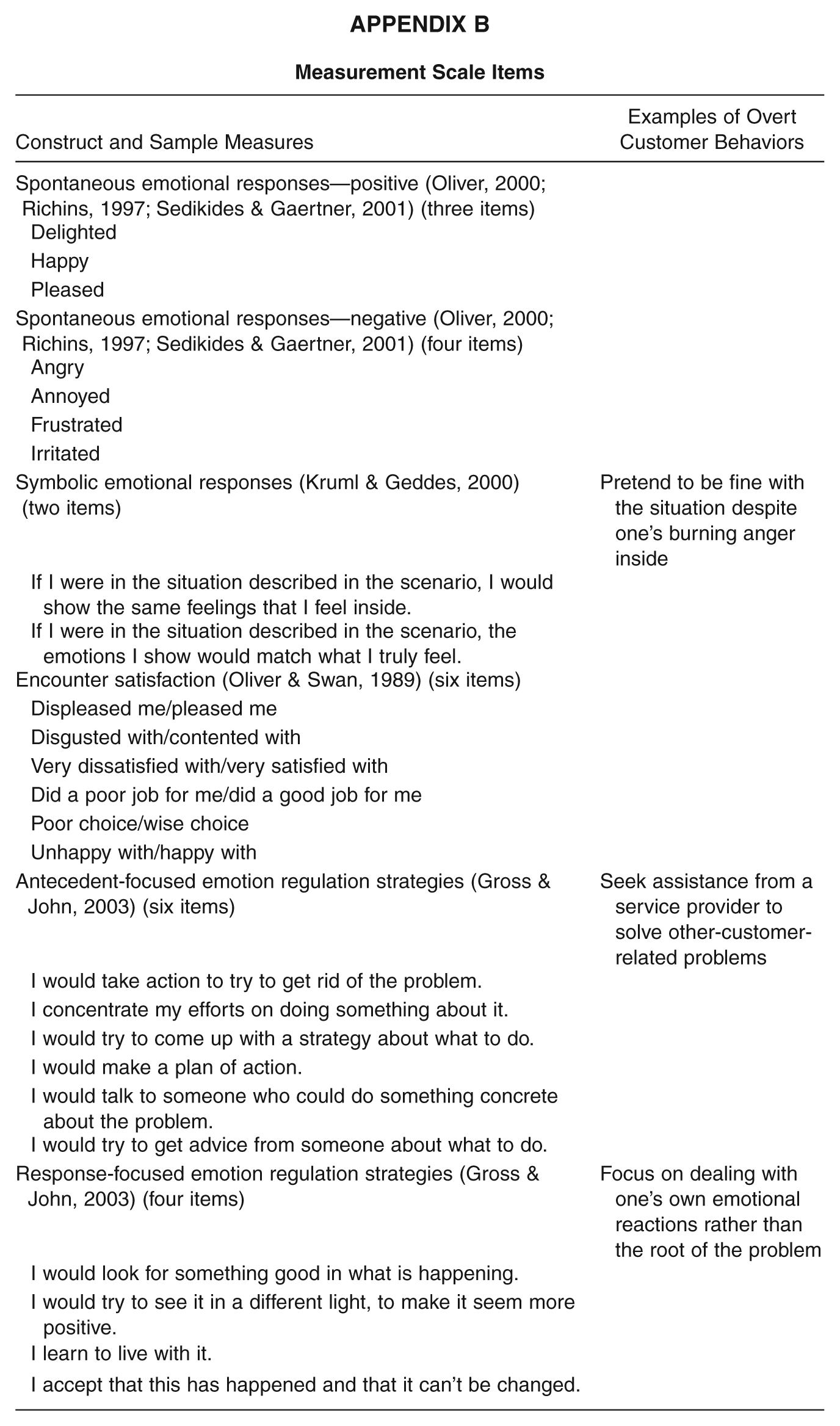
To assess spontaneous emotional responses, participants completed an alphabetized 7-item emotion scale, based largely on Richins’s (1997) work, with relevant items added from Sedikides and Gaertner (2001) and Oliver (2000). These items consisted of emotional terms such as pleased, delighted, happy, annoyed, angry, frustrated, and irritated. Participants were asked to indicate the extent to which each item reflects how they feel when they imagine themselves in the service encounter described in the scenario. All responses were on a 7-point scale anchored at 1 = not at all and 7 = very much. This 7-item scale was used to derive an index for positive and negative emotional responses (three positive items, α = .96, four negative items, α = .97). A positivity index was constructed by averaging the positive and negative emotional responses separately and then subtracting the later from the former for each participant (Labroo & Ramanathan, 2007).
Symbolic emotional responses
In this study, symbolic emotional responses were operationalized into emotive dissonance, an emotional state marking a mismatch between the felt emotions and the expressed emotions (Kruml & Geddes, 2000). A greater emotive dissonance score means a greater discrepancy between felt emotions and expressed emotions or a greater symbolic emotional response. Emotive dissonance was measured via a 2-item scale (Kruml & Geddes, 2000). The two items measured on a 7-point scale were “If I were in the situation described in the scenario, I would show the same feelings that I feel inside” and “If I were in the situation described in the scenario, the emotions I show would match what I truly feel.” Ratings on the two items (r = .80) were recoded so that greater scores represent greater levels of symbolic emotional responses.
Encounter satisfaction
Encounter satisfaction (α = .97) was measured using a 6-item satisfaction scale (Oliver & Swan, 1989). Following the recommendation by Nunnally and Bernstein (1994), this study used two separate continua to capture the bipolar nature of the satisfaction construct, with zero point capturing a neutral state. Specifically, the satisfaction scale was anchored at −7 = very dissatisfied, 0 = neither, and 7 = very satisfied. A negative score represents encounter dissatisfaction, whereas a positive score reflects encounter satisfaction. All measurement scale items are included in Appendix B.
Control Variables
Prior research suggested that two individual differences, public self-consciousness and self-monitoring, may affect people’s emotional reactions in social settings (Fenigstein, Scheier, & Buss, 1975; Snyder & Gangestad, 1986). These variables were included as control variables in the data analysis. Public self-consciousness was measured using a 7-item scale (Fenigstein et al., 1975). Self-monitoring was measured using the 18-item version of the self-monitoring scale (Snyder & Gangestad, 1986). Product category involvement (Zaichkowsky, 1985) was also included as a control variable. It was measured using a 3-item scale (Zaichkowsky, 1985). As the effects of these variables on dependent variables all failed to reach the conventional levels of statistical significance in the ANCOVA analyses (Fs < 1.21, ps > .27), these variables are not further discussed in the article.
Manipulation checks were also included in the research protocol. Realism of the scenario was measured with the item “how realistic is the scenario described at the beginning of the questionnaire?” (1 = very unrealistic and 7 = very realistic). Ease of use was measured with the item “how easy is it for you to imagine yourself in the scenario?” (1 = very difficult and 7 = very easy).
Results
Manipulation checks
The scenario manipulations were first checked for their realism (Ms ≥ 5.80) and ease of use (Ms ≥ 5.74). Furthermore, as expected, participants in the negative behavior conditions rated the behaviors more negatively than participants in the positive behavior conditions, Ms = −1.91 vs. 2.60, t(135) = −23.11, p < .01, and both were significantly different from the midpoint, t(69) = −15.47, and t(66) = 17.09, ps < .01. Also, as expected, participants in the close psychological distance condition perceived the distance from other customers in the service encounter to be much closer than those in the distant distance condition (Temporal: Mclose = 5.60 vs. Mdistant = 2.43; t[135] = −13.91, p < .001; Spatial: Mclose = 5.89 vs. Mdistant = 3.88; t[134] = −6.78, p < .001). 2 Taken together, the manipulations of other customers’ behaviors and psychological distance were successful.
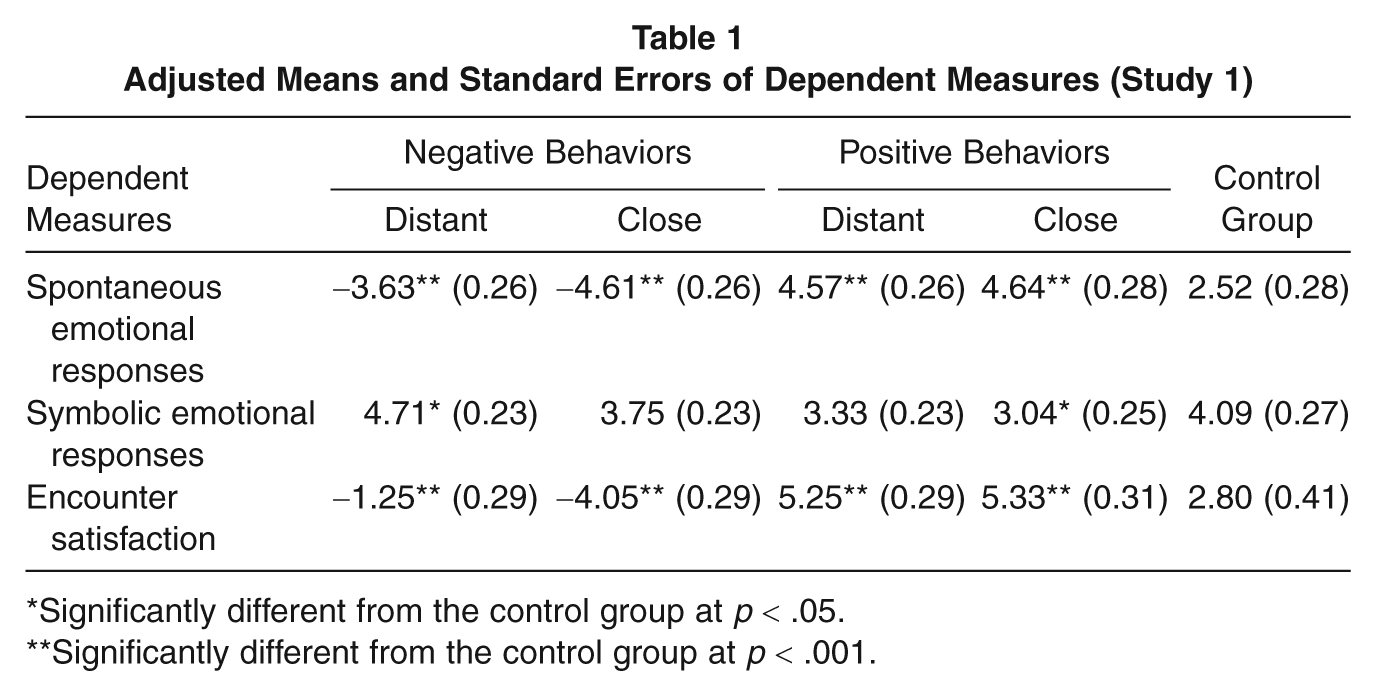
A multivariate analysis of covariance (MANCOVA) analysis was performed on the set of the dependent variables, with behaviors of other customers and psychological distance as between-subjects factors and the set of control variables as covariates. The MANCOVA results show that the main effect of behaviors of other customers, F(3, 128) = 328.18, p < .001, Wilks’s Λ = .10, the main effect of psychological distance, F(3, 128) = 8.35, p < .001, Wilks’s Λ = .83, and the interaction effect of behaviors of other customers and psychological distance, F(3, 128) = 7.42, p < .001, Wilks’s Λ = .85, were all highly significant. In the following section, the MANCOVA results on each dependent variable are reported in detail. Table 1 presents the means and standard errors of the dependent variable measures.
Adjusted Means and Standard Errors of Dependent Measures (Study 1)
Significantly different from the control group at p < .05.
Significantly different from the control group at p < .001.
Spontaneous emotional responses
The MANCOVA results show a significant main effect of behaviors of other customers on spontaneous emotional responses, F(1, 130) = 1023.03, p < .001. However, this main effect is qualified by a significant interaction with psychological distance, F(1, 130) = 4.05, p < .05. When the behaviors of other customers were negative, there was a significant difference in spontaneous emotional responses between the two distance groups, t(68) = 2.35, p < .05. Participants in the close distance condition reported greater negative emotional responses (M = −4.61) than those in the distant distance condition (M = −3.63). However, when the behaviors of other customers are positive, their responses are similar, Ms = 4.64 vs. 4.53, t(65) = −21, p = .83. Therefore, Hypothesis 1 predicting an asymmetrical pattern of the effect of psychological distance on spontaneous emotional responses is supported. Figure 1 illustrates the interaction pattern.
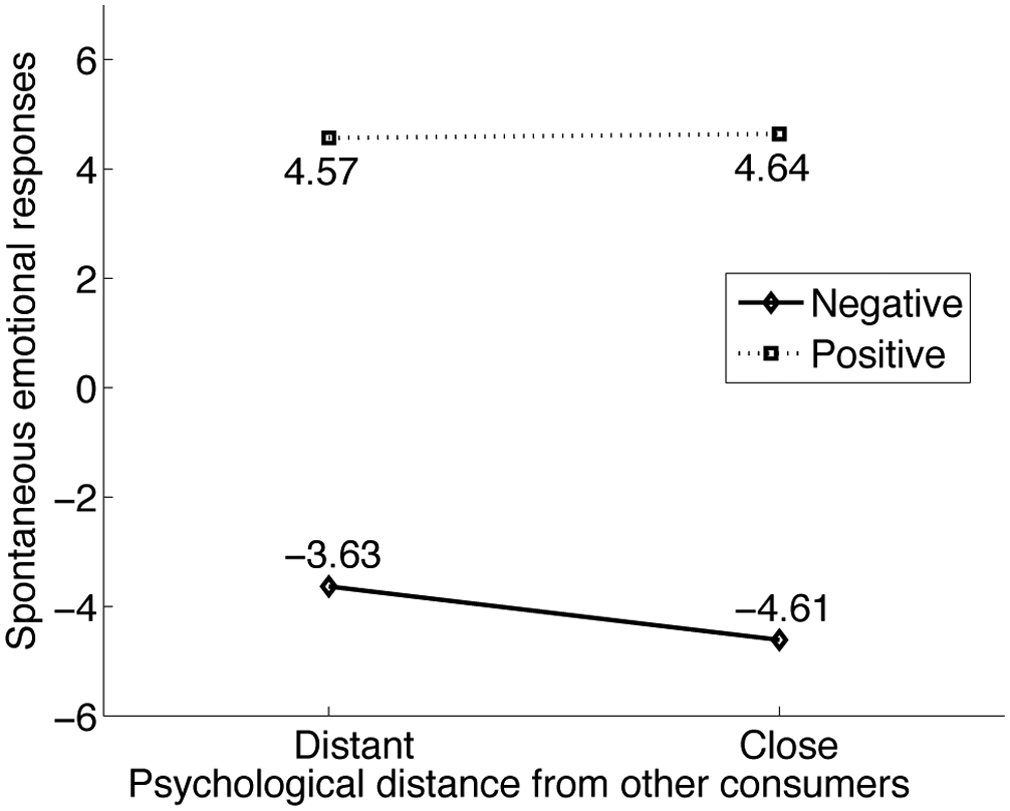
The Interaction Patterns of Behaviors of Other Customers and Psychological Distance
Symbolic emotional responses
The MANCOVA results reveal a significant main effect of behaviors of other customers, F(1, 130) = 16.72, p < .001. The marginal means show that participants exposed to the negative behaviors of other customers reported significantly greater levels of symbolic emotional responses (M = 4.21) than their counterparts exposed to positive behaviors (M = 3.21). The main effect of psychological distance is also significant, F(1, 130) = 6.35, p < .01. The marginal means reveal that participants in the distant psychological distance condition reported significantly greater levels of symbolic emotional responses (M = 4.03) than their counterparts in the close distance condition (M = 3.39). However, the interaction effect between the two factors fails to reach conventional levels of significance, (F(1, 130) = 1.80, p = .18. Therefore, Hypothesis 2 is not supported.
Encounter satisfaction
The MANCOVA results show a significant main effect of behaviors of other customers on encounter satisfaction, F(1, 130) = 684.63, p < .01. This main effect is qualified by a significant interaction with psychological distance, F(1, 130) = 21.54, p < .01. The planned contrasts reveal that in the negative behavior condition, participants in the close distance group (M = −4.08) reported greater encounter dissatisfaction than their counterparts in the distant distance group, M = −1.25, t(68) = 6.69, p < .01. However, encounter satisfaction between the two distance groups shows no statistical difference when other customers’ behaviors are positive, (Ms = 5.26 vs. 5.33, t(65) = .16, p = .86. Therefore, Hypothesis 3 predicting the effect of psychological distance on encounter satisfaction is supported.
Discussion
Study 1 tested the effect of psychological distance on a set of customer responses to behaviors of other customers in a restaurant setting. The results indicate that the behavior of other customers has a significant effect on a focal customer’s spontaneous emotional responses, symbolic emotional responses, and encounter satisfaction. More important, the results provide strong support for the moderating role of psychological distance on customer responses to the behaviors of others. As predicted, the psychological distance effect is limited to negative behaviors. One puzzling piece in the results is that participants reported greater symbolic emotional responses when the psychological distance from other customers was distant. This result goes against our prediction that the greater outcome dependency in the close psychological distance condition would result in greater levels of symbolic emotional responses. As the relationship was in the direction opposite to that hypothesized, we speculate that there might be another intervening variable other than outcome dependency that affects the patterns of symbolic emotional response.
One such variable is emotion-regulation strategies. The rationale is as follows: Individuals in the two psychological distance conditions may have used different emotion-regulation strategies when managing their negative emotional responses elicited by other customers’ behaviors. Emotion regulation involves multiple strategies that fall into two broad categories (Gross & John, 2003): antecedent-focused and response-focused emotion-regulation strategies. Antecedent-focused strategies refer to things we do to change emotional responding, and response-focused strategies refer to things we do to manage the expression of emotional responses (Gross & John, 2003). In interpersonal encounters with minimal psychological and social stakes, people are more likely to engage in escape-avoidance response-focused emotion-regulation strategies such as suppression of emotional expressiveness (Folkman, Lazarus, Dunkel-Schetter, DeLongis, & Gruen, 1986). We thus speculate that when the psychological distance from other customers is distant, the social impact of other customers on a focal customer’s experience is weak. As a result, it is unlikely that the consumption experience will be jeopardized by other customers and thus the focal customer engages in passive response-focused emotion regulation. Conversely, when the psychological distance is close, the social impact of other customers on the focal customer is significantly stronger and more is at stake if behaviors of other customers affect the consumption experience. In such situations, the focal customer is likely to be more active and to use antecedent-focused emotion regulation in dealing with a stressful service encounter. This prediction was tested in Study 2.
Study 2: The Effect of Psychological Distance on Customer Emotion-Regulation Strategies
Subjects, Design, Procedure, and Experimental Conditions
A total of 151 people participated in Study 2. Participants were recruited using a database provided by the human resources office at a major university in the Northeastern region in the United States. The database contains faculty and staff on multiple campuses. Questionnaires were sent to 1,200 people randomly selected from the database. The returned questionnaires represent a response rate of 12.5%. Of these, 94 participants were female (62%). The participants were between the ages of 19 and 68 years (M = 45.8).
As emotion-regulation strategies are most relevant in stressful service encounters, Study 2 was limited to negative behaviors of other customers. The manipulation of psychological distance (distant vs. close) was the same as that used in Study 1. Participants were randomly assigned to the two psychological distance conditions. Participants were exposed to a hypothetical consumption episode similar to the one used in Study 1.
Dependent Variables
Spontaneous emotional responses, symbolic emotional responses, and encounter satisfaction were the same measures used in Study 1.
Emotion-regulation strategies
Emotion-regulation questionnaire was used to measure the emotion-regulation strategies (Gross & John, 2003). The scale included six items representing the antecedent-focused strategies (e.g., “I would take action to try to get rid of the problem”) and four items reflecting the response-focused strategies (e.g., “I would try to see it in a different light, to make it seem more positive”). The 10-item measurement (α = .90 for antecedent-focused strategies; α = .86 for response-focused strategies) was assessed on a 7-point scale (1 = strongly disagree and 7 = strongly agree).
Manipulation check variables and demographic variables were assessed with similar measurements used in Study 1.
Results
Manipulation checks
The scenario manipulations were first checked for their realism (Ms ≥ 5.40) and ease of use (Ms ≥ 5.81). As expected, participants in the close psychological distance condition perceived distance from other customers in the service encounter to be much closer than those in the distant distance condition (Temporal: Mclose = 4.45 vs. Mdistant = 2.97; t[151] = −5.81, p < .001; Spatial: Mclose = 6.20 vs. Mdistant = 3.54; t[151] = −10.01, p < .001). Taken together, the manipulation of psychological distance was successful.
Emotional responses and encounter satisfaction
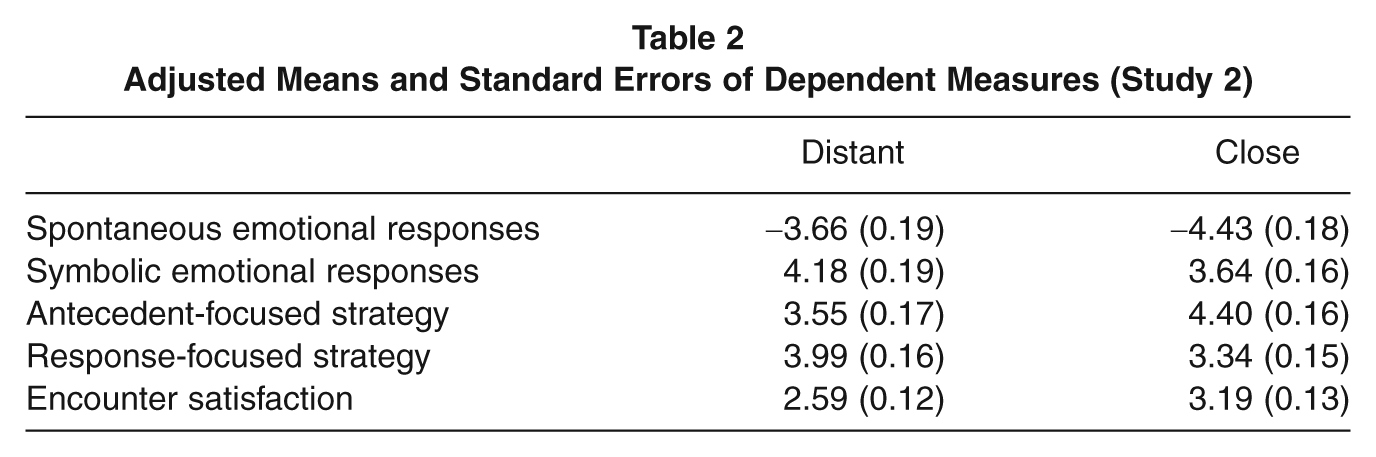
To further test the robustness of the results observed in Study 1, MANOVA analysis was performed to test the effect of psychological distance on spontaneous emotional responses, symbolic emotional responses, and encounter satisfaction. The MANOVA procedure produced similar results obtained in Study 1. The effect of psychological distance was highly significant, F(3, 139) = 4.25, p < .001, Wilks’s Λ = .91. Tests of between-subjects effects show that the magnitude of spontaneous emotional responses in the close distance group was significantly stronger than those in the remote distance group, F(1, 141) = 7.82, p < .01, Ms = −4.43 vs. −3.66. Similarly, participants in the close distance condition showed significantly lower encounter satisfaction than their counterparts in the remote distance condition, F(1, 141) = 11.02, p < .001, Ms = 3.19 vs. 2.59). As with the results obtained in Study 1, symbolic emotional responses in the remote distance condition were stronger than those in the close distance condition, F(1, 141) = 6.53, p < .01, Ms = 4.18 vs. 3.64. The means and standard errors of the dependent variables are reported in Table 2.
Adjusted Means and Standard Errors of Dependent Measures (Study 2)
Emotion-regulation strategies
An emotion-regulation index was formed by first averaging the antecedent-focused strategy ratings and response-focused strategy ratings separately and then subtracting the later from the former, so that a greater score represents a greater tendency to engage in antecedent-focused emotion regulation. The results of an independent-samples t test show a significant difference in emotion-regulation strategies between the two distance groups, t(146) = −3.70, p < .001. As predicted, participants in the close distance group reported greater tendency to use antecedent-focused strategy than those in the remote distance group (Ms = 1.06 vs. −.44, p < .001).
To further test the robustness of the observed differences in emotion regulation strategies between the two distance groups, MANOVA analysis was performed using ratings of antecedent-focused strategy and response-focused strategy as dependent variables and psychological distance as a factor. The MANOVA results show that the effect of psychological distance on emotion regulation strategies is significant, F(2,145) = 6.97, p < .001, Wilks’s Λ = .91. As predicted, participants in the close distance group reported greater tendency to use antecedent-focused strategy than those in the distant distance group (Ms = 4.40 vs. 3.55). Conversely, participants in the distant distance group reported greater tendency to use response-focused strategy than those in the close distance group (Ms = 3.99 vs. 3.34). The means and standard errors of the means are reported in Table 2.
Effects of other-customer-elicited responses on encounter satisfaction
To examine the joint effect of spontaneous emotional responses, symbolic emotional responses, and emotion-regulation strategies on encounter satisfaction, a multiple regression procedure was applied using the residuals of the variables produced by the MANOVA procedures. 3 The regression results suggest that the three other-customer-elicited responses altogether explained 36.3% of the variance in encounter satisfaction, F(3, 135) = 25.68, p < .001. Spontaneous emotional responses were significantly and positively related to encounter satisfaction (b = .37, p < .001). Emotion-regulation strategies yielded a significant negative effect on encounter satisfaction (b = −.33, p < .001). However, the effect of symbolic emotional responses on encounter satisfaction was not significant (b = −.14, p = .34).
Discussion
An important finding from Study 2 is that customers use different emotion-regulation strategies depending on the psychological distance from other customers. When the psychological distance is remote, customers tend to be passive and rely on response-focused emotion-regulation strategies when dealing with other customers’ negative behaviors. In contrast, when the psychological distance is close, instead of suppressing their emotional expressiveness, customers employ more positive antecedent-focused emotion-regulation strategies to manage negative emotions caused by other customers.
The results show that the effect of symbolic emotional responses on encounter satisfaction is not significant. As speculated earlier, the results indicate that emotion-regulation strategies may have attenuated the effect of symbolic emotional responses on encounter satisfaction as the symbolic emotional responses can be related to the type of emotion-regulation strategies used. A notable finding from Study 2 is that antecedent-focused emotion regulation has a negative effect on encounter satisfaction. Emotion-regulation literature suggests that antecedent-focused strategies are generally more effective than response-focused strategies (Silk, Steinberg, & Morris, 2003). Interestingly, Study 2 shows that managing negative emotions via antecedent-focused emotion regulation appears to result in decreased encounter satisfaction. Response-focused emotion regulation can be cognitively taxing and thus adversely affect encounter satisfaction. These results highlight the importance of isolating other-customer-elicited emotional responses from other emotion-eliciting sources in a service environment (e.g., atmospheric factors and service providers) and of examining the unique underlying psychological processes associated with other-customer-elicited responses to service encounters.
General Discussion
Theoretical Implications
Managing customer experiences is among the key success factors in today’s competitive hospitality business environment. Yet theory-based research on the impact of the social environment on customer experiences is scant. In response to Bendapudi and Leone’s (2003) call for more empirical investigation of customers’ psychological responses to service encounters, the present study provides a psychosocial distance perspective of the impact of other customers on customer experiences. The egocentric perspective of the social environment puts the customer at the center of a consumption experience. The notion of psychological distance provides a theoretical framework to conceptually define the “customerscape” of a service encounter in which customer-to-customer interactions take place. This research accounted for the social nature of customer-to-customer interactions and is among the first to model the symbolic emotional responses of customers in service encounters. Following Buck et al.’s (1992) conceptualization, this research empirically tested the effect of psychological distance on two aspects of emotional reactions: spontaneous responses and symbolic responses. Spontaneous emotional responses have traditionally been the focus of research in customer responses to service encounters. Given the presence of other customers in a typical service experience, service encounters are also subjectively experienced by customers as social encounters. According to Verhoef et al. (2009), customer experience is holistic in nature and involves the customer’s physical, cognitive, affective, and social responses to the service organization. Our findings indicate that multiple dimensions may interact with each other to affect customer experiences. For example, our findings suggest that the physical dimension of a customer experience (e.g., spatial distance) influences the affective (e.g., magnitude of emotional responses) and social (e.g., symbolic emotional responses) dimensions of the customer experience. The multidimensional nature of the customer experience in general and the social dimension in particular is better understood through the findings from this research.
This study further explored the social dimension of customer experience by examining how the very presence of other customers alters the way customers regulate other-customer-elicited emotions. We also investigated how such socially patterned customer responses to behaviors of others jointly affect the consumer’s overall evaluation. The current research demonstrates that customers are more likely to use antecedent-focused emotion-regulation strategies when the psychological distance from other customer is close. Antecedent-focused emotion-regulation strategies are generally considered more effective than response-focused strategies in coping with stressful encounters (Gross & John, 2003). However, our results show that antecedent-focused emotion regulation resulted in lower levels of encounter satisfaction. These results imply that antecedent-focused emotion regulation, which often involves direct confrontations with other customers, may have involved psychological costs. Our study findings suggest that the presence of other customers may affect customer experiences through multiple pathways. Although customer experience involves the customer’s cognitive, affective, social, and physical response to services (Verhoef et al., 2009), our results allude to the possibility that such responses may also interact with each other to affect customer experiences. The interactive dimension of the customer experience reveals another layer of the customer experience and calls for a holistic approach to CEM research.
Managerial Implications
This research offers several important managerial implications for hospitality firms. The findings from this research suggest that managerial approach to CEM requires a strategic shift from staging experiences for customers to engaging customers in the consumption process. Traditionally, hospitality firms have focused on elements that are under direct managerial control such as service interface and customer–provider interactions. As hospitality firms have no direct control over customer-to-customer interactions, many hospitality firms take a laissez-faire approach to managing this part of the customer experience. The findings from this research suggest that the impact of other customers may differ in service encounters within and across service categories as a function of a focal customer’s psychological distance to other customers. Furthermore, customers’ emotional responses to the behaviors of other customers are not monolithic and homogenous across all service encounters. As this research demonstrates, in situations where psychological distance from other customers is close, behaviors of other consumers is likely to trigger stronger consumer responses. Therefore, for hospitality services that entail close psychological distance between customers (e.g., cruise trips, group tours), practitioners need to be aware that behaviors of other customers can either “make or break” a focal customer’s experience. In such situations, customer-to-customer dynamics probably have a greater impact on customer experiences than provider-to-customer dynamics.
At an operational level, the customer engagement approach requires hospitality firms to identify customer–customer contact points in the service delivery process. For example, the traditional service blueprinting only focuses on customer-to-employee contact points (line of interaction) and employee-to-employee contact points (line of internal interaction), whereas the customer-to-customer contact points are ignored. This research demonstrates that, as part of the service design, it is critical to identify customer-to-customer contact points in the service delivery process. Management of customer-to-customer interactions should also be a strategic imperative. At the implementing stage of the service design, systematic training programs should adequately prepare frontline employees to deal with not only provider–customer interactions but also with customer-to-customer interactions.
Hospitality firms can also strategically manipulate the temporal and spatial distance between customers to enhance the holistic value of a customer experience. Hospitality firms can deliberately reduce the spatial distance to make customer-to-customer interactions a salient part of the customer experience. For instance, Marriott Corporation recently redesigned its lobby and public areas to foster a social environment conducive to a community-like hotel experience (Wolf, 2008). Similarly, in the restaurant business, some establishments such as Starbucks are starting to use large communal tables to serve customers in an effort to reduce psychological barriers between customers and to add a new dimension to a restaurant experience. In addition to fostering interactions among customers, communal tables can also reduce the feeling of loneliness for solo customers (Zomerdijk & Voss, 2010).
The hospitality industry has long recognized the symbolic emotional responses of service providers under the rubric of “emotional labor” (e.g., Grandey, Tam, & Brauburger, 2002). However, symbolic emotional responses on the part of customers are not widely recognized. This research suggests that hospitality managers need to be aware that customers may also engage in “emotional labor” to deal with other-customer-elicited negative emotions. Similar to the negative effect of emotional labor on job satisfaction, consumers’ symbolic emotional responses are also found to be taxing, as reflected in reduced levels of encounter satisfaction. Of particular pertinence to practitioners, this study sheds light on customers’ emotional regulation in other-customer-elicited stressful service encounters. Antecedent-focused strategies will affect encounter satisfaction more negatively than response-focused strategies. Therefore, frontline employees need to be extremely vigilant about potential undesirable behaviors and take proactive actions to minimize the need for customers to engage in antecedent-focused strategies. For example, one common guest grievance in beach resort hotels during high season is that some guests choose not to give up their “territories” on the beach for other guests to enjoy even when they are not using the beach facilities for an extended period of time. Most hotels take a laissez-faire approach to the “territorial” wars waged by guests. Our results suggest that, to create a pleasurable experience for all guests, hotels need to establish explicit behavioral expectations and may even need to take managerial actions to enforce the rules.
Limitations and Future Research
There are several limitations associated with this research. First, the limitations of self-reported emotional response measures should be acknowledged. Although prior studies have demonstrated that self-reports provide an effective and efficient method of assessment in measuring consumption-related emotions (Westbrook & Oliver, 1991), it would have been preferable to use additional observational measures such as facial expressions and behavioral measures to assess emotional responses. Second, we simultaneously manipulated temporal distance and spatial distance in the same direction to induce a salient difference in perceived psychological distance across experimental conditions. It would have been interesting to compare the relative impact of each dimension of psychological distance on consumer responses separately by independently manipulating the two dimensions, or to compare the relative impact of each dimension on the overall psychological distance by simultaneously manipulating different dimensions in opposite directions. Third, in this study we treated individual differences such as self-consciousness, self-monitoring, and product category involvement as control variables and included them as covariates in MANCOVA analyses. However, it is possible that such differences may moderate the effect of psychological distance on customer responses. As the focal interest of the present research was to examine the interaction effect between psychological distance and behavior of other customers, the potential moderating effects of the individual differences were not purposively pursued. Future research can explore the potential moderating effects of the individual differences to further our understanding of this topic.
The present research offers some interesting avenues for future research. Future research can examine the evolvement of emotional responses to the behaviors of other customers over the course of a service encounter. The spontaneous emotional responses captured in this research are likely to be “unregulated” emotional responses. As the service encounter progresses, emotion-regulation strategies are activated and such regulatory efforts are likely to alter the magnitude or even the valence of the emotional responses. Such “regulated” emotional responses are likely to reflect the joint effect of behaviors of other customers, psychological distance, and emotion-regulation strategies. With both the “unregulated” and “regulated” emotional responses captured in one study, the strength of their relationship with encounter satisfaction can be further explored. In this study, psychological distance was manipulated to test the causal effect on customer responses. The effect of psychological distance on customer responses can be further understood by directly measuring customers’ perception of psychological distance and examining how distance perception influences customer responses. Of particular interest is to empirically test whether the effect of psychological distance on emotion display is mediated through emotion regulation strategies and to explore its underlying psychological mechanisms.
In conclusion, the present research sheds light on an important and underexplored aspect of CEM in the hospitality context. The findings presented in this article offer a sound theoretical platform for further research in the impact of social environment on customer experiences.
Footnotes
Appendix A
Appendix
Measurement Scale Items
| Construct and Sample Measures | Examples of Overt Customer Behaviors |
|---|---|
| Spontaneous emotional responses—positive (Oliver, 2000; Richins, 1997; Sedikides & Gaertner, 2001) (three items) | |
| Delighted | |
| Happy | |
| Pleased | |
| Spontaneous emotional responses—negative (Oliver, 2000; Richins, 1997; Sedikides & Gaertner, 2001) (four items) | |
| Angry | |
| Annoyed | |
| Frustrated | |
| Irritated | |
| Symbolic emotional responses (Kruml & Geddes, 2000) (two items) | Pretend to be fine with the situation despite one’s burning anger inside |
| If I were in the situation described in the scenario, I would show the same feelings that I feel inside. | |
| If I were in the situation described in the scenario, the emotions I show would match what I truly feel. | |
| Encounter satisfaction (Oliver & Swan, 1989) (six items) | |
| Displeased me/pleased me | |
| Disgusted with/contented with | |
| Very dissatisfied with/very satisfied with | |
| Did a poor job for me/did a good job for me | |
| Poor choice/wise choice | |
| Unhappy with/happy with | |
| Antecedent-focused emotion regulation strategies (Gross & John, 2003) (six items) | Seek assistance from a service provider to solve other-customer-related problems |
| I would take action to try to get rid of the problem. | |
| I concentrate my efforts on doing something about it. | |
| I would try to come up with a strategy about what to do. | |
| I would make a plan of action. | |
| I would talk to someone who could do something concrete about the problem. | |
| I would try to get advice from someone about what to do. | |
| Response-focused emotion regulation strategies (Gross & John, 2003) (four items) | Focus on dealing with one’s own emotional reactions rather than the root of the problem |
| I would look for something good in what is happening. | |
| I would try to see it in a different light, to make it seem more positive. | |
| I learn to live with it. | |
| I accept that this has happened and that it can’t be changed. |
Article Note
The review process was monitored by Associate Editor Stowe Shoemaker.