




Abstract
Conventional wisdom would have us believe that Assam is a state where the status of women is comparatively better off than that of their counterparts in the rest of India, that they suffer from fewer instances of domestic violence. The geographical contiguity of a region which contains some matrilineal tribal societies, significant female mobility, and a near absence of practices such as dowry or sati as part of tradition, might lend some credibility to this belief. However, present indicators and crime statistics have actually shown a high incidence of overall crimes against women in Assam. A complex socio-political milieu, characterised by increasing militarism and insurgency, continuing ethnic and group conflicts in an overall environment where ‘market forces’ dominate, has in its own way posed serious challenges to the security of women and led to the opening up of more and more ‘violent spaces’ –the home being one one of them. The present study endeavours to explore the socio-structural dynamics and contexts rooted in Assam that perpetuate domestic violence against women. The study underscores the necessity of informed policy-level interventions and a holistic approach to address structural constraints that underpin such violence.
Introduction
Domestic or family violence is increasingly being recognised as the most pervasive yet the most silenced form of gender-based violence. Understood simply as ‘violence by an intimate partner and by other family members, wherever this violence takes place and in whatever form’, acts of domestic violence are found to manifest themselves in all strata of society, cutting across racial, cultural, economic, political and religious spectrums (Khan, 2000). Globally, the prevalence estimates of such violence range from 23.2 per cent in high-income countries and 24.6 per cent in the western Pacific region to 37 per cent in the eastern Mediterranean region and 37.7 per cent in South-East Asia (WHO, 2013). It is important to note that the gendered nature of domestic violence has been adequately highlighted in several studies, underscoring the need to comprehend the phenomenon in the context of gender inequality (Dobash, R. E. & Dobash, 1998; Schwartz, 2005; Tracy, 2007). However, one cannot deny the fact that in crimes like these gender operates along other axes of society such as class, caste, race and religion to create oppressive spaces for women.
The issue of domestic violence came into sharp focus in India in the 1980s (Kumar, 1993; Mitra, 2000). Researches and studies carried out later highlighted the increasing spate of such incidences and the factors associated with them (Jeejebhoy, 1998; Sunny, 2003; Vindhya, 2000; Visaria, 2000). In India, the predominant forms of violence against women in families is husband–wife abuse (Chawla, 2004), where the low status of the bride increases her chances of being abused, especially in dowry-related cases, making her five times more likely to suffer abuse in the first seven years of her marriage than after the seven-year mark (Prasad, 1994). Religious, cultural and traditional social norms also provide some grounds for justification of domestic violence, which a woman suffers throughout her life. These can take place in various forms: through personal confinement and restrictions on mobility, particularly in rural areas; almost complete marginalisation in the decision-making process at the household-level; responsibility for household work, including looking after younger siblings; sexual abuse by family members, even incest; childhood/forced marriage; and verbal abuse (HDR, 2001).
Women in Assam are no exception to such violence. Contrary to the prevailing belief that women in the state are better off than their counterparts in the rest of India, statistics suggest a different picture. Official figures of the Assam police show that there is a steady rise in the number of cases of cruelty by husbands and dowry deaths since 2010, with a minor dip in 2016 (Assam Police, 2018). According to figures available with the National Crime Records Bureau (NCRB), the incidences of cruelty by a husband and his relatives were highest in Assam (71.5 per cent), nearly four times the national rate of 18.7 per cent (NCRB, 2015). Newspaper reports and media portrayals in the state present a sordid picture of the nature of domestic violence—ranging from beating to burning to even death. However, figures seen in large-scale national health and crime surveys are unable to represent the grim reality due to the silent nature of the crime. An empirical inquiry with theoretical insights and contextual specifications presents a fairly realistic picture of underlying social, cultural, economic or contextual factors responsible for domestic violence. However, such studies are conspicuously absent in Assam. The present article seeks to uncover these issues that are critically related to the occurrence of violence within the private sphere.
Methodology of the Study
The article is primarily based on the findings of a field study conducted between 2009 and 2010 through interviews with 300 women drawn from the erstwhile Kamrup district of Assam, currently divided into Kamrup (rural) and Kamrup (metro). Kamrup district, shows a low sex ratio even though it is the administrative centre of the state, and is marked by high levels of urbanisation and development (Office of the Registrar General and Census Commissioner, 2001). It also has a persisting gender gap in rates of literacy, female labour force participation and high rates of crimes committed by husbands and relatives (Planning and Development Department, 2014). The field study was a cross-sectional inquiry into the problem of domestic violence derived from a randomly selected sample located in six villages selected from two blocks of Kamrup district. Since one of the primary objectives of the research was to get an idea of the attitudes of the victims of domestic violence as well as to understand its nature, a significant section of the data collection was based on open-ended questions and informal communication with respondents. For the purpose of the present article and to explore the socio-structural dynamics of domestic violence, the recent data drawn from diverse sources has been complemented by the findings of the field survey.
A feminist standpoint theory guides the entire research process which requires us to understand the world through the experiences of oppressed women (Brooks, 2007). Knowledge regarding the typology, nature, forms as well as associated factors, has been obtained from the women’s own experiences and activities depending upon how they interpret and negotiate domestic violence in their lives coming from multiple contexts and locations. There has been no attempt to force any particular accepted model or theory to deduce conclusions.
Findings from the Field Study
The 2009–2010 study interviewed 300 women from six villages in the Kamrup district of Assam. The mean age of the respondents was 35 years, the average years of schooling was 4.47 years and that of their husbands was 5.65 years. Of the total respondents, 40 per cent lived in joint families, 60 per cent in nuclear families, 40 per cent of the households had electricity, 33 per cent had toilets and 60 per cent had agricultural land. However, none of the households had access to piped drinking water.
It was found that 59 per cent of the total respondents were subjected to one or more forms of domestic violence at the time of the study. The majority of women who reported domestic violence were homemakers in the age group of 18–30 years, with an average of 3.5 years of education. Others were involved in occupations such as weaving, making country liquor and agriculture. None of the victims of domestic violence had any permanent employment. Only around 4 per cent of them had an immovable property of their own. Further, it was also found that husbands were the perpetrators of violence in majority of the cases, and in a small number of cases, the respondents reported the involvement of close relatives in the household.
Typology of Domestic Violence
It is important to understand the typology of violence to acquaint oneself with the nature, contexts and correlates of such violence. It also enables one to determine whether domestic violence is a gender symmetrical or gender asymmetrical crime (Johnson, 2008). Ranging from Johnson’s complex analysis of three forms of violence as ‘intimate terrorism’, ‘violent resistance’ and ‘situational couple violence’ to the United Nations, the broader frame include, in addition to physical, psychological and sexual violence, other acts such as kidnapping, threats, intimidation, coercion, stalking, humiliating, verbal abuse, arson, destruction of property, marital rape, dowry-related violence and female genital mutilation, indicating that domestic violence takes many forms.
Psychological Violence
Psychological or emotional abuse does not involve direct injury or hurt to the abused woman and ‘partners may rely on name calling, degradation and hurting their partners with words out of anger and frustration’ (Kurst-Swanger & Petcosky, 2003). It might sometimes be the consequence of physical abuse too when the victims suffer from ‘battering fatigue’ after an episode of serious physical battering (Mega, L. T., Mega, J. L., Mega, B. T., & Harris, 2000). It might also include acts such as denial of access to money, education or healthcare and so on (Kramarae & Spencer, 2000).
The most common form of violence in the study was psychological violence, which was found to exist at 89.2 per cent. Different forms of such violence were reported, the highest being the use of abusive language (81.64 per cent). The other forms of psychological violence were reprimanding (71.51 per cent) and refusal to talk to one’s wife (26.58 per cent). It is interesting to note that the use of abusive language was found to be most prevalent in those villages with a predominant tribal population; it was attributed consumption of alcohol by the men. However, some cases depict the multi-causal nature of psychological violence.
Physical Violence
Overt forms of physical violence such as hitting, shoving, biting, restraint, kicking or use of a weapon with the intentional use of force have the potential for causing injury, harm, disability or even death. ‘It is the most visible and life-threatening form of domestic violence and usually establishes the basis for the coercive effects of psychological battering’ (Kramarae & Spencer, 2000). Population-based research findings reveal that 10 to over 50 per cent of women reported being hit or otherwise physically harmed by an intimate male partner at some point in their lives (Heise, Ellsberg, & Gottemoeller, 1999).
Nearly 67.2 per cent of the women in the study experienced physical violence. Different forms of physical violence such as slapping, beating with a stick, throwing objects, banging a women’s head against a wall, pulling hair and pinching and so on were reported in the study. Slapping was the most common form of physical violence inflicted upon them, accounting for 98.3 per cent of all physical violence, followed by beating with a stick (68.9 per cent), hurling objects (44.5 per cent), banging head against a wall (21.8 per cent), and pulling hair and pinching (24.3 per cent). About 58.19 per cent of the respondents were subjected to both physical and psychological violence.
Economic Violence
Economic violence towards women occurred when a male abuser maintained complete control of the family finances, taking decisions without any consideration of a woman’s needs as to how the money was to be spent or saved, thereby reducing women to complete dependence for money to meet their own personal needs. Domestic violence of an economic nature was reported by 14.68 per cent of the respondents who said that they had conflicts over the issue of money. Of the forms of economic violence suffered by the women, 80.76 per cent said that they were not given enough money to run their household, and 19.23 per cent said that their husbands scolded them on the question of spending money properly or when they spent a little extra. Resultantly, conflicts broke out between them that sometimes took a violent turn.
Sexual Violence
Sexual abuse in a domestic relationship may involve a number of sexual violations including rape, forced pornography, fondling or grabbing. It may also be referred to as marital or partner rape, a form of violence whereby sex is used to hurt, degrade, humiliate and gain power over the victim (Langford & Thompson, 2004). Only five women (2.82 per cent) reported sexual abuse in their marriage, and this was related to different forms of physical abuse which they suffered. Concerning various forms of sexual violence, a majority of the women reported that they were subjected to forced sex by their husbands. One of them said that she was forced to watch pornographic material by her husband.
Factors Leading to Domestic Violence
An analysis of ‘the structure and personal elements’ that leads to its perpetuation is crucial to understand domestic violence.
Individual-Level Factors
A micro-level explanation of domestic violence viewed violence in the family as a result of a personality disorder or some mental illness of the perpetrator. Individual theories of domestic violence say that it is ‘usually attributed to the amount of alcohol consumed by the abuser’ (Leonard & Sanchek, 1996). ‘Men’s violence, sex addiction, gambling, alcohol and drug abuse is a form of self-medication, that is, an attempted defence against covert depression stemming from shame and toxic family relationships’ (Barker, 2007). At an individual level, alcohol consumption by husbands appeared to be one of primary causes of household conflicts and violence in the study. Such violence was reported by 61.58 per cent of the respondents. Most women said that their husbands would lose control over themselves under the influence of alcohol and quarrels would break out that often took a violent turn, leading to the use of physical force. Interestingly, most women would choose to ignore their husbands’ taunts; else it would result in more violence. However, several women also said that ignoring the taunts or not responding to them did not save them from domestic violence, as their husbands would hit them anyway, even on the slightest pretext. Another respondent remarked that conflicts broke out in the family when she tried to stop her son from drinking. Other individual-level causes of domestic violence were misunderstandings accounting for 12.99 per cent and extramarital affairs accounting for 2.82 per cent.
Structural Factors
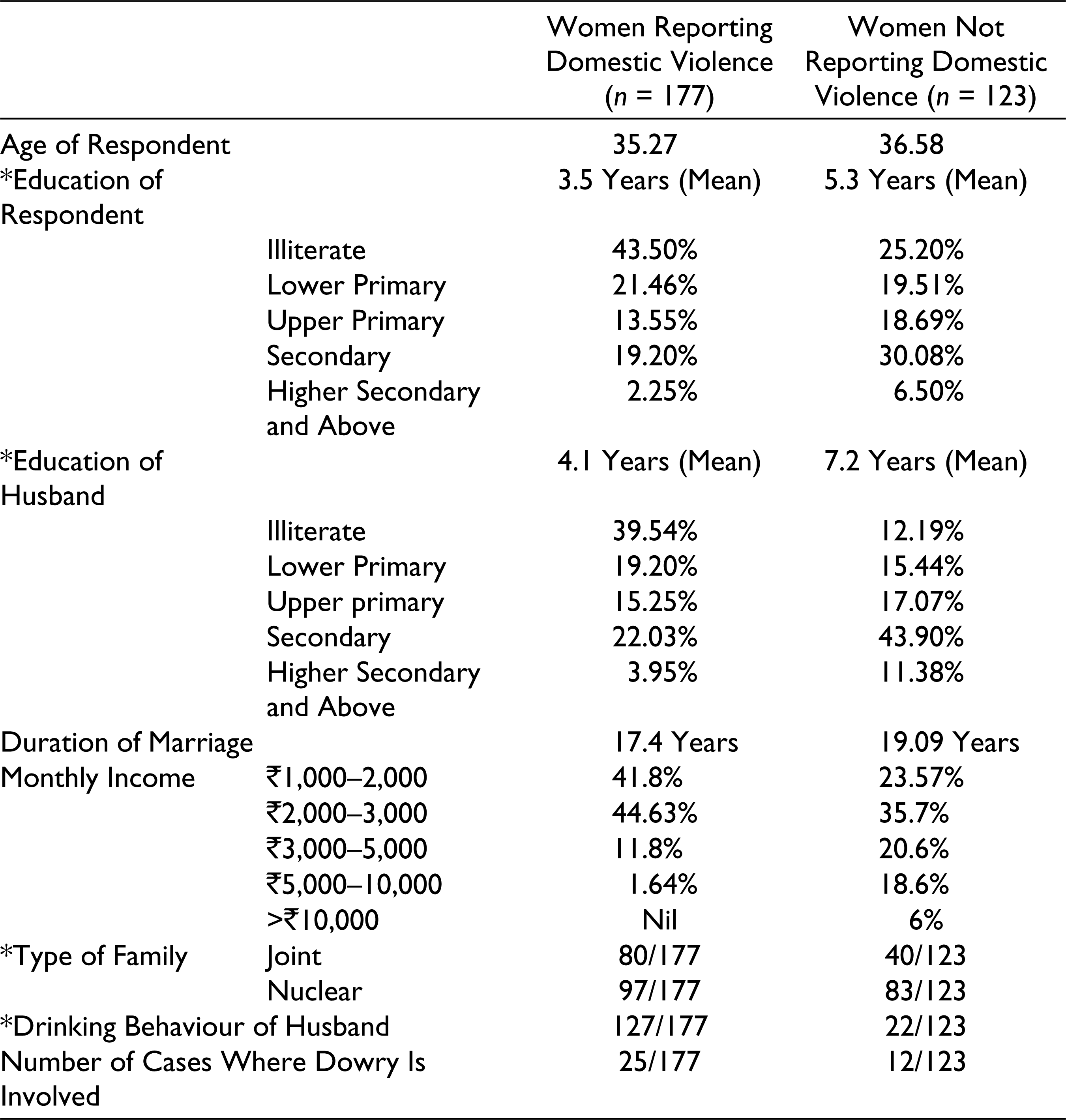
A comparison of socio-demographic variables of women who reported domestic violence with those who did not, revealed that factors such as education levels of the respondent, education of the husband, the average monthly income and the structure of the family had a significant bearing on the presence or absence of domestic violence and such factors were found to be statistically significant.
Education
Women who reported violence were found to have a mean level of education (3.5
years) that is, lower than the mean education of women who had not reported domestic violence (5.3 years). This was similar in the case of the education levels of the respondents’ husbands ( Table 1 ). A systematic exclusion of women from acquiring education was noticed when the respondents narrated parental objection, poverty, marriage at an early age and the large distance between schools and homes as the primary causes for dropping out of school. However in the case of men the main factors were mainly ignorance and the pressure to earn something for the family by engaging in wage labour. A similar study in rural Gujarat also established an inverse relation between the level of education of both men and women, and violence (Visaria, 2000).
Family Income
A limited household income, with no substantial contributions from women who were primarily homemakers was in many cases grounds of conflict. While comparing the average monthly income of the two groups of women (Table 1), the association between household income and domestic violence was highlighted by the fact that there were more families with low income in the domestic violence group (41.8 per cent) while it was just 23.5 per cent in the second group.
Socio-demographic Profile and Domestic Violence
Family Structure
Family structure was found to have a significant bearing upon the incidence of domestic violence. It was found that 45.19 per cent of respondents suffering domestic violence lived in joint families and 54.81 per cent lived in nuclear families. On the contrary, 35.53 per cent of respondents who did not report domestic violence lived in joint families, and 67.47 per cent lived in nuclear families. Most women in joint families pointed out to the passive interference by the other members, mostly mothers-in-law and elder sisters-in-law, in their lives which would go a long way in instigating their spouses against them. Such interference, however, was absent in nuclear families where violence was mainly perpetrated due to other factors.
Socio-cultural Factors
The family system in Assam works within a patriarchal social framework giving rise to strict gender roles that relegate women to activities in the private sphere. The construction of gender roles in a society provides an analytical framework to identify norms and beliefs that support violence in the household (Kapadia-Kundu, Khale, Upadhaye, & Chavan, 2007). Assamese societies are marked by the prevalence of particular phrases like buwari pua (buwari refers to the daughter-in-law and pua means early morning; so the phrase is associated with early morning hours and with daughters-in-law, and the kind of chores they are expected to perform during those hours). Existing within such ideological framework, it was not surprising that the issue of ‘food preparation for the household’ was an important reason behind family violence for 42.93 per cent of respondents. The reasons behind such conflicts ranged from a shortage of food grains, quality of the cooked food to delay in serving meals or even whether the dish was cold or warm. These factors, in conjunction with economic constraints in the family, created constant stress and strained family relations, often leading to arguments between partners that culminate in violent outbreaks.
Violence in the family due to economic hardships was also found to exist (41.80 per cent). Rigid gender roles and patriarchal practices again became evident when 27.68 per cent of the respondents said that they were subjected to violence for ‘not looking after their children properly’. Here, the women said that they were wrongly blamed as they would never think of neglecting their own children whom they loved very much despite all their financial or other problems.
In Assam, cases of dowry-related violence were not so pronounced. Only 5.64 per cent women reported it as a cause of domestic violence. In fact, the practice of dowry was never a part of the culture of people in Assam or in any of the tribes. It is a practice which has developed overtime.
Women’s Responses to Domestic Violence
The response of women to periodic or daily episodes of abuse, although to a large extent conditioned by social norms that uphold patriarchy that imposed strict gender roles, depended on how abused women perceived violent acts, and the perception of themselves and their relations with their husbands. A majority respondents who acknowledged that wife beating or torture was not justified, could not voice their protest due to various societal and structural factors. On the other hand, there were women who did not even attempt to question the violent abuse inflicted upon them, accepting it as part of the natural order of things for a man to hit his wife in order to control her. It is therefore not surprising that a considerable number of such women (88 per cent) across all ages and education levels chose to quietly tolerate the violence inflicted on them instead of protesting. Only ten women left the house at some point due to the violent behaviour of their partners; some returning as soon as the violence subsided, others living separately in their natal family at the time of the study.
A scrutiny of the major reasons behind such behaviour on the part of women revealed that it primarily stemmed from fear of social disapproval. Indeed, 60.89 per cent victims of domestic violence said that society would not approve if they raised their voice against the violent actions of their husbands. Almost 50.64 per cent women said that they did not protest because of their children. They feared that their protesting would lead to more violence and their children would suffer. Some even feared that if they were sent away from their homes by their husbands no one would be there to take care of their children. The absence of an alternative shelter for the sufferers of domestic violence was a main reason why most women (30.12 per cent) were compelled to stay within a violent relationship. Protesting would make their husbands hate them all the more. Economic compulsions were also cited by several women (24 per cent) as a strong reason for not breaking free from such violent relationships. A vast majority of women (98.87 per cent) said that they had never reported any instance of violence to the police. Only two respondents replied that they reported the matter to the police. Social disapproval, again, was the primary reason why a majority of women (36 per cent) refrained from taking recourse to law. Fear of police, fear of their husbands, fear of condemnation by family members, including their own natal family and economic constraints were other important factors cited by respondents that prevented them from seeking recourse under the law.
Analysis and Discussion
The study conducted in 2009–2010 is perhaps one of the first studies in this area which attempts to highlight not only the prevalence and forms of domestic violence in Assam but also attempts to understand the underlying socio-structural factors behind its occurrence and the prevailing attitudes and beliefs of women on this issue. The prevailing rate of domestic violence (59 per cent) found in this study was far more than that the rate projected in the NFHS (National Family Health Survey)–3, which showed that 39.4 per cent of even married women in Assam faced spousal violence. The recent NFHS–4 data though it projects a fall in the prevalence of domestic violence rates compared to the earlier round still shows that a significant number of women (24.5 per cent) face spousal abuse in Assam. The findings of the present study are also conform with a survey carried out by the North East Network, a women’s rights organisation, showing high rates of all forms of domestic violence in rural Assam (Hazarika & Sharma, 2015). NCRB statistics reveal that the highest number of cases of cruelty by husbands and relatives were reported from Assam between 2014 and 2015. Crimes under these categories also show a continuous upward trend in the state since 2010. Recent statistics, thus, highlight that there is a continuing trend in the spread of domestic violence. The above figures deconstruct the long-held belief that women enjoy a better position in the region. The findings of the study are comparable with those of other studies in India, projecting almost similar rates of violence (Deotale, Ranganathan, Akarte, & Lokare, 2015; Rocca, et al., 2008; Sinha et al., 2012).
Although caste-based discrimination is not so pronounced in Assam, differences in the cause, form and magnitude of domestic violence do exist between different categories of people. Thus, areas dominated by backward castes show the highest prevalence of violence. Visaria, in a study in Gujarat, commented that in caste-ridden Indian society, different caste groups suffer different magnitudes of violence with the most widespread violence reported by women belonging to backward castes (Visaria, 2000). Again, while the present study shows alcoholism, low literacy rates, average low annual incomes, rigid gender roles and patriarchal culture to be the prime reasons behind domestic atrocities, similar findings in other studies attribute economic needs, caste disadvantages and a lack of social support (Krishnan, 2005). It is also interesting to find that the rate of physical violence reported in this study is much higher than the same form of violence in other states of the country (Jeejebhoy, 1998; Rajkumari, Rajkumar, & Keisham, 2016).
One other factor behind the high reporting of physical abuse could be the low tolerance of women in Assam to such violence as compared with other states where such behaviour may not be considered violent enough for it to be reported because of a widespread acceptance of spousal abuse. Psychological violence is the most common form of violence found in the present study. Data from other states show a wide variation in the prevalence of psychological violence, from a low of 19.8 per cent in Kolkata (Sinha et al., 2012) to a high of 78.4 per cent in Manipur (Rajkumari et al., 2016).
The study reveals that individual, structural and community-level factors are responsible for the occurrence of domestic violence against women in rural Assam. Additionally, socio-demographic variables such as education, family structure and monthly income are related to the occurrence of domestic violence. Such factors are also echoed in accounts of domestic violence from other states of India (Simister & Makowiec, 2008). Jeejebhoy (1998) has pointed out that in deeply patriarchal settings of Uttar Pradesh, it is not primary but higher education that can give protection to women. Conversely, a study of domestic violence in Kerala has shown that even when the education levels of the husband and the victim are relatively high, women did not enjoy any security in the household (Sunny, 2003). The association between the economic status of a family and the incidence of violence against women has also been reported from other studies in India (Koenig, Stephenson, Ahmed, Jeejebhoy, & Campbell, 2006).
The 2009–2010 survey is significant as it highlights differences in prevailing rates of domestic violence because of different family structures. Whereas other studies have found joint families to offer protection against domestic violence (Visaria, 2000), the present study finds that women living in joint families are more likely to suffer violence than women living in nuclear families. It has been established through studies that the ‘structurally and culturally older women in Indian families are subject to the authority of men, whereas supervision of younger daughters–in-law is delegated by men to older women’ (Fernandez, 1997). Only one woman in the 2009–2010 study admitted to providing protection to her daughter-in-law against the brutalities of her son. But by and large no other woman said that she found support from extended family members.
Among individual-level factors, alcoholism has surfaced as the primary cause leading to abuse. The strong connect between domestic violence and alcohol use by the husband, seen in the present study, found similarity in other studies in the country (Palmer, Patra, Bhatia, Mishra, & Jha, 2016; Sinha et al., 2012). Manifestations of internal conflict were more evident in the case of wives of alcoholics as compared to wives of non-alcoholics (Stanley, 2012). This might be because alcoholism provides the necessary excuse to exercise domination and control over women, and the perpetrator can get away easily on the pretext of being drunk. However in Assam, alcoholism was more pronounced among tribal communities where it is a daily habit for men, while making local liquor is a livelihood alternative for women. Violence over the issue of the food prepared by the wife appears to be an important factor leading to physical and verbal abuse. This factor, found in the present study, was also reflected in other studies of domestic violence (Jeejebhoy, 1998; Visaria, 2000). Reflecting on food as a cause of violence, Visaria (2000) says that, ‘food-related problems reported by women are both symptoms of some deep-seated tensions between husband and wives and of limited understanding of men about the amount of time that women spend on various domestic chores when money is scarce.’ Similar explanations are also found to be true in the case of Assam and highlights the highly patriarchal structure of the family.
In Assam, the origin and prevalence of dowry is significantly different from other regions of the country. In Assam, as is seen in the study, there is a low prevalence of dowry-related violence. Dowry was never a part of Assamese culture or of any of the tribes inhabiting the state. Some written accounts reveal that in contrast to the dowry system that exits in the rest of India, marriages in Assam are characterised by the ceremony of joron diya (this is the part of a marriage ceremony in which the bridegroom gives apparel and ornaments to the bride) among the Assamese and gaadhon (bride price) among the tribal societies of the plains in western Assam (Deka, 2013). The elder women in the study bear testimony to the fact that the practice of giving or receiving dowry in Assam emerged as a custom among the wealthy, propertied class and became a norm over time. Presently in rural areas of Assam that have been studied, barring tribal areas, the demand for dowry does not end with the marriage ceremony but sometimes continues, and in the event when the parents of the bride fail to satisfy demands from the groom’s family, violent incidents occur sometimes ending in divorce or separation. Therefore, the larger ramification of dowry in the context of domestic violence and the preference for the male child becomes evident. However, as a socio-cultural practice, dowry is one of the major causes of domestic violence in other parts of India (Bannerjee, 2014; Bloch & Rao, 2002). Studies in neighbouring countries such as Bangladesh also reveal that dowry has an important correlation with the incidence of domestic violence (Das, Bhattacharya, Alam, & Pervin, 2016).
The formation of gender identities and the appropriation of culturally-appropriate behaviour patterns are also responsible for the continued subordination of women within the household, not to speak of the larger society. For instance, the presence of certain idioms and phrases in the Assamese culture provide enough social sanction for violence against women. Phrases such as tiri matir bera, ek ghusa marile xori pora (women are like walls made of mud that can be brought down with one punch) or athuwar moh, maribo lagibo (women are like mosquitoes and hence need to be swatted) are enough to suggest a tradition of domination of women in the region (Hazarika & Sharma, 2015). Likewise, deep-seated patriarchal tendencies within families can be observed when women say that they are denied equal decision-making power in the household, and that they do not have ownership of land or other properties; when it is said a son is preferred to a daughter; when wife beating is part of normal behaviour and when regular episodes of physical or verbal abuse are tolerated. These proximate practices, though not directly discernible as factors of domestic violence, contribute to sustaining patriarchal structures in Assamese homes.
However, there is a difference in attitudes among the women in tribe-dominated areas, mostly Bodos and Karbis. The communal ownership of property, the near absence of the dowry system and the high mobility of women are responsible for the comparatively high status given to them in their homes. In contrast to the other two groups of women, the majority of tribal women say they have equal participation in decisions relating to household matters. From their daily activities, too, it is apparent that they are less financially dependent on their husbands. Almost every woman is engaged in making country liquor and earned money by selling it in the evening market. A similar practice is not seen in women belonging to general or the backward categories.
A range of personal and societal factors determine how women respond or react to violence within their homes. Studies conducted in various parts of the world have shown that embarrassment, fear of retaliation, economic dependency, social silence and victim-blaming attitudes make it difficult for women to speak against the violence perpetrated upon them (Gracia, 2004). The 2009–2010 study of Assam shows that similar factors prohibit women from speaking against the violence perpetrated upon them. Although multiple factors are observed here, there is an undeniable undercurrent of patriarchy and power imbalance that influence the way women respond to the recurring violence in their lives.
Conclusion
In an effort to explore the prevalence and the forms of domestic violence, the study in Assam also highlights the close association of socio-cultural and structural inequalities with the incidence of violence in the domestic sphere. Against this backdrop of prevailing inequalities, the presence of an overarching patriarchal ideology results in a systematic subordination of women, often leading to violence within families. These situations, which create fear and insecurity among women, destroy their self-esteem, make them helpless and, sometimes, leave them homeless completely shattering the notion that women in Assam ‘enjoy’ a better position than their counterparts in the rest of India. It is apparent from the study that, with some exceptions across categories and caste or tribe affiliations, women in Assam are as prone to insecurities and violence as any other women in any part of India and indeed even the world. While the abolition of patriarchy and the dominant constructions of gender roles cannot be brought about in a day, a lot of change is possible through various practical measures. Community-based interventions to generate awareness about domestic violence and the associated laws, and providing counselling to the victims might produce positive outcomes, considering the pervasive ignorance of women on these issues.
Localised drives on alcohol eradication is an urgent need. The findings of the current study highlight the critical role that a well-thought-out education policy might play in creating awareness, challenging superstitions, building confidence and opening up employment avenues for women that would ensure adequate income flow to the household. A critical role has to be played by the state in such initiatives and others, such as setting up shelter homes for victims, sensitising the police and the judiciary. Women-centric initiatives in the state at present are focussed primarily on reproductive health. Given the high occurrence of domestic violence in the state, it is imperative for the healthcare personnel to monitor and identify implications of domestic violence on women’s health and attend those cases with a different approach. For a proper policy level intervention, there is a simultaneous need for intervention through research to fill up the existing gaps in understanding the phenomenon and all its ramifications. Concerted efforts by individuals, civil society and the state can end discrimination and create equal living spaces for women.
Footnotes
Declaration of Conflicting Interests
The author declared no potential conflicts of interest with respect to the research, authorship and/or publication of this article.
Funding
The author was awarded a ICSSR Doctoral Fellowship during 2005–2006 which aided the initial stages of fieldwork used for this article.