



Abstract
This article develops a framework for the causal analysis of critical events in case study research. A critical event is defined as a contingent event that is causally important for an outcome in a specific case. Using set-theoretic analysis, this article offers definitions and measurement tools for the study of contingency and causal importance in case study research. One set of tools consists of guidelines for using theoretical expectations to arrive at conclusions about the level of contingency of events. Another set of tools are guidelines for using counterfactual cases to determine the extent to which a given event is necessary and sufficient for a particular outcome in an individual case. Examples from comparative and international studies are used to illustrate the framework.
Keywords
Critical event analysis is often the implicit analytical framework that people use when asked to explain the major choices and outcomes in their own lives. For example, if asked why we followed a certain career path or selected a specific life partner, we often call attention to a small number of salient events that we understand to be important causes. These events may be important because we believe that they set into motion a subsequent chain of events that led to the outcome. They may also be important because we believe that if the events were counterfactually taken away (or changed), the outcome of interest would not have occurred. The events on which we focus are usually contingent occurrences that could have turned out differently. These contingent events lend themselves to consideration of the alternative trajectories our lives may have followed.
In the social sciences, case study analysts also focus much attention on critical events—sometimes referred to as watersheds, turning points, or critical junctures—when explaining outcomes of interest. These analysts suggest that, during relatively well-defined periods, cases experience occurrences that are highly consequential for their subsequent development. Examples of critical events from comparative–historical work include the choice of coalitional partner by liberal political parties in interwar Europe (Luebbert 1991), episodes of labor incorporation into the state in Latin America (Collier and Collier 1991), the fate of tribal groups during independence struggles in North Africa (Charrad 2001), the formation of interethnic associations in Indian cities (Varshney 2003), and the choices by white moderates about racial exclusion in the United States, Brazil, and South Africa (Marx 1998).
In this article, we develop a set-theoretic framework for the identification and analysis of critical events in case study research. A critical event is defined as a contingent event that is causally important for an outcome in a particular case. The following passage from Robert Frost’s poem “The Road Not Taken” illustrates the features of this definition:
The traveler faces a choice between two clear alternatives, and the decision to take the road less traveled is a contingent event. The event is extremely important, in fact, making all the difference.
The centrality of causal importance for Frost’s poem can be seen by changing the words of the last line as follows: “And that has made a small difference.” Clearly, this change dramatically weakens the traveler’s bold assertion and the allure of the poem. If one further formulates the last sentence as a probabilistic cause, it becomes even weaker: “And that has probably made a small difference.”
The centrality of contingency in the passage can be seen by changing the second line to: “I took the one usually travelled by.” Without the contingency, one wonders why taking the usual path made such a big difference. One wonders why the traveler bothers to call attention to the divergence of roads at all. If we completely eliminate contingency, such that only one road exists in the wood, the poem no longer makes sense.
Critical event analysis is attractive to social scientists in part because it promises a parsimonious explanation of a puzzling outcome. A single causal episode does much of the explanatory lifting. Beyond explanatory austerity, critical event analysis is appealing because the critical event is not “predetermined.” With critical event analysis, the counterfactual question of what would have happened—indeed, what could have happened—is spotlighted and given center stage. The idea that things could have turned out differently captures the imagination and encourages consideration of possible outcomes. What would have happened if the event had not occurred? What would have happened if the event had occurred under different circumstances?
This article is motivated by the lack of a clear approach to causal analysis for the study of critical events. To be sure, an important and influential literature on critical junctures, turning points, and small events exists (Abbott 1997; Arthur 1994; Capoccia 2015; Capoccia and Keleman 2007; Collier and Munck 2017; Collier and Collier 1991; David 1985; Hogan 2006; Sewell 1996; Slater and Simmons 2010; Soifer 2012). However, the existing literature does not clearly identify with any contemporary approach to causal analysis (see Beebee, Hitchcock, and Menzies 2012). As a result, when researchers assert that event X was a turning point or a critical juncture for outcome Y, it is hard to know exactly what they mean by the assertion beyond the idea that the event made the outcome more likely. Likewise, the absence of an explicit causal framework makes it difficult to assess the proposition that event X was a critical juncture or a turning point for outcome Y. The existing literature does not provide formal rules for deciding whether an event makes an outcome more likely. Researchers lack clear guidelines for using evidence to arrive at an informed determination about whether a given event is a critical event.
We provide a set-theoretic framework that allows social scientists to be more systematic and rigorous in the analysis of critical events. The framework builds on a large and growing set-theoretic literature that focuses on necessary and sufficient conditions—as well as their derivatives such as INUS conditions—for understanding the causes of specific outcomes in particular cases. A focus on necessary and sufficient conditions informs methodologies such as qualitative comparative analysis (QCA; Ragin 2000, 2008; Rihoux and Ragin 2009; Schneider and Wagemann 2012; Thomann and Maggetti 2017), small-N set-theoretic methods (Mahoney, Kimball, and Koivu 2009; Mikkelsen 2017; Rohlfing 2012), and implicitly much of qualitative research in political science and sociology more generally (Goertz and Mahoney 2012). In the context of this literature, our contribution is to offer new tools for assessing the contingency and causal importance of specific events for particular outcomes in individual cases.
Our framework focuses on events, defined as well-bounded episodes in the history of a case marked by a particular occurrence or specific pattern of activity. Among all events, critical events are those are both contingent and causally important. Contingent events are defined as events that were not expected to occur, given well-specified expectations. We distinguish different types of contingency according to the source of one’s expectations and the nature of those expectations. We show why contingency is constitutive of critical events and offer guidelines for case study analysts to assess whether a particular event is a contingent event.
Causally important events are antecedent events that are (1) highly necessary or highly sufficient for an outcome (or both) and (2) at least moderately necessary and moderately sufficient for an outcome. We formally and more precisely develop this definition using the tools of set-theoretic analysis. We then offer concrete procedures for assessing the extent to which individual events are necessary and sufficient for outcomes in specific cases.
The new tools we develop to assess whether an event is causally important are divided into procedures for the analysis of necessity and procedures for the analysis of sufficiency. On the necessity side, we offer guidelines for the study of counterfactual cases in which a potential critical event X is absent or altered, but all else in context is held constant (except for the minimal changes needed to arrive at not-X). We provide heuristics for selecting specific versions of not-X and discuss how analysts can estimate the extent of changes to the actual world that are needed to create these not-X cases. We propose that analysts assess how large of a change is required to create an inconsistent case for necessity—that is, a counterfactual case in which not-X is followed by Y. In our framework, the extent to which X is necessary for Y is linked to the size of revisions needed to create this kind of inconsistent case.
On the sufficiency side, we discuss procedures for the analysis of counterfactual cases in which a potential critical event X is kept in place, but relevant aspects of context are changed. We explore how analysts can use counterfactual cases that alter contingent aspects of context that are potentially essential for Y. We offer guidelines for making decisions about which specific aspects of context to alter when constructing these counterfactual cases. We propose that analysts assess how large of a change is required to create an inconsistent case for sufficiency—that is, a counterfactual case in which X is not followed by Y. In our framework, the extent to which X is sufficient for Y is linked to the size of revisions needed to create this kind of inconsistent case.
We view the development of tools for estimating the extent to which an individual event is necessary and sufficient for a particular outcome as one of the most important methodological challenges facing case study research. To pursue this challenge, we adopt a set-theoretic perspective that allows us to focus explicitly on necessary and sufficient conditions, which is not the usual way in which scholars think about token/actual causality (cf. Gerring 2007; Halpern 2017; Halpern and Hitchcock 2010; Halpern and Pearl 2005; Woodward 2003). Likewise, we develop a framework that depends heavily on knowledge of the individual case to build counterfactuals (Schneider and Rohlfing 2016), which differs from those approaches that locate token causes as instantiations of causal regularities (Baumgartner 2013; Glymour and Wimberly 2007). We see our framework as part of the larger quest to develop a fully adequate approach to token causality for the social sciences.
Figure 1 summarizes the main analytic steps of our framework. The first step is to identify the event of interest, clearly specifying its temporal boundaries and defining features. With a well-defined event, the analyst proceeds to assess whether it is a contingent event. Following this step, the analyst identifies the potential causal properties of the event using ideas of necessity and sufficiency. The analyst then evaluates the causal importance of the event based on the extent to which the event is necessary and sufficient for the outcome. This article is organized around these analytic steps and provides guidelines for each of them.

Overview of steps in critical event analysis.
Events
Events are well-bounded episodes marked by the unfolding of specific occurrences and coherent modes of activity. The prototypical event has a crisp beginning and end; it corresponds to a clear slice of time (Casati and Varzi 1999:169-71). The temporal boundedness of events facilitates their use in causal analysis. With case studies, researchers explore whether an event that begins at time t is a cause of an outcome that begins later at time
In case study research, there is a downside to analyzing drawn out, multifaceted events as causes. A core problem is that it can be hard to identify the specific aspects of the event that are causally efficacious. For example, one might treat centuries of colonialism as a critical event for an episode of postcolonial civil violence in a country. A basic problem with doing so, however, is that the event of colonialism contains within it countless subevents and subprocesses, rendering unclear the specific institutions and actors that might do causal work for the overarching category of colonialism. In general, complex and lengthy events are not good candidates for critical events.
A related problem with the analysis of a complex event concerns the meaning of its negation (or absence). The logical complement of an event such as colonialism—that is, “not colonialism”—is a vague category that lacks substantive content. If the negation of an event is not clear, the “difference-making” effects of the positive event are also not clear. To understand counterfactually what would have happened without an event, the analyst must identify the relevant alternative(s) to the event (Garfinkel 1981).
Consideration of specific nonactual alternatives allows the analyst to assess the changes to history that are required to bring into existence these alternatives. Nonactual events that require massive historical revisions for their occurrence, such as the absence of colonialism in Mexico, are less useful for the purposes of causal analysis (Levy 2008b:634-38; Tetlock and Belkin 1996:7-8, 23-25). The most useful events for causal analysis are those whose absence or negation is possible by means of relatively small changes that hold nearly all other conditions in the world constant (cf. Lewis 1979). With useful counterfactuals, the substantive alternative to the event is a plausible occurrence that requires only a small historical revision.
Rather than uniformly discourage the analysis of lengthy and complex events (cf. Capoccia and Keleman 2007:348), we require that critical events be well defined for causal analysis. A well-defined event calls attention to its specific components that perform causal work for the outcome of interest. Specific events perform causal work in two different and nonexclusive ways (cf. Hall 2004; Soifer 2012). First, events play a productive and generative role in actively bringing about an outcome (cf. Lewis 2000; McDermott 2002). We call these aspects of an event its sufficiency properties. Events produce outcomes by setting into motion a chain of subsequent events that culminate in the outcome of interest. The sufficiency effect of the initial event runs through and exists because of this causal chain. While some of the links in the chain may involve necessity and counterfactual dependence, the logical relationship between the initial event and the final outcome is one of sufficiency, not necessity and counterfactual dependence. A well-defined event specifies those properties of the event that endow it with the generative capacity to produce an outcome by virtue of the intermediary causal chain of events that it unleashes. 1
Second, a well-defined event calls attention to aspects of the event that play a permissive and enabling role in allowing for the occurrence of an outcome. We call these aspects of an event its necessity properties. Events enable outcomes by influencing the context or circumstances in which productive causal chains occur. Necessity properties allow sufficiency properties to operate and unfold without being derailed or blocked; necessity properties enable outcomes by creating the setting in which productive causal forces can function. The necessity properties of an event may actively remove common blockages or dislodge entrenched obstacles that stand in the way of the operation of a causal chain. Alternatively, necessity properties may shut down a productive chain that otherwise was destined to generate a different outcome. 2
To identify the necessity properties of an event, the analyst considers those aspects of the event whose counterfactual negation would (or would likely) cause the negation of the outcome of interest. Necessity properties can be located through the analysis of counterfactual cases that are similar to the actual world except that they lack those specific parts of the event that are hypothesized to be necessary for the outcome (cf. Lewis 1973). With a well-defined event, the analyst identifies its particular components whose counterfactual negation would make the occurrence of the outcome impossible (or less likely). The analyst may do so by showing that a property of the event is necessary for essential links in the causal chain leading to the outcome. Or the analyst may show how properties of the event prevent a specific not-Y outcome that otherwise would occur.
A well-defined event identifies and distinguishes its sufficiency properties and its necessity properties. To illustrate, consider the hypothesis that the election of George W. Bush in 2000 was a critical event for the U.S. invasion of Iraq in 2003 (see Harvey 2011). To specify the meaning of “the election of George W. Bush,” the analyst might call attention to three properties of Bush as an individual that were potentially causally efficacious: (1) Republican Party affiliation, (2) hawkish foreign policy orientation, and (3) personal animosity toward Saddam Hussein. The identification of these properties clarifies useful alternatives to the event, making the election of a president who is Democratic, dovish, and/or not personally hostile to Hussein as relevant possibilities. The exercise underscores that appropriate alternatives concern substituting the particular individual who is elected president as opposed to scenarios in which Bush is “not elected” (e.g., Bush coming to power via a military coup or foreign intervention; see Garfinkel 1981 on “contrast spaces”).
In terms of sufficiency properties, the analyst works to identify the major links in a causal chain set into motion by the election of a Republican, hawkish president with personal animosity toward Saddam Hussein. This chain of events might include an administration’s early obsession with Iraq, its subsequent support for and even encouragement of dubious arguments emphasizing the need for intervention, and then its investment of large amounts of political capital to build domestic and international coalitions in support of a military invasion. Relevant counterfactuals when assessing sufficiency properties involve changing contingent aspects of context that are potentially difference makers for the outcome. In this example, relevant counterfactuals include scenarios in which members of Bush’s cabinet are shifted, the intelligence community avoids easily preventable mistakes, and Saddam Hussein manages the crisis using alternative tactics. To the extent that the election of Bush is highly sufficient for the Iraq War, it should unleash a productive causal chain that leads to the war despite individual changes to contingent aspects of context.
In terms of necessity properties, the analyst might begin by hypothesizing that if Al Gore had been elected president, the United States would not have invaded Iraq. This counterfactual implies that Bush’s election was considerably necessary for the invasion. 3 To evaluate this proposition, the analyst must consider aspects of context and circumstances that were affected by the election of Bush and that enabled the outcome. For instance, Bush’s election may have permitted the invasion by removing barriers to intervention and providing a context in which actors and organizations that sought intervention could operate as productive forces. The Bush administration dismissed the findings of United Nations inspectors, tacitly encouraged the U.S. public to believe that Hussein was linked to the 9/11 attacks, and raised political costs for those who favored diplomacy. The Al Gore counterfactual defines the negation of the election of Bush in light of a plausible and obvious alternative. However, other forms of the negated event were possible: John McCain could have won the Republican primary, been elected president in 2000, and invaded Iraq. Given this possibility, the Bush election cannot be regarded as an irreplaceable enabling factor for the invasion. In fact, Harvey (2011) argues with persuasive evidence that the Al Gore/no war counterfactual is probably not correct: A Gore administration probably would have invaded Iraq. If so, the Bush election had, at best, modest necessity properties.
Contingency
The literature on critical junctures is currently divided over the question of whether these junctures are necessarily characterized by contingency. Some scholars build contingency into the definition of critical junctures (Bernhard 2015; Capoccia 2015; Capoccia and Keleman 2007; Roberts 2014; Soifer 2012). They follow the literature on path dependence, which identifies the event that launches a path-dependent sequence as contingent (Arthur 1994; David 1985; Mahoney 2000; Pierson 2004). 4 However, other scholars argue that contingency is not an essential condition for a critical juncture (Collier and Collier 1991; Collier and Munck 2017; Slater and Simmons 2010). They argue that building contingency into the definition of critical juncture unnecessarily restricts the concept without significant analytical gain.
In this section, we first offer a definition of contingency intended to accommodate the various ways in which scholars use this term. Second, we provide heuristics for measuring contingency with counterfactual analysis. Finally, we show why it makes sense to include contingency as part of the definition of a critical event.
Defining Contingency
Social scientists lack a uniform vocabulary for discussing contingency. In the economic history literature, economists use the expression “small events” to refer to the occurrences that trigger path dependence (e.g., Arthur 1994; David 1985; North 1990). Small events are characterized by “chance” and “randomness”; the ideal-typical small event is a randomly generated event. In the literature on critical junctures, by contrast, scholars emphasize agency, subjective discretion, and deliberative choice when discussing contingency (Capoccia 2015; Mahoney 2000). This literature often sees contingent events as unpredictable in light of macroscopic causal variables; contingent events fall outside of the scope of the theories that are used to explain path-dependent sequences. Other social scientists who work on “unsettled times” and moments of transition stress the ways in which the weakening of structural constraints allow microevents and individual and group decisions to carry unusual weight in shaping outcomes (Katznelson 2003; Linz 1978; O’Donnell and Schmitter 1986; Swidler 1986). Still, other social scientists associate contingency with “exogenous shocks” that emanate from outside of a system and suddenly and unpredictably reshuffle its elements (Berman 1998; Gourevitch 1986).
Despite their differences, these formulations have in common the following idea: An event is contingent when it is not expected to occur but it does occur. The source of the expectations may vary, ranging from the predictions of theoretical traditions to the values of known causal factors to preexisting likelihood functions to commonsense intuitions. In each case, nevertheless, the contingent event is not anticipated by the relevant model, theory, variables, function, or belief system. This understanding of contingency stands in alignment with the philosophical definition of contingency: a contingent event is neither necessary nor impossible. Contingency calls attention to the nonnecessity of the occurrence of the event; a contingent event happens in some possible worlds but not in others. Social scientists build on this foundation by adding the idea that a contingent event is not only not necessary but is, in fact, not expected.
Different kinds of contingency can be delineated based on the nature and source of one’s expectations. For example, some scholars believe that one should treat contingency as an objective fact about the world in much the same way that some quantum physicists assume randomness is inherent to reality. Yet, other scholars find it useful to treat an event as contingent if it is unexpected vis-à-vis one particular theory that is designed to explain the outcome of interest. For instance, economists treat events as contingent if they are not well predicted by or encompassed within neoclassical theory (Arthur 1994). Intermediate approaches are also possible. One might treat an event as contingent if it is not expected by social science theories in general, even though it might be anticipated by natural science theories. For instance, it is common for social scientists to treat natural disasters (e.g., an earthquake) and weather phenomena (e.g., a drought) as contingent events.
Critical event analysis does not mandate any particular approach regarding how broadly one should cast the net when formulating expectations. However, critical event analysis does require analysts to be clear and consistent about the nature of their expectations.
Measuring Contingency
For the purposes of empirical measurement, it is useful to differentiate two ways in which expectations are linked to contingent events. One mode involves the occurrence of an event that is not probable given expectations derived from knowledge of causal factors associated with one or more relevant theories. At the extreme, a contingent event directly contradicts the predictions of relevant theories. For instance, event X may occur even though conditions that are usually sufficient for
To build a precise measure of contingency, it is helpful to draw on the idea of possible worlds, which is rooted in a well-developed philosophical literature and often arises in discussions of counterfactuals (Bradley and Swartz 1979; Divers 2002; Girle 2003; Hale 2013; Lewis 1986; Menzel 2015; Stalnaker 2003, 2012). In case study research, possible cases are counterfactual cases that could have characterized the actual world. Phenomena that could not have characterized the actual world are impossible cases (see Bradley and Swartz 1979: chap. 1). For example, Hillary Clinton winning the 2016 U.S. presidential election is a possible case because it could have been true in the actual world. Abraham Lincoln winning the 2016 U.S. presidential election is an impossible case because he was already long dead. Determining the exact boundary between the possible and impossible is not particularly important in our framework because cases are heavily discounted as they become distant from the actual world. For instance, a case in which one of us is elected president of the United States in 2016 might be regarded as possible, but it is so far removed from the actual world that it carries no weight in our framework. Our framework is concerned only with possible cases that are proximate to the actual world.
The distribution of possible cases across an event (X) and its logical complement or negation (
Using this method, researchers can assign “weights” to specific counterfactual cases under the assumption that each counterfactual case represents a whole group of possible cases that differ in only trivial respects. For instance, two possible cases in which Al Gore is elected president that vary only in terms of the weather on inauguration day are part of the same group for the purposes of assessing whether Al Gore would have invaded Iraq. A group of possible cases consists of all cases that are identical on measured and theoretically relevant characteristics but that differ in countless other small ways. This approach solves the problem of trivial differences across counterfactual cases by allowing a single exemplary case to stand as a representative for an entire group of counterfactual cases. The weight that is assigned to this exemplary possible case reflects the size of the group that it represents.
A formal approach to measuring contingency examines the distribution of possible cases across an event and its logical complement. Once the researcher has identified the plausible negation cases, she or he then estimates the approximate weight of each of them. The combined weight of all of these negation cases is then compared to the weight of X to estimate the overall distribution of possible cases across X and

With this measure, a contingent event occurs when the actual case is located in set X, but most possible cases (or perhaps an equal number of possible cases) are located in set
A second measurement consideration arises when an event of interest falls outside of the scope of relevant theories and thus is neither anticipated nor not anticipated. Systematic causal factors neither predict nor do not predict the event; they simply fail to consider the possibility of the event, leaving it as an out-of-scope occurrence. An example is an exogenous shock: An event that suddenly and unexpectedly disrupts or overturns a normal context or system, perhaps creating an atypical and rare set of circumstances. Examples of such shocks in case study research may include foreign wars, natural disasters, and military interventions that shift a broad range of parameters within the case. By definition, an exogenous shock is an unexpected occurrence from the perspective of endogenous factors. The event or shock need not be truly random: it need only be random vis-à-vis the orientation that defines systematic causes. The nature of these systematic causes may vary across disciplines and theoretical frameworks. For instance, a social scientist might reasonably regard the earthquake of 1972 near Managua as an exogenous shock that was an important cause of the Nicaraguan Revolution in 1979. While this earthquake is not a truly random experience, it is a contingent event from the standpoint of social science theories of revolution.
This kind of out-of-scope contingency also encompasses small-scale and idiosyncratic events that escape the discriminating power of theories. These events may be specific happenings—such as the death of a particular individual or the outcome of a specific battle—that are too distinctive to the case to fall within the empirical scope of a general theoretical framework. For instance, the historical factors that caused the initial adoption of the QWERTY keyboard format are well understood but this outcome is treated as contingent because these causal factors are idiosyncratic vis-à-vis neoclassical economics (David 1985).
The empirical measure in equation (1) also applies to out-of-scope contingency. However, the problem is that, with out-of-scope contingency, the researcher does not have a theoretically informed basis for situating possible cases. If the researcher is truly ignorant about the distribution, a standard solution is to evenly distribute possible cases across X and
In substantive case study research, analysts can use the tools of counterfactual analysis to situate possible cases across an event and its negation (Fearon 1991, 1996; Lebow 2007, 2010; Levy 2008b, 2015; Barrenechea and Mahoney 2019; Tetlock and Belkin 1996; Tetlock and Parker 2006; Weber 1949; Woodward 2006). They can use their expert knowledge of the case to identify the specific versions of
When the contingency of an event remains uncertain or debated, researchers can follow additional steps. First, they can again explore the nature and sources of their expectations. This exploration can be helpful for resolving debates: Scholars working from within different theoretical frameworks will not necessarily agree about the contingency of an event. When their background theories are made explicit, however, scholars may see that an event is contingent from one theoretical perspective but not another. Second, scholars can work to make sure that they are not engaging in common errors that arise in the subjective assessment of probabilities (Kahneman and Tversky 1973; Tversky and Kahneman 1973, 1974). For instance, even experts must guard against the bias of “availability” in which one assumes that the ease with which counterfactual examples come to mind determines the probability of an event. They must realize that counterfactual examples carry weight only to the extent that they are empirically plausible and independent of one another.
Third, scholars can engage in empirically grounded counterfactual analysis to explore the extent of change to the actual world that is required to create a particular counterfactual case (Fearon 1996; Harvey 2015; Tetlock and Belkin 1996; Woodward 2006). Empirical data and explicit assumptions can guide the researcher in deciding whether the actual world event was abnormal or nonroutine (Hart and Honoré 1985; Lewis 1973; Menzies 2011). Likewise, empirical considerations can drive an answer to the following question: What is the smallest “miracle” that is required to bring the counterfactual event into being (Lewis 1979)? Case expertise is essential when answering these questions, and debates must focus on the empirical evidence that supports one’s conclusions. When deciding the size of the rewrite or miracle needed to create a
At the end of the day, of course, researchers may ultimately disagree about the distribution of possible cases across a category and its negation. Yet, by explicitly stating their understanding of the evidence and their theoretical expectations, they can engage in structured and productive conversations rather than treat the measurement of contingency as an arbitrary matter.
Why Contingency?
Building contingency into the definition of a critical event makes sense for several reasons. First, causally important events must be contingent if the goal is to explain a puzzling outcome, which is the norm in case study research.
6
That is, for a contingent outcome Y, any individually important causal event X will also be contingent. One can think about the relationship in the following way: in order to explain membership in the sparsely occupied set Y, any individual factor X cannot be causally important if it is a heavily occupied category because it will have weak coverage vis-à-vis Y. If event X plays a major causal role for contingent outcome Y, the occurrence of X must also be contingent. One can generalize the idea with the following Rule of Causal Contingency: Rule of Causal Contingency: The level of contingency of an individually important cause approximates the level of contingency of the outcome it explains.
Thus, when explaining an outcome that was expected to occur, any single event that is an important cause will be a noncontingent event. Contingent events are at best minor causes of noncontingent outcomes. By contrast, when explaining an outcome that was not expected to occur, any single event that is an important cause will be a contingent event. 7
Second, the inclusion of contingency in the definition of a critical event allows scholars to distinguish between causally important events and critical events. If all causally important events are critical events, it is not clear why we even need the critical event label. Causally important events that are not contingent are relatively routine occurrences in the history of a case. For instance, when explaining the poor performance of the Democratic Party in the 2010 midterm elections in the United States, one might find that an important cause was low voter turnout during the 2010 election. Should one, therefore, conclude that low turnout was a critical event for poor performance by the Democrats? We do not believe so because this event is precisely what one would expect during a midterm election. Routine events such as low turnout for the president’s party during midterm elections may be important causes of particular outcomes in specific cases, but they are not critical events in the sense used here.
Third, building contingency into the definition of a critical event makes sense because it focuses attention on causes that one can envision not occurring (or occurring differently). Contingent events direct attention to “roads not taken” that were at one point distinct possibilities (Haydu 2010; Levy 2008b; Tetlock and Belkin 1996). With contingency included in the definition, critical event analysis captures those moments in history when expected patterns and routine events do not prevail (Capoccia and Keleman 2007:352, 355-57; Hart and Honoré 1985:29; Menzies 2011:198-99). Analyzing a critical event is associated with an intriguing kind of explanation: An unexpected event significantly explains a puzzling outcome. By contrast, the analysis of a noncontingent but causally important event is associated with the following kind of explanation: An expected event significantly explains an outcome that is not puzzling.
Fourth, an important causal event that is not contingent does not lend itself to counterfactual analysis, which we argue is essential for evaluating causal importance. The counterfactual for a noncontingent event requires a large change that is unlikely and unbelievable. Any subsequent analysis of the miracle counterfactual event is unhelpful both because the event almost certainly would not have occurred and because miracle counterfactuals require so many enabling miracles that they cannot be meaningfully analyzed using empirical evidence (Fearon 1996; Levy 2008a; Tetlock and Belkin 1996). Scholars who dismiss including contingency in the definition of a critical event need to recognize that noncontingent events cannot be analyzed using counterfactual investigation at the case level.
Finally, but importantly, contingency as part of the definition of a critical event allows analysts to meaningfully address the “infinite regress” problem of historical research (Pierson 2004:45). The problem arises when researchers keep asking questions about the causes of causes, leading the analysis further and further back in time. One potential solution is to simply focus on the most proximate causes of an outcome and avoid any looking back at all (Elster 1983:28-29). Yet there is no reason to think that the most proximate causes are the most helpful or theoretically important ones when explaining an outcome. Nor should one make the opposite mistake of assuming that the most historical causes are necessarily the best ones. Rather, the most helpful and theoretically interesting causes are often those that involve turning points when alternative outcomes were possible. By virtue of including contingency in its definition, critical event analysis directs attention to precisely these key moments. By focusing on contingent events, critical event analysis provides a meaningful stopping rule to causal backtracking. With critical event analysis, one does look back in history for causes, but one stops with the identification of contingent events that are causally important. These events stand out in the history of a case as turning points, and their analysis punctuates the seamless flow of history with key breakpoints.
Causal Importance
The idea that causal importance should be built into the definition of a critical event is not particularly controversial. However, case study researchers currently lack a framework for conceptualizing and measuring causal importance. This section develops such a framework.
Estimating Necessity and Sufficiency
Methodologists have created formulas for calculating the extent to which a condition is consistent with necessity or sufficiency in a population of cases (e.g., Ragin 2008: chap. 3; Schneider and Wagemann 2012: chap. 5). With dichotomous categories, cases are ordinarily coded 1 for present and 0 for absent. The formulas for necessity and sufficiency are then as follows:


With graded categories, modifications are needed to accommodate partial membership and continuous measurement (see Online Appendix A [which can be found at http://smr.sagepub.com/supplemental/]: “Necessity and Sufficiency with Graded Categories”; Ragin 2008:52-53; Zadeh 1965). But the underlying rule remains the same: One calculates the percentage of cases consistent with necessity or consistent with sufficiency. This measure is called consistency in the QCA literature (Ragin 2000, 2008; Rihoux and Ragin 2009; Schneider and Wagemann 2012). Statistical approaches for analyzing necessary conditions and sufficient conditions with continuous measurement can also be used to estimate the percentage of cases that are consistent with necessity and consistent with sufficiency (e.g., Clarke, Gilligan, and Golder 2006; Eliason and Stryker 2009; Seawright 2016).
Equations (2) and (3) are easy to use whether one knows the values of all cases for X and Y in a well-defined large population. With case study research, however, one is dealing almost entirely with counterfactual cases. Normally, the scores for the one actual case are consistent with both necessity and sufficiency (i.e.,
We propose heuristics involving counterfactual analysis to pursue this challenge (see also Schneider and Rohlfing 2016). The heuristics require the analyst to consider possible cases that are not consistent with necessity and sufficiency. Of special importance is the closest inconsistent case, which is the relevant possible case closest to the actual world in which
With necessity properties, the analyst constructs possible cases by considering different versions of
Let us first consider more carefully the evaluation of the necessity properties of a hypothesized causal event X. The analyst constructs a possible case by creating a specific not-X alternative and holding everything else as constant as possible. The size of the historical revision required to accomplish the negation of X will vary for different versions of
To illustrate more concretely, consider again the hypothesis that the election of George W. Bush was a critical event for the U.S. invasion of Iraq. To estimate the necessity effect of this event, the analyst creates cases with different versions of
In short, some possible cases are consistent with the necessity hypothesis, but they do not carry much weight because they are not particularly close to the actual world. Notably, a Bradley victory (probably a consistent case) requires a much larger historical revision than a Gore victory (probably an inconsistent case). Other fairly close cases, including when McCain is elected president, are also probably inconsistent. The implication is that we have reason to believe that the election of George W. Bush was only modestly necessary for the U.S. invasion of Iraq. Given the circumstances, hawkish presidents—whether Republican or Democrat and with or without personal animosity toward Hussein—would have usually invaded Iraq.
Turning now to the evaluation of sufficiency properties, the analyst constructs possible cases in which X remains the same as in the actual world, but aspects of the context in which it operates are changed. Not all aspects of context need be considered for change. Rather, the analyst alters only individual aspects that are contingent, theoretically relevant, and potentially necessary for the outcome. Conditions that are trivially necessary for Y, such as gravity or the absence of an alien invasion, can be safely ignored. Likewise, conditions that are not contingent, such as the United States having an electoral democracy and presidential system, are left in place. In fact, only conditions that are relevant to the theories used to set expectations about the contingency of the event and the outcome are considered. The analyst changes only those aspects of context that are theoretically relevant, potentially essential for the outcome, and that can be altered with small historical revisions.
If X is fully sufficient for Y, it produces Y in all cases despite plausible shifts to theoretically relevant and contingent individual aspects of context. If X is not at all sufficient for Y, it is sensitive to all changes in context, yielding Y only in the actual world. Between these extremes, the sufficiency effect of X on Y can vary widely. The analyst estimates the extent to which X is sufficient for Y by considering the degree of contextual change that a case can withstand and still exhibit consistency with sufficiency. If minor changes that require only slight revisions yield inconsistent cases, the analyst concludes that X has minimal sufficiency properties. But if consistent cases are generated most of the time despite plausible changes to theoretically relevant individual contingent aspects of context, the analyst infers substantial sufficiency properties for X.
To illustrate, let us consider cases in which George W. Bush is still elected president but changes are made to circumstance and context. Let us assume that the analyst sets theoretical expectations by drawing on a variety of mainstream theories of war. How large of a historical revision is required to create an inconsistent case in which the Bush administration does not invade Iraq? Would a small tilt toward Democrats in the 2000 U.S. Senate have changed the outcome? Would the Department of Defense exhibiting less confidence about the presence of weapons of mass destruction in Iraq have stopped the Bush administration from invading? Would Saddam Hussein more skillfully navigating diplomatic options have prevented the Bush administration from acting militarily? Would a world in which Dick Cheney dies from his heart attack in 2000 have prevented the invasion? Would a world in which the U.S. economy was performing somewhat better (or worse) have stopped it? Would a somewhat less controversial election victory by Bush have been a difference maker?
If one has reason to believe that the Bush administration would invade in all theoretically relevant possible cases, one attributes considerable sufficiency properties to Bush’s election. But if one establishes counterfactually that Bush probably would not invade in heavily weighted, the sufficiency properties of the event are regarded as less considerable. Inconsistent cases reveal that X is not fully sufficient for Y because X generates the outcome only when other contingent pieces of context happen to be in place. The question of how damaging a given inconsistent case is for the sufficiency effects of X depends on its relative weight—that is, how close that case is to the actual world. For example, it seems moderately plausible to imagine Saddam Hussein not lying about Iraq’s possession of weapons of mass destruction. If this change prevents an invasion, the sufficiency properties of the Bush election cannot be regarded as extremely high. Likewise, a world in which Cheney dies from a heart attack is moderately plausible, given that he did have a heart attack. If this at least moderately weighted case is inconsistent, one again concludes that Bush’s election did not exert extreme sufficiency effects. By contrast, one might argue that a large historical revision is required to create a world in which the Department of Defense correctly assesses the probability of weapons of mass destruction being present in Iraq. If this scenario is inconsistent, it may not be very damaging to the hypothesis because it does not carry much weight.
This framework requires the analyst to assess potential critical events through the use of counterfactual analysis. Methodologists have been developing tools of counterfactual analysis for decades, and these tools continue to be developed today, including using set-theoretic analysis (Fearon 1991, 1996; Lebow 2007, 2010; Levy 2008b, 2015; Barrenechea and Mahoney 2019; Tetlock and Belkin 1996; Tetlock and Parker 2006; Weber 1949). As with any inferential technique, counterfactual analysis is not a foolproof method for assessing causation. However, qualitative methodologists widely regard counterfactual analysis as a mainstream, well-developed, and indispensable methodological tool for case study and small-N research. Our specific contribution in this article is not to develop new methods of counterfactual analysis. Rather, our goal is to show how these established methods can be best put to work when evaluating the necessity and sufficiency properties of events.
Empirical Consistency and Empirical Relevance
The relative importance of any token cause is a function of its necessity properties and its sufficiency properties. A token cause becomes more important as it moves closer to being both necessary and sufficient for the outcome of interest. Thus, a cause that is fully necessary for an outcome will become more important to the extent that it is also sufficient for the outcome; likewise, a cause that is fully sufficient for an outcome will become more important to the extent that it is also necessary for the outcome. A cause that is necessary and sufficient for an outcome is a maximally important cause: A necessary and sufficient cause is an essential producer of the outcome across all possible cases with the outcome of interest.
This understanding of causal importance addresses common concerns about necessary conditions being trivial or unimportant (e.g., Downs 1989). Completely trivial necessary conditions are always present (i.e.,
A trivial sufficient condition is a factor that generates the outcome of interest in a context in which the outcome is overdetermined—that is, a trivial sufficient condition is not a difference maker. A sufficient condition becomes less trivial and more important to the extent that it is the exclusive factor that produces the outcome in question—that is, a sufficient condition becomes more important as it approaches the threshold of also being a necessary condition. The relative importance of two or more sufficient conditions can be evaluated according to the extent to which they approximate being necessary conditions.
For our purposes, a core issue concerns the extent of necessity and sufficiency required for causal importance and thus a critical event. In addressing this issue, we give identical weight to necessity and sufficiency, privileging neither. We require that a critical event meet certain thresholds on the dimensions of empirical consistency and empirical relevance. To measure empirical consistency, we consider the extent to which a condition is necessary or sufficient for an outcome (Ragin 2008; Schneider and Wagemann 2012). To qualify as a causally important event, we propose that a condition must reach at least 90 percent on either the necessity dimension or the sufficiency dimension. For empirical relevance, we measure the extent to which a condition is necessary and sufficient for an outcome. To qualify as a causally important event, we propose that a condition must be at least 50 percent for both the necessity and the sufficiency dimensions. The first threshold of empirical consistency has the effect of ensuring that all causally important events are conditions that approximate necessary, sufficient, or necessary and sufficient conditions. The second threshold of empirical relevance has the effect of ensuring that no trivial conditions are included as causally important events.
Once the analyst has estimated the necessity and sufficiency properties of a condition, they can use logical aggregation to measure the condition’s empirical consistency and empirical relevance. Empirical consistency requires assessing the extent to which a condition is necessary or sufficient for an outcome. With the logical OR, the analyst takes the higher value between its necessity and sufficiency properties as its value for empirical consistency (Zadeh 1965). The equation is simply:

Our proposal is that all causally important events must have a high value on empirical consistency, that is, at least 90 percent. This rule ensures that a critical event either enables an outcome to the point that counterfactual dependence nearly applies or produces an outcome to the point that constant conjunction nearly applies.
Empirical relevance is considered to ensure that no trivial condition is classified as a causally important event. 8 To calculate relevance, the analyst considers the extent to which a condition is necessary and sufficient for the outcome. Using the logical AND, the analyst takes the lower value between its necessity and sufficiency properties as its value for empirical relevance (Zadeh 1965). The equation is simply:

Imposing a threshold of at least 50 percent for empirical relevance serves to weed out trivial conditions. With this threshold, an individual factor cannot be a critical event if the outcome is overdetermined to the point that it would usually occur without the critical event or if the event is part of a standard context or typical set of circumstances that are normally present.
This framework allows for critical events that are neither fully necessary nor fully sufficient for the outcome of interest; critical events are often important INUS conditions for the outcome. In Appendix B: “Types of INUS Conditions” (which can be found at http://smr.sagepub.com/supplemental/;), we consider the three main kinds of INUS conditions that meet the standard of causal importance required for critical events. One type allows for probabilistic counterfactual statements with case studies, such as, “If event X had not occurred, outcome Y probably would not have occurred.” Another type allows for probabilistic regularity statements with case studies, such as “Event X made outcome Y very likely.” A third type permits both probabilistic counterfactual assertions and probabilistic regularity assertions. By disentangling necessity properties from sufficiency properties, we can better make sense of probabilistic counterfactual statements versus probabilistic regularity statements in case study research.
The discussion in this section assumes that the researcher is able to make a precise numerical estimate of the extent to which event X is necessary and sufficient for outcome Y. In fact, such precise numerical estimates are rarely if ever possible in qualitative case study research. Nevertheless, qualitative researchers usually can make general estimates with confidence along on a three or perhaps four-point ordinal scale ranging from high to low. When using our framework with an ordinal ranking, we would suggest that the threshold for a critical event be set such that an event must have (1) the highest level for either necessity or sufficiency (or both) and (2) cannot have the lowest level for either necessity or sufficiency. For instance, a researcher may have a three-point scale in which an event is scored as high, moderate, or low for the dimensions of necessity and sufficiency. To be a critical event, any particular event must be scored as having either high necessity or high sufficiency (or both) and have at least moderate necessity and moderate sufficiency.
Applying the Framework
In this section, we discuss the application of our framework in substantive research. We first review the steps that an analyst follows to assess whether a given phenomenon is a critical event. We then illustrate the framework through consideration of existing works on critical events in case study and small-N research.
Steps of Application
Our framework suggests a sequence of steps for assessing whether a particular state of affairs is a critical event (see Table 1). The steps can be framed as questions concerning: (1) the temporal boundaries and distinguishing features of the event, (2) the contingency of the event, (3) the causal properties of the event, (4) the extent to which the event is necessary and is sufficient for the outcome of interest, and (5) the extent to which the event is causally important. These steps assume and require that the researcher has already identified the potential critical event, the outcome of interest, and the specific case under study.
Codification of User Guidelines.
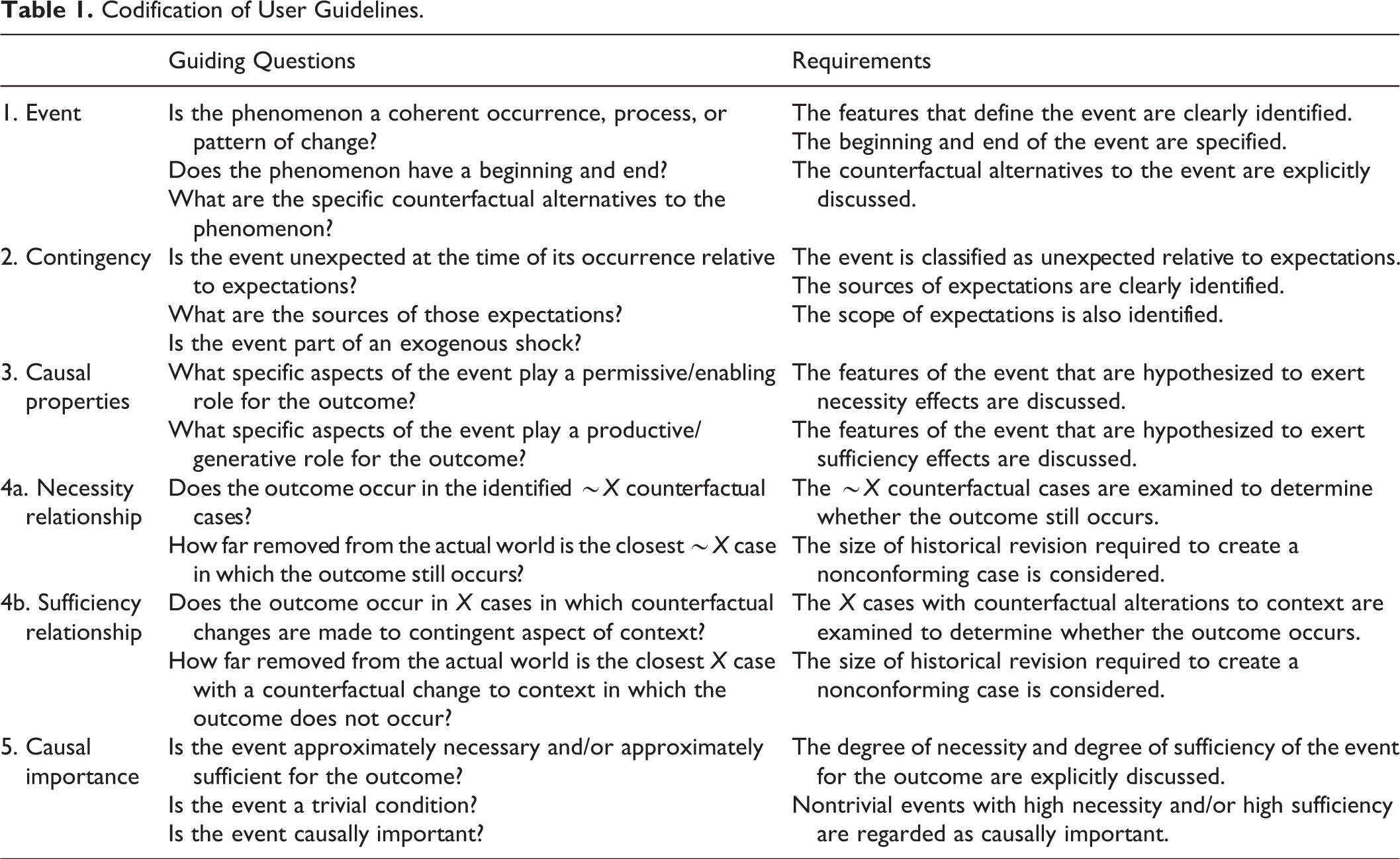
First, the analyst addresses the question: Is the phenomenon under study an event? To answer, the analyst identifies the beginning and ending points of the phenomenon as well as distinguishing features that define it as a coherent episode. If the phenomenon lacks clear temporal boundaries and/or lacks distinguishing content, the phenomenon is not regarded as an event.
Second, the analyst addresses the question: Is the event contingent? In answering, the analyst estimates whether the event was expected to occur at the time of its occurrence. To qualify as a contingent event, the event must be at least as unexpected as expected (i.e., contingency
Third, the analyst addresses the question: What are the potential causal properties of the event? Necessity properties are features of the event that permit/enable the outcome. These properties can be identified with counterfactual cases that lack the event of interest but that are otherwise similar to the actual case. Sufficiency properties are features of the event that produce/generate the outcome. These properties can be identified with counterfactual cases in which the event still occurs, but contingent aspects of context are changed.
Fourth, the analyst addresses the question: To what extent is the event necessary and sufficient for the outcome? To answer this question, the analyst considers plausible counterfactual cases for necessity and sufficiency, as identified in the previous step. To assess the extent to which the event is necessary for the outcome, the analyst explores whether the outcome still occurs in counterfactual cases that lack the event. If the event is significantly necessary for the outcome, the outcome does not occur in counterfactual cases that are close to the actual world. To assess the extent to which the event is sufficient for the outcome, the analyst explores counterfactual cases in which the event still occurs, but theoretically relevant changes are made to contingent aspects of context. If the event is significantly sufficient for the outcome, it unleashes a causal path leading to the outcome despite individual changes to contingent aspects of context.
Fifth, the analyst addresses the question: Is the event causally important for the outcome of interest? To answer this question, the analyst considers whether the event is approximately necessary or approximately sufficient for the outcome. A critical event must have a high level of necessity or a high level of sufficiency (or both). The analyst also considers whether the event is a trivial cause. This consideration adds the requirement that the event have moderate or greater levels of both necessity and sufficiency for the outcome.
Examples of Critical Events
Table 2 lists 10 studies that identify and examine critical events for substantively important outcomes in particular cases. For each study, we carry out the five steps of application summarized in Table 1, using a three-point ordinal scale (high, moderate, low) for the degree of necessity and sufficiency. For reasons of space, our discussion focuses on only 2 of the 10 studies considered. But all 10 studies are examined in Appendix C: “Coding of Critical Events” (which can be found at http://smr.sagepub.com/supplemental/).
Examples of Critical Events.
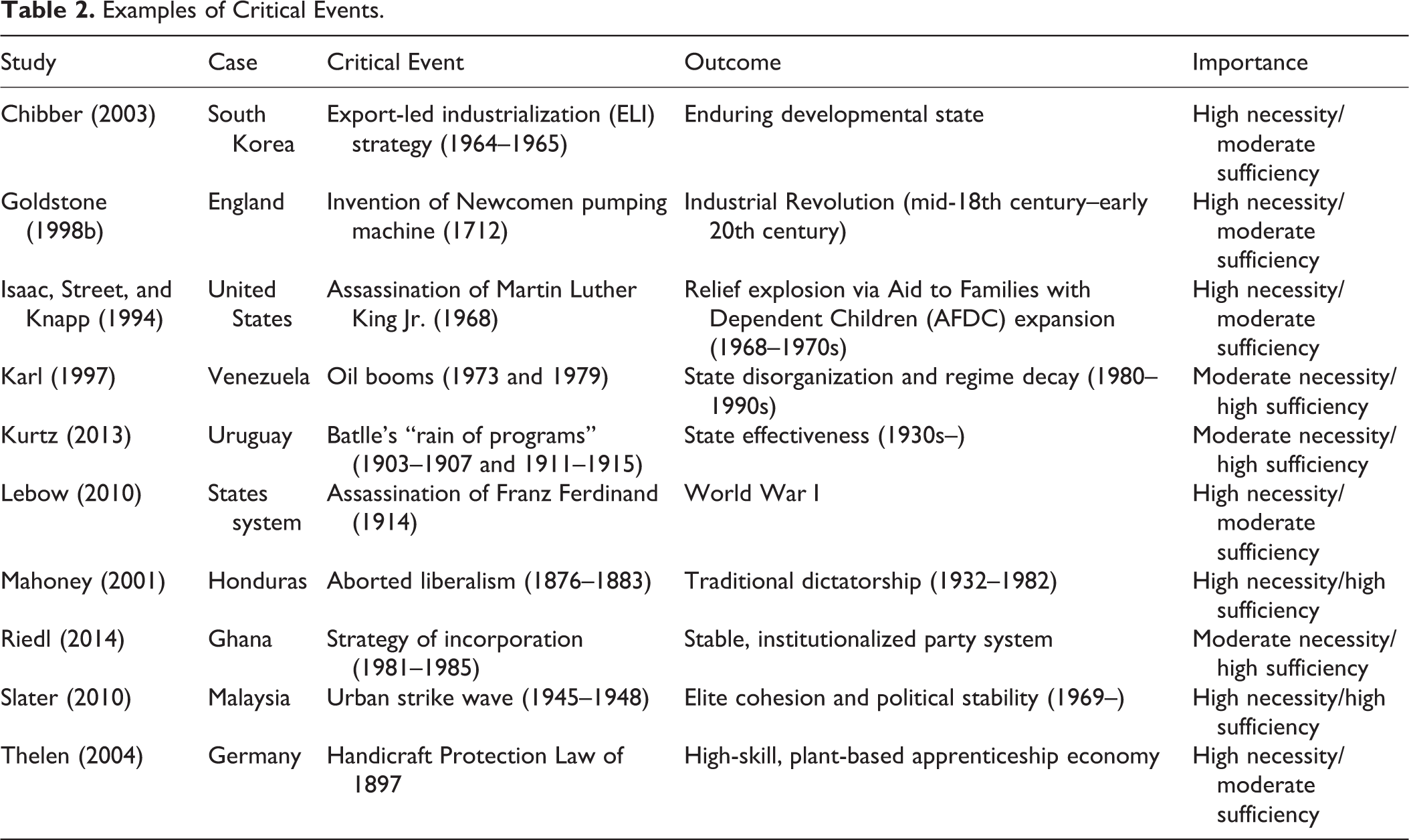
We first consider Rachel Riedl’s book, Authoritarian Origins of Democratic Party Systems in Africa, focusing on her argument about the case of Ghana. Riedl seeks to explain Ghana’s trajectory of political change in the democratic era, starting with the founding democratic election in 1992 of the incumbent military leader J. J. Rawlings and culminating with high party system institutionalization. Here we are concerned with the historical causes of this sequence. Why did Ghana experience a controlled democratic transition in which a coherent and genuinely competitive party system emerged?
In answering this question, Riedl (2014) highlights a critical event: the choice of Ghanaian leaders under the previous authoritarian regime (from 1981 to 1985) to adopt what she calls a strategy of incorporation. Riedl argues that postcolonial leaders in Ghana faced a choice concerning how to establish political order: a strategy of incorporation, a strategy of state substitution, or a revolutionary strategy. Riedl argues that the choice of a specific option “could not have been predicted ex-ante” (p. 10). In Ghana, she finds that the decision turned on the agency of Rawlings, who sought to use the Provisional National Defense Council (PNDC) to unify the country through grassroots mobilization and citizen participation. Riedl (p. 109) is explicit that this choice was “contingent” in part because it involved the beliefs and agency of a particular leader and in part because it was driven by situationally specific factors in Ghana. She makes it clear that structural conditions and other general causal factors left the critical choice underdetermined.
Although Riedl does not discuss necessary and sufficient conditions, our analysis of her work finds that this critical event was highly sufficient and moderately necessary for the controlled democratic transition. On the sufficiency side, Riedl traces the process through which a strategy of incorporation generated local elite support, suggesting that the choice of incorporation locked in the generation of this support. In turn, regardless of contextual contingencies, local elite support ensured that the democratic transition would unfold in a political environment in which the authoritarian government enjoyed substantial support, and the opposition was weak and divided. Riedl shows that a strategy of incorporation produced a similar sequence and outcome in Senegal, a very different case. Hence, once Rawlings pursued the strategy of incorporation in the early 1980s, Ghana was on a pathway nearly destined to end with a controlled democratic transition.
On the necessity side, the logic of Riedl’s argument suggests that if Rawlings or other leaders had pursued a strategy of state substitution, Ghana would not have had its controlled transition. However, if Ghana had followed a path of revolution, the country probably would have still experienced a controlled transition. The text does not discuss which of these two counterfactual alternatives—a state substitution strategy versus a revolutionary strategy—requires a more radical rewrite to the actual history of Ghana. But either counterfactual scenario seems possible, and the key point is that Ghana could have experienced the same outcome of a controlled democratic transition if the country had followed the initial revolutionary road to postcolonial stability.
In sum, the selection of a strategy of incorporation more or less ensured a controlled democratic transition in Ghana (high sufficiency). However, Ghana may have still arrived at this outcome even without the selection of this strategy (moderate necessity).
As a second example, we consider Lebow’s (2010) argument that the assassination of Franz Ferdinand (and his spouse Sophie) was an important cause of the continental war in the summer of 1914, which in turn was an important cause of World War I and many other major outcomes in world history. Lebow is quite explicit that the assassination was both contingent and necessary for the continental war. With respect to contingency, Lebow emphasizes “how easy it would have been to avert Franz Ferdinand’s assassination” with only slight and plausible changes to history (p. 60). For example, if Ferdinand’s cavalcade had followed its planned route, the assassination probably would not have occurred. With respect to necessity, Lebow explicitly analyzes possible cases in which the assassinations do not occur. He concludes that “Without the assassinations there would have been no war in the summer of 1914.”
With respect to sufficiency, Lebow (2010) makes clear that the assassination played an important, independent causal role for the continental war; the event changed the way in which leaders viewed ongoing events, causing them to be more risk-taking in their behavior (p. 96). Thus, the assassination event is a nontrivial part of the generative causal chain leading to the war. Estimating the full extent of its sufficiency effects requires the examination of proximate possible cases in which the assassination occurs, but aspects of context are changed. Lebow explores these possible cases by considering whether the assassination could have taken place without other leading causes of the war being in place. According to Lebow, the other potential causes of the war include system-level factors, ideas, state structural factors, domestic politics, and leadership (pp. 75-76). Lebow suggests that many, but not all of these causes had to be in place for the assassination to occur. For example, we cannot imagine a world in which the assassination occurs without also assuming Austro-Serb hostility. On the other hand, the assassination probably could have still occurred without all of the shifts in the local balance of power that threatened Russia. The point is that proximate cases in which the assassination takes place require that many, but not all, important causes of the war are in place. Given this, it is possible to imagine relatively proximate cases in which the assassination occurs, but it is not followed by the continental war because certain key causes of the war are missing. Thus, while the assassination exerted nontrivial productive effects for the war, the assassination itself did not come close to making the war inevitable.
In sum, according to Lebow, the assassination of Franz Ferdinand was essential for the war in the summer of 1914 (high necessity). However, the occurrence of the assassination did not ensure that this war would take place (moderate sufficiency).
The studies by Riedl and Lebow identify critical events with different causal properties. Both events are contingent and causally important, but the nature of their causal importance varies. In Riedl’s argument, the early pursuit of stabilization via incorporation in Ghana had productive and generative properties that nearly ensured a particular path of political development. By contrast, in Lebow’s argument, the assassination had primarily enabling and permissive properties, allowing other causes to do their productive work.
Critical events that are marked by high sufficiency and moderate necessity are often linked to self-reinforcing path dependence (Arthur 1994; Mahoney 2000; Pierson 2000). Here, a critical event yields an initial outcome, which is amplified and then stabilized overtime via an increasing returns process. Once the sequence is launched, the initial outcome is reinforced in the absence of the critical event that first generated it (Stinchcombe 1968). The productive properties of high sufficiency critical events generate this kind of historical lock-in: An initial event triggers a self-perpetuating outcome from which escape is difficult.
By contrast, critical events that have high necessity and moderate sufficiency are linked to reactive-sequence path dependence (Mahoney 2000). Here, a critical event launches a chain of disparate events, each event being a reaction to the previous event, and each event being essential for the next event. The sequence concludes with the main outcome of interest. Reactive path dependence is featured in studies that show how an initial small or unpredictable event (e.g., an assassination or a specific choice) is essential for an important outcome down the line that seems unrelated to the initial event. These arguments invite counterfactual considerations of how history could have turned out differently with a small difference at the beginning of the sequence.
To date, scholars have not distinguished these different kinds of critical events. Nor have they explored how critical events that are both highly necessary and highly sufficient combine the two modes of explanation. One reason for these omissions is that scholars have not explicitly discussed issues of necessity and sufficiency in their work on critical events. The payoff of our approach is that it requires authors to be explicit about the hypothesized causal properties of their critical events, steering empirical analysis toward clearer, more precise, and indeed more interesting explanations.
Noncritical Events
Given our definition of critical event, the category of noncritical event can be partitioned into three kinds of events: events that are contingent but not causally important, events that are causally important but not contingent, and events that are neither contingent nor causally important. Examining these three categories helps to sharpen our definition and calls attention to the potential value of an alternative gradualist mode of explanation.
Contingency Without Causal Importance
An event is contingent but not causally important when it is theoretically surprising but does not play a major role in enabling or generating an outcome. These events may appear as pieces of noise that shape an outcome in small, nonsystematic, and inconsistent ways. In general, they are assumed to be too random and inconsequential to merit sustained attention. Researchers often believe that these kinds of events are numerous in quantity, but that they cancel out one another, such that—when taken as a collection—they play a little causal role.
Contingent but unimportant causes need to be distinguished from those triggers, catalysts, and sparks that do play causally important roles (Soifer 2012). Researchers often assert that background or structural conditions are permissive for an outcome but its occurrence still requires the right kind of catalyst. These causal notions are featured in “window of opportunity” and “powder keg” arguments that highlight the necessity of both structural factors and contingent catalysts (see Goertz and Levy 2007). In such arguments, the catalyst may well be an important necessary cause, and its occurrence a critical event. A good example is Lebow’s argument about the Franz Ferdinand assassination.
To illustrate important versus unimportant catalysts, consider Stepan’s (1978) famous explanation of the breakdown of democracy in Brazil in 1964. Stepan separates causal factors into two levels: macropolitical and micropolitical. The macropolitical level includes noncontingent, structural causes, such as the increasingly fragmented structure of the Brazilian party system, which Stepan regards as necessary but not sufficient. Macrocauses left a “margin of maneuverability” in which microfactors could have averted the military coup. Stepan emphasizes the importance of President João Goulart’s failed leadership, which he characterizes as part of the “realm of the noninevitable.” In Stepan’s explanation, Goulart’s inflammatory political actions are a critical event—a contingent and important catalyst in enabling the regime breakdown. His maladroit leadership is viewed as necessary for the coup, and it also has some productive properties of sufficiency. Other catalysts are discussed in Stepan’s explanation, but they are not causally important, like Goulart. For instance, the March 13 rally and the mutiny of sailors may have slightly accelerated the timing of the coup, but Stepan suggests that Brazilian democracy would have collapsed even without these noncritical events. Unlike Goulart’s leadership, these events are not important causes of the breakdown of democracy in Brazil.
Causal Importance Without Contingency
Important causes that are not contingent differ from critical events in that their occurrence is anticipated. When explaining contingent outcomes, these noncontingent, important causes are not featured in the explanation because they are logically impossible. Following the Rule of Causal Contingency, an individually important cause of a contingent outcome must itself be contingent.
Yet, noncontingent, causally important events often help explain routine and unsurprising outcomes. These causes drive stable trajectories, patterns of reproduction, and events that reoccur over time (Stinchcombe 1968). To explain persistent and expected outcomes, case study analysts frequently identify self-enforcing mechanisms as causes. Such mechanisms are important in the sense used here, but they are not contingent: They expectedly help enable and generate the persistent outcome (Arthur 1994; North 1990; Pierson 2004). For example, consider David’s (1985) famous study of the QWERTY keyboard format. He understands the initial adoption and use of QWERTY to be a critical event that is contingent vis-à-vis neoclassical economic theory. However, to explain the subsequent stable reproduction of the QWERTY format, David emphasizes predictable causal factors associated with neoclassical theory. In his path-dependent argument, the adoption of QWERTY is a surprising and contingent event, whereas its reproduction is an expected occurrence well explained by familiar causes. No one is puzzled that the QWERTY keyboard format now persists year after year.
Likewise, when explaining patterns of change that have a coherent logic, analysts may identify noncontingent, causally important events. Examples of such patterns include “inertial trajectories” in which a case travels through a predictable sequence of stages (Abbott 1997). For example, many types of employment involve career paths that follow relatively predictable professional stages (Abbott 1992). Patterns of national regime change are characterized by a modal sequence of events (Linz 1978; O’Donnell and Schmitter 1986). Organizational stasis and change are often understood in terms of equilibrium models (Hannan and Freeman 1984). Work on the natural or evolutionary history of social phenomena may describe a coherent process of change in which noncontingent, but important causes predictably drive pathways of development. The major event stages in these trajectories may themselves be important causes of subsequent event stages, but they are not the breakpoints that we identify as critical events. Critical events are not only important causes, they are also contingent happenings.
Neither Important nor Contingent
Finally, some events are neither causally important nor contingent. Usually, these events are trivial and expected occurrences that are taken for granted or not highlighted in case study research. They may help set the context against which more important causal processes unfold. Ongoing events and processes that are trivially necessary for an outcome fall into this category, such as the existence of militaries and sovereign states as causes of interstate war. Also included here are routine events such as a relatively standard military budget or a fairly routine congressional election. These events may have some small causal relevance for the outcome, but they do not come close to being nontrivially necessary or sufficient.
Gradualist or incrementalist explanations are a major exception in which unimportant, noncontingent events do play the leading explanatory role for contingent outcomes. With a gradualist explanation, many small, unexceptional causes push in a consistent direction over time to enable and produce a puzzling outcome (cf. Mahoney and Thelen 2010; Streeck and Thelen 2005; Thelen 1999, 2003, 2004). For instance, threshold, tipping point, and drift arguments suggest that a long-run process composed of small but consistently directed events accumulates to produce a sudden shift (Granovetter 1978; Hacker 2005; Schelling 1978). The individual events that build up over time are neither important nor contingent. They are minor INUS causes that eventually combine to produce a combination that is sufficient to generate a contingent outcome of interest. A common form of this argument involves a slow-moving process composed of many well-understood small events that eventually reaches a surprising breaking point (Pierson 2004:82-87). In France, gradual population growth may have triggered sudden structural crises and revolution (Goldstone 1991); the slow decline of the cotton industry in the southern part of the United States. South may have caused a threshold effect yielding outcomes such as the Montgomery bus boycott and the Brown v. Board of Education decision (McAdam 1997); and several moves toward financial deregulation may have generated the unexpected 2008 economic crisis in the United States (Hacker, Pierson, and Thelen 2015:184-85).
These examples suggest how coherent processes that unfold over long periods of time can be crucial causes of major outcomes, including contingent outcomes. Explanations of contingent outcomes that emphasize slow-moving processes offer a clear alternative to critical event analysis (Thelen 1999, 2003, 2004). These explanations call attention to long-run processes that subsume many small events that are not individually important. When taken as a collection, however, these small causes enable and produce a major outcome, either through slowly accumulating changes or through a gradual build-up that triggers a sudden threshold effect.
In one sense, critical event analysis and gradualist analysis are rival frameworks that compete with one another. For any puzzling outcome in a particular case, one can pose the question of whether critical event analysis or gradualist analysis better explains the outcome. Likewise, if a scholar asserts that a critical event explains in substantial measure an outcome, one can always explore the rival hypothesis that a gradual process actually explains the outcome (or vice versa).
In another sense, however, the two modes complement one another rather than compete. On this view, some contingent outcomes are best explained by critical events, whereas others are best explained by gradualist processes of change. The two frameworks may both be useful for case study research, though not simultaneously useful for a specific outcome in a particular case. This complementarity view suggests an important research agenda focused on identifying when and why a given framework is more useful for explaining a given outcome. We consider this agenda in the concluding discussion.
Conclusion
Robert Frost’s poem discussed in the introduction of this article offers a vivid illustration of a critical event. A critical event is a contingent and causally important event for an outcome in a specific case. This article has developed a framework for conceptualizing and measuring events, contingency, and causal importance. It has also identified procedures and heuristics involving counterfactual analysis that can be used in the analysis of critical events in substantive research. We see our contribution as part of an ongoing effort to develop useful tools for the study of token causation in the social sciences.
Although we have argued that critical event analysis is central to important substantive works, our goal has not been to suggest that all or even most case study explanations should or will be able to identify critical events. It is certainly possible that puzzling outcomes are usually the result of gradual processes that unfold over long periods of time. With gradualist explanations, no single event is of decisive causal importance; a process of many small events pushing in a consistent direction drives the outcome. For instance, consider the following poem, “The Roads Consistently Followed”:
While this gradualist version of Frost’s poem is not as intriguing as the original version, it is certainly possible that this version better characterizes the trajectory of many cases and phenomena of interest in the social sciences (cf. Thelen 1999, 2003, 2004). At this point, it is an open empirical question regarding the frequency of punctuated versus gradual change. It is also an open question regarding the kinds of puzzling outcomes that are best explained by critical events versus incremental causes.
Going forward, the framework of causation developed in this article could offer a common vocabulary and a shared orientation for synthesizing work on critical events and work on incremental causes. The point of such a synthesis would not be to dissolve critical event analysis and gradualist explanation into a compromise framework in which all change follows an intermediate pace. Rather, the goal must be to arrive at a satisfactory solution for understanding when and why one kind of change prevails rather than the other. By beginning to clarify the critical event side of this possible synthesis, this article leaves the door open for new methodological work by scholars interested in the other gradualist side.
Supplemental Material
Supplemental Material, Online_Appendix_Final - Critical Event Analysis in Case Study Research
Supplemental Material, Online_Appendix_Final for Critical Event Analysis in Case Study Research by Laura García-Montoya and James Mahoney in Sociological Methods & Research
Footnotes
Acknowledgment
For helpful comments, we thank Michael Baumgartner, Isabel Castillo, Daniel Encinas, John Gerring, Gary Goertz, Macartan Humphreys, Alan Jacobs, Kendra Koivu, Emilio Lehoucq, Richard Nielsen, Rachel Riedl, Ingo Rohlfing, Kim Sass Mikkelsen, Carsten Schneider, Hillel Soifer, Eva Thomann, and David Waldner. We are also grateful to anonymous reviewers for excellent feedback on a previous draft.
Declaration of Conflicting Interests
The author(s) declared no potential conflicts of interest with respect to the research, authorship, and/or publication of this article.
Funding
The author(s) received no financial support for the research, authorship, and/or publication of this article.

Supplemental Material
Supplemental material for this article is available online.
Notes
References
Supplementary Material
Please find the following supplemental material available below.
For Open Access articles published under a Creative Commons License, all supplemental material carries the same license as the article it is associated with.
For non-Open Access articles published, all supplemental material carries a non-exclusive license, and permission requests for re-use of supplemental material or any part of supplemental material shall be sent directly to the copyright owner as specified in the copyright notice associated with the article.
