



Abstract
An increasing use of immunosuppressant medication mandates clinicians to look for leishmaniasis even in non-HIV febrile patients. We report this case to highlight leishmaniasis as a cause of fever in patients undergoing chemotherapy in an endemic area.
Introduction
An increasing use of immunosuppressant medication mandates clinicians to look for leishmaniasis even in non-HIV febrile patients. We report this case to highlight leishmaniasis as a cause of fever in patients undergoing chemotherapy in an endemic area.
Case report
We hereby report a 56-year-old man, residing in Apulia, southern Italy. He had been diagnosed with a cerebral metastatic non-small-cell lung cancer and presented with antibiotic-resistant fever. Fever had persisted for the previous 40 days, reaching 40℃. During a previous admission in another hospital, he had been treated with imipenem and teicoplanin with no benefit. A transthoracic echocardiogram had raised the suspicion of a mitral endocarditis, but a thoracic computed tomography (CT) scan did not reveal any source of infection. Microbiological culture of the tip of a central venous catheter, in situ for a year, revealed no bacterial growth.
On admission, the patient was undergoing corticosteroid treatment (methylprednisolone 16 mg o.d.) in addition to levetiracetam 250 mg b.i.d., pantoprazole 20 mg o.d. and B-vitamin complexes. He had undergone six chemotherapy cycles with cisplatin and pemetrexed and a combined radio-surgical treatment of his cerebral secondaries.
Biochemical characteristics.
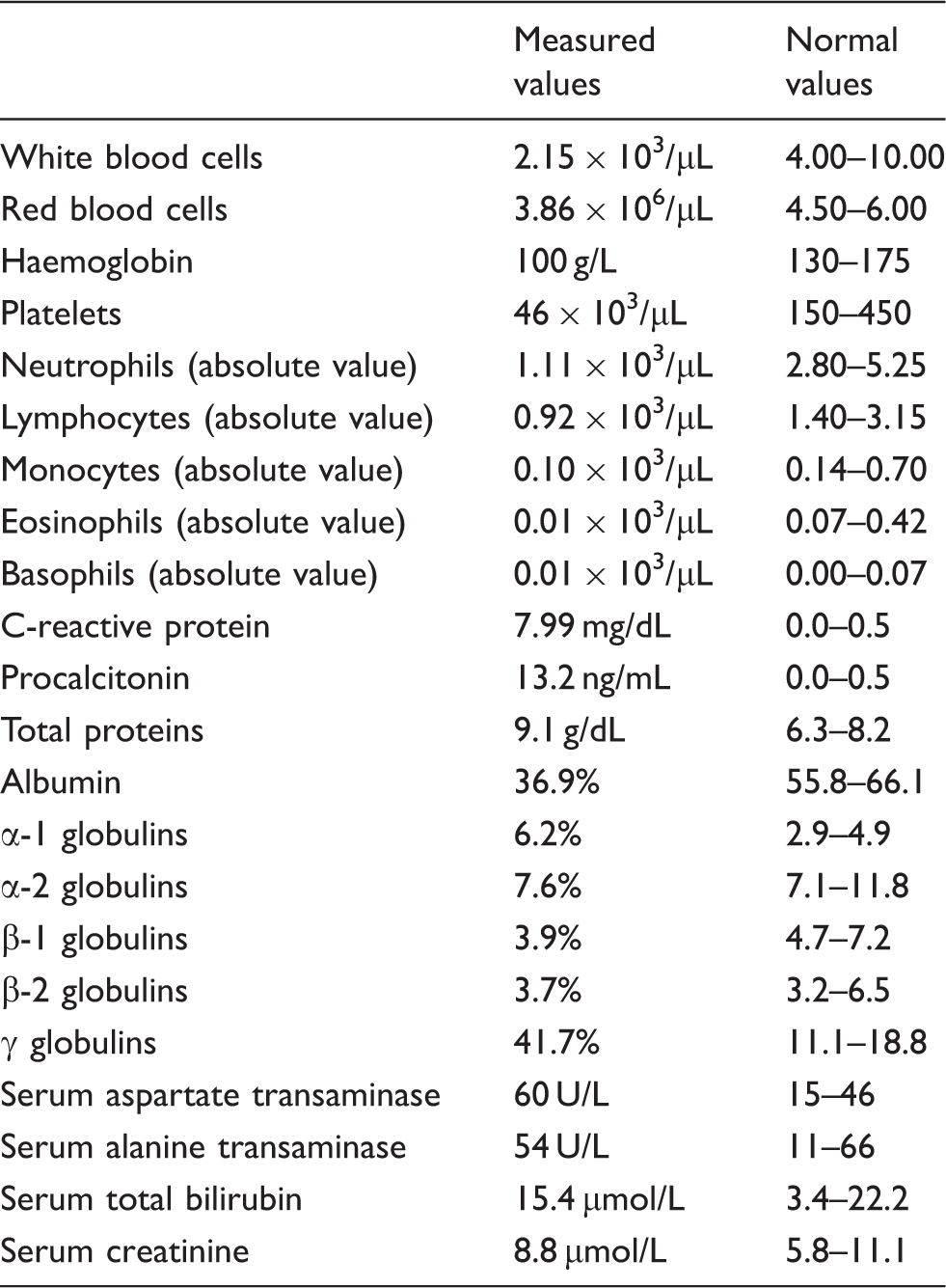
Given the fact that the patient came from a hypo-endemic area for Leishmania infections and his immunocompromised status, suspicion of visceral leishmaniasis (VL) was raised. Serologic and molecular exams confirmed the infection, by showing positivity of both polymerase chain reaction (PCR) and IgG antibodies for Leishmania spp., while the IgM turned out to be negative. We therefore applied a first line regimen therapy for VL, administering 300 mg of liposomal amphotericin B for five days during his hospital stay. Then, after the discharge, we completed treatment with two further infusions of amphotericin B on days 14 and 21.
After completion of this therapy, repeated laboratory examinations confirmed the absence of VL. Furthermore, a complete resolution of his pancytopenia and a normalisation of the levels of CRP were noted.
Discussion
VL is hypo-endemic in the Mediterranean basin. In this region, it is caused by L. infantum and dogs act as the main zoonotic reservoir. In the World Health Organization (WHO) European Region, Albania, Georgia, Italy and Spain are the countries with the majority of reported VL cases, with nearly 75% of cases. 1 As reported elsewhere, even in Southern Europe, the incidence of symptomatic disease is low, although it is estimated that asymptomatic infections are widespread in the region. 1 The Gargano Promontory, in particular, in Southern Italy has a high prevalence of canine leishmaniasis and asymptomatic carriage among dogs. 2
It is well documented that solid tumours may impair the proper function of the immune system.
Circulating dendritic cells in patients with different types of solid cancers are fewer and immature, leading to a less effective immune response. 3 Tumour cells also deregulate immune function by secreting exosomes loaded with immunosuppressive molecules in body fluids. Moreover, tumour-derived exosomes have the ability to reprogramme T-cells towards the Th2 phenotype, to suppress NK cells activity and to inhibit monocyte differentiation.
There is also an impairment of neutrophil chemotaxis, of monocyte phagocytosis and of the proliferation of lymphocytes, along with a lower number of NK cells. 4
The monocyte-macrophage cell lineage is, in fact, the primary target of Leishmania invasion and replication. The specific immune response plays a crucial role in redefining the subsequent progress of the infection. In fact, while a Th1 T-cell response has a correlation with the resolution of the infection, a Th2 response allows the parasite to replicate by inhibiting macrophage activation, resulting in symptomatic disease. 1
Although both cisplatin and pemetrexed are reported to exert a toxic effect specifically towards myeloid progenitors, these effects are displayed by the induction of granulocytopenia and thrombocytopenia. 5 In our clinical case, we cannot rule out this drug-induced effect, since we have no data concerning our patient’s cell count before admission.
Nonetheless, infections are the main cause of fever in cancer patients. Leishmaniasis is a minor cause of morbidity in this subset of patients in endemic and hypo-endemic areas and is therefore essential to diagnose.
The reasons for the increase in distribution of Leishmania globally in recent years include human migration, international travel, globalisation and environmental changes. 5
Given all these factors, we suggest that VL is considered as a possible and curable cause of fever and pancytopenia in patients with solid tumours on chemotherapy, living in or with a history of recent travel in a hypo-endemic or endemic area.
Footnotes
Declaration of conflicting interests
The author(s) declared no potential conflicts of interest with respect to the research, authorship, and/or publication of this article.
Funding
The author(s) received no financial support for the research, authorship, and/or publication of this article.