



Abstract
Scrub typhus has a variety of clinical presentations ranging from asymptomatic to fever with chills, myalgias, hepatitis, gastric ulcerations and pancreatitis, all being attributed to disseminated vasculitis, with splenic infarction being a rare presentation. A 26-year man, a resident of north India, presented with an acute febrile illness and abdominal pain, computed tomography scan of the abdomen was suggestive of a splenic infarct. After ruling out other aetiology, a positive IgM (ELISA) for scrub typhus led to treatment with oral doxycycline, following which the patient was discharged symptom-free. Rarely can splenic infarction be attributable to scrub typhus; so far, five such cases have been reported in the published literature.
Case report
A 26-year-old man, with no pre-morbid illness, presented with high-grade fever for one week associated with fever and chills and abdominal pain for 4–5 days. On examination, he had left hypochondrial tenderness with a palpable spleen and hepatomegaly along with deep jaundice. There was no eschar or rash over the body. The rest of his systemic examination was unremarkable.
Full blood count showed anaemia (Hb 81 g/L), leucocytosis (white cell count 9100/mm3; 61% neutrophils) and thrombocytopenia (platelets 37 × 109/L). Liver function tests showed an elevation in bilirubin (265.05 µmol/L with direct bilirubin 162.45 µmol/L) and liver enzymes (serum glutamic oxaloacetate transaminase 50 U/L and serum glutamic pyruvic transaminase 22 U/L) and alkaline phosphatase was 114 U/L. Serum creatinine was 212.21 µmol/L with blood urea 15.8 mmol/L. Urine routine microscopy was within normal limits. Serum amylase and lipase levels were normal. The patient was subjected to serological analysis to establish an aetiology. He was found to be positive for scrub typhus IgM enzyme linked immunosorbent assay. Three blood cultures were negative and other infectious aetiology such as malaria, enteric fever, dengue fever and leptospirosis were ruled out by appropriate serological tests. Urine culture showed no growth. He was started on oral doxycycline. A computed tomography (CT) scan of the abdomen revealed a splenic infarct (Figure 1). Doppler study showed a normal calibre and flow in the splenic vein and artery. Transthoracic echocardiography did not show any vegetation. The work-up for hyper-coagulable states like (anti-phospholipid antibody syndrome, etc.) was also negative. Significant clinical improvement occurred within 48 h. He was discharged after successfully completing a course of doxycycline for 14 days and was kept under observation to monitor for any complications and completing the course of other supportive treatments.
CT scan of the patient’s abdomen (axial section) showing splenic infarct.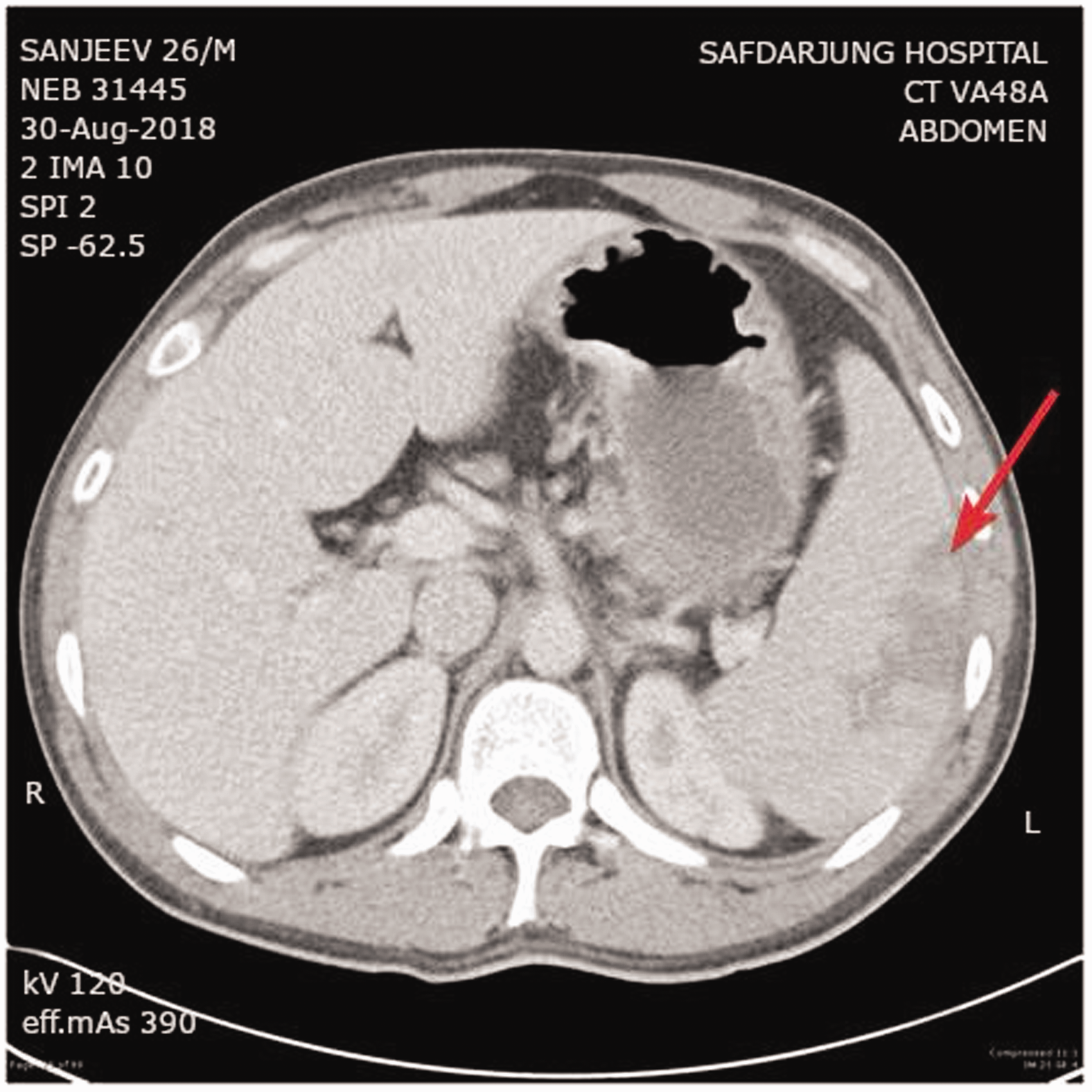
Discussion
Scrub typhus infection is an important cause of acute undifferentiated fever in south-east Asia and India. 1 It can range from asymptomatic to fatal. 2
Although the pathophysiological hallmark of this disease has been found to be disseminated vasculitis with subsequent vascular injury, the involvement of the spleen has been found in only 8% of cases.
To the best of our knowledge, only five such cases have been reported so far, only one being from Tamil Nadu, India.3–5 Splenic infarction is usually seen in patients with malaria, infective endocarditis, infectious mononucleosis, cytomegalovirus infection or babesiosis.
Although hepatosplenomegaly is the norm in scrub typhus, an infarct should not rule out the clinical diagnosis.
Footnotes
Declaration of conflicting interests
The author(s) declared no potential conflicts of interest with respect to the research, authorship, and/or publication of this article.
Funding
The author(s) received no financial support for the research, authorship, and/or publication of this article.
