



Abstract
Slipped Capital Femoral Epiphysis (SCFE) is a physeal disorder of the proximal femur. Misdiagnosis and late treatment are associated with poorer outcomes. The epidemiology and delays in treatment of the disease between 1968 and 2018 were investigated in North Trinidad. The number of cases presenting annually has increased over the decades and the incidence between 2008–2018 was 2.2 cases per 100 000 per year. Almost 70% of cases were above the 95th percentile for body weight. Delay in treatment from onset of symptoms was 278 ± 258 days. Awareness of the risk factors and clinical presentation of SCFE may facilitate early diagnosis and treatment, and prevent severe hip disability in adulthood.
Introduction
Slipped Capital Femoral Epiphysis (SCFE) is the most common hip disorder in adolescence and is considered to be a Salter-Harris injury of the proximal femur. 1 The metaphysis slips anteriorly with external rotation, creating a beak like projection.2,3 Consequently, the epiphysis compensates with hypertrophy, growing around the physis, creating a cupping deformity. 3 This deformity can cause a cam deformity of the hip in adulthood. 4 Misdiagnosis and delays in treatment may result in deformity progression, and hip replacement in patients before the age of 25 years.5,6 Knowledge of epidemiological factors such as geographic and ethnic differences associated with SCFE can aid in early diagnosis.7–9 Treatment delays can also be due to clinicians not recognising the symptoms of the disease, with 22% of patients presenting atypically with knee pain. 10
This study was performed to determine the incidence of SCFE in Trinidad and Tobago and the epidemiological markers, using the medical records of SCFE patients presenting to the Princess Elizabeth Centre (PEC) over a 50-year period. PEC provides elective paediatric orthopaedics treatment for Northern Trinidad. Delays in disease presentation as well as contributing factors to these delays will be identified.
Methods
The PEC is a tertiary elective paediatric orthopaedics institution which accepts referrals from physicians as well as walk-ins by patients. The medical records of all patients with SCFE for the period 1968–2018 at PEC were reviewed. The subjects of the study were identified from the operating theatre logbooks as SCFE is always treated surgically. Hand-written medical notes for each patient were then retrieved from the alphabetised filing room. Records with incomplete data were included and the missing information highlighted in the results. Patients were grouped according to the decade that they presented to PEC. Patients’ weights on first visit were plotted on World Health Organization gender specific growth charts and classified based on their percentile. 11 The time periods from patients’ first symptoms to their presentation were recorded as the delay in diagnosis. These delays were grouped into the time periods <30 days, 31–90 days, 91–180 days, 180–365 days and > 365 days.
Incidence was calculated by using relative risk and a confidence interval of 95%. The population of children between the ages 5–20 years were obtained from the Central Statistical Office of Trinidad and Tobago. 12 The incidence of SCFE was corrected for the changes on population demographics over time. Means and standard deviations were used for univariate analysis. Paired sample T-test and ANOVA test were used for bivariate and multivariate analyses.
Results
Seventy-nine (79) patients were treated at PEC for SCFE between 1968 and 2018. The age range was 8–19 years, with a mean of 13 years. Male to female ratio was 2.4: 1, with males presenting at a later mean age (13.6 years) compared to females (11.9 years) (Figure 1). The majority (75%) were Afro-Trinidadian and the remainder consisting of Indo-Trinidadian and mixed races.
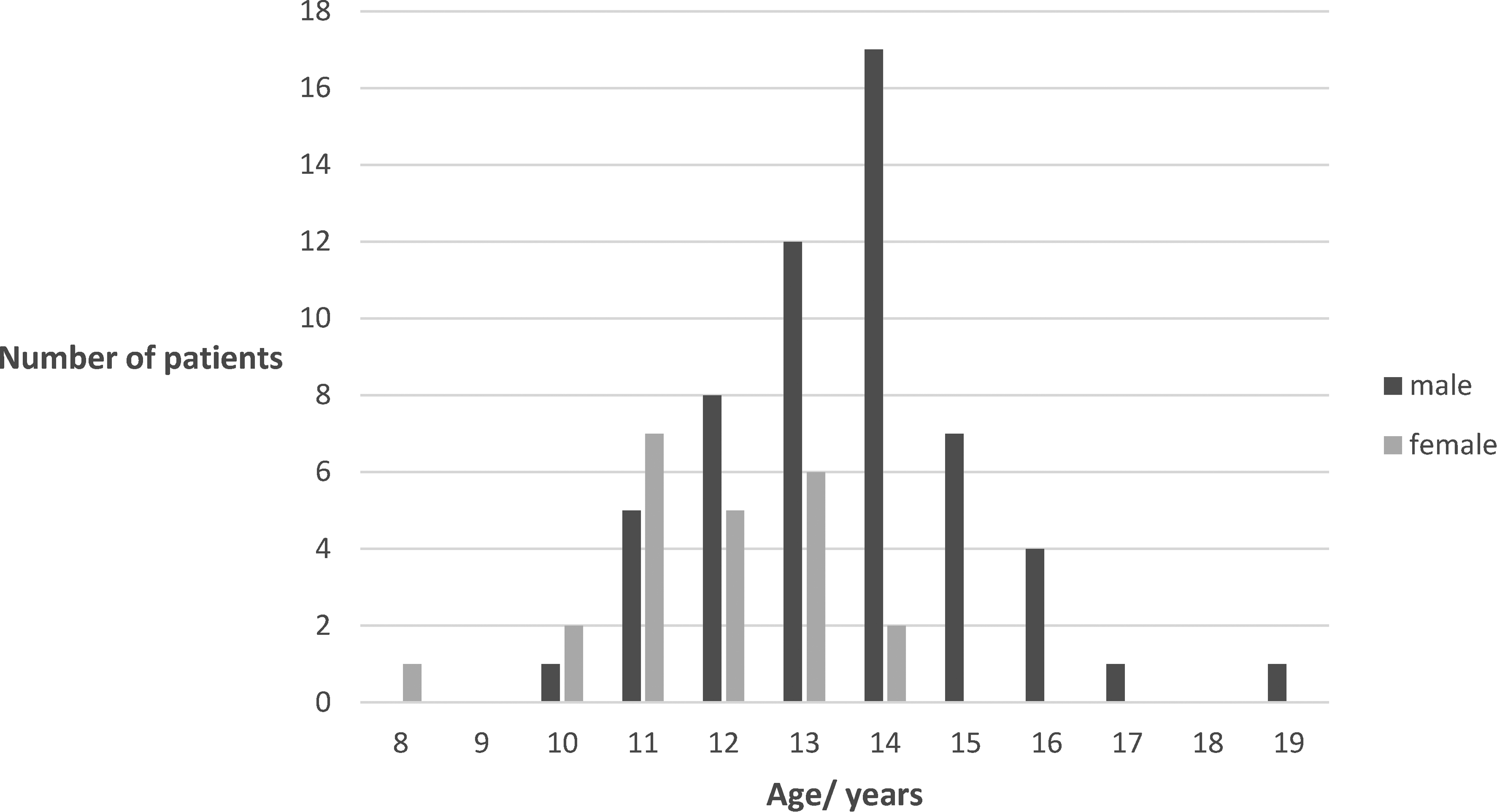
The age distribution of SCFE patients.
The annual number of patients presenting increased over the 50 years with 74.7% of cases presenting to the centre after 1998 (Figure 2). The current incidence for the period 2008–2018 was 2.2 cases per 100 000 per year (Table 1). The majority of patients (67.5%) were above the 95th percentile for body weight. Most patients resided in urban areas with no significant change to the trend over the decades. Referrals were mainly from orthopaedic surgeons (44%) and walk-ins to the facility (35%).

Incidence of SCFE patients per decade.
The change in SCFE patient numbers through the decades.

Unilateral presentations were seen in 68.4% of cases and the remainder had bilateral symptoms. Six patients (8.6%) presented with an unstable hip by Loder classification, and 69 (87.1%) presented with a stable hip (Table 2). Delays in presentation ranged from 1–1095 days with a mean of 278 ± 258 days. The mean delay decreased from 370 ± 508 in 1968–1977, to 196 ± 220 days in 2008–2018 (F (4, 66) = 1.272, p = 0.29) (Table 2). The most common presentation was hip or groin pain (47.4%), with isolated knee pain only making up 3.8% of cases. Delays in presentation showed no correlation to the patients’ presenting complaints (F (3, 66) = 0.234, p = 0.87). Patients from urban areas presented at a mean of 286 days, whereas those from rural areas presented at 234 days (F (20, 62) = 0.628, p = 0.91). Stable hips presented later (mean 278 days) compared to unstable hips (mean 115 days) (F (10, 65) = 3.86, p = 0.05)
The delay in presentation of patients with SCFE.

Discussion
Reported incidences of SCFE vary widely from 0.0 to 30.0 per 100 000 per year. The worldwide incidence of SCFE has been increasing over the decades, which is also demonstrated in our findings.13–15 This has been attributed to increased access to medical care, which is also true in our setting.16,17 Gender distribution patterns also reveal wide variation with male to female ratios of 1.4–4.1: 1.18,19 Ethnic variation also exists with the Maori and American Samoan groups having an incidence as high as 30 per 100 000 per year. 19 Our local incidence for the 2008–2018 period was similar to that of New Mexico and Japan, with incidences of 2.13 and 1.51 per 100 000 per year respectively.20,21 Trinidad and Tobago's multi-ethnic population was ideal for measuring ethnic differences; however, the ethnic breakdown nationally of persons under 20 years of age was not available. Male predominance of SCFE is constant in all studies, and the male to female ratio of 1.7: 1 in the United Kingdom is similar to our reported distribution. 22 It has been noted that SCFE patients present 1.5 years later in males. 20 European studies have placed the male presentation at 12.7–13.5 years, and the female presentation at 11.2–12.0 years, similar to our local population. 21 There is a high preponderance of SCFE patients in urban environments with 64% of cases found near cities in Sweden. 23 This is similar to our findings, and may be due to better access to health care in these areas.
Bilateral SCFE is seen in 20–40% of cases at presentation.24,25 At one year, 7–25% of patients with unilateral presentations can have subsequent slips of the opposite hip. 26 Long term follow up at adulthood reports bilateral pathology as high as 40–80% of SCFE cases, suggesting a subclinical slip of the contralateral hip.26,27 The high number of unilateral hip involvement in our local population highlights the need for us to follow up this group closely. Internationally, 71% of cases present as stable hips by Loder classification, which is similar to our findings. 28 Isolated knee pain is seen more commonly as a presenting symptom in the international literature with rates of 22%, as compared to less than 4% locally. 10 It has been theorised that knee and thigh pain acts as a distractor to clinicians, as 20–52% of these SCFE cases are missed on initial visit.29,30
Obesity is a well-known risk factor for SCFE which has been widely reported, and the majority of patients in our study were overweight. Obese children are at risk because of increased mechanical load, decreased femoral anteversion and greater physeal obliquity.31,32 Although Body Mass Index is used in the literature as a more accurate measurement of childhood obesity, our data could not be compared to previous publications as the heights of patients were not routinely measured at the institution in the study. In Trinidad and Tobago, there has been a four-fold increase in the percentage of overweight and obese school-age children between 2001 to 2018 from 12% to 51.5%. 33 This striking local increase may have contributed to the increasing incidence in SCFE seen in our study, and may lead to continued elevation of the incidence in future.
In developed countries, diagnostic delays occur in about 15% of patients and can be as high as 169 days.34,35 There has been no change in the duration of delays over the years. 35 Although longer delays were noted in our study, a decreasing trend was present over the decades. This could be due to increasing awareness of SCFE by primary care physicians or larger numbers of patients directly accessing the institution of study without first seeking primary healthcare. Diagnostic delays correlate with the severity of the disease, with slips missed for greater than 2 months having a four times greater likelihood of being moderate to severe. 36 Increased disease severity is associated with greater complications such as avascular necrosis, chondrolysis and poor long term outcomes (pain, hip mobility, and arthritis).37,38 Delays in diagnosis have been attributed to clinicians not being aware of vague presentations, only one radiographic view being obtained, missing subtle changes on radiographs, and lack of insurance coverage. 39 Long delays are seen in our study, and therefore measuring slip severity would have been valuable to highlight the magnitude of the problem. The reasons for delay listed above are also applicable in Trinidad and Tobago, with the exception of insurance coverage, as free public health care is available to all patients. This therefore highlights the need to educate primary care physicians.
Our data did not demonstrate any significant correlation between delays in presentation and body weight, proximity to the city or presenting symptom. However, this is likely due to the wide range in delays seen (1–1095 days). It was noted that stable hips presented later than unstable hips, and this could be attributed to stable hips being less painful which could cause patients and their parents to postpone seeking medical attention.
The first clinicians to see SCFE patients are generally primary care physicians. Consequently, to prevent delays in diagnosis, children aged between 5 to 19 years with hip, thigh, and knee pain, and decreased hip motion should raise suspicion of SCFE. 40 Two radiographic views of hips are mandatory with review by specialists to pick up subtle changes, as specialists have an accuracy of 85–95%, compared to general practitioners’ 48–78%. 39 This may decrease delays in diagnosis thus decreasing morbidity of the disease.
Conclusion
The epidemiology of SCFE shows wide variability, with notable ethnic and geographic differences. Our data show that Trinidad and Tobago has an incidence similar to that seen in Europe. Primary care physicians are generally the first contact for these patients, and therefore their education can allow earlier disease recognition. This could facilitate prompt specialist referral and surgical intervention, thus reducing the morbidity associated with SCFE and the costs in treating its complications.
Footnotes
Acknowledgements
Professor Vijay Naraynsingh-review and editing
Declaration of conflicting interests
The author(s) declared no potential conflicts of interest with respect to the research, authorship, and/or publication of this article.
Ethical review statement
Ethical approval was obtained from the Campus Research Ethics Committee, Graduate Studies and Research, The University of the West Indies, St Augustine Campus, Trinidad
Funding
The author(s) received no financial support for the research, authorship, and/or publication of this article.
