




Abstract
With the invent of smart phones, tele-dermatology has become a cheap and cost-effective medium to provide medical services to rural population. Its usefulness is more prominently noted during the COVID 19 pandemic and much more in countries with difficult terrain with limited specialist health providers. Cutaneous leishmaniasis (CL) is a neglected tropical disease which may cause significant disability if treatment is delayed. Here, we discuss three cases of CL from a remote district by use of tele-dermatology during the pandemic lockdown.
Introduction
Telemedicine is a modern technology supporting health care at a distance using different methods of communication. One of the techniques in telemedicine, tele-dermatology, has grown exponentially as a cost-effective and reliable way to implement dermatological healthcare to underserved areas and populations.1,2
Mobile tele-dermatology is particularly popular owing to its ease and accessibility, 3 as more and more physicians carry smartphones with increasing camera resolution. It is useful in the treatment of different neglected tropical diseases such as cutaneous leishmaniasis (CL) which is associated with significant scarring. Many case reports of CL from remote areas of the country which lack specialist care have been published.4–6 The role of tele-dermatology cannot be overstressed especially during the COVID-19 pandemic. We present three cases from Kalikot, a remote district of Nepal, managed using mobile tele-dermatology.
Case report 1
A 12-year old male presented at Bir Hospital in Kathmandu in March 2020 with a well-defined indurated plaque over the bridge of the nose over 6 months’ duration (Figure 1A). It took him more than three days to reach the hospital from his remote village in Kalikot district. A slit skin smear from the plaque showed multiple amastigotes forms. A rapid immune-chromatographic test (rK39) was negative. He was advised to attend for follow-up and was prescribed topical ketoconazole cream to be applied twice daily. However, he was unable to attend regular follow-up owing to the ongoing lockdown and financial constraints.

A. Figure showing a well-defined indurated plaque over the bridge of nose. B. Plaque hea.
After few months, at the district hospital a few hours jeep ride from his village, a photo consultation was provided by the consulting physician there (Figure 1B), with a dermatologist in the capital Kathmandu located centrally using a Viber® mobile application. An improvement on the status of the skin lesion was enough to reach to a consensus on using only ketoconazole cream.
Case report 2
A 21-year old female presented with plaques over her chin and the clavicular region for more than 8 months. A probable diagnosis of CL had been made at the district hospital. A photo consultation with the dermatologist at central level was made for a second opinion (Figure 2A and 2C). A slit skin smear was not possible in the local setting. However, a rk39 test was positive, and a probable diagnosis of CL was made. The patient was started on oral miltefosine 50 mg thrice daily after a complete blood count, renal and liver function tests were all within normal limit. All of the lesions healed satisfactorily after a period of 28 days (Figure 2B and 2D).

A well-defined ulcerated plaque noted over the left chin before (A) and after (B) treatment with oral miltefosine; Photographs showing well-defined ulcerated plaque over the left clavicular region before (C) and after (D) treatment with oral miltefosine.
Case report 3
A 14-year old male presented with a crusted plaque with surrounding erythema over the chin for a duration of 9 months (Figure 3). A skin scraping showed fungal hyphae with potassium hydroxide, however, rK 39 was positive. Confusion on the morphology of the lesion and the reports prompted a discussion with the dermatologist, with whom a photo consultation was done by using Viber® platform. After a detailed case discussion, a probable diagnosis of CL was made based on the morphology, duration and the positive rK39 test The patient was treated with topical ketoconazole alone.
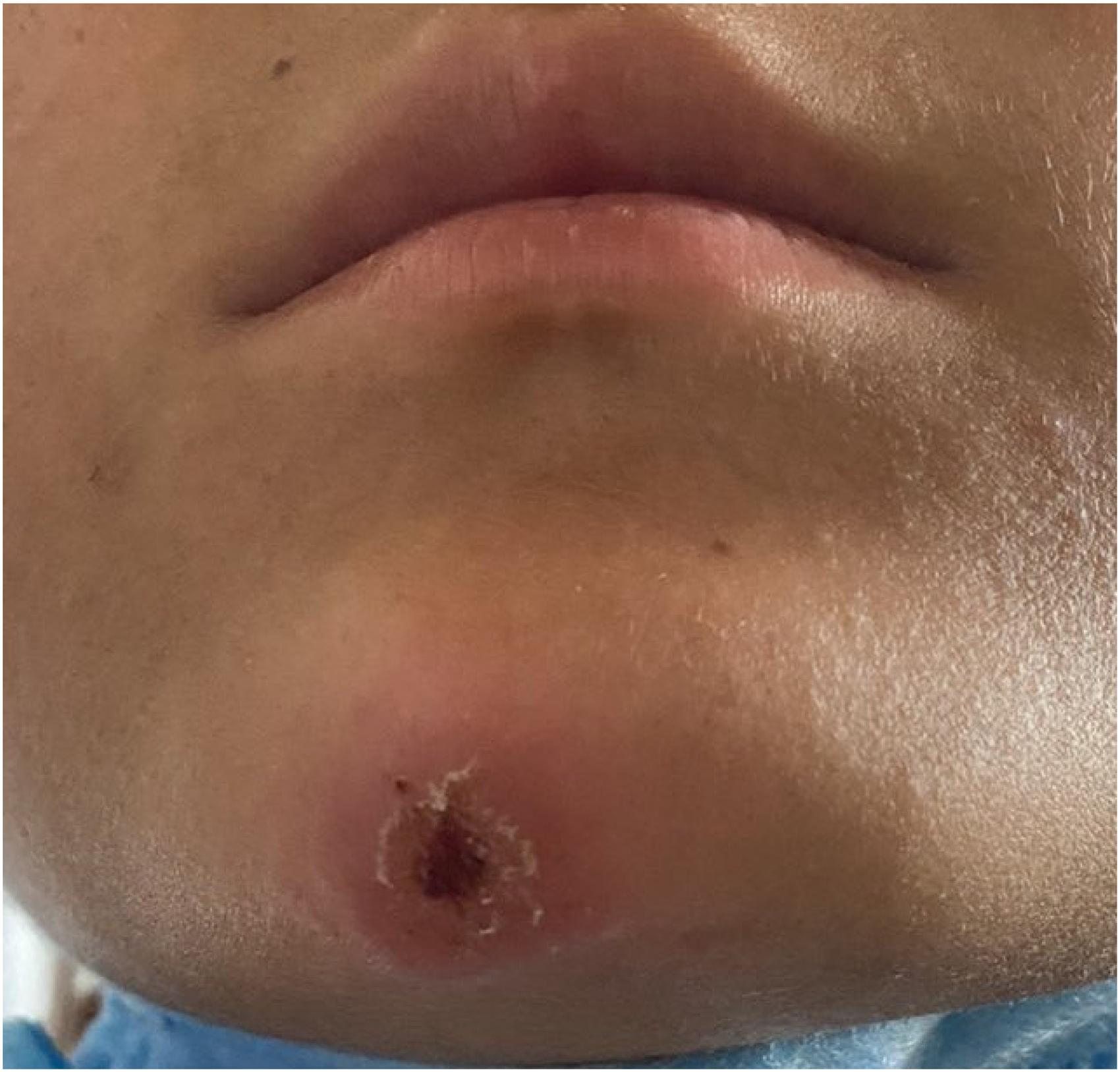
A crusted plaque noted over the chin with slight scaling over the periphery.
Discussion
Tele-dermatology is very efficient and time-saving for diagnosing and advising on treating of dermatological conditions.1,2 Its usefulness is more than justified in remote areas where there are lack of proper transportation and specialist medical services. Therefore, this form of consultation is gaining popularity among doctors. 3
Dermatological conditions such as CL which presents with varied morphology, difficulty in diagnosis without proper laboratory diagnostics, tele-dermatology consultation is an ideal dermatological disease for teleconsultation.
In Nepal, the Ministry of Health and Population has already developed a national e-health strategy which will ease up the regulations and restrictions on the use of telemedicine.
Footnotes
Declaration of conflicting interests
The author(s) declared no potential conflicts of interest with respect to the research, authorship, and/or publication of this article.
Funding
The author(s) received no financial support for the research, authorship, and/or publication of this article
