



Abstract
Noma is a neglected tropical disease of an underserved population. Our review describes the volume and scope of existing research evidence on psychosocial aspects of Noma in sub-Saharan Africa (SSA). Our literature search was conducted on all original peer-reviewed research articles on the psychosocial aspects of Noma in each country in SSA using PubMed, Google Scholar, and a direct search of reference list of pertinent journal articles. The Preferred Reporting Items for Systematic Reviews and Meta-Analyses extension for Scoping Reviews guidelines was used to describe the review. A total of six studies were found in four countries of the region. One in three persons with Noma has a mental health condition, indices of social disadvantage and belief in the supernatural causation of the disease are very common. However, despite evidence of enormous need, a huge gap still exists in the area of psychosocial alleviation.
Background
Noma (cancrum oris) is a neglected destructive, disfiguring disease predominantly of children from an underserved population with multiple indices of social disadvantage such as poverty and malnutrition. 1 It is estimated that 2–14 per 10,000 children develop the disease in sub-Saharan Africa (SSA), 2 with a mortality rate of 90% within two weeks if untreated; this calculates at 1–10 million disability adjusted life years in the region. 2 Particularly in the so-called Noma belt, located directly south of the Sahara, the disease has a significant impact. 1 However, while poverty and malnutrition play a significant role in its aetiology, their effects may be influenced by other factors that are still not fully understood. To explain this phenomenon, some authors have proposed that living with herbivorous livestock may be a risk factor, 3 while others suggest that mechanisms causing gangrene after a bacterial infection may be explained by bacterial genetic factors or the genetic host vulnerability factors but not specifically the bacteria, or perhaps the pattern of prevalence may simply be an epiphenomenon. 1 In spite of these theories, there are serious psychosocial issues across the whole duration of illness continuum.4,5
The few studies addressing psychosocial aspects in Noma4–6 are unanimous in their findings of significant psychological and social issues either as complications of the disease4–6 or contributing to help-seeking. 5 Psychiatric disorders are known to be common among the facially disfigured and have been estimated to range from 30–50% with anxiety-related and depressive disorders being predominant. 7 Social problems such as inability to marry, stigma and discrimination are also very common in persons with Noma.8,9
However, these studies have been described in isolation without any regional integrative analysis, except for one systematic review which included 15 studies focusing on disfigurement. 7 Our scoping review sought to answer the question: what is the volume and scope of peer-reviewed articles on psychosocial issues of in SSA?
Review methodology
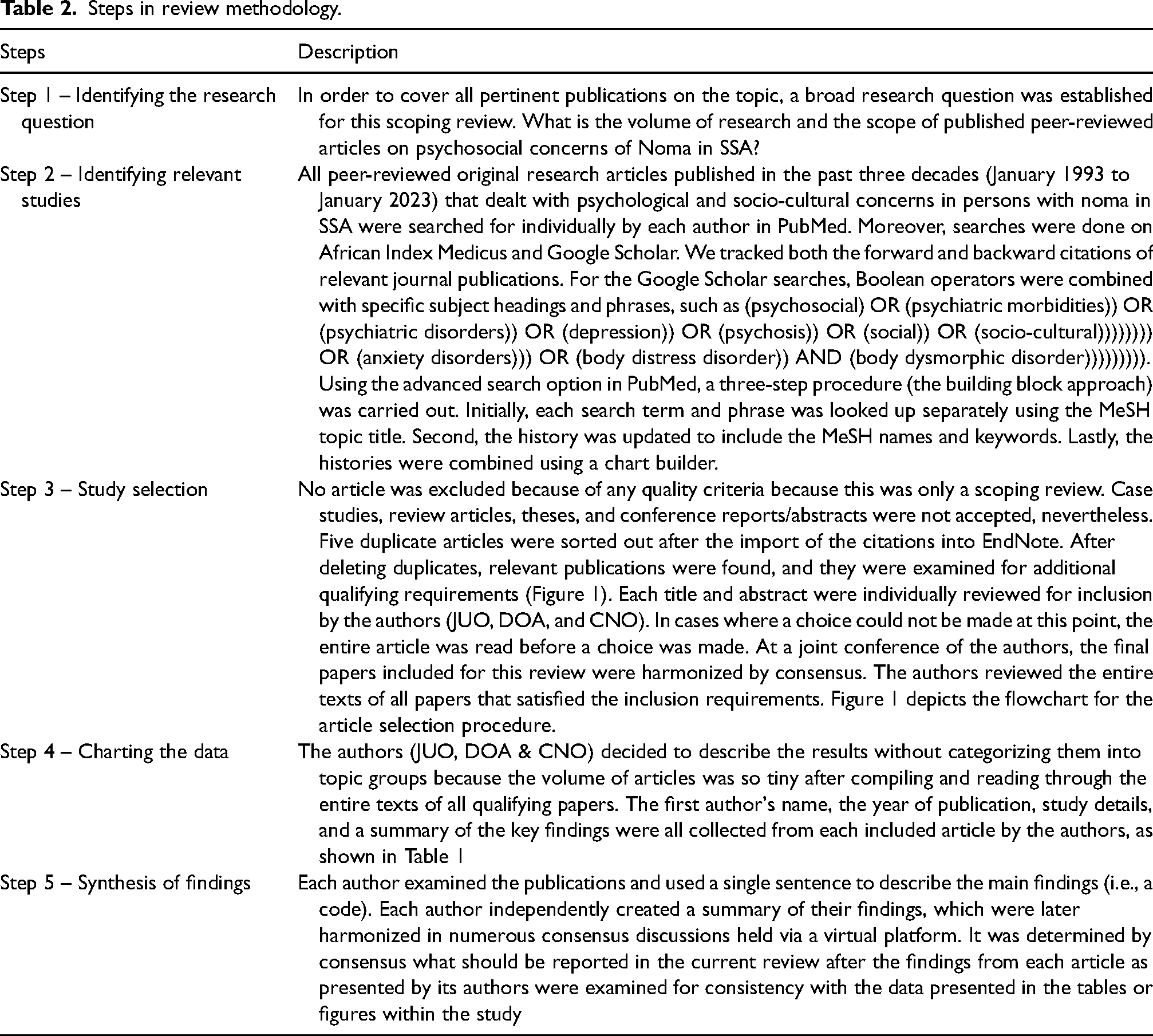
Scoping reviews are a type of descriptive review intended to map the body of literature surrounding a specific issue. They often have a wider scope than systematic reviews 10 and can be used to guide future research by pointing out gaps in the body of knowledge as well as to pinpoint topics that may have a substantial body of literature to merit a systematic review. 10 Our primary goal was to determine the volume of peer-reviewed original research publications on psychosocial concerns of persons with Noma in SSA. We used a methodology, which includes defining the problem (step 1), locating research (step 2), choosing pertinent studies (step 3), charting the data and compiling it (step 4) as shown in Table 1 and summarizing and reporting the findings (step 5). 11 Details of the steps are shown in Table 2 and Figure 1.
Summary of the articles.

Steps in review methodology.
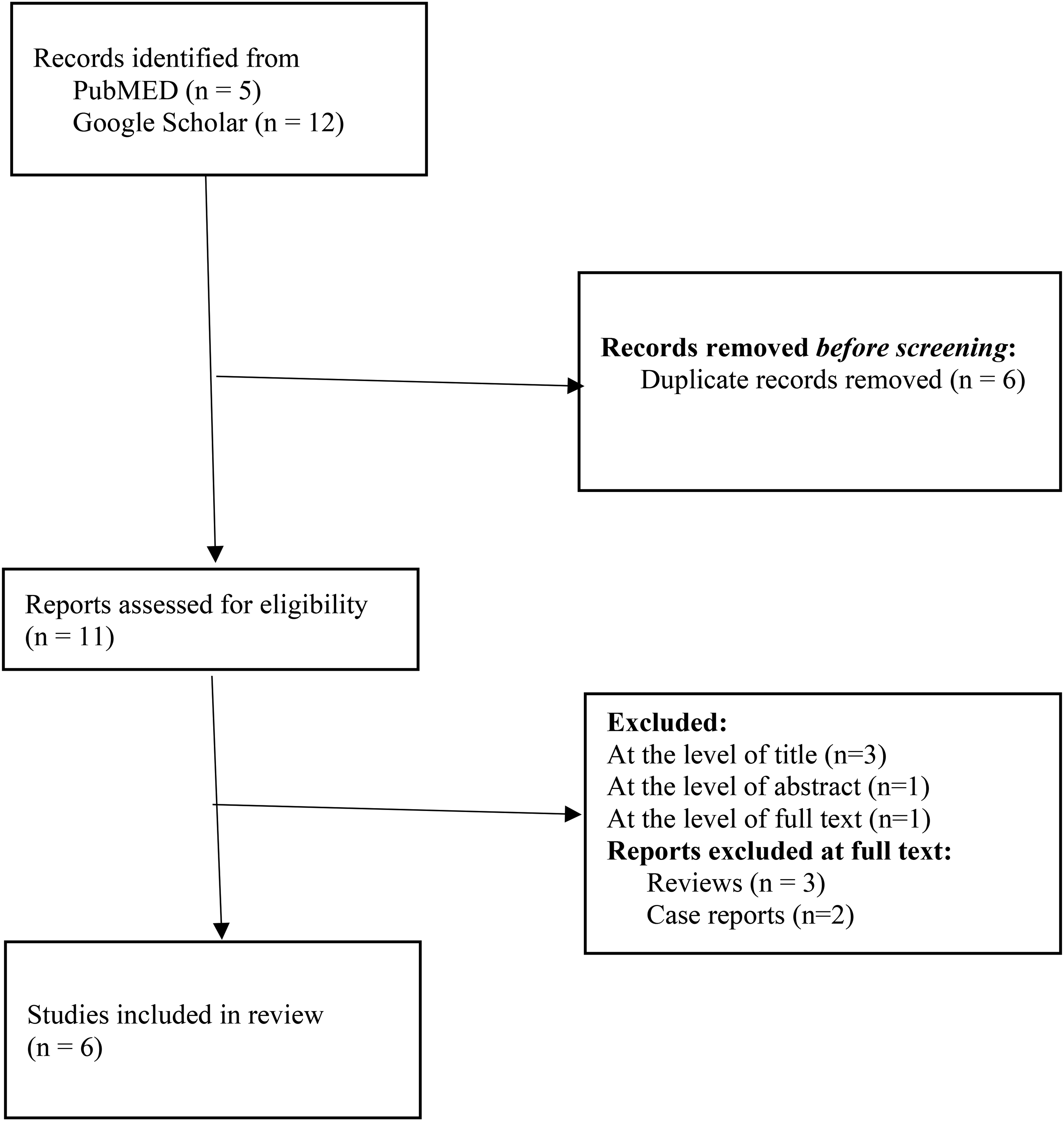
Articles selection process.
Results
A total of six studies including a total of 220 patients with Noma that satisfied the criteria for inclusion (i.e. peer-reviewed original articles published in SSA on the topic) covering four of the 46 SSA nations, namely Burkina Faso, Niger, Nigeria, Ethiopia, and both Niger and Burkina Faso, three studies are qualitative, two cross-sectional and one retrospective. Key conclusions are: (1) one-third experience significant psychological distress 5 ; (2) social issues such as bullying, social exclusion and isolation are frequent9,12; (3) the disease has significant social and economic costs, with lost productivity estimated between 16 and 20 m US$ 6 ; and (4) many patients and caregivers are involved.
Discussion
The prevalence of substantial psychological distress was found to be 37% in those with Noma who had psychiatric illness. According to this, one out of every three people with Noma is suffering from a serious mental illness. This highlights the necessity of enshrining mental health screening in those who have this illness, which is currently not the case in the majority of SSA nations. The effectiveness of Noma treatment is also significantly impacted by psychological distress. 2 In this patient population, deformity on the one hand causes psychological anguish, and on the other, psychological discomfort may cause delayed seeking of care, a reduction in recovery and a reduction in rehabilitation. 2
This review also brought attention to some socio-cultural effects on individuals with Noma in SSA. Marriage-related problems, bullying, stigma and social exclusion are regularly reported consequences of the illness, and supernatural influences are frequently shown to be the cause. The abundance of social issues detailed in this research further supports the idea that people with Noma should be assessed and treated using the biopsychosocial model. 13 The idea that diseases in the SSA are caused by supernatural forces is not unusual, but it has significant detrimental effects on how people receive care because the type of assistance requested depends on how the ailment is perceived by the person. 14
Future research in psychology of Noma should focus (1) a need to describe the various psychological disorders using rigorous methodology, using, for example, diagnostic instead of screening tools used in previous studies. For primary mental health preventive programmes, longitudinal studies assessing the efficacy of early psychosocial interventions across the disease continuum would be required. Such research, given the recent move to list Noma as a neglected tropical disease, should stimulate this. 15 Secondly, studies on social support and religiosity as a coping resource and how the socio-cultural milieu mediates the pathway to care are necessary. Thirdly, studies that test various models to implement the integration of interventions such as screening, treatment, follow-up and referral for psychosocial problems. Finally, treatment outcomes (e.g., response, remission, and recovery), functional and quality of life need to be investigated to determine that interventions are successful.
Footnotes
Authors’ contributions
JUO, DOA and CNO were involved in conceptualization of the study. All authors were involved in literature search and contributed to writing and revision of the Manuscript. All authors read and approved the final draft of the manuscript.
Declaration of conflicting interests
The author(s) declared the following potential conflicts of interest with respect to the research, authorship, and/or publication of this article: Deborah Oyine Aluh is a PhD student receiving the support of a PhD Fellowship from” la Caixa” Foundation (LCF/BQ/DI20/11780013).
Funding
The author(s) received no financial support for the research, authorship, and/or publication of this article.
