



Abstract
The aetiopathogenesis of chronic obstructive pulmonary disease (COPD) remains unclear. The aim of our study was to determine the possible influence of Ascaris lumbricoides on the development of chronic pulmonary aspergillosis (CPA) in patients with COPD. The prevalence of A. lumbricoides in patients with COPD with CPA (19.05%) was significantly higher than that in those without (9.20%) and controls (4.9%) (p < 0.05). Trends in levels of Interleukin-1β and of tumour necrosis factor α suggest ascariasis increases susceptibility to Aspergillus sp. in patients with COPD and can be considered an additional risk factor for CPA.
Introduction
Chronic obstructive pulmonary disease (COPD) is the most frequent non-communicable incurable lung disease with a high mortality rate, mainly in low-income countries. 1 Most patients with COPD receive broad-spectrum antimicrobials and corticosteroids, and have high susceptibility to pulmonary aspergillosis.2,3 Chronic pulmonary aspergillosis (CPA) is often misdiagnosed, especially among patients with COPD. Early diagnosis and identification of factors predisposing to pulmonary aspergillosis are therefore critical to reduce mortality from fungal infections. 4
Ascaris spp. induce immunological and structural changes in the lungs during larval migration owing to the switch to Th2 from Th1 response.5–8 Fluid antigens of adult Ascaris spp. inhibit cytokine secretion and co-stimulatory molecule expression in classically activated but not alternatively activated macrophages. 9 So Ascaris spp. may inhibit the Th1 response at various stages of the disease, providing a long-term increased susceptibility to concomitant infections. During severe infection with Ascaris spp., chronic emphysema-like lung disease may ensue, similar to COPD. 8 Data on the long-term effects of Ascaris lumbricoides on lung function in humans are scarce and unclear.
Regulatory T cells control the balance between Th1, Th2, and Th17 responses, which are essential for the clearance of fungal infections from the host. The Th1 response plays a protective role in pulmonary aspergillosis, whereas Th2 reactions are associated with a higher fungal burden. 10 Therefore, we hypothesize that co-infection with A. lumbricoides activating the Th2 response and frequent corticosteroid use in patients with COPD may be considered additional risk factors for development of pulmonary aspergillosis. Moreover, Uzbekistan is known among the regions endemic for ascariasis. 11
Materials and methods
Patients with COPD in the acute exacerbation phase were admitted to the Department of Respiratory Medicine of the Republican Specialized Research and Practical Medical Center of Tuberculosis and Pulmonology between January 2015 and July 2023. COPD was diagnosed on the basis of clinical examination, spirometry, chest radiography, and laboratory data according to the Global Initiative for Chronic Obstructive Lung Disease criteria. 12 Inclusion criteria of patients with COPD were age >30 years, exacerbation of the III and IV COPD stage, prolonged or frequent use of corticosteroids and antibiotics. Patients with acute and chronic infections (except CPA and ascariasis), oncological and autoimmune diseases were excluded from the study. Finally, 300 patients with COPD met the required inclusion and exclusion criteria. CPA in patients with COPD was diagnosed according to the guidelines established by the European Society for Clinical Microbiology and Infectious Diseases/European Respiratory Society and Infectious Disease Society of America. 13 Determined by the results of a health check-up, 61 healthy subjects were included in the study as a control group.
Our study complied with the Declaration of Helsinki Ethical Principles for Medical Research Involving Human Subjects. All patients with COPD and control subjects were provided written informed consent to participate in the study. The trial was registered at the US National Institutes of Health (ClinicalTrials.gov #NCT 05783544).
Parasitological diagnosis included A. lumbricoides detection in patients with COPD and control subjects. Three stool samples for parasitological analysis were taken from all participants at 2-day intervals. Stool samples were collected in individual containers with 5 mL of Turdiev's preservative, 14 ensuring and preserving worm eggs for staining and conservation for a year. Triple coproscopy was performed by the formalin-ethyl acetate concentration technique and iodine-stained smears.
On the first day of admission, before any drugs had been administered, 5 mL of whole blood was taken from each subject. Serum was separated for immediate testing or stored at −20 °C for later testing. Commercial ELISA kits (Vector-Best, Novosibirsk, RF) were used to detect Ascaris IgG, Aspergillus IgG, Interleukin (IL) 1β, IL-4, IL-6, tumour necrosis factor (TNF) α and IFN-γ. Enzyme-linked immunosorbent assay (ELISA) was performed according to the manufacturer's instructions.
Data were expressed as the mean ± standard deviation (SD) for continuous variables, whereas categorical variables are summarized as percentages. Categorical data were analyzed by odds ratios (OR) with 95% confidence intervals (CI) of the mean. Results were analyzed by analysis of variance and the Tukey–Kramer's multiple comparisons test for the differences among the groups. A value of p < 0.05 was considered statistically significant. Origin 8 software (OriginLab, Northampton, MA) was applied for the statistical analysis of the data.
Results
A total of 437 participants were evaluated for eligibility, of whom 76 did not meet one or more inclusion criteria, so 300 patients with COPD and 61 healthy subjects were included in the study. No significant differences in age and body mass index were observed among the groups. The patients with COPD demonstrated male predominance (79%). Most patients were ex-smokers (64%), with few being nonsmokers (28%) and the remainder current smokers (8%). Patients with COPD included used inhaled (58%), oral or intravenous (42%) corticosteroids during the acute exacerbation of the disease. Cultures were positive in 42 such patients, and Aspergillus fumigatus was the most frequently isolated species, followed by Aspergillus niger and Aspergillus flavus. Although 72 patients with COPD were Aspergillus IgG positive, only 63 met the diagnostic criteria for CPA (Table 1).
Baseline characteristics of participants of the study.

COPD: chronic obstructive pulmonary disease; CPA: chronic pulmonary aspergillosis; GOLD: the Global Initiative for Chronic Obstructive Lung Disease criteria; SD: standard deviation.
To assess the influence of concomitant diseases on the course of COPD, patients were divided into the following groups: patients with COPD without comorbidities (n = 214), patients with COPD with CPA (n = 51), patients with COPD with ascariasis (n = 23), and patients with COPD with CPA and ascariasis (n = 12).
The prevalence of A. lumbricoides in patients with COPD without CPA (9.70%) was higher than in controls (4.9%) (OR: 2.07; 95% CI: 0.60 to 7.10; p > 0.1), but a significantly high percentage was in patients with COPD with CPA (19.05%) (OR: 4.54; 95% CI: 1.21 to 17.02; p < 0.05). The prevalence of A. lumbricoides in patients with COPD and control subjects is shown in Figure 1.

The prevalence of Ascaris lumbricoides in patients with COPD and control subjects. The data show the percentage of A. lumbricoides in patients with COPD without CPA (n = 237), patients with COPD with CPA (n = 63), and control subjects (n = 61). *Compared with the control subjects (p < 0.05); ‡ compared with the patients with COPD. COPD: chronic obstructive pulmonary disease; CPA: chronic pulmonary aspergillosis.
As shown in Figure 2, the level of IL-1β in patients with COPD with ascariasis (24.3 ± 11.6 pg/mL) was significantly higher than that in patients with COPD with (11.5 ± 3.1 pg/mL; p < 001) and without CPA (5.6 ± 8.7 pg/mL; p < 001) and control subjects (1.9 ± 2.0 pg/mL; p < 001). The highest level of IL-1β was found in patients with COPD with concomitant CPA and ascariasis (29.6 ± 26.6 pg/mL).
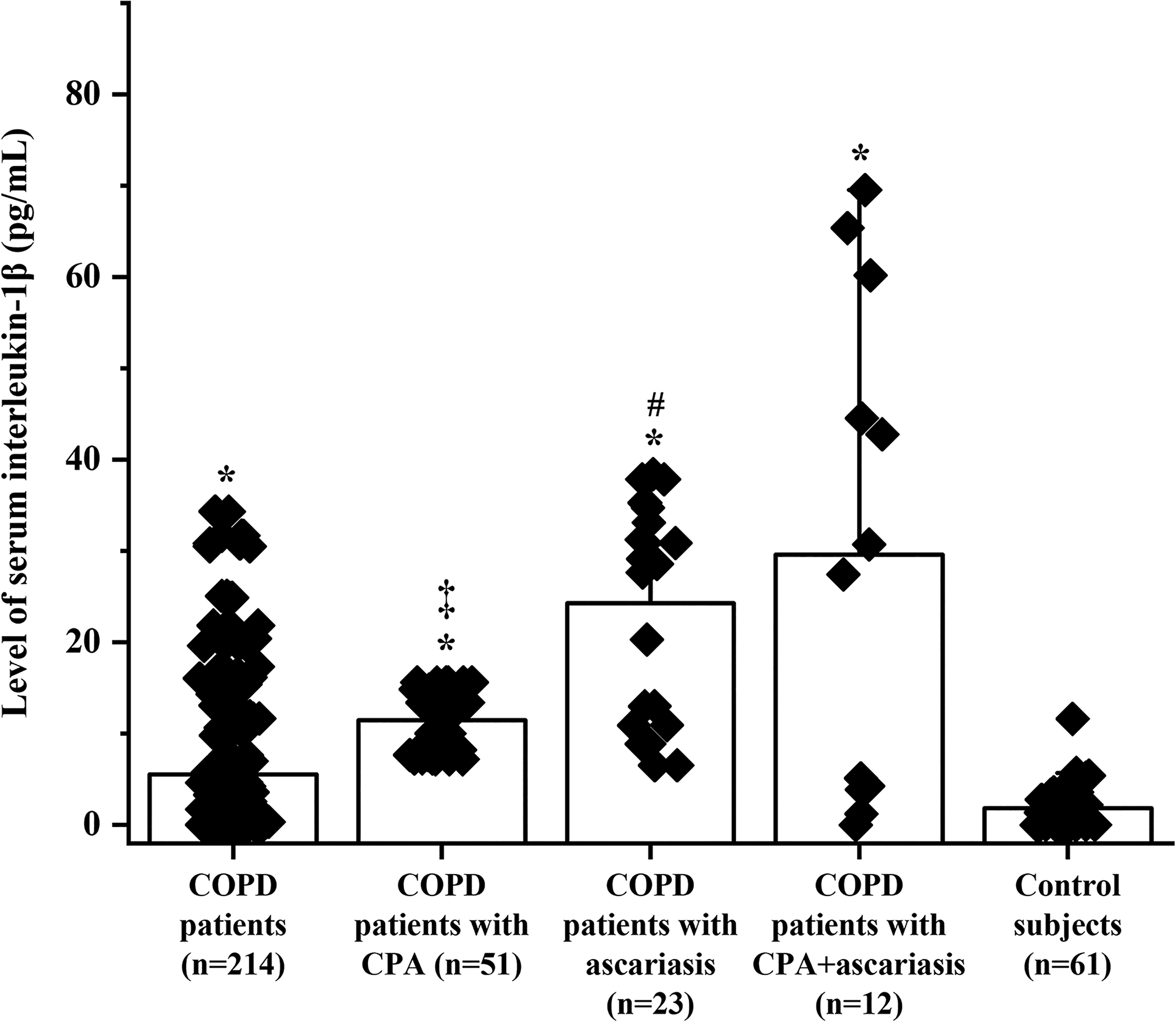
The level of serum IL-1β in patients with COPD and controls. The figure presents the level of IL-1β in patients with COPD without comorbidities (n = 214), patients with COPD with CPA (n = 51), patients with COPD with ascariasis (n = 23), patients with COPD with CPA and ascariasis (n = 12), and control subjects (n = 61). *Compared with the control subjects (p < 0.005); # compared with the patients with COPD (p < 0.0005); ‡ compared with the patients with COPD with ascariasis (p < 0.005). COPD: chronic obstructive pulmonary disease; CPA: chronic pulmonary aspergillosis; IL: interleukin.
Figure 3 demonstrates that the level of IL-4 was significantly higher in all COPD groups than that in controls (0.46 ± 0.80 pg/mL; p < 0.01). The highest level of IL-4 was found in patients with COPD with ascariasis (3.3 ± 0.9 pg/mL) and patients with COPD with concomitant CPA and ascariasis (2.9 ± 0.9 pg/mL). There was a 1.8-fold lower level of IL-4 in patients with COPD with CPA (1.8 ± 1.4 pg/mL) than in patients with COPD with ascariasis (3.4 ± 0.9 pg/mL).

The level of serum IL-4 in patients with COPD and controls. The figure presents the level of IL-4 in patients with COPD without comorbidities (n = 214), patients with COPD with CPA (n = 51), patients with COPD with ascariasis (n = 23), patients with COPD with CPA and ascariasis (n = 12), and control subjects (n = 61). *Compared with the control subjects (p < 0.005); # compared with the patients with COPD (p < 0.0005). COPD: chronic obstructive pulmonary disease; CPA: chronic pulmonary aspergillosis; IL: interleukin.
According to Figure 4, the IL-6 concentration was not significantly different in patients with COPD with CPA (10.0 ± 5.2 pg/mL) and without CPA (10.5 ± 13.3 pg/mL). The highest level of IL-6 was in patients with COPD with ascariasis (39.8 ± 8.5 pg/mL), as well as in patients with COPD with CPA and ascariasis (21.1 ± 3.6 pg/mL). In all cases, IL-6 was significantly higher than in controls (2.6 ± 2.78 pg/mL) (p < 001).

The level of serum IL-6 in patients with COPD and controls. The figure presents the level of IL-6 in patients with COPD without comorbidities (n = 214), patients with COPD with CPA (n = 51), patients with COPD with ascariasis (n = 23), patients with COPD with CPA and ascariasis (n = 12), and control subjects (n = 61). *Compared with the control subjects (p < 0.005); # compared with the patients with COPD (p < 0.0005); † compared with the patients with COPD with ascariasis and CPA (p < 0.005); ‡ compared with the patients with COPD with ascariasis (p < 0.005). COPD: chronic obstructive pulmonary disease; CPA: chronic pulmonary aspergillosis; IL: interleukin.
The level of TNF-α was significantly higher in all groups of patients with COPD than in the controls (p ≤ 0.01). The highest TNF-α level was observed in patients with COPD with CPA and ascariasis (12.05 ± 2.89 pg/mL) and patients with COPD with ascariasis (6.74 ± 3.30 pg/mL) (Fig. 5).

The level of serum TNF-α in patients with COPD and controls. The figure presents the level of TNF-α in patients with COPD without comorbidities (n = 214), patients with COPD with CPA (n = 51), patients with COPD with ascariasis (n = 23), patients with COPD with CPA and ascariasis (n = 12), and control subjects (n = 61). *Compared with the control subjects (p < 0.005); # compared with the patients with COPD (p < 0.0005); † compared with the patients with COPD with ascariasis and CPA (p < 0.005). COPD: chronic obstructive pulmonary disease; CPA: chronic pulmonary aspergillosis; TNF: tumour necrosis factor.
The level of IFN-γ was lower in patients with COPD with ascariasis (6 ± 3.42 pg/mL) and patients with COPD with CPA and ascariasis (4.5 ± 3.6 pg/mL) than in the controls (10.0 ± 4.8 pg/mL). The highest level of IFN-γ was observed in patients with COPD without comorbidity (15.4 ± 3.6 pg/mL) and patients with COPD with CPA (13.4 ± 5.9 pg/mL) (Fig. 6).

The level of serum IFN-γ in patients with COPD and controls. The figure presents the level of IFN-γ in patients with COPD without comorbidities (n = 214), patients with COPD with CPA (n = 51), patients with COPD with ascariasis (n = 23), patients with COPD with CPA and ascariasis (n = 12), and control subjects (n = 61). *Compared with the control subjects (p < 0.005); # compared with the patients with COPD (p < 0.0005); † compared with the patients with COPD with ascariasis and CPA (p < 0.005); ‡ compared with the patients with COPD with ascariasis (p < 0.005). COPD: chronic obstructive pulmonary disease; CPA: chronic pulmonary aspergillosis.
Discussion
Detection of A. lumbricoides in patients with COPD with CPA was of special interest because it could indicate a possible association of ascariasis with CPA development in patients with COPD. The latter is an incurable disease, but it is important to identify concomitant infections that may aggravate its course and can be treated. 4 Uzbekistan is endemic for intestinal parasites, including A. lumbricoides; thus, it is likely that patients with COPD are infected with intestinal helminths. 11 We found that the prevalence of A. lumbricoides in patients with COPD complicated with CPA was 3.8 times as high as that in the control group and 2.0 times higher than that in patients with COPD without CPA. Our data indicate that A. lumbricoides significantly increases susceptibility to Aspergillus sp. and may be considered as additional risk factor for CPA in patients with COPD.
The determination of cytokine levels in patients with COPD showed that the most pronounced shifts were observed for IL-1β, and its level was significantly higher in all COPD groups than in controls. The high prevalence of ascariasis in patients with COPD with CPA is in accordance with the cytokine profile: the highest level of IL-1β was detected in patients with COPD with ascariasis and CPA, significantly exceeding the corresponding values in patients with COPD without comorbidity and in controls. The increase in IL-1β levels in patients with COPD is explained by the inclusion of NLRP3 inflammasome activation in COPD pathogenesis, which is involved in the release of the pro-inflammatory cytokines IL-1β and IL-18. Active caspase-1 or caspase-4/5/11 process pro-IL-1β and pro-IL-18 into their mature forms, inducing inflammation and pyroptotic cell death or inflammation without pyroptosis. 15 It has been established that elevated levels of IL-1β correlated with common inflammatory biomarkers (white blood cell count and fibrinogen) in 89% of patients with COPD. 16 Significantly increased levels of IL-1β and CPA in patients with COPD with ascariasis indicate that susceptibility to Aspergillus sp. and exacerbation of pulmonary inflammation can be mediated by A. lumbricoides. Our results are in agreement with other data 17 : Ascaris suum infection during pulmonary fibrosis in mice exacerbated chronic pulmonary inflammation and dysfunction but not fibrosis. These data suggest possible activation of the NLRP3 inflammasome by Ascaris spp. as well as exacerbation of the inflammatory process. The NLRP3 inflammasome mediates caspase-1 activation and the secretion of the proinflammatory cytokines IL-1β/IL-18 in response to helminth infections. 18 Infection with A. lumbricoides induces a more severe course of malaria caused by Plasmodium falciparum, manifested by more severe parasitemia and significantly higher serum IL-1β levels. 19 Our findings of a significant increase in serum IL-1β levels in patients with COPD with ascariasis and CPA correspond to a previous study. 20 Alternative activation of alveolar macrophages in aspergillosis and ascariasis (Th1 and Th2 responses, respectively) in patients with COPD may lead to fungal burden and inflammation enhancement.
In our study, IL-4 levels in all patients with COPD were higher than those in controls. The highest IL-4 level was found in patients with COPD with ascariasis, exceeding this index in patients with COPD with ascariasis and CPA. Ascariasis could suppress the Th1 response to Aspergillus sp. and worsen the CPA course in patients with COPD.
The inflammatory process in patients with COPD is accompanied by elevated levels of TNF-α, IL-6, and IL-8 in the serum. 21 The high levels of TNF-α and IL-6 in patients with COPD with ascariasis and CPA in our study are similar to other data.22,23
Rise in both IL-1 and IL-6 have been associated with negative health outcomes, mortality and a pro-inflammatory phenotype in COPD. IL-6 in COPD was shown to correlate negatively with lung function, and IL-1β induces airway inflammation. 24 Thus, a significant increase in IL-1β, IL-6, and TNF-α levels in patients with COPD with ascariasis and CPA in comparison with the control group and patients with COPD without such comorbidity indicates enhancement of inflammation induced by A. lumbricoides.
Our study has the limitation of being conducted at a single centre, with a limited sample size, and included only patients with COPD at stages III and IV during exacerbation, which may have influenced the stability of the results. Furthermore, the impossibility of studying the impact of the A. lumbricoides migration phase on CPA development in patients with COPD is acknowledged.
Conclusions
The high prevalence of ascariasis and changes in the cytokine profile in patients with COPD with CPA in comparison with healthy controls allows us to consider A. lumbricoides as an additional risk factor. The study needs to be continued to clarify the duration of immunological shifts after parasite elimination and their possible correction. Diagnosis of A. lumbricoides in patients with COPD is important not only for helminth endemic regions but also where tourism and intensive migration occur.
Footnotes
Declaration of conflicting interests
The authors declared no potential conflicts of interest with respect to the research, authorship, and/or publication of this article.
Funding
The authors received no financial support for the research, authorship, and/or publication of this article.
