



Abstract
Cyclospora cayetanensis is an emerging notifiable food-and-water-borne coccidian parasite causing gastro-intestinal-disease in humans. Detailed information about its biology-associated risk-factors and routes of transmission remain poorly understood; the lack-of-comprehensive epidemiological data underlines a critical need for targeted research into effective prevention and control. Acid variable (pink to brilliant red colour) oocysts of Cyclospora spp. were observed in 16/162 samples, predominantly in 51–60 years males in October. Most cases were among transplant recipients presenting with diarrhoea, therapeutic options among whom remains limited.
Introduction
Cyclospora cayetanensis belongs to the family Eimeriidae, phylum Apicomplexa causing gastro-intestinal disease now seen globally owing to increased global travel and globalised food supply. 1 First published in 1979 in Papua New Guinea, as an unidentified Isospora-like coccidian parasite causing diarrhoea, 2 it gained significant attention following an outbreak at a Chicago hospital in 1990, where it was linked to contaminated tap water. 3 Its comprehensive morphology was deduced in 1994 officially validating its species name. 4
Cyclosporiasis is more common in tropical and sub-tropical countries. Its overall global prevalence in humans worldwide ranges between 3.4% and 3.55%. 5 Recently, the Centers for Disease Control and Prevention (CDC) reported 3000 domestically-acquired cases in the USA over a period of three years but 990 cases were acquired in the USA over a period of 4 months. 6 It is a nationally notifiable disease. 7
Its clinical presentation varies from asymptomatic to severe depending upon age and host immune status. It presents with watery diarrhoea, often accompanied by abdominal cramps, nausea, loss of appetite, weight loss, bloating and fatigue. Systemic features such as low-grade fever, headache and body aches may also occur. The incubation period averages 1 week (range 2–14 days), and symptoms may persist from days to weeks, with possible relapses. In some infected individuals, particularly in endemic regions or when immuno-compromised, infections may be prolonged. The parasite is transmitted by the faeco-oral route, typically through ingestion of food or water contaminated with sporulated oocysts. However, direct human to human transmission remains highly unlikely as the oocysts, shed in faeces, require at least 7–15 days in the environment to sporulate before becoming infectious. 8
Historically, cyclosporiasis has been primarily associated with travel to endemic regions such as Latin America, the Indian subcontinent and South East Asia. 9 However more recently a rising number of cases, both imported and domestically acquired, have been reported. This shifting epidemiology underlines the need for more robust surveillance systems, improved traceability mechanisms in fresh food and supply chains and strengthened preventive strategies.8,10
However, the detailed information about its biology, associated risk factors, and routes of transmission remain poorly understood.6,11 Given its seasonal transmission patterns (the specific timing of peak incidence varies by geographic region), linkage to environmental and socioeconomic risk factors, and predominance among vulnerable populations, especially children and low-income communities emphasises the critical need for targeted research to guide effective prevention and control.
Methods
A descriptive observational study was therefore done as a control on stool samples of all patients arriving for routine medical examination at a tertiary care centre between May and October 2024, suspected of harbouring parasitic infections. The stool sample of 162 immuno-compromised patients (e.g. liver, renal and bone marrow transplant recipients, patients with malignancy, HIV-positive patients and patients on immunosuppressive therapy) presenting with diarrhoea, dysentery, gastroenteritis and abdominal cramps was further processed for modified Ziehl-Neelsen staining. Patients with food allergies (as this can interfere with the results) and those who had either used probiotics in the previous three weeks or antiparasitic drugs in the past three months or who did not comply with the routine and modified acid fast staining of stool involved in the study were excluded (n = 25). The study was conducted after obtaining a waiver from Institutional Ethics Committee under Number MGMC&H/IEC/JPR/2025/4395 as it involved analysis of anonymised data and possessed minimal risk to the participants.
Fresh stool samples were collected in sterile, wide-mouth, leak proof, well-labeled containers without any contamination with urine, water or disinfectant and matched with complete test requisite forms. Stool samples were directly subjected to routine microscopy using saline and iodine direct wet mount technique for detection of the trophozoites and cysts of parasites. Upon suspicion of the presence of a coccidian infection (viz those having cystic structures morphologically resembling Coccidian parasites), a modified Ziehl-Neelsen staining was done on those samples only. Carbol fuchsin stain was applied in the same manner as routine acid-fast stain; however, 1% H2SO4 was used as the decolouriser instead of acid alcohol. 12 The oocysts appeared 8–10 µm variably acid fast (pink-red) against the blue background of counterstain under 1000× light microscopy. Data were collected regarding patient demographics, clinical presentation, risk factors and co-morbidity, and entered in the form of data matrix in Microsoft® Excel® and analysed using IBM® SPSS® Version 20.0.0 (IBM Corp., Armonk, New York, USA). The statistical analysis was performed using Pearson's chi square test and McNemar test. A p < 0.05 was considered as statistically significant.
Results
A total of 553 stool samples were received for routine microscopy, out of which 162 were found to be suspected for opportunistic coccidian parasites. On modified ZN staining of these 162 samples, many acid fast oocysts of Cyclospora spp. was seen in 16 (Fig. 1), of whom 10 were male and a difference not significant statistically (p = 0.84) (Table 1). The predominant age group was 51–60 years, followed by >61 years and the results were found to be statistically significant (p < 0.001). Of the 16 positive patients, 13 were admitted in ward, and two needed intensive care and one could be managed as an out-patient. Most were resident in rural areas and predominantly isolated in the monsoon month of October (Table 1). Most were reported in transplant recipients (liver/renal/bone marrow) presenting with diarrhoea (Table 2). Most had a deranged total leucocyte count (<4 or >11 × 109/L) and altered liver profiles. Three demised (Table 2).
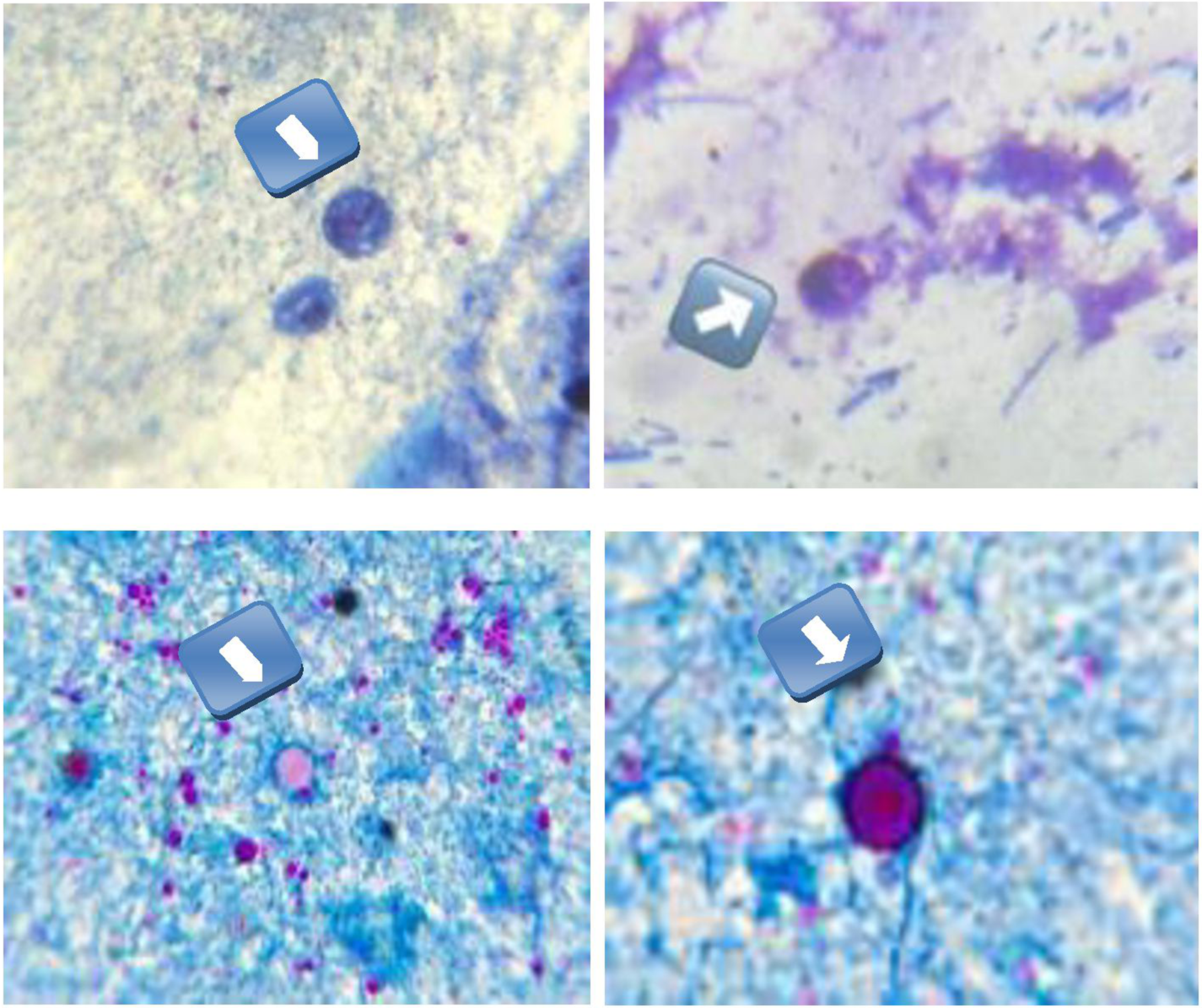
Modified Ziehl–Neelsen staining of stool sample showing round, acid variable oocysts morphologically resembling the oocysts of Cyclospora spp.
Socio-demographic profile of the patients diagnosed with cyclosporiasis.

Note: ICU, intensive care unit; IPD, in-patient department; OPD, out-patient department. 1McNemar Test; 2Pearson's Chi square test.
Risk factors, co-morbidities, clinical and laboratory profile of the patients diagnosed with Cyclosporiasis (n = 16).

Note: AST, aspartate aminotransferase; ALT, alanine aminotransferase; SGOT, serum glutamic-oxaloacetic transaminase; SGPT, serum glutamic pyruvic transaminase.
Discussion
In essence, Cyclospora remains a neglected pathogen not due to its rarity nor lack of clinical significance, but because its detection requires specialised diagnostic techniques, heightened clinical awareness, and often target surveillance efforts. The incidence of C. cayetanensis was only 2.9% (16/553) in our study, compared to other similar studies where prevalence as high as 22.2% were found (Table 3).13–19 Prior empirical therapy before reaching us could explain our low incidence amongst the other reasons. 20
A brief summary of recent studies on Cyclosporiasis in India.
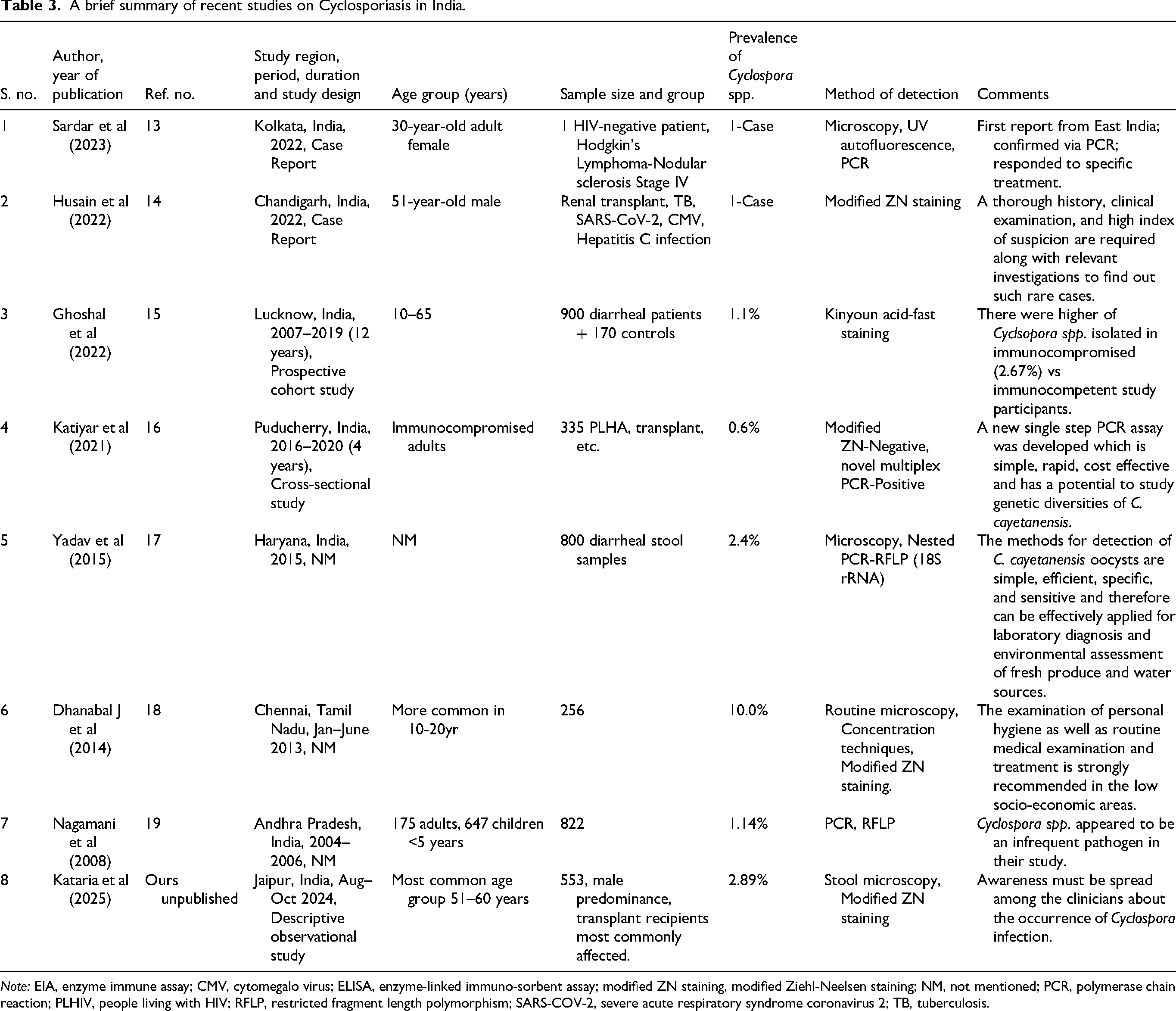
Note: EIA, enzyme immune assay; CMV, cytomegalo virus; ELISA, enzyme-linked immuno-sorbent assay; modified ZN staining, modified Ziehl-Neelsen staining; NM, not mentioned; PCR, polymerase chain reaction; PLHIV, people living with HIV; RFLP, restricted fragment length polymorphism; SARS-COV-2, severe acute respiratory syndrome coronavirus 2; TB, tuberculosis.
In endemic regions, a significant proportion of the population, particularly older children and adults, may carry the parasite without having obvious clinical symptoms.
In addition to challenges in detection and diagnosis, several environmental and behavioural factors contribute to the persistence and transmission of C. cayetanensis, particularly in low-resource settings. In rural areas, open defaecation remains a significant risk factor, increasing the likelihood of faecal contamination of soil, water sources and agricultural produce. The absence of proper sanitation infrastructure, combined with limited public health awareness and poor hygiene practices, further facilitates the parasite's transmission. These factors not only sustain endemic transmission in certain regions but also increase the risk of contaminating food items that may enter international markets, particularly when sanitary standards in food production and handling are inadequate.
Many important questions remain about the epidemiology of this emerging protozoan parasite. Although the contribution of non-human primate Cyclospora species to human disease is not yet demonstrated, their environmental presence presents a public health risk. Their potential to contaminate water and food underlines the need for rapid, accurate identification for timely diagnosis. Cyclosporiasis remains poorly understood in many respects, and thus is an expanding frontier for research across epidemiology, diagnostics, environment and public health. Although quite readily treatable, our analysis shows that if it affects immune depleted persons, it may readily prove fatal. Its detection is possible by modified Ziehl-Nielsen staining.
Although our study was conducted at a single centre, which limits its generalisability. Our analysis reflects a high-risk clinical population rather than the broader community. Our findings emphasise the diagnostic challenge of Cyclospora in non-endemic settings where routine testing may be overlooked, and thus the need for increased clinical awareness and targeted diagnostic methods in diarrhoeal patients.
Footnotes
Acknowledgements
We thank all our patients for their contribution in our study and the institution for allowing us to conduct the study. We are very much grateful to our Laboratory technicians Mr Lalit Kumar Prajapat and Mr Bhupendra Meena for their contribution in this study.

Funding
The authors received no financial support for the research, authorship and/or publication of this article.
Declaration of conflicting interests
The authors declared no potential conflicts of interest with respect to the research, authorship, and/or publication of this article.
Authors’ inclusion criteria
SK: Drafting the article and concept and design of the study. AS: Interpretation of data. VM: Final approval of the version. IS: Acquisition of data. The manuscript has been read and approved by all the authors. The requirements for authorship as stated earlier in this document have been met. The manuscript, or parts of it, has not been submitted elsewhere for publication.
Source of support
Not applicable.
Funding
Not applicable.