



Abstract
Historians of science can benefit from thinking more deeply about land. Scholarly emphasis on the geographies of scientific knowledge has become pervasive since the “spatial turn” of the late 1990s. At the same time, the history of science has increasingly intersected with environmental history. Despite these growing connections, historians of science have been slow to embrace a core concern of environmental history: land. While space and place now have a rich literature in the historiography of science, land appears in histories of science in more scattered, incidental ways – largely as a place where science may occur or be applied. More than just a unit of ground, land is analytically connected to a web of questions about labor, property, governance, identity, and environmental change explored by environmental historians, geographers, and political ecologists. This article examines what historians of science – particularly, but not exclusively, historians of the field and environmental sciences – have to gain by taking land more seriously. A reexamination of the Rain Forest Project (1962–1970), a radioecology study initiated by systems ecologist Howard Thomas Odum in what is today El Yunque National Forest, Puerto Rico, serves as a case in point. Viewing this field site as land reframes ecologists’ fieldwork as a form of land use, highlighting its place within regimes of land tenure, its connections with other communities’ uses of the land, and its persistent local legacies.
Keywords
Introduction
On December 7, 1964, a helicopter hovered over a stretch of tropical rainforest in Puerto Rico. At a site called El Verde, it deposited a cylinder containing a 10,000-curie cesium gamma radiation source. 1 (See Figures 1 to 3.) This source was the centerpiece of the Rain Forest Project, a large-scale ecological study intended to produce a complete picture of a tropical forest ecosystem and its response to disturbance. Led by ecologist Howard Thomas Odum and funded by the U.S. Atomic Energy Commission (AEC) from 1962 to 1970, a group of almost a hundred scientists produced a comprehensive study of the area before and after three months of irradiation.

“Source and Crew. El Verde. June 1965,” Howard T. Odum Papers, Special and Area Studies Collections, George A. Smathers Libraries, University of Florida, Gainesville, Florida.
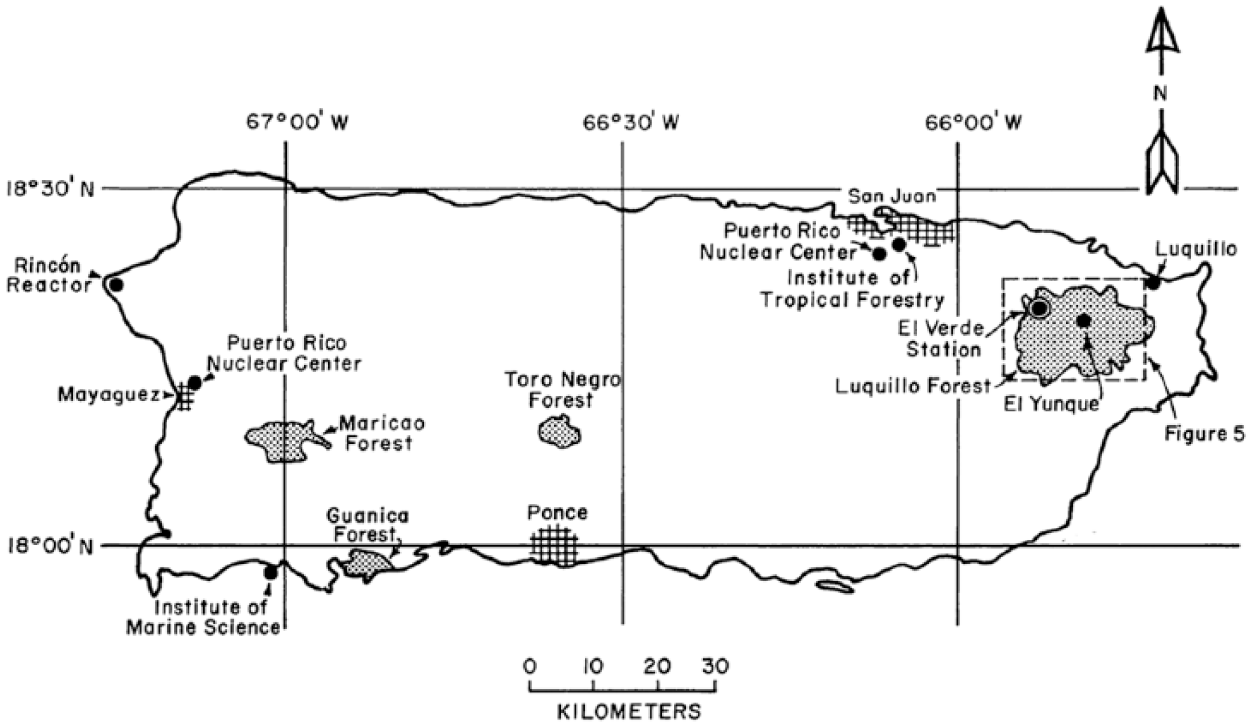
Map view of Puerto Rico showing the location of the El Verde field station and other scientific sites. Note that El Yunque is depicted here as the toponym of a mountain peak only, rather than reflecting local usage to include the surrounding lands. The area labelled Luquillo Forest was administratively the Luquillo Experimental Forest/Caribbean National Forest, and is today El Yunque National Forest. Odum and Pigeon, A Tropical Rain Forest, p.B4.
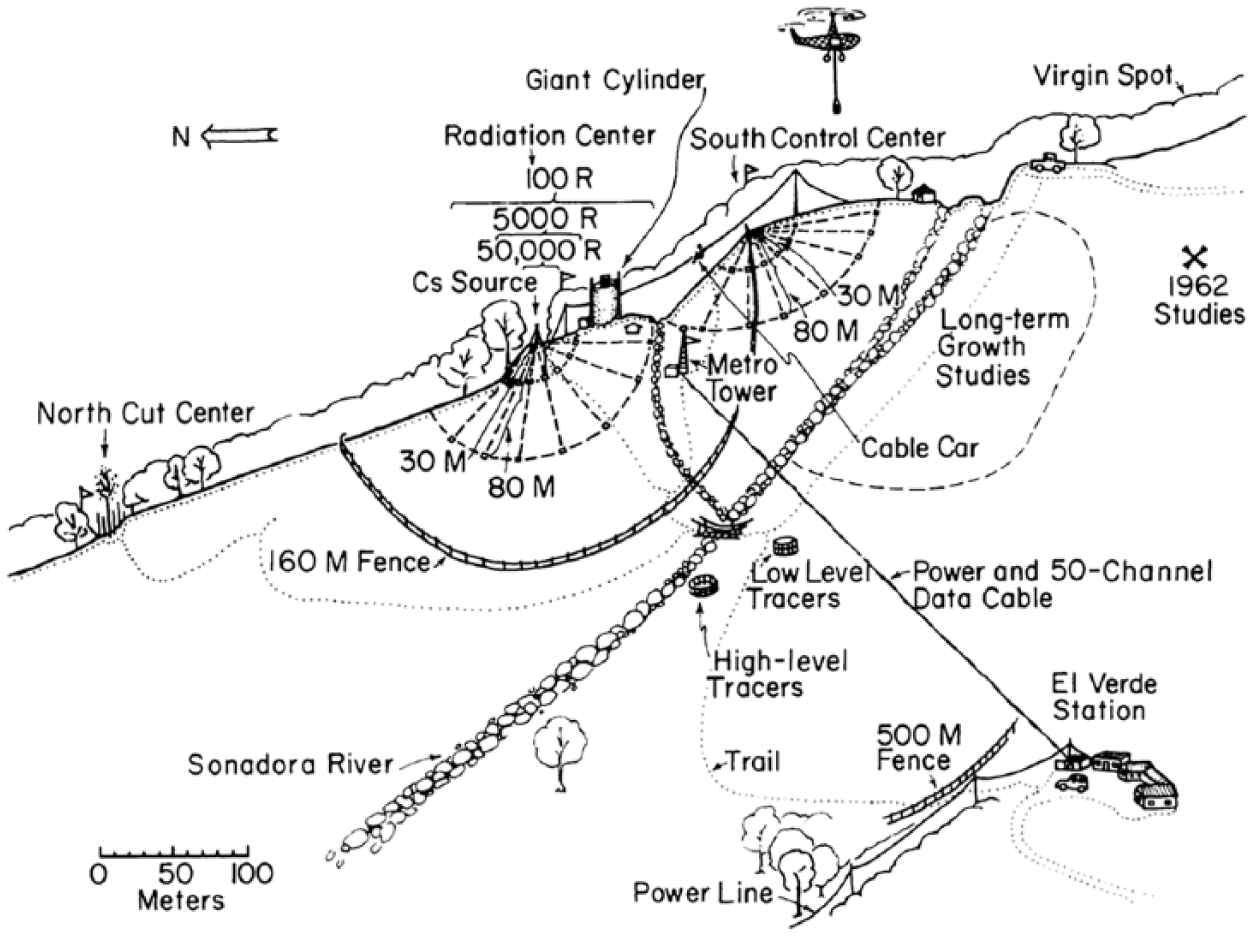
Side view diagram of the Rain Forest Project research area at El Verde. Odum and Pigeon, A Tropical Rain Forest, p.B19.
The Rain Forest Project had far reaching effects, well documented by historians of science. It established the precedent of “big science”-style funding and team-based research management in ecology. 2 It contributed to Odum’s efforts to develop theoretical models for generalizing about the functions and energy dynamics of natural systems, thereby contributing to the rise of ecosystems ecology. 3 It also introduced new experimental field practices. Partly because of its irradiation of about eight hectares of rainforest and a variety of other destructive interventions, one scientist (rather darkly) joked that it should be called a study in “slash-and-burn ecology.” 4
What if we take this allusion to land use seriously? Like swidden agriculturalists, field ecologists impact the land. They, too, are people whose activities are shaped by regimes of land tenure and the legacies of the past uses of the lands where they work. The morality of their land use, too, may become subject to intense scholarly and public debate. 5 Despite the striking nature of this radioecology project, its colonial context, and its location within one of the hemisphere’s oldest forest reserves – El Yunque National Forest – the environmental history of the El Verde field site, before or after Odum’s project, has hardly figured in historical discussion of the Rain Forest Project. This case carries contemporary significance because El Yunque remains a key site of environmental change research in the face of global warming and in the wake of Hurricane Maria. It also demonstrates what we gain by attending more closely to the environmental history of field science through analytical engagement with land.
Spaces of science vs. science on the land
At first glance, situating the Rain Forest Project on the land may not seem such a radical move. Since the “spatial turn” of the late 1990s, historians of science have become deeply concerned with the situated nature of scientific knowledge. 6 The geographical concepts of space and place have been key tools for theorizing the social construction of science. Historians of science have examined how knowledge produced in particular places has, through a variety of spatial practices, attained the power to circulate beyond the sites of its production and gain the status of universal scientific knowledge. Thus, a laboratory’s authority derives from spatial control and standardization, while a museum’s synoptic view emerges out of practices of on-site accumulation and comparison. Concern with the geographies of science helped propel interest in science taking place beyond the long-privileged indoor spaces of labs and museums, in the wider world of scientific sites known as “the field.” 7
During that same period, the intellectual territory shared by the history of science and environmental history grew rapidly, despite tensions over methodological approaches to scientific knowledge. 8 Fundamentally, science stands as the primary object of critical study for historians of science, whereas it acts as one of several tools for environmental historians seeking to understand human relationships with nature. Both disciplines, nevertheless, are concerned with the materiality of the natural world and emphasize the material and social consequences of ideas about nature. By historicizing environmental knowledge, perspectives from the history of science helped environmental historians refine how they examine the knowledge systems that mediate human-environment interactions. 9 Environmental historians’ use of science to reconstruct past landscapes grew in sophistication. In turn, historians of science drew inspiration from environmental history – especially within the emerging subfield of the history of the field sciences – because it dovetailed with their newfound emphasis on place. After all, if historians of science were interested in where science took place, then, for historians of the field sciences, that place was most obviously part of “the environment.”
Space and place are now well integrated into the toolkit of the historian of science. But what about land? Land is a complex and multifaceted concept, but it is undeniably central to environmental history. After all, much of the field emphasizes histories of land use and changes in the land. 10 Along with closely allied fields like agricultural history, geography, and political ecology, environmental history reveals how land is more than just a unit of solid ground. 11 Land specifically directs our attention to issues of ownership and access, labor and resource use, governance, and management, as well as to people’s livelihoods and identities. 12 If space highlights the abstract relations of locations and place highlights the meanings humans attribute to spaces, land is a peculiar type of place. As much a political economic concept as a cultural one, land places emphasis on power. 13
Land is fundamental to the work of environmental historians, but it appears only sporadically in the history of science. Land figures most prominently and richly in histories that fuse environment, health, and knowledge, where it stands as the medium of lived experience. 14 For historians of the field sciences, who essentially take scientists in the land as their subject, land has been ever present and yet somehow elusive. In his pathbreaking Landscapes and Labscapes and subsequent writings, for example, Robert Kohler suggested that historians of the field sciences should consider fieldwork as a type of land use. 15 Nevertheless, Kohler himself originally employed land use in a more metaphorical sense, drawing a comparison between the Mongolia–China frontier and the “borderland” of scientific practice between laboratory and field – field scientists engaged in extensive land use like the nomadic, pastoral Mongols, while laboratory scientists were akin to the intensive agriculturalists of the Chinese Empire. Land use figured in this work more as a way to think about the spatial relations of science than to interrogate its relationship to the broader political economy (despite the analogy of scientific “modes of knowledge production” 16 ). Later, however, Kohler noted the potential of a “land-use perspective” to bring concepts like property law, public versus private ownership, and the commons to the fore. He hoped it might eventually “serve as a common language for those (like myself) whose interest is held by the actual practices of field science and those who are more powerfully drawn to environmental politics and policy.” 17
The community of scholars who are indeed interested both in the history of scientific practice and environmental politics has grown enormously in recent years, yet land and land use remain diffuse and implicit in the history of the field sciences. Land may appear as part of descriptions of sites where science takes place or where science-based policies have been applied, but opportunities remain to more fully take advantage of the web of analytical concerns that surround it in environmental history, geography, and political ecology. Land generally remains subordinate to space and place in the history of science. Putting land first can uncover and foreground the often hidden politics inherent in scientists’ land use.
Space, place, and the Rain Forest Project
To understand how a land-centered approach means considering more than just space and place, let’s first examine how the Rain Forest Project has been framed within the historiography of science. Although the project has not been the subject of a focused study, it appears in several major histories of ecology, most extensively in Joel Hagen’s An Entangled Bank and Peter Taylor’s Unruly Complexity. 18 Alongside his older brother Eugene P. Odum, H. T. Odum is widely recognized as a major figure in the history of ecology. Together, they founded modern ecosystems ecology, drawing on concepts and techniques from the physical sciences and tapping into U.S. government funding for atomic research after World War II. Even though many authors who discuss Odum do not specifically examine the Rain Forest Project, it therefore fits securely into several well-established literatures in the history of ecology, Cold War science, and the field sciences more broadly. 19
The existing historiography of the Rain Forest Project can illustrate two common modes of analyzing science spatially. First, ecologists’ spatial practices at El Verde could be described as efforts to produce knowledge capable of traveling beyond the site. For Odum, the project fundamentally addressed the question, “Can stress, such as radiation, be put in energy terms . . . so that these field experiments can be generalized?” 20 Rather than attempting to understand El Verde as a unique community of species, Odum’s team measured biomass, chlorophyll content, nutrients, species diversity, and other standardized, quantifiable variables that could be collected at other sites, including nearby control sites and a similarly-irradiated temperate forest at Brookhaven, New York. Odum then used this data to create diagrams of energy flow using symbols borrowed from electrical engineering (a practice he developed during this project). 21 As a Latourian “immutable mobile,” these diagrams enabled El Verde’s comparison with other ecosystems to reveal underlying functional similarities. As Taylor explains, Odum aimed to discover “universal principles of ecosystem ‘design’” that could be used to manage human and natural systems. 22 Hagen shows, however, that knowledge produced at El Verde did not travel as well as Odum hoped. The final results were published in an unwieldy, 111-chapter, multi-authored book, A Tropical Rain Forest: A Study of Irradiation and Ecology at El Verde, Puerto Rico. Weighing over 10 pounds, it is quite literally a challenge to “mobilize.” Other ecologists found it “difficult to glean coherent conclusions from the book or to compare the overall results with those from other AEC studies.” 23 The Rain Forest Project’s institutional model traveled more readily. As the prototype for the International Biological Program, the hierarchical institutional and spatial model of ecosystem science at El Verde was transplanted to sites ranging from the deserts of the U.S. Southwest to an Ivory Coast savannah. 24
Second, ecologists’ practices at El Verde could also be located within the “lab-field borderlands” – a space of tension and interaction between the cultures of laboratory and field scientists. 25 Although not directly addressing the Rain Forest Project, Kohler describes two of Odum’s other field sites as places where laboratory practices “went wild.” From Odum’s point of view, an ecosystem was like an organism, the only problem was that “one could not dig it out or put it under glass” in order to measure its metabolism inside a lab. At Enewetak Atoll, Marshall Islands, and Silver Springs, Florida, Odum found naturally occurring “lab-like” spaces – “contained” and functioning under constant, steady-state conditions. 26 Odum presumed El Verde’s rainforest also to be at a steady-state climax, but unlike Enewetak or Silver Springs, El Verde was not self-contained. Confronting a less-than-ideal natural laboratory, Odum’s team developed a host of hybrid “practices of place” to adapt experimental techniques to field conditions. 27 Indeed, they came very close to putting at least one piece of El Verde under glass: in their “giant cylinder experiment” they enclosed a sixty-foot-wide patch of forest in plastic sheeting to measure whole-canopy respiration, photosynthesis, and primary productivity. 28 They also rendered the site more lab-like by fencing non-scientists out of El Verde’s irradiated zone. Odum had to share Silver Springs with “fishermen, swimmers, and tourists,” but hikers and picnickers could not disrupt the scientific space of El Verde. 29 From this perspective, through judicious site selection and the adaptation of experimental techniques, field scientists like Odum could come close to matching the rigor and prestige enjoyed by lab scientists.
Both of these spatial approaches are powerful, and they have profoundly shaped my own thinking. Nevertheless, it is striking how different engagement with space and place can look in the history of science as compared to environmental history, where the land itself is more often at the center of analysis. In fact – other than that there is a rainforest – we learn almost nothing from the secondary history of science literature about the land in which the Rain Forest Project actually took place. Its physical and cultural landscape, its uses and meanings for people other than Odum’s team, remain invisible. (As we will see, El Verde’s enclosure meant something quite different to those excluded from the site than to the scientists using it as a laboratory.) Despite starting with attention to material practices in a local place, these approaches have ultimately drawn our attention elsewhere – to the problems of constructing universal scientific knowledge, international institutions, or prestige for science done outside laboratory walls. They tell us much about El Verde’s relationship to far away scientific sites, but they tell us little about science in its Puerto Rican context. They illuminate global geographies of science, but may obscure significant local ones.
In fact, the El Verde field site lies within the broader area known to Puerto Ricans as El Yunque, and it has a deep, complex, and contested history of land use and meaning, in which science has long been entangled.
Seeing El Yunque: Land use, land tenure, and territory
El Yunque is the name long used by Puerto Ricans both for the prominent and distinctive peak in the island’s northeastern Sierra de Luquillo and for the surrounding forests. It is understood locally as monte – a Spanish concept without a single-word equivalent in English, encompassing both the idea of a mountain and of undeveloped woodland or bush. 30 As anthropologist Manuel Valdés Pizzini and coauthors explain, El Yunque is also a symbolic place of Puerto Rican cultural heritage and national identity, seen as the island’s last wilderness and a historic region of Tainó resistance to Spanish colonization. Managed by the U.S. federal government, it is also a site of political tension. 31 Under the U.S. colonial occupation of Puerto Rico, the area has been administered as a U.S. National Forest since 1907. Only in 2007 was it renamed El Yunque National Forest to better align with residents’ own usage and sense of place. When Odum arrived to set up the Rain Forest Project in 1963, the area was officially managed by the U.S. Forest Service as the Caribbean National Forest and, simultaneously, as the Luquillo Experimental Forest.
These multiple meanings and administrative designations matter for understanding the Rain Forest Project as land use. Land use is never just a set of human activities in a landscape (landscape being largely a visual and aesthetic way of apprehending land); land use is inextricable from the systems of land tenure that govern it.
32
Land tenure encompasses the social institutions, legal or customary, that regulate how people – including scientists – access, own, and use lands and their resources. Systems of land tenure govern whether or not the owner of a plot of land also has rights over, say, the water and mineral resources found on it. Indeed, land tenure systems determine whether land is something that an individual can own at all, or whether lands are held in common, by a state, or by no one.
33
Although land is sometimes treated “as a commodity,” Tania Murray Li notes: it is not like a mat: you cannot roll it up and take it away. To turn it to productive use requires regimes of exclusion that distinguish legitimate from illegitimate uses and users, and the inscribing of boundaries through devices such as fences, title deeds, laws, zones, regulations, landmarks and story-lines.
34
These activities often involve or benefit scientists, but while land tenure is at the center of narratives of conflict in many environmental histories, it is rarely invoked in the history of science. 35 Land use and tenure are also related to the governance of territory – itself a complex category, involving control over land and entailing particular political and legal conceptions of space. 36 Attention to such concepts can deepen analysis of how scientists choose, negotiate access to, and use fields sites by highlighting the power relations present in the lands where scientific knowledge is produced.
Historians of science are well aware of the importance of examining scientists’ reasons for selecting particular sites – choosing the “right” place for the job is as important in field science as the selection of instrumentation or a model organism in laboratory science. 37 In fact, Puerto Rico was not Odum’s first choice. He had envisioned a large-scale ecosystem study of a tropical rainforest well before deciding on Puerto Rico or securing funding from the AEC for a radioecology approach. His fascination with tropical rainforests went hand-in-hand with his focus on energy and his methodological requirement for steady-state systems (noted above). From his perspective, as the global region with maximum solar radiation, the tropics should be where one could find ecosystems achieving their thermodynamic maximum. Like most biologists at the time, he also presumed that rainforests were evolutionarily ancient and in ecological balance. Therefore, Odum was excited by the prospect that a rainforest ecosystem study could answer general biological questions, but he did not initially have a specific field location in mind. His initial 1957 proposal to the Rockefeller Foundation vaguely indicated only his need for “a typical rain-forest site.” 38
Seen as a “relic of pre-Columbian Puerto Rico,” El Yunque conformed to Odum’s expectations that rainforests be ancient. 39 Yet, far from being a relic outside time, El Yunque’s forest was the product of a long history of human use and management. As might be surmised, the United States was not El Yunque’s original landowner. When Spain ceded Puerto Rico following the 1898 Spanish-American War, the U.S. federal government “inherited” Spanish Crown lands. The Spanish government had implemented a variety of conservation laws in Puerto Rico by the early nineteenth century. Like other imperial powers, Spain had been forced to confront the degradation of tropical forests, and associated effects on water and climate, under its rule. 40 Spanish officials gradually recognized El Yunque as a source of timber, fresh water, and other resources valuable enough to conserve. (The highlands were also challenging for settled agriculture and indigenous Taínos and maroon communities had long used the rugged terrain to resist Spanish control.) In 1876, Spain created a forest service, the Inspección de Montes, and declared El Yunque a forest reserve under its protection – fifteen years before the creation of a U.S. system of forest reserves. Peasants continued to use forest resources for subsistence, as their Taíno forebears had before the Spanish claimed their land. El Yunque was already one of the oldest forest reserves in the Americas when it entered the U.S. forest system in 1903 (to become a National Forest in 1907). 41 A degree of inter-imperial continuity of forest governance had maintained tree cover, but El Yunque was no unpeopled wilderness.
Odum described other environmental factors that also made Puerto Rico ideal for his project: Its relatively uniform seasonal rainfall brought it closer to what he called “a desired steady state” and, as an island, Puerto Rico’s flora and fauna were less diverse and simpler to study than mainland tropical sites. 42 Note, however, that Odum only cited these factors after access to a site in Puerto Rico was assured. Scientists’ claims about the ideal nature of their field sites are often post hoc justifications; practical matters of land access frequently loom large in their choices. Thus land matters to field science not only in terms of its physical environment, but also in terms of its governance as territory. The range of potential sites Odum had first considered was in fact sharply delimited by those that he could expect to have secure access to as a U.S. Citizen – including existing Rockefeller research sites in Brazil, Mexico, and Trinidad, and the Smithsonian Institution’s biological station at Barro Colorado Island in the U.S.-controlled Panama Canal Zone. 43 These were sites that many U.S. biologists frequented during this period.
Crucially, however, Odum needed not only a site that he could access, but also one that he could use for large-scale experimentation. His initial plan involved felling a 1-acre plot of rainforest and collecting measurements of biomass, chlorophyll content, and species diversity – a daunting task he thought would be “feasible because of inexpensive local labor” in tropical countries. 44 Although the Rockefeller Foundation did fund Odum’s studies beginning in 1957 (later expanded into the Rain Forest Project under the AEC’s aegis), funding officers at first expressed skepticism about Odum’s lack of attention to the practical matter of “how they would get permission to cut down rainforest, etc.” 45 Choosing Puerto Rico solved this problem. Historians of Puerto Rico have shown how the island became a “laboratory” for U.S. policy. 46 Although Puerto Rico had declared itself a “Commonwealth” or “Estado Libre Asociado” in 1952, this did not change its essentially colonial (although highly legally ambiguous) status as a U.S. “unincorporated territory,” lacking the full rights and protections of the U.S. constitution. 47 Under the AEC, the project would directly impinge on matters of land use and territorial sovereignty – not in Puerto Rico, but in Panama. The agency’s primary rationale for funding the Rain Forest Project was to understand the environmental impact of a proposed Project Plowshare “Pan-Atomic Canal,” a nuclear-excavated sea-level isthmian canal intended to replace the aging Panama Canal (and serve as a bargaining chip as the U.S. and Panama negotiated the future of the canal and Canal Zone, another U.S. “unincorporated territory”). 48 At the outset, for Odum at least, working within U.S. territory in Puerto Rico made fieldwork “simpler diplomatically . . . and logistically.” He faced no need to negotiate access with a foreign government and less risk of difficulty with local authorities. 49
More specifically, El Yunque’s status as a U.S. National Forest – the only tropical rainforest in the U.S. National Forest System – was key. The Forest Service, after all, is part of the U.S. Department of Agriculture. Unlike National Parks, Wilderness Areas (after 1964), or other types of nature reserves designed to preserve wilderness or scenic vistas, National Forests are managed on a model that also includes conservation for sustained resource use. 50 While U.S. National Parks also host scientific research, they constrain fieldwork by limiting activities like collecting, cutting vegetation, or, indeed, using herbicides or radioisotopes. 51 For comparison, it is worth noting that ecosystem ecology had a slow start at the Smithsonian’s Barro Colorado Island, Panama, a reserve where large-scale experimentation was not permitted. 52 In National Forests, conservation and resource management had long operated in conjunction with scientific research, particularly at Forest Service sites designated as Experiment Stations or Experimental Forests. 53 Building on earlier United States Department of Agriculture (USDA) models and formally initiated by the McSweeney-McNary Act in 1928, Forest Service Experiment Stations and Experimental Forests were designed specifically to be sites for scientific manipulations of the land, such as test plots of tree species for timber production or reforestation efforts.
El Yunque was thus, if not unique, one of very few tropical rainforests where destructive interventions of the sort Odum planned could be undertaken. The Forest Service had had an experiment station in place since 1939 at the University of Puerto Rico, Río Piedras (renamed the Institute of Tropical Forestry in 1961). It had a small satellite field station in the northwestern part of El Yunque, called El Verde. The experiment station had been implemented following the failure of reforestation efforts by the Civilian Conservation Corps (CCC) throughout Puerto Rico in the 1930s. 54 As thousands of planted trees failed to thrive, U.S. administrators increasingly recognized the need to adapt scientific forestry techniques to tropical conditions. In 1956, the whole Caribbean National Forest was designated as the Luquillo Experimental Forest to recognize its strong and longstanding emphasis on forestry research.
When Odum expanded his plans to encompass a radioecology study, then, all he needed was a Special Use Permit issued by the Forest Service and a formal “memorandum of understanding” between the Forest Service and the AEC, operating through the University of Puerto Rico’s recently founded Puerto Rico Nuclear Center (PRNC). This permitted his team’s occupation and modification of a 69-hectare area at El Verde. 55 Odum’s choice of a forested tropical site – one he would have the freedom to use for large-scale ecosystem experimentation – was thus structured by a long history and specific current regime of territorial governance in Puerto Rico and of land tenure in El Yunque.
Science on land with a history
The case of the Rain Forest Project suggests how broader systems of governance affect scientists’ ability to choose, access, and use land, but a land-centered approach can go even deeper. Those lands themselves have histories – environmental histories that materially shape field scientists’ objects of study. At El Yunque, a long history of land tenure and use determined precisely what kind of forest Odum’s project would encounter.
Although Odum argued that “the Luquillo Experimental Forest…remained continuously in forest cover” as it passed from Spanish to U.S. control, only 5,018 hectares of the then 11,330-hectare Caribbean National Forest/Luquillo Experimental Forest had actually stood within the original Spanish Crown reserve. 56 Most of the forest was new, regrowing on land purchased piecemeal by the Forest Service from surrounding large landowners, especially coffee haciendas put out of business in the 1930s by the Great Depression and a succession of devastating hurricanes. 57 Poor peasants continued to call this land home. Known as agregados, they were tenants customarily “attached” to the land, exchanging their labor with a landowner for usufruct rights to subsistence cultivation. 58 The Forest Service did not immediately evict these agregados. Fearing conflict with adjacent landowners and displaced peasants, and seeing a potential source of cheap forestry labor, foresters implemented a social and forestry experiment they called the “parcelero system” – an adaptation of the British colonial taungya system. 59 Forester Leslie Holdridge distributed agregado families 12-acre parcels of land where they received permits to engage in shifting cultivation, interplanting crops amid successive timber plantings. The parcels were too small, however, to sustain forest and crop production. Soil degradation set in. Most peasants left or were relocated as part of reforms initiated by Puerto Rico’s 1941 Land Law. 60 Only 22 of the 250 original parceleros remained by 1958. The Forest Service abandoned the experiment, grandfathering the few who owned their homes onto quarter-acre sites for life tenure and expelling the rest by 1959. 61
The Forest Service bought the El Verde tract itself in 1934. Two U.S.-owned plywood corporations had owned and partially logged the tract, later planting clearings with coffee. 62 The CCC constructed the El Verde field station buildings on part of this former coffee plantation, and although Odum stated that cultivation never reached the study areas (stopping short by somewhere between 100 and 200 meters), the whole area was clearly far from pristine. 63 Even the patches of forest within the El Verde study area that Odum described as “virgin” were the historical products of management – plantation owners typically maintained stands of Tabonuco forest (forest dominant in Dacryodes excelsa and classified by foresters as the original “forest type” of the lower elevations) as a source of forest products. Like much of the forest at this elevation, the area of the tract had been periodically occupied by subsistence farmers and exploited for charcoal and timber since the pre-Columbian era. The CCC had selectively logged El Verde in 1937, as had the Forest Service several times between 1944 and 1953, and locals were permitted to harvest for desperately-needed charcoal production. 64 Throughout the El Verde tract, the Forest Service also maintained several long-term research plots to monitor how the growth and composition of Tabonuco forest responded to experimental thinning treatments. 65
El Verde, and El Yunque as a whole, thus had a long history of land use – one that included experimentation by foresters. Indeed, the Forest Service provided Odum space at El Verde, and not (as he originally appears to have requested) in the less modified, higher elevations, precisely because it was designated for experimental purposes under the Forest Service’s multiple use plan. 66 This plan balanced recreation, timber production, soil and water conservation, and various types of scientific use – a patchwork of land uses requiring both modified and unmodified forest. At times, the Forest Service also accommodated military usage, allowing field training exercises, the construction of communications infrastructure, and even chemical weapons tests – some of which were integrated into the Rain Forest Project as comparative studies. 67 From the foresters’ point of view, El Verde was largely secondary forest and therefore less valuable for uses requiring relatively unmodified forest, although perfectly suitable for destructive experimental interventions.
This was not the perspective of most ecologists. Ecologists had long favored (apparently) pristine sites as reflecting “natural conditions.” Human use complicated their efforts to distinguish natural processes from anthropogenic effects. Several reviewers of A Tropical Rain Forest were indeed skeptical of Odum’s choice of a site so obviously marked by past land use. Tropical botanist Peter S. Ashton argued that El Verde “can hardly be called typical lowland tropical forest” and ant ecologist Paul Kannowski objected (using sexist language), “The forest site at El Verde is said to be nearly virgin, although selective timber cutting occurred until 1953. One wonders how much raping of the forest is required before she loses her virginity.” 68
In fact, various chapters of A Tropical Rain Forest did note many aspects of the forest’s complex land use history. Odum never claimed the entire study area was “virgin.” He did, however, downplay any lingering effects past land use might have on the structure or composition of El Verde, at least as they affected the project’s conclusions. In this he relied on forest manager and Institute of Tropical Forestry Director Frank Wadsworth’s assessment that the forest in the study area had reached a “climax” state. The site had not been affected by major natural disturbances – forest fires did not occur in rainy El Yunque and no evidence of damage from the most recent hurricanes was evident. Indeed, Odum suggested that Forest Service interventions had actually made El Verde’s forest a more desirable ecosystem to study, quoting Wadsworth that, “The general effect of these [thinning] treatments was to increase the representation of the species that typify the climax.” 69 To Odum, what mattered was not whether the forest had ever been modified by humans, but whether it was “at steady state, holding an average pattern of structure and metabolism constant” – his definition of a climax ecosystem. 70 “A forest with 300-year-old trees should be old enough to receive the climax name,” he argued, “even if 600 years without cutting are required to attain virgin status.” 71 Odum’s ecosystem view allowed him to accept a field site that was not pure wilderness.
The overall prevalence of human and periodic climatic disturbance throughout El Yunque led readers like Ashton, however, to question “the premise that a steady state equilibrium exists in the control plot,” therefore limiting “the applicability of the results to other areas.” 72 Thus the interpretation of El Verde’s land use history played a much greater role in ecologists’ cautious response to the project than previous accounts have acknowledged. Rather than only a matter of discomfort with the large-scale experimental approach of ecosystem ecology, or difficulties interpreting A Tropical Rain Forest, reviewers’ central qualms rested with the epistemological claims Odum made about the status of El Verde’s land.
It is difficult to determine to what extent the forest’s past land use history did shape the Rain Forest Project’s results. Much of El Verde’s past land tenure and use still remains to be studied, though ecologists today increasingly recognize significant and persistent traces of land use in the species composition of tropical forests. (El Yunque, not coincidentally, has been a major area for precisely such work.) 73 It is clear, however, that working within a managed forest significantly shaped Odum’s view of the forest. Working in the forest meant working with land managers, like Wadsworth. The U.S. Forest Service’s tenure over El Yunque led to a much closer association between foresters and ecologists than at most comparable sites. 74 From Wadsworth, Odum learned about the natural history and recent human history of the area, and was also exposed to methods such as Leslie Holdridge’s life zone classification system. Odum’s experimental and managerial perspective melded well with that of foresters. Described by Taylor as a “technocratic optimist,” he shared with foresters a belief that science could and should be applied for “rational” resource use. 75 As environmental historian Robert Gardner explains, foresters “were not bound by a normative view of pristine nature.” They actively sought to “gain ecological knowledge” through “an interactive relationship” with forests. 76 Both El Verde’s deeper land-use history and the Forest Service’s role as land managers in shaping the project has been overlooked by historians of science.
Previous accounts of the Rain Forest Project emphasize the AEC’s role as a patron of ecology during the Cold War, understandable given the importance of the Odums’ other AEC studies and the prestige of atomic science. “Following the money” is certainly a powerful method in the history of science. Nevertheless, centering on the land uncovers a somewhat different story. In this case, examining histories of land tenure and use reveals a much more dynamic and contested (physical and political) landscape of study than first meets the eye. At the same time, it connects the emergence of ecosystem ecology to forestry – an “applied” science often more closely attended to by environmental historians than historians of science. Historians of science have sometimes critiqued environmental historians – fairly or unfairly – for taking scientific descriptions of past landscapes at face value. The case of the Rain Forest Project suggests, in turn, the need for historians of science to take a closer critical look at the environmental history of field sites.
The footprints of fieldwork
If the Rain Forest Project took place on land with a history, it also left its own traces. Most obvious were the initial effects of irradiation by the cesium source. On 19 January 1965, technicians at the El Verde Field Station operated controls that lifted a capsule of radioactive cesium chloride powder out of its lead container. As the unstable cesium isotopes decayed, gamma radiation flooded the surrounding environment. Odum and his team “watched with keen interest as the leaves began to yellow and fall.” 77 Over the next three months, this source emitted enough radiation to destroy foliage and kill plants and seeds within a forty-meter radius. The most severe damage occurred within twelve meters; effects sharply diminished with distance. At the center a light gap opened in the forest canopy. 78
When the cesium source was re-shielded, irradiation ceased. Ambient radiation at El Verde returned to background levels. In the following years, researchers conducted a few supplementary tracer studies, in which radioisotopes were actually introduced into vegetation or soil. Very small in scale, they included the injection of two trees with Cesium-137 and the application of a liter of tritiated water – sprinkled from a garden watering can – onto a 0.94-square-meter soil plot (see Figure 4). 79 While the site as a whole remained free of radiation, contamination remained for decades within these very localized areas. The Department of Energy (successor to the AEC) was left in the position of managing the ten-foot radius of land surrounding a single Matayba tree – removing contaminated topsoil and maintaining a fence and warning signs – until finally declaring the tree safe in 2008. 80
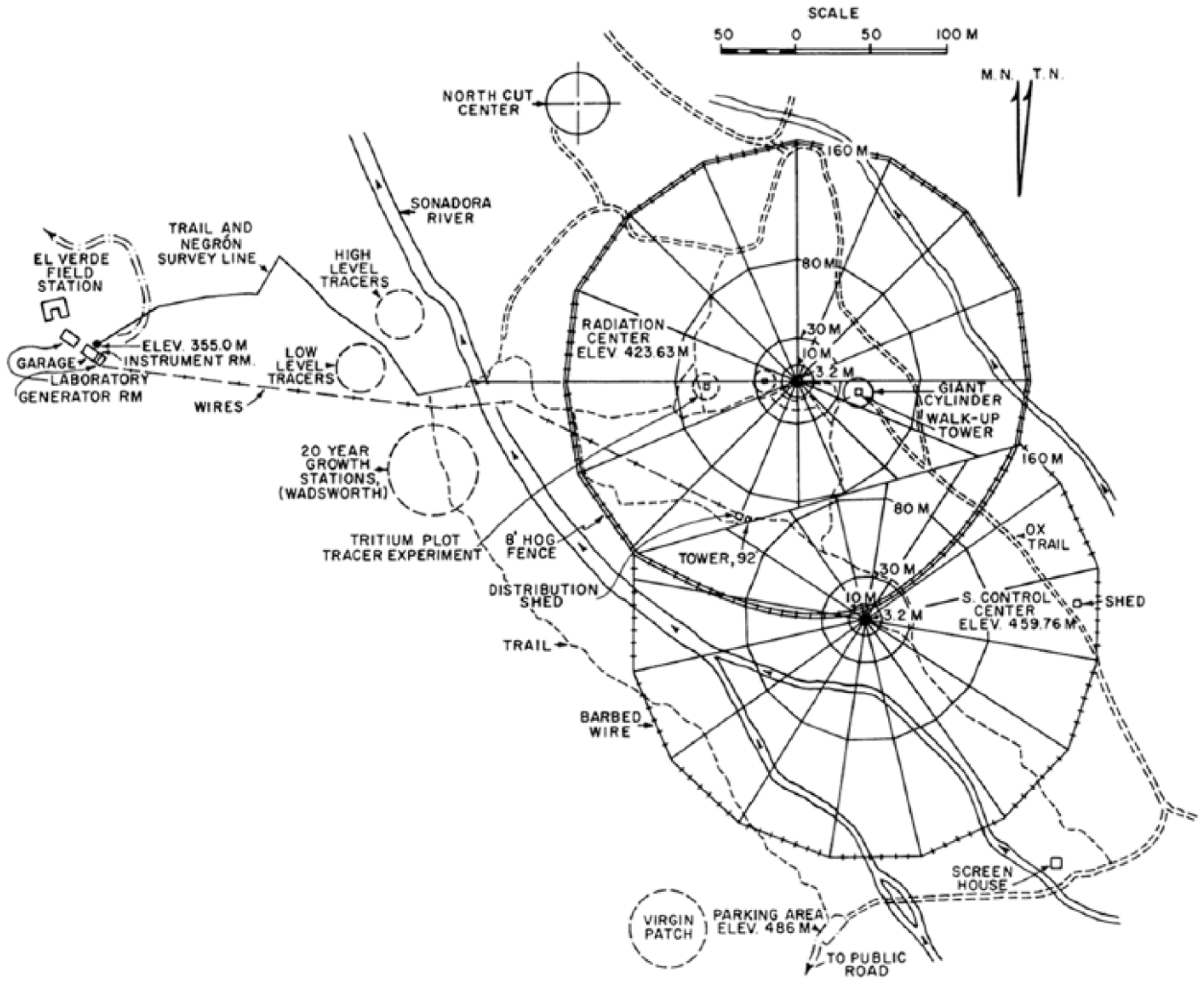
Map view of the Rain Forest Project research area at El Verde, including the field station buildings, radiation center and bounding fences, a “virgin patch,” as well as the locations of subsidiary experiments – the giant plastic cylinder, tracer studies, and tritium plot. Odum and Pigeon, A Tropical Rain Forest, p.B20.
The forest began to regenerate quickly – though, not as fast as the cut-over comparison plot because radiation destroyed the soil’s existing bank of seeds. To Odum, the forest’s regrowth confirmed his expectation that diverse ecosystems were resilient to disturbance. Long-adapted to periodic hurricanes, native species quickly recolonized the site. Ecologists re-surveying the area twenty-three years later found individual plants still bearing testament to the experiment in the form of “tumors, ‘two-headed’ palms with dichotomous apical meristems, and trees that were dead on the side facing the former source of radiation but robustly growing and reproducing from the portions sheltered by their own trunks.” 81 The long-term, but likely persistent, effects of the concurrent chemical defoliant tests have been much less well studied. Yet El Verde remains neither wasteland nor wilderness. 82 Sites of experimental land use – “slash-and-burn ecology” – join the overall pattern of “patchy disturbance” throughout El Yunque (see Figure 5).
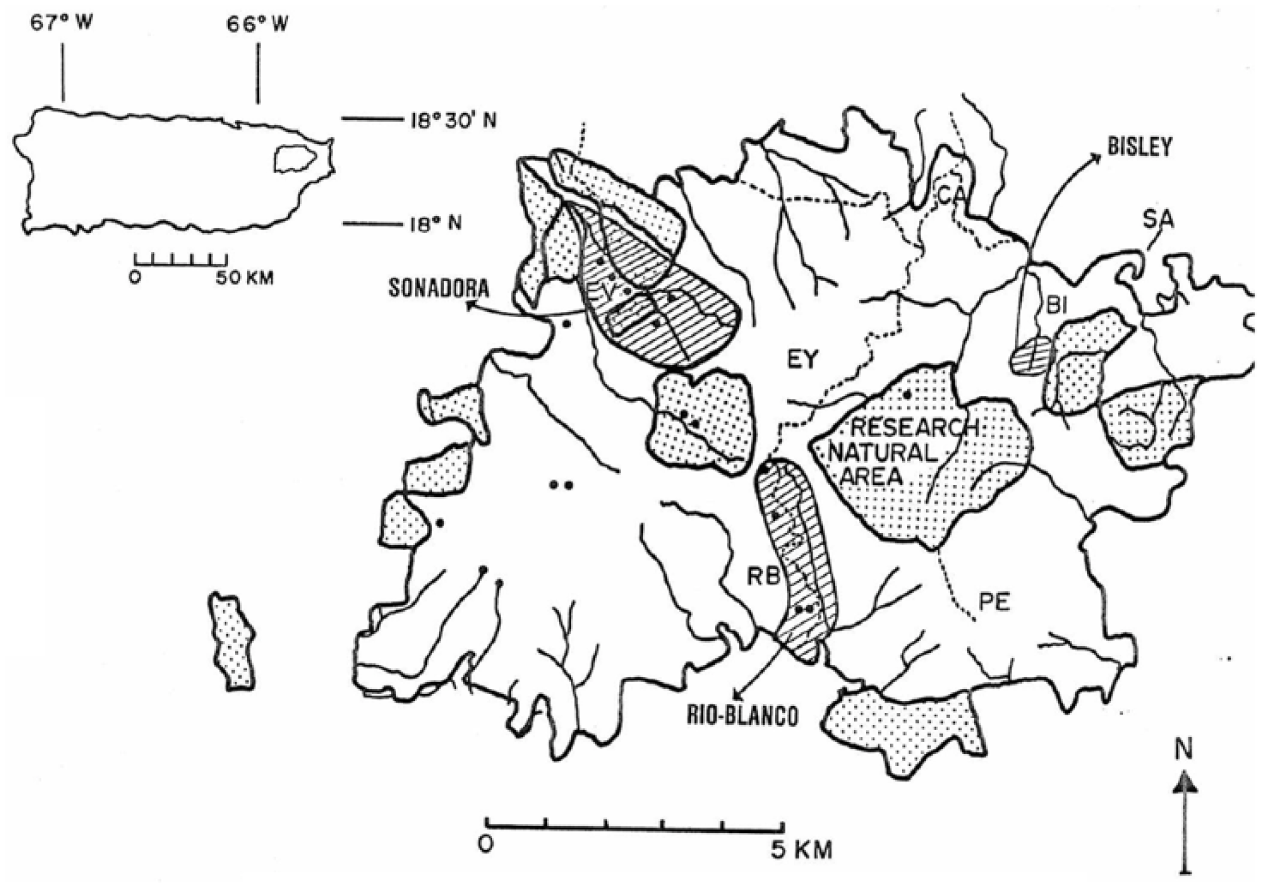
Map of the Luquillo Experimental Forest, showing a patchy distribution of research land use designations. Waide and Lugo, “NSF Proposal: Long-Term Ecological Research (LTER) on the Luquillo Experimental Forest (LEF),” p.1b.
Geographer Lisa Harrington has noted how invisible scientific research has tended to be in scholarly discussion of land use; despite (as she documents) its importance and large geographic extent, “land managers and academics have failed to recognize it as land use.” Harrington explains, “there is a tendency to think of it only as something that scientists do, and not as an activity that makes use of land resources and may even conflict with other land uses.” 83 The case of the Rain Forest Project – not to mention recent controversies between Native Hawaiians and astronomers, over antiquities at Bears Ears National Monument, or as field stations face pressure from rising land values – should make it abundantly clear that science indeed entails land use and urgently needs the analysis environmental history can provide. 84 Most environmental impacts of research are far less spectacular or controversial than irradiation. They may even seem trivial, such as the development of trails, littering, or the disposal of waste at field stations. Nevertheless, some scientists themselves have begun to call attention to such impacts, arguing that field scientists have an ethical imperative to behave in the field in a way consistent with overall conservation values – noting how their own behavior affects nearby communities’ perceptions about science and conservation. 85
Indeed, perhaps less visible and more long-lasting than the physical effects of irradiation is the role the project played in shaping Puerto Ricans’ relationship with science and nature at El Yunque. Barriers preventing non-scientists from entering El Verde did not merely create a “lab-like” site of knowledge production, trustworthy to far-away scientists – it also transformed people’s experience and understanding of the land locally. At 160 meters from the source, an eight-foot fence with bilingual warning signs encircled the radiation center. A barbed-wire fence and more signs stood at the 500-meter perimeter of the experimental area. A twenty-four-hour patrol guarded nearby roads during the three months of irradiation. 86 These precautions and a few obligatory press releases and public relations hearings seem to have been effective at keeping locals safe from dangerous radiation, but the project’s apparent secrecy generated suspicion within nearby communities. At least one “radical university student group” published a leaflet denouncing the project. 87 Local newspapers misidentified the cesium source as a dosimeter for civil defense. 88 Reportedly, glimpses of the giant plastic cylinder experiment from San Juan generated rumors about UFOs landing in the forest. 89 Decades later, the area remained a hotspot for tales of secret military science experiments, encounters with aliens, and the legendary chupacabras, as well as protests over logging and unexplained park closures. 90 Such mistrust, confusion, and conflict is understandable given the long history of enclosure and land dispossession at El Yunque and throughout Puerto Rico. 91
While the project excluded some Puerto Ricans from their own use of the land, others were drawn in as part of the project’s scientific, technical, and manual labor force. Notably, the Puerto Rican ecologist Ariel Lugo got his start carrying bricks for the Rain Forest Project. 92 Rising to become Director of the International Institute of Tropical Forestry, he was a key player in achieving El Yunque’s designation as a long-term ecological research site. 93 In a context where most ecological research is carried out in “undisturbed” lands, El Yunque has become a critical place for research focused on the effects of environmental change and disturbance in landscapes with a history of human use. 94 The need for such research only became clearer after Hurricane Maria in 2017, as apocalyptic images circulated of El Yunque showing the forest bare and denuded of its green leaves. What would be the future of Puerto Rico? What would be the future of a world facing climate change? An explosion of fresh growth has swept through the forest in the many months since, but as El Yunque regenerates, these questions still linger.
Conclusion
Sara Pritchard, Steven Wolf, and Wendy Wolford have noted, “the production of knowledge—particularly scientific knowledge—has been critical in shaping the nature of land acquisition and management in contemporary as well as historical periods and places.” 95 As this brief exploration of the Rain Forest Project should demonstrate, the reverse is also true. Histories of land acquisition, use, and management shape the production of knowledge. More explicit attention to land in the history of the field sciences can draw out connections and generalizations among disparate case studies, while forging connections with the work of environmental historians, geographers, and political ecologists concerned with relationships between science, land tenure and use, and power relations in society. 96
Centering on land complements standard spatial approaches, deepening answers to questions of knowledge production and circulation that have long been of core concern to historians of science. Our understanding of how scientists choose, access, and interpret their field sites, for example, is sharpened by considering field sites not merely as environmental settings, but as lands with deep histories of territorial governance, land tenure, and human use. Moreover, considering field sites as land draws attention to their deeper human and environmental histories – histories frequently obscured by field scientists’ recourse to discourses of pristine nature. Field scientists’ objects of study are material products of such histories.
Finally, fieldwork itself is labor on and with the land, and as environmental historian Nancy Langston has written, “There is no way to work with the land and not end up changing it.” 97 Although labelling the Rain Forest Project “slash-and-burn ecology” was one contemporary’s way of critiquing Odum’s large-scale experimental approach to ecosystem ecology, the comparison is fruitful. No less than swidden agriculturalists, field scientists use the land. Their uses may leave a light trace or an indelible stamp, perhaps depending on the larger political economies in which their use is embedded. Their use of the land brings them into contact, and sometimes conflict, with others who use or claim the land. And just as slash-and-burn agriculture has been at the focal point of contestation over land rights, global capitalism, and environmental sustainability, so too is the work of scientists on the land. Scientists are one among many communities who have used, shaped, and known the land over its long history. Their work shapes not only the nature of science, but also the nature of the land.
Footnotes
Acknowledgements
I am indebted to Jason Cons, Elizabeth Hennessey, Mark Hersey, José O. Solá, Manuel Valdés Pizzini, Jeremy Vetter, Amrys Williams, Eric Williams, participants in the session “Taking the Long View: Time and Space in the Study of Ecological Change” at the 2017 History of Science Society Annual Meeting, and two anonymous reviewers for comments and conversations that greatly improved this essay. Many thanks also to the staff of the Rockefeller Archive Center, the staff of the Special and Area Studies Collections, George A. Smathers Libraries, University of Florida, and Luquillo LTER Information Manager Eda C. Meléndez-Colom.
Declaration of Conflicting Interests
The author(s) declared no potential conflicts of interest with respect to the research, authorship, and/or publication of this article.
Funding
The author(s) received no financial support for the research, authorship, and/or publication of this article.
1.
Howard T. Odum and George Drewry, “The Cesium Source at El Verde,” in Howard T. Odum and Robert F. Pigeon (eds.) A Tropical Rain Forest: A Study of Irradiation and Ecology at El Verde, Puerto Rico (Oak Ridge, TN: Division of Technical Information, U.S. Atomic Energy Commission, 1970), pp.C23-C36.
2.
Joel B. Hagen, An Entangled Bank: The Origins of Ecosystem Ecology, (New Brunswick, NJ: Rutgers University Press, 1992), pp.167-69. See also Joel B. Hagen, “Odum, Howard Thomas,” Complete Dictionary of Scientific Biography (Detroit: Charles Scribner’s Sons, 2008), pp.323-24.
3.
Peter J. Taylor, Unruly Complexity: Ecology, Interpretation, Engagement (University of Chicago Press, 2010), pp.65–68, 88–89. See also Peter J. Taylor, “Technocratic Optimism, H. T. Odum, and the Partial Transformation of Ecological Metaphor After World War II,” Journal of the History of Biology 21, no. 2 (1988): pp.213–244, pp.229, 231.
4.
Quoted in H. T. Odum, “The Rain Forest and Man: An Introduction,” in Odum and Pigeon, A Tropical Rain Forest, A5-A11, A7 (note 1). The comment also referenced the broad-brush nature of the project’s intellectual approach; see Megan Raby, American Tropics: The Caribbean Roots of Biodiversity Science (Chapel Hill: University of North Carolina Press, 2017), pp.169–70.
5.
On conflict and controversies over the sustainability or destructiveness of slash-and-burn (or swidden) agriculture, see Christian A. Kull, Isle of Fire: The Political Ecology of Landscape Burning in Madagascar (Chicago: University of Chicago Press, 2004); P. J. A. Kleinman, D. Pimentel and R. B. Bryant, “The Ecological Sustainability of Slash-and-Burn Agriculture,” Agriculture, Ecosystems & Environment 52, no. 2 (1995): 235–49.
6.
Diarmid Finnegan, “The Spatial Turn: Geographical Approaches in the History of Science,” Journal of the History of Biology 41, no. 2 (2008): 369–88; David N. Livingstone, Putting Science in Its Place: Geographies of Scientific Knowledge (Chicago: University of Chicago Press, 2003).
7.
Robert E. Kohler and Jeremy Vetter, “The Field,” in Bernard Lightman (ed.) A Companion to the History of Science (Malden; MA: John Wiley & Sons, 2016), pp.282-95; Nicholas Jardine, James A. Secord and Emma C. Spary (eds.), Cultures of Natural History (Cambridge: Cambridge University Press, 1996); Henrika Kuklick and Robert E. Kohler, “Introduction,” Osiris 11: Science in the Field (1996): 1-14.
8.
For an introduction to these tensions, see Michael Lewis, “And All Was Light?—Science and Environmental History,” in Andrew C. Isenberg (ed.) The Oxford Handbook of Environmental History (2014), pp.207–26; Gregg Mitman, “Living in a Material World,” Journal of American History 100, no. 1 (2013): 128–30; Linda Nash, “Furthering the Environmental Turn,” Journal of American History 100, no. 1 (2013): 131–35; Kevin Dann and Gregg Mitman, “Exploring the Borders of Environmental History and the History of Ecology,” Journal of the History of Biology 30, no. 2 (1997): 291–302.
9.
Such an approach, however, is not new in environmental history. See also Donald Worster, Nature’s Economy: The Roots of Ecology (San Francisco: Sierra Club Books, 1977); Carolyn Merchant, The Death of Nature: Women, Ecology, and the Scientific Revolution (San Francisco: Harper & Row, 1980).
10.
This focus dates to the field’s origins. Aldo Leopold, “The Land Ethic,” A Sand County Almanac, and Sketches Here and There (New York: Oxford University Press, 1949), pp.201–26; Donald Worster, “Transformations of the Earth: Toward an Agroecological Perspective in History,” The Journal of American History 76, no. 4 (1990): 1087–106.
11.
Perhaps less familiar to historians of science, political ecology centers on the relationship between political economy and the environment, drawing especially on approaches from geography, anthropology, and other social sciences. In opposition to “apolitical ecology,” it calls attention to connections between environmental change and social, political, and economic inequalities. For an introduction, see Roderick P. Neumann, Making Political Ecology (New York: Routledge, 2014); Paul Robbins, Political Ecology: A Critical Introduction (Malden; MA: John Wiley & Sons, 2012); Jan Cherlet, “STS and Political Ecology in Dialogue: Future Directions for a Social Study of Environmental Controversies,” in Massimo Mazzotti and Giuliano Pancaldi (eds.) Impure Cultures: Interfacing Science, Technology, and Humanities (Bologna: Università di Bologna, 2010), pp.19-56. Political ecology includes environmental historical perspectives, though there are tensions as well as connections (akin to those between the history of science and science and technology studies). Christian Brannstrom, “What Kind of History for What Kind of Political Ecology,” Historical Geography 32 (2004): 71-87. The field offers a rich theoretical toolset for engaging the politics of land.
12.
Although I focus here on land rather than sea, scholars of the ocean environment and marine science have been especially conscious of the issues I intend to highlight. The ocean commons and economic importance of fisheries science bring questions of governance regimes and access to the fore. Helen M. Rozwadowski, “Oceans: Fusing the History of Science and Technology With Environmental History,” A Companion to American Environmental History (Malden; MA: Wiley Blackwell, 2010), pp.442-61; Christine Keiner, The Oyster Question: Scientists, Watermen, and the Maryland Chesapeake Bay Since 1880 (Athens, GA: The University of Georgia Press, 2009); Joseph E. Taylor III, Making Salmon (University of Washington Press, 2009); Gregory Cushman, “Choosing Between Centers of Action: Instrument Buoys, El Niño, and Scientific Internationalism in the Pacific, 1957-1982,” (in Helen M. Rozwadowski and David K. Van Keuren (eds.) Machine in Neptune’s Garden: Historical Perspectives on Technology and the Marine Environment (Sagamore Beach, MA: Science History Publications, 2004): 133-82; Arthur F. McEvoy, The Fisherman’s Problem (Cambridge University Press, 1986).
13.
Anthropologist Tania Murray Li reminds us, “the English word ‘land’ carries cultural baggage . . . Not everyone has such a word, or lumps together the same set of material substances under one label.” Tania Murray Li, “What is Land? Assembling a Resource for Global Investment,” Transactions of the Institute of British Geographers 39, no. 4 (2014): pp.589-602, 590. She suggests viewing land as an assemblage of materialities and social relations. For introductions to the complex meanings of land, see also Tania Murray Li, Land’s End: Capitalist Relations on an Indigenous Frontier (Durham, NC: Duke University Press Books, 2014); Derek Hall, Land (Malden, MA: Polity Press, 2013); Wendy Wolford, This Land is Ours Now: Social Mobilization and the Meanings of Land in Brazil (Durham, NC: Duke University Press, 2010); Stuart Elden, “Land, Terrain, Territory,” Progress in Human Geography 34, no. 6 (2010): 799–817. On the political economy of space and place, see David Harvey, “Space to Place and Back Again,” Justice, Nature and the Geography of Difference (Cambridge, MA: Blackwell, 1996), pp.291-326.
14.
See especially, Conevery Bolton Valencius, The Health of the Country: How American Settlers Understood Themselves and Their Land (New York: Basic Books, 2002); Linda Nash, Inescapable Ecologies (Berkeley: University of California Press, 2006); Gregg. Mitman, Breathing Space: How Allergies Shape Our Lives and Landscapes (New Haven, CT: Yale University Press, 2007); Nancy Langston, Toxic Bodies: Hormone Disruptors and the Legacy of DES (New Haven, CT: Yale University Press, 2010). The history of agricultural science also includes this emphasis. For example, Deborah Fitzgerald, Every Farm a Factory: The Industrial Ideal in American Agriculture (New Haven, CT: Yale University Press, 2003); Steven Stoll, Larding the Lean Earth: Soil and Society in Nineteenth-Century America. (New York: Hill and Wang, 2003); Mark D. Hersey, My Work is That of Conservation: An Environmental Biography of George Washington Carver (Athens; GA: University of Georgia Press, 2011); Jess Gilbert, Planning Democracy: Agrarian Intellectuals and the Intended New Deal (New Haven, CT: Yale University Press, 2015); Denise Phillips and Sharon Kingsland, New Perspectives on the History of Life Sciences and Agriculture (New York: Springer, 2015).
15.
Robert E. Kohler, Landscapes and Labscapes: Exploring the Lab-Field Border in Biology (Chicago: University of Chicago Press, 2002), p.18.
16.
Ibid.
17.
Robert E. Kohler, “Practice and Place in Twentieth-Century Field Biology: A Comment,” Journal of the History of Biology 45, no. 4 (2012): pp.79-586, 584.
18.
Hagen, Entangled Bank (note 2); Taylor, Unruly Complexity (note 3). The Rain Forest Project is also discussed in Frank Egerton, A Centennial History of the Ecological Society of America (Boca Raton; FL: CRC Press, 2015), pp.99-100; Laura A. Bruno, “The Bequest of the Nuclear Battlefield: Science, Nature, and the Atom During the First Decade of the Cold War,” Historical Studies in the Physical and Biological Sciences 33, no. 2 (2003): 257; Chunglin Kwa, “Radiation Ecology, Systems Ecology and the Management of the Environment,” in Michael Shortland (ed.) Science and Nature: Essays in the History of the Environmental Sciences (Oxford: Alden Press, 1993), pp.213-249, 246. It likewise appears frequently in ecologists’ (especially participants’ and Odum’s students’) accounts of their field’s history. Alan P. Covich, “On Frank Golley’s International and Interdisciplinary Insights for a Twenty-First Century Earth Stewardship Based on Environmental Ethics,” in Ricardo Rozzi et al. (eds.) Earth Stewardship: Linking Ecology and Ethics in Theory and Practice (New York: Springer, 2015), pp.431-50; David C. Coleman, Big Ecology: The Emergence of Ecosystem Science (Berkeley: University of California Press, 2010), pp.8, 28-29; Ariel E. Lugo, “H. T. Odum and the Luquillo Experimental Forest,” Ecological Modeling 178, no. 1 (2004): 65-74; Ariel E. Lugo, “Contributions of H. T. Odum to Tropical Ecology,” in H. T. Odum and Charles A.S. Hall (eds.) Maximum Power: The Ideas and Applications of H. T. Odum (Niwot; CO: University Press of Colorado, 1995), pp.23-24; Frank B. Golley, A History of the Ecosystem Concept in Ecology: More Than the Sum of the Parts (New Haven, CT: Yale University Press, 1993), p.74. One popular account also exists. Kathryn Robinson, Where Dwarfs Reign: A Tropical Rain Forest in Puerto Rico (San Juan: University of Puerto Rico Press, 1997), pp.175-176, 206-210.
19.
H. T. Odum’s ecological ideas and fieldwork – but not the Rain Forest Project – appear in, for example, Laura J. Martin, “Proving Grounds: Ecological Fieldwork in the Pacific and the Materialization of Ecosystems,” Environmental History 23, no. 3 (2018): 567-92; Angela Creager, Life Atomic (Chicago: University of Chicago Press, 2013), pp.351-93; Rachel Rothschild, “Environmental Awareness in the Atomic Age: Radioecologists and Nuclear Technology,” Historical Studies in the Natural Sciences 43, no. 4 (2013): 492-530; Sharon Kingsland, “The Role of Place in the History of Ecology,” in Ian Billick and Mary V. Price (eds.) The Ecology of Place: Contributions of Place-Based Research to Ecological Understanding (Chicago: University of Chicago Press, 2010), pp.15-39; Sharon Kingsland, The Evolution of American Ecology, 1890-2000 (Baltimore, MD: Johns Hopkins University Press, 2005), pp.188-226; Scott Kirsch, Proving Grounds: Project Plowshare and the Unrealized Dream of Nuclear Earthmoving (New Brunswick, NJ: Rutgers University Press, 2005), pp.56-57; Kohler, Landscapes and Labscapes, pp.296-301 (note 15); Robert E. Kohler, “Place and Practice in Field Biology,” History of Science 40, no. 2 (2002): 189-210; Stephen Bocking, Ecologists and Environmental Politics: A History of Contemporary Ecology (New Haven, CT: Yale University Press, 1997), pp.180-82; Robert P. McIntosh, The Background of Ecology: Concept and Theory (Cambridge: Cambridge University Press, 1985). Odum also figures in works by environmental historians, most famously Donald Worster, Nature’s Economy: A History of Ecological Ideas, 2nd ed., (Cambridge: Cambridge University Press, 1994), pp.362-74. See also Debora Hammond, “Ecology and Ideology in the General Systems Community,” Environment and History 3, no. 2 (1997): 197-207; Mark Glen Madison, “‘Potatoes Made of Oil’: Eugene and Howard Odum and the Origins and Limits of American Agroecology,” Environment and History 3, no. 2 (1997): 209-38. As histories of ideas about nature and environmental management, these include little about the physical environmental context of Odum’s fieldwork.
20.
Odum, “The Rain Forest and Man,” p.A11 (note 4).
21.
Taylor, Unruly Complexity, p.88 (note 3).
22.
Ibid., pp.65-67.
23.
Hagen, Entangled Bank, p.168 (note 2).
24.
Ibid., pp.167-69. See also Etienne Benson, “Ecosystem Simulation as a Practice of Emplacement: The Desert Biome Project, 1970–1974,” in Raf de Bont and Jens Lachmund (eds.) Spatializing the History of Ecology (New York: Routledge, 2017), pp.121-40; Elena Aronova, Karen S. Baker and Naomi Oreskes, “Big Science and Big Data in Biology: From the International Geophysical Year Through the International Biological Program to the Long Term Ecological Research (LTER) Network, 1957–Present,” Historical Studies in the Natural Sciences 40, no. 2 (2010): 183-224; Coleman, Big Ecology, pp.15-88; (note 18) Chunglin Kwa, “Modeling the Grasslands,” Historical Studies in the Physical and Biological Sciences 24, no. 1 (1993): 125-55.
25.
Kohler, Landscapes and Labscapes (note 15). See also Jeremy Vetter, “Labs in the Field? Rocky Mountain Biological Stations in the Early Twentieth Century,” Journal of the History of Biology 45, no. 4 (2012): 587-611; Sharon Kingsland, “Frits Went’s Atomic Age Greenhouse: The Changing Labscape on the Lab-Field Border,” Journal of the History of Biology 42, no. 2 (2009): 289-324; Thomas F. Gieryn, “City as Truth-Spot: Laboratories and Field-Sites in Urban Studies,” Social Studies of Science 36, no. 1 (2006): 5-38.
26.
Kohler, Landscapes and Labscapes, pp.299, 300 (note 15).
27.
On practices of place, see ibid., pp.213-14.
28.
H. T. Odum and C. F. Jordan, “Metabolism and Evapotranspiration of the Lower Forest in a Giant Plastic Cylinder,” in Odum and Pigeon, A Tropical Rain Forest, pp.I165-I189 (note 1).
29.
Kohler, Landscapes and Labscapes, p.300 (note 15).
30.
Manuel Valdés Pizzini, Michael González Cruz and José Eduardo Martínez-Reyes, La Transformación del Paisaje Puertorriqueño y la Disciplina del Cuerpo Civil de Conservación, 1933–1942 (San Juan: Centro de Investigaciones Sociales, Universidad de Puerto Rico, 2011), p.188.
31.
Ibid., pp.183-212; Marta María Maldonado, Manuel Valdés Pizzini and Alfonso R Latoni, “Owning and Contesting El Yunque: Forest Resources, Politics, and Culture in Puerto Rico,” Berkeley Journal of Sociology 44(1999): 82-100; Manuel Valdés Pizzini, Alfonso Latoni and Virgilio Rodriguez, “El Yunque or the Caribbean National Forest? Meaning, Management, and Culture in the Urban-Tropical Forest Interface,” in Alan W. Ewert, Deborah J. Chavez and Arthur W. Magill (eds.) Culture, Conflict, and Communication in the Wildland-Urban Interface (Boulder, CO: Westview Press, 1993), pp.221-33.
32.
The field of landscape ecology today deals with ecosystem structure and function, but it too has roots in the visual interpretation of landscapes. Chunglin Kwa, “The Visual Grasp of the Fragmented Landscape: Plant Geographers vs. Plant Sociologists,” Historical Studies in the Natural Sciences 48, no. 2 (2018): 180-222. Historians of science do frequently engage with landscape by exploring the physical and representational aspects of field sites, but have not explicitly engaged with debates over approaches to landscape interpretation within environmental history, geography, or political ecology. For an introduction to these, see Roderick P. Neumann, “Political Ecology III: Theorizing Landscape,” Progress in Human Geography 35, no. 6 (2011): 843-50; Don Mitchell, “New Axioms for Reading the Landscape: Paying Attention to Political Economy and Social Justice,” in James L. Wescoat, Jr., and Douglas M. Johnston (eds.) Political Economies of Landscape Change (Dordrecht: Springer, 2008), pp.29-50; James Fairhead and Melissa Leach, Misreading the African Landscape (Cambridge: Cambridge University Press, 1996).
33.
For an introduction, see Neumann, Making Political Ecology, pp.102-13. On forests and land tenure specifically, see Nancy Langston, “Global Forests,” in J. R. McNeill and Erin Stewart Mauldin (eds.) A Companion to Global Environmental History (Malden, MA: John Wiley & Sons, Ltd, 2012), pp.263-78. Emilio F. Moran and Elinor Ostrom, Seeing the Forest and the Trees: Human-Environment Interactions in Forest Ecosystems (Cambridge, MA: MIT Press, 2005); Lynne Heasley and Raymond P. Guries, “Forest Tenure and Cultural Landscapes: Environmental Histories in the Kickapoo Valley,” in Harvey M. Jacobs (ed.) Who Owns America?: Social Conflict Over Property Rights (Madison: University of Wisconsin Press, 1998), pp.182-207; Nancy Lee Peluso, Rich Forests, Poor People: Resource Control and Resistance in Java (Berkeley: University of California Press, 1994).
34.
Li, “What is Land?,” p.589 (note 13).
35.
The relationship between land use and power relations is central in many of environmental history’s classic works. Donald Worster, Dust Bowl: The Southern Plains in the 1930s (New York: Oxford University Press, 1979); Richard White, Land Use, Environment, and Social Change. The Shaping of Island County, Washington (Seattle: University of Washington Press, 1980); William Cronon, Changes in the Land: Indians, Colonists, and the Ecology of New England (New York: Hill and Wang, 1983); Donald Worster, Rivers of Empire: Water, Aridity, and the Growth of the American West (New York: Oxford University Press, 1985); White Richard, The Roots of Dependency (Lincoln: University of Nebraska Press, 1988); Carolyn Merchant, Ecological Revolutions: Nature, Gender, and Science in New England (Chapel Hill: University of North Carolina Press, 1989). Within the history of science, land tenure usually appears in discussion of the application of science (agricultural science, forestry, or land surveying) to state and colonial projects, rather than as a set of conditions reciprocally shaping the science itself. For example, Helen Tilley, Africa as a Living Laboratory: Empire, Development, and the Problem of Scientific Knowledge, 1870-1950 (Chicago: University of Chicago Press, 2011); Christophe Bonneuil, “Development as Experiment: Science and State Building in Late Colonial and Postcolonial Africa, 1930–1970,” Osiris 15 (2000): 258-81; Deborah Fitzgerald, “Exporting American Agriculture: The Rockefeller Foundation in Mexico, 1943-53,” Social Studies of Science 16, no. 3 (1986): 457-83. Some of the literature at least implicitly deals with land tenure – scientists’ efforts to buy or lease land for research stations, convince governments to designate parks for scientific research, or obtain permission to quarry for fossils or artifacts are certainly all engagements with land tenure systems. Peter Alagona, “A Sanctuary for Science: The Hastings Natural History Reservation and the Origins of the University of California’s Natural Reserve System,” Journal of the History of Biology 45, no. 4 (2012): 651-80; Megan Raby, “A Laboratory for Tropical Ecology: Colonial Models and American Science at Cinchona, Jamaica,” Spatializing the History of Ecology: Sites, Journeys, Mappings (New York: Routledge, 2017), pp.56-78; Patrick Kupper, “Science and the National Parks: A Transatlantic Perspective on the Interwar Years,” Environmental History 14, no. 1 (2009): 58-81; Gina Rumore, “A Natural Laboratory, a National Monument: Carving Out a Place for Science in Glacier Bay, Alaska, 1879-1959” (PhD Dissertation, University of Minnesota, 2009); Peter C. Kjærgaard, “The Fossil Trade: Paying a Price for Human Origins,” Isis 103, no. 2 (2012): 340-55; J. Conor Burns, “Negotiating the Agricultural Frontier in Nineteenth-Century Southern Ohio Archeology,” in Jeremy Vetter (ed.) Knowing Global Environments: New Historical Perspectives on the Field Sciences (New Brunswick, NJ: Rutgers University Press, 2011), pp.59-86; Jeremy Vetter, Field Life: Science in the American West During the Railroad Era (Pittsburgh: University of Pittsburgh Press, 2016); Jeremy Vetter, “Cowboys, Scientists, and Fossils: The Field Site and Local Collaboration in the American West,” Isis 99, no. 2 (2008): 273-303. Vetter’s work, particularly on fossil quarries, is perhaps the most explicit treatment of field science as land use. It demonstrates the crucial role of land tenure (without using the term) for paleontologists, particularly in the nineteenth- and early twentieth-century U.S. West, where scientists found themselves facing bitter competition, rapidly shifting federal land policies, and a complex patchwork of private, state, and Native American lands. Albert Way’s work is also a prime example of how environmental history and the history of science can productively align through careful attention to how scientists’ work fits in into broader regional patterns of land use and tenure. Albert G. Way, “The Invisible and Indeterminable Value of Ecology: From Malaria Control to Ecological Research in the American South,” Isis 106, no. 2 (2015): 310-36; Albert G. Way, Conserving Southern Longleaf: Herbert Stoddard and the Rise of Ecological Land Management (Athens, GA: University of Georgia Press, 2011).
36.
Elden, “Land, Terrain, Territory” (note 13).
37.
Samantha K. Muka, “The Right Tool and the Right Place for the Job: The Importance of the Field in Experimental Neurophysiology, 1880-1945,” History and Philosophy of the Life Sciences 38, no. 3 (2016): pp.1-28,7. See also Jeremy Vetter, “Rocky Mountain High Science,” in Jeremy Vetter (ed.) Knowing Global Environments: New Historical Perspectives on the Field Sciences (New Brunswick, NJ: Rutgers University Press, 2011), pp.108-34; Kingsland, “Role of Place in the History of Ecology” (note 19); Adele E. Clarke and Joan H. Fujimura (eds.), The Right Tools for the Job: At Work in 20th-Century Life Sciences (Princeton, NJ: Princeton University Press, 1992).
38.
“A Comparison Between Tropical Rainforest Community and a Tropical Plankton Community,” stamped 25 January 1957. Folder 2306, Box 238, Subseries 200.D, RG1.2, Rockefeller Archive Center (RAC).
39.
Frank H. Wadsworth, “Review of Past Research in the Luquillo Mountains of Puerto Rico,” in Odum and Pigeon, A Tropical Rain Forest, pp.B33-B46 (note 1).
40.
Richard Grove, Green Imperialism: Colonial Expansion, Tropical Island Edens, and the Origins of Environmentalism, 1600-1860 (New York: Cambridge University Press, 1996).
41.
U.S. foresters often belittled Spanish conservation efforts, viewing themselves as bringing a scientific approach. See Greg Bankoff, “Conservation and Colonialism: Gifford Pinchot and the Birth of Tropical Forestry in the Philippines,” in Alfred W. McCoy and Francisco A. Scarano (eds.) Colonial Crucible: Empire in the Making of the Modern American State (Madison: University of Wisconsin Press, 2009), pp.479-88. The Forest Reserve Act of 1891 created the first U.S. forest reserves. U.S. officials first called El Yunque the Luquillo Forest Reserve, then the Luquillo National Forest. It was renamed the Caribbean National Forest in 1935. For a comprehensive forest history, see Carlos Domínguez Cristóbal, Panorama Histórico Forestal de Puerto Rico (San Juan: Editorial de la Universidad de Puerto Rico, 2000). On U.S. scientists in Puerto Rico, see Darryl Erwin Brock, “American Empire and the Scientific Survey of Puerto Rico” (PhD Dissertation, Fordham University, 2014); Peter Philip Mickulas, Britton’s Botanical Empire: The New York Botanical Garden and American Botany, 1888-1929 (Bronx, NY: New York Botanical Garden, 2007); Kingsland, Evolution of American Ecology (note 19); Simon Baatz, “Imperial Science and Metropolitan Ambition: The Scientific Survey of Puerto Rico, 1913–1934,” Annals of the New York Academy of Sciences 776, no. 1 (1996): 1-16.
42.
“Plan for Making Holistic Measurement of Rainforest,” January 1958. Folder 2306, Box 238, Subseries 200.D, RG1.2, RAC. This is an interesting reversal; most tropical ecologists described high diversity as an ideal for field sites.
43.
“A Comparison Between Tropical Rainforest Community and a Tropical Plankton Community,” stamped 25 January 1957; Robert S. Morison diary, 1 May 1957, Folder 2306, Box 238, Subseries 200.D, RG1.2, RAC.
44.
“A Comparison Between Tropical Rainforest Community and a Tropical Plankton Community,” stamped 25 January 1957. Folder 2306, Box 238, Subseries 200.D, RG1.2, RAC. The “availability of cheap labor” also shaped the International Biological Program’s choice of sites in tropical Africa See Guillaume Lachenal, “At Home in the Postcolony: Ecology, Empire and Domesticity at the Lamto Field Station, Ivory Coast,” Social Studies of Science 46, no. 6 (2016): 877-893, 881.
45.
HMM [Harry M. Miller] note, 22 January 1957, Folder 2306, Box 238, Subseries 200.D, RG1.2, RAC.
46.
See Francisco A. Scarano, “Puerto Rico Between Empires: Population and Society,” Caribbean Studies 35, no. 2 (2007): xiiiv-xiii; Laura Briggs, Reproducing Empire: Race, Sex, Science, and U.S. Imperialism in Puerto Rico (Berkeley: University of California Press, 2002); Michael Lapp, “The Rise and Fall of Puerto Rico as a Social Laboratory, 1945-1965,” Social Science History 19, no. 2 (1995): 169-99.
47.
For theoretical analysis, see Ramon Grosfoguel, Colonial Subjects: Puerto Ricans in a Global Perspective (Berkeley: University of California Press, 2003).
48.
Odum, “The Rain Forest and Man,” p.A11 (note 4); Christine Keiner, “The Panatomic Canal and the U.S. Environmental Management State, 1964-1978,” Environmental History 21, no. 2 (2016): 278-87; Mark Atwood Lawrence, “Exception to the Rule? The Johnson Administration and the Panama Canal,” Looking Back at LBJ: White House Politics in a New Light (Lawrence: University Press of Kansas, 2005), pp.20-47.
49.
“Plan for Making Holistic Measurement of Rainforest,” January 1958. Folder 2306, Box 238, Subseries 200.D, RG1.2, RAC.
50.
Roderick Nash, Wilderness and the American Mind (New Haven, CT: Yale University Press, 1967); Char Miller, Gifford Pinchot and the Making of Modern Environmentalism (Washington; DC: Island Press, 2013); Paul Sutter, Driven Wild: How the Fight Against Automobiles Launched the Modern Wilderness Movement (Seattle: University of Washington Press, 2002).
51.
For example, Diane Smith, Yellowstone and the Smithsonian: Centers of Wildlife Conservation (Lawrence: University Press of Kansas, 2017). For contemporary scientists’ take on the difficulty of accessing National Parks for research, see David Parsons, “Supporting Basic Ecological Research in U.S. National Parks: Challenges and Opportunities,” Ecological Applications 14, no. 1 (2004): 5-13; Alice Wondrak Biel, “The Bearer Has Permission: A Brief History of Research Permitting in Yellowstone National Park,” Montana: The Magazine of Western History 54, no. 4 (2004): 16-31. For a contrasting case involving Bureau of Land Management funding, see Etienne Benson, “A Difficult Time with the Permit Process,” Journal of the History of Biology 44, no. 1 (2011): 103-23.
52.
Desire for alternative experimental lands helped drive its administrators to acquire additional land during this same period. Raby, American Tropics, p.197 (note 4).
53.
Aaron Shapiro, “A Grand Experiment: USDA Forest Service Experimental Forests and Ranges,” in D.C. Hayes, et al. (eds.) USDA Forest Service Experimental Forests and Ranges: Research for the Long Term (New York: Springer, 2014), pp.3-23; Ariel E. Lugo, et al., “Long-Term Research at the USDA Forest Service’s Experimental Forests and Ranges,” BioScience 56, no. 1 (2006): 39-48.
54.
José Marrero, “Resultados de la Repoblacion Forestal en Los Bosques Insulares de Puerto Rico,” Caribbean Forester 11, no. 4 (1950): 151-95; Frank H. Wadsworth, “A Forest Research Institution in the West Indies: The First 50 Years,” in Ariel E. Lugo and Carol Lowe (eds.) Tropical Forests: Management and Ecology (New York: Springer, 1995), pp.33-56. On the CCC’s efforts, see Valdés Pizzini, Cruz and Martínez-Reyes, La Transformación del Paisaje Puertorriqueño (note 30); Domínguez Cristóbal, Panorama Histórico Forestal, pp.477-93 (note 41).
55.
“Master Memorandum of Understanding between the Atomic Energy Commission and the Forest Service, United States Department of Agriculture,” 15 September 1964, “El Verde, Puerto Rico, Site Documents,” U.S. Department of Energy (DOE) Office of Legacy Management, < > (13 June 2017). Odum became PRNC’s Chief Scientist in 1963.
56.
H. T. Odum, “The El Verde Study Area and the Rain Forest Systems of Puerto Rico,” in Odum and Pigeon, A Tropical Rain Forest, pp.B3-B32 (note 1); Sandra Brown, et al., Research History and Opportunities in the Luquillo Experimental Forest, vol. so-44, General Technical Report (New Orleans, LA: USDA Forest Service Southern Forest Experiment Station, 1983), p.1.
57.
Ismael García-Colón, Land Reform in Puerto Rico: Modernizing the Colonial State, 1941-1969 (Gainesville: University Press of Florida, 2009), p.29; Domínguez Cristóbal, Panorama Histórico Forestal, pp.463-65 (note 41).
58.
For an overview, see García-Colón, Land Reform in Puerto Rico, p.3 (note 57); Katherine T. McCaffrey, Military Power and Popular Protest: The U.S. Navy in Vieques, Puerto Rico (New Brunswick, NJ: Rutgers University Press, 2002), pp.46-48.
59.
Harold K. Steen, An Interview with Frank H. Wadsworth (Durham, NC: Forest History Society, 1993), pp.21-22; Frank Wadsworth and Emilio Solís, “Problemas de Población y de Empleo en El Bosque de Toro Negro,” Caribbean Forester 10 (1949): 69-79; Arthur T. Upson, “Forests and Land Tenure in Puerto Rico,” Caribbean Land Tenure Symposium (Washington DC: Caribbean Research Council, 1946), pp.233-37. On taungya agroforestry, see Richard P. Tucker, Insatiable Appetite: The United States and the Ecological Degradation of the Tropical World (Berkeley: University of California Press, 2000), pp.211-12; P. K. R. Nair, An Introduction to Agroforestry (Dordrecht: Springer Science & Business Media, 1993), pp.75-78.
60.
This was the parcelas program, distinct from the Forest Service parcelero system, but also addressing the problem of landless agregados. García-Colón, Land Reform in Puerto Rico (note 57); César J. Ayala and Rafael Bernabe, Puerto Rico in the American Century: A History Since 1898 (Chapel Hill: University of North Carolina Press, 2007), pp.184-87.
61.
“1958 Annual Report: Tropical Forest Research Center,” Caribbean Forester 20, no. 1 (1959), pp. 1-10, 8.
62.
Jill Thompson, et al., “Land Use History, Environment, and Tree Composition in a Tropical Forest,” Ecological Applications 12, no. 5 (2002), pp. 1344-63, 1351.
63.
Odum states that “there was no cultivation beyond the southward turn in the main trail.” Odum, “The El Verde Study Area,” p.B30 (note 56). On surrounding areas, see D. C. Garcia-Montiel and Frederick N. Scatena, “The Effect of Human Activity on the Structure and Composition of a Tropical Forest in Puerto Rico,” Forest Ecology and Management 63 (1994): 57-78; Juan A. Giusti-Cordero, “Labor, Ecology and History in a Caribbean Sugar Plantation Region: Pinones (Loiza), Puerto Rico, 1770-1950” (PhD Dissertation, State University of New York at Binghamton, 1994).
64.
Thompson, et al., “Land Use History” (note 62); Odum, “The El Verde Study Area,” p.B30 (note 56); Valdés Pizzini, Cruz and Martínez-Reyes, La Transformación del Paisaje Puertorriqueño (note 30).
65.
C. B. Briscoe and F. H. Wadsworth, “Stand Structure and Yield in the Tabonuco Forest of Puerto Rico,” in Odum and Pigeon, A Tropical Rain Forest, B79-B90, B80 (note 1).
66.
Odum explained, “we have not yet received final approval to cut an acre of cloud forest on Puerto Rico.” Odum to Robert S. Morrison (Rockefeller Foundation), 2 November 1957, Folder 2306, Box 238, Subseries 200.D, RG1.2, RAC. By cloud forest, Odum presumably meant the highest-elevation “dwarf” or “elfin forest.”
67.
The Institute of Tropical Forestry collaborated with the Department of Defense to test Agent Orange and various “tactical herbicides” for use in the Vietnam War within El Yunque, including sites near El Verde. Rain Forest Project researchers compared their recovery to that of the irradiated plot. Alvin L. Young, The History of the U.S. Department of Defense Programs for the Testing, Evaluation, and Storage of Tactical Herbicides (Fort Belvoir, VA: Defense Technical Information Center, 2006), pp.46-47; Gordon H. Orians and E. W. Pfeiffer, “Ecological Effects of the War in Vietnam,” Science 168, no. 3931 (1970), pp.544-554, 547; Wadsworth, “Review of Past Research,” p.B44 (note 39); C. C. Dowler and F. H. Tschirley, “Effect of Herbicides on a Puerto Rican Rain Forest,” in Odum and Pigeon, A Tropical Rain Forest, pp.B315-24 (note 1); Edwin A. Martini, Agent Orange: History, Science, and the Politics of Uncertainty (Amherst: University of Massachusetts Press, 2012), pp.32, 233. Odum himself had first visited El Yunque in 1944 for training during his military service. Lugo, “Contributions of H. T. Odum,” p.23 (note 18).
68.
P. S. Ashton “Review of A Tropical Rain Forest: A Study of Irradiation and Ecology at El Verde, Puerto Rico. by Howard T. Odum and Robert F. Pigeon,” Journal of Ecology 60, no. 2 (1972), pp. 623-25, 624; Paul B. Kannowski, “Tropical Radioecology,” Ecology 52, no. 6 (1971), pp. 1131-1132,1131.
69.
Odum, “The El Verde Study Area,” p.B30 (note 56).
70.
Odum, “The Rain Forest and Man,” p.A9 (note 4).
71.
Odum, “The El Verde Study Area,” p.B28 (note 56).
72.
Ashton, p.634 (note 68).
73.
Thompson, et al., “Land Use History” (note 62); David Foster, et al., “The Importance of Land-Use Legacies to Ecology and Conservation,” BioScience 53, no. 1 (2003): 77-88; Jess K. Zimmerman, et al., “Implications of Land Use History for Natural Forest Regeneration and Restoration Strategies in Puerto Rico,” Old Fields: Dynamics and Restoration of Abandoned Farmland (Washington, DC: Island Press, 2007), pp.51-74.
74.
Conflicting conservation philosophies often led to tensions between ecologists and foresters, though the need to cooperate with foresters to access tropical sites also led to collaboration in Brazil and Costa Rica. See Raby, American Tropics, pp.143-144, 155, 163 (note 4). On the early confluence of ecology with applied science, see Mark D. Hersey, “‘What We Need is a Crop Ecologist’: Ecology and Agricultural Science in Progressive-Era America,” Agricultural History 85, no. 3 (2011): 297-321.
75.
Taylor, “Technocratic Optimism” (note 3); Taylor, Unruly Complexity (note 3).
76.
Robert Gardner, “Constructing a Technological Forest: Nature, Culture, and Tree-Planting in the Nebraska Sand Hills,” Environmental History 17, no. 2 (2012), p.276.
77.
Odum, “Rain Forest and Man,” p.A11 (note 4).
78.
Susan Silander, Succession at the El Verde Radiation Site (CEER-T-205) (Center for Energy and Environment Research, University of Puerto Rico, U.S. Department of Energy, 1985).
79.
J. R. Kline and C. F. Jordan, “Tritium Movement in Soil of a Tropical Rain Forest,” in Odum and Pigeon, A Tropical Rain Forest, H129-H132, H129 (note 1).
80.
81.
Charlotte M. Taylor, et al., “Recovery of a Tropical Forest After Gamma Irradiation: A 23-Year Chronicle,” Tropical Forests: Management and Ecology (New York: Springer, 1995), pp.258-285, 261.
82.
These sites contrast with Peter Galison’s “waste-wildernesses.” They are zones of only partial, not complete human exclusion; they have been and remain sites of ongoing human land use, and for visions of continued human occupation into the future. Peter Galison, “Technical Lands” (Paper presented at the History of Science Society Annual Meeting, Atlanta, Georgia, 4 November 2016).
83.
Lisa M. B. Harrington, “Regarding Research as a Land Use,” Applied Geography 16, no. 4 (1996), pp.265-277, 275. See also Lisa M. B. Harrington, “Research as an Alternative Land Use,” Contemporary Rural Systems in Transition (Wallingford, UK: CAB International, 1992), pp.195-205.
84.
Leandra Swanner, “Instruments of Science or Conquest? Neocolonialism and Modern American Astronomy,” Historical Studies in the Natural Sciences 47, no. 3 (2017): pp.293-319; Leandra Swanner, “Contested Spiritual Landscapes in Modern American Astronomy,” Journal of Religion and Society Supplement 11 (2015): 149-62; Carolyn Gramling. “Science and Politics Collide Over Bears Ears and Other National Monuments.” Science: Science Insider, 27 April 2017, <https://www.sciencemag.org/news/2017/04/science-and-politics-collide-over-bears-ears-and-other-national-monuments> (26 August 2017); Beth Baker, “The Way Forward for Biological Field Stations: Change Needed to Ensure Survival and Scientific Relevance,” BioScience 65, no. 2 (2015): 123-29; Ralph K. M. Haurwitz. “UT President Fenves Rethinks Future of West Austin Field Lab.” Austin-American Statesman, 1 April 2017, <> (25 August 2017).
85.
Michelle Bezanson, Rochelle Stowe and Sean M. Watts, “Reducing the Ecological Impact of Field Research,” American Journal of Primatology 75, no. 1 (2013): 1-9; Hazel A. Wright, Joseph E. Ironside and Dylan Gwynn-Jones, “Sustainability in Bioscience Fieldwork: Practical Information From a UK Agricultural Research Institute,” International Journal of Sustainability in Higher Education 10, no. 1 (2009): 54-67; John R. Spear, “Minimum-Impact Research,” Conservation Biology 18, no. 4 (2004): 861.
86.
Odum and Drewry, “The Cesium Source,” p.C26 (note 1).
87.
H. T. Odum, The Rain Forest Project Annual Report (Rio Piedras, Puerto Rico: Puerto Rico Nuclear Center, 1965), p.21. I have not yet been able to identify the group or locate existing copies of this document.
88.
Ibid.
89.
Gary Wayne Barrett and Terry L. Barrett, Holistic Science: The Evolution of the Georgia Institute of Ecology (1940-2000) (Boca Raton; FL: CRC Press, 2001), p.264.
90.
Lauren Derby, “Imperial Secrets: Vampires and Nationhood in Puerto Rico,” Past & Present 199, Supplement 3 (2008): 290-312; Valdés Pizzini, Latoni and Rodriguez, “El Yunque or the Caribbean National Forest?” p.228 (note 31); Maldonado, Valdés Pizzini and Latoni, “Owning and Contesting El Yunque, (note 31) Cayo Santiago is another Puerto Rican scientific site linked to both el chupacabras (“the goatsucker”) and nationalist tensions. Neel Ahuja, “Notes on Medicine, Culture, and the History of Imported Monkeys in Puerto Rico,” in Martha Few and Zeb Tortorici (eds.) Centering Animals in Latin American History (Durham; Duke University Press, 2013), pp.180-206. Primatologists introduced a colony of rhesus macaques to the island in 1938. It awaits a full land-use and environmental history, but on its role in constructing “natural” primate behavior in the field, see Donna Haraway, Primate Visions: Gender, Race, and Nature in the World of Modern Science (New York: Routledge, 1989), pp.84-86; Georgina M. Montgomery, Primates in the Real World: Escaping Primate Folklore and Creating Primate Science (Charlottesville: University of Virginia Press, 2015), pp.74-78.
91.
See, for example, the conflict over conservation and land use on the Puerto Rican island of Vieques, McCaffrey, Military Power and Popular Protest (note 58); Javier Arbona, “Vieques, Puerto Rico: From Devastation to Conservation and Back Again,” Traditional Dwellings and Settlements Review 17, no. 1 (2005): 33-50. For a broader discussion of environmentalism in Puerto Rico, the Caribbean and Latin America – often focused on land rights and environmental justice – see also Sherrie L. Baver and Barbara Deutsch Lynch, Beyond Sun and Sand: Caribbean Environmentalisms (New Brunswick, NJ: Rutgers University Press, 2006); David V. Carruthers (ed.), Environmental Justice in Latin America (Cambridge; MA: MIT Press, 2008).
92.
Neil A. Campbell and Ariel Lugo, “A Conversation with Ariel Lugo,” The American Biology Teacher 55, no. 5 (1993): 292-96.
93.
“Luquillo LTER,” <http://luq.lternet.edu> (7 July 2017); Robert B. Waide and Ariel E. Lugo, “NSF Proposal: Long-Term Ecological Research (LTER) on the Luquillo Experimental Forest (LEF),” <> (15 April 2017).
94.
Laura Martin, Bernd Blossey and Erle Ellis, “Mapping Where Ecologists Work: Biases in the Global Distribution of Terrestrial Ecological Observations,” Frontiers in Ecology and the Environment 10 (2012): 195-201. See for example Ariel E. Lugo, “Novel Tropical Forests: Nature’s Response to Global Change,” Tropical Conservation Science 6, no. 3 (2013): 325-37.
95.
Sara B. Pritchard, Steven A. Wolf and Wendy Wolford, “Knowledge and the Politics of Land,” Environment and Planning A 48, no. 4 (2015), pp.616-625, 618.
96.
Geographers Elizabeth Hennessey and Jake Fleming have specifically called for closer ties between political ecology and the history of science. Fleming shows how science is not simply “brought to the field finished and ready for application,” but “rather . . . constructed there for use in live scientific debates.” Jake Fleming, “Political Ecology and the Geography of Science: Lesosady, Lysenkoism, and Soviet Science in Kyrgyzstan’s Walnut-Fruit Forest,” Annals of the Association of American Geographers 104, no. 6 (2014), pp.1183-1198, 1184, 1187. Hennessey demonstrates “what is at stake in histories of field science: not only the production and authority of knowledge claims, but also authority over life and death in particular places.” Elizabeth Hennessy, “The Politics of a Natural Laboratory: Claiming Territory and Governing Life in the Galápagos Islands,” Social Studies of Science 48, no. 4 (2018), pp.1183-1198, 500.
97.
Nancy Langston, Forest Dreams, Forest Nightmares: The Paradox of Old Growth in the Inland West (Seattle: University of Washington Press, 1995), p.306.