



Abstract
This paper examines the planning, execution, and closure of the US–Korea Cooperative Ecological Survey project in the Korean Demilitarized Zone (DMZ) in the 1960s. In this period, the U.S. National Academy of Sciences (NAS) initiated bilateral scientific cooperation between the NAS and similar organizations in developing countries along the line of the developmental turn of U.S. foreign assistance. Working closely with the NAS, U.S. conservationists used this scheme to introduce nature conservation practices and the discipline of ecosystem ecology to developing countries. In this context, by way of the NAS’s Pacific Science Board, two countries’ biologists initiated the preliminary cooperative project in the DMZ in 1966. Korean and U.S. scientists soon began to realize that their collaboration was marked by dissonance. The U.S. side attributed the cooperation failure to Korean culture while the Korean side criticized the unequal structure of their cooperation. Joining the global historiography of Cold War scientific collaboration, this paper pays particular attention to the intermediaries of the collaborative project and their rivalry. It argues that political struggles revolving around the position of go-betweens – as what I call knowledge brokers – on the recipient side provoked contestation between American and Korean scientists. The contention between the two sides played out in the collaboration coming to an end, albeit partially. Throughout this analysis, this study suggests paying more serious attention to the politics of scientific exchange among actors on the recipient side as an outset from which to analyze the heterogeneity of the Korean side without losing sight of their active role in the building process of American hegemony.
Introduction
This paper examines the rise and fall of a scientific cooperative project conducted in the Korean Demilitarized Zone (DMZ) between U.S. ecologists at the Smithsonian Institution (SI) and South Korean biologists from the Korean Commission for Conservation of Nature and Natural Resources (KCCNNR) during the 1960s. 1 The collaborative project was initiated in the 1960s when the U.S. government officially changed their aid policy from grant assistance to a developmental loan program in order to build recipients’ ability to achieve economic growth autonomously. 2 Science and technology were considered one of the most important capabilities in “modernizing” recipient countries. The Pacific Science Board of the U.S. National Research Council (PSB), a channel of the U.S. National Academy of Sciences (NAS), established various bilateral scientific cooperation programs in Southeast and East Asia in this context, and the DMZ project was one of the bilateral programs initiated in South Korea via the SI. In addition, the 1960s was a period of global environmentalism. 3 Harold J. Coolidge (1904–85), the executive director of the PSB and vice president of the International Union for Conservation of Nature and Natural Resources (IUCN), used it as a chance to initiate nature conservation practices in South Korea. The Smithsonian secretary Sidney Dillon Ripley (1913–2001) and head of the newly established Office of Ecology (OE) Helmut Karl Buechner (1918–75) considered the cooperation a way to introduce the discipline of ecosystem ecology to the developing country. 4
Although the collaborative project was closed down only two years after it began, it transformed science and nature in South Korea, while seemingly following the agenda of American scientists. As a result, the KCCNNR was officially endorsed by the government and became the leading organization in the nationwide nature conservation movement; ecology came to be institutionalized and the ecosystem emerged as a core concept for field biologists in South Korea; and, most importantly of all, the DMZ itself came to be reconceptualized as a wildlife haven and would later be designated a national monument reserve. These transformations were greatly beneficial for Korean biologists, who were seeking governmental support and the sociopolitical authority to govern nature. For this reason, the Korean participants have situated the DMZ project as a monumental point in the development of Korean biology; the collective narrative, according to their memoirs, states that the US–Korea collaboration was strongly supported by both sides, but unfortunately ended due to a political crisis caused by North Korea. 5
The recent literature exploring the history of the DMZ project has illuminated the multifaceted aspects of this bilateral project. Korean historian Moon Manyong, with a focus on the often-underestimated role of Korean scientists in Cold War collaboration, examines how Korean biologists’ postcolonial scientific nationalism – their belief that the development of science and technology was central to the survival of the Korean nation – led their research on the DMZ to be continued even after the collaboration had been closed down. 6 American-based research using archival sources from the SI adds a new layer to the history of the DMZ project by showing the contested nature of the bilateral project while demonstrating understanding that the early closure of the collaboration was also contributed to by the Korean side’s scientific insufficiency. 7 In particular, Myung Sumin highlights the way in which the Smithsonian consultant Kim Ke Chung (b. 1934), a Korean entomologist who worked and trained at the U.S. research institution, failed to serve as a cultural mediator between the two sides due to age-based academic hierarchy in South Korea. 8
This paper adds to this literature by examining the politics of scientific exchange playing out behind the scenes of a seemingly reciprocal exterior. In particular, it pays specific attention to the intermediaries of the collaborative project and their rivalry with each other. This paper argues that political struggles revolving around the position of go-betweens on the recipient side provoked contestation between American and Korean scientists. The contention between the two sides played out in their collaboration coming to an end, albeit partially. At this point, two historical contexts of the 1960s should be considered. First, the bilateral DMZ project required the recipient scientists to participate more actively in research projects than had been the case in previous grant assistance projects. Second, young South Korean scientists earning doctoral degrees in the United States began to return to their home countries, where they had to compete with older generations for the limited number of academic positions. The marriage of these contexts saw the bilateral programs between South Korean and U.S. scientists become embroiled in the domestic, academic politics operating between older and younger generations of Korean scientists. Situating the DMZ project within these historical contexts, this paper presents how claims about cultural differences between the U.S. and Korean sides and a lack of scientific capability on the Korean side was a narrative that served project participants in their struggle for the coveted position of go-between. Furthermore, while still recognizing that the rise of military tensions between the two Koreas and South Korea’s scientific insufficiency were the crucial factors contributing to the ending of the collaboration, it will also shed light on other possible causes: first, breakdowns in communications between the two sides, mainly caused by generational politics; and second, the conflicting visions held by the project participants and research funding agencies of what it meant to do environmental research.
This study contributes to the history of South Korean science, joining the global historiography of Cold War scientific collaboration. The Cold War history of scientific cooperation began and continued with U.S. technical aid to reconstruct the postwar free world. 9 In a growing body of work, often considered under the new label of transnational history, the focus has shifted from examinations conducted from the American perspective to looking more closely at the recipients. It critiques previous narratives depicting passivity on the client side and claims an active co-constructive process for American hegemony and the reconstruction of recipient countries’ science and technology capabilities. 10 The recent literature also emphasizes contestation provoked by anticolonial or nationalist resistance against collaborative projects as a way to reveal the more active role of client actors. 11 In the same vein, historians studying the postwar history of South Korean science have previously concentrated on the active role of Koreans in establishing American-led aid programs but painted Korean actors as homogeneous and unified in their aims and intentions. Throughout, this analysis suggests paying more serious attention to the politics of scientific exchange among various actors on the recipient side – what I call “the politics of knowledge brokers.”
The politics of knowledge brokers in South Korea
The term knowledge broker is useful when attempting to understand the contestation within scientific cooperation. The word was originally devised to highlight the role of cross-cultural brokers in the seventeenth and eighteenth centuries participating in the making of modern science in the non-Western world. Kapil Raj used the term as one of the major types of intermediaries in intercontinental trading corporations between Asia and Europe. He claimed that the intermediation of knowledge brokers or go-betweens was pivotal in global production and in the circulation of modern scientific knowledge. 12 One interesting feature of such intermediaries, as Raj has shown with his eighteenth-century Calcutta case, is their insecure status due to “competition amongst the mediating communities themselves” and “distant events in a connected world which could make or break a community.” 13
I would expand the political aspects as defined by Raj’s definition and borrow the term “brokers” as it was used in the 1960s by the historical actors in the DMZ case. While Raj remarks on competition between the different mediating communities, I would focus more on power dynamics within a certain scientific community. At the time, Koreans used the word to indicate the intermediaries who had political power to influence a certain community using their brokerage capability between powerful authorities and local demanders. In particular, in the context of the U.S.-aid dependency in Korean society, a local scientist capable of linking the Koreans to American scientists and aid authorities was able to exercise political authority in the Korean scientific community as a result. In this sense, becoming a knowledge broker was the object of fierce struggles between local scientists; the winner would take the authority of connecting the American scientific community to local scientists in terms of money and social ties, as well as knowledge, and thus gain leadership within the local community.
Kang Yung Sun (1917–99), professor of zoology at Seoul National University (SNU), who took the lead on the Korean side of the DMZ project, established himself as a successful knowledge broker in the early 1960s. It was enabled by his several years of U.S. experience and ties through the U.S. technical aid programs. 14 Kang had graduated from Hokkaido Imperial University, Japan, in the last years of the Japanese Empire, but he had retrained at U.S. institutions several times immediately after the Korean Armistice Agreement in 1953. Kang positioned himself as go-between for the two countries. In 1963, he obtained a research grant from the International Atomic Energy Agency as the sole “radiogeneticist” in South Korea. The Rockefeller Foundation also began to support him as the only “population geneticist” in his country. Kang was even able to influence the Population Council to award one of his students the chance to study in the United States despite his poor English. 15
In this context, it was unsurprising that the initiator of the DMZ project, Harold J. Coolidge, chose Kang as a local partner, connecting himself to Korean biologists. Coolidge’s double-affiliation to the NAS-PSB and IUCN led him to use the PSB’s developmental assistance to raise environmental conservationists in developing countries. As a commissioner at the IUCN, in 1963, Coolidge encouraged Kang to organize a local special committee for the national park project, which would later become the KCCNNR. When Kim Hon-kyu (1910–87), a professor of entomology at Ewha University and a prestigious Cornell graduate, tried to replace Kang in his position mediating nature conservation activities in Korea using his governmental ties and language excellency, Coolidge supported Kang as president of the KCCNNR and the established knowledge broker. 16
One reason that Coolidge remained in support of Kang was the relationship they had formed via the official Korean–U.S. exchange at the level of National Academy of Sciences, cemented by the U.S. NAS’s bilateral scientific program. With increasing political instability in “the Third World,” the Kennedy and Johnson administrations (1961–9) introduced developmental aid programs for underdeveloped countries in Asia, Africa, and Latin America as a way to prevent those regions from becoming communist. 17 The NAS began to promote bilateral cooperative programs with developing countries in Asia in line with this new governmental policy. 18 The NAS authorities expected that systematic scientific exchange between the United States and developing countries’ scientists through cooperative research projects would offer a chance for the recipient scientific communities to develop their research capabilities for industrial development purposes, thus helping them to become self-sufficient. In Asian regions, the NAS established long-term scientific cooperation programs with Taiwan and the Philippines, and various bilateral scientific workshops were held with Indonesia and India. 19 Coolidge used the NAS’s new endeavor to promote the bilateral cooperation program in nature conservation with Asian developing countries; the programs would contribute to enlarging nature reserves and training conservation-minded experts in the region. 20 Coolidge visited South Korea in 1960, when NAS advisors visited the Korean National Academy of Sciences of the Republic of Korea (KNAS) in South Korea to evaluate the state of Korean science as a part of the search for a possible academic-level scientific cooperation in Asia. 21 As a member of the KNAS, Kang was chosen for Coolidge as an official conduit for conservation activities in South Korea. 22 Indeed, Coolidge included his national park and other conservation works collaborating with Kang as a pilot bilateral project for the NAS-PSB in Asia. 23
Meanwhile, the flipside of the bilateral cooperative program made Kang’s position precarious. The new cooperative scheme required recipient scientists to occupy a new role compared to the previous technical assistance programs. The client scientists had to fulfill minimum requirements to be able to carry out a specific research project together with their American counterparts and were expected to work as research partners, albeit very unequal ones. They also had to be productive from the U.S. scientists’ point of view; if they were not, it would reflect negatively on the scientific community’s readiness to establish bilateral scientific cooperative projects. Indeed, after intensive field surveys concerning scientific capabilities throughout Asian regions, the U.S. NAS scientists decided on Taiwan and the Philippines as their bilateral program partners. 24 Such ideals for recipient scientists were gapped with the real collaborators occupying the KNAS. Kang, in particular, was not the ideal figure in terms of nature conservation – he was a lab biologist with expertise on cytogenetics, but not a field biologist or conservationist.
This new scientific aid policy coincided with rising generational tension between scientists in South Korea. At the time, many young scientific researchers who had spent over five years in the United States began to return with doctoral degrees. They were, however, unable to find suitable work, mainly due to professorships of universities and colleges being occupied by relatively old scientists, who tended to appoint their own students to any vacant positions. For this reason, many Koreans who had earned a Ph.D. in the United States chose not to return or found less prestigious positions at governmental research institutes or private companies. Disaffected returnee scientists organized an exclusive, semi-official association – the “π-Club” – and began to make this matter public. 25 They defined the current status of Korean science and engineering as miserable because older, Japanese-trained scholars were not only unable to perform academic research but also occupied academic positions and bestowed those they did not already occupy on their heirs based on factionalism, not meritocracy.
The KNAS was the main target of this criticism. They defined the organization as a clique consisting of old professors trained under the colonial Japanese educational system. The U.S. NAS scientists tried, in some instances, to attenuate such conflict between the KNAS and the π-Club. For instance, the U.S. NAS observer Ralph E. Cleland reported on the informal group and advised the Asia Foundation to use the young returnees to stimulate the KNAS. He was, however, clear that they should not be allowed to become “an insurgent group of young radicals” against the KNAS “composed of older persons.” 26 However, his efforts could not prevent the U.S. aid agencies and other authorities from becoming involved with the generational struggle. William L. Eliers, for example, representative of the Seoul Office at the Asian Foundation, commented that the KNAS “is a moribund organization of older, Japanese-trained scientists who have shown no interest in the national development of science,” while phrasing the π-Club as an alternative young group for Korean science. 27
The bilateral program became the combat zone for these generational struggles when the Park Chung-hee administration (1963–79) employed young returnee scientists for the Korea Institute of Science and Technology (KIST) project in the mid-1960s. As a reward for South Korea’s participation in the Vietnam War, in 1965 the Johnson administration formed a governmental-level collaboration program with South Korea to establish and operate the KIST. Both the U.S. and Korean governments expected that KIST would become an applied research center for industrial demands from private sectors and ultimately contribute to national economic growth. With Choi Hyung Sup (1920–2004), the leader of the π-Club, as its president, the KIST became a haven for returnee scientists, expressing its aim to “block the brain drain” to the United States and actively recruiting U.S.-trained young scientists. 28 Indeed, by taking the lead on the KIST project, the returnee scientists won the battle with old generations at least in the field of “applied research” for industrial needs. The new U.S. bilateral program, the DMZ project, would become another battleground in “basic science” areas between old and new biologists. In particular, as we shall see, the gap between the ideal requirements and the institutional reality of the bilateral project would become the front line in the struggle between young and older Koreans.
A smooth launch?
The DMZ project was a successive study of the proto-KCCNNR’s national park basic survey. As noted in the previous section, Coolidge requested Kang and his Korean colleagues to carry out the survey by forming the national conservation organization in 1963. He dispatched an American national park expert to plan the “Basic Investigation for Conservation for Nature and Natural Resources in Korea” together with the proto-KCCNNR biologists. 29 In the report, the Koreans proposed basic surveys of four areas – Mount Sorak (Sŏraksan), Ullungdo Island (Ullŭngdo), Nakdong River Delta (Naktonggang), and Chejudo Island (Chejudo) – to designate them as national parks, with a request for about $60,000 (Figure 1). Coolidge wanted to develop it as a bilateral project but was not able to find stable financial support. 30
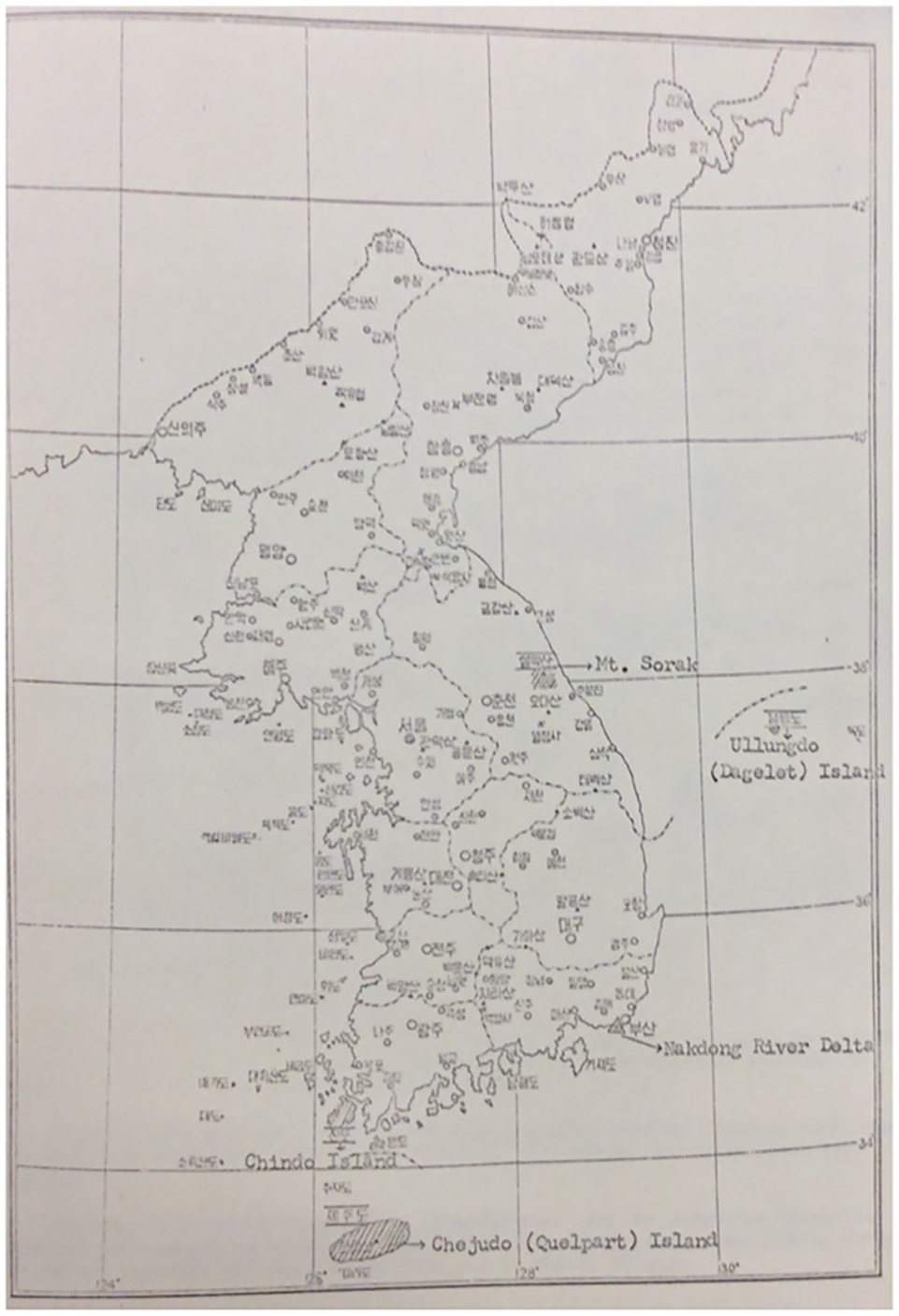
Candidate national park areas proposed by KCCNNR.
The NAS-PSB director was looking for a more promising place that would attract U.S. private and public patrons, and the DMZ was the very place. After the Korean Armistice Agreement in 1953, the border barrier between the two Koreas, 250 kilometers in length and 4 kilometers in width, had turned into a kind of serendipitous nature reserve. 31 On November 3, 1965, when the special committee was enlarged into the KCCNNR and Kang became the first president of the organization, Coolidge recommended they investigate the DMZ as a potential research park. 32 Instead of conducting a basic survey of natural resources he suggested looking at the DMZ in terms of ecosystem ecology. The intensive human interventions that had occurred over a thousand years, and then their sudden suspension for over thirteen years following the armistice, would enable Korean biologists to observe a unique plant and animal environment. In particular, Coolidge promised to promote a bilateral cooperative program with U.S. ecologists if they could first conduct a preliminary survey of the area. 33
The launch process of the DMZ project seems to have been consensual, with Korean biologists proactively responding to Coolidge’s suggestion. Since the Korean government had no interest in non-industrial, academic research, Korean biologists were very much in need of research funding and support. In this context, Coolidge’s appeal was read as a way for them to improve their prospects for the deteriorated state of research. Kang Yung Sun quickly organized a research team to do preliminary fieldwork at the DMZ area following Coolidge’s advice. From December 20–22, 1965, the KCCNNR scientists surveyed a civilian control zone (CCZ), the southern buffer area of the DMZ, because the communist side denied them access to the inside of the zone. Kang reported its results to Coolidge in January 1966. The Korean team identified four areas as being well preserved since the truce: Panchuk-gol, Myojang-dong, Injae Punchbowl, and Hyangnobong (Figure 2). 34
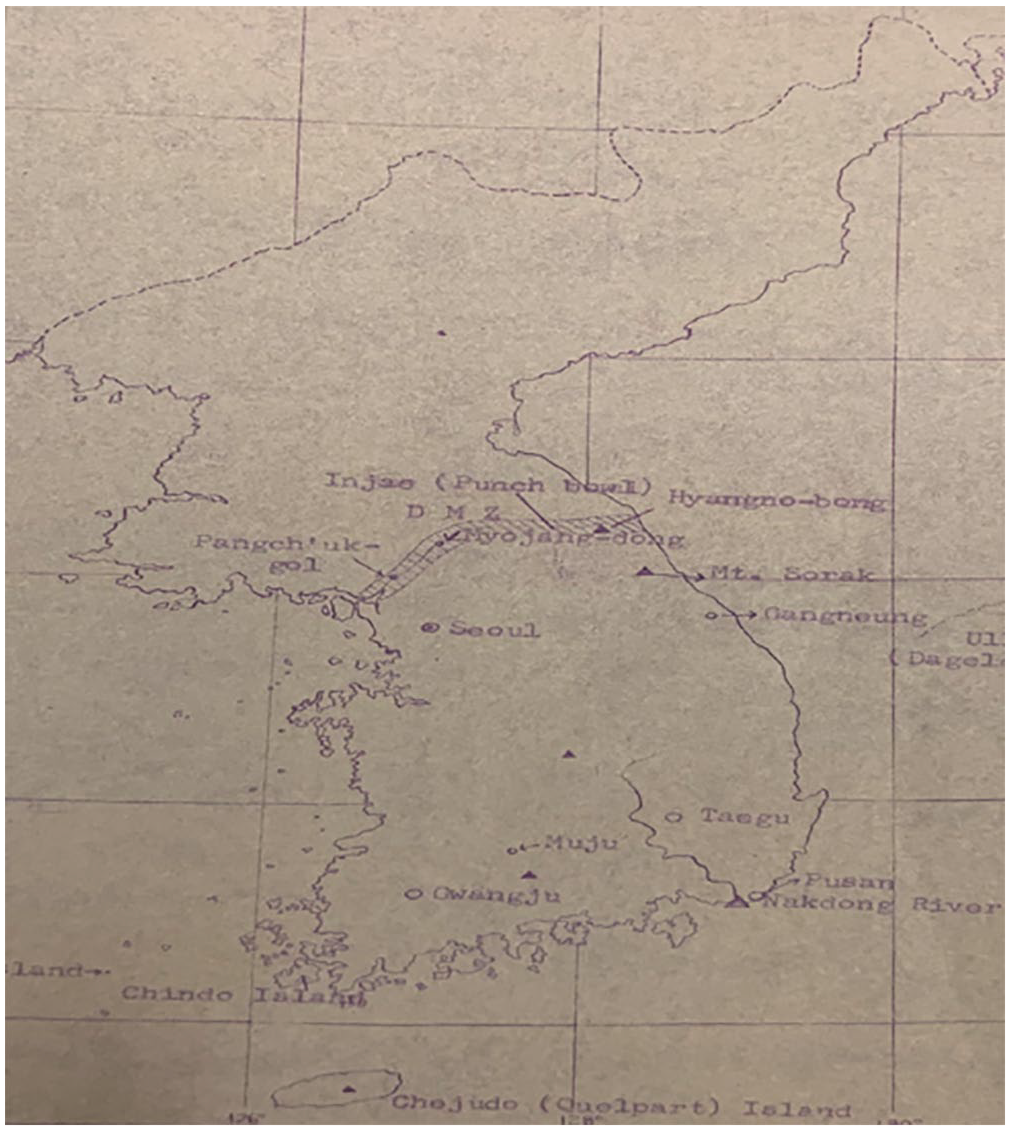
The fieldwork areas of the DMZ project. The striped area is the CCZ, and the upper line of the stripe is the DMZ.
In February of the following year, Coolidge liaised between Korean biologists and U.S. ecologists in the Smithsonian OE to promote an ecosystem survey of the Korean DMZ area. The OE was established by Ripley in July 1965 with the purpose of developing ecosystem ecology as a new interdisciplinary science. The wake of public concern about environmental issues provoked by Rachel Carson’s Silent Spring and the initiation of the International Biological Program – considered a first big science in the field of ecology among American ecologists – were the backgrounds of its installation. 35 The Smithsonian’s ecology arm aimed to work as a center for “national and international programs in basic research and education” in ecosystem ecology. 36 At the time, the OE was seeking to develop international programs to promote bilateral projects studying the regional ecosystems and promoting conservation in countries like India, Pakistan, and Ceylon (currently Sri Lanka). 37 Indeed, the SI had already looked for more opportunities to collaborate with researchers in developing countries as “exchange” became the key word to secure U.S. governmental support. 38 Along the same line, Buechner, the head of the OE, was seeking to prove the importance of his nascent bureau by promoting collaborative ecology programs in developing countries. 39 In particular, Buechner and Ripley believed that descriptive and inventory types of ecological investigations should be prioritized before carrying out any serious ecosystem-oriented studies, especially in the regions where local ecosystems were not yet well investigated. 40 In this context, the DMZ project – doing basic descriptive research on the DMZ ecosystem while inspiring ecosystem thinking in their Korean partners – could be a starting point that he could grow from. The South and Southeast Asia Office of the Ford Foundation showed specific interest in the project and promised to seriously consider supporting it. 41 Buechner considered the DMZ project a chance to establish a regional research center for environmental sciences where the Smithsonian could realize their vision of developing ecosystem ecology step by step – from descriptive studies to ecosystem-oriented research in a given regional ecosystem – for a long-term period.
In June of the same year, Kang visited and stayed at the SI in Washington D.C. to develop the DMZ plan together with Buechner. They made a bilateral scientific cooperation agreement between the SI, the SNU, and the KCCNNR. The two agreed to promote a twenty-five-year long-term research project for the study of all facets of South Korea’s ecosystem. The long-term ecological research project would ultimately contribute to South Korea by guiding efficient use of natural resources compatible with the ecosystem of the country. They first initiated the five-year plan-making project, including “preliminary field surveys” of the DMZ and integration of research plans “from both the U.S. and Korean scientists.” 42 Buechner obtained one year’s support from the U.S. Air Force Office of Scientific Research (USAFO) with $36,000 spanning from August 1, 1966 to July 31, 1967. 43 In August of the same year, the United Nations Command endorsed the cooperative team’s access to field sites of the CCZ. 44 The necessary endorsements from the South Korean government and Korean army soon followed. 45
The project became official and was named a “Cooperative Program for Ecosystem Research in Korea.” 46 Kang and Buechner became co-principal investigators for the project and Coolidge’s name was listed as the U.S. participant scientist, while thirty-two local KCCNNR biologists would conduct fieldwork and the SI would dispatch one resident scientist (field representative) in order to help and support their planning work. The KCCNNR board members, including Kang and other KNAS-affiliated biologists, would advise the Smithsonian scientists to facilitate collaboration with the Korean local biologists. The principal aim was to prepare a five-year plan for ecological research in South Korea in order to submit applications to the appropriate granting agencies. To do this, they would need to obtain general information about the ecosystem of the DMZ based on aerial photographs and fieldwork; site selections for the DMZ and unprotected areas outside of the zone for future comparative studies would also have to be carried out. In the process, ultimately, it was expected that the preliminary surveys of the geological characteristics, flora, and fauna of South Korea would be conducted solely by Korean scientists on the ground. 47
It was announced as a representative case of promising bilateral cooperation with developing countries by both the SI and the NAS-PSB. They advertised the DMZ project as an exemplar of U.S. commitment to scientific freedom that could be incorporated into recent multilateral cooperative efforts through involvement with the International Biological Program. The SI filmed the DMZ in a documentary series co-made by the National Broadcasting Company (NBC), framing it as the Asian frontier of the Smithsonian’s conservation activities. 48 To power the project, Coolidge made the official request to designate the DMZ a national park and announce the DMZ project’s initiation at the Pacific Science Association at the Pacific Science Congress in August 1966. 49 The Korean scientists also advertised it as a U.S.–Korea cooperative program that would be under the sponsorship of the SI for at least six years. They equally emphasized the importance of the DMZ as a site for preserving “national natural resources” that would help national growth. 50 The domestic media outlet framed the cooperative project as an indicator that the “Korean academy goes on the international frontier.” 51 So Buechner wrote to Kang that “we are now off to a good start on the cooperative Smithsonian-Korean project.” 52 It was not that long, however, before Buechner and Kang realized that this rosy future would not be easily fulfilled.
Contested cooperation and the problem of control
Korean culture: sources of failure?
Edwin L. Tyson (1920–76), Buechner’s former student and field biologist, had worked at the U.S. Army Tropic Test Center Fort Clayton, Panama, and was dispatched to Seoul as a resident scientist from the Smithsonian side. 53 He arrived in Seoul on September 10, 1966, together with Coolidge, Buechner, and other Smithsonian scientists F. Raymond Forsberg (1908–93) and Lee M. Talbot (b. 1930). 54 On September 14 and 16, they made a trip to the DMZ field sites with the help of the U.S. military. Kang and two KCCNNR board members were their local companions. 55 After that, they had serial meetings with high governmental officials to discuss Korean governmental support. 56 When the other Americans left for D.C., Tyson stayed in Seoul and Kang offered him an office at SNU with a typewriter, a telephone, and two assistants.
“Securing the mutual understanding and cooperation is basic to the success of our venture in Korea,” Buechner wrote to Tyson when the resident scientist complained about the Korean biologists. 57 After a month in Seoul, Tyson became very skeptical about his collaborators: “Kang has no idea how to go about any sort of field work” and “most of the [Korean] scientists have little idea just what we are trying to do.” 58 Most of all, Koreans seemed to be “certain the money is forthcoming” and the Smithsonian just tried to “get more work out of them” by arguing the need to seek money from granting agencies after this plan-making project. 59
Tyson’s main complaints were Koreans’ misunderstandings about scientific cooperation, their decision-making based on politics, and misuse of money. These three issues were interconnected in Tyson’s view. He advised Koreans to “keep in mind that our project is an ecosystem research project and this will require that we work together,” but concluded they had no idea about cooperation. 60 Tyson requested permission to attend the two early fieldwork meetings organized by the KCCNNR board members but was refused. He supposed his exclusion was due to “some bickering between the Korean scientist[s].” 61 The Smithsonian representative claimed that Koreans were so political and factional that to keep their political circle’s interest, they even prevented students from going to get a Ph.D. in the United States. 62 In Tyson’s opinion, Koreans solved academic problems with politics over science. For them, scientific cooperation was not comprehensible because they made decisions about their research projects based on political negotiations, not sound, scientific rationale. The only agreement that could be reached among them was a political one. Tyson believed that the board members sometimes even mistranslated his explanations to other members on purpose to support their own specific political agendas. 63 Money was central to such politics. Kang did not allow individual field trips even though they were urgently needed; the reason was to prevent the political conflict that might be caused by the unequal payment of project members following the different number of fieldworks carried out. Furthermore, he paid “everyone on the project a salary” in order to gain political power among the KCCNNR scientists. 64
Kang’s “misuse” of money could not be controlled by Tyson on his own, particularly as he claimed that this might be part of Korean nature and not one individual’s malpractice. A U.S. military colonel advised Tyson that Koreans “try to milk you dry of every penny they can.” 65 Even in the event that Kang was only using the money for the project, his approach was the “Korean way” – despite the Korean commander having already given an official endorsement of their access, Kang offered a bribe to Korean military personnel to access the field. 66 Buechner understood the source of the conflict between Tyson and the Koreans as the Korean side misunderstanding the American way, in which he included the grant system, fund management, and proposal writing. 67 Seen from this angle there was a simple solution: dispatching a proper cultural mediator to teach Koreans about the American way.
Kim Ke Chung, curator research fellow at the University of Minnesota, functioned as a troubleshooter in this context. Kim graduated from the Department of Zoology of SNU in 1956, moved to the United States, and earned his Ph.D. at the University of Minnesota in 1964. He impressed Buechner with his skillful English and ecological knowledge, displaying self-confidence as a cultural mediator between Americans and Koreans. His profile made him a terrific candidate to resolve cultural tension between Tyson and Kang. Buechner appointed Kim as a Smithsonian consultant for a one-month stay in South Korea. Soon after his appointment, Kim landed at Kimpo Airport, Seoul, on January 2, 1967, and he returned to Minneapolis after finishing his assignment on February 5. 68 One of his directives was to “explain the condition and nature of the DMZ project” to the Korean side and “define the role of Korean participants and the Smithsonian scientist.” 69 Kim eased Buechner’s mind by reporting on his first day in Seoul that he had “had rather impressive discussions of all things” with “Drs. Kang, Hong [Soon-Woo, a board member of the KCCNNR], and others.” 70 He described himself as a wonderful troubleshooter by impressing that he had immediately helped the Koreans understand Tyson’s intentions and efforts and that they recognized his “leadership,” so “most of the Koreans shall follow my general guideline and cooperate with my thoughts and efforts.” 71
After returning to the United States, in his field trip report Kim identified five reasons for the problems and misunderstandings in the cooperation: the Korean side’s misinterpretation of the DMZ project’s objectives, a lack of defined duties on both sides, the inadequate administrative organization without consideration of the local situation in Korea, different philosophical and cultural backgrounds, and language barriers.
Cultural differences were the most problematic among them and should thus be solved imminently. Kim explained “the language barrier” as having “caused considerable misunderstanding between the Korean and American scientists.” The barrier, however, was “not due to the lack of English vocabulary and grammar,” but “different cultural and philosophical backgrounds.” Such difficulties could only be overcome by “a person with bilingual ability in both thinking and philosophy.” 72 Needless to say, that person was to be Kim himself. He suggested revising administrative structures for the project in order to control Kang rationally. 73 It was Kim who was able to find the solution by redefining the administrative structure to tighten control of the conflicts that cultural differences had caused. Buechner accepted Kim’s recommendation and decided to extend the plan-making project for one more year. The USAFO endorsed it. 74 With this, the OE’s head officially included Kim in the project. Kim would become an intermediary between the two worlds and ultimately the Good Shepherd of Koreans.
It should be noted that Kim was also deeply involved as one of the stakeholders in the generational politics I discussed in the second section. Although he described himself as a transparent observer, capable of mediating two cultures, he was also a potential returnee scientist and job seeker in South Korea. Kim had a deep interest in the KIST project led by members of the π-Club, and shared their vision of the Korean situation:
Korea has been transformed [sic] to a society with a young, vigorous, well-educated generation in many ways of life to support the phenomenal strides toward a self-sufficient economy, a stable government and a [sic] health society . . . Korean scientists and government leaders have begun to give emphasis to the upgrading [sic] of the quality of science and technology in Korea . . . In the scientific community the conservative system of hierarchy by age, which prevents the development of Korean science and the transformation of the scientific community for the better, [however] is still prevalent.
75
Kim slightly twisted Tyson’s criticism here, attributing the conflicts to the prevalent agism in the Korean scientific community. Just as other young Korean scientists, Kim hoped to have the older biologists removed from the DMZ project to make way for the next generation. It was clear this young, U.S.-trained entomologist wanted to take Kang’s place as knowledge broker. To claim his eligibility as intermediary, Kim furthered Tyson’s criticism of Korean culture: he rendered it incommensurable with the American rationality such that the problem would have to be corrected by the Americans and their proxy. Seen from this perspective, situated on the Korean side, Kang was unable to broker and moreover was a part of the problem that needed so urgently to be fixed, a problem that could only be solved by effective brokering via a genuine cultural mediator like Kim. Neither Buechner nor Tyson recognized this underlying power struggle. Kang and his Korean colleagues, however, recognized Kim’s challenge and reacted fiercely to it soon after.
Ignoring involvement with local, generational, and academic politics, the Smithsonian side defined the failure of cooperation in the initial phase as being the result of misunderstanding on the Korean side, caused by their cultural attributes and political nature. Even though they cited cultural “differences” between “Korean” and “American” ways, the Americans considered their own conceptualization of scientific cooperation, science, and the grant system to be universal, and that as such it was the correct way to go about such undertakings. By asserting their definitions as right and the Koreans’ as wrong, they translated the problem of cooperation into one of control.
The cooperative scheme: equality vs. rationality
Buechner asked Kim to develop a five-year plan proposal reflecting his opinion of the administrative structure. Kim soon sent a draft proposal suggesting a direct-control structure: the removal of the co-principal investigator position from the Korean side and the making of a new program director position. According to his scheme, the Smithsonian’s only position would be held by a principal investigator. The program director would be newly created for mediating the U.S. and Korean sides both culturally and scientifically. The director would be appointed by the Smithsonian and should be a representative of the SI, taking overall responsibility for the operation. In Kim’s scheme, the Scientific Advisory Committee might have been the only route by which Koreans could influence the project’s operation. The committee would consist of five scientists from SNU, the SI, and two other institutions. However, these committee members would also be nominated by the program director. The new administrative structure guaranteed the total exclusion of Koreans from the project at operational level. 76
At the time, the Koreans understood the situation very differently. Kang had complained that the Smithsonian had not treated the cooperative project as a bilateral cooperation, but as unilaterally commanded. Highlighting the importance of Koreans as fieldworkers, Kang wrote a letter to Buechner in early April 1967: “Of course the grant source is [sic] the U.S., but the manpower is totally [sic] Korean.” 77 To reflect equality between the two sides, Kang asked Buechner to allow one Korean scientist to take part in writing the final report for the five-year plan at the SI. 78 For Buechner, this was just further confirmation of Kang’s failure to understand the American funding system. He supported Kim’s negative response to Korean participation in writing the final draft of the proposal and limited the writing of it to only Kim, Tyson, and himself. Finally, he circularized Kim’s proposal with Tyson and Kang on April 13. 79 This was a signal to Koreans that the Smithsonian was about to take the bull by the horns.
Kang responded by writing a new version of the proposal with the KCCNNR board members. He wanted to keep the co-principal investigator position and lower the qualification of the program director. The director should, in his opinion, be a Korean with U.S. experience. The Korean co-principal investigator would monitor the director’s work. 80 Kang and other KCCNNR board members understood the cooperative scheme revision in a nationalist framework. From their point of view, Kim’s proposal supposed that the U.S. principal investigator and program director would have complete authority over the operation and administration of the project, despite the headquarters being located within the SNU and the fact that most of the field scientists would be Koreans. Kang wrote to Buechner, “this kind of system will not be accepted by any some-advanced, if not much, country even if research grant source is [sic] foreign country.” 81
In particular, Kang interpreted Kim’s proposal as an outcome of the young Korean’s effort to stake his own position in South Korea by depriving Kang of his intermediary role. The older knowledge broker did not recognize Kim as the pure observer he claimed to be, but as a political stakeholder in the generational politics. It was true that both Kim and Buechner presumed that it would be Kim who would take the position of program director. Furthermore, Kang was not the only one among the Korean participants in the DMZ project to consider Kim unqualified for the job of mediating the two cultures. The Koreans considered Kim as a kind of American who did not understand the Korean situation and, more importantly, Korean customs. Tyson later confessed to Buechner that “the resentment that Dr. Kim built up for himself ran so deep” because during his Seoul trip Kim was “running over the older people.” 82 Tyson thought that “perhaps he has forgotten how [sic] sensative most Koreans are most of the time.” Kim did not understand the “Korean way” and instead relied on the “good old American way,” and it was this that brought about hostility from the natives. 83 Kang officially criticized Kim’s scarce knowledge about Korea and suggested that it should be a Korean who took the position as a representative for the Korean side, or, in other words, the knowledge broker of this cooperative project. 84
Kim pushed forward his version. In his correspondence with Buechner, he defined himself as a champion of “revolution” in Korea’s “conservative hierarchical academic system.” Kim discerned the Koreans’ proposal as having been made by Kang with the view to running the DMZ project “as Dr. Kang’s ‘pet’ to operate the Korean ‘power’ structure of the biological science.” 85 He claimed that Kang and other older professors on the KCCNNR board committee were looking for “some sort of ‘cling’ in order to keep up their positions in the academic community, while young and well-educated scientists are beginning to return from other countries.” According to him, “Dr. Kang maybe/is afraid of young ambitious and productive scientists coming up to his caliber.” That is why Kang and his cliques objected to him becoming program director. But “Korea is definitely in need of ‘revolution’ in academic hierarchy based on age, which, by the way, has already broken down in a general society and government.” Kim claimed he would achieve such a revolution by enlightening Korean scientists because “most Korean scientists are not so controlled by ‘power’ as much as Dr. Kang.” 86 If the project was initiated “for the development of all Korean science,” he suggested that “the simplest administrative structure” would be the most rational way to “not be trapped in the web of a conservative Korean hierarchic system.” Kim’s return would purely be motivated by his revolutionary will: “My reason being associated with the SI and Korean project is to help my native country upgrading her science. That is all I am interested in.” 87
Buechner considered Kim’s structure to be much “more sound” than the Koreans’ one, and announced his support for Kim’s nomination as program director. 88 Assuming the binary of the rational Americans and politically provoked Koreans, Buechner reasoned with Kang quietly by saying that the Smithsonian would have to take the lead if Kang hoped to get a chance of obtaining funds from the Ford Foundation or other U.S. granting agencies. 89 Also, he persuaded Kang to accept Kim as at least an associate program director. 90 Buechner promised that the Korean associate program director would help the U.S. program director and principal investigator as a cultural mediator. 91 While endorsing Tyson’s negotiated version, which reflected Koreans’ request for a Korean co-principal investigator, Buechner requested Kang include Kim (Figure 3). According to Buechner, Kim’s rationalist approach, learned in the United States, would help Koreans develop biological sciences and enable the discipline’s contribution to national development. 92 It is worth noting that Tyson’s version also contained the idea of U.S. rationality over Korean political nature: the structure presumed the Korean co-principal investigator’s potential corruption and made the Scientific Advisory Committee a tool to control unnecessary political actions provoked by the Korean side of the project. 93
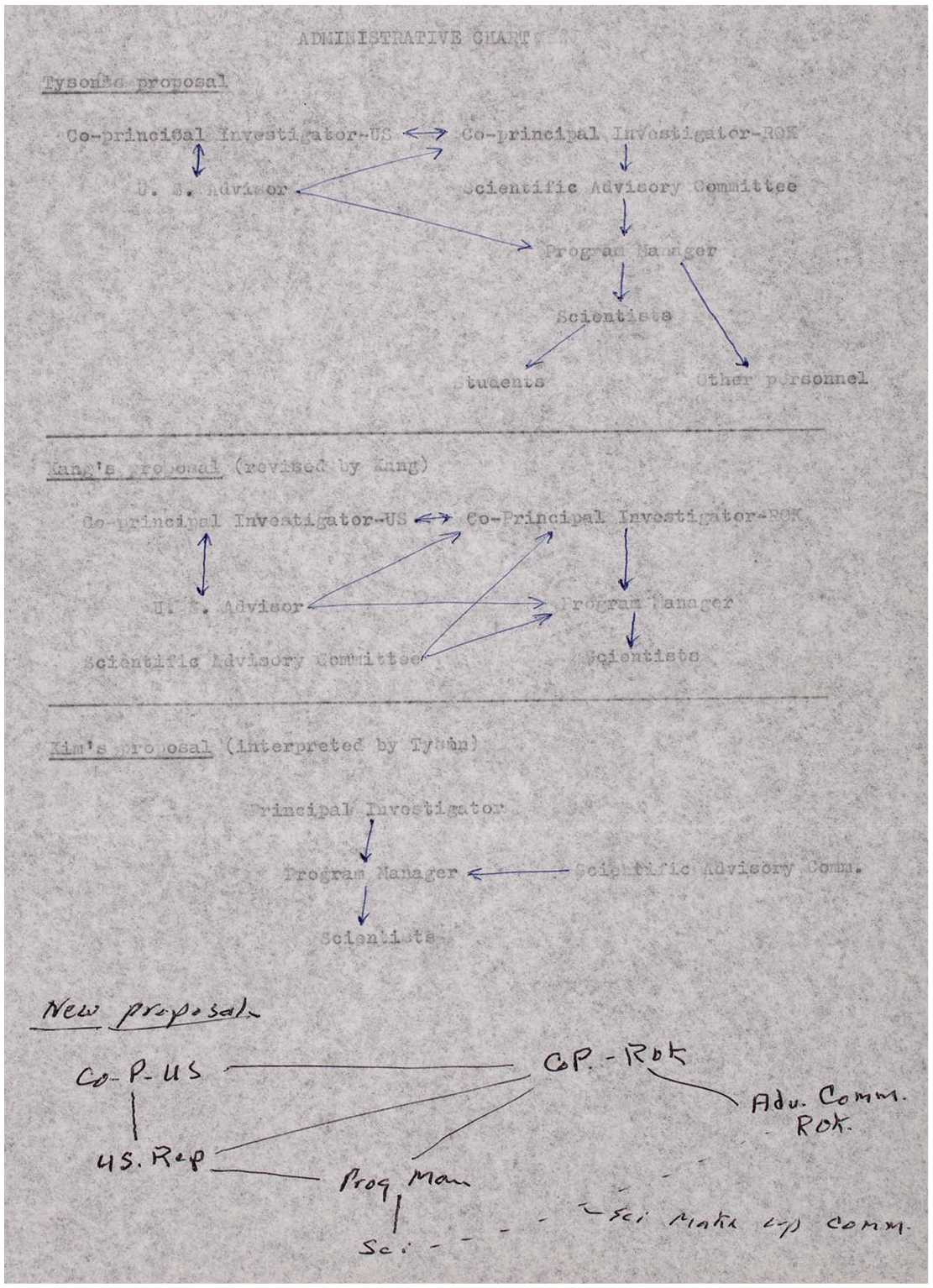
Tyson’s summary of the variety of administrative structures suggested by Kim Ke Chung, Kang Yung Sun, and himself.
Kang and the KCCNNR members finally accepted the revised version, given that the associate program director would be under the guidance of the Korean co-principal investigator. 94 It is interesting that Kang also expressly admitted the very age-based hierarchy in Korean culture criticized by Kim. From this worldly knowledge broker’s point of view, however, it was Korean culture that made the presence of the Korean co-principal investigator necessary – and Kang himself – as a coordinator between the Korean government, military, and diverse academic circles. The DMZ project would require “cooperation” not only between the United States and Korean scientific communities, but also between Korean scientific and non-scientific stakeholders. Thus, age and experience were also worth as much in the Korean context as other rational factors such as language and academic achievements were in the U.S. community. 95 It was another story of the two sides’ different understandings of “cooperation.” For the time being, the debate seemed to end and the project seemed to be working out well, at least ostensibly.
Where to cooperate: SNU vs. the KIST
The Smithsonian’s suspicion and distrust of their counterpart deepened, however. 96 The quarrel around the administrative structure took longer than the Smithsonian had originally thought. Kim finished writing up the final draft and circulated it to get feedback from both sides. 97 Kim and Buechner visited South Korea to sell their proposal to the Korean government in early November 1967 (Figure 4). 98 An official meeting between the Smithsonian–KCCNNR group and the Korean government authorities followed. The minister of science and technology, Kim Ki Hyung (1925–2016), and the president of the KIST, Choi Hyng Sup, both attended the meeting. The Smithsonian and KCCNNR agreed to include Choi in the future Scientific Advisory Committee as the third-party representative between them. The new proposal assigned the Korean associate investigator instead of the Korean co-principal investigator. The Smithsonian side wanted Choi to take the position, while the KCCNNR rejected the idea because he was not a member of the commission. 99

The U.S.–Korean Demilitarized Zone scientists in front of Kang’s house in early November 1967. (From the left to the right) Kim Ke Chung, Kang Yung Sun, Helmut Buechner, Kang’s wife and daughter, and Edwin Tyson.
Buechner and Kim’s preference for Choi was linked to his position as the π-Club’s leader as well as his role as president of the KIST. Kim repeatedly told Buechner that the old “Japanese-trained” scholars in universities should be replaced with the young “U.S.-trained” returnee scientists and that the DMZ project might be the best chance to achieve such a “revolution” in the biological sciences. The guidance from the U.S.-trained returnee scientists, including Kim himself, would be the only way to achieve genuine development in Korean biology. 100 If the π-Club’s leader took a role in the DMZ project and pushed Kang and his people out, the “revolution” would be more easily achieved.
Kim asserted the necessity of finding another place for the future headquarters in order to reduce Kang’s power. According to Kim’s perspective, SNU was, at least at that time, a den of old Japan-trained KCCNNR biologists whose only desire was to keep their “power” in the scientific community. Kim translated Buechner’s idea to change headquarters into action. Immediately after returning to Minnesota, he secretly sent a letter to Choi Hyung Sup, telling him that the Smithsonian were trying to dissociate themselves from the KCCNNR and promote the DMZ project with a new, younger partner like the KIST, claiming that the KCCNNR was incapable of scientific cooperation with the SI. If Choi accepted, the Smithsonian center would be completely integrated into the KIST within five to ten years, and the KIST would have all the power over administering the funds from the Korean government. 101 This suggestion was grounded in the belief that the KIST, functioning with young returnee scientists, would operate in the American way. Kim Ke Chung suggested that he could become the U.S. consultant and work together with Choi. The DMZ would be covered as one of the fields in South Korea for the initial collaboration. 102
Buechner accepted Kim’s conclusion, not only because he agreed with his evaluation but because he was also skeptical of the university system with respect to developing ecosystem ecology. When suggesting “ecosystem science” as a new interdisciplinary science with Ripley, he criticized the university administrative structure, which was bracketed by old disciplinary programs “before the space age” and thus would “mitigate against the interdisciplinary programs.” Universities should be involved in establishing “regional centers” studying ecosystem science; however, to avoid being hampered “by the conventional departmental structure of universities,” an independent research institution “as a basically private organization with strong governmental relationships” like the SI should take the role of regional centers. 103 For Buechner, the KIST was the only institution similar to the SI in South Korea because it was government-funded but independent from government agencies. 104 Based on this rationale, Buechner supported Kim’s secret contact with the KIST president.
Choi replied to Kim in February 1968, accepting the basic idea but with some reservations about the settlement – the space for the Smithsonian center should be considered after the construction of the whole facility. 105 William J. Harris (1918–2012), a science administrator of the Battelle Memorial Institute and Choi’s U.S. partner, also rejected Buechner’s suggestion because, as it stood, the KIST only served industrial research, not basic science. 106 Despite Harris’s negative response, Buechner continued with his efforts to incorporate the KIST into the final proposal. 107
While Buechner and Kim continued their secret lobbying, Kang got an unofficial endorsement from the Ministry of Science and Technology to fund the biological surveys over the CCZ from 1968 on. 108 This was the outcome of Coolidge’s tireless pressure on the Korean governmental authorities. 109 Kang told Buechner that a legal association like the KCCNNR was necessary if the DMZ project was to receive government funding in South Korea. Tyson interpreted Kang’s move as another attempt to mold his “power” via governmental funding and misuse the SI’s scientific clout. 110 Buechner quickly wrote to the Korean minister of science and technology to withdraw their promise of governmental funding to the KCCNNR. 111 Kim also asked Choi Hyung Sup not to offer them any funds. 112 It soon turned out, however, that Kang’s claim was true: the Korean government required a national legal association to grant government funds. It was impossible for Korean funding to be directly issued to the Smithsonian, not only for the current year but also in general, going forward. 113 At the time, the Smithsonian considered that the funding from the Korean government was no longer needed, or at least, with the confidence of securing grants from U.S. private foundations, that this would be the case within a few years. Such optimistic thoughts would prove fatal to the future of the DMZ project.
Closure
In 1968, the last year of the plan-making project, the prickly relationship between the Koreans and the Smithsonian became evident. Tyson hysterically described the situation of nine Koreans in one vehicle for the field trip as bothering his “sense of human dignity to see so many people more cowed than I have ever seen Negros act in the south.” 114 Koreans also complained that Tyson “neglected their interests” while all his efforts seemed to be going into his own research. 115
The increasing military tension at the DMZ, along with the thorny relationship between the Korean and U.S. collaborators, made the fieldwork increasingly difficult. On January 21, North Korean commandos crossed the DMZ, killed twenty-six South Koreans, and tried to assassinate the South Korean president. The attempt was unsuccessful but brought with it a cloud of war that settled over the South. After two days, North Korean forces attacked and captured the USS Pueblo, “environmental research ship” and, in fact, spy ship, off the coast near the North Korean port city of Wonsan. The Johnson administration acted as if they intended to enter into a war against North Korea right away. As a result of rising military tensions between the two Koreas, the South Korean and UN Commanders prohibited fieldwork at the CCZ, and Korean fieldworkers became concerned about an attack from North Korean forces during their activities there. 116 Considering the military struggle both inside and outside the DMZ, by February Tyson and Buechner had shared their opinions regarding the difficulty of promoting the DMZ project. In the final report, Buechner thus decided to minimize the DMZ and emphasize the Smithsonian–KIST environmental research center program. 117
In April, Buechner circulated his final report to the possible funding agencies – the Ford Foundation, the Asia Foundation, USAID, and so on. The response from U.S. private foundations was chilly, with no agencies showing interest in supporting the Korean environmental research center plan. 118 In late May, Ripley ordered Buechner to abandon the Korean project. 119 Buechner sent an official letter to Kang, Coolidge, and Korean officials, informing them that the Smithsonian had failed to obtain funding for their plan. 120
An official record explains that Buechner and Kang failed to promote the DMZ project due to the intense military struggle at the DMZ. 121 This was true up to a point, although it was not the full truth. There was also an internal factor that led to the cooperative project meeting a dead end – the failure to recognize the political motivations of the knowledge brokers. Buechner did not accept the Smithsonian’s involvement with generational politics that occurred while attempting to maintain the binary of rational Americans and political Koreans. The Smithsonian’s distrust prevented the Korean side from getting funds from the Korean government. As a result, they lost their most promising source of funding. Perhaps of equal importance, overlooking the developmental nature of their project led the Smithsonian’s ambitious project to failure. The initial project plan had been to study the DMZ to test general ecological principles such as succession, even though its origin was Coolidge’s amalgamated version of environmentalism and developmentalism. While supporting Kim’s position in the battle with Kang, however, Buechner integrated Kim’s idea into his Smithsonian center plan. Kim claimed to be establishing the Institute of Natural Resources as a comprehensive environmental research institution contributing to the economic development of South Korea. It would help the Korean government to catalog national natural sources and enable them to be used in the most efficient way. 122 Buechner’s initial aim, which was to develop basic research and education programs in ecosystem ecology in South Korea, was also negotiated with Kim’s developmentalist hope. In consequence, the final proposal had dual aims: to promote ecosystem ecology, on the one hand, and to develop Korean biology and the economy by surveying natural resources there, on the other.
The Ford Foundation, the most favorable funding agency to the project initially, turned down Kim and Buechner’s proposal because they saw the first aim as incompatible with the second one. Gordon Harrison, the Ford Foundation’s primary environmental program officer, sent an evaluation of the final proposal to Eugen Staples, the head of the South and Southeast Asia Office. Harrison was very skeptical about ecosystem ecology research in South Korea because “Korea might be among the worst places to make such an effort.” In the country, “such basic data as the identification of species are so notably lacking.” It would help the development of basic science in that country but not be beneficial for science itself at all. In fact, “neither the Smithsonian nor the local scientists have command of the indispensable mathematical tools capable of using the information to understand the functioning of systems when they get it.” Gordon cynically concluded that “it is foolish to pretend that such basic work will contribute to the understanding of how ecological systems function.” 123 Gordon’s evaluation was unfair given that Buechner was the real deal, using complex ecosystem modeling and GPS tracking methods in his research on mammal ecology. As stated earlier, Buechner believed that ecosystem ecology required first studying basic descriptive investigations on a specific ecological area as a basis for further ecosystem-oriented research. 124 Nevertheless, it was clear that Buechner failed to discern how deeply involved he was with the politics of knowledge brokers; uncritically supporting Kim’s side, he was unaware of the breakdown in communications between the two camps and how this resulted in the change of direction in the project. If the unexpected early closure can be considered a failure, these would be some internal reasons contributing to it.
Conclusion
The DMZ project ostensibly was consensual, but it was in fact heavily contested. Its contested nature was rooted in the generational struggle among Korean scientists and the United States’ failure to understand their own involvement in it. Buechner interpreted the discordance of Tyson with Kang and the KCCNNR members in the framework of Kim’s version of generational struggle, that is, a conflict between the older Japan-trained scientists and the young revolutionary scientists trained in the United States. The Smithsonian ecologists blamed Korean political culture as the leading cause for cooperation failure and endeavored to instill what they thought was scientific rationality into the project. In particular, accepting Kim’s narrative, Buechner considered that U.S.-trained Korean scientists who had learned American ways would be able to use rationality to direct politically motivated Koreans.
However, the problem was not the struggle between the Japan-trained and the U.S.-trained scientists, nor was it one between politics and rationality. It was the power struggle for the position of knowledge broker. Kang, the symbol of the old school of Japanese-trained Korean scientists, had in fact been retrained in the United States after the Korean War and achieved his academic prestige by engaging with the American scientific community. The problem was that Kang could not be a research partner for the bilateral cooperative project; this lab biologist did not fit with the DMZ project, which definitely demanded a higher level of expertise in field biology. For Coolidge, Kang’s lack of expertise was not a concern because he would not be working as a scientist in the field and he developed the partnership with Kang based on institutional relations between the NAS-PSB and KNAS. In contrast, the Smithsonian’s field scientist Tyson was very dissatisfied with Kang’s research capabilities in ecology and the related fieldwork. Kim saw through this crack and capitalized on his U.S.-trained profile to take the intermediary role from him. To consolidate his position brokering this new science called ecology, Kim authenticated and blamed Korean culture, deliberately playing to U.S. cultural stereotypes. Kang countered Kim’s attack by appropriating his criticism and claiming his necessity in the context of the agism-based and politics-based culture of the Korean scientific community, though this failed to persuade Buechner. For Buechner, Kim’s version resonated with the perspective of Cold War orientalism using the binary of political culture and rationality and thus was a preferable way of seeking to clearly understand the conflict. 125 Although sometimes Tyson met the self-skepticism of Koreans’ capacity to achieve the required level of “modernization,” the Smithsonian strived to “modernize” the Korean scientific community by educating them in the “American way.” 126 In the white man’s burden of the Cold War era, Kim can be seen as a “native” collaborator helping them achieve such lofty goals. At this point, U.S. cultural orientalism, the politics of knowledge brokers, and the changing scientific cooperation became interwoven into the free world’s cooperative project in the high Cold War context.
The impact of the generational transition on scientific collaboration in that period is still understudied in the history of South Korean science. In particular, in the previous literature, Korean scientists have often been considered a homogenous group collaborating toward their common goal of nation-building by promoting science and technology, regardless of their alma mater and age. Doubtlessly they did share a sort of scientific nationalism, that is, a belief in the advancement of science as the ultimate basis of national development. 127 At the same time, their ideas for the direction and means of the promotion of science and technology differed – Kang claimed universities as the place for science, whereas Kim favored a new type of independent research institute like the KIST. Kang also believed that local scientists working in South Korea had to take a lead. In contrast, Kim convinced himself that smart, young scholars, newly trained in state-of-the-art scientific fields at U.S. institutions, should act as the Good Shepherds of South Korean science. Rarely have historians of South Korean science addressed such a heterogeneity of intentions and visions behind the explicit nationalistic tone among Korean scientists. This study suggests paying closer attention to the politics of knowledge brokers at the outset for the analysis of the heterogeneity of the Korean side while not losing sight of their active role in the building process of American hegemony.
Footnotes
Acknowledgements
An earlier version of this article was presented at the panel titled “Beyond Technical Aid: Cold War Scientific Cooperation in East Asia,” the History of Science Annual Meeting held in Utrecht in July 2019. I thank Mary Augusta Brazelton, Yubin Shen, Masato Hasegawa, Tamar Novick, Kerstin Panhorst, Juyoung Lee, Sumin Myung, Hyun Gyung Kim, Kyong Yong Francis Yoon, and Wonkyo Jung for their insightful suggestions on earlier drafts of this article. Chuyoung Won carefully read and criticized my earlier drafts several times. Pamela Henson taught me about the nature of the Smithsonian overseas ecology program. Deborah Shapiro at the Smithsonian Institution Archives and Janice Goldblum at the US National Academy of Sciences Archives helped me consult the DMZ-related materials in their institutions. I also thank Dagmar Schäfer, who generously supported my archival trip to the United States while I was at the Max-Planck Institute for the History of Science. Finally, I am grateful to the editor and the anonymous referee for helping me articulate the ideas presented here.
Author’s note
Jaehwan Hyun is now affiliated with Institute of General Education, Pusan National University, South Korea.
Declaration of conflicting interests
The author declared no potential conflicts of interest with respect to the research, authorship, and/or publication of this article.
Funding
The author received no financial support for the research, authorship, and/or publication of this article.
1.
All Korean names in the text are surname first, followed by the given name. Transliteration of names follows the person’s preferences as indicated in their English language publications.
2.
H. W. Arndt, Economic Development: The History of an Idea (Chicago: University of Chicago Press, 1989); Diane B. Kunz (ed.), The Diplomacy of the Crucial Decade: American Foreign Relations During the 1960s (New York: Columbia University Press, 1994).
3.
John McCormick, The Global Environmental Movement (Chichester: John Wiley & Sons Incorporated, 1995); Perrin Selcer, The Postwar Origins of the Global Environment: How the United Nations Built Spaceship Earth (New York: Columbia University Press, 2018).
4.
For Coolidge’s career as an American globalizer of nature conservation, see Mark V. Barrow, Jr., Nature’s Ghosts: Confronting Extinction from the Age of Jefferson to the Age of Ecology (Chicago: The Chicago University Press, 2009).
5.
KCCNNR, The 40 Years of Nature Conservation [자연보호 40년사] (Seoul: KCCNNR, 2003).
6.
Manyong Moon, “The Meaning and Prospect of the Ecological Survey of the DMZ [비무장지대 생태조사의 의의와 전망],” Daedong Institute for Korean Studies [대동문화연구] 106 (2019): 35–64.
7.
Jieun Shin, “International Museum Building: The Korean-Smithsonian Project in the 1960s” (a conference paper delivered at the 15th International Conference on the History of Science in East Asia, August 19, 2019).
8.
Sumin Myung, “When Nature Goes ‘Public’: A Political Life of Nature Conservation in Cold War South Korea, 1963–1979” (a conference paper delivered at the 15th International Conference on the History of Science in East Asia, August 19, 2019).
9.
John Krige, American Hegemony and the Postwar Reconstruction of Science in Europe (Cambridge, MA: MIT Press, 2008).
10.
Zuoyue Wang, “Transnational Science during the Cold War: The Case of Chinese/American Scientists,” Isis 101 (2010): 367–77; John Krige, “Building the Arsenal of Knowledge,” Centaurus 52 (2010): 280–96; John DiMoia, “Atoms for Sale?: Cold War Institution-Building and the South Korean Atomic Energy Project, 1945–1965,” Technology and Culture 51 (2010): 589–618; Ana Barahona, “Transnational Science and Collaborative Networks: The Case of Genetics and Radiobiology in Mexico, 1950–1970,” Dynamis 35 (2015): 333–58.
11.
Michael Lewis, “Indian Science for Indian Tigers? Conservation Biology and the Question of Cultural Values,” Journal of the History of Biology 38 (2005): 185–207; Audra Wolfe, “What’s in a Zone? Biological Order versus National Identity in the Biological Science Curriculum Study,” in Patrick Manning and Mat Saveli (eds.), Global Transformations in the Life Sciences, 1945–1980 (Pittsburgh: University of Pittsburgh Press, 2018), pp.146–59.
12.
Kapil Raj, “Mapping Knowledge Go-Betweens in Calcutta, 1770–1820,” in Simon Schaffer, Lissa Roberts, Kapil Raj, and James Delbourgo (eds.), The Brokered World: Go-Betweens and Global Intelligence, 1770–1820 (Sagamore Beach, MA: Science History Publications, 2009), pp.105–50.
13.
Ibid., p.118.
14.
For the details of Kang’s career, see Jaehwan Hyun, “Making Postcolonial Connections: The Role of a Japanese Research Network in the Emergence of Human Genetics in South Korea, 1941–1968,” The Korean Journal for the History of Science [한국과학사학회지] 29 (2017): 291–324.
15.
A letter from Marshall C. Balfour to Warren O. Nelson, January 3, 1963, The Rockefeller Archive Center, Population Council Records, FA432, Series 2, Box 109, Folder 1045.
16.
A letter from Harold J. Coolidge to Yung Sun Kang, January 19, 1966, Harold Jefferson Coolidge Papers, Harvard University Archives (hereafter HUG) (FP) 78.14, Box 19, Folder “ADM: International Relations 1966; South Pacific Area.”
17.
Kunz, The Diplomacy (note 2).
18.
In 1961, Japan was the first country in Asia to start a large-scale bilateral scientific cooperation program. Although the nature of the cooperation program was quite different from that of developing countries, it was also an indicator of the 1960s’ transformation in the scientific exchange of Asian “free world” countries with the United States – that is, the donor importing scientific information and technological equipment from the United States to a bilateral research partner. Rexmond Canning Cochrane, The National Academy of Sciences: The First Hundred Years, 1863–1963 (Washington, D.C.: The National Academy of Sciences, 1978).
19.
Harrison Brown and Theresa Tellez, International Development Programs of the Office of the Foreign Secretary (Washington, D.C.: The National Academy of Sciences, 1973).
20.
A letter from Harold J. Coolidge to F. R. Forsberg, July 11, 1963, Smithsonian Institution Archives (hereafter SIA), Acc. 98-026, Box 3, Folder “PSB 1963 Meeting.”
21.
A letter from Harold J. Coolidge to Yung Sun Kang, November 5, 1963, Pacific Science Board, The National Academy of Sciences Archives (hereafter NAS-PSB), Folder “Institutions: Assoc Individuals A-Z 1963.”
22.
Yung Sun Kang, The Collected Works of Doctor Kang Yung Sun for the Celebration of His Retirement [하곡 강영선 박사 정년퇴임 기념문집] (Seoul: Kinyŏmmunjip saŏp’oe, 1982).
23.
“A Minute PSB Meeting 1966,” NAS-PSB, Folder “ADM: Pacific Science Board: General 1966.”.
24.
“PSB Meeting 13 December 1963 Agenda Item 4 (a): Science Development Panels – An Experimental Program,” SIA, Acc. 98-026, Box 3, Folder “PSB 1963 Meeting,” pp.2–3.
25.
For the history of the π-Club in the context of the generational transition in the South Korean scientific community during the 1960s, see Geun Bae Kim, “An Anatomical Chart of South Korean Science and Technology in the 1960s: Their Relationships with Political Power,” East Asian Science, Technology and Society: An International Journal 5 (2011): 529–42.
26.
Ralph E. Cleland, “Report of Ralph E. Cleland on Korea,” NAS-PSB, Folder “Institutions: Companies Individuals 1960: Asia Foundation: Asia Mission: Cleland R. E.”
27.
“Visit of Dr. Choi Hi-Chang, Yonsei University,” letter from the Representative of Korea to the Representative of Japan, November 10, 1961, The Asian Foundation Papers, The Hoover Institution Archive, Box P-149.
28.
For the history of the KIST, see Manyong Moon, The Formation of a Modern Research System in South Korea: The Establishment of KIST and its Transformation, 1966–1980 [한국의 현대적 연구 체제의 형성: KIST의 설립과 변천, 1966–1980] (Seoul: Sunin Publishing, 2010).
29.
A letter from Bok-Sung Cho to William Hart, December 28, 1963, HUG (FP) 78.14, Box 11, Folder “ADM: International Relations; South Pacific Area.”
30.
Ibid. The Bureau of Cultural Property Preservation, the Korean Ministry of Education, supported $8,890 to conduct the national park basic surveys. KCCNNR, “The Korean Commission for Conservation of Nature and Natural Resources,” 1965, SIA, RU 271, Box 16, Folder 3, pp.384–5.
31.
A letter from Harold J. Coolidge to William Bridges, January 24, 1966, HUG (FP) 78.14, Box 19, Folder “ADM: International Relations 1966; So Pac & Asia; General.” According to Coolidge’s explanation, John E. Jameson, an officer of the Asia Foundation, let him know about the peculiarity of the DMZ. For another explanation of Coolidge’s motivation, see Moon, “The Meaning” (note 6). Won Pyong-oh, ornithologist and KCCNNR Board Member, claimed that the DMZ was already included in their “Basic Investigation” planning project in 1963, but the report did not discuss the DMZ. As  shows, the DMZ was not even delineated on the map of the Korean peninsula. Pyong-Oh Won, “Conservation of Nature and Natural Resources in Korea,” November 1965, SIA, RU 271, Box 16, Folder 3.
32.
Coolidge visited Korea to be conferred with an honorary doctorate from SNU. His suggestion of the DMZ project was endorsed by the meeting of the KCCNNR, with his participation, on November 3, 1965. Yung Sun Kang, “The Korean Commission for Conservation of Nature and Natural Resources,” April 30, 1966, SIA, RU 271, Box 16, Folder 3, p.330. Coolidge recognized that Kang was an official conduit to the Korean community of conservation activists and researchers. A letter from Harold J. Coolidge to Yung Sun Kang, January 19, 1966, HUG (FP) 78.14, Box 19, Folder “ADM: International Relations 1966; So Pac & Asia: General.”
33.
Harold J. Coolidge, “The Role of International Nature Conservation in the Protection of the Human Environment [인간의 자연환경을 수호함에 있어서 국제자연보존의 역할]” (An inaugurate speech delivered at Seoul National University, November 4, 1965).
34.
A letter from Yung Sun Kang to Harold J. Coolidge, January 12, 1966, SIA, RU 271, Box 16, Folder 3.
35.
For the background of the establishment of the Smithsonian Office of Ecology, see Smithsonian Year 1966: Annual Report of the Smithsonian Institution for the Year Ended June 30, 1967 (Washington, D.C.: Smithsonian Institution, 1967).
36.
Ibid., p.76.
37.
Ibid., p.74. The bilateral projects were expected to be funded by the Smithsonian Foreign Currency Program. For the detail of the funding scheme, see Michael Lewis, Inventing Global Ecology: Tracking the Biodiversity Ideal in India, 1947–1997 (Athens: Ohio University Press, 2004), pp.93–5.
38.
For a case of the SI’s international activities in Latin America, see Megan Raby, American Tropics: The Caribbean Roots of Biodiversity Science (Chapel Hill: The University of North Carolina Press, 2017), pp.187–8.
39.
Later he tried to develop similar ecosystem ecology projects in Poland and Yugoslavia. Anonymous, “Requisition for Services, Supplies, or Equipment Order from Dr. Frank A. Pitelka,” SIA, RU 271, Box 16, Folder 4.
40.
Helmut K. Buechner, “Smithsonian Office of Ecology,” Smithsonian Year 1967: Annual Report of the Smithsonian Institution for the Year Ended June 30, 1967 (Washington, D.C.: Smithsonian Institution, 1968), pp.48–50. See also S. Dillon Ripley and Helmut K. Buechner, “Ecosystem Science as a Point of Synthesis,” Daedalus 96 (1967): 1192–9.
41.
On the Ford Foundation’s support of the Smithsonian ecological program in the 1960s, see a letter from S. Dillon Ripley to Gordon Harrison, January 14, 1969, The Rockefeller Archive Center, Ford Foundation Records (FFR), FA735, Reel-C 1793, Folder “R&E 1970.”
42.
Helmut K. Buechner, “Proposal to the Air Force Office of Scientific Research,” July 14, 1966, SIA, RU 271, Box 16, Folder 3.
43.
A letter from Leo V. Brashier to Smithsonian Institution, September 8, 1966, SIA, RU 271, Box 16, Folder 3.
44.
From USFK to Embassy of USA, Seoul, August 2, 1966, SIA, RU 271, Box 16, Folder 3.
45.
From the Ministry of Foreign Affairs, Republic of Korea to the Embassy of the United States of America, August 31, 1966, SIA, RU 271, Box 16, Folder 3.
46.
Buechner, “Proposal” (note 42).
47.
Ibid.
48.
A letter from Helmut K. Buechner to Edwin Tyson, October 13, 1966, SIA, RU 271, Box 16, Folder 3. For the Smithsonian–NBC documentary program, Marcel Chotkowski LaFollette, Science on American Television: A History (Chicago: University of Chicago Press, 2013).
49.
“The Proposal Designating the Korean DMZ as a National Park was Announced [한국비무장지대 국립공원안 채택],” Dongailbo [동아일보], September 1, 1966.
50.
“Natural Resources Spotlighted [각광받는 자연자원],” Kyunghyang Shinmun [경향신문], September 10, 1966.
51.
“The Korean Academy’s International Activity on the Global Frontier: The Basic Survey of Biological Resources [세계의 대열에서 한국 학술의 국제참여 (완) 생물자원의 기본조사],” Kyunghyang Shinmun [경향신문], January 26, 1966.
52.
A letter from Helmut K. Buechner to Yung Sun Kang, November 9, 1966, SIA, RU 271, Box 16, Folder 3.
53.
A letter from Helmut K. Buechner to Yung Sun Kang, August 10, 1966, SIA, RU 271, Box 16, Folder 3.
54.
A letter from the Embassy of the United States of America to the Ministry of Foreign Affairs of the Republic of Korea, August 9, 1966, SIA, RU 271, Box 16, Folder 3.
55.
“KOREA Trip Note, 8–17 September 1966: Schedule for Ecological Survey,” SIA, RU 271, Box 16, Folder 3.
56.
Another purpose of their visit was to establish the national science museum as a cooperative project between the SI and Korean government. See Shin, “International Museum Building” (note 7).
57.
A letter from Helmut K. Buechner to Edwin Tyson, October 13, 1966, SIA, RU 271, Box 16, Folder 3.
58.
A letter from Edwin Tyson to Helmut K. Buechner, October 4, 1966, SIA, RU 271, Box 16, Folder 3.
59.
Ibid.
60.
A letter from Edwin Tyson to Helmut K. Buechner, November 15, 1966, SIA, RU 271, Box 16, Folder 3.
61.
From Tyson to Buechner, October 4 (note 58).
62.
Ibid.
63.
A letter from Edwin Tyson to Helmut K. Buechner, January 11, 1967, SIA, RU 271, Box 16, Folder 3.
64.
From Tyson to Buechner, October 4 (note 58).
65.
A letter from Helmut K. Buechner to Edwin Tyson, January 16, 1967, SIA, RU 271, Box 16, Folder 3.
66.
From Tyson to Buechner, January 11 (note 63).
67.
A letter from Helmut K. Buechner to Edwin Tyson, January 25, 1967, SIA, RU 271, Box 16, Folder 3.
68.
Ke Chung Kim, “Report to the Office of Ecology, Smithsonian Institution on a mission to Korea, Jan. 2 – Feb. 5, 1967,” SIA, RU 271, Box 16, Folder 4.
69.
Ke Chung Kim, “Some Objectives for Ke Chung Kim in Korea during January 1967,” SIA, RU 271, Box 16, Folder 4.
70.
A letter from Ke Chung Kim to Helmut K. Buechner, January 5, 1967, SIA, RU 271, Box 16, Folder 4.
71.
Ibid.
72.
Ke Chung Kim, “Report,” p.6 (note 68).
73.
Ibid.
74.
A letter from Helmut K. Buechner to Edwin Tyson, January 19, 1967, SIA, RU 271, Box 16, Folder 3.
75.
Ke Chung Kim, “Report” (note 68).
76.
Ke Chung Kim, “Preliminary Draft (Kim’s Proposal) of a Proposal for a Cooperative Research Program in Ecology in Korea,” February 22, 1967, SIA, RU 271, Box 16, Folder 4.
77.
A letter from Yung Sun Kang to Helmut K. Buechner, April 3, 1967, SIA, RU 271, Box 16, Folder 4.
78.
Ibid.
79.
A letter from Ke Chung Kim to Helmut K. Buechner, April 4, 1967, SIA, RU 271, Box 16, Folder 4.
80.
A letter from Yung Sun Kang to Helmut K. Buechner, April 22, 1967, SIA, RU 271, Box 16, Folder 4.
81.
A letter from Yung Sun Kang to Helmut K. Buechner, May 18, 1967, SIA, RU 271, Box 16, Folder 4.
82.
A letter from Edwin Tyson to Helmut K. Buechner, May 12, 1966, SIA, RU 271, Box 16, Folder 4.
83.
Ibid.
84.
From Kang to Buechner, May 18 (note 81).
85.
A letter from Ke Chung Kim to Helmut K. Buechner, May 17, 1967, SIA, RU 271, Box 16, Folder 4.
86.
Ibid.
87.
Ibid.
88.
A letter from Helmut K. Buechner to Edwin Tyson, May 7, 1967, SIA, RU 271, Box 16, Folder 4.
89.
A letter from Helmut K. Buechner to Yung Sun Kang, May 5, 1967, SIA, RU 271, Box 16, Folder 4.
90.
A letter from Helmut K. Buechner to Yung Sun Kang, May 29, 1967, SIA, RU 271, Box 16, Folder 4.
91.
Ibid.
92.
Ibid.
93.
A letter from Edwin Tyson to Helmut K. Buechner, May 11, 1967, SIA RU 271, Box 16, Folder 4.
94.
A letter from Ke Chung Kim to Helmut K. Buechner, July 24, 1967, SIA, RU 271, Box 16, Folder 4.
95.
A letter from Yung Sun Kang to Helmut K. Buechner, June 10, 1967, SIA, RU 271, Box 16, Folder 4.
96.
As early as November, Tyson and Buechner secretly sought to revise the administrative structure to kick Kang off the project. A letter from Edwin L. Tyson to Helmut K. Buechner, November 28, 1967, SIA, RU 271, Box 16, Folder 5.
97.
A letter from Mike Lacey to Edwin L. Tyson, November 3, 1967, SIA, RU 271, Box 16, Folder 5.
98.
Anonymous, “The Korean Schedule,” October 20, 1967, SIA, RU 271, Box 16, Folder 5.
99.
For Kim’s view of the establishment of the KIST as a revolutionary step for the development of Korean science and technology, see Ke Chung Kim, “‘Institute of Natural Resources’ in Korea,” September 1966, SIA, Acc. 95-011, Box 4, Folder “Korea-DMZ Project.”
100.
A letter from Ke Chung Kim to Helmut K. Buechner, June 5, 1967, SIA, RU 271, Box 16, Folder 5.
101.
A letter from Ke Chung Kim to Hyung Sup Choi, December 12, 1967, SIA, RU 271, Box 16, Folder 5.
102.
A letter from Helmut K. Buechner to Edwin L. Tyson, February 9, 1968, SIA, RU 271, Box 17, Folder 1.
103.
Ripley and Buechner, “Ecosystem Science,” 1197–8 (note 40).
104.
In this respect, the OE’s head had already followed up the administrative structure of the KIST personally at least since the early summer of 1966. A letter from Sidney Galler to Helmut K. Buechner, June 16, 1966, SIA, RU 271, Box 16, Folder 3.
105.
A letter from Hyung Sup Choi to Ke Chung Kim, January 24, 1968, SIA, RU 271, Box 17, Folder 1.
106.
A letter from William J. Harris to Helmut K. Buechner, April 19, 1968, SIA, RU 271, Box 17, Folder 1.
107.
A letter from Helmut K. Buechner to Hyung Sup Choi, April 25, 1968, SIA, RU 271, Box 17, Folder 1. Buechner told Choi that he was satisfied with keeping “a loose relationship” until the Smithsonian could obtain support from granting agencies.
108.
A letter from Yung Sun Kang to Helmut K. Buechner, November 25, 1967, SIA, RU 271, Box 16, Folder 5.
109.
A letter from Kee Hyong Kim to Harold J. Coolidge, June 27 1967, SIA, RU 271, Box 16, Folder 5; A letter from Harold J. Coolidge to Kee Hyong Kim, August 5, 1967, NAS-PSB, Folder “Institutions: Assoc Individuals 1966–1967; Korean Projects: DMZ Study.”
110.
A letter from Edwin L. Tyson to Helmut K. Buechner, November 30, 1967, SIA, RU 271, Box 16, Folder 5.
111.
A letter from Helmut K. Buechner to Kee Hyong Kim, December 1, 1967, SIA, RU 271, Box 16, Folder 5.
112.
A letter from Ke Chung Kim to Hyung Sup Choi, December 12, 1967, SIA, RU 271, Box 16, Folder 5.
113.
A letter from Edwin L. Tyson to Ke Chung Kim, December 14, 1967, SIA, RU 271, Box 16, Folder 5.
114.
A letter from Edwin L. Tyson to Helmut K. Buechner, January 9, 1968, SIA, RU 271, Box 17, Folder 1.
115.
A letter from Helmut K. Buechner to Edwin L. Tyson, December 26, RU 271, Box 16, Folder 5; A letter from Helmut K. Buechner to Edwin L. Tyson, February 21, 1968, SIA, RU 271, Box 17, Folder 1.
116.
A letter from Edwin L. Tyson to Helmut K. Buechner, February 12, 1968, RU 271, Box 16, Folder 5.
117.
A letter from Helmut K. Buechner to Edwin L. Tyson, February 9, 1968, SIA, RU 271, Box 17, Folder 1.
118.
For the Ford Foundation’s rejection letter, see A letter from Eugene S. Staples to Helmut K. Buechner, May 14, 1968, FFR, FA735, Reel C-1600, Folder “A&P 1968_Smithsonian.”
119.
A letter from Sidney R. Galler to Helmut K. Buechner, July 17, 1968, SIA, RU 271, Box 17, Folder 1.
120.
A letter from Helmut K. Buechner to Yung Sun Kang, June 6, 1968, SIA, Acc. 95-011, Box 4, Folder “Korea-DMZ Project.”
121.
See note 6. Buechner also explained the reason for failure in this way in the letter to Kang on June 6, 1968. Ripley might have also concluded for the termination of the DMZ project after reading the “Report of the United Nations Command to the United Nations on the Increase in Violations by North Korea of the Military Armistice Agreement in Korea,” undated, SIA, RU 271, Box 17, Folder 1.
122.
Kim, “Institute of Natural Resources” (note 99).
123.
A letter from Gordon Harrison to Eugen Staples, “Inter-Office Memorandum,” May 10, 1968, FA735, Reel C-1600, Folder “A&P 1968_Smithsonian.”
124.
See Buechner, “Office of Ecology” (note 40). The final proposal also stated the ecological research scheme in the same way. Buechner, “Proposal,” pp.6–7 (note 42).
125.
I use this term following Klein’s usage when she identified this kind of American viewpoint toward Asia in U.S. middlebrow literature in the 1950s and 1960s. Christina Klein, Cold War Orientalism: Asia in the Middlebrow Imagination, 1945–1961 (Berkeley, CA: University of California Press, 2003).
126.
From Tyson to Buechner, January 9 (note 114).
127.
For the historical and sociological analysis of a postcolonial form of scientific nationalism that South Korean scientists shared, see Manyong Moon, “Postcolonial Desire and the Tripartite Alliance in East Asia: The Hybrid Origins of a Modern Scientific and Technological System in South Korea,” in Hiromi Mizuno, Aaron S. Moore, and John DiMoia (eds.), Engineering Asia: Technology, Colonial Development, and the Cold War Order (New York: Bloomsbury Academic, 2018), pp.165–88; Sang-Hyun Kim, “Science, Technology, and the Imaginaries of Development in South Korea,” Development and Society 46 (2017): 341–71.