




Abstract
This study explores the system of progressive aspect marking in educated adult speakers of Nigerian English (NigE), which has been claimed to differ distinctly from that of other varieties of English. A total of 4,813 progressive constructions drawn from the International Corpus of English (ICE)–Nigeria were analyzed and compared with data from the ICE–Great Britain and previous studies. In addition, the acceptability of progressive constructions was tested in a questionnaire study. The results show both distinct stylistic variation in the use of progressives in NigE and some systematic differences from their use in British English. The corpus-based study further reveals some extended use of the progressive in NigE such as in connection with verbs referring to habitual nonbounded durative activities or stative verbs. Many of these patterns of extended use might be explained by referring to the interplay between aspects of first and second language usage (such as that of Igbo and English). Results from the questionnaire survey suggest that only a subgroup of these extended progressives is considered acceptable by NigE speakers.
Nigeria to date has the largest population of speakers of English in Africa. It is a linguistically heterogeneous and highly multilingual country with an estimated 500 indigenous languages (Grimes 2000). The major indigenous Nigerian languages include Hausa, which is mainly spoken in the north by about 20 million first- and 20 million second-language speakers, Yorùbá, which is mainly spoken in the southwest by about 20 million first- and 10 million second-language speakers, and Igbo, which is the first language of about 20 million Nigerians in the southeast.
English was introduced to Nigeria in the sixteenth century with the establishment of trading contacts between inhabitants of the West African coast and the British. This contact resulted in a form of Nigerian Pidgin, which has been claimed to be the predecessor of present-day Nigerian English Pidgin (Bamgbose 1997; but see Huber 1999). Nigerian Pidgin English is currently most commonly used for interethnic communication and seems to serve as a language of identity construction among Nigerian students. From the mid-nineteenth century on, Nigerians have come into contact with English through schooling. The first missionary stations were established in 1842 and 1846, and the first state schools were founded in 1899 in Lagos and in 1909 in Kano. Today, English has a geographical spread throughout the country. It is the official language of the country (next to the national languages Hausa, Yorùbá, and Igbo) and is spoken as a second language by an estimated 20 percent of the population (Jowitt 1997). 1 English plays a key role in the Nigerian education system: for the majority of Nigerian pupils, English is the language of instruction from the fourth year of primary education on. English is also used in most formal contexts such as government, education, literature, business, and commerce, and as a lingua franca in social interaction among the educated elite. Furthermore, the majority of the national newspapers are published in English, and English predominates on most radio and television programs.
There is no uniform form of English spoken throughout Nigeria; rather a number of different varieties have been distinguished. This situation is characteristic of many countries where “new” English varieties have emerged that function as a second language. Nigerian English (NigE) can be divided into several regional subvarieties that are influenced by the speakers’ native languages (e.g., Jibril 1986; Jowitt 1991) and the different histories of colonization, administration, and education in the western, eastern, and northern regions of Nigeria (Awonusi 1986). Moreover, the speakers’ educational background has been found to be a decisive factor influencing the variety of English spoken in Nigeria (Banjo 1971; Udofot 2003). No codified or widely accepted Standard NigE exists yet. While Received Pronunciation and British English (BrE) is still the model held up in Nigerian schools and examinations, a number of scientific studies have begun to describe characteristic structural features of a Nigerian variety of English (Kujore 1985; Odumuh 1987; Banjo 1997; Igboanusi 2002, 2006; Gut & Coronel 2012).
One such structural feature is the nonstandard extension of the progressive, in particular its use with stative verbs (Jowitt 1991:114; Alo & Mesthrie 2008:325). This has been described as typical of many New Englishes (Platt, Weber & Ho 1984:72-73; Trudgill & Hannah 2008:107, 130, 137) and has even been claimed to constitute a universal structure shared by all of the New Englishes (Kortmann & Szmrecsanyi 2004:1189; Mesthrie 2008b:626). Other African varieties of English for which an extended use of the progressive has been reported include Black South African English (Klerk 2003; Makalela 2004; Van Rooy 2006), Indian South African English (Mesthrie 2008a:502), Ghanaian English (Huber & Dako 2008:369), and East African English (Schmied 2008:452).
At present, no systematic large-scale studies on the use of progressives in NigE exist. It is the objective of this study to provide a first corpus-based description of the progressive aspect in NigE.
Progressive Aspect in English
Comrie (1976:32-40) claims that the progressive in English has a more extended range of meanings than in other languages. While the prototypical meaning of the progressive involves an activity without implicit or explicit endpoint that is expressed by a dynamic, durative, atelic verb, a wide range of additional meanings and usages of the progressive have been described for English:
Stative verbs that are marked for the progressive can adopt dynamic meanings, indicating an activity or a type of behavior with limited duration as in You are being silly (Greenbaum & Quirk 1990:53; Biber et al. 1999:473; Huddleston & Pullum 2002:167).
Dynamic, telic verbs that refer to an accomplishment can be used in the progressive form with reference to a situation that has duration and is not completed yet as in I was reading a book last night (Greenbaum & Quirk 1990:53 call this the event progressive). The progressive implies the impermanence or possible interruption of the situation (Williams 2002:89).
Dynamic, durative, atelic verbs marked by a progressive can refer to situations that occur repeatedly but over a limited period of time as in She’s teaching in a secondary school (the habitual progressive, according to Greenbaum & Quirk 1990:53).
Dynamic, punctual, atelic verbs that express achievements acquire the meaning of a series of repetitions that is incomplete as in She was knocking at the door when marked with the progressive (Huddleston & Pullum 2002:165).
The progressive can be used with futurate sense to describe events that are about to take place as in She’s coming back tomorrow (Greenbaum & Quirk 1990:58; Biber et al. 1999:471; Leech et al. 2009:131).
The progressive can be used with a subject pronoun that has generic reference as in When it gets to petrol bombing I think you are talking about a different category from breaking windows (Leech et al. 2009:131).
The progressive can be used with an expressive or attitudinal function that conveys annoyance, amusement, or condescension, as in You are always complaining (Leech et al. 2009:131).
In the interpretative usage the progressive can be employed to interpret a situation that is familiar to the addressee, as in You’re kidding (Leech et al. 2009:131).
Some verbs such as to bleed, to chase, to joke, and to moan have a strong lexical association with the progressive and occur in 80 percent of the time with it in conversation, while others such as to award, to frighten, to swallow, to convince, and to promise occur very rarely with it (less than 2 percent of the time; Biber et al. 1999:473). Biber et al. (1999:473) note that it is verbs that take a human subject as an agent who actively controls the situation (e.g., to see, to think) and that describe situations that can be prolonged (e.g., to wait, to stand) that are commonly used with the progressive in English. Conversely, verbs that rarely occur with the progressive take a human subject as experiencer (e.g., to hear, to know) and refer to either an action that is immediate or a state that is not a continuous process (e.g., to shut, to throw).
Over the past years, some empirical data on the frequency and use of the progressive in English have been collected. The corpus-based analysis carried out by Biber et al. (1999:461-475), for example, shows that only about 5 to 10 percent of all verbs in English are marked for progressive aspect. Furthermore, a number of diachronic and synchronic studies have underlined the importance of investigating the different types of progressive construction in English. While the progressive is most frequent in present tense constructions, the present perfect progressive as in I have been reading occurs in less than 0.5 percent of all verb phrases (Biber et al. 1999:641). In his analysis of nineteenth-century English, Smitterberg (2005) showed that only the passive progressive construction had increased in frequency but not other types of progressive construction. Moreover, the significant increase of the use of the progressive in twentieth-century BrE and American English (AmE) that has been observed by Smith (2002), Hundt (2004), and Smith and Rayson (2007) does not affect the entire verbal paradigm but is limited to present tense and passive constructions.
Both the overall use of the progressive and the distribution of the different construction types show stylistic variation in English. Biber et al. (1999:461-475) report that, compared to academic writing and news, progressives occur more frequently in conversations and fiction. By the same token, Leech et al. (2009:122-141) found in their analysis of the International Corpus of English (ICE)–Great Britain (GB) that progressives are more frequent in informal text types such as phone-calls (with a frequency of about 12,000 per million words [pmw]), social letters (nearly 10,000 pmw), informal conversations (more than 9,000 pmw), and broadcast discussions (8,000 pmw) than in formal written text types such as academic writing and student essays (with a frequency of less than 1,000 pmw). While in conversations, news reportage, and academic prose progressive constructions in the present tense are most frequent, in fiction it is constructions in the past tense that are preferred (Biber et al. 1999:461-462). Moreover, the progressive passive construction is more prevalent in text types with informational orientation such as broadcast news, press editorials, and parliamentary debates (with a frequency of more than 300 pmw) than in academic writing (100 pmw) or fiction (about 25 pmw).
There is growing evidence that the use of the progressive and the different construction types vary across varieties of English. Biber et al. (1999:473), for instance, describe one difference between BrE and AmE with respect to the progressive: it is more common in conversations in AmE with a frequency of more than 9,000 pmw than in BrE (7,000 pmw). In their study on twentieth-century use of the progressive in both BrE and AmE, Leech et al. (2009:122-141) found that both varieties differ in terms of the frequency of the progressive BE-passive on the one hand, and combinations of the progressive with modal auxiliaries, primarily will, on the other. Both types have increased in the second half of the twentieth century in written BrE. In written AmE, by contrast, a decline of these constructions can be observed.
Only a few in-depth empirical studies on the use of the progressive in New Englishes have been carried out so far. Sharma (2009), for instance, compared progressives in conversations by basilectal Indian English and educated Singapore English speakers. She found that in basilectal Indian English, the progressive is frequently extended to both usage with durative habituals as in Every week I’m calling my parents and usage with stative verbs as in Some people are thinking it’s a bad job (Sharma 2009:181). Overextension of the progressive in Singapore English, in contrast, is rare. Sharma explains this difference between the two varieties of English by referring to a specific substrate-superstrate interplay: while in Hindi, the first language of the Indian English speakers she studied, all clauses must be marked overtly as either perfective or imperfective, in the various Chinese dialects spoken by Singaporeans many imperfective and progressive senses (such as the futurate use and the habitual in a limited temporal period) are unmarked. Indian English speakers thus, she claims, have substrate pressure to use overt aspect markers and consequently “overuse” the English progressive, while Singapore English speakers do not have such pressure.
Further evidence for the extension of the progressive and its stylistic variation in Indian English comes from Balasubramanian (2009:90-91). She found that stative progressives are fairly frequent in educated spoken, but only marginally more frequent in written, Indian English compared with BrE and AmE. Among the written registers, it is the informal registers of personal correspondence and travel writing that show high frequencies of stative progressives. The prevalence of stative progressives found in academic writing is explained by Balasubramanian (2009:149-150) by the younger age of the authors—she interprets this finding as an indication that stative progressives are spreading in Indian English. However, they occur mainly with a very restricted set of verbs: having accounts for more than half of all stative progressives found by Balasubramanian (2009:90).
Van Rooy (2006) investigated student essays written by Setswana speakers of Black South African English. Apart from a striking “overuse” of the progressive compared to essays composed by British students, he observed systematic meaning extensions such as the use of progressive forms with stative verbs as in We are living in the present contextual situation (Van Rooy 2006:56), progressive constructions with perfective verbs and verbs that denote ongoing changes, and progressive marking of verbs that refer to iterative situations that are not bounded in time. Like Sharma, Van Rooy interprets these types of extended progressive usage as indications of substrate influence. In Setswana, as in many Bantu languages, persistive aspect is marked overtly by a verbal prefix, which denotes an activity that started in the past and that is still ongoing at the time of reference. It can be used with both stative and dynamic verbs. Unlike in English, there is no marking of the perfective/imperfective distinction in Setswana. Van Rooy (2006:62) thus claims that the persistive marker is treated as equivalent to the progressive marker –ing in English by Black South African speakers.
Similarly, Ajani (2001), who analyzed three English narratives of the Nigerian writer Amos Tutuola, traces back some instances of extended usage of the progressive to the writer’s first language, Yorùbá. In Yorùbá, morphological marking in verbs is not obligatory, but several types of aspect can be marked. Ajani (2001:44-47) identifies twelve different aspects—the incompletive, habitual, anticipative, relational, relevant-inceptive, completive, intentional, backgrounder, expective, inceptive, manifestive, and antecedent completion—while other authors describe fewer (see Delanọ 1965; Bamgbose 1966; Comrie 1976:82-83; Akanni 1980; Awoyale 1991:199-205). Of these aspect usages, Ajani (2001:111) argues, some are transferred into English by Tutuola, resulting in an extension of the use of the progressive. This applies especially to the use of the progressive for marking the incompleteness of an action in the past as in “they told me that the town was very far away and only deads were living there” (Ajani 2001:114). By the same token, verbs of perception such as see and hear are marked for incompleteness by the progressive in Tutuola’s writings, and progressives are used to express habitual actions.
At present, no other empirical studies on the use of progressives in NigE exist. In order to test whether Ajani’s findings for one Nigerian writer are representative of speakers of NigE as a whole, empirical data from a large group of different speakers need to be analyzed. This approach furthermore allows for the description of stylistic variation of the use of the progressive in NigE, which has not been investigated systematically yet. Moreover, NigE constitutes an excellent test case for Sharma’s hypothesis of L1 influence on the use of the progressive: the aspect marking system of Yorùbá and other Nigerian languages (see the Extended Use of the Progressive section) is more like that of Hindi in having a number of optional preverbal aspect markers than that of Chinese. Thus, Nigerian speakers should behave more like Sharma’s Indian English speakers in showing more cases of extended progressive use than the Chinese English speakers do.
Previous treatments of the use of the progressive in New Englishes have been restricted to the observation of language production. However, production data do not necessarily reflect speakers’ acceptance of these structures. Grammaticality and acceptability judgments therefore should be used to complement the study of linguistic structures. They will provide further insight into the speakers’ evaluation of these structures and might even provide some indirect insight into their mental representation of the language system.
The aim of this study is threefold: (1) to explore the system of progressive aspect marking in adult speakers of NigE, taking into consideration possible first language influence; (2) to investigate variation in the use of the different progressive constructions with register and style; and (3) to provide evidence for the speakers’ linguistic system from both language production and grammaticality or acceptability judgments. To this end, a wide range of language production contexts and grammaticality judgments by educated Nigerian speakers of English are analyzed.
Data and Method
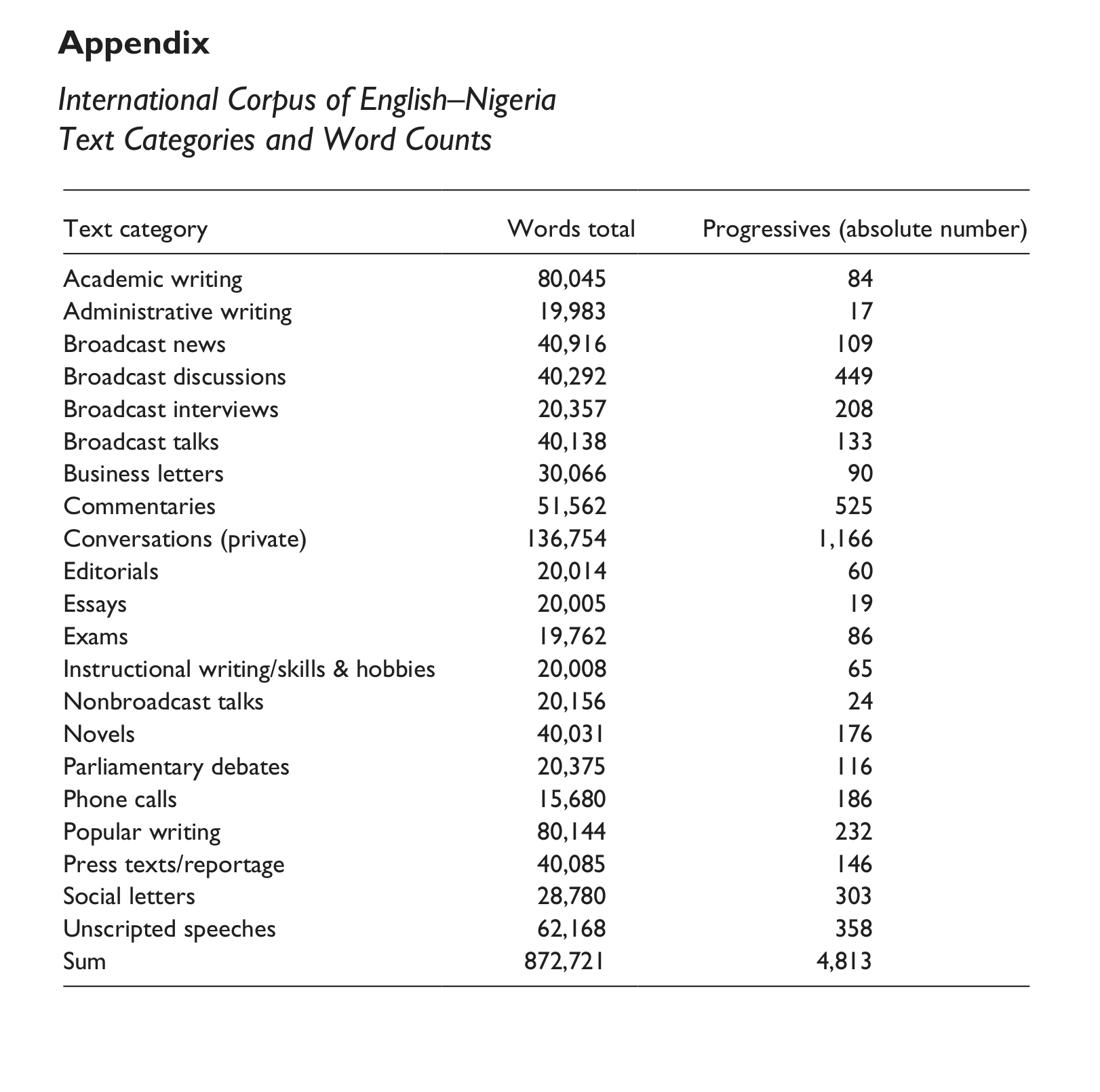
The production data were drawn from the ICE–Nigeria (NIG), which is being compiled at the University of Münster in Germany (Wunder, Voormann & Gut 2010). At the time of analysis, it comprised 872,721 words of written and spoken language (see the appendix for the word counts of each text category) produced by 1,191 educated Nigerians, 722 male and 469 female, aged between 18 and 76 years. These speakers use the sophisticated variety described by Udofot (2003) or Variety III described by Banjo (1971), which is associated with university education. Most of the speakers/writers in the corpus have either Yorùbá or Igbo as their first language.
The ICE-NIG was searched with AntConc 3.2.2 (Anthony 2011) for constructions consisting of a form of BE + a word ending in –ing with a maximum of three intervening words. 2 Constructions with gerunds and present participles as well as incomplete sentences and utterances that obscured the classification of the –ing construction were removed manually. Furthermore, progressives in nonfinite clauses such as They speak when they ought to be listening and keep sealed lips when they ought to speak were excluded from the analysis as they cannot occur with all tenses or the passive voice (see also Smitterberg 2005:117). A total of 4,813 progressive constructions in NigE were thus analyzed. For comparison with BrE, the ICE-GB corpus (Nelson, Wallis & Aarts 2002), which has a size of 1,061,264 words, was queried using the same procedure and yielding a total of 4,902 progressive constructions. The text categories legal presentations, demonstrations, business transactions, and cross-examinations, which are as yet underrepresented in the ICE-NIG, were excluded from the analysis. Examples from the corpus are given in the original spelling. Punctuation is provided in examples from the spoken material for ease of reading.
Results
Use of the Progressive Construction in NigE
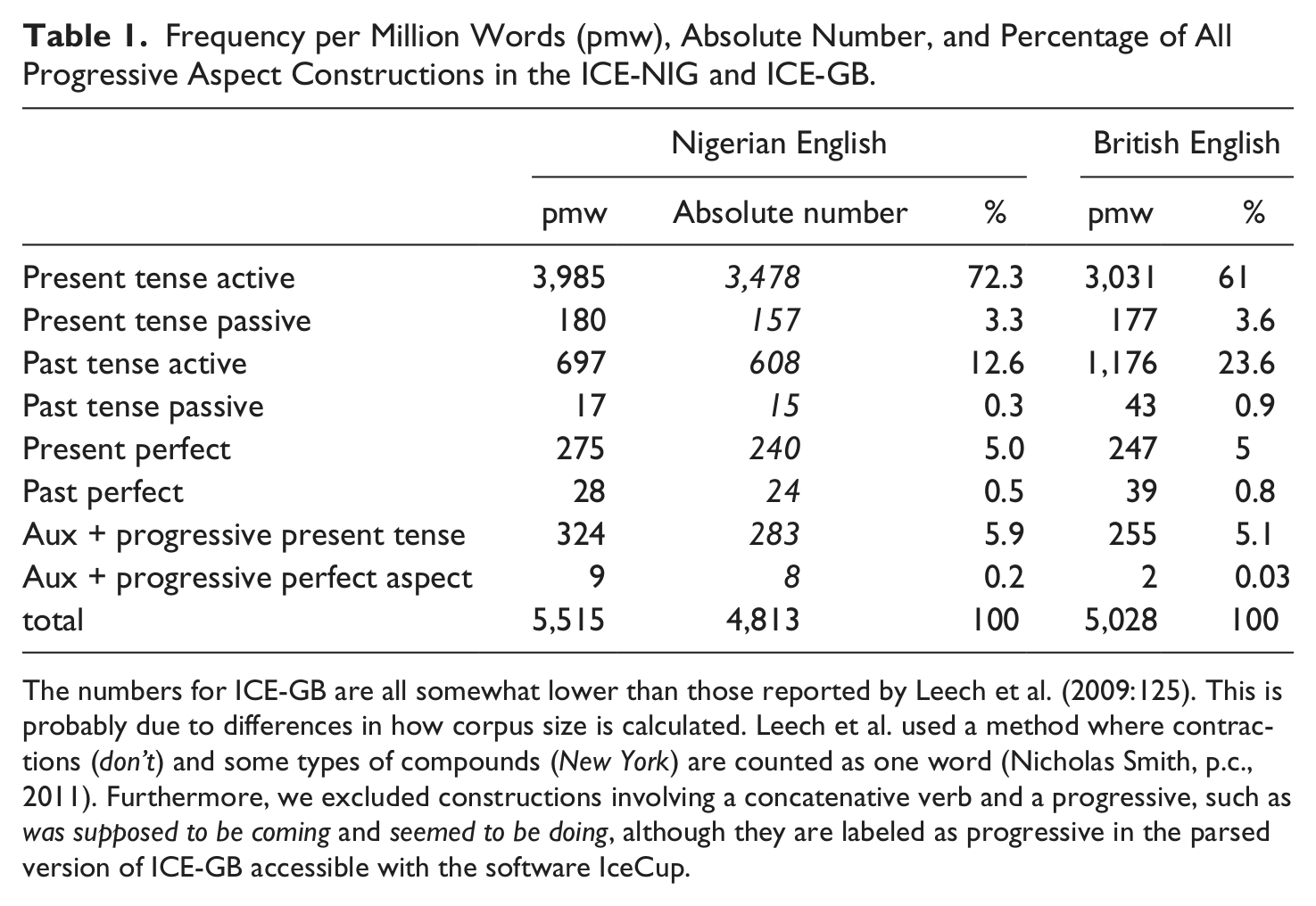
Progressive constructions occur in NigE with a frequency of 5,515 pmw. Table 1 gives the frequency (pmw), absolute number, and percentage of all progressive constructions in the corpus, divided by present progressive, past progressive, present perfect progressive, futurate progressive, present progressive passive, past progressive passive, and aux + progressive.
Frequency per Million Words (pmw), Absolute Number, and Percentage of All Progressive Aspect Constructions in the ICE-NIG and ICE-GB.
The numbers for ICE-GB are all somewhat lower than those reported by Leech et al. (2009:125). This is probably due to differences in how corpus size is calculated. Leech et al. used a method where contractions (don’t) and some types of compounds (New York) are counted as one word (Nicholas Smith, p.c., 2011). Furthermore, we excluded constructions involving a concatenative verb and a progressive, such as was supposed to be coming and seemed to be doing, although they are labeled as progressive in the parsed version of ICE-GB accessible with the software IceCup.
The most frequent progressive construction is a present tense form of BE + present participle in the active voice as in (1), which makes up 72.3 percent of all progressive constructions. The second most frequent structure, progressive constructions in the past and active voice (see (2)), occurs only in 12.6 percent of all progressive constructions. Complex progressive constructions are highly infrequent in the corpus; verbs marked for both passive and progressive are very rare with 3.3 percent in the present tense, as in (3), and 0.3 percent in the past tense (see (4)). Progressive aspect co-occurring with perfect aspect is equally rare: there are 5 percent present perfect and 0.5 percent past perfect progressive constructions in the corpus (see (5) and (6), respectively). A combination of a modal auxiliary with a progressive construction in the present tense occurs in 5.9 percent of all cases (see (7)); 0.2 percent of the examples occur with a modal auxiliary and are marked for perfect aspect (see (8)). Clearly, the progressive has a strong tendency to occur with present tense predicates in NigE.
(1) . . . not one single senatorial candidate and then erm on the eve of election you say you
(2) Oghara and Idjerhe kingdoms
(3) . . . the way and manner in which teachers welfare
(4) . . . many problems pertaining to language
(5) So what
(6) Already the states
(7) I guess I told you I
(8) we guess you
The overall frequency of progressive constructions is significantly higher (p < .001, log likelihood test) in NigE than in BrE, where it lies at 5,028 pmw. Past progressive (active) constructions are relatively less frequent in NigE with 697 pmw compared to 1,176 pmw in BrE. Likewise, the past progressive passive is several times as frequent (43 pmw) in BrE as in NigE (17 pmw). This can, at least partly, be explained by a general tendency of the past tense to be used less frequently in NigE than in BrE (Fuchs 2012).
Stylistic Variation
The frequency of progressives in NigE depends highly on text type (text categories with an absolute number of progressives below 25 are excluded). Figure 1 shows that in NigE progressive constructions tend to occur primarily in informal text types such as phone calls (with a frequency of 11,862 pmw), social letters (10,066 pmw), and media talk (11,444 pmw in broadcast discussions and 10,218 pmw in broadcast interviews), while they are very rare in academic writing (1,049 pmw), student essays (950 pmw), and administrative writing (850 pmw). Asterisks show significant levels of differences between ICE-NIG and ICE-GB (log likelihood with Bonferroni correction, see Rayson, Berridge & Francis 2004). Compared to the Black South African student writings that showed a frequency of 6,870 progressives pmw (Van Rooy 2006:47), Nigerian students use far fewer progressives, even fewer than were found in the British students’ essays (3,700 pmw) that were analyzed in Van Rooy (2006:47).
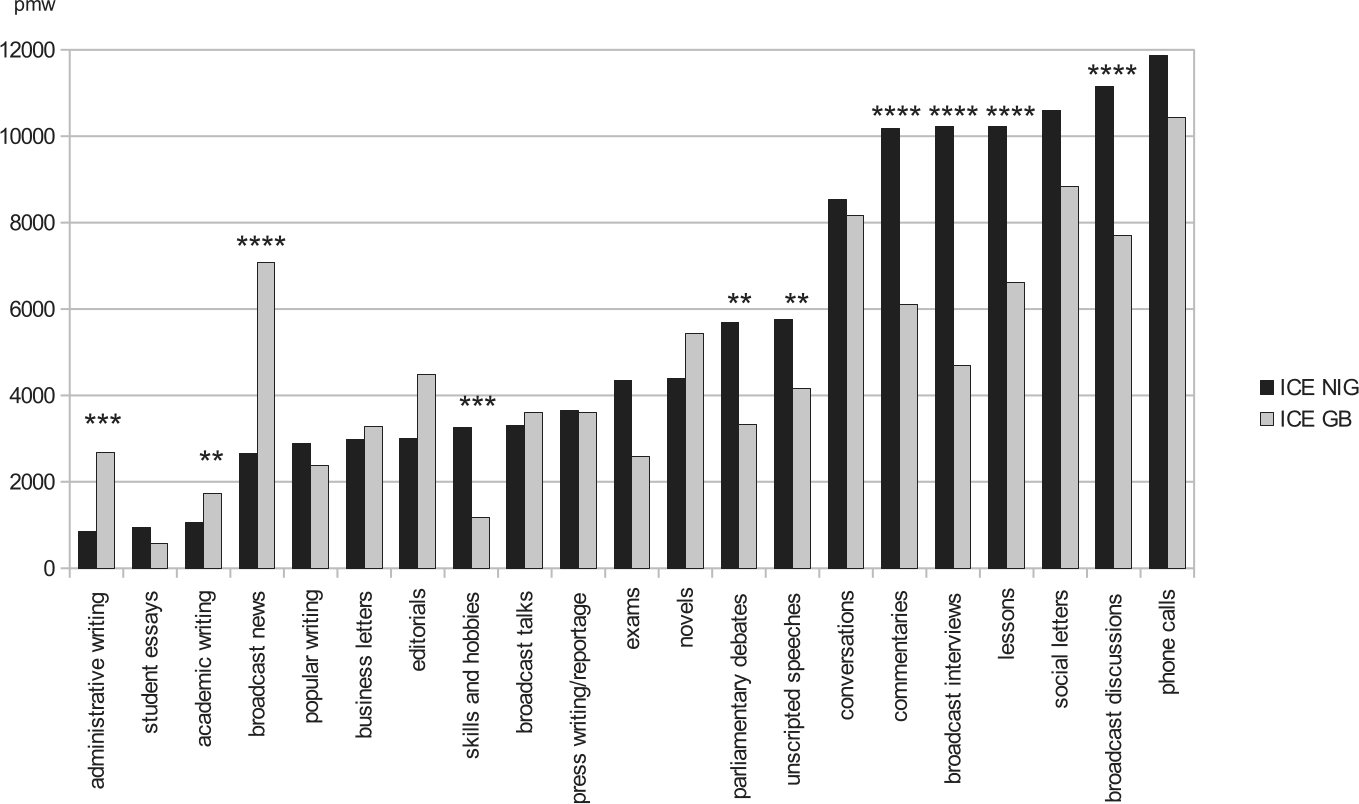
Frequency per million words of progressive aspect constructions in the different text categories.
The stylistic variation of progressive constructions in NigE is in some cases significantly dissimilar to that found in BrE. For instance, Nigerian speakers of English use far fewer progressive constructions in registers that involve a formal and detached presentation of information such as broadcast news, administrative writing, and academic writing. A significantly higher use of progressives by NigE speakers compared to BrE speakers, by contrast, occurs in the text categories skills and hobbies, parliamentary debates, unscripted speeches, commentaries, broadcast interviews and discussions, and classroom lessons. Most of these have in common that speakers wish to express their opinion or persuade or convince others.
Figure 2 illustrates that there is also distinct stylistic variation in terms of the relative frequency of different types of complex progressive constructions in NigE: while verbs marked morphologically with a combination of progressive and perfect aspect as in (5) are very infrequently found in classroom lessons, conversations, and broadcast discussions, they have a high relative frequency in text types that require a high degree of preparation such as news writing, social letters, broadcast talks, and parliamentary debates. Progressive constructions that include modal auxiliaries, as in (7) and (8), are very rare in factual informational language such as in academic writing, broadcast news, and press writing. Conversely, a prevalence of these constructions was found in commentaries, parliamentary debates, and broadcast talks. Progressive passive constructions, as in (3) and (4), seem to be associated with formality: they are particularly frequent in the formal, informational text types academic writing, press writing, broadcast news, and student essays while they are extremely rare in the informal text types commentaries, phone calls, social letters, and private conversation (less than 2 percent of all progressive constructions).
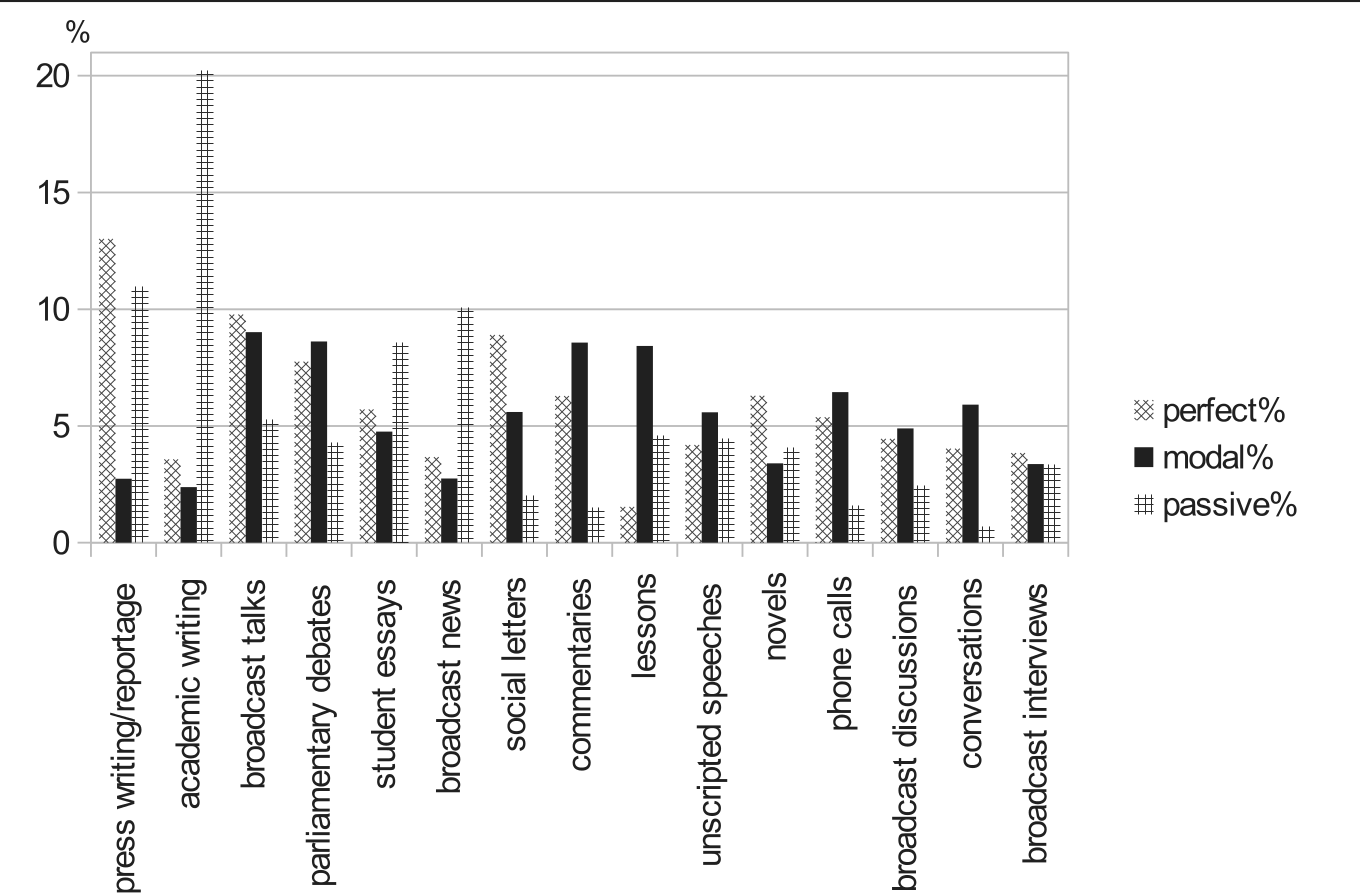
Relative frequency (in percentage of all progressive constructions) of complex progressive aspect constructions in Nigerian English in different text types.
Stylistic differences between NigE and BrE were found not only in the overall use of progressive structures, but also in the relative distribution of individual progressive structures: while in BrE the past progressive (active) is strongly favored in spoken language (1,751 pmw in the spoken, 822 in the written part of ICE-GB; p < .0001), this tendency is much less pronounced in NigE (920 vs. 621 pmw; p < .0001). Like the past progressive, the NigE present perfect progressive is only slightly more frequent in spoken than in written language, while in BrE it is more than twice as frequent in spoken language (ICE-GB spoken: 379 pmw, written: 145 pmw, p < .0001; ICE-NIG spoken: 373 pmw, written: 236 pmw, p < .001).
By the same token, passive progressive constructions have a higher absolute frequency in NigE than in BrE (Leech et al. 2009:138). In the latter, only informational text types such as broadcast news and editorials contain these constructions with a rate of more than 300 pmw, and they are as infrequent as 37.5 pmw in academic writing and 50 pmw in fiction. In NigE, on the other hand, passive progressive constructions occur with a frequency of 470 pmw in classroom lessons, 273 pmw in broadcast discussions, 257 pmw in unscripted speech, and 202 pmw in social letters. This might be one reason why especially spoken NigE appears more formal than spoken language in standard varieties of English (Chiluwa 2008:52). In terms of the frequency of rare constructions such as progressive BE-passives and progressives with modal auxiliaries, NigE is much closer to BrE than to AmE, which makes use of far fewer of these constructions (Leech et al. 2009:122-141). In fact, NigE speakers produce such constructions even more frequently than BrE speakers do.
Extended Use of the Progressive
Of the 4,813 progressive constructions that were found in the corpus, 770 or 16 percent can be classified as representing an extended use. This classification was based on a comparison with the standard uses described in Greenbaum and Quirk (1990), Biber et al. (1999), Huddleston and Pullum (2002), and Leech et al. (2009) listed above. It is possible, though, that some of these NigE sentences and utterances would also be accepted by native speakers of BrE or AmE. Unfortunately, the scope of this study does not allow a comparison of the relative frequency of these extended uses in NigE with their frequency in BrE.
Of the extended uses of the progressive, 618 instances (80.3 percent) occur with verbs in the present tense. Progressive constructions with an extended sense also occur in the past tense (57 or 7.4 percent), in perfect constructions (34 or 4.4 percent), and with modal verbs (61 or 7.9 percent). Like the progressive construction on the whole, extended use of progressives shows a slight bias for present tense verbs, which represent 72.3 percent of all progressive constructions (see Table 1).
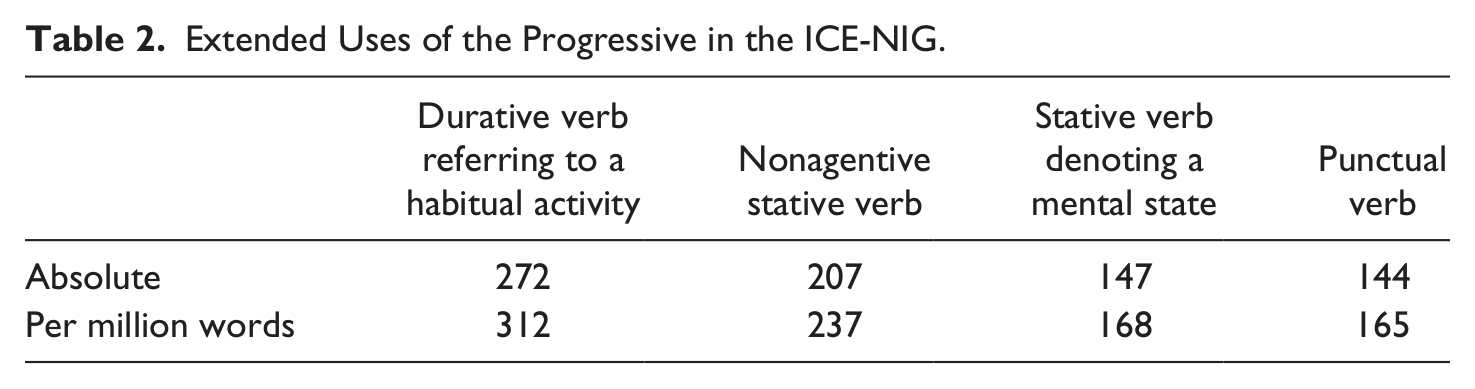
Table 2 shows the absolute and pmw frequency of the four different extended uses of the progressive that were found in NigE. Progressives with habitual durative, that is, nonbounded activities, represent the largest group of extended usage with a frequency of 312 pmw. Examples of such use are given in (9) to (11):
Extended Uses of the Progressive in the ICE-NIG.
(9) I believe that I
(10) VoIP
(11) I’m still
The extended use with nonagentive stative verbs is fairly frequent in NigE (237 pmw). Examples (12) to (15) are cases in point:
(12) Why did you say I
(13) you asked how do you know that the speaker erm is
(14) I hope you
(15) I can’t believe what I’
Extended use of the progressive with verbs denoting a mental state is illustrated in (16) to (18):
(16) we
(17) why
(18) I
The rarest extended use of the progressive in NigE was found for punctual verbs such as illustrated in (19) and (20):
(19) . . . want to study erm English language but when you’
(20) and we
Figure 3 shows that the use of the progressive with an extended meaning varies with the text type. It is most common in media talk (broadcast discussion and broadcast interviews) and classroom lessons, while it occurs very rarely in press writing and academic writing. While the use of the progressive with habitual, durative verbs is shared by almost all text types, the progressive form used with nonagentive stative verbs such as to hear occurs only in the more informal text types social letters and media talk.
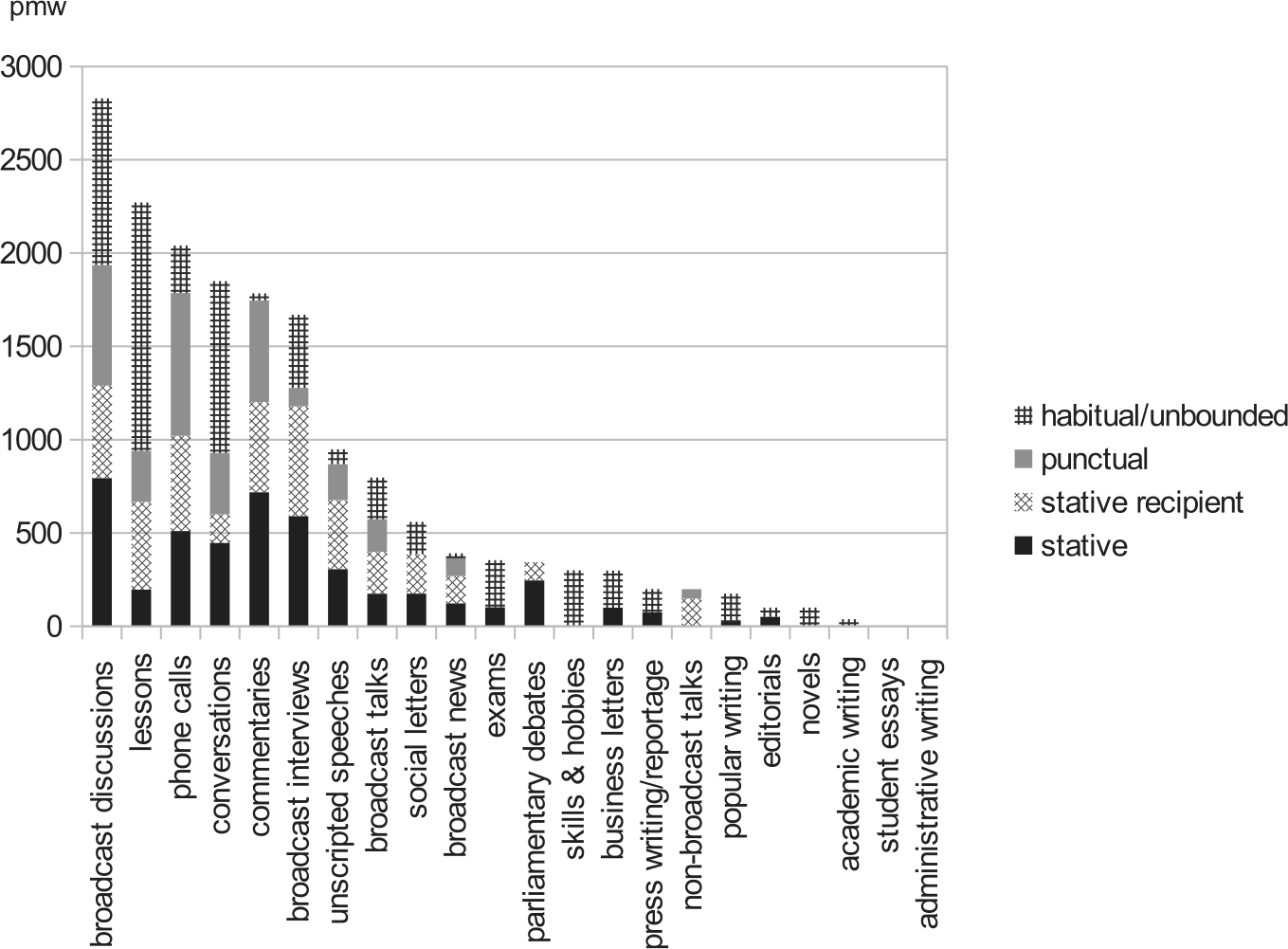
Occurrence (per million words) of the different extended uses of the progressive in different text types.
Some of these extended uses of the progressive in NigE might be explained by first language influence. The verbs marked for progressive aspect that refer to habitual durative activities can be interpreted as a result of transfer from the Yorùbá habitual markers máa ń, ma ń, a máa, or a (Bamgbose 1966:92; Akanni 1980; Awoyale 1991:199-205). Like in Yorùbá, in Igbo aspect marking on verbs is possible: nà marks the progressive and can express both habitual and continuous meaning (Williamson 1972:xxiv; Okiwelu 1991:474-476; Anyanwu 2010:47-48). The preverbal marker àna marks the “progressive unexpected” and is used to express surprise, emphasis, and sarcasm (Williamson 1972:xxiv; Emenanjọ 1978:174). Moreover, in Igbo the progressive is also used to express eternal truths, such as in geographical and scientific statements as well as in proverbs (Emenanjọ 1978:176).
A total of 31 verbs that are marked with a progressive of extended meaning in ICE-NIG have some incompletive meaning and might therefore represent transfer from the Yorùbá incompletive aspect marker ń or the Igbo preverbal marker nà. In some cases, this analysis is supported strongly by the presence of still, as shown in (21) and (22):
(21) I
(22) She told me that and I’
Moreover, the relatively low number of extended uses of the progressive with punctual verbs could be explained by referring to the fact that punctual verbs in Igbo do not take the progressive (Okiwelu 1991:472-474). 3 The one instance of a punctual verb marked with the progressive that was found in the corpus, (23), can indeed be interpreted as referring to an incomplete state and thus might be marked by a transferred incompletive aspect.
(23) My PhD at Ibadan which I am still pursuing
Last, one instance of transfer of the Yorùbá anticipative aspect proposed by Ajani (2001:125) might be seen in (24) where the speaker speculates about the future:
(24) You’
In sum, the corpus analysis of language production showed that progressive constructions in NigE occur predominately with present tense verb forms. They show distinct stylistic variation with a higher frequency in informal text types and media talk, and lower frequency in formal, informational text types. In comparison to BrE, the overall frequency of progressive constructions is higher in NigE. Yet, there are fewer past tense constructions and fewer progressives in some text types particularly in academic writing, broadcast news, and administrative writing. Conversely, Nigerians produce more progressives than British speakers in “opinion-expressing” or “persuasive” text categories such as parliamentary debates, unscripted speeches, commentaries, broadcast interviews and discussions, and classroom lessons. An extended use of the progressive was found in NigE with durative verbs referring to a habitual activity, with stative verbs denoting a mental state, with nonagentive stative verbs, and with punctual verbs.
Yet, additional explanations of the extended use of the progressive in NigE other than first language influence should not be ignored. Previous research has suggested that there might be some language-internal mechanisms of complexity reduction that underlie shared structural innovations in New Englishes (e.g., Mair’s [2003] “angloversals”). Systematic comparative studies of the use of the progressive across various New Englishes are called for to investigate these mechanisms in more detail. Moreover, it is possible that there is an influence from different teaching traditions in Nigeria. The tendency of Nigerian speakers to produce progressive constructions with stative verbs and verbs of perception has been described in various places (Jowitt 1991:114; Alo & Mesthrie 2008:325), and the syntactic behavior of this small group of verbs can relatively easily be taught in school. By contrast, the nonrealization of the habitual aspect in Yorúbà and Igbo as an English progressive might be more difficult to explain in class and might prove more difficult for teachers to detect in students’ production.
Grammaticality Judgments
Data and Method: Grammaticality Judgments
Grammaticality judgments were elicited using the questionnaire method. A total of twenty-three sentences and utterances containing extended uses of the progressive and other verb forms were taken from the written and the spoken part of the ICE-NIG, and one sentence was constructed by the authors. Seven sentences contained a progressive construction with a durative verb referring to a habitual activity; in five cases the verb marked with the progressive was a stative verb denoting a mental state; in five further cases the verb marked with the progressive was a nonagentive stative verb; and one punctual verb occurred with the progressive. In addition, five sentences contained progressive forms that are in accordance with standard English grammar, and one sentence contained a simple verb form that would have been produced as a progressive form in standard English. Apart from the twenty-four test sentences, twenty distractor sentences taken from ICE-NIG were also included in order not to raise the respondents’ awareness of the object of the questionnaire. As a consequence of a pretest that showed that the resulting questionnaire was too long, the twenty-four test sentences were eventually distributed in two different questionnaires with twelve test sentences and ten distractor sentences each. The instruction for the respondents was “Please correct all errors (if there are any) in the sentences below.” The informants were teachers, lecturers, and students of English (see below). While the responses by these informants are certainly not representative of the average Nigerian speaker, it can be assumed that if a structure is accepted, that is, not corrected, by them, the likelihood that other speakers will also accept it is high. Acceptance in our study was interpreted as a speaker’s readiness to recognize the endormativity—that is, the systematic local use and acceptance—of a certain structure. The nonacceptance of structures, conversely, might of course reflect prescriptive rules these speakers teach or were taught in school, and might not correlate with their actual language use in all cases.
The grammaticality judgments were elicited in November 2010 during a national conference of NigE teachers and lecturers held at Covenant University, Ota. A total of fifty-two Nigerians, twenty-eight of them English teachers and lecturers and twenty-four of them students of English, filled out one of two different questionnaires during a conference break. Of them, thirty-three were speakers of Yorúbà, ten were speakers of Igbo, and the remaining nine had other Nigerian languages as first languages. The corrections of the test verb forms that were made by the respondents were categorized into two different classes: (1) corrections concerning the progressive form of the verb and (2) other corrections (e.g., exchanging the verb but keeping the progressive form) and other changes (e.g., underlining the verb form but not giving an alternative). Changes were recorded too as they probably indicate the respondents’ nonacceptance of a verb form although they might not have been able to specify exactly in what way it should be corrected.
Results: Grammaticality Judgments
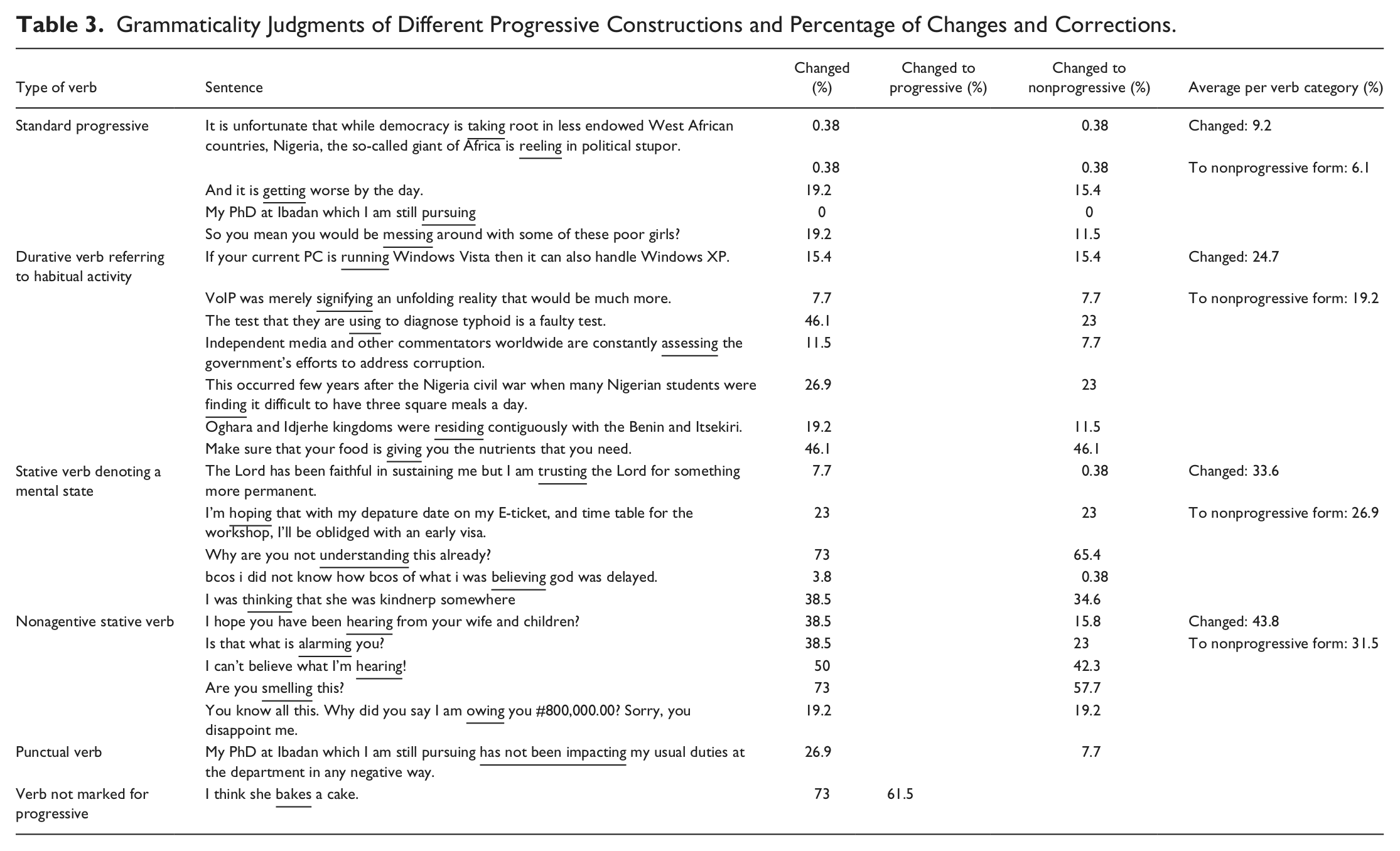
Table 3 shows the percentage of changes and corrections made by the Nigerian teachers, lecturers, and students of English in the twenty-four progressive constructions and other verb forms in the questionnaires; since no si
Grammaticality Judgments of Different Progressive Constructions and Percentage of Changes and Corrections.
(25) And it
(26) So you mean you
This low figure of false corrections of progressive constructions could on the one hand be interpreted as a general, underlying “baseline” insecurity about this grammatical feature. On the other, it probably simply reflects the propensity of questionnaire respondents to make changes when expressly instructed to do so.
The seven durative verbs referring to a habitual activity that were marked with the progressive in the questionnaire were, on average, changed in 24.7 percent of all cases and were corrected to a nonprogressive verb form in 19.2 percent of all cases. The highest rate of such corrections occurred in (27):
(27) Make sure that your food
The questionnaires contained five stative verbs that refer to mental states that were marked with the progressive. On average, 33.6 percent of all occurrences were changed and 26.9 percent of the forms were corrected into verbs not marked for the progressive. A clear divide between the different verbs can be observed: while believing and trusting in examples (28) and (29) were corrected by only one of the twenty-six respondents (0.38 percent) each, thinking and understanding in examples (30) and (31) were corrected to a simple verb form in 34.6 percent and 65.4 percent, respectively. Hoping in example (32) was corrected in 23 percent of all cases.
(28) bcos i did not know how bcos of what i
(29) The Lord has been faithful in sustaining me but I
(30) I was aferid because she never even a day miss at home. I
(31) Why
(32) I’
Of the extended uses of the progressive, nonagentive stative verbs form the group of verbs with the highest correction rate. Of the five nonagentive stative verbs marked with the progressive, an average of 43.8 percent were changed by the respondents, and an average of 31.5 percent of all cases in the questionnaires were corrected to a simple verb form. The rate of corrections varies from 15.8 percent for sentence (33) to 57.7 percent for sentence (34). Smelling in sentence (34) furthermore is the verb in the questionnaire that had the highest lexical change rate. Of all respondents, 42.3 percent changed it into perceive or perceiving.
(33) I hope you
(34)
The punctual verb marked for progressive in (35) was corrected to a simple verb form in 7.7 percent of all cases.
(35) My PhD at Ibadan which I am still pursuing
The questionnaires furthermore contained one constructed sentence with the verb bake that would be marked by a progressive in standard English (36):
(36) Are you smelling this? - I think she
This form was changed nineteen times (in 73 percent of all cases) and corrected to baking sixteen times (61.5 percent), which is among the highest correction rates. A rate closer to 100 percent might have been expected here, but the nature of the task, which involved frequent corrections, might have precluded higher rates.
Overall, the extended uses of the progressive that were changed least and therefore accepted most were the two verb forms believing and trusting that refer to a mental state in sentences (28) and (29) with an acceptance rate of 99.62 percent each. Equally, the two forms of the habitual durative verbs assessing and signifying in (37) and (38) show a very high acceptance rate of 92.3 percent.
(37) VoIP
(38) Independent media and other commentators worldwide
The lowest overall acceptance rate was found for the verb forms understanding (acceptance rate 34.6 percent) in (31) and smelling (acceptance rate 42.3 percent) in (34).
Comparison of Use and Acceptability of Progressives
In a final step, the frequency of the verbs with extended use of the progressive in NigE was compared with the acceptability judgments. Although the ICE-NIG is too small to give reliable information about the frequency of verbs in NigE as a whole and the number of verbs in the corpus is too restricted for statistical analyses, the findings suggest that high frequency implies high acceptability, but not vice versa. This relationship is especially pronounced when considering the relative likelihood of a verb to take the progressive given its absolute number of occurrences in the corpus: habitual durative to reside, for example, is used in the progressive in 25 percent of all occurrences in ICE-NIG and was accepted in the extended use progressive form by 88.5 percent of the informants. Conversely, there is no clear relationship between verbs that rarely occur in the progressive and their acceptance in extended usage. Less than 1 percent of all tokens of believe occur in the progressive in the corpus, yet believing was accepted in 99.62 percent of all cases. This stands in sharp contrast to understanding, which is equally rare in the progressive in the corpus but which was not accepted by 65.4 percent of all informants.
Low acceptability seems to have a tendency to go hand in hand with low frequency. The progressive forms understanding and smelling showed the lowest acceptability rates of all progressive forms, and they occur extremely rarely (less than 1 percent of all forms of understand) or not at all (in the case of smell) in the corpus. The observed mismatch between the acceptability ratings and the corpus results in this study seems to contradict usage-based theories of language, which hold that the perceived acceptability of a structure is strongly tied to its frequency of use (see overviews in Manning & Schütze 1999 and Manning 2003). However, our results substantiate previous findings that some grammatical structures are highly or moderately acceptable yet rarely used (Featherston 2005:194-195; Kempen & Harbusch 2005:336-338). They also support Bader and Häussler’s (2010) generalizations that low acceptability implies low frequency, and high frequency high acceptability, but that in each case the reverse does not necessarily hold.
Summary and Conclusion
One of the objects of this study was to give a comprehensive account of the use of the progressive in NigE. The corpus analysis showed that progressive constructions occur mainly with present tense verb forms; they occur most frequently in some involved and informal text types and media talk and least frequently in formal, informational text types. In terms of frequency, distribution, and stylistic variability, therefore, the progressive aspect system in NigE appears fairly similar to that of standard BrE. Some significant differences between the two varieties, however, exist. First of all, the overall frequency of progressive constructions is higher in NigE than in BrE, which is largely due to an increased frequency of these constructions in commentaries, broadcast interviews and discussions, and classroom lessons. It thus appears that the overall rise of progressive constructions that has been observed in both BrE and AmE in the past fifty years (Mair & Hundt 1995:113), especially in newspaper language (Mair & Leech 2006:323), is paralleled in NigE. This relative “overuse” of the progressive, however, seems to be mainly restricted to what we referred to as “opinion-expressing” or “persuasive” text types. Nigerians use fewer progressives than BrE speakers in text categories of a more objective and information-oriented character such as broadcast news and administrative writing.
With regard to different types of progressive constructions, further cross-varietal differences were observed: NigE speakers/writers use far fewer past progressive forms than BrE speakers/writers do. Overall, the preference for the past and present perfect progressive in spoken language over written language is less pronounced in NigE compared to BrE. Conversely, passive progressive constructions in NigE are not restricted to informational text types as in BrE but occur also in informal text types. Comparable data from other New English varieties not being available, only future research will show whether these preference patterns are specific to NigE or whether they reflect shared developments.
Furthermore, speakers of NigE use the progressive with durative verbs referring to a habitual activity, with stative verbs denoting a mental state, with nonagentive stative verbs, and with punctual verbs. These uses are not entirely uncommon in native varieties of English and therefore do not reflect a fundamental difference between varieties but probably rather a difference in the frequency of usage (a hypothesis that needs to be verified empirically in future research). The extended use of the progressive in NigE occurs most often with present tense verbs and in media talk. While progressives with habitual meaning can be found across various text types, their occurrence with nonagentive stative verbs such as hear and come from is restricted to informal text types. In total, this extended use makes up 16 percent of all progressive forms in NigE. Thus, from a quantitative point of view, this number lends some support to the observations that the extended use of the progressive occurs in NigE, as has been suggested for New Englishes in general (see, e.g., Platt, Weber & Ho 1984:72-73; Kortmann & Szmrecsanyi 2004:1189; Mesthrie 2008b:626; Trudgill & Hannah 2008:107, 130, 137). Whether extended uses are more frequent in these varieties than in other varieties such as BrE or AmE remains an open question for future research.
A comparison with other New Englishes shows that the NigE progressive construction system is both similar and distinct from that of other varieties. For instance, like in the case of the basilectal Indian English speakers studied by Sharma (2009), both an overextension of the progressive to durative habitual verbs and its use with stative verbs were observed in NigE. Conversely, the frequency of progressive forms in student essays written by Nigerians is much lower than that of essays written by Black South African students (Van Rooy 2006:47).
It was shown that some of the uses of the progressive in NigE might be explained by first language influence as claimed by Ajani (2001) and as found for Indian English by Sharma (2009) and for Setswana English by Van Rooy (2006). A number of the progressive forms with extended use occur in sentences that would be marked by incompletive aspect markers in Yorúbà and Igbo. Similarly, one instance was found of a progressive used in analogy to the Yorúbà anticipative aspect (24). The L1 transfer hypothesis can furthermore be invoked to explain the different acceptance rates of the five verbs that refer to mental states in the questionnaires. In (28), the verb believe and in (29) the verb trust would probably be marked for incompletive aspect in Yorúbà or Igbo. A corpus search of the ICE-NIG showed that those two verbs are in the overwhelming majority of cases not marked for the progressive. Believe is marked for the progressive in only 3 out of 172 cases, and the four instances of trusting, which all occur in social letters, stand against the fifteen cases of trust in the same syntactic environment in other sentences.
Cogent as the L1 transfer hypothesis is, future research should investigate whether the extension of the progressive in New Englishes can also be considered a consequence of the factors that have led to the rise of the progressive in BrE and AmE (Leech et al. 2009). Likewise, further research could address the question of whether in addition to extended uses of the progressive there are instances of a simple verb form in New Englishes where the progressive is preferred in BrE and AmE. Such investigations would help determine whether the progressive constitutes a structure whose use is determined mainly by semantic constraints in all varieties of English or whether pragmatic considerations might play a larger role in New Englishes.
Footnotes
Appendix
International Corpus of English–Nigeria Text Categories and Word Counts
| Text category | Words total | Progressives (absolute number) |
|---|---|---|
| Academic writing | 80,045 | 84 |
| Administrative writing | 19,983 | 17 |
| Broadcast news | 40,916 | 109 |
| Broadcast discussions | 40,292 | 449 |
| Broadcast interviews | 20,357 | 208 |
| Broadcast talks | 40,138 | 133 |
| Business letters | 30,066 | 90 |
| Commentaries | 51,562 | 525 |
| Conversations (private) | 136,754 | 1,166 |
| Editorials | 20,014 | 60 |
| Essays | 20,005 | 19 |
| Exams | 19,762 | 86 |
| Instructional writing/skills & hobbies | 20,008 | 65 |
| Nonbroadcast talks | 20,156 | 24 |
| Novels | 40,031 | 176 |
| Parliamentary debates | 20,375 | 116 |
| Phone calls | 15,680 | 186 |
| Popular writing | 80,144 | 232 |
| Press texts/reportage | 40,085 | 146 |
| Social letters | 28,780 | 303 |
| Unscripted speeches | 62,168 | 358 |
| Sum | 872,721 | 4,813 |
Acknowledgements
We are grateful to our anonymous reviewers and the editors for their insightful comments and valuable suggestions on an earlier version of this article.
Declaration of Conflicting Interests
The author(s) declared no potential conflicts of interest with respect to the research, authorship, and/or publication of this article.
Funding
The author(s) disclosed receipt of the following financial support for the research, authorship, and/or publication of this article: This research was funded by the German Research Council, DFG (GU 548/6-1).