



Abstract
This article explores the modulation of seven verbs that mark source of information in English:
1. Introduction
“Evidentiality” (in the sense of marking the source of information or knowledge) remains an underexplored aspect of English. This is in large part because English has not been seen as possessing evidentiality in terms of the obligatory, morphological marking found in other languages (Aikhenvald 2004, 2018). However, studies of English have begun to show that language users have developed and employed a wide range of lexical and grammatical resources to express evidentiality in different historical contexts and for different purposes (e.g., Traugott 1989; Gisborne & Holmes 2007; Whitt 2010, 2016, 2018a, 2023; Grund 2012, 2013, 2016, 2021; Mélac 2022). These studies have also pointed to the complex intersection of evidentiality and the expression of “stance,” that is “personal feelings, attitudes, value judgments, or assessments” (Biber, Johansson, Leech, Conrad & Finegan 1999:966). But the parameters and pathways of change have not yet been fully outlined and questions regarding the sociopragmatic deployment of evidential markers in historical contexts have yet to be extensively explored.
This study focuses especially on the second aspect: the historical use of evidentials to fulfill sociopragmatic functions. I explore how language users, in the context of signaling the source of the information they convey, modulate their source claim, by, for example, boosting its significance, giving justification for the source, or even negating it. In (1), a trial witness (Agnes Bolter) in the sixteenth century claims to know (knoweth) that Elizabeth, a woman brought to trial on a defamation charge, made a statement that is potentially defamatory.
(1) whiche said <f. 4r> wordes althoughe this deponent did {not} see the same did at the speakinge thereof yet she knoweth
Agnes could simply have said that Elizabeth made a particular statement, since marking the source of information has never been obligatory in English. But she chooses to claim knowledge, a fairly vague source reference. Perhaps recognizing the relatively weak claim or prodded to clarify, Agnes strengthens it with the use of certainly and of her own knowledge, underscoring her conviction and the (perceived) significance of the testimony. Likely after further questioning (after all, what does of her own knowledge actually mean?), Agnes specifies her knowledge basis (“Reddens cam~ scie~ sue” reddens causam sciencie sue ‘giving the reason for her knowledge’): as Elizabeth’s neighbor, she has had first-hand experience with Elizabeth’s voice in the past.
As this example suggests, complex dynamics are involved in claiming a source of information and in negotiating that claim to fulfill the language user’s communicative needs in a legal setting. This article explores these dynamics. Specifically, the article aims to address the following research questions:
(a) What is the frequency of modulation (versus non modulation) for the seven evidential verbs
(b) What types of modulation are found in the data and what stance functions do these modulations perform?
My data comes from Early Modern English materials where source marking and knowledge negotiation are central: legal records, and especially witness depositions, from the Salem witch trials in 1692-1693 (RSWH; Rosenthal et al. 2009) and from criminal and ecclesiastical courts in England in the period 1560-1760 (ETED; Grund & Walker 2011). In these records, witnesses (and others) are frequently concerned with framing their own position vis-à-vis their knowledge and, concomitantly, expressing their situational roles as witnesses and their (degree of) alignment or disalignment with other trial participants (cf. Du Bois 2007).
I show that the verbs are crucial sites of evidential and stance-related negotiations. The study illustrates the importance of charting the sociopragmatic nature of these features to uncover reasons for their variable use in particular synchronic-historical communities and contexts. Indeed, it highlights the centrality of evidentiality as a stance resource.
After a scholarly background (section 2) and a discussion of material and method (section 3), I provide an overview of the results in section 4.1, followed by a detailed discussion of five major types of knowledge negotiation and stance: degree modification and frequency (4.2), negation (4.3), evidential combination (4.4), and justification (4.5). I conclude in section 5 by summarizing the study and outlining some of its larger implications.
2. Background
Previous research into evidentiality in English has been shaped by broader debates in the study of evidentiality cross-linguistically. Some, especially language typology scholars, hold that English does not possess evidentiality, as it is not part of the (morphological/grammatical) structure of the language; nor is it obligatory (e.g., Aikhenvald 2004:10, 2018). Such scholars do admit that English uses other, often lexical resources (or “strategies”) to express source of information, but also claim that such strategies do not qualify as evidentiality (Aikhenvald 2018:4-5). This curtailment of the concept and term has been questioned by a number of scholars (e.g., Whitt 2010; Grund 2012; Reber 2021:16, 299-300; Mélac 2022; Landert 2024:46-51), who show that such a delimitation is arbitrary. Users of English are indeed concerned with marking source of information in many contexts, and they exploit evidential markers for various communicative needs, even if the marking is not obligatory.
Perhaps even more central to the goals of this study is the debate about what to include under the umbrella of evidentiality. Again, language typology scholars often center the concept on “source of information” (how did the information provider come to know what they claim to know?). While they often acknowledge that source marking can have “epistemic extensions,” they maintain the primacy of source marking (e.g., Aikhenvald 2004:6-7). Scholars who focus on English, by contrast, frequently treat evidentiality and epistemic modality as one and the same or as overlapping (e.g., Chafe 1986; Biber & Finegan 1989; Stygall 1994; Taavitsainen 2001; Landert 2019, 2024). Such a conflation may be helpful in some ways as it allows us to look at evidentiality as part of a broader system. This system has been conceptualized by many as one of “stance,” where language users draw on a large number of available resources to express “personal feelings, attitudes, value judgments, or assessments” (Biber, Johansson, Leech, Conrad & Finegan 1999:966). At the same time, the conflation likely obscures the possibility that markers that signal source of information have distinct stance functions, or that this slice of stance exhibits distinct lexico-grammatical patterns. In other words, evidentiality is not the same as epistemic modality (as expressed by, e.g., modals such as may and might, or adverbs such as certainly and possibly); at the same time, it may perform similar functions, depending on context and purpose (cf. Fetzer 2014:74; Reber 2021:300).
While my study cannot address the distinctness of the patterns, it contributes to our understanding of how evidentials are deployed for communicative, sociopragmatic reasons in historical periods. As such, my study joins a body of research that has pointed to the interactional and social functions of evidential markers (e.g., Fox 2001; Clift 2006; Raymond & Heritage 2006; Kärkkäinen 2007; Fetzer 2014; Nuckolls & Michael 2014; Reber 2021). Unlike much of this research, my material is not directly interactional and conversational. The witness depositions that constitute the material of this study report witnesses’ observations, inferences, and conclusions about previous events and experiences. At the same time, these documents are interactive in the sense that they respond to or consider a perceived audience, usually the legal authorities, but possibly also other witnesses.
I argue that this perceived audience greatly affects the use of evidentials and their modulation in legal records. Key to understanding these patterns is Du Bois’s (2007) notion of the “stance triangle.” In his view, “[s]tance is a public act by a social actor, achieved dialogically through overt communicative means, of simultaneously evaluating objects, positioning subjects (self and others), and aligning with other subjects, with respect to any salient dimension of the sociocultural field” (Du Bois 2007:163). This characterization aligns well with the use and modulation of evidential markers in this study. The witnesses provide a source for a statement, which also usually involves claiming certainty, authority, and/or credibility. With this “public act” they also stake out for themselves a position of importance as a witness, or they downtone their role in the context. In so doing, they may actively align or disalign with an accused, other witnesses, or the legal system more broadly.
With the focus on evidentiality and stance in the history of English, my research also connects with the rapidly expanding body of research on stance resources in the history of English (e.g., Biber 2004; Włodarczyk 2007; Boggel 2009; Levorato 2009; Cecconi 2012; Chaemsaithong 2012, 2014; Grund 2012, 2021; Whitt 2018a; Landert 2019, 2024). The connection between stance and evidentiality in the history of English has not been the focus of much research so far (though see, e.g., Grund 2012, 2021; Whitt 2016, 2023), but several studies include aspects of source marking in broader takes on the stance resources available to language users in historical periods (e.g., Biber 2004; Boggel 2009; Landert 2024). My focus on the combination of stance resources (as evidenced in the modulation of evidential verbs) also relates to and supports Landert’s (2019, 2024) observation that stance resources tend to cluster in texts (cf. also Fetzer 2014).
3. Material and Method
My article draws data from two collections of witness depositions: the witch trials in Salem, Massachusetts, in 1692-1693, and criminal and ecclesiastical trials from England spanning the period 1560 to 1760. The Salem depositions are not publicly available in electronic form but exist in a printed edition (RSWH). I used electronic files that were created from the printed edition for an earlier study, Grund (2021). The 457 Salem depositions represent a text collection of ca. 90,000 words (for more details, see Grund 2021:15-42). The depositions from England, on the other hand, are available in an electronic, searchable text edition: ETED. Included there are 905 witness depositions, covering ca. 270,000 words (Grund & Walker 2011).
While both collections contain depositions, they should obviously not be seen as balanced corpora. In addition to differences in size, scope of time, and geographical origin, their circumstances of production also differ. As permitted by contemporaneous law in the late seventeenth-century Massachusetts Bay Colony, the Salem depositions were for the most part not recorded by professional scribes but rather by various individuals, including the deponents themselves and others who were enlisted by the deponents to write on their behalf (Grund 2021:25-39). The depositions are not the kind of factual, unbiased statements that we expect from modern trials but often strategically honed documents that are intended to serve specific goals for sets of deponents and/or recorders (Grund 2021). This is clearly reflected in some patterns we find in the evidential verbs and their modulation in this material.
The ETED material was produced under different circumstances and within different legal parameters. Some depositions were produced by highly trained, even professional recorders (especially in the ecclesiastical courts). Others (especially for local criminal courts) were taken down by people who had experience in writing the genre, but whose main profession was not that of scribe (Grund 2011:151-156).
Since it is to my knowledge the first to systematically look at the modulation of evidential verbs, this study focuses on outlining overall frequency patterns and functional categories of modulation. I provide breakdowns of the data according to collections, and I comment on and explore possible reasons for the patterns. However, this is not a systematic study of temporal and geographical trends, which would necessitate more balanced materials; such materials are not yet available for legal documents of this period.
Data selection and retrieval from the sources required several methodological decisions. There are many mechanisms that can signal source of information. In selecting the specific features for investigation, I relied on the comprehensive charting of evidentials in the Salem witch trial depositions from Grund (2012). Grund (2012:15-16) shows that verbs (or verb phrases) are the most common constructions expressing evidentiality there, and the specific verbs selected here represent the most significant verbs in different semantically-based categories of evidentiality (Grund 2012:11, based on Aikhenvald 2004:63-64):
The two sources are rife with spelling variation. To ensure full retrieval, I identified potential forms of the verbs in wordlists created with the help of WordSmith 8.0 (Scott 2022), considering all forms of the verbs (base form, present tense, past tense, past participle, and present participle). All verbs were scrutinized in context to ensure relevant results: all of the verbs are polyfunctional and hence do not always serve to indicate the source of the deponent’s information.
I study uses that reflect the deponent’s own evidential and stance-related negotiation in the reporting of the information in the testimony. I therefore exclude instances that are embedded in a previous speech event (i.e., it is part of what someone—the deponent or another person—said previously). These exclusions are made since embedded speech represents a different type of situation where we often lack a larger context, information about participants, and similar issues.
More broadly, there has been some debate about how to conceptualize the scope of evidentials (see, e.g., Boye 2010; Grund 2012, 2016; Whitt 2018b, 2023). Traditionally and frequently in typological work, evidentiality is tied closely to propositions and particular propositional constructions. That is, an evidential marker has to have scope over a (clausal) proposition in order to qualify. Example (2) would thus qualify, but example (3) would not. Example (2) involves two propositions—the seeing and the afflicting—and the seeing has scope over the afflicting. 1 In (3), by contrast, saw is seen as simply signaling the act of perception.
(2) she hath seen: George Jacobs Senɛ afflict: Mary Walcot Ann Putnam & Abigail Williams: (RSWH, no. 480) (3) I saw the Apperishtion of Sarah good which did tortor me (RSWH, no. 9)
While some distinctions between propositions and non-propositions are straightforward, there are reasons not to think about propositions simply as particular construction types and to see evidential markers as having more expansive scope in English (e.g., Grund 2012, 2016). In (4), for example, heard and see (“hard and se”) is not followed by a straightforward proposition, tied to a specific construction; rather the deponent provides a larger framing of the evidence provided subsequently, indicating its basis in sensory perception. By doing so, the deponent does not have to repeat the evidential basis throughout. In other word, heard and see has larger pragmatic scope in the deposition (Grund 2016:164-170). I adopt this larger sense of evidentiality and evidential scope in this article.
(4) This deponent saies that apon a Mondaye in the morninge about St Andrewes day Last past as he remembres this depont beinge espīally required bie Rog~ bibbye articulate reꝑ repaired to the house of Alex~ garnet nowe Maio~ of Liu~pole and there hard and se as followeth viz [. . .] (ETED, Chester 1562-1566: F_1ND_Chester_041)
The question of pragmatic scope is also significant in another respect. It is clear from a superficial glance at the data that the evidential claims instantiated by the verbs are modified, qualified, and negotiated in a range of ways. In most contexts the verbs are directly modified by, for example, adverbs such as well and verily; but, at other times, the depositions record longer sentential discussion of the limitations or implications of the evidential claim (see section 4), or the verbs cooccur with other evidential verbs. In other words, the claim receives contextual negotiation that goes beyond straightforward verb modification. With a sociopragmatically significant phenomenon such as evidentiality, such negotiation should of course not surprise us. But this contextual negotiation necessitates us to look beyond modification in a strict sense, which usually applies to more closely connected syntactic units, such as adjectives modifying nouns within a noun phrase (Quirk, Greenbaum, Leech & Svartvik 1985:65), to broader connections. I therefore use the term “modulation.” This notion and approach also dovetail nicely with Landert’s (2019, 2024) findings that stance markers (including evidentials) cluster, helping to shape the projection of a particular stance. Here I am of course not concerned with all the stance markers in a particular context (as in Landert’s studies), but rather more locally with how contexts reinforce, strengthen, mitigate, or problematize an evidential claim and by extension a stance.
4. Results
4.1. Overall Patterns
Table 1 shows the rate of modulation in the two data sources according to different verbs. 2
Modulation and Non-Modulation of Evidential Verbs
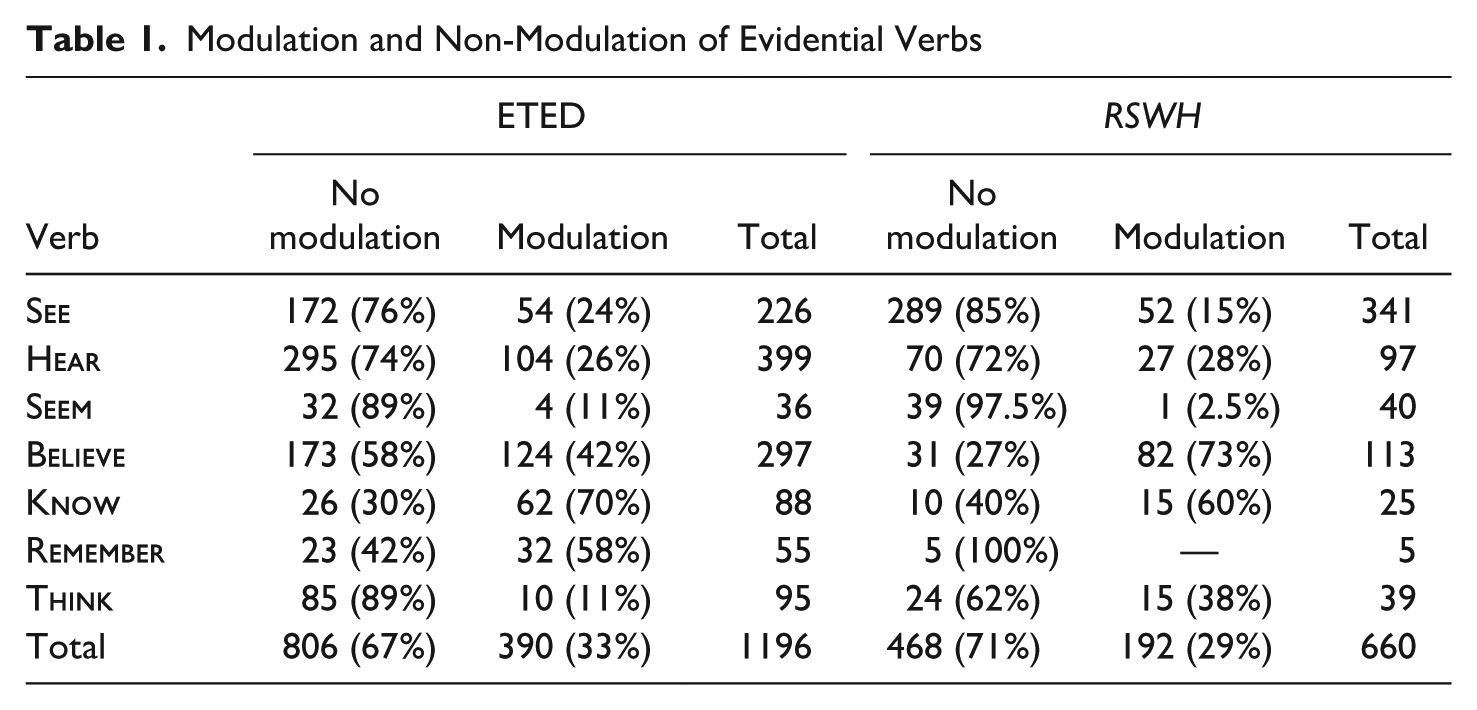
For most verbs non-modulation is the norm, but there is variation across verbs, with
More complex yet is the question of whose patterns we see reflected in the texts: the deponents’ and/or the recorders’. The recorders of the testimony may have left out or changed features used by the deponents according to their preferences or sense of what was appropriate in the context. While such modifications cannot be discounted, they do not appear to have been systematic. I return to a consideration of the role of the recorders in various contexts.
To my knowledge there is no previous descriptive framework for the kinds of modulations found in this study. I therefore construct the categories of description as they emerge in the data. Table 2 gives an overview of these categories, presented according to the verbs. Distinctions between the two data sources are discussed in subsequent sections.
Modulation Categories
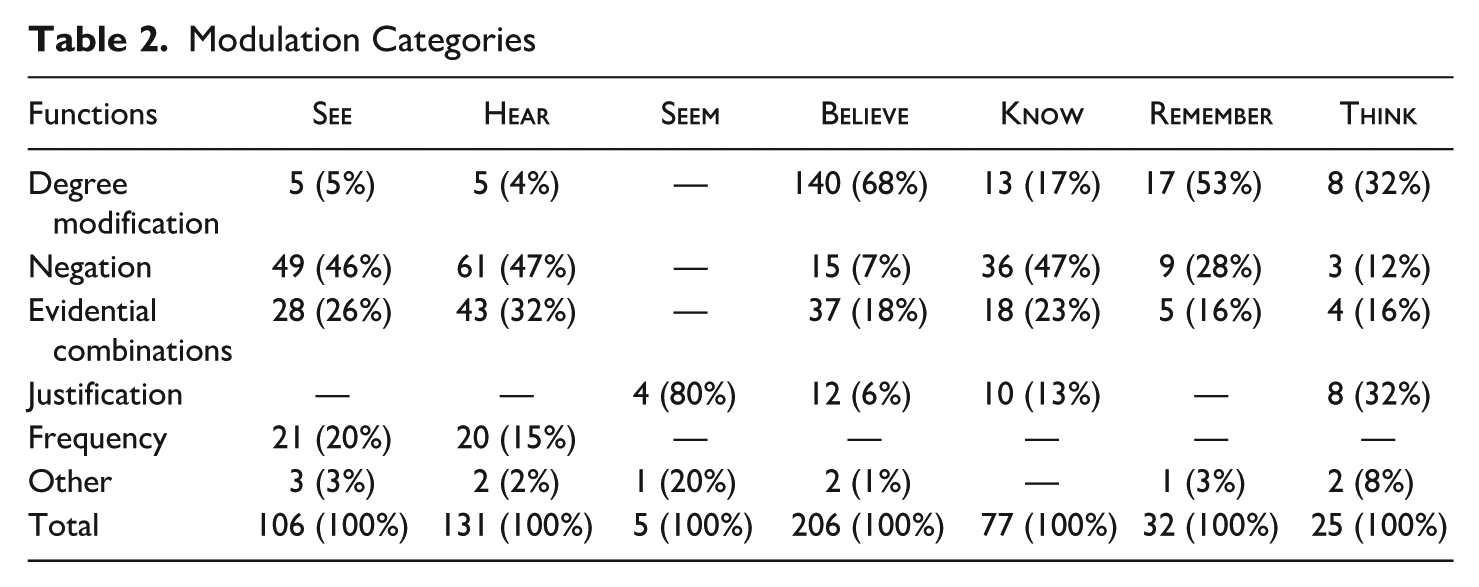
It is clear from Table 2 that just a few persistent categories are found in the data and that the same categories are relevant across the verbs. But variation is also present in individual verbs and categories. The most closely related verbs overall are the two sensory verbs,
In subsequent sections, I focus on the patterns and functions of the five major categories. The Other category covers a number of types that did not have numerical persistence. For example, we find three separate instances of stacking of the same verb, in different tenses, presumably stressing the deponent’s commitment to the veracity of the claim, as in (5). There are also two examples such as (6) where the contextual information about the deponent’s state of mind or physical state appears to be intended to strengthen the claim of the verb. As patterns are difficult to discern for these infrequent categories, I don’t explore them further.
(5) {all} which made us then to think and euer sence haue thought: and still doe thinke that Gooddy willes who (6) I being parfittly awake I saw standing in the chamber Rebekah [“kah” written over “ce”] nurs (RSWH, no. 382)had now stand<s> charged w<ith> ^{High} suspition of seuerall acts of wicthcraft had a hand in our Mishap at that time<?> (RSWH, no. 393)
4.2. Degree Modification and Frequency
Degree modification (often under the term of “intensification”) is a vibrant research field in English historical linguistics (see Claridge & Kytö 2021 for an overview). Scaling a quality, behavior, or action up or down has obvious stance implications, signaling a person’s evaluation, attitude, and assessment. Despite this connection, degree modification has received surprisingly little focused attention within the context of stance (e.g., Thompson & Hunston 2000:21; Hyland 2005:52-53; Martin & White 2005:137-150; Lewis 2020:4; Grund 2021:115-116).
At the face of it, frequency is not stance-related and quite different from the upscaling or down-scaling of degree modification: it involves a straightforward statement of the number of times specifically or generally something happened. However, I have argued elsewhere that expressions of frequency in the Salem depositions often act similarly to intensifiers in accentuating the severity of a phenomenon or the sincerity of conviction (Grund 2021:181-182; see also Hasselgård 2010:31-34, 249). This appears to be true for the ETED depositions as well. I therefore treat the phenomena of degree modification and frequency together here.
Degree modification is found for all verbs in this study except for
At the same time,
(7) but he sayth that the sai[d] m~ Wilson did baptize other twoe the same daie wthout the signe of the crosse, and the better he knoweth to depose herein for that he was an ^{eye} wittnes prent
In (7), using see is part of a larger justification for why the evidence provided is reliable and certain. This case revolves around a clergyman (Mr. Wilson) who allegedly carried out his sacramental duties (and his priestly profession in general) in an improper manner. The fact that the case involved a person in the church hierarchy, who presumably had a great deal of power in the community and who was also a member of the gentry, may have triggered the strategic use of a boosting modifier (certainly) to underscore the foundation of the claim (as well as the evidential combination see and mark; see section 4.4).
While the two sensory verbs (
(8) She has often heard Miss Blandy not only wish her Fathers Death, but has Carried her Resentment beyond the Grave by Adding that She wished he might go to Hell, (ETED: Henley 1751: F_4SC_Henley_005) (9) also seuerall times sence we haue seen the afforesaid parsons most dreadfully tormented as if all their bones would haue been disjoined (RSWH, no. 54)
On one level, the generalized frequency markers often and several times record a simple fact: the information provided was not based on an insular event of experience, but a recurring one. But that fact can have sociopragmatic implications: the deponents clearly provide reliable information since they have heard or seen the event more than once. Of course, that also means that the damning information they provide does not reflect an insular event either. That matters a great deal both in a trial of fatal poisoning (as in 8) and in a witch trial (as in 9). So, the overall communicative effect of a frequency marker may be the same as that of a degree modifier: signaling the certainty of the information and the reliability of the witness. But the dynamics are different (emphasizing a singular event of perception versus highlighting repeated experience). That the other evidential verbs do not occur with frequency statements is not surprising as they less clearly refer to specific points of experience (e.g., I have often known that . . .?).
In both the Salem and ETED depositions, there is one collocation of verb+degree modifier that stands out: verily
(10) she this dept verily beleeueth that the sd Anne Saunders and Thomas Greenway did comitt ye filthy sinne of adultery (ETED, London 1627-1628: F_2LD_London_007) (11) I verily beleue in my heart that George Jacobs is a most dreadfull wizard (RSWH, no. 134)
This combination is part of a broader usage pattern involving verily in the Early Modern English period, where the adverb can combine with a number of different verbs or be used on its own. Its use declines drastically over the course of the period and appears to be perceived increasingly as archaic (e.g., González-Álvarez 1996:228, 230; Bromhead 2009:56-78; OED, s.v. verily).
Considering its cross-collection appearance, the combination likely had a specific legal usage (not noted in previous studies of verily). Indeed, the phrase still figures in some legal discourse, perhaps in particular in affidavits, in the English-speaking world, though the usefulness and significance of the phrase nowadays is debated (Affidavit Guru 2015). In the Salem trials, the phrase appears to be used strategically (often in combination with in my heart, as in 11) by some witnesses and recorders to emphasize the witnesses’ conviction and their in-group status as core members of and therefore also their full alignment with the community of practice that developed during the trials; the phrase also helps suggest that their accusations of witchcraft were tantamount to religious conviction (Grund 2021:131-132; cf. also Adamson 2021). The specific communal dynamics are probably not the same in ETED; if they are, they are more difficult to trace, as ETED covers a greater diversity of texts and a larger time span than do the Salem documents.
In both sources, the formula tends to appear at the end of an article of a deposition (where a—usually unstated—question is answered) or at the end of the testimony. The placement at the end of the deposition allows the witness to put their final stamp on the testimony and thus to leave the authorities with the witness’s final conclusion: all the evidence provided translates into the deponent’s stated conviction. So, while the information is given as based on conviction (or “belief”), the larger backdrop clarifies what the conviction is based on. Personal opinions and conviction may be treated with suspicion and even ruled out as irrelevant in modern legal contexts (Stygall 1994:138). The pervasiveness of the formula strongly suggests that it carried weight and that there were reasons to leverage it as part of a strategy to claim credibility and reliability.
A similar usage is found with
(12) sd Warin verily: thinks: sd George Jacobs is a wizard (RSWH, no. 480)
However, with
Both degree modification and frequency statements can also vary according to deponent and case. In the infamous Blandy trial from mid-eighteenth-century England (where Mary Blandy and her lover poisoned Francis Blandy, Mary’s father), two of the witnesses (Susannah Gunnel and Elizabeth Binfield, both servants) frequently appeal to remembrance in their testimony. This is likely because they relate observations and statements (in often surprising detail) that have been made some time before the testimony; assertions without evidential framing may have led to questions of how the witnesses knew what they claimed to know. At the same time, remembrance is a claim that relies on personal authority and hence can be seen as weak (depending on the person’s standing). And of course, such claims are open to charges of misremembering. Elizabeth Binfield may have recognized the weakness (on her own or after prodding by the person taking down the deposition). In four of the five appeals to remembrance, she (or the recorder) adds the booster well (as in 13), signaling that there is no doubt about the reliability of her memory. In other words, there is an attempt at clarifying her status as a reliable witness who has important information for the case. While not numerically persistent overall, some degree modifiers and frequency markers can act as important localized tools for deponents to position themselves and their evidence.
(13) And this E
(ETED, Henley 1751: F_4SC_Henley_008)
4.3. Negation
The interaction of negation with evidentiality and stance is a complex one. Some scholars claim that negation is incompatible with evidentiality, as negation is seen as signaling the lack rather than the presence of source (e.g., Whitt 2010:79, 158; also de Haan 1999:84-85). However, Aikhenvald (2004:256-257) shows that the question is more nuanced: some languages that have obligatory evidential marking do not allow negation, while others do (in various complex constellations). The connection between negation and stance is more straightforward, though there appears to be little work devoted to this connection specifically (e.g., Martin & White 2005:118-120; Dancygier 2012; Hidalgo-Downing 2021; see also Labov 1972:380-387). As Hidalgo-Downing (2021:97) puts it, negation “enables speakers/writers to express positionings towards topics, to create relations of alignment/disalignment with communities of speakers and to articulate opposing systems of values and beliefs.”
Negation is found with all verbs except
(14) As for my mother I neuer saw aniey harm by har upon aniey sutch acout naither in word nor action as she is now acused for she hath awlwais instructed me well in the cristion religion and the wais of god euer sence I was abell to take instructions: (RSWH, no. 412)
The witness Ephraim Wilds’s mother has been accused of witchcraft, and, although not stated explicitly here, accusations against her are claimed to be based on direct visual experience by the accusers. In presenting his information, Ephraim also stresses visual perception, but he negates it with the emphatic never, signaling that the claim is not restricted in time and space. By doing so, Ephraim tries to throw doubt not only on the information that his mother has caused any harm but also on the basis of that claim (i.e., the claimed direct visual perception). Of course, this negated example also means a very active disalignment stance vis-à-vis the accusers of his mother. Similar examples are found ETED as well.
It is not always clear why a statement and source are being negated, but it is reasonable to assume that another witness or the accused has made a claim that the deponent in question cannot endorse. Example (15) is a case in point.
(15) And this informt further saith that the said Tho: Maddox had not all this time any stick or other weapon in his hand, or about him and that hee did not see him strike att my Lord att all (ETED, Northern 1654-1699: F_3NC_Northern_015)
The witness (Jasper Blythman) reports an argument that came to blows between Thomas Maddox and his presumed killer, Lord Egglington (here “my Lord”). Another witness or perhaps Lord Egglington himself has likely claimed that Lord Egglington was attacked by Maddox and therefore defended himself. Maddox’s death would thus be accidental or a case of self-defense. Blythman clearly throws doubt on that defense by noting that, although he was obviously there, he did not see any strikes from Maddox. The use of see may seem to open the door for disputing his claim: perhaps the event just escaped Blythman’s observation? Although there are examples where such a limitation may be possible (it is just one person’s observation; for instance, example 14), Blythman’s overall deposition and his emphasizer at all militate against that interpretation: he records the event in some detail, and it would seem strange that he overlooked a major detail such as Maddox attacking Lord Egglington. Instead, the negated see is likely a marker of emphasis and certainty. It is also a clear disalignment device, marking a stance in opposition to other witnesses and certainly to Lord Egglington.
We find similar dynamics for all verbs. In negated examples with assumption evidentials, the focus is squarely on the deponents’ own cognitive negotiations. The implications and effects of the negation vary, however. With
(16) 5 Ad quintum Interro
While the negation of
(17) shee doth not believe the sd Anne Smith is any way damnified in her credit or reputaco[n] by reason of the speaking of the aforesd words (ETED: Oxford 1667-1679: F_3SD_Oxford_013)
4.4. Evidential Combination
The evidential verbs studied here (as well as others) can co-occur in various complex constellations. Most commonly, we find two or more verbs coordinated, as in (18).
(18) he Apprehends and Verily believes, that the Dreadful Disorders, that the said Poor Woman Dame Emmett ^{now} labours under, and also the Indisposition of the said Susan Gunnell ^{at ye time of her Masters death & since} are both intirely owing to their Drinking and tasting of the Tea and Watergruel (ETED, Henley 1751: F_4SC_Henley_004)
These combinations adhere to as well as cut across evidential categories, as in
The reason for combining evidentials from multiple evidential domains must have been to emphasize the reliability of the information provided. In (19), not only does the information rest on observation but also on hearing. This establishes the deponent (Michael von der Ostan) as an important witness since the case revolves around a charge of defamation. Michael clearly saw the person as she uttered the alleged defamatory words and heard the words spoken, a crucial evidentiary combination in defamation cases.
(19) he this dept and his contest and work fellow Asdruball dodson looked both out of the window downe into the yard and there saw and heard the arlate m~s Stansbury scolding ^{out of her owne window being open} at and revileing the producent (ETED, London 1681-1682: F_3LD_London_006)
Many examples of combinations are negated, suggesting that the deponent lacks any information about a particular event or statement. As for negation in general (see section 4.3), the negation implies that there is a contested issue that the deponent is asked to respond to, and multiplying negated sources is clearly supposed to attest to the deponent’s total lack of knowledge. This matters in a case like (20).
(20) shee neith~ knew beeleeved nor heard it reported that thear was any citac
(ETED: London 1590-1593: F_1LD_London_009)
Margerie Fidget, the deponent, makes clear that she had no knowledge of a citation that could have prohibited her daughter’s marriage. She admits later that she learned about such a suit, but only after the fact. She thus tries to stress her innocence: not only did she not know of such a citation, but she did not know, believe, or hear it reported that that was the case.
These combinations are more frequent in the ETED depositions. It is possible that the combinations are rarer in the Salem depositions because the recorders were not as familiar with legal conventions. That is, if the use of multiple evidentials was at least partly related to the use of multinomials, the Salem recorders, who were for the most part not legal professionals (see section 3), may not have been as familiar with that usage.
Of course, this presumes that the combinations were the product of the scribes rather than the deponents, a much-debated issue regarding the language of depositions in general (e.g., Grund & Walker 2011:47-56; Grund 2021:25-39). In many cases, the depositions are co-constructed in complex ways. Margerie Fidget from example (20) may have been asked: “Did you know, believe, or hear it reported that a citation had been sent out from a court against your daughter Suzan?” and she may have responded “No.” The scribe, however, specified the written response to make the answer clear (without the question). But she may also have responded with her own formulation or perhaps even repeating the verbs to emphasize that she did not know, believe, or hear it reported (for deponents repeating the formulation of a question in a deposition, see Grund & Walker 2011:50). Whatever the origin of the formulation, the deponent is positioned as taking a strong position against a claim that she had known about it beforehand, disaligning her with the man who claimed to have a marriage agreement with Suzan and therefore filed the suit.
4.5. Justification
At times, additional justifications for an evidential claim are added. The witnesses (perhaps after prodding or with the assistance of the recorders of the testimony) may have recognized that appealing to a source may trigger rather than assuage doubt. These justifications come in several shapes, at times closely connected to the verbs, in other cases more loosely associated with the verbs. Perhaps not surprisingly, these justifications do not occur with
Back-up from justifications is rare in the Salem documents in the context of these verbs (cf. Grund 2021:162), perhaps because many witnesses expressed firm conviction, and further elaboration was thus unnecessary. In ETED, by contrast, we see a wide range of forms for these justifications. In some contexts, the reason is embedded in the evidential expression itself, as in made X think or induced X to believe. In (21), the deponent’s knowledge of when a child was born and his comparison (“conference”) with the time when he spoke with Ramshae add up to his thinking that the child was conceived after the couple had decided to marry. The steps of his deduction are thus laid out, and this outline could matter to the authorities, who would be persuaded not to charge the couple with fornication under these potentially mitigating circumstances.
(21) wch ^{tyme of the} [an] birth and acceptinge of the child induceth this depont to think by conference of the tyme of the talk had betwene this Depont and the said Ramshae that the said child was begott after that the said Ramshae had declarid to this depont that they two viz~ the said Ran~ and Sibill were concludid of {apon} mariage betwene them / (ETED, Chester 1562-1566: F_1ND_Chester_042)
Another, infrequent strategy involves an appeal to reason or cause especially in combination with
(22) But I neuer saw Goodw Cole But haue great Cause to thinke that Goodw Cole hurts mee and that because my mother see Goodw Cole and has been sadly Terrified by her (RSWH, no. 684)
A formulation peculiar to ETED (and some deposition groups within this collection especially) is the phrase reddens causam sciencie sue ‘giving a reason for his/her/their knowledge’ (or variations on this phrase), as in (23). The phrase is certainly attributable to the scribe, as is the use of Latin, which likely had a highlighting function, emphasizing the importance of the statements that followed (see Grund 2011:192-199, 208). In (23), the deponent shows that the conviction (beleveth) stems from conclusions drawn from the behavior of Elizabeth Clerke; he believes that she was unwell since she did not volunteer any speech unless prompted. His conviction is further stressed by in his conscience, which may act as a boosting degree modifier here (see OED, s.v. conscience n. 8, Phrase P1).
(23) he beleveth in his conscience that the said Elizabeth Clerke at the tyme of the geveinge of the said giftes so before by him deposed was not of good mynde and memorie Reddens cam~ scie~ sue for that she did not speake any words nor gave any goods to any man otherwyse {then} by the demand of this depot and others and died so shortlie after the said giftes (ETED, Chelmsford 1578-1591: F_1ED_Chelmsford_019)
5. Conclusion
This study has explored how a group of verbs that express source of information can be modulated in the context of witness testimony in historical legal proceedings. Modulation is overall less common than non-modulation. But modulation, which illustrates the operation of Du Bois’s (2007) stance triangle in historical materials, was of communicative, sociopragmatic use for the witnesses as they positioned their evidence and themselves in their roles as participants in a legal case. Some verbs even showed a predominance of modulation (esp.
The five major categories of modulation (negation, degree modification, evidential combination, justification, and frequency) reveal different, yet overlapping types of negotiation of knowledge and stance. And the categories come in different shapes: while negation, degree modification, and frequency involve direct modification of the verb in question, evidential combinations and especially justification entail broader modulation, even in subsequent sentences or paragraphs.
Negation allows the witnesses to signal a contrary stance on an issue, which frequently entails disaligning with a previous witness or an accused. Negation involves not only negating a piece of information but also negating and disputing the nature of a previously claimed source. Degree modification, by contrast, usually entails boosting a statement (and, concomitantly, the user’s role as a reliable witness), perhaps because the source indication was not enough in itself or because it had been questioned. The booster may also have been necessary in bringing out a particular meaning of an evidential verb where more than one function is possible (as with
More broadly, the study underscores that not only does evidential use exist in English (as a number of scholars have increasingly argued), but the manipulation of it is an important stance resource in a context such as that of giving legal testimony. Evidential use is not a new phenomenon but one that has no doubt been part of language users’ repertoire throughout the history of English. That language users in historical periods should employ sophisticated linguistic resources to craft their situational roles should not surprise us of course, but this intuitive notion has yet to be backed up by substantial study, especially work that makes systematic use of theories and tools from modern stance research. What we need are studies that center their research on communities, users, or texts (rather than studies of a small set of specific features in large corpora, valuable as such investigations are; cf. similar points made by Whitt 2023; Landert 2024). Such studies will show exactly how language and sociopragmatic context interact in the history of English as users wield language for their many and varied social needs.
Footnotes
Acknowledgements
I am grateful to the special issue editors, the journal reviewer, and the journal editors for their helpful comments on previous versions of the article. Naturally, any errors are my own.
Declaration of Conflicting Interests
The author declared no potential conflicts of interest with respect to the research, authorship, and/or publication of this article.
Funding
The author received no financial support for the research, authorship, and/or publication of this article.

Data Sources
ETED = An electronic text edition of depositions 1560-1760. 2011. Kytö, Merja, Peter J. Grund & Terry Walker (eds.). Available on the CD accompanying Testifying to language and life in early modern England. Amsterdam/Philadelphia: John Benjamins.
RSWH = Rosenthal, Bernard, Gretchen A. Adams, Margo Burns, Peter Grund, Risto Hiltunen, Leena Kahlas-Tarkka, Merja Kytö, Matti Peikola, Benjamin C. Ray, Matti Rissanen, Marilynne K. Roach & Richard B. Trask (eds.). 2009. Records of the Salem witch-hunt. Cambridge: Cambridge University Press.