



Abstract
Focusing specifically on the speech act of advice, the present study investigates the role of democratization, or the flattening of social hierarchies, in the use and development of modal verbs in Present-Day spoken British English. In contrast to previous research, which so far has investigated English modality across a variety of speech acts, this study provides a more controlled environment for testing the democratization hypothesis through its focus on modality in only one speech act. Advice is an appropriate testbed because of its sensitive nature. Based on spoken diachronic data from the London–Lund Corpora, the results show a shift toward not only more equal but also more informal advice-giving strategies, as evidenced by an increase in need to and can, and in constructions involving possibility modals with the inclusive we, and a decrease in must, have got to, might, and would. While by and large the results mirror those of earlier studies, there are also some differences that call for more detailed investigations of the shifts and changes in English modality in specific speech act contexts.
1. Introduction
English modality and in particular English modal verbs are a well-researched area in contemporary linguistics. One simply needs to read the chapter headings of the book Models of Modals by Ilse Depraetere and colleagues to understand its popularity: Modal verbs and why they have attracted a lot of attention or Why we still need another book on modal verbs. According to Depraetere et al. (2023), the amount of attention that English modality has received is “hardly surprising for a lexical-grammatical area that pertains to an indispensable aspect of human cognition” where “as people, we cannot help but communicate our natural interest in what is possible and what is necessary” (Depraetere et al. 2023:1). This leads to considerable variation in form of the modal expressions and raises the question of “what makes speakers of English choose one verb among the full range of available modal verbs” (Depraetere et al. 2023:5), one of the many reasons for continued research in this area.
The present study paves way for new research by examining the role of democratization, or the flattening of social hierarchies, in the use and development of modal verbs in one speech act in Present-Day spoken British English: advice. To date, studies of English modality have approached the topic from a relatively broad perspective: they have examined modal verbs such as must across a variety of speech acts and communicative goals, making broad generalizations about how their use and distribution has changed in recent decades (for an overview, see Mair & Leech 2020; also Kranich, Hampel & Bruns 2020 for an exception in work on requests). These studies have noted a decrease in the use of ‘strong’ forms such as must and increase in the use of ‘weak’ forms such as could, due in part to the external socio-cultural factors related to democratization. By focusing on advice only, this study moves beyond the broad semantic categories of deontic and epistemic modality addressed by previous research into the specific choices made by speakers with similar communicative goals in mind. This makes it more likely that any changes observed are attributable to shifts in socio-cultural norms over time, rather than to the effects of different communicative events. The speech act of advice is an appropriate testbed because, despite being beneficial for the addressee, it may still be a sensitive undertaking for the interlocutors if the advice is resisted, rejected, or ignored altogether. Consider the short exchange between close friends from the London–Lund Corpus 1 of spoken British English in (1), about speaker A getting back to teaching. 1
(1) (LLC–1; face-to-face conversation between = S.2.11b) d: but you don’t actually do it do you A: no d: you ought to try A: no fear d: really you were all keen on it to start with what happened to that
In (1), speaker d’s advice-giving utterance, you ought to try, contains the semi-modal ought to, a relatively strong construction. It is met with rejection by speaker A (no fear). The choice of the construction, and the identities that the speakers claim for themselves, are crucial in such situations because they make different affordances for the working space of the communicative event. In a different discourse context, such as a conversation between people who do not know each other well, the modal verb might be different to reflect the type of relationship between the interlocutors. There might also be a difference between the time that the London–Lund Corpus 1 was recorded (1950s-1980s) and the present day.
Therefore, by adopting a speech-act-oriented perspective on modal verbs in English, the study addresses two research questions.
Focusing specifically on the speech act of advice, how, if at all, has the use and distribution of modal verbs changed in recent spoken British English?
What does this tell us more broadly about the role of democratization in shifts and changes in English modality in specific speech act contexts?
The spoken diachronic data in this study are from two corpora of British English representing two different time periods of Present-Day English with roughly fifty years in between: the London–Lund Corpus 1 (LLC–1) with data from the 1950s to 1980s (Svartvik & Quirk 1980; Greenbaum & Svartvik 1990) and the London–Lund Corpus 2 (LLC–2) from 2014 to 2019 (Põldvere, Johansson & Paradis 2021, forthcoming). The LLCs are comparable corpora in terms of size (half a million words each) and the distribution of the discourse contexts. Specifically, both corpora are broadly divided into seven discourse contexts, from face-to-face conversation to prepared speech, with further distinctions between face-to-face conversation between equals and disparates. This allows for detailed investigations of the role of context in the use and distribution of the modal verbs. The modals themselves are analyzed with regard to their formal, pragmatic, and social properties, partly based on a classification scheme for advice constructions developed in Põldvere, De Felice, and Paradis (2022). Ordered on a scale of deontic and epistemic authority, and the degree of communicative (in)directness, the classification scheme facilitates a systematic analysis of the nature of development of the modal verbs over time, and the role of democratization in it. The results will shed new light on whether the development of English modality in advice situations has been the same as in language more generally (based on comparisons with previous findings) or whether we need more detailed investigations.
The article is structured as follows. Section 2 presents previous research on the topics of modality and advice, followed by a description of the LLCs and the procedure for extracting and annotating the modal verbs for relevant factors in Section 3. Section 4 is concerned with the distribution of the modal verbs across the corpora, along with a discussion of their use and development from the perspective of the democratization hypothesis. The article concludes with some theoretical implications and a summary of the study in Section 5.
2. Background
This section presents the background to the study. Section 2.1 gives an overview of how modal verbs have developed in recent spoken and written English. In Section 2.2, I present the main lines of research on the speech act of advice as well as the broad definition of advice adopted in this study.
2.1. Modality and Recent Change
As previously mentioned, English modality as expressed by modal auxiliaries of different kinds is a well-researched area in linguistics. The development of these auxiliary verbs in Present-Day English since the emergence of large corpora of spoken and written texts in the mid-twentieth century is an equally well-understood area. Therefore, the overview given here can only scratch the surface of what has been done so far; the reader is referred to publications that provide a more detailed review (see, e.g., Krug 2000; Facchinetti, Krug & Palmer 2003; Leech 2003, 2013; Smith 2003; Leech, Hundt, Mair & Smith 2009; Close & Aarts 2010; Love & Curry 2021). Nevertheless, a short overview is required to motivate a study of the use and development of modal verbs in specific speech act contexts such as advice.
Modality is a linguistic means by which the speaker or writer expresses their attitude or point of view toward something. In Palmer’s (2001:1) definition, modality is a linguistic category used to frame events: it is “concerned with the status of the proposition that describes the event,” while the other linguistic categories of tense and aspect are concerned with the time and nature of the event, respectively. In this study, we are primarily concerned with deontic modality as a performative and discourse-oriented type of modality that is used, for example, to give permission (may), lay an obligation (must), and make a promise or threat (shall) (Palmer 2001:69). These acts can be performed by using modals with varying degrees of deontic force (compare you must do the dishes with you could do the dishes). An important element of deontic speaker stance is the extent of the speaker’s or writer’s epistemic commitment and judgments of truth, probability, certainty, belief, and evidence (Gupta 2006). These two layers of modal grounding are ordered on deontic and epistemic gradients with conceptual links between them. For example, modals that express weak deontic speaker stance at the discourse level tend to express low epistemic control and uncertainty at the clause level, and vice versa (Langacker 1987; Paradis 2021; see also Heritage 2012 and Couper-Kuhlen & Thompson 2022 for epistemic and deontic gradients, respectively).
Previous research on the diachronic development of English modal auxiliaries shows that, in general, they have decreased in frequency since the mid-twentieth century (Leech 2003, 2013; but see Millar 2009 for a different trend in the TIME Magazine in particular). This is particularly the case with so-called core modals such as shall, must, and may but not with semi-modals such as need to, want to, and be going to, which are on the rise (see Section 3.2 for the formal differences). Based on both written British English (the Lancaster-Oslo/Bergen and Freiburg-Lancaster-Oslo/Bergen corpora; LOB and FLOB, respectively) and spoken British English (subsets of the Diachronic Corpus of Present-Day Spoken English; DCPSE), covering a time period from the 1960s until the 1990s, Leech, Hundt, Mair, and Smith (2009) found a particularly strong decline in must and may due in part to an increase in semi-modals, particularly need to and want to, and a shift away from must to weaker forms such as should. These patterns seem to be particularly pronounced in spoken English. Based on a detailed analysis of DCPSE, Close and Aarts (2010) and Bowie, Wallis, and Aarts (2013) observed a significant increase in have to and a decrease in must, may, and shall, particularly in informal face-to-face conversation. Have got to showed a decrease, albeit a non-significant one. To some extent, these trends have continued to the present day, as observed by Love and Curry (2021) in their analysis of the Spoken British National Corpus (BNC) 1994 and 2014. For example, they observed an increase in the use of weak modals such as could, might, and would. Surprisingly, however, the corpora showed a decreased use of the semi-modals have to and want to. An important aspect of Love’s and Curry’s work is that, in addition to form, the authors also considered the modal function of the core modals. Although none of the modals reached statistical significance, many of them showed a general trend over time toward more epistemic-informational and fewer deontic-interpersonal uses (e.g., can, may, might, must, will; see also Hilpert 2016 and Kranich 2021 for the same trend for may and must in written American English). Conversely, Love and Curry observed a shift in should toward a greater proportion of deontic use, possibly at the expense of must. The high degree of comparability between the DCPSE and BNCs, on the one hand, and the LLCs, on the other, means that these results may foreshadow the strength and developmental path of modals expressing advice in Present-Day spoken British English in this study.
Several explanations have been provided for the above shifts and changes. A prominent one is the democratization hypothesis. The democratization hypothesis offers a link between language and society, where language change is a function of external socio-cultural factors related to “changing norms in personal relations” (Leech, Hundt, Mair & Smith 2009:259). Specifically, these norms manifest themselves in forms of communication that emphasize “equality of power” and “express obligation less directly” (Smith 2003:259), in line with societies becoming more democratic. The direction of the relationship between language change and socio-cultural change is a topic that is beyond the scope of this study, but, needless to say, it is not a straightforward one, as indicated by this quote by Farrelly and Seoane (2012): “people alter their language use in response to social change and people shape social change through their use of language” (Farrelly & Seoane 2012:392).
In addition to studies of address terms (e.g., Bruns & Kranich 2021), person reference (e.g., Palander-Collin & Nevala 2020), and gendered nouns and pronouns (e.g., Baker 2010), democratization has been found to play an important role in English modality. The decline in highly deontic modals in particular has offered support for the leveling of power hierarchies (Myhill 1995) associated with democratization. Based on British English data, Smith (2003) argues that must is “prototypically subjective and insistent, sometimes authoritarian-sounding” and therefore it is “likely to be increasingly avoided in a culture where overt markers of power or hierarchy are much less in favour” (Smith 2003:263). The subjective nature of must means that, whatever the intention, the source of the force of must is perceived to be the speaker/writer (Kranich 2021:282). Its place is increasingly taken over by semi-modals such as have to and need to because they are ambiguous in terms of the source of obligation, which may be interpreted as being external to the speaker/writer (Smith 2003:242). This constitutes democratization proper, or the phasing out of overt markers of power asymmetry (Farrelly & Seoane 2012:393), while related processes may also play a role. Leech (2003), for instance, has argued that the decline in may and shall may be due to colloquialization, a shift toward more colloquial linguistic choices to convey more speechlike style. Relatedly, informalization has been described as an increased tendency to simulate informal conversation in traditionally formal registers of mass communication (Landert 2014). 2
While democratization is not a new topic in research on English modality, we know very little about its role in the occurrence of different modal verbs (i.e., weaker versus stronger) in specific speech act contexts where the verbs have very specific functions. A notable exception is Kranich, Hampel, and Bruns (2020), which looks at requests made by speakers of three varieties of English: British, American, and Indian. This allowed the authors to turn their attention to deontic modals specifically, a key phenomenon in requests. Moreover, Kranich, Hampel, and Bruns (2020:4) considered requests to be of great interest in the study of democratization due to their “high sensitivity to perceived power differences and distance between speaker and addressee.” Indeed, they found important differences in the way in which requests are made in the three varieties of the study, where British English stands out as the variety that favors indirectness most clearly. This was the case with both older (between forty-seven and eighty-six years old) and younger (between eighteen and thirty-one years old) speakers as well as across different discourse situations (in terms of power differences and weight of imposition). In this study, we turn to a related, yet functionally different, speech act that is of interest to democratization research, namely, advice.
2.2. The Speech Act of Advice
The speech act of advice is an interesting testbed for the study of recent change in modality in Present-Day English, and the role of democratization in it. This is because of the highly sensitive nature of advising in natural communication where face considerations of both the adviser and advisee are potentially at risk. As noted by Põldvere, De Felice, and Paradis (2022:16), “[t]he complex relationship between face and advice is evident at every stage of interactions involving advice,” from when the advice is sought, or volunteered, to the formulation of the advice and its outcome: when it is accepted, resisted, rejected, or ignored altogether. If unsuccessful, the advice itself, or its formulation, may have negative consequences for the relationship among the interlocutors. Also, the expression of trouble does not necessarily mean that the advice is solicited or expected in such situations, because the trouble may simply serve as an invitation for emotional reciprocity rather than a directive for future action (Jefferson & Lee 1981). In addition to knowing whether or not a directive is appropriate in any given situation, advisers need to choose the construction that best fits the broader socio-cultural frame in which the advising takes place. In other words, they need to develop an understanding in that moment of the relationship between the interlocutors, the context of their interaction, and the identities that the interlocutors claim for themselves (Põldvere, De Felice & Paradis 2022:17). The exact role of these factors in language use is likely to change over time, in step with broader socio-cultural changes in society.
For these reasons, advice has received a lot of academic interest in recent years—in linguistics most notably in Conversation Analysis and Interactional Linguistics (e.g., Jefferson & Lee 1981; Heritage & Sefi 1992; Limberg & Locher 2012; Shaw, Potter & Hepburn 2015; MacGeorge, Guntzviller, Branch & Yakova 2016; Stivers et al. 2018; Couper-Kuhlen & Thompson 2022)—although it is still difficult to find a priori operational definition of advice for a corpus linguistic study of natural conversation, as is needed in this study. A standard definition in Conversation Analysis is that advice “describes, recommends or otherwise forwards a preferred course of future action” (Heritage & Sefi 1992:368). While probably not intended by the authors, by this definition advice is an instance of the family of directives in that its illocutionary function is to get the addressee to do something (Austin 1962\1975; Searle 1976). A distinguishing feature of advice in that family is that the direction of fit of the advice is from me-to-you, meaning that the addressee is also the main benefactor of the action. However, the definition is agnostic about the role of the speaker: can they be involved in any way? In fact, it may not always be possible to tease apart the commissive aspect of directive meanings whereby the speaker may also be involved, firstly, by bringing about the future action and, secondly, by benefitting from that action in some way. This is the case in proposals, as in (2), and in instances of advice proper with the inclusive we; see (3).
(2) (LLC–2; face-face conversation between = T002) S004: we should do something for Halloween (3) (LLC–2; face-to-face conversation between disparates (academic supervision on phonetics); T037) S012: and then we could go into those and uhm make like measurements of burst frequency
The advice-giving utterance in (3) is a special case because, by presenting the action as a joint undertaking, the supervisor has considerably lowered the level of imposition on the supervisee, compared to using the second-person pronoun you (and then you could go into those. . .). This said, the utterances in both (2) and (3) share the same broad illocutionary function and the same direction of fit as a typical example of advice in (1) in Section 1: the advisee is still one of the intended undertakers and benefactors of the action, if not the main one. For example, it is still the supervisee that is expected to carry out tasks related to their thesis project, and that ultimately benefits most from them. Therefore, in this study I use advice as a cover term for a broad network of instantiations of directive-commissive speech acts, such as advice proper, suggestions, recommendations, and proposals, all of which are closely related to each other in terms of their illocutionary function, direction of fit, and as described next, their constructional properties.
The directive-commissive meaning of advice-giving utterances can be expressed in a variety of ways in language, using different kinds of constructions, or form-meaning pairings (Goldberg 2006). Constructions involving modal verbs are common in such contexts. The diversity of the modal system, as described in Section 2.1, means that speakers/writers can vary the strength of their advice by choosing verbs with more or less directive force. Also, the type of the advice-giving utterance in which the modal verb is used plays a role, with questions and declaratives making different affordances for how the social action is received by addressees (Leech 2014). Several classification schemes have been proposed to describe the linguistic expression of advice. For example, Stivers et al.’s (2018) scheme distinguishes between five main categories—pronouncements, suggestions, proposals, offers, and assertions—based on the design and delivery of the advice. However, these classification schemes tend to be relatively broad in their treatment of different constructions and relatively narrow in terms of the discourse contexts based on which the categories have been devised (e.g., treatment recommendations in primary care in Stivers et al. 2018; see also Couper-Kuhlen & Thompson 2022 for advice constructions in informal face-to-face conversation among friends and family).
In this study, I draw on the classification scheme developed in Põldvere, De Felice, and Paradis (2022). Based on a systematic empirical investigation of advice in a range of casual and institutional contexts in spoken English, Põldvere, De Felice, and Paradis provide a comprehensive overview of the linguistic constructions that are available to advisers in a given situation. The constructions are ordered on a scale of deontic and epistemic authority as well as communicative (in)directness and the interlocutors’ intersubjective consideration of each other’s face concerns. Table 1 presents a narrow version of the constructional overview, with a focus on modal verbs only (excluding imperatives and performatives). As can be seen in the table, at the top of the scale are the general-level constructions of interrogatives, followed by declaratives and then conditionals, which in turn are divided into finer-grained constructions based on specific form and meaning properties. These include the difference between negated and non-negated forms (interrogatives), who or what is referenced (interrogatives, declaratives), modal meaning (declaratives), and syntactic structure (conditionals).
Narrow Version of the Constructional Overview in Põldvere, De Felice, and Paradis (2022:42-43), with a Focus on Modal Verbs; Examples Are from the LLCs
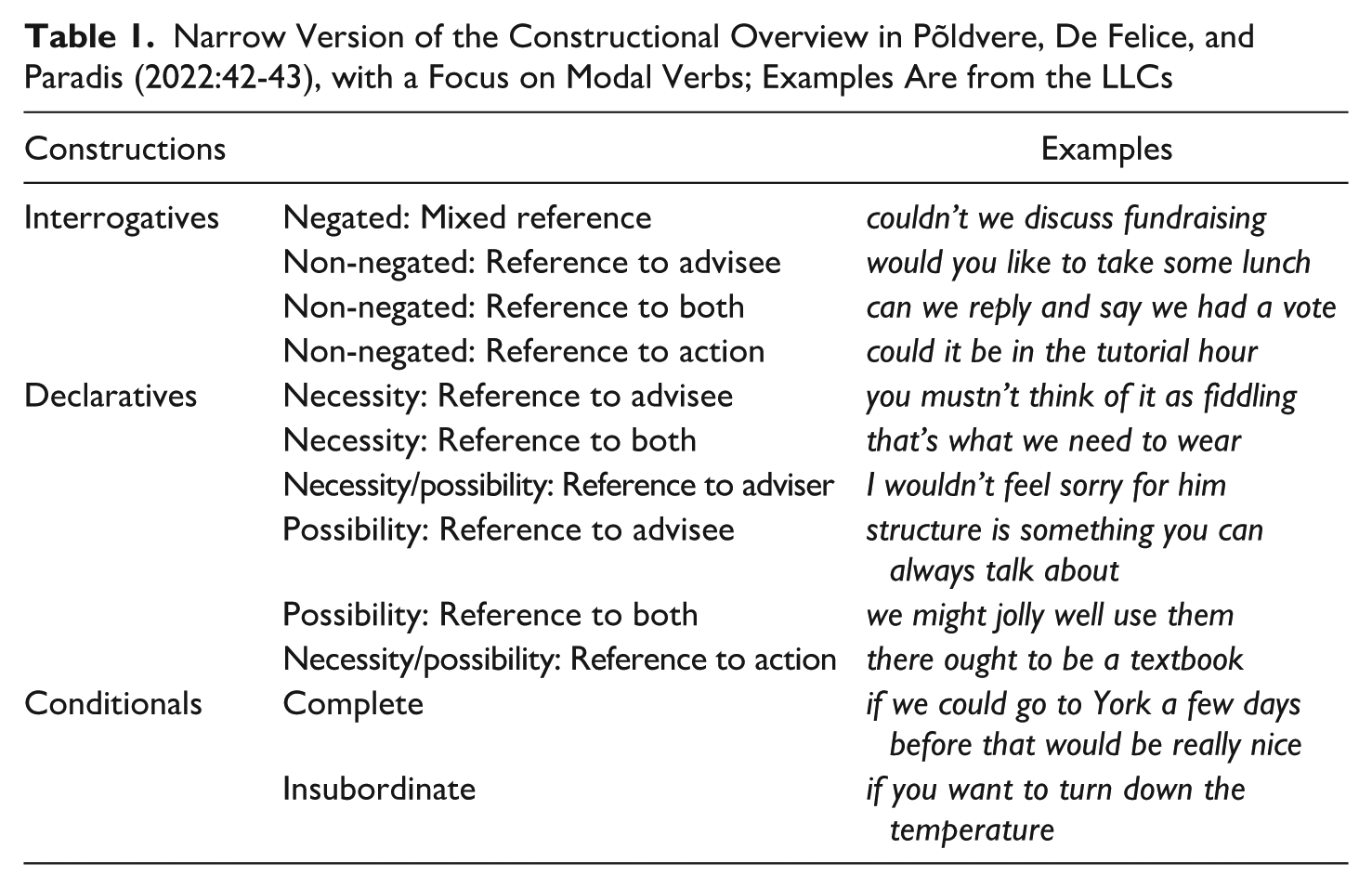
The idea of the scheme in Põldvere, De Felice, and Paradis (2022) is that the lower one goes down the scale, the more communicatively indirect the constructions are. By communicative indirectness, the authors refer to the adviser’s openness toward the advisee to alternative options and viewpoints (the idea of dialogic expansion versus contraction in Appraisal Theory; Martin & White 2005). By using an advice-giving utterance such as couldn’t we discuss fundraising, the advisee is expected to take a stand for or against the piece of advice, while in communicatively indirect forms such as various kinds of conditionals (e.g., if you want to turn down the temperature), the adviser recognizes that the advisee may have different thoughts about the situation. While Põldvere, De Felice, and Paradis (2022:46-47) acknowledge that the scale of communicative (in)directness is not a simple reflex, or one-to-one match, of the modality scale of deontic and epistemic strength of speaker authority, the former nevertheless overlaps with the latter at the top and bottom of the continuum. Also, there is internal hierarchy within the construction types not reflected in the classification, such as the difference within stronger core modals (e.g., must versus should), the various types of semi-modals (e.g., have to versus need to), and the weaker core modals (e.g., can versus could). 3 These are subtle differences that were not covered by Põldvere, De Felice, and Paradis, but which will be dealt with in this study through the investigation of specific modal forms.
In addition to devising the constructional overview, Põldvere, De Felice, and Paradis (2022) tracked the development of the advice constructions across the LLCs, albeit in face-to-face conversation only. Among their many results, surprisingly, the authors found a move toward stronger forms of advising in the twenty-first century, as illustrated by the significantly greater proportion of imperatives in LLC–2. The conversations in LLC–1, conversely, were characterized by a greater proportion of conditionals, but also of negated interrogatives, which are quite direct. It was suggested by Põldvere, De Felice, and Paradis that these seemingly contradictory results can be described by a shift over time of what is considered the default for potentially face-harming instances of advice. In today’s conversation, imperatives may not necessarily be indicative of unequal interaction, which instead may be characterized by conditionals that could come across as overly indirect and elaborate. Therefore, Põldvere, De Felice, and Paradis (2022:51) argue that democratization “is not just a question of strong or weak modality, but of a more general shift towards more informal and less elaborate and convoluted ways of giving advice, which can include more direct ones, too.” This is in line with the view of democratization proposed in Kranich, Hampel, and Bruns (2020), where directness is viewed as a sign of increased familiarity and solidarity among interlocutors (see also Hiltunen & Loureiro-Porto 2020 for a rejection of a view of linguistic directness as signaling social hierarchies). The present study extends the diachronic investigation in Põldvere, De Felice, and Paradis (2022) in two ways. First, it goes beyond face-to-face conversation to include all discourse contexts in the LLCs, allowing for the description and explanation of more general patterns of shifts and changes in advising in Present-Day English. Second, it focuses specifically on modal verb constructions in different utterance types and constructional patterns to track the development of English modality in advice situations. As noted by Põldvere, De Felice, and Paradis (2022:54), the fact that declaratives expressing necessity, for example, did not show any differences between LLC–1 and LLC–2 may have been due to internal hierarchy within the construction types rather than to a lack of development over the last half a century. After all, “by considering modals on a case-by-case basis, it is possible to see more coherent trends in modal function use” (Love & Curry 2021:539), since “semantic function arguably plays a[n] . . . important role in determining their use” (Love & Curry 2021:555) and development over time.
3. Data and Methods
This section presents the data and methods of the study. After a brief description of the London–Lund Corpora (LLCs) of spoken British English in Section 3.1, I present the procedure for extracting and annotating the modal verbs for a range of formal, pragmatic, and social factors (Section 3.2) and the statistical models that were used in the quantitative part of the study (Section 3.3).
3.1. London–Lund Corpora
The data are from two corpora of spoken British English: the London–Lund Corpus 1 (LLC–1) and the London–Lund Corpus 2 (LLC–2). The corpora are comparable (Leech 2007) in the sense that they differ from each other in terms of one parameter only: the parameter of time. While LLC–1 contains data from the 1950s to 1980s, LLC–2 was recorded 2014-2019. Therefore, approximately fifty years separate the two corpora. The rest of the parameters have been kept constant to the extent possible (see Seitanidi, Põldvere & Paradis 2023 for a critical assessment of the comparability level between the corpora). Both LLC–1 and LLC–2 contain approximately half a million words stored in one hundred texts, totaling some one million words, and 200 texts, for the whole dataset. The speakers are educated adult speakers of British English. Depending on the nature of the speech situations, the texts have been grouped into seven discourse contexts: face-to-face conversation, distanced conversation, broadcast media, parliamentary proceedings, spontaneous commentary, legal proceedings, and prepared speech. The face-to-face conversations make up the largest proportion, with almost half of all the texts. They are further divided into conversations between equals (e.g., friends, family) and conversations between disparates (e.g., employer-employee, supervisor-supervisee), depending on the power relations between the interlocutors. The same principle was adopted in two other discourse contexts in LLC–1: distanced conversation and broadcast media. However, due to the lack of clear guidelines for the classification, no such distinction was made in LLC–2.
3.2. Procedure for Extracting and Annotating the Modal Verbs
The analysis of the data involved extracting and annotating the modal verbs for a range of formal, pragmatic, and social factors. The verbs were extracted from LLC–1 by means of the corpus annotation and analysis tool Corpuscle (Meurer 2012) and from LLC–2 by means of AntConc (Anthony 2022). The audio files of both corpora were consulted in case of any ambiguity in the written transcriptions.
The selection of the modal verbs was based on previous research on English modality (see Section 2.1 for references) with particular focus on the forms and categories in Quirk, Greenbaum, Leech, and Svartvik (1985). A further criterion was that the verb had to have the potential to be used in advice situations, that is, to convey a future-oriented and performative communicative function in discourse. Table 2 provides a list of the modal verbs included in the study, and their modal categories based on syntactic behavior: core modals and semi-modals. The core modals were identified based on so-called NICE properties (Huddleston 1984) whereby (i) core modals can be Negated (e.g., can’t), (ii) they can be Inverted (e.g., shall we leave), (iii) they exhibit Code, that is, they allow for the following verb phrase to be deleted (e.g., Mary never sings but she should), and (iv) they can be Emphasized (e.g., you MUST eat). This is not always the case with semi-modals, which tend to take do-support in non-assertive contexts (e.g., you don’t need to eat, do we have to leave). Thus, it is important to distinguish between the core modal need(n’t) and the semi-modal need to, since only the former meets the NICE criteria above (cf. Smith 2003, but see Love & Curry 2021 for a treatment of need as a lexical modality-indicating device).
Modal Verbs Included in the Study
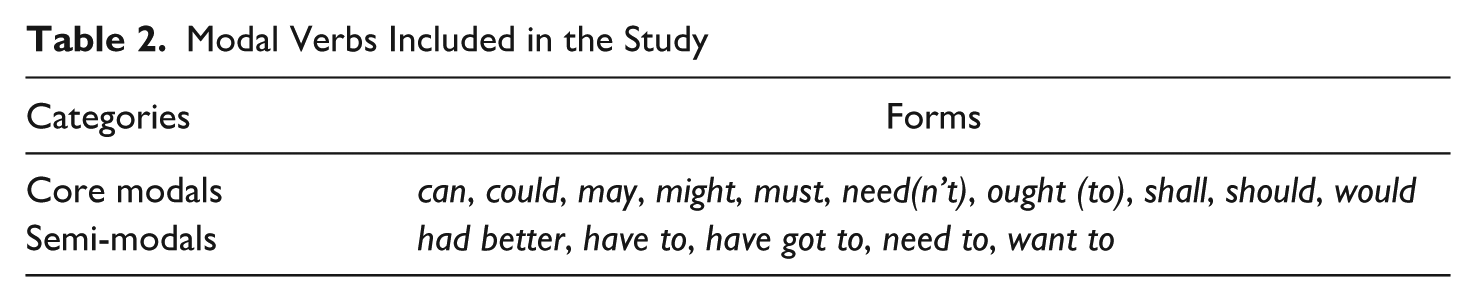
As can be seen in Table 2, I excluded the highly marginal modals dare and used to, and the future marker be going to, because of their non-occurrence in advice situations—as well as will due to the difficulty of identifying its speech act function. In the same vein, only the semi-modal had better was included, despite the fact that it forms a larger category of comparative modals with had sooner and had rather (Traugott 2016; Nykiel & Thaisen 2024). According to Traugott (2016), only had better has the necessary properties to be used in advice situations, since it is future-oriented and performative in nature. Due to low frequencies, I excluded several other forms such as be supposed to, be allowed to, and is to. The corpus searches included both the base forms in Table 2 and, where relevant, their negative and contracted variants. For example, for would the relevant forms were wouldn’t and ‘d. For grammaticalizing modals such as have got to, want to, and had better, both the full and reduced forms were included (got to/gotta, wanna, and better, respectively).
The next step was to identify those modal verbs that occurred in advice-giving utterances. This was done via close inspection of the concordance lines where the immediate linguistic context provided the necessary contextual cues. The analysis followed closely the guidelines in Põldvere, De Felice, and Paradis (2022:29-31), whereby an utterance is an instance of advice-giving only if it exhibits all the properties in (a)-(f).
(a) The focus of the utterance had to be on the advisee’s action; the adviser had to elicit an action from the advisee, not just communicate their attitudes or values.
(b) The proposed action had to include the advisee as one of its undertakers; the advisee could act alone or jointly with the adviser, but the action could never be carried out by the adviser alone.
(c) The advisee—either solely or jointly with the adviser—was the benefactor of the action.
(d) The action had to take place in the future; references to past actions were not considered.
(e) The utterance had to be directed at people who were present in the conversation at the time of the utterance; reported speech and general statements without a clear addressee were excluded.
(f) When the utterance was ambiguous between advice and another type of speech act such as a general statement, the addressee’s response was consulted; the utterance was considered to convey advice if the addressee either agreed or disagreed to carry out the proposed action, rather than simply providing information.
To exemplify, the advice-giving utterance in (4), underlined, meets all the requirements above, while the ones in (5) and (6) do not. In the former, from a face-to-face conversation, the speaker simply evaluates the situation, while the latter is a series of statements made by a politician on a radio show to the general public, rather than to a specific individual, or groups of individuals, whose presence in the conversational situation would surely affect the adviser’s choice of construction—a requirement that ensured a more controlled dataset.
(4) (LLC–1; distanced conversation; S.8.2a) B: uhm and we have to assume that for a year or two we’re we’ll in fact be <pause/> you know <pause/> uh <pause/> have these extra expenses C: yeah <pause/> you’d better buy a flat <pause/> madam <pause/> B: <trunc>y</trunc> <pause/>you reckon <pause/> C: mm yes B: yeah (5) (LLC–2; face-to-face conversation between disparates; T033a) S087: but you see we have to book kind of a year in advance which I’m sure you do . . . S002: we’re not charging though . . . but we’d charge them to do the catalogue <pause/> so they’d end up paying less but getting something out of it <pause/> like the catalogue S087: you could charge for <trunc>catalo</trunc> well that would be brilliant <pause/> that would be really good god I could get you to do this year’s but we need it for uhm March (6) (LLC–2; broadcast media; T070a) S201: so I think it’s really <pause/> uh being conscious that that we need to deliver<pause/> uhm our own <pause/> uh climate change agenda <pause/> and uhm that’s a <pause/> but we shouldn’t see that as a threat we shouldn’t see it as a <pause/> uh as an expensive burden on the community we should see it as being part of this opportunity to reposition the island and and and if we <trunc>s</trunc> if we view it through that lens <pause/> uhm then I think it’ll be much easier for the community to accept <pause/> uh the changes which are inevitable as part of that uh part of their journey
For the purposes of this study, it was necessary to distinguish between modal verbs that were part of the main illocutionary message of the utterance, that is, the advice constructions, and modal verbs that instead played a supporting role. The latter included various kinds of hedges (e.g., might in you might need to refresh some of those ideas) and tag questions (e.g., we can’t trust anything in this place can we), which in this study were annotated separately (see next).
Finally, the advice-giving utterances were annotated for a range of formal, pragmatic, and social factors. They were: (i) modal verb form, (ii) modal category, (iii) type of advice construction, (iv) discourse context, (v) social power relations, and (vi) corpus. Table 3 presents the annotation factors and their values.
Annotation Factors and Values
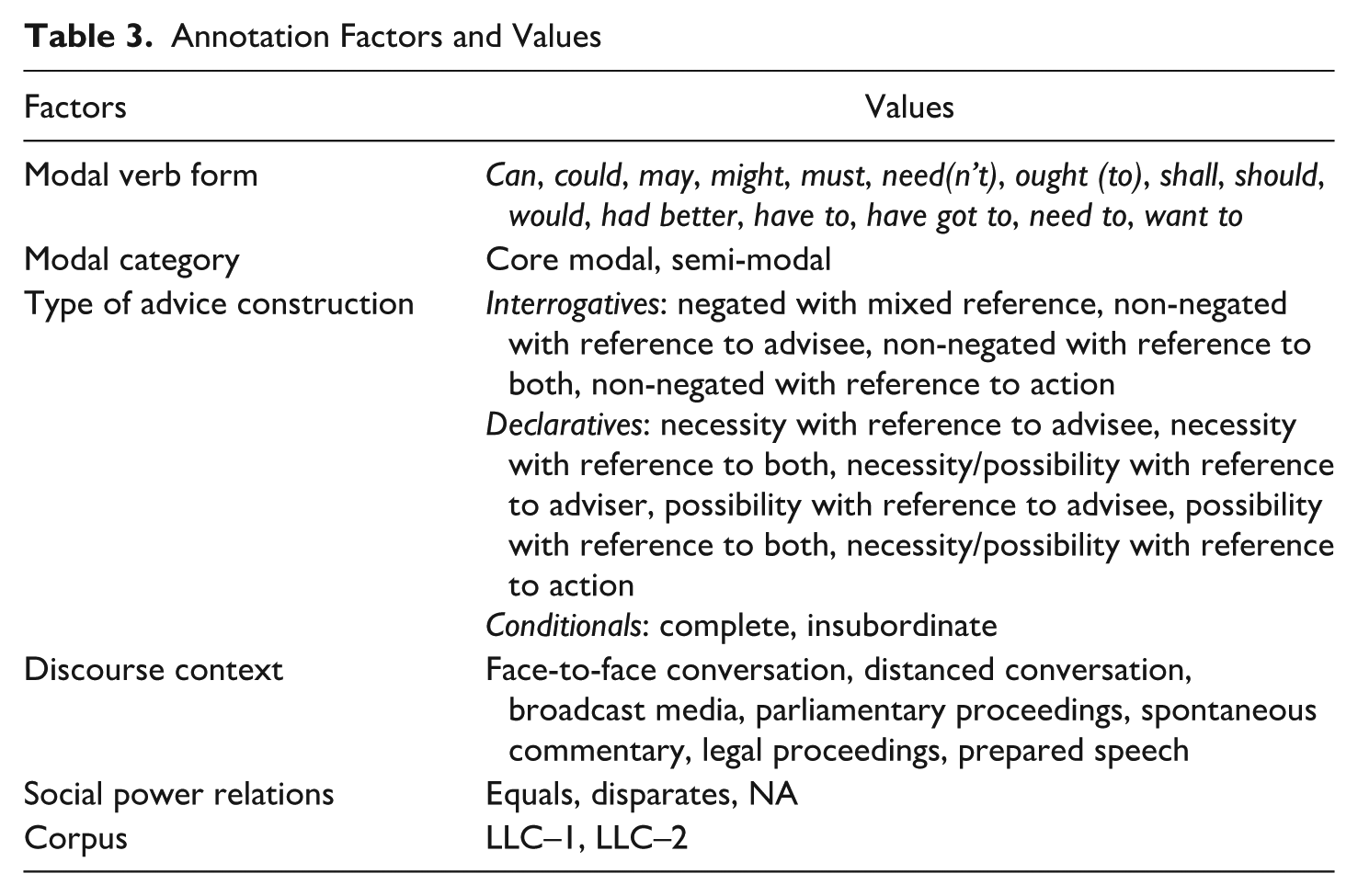
The first three factors—modal verb form, modal category, and type of advice construction—were explained previously. It should perhaps be noted that, among modal verb forms, all variants were subsumed under the parent form (e.g., would also includes wouldn’t and ‘d). In the analysis, no distinction was made between negated and non-negated declaratives, due to a lack of evidence that they would show different frequency profiles (Smith 2003:249). Also, negated declaratives do not carry the same implicature as negated interrogatives that a piece of advice is “so obvious and natural that there must be good reason not to embrace it” (Couper-Kuhlen & Thompson 2022:192). Declaratives such as one must remember two things were considered to refer to action, due to their lack of an explicit referent, and comparatives such as had better were classified as necessity modals. The next two factors—discourse context and social power relations—were based on the metadata of the corpora. The social power relations, equals versus disparates, were only determined in face-to-face conversation. A decision was made not to consider the content of the proposition framed by the modal verb, due to inconclusive findings in Põldvere, De Felice, and Paradis (2022) regarding its effects on advice outcomes. In the analysis, factors such as discourse context and social power relations were explored qualitatively, while the modals themselves underwent quantitative statistical analysis, as described next.
3.3. Statistical Analysis
The statistical analysis was conducted in RStudio (Posit Team 2026). Descriptive statistics was generated using the ggplot2 package. To capture the multifactorial nature of the data, I used logistic regression analyses for inferential data summaries, based on the glm function in base R. The models always had corpus as the dependent variable. The independent variables varied depending on the type of classification: (i) the modal categories of core modals versus semi-modals, (ii) the specific modal verb forms, and (iii) the advice constructions in Põldvere, De Felice, and Paradis (2022). In the next section, the regression models, together with descriptive statistics, are presented in that order. It should also be noted that it was not possible to treat the individual texts 4 as random effects in a mixed-effects model, because one runs into singular fit issues. This is probably because there was not enough data for the random effect structure, which in the future could be overcome by collecting more instances of the advice-giving utterances from larger corpora, such as the BNCs.
4. Results and Discussion
This section presents the quantitative analysis of the study (Section 4.1), followed by qualitative insights along with a discussion of the study’s results in light of the democratization hypothesis (Section 4.2).
4.1. Distributions Across the Corpora
All in all, I identified 1205 advice-giving utterances involving modal verbs in the LLCs. Of these, 47 percent (n = 564) were from LLC–1 and 53 percent (n = 641) were from LLC–2. Figure 1 presents the distribution of the modal categories across the corpora. As can be seen in the figure, the corpora show the same patterns in the proportions of the core modals and semi-modals, with the latter being less common than the former. However, there are differences in the extent to which this is the case. While semi-modals make up 20 percent (n = 111) of the data in LLC–1, their proportion is considerably higher, 35 percent (n = 223), in LLC–2.
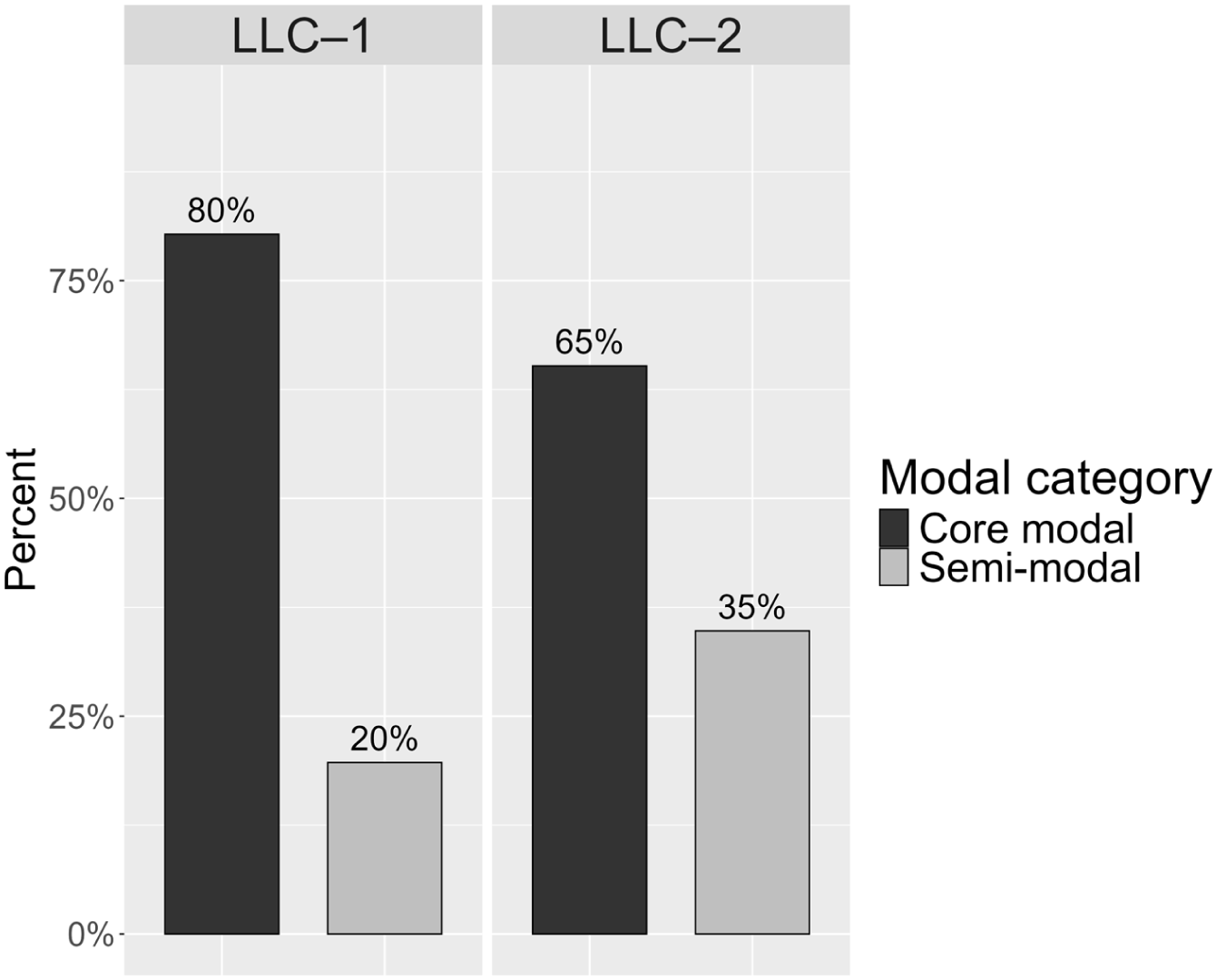
Proportions of Modal Categories Across the LLCs
Indeed, the regression model identified a significant association between LLC–2 and semi-modals (ß = 0.78, SE = 0.13, z = 5.78, p < .001). This suggests an increased use of semi-modals in advice situations in spoken British English over the past fifty years (see Supplementary Materials for the full results). 5
To capture the contribution of each of the modal verb forms separately, Table 4 presents their distribution in the LLCs, ordered by frequency.
Distribution of Modal Verb Forms in the LLCs, Ordered by Frequency; Change in Percentage Expresses the Difference Between LLC–1 and LLC–2 as a Percentage of the LLC–1 Value
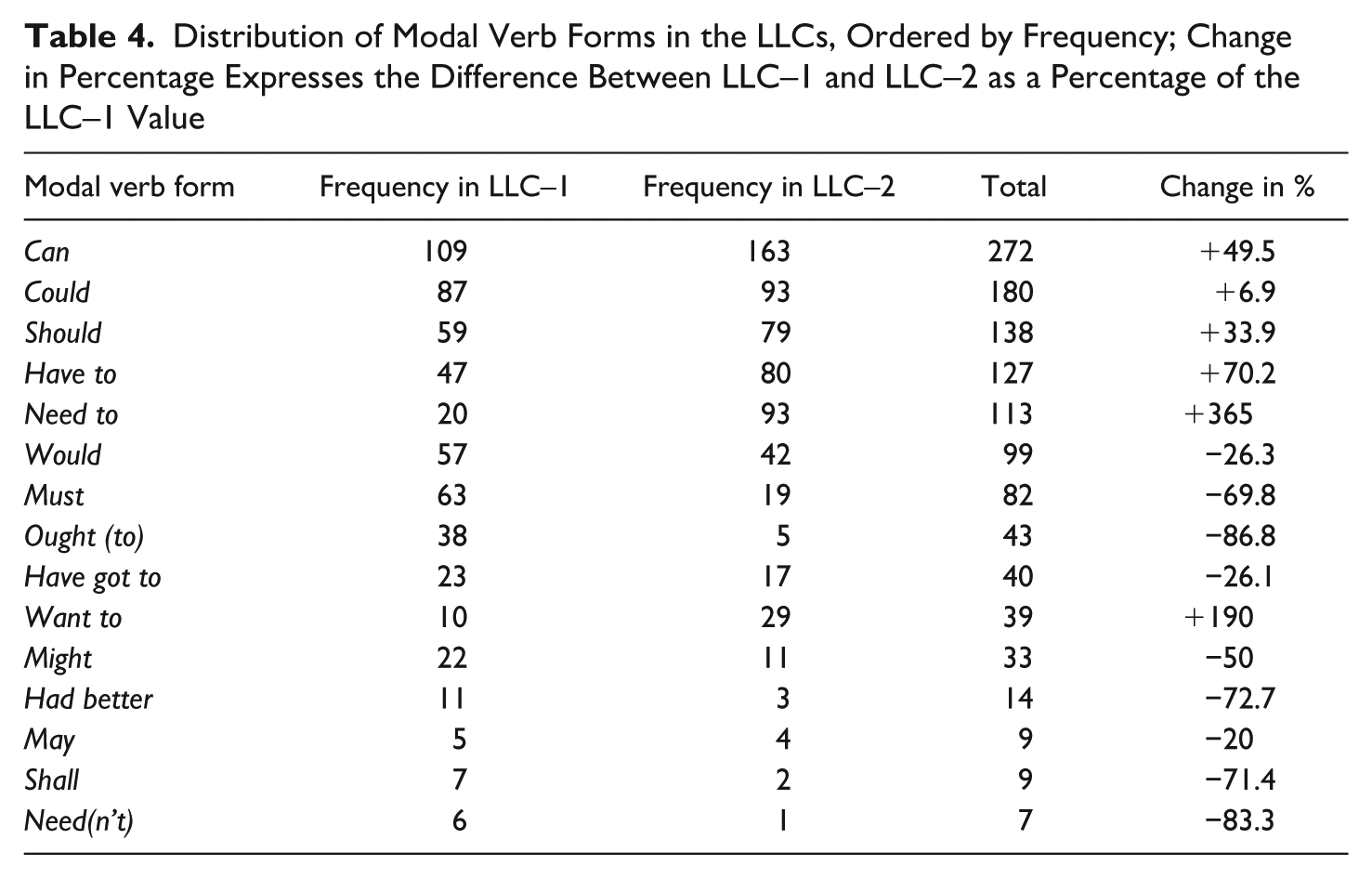
The most common verb forms in the corpora are the ‘weaker’ core modals can, could, and should, followed by the semi-modals have to and need to. In fact, for all of them the observed frequencies are higher in LLC–2 than they are in LLC–1. Most of the other modals show the opposite pattern; these include the ‘stronger’ core modals must and ought (to). Due to the relatively low frequencies of some of the modals, the regression model only contains those that had an observed frequency of at least ten. Specifically, it identified a significant association between LLC–1 and have got to (β = −0.70, SE = 0.34, z = −2.06, p = .04), might (β = −1.10, SE = 0.39, z = −2.81, p = .005), must (β = −1.60, SE = 0.29, z = −5.53, p < .001), and would (β = −0.71, SE = 0.24, z = −2.97, p = .003), and between LLC–2 and can (β = 0.40, SE = 0.12, z = 3.25, p = .001) and need to (β = 1.13, SE = 0.28, z = 4.11, p < .001). These results suggest that there is a great deal of internal variation within the broad categories of necessity and possibility not covered in Põldvere, De Felice, and Paradis (2022). In relation to previous research on English modality across a range of speech act contexts, the results show similar trends, for example, the decreased use of must and the increased use of need to. However, there are some interesting differences, which might be explained with reference to the speech act characteristics of advising in particular (see Section 4.2 for a discussion).
The classification scheme of advice constructions in Põldvere, De Felice, and Paradis (2022) sheds further light on the patterns of shifts and changes of the modals. Due to low frequencies, we conflated all types of conditionals and interrogatives. The regression model identified a significant association between LLC–2 and possibility modals with reference to both the adviser and advisee (β = 1.00, SE = 0.35, z = 2.84, p = .005), which is an indication of a possible shift in recent British English speech from the individual to the collective when solving problems. The next subsection provides qualitative support for these quantitative findings.
4.2. Democratization or Not?
In light of the above findings, is there enough evidence to suggest that the use and development of English modal verbs from the 1950s until the 2010s is at least partly due to democratization? Are the patterns the same as for language more generally or are they specific to the illocutionary function of advice? Indeed, the increased use of less deontic forms of advice, such as semi-modals in general and need to in particular, points to the preference on the part of advisers today to convey their advice in a more indirect and non-impositive way, in line with democratization proper. These aspects of need to become particularly noticeable when the discourse context and social power relations between interlocutors are taken into account. In face-to-face conversations between disparates, for instance, need to is often used to evoke the professional context which licenses the advice. From the perspective of those with more power, it allows the advice to be backgrounded against the norms and values of a larger institutional or organizational body that is considered to set the agenda for how things should be done. At the same time, the speaker’s degree of epistemic control and certainty is relatively high in order to influence the advisee’s prospective assessment on important topics. In (7), it is the academic community that is evoked as a backdrop for the supervisor’s (S039) directive to the student.
(7) (LLC–2; face-to-face conversation between disparates; T040a) S039: so there’s just a couple of small points where you just need to be clear that you know we’re talking about English so just <pause/> you know S109: yeah <pause/> S039: as in most topics we study it’s <pause/> there there’s gonna be an English focus uhm for better or for worse but that’s just cause of what’s been done
Such evocation tends to be more ambiguous in other contexts (e.g., we need to ask why are people believing nonsense in a broadcast discussion about fake news).
Another indication that the development of modal verbs in advice situations is in line with the democratization hypothesis is the decrease in must over time. The discourse contexts in which must is particularly preferred in LLC–1 are those that are argumentative in nature, whereas in LLC–2 these contexts would instead tend to take a semi-modal; these include broadcast media, parliamentary proceedings, and prepared speech (often in the form of popular science and academic lectures). Example (8) is from a broadcast debate about fox-hunting from LLC–1. Speaker b uses must along with the inclusive we to criticize the prior actions of his opponent while simultaneously lowering the level of imposition of the advice. Nevertheless, the switch to you in the next utterance still reveals the addressee as the true referent, thus adding to the overall impression of power and authority on the part of the speaker.
(8) (LLC–1; broadcast media; S.5.6) b: uh Mr Moore now <pause/> I think we must <pause/> really do something constructive about this all you’ve done so far is to read <pause/> accounts of isolated incidents <pause/> which are not typical of hunting <pause/> m: oh obviously
This said, have got to is a semi-modal that does not follow this general trend: its use has declined significantly from the 1950s until the present day, which contrasts with the slight decrease observed in Close and Aarts’ (2010) analysis of the semi-modal across a variety of speech acts and communicative goals. There has been some debate in the literature about the differences between the deontic meanings of have got to and must (e.g., Leech 1987; Myhill 1995). However, it seems that at least in advice situations the modals are placed on a similarly high level on the scale of deontic and epistemic strength of speaker authority, particularly in argumentative contexts (e.g., you’ve got to move on). This is likely due to the sense of urgency and emotion (Myhill 1995) expressed by the modal, which places additional burden on the advisee to deliver the action. Thus, the development of have got to becomes clearer when the speech act characteristics of advising are taken into account.
The decreased use of the core modals might and would in this study, and the increased use of can, seem to point not only to democratization but also to increased informality. Consider might and would in (9) and (10), respectively.
(9) (LLC–1; face-to-face conversation between = S.2.6) A: well we were saying when you arrived that uhm Tom Walker’s combination of <pause/> drama and the eighteenth century <pause/> might be something to be looked for among these applicants C: mm A: but uh I don’t suppose anybody feels a certain <pause/> absolute necessity for that <unclear/> B: no and I don’t think it very likely it’s very unlikely (10) (LLC–1; face-to-face conversation between = S.2.5b) a: that’s the point that I’ve always made <pause/> about <pause/> a project like the survey requiring a certain <pause/> rather odd combination of naivete and trust <pause/> it’s getting harder and harder to uh <pause/> to maintain and to and even harder to create <pause/> these days <pause/> B: well I suppose the Victorian maxim would be not to <pause/> talk a lot of malicious gossip <pause/> which would be good for all our characters
In (9), the speakers are assessing applicants for a position in the department, during which speaker A fills in C on a possible course of action that the committee discussed prior to C’s arrival, which B then rejects. In (10), speaker a has just learned that he was recorded without his prior consent. Speaker B interprets this as a being concerned about what he said during the recording and thus advises a (or anyone else for that matter) to avoid ‘malicious gossip.’ Both examples are quite typical of face-to-face conversation between equals in LLC–1. In fact, to a modern ear they come across as overly elaborate and formal, despite the apparently close (professional) relationship between the interlocutors. While in Love and Curry (2021) the modals showed only a marginal shift to less deontic uses over time, the pattern is somewhat clearer in advice situations. In informal conversation, this might be due to the fact that “advice is not typically the default aim of such conversations” (Põldvere, De Felice & Paradis 2022:13). Therefore, it might have to be given in ways that are recognizable to the advisee, for example, by using constructions with an explicit subject, but as we have seen in LLC–2, not necessarily with directly assertive force. This is evidenced by the rise of can (e.g., you can’t live off of two OXO cubes) as well as the occurrence of can and other possibility modals in constructions with reference to both the adviser and advisee (i.e., the inclusive we; e.g., we can stop this pretence of yeah I’ve read it; see also example (3) in Section 2.2). Stylistically, can provides a much less formal way of giving advice than would and might. Also, a closer inspection of the data reveals that the latter are more drawn to the kinds of elaborate and convoluted syntactic contexts observed in (9) and (10): 41 percent (41 out of 99) of would and 39 percent (13 out of 33) of might versus 8 percent (23 out of 272) of can. This seems to make can a more appropriate, and perhaps effective, choice for conversations between friends, family, and close colleagues today. Communicatively, it expands the working space of possible alternative viewpoints and treats the interlocutors on more equal ground, which is particularly noticeable in professional contexts such as conversations between disparates and prepared speech, where the advisee (student, young employee) is treated with intersubjective consideration as a thoughtful and capable person—or in the case of constructions of the we can type, as part of a collective effort to share the burden of having to solve a problem. This meaning aspect of can is shared by need to, which similarly lowers the significance of social power hierarchies between interlocutors, but not by must and to an extent by have got to, which instead call attention to them by contracting the communicative space and time for possible alternative viewpoints by the advisee.
Therefore, I venture to argue that, among the external mechanisms of language that are known to us, it is the combination of democratization, or the phasing out of strongly assertive forms such as must, and increased informality both in private and public contexts that in the past fifty years has led to advice-giving practices that are more equal and straightforward or less elaborate in nature. In other words, it is not necessarily the case that the modals today are placed at the bottom of the scale of deontic and epistemic strength of speaker authority and communicative (in)directness. By delivering advice in a more straightforward way, speakers can ensure more successful advice outcomes while simultaneously taking into consideration the advisee’s own capabilities to solve the problem.
5. Conclusion
In this study, I have investigated the role of democratization in the use and development of modal verbs in the speech act of advice in recent spoken English. By moving away from the broad semantic categories of deontic and epistemic modality, I was able to provide a more controlled environment for testing the democratization hypothesis and to capture the specific choices made by speakers with similar communicative goals in mind. The speech act of advice was an appropriate testbed because of its potential harm for the interlocutors’ face concerns. The data were from the London–Lund Corpora covering roughly fifty years of Present-Day spoken British English. Based on 1205 examples, the results showed that, by and large, the patterns are the same as for language more generally, as observed in previous research. Specifically, there was an increase in semi-modals such as need to and a decrease in core modals such as must, in line with democratization proper. Moreover, the rise of can, along with possibility modals in constructions with reference to both the adviser and advisee, seems to point to the preference on the part of advisers today for increased informality and solidarity with the advisee, where the latter is treated on more equal terms as someone who is capable of making their own decision. This said, certain patterns such as the decline in have got to, might, and would became clearer when the speech act characteristics of advising, and the speakers’ goals, were taken into account. Therefore, the study has contributed new knowledge to speech-act-oriented perspectives on English modality, and it has highlighted the importance of carrying out more detailed diachronic investigations, ones that take context more seriously. Furthermore, it has highlighted the close interaction between democratization and informalization as language-external forces of shifts and changes.
The present study has also shown the value of using smaller, carefully-designed corpora to study the role of democratization in short-term language change (cf. Hiltunen & Loureiro-Porto 2020; Palander-Collin & Nevala 2020). The LLCs are equipped with crucial metadata information about the texts and speakers (discourse context, social power relations) without which it would have been impossible to assess the speakers’ specific discursive motivations to choose one modal over another, in combination with quantitative, probabilistic information about which modal best fits the broader socio-cultural frame in which the advising takes place. Moreover, the manageable sizes of LLCs have allowed me to take seriously the call for more functional, rather than formal, analyses of modal verbs (Love & Curry 2021), which is more in line with the notion of the centrality of meaning in human communication. This said, I have not taken advantage of this aspect of the corpora to directly compare advice-giving utterances with and without a modal verb. Comparisons were made with the findings in Põldvere, De Felice, and Paradis (2022), but the slightly modified sample used in this study certainly calls for more controlled, comparative investigations in the future.
Footnotes
Declaration of Conflicting Interests
The author declared no potential conflicts of interest with respect to the research, authorship, and/or publication of this article.
Funding
The author received no financial support for the research, authorship, and/or publication of this article.
