



Abstract
This article attempts to understand the effect of work–family conflict on work–family balance and in turn, on the satisfaction perceived by individuals in their job and family roles. Using an online questionnaire, we collected data from 218 participants who were members of teaching faculty in higher education institutions in the southern part of India. To test the mediating effect of work–family balance on job and family satisfaction in relation to work–family conflict, we used the structural equation modeling technique along with the Bollen–Stine bootstrap estimation method. The structural equation modeling results show that the relationship between work–family conflict and satisfaction (job and family) is partially mediated by work–family balance. The study shows that both job and family satisfaction can be enhanced by balancing job and family roles. The implication and scope for further research are discussed.
Introduction
Balancing work and family is a critical issue among the members of teaching faculty in institutions of higher education. According to the 2010–2011 Higher Education Institute Faculty Survey, only 32% of faculty in the United States strongly believed that they have a healthy balance between work and family life. This low percentage shows serious incompatibility between work and family life among faculty. There remains much scope for improvement in work–family balance (WFB) in academia (cf. Watanabe & Falci, 2014). In many of the Indian universities, a 40–60 hr week workload has become the norm. There is a need to study the perceptions of the members of faculty in higher educational institutions on WFB in Indian context. There have been, to the best of our knowledge, no studies on the effect of WFB on the job and family satisfaction of academic faculty in the Indian context. This aspect is studied in this work.
The dramatic changes in composition of the workforce in the past two decades (Eby, Casper, Lockwood, Bordeaux, & Brinley, 2005) have led to changes in the demographic characteristics such as an increased number of women entering the workforce and working in diverse environmental conditions. These factors have greatly reduced the separation between an individual’s work and family (Baral & Bhargava, 2010, 2011). Thus, people now experience conflicts between their work and family, and this has been a topic of interest for scholars around the world (e.g., Aryee, Srinivas, & Tan, 2005; Baltes, Zhdanova, & Clark, 2010; Carlson, Grzywacz, & Zivnuska, 2009). To understand this issue, many scholars have studied the antecedents and consequences of work–family conflict (WFC) and work–family facilitation (WFF) (e.g., Aryee et al., 2005; Proost, De Witte, De Witte, & Schreurs, 2010; Warner & Hausdorf, 2009).
WFC is defined as “a form of inter role conflict in which the role pressures from the work and family domains are mutually incompatible in some respect” (Greenhaus & Beutell, 1985, p. 77). Frone (2003) assumed that less WFC and high WFF are equivalent to WFB. However, other researchers have assumed WFB as the outcome of both directions (work-to-family and family-to-work) of WFC and WFF. According to Frone (2003), WFB consist of four components (work-to-family conflict, family-to-work conflict, work-to-family facilitation and family-to-work facilitation). The inconsistent results seen in a study by Aryee et al. (2005) that used the four component-based conceptualization on WFB led to the development of a five-item measure on satisfaction with WFB by Valcour (2007). Valcour (2007) focused on resolving the multiple demands of work and family. Our work is based on Grzywacz and Carlson (2007) who define the accomplishment of role-related expectations in work and family domains. Our study, unlike Greenhaus and Allen (2011) and Valcour (2007), does not consider effectiveness and satisfaction in work and family domains as a factor of WFB. Instead, it focuses on the outcomes of WFB (job and family satisfaction). The study also features the roles and responsibilities of individuals in social domain rather than individual perceptions in psychological domain. Also, the definition by Grzywacz and Carlson (2007) is valuable as it suggests that WFB is possible despite experiences of WFC.
The differentiation of WFB from WFC is not yet clear. Recently, Greenhaus, Ziegert, and Allen (2012) established that WFB is an outcome of WFC; however, the correlation between WFC and WFB is considerably high (r = −.66), and there were no detailed results for the tests of confirmatory factor analysis, thus making the tests for discriminant validity essential.
Carlson et al. (2009) showed that WFC and WFB exist as distinct constructs and these constructs have separate work and family domain outcomes. Past evidence shows that work-to-family conflict (WtoFC) and family-to-work conflict (FtoWC) are negatively related to job and family satisfaction (e.g., Boyar & Mosley, 2007; Carlson et al., 2009). To the best of our knowledge, there have been no studies reporting the effect of WtoFC and FtoWC on job and family satisfaction through WFB.
Past studies have tested the direct effect of WFC on job satisfaction, organizational commitment, family satisfaction, family performance, and turnover intention (Aryee et al., 2005; Carlson et al., 2009). Very few studies have included WFB as a mediator between WFC and job satisfaction (Greenhaus et al., 2012; Haar, 2013). On the basis of recent studies on the conceptualization of WFB (e.g., Brough & Kalliath, 2009; Carlson et al., 2009; Clark, 2000), this study aims to test the mediating role of WFB between WFC (WtoFC and FtoWC) and satisfaction (job and family). The mediation model in this work helps in understanding how an antecedent is related to the outcome variable through a third variable called the mediator.
Theoretical and empirical backgrounds
WFB is defined as “accomplishment of role-related expectations that are negotiated and shared between an individual and his or her role-related partners in the work and family domains” (Grzywacz & Carlson, 2007, p. 466). Grounded in this conceptualization is the negotiation and accomplishment of role-related expectations that embody the concept of WFB which lead to important outcomes such as job satisfaction, family satisfaction, family performance, marital satisfaction, family functioning, and organizational commitment (Carlson et al., 2009; Greenhaus et al., 2012).
This research is based on a few empirical and theoretical foundations. The first foundation is based on the WFB review conducted by Greenhaus and Allen (2011) and Greenhaus et al. (2012), who empirically tested and proved that both the directions of WFC (WtoFC and FtoWC) are related to WFB. The second foundation is based on the study by Carlson et al. (2009), which supports the existence of a link between WFB and job satisfaction and family satisfaction.
The third foundation of this research is based on the role balance theory, which suggests that individuals who handle all the role expectations (work or family) with even-handed alertness produce beneficial consequences, both in job and family satisfaction (Marks & MacDermid, 1996). We theorize that WFB could be a mediating construct to test the effect of WtoFC and FtoWC on job satisfaction and family satisfaction. Recently, Haar (2013) used the role balance theory to link WFC with various psychological outcomes such as emotional exhaustion, anxiety, and depression through WFB. Based on these theories and empirical support, we have developed a mediation model on WFB for testing in the Indian context.
Work–family conflict, work–family balance, and outcomes
In this empirical work, we have attempted to link WtoFC and FtoWC with WFB, because very little research has been carried out in this domain. Traditionally, researchers on WFC have assumed that WFC and WFF are equivalent to WFB (Odle-Dusseau, Britt, & Bobko, 2011; Post, DiTomaso, Farris, & Cordero, 2009). Carlson et al. (2009) and Greenhaus et al. (2012) recently established that these constructs are distinct and there exists a negative relationship between WFC and WFB. Therefore, lower WFC leads to a better balance between work roles and family roles. Past empirical studies have reported that high levels of WtoFC and FtoWC have negative consequences (e.g., Amstad, Meier, Fasel, Elfering, & Semmer, 2011).
Recently, Michel, Mitchelson, Kotrba, LeBreton, and Baltes (2009) conducted a meta-analysis to test the WFC models and evaluated critical work–family linkages. Their analysis reported a negative relationship of WFC on job satisfaction and family satisfaction. Furthermore, many scholars have analyzed the relationships between both directions of conflict (WtoFC and FtoWC) and job and family satisfaction. A number of studies have shown that WtoFC and FtoWC lead to reduced job satisfaction (Boyar & Mosley, 2007; Lu, Siu, Spector, & Shi, 2009) and diminishes the individuals’ family satisfaction (Carlson et al., 2009; Frye & Breaugh, 2004; Karatepe & Baddar, 2006; Rupert, Stevanovic, Hartman, Bryant, & Miller, 2012).
Although WFB helps individuals to be satisfied with their work and family activities, recent studies conducted by Carlson et al. (2009) and Ferguson, Carlson, Zivnuska, and Whitten (2012) found a positive relationship between WFB and job satisfaction. Similarly, balanced work and family activities enhanced family satisfaction of individuals (Carlson et al., 2009). Based on this notion, it was hypothesized that there is a negative relationship between the two directions of conflict (WtoFC and FtoWC) and WFB (Objective 1). Similarly, there is a positive relationship between WFB and satisfaction (job and family) (Objective 2).
Very few studies have tested the mediating effect of WFB on WFC and family and job satisfaction (Greenhaus et al., 2012 (Business college alumni sample from a private university in United States); Haar, 2013 (Employees sample in New Zealand)). We expect that WFC will be negatively related to WFB, which in turn, will be positively related to job and family satisfaction. The role balance theory lends support to include WFB as a mediator between conflict and satisfaction (job and family). The study by Haar (2013) supports that both directions of conflict (work to life and life to work) on job and life satisfaction are mediated by work–life balance. Based on these assumptions and literature, we expect that WFB may mediate the relationship between conflict (WtoFC & FtoWC) and satisfaction (job and family) in the context of Indian academic samples as well. It is hypothesized that WFB may mediate the relationship between both directions of conflict and satisfaction (job and family) (Objective 3).
Method
Participants
The research designed comprised cross-sectional and quantitative data collection methods. The participants were teaching faculty members, working in government and private institutions of higher education, and universities in the southern part of India. The criteria for including a participant in the study were as follows: (1) the teaching faculty member must be married and (2) they must be full-time employees. The reason for limiting the participants to these criteria is to increase the likelihood that WFC was a relevant issue to the individual and to increase accuracy of response to the WFC questions (Rotondo, Carlson, & Kincaid, 2003). Screening of the 466 participants (rate of response was 3.1%) who had submitted their responses resulted in 218 full-time employees who were also married. The sample size of 218 participants considered in this study is deemed to be sufficient to test the proposed hypotheses since it satisfies the minimum requirement criterion of 200 participants recommended by Hair, Black, Babin, and Anderson (2009) for such analysis. Of the 218 respondents, 63.3% were men and 36.7% were women. The average age of the participants was 37.79 years. The average work hours per week was 40 hr, 71.1% worked in private institutions, and 28.9% in government institutions with average work experience of 13.18 years. 43.6% had a single child at home and 31.7% had two children, 1.8% had three children, 14% did not have children, and 8.7% did not disclose information on the number of children they had.
Instruments
The study reliability was measured using Cronbach’s alpha value, and the values are presented in Table 1.
Mean, standard deviation, reliability, and correlations of the study variables.

SD: standard deviation; α: Cronbach’s alpha.
p < .01.
Work–family conflict
The 10-item WFC scale by Netemeyer, Boles, and McMurrian (1996) was used to measure WtoFC and FtoWC. This scale was used by Karatepe and Baddar (2006) who obtained Cronbach’s alpha values of .76 and .75 for WtoFC and FtoWC, respectively. A sample item for WtoFC is “Due to work-related duties, I have to make changes to my plans for family activities” and for FtoWC is “The demands of my family or spouse/partner interfere with work-related activities.” Each item was measured with a 5-point Likert scale (1 = strongly disagree to 5 = strongly agree).
Work–family balance
WFB was measured using the five items used by Hill, Hawkins, Ferris, and Weitzman (2001). The obtained Cronbach’s alpha value in Hill et al. (2001) study was .83. The items were as follows: (1) How easy or difficult is it for you to balance the demands of your work and your family life? (5-point scale: very difficult to very easy), (2) I have sufficient time away from my job at this organization to maintain adequate work and family balance (5-point scale: strongly disagree to strongly agree), (3) When I take a vacation, I am able to separate myself from work and enjoy myself (5-point scale: strongly disagree to strongly agree), (4) All in all, how successful do you feel in balancing your work and family life? (5-point scale: extremely unsuccessful to extremely successful), and (5) How often do you feel drained when you go home from work because of work pressures and problems? (5-point scale: never to almost always).
Job satisfaction
We used the three-item job satisfaction measure designed by Cammann, Fichman, Jenkins, and Klesh (1979) to assess the global job satisfaction. This scale was recently used by Ferguson et al. (2012), who obtained a Cronbach’s alpha value of .88. The sample item is “All in all I am satisfied with my job” and the scale is anchored with 1 = strongly disagree to 5 = strongly agree.
Family satisfaction
The three items scale developed by Edwards and Rothbard (1999) was used to measure family satisfaction. It was earlier used in WFC research by Lu et al. (2010), who obtained a Cronbach’s alpha value of .97. A sample item is “My family life is very enjoyable” which was anchored with 1 = strongly disagree to 5 = strongly agree.
Procedure
A self-reported online questionnaire to measure the constructs was e-mailed to the participants with an invitation for voluntary participation. Fifteen thousand e-mail addresses of teaching faculty members were collected from the official websites of the institution’s and conference/seminar advertisements. Purposively, e-mails were sent to the teaching faculty members, working in various government and private institutions, and universities across southern India, with a request to participate in the survey. The total time for completing the questionnaire was estimated to be approximately 10 min. A total of 466 (3.1%) responses were received.
Ethical considerations
The participants responded out of their free will and were not personally known to the researchers. This study was a part of the doctoral level research of the first author. Hence, prior ethical approval was granted by the doctoral committee and the Center for Research, Anna University, India to pursue this study from the Institution where in the researcher was registered.
The research instruments clearly stated the objectives of the study and provided instructions to fill the e-questionnaire. The researchers’ ensured anonymity and that no response could be linked to a specific individual or organization.
Data analysis
In order to test the hypothesized research model, we used structural equation model (SEM) with Analysis of Moment Structures (AMOS version 21) and
Results
Descriptive, inter-correlation, and reliability analysis results are presented in Table 1. After completion of the preliminary analysis, principal component analysis was performed by including all the constructs indicators/items with a varimax rotation. The results are presented in Table 2.
Rotated component matrix.

FS: family satisfaction; WFB: work–family balance; WtoFC: work-to-family conflict; FtoWC: family-to-work conflict; JS: job satisfaction.
Results obtained using principal component extraction with a varimax rotation.
The total variance explained by the five factors was 69.21. During the principal component analysis, few items were deleted due to poor loading and cross loaded on another component. In FtoWC, item number five was given a loading value of .40; in WFB, item number three was cross-loaded on family satisfaction component and WFB item number four was created as the sixth (new) component, and in WtoFC, item number five was given a loading value of .41.
The measurement model and structural model tests were then conducted as suggested by Anderson and Gerbing (1988). In the first step, the measurement properties of the manifest variables were tested. The five-factor model was fitted well with the data (refer to Table 3), because all the fit indices were within the cutoff limit as prescribed by Hair et al. (2009). The multivariate normality of the data was tested and the multivariate kurtosis critical ratio value which should be <5 was found to be 15.80 (Byrne, 2009). So it was concluded that the data were non-normal. To avoid biased estimation of parameters with non-normal data, we used the Bollen–Stine bootstrap estimation technique. During confirmatory factor analysis, the first item in WtoFC was deleted due to high error correlation with WFB construct.
Measurement models result.

χ2: Chi-square value; df: degrees of freedom; CFI: comparative fit index; GFI: goodness of fit index; RMSEA: root mean square error of approximation.
All the measurement models were estimated using the Asymptotic Distribution Free estimation method.
Al the variables are considered as single factor.
WtoFC, FtoWC, and WFB are considered as one factor and job satisfaction and family satisfaction considered as another factor.
WtoFC, FtoWC, and WFB are considered as one factor and job satisfaction and family satisfaction considered as separate factors.
WtoFC and FtoWC are considered as one factor and WFB, job satisfaction, and family satisfaction considered as separate factors.
All the variables are considered as separate factors.
There existed a chance of common method bias as the constructs were measured using a self-reported online survey at a single point of time. To detect common method bias, Harman’s one-factor test was conducted, which resulted in a single-factor solution. However, the single-factor solution did not account for larger variances. Hence, it was decided that this study was free from the common method bias (Podsakoff, MacKenzie, Lee, & Podsakoff, 2003).
To test the unidimensionality of the measures, confirmatory factor analysis was also carried out with several measurement models such as the one-factor to five-factor models (see Table 3). This step was performed particularly to find the unidimensionality of the measures. Result shows that the one-factor model did not fit well with the data and the five-factor model provided a good fit to the data (GFI = .96, CFI = .92, and RMSEA = .049), thus supporting unidimensionality of the measures.
Convergent validity was assessed by average variance extracted (AVE) and except for FtoWC, all the constructs AVE were above the cutoff value of .5 (Straub, Boudreau, & Gefen, 2004). Table 4 shows the AVE, composite reliability (CR), and discriminant validity of the construct and it was assessed by comparing the square root of AVE with its corresponding construct correlation values. All the construct correlations were less than the square root of AVE. Hence, all the constructs used in this study were distinct and theoretically related (Straub et al., 2004).
Convergent and discriminant validity.

AVE: average variance extracted; CR: composite reliability.
Diagonal values representing square root of the AVE.
In the second step, the structural model was tested using the Bollen–Stine bootstrap estimation method (Byrne, 2009), because this method is appropriate to estimate the parameter values with the non-normal data. This method of estimation is best suited to the data for the proposed structural model (Hair et al., 2009). The parameter estimate and its unstandardized regression (b) values along with the confidence interval (CI) and p are given in Table 5. If the CI included zero between its upper and lower bound limit, then the direct or indirect effect value is considered to be insignificant.
Standardized direct effects with lower and upper bound limits.

CI: confidence interval; b: unstandardized regression Weight, b-values are computed through bootstrapping procedure with 218 cases and 5000 bootstrap samples; a: suppression effect.
In order to establish the direct and indirect effects of WtoFC and FtoWC on job and family satisfaction and to select the best fit model, the mediation role of WFB was tested using Baron and Kenny (1986) steps. We have tested two models, a fully mediated model having direct paths from WtoFC and FtoFC to job and family satisfaction, and a partially mediated model having direct paths from WtoFC and FtoWC to job and family satisfaction.
Direct and indirect effects were tested using the bootstrapping procedure with 5000 bootstrap samples. The estimated structural model is presented in Figures 1 and 2.
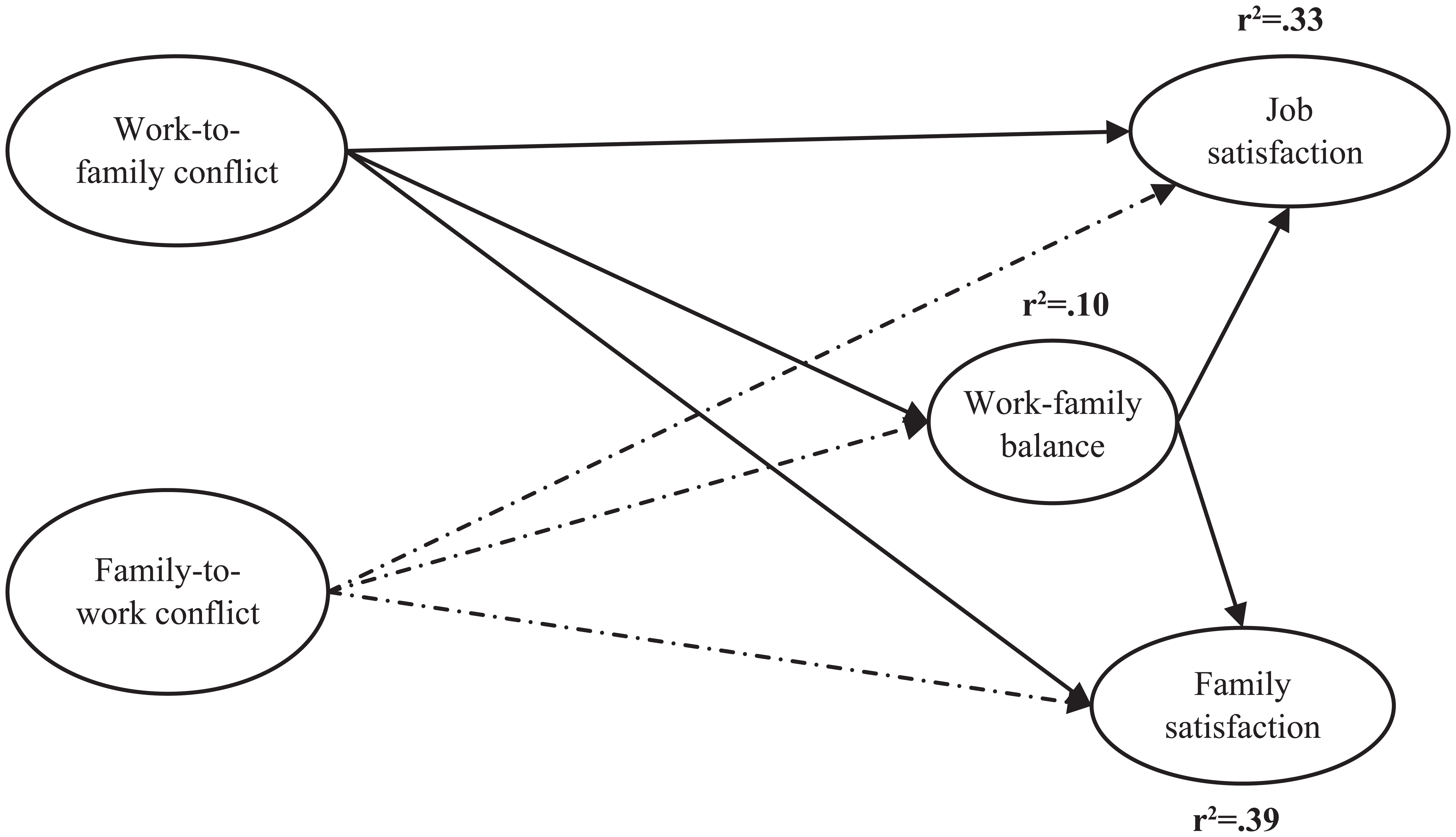
Partial mediation model.

Full mediation model.
From the above structural model, it is evident that WtoFC was negatively related to WFB (b = −.39, p < .05), but FtoWC was not statistically related to WFB (b = .04, p = .84). Thus, objective one was partially supported. WFB was positively related to job satisfaction (b = .38, p < .05) and family satisfaction (b = .58, p < .001). Thus, objective two was supported.
To assess whether mediation was present in the theoretical model, we used the recommendations of Preacher and Hayes (2004) and Zhao, Lynch, and Chen (2010) utilizing the bias-corrected and percentile bootstrap CIs addressing some flaws related to the Sobel test. The bias-corrected and percentile bootstrap methods can be conducted in AMOS.
The indirect effect values with lower and upper bound limits for bias-corrected and percentile bootstrap methods are given in Table 6. While testing the partial mediation model, we found a significant negative relationship between WtoFC and job satisfaction (b = −.35, p <.01). However, the relationship between WtoFC and family satisfaction was significant (b = .27, p <.05), but the sign was in the opposite direction. This implied the existence of a suppression effect (MacKinnon, Krull, & Lockwood, 2000).
Standardized indirect effects with lower and upper bound limits.

CI: confidence interval.
Indirect effect values are computed through bootstrapping procedure with 218 cases and 5000 bootstrap samples.
The mediation test offers partial support for both mediational hypotheses since the indirect effect does not include zero in the CI for WtoFC to both the satisfactions (job and family) through WFB. Therefore, there exists a partial support for objective three. The research model showed a full mediation effect. For the entire research model, the amount of variance that accounted for endogenous constructs was modest: for WFB, it was 10%, job satisfaction was 33%, and family satisfaction was 39%. A supplementary analysis was also conducted to test the full mediation effect. The full mediation model does not fit well with the data compared with the partial mediation model (Partial mediation model: χ2 = 118.80, df = 81, p = .004, χ2/df = 1.47, GFI = .93, CFI = .97, RMSEA = .05, RMR = .07; Full mediation model: χ2 = 133.67, df = 85, p = .001, χ2/df = 1.57, GFI = .92, CFI = .95, RMSEA = .05, RMR = .08). In the full mediation model, the link between FtoWC and WFB was insignificant. The corresponding results are presented in Figure 2. Finally, this study established a partial mediation effect between WtoFC and satisfaction (job and family) through WFB.
Discussion
This study augments to the growing literature on WFB. Based on the role balance theory, we tested the effect of WtoFC and FtoWC on job and family satisfaction through WFB. Additionally, the study also showed the direct effect of WtoFC on WFB and indirect effect on job and family satisfaction of individuals through a mediating process. Our results also explained the association of WtoFC and FtoWC on job and family satisfaction. In particular, the indirect effect of WtoFC on job and family satisfaction through WFB was substantially stronger. In other words, in cases where WtoFC is lower, the individual’s satisfaction in their job and family responsibilities increased with the help of balanced work and family roles. Overall, there exists a strong support for WFB influencing job satisfaction and family satisfaction regardless of WtoFC (Aryee et al., 2005; Carlson et al., 2009; Haar, 2013). An inconsistent finding from this study was the inability to detect the significant effect of FtoWC on WFB and job and family satisfaction. Previous research has also reported similar inconsistencies (Boyar & Mosley, 2007; Lu et al., 2009). In the past, few studies had established significant impact of FtoWC on WFB and some of the psychological outcomes (Greenhaus et al., 2012; Haar, 2013).
The findings have also supported the direct effect of WFB on job satisfaction. A balanced work and family role positively enhances satisfaction in routine jobs done by individuals in an organization. Similarly, a balanced work and family environment enhances satisfaction in an individual’s family activities. Additionally, in the partial and full mediational models, the variance explained in family satisfaction was considerably higher than job satisfaction. This shows that WFB makes a relatively less contribution to job satisfaction than family satisfaction. Therefore, balanced work and family life is more important for individuals to be satisfied with their family responsibilities than work role responsibilities. Moreover, job satisfaction of the individuals may be determined by some of the work domain constructs other than WFB. WFB helps individuals to manage their family responsibilities effectively by getting adequate time to spend with family. Thus, the WFB strongly contributes to family satisfaction rather than job satisfaction. Furthermore, the impact of WtoFC and FtoWC on WFB is low (10%), indicating that other factors may be influencing WFB. However, some authors include work–family enrichment and family–work enrichment (Carlson et al., 2009; Haar, 2013) as possible precursors to WFB.
In the mediation analysis, we found partial mediation for both the satisfaction constructs through WFB from WtoFC (not for FtoWC). Thus, in order to reduce WtoFC and improve job and family satisfaction, individuals are required to maintain a better balance between their work and family roles. Furthermore, current literature and this study suggest that WFB is different from WFC (Carlson et al., 2009; Greenhaus et al., 2012). This study also produced strong evidence to prove that WFB is different from WtoFC and FtoWC in the Indian sample. It also found support from previous literature related to the effect of WFC on WFB (e.g., Carlson et al., 2009; Greenhaus et al., 2012; Haar, 2013).
This study result supports the fact that the teaching faculty can enhance their work and family satisfaction by balancing their work and family roles. Correspondingly, this study validates the fact that focusing on the maintenance of a balance between work and family roles may be moderately valuable, due to the partial mediation effect established in this study. Consequently, organizations must focus on modifying the existing practices so as to improve employee balance between their work and family roles. Higher educational institutions can implement specific WFB practices such as flexible schedule benefits, support from the superior, co-workers, and organization, and additional leave benefits to help the faculty to manage their academic and family responsibilities in an even-handed way (Haar, 2013). By this, the faculty members may be able to balance their work and family-related activities effectively, leading to satisfaction in work and family.
Overall, this research provides evidence that individuals with higher WFB are more satisfied with their job and family than those with lower WFB (Haar, 2013). This study has also partially replicated Greenhaus et al.’s (2012) research to test the link between WtoFC, FtoWC, and WFB.
In this study, since the data were collected through self-reporting, there was a possibility of common method bias. The common method bias was tested by the single-factor (Harman’s) test. However, common method bias is not a serious concern and it may not inflate the relationship among the constructs (Spector, 2006). Another limitation of this study with respect to sampling is the limited availability of the database of faculty members. This study lays the foundation for specific future research. First, the present research work has proved the relationship between WtoFC and WFB and has provided evidence to establish that these two constructs are distinct. Future studies are required to test this effect with different samples. Second, through mediation analysis, the effect of WtoFC on satisfaction through WFB was partially supported and we did not obtain any effect of FtoWC on satisfaction through WFB. Further frameworks may be required to use both the directions of WFC and work–family enrichment to test this effect (Jaga & Bagraim, 2011).
Conclusion
Despite the above-mentioned limitations, this study has provided key insights to the existing work–family literature. The study linked WFC with WFB by considering that the two constructs are distinct. The study also provided sufficient evidence for the partial mediating effect of WtoFC on satisfaction (job and family) through WFB. Finally, it was established that employees can enhance their satisfaction in both job and family by balancing their work with the family.
Footnotes
Acknowledgements
I sincerely thank Joseph Grzywacz, Florida State University and three anonymous reviewers of the South African Journal of Psychology for the invaluable help and guidance in drafting the earlier version of this article. We acknowledge the assistance of www.manuscriptedit.com and  for English language editing and proofreading of the article.
Declaration of conflicting interests
The author(s) declared no potential conflicts of interest with respect to the research, authorship, and/or publication of this article.
Funding
The author(s) received no financial support for the research, authorship, and/or publication of this article.