



Abstract
This study aimed to determine how work–nonwork interference and work–family enrichment operate simultaneously to influence the work-related outcomes job satisfaction, organisational commitment, and subjective career success. By employing South African work–family instruments, the study tested substantive hypotheses in this regard. A cross-sectional survey design among a sample of permanently employed married parents (n = 212) was utilised. Statistical analyses included confirmatory factor analyses and validity assessments. Second-order measurement models were utilised in a structural equation modelling to test various hypotheses in this regard. Results indicate that work–nonwork interference and work–family enrichment operate simultaneously and are independently significantly related to work-related outcomes (except work–nonwork interference with commitment). Work–family enrichment was positively related to job satisfaction, organisational commitment, and subjective career success, while work–nonwork interference was found to be negatively related to job satisfaction and subjective career success. The findings suggest that these concepts should not be viewed as opposites on a continuum, but rather as phenomena that act independently in the nomological net of the work–family domain. The findings also suggest that work–family enrichment contributes more to the work-related outcomes than in the case of work–nonwork interference. The implication is that, in order to obtain positive work-related outcomes, it is more important to focus on fostering positive interaction in the work–family context than trying to eliminate the conflict in this regard.
Keywords
Due to economic pressures and increased work demands from contemporary careers, it is becoming increasingly difficult to ignore the interaction between the work and family domains (Greenhaus & Kossek, 2014). A considerable amount of literature has been published on work and family, of which Greenhaus and Powell (2006) proposed the dividing into two different structures, namely role conflict (i.e., compliance with one role makes the compliance with the other role more difficult) and role enrichment (i.e., the positive influence of participating in multiple roles on an individual). In addition, extensive research has made it evident that both work–family conflict (WFC) and work–family enrichment (WFE) are bi-directional (Grzywacz & Marks, 2000; Kinnunen, Feldt, Geurts, & Pulkkinen, 2006; Odle-Dusseau, Britt, & Greene-Shortridge, 2012).
What is currently known about work–family interaction is largely based upon international empirical studies, although numerous South African (SA) studies on work–home interaction have been conducted since 2006 (De Klerk & Mostert, 2010; Jacobs, Mostert, & Pienaar, 2008). Questions have been raised regarding the applicability of international work–family research findings as well as the use of international work–family measurements in South Africa (Koekemoer, Mostert, & Rothman, 2010). However, Samaddar and Kadiyala (2006) stated that revisiting earlier studies to evaluate their general applicability to new contexts is important, since it can be a valuable part of theory development. The successful or nonsuccessful replication provides the basis for further and deeper explanatory studies and theory (Lindsay & Ehrenberg, 1993).
Recently, international researchers have shown a renewed interest in work–family relationships and its influence on work-related outcomes, where the most recent evidence confirms that same-domain relationships are stronger than cross-domain relationships (Amstad, Meier, Fasel, Elfering, & Semmer, 2011; Mihelič, 2014; Nohe, Meier, Sonntag, & Michel, 2015; Shockley & Singla, 2011). Carlson, Hunter, Ferguson, and Whitten (2014) have indicated that this is especially true regarding the work domain. If employees experience spill-over of resources from their work lives into their family lives, they are more likely to give credit to work, which will, in turn, enhance their positive attitudes towards work. Somewhat similarly, when employees feel that their work interferes with their family life, they tend to blame the work domain which results in negative relationships with work-related outcomes (Anderson, Coffey, & Byerly, 2002). Grzywacz and Bass (2003) suggested that employees may simultaneously experience enrichment and conflict, while Gareis, Barnett, Ertel, and Berkman (2009) already found that WFC and WFE were independently linked to outcomes. Since then, several researchers have warranted the need to investigate work–family interaction with regard to possible interference and enrichment operating simultaneously, and the effect thereof on work-related outcomes (Buonocore & Russo, 2013; Mihelič, 2014).
The aim of this study was to incorporate valid and reliable measurements developed in the SA context for measuring work–family interference and enrichment as they operate simultaneously to influence work-related outcomes.
Work–family interaction
A substantial body of research indicates work–family interaction as a form of interaction that refers to the relationship between individuals’ work and home domains and the reciprocal effect of these domains, whether positive or negative (Grzywacz & Marks, 2000; Odle-Dusseau et al., 2012). Work–family interference represents a process whereby the involvement in the work role interferes with functioning in the nonwork role (Greenhaus & Beutell, 1985). In this study, the term ‘interference’ (specifically work–nonwork interference [WNWI]) includes both ‘interference’ and ‘conflict’, which refer to the negative influences between the work and nonwork domains. In contrast to this, WFE is regarded as the positive contributing factor within work–family interaction (Greenhaus & Powell, 2006). Various measurable concepts, such as ‘positive spill-over’ (Hanson, Hammer, & Colton, 2006) and ‘facilitation’ have been used in relevant literature to describe the extent to which individuals are engaged within one domain leading to increased functionality in the other (Wayne, Grzywacz, Carlson, & Kacmar, 2007). WFE is used as the overall term for positive interaction.
African work-and-family scholars have called for the replication of research done in the Global North as a way of establishing its applicability to African context (Nyengele, 2004). Two work-and-family instruments have recently been developed within the SA context in an endeavour to overcome the problematic issues regarding international measurements. First, the WNWI instrument of Koekemoer et al. (2010) to measure the interference between the work and various nonwork domains; second, the WFE instrument of De Klerk, Nel, Hill, and Koekemoer (2013) which was based on the WFE model of Greenhaus and Powell (2006).
Work–family interaction and work-related outcomes
Work–family interaction has been related to a vast number of outcomes (see Eby, Casper, Lockwood, Bordeaux, & Brinley, 2005, for a comprehensive overview). However, since then, some of the most prevalent outcomes being investigated within work–family studies are job satisfaction (Armstrong, Atkin-Plunk, & Wells, 2015; Chan et al., 2016; Daniel & Sonnentag, 2016), organisational commitment (Akintayo, 2010; Allen et al., 2012), and subjective career success (Beauregard & Henry, 2009). In most of these studies, these outcomes were separately investigated with either WFE or WFC. By including these three outcomes in one study and including both the positive and negative interactions between work and family, the present study makes for a significant contribution to work–family literature. Therefore, it was decided to include these three outcomes in this study.
Job satisfaction
Job satisfaction is known as gaining a sense of meaning and purpose from one’s work (Heslin, 2005). Since it is often considered as an indicator of the effectiveness of organisations, various researchers have shifted their focus to the influence that work–family interaction has on job satisfaction. More recently, researchers have investigated job satisfaction with WFC (Armstrong et al., 2015; Neerpal & Barath, 2013; Singh & Nayak, 2015), and WFE (Carlson et al., 2014; Chan et al., 2016; Daniel & Sonnentag, 2016); with only a few studies focusing on the work–family interface (i.e., WFC and WFE simultaneously) (Mihelič, 2014; Odle-Dusseau et al., 2012). All these findings confirm that when conflict occurs, a negative relationship exists with job satisfaction, which suggests that employees become less satisfied with their jobs due to the interference their work has on their personal lives. Alternatively, if employees experience enrichment in their work–family context they are more satisfied with their jobs.
Organisational commitment
Organisational commitment is known as the psychological connection that exists between employees and their organisations. Meyer, Stanley, Herscovitch, and Topolnytsky (2002) distinguish between affective, continuance, and normative commitment. Affective commitment is the individual’s attachment to and identification with his or her organisation. In the case of continuance commitment, the connection is based purely on financial implications whereas with normative commitment it is the individual’s perceived obligation to remain with his or her current organisation.
Ballout (2008) suggests that inadequate organisational programmes to promote work–family balance may decrease employee’s level of commitment. Some literature has already established the negative relationship between WFC and organisational commitment (Akintayo, 2010; Allen et al., 2012; Greenhaus & Powell, 2006). When considering WFE, Hammer, Neal, Newsom, Brockwood, and Colton (2005) are of the opinion that when offering family-friendly workplace support, organisations demonstrate their commitment to the well-being of their employees. This, in turn, increases employees’ organisational commitment and their loyalty to the organisation. Positive relationships have been found between WFE and organisational commitment (Eby et al., 2005; Wayne, Randel, & Stevens, 2006).
Subjective career success
Subjective career success is defined by Seibert, Crant, and Kraimer (1999) as an individual’s feeling of personal accomplishment, satisfaction in career progression, and appropriate skills development. Individuals may differ, however, on factors such as career aspiration, learning and development opportunities within the work environment, and well as the importance of work in relation to time spent with their families (Arthur, Khapova, & Wilderom, 2005).
Ballout (2008, p. 441) explains the relationship between work–family interference and subjective career success as follows: An employee perceives himself or herself to be successful if he or she manages to excel in both job and family roles. If this employee favours one role at the expense of the other role, the amount of conflict tends to increase, and this will limit his or her career possibilities.
On the other hand, career success seems to increase when one domain positively contributes towards the other domain (Hanson et al., 2006). It also improves employees’ ability to function optimally and deal with the other domain’s responsibilities. Thus, employees investing time and energy into their work contribute positively to career satisfaction and create subjective perceptions of being successful (Beauregard & Henry, 2009).
Theoretical framework
This study was based on the Work–Home Resources model of Ten Brummelhuis and Bakker (2012), which explains the positive and negative work–home processes integrally. According to their framework, work–home conflict presents a process whereby demands in one domain deplete personal resources and impede accomplishments in the other domain. Enrichment is described as the process of resource accumulation, where work and home resources increase personal resources, which in turn, can be utilised to improve work and home outcomes. This framework provides a more informative view of what occurs when work and home domains conflict with or enrich each other. Thus, when employees experience a positive influence (enrichment) within their work–family relationship, they will tend to reciprocate with more willingness to put effort into their work; and when employees experience their organisation as unsupportive, and perceive their work as interfering in their home responsibilities, they will tend to develop a negative attitude towards the organisation.
Based on the above-mentioned, it is firstly hypothesised that there is a negative relationship between WNWI and job satisfaction; organisational commitment; and subjective career success. Second, it is hypothesised that there is a positive relationship between WFE and job satisfaction; organisational commitment; and subjective career success. Figure 1 illustrates these specified hypotheses.
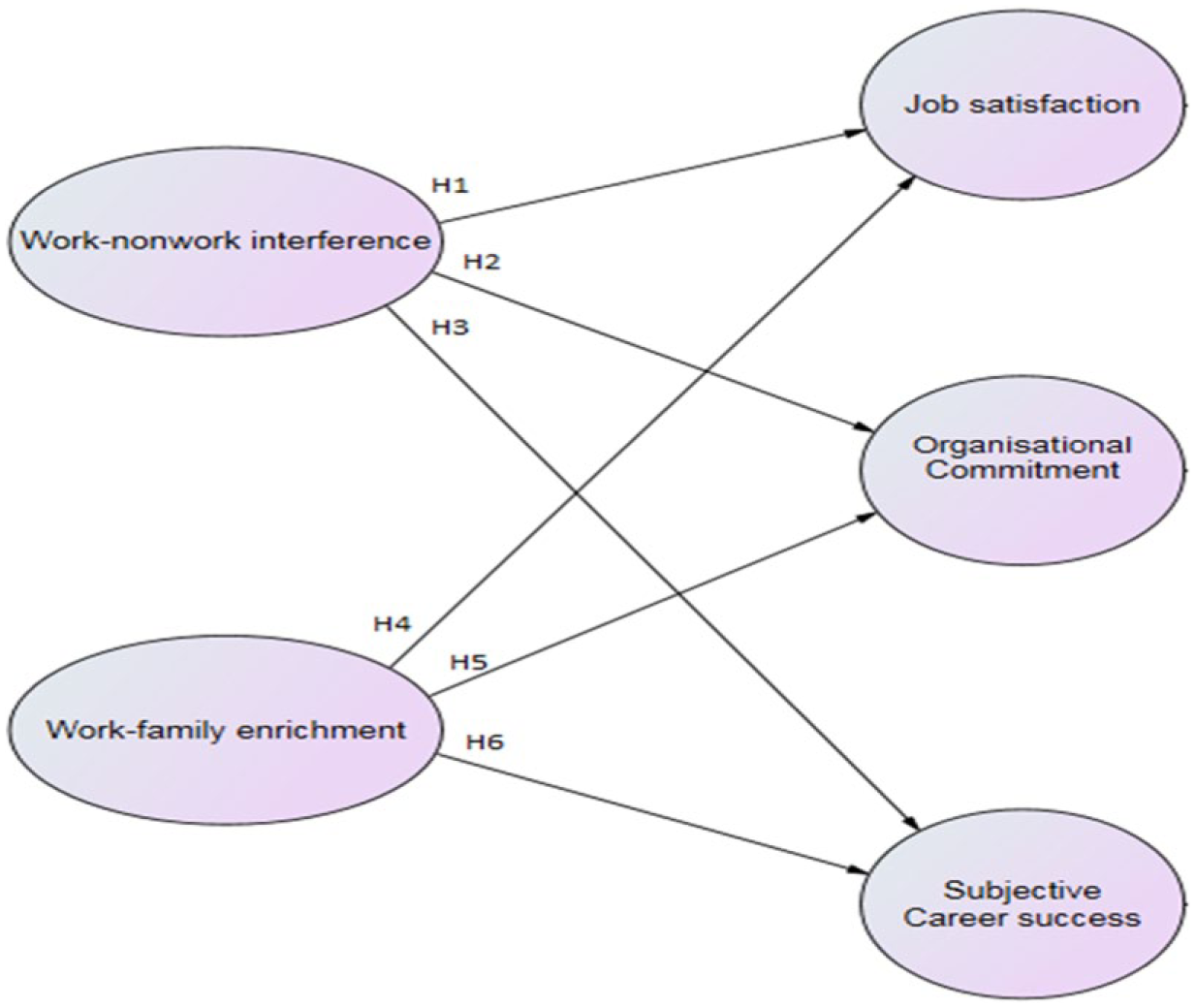
Conceptual model.
Purpose of the study
This study investigated how WNWI and WFE may simultaneously influence work-related outcomes (i.e., job satisfaction, organisational commitment, and subjective career success).
Method
Participants
The empirical part of this study followed a quantitative cross-sectional survey design. A convenience sample of permanently employed individuals who are married and have at least one child (n = 212) was used, a requirement in the operationalisation of the WNWI instrument. By employing a convenience sample, the researcher selects the population due to their availability. As a result, the population consists of the nearest and easiest candidates whom the researcher can gather. Participants were mainly recruited personally by the researcher based on availability and the researchers’ initial network of colleagues and friends. The researcher also relied fully on the referral of a participant who met the necessary criteria and others of similar nature (also known as snowball-sampling, Alston & Bowles, 2003). The group consisted of 66% females, with the majority of respondents being between the age groups 30–39 years (30.70%) and 40–49 years (31.10%). The sample included White (78.80%), African (11.80%), Coloured (3.30%), and Indian (6.10%) employees, who were mainly employed within the private sector (61.30%) and retail environment (29.20%) with the remainder of the sample being employed in the mining industry (5.70%) and other industries such as education, real estate, and the medical field (3.80%). With regard to highest qualification obtained, almost half of the sample (45.70%) listed a degree or post-graduate qualification, and 25.50% listed diplomas, and 28.80% grade 12. Most of the employees had one (31.10%) or two (45.30%) children. The sample size deemed to be sufficient to test the proposed hypotheses when considering the guideline of 200 proposed by Hair, Black, Babin, and Anderson (2010).
Instruments
The WNWI instrument of Koekemoer et al. (2010) was used to measure the interference between the work and nonwork domains. Although the original instrument measures WNWI bi-directionally, only the work → nonwork direction was utilised, which comprises four dimensions with six items each. The dimensions are work–parent interference (WPI) (e.g., your work keeps you from your child[ren] more than you like), work–spouse interference (WSI) (e.g., your marriage or relationship with your spouse or partner suffers because of your work), work–domestic interference (WDI) (e.g., because of your work arrangements, you find it difficult to fulfil your domestic obligations), and work–religion interference (WRI) (e.g., your work interferes with your religion or spirituality). All items started with “How often does it happen that . . . ” with response categories that varied between 0 (‘never’), 1 (‘some of the time’), 2 (‘most of the time’), and 3 (‘always’).
The MACE WFE Instrument of De Klerk et al. (2013) was used to measure WFE. This instrument was based on the initial theoretical model of Greenhaus and Powell (2006) which supports the notion that a positive experience in one role may lead to enhanced quality in the other, therefore presuming that enrichment in one domain should improve individuals’ functionality and involvement in the other domain. Similar to the WNWI instrument, only the work → family direction was utilised. The 18-item instrument, with four subscales, was administered, where each item started with “My family life is improved by . . . .” The subscales are work–family perspectives (WFP) (e.g., the skills I have developed at work), work–family affect (WFA) (e.g., my work that makes me feel happy), work–family time (WFT) (e.g., managing my pace at work), and work–family social capital (WFS) (e.g., the support I receive from my colleagues). The instrument uses a 5-point Likert-type scale to rate items from 1 (‘strongly disagree’) to 5 (‘strongly agree’).
Job satisfaction was measured using the three items of the Job Satisfaction Questionnaire (JSQ) of Hellgren, Sjöberg, and Sverke (1997) which employ a 5-point Likert-type scale, ranging from 1 (‘strongly disagree’) to 5 (‘strongly agree’), with a typical item stating, “I am contented with the job I have.”
Organisational commitment was measured with the Meyer, Allen, and Smith (1993) commitment scale which measures affective, normative, and continuance organisational commitment, each being indicated by six items. Example items include “I really feel as if this organisation’s problems are my own” (affective commitment), “It would be very hard for me to leave my organisation right now, even if I wanted to” (continuance commitment), and “I owe a great deal to my organisation” (normative commitment). A 7-point response category was used ranging from 1 (‘strongly disagree’) to 7 (‘strongly agree’).
The Subjective Career Success Instrument (SCSI) of Gattiker and Larwood (1986) was utilised to assess participants’ subjective evaluations of career success. The 23-item instrument measures factors such as job success (e.g., “I am in a position to do mostly work which I really like”), financial success (e.g., “I receive a high income compared to my colleagues”), hierarchical success (e.g., “I am pleased with the promotions I have received so far”), interpersonal success (e.g., “I am respected by my colleagues”), and life success (e.g., “I am enjoying my non-work activities”). Statements are measured on a 5-point response format, ranging from 1 (‘completely disagree’) to 5 (‘completely agree’).
Procedure
All instruments were administered using an anonymous web-based survey. A convenience sample of respondents was invited to participate in the study. An introductory e-mail explained the purpose of the study.
Ethical considerations
Ethical approval was obtained from the Research Ethics Committee at the University of Pretoria. Participants were ensured of confidentiality and anonymity, and communicated instructions for completing the anonymous online survey.
Data analyses
Preliminary analyses using SPSS23 included descriptive statistics, followed by confirmatory factor analysis (CFA) of each of the five instruments using AMOS 23, which is generally regarded as the most powerful method to test for construct validity. CFA was used to refine the measurement models and to assess the discriminant and convergent validity of each of the measurement models. As recommended by Anderson and Gerbing (1988), the measurement models were refined before a structural equation model (SEM) was used for testing the substantive hypotheses shown in Figure 1.
Assessment of model fit for the CFA models as well as for the SEM was based on a variety of fit measures. The model Chi-square (χ2) is regarded as the most important way to assess model fit, and it should ideally be nonsignificant. Additional fit measures included the ratio of the Chi-square to the degrees of freedom (χ2/df) where values should ideally be <3 for excellent fit, and <5 for good fit (Bentler & Bonett, 1980). The root mean square error of approximation (RMSEA) value should be <.08 for adequate fit and <.05 for excellent fit. The Incremental Fit Index (IFI), the Tucker–Lewis Index (TLI), and the Comparative Fit Index (CFI) evaluate relative fit and values of >0.90 are considered as good fit, while values of >0.95 are considered excellent fit. The standardised root mean residual (SRMR) cut-off value should be <0.08 for good fit and <0.05 for excellent fit (Hu & Bentler, 1999). There is general agreement that models should not be rejected if a single criterion does not meet the general guidelines for fit, but a range of criteria, including model complexity and sample size, should be taken into account when fit measures are interpreted (Strasheim, 2014).
Results
Testing measurement models
Four measurement models were tested. The four models, each with their correlated latent variables are (1) WNWI with the dimensions WPI, WSI, WDI, and WRI; (2) WFE, with dimensions WFP, WFT, WFA, and WFS; (3) organisational commitment with the dimensions of affective commitment, continuance commitment, and normative commitment; and (4) subjective career success with the dimensions hierarchical, financial, nonorganisational, interpersonal success, and job success.
Since job satisfaction was measured with only three items, a perfect fit was found, and according to Anderson and Gerbing (1988) is per definition saturated.
Each of the four measurement models was assessed for outliers and the univariate normality of items was investigated. The univariate skewness was not extreme (values between −3 and +3) and kurtosis values were between (−7 and +7), as recommended by Kline (2011). It was reasonable to assume normality of the items so that maximum likelihood estimation could be utilised. For each of the models, the following approach was used: the models were specified according to their original conceptualisation. If adequate fit was not obtained, the estimated parameters were investigated. Model refinement included an investigation of the standardised regression weights (these should ideally be below 0.6, Hair et al., 2010), estimated measurement error (should not be excessively large when compared to the other estimates of measurement error), squared multiple correlations (should be lower than 0.3), and the matrix with standardised residuals between the observed covariance matrix and the model implied covariance matrix should be between (−2.57 and +2.57, using α = .01), Byrne (2010). Items not meeting the recommended criteria (Hair et al., 2010; Kline, 2011) were removed from the models step-by-step, until a well-fitting model was obtained. Table 1 indicates the fit measures for the final first-order measurement models.
Goodness-of-fit measures obtained for the first-order measurement models.
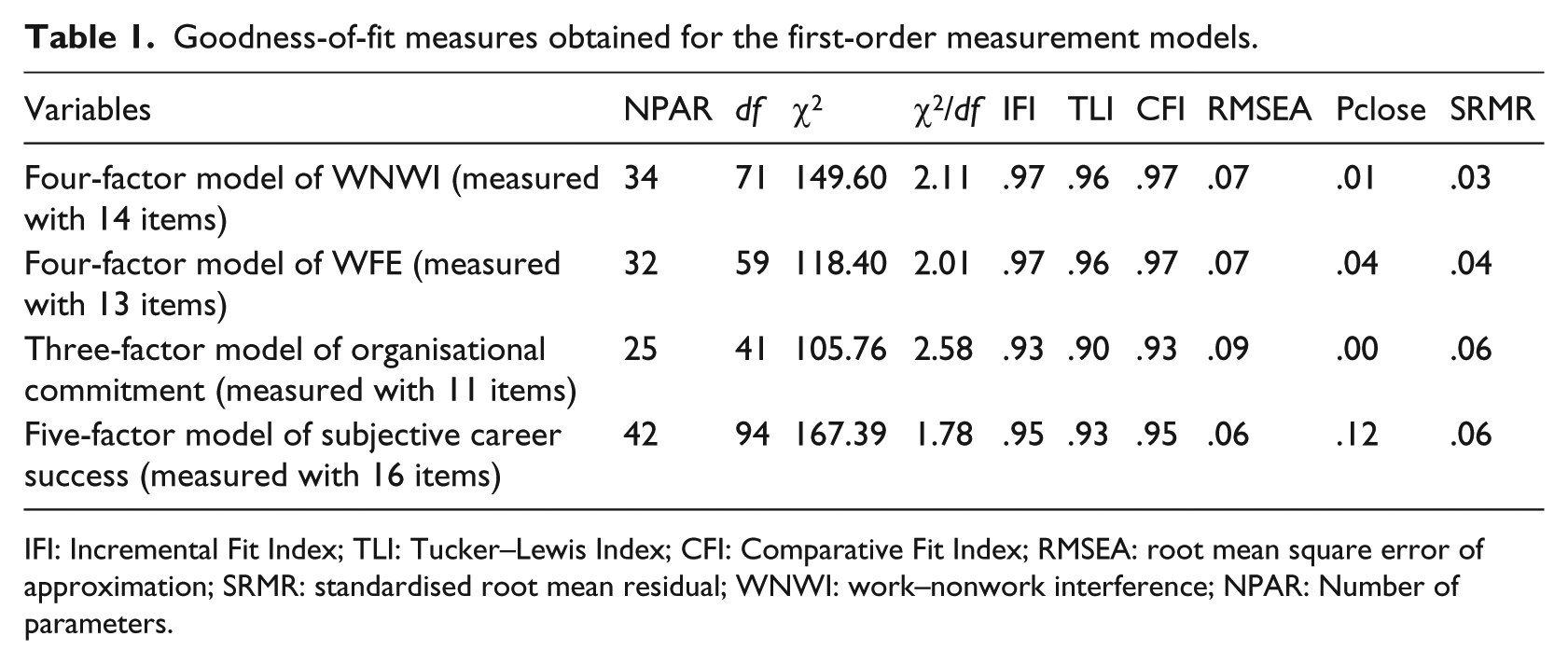
IFI: Incremental Fit Index; TLI: Tucker–Lewis Index; CFI: Comparative Fit Index; RMSEA: root mean square error of approximation; SRMR: standardised root mean residual; WNWI: work–nonwork interference; NPAR: Number of parameters.
Table 1 shows that the refined models fitted the observed covariance matrices very well based on all criteria. Schermelleh-Engel, Moosbrugger, and Muller (2003) recommend that researchers should refrain from rejecting models based on a single measure indicating inadequate fit. Given the relatively small sample, the researcher did not reject the model of organisational commitment based on the RMSEA value alone. The other goodness-of-fit measures that showed acceptable values provided further support for accepting the measurement models as reasonable approximations of the observed data. Further support for the acceptability of the proposed models was found from the Cronbach’s alpha coefficients of the factors of each of the five instruments, all of which met the typical cut-off criterion of .70 (Nunnally & Bernstein, 1994).
Using the approach suggested by Fornell and Larcker (1981), item reliabilities were calculated for each item in all the scales, as well as the composite reliability (CR) and Average Variance Extracted (AVE) for each factor. From these results, support for convergent validity was found for all the factors in the measurement models.
Evidence for discriminant validity was found for all the dimensions of the WNWI and the WFE instruments (using the recommended values of Fornell & Larcker, 1981). However, discriminant validity was not supported for any of the three commitment factors, and neither for the job success, interpersonal success, or the hierarchical success factors. There was sufficient discriminant validity for the nonorganisational success and financial success factors.
Discriminant validity is important to consider in instrument validity since a high correlation between constructs can suggest that the concepts are not clearly different. Brown (2015) suggests using second-order confirmatory models in situations where the discriminant validity of a scale is compromised, and when the aggregation of the first-order latent variables can be theoretically justified (Johnson, Rosen, Chang, Djurdjevic, & Taing, 2011). According to Brown (2015), a second-order factor analysis model can be used to provide a more parsimonious model representing the underlying associations between the first-order latent variables, especially when these are highly correlated. This can help to avoid the problem of multicollinearity in the exogenous part of the model. The usefulness of correctly specified and theoretically sound higher-order factor analysis models is that they provide a more parsimonious representation of the correlations among lower-order factors (Chen, Sousa, & West, 2005; Johnson et al., 2011; Strasheim, 2011).
The fit measures of the second-order models in Table 2 provided acceptable to very good fit based on most criteria. It should be noted that a second-order model would always fit slightly worse than the first-order model (Strasheim, 2011).
Goodness-of-fit measures of the second-order CFA measurement models.
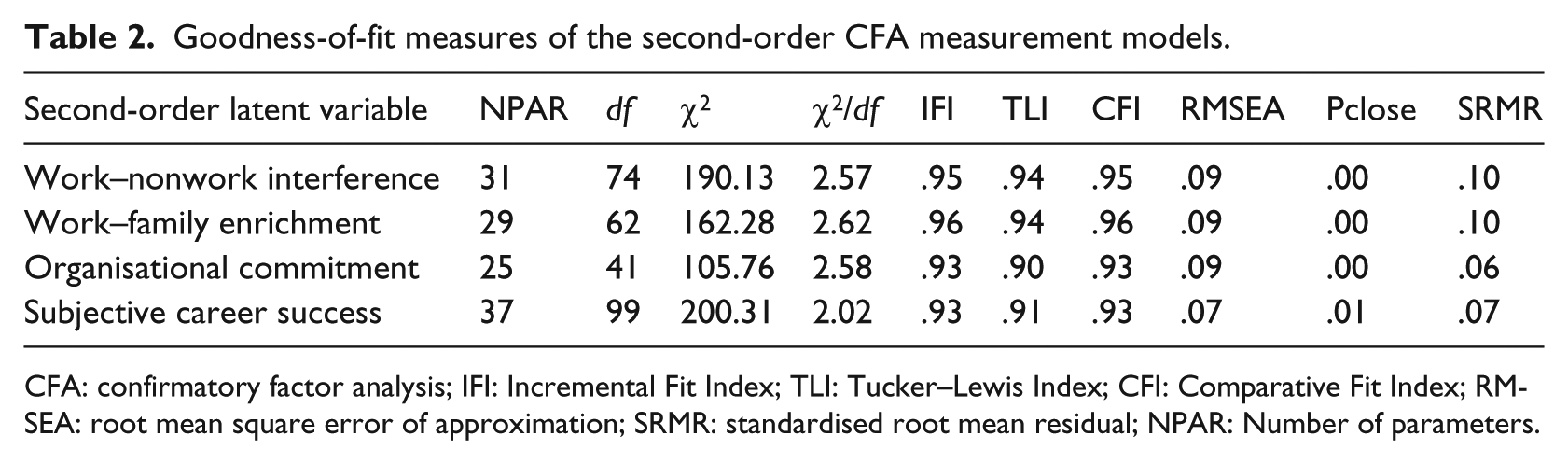
CFA: confirmatory factor analysis; IFI: Incremental Fit Index; TLI: Tucker–Lewis Index; CFI: Comparative Fit Index; RMSEA: root mean square error of approximation; SRMR: standardised root mean residual; NPAR: Number of parameters.
SEM specifying the substantive hypotheses
Using the second-order latent variable measurement models as a basis, a structural equation model was specified to test the substantive Hypotheses H1 to H6 simultaneously. An acceptable fit of the model to the data was found: χ2 = 2300.32, df = 1513, χ2/df = 1.52, TLI = .90, IFI = .90, CFI = .90, RMSEA = .05, and SRMR = .07. The maximum likelihood estimated regression weights, as well as the estimated R-square for the endogenous variables, are shown in Figure 2.
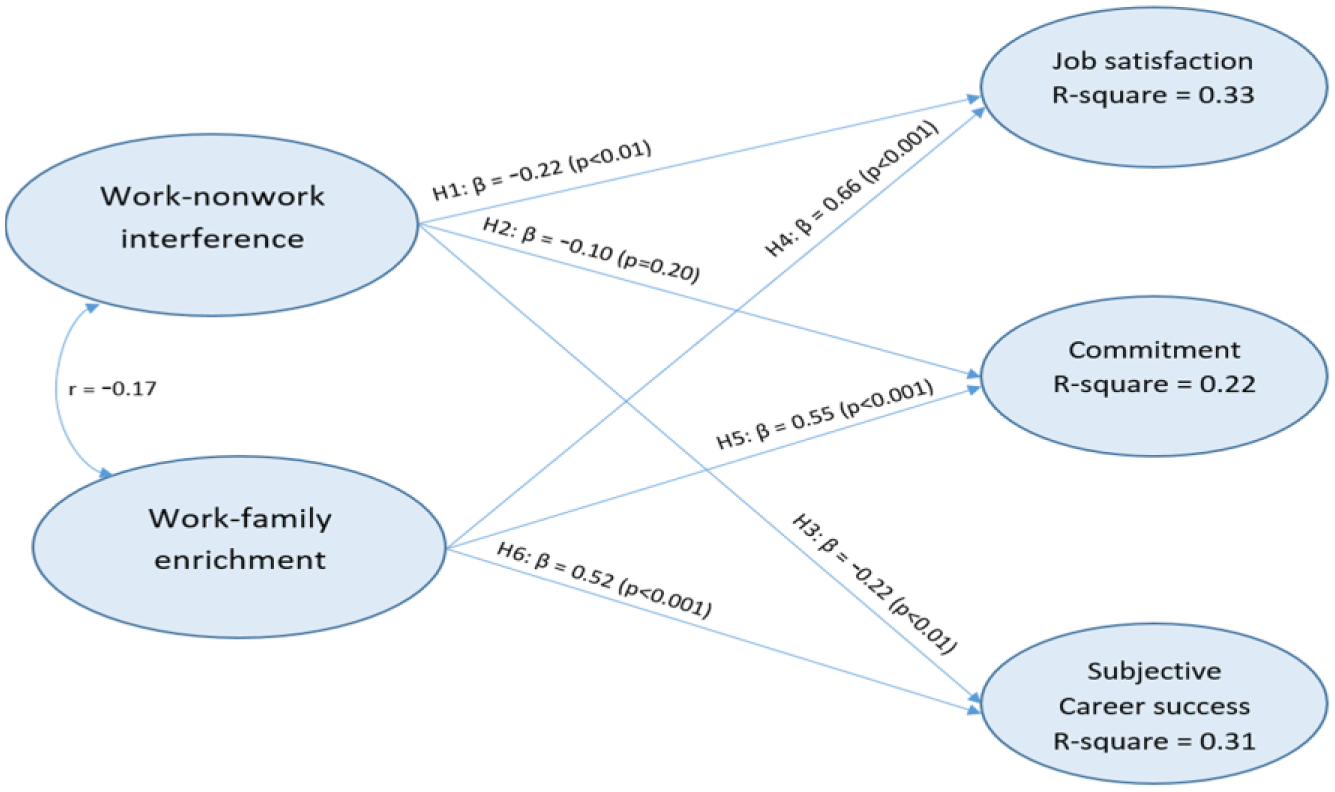
SEM specifying the substantive hypotheses.
Based on the estimated regression coefficients, empirical support was obtained for all the stated hypotheses, except for H2 (b2 = −0.10; p = .20). The findings suggest that for H1, WNWI was significant and negatively related to job satisfaction (b1 = −0.22; p < .01); and subjective career success (b3 = −0.22; p < .01). WFE was significantly positively related to (H4) job satisfaction (b4 = 0.66; p < .001); (H5) organisational commitment (b5 = 0.55; p < .001); and (H6) subjective career success (b6 = 0.52; p < .001).
The estimated correlation between WNWI and WFE in the substantive model is −.17, which can be interpreted as empirical evidence that the two concepts are distinct, independent, and therefore very different aspects of work–family interaction.
Discussion
The aim of this study was to investigate how WNWI and WFE operate simultaneously to influence work-related outcomes. The study makes several contributions to the literature in this area.
First, it contributes by incorporating SA work–family measurements, thus eliminating previous concerns raised by researchers in this regard. The instruments for WNWI (Koekemoer et al., 2010) and WFE (De Klerk et al., 2013) proved to be valid and reliable, with evidence of both discriminant and convergent validity. Although second-order measurement models were used in the SEM (due to the large number of variables), given the evidence of discriminant and convergent validity for the work–family instruments, SA researchers are encouraged to use these multi-dimensional instruments in future studies.
Second, the majority of the present findings mirror those of previous international studies (Beauregard & Henry, 2009; Odle-Dusseau et al., 2012) regarding the relationships between work–family interaction and job satisfaction, organisational commitment, and subjective career success. For the negative interaction, empirical evidence was found for negative relationships with job satisfaction and subject career success, thus supporting Hypotheses H1 and H3. However, the relationship between WNWI and organisational commitment was not significant (Hypothesis 2). This is somewhat surprising, since various researchers have suggested negative relationships in this regard (Akintayo, 2010; Allen et al., 2012; Greenhaus & Powell, 2006). Babolola, Oladipo, and Chovwen (2015), however, found that employees with high WFC are more committed to their organisations, as, according to them, these employees possess personal coping strategies for controlling behaviours in their organisations. Another possible explanation for not finding a significant relationship in this regard may be the lack of discriminant validity and poor measurement model fit for the organisational commitment instrument found in the present sample.
Concerning WFE, as expected, support was found for positive relationships with job satisfaction, organisational commitment, and subjective career success (thus supporting Hypotheses H4, H5, H6). Findings therefore suggest that, within this sample, employees who are experiencing their work–family context as positive experience a sense of commitment, job satisfaction, and subjective career success. These findings are in line with the social exchange theory, suggesting that employees will tend to reciprocate positive work attitudes if they feel valued and appreciated within their organisation, and more so if they experience the positive spill-over from work to nonwork domains (Wayne, Casper, Matthews, & Allen, 2013).
Third, the present findings provide empirical evidence that even within the SA context (with the SA measurements), the two concepts WNWI and WFE are distinct and independent and are therefore very different aspects of work–family interaction. It thus suggests that these concepts should not be viewed as opposites on a continuum, but rather as phenomena that act independently in the nomological net of the work–family domain. This confirms previous international findings which suggested that WFE and WFC are independently linked to outcomes (Gareis et al., 2009; Grzywacz & Bass, 2003). The present findings indicate that employees experience both interference and enrichment, each which relates differently with the work-related outcomes investigated in this study.
Finally, based on the higher estimated regression coefficients found for the relationships between WFE and the work-related outcomes, the present findings suggest that WFE contributes more to the work-related outcomes than in the case of WNWI. This corresponds with the findings of Gareis et al. (2009) who found that enrichment contributes incremental explanatory power over WFC alone. The implication is that, in order to obtain positive work-related outcomes, it is more important to focus on fostering positive interaction in the work–family context than trying to eliminate the conflict in this regard.
Despite the important findings of the study, the following two limitations were noted: there is the possibility of common method bias in self-reported data, and the use of cross-sectional data makes it difficult to prove causal relationships between variables. Since the participants were drawn from a convenience sample, aspects such as a nonrepresentative sample (demographics) and the limited range of sectors should be noted and influence the possibility of generalisability of the findings.
Conclusion
This SA study has shown that work–family interaction presents with two independent constructs, that is, WNWI and WFE. These constructs operate simultaneously and are independently significantly related to work-related outcomes (except WNWI with commitment). WFE (enrichment) is positively related to job satisfaction, organisational commitment, and subjective career success, while WNWI is negatively related to job satisfaction and subjective career success. By successfully replicating some of the international work–family research findings, the researchers have contributed to theory development and thus provide a basis for further and deeper theoretical and explanatory studies. Since the focus was only on the work → family direction of interaction, future studies could include the family → work direction of interaction (with both interference and enrichment). Such studies will lead to further in-depth understandings of work–family interaction with work-related and family-related outcomes in South Africa. Furthermore, based on the nonrepresentative sample in this study, it is recommended for future studies to attempt to conduct similar research with more SA representative samples among employees employed in more diverse set of sectors.
Footnotes
Funding
The financial assistance of the National Research Foundation (NRF) in conducting this research is acknowledged. Opinions expressed and conclusions arrived at are those of the authors and are not necessarily attributed to the National Research Foundation. This research is based on work supported by the National Research Foundation under the reference number, TTK14051567368.