




Abstract
South African career counselling practices have predominantly been informed by vocational theories and models developed in the United States and Europe. In view of South Africa’s peculiar history and its unique cultural and linguistic environment, the indiscriminate application of Western career models has become increasingly contentious, as the majority of these models fail to account for culture-specific values that influence an individual’s career interests, decision-making, and development. The South African Career Interest Inventory was developed to address this contention, through operationalising John Holland’s vocational personality theory in South Africa. This study adapted and translated the South African Career Interest Inventory into isiXhosa, in the process constructing the first career interest inventory in a South African indigenous language. Subsequently, we investigated the structural validity of the South African Career Interest Inventory, and therefore Holland’s model, on a sample of isiXhosa-speaking secondary school learners (n = 266). The randomisation test of hypothesised order relations, multidimensional scaling, and covariance structure modelling were employed to examine the structural validity of the inventory. The results demonstrated the South African Career Interest Inventory–isiXhosa version to be a reliable and valid measure of vocational interest on an early isiXhosa adolescent sample, suggesting the tenability of Holland’s model in the South African context. Implications for research and practice are discussed.
The assessment of vocational interests is a central component of the practice of career counselling. Using interest inventories, practitioners are provided with the necessary information to reveal individual interests, competencies, and vocational preferences (Harrington & Long, 2013) and to guide persons to a variety of related occupational opportunities (Weisgram, Bigler, & Liben, 2010). In South Africa, career counselling practices have primarily been informed by vocational theories and models developed in the United States and Europe (Leong & Pearce, 2014; Morgan, 2014; Tracey & Gupta, 2008). However, in view of South Africa’s unique cultural and linguistic environment, the indiscriminate application of Western career models has become increasingly contentious, as the majority of these models fail to account for culture-specific values that influence an individual’s career interests, decision-making, and development (Leong & Pearce, 2014; Naidoo, Pretorius, & Nicholas, 2017).
Both globally and in South Africa, John Holland’s (1997) theory of vocational personalities has received widespread application (Bullock, Andrews, Braud, & Reardon, 2010), providing a theoretical framework from which practitioners offer career guidance, as well as develop and administer vocational interest inventories. However, in recent years, studies have reported conflicting results for the cross-cultural applicability of Holland’s theory, bringing into question the validity of the model in diverse contexts (Darcy & Tracey, 2007; Einarsdóttir, Rounds, & Su, 2010; Rounds & Tracey, 1996; Šverko & Babarović, 2006; Watson & McMahon, 2004). Particularly in the South African context, there has been limited empirical evidence on the validity and reliability of Holland’s RIASEC interest model among diverse demographic groups (du Toit & de Bruin, 2002). As such, if Holland’s (1997) theory and the instruments it is based on are not equally applicable across diverse demographic groups, vocational counselling and interest inventories based on his model may not be valid.
To address these limitations, Morgan, de Bruin, and de Bruin (2014) constructed and assessed a new interest inventory for the South African population, namely, the South African Career Interest Inventory (SACII). The SACII was developed to represent Holland’s (1997) six vocational personality types: Realistic, Investigative, Artistic, Social, Enterprising, and Conventional (RIASEC). Using a constrained emic approach, the items were developed to reflect the contemporary South African occupational environment (Morgan et al., 2014). The SACII was investigated using diverse adult sample groups and produced promising results, signifying the validity of the SACII, and therefore Holland’s model, in the South African context (Morgan, 2014).
Prior to this study, the majority of career assessment measures in South Africa was only available in English, with a handful of instruments translated into Afrikaans (Health Professions Council of South Africa [HPCSA], 2014) – the original SACII followed in this trend. Considering Apartheid’s legacy of segregation, multilingual test adaptation in South Africa has received insufficient attention, largely because English is the language of instruction in the workplace and in the majority of educational institutions (de Kock, Kanjee, & Foxcroft, 2013). This has led to an assumption that assessing all South Africans in English is acceptable (Foxcroft & Aston, 2006). However, various South African researchers have challenged this assumption (Koch, 2005; Meiring, 2007; Saunders, 2002). Watson, Davies, and Foxcroft (2006), for instance, found that being educated in the medium of English is not a guarantee of students’ language proficiency and that the majority of the learners are not proficient in English as a second language at the end of their school career. Accordingly, assessing individuals in a language in which they are not proficient infringes on the standards set for the fair and ethical practice of assessment (de Kock et al., 2013). Within this context, the current state of career assessment practice in South Africa excludes a large majority of the population, due to the unavailability of valid and reliable career measures in other South African languages. Recent research by Albien and Naidoo (2016) has found that with high school learners using an English-based measure with non-mother tongue English participants may present challenges that may frustrate rather than facilitate the career exploration process. They called for career assessment measures to be translated into the indigenous languages of South Africa for use at high school level.
Accordingly, the purpose of this study was to adapt and translate the SACII into isiXhosa, and in the process, develop the South African Career Interest Inventory–isiXhosa version (SACII-X). Moreover, the SACII-X was administered to a sample of isiXhosa-speaking adolescents to investigate the measure’s reliability and validity.
The cross-cultural applicability of Holland’s model
In general, cross-cultural studies investigating Holland’s typology have traditionally employed an etic approach, where Holland’s theory and instruments were directly imported from the United States and assessed in another cultural context (Morgan, 2014). For example, Rounds and Tracey (1996) conducted a structural meta-analysis to evaluate the cross-cultural fit of the RIASEC model. Using 76 international correlation matrices, which represented 18 countries, they found inadequate support for Holland’s (1985) hexagonal model outside the United States. They argued that the cross-cultural applicability of Holland’s (1985) model to be limited and cautioned researchers and practitioners against applying the model indiscriminately in diverse cultural contexts (Rounds & Tracey, 1996).
More recent research, however, have found increasing support for Holland’s (1997) interest structure across diverse cultural contexts. For example, investigating Holland’s (1997) circular ordering hypothesis with two samples of male and female university students and young adults in Iceland (n1 = 449; n2 = 438), Einarsdóttir, Rounds, Ægisdóttir, and Gerstein (2002) found adequate fit for Holland’s model and reported mean correspondence index (CI) values of .72 for females and .62 for males (p < .05). Similarly, examining the validity of Holland’s RIASEC structure among a sample of adolescent Croatian males and females (n = 1866) using the Croatian Self-Directed Search (SDS), Šverko and Babarović (2006) found significant correspondence indices for the different age groups in their sample (p < .05).
Various studies conducted in Asia have also found support for Holland’s model outside the United States. For example, Tak (2004) investigated the fit of Holland’s model on a sample of male and female Korean university students (n = 829) and reported adequate model fit (all p-values <.05), with CI values of .82 reported for both male and female participants. Similarly, Tien (2009) explored the vocational interest structure of a sample of 572 (n = 572) Taiwanese high school and college students. Employing unconstrained multidimensional scaling (MDS), Tien (2009) found the theoretical ordering of the RIASEC types to be accurate. Moreover, a randomisation test of hypothesised order relations (RTHOR) indicated the circular ordering to fit the data adequately (CI = .69, p < .05). In another study, Zhang, Kube, Wang, and Tracey (2013) examined the fit of the RIASEC structure on a sample of Chinese high school and university students (n = 2567). They found the RIASEC structure of the Chinese participants to fit the circular model sufficiently and reported CI values of .83 for the high school sample and CI values of .81 for the university sample (Zhang et al., 2013).
In South Africa, research investigating Holland’s model has produced mixed results. In their standardisation of the South African SDS, Gevers, du Toit, and Harilall (1997) employed unconstrained MDS to examine the circular ordering model and found support for Holland’s calculus assumption. However, examining the validity of Holland’s model on a sample of Black, isiXhosa-speaking secondary school students, Schonegevel (1997) found inadequate fit for the RIASEC model. Furthermore, a study conducted by du Toit and de Bruin (2002) investigating the validity of Holland’s hexagonal interest structure with a group of young Black South African men and women from the North West (n1 = 1032) and Eastern Cape (n2 = 386) provinces, using unconstrained MDS, found the six interest domains to be disarranged. Moreover, the RTHOR indicated a poor fit for both samples (n1: CI = .35 for males; CI = .32 for females, p < .05; n2: CI = .49 for males; CI = .48 for females, p > .05) between the observed data and the hypothesised hexagonal ordering. These findings, at the time, signified that Holland’s (1997) model cannot be applied indiscriminately in non-Western cultures, particularly in a diverse cultural context such as South Africa. Possible explanations for the poor fit of Holland’s model among this particular sample included differences between Western and South African cultures, socio-economic status, and language barriers (the English South African SDS was the assessment measure) (du Toit & de Bruin, 2002). More recently, Morgan et al. (2014) investigated the validity of Holland’s circular/hexagonal structure. Employing RTHOR and covariance structure modelling, Morgan et al. (2014) found satisfactory fit for Holland’s (1997) circular/hexagonal structure with their two multi-ethnic samples (n1 = 985; n2 = 175). Importantly, their results contradict du Toit and de Bruin’s (2002) findings that Holland’s (1997) typological structure is invalid among diverse South African cultures. Contrary to previous research, Morgan et al. (2014) suggest that Holland’s (1997) RIASEC structure is applicable in the South African context and using valid interest inventories, career assessment based on the model can be supported.
However, despite the promising results reported by Morgan et al. (2014), the original investigation and standardisation of the SACII exclusively employed the English version of the measure as the primary research instrument of the study. Accordingly, this study adapted and translated the SACII into isiXhosa, to build on the initial results reported by Morgan et al. (2014), to extend the availability of the SACII to a new population group, and to high school sample.
Method
Participants
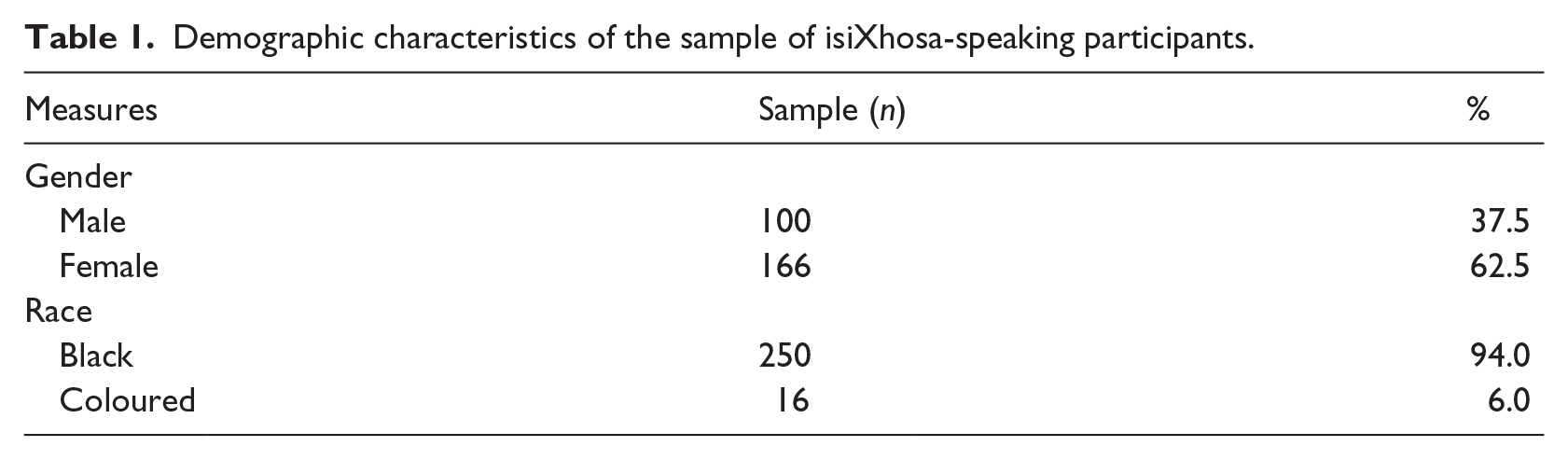
The data used in this study were derived from a larger study which aimed to investigate gender and racial differences on the SACII on a sample of Grade 9 secondary school learners (n = 628) in the Cape Winelands district of South Africa (Rabie, 2017). Accordingly, a subsample of 266 (n = 266) isiXhosa-speaking secondary school learners were recruited in this study. The mean age of the sample was 15 years (standard deviation [SD] = 1.02), with the age of the participants ranging from 13 to 20 years. The participants were primarily recruited from five secondary schools in the Cape Winelands district of South Africa.
All Grade 9 secondary school learners in the respective schools were recruited as participants and represent the unit of analysis of this study. Convenience sampling with universal inclusion was employed to recruit participants. The participants were solely recruited based on the logistical expediency of their Grade 9 classes and the availability of the participating schools. Employing random sampling in the school environment was not possible, due to logistical constraints associated with coordinating participating school time tables and the compact nature of modern school curricula. In an attempt to address these shortcomings, secondary schools from various socio-economic and cultural backgrounds were sampled and the participants were grouped based on demographic characteristics (Sink & Mvududu, 2010). Table 1 presents a summary of the demographic characteristics.
Demographic characteristics of the sample of isiXhosa-speaking participants.
Instrument
SACII
The SACII was developed to measure Holland’s (1997) six theoretical vocational personality types in the South African context (Morgan et al., 2014). The items were written using a constrained emic approach, which involves writing indigenous items informed by a theoretical perspective (Einarsdóttir et al., 2010). This approach was employed to generate items that are representative of the world of work in South Africa (Morgan, 2014). Accordingly, occupational profiles and descriptions obtained from a variety of online sources (such as the O*Net database) provided a foundation from which to generate items that are appropriate in the South African context (Morgan, 2014). In the South African context, the SACII has shown promising psychometric properties to date (Morgan, de Bruin, & de Bruin, 2015; Rabie, 2017). To provide a detailed analysis of an individual’s interest structure, the SACII consists of 142 items across six scales. Morgan et al. (2014) reported high reliability coefficients for the SACII’s six scales, with all RIASEC types ⩾ .93
Developing the SACII-X
The SACII-X was developed as part of a two-step process. First, a committee forward-back translation design was employed to translate the original source language (English) of the SACII into isiXhosa (de Kock et al., 2013). Two independent bilingual, home-language isiXhosa-speaking translators collaboratively translated the 142 items on the SACII. Bearing in mind the various dialects existing within the isiXhosa language, the translators made a conscious attempt to include language that is appropriate for the diversity of the isiXhosa-speaking population in the Western Cape province of South Africa. Moreover, using a committee forward-translation design, the first author facilitated numerous meetings with the translators to discuss and compare the isiXhosa translations to ultimately create composite translations that best reflect the semantic and conceptual meaning of the original items.
The second step in developing the SACII-X involved employing two independent bilingual, home-language isiXhosa-speaking translators, blinded to original version of the SACII, to conduct a collaborative back-translation into English. In order to assess the equivalence and quality of the translation, the original source language and back-translated versions were compared (de Kock et al., 2013). It was assumed that if the item content of the two English translations were similar or near-identical, the isiXhosa translation was accurate. Conversely, if there is a low degree of accuracy between the two English versions, the isiXhosa translation was deemed inaccurate and required to be re-translated. In these circumstances, this process was repeated until all items reflected a high degree of accuracy between the two English versions.
Through this process, certain challenges related to the translation process were identified. The major challenge the translators were confronted with was the non-equivalence of certain isiXhosa and English terminology used on the SACII. As a result, for some of the items the two languages are not directly transferable. To address these challenges, two approaches were adopted: (1) the English concepts were directly imported and adapted into isiXhosa or (2) a description of the meaning behind the English concepts was provided in isiXhosa. In total, the terminology of eight items on the scale were directly imported and adapted into isiXhosa and 13 items were described to provide the isiXhosa meaning behind the respective items. Considering that the two languages are not directly transferable, certain items were rephrased and restructured to present the isiXhosa translations in the active voice.
Procedure
Prior to the commencement of data collection, permission to conduct research at five secondary schools in the Cape Winelands district was obtained from the Western Cape Education Department (WCED). In accordance with the stipulations provided by the WCED and Stellenbosch University’s Research Ethics Committee, the staff at the respective schools distributed formal letters of invitation, which contained all relevant details of the study, and passive informed consent forms to the participants’ guardians 1 week prior to the collection of the data. In addition, the participants were required to complete a demographic questionnaire and assent form on the day of the data collection.
The researcher’s arrangements for the administration of the SACII varied at each school, based on the availability of venues and the students’ academic responsibilities during the week of data collection. The isiXhosa version of the SACII was administered during a single session of 45 min at the respective schools over a course of 3 weeks during the second school term of 2016. Participants were required to complete the paper-and-pencil version of the SACII during the assessment period.
Ethical considerations
Prior to the process of data collection, permission was obtained from Stellenbosch University’s Research Ethics Committee (SU-HSD-000640). This study received approval to collect data, in writing, from the Western Cape Education Department (Reference: 20,150,930-3811) and the principals and/or governing bodies of participating high schools. The participants were required to complete informed assent forms in order to acquire their consent to participate in this study. Throughout the study, all participants were informed of the aims and objectives of the study, as well as their rights as a participant. All participants were informed, inter alia, that participation in the proposed study is completely voluntary and that they had the right to withdraw from participation any time during the course of the proposed study. Furthermore, the participants were assured of the confidentiality of their responses and that all information on the scale is completely anonymous. There was no immediate risk associated with this study and no purported benefits. However, the participants’ exposure to the variety of occupations presented in the SACII might have elicited insight into their career development and career choices (McIlveen, 2007).
Data analysis
The statistical analyses employed in this study focused on the investigation of Holland’s circumplex model, using a RTHOR (Hubert & Arabie, 1987), MDS (Borg, Groenen, & Mair, 2013), and circumplex covariance structure modelling (CCSM; Browne, 1992). The RTHOR is used to test a circular ordering model that is consistent with Holland’s (1997) calculus assumption (Tracey, 2000). To achieve this, the fit of a correlation matrix to the circular ordering model is investigated (Darcy & Tracey, 2007). Inferences regarding the fit of the data to the circular ordering model are made through inspecting the p-value and CI produced by the RTHOR (Hubert & Arabie, 1987).
MDS is a cluster of statistical techniques employed to examine and model the spatial distances between data points in a low-dimensional space – visually representing the empirical relationships among objects in the dataset (Borg et al., 2013; Coxon, 1982; Mair, Borg, & Rusch, 2016). To investigate the structural arrangement underpinning the RIASEC types, non-metric MDS, with a Togenson optimal starting configuration was applied to the dataset (Borg et al., 2013; Coxon, 1982). Furthermore, to achieve global optima, multiple random starts configured to 100 was utilised (Mair et al., 2016). The fit of the dimensions to the data (i.e., the calculated MDS solution) was investigated through interpreting Kruskal’s Stress-1 test value, the dispersion accounted for (DAF) coefficient, and Tucker’s congruence coefficient (CC) (Borg et al., 2013).
Finally, the CCSM approach is centred on a circular stochastic process using a Fourier (trigonometric) series to model the relationship between angles of common score variables and common score correlations (Tracey, 2000). CCSM utilises maximum likelihood estimates to obtain parameters of four unique, intricate circumplex models, namely, (1) unconstrained model, (2) quasi-circumplex equal-spacing model, (3) quasi-circumplex equal-communality model, and (4) equal-spacing, equal-communality (circulant) model (Browne, 1992; Tracey, 2000). A number of fit statistics were interpreted to determine the fit of the data to a circumplex model, including the chi-square (χ2) fit statistic, root mean square error approximation (RMSEA), standardized root mean square residual (SRMR), Tucker–Lewis index (TLI; Tucker & Lewis, 1973), comparative fit index (CFI; Bentler, 1990), goodness of fit index (GFI), and finally, the expected cross-validation index (ECVI; Browne & Cudeck, 1992). RMSEA values ⩽.08 (Browne & Cudeck, 1992), SRMR values <.06 (Hu & Bentler, 1999), and TLI, CFI, and GFI coefficients ⩾.90 indicated acceptable fit (Brown, 2006). Although a RMSEA ⩽.08 is commonly used as a cut-off score, this value is relative to other RMSEAs obtained in the same field of study. As such, the cut-off score of ⩽.08 was used as a point of departure (Bronwe & Cudeck, 1992), while also comparing this study’s results to extant results. In particular, Browne and Cudeck (1992) recommended that a RMSEA <.05 signifies a close fit, whereas estimates between .05 and .08 are indicative of satisfactory fit. However, Kenny (2015) cautions against an over-interpretation of the RMSEA in models with small degrees of freedom, such as the RIASEC model. In addition, McDonald (1999) asserts that the SRMR should be the primary index of fit. For this reason, the SRMR, CFI, and TLI were the primary indices of fit for this study.
Results
The descriptive statistics for the total sample demonstrated that participants endorsed lower scores on the Realistic and Investigative scales, and higher scores on the Artistic and Enterprising scales. Moreover, examination of bar charts and histograms indicated that Investigative, Artistic, Social and Enterprising scales were normally distributed, while the Realistic and Conventional scales demonstrated a negatively skewed distribution. The descriptive statistics for the total sample on all six RIASEC scales are presented in Table 2 below.
Descriptive statistics and reliability coefficients of the SACII scales.
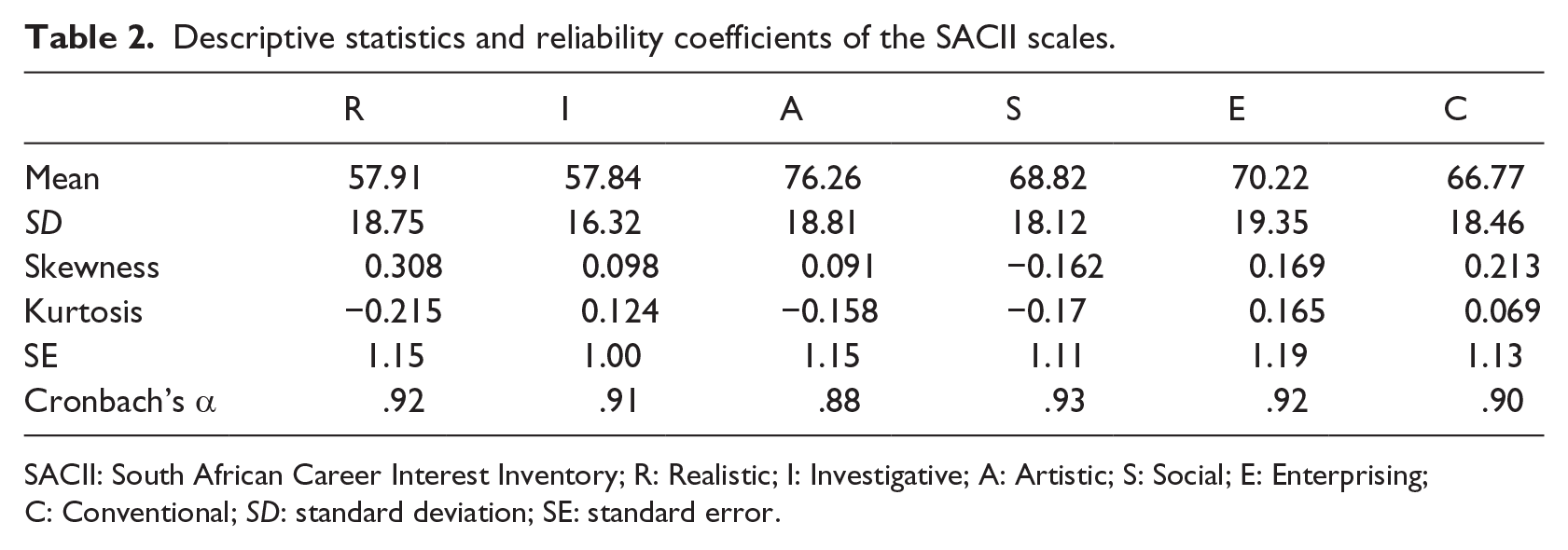
SACII: South African Career Interest Inventory; R: Realistic; I: Investigative; A: Artistic; S: Social; E: Enterprising; C: Conventional; SD: standard deviation; SE: standard error.
In terms of the analysis of the underlying circumplex structure of the SACII-X, the RTHOR produced significant probability values (p < .05) for the isiXhosa participants, and subsequently, the null hypothesis was rejected. In other words, a tight circular ordering that is consistent with Holland’s (1997) calculus assumption emerged from the data. Moreover, the CI value was satisfactory for the isiXhosa participants (.69). The results for the randomisation test of hypothesised order relations are presented in Table 3.
Randomisation test of hypothesised order relations for the SACII.
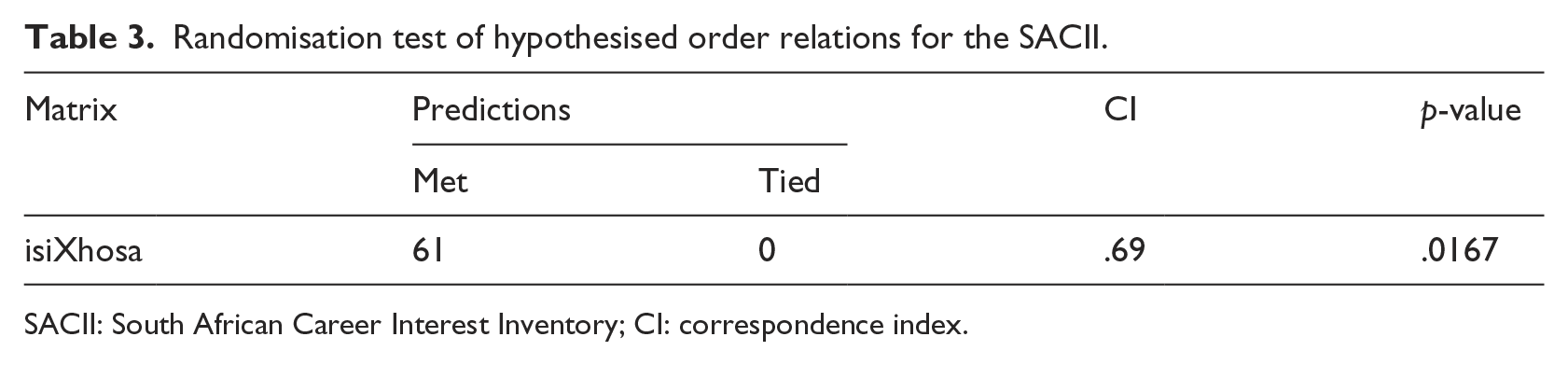
SACII: South African Career Interest Inventory; CI: correspondence index.
In addition, the isiXhosa participants demonstrated acceptable model fit on the MDS analysis, with the Stress-1 value (.003), DAF coefficient (.999), Tucker’s CC (.999), and Variance Accounted for (VAF) coefficient (.83) all satisfactory. Moreover, a circular order was approximated in the non-metric MDS plot, as represented in Figure 1.
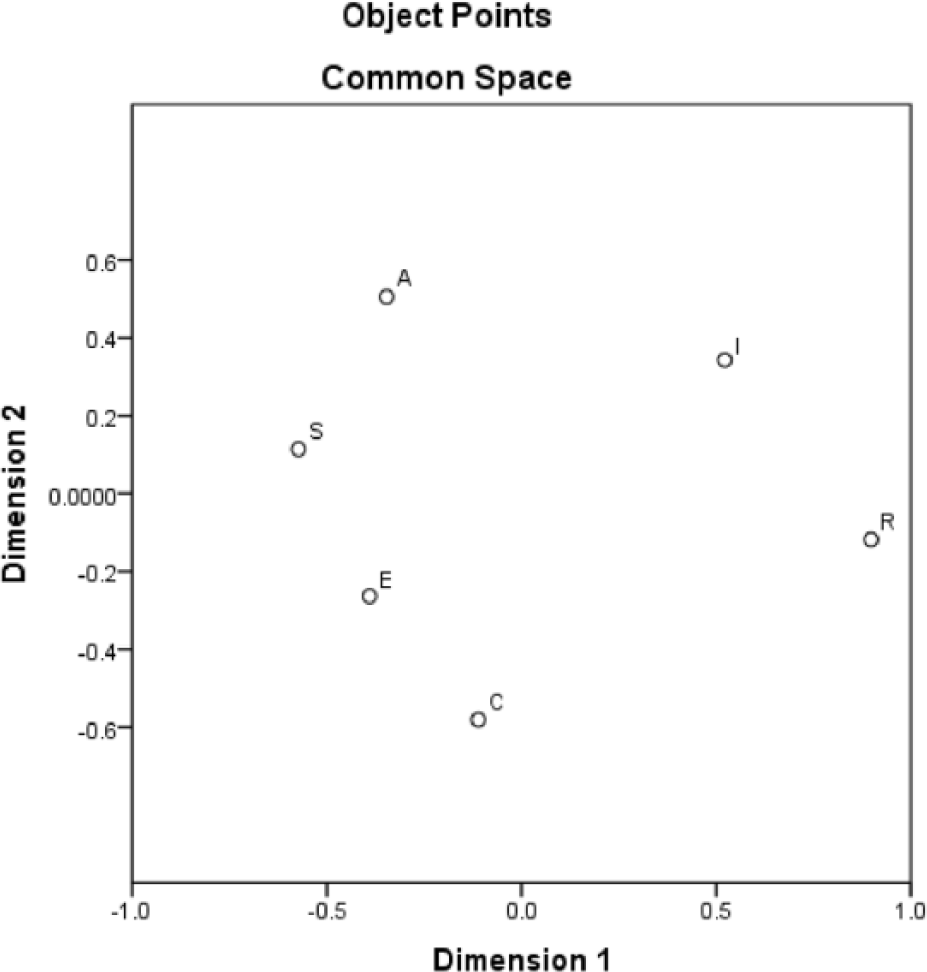
Non-metric MDS plot of the RIASEC scales for isiXhosa participants.
Finally, for the CCSM analysis, the best overall model fit for the isiXhosa participants was demonstrated on the unconstrained model. Marginally satisfactory fit was obtained by the RMSEA (.08) for the unconstrained model – the remaining three models, however, produced unsatisfactory fit (i.e., > .08). However, acceptable fit was obtained on the SRMR (⩽.05), TLI, CFI, and GFI (>.90) coefficients for the unconstrained, equal-communality, and equal-spacing models. For the circulant model, these coefficients were marginally unsatisfactory. Finally, the unconstrained model demonstrated the lowest ECVI (.09) value across the four competing circumplex models. The fit statistics for the sample are presented in Table 4.
Fit statistics for the IsiXhosa sample of the four circumplex models.
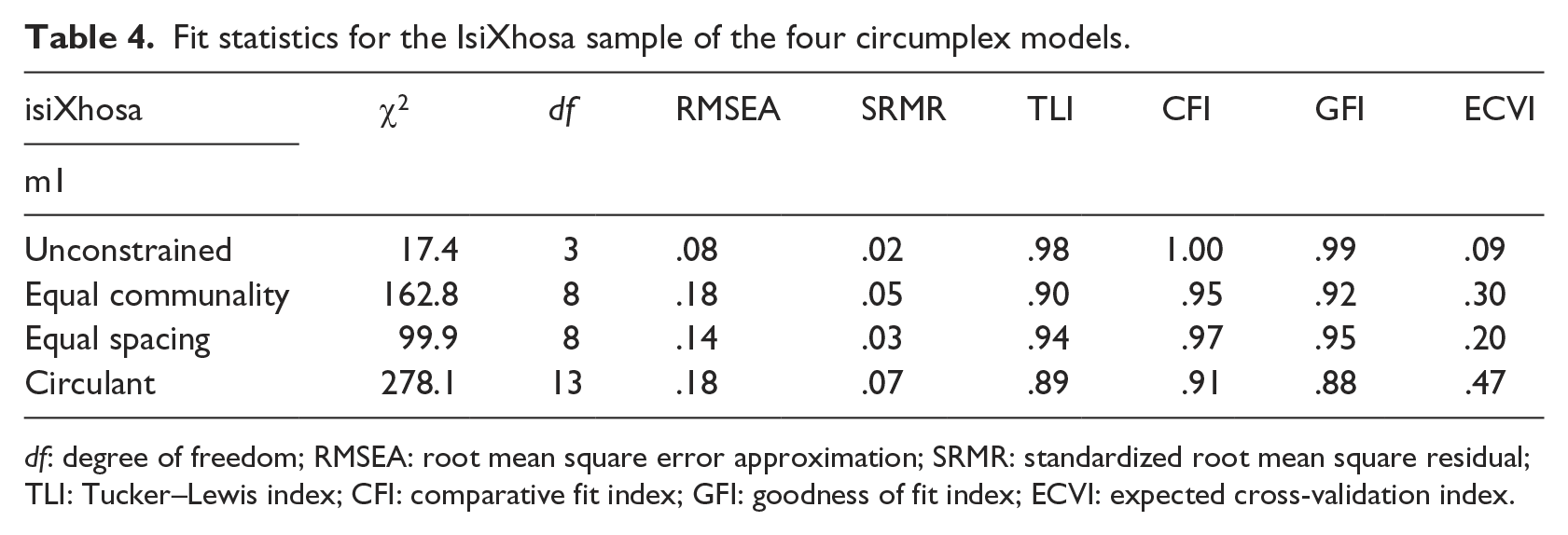
df: degree of freedom; RMSEA: root mean square error approximation; SRMR: standardized root mean square residual; TLI: Tucker–Lewis index; CFI: comparative fit index; GFI: goodness of fit index; ECVI: expected cross-validation index.
Moreover, the interest structure of the data was investigated by plotting the angular locations of the six RIASEC types on the circumference of a circle. The results indicated that the Artistic and Social, and Enterprising and Conventional types demonstrated a relatively close displacement, whereas an estimated 60° spacing was evident between the Realistic and Investigative types. As such, the displacement of the six RIASEC types was in contrast to Holland’s theorised 60°. In particular, the RIASEC scale for the participants was unequally spaced (≠60°). These results are represented in Figure 2.
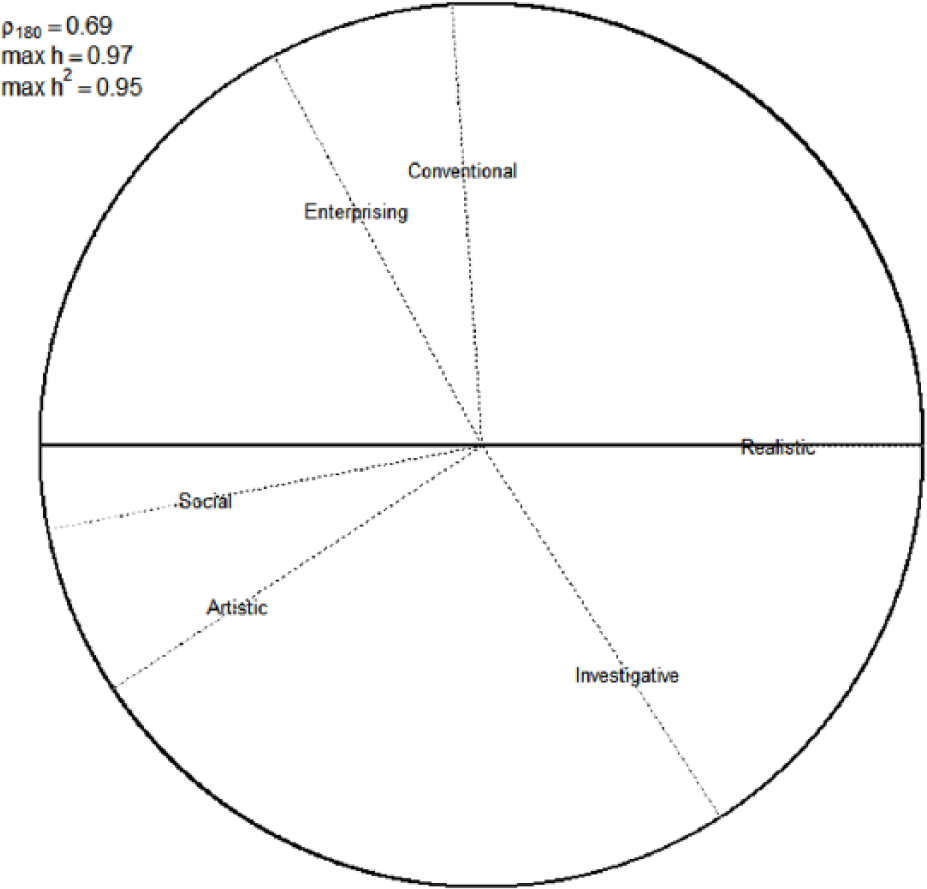
Angular locations of the RIASEC types for unconstrained model.
Discussion
The purpose of this study was to adapt and translate the SACII into isiXhosa, to ultimately build on the initial results reported by Morgan et al. (2014), and to extend the availability of the SACII to a new population group. In addition, the reliability and validity of SACII-X, and therefore Holland’s model, was investigated among a sample of isiXhosa-speaking adolescents. The results demonstrated the SACII-X to be a reliable and valid measure of vocational interest among a sample of early adolescents and signified that Holland’s model may be valid within the South African context. For the majority of the results obtained in this study, the model fit statistics exceeded the statistical cut-off scores discussed in the ‘Data analysis’ section. In particular, the Cronbach’s alpha were all acceptable (>.85). Although the reliability coefficient obtained for the SACII-X were slightly lower compared to the original English version (>.93), this difference was deemed to have no practical significance and comfortably exceeded Nunnally and Bernstein’s (1994) recommendation of >.70. Furthermore, the angular locations and communality estimates resembled a loose circular ordering, and most importantly, the RTHOR (CI = .69), MDS (Stress-1 = .003; DAF = .999; Tucker’s CC = .999; VAF = .83) and CCSM (RMSEA = .08; SRMR = .02; TLI = .98; CFI = 1.00; GFI = .99) analyses indicated that a circular ordering structure, consistent with Holland’s (1997) calculus assumption, emerged from the data for isiXhosa-speaking adolescents. That is, the results signified that the six RIASEC types on the SACII-X were arranged in the correct circular ordering, resembling Holland’s theoretical RIASEC model (Tracey, 2000). These results suggest that career assessment and counselling based on Holland’s model may be valid in the South African context when valid inventories, such as the SACII-X, are used.
These results are particularly promising, as Iliescu, Ispas, Ilie, and Ion (2013) argue the use of adolescent samples might have a detrimental effect on the equal applicability of the RIASEC model, since an individual’s career interests are likely to be more stable during adulthood than in adolescence or young adulthood. Furthermore, since adults have more exposure to the world of work, they tend to have a more differentiated perception of their vocational interest. Our results suggest that through using the SACII-X, the vocational interests of early adolescent isiXhosa-speaking learners can be assessed and may also be utilised to direct subject choices at school. Moreover, these results have potentially important implications for the measurement of career interests in South Africa using Holland’s model. In particular, the results are at odds with previous local research that failed to find support for the RIASEC model with diverse samples in South Africa (Deller, 1997; du Toit & de Bruin, 2002; Schonegevel, 1997). However, these studies would not have had the benefit of using an emic constructed interest questionnaire such as the SACII, and assessing participants in a language other than Afrikaans and English.
In addition, through developing the SACII-X, this study makes a constructive contribution to not only the debate surrounding the influence of language on test takers’ career interest scores (du Toit & de Bruin, 2002; Morgan, 2014) but also through constructing the first career interest inventory available in isiXhosa. In terms of the 11 officially recognised languages in South Africa, Afrikaans is the home language for 13.50% of South Africans, while 9.60% of the population is English first-language speaking (Statistics South Africa, 2011). In combination, these two language groups account for less than a quarter of the South African population (23.10%). Yet, almost all vocational interest inventories in South Africa are only available in English and Afrikaans. The HPCSA (2010, p. 1) has called for more tests to be developed and applied with the appreciation of the cultural and other diversity concerns with a view to standardising these for all South Africans. As such, with 16% of the population being isiXhosa-speaking, the development of the SACII-X is an important stepping stone to afford more South African high school learners the opportunity to have their career interests assessed in their home language.
Within this context, future studies should investigate the reliability and validity of the SACII-X among diverse samples, ideally with late adolescents and young adults to extend the availability of the measure beyond the current sample. It is further recommended that research explore the psychometric properties of the SACII-X within urban and rural settings and conduct additional measurement invariance tests across the Afrikaans, English, and isiXhosa versions of the SACII. Further confirmation of the reliability and validity of the SACII-X will pave the way for implementing the application of the measure in career guidance and counselling interventions in high schools where there is a dire need (Albien & Naidoo, 2016).
Furthermore, beyond the scope of vocational psychology, the committee forward-back translation procedure employed in this study can, and should, be employed across a wide range of psychological assessment practices to produce psychometric instruments with sufficient reliability, validity, and cultural invariance. Indeed, the onus lies with researchers, practitioners, and test developers to ensure that our clients and patients are assessed in a fair, unbiased manner.
Notwithstanding our promising results, the interpretation thereof is limited. First, the non-probability sampling technique employed in this study limits the generalisation of the results. In addition, although sufficient for statistical analyses, this study’s sample was relatively small (n = 266). Finally, the results are limited by the geographical location in which the data were collected. The majority of the participants resided in a peri-urban settlement in the Winelands district of the Western Cape, South Africa. As such, we caution against generalising the results across isiXhosa-speaking South Africans residing in different provinces and geographical locations.
Conclusion
The SACII-X represents the first career interest inventory to be available in isiXhosa and, subsequently, holds the potential to offer a large proportion of South Africans the opportunity to assess their career interest in their home language. More importantly, the results for this study demonstrate the SACII-X to be a valid measure in a sample of isiXhosa-speaking early adolescents and augments the initial findings reported by Morgan et al. (2014). Within the context of previous local research, the results are more optimistic in terms of the validity of Holland’s model in the South African context and provide confirmatory evidence that the isiXhosa version of the SACII may be used as a valid career interest inventory within the diverse South African context.
Footnotes
Acknowledgements
The authors express gratitude to Professor Gideon de Bruin and Dr Brandon Morgan of Stellenbosch University and the University of Johannesburg for permission to use the SACII as the basis for this study and for their assistance with the statistical analyses.
Declaration of conflicting interests
S.R. was the recipient of the Postgraduate Merit Bursary from Stellenbosch University for the completion of this study as part of his doctoral research.
Funding
The author(s) received no financial support for the research, authorship, and/or publication of this article.