



Abstract
The purpose of this study was to investigate the reliability and structural validity of the Maree Career Matrix when used to measure the vocational interests of adults. Reliability of the 19 Maree Career Matrix interest categories were investigated using Cronbach’s alpha and McDonald’s omega total and the structural validity of these 19 interest categories was examined using principal components analysis. Results indicated mostly satisfactory reliability of the 19 interest categories when used for discussion of interest profiles and that the 19 interest categories formed approximate circular ordering consistent with Holland’s circumplex model of vocational personality types. These results provide initial support for the reliability and structural validity of the Maree Career Matrix when used to measure the vocational interests of adults. Implications for theory and practice are discussed.
Measurement of vocational interests is usually limited to career counselling with adolescents (Hansen & Wiernik, 2018). However, measuring adults’ vocational interests is also important because research has shown that vocational interests and/or person-environment fit (i.e., the fit between a person’s vocational interests and the working environment) are related to work performance, persistence, and turnover (Nye, Su, Rounds, & Drasgow, 2017; Rounds & Su, 2014; Van Iddekinge, Roth, Putka, & Lanivich, 2011). Interest inventories can therefore be of potential use in employee recruitment, selection, and retention strategies (Arulmani, Bakshi, Leong, & Watts, 2014; Bergh, 2003; Greenhaus, Callanan, & Godshalk, 2000; Gregory, 2007; Nye et al., 2017; Van Iddekinge et al., 2011) provided that the interest inventory that is used has satisfactory psychometric properties.
In South Africa the Maree Career Matrix (MCM; Maree & Taylor, 2016a, 2016b) has recently been introduced as a measure of vocational interests. Two strengths of the MCM are (a) that the item content was generated with the South African context in mind and (b) that it measures 19 different interest categories (see Table 1; Maree & Taylor, 2016a). Using interest inventories in South Africa that were developed specifically for the South African context is important because imported instruments might not take local socio-economic factors into account or might have items that are not applicable to the South African context (Einarsdóttir, Rounds, & Su, 2010; Foxcroft, 2011; Morgan & de Bruin, 2018; Morgan, de Bruin, & de Bruin, 2015). It is therefore necessary to ensure that any international interest inventory has satisfactory psychometric properties in the South African context before it is used in South Africa (see Foxcroft, 2011).
The 19 Categories of the MCM and their associated Holland Type and O*Net code.

R: realistic; I: investigative; A: artistic; S: social; E: enterprising; C: conventional.
Definitions were obtained from Maree and Taylor (2016b). The reader is referred to this source for full defintions.
To our knowledge, only one study to date (Maree & Taylor, 2016a, 2016b)1 has investigated the psychometric properties of the MCM. This aforementioned study found promising evidence for the reliability and validity of the MCM on a sample of high-school learners. But what is lacking in their study is an investigation of the latent structure of the 19 MCM interest categories and the category score reliabilities when used to measure the vocational interests of adults. Vocational interests, at least in regard to Holland’s (1973, 1997) six vocational personality (interest) types, have circumplex or circular structure (Morgan, 2017; Rounds, Tracey, & Hubert, 1992; Tracey, 2012; Wiernik, 2016). We believe that the 19 MCM interest categories should show this circular structure and that their locations on the circle should approximately follow the interest structure proposed by Holland (1973, 1997). Showing that the 19 MCM interest categories has circular ordering is important for two reasons: (a) it will support the structural validity of the MCM and (b) have implications for using the MCM in practice.
Development and theoretical background of the MCM
The MCM consists of 152 items presented as job/occupational titles. Individuals indicate their interest and confidence to work in each of these jobs on a three-point rating scale. There are 19 different interest categories (Table 1), each consisting of eight items. In this study, we only focus on the reliability and validity of these 19 interest categories. Development of the MCM occurred over several years. In brief, 19 interest categories were conceptualised based on investigation of the relevant literature and other interest inventories and through collaboration with content experts (Maree & Taylor, 2016a, 2016b) The theoretical and conceptual framework of the MCM consists of: (a) Super’s developmental theory (Super, 1953), (b) social cognitive career theory (Lent, Brown, & Hackett, 1994), and (c) Holland’s vocational personality theory (Holland, 1973, 1997).
Psychometric properties of the MCM
Maree and Taylor (2016a, 2016b) investigated the reliability of the 19 interest categories and fit of the items for each interest category to the Rasch (1960) measurement model on a sample of 1106 high school boys and girls. Cronbach alpha coefficients for the 19 interest fields ranged from .73 to .88 for Time 1 and .72 to .89 for Time 2 (Maree & Taylor, 2016a). The test–retest reliability coefficients ranged from .72 to .81 (Maree & Taylor, 2016a). Most of the items fit the Rasch model supporting its construct validity (Maree & Taylor, 2016a). Concurrent validity was established by administering the Career Interest Profile (CIP; Maree, 2010) and the Rothwell Miller Interest Blank (RMIB) (Miller, Tyler, & Rothwell, 1994) alongside the MCM. The correlations of the MCM interest categories with the relevant RMIB and CIP interest scales supported the concurrent validity of the MCM (Maree & Taylor, 2016a).
Holland’s model of vocational personality types
Holland’s (1973, 1997) model of vocational personality types and work environments proposes that both people and environments can be classified into one of six personality (i.e., interest) types: Realistic (R), Investigative (I), Artistic (A), Social (S), Enterprising (E), and Conventional (C) (RIASEC). These personality types form circumplex structure meaning that they are arranged in a circle spanned by two orthogonal dimensions (Holland, 1997; Morgan & de Bruin, 2018; Tracey & Rounds, 1995). Circumplex structure also implies that the RIASEC personality types form a sinusoidal pattern of relations with each other (Fabrigar, Visser, & Browne, 1997) and that the two orthogonal circumplex dimensions account for a large and approximately equal proportion of the variance (Gurtman, 1997).
Circumplex structure is usually investigated using exploratory approaches that focus on the ordering of variables in two dimensions (Tracey, 2000). These techniques include, for example, principal components/factor analysis and multidimensional scaling (Fabrigar et al., 1997; Tracey, 2000). None of these techniques, however, explicitly tests for circumplex structure, rather relying on visual inspection of variable ordering and their location on a circle (Fabrigar et al., 1997). Browne (1992) introduced a confirmatory technique to test for circumplex structure. His approach has been applied to investigative circumplex structure in RIASEC correlation matrices (e.g., Darcy & Tracey, 2007; Mintram, 2018; Morgan & de Bruin, 2018), but to our knowledge it has yet to be applied to correlation matrices consisting of more than six interest types.
Validity of Holland’s model in South Africa
Morgan and de Bruin (2018) and Leong and Pearce (2014) point out that Holland’s model was developed in the United States. It is therefore necessary to demonstrate that the model is valid if it used in South Africa (Morgan et al., 2015; Tracey & Gupta, 2008). Early research (e.g., du Toit & de Bruin, 2002; Wheeler, 1992) cast serious doubts about the applicability of Holland’s model in South Africa. However, recent research has shown that Holland’s model is probably more valid than was previously thought, because the correct RIASEC ordering is generally found and because the sample correlations are mostly consistent with circumplex structure (Mintram, 2018; Morgan et al., 2015; Rabie, 2017).
The structure of basic interests
Holland’s six personality types can be thought of as broad or general interests that slice the interest space into 60º sectors. It is possible to further slice the interest space into basic interests (such as the MCM’s 19 interest categories) and specific occupational titles (Rounds, 1995). This conceptualisation is consistent with the concentric circles argument of Tracey and Rounds (1995). That is, the interest space consists of concentric circles moving from broad interests into more fine-grained (or basic) interests (Tracey & Rounds, 1995). The MCM can be seen as existing at two of these levels, namely, basic interests (the 19 interest categories) and occupational interests (the individual items; Maree & Taylor, 2016a).
The structure of basic interests has received relatively little research (Morgan, 2017; Willie, De Fruyt, Dingemanse, & Vergauwe, 2015). Early research usually searched for simple structure resulting in lists of basic interests (Rounds, 1995) that did not always support six broad interest dimensions (Tracey, 2012). Some early research (Cole, 1973; Cole & Hanson, 1971) and more recent research (Morgan, 2017) have shown that basic interests tend to have circular structure and that this structure roughly approximates RIASEC ordering. In other words, the interest space consists of two dimensions and the location of interests on the circle depends on their correlations (Fabrigar et al., 1997).
In contrast, others (Day & Rounds, 1997; Rounds, 1995) have argued that RIASEC ordering might not best represent the structure of basic interests or alternatively that basic interests might be represented using simple structure instead (Willie et al., 2015). However, given (a) Tracey and Rounds (1995) conceptualisation of interests as concentric circles, (b) research showing that Holland’s six personality types form circumplex structure rather than simple structure (Wiernik, 2016), (c) research (Armstrong, Smith, Donnay, & Rounds, 2004; Cole, 1973; Cole & Hanson, 1971; Morgan, 2017) supporting the circular structure of basic interests, and (d) the problem of the large general interest factor when rotating to simple structure (Tracey, 2012), we believe that the 19 MCM interest categories should form a circle and that their locations on this circle should roughly approximate Holland’s RIASEC ordering.
Table 1 provides each of the 19 MCM interest categories and their associated Holland type reported by Maree and Taylor (2016b). We also categorised each of the 19 interest categories into a Holland type (or types) based on the occupations that make up each interest category using O*Net Online (2017). In some cases, we could not find an exact code for an occupation and so we used an occupation that closely represented the MCM occupation. Clustering of the basic interests into these categories in two-dimensional space will provide some support for the idea that basic interests form circular structure consistent with RIASEC ordering.
Method
Participants
Adult participants were recruited using convenience sample. The sample consisted of 117 participants with a mean age of 35 (Mdn = 32, SD = 10.75), 25.6% (n = 30) were men and 73.5% (n = 86) were women. Participants were mostly White (n = 65, 56%) followed by Black African (n = 22, 19%), Coloured (n = 3, 3%), Indian (n = 24, 21%), and Asian (n = 2, 2%). The most common spoken home language was English (n = 65, 56%) or Afrikaans (n = 27, 23%). Participants were employed in various industries with most employed in education (n = 23, 19.7%), information technology (n = 19, 16.2%), and human resources (n = 16, 13.7%).
Instruments
Participants completed a biographical questionnaire and the MCM (Maree & Taylor, 2016a, 2016b)
Procedure
Human resource managers or other relevant organisational gatekeepers were contacted to obtain permission to include the organisation and its employees in the research. All instruments were given to working adults with permission from the relevant organisational gatekeeper. In some instances, the instruments were administered to adults outside of the workplace.
Ethical considerations
Ethical permission for this study was obtained from relevant ethics committees at the University of Johannesburg. All participants were required to complete informed consent forms prior to participation. They were informed that results would remain anonymous and that participation in the study was voluntary. Permission to investigate the psychometric properties of the MCM was obtained from the test distributor and from the author of the MCM.
Data analysis
We used Cronbach’s alpha coefficient (Cronbach, 1951) and McDonald’s (1999) coefficient omega total (Revelle & Zinbarg, 2009) to investigate the reliability of the 19 interest categories. Confidence intervals for the reliability coefficients were obtained based on normal theory (see Kelley & Pornprasertmanit, 2016). This was done using the MBESS package (Kelley, 2018) version 4.4.3 for R version 3.4.1 (R Core Team, 2017). Principal components analysis following the procedure described by Tracey (2000) and Tracey and Rounds (1996) was used to investigate the structure of the 19 MCM interest categories. We also used the component loadings on the second and third orthogonal components to obtain angular locations (θ) and vector lengths (VL) for each MCM interest category. Angular locations indicate the location of each interest category on the circle and vector length indicates the strength of the relationship of each interest category with the two orthogonal dimensions (Revelle, 2017).
We preferred to use the aforementioned approach to investigate for potential circumplex structure of the 19 MCM interest categories in this study because (a) the precise structure of basic interests remains relatively unknown and (b) because the sample size was too small to allow for confident application of Browne’s (1992) approach. Our focus was therefore on whether or not the 19 MCM interest categories formed a circular structure and if the locations of the interest categories on the circle corresponded with their theoretical locations. It is doubtful that circumplex structure would be found using Browne’s (1992) approach if principal components analysis does not provide support for circular structure. The analyses described above were conducted using the psych package version 1.7.5 (Revelle, 2017) in R version 3.4.1 (R Core Team, 2017).
Results
Descriptive statistics and reliability coefficients for the 19 MCM interest categories are presented in Table 2. All reliability coefficients except for PT, AC, SCT, and TAT were > .70. Pearson and disattenauted correlation coefficients (based on Cronbach’s alpha as an estimate of reliability) for the 19 MCM interest categories are provided in Table 3. Inspection of Table 3 shows that for the most part the 19 MCM interest category correlations matched the theoretical expectations. That is, interests that are more conceptually similar had larger correlations and interests that are more conceptually dissimilar had lower correlations. For example, MUS, AC, and WA, (i.e., artistic type interests) had medium to strong correlations with each other, and had small correlations with interests that are theoretically opposite to them, such as OW and MAT. But there were also some unexpected correlation coefficients. For example, PC, which would be expected to correlate strongly with artistic interests, had medium to strong correlations with AC and WA but also with ENT and MPS (i.e., enterprising). SPO (a realistic interest) showed relatively low correlation coefficients across the 19 interest categories except for with MAT (r = .30) and SCT (r = .30).
Descriptive statistics and reliability coefficients of the 19 MCM interest categories.
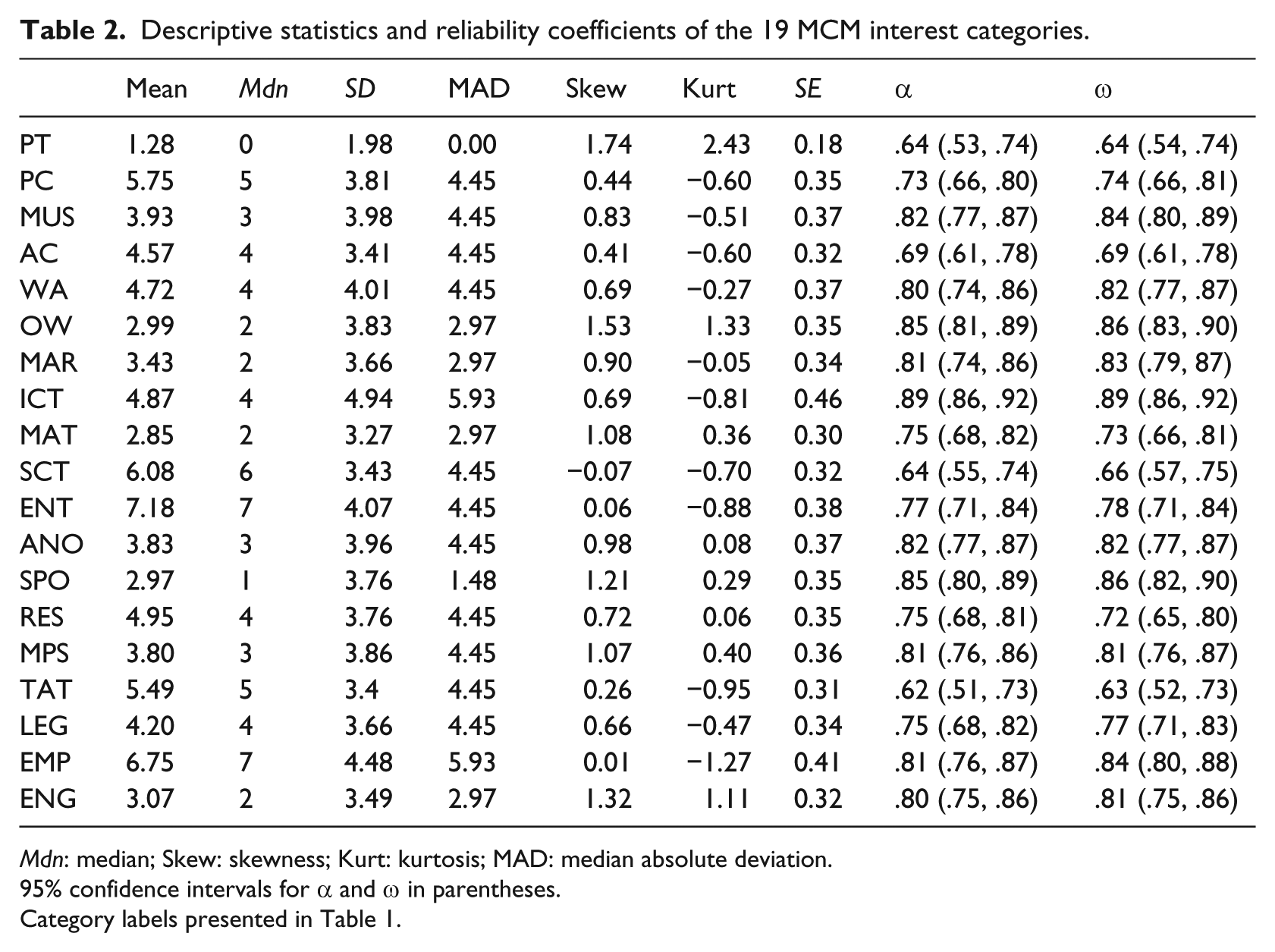
Mdn: median; Skew: skewness; Kurt: kurtosis; MAD: median absolute deviation.
95% confidence intervals for α and ω in parentheses.
Category labels presented in Table 1.
Pearson’s correlation coefficients for the 19 MCM interest categories.

Disattenuated correlations (based on α) above the diagonal.
Category labels presented in Table 1.
Correlation coefficients ≥.30 in bold.
Table 3 shows the component loadings and polar coordinates for the 19 MCM interest categories. It can be seen that there is a large general component explaining 31% of the variance. Components two and three explained 12% and 9% of the variance. The root mean square residual was .09. The vector lengths (i.e., h) of the 19 interest categories ranged from .10 (TAT) to .66 (WA) with five interest categories having vector lengths <.30 (Table 4; see Tracey & Rounds, 1996). Interest categories with the lowest vector lengths were PC, SPO, MPS, TAT, and LEG. The 19 interest categories locations are presented in Figure 1. We also plotted the RIASEC locations in Figure 1 by averaging the angular locations of relevant interest categories that had vector lengths ≥.30 (i.e., that had relatively large projections into the interest space).
Unrotated pattern matrix, thetas, and vector lengths for the 19 MCM interest categories.
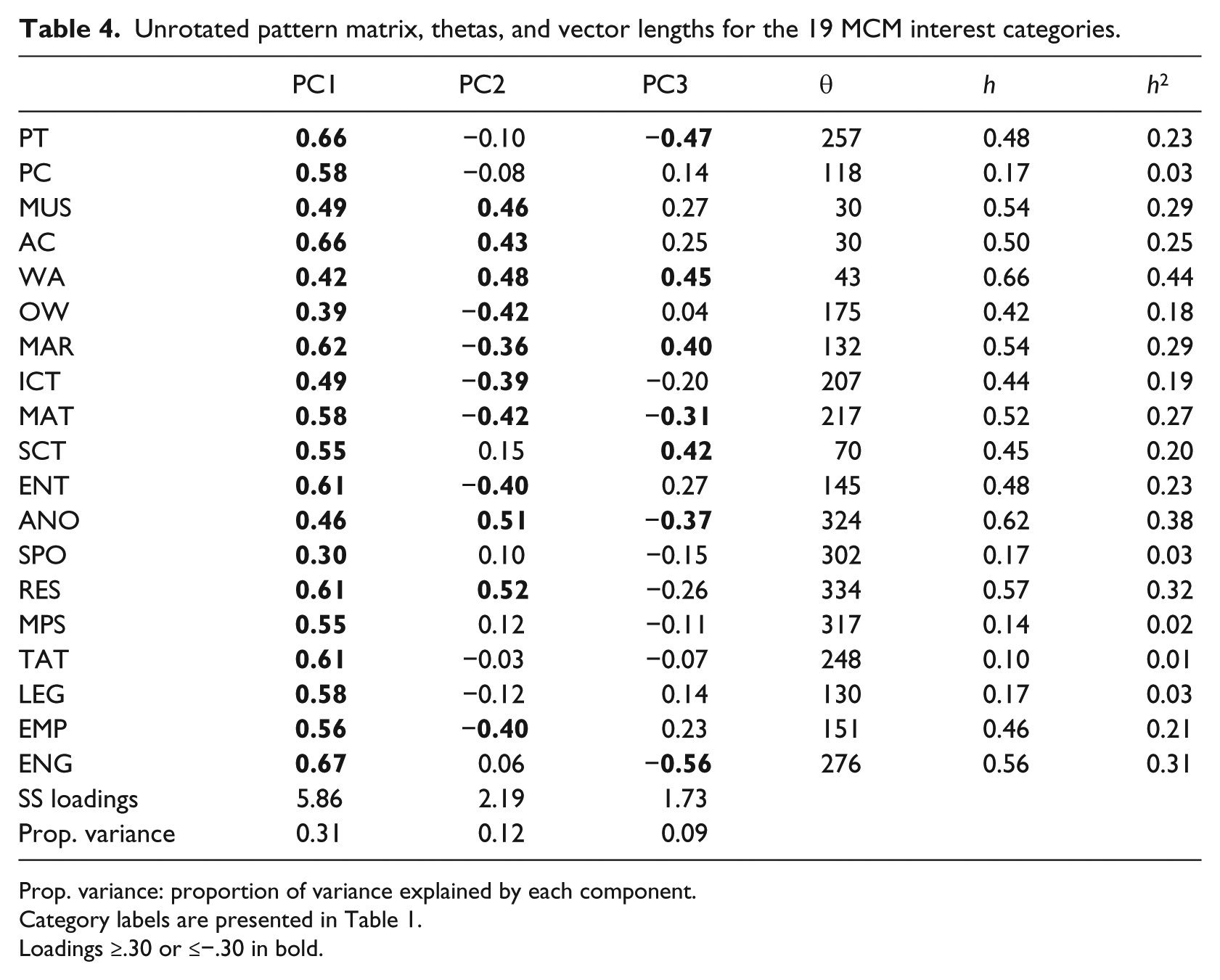
Prop. variance: proportion of variance explained by each component.
Category labels are presented in Table 1.
Loadings ≥.30 or ≤−.30 in bold.
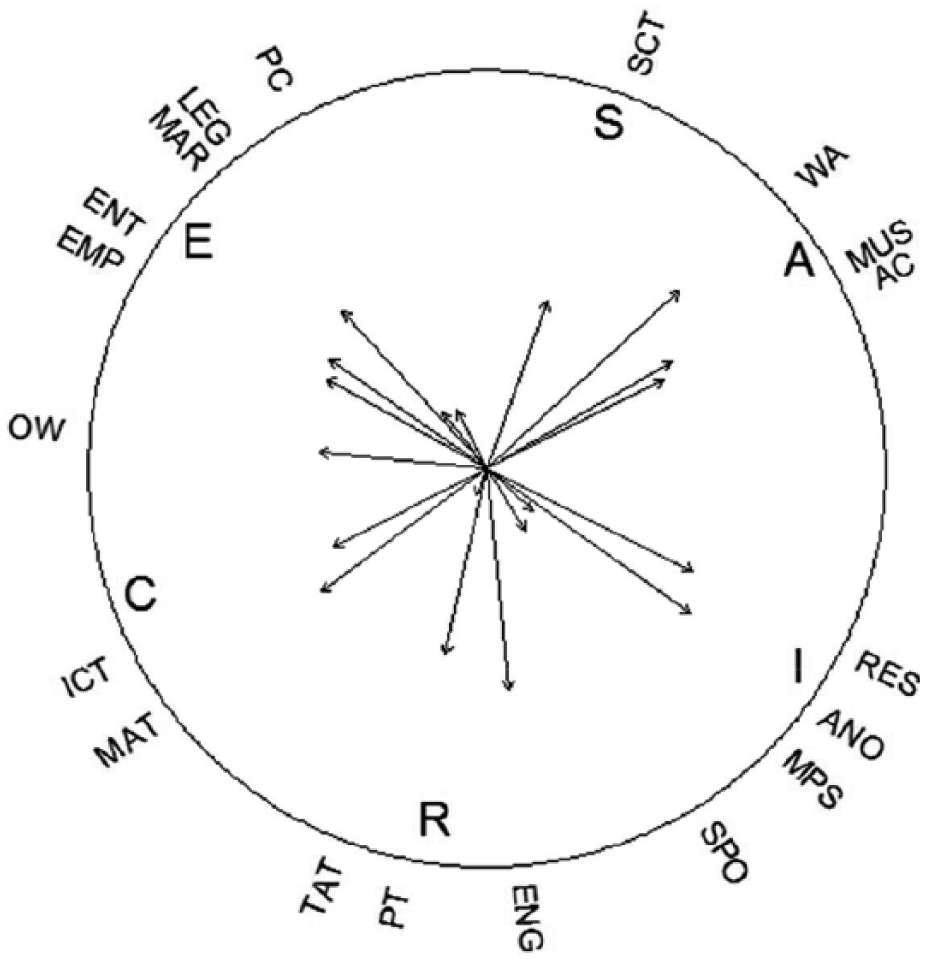
19 MCM interest category locations on the unit circle. Angular location of AC and MAR slightly adjusted to prevent overlapping categories on the circle. Angular locations for the RIASEC locations adjusted to prevent overlap. Arrows represent vector lengths (h) of the 19 interest categories. Rotation is arbitrary.
It can be seen that the locations of the 19 interest categories tended to mirror the ordering of Holland’s RIASEC types. For example, the Realistic cluster consisted primarily of PT and ENG. Moving anticlockwise from Realistic, the Investigative cluster consisted of ANO and RES. The Artistic cluster consisted of MUS, AC and WA and is followed by the Social (i.e., SCT) interest category. MAR, ENT, and EMP made up the Enterprising cluster and finally, the Conventional cluster consisted of OW, ICT, and MAT. For completeness, we also investigated simple structure of the 19 interest categories using factor analysis. The results showed that simple structure was tenable when not accounting for the general factor but that after accounting for the general factor the simple structure solution was less clear.2
Discussion
We set out to investigate the reliability and structural validity of the MCM on a sample of working adults. Reliability coefficients were mostly satisfactory for using the MCM as a discussion document alongside other relevant information (Maree & Taylor, 2016a, 2016b). In other words, rather than relying solely on absolute score levels or interest profiles obtained from the MCM, counsellors should (a) discuss results with clients to confirm if the results are an accurate reflection of their interests and (b) use the results as a part of the career counselling process (Maree & Taylor, 2016b). In all, 5 of the 19 interest categories had reliability coefficients <.70.
The reliability coefficients in this study mostly corresponded with the reliability coefficients reported by Maree and Taylor (2016a, 2016b). Interest categories that had higher reliability coefficients in their study also tended to have higher reliability coefficients in our study and the interest categories with the lowest reliabilities in this study were also the categories with the lowest reliabilities in their study. These results suggest that there might be merit in further investigating the psychometric properties of these five interest categories. However, we cannot rule out the impact of the small sample on the estimated reliability coefficients and the different sample group used in this study when comparing our results with that of Maree and Taylor (2016a, 2016b).
In terms of structural validity, the results suggest that the 19 MCM interest categories approximately formed circular structure and that this structure was mostly consistent with Holland’s RIASEC ordering. It must be kept in mind, however, that the technique employed in this study does not provide an index of the fit of a circumplex model. As a whole, these results mirror other studies that have found that basic interests tend to form a circle (Armstrong et al., 2004; Cole, 1973; Cole & Hanson, 1971; Morgan, 2017). The locations of the 19 MCM interest categories mostly matched with the Holland codes provided for each interest category in Table 1, further supporting their alignment with RIASEC ordering. These results provide initial support for the structural validity of the MCM, at least from the perspective of circular structure, when used to measure the vocational interests of adults.
Five interest categories demonstrated shorter vector lengths, indicating that they did not share much variance with the two underlying dimensions (Gurtman, 1997; Revelle, 2017). These results do not mean that these five interest categories cannot be used in practice, but rather that their circular structure is less clear. It is difficult to determine the reasons for these shorter vector lengths. It may be a characteristic of the MCM or it might be that not all basic interests can be well captured in two-dimensional space (Day & Rounds, 1997; Rounds, 1995). However, given the small sample size and that relatively little is known about the circular structure of basic interests (Morgan, 2017), we can only speculate on these propositions.
These results suggest that practitioners can potentially benefit from interpreting individuals scores on the MCM in terms of circular structure, in addition to interpreting interest scores/profiles (Cole & Hanson, 1971). That is, individual interest scores can be interpreted in relation to related interest categories and more broadly in terms of Holland’s model. This also opens up the possibility of interpreting the MCM in terms of a hierarchy (Rounds, 1995) where practitioners can move from broad interests to basic interests and then to occupations endorsed within each interest category that the individual scored high on as well as by drawing on the confidence rating scores for each category and occupation endorsed. Theoretically, this study builds on earlier work (Cole & Hanson, 1971; Day & Rounds, 1997; Rounds, 1995;) about the structure of basic interests and suggests that basic interests appear to form circular structure and that Holland’s model serves as a useful theoretical framework for the structure of basic interests. The results also hold promise for the application of local interest inventories in the South African context and support the validity of Holland’s model in South Africa.
The small sample size is a limitation of this study and, therefore, caution should be applied when interpreting the results. The small sample size had an impact on the estimated reliability coefficients and component loadings and also impacted on the generalisability of the results to the population. Future research should therefore replicate the results we obtained in this study as well as conducting more in-depth investigation of the interest categories that were found to be potentially problematic in this study. This will shed further light on the psychometric properties of the MCM and inform on circular interpretation of the 19 interest categories. The sample was also not reflective of the general South African population in terms of race, language, and gender. This again limits generalisation of the results. Principal components analysis also does not explicitly test for circumplex structure. Future research could consider applying confirmatory factor analysis to test for circumplex structure (Fabrigar et al., 1997). This in turn could further assist in understanding the psychometric properties of the MCM. Finally, we did not investigate the reliability of the confidence score categories in this study.
Conclusion
This study set out to investigate the reliability and structural validity of the MCM when used to measure the vocational interests of adults. As a whole, our results provide promising evidence for the reliability and structural validity of the MCM.
Footnotes
Acknowledgements
We extend our appreciation to the anonymous reviewers for their insightful comments on the article. We also thank Professor J.G. Maree and Dr N. Taylor for their permission for us to investigate the psychometric properties of the MCM.
Funding
The author(s) received no financial support for the research, authorship, and/or publication of this article.