




Abstract
A systematic literature review was conducted to explore worldwide prevalence studies on student suicide, the risks and protective factors related to student suicide, and university-based interventions to combat it. The search of four major databases identified 60 studies published in peer-reviewed academic journals between 2015 and 2020. Majority of these publications were from the United States, followed by China and the United Kingdom. Studies in South Africa and the African Continent as a whole were limited in terms of meeting the selection criteria of the review. The findings indicate that most of the publications ranged from describing suicide risk factors innate to students, such as their demographic and mental health features, to social and university stressors. Although the studies on protective factors were limited, several psychological, social, and behavioural elements to prevent student suicide were identified. I adopted the Three-Step Theory of suicide to discuss the implications of the findings by presenting several campus-based strategies to combat student suicides.
Keywords
Introduction
In recent years, suicide has been identified as one of the top five mental health problems among university students across the world (World Health Organization, 2019). Recent findings in South Africa by Bantjes et al. (2019) confirm that out of 1402 first-year South African students, 46.4% had suicidal ideations, 26.5% planned suicide, and 8.6% attempted suicide. Suicide ideation is exacerbated by risk factors such as a stressful university life often compounded by broken relationships, loss of loved ones, family mental health history, and feelings of failure which generally contribute to depression and other comorbid mental illnesses among students (Mortier et al., 2018). Based on the multiple risk factors university students face, research on protective factors and successful campus-based interventions were reviewed (Brailovskaia et al., 2020).
In a preliminary observation of the literature on suicide among university students, most of the research conducted focused on the risks or causes that contributed to student suicide, with a paucity of studies on protective factors. Of the systematic (Russell et al., 2019) and scoping review (Gselamu & Ha, 2020) publications on university-based student suicide, the focus was solely on sleeping or eating disorders and their effect on student suicide attempts. An initial 10-year search identified over 15,000 publications, requiring the researchers to narrow the search to 5 years, focusing on risk and protective factors and campus-based interventions related to student suicidal behaviours.
Theoretical perspective
I chose the Three-Step Theory (3ST) of suicide presented by Klonsky and May (2015) as the theoretical framework for this study. They argued that suicide should be viewed from an ‘ideation-to-action’ framework in terms of theory, research, and prevention. As the aim of the publication is to propose campus-based preventive measures, I used the 3ST as a conceptual framework to consider the risks, their effect on ideation, and the types of protective factors that mitigate these risks.
The 3ST maintains that there are distinctive processes from the moment students start contemplating suicide until the culmination of actual attempts. In the first step of 3ST, suicide ideas emanate from the psychological pain, hopelessness, shame, and anger experienced by students. In the second step, the ideation is exacerbated if students lack a sense of connectedness to protect and heal them from further hopelessness. In the third step, the theory highlights progression to suicide attempts as being mitigated by dispositional aspects (age, gender, and race). In sum, the 3ST postulates that strategies that are effective in combatting suicide must decrease psychological pain, hopelessness, or loneliness; increase hope; enhance connection; and reduce student capacity to attempt suicide (Dhingra et al., 2019).
Methodology
Research design
A systematic literature review (SLR) method was selected for this study adopting the 16 steps recommended by Pati and Lorusso (2018). Stages 1–9 formulate the review questions, define inclusion and exclusion criteria, and develop a search strategy to select studies on databases. During stages 10–13, data are extracted from included studies and critically appraise the included studies. In the last three stages, data are analysed and interpreted of articles which pass the quality check.
Search process
EbscoHost, Scopus, Proquest, and Google Scholar databases were selected as they provide international and African-focused multi- and interdisciplinary scholarly literature. Reference lists of selected articles were screened for any additional eligible articles. The key terms Suicide OR Suicide Attempts OR Suicide Ideation OR Non-Fatal Suicide Behaviour OR Acquired Capability of Suicide AND University Students OR Higher Education Students were used. Between 2015 and 2020, a total of 5626 articles were flagged in the databases. All search results were saved to EndNote (referencing software). Of the 433 articles reviewed at the title, keyword, and abstract level, 60 met the inclusion criteria considered for the SLR. Articles that lacked clarity were fully reviewed by both reviewers to determine inclusion.
Criteria for selection of studies to review
Two reviewers (the author and a research consultant) reviewed articles for the SLR. Eligible studies were (1) published between January 2015 and June 2020, (2) peer-reviewed articles in an English academic journal; and (3) discussing the risk or protective factors to suicide attempt and completion, or successful campus-based interventions to protect students from suicide ideation and attempts.
Data analysis, extraction, and quality assessment
Data from each of the selected studies were entered into a contextually designed content database, constructed to extract study details for analysis for the SLR, including author, study design, location, sample characteristics (age, gender, sampling technique), risk factors, protective factors, and future recommendations for interventions (see Table 1). Data were analysed using content analysis, which proceeded in three phases (Elo & Kyngäs, 2008): (1) units of analysis (above mentioned); (2) free coding, creating categories and abstraction of units of analysis; (3) data were reported in terms of the codes determined through phase 2. Selected studies were assessed for their quality using the Joanne Briggs Quality Appraisal for Analytical Cross-Sectional Studies, which excluded articles due to (1) a lack of quality on sample clarity, (2) study focus, and (3) inaccurate statistical measures or methodology.
Summary of Articles Used for SLR.
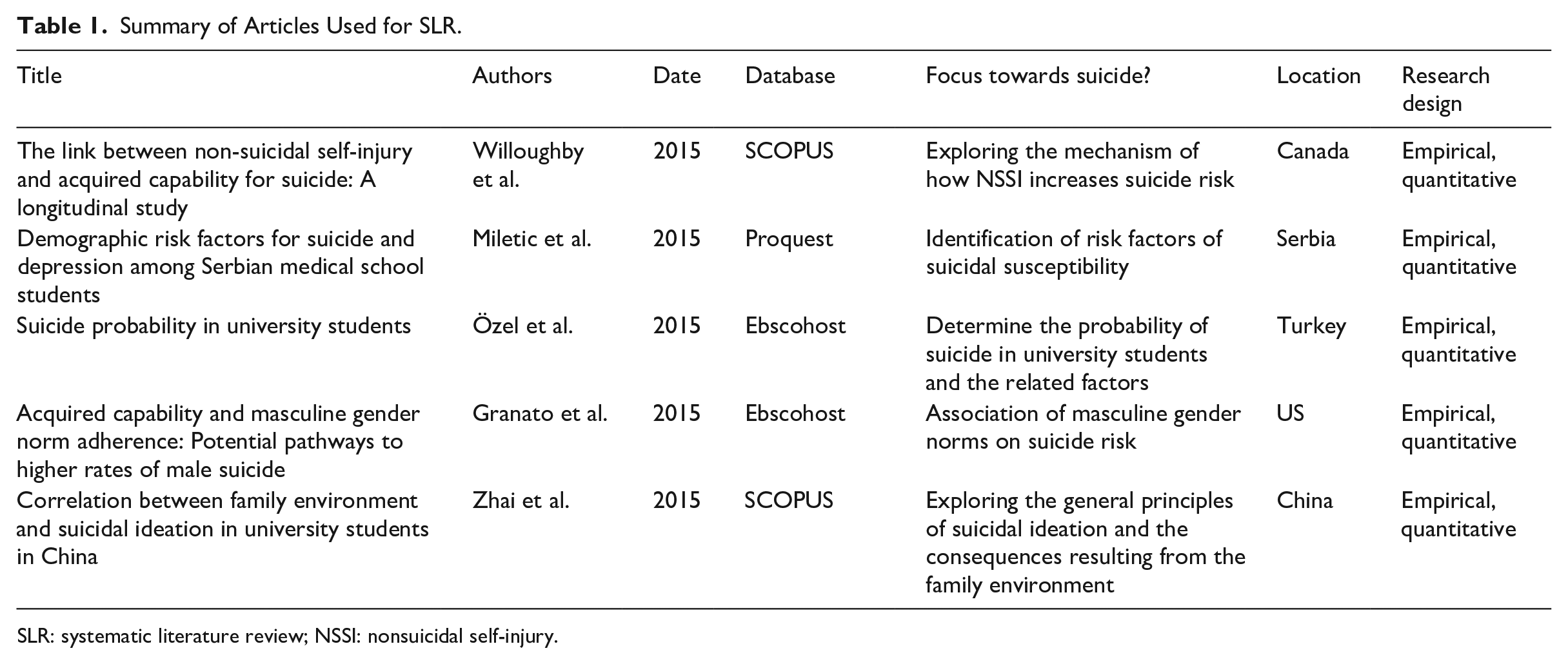
SLR: systematic literature review; NSSI: nonsuicidal self-injury.
Ethics
Articles obtained for analysis in the review were all available in the public domain; as a result, no special ethical considerations were required.
Results
Description of studies
Sixty publications that qualified for inclusion in this review were identified (see Figure 1). Most of the reviewed studies originated from the United States (n = 20), among other countries (see Table 1 for an extract for certain details of the review).

Systematic review search procedure flowchart.
Risk factors
Demographic features
Age emerged as one of the most prominent demographic features, especially the transition stage from school to university (Conley et al., 2014). Female students were more at risk for suicide attempts than male students (Bantjes et al., 2019; Hong et al., 2018; Loftis et al., 2019; Miletic et al., 2015; Sivertsen et al., 2019). However, Bantjes, Breet, Saal, Lochner, Roos, Taljaard, Mortier, Auerbach, Bruffaerts, Kessler, and Stein (2020) report a significantly lower likelihood of males seeking professional treatment than females, placing them at greater risk of suicide attempts. Black and minority group students were more likely to experience racial discrimination, which put them at risk (Bernanke et al., 2017; Cramer et al., 2017; de Albuquerque et al., 2019; Gnan et al., 2019). Furthermore, students from poor economic backgrounds (Grasdalsmoen et al., 2020; Miletic et al., 2015; Özel et al., 2015) and those with disabilities (Stradomska, 2019), obesity, and health-related problems appear to be more susceptible to suicide ideations and behaviours.
Mental health problems
Anxiety and depression comorbidities were identified as prominent mental health problems experienced by students (Lew et al., 2020; Mitsui et al., 2018; Russell et al., 2019; Taylor et al., 2020). These comorbidities were reported to be experienced as: feelings of helplessness and hopelessness (Akpinar Aslan et al., 2020; Bernanke et al., 2017; Reyes et al., 2015); loneliness/sense of disconnection (Chang et al., 2019); thwarted belongingness (Collins et al., 2018; Kwan et al., 2017; Lee et al., 2018); unbearable mental pain (Dhingra et al., 2019); sense of powerlessness in stressful events (de Albuquerque et al., 2019); psychological distress, emotional exhaustion, eating problems, and sleeping difficulties such as insomnia, nightmares, and sleep deprivation (Haghighi et al., 2018), fatigue (Rosiek et al., 2016); alexithymia; impulsivity; anhedonia; and low distress tolerance levels (Kratovic et al., 2020).
Often mental health problems resulted in maladaptive interpersonal behaviour, especially in the display of anger (Hollingsworth et al., 2018), affective dysregulation (Fang et al., 2019; Lew et al., 2020), and hostile reactions (Bruns & Letcher, 2018). Substance use was identified as a major cause of mental health problems further exacerbating student suicides. This included alcohol and the abuse of psychoactive drugs (Bernanke et al., 2017; Cramer et al., 2017; Dachew et al., 2018; Eskin et al., 2019; Kiani et al., 2019; Shagufta et al., 2019).
Negative thought trajectory
A negative thought trajectory was found to be a contributory risk factor for non-fatal student suicide behaviour or suicide attempts. This included reports of thoughts leading to low self-esteem (Taylor et al., 2020) and a negative self-concept (Gselamu & Ha, 2020). Factors contributing to the above-mentioned were decreased life satisfaction (Rosiek et al., 2016); low life purpose and meaning of life (Lew et al., 2020); sense of burdensomeness (Becker et al., 2020; Collins et al., 2018; Kwan et al., 2017; Park & Kim, 2019); rumination on their negative life experiences and environmental stressors (Akpinar Aslan et al., 2020; Hasking et al., 2019); and self-blame (Lew et al., 2020).
Negative and traumatic life events
Negative and traumatic life events exacerbated by lack of psychotherapy for depression and post-traumatic stress disorder (PTSD; Zeng et al., 2018) contributed heavily towards student suicide attempts and in some cases completion. Untreated adverse childhood psychological experiences, such as emotional, physical, sexual abuse, and neglect, often persisted into young adulthood (Kiani et al., 2019). In addition, students coming out of dysfunctional families due to parental separation/divorce, violence against mother and children, household substance abuse, household mental illness, incarceration of household member/s, parents who did not have stable jobs, or if their parents used improper parenting styles were all more prone to suicide attempts (Zhai et al., 2015). Contextualising to South Africa, Bantjes et al. (2019) also indicated that the oppression or exclusion of historically marginalised students is also a contributor to the negative life events exacerbating student suicides.
Sexual orientations
Students from the Lesbian, Gay, Bisexual, Transgender & Queer (LGBTQ) community reported being teased, mocked, and ridiculed due to their sexual orientations (Taylor et al., 2020). Many students raised concerns of stigmatisation and marginalisation on their campuses, especially when they were denied access to bathrooms or gender-appropriate campus housing (Seelman, 2016). These students reported being consistent victims of crime and their LBGTQ status inadvertently led to self-harm and mental health problems (Gnan et al., 2019).
Acquired capability of suicide
Four studies in the SLR were explicitly concerned about the acquired capability of suicide (ACS) among students (Becker et al., 2020; Granato et al., 2015; Willoughby et al., 2015; Zuromski & Witte, 2015). ACS is a condition in which students become increasingly fearless and insensitive to pain to the extent that ideas of suicide are no longer alarming to them. Several authors have noted that negative life experiences create an immunity in students to fear any physical pain, since the subjective reported emotional pain is more unbearable (Collins et al., 2018; de Albuquerque et al., 2019; Escobar-Padilla et al., 2019). Also, students who have a history of suicide attempts are more prone to ACS (Hasking et al., 2019; Kratovic et al., 2020; Mitsui et al., 2018; Rohani & Esmaeili, 2020; Shagufta et al., 2019).
Lack of social support
Research with students who attempted suicide noted social isolation (Grasdalsmoen et al., 2020), weak social ties, a lack of a sense of support (Stradomska, 2019), and insecure attachment styles (Rohani & Esmaeili, 2020) as contributory factors to suicidal ideations and attempts. Loss of anyone in their social support system, which they significantly depend on (Dachew et al., 2018; Eskin et al., 2019), reportedly escalated suicide attempts. In addition, a recent study also suggests that undergraduate students often do not seek formal treatment from a mental health professional, instead, preferring to access psychosocial support from friends, family, or via self-help (Bantjes et al., 2020). As such, when the psychosocial support is low, the risk of increased suicidal ideation and attempted behaviour increases (Dachew et al., 2018).
University stressors
Through the SLR several university stressors that posed a risk for suicide among students were identified, namely, the transition from school to university, planning their future, travelling, accommodation, finance for studies, entrance and admission requirements, ability to cope with academic work, the pressure to succeed, and health concerns of family members and themselves (Lew et al., 2020; Modi et al., 2017; Özel et al., 2015). Furthermore, they were stressed by competition, burnout, extreme workloads, personal life problems, lack of leisure time, bullying, and high expectations of self/others (Granato et al., 2015). Also, students reported feeling intimidated by university management and leaders as well as health care professionals in seeking help (Lipson et al., 2019) mainly because they had a low cultural and contextual understanding of students (Cramer et al., 2017; Eskin et al., 2019).
Protective factors
Substantial psychological, social, and behavioural factors inherent in university students were reported as protective factors. Psychological factors included the creation of a positive self-identity, self-compassion (Hasking et al., 2019), unified sense of self (Gnan et al., 2019), finding meaning and purpose in life (Hong et al., 2018), satisfaction with life (Taylor et al., 2020), and mindfulness (Fang et al., 2019). Furthermore, exposure to resilience and conflict management programmes reduced suicide rumination when experiencing difficulties (Bruns & Letcher, 2018; Kratovic et al., 2020; Mitsui et al., 2018). Any activities that enhanced students’ optimism, persistence (Mitsui et al., 2018), hope, plans for the future, reasons for living, emotional self-efficacy, and emotional stability inhibited suicide ideations and attempts (Bruns & Letcher, 2018; Zeng et al., 2018). Examples include physical activities, a set sleep and wake schedule, building of positive self-image, and healthy eating habits (Russell et al., 2019),
From a social perspective, students felt secure when they had strong positive relationships and support from family and friends (Zhai et al., 2015). Secure social attachments and interpersonal relationships were found to be a vehicle to veer students away from suicidal ideation and attempts (Rohani & Esmaeili, 2020).
Behavioural protective factors were observed in students’ focus on keeping their bodies and minds healthy. Students who were careful about eating healthy foods, getting enough sleep, exercising, and reading material that boosted their mental health reported less vulnerability to suicide ideation and attempts (Grasdalsmoen et al., 2020). Finally, students who actively educated themselves about suicide risks and protective factors were found to be less prone to attempting suicide (Stradomska, 2019).
Discussion
The SLR findings indicate that both risk and protective factors for student suicide are embedded in their psychological, social, and behavioural experiences. In fact, there is an overlap between the risk and protective factors because addressing the risk factors actually turn them into protective factors. Furthermore, the SLR insinuates that suicide risk is probably greater when students experience problems in multiple areas of functioning. As such, I do not discuss each risk and protective factor for student suicide identified in the SLR but chose to look at integrated strategies that harness both risk and protective factors through student support centres (SSCs), access to counselling support, university courses, and curricula – all supported by university leaders and management.
The first strategy is for all universities to design an SSC as an on-campus safe space that provides mental and physical health support for all students to address multiple areas of functioning identified in this SLR (Brailovskaia et al., 2020; Loftis et al., 2019). Agreeing with Bantjes (2020), campus-based interventions are needed to promote mental health care utilisation by students in South Africa, especially among Black students and those with non-heteronormative sexual orientations.
Currently, SSCs are existent at most universities but may differ in size and capacity as well as level of functionality. Some of them are limited in the support services provided for diverse students in terms of age, gender, race, ethnicity, socioeconomic status, dis (abilities), and sexual orientations. However, keeping Bantjes’ (2020) findings in sight, SSCs should create an environment that encourages professional mental health-seeking behaviour in students. As such, the SSCs should be accessible to students in terms of human, material, and physical resources. Its location should be in physically accessible spaces that are simultaneously away from university management to reduce a sense of intimidation for students. The SSC must have professional mental health staff who are able to deal with all the mental health problems and negative thought trajectories identified in this SLR. For example, individual and group counselling support should be provided for the treatment of depression, anxiety, stress, low self-esteem and self-confidence, and the many other psychosocial problems mentioned in this review. Particular focus could be placed on adverse childhood experiences, family problems, feelings of helplessness and hopelessness, and how all of these impact on student suicides (Kiani et al., 2019; Zeng et al., 2018). Infectious diseases such as HIV/AIDS and COVID-19 are likely to cause psychosocial problems for students and could result in an increase in suicide ideations and attempts. Supporting students with their psychological pain and feelings of hopelessness at the SSC is the first step advocated by the 3ST of suicide. I believe that there is a need for the SSC to function holistically integrating student wellness as an integral part of students’ daily lives (Cole, 2019). Strategies to destigmatise social stigma attached to accessing mental health services and making psychological safety a priority at universities should be endorsed in the action plans of SSCs (DePauw, 2017).
There should be specially designed programmes at SSCs to support vulnerable students identified in this SLR, such as students with disabilities, minority groups, and students affected by racism, sexism, classism, or their LGBTQ status (Gnan et al., 2019). Such programmes should address the attributes highlighted in the 3ST of suicide by establishing campus-based support groups that increase the social connections of students prone to suicide ideations.
Online self-help counselling resources via SKYPE, telephone, conference calls, and so on should be readily available at universities. Artificial intelligence (AI) can be useful in monitoring and supporting students with mental health challenges, for example, suicidal ideations could be detected by the sites that students visit to determine ways of ending their lives. This could easily be linked to service providers who could provide immediate support for students thinking of suicide through the necessary ethical protocols. Building these social connections and networks articulates what is advocated in step 2 of the 3ST of suicide. Online self-help may be useful for suicidal students who avoid the SSC because of social stigma and intimidation as noted in this SLR (Cole, 2019).
Universities must have courses and curricula that focus on broader mental health issues which encompass suicide. The courses and curriculum focusing on mental health should commence from first-year orientations and be embedded in undergraduate course work (de Albuquerque et al., 2019; Öztürk, 2018). This could vary in the form of classroom or online lectures and be followed by workshops and refresher courses on mental health. Exposure to such courses and curricular would open the possibility of students addressing their psychological pain from the first year of study which is strongly supported by step 1 of the 3ST of suicide.
The success of the mental health support interventions for students will depend on the support received from university leaders and management which was highlighted as a concern in this SLR. Leaders sharing their testimonies about their mental health challenges would assist students to destigmatise the need to reach out for help and develop a sense of connection with the leaders – another form of connection implicit in step 2 of the 3ST of suicide. Allocating human, material, physical, and financial resources for combatting mental health challenges of students and staff should be a priority of university leaders (Lipson et al., 2019).
In ending the discussion, I want to emphasise the importance of cultural competence that all mental health care workers should have as a prerequisite when they work with university students – this was noted under university stressors (Cramer et al., 2017). This study supports the advice by Eskin et al. (2019) whose study indicated a consistent need for cross-cultural training of mental health care providers at universities to meet the needs of a diverse group of students. According to the 3ST of suicide, cross-cultural competencies would provide an opportunity for health care providers to understand the pain and suffering of students from the students’ cultural frame of reference, increasing the possibility of building a stronger connection with students who are suicidal. A culture of taking suicide among university students seriously needs to be promoted, especially within the African context. Bantjes et al. (2019) highlighted the fact that student suicide is not taken seriously even though there is an escalation of this in South African universities. In addition, a culture is observed where male students may have a lower tendency of seeking help for suicidal ideations and attempts, holding on to the erroneous societal belief that only women should express their emotions (Doward, 2016). Reaching out to male students should be incorporated in all the campus-based strategies mentioned above (APA, 2005).
Conclusion
In terms of limitations, this SLR solely focused on peer-reviewed journal articles, as such findings could be affected by publication bias. Second, the quantitative studies were inconsistent in the research methodologies used, reducing the possibility of comparing the effect size in the presentation of the findings. Finally, the SLR was limited to 5 years from 2015 to 2020 due to the significant escalation of suicide among university students in recent years, acknowledging the possibility of different results emerging if the review was extended to a longer period. Despite the limitations, this SLR draws attention to a consolidated identification of risk and protective factors in combatting suicide among university students which were otherwise fragmented in individual studies. Furthermore, the review highlighted successful university-based support strategies to combat student suicide ideation through adopting a multilevel and multidisciplinary engagement. Finally, the study promotes using the 3ST as a conceptual framework in proposing future campus-based interventions for success. In conclusion, the risks, protective factors, and university-based support strategies to combat student suicide discussed in this SLR are most likely to have global value since there are universities and vulnerable students worldwide.
Footnotes
Declaration of conflicting interests
The author(s) declared no potential conflicts of interest with respect to the research, authorship, and/or publication of this article.
Funding
The author(s) disclosed receipt of the following financial support for the research, authorship, and/or publication of this article: This work is based on the research supported by the South African Research Chairs Initiative of the Department of Science and Innovation and the National Research Foundation of South Africa (Grant Number: 87300).
