




Abstract
The present study explored the effects of long working hours and low salary on public employees’ well-being indicators, such as job satisfaction, life satisfaction, and self-rated health. Results showed that having long working hours was not significantly and negatively related to public employee wellness, whereas having a higher salary was significantly and positively associated with employee well-being. Finally, the interaction effects of working hours and salary on job satisfaction and life satisfaction were not supported; however, the interaction effects of working hours and salary on self-rated health were found.
Introduction
Due to rapid industrialization, employees in South Korea have consistently suffered from long working hours. In 2004, South Korea passed legislation to regulate employees’ working hours to 40 hr a week to improve employees’ quality of life and to increase private firms’ competitiveness. Nonetheless, South Korea was ranked near the top for long working hours among the Organization for Economic Cooperation and Development (OECD; 2010) member countries. Furthermore, in recent years, there has been a series of local government social worker suicides due to psychological depression, resulting from long working hours in South Korea (Kim, 2013). These long working hours have caused serious social problems such as low quality of life and work–life imbalances (Lee et al., 2013).
Many prior studies have consistently reported that long hours spent working negatively affect employees’ well-being. For example, one meta-analysis reported that higher numbers of work hours are negatively associated with psychological well-being (Sparks, Cooper, Fried, & Shirom, 1997). Similarly, using a sample of private-sector employees, an empirical study also found that long work hours were positively and significantly related to employees’ depression through work and family role conflict (Major, Klein, & Ehrhart, 2002). Therefore, it seems difficult to deny that long working hours exacerbate employees’ well-being.
Nonetheless, few studies have explored the relationship between working hours and well-being outcomes in the field of public administration. We must be careful when generalizing the prior findings from private-sector employees into the sphere of public administration because the private and public sectors have different job characteristics and work environments (Rainey, 2009; Rainey & Bozeman, 2000). That is, the relationship between hours worked and well-being may be moderated by a different context (i.e., private vs. public sector).
Furthermore, most studies of the relationship between working hours and well-being have been predominantly conducted in Western countries such as Canada, the United Kingdom, and the United States. Moreover, prior findings may have the limitation of generalization because the relationship between number of working hours and well-being is significantly different at the international level (Spector et al., 2004). Thus, empirical studies done in non-Western countries may be helpful in understanding differences in the relationship at national levels.
Happy employees show higher levels of job performance than others (Wright & Cropanzano, 2000). Nonetheless, little attention has been paid to public employees’ well-being, and little is known about what exacerbates their wellness in the field of public administration. The current study examined public employees’ well-being particularly under the working conditions of lower salaries and longer working hours. It is important to uncover the causes of public employees’ stressors to protect their well-being. For example, if employees with low salary and long working hours show lower levels of well-being, their organizations should provide them with effective psychological treatment to enhance their wellness, leading to high job performance. Accordingly, the findings of the present research may shed light on how to protect public employees’ wellness.
Literature Review
The term well-being has been used within a variety of concepts in research. For example, Andrews and Withey (1976) described subjective well-being as including both a cognitive evaluation of and some degree of positive or negative feelings about a person’s life. It is also defined as the degree to which an individual evaluates the overall quality of his or her life (Veenhoven, 1988). The concept of well-being represents an ongoing state of psychological wellness (Diener, Suh, Lucas, & Smith, 1999). The present study more broadly defines well-being as individuals’ perceived overall quality of psychological wellness and healthiness because the concept of well-being should physically and psychologically be understood (Kaplan, Bush, & Berry, 1976; Ryff & Singer, 2001).
Several theoretical frameworks on employees’ stress have evolved to explain the importance of working environments. For example, the effort–reward imbalance (ERI) model claims that lack of reciprocity between efforts and rewards leads to poor health (Siegrist, 1996). ERI predicts that when employees have a strong desire to be approved and esteemed, they tend to pour all of their energy and time into their job, which leads to psychological and physical burnout (Peter et al., 1998). The ERI model also suggests that when employees perceive a high imbalance resulting from the lack of reciprocity between efforts and gains (i.e., high-effort, low-reward conditions), they experience higher levels of distress. The present study focused on two main occupational stressors—working hours and inadequate salary—and the interaction effects between the two.
Long Working Hours and Well-Being
Longer working hours are generally known to be negatively related to employees’ mental health (Spurgeon, Harrington, & Cooper, 1997; van der Hulst, 2003). Too many work demands make employees feel exhausted or burned out and exhaust their limited energy, resulting in poor health consequences (Maslach, Schaufeli, & Leiter, 2001; Valcour, 2007). Due to limited time and energy, people who have both work and family role involvement will inevitably experience role conflict (Greenhaus & Beutell, 1985). Moreover, when individuals perceive that they have insufficient time to accomplish their work and family role demands, they experience higher levels of role conflict, which leads to negative healthiness (Dugan, Matthews, & Barnes-Farrell, 2011).
In a similar vein, the conservation of resource (COR) theory (Hobfoll, 1989, 2011) fundamentally presumes that people have an inherent attitude to create, foster, conserve, and protect the quality and quantity of their resources. It further asserts that individuals experience stress when “there is (a) the threat of a net loss of resources, (b) the net loss of resources, or (c) a lack of resource gain following the investment of resources” (Hobfoll, 1989, p. 519). The theory tells us that stress occurs when environmental factors threaten individuals’ status, energy, position, basic beliefs, or self-esteem. In particular, resource loss is more salient than resource gain to individuals, and resource loss naturally brings about future loss with spiral cycles, resulting in negative emotions and impaired psychological well-being (Gorgievski & Hobfoll, 2008; Hobfoll, 2011).
Long working hours could be a stressor because they exhaust people’s limited energy (i.e., resource loss). When individuals experience insufficient time to accomplish all of their life activities, time may become a very valuable resource to them, and they perceive the situation as very stressful (Clarkberg & Moen, 2001). Employees feel the situation is stressful when they perceive themselves to be rushed by a deadline (Szollos, 2009). Furthermore, the working conditions are related to work and family role conflict because preoccupation with one’s role at work prevents participation in family roles, leading to negative health consequences (Carlson & Frone, 2003; Hughes & Parkes, 2007). Due to the lack of time resource, moreover, individuals may experience stress when they perceive difficulty with work–family role balancing, which they highly value (Mattingly & Bianchi, 2003). Accordingly, long working hours acerbate individuals’ well-being because they inevitably yield work and family role conflict as well as resource (i.e., energy) loss.
Similarly, having longer working hours negatively affects job and life satisfaction. Job satisfaction results from the comparison between what the job provides and what the employee needs, wants, or desires from the job (Edwards, 2008; Locke, 1976). For example, suppose that an employee actually works 50 hr per week but wants to work 40 hr per week. Working more hours negatively affects that employee’s satisfaction with his or her job due to the gap between the employee’s desire and the job’s requirement. Likewise, life satisfaction is a function of satisfaction with life domains (Erdogan, Bauer, Truxillo, & Mansfield, 2012). When individuals frequently have longer working hours than desired, they cannot enjoy life activities, resulting in lower satisfaction in the life domain (Clarkberg & Moen, 2001).
Ample evidence exists to support the belief that having longer working hours negatively affects employees’ well-being. For example, a longitudinal study of 25,703 full-time public employees in Finland found that total working hours were positively associated with higher rates of medically certified absences (i.e., more than 3 days absent; Ala-Mursula et al., 2006). A meta-analysis study also reported that long working hours negatively affect employees’ well-being (Ng & Feldman, 2008). Therefore, in this study, it was expected that having longer working hours would be significantly and negatively related to well-being, leading to the first hypothesis:
Inadequate Salary and Well-Being
Monetary rewards have a multidimensional construct associated with four important symbolic attributes: (a) achievement and recognition, (b) status and respect, (c) freedom and control, and (d) power (Mitchell & Mickel, 1999). For example, recognition for their contributions via monetary rewards may motivate people by increasing their self-esteem and their belief that their contributions are valuable and appreciated. Therefore, monetary reward does not simply mean an exchange for employees’ work.
Many scholars (e.g., Deci, 1971; Gardner, Van Dyne, & Pierce, 2004) have consistently indicated that pay level signals how much the organization values an employee, and it crucially affects employees’ self-esteem. Furthermore, employees may have an impression of insufficient financial rewards when they do not receive a salary or benefits commensurate with their achievements, and this lack of reward is closely associated with feelings of loss (Maslach et al., 2001).
The COR theory (Hobfoll, 1989, 2011) presumes that individuals seek to gain and maintain resources (e.g., feeling of mastery, self-esteem, socioeconomic status, etc.) to avoid stressful experiences. The theory also asserts that people feel stress when they perceive a threat to the resources that they value. Consequently, an inadequate salary can be a stressor, particularly when employees place a high value on monetary rewards and feel that the rewards they are receiving are inadequate, which in turn signals a threat to their self-esteem or socioeconomic status. As a result, employees may feel stressed by inadequate salary, resulting in negative health consequences.
Furthermore, life satisfaction occurs in response to a cognitive comparison between current conditions and expected ones (Diener et al., 1999). That is, people may experience a feeling of loss when they perceive that their income level is relatively lower than that of others, which in turn negatively affects their life satisfaction. Similarly, employee satisfaction with a job is associated with the comparison between what the job provides and what the employee wants from his or her job (Locke, 1976). Employees may desire a particular level of salary but actually receive a salary lower than their expectation. This inadequate salary then negatively affects job and life satisfaction because their needs or wants (e.g., being more rewarded) are not satisfied.
There is strong evidence that inadequate salary is negatively related to well-being. Empirical research reported that with a large sample of the U.S. and European countries, for instance, a higher income positively and slightly affected individual happiness (Oswald, 1997). Likewise, it was found that a higher income was negatively related to subjective well-being (Cummins, 2000). Moreover, another study found that when individuals had lower income than the reference group, they showed lower well-being (Ferrer-i-Carbonell, 2005). As such, this current study hypothesized that having a lower salary would be negatively and significantly associated with well-being.
Interaction Effects of Longer Working Hours and Inadequate Salary on Well-Being
The ERI model, developed in the discipline of psychology and recently applied to organizational behavior, suggests that when employees perceive a high imbalance resulting from the lack of reciprocity between efforts and gains (i.e., high-effort and low-reward conditions), they experience high levels of stress, resulting in poor health consequences (Siegrist, 1996, 2005). Furthermore, the theory maintains that both the low-reward and high-effort working conditions yield a synergy effect, acerbating employee wellness. The interaction assumption of the working conditions is the most central hypothesis in the model as it argues that the lack of reciprocity with the working conditions of high efforts and low rewards significantly exacerbates employees’ wellness (van Vegchel, de Jonge, Bosma, & Schaufeli, 2005).
Siegrist and Peter (1996) operationalized the term interaction as a relative excess term to examine the interaction effects of high efforts and low rewards. That is, they assumed that most strain would result from a ratio of high effort to low reward. They posited that rewards would influence the relation between effort and strain considerably when rewards were low; in contrast, when rewards were high, the amount of strain would merely be determined by efforts. However, an empirical study by van Vegchel, de Jonge, and Landsbergis (2005) thoroughly examined the interaction effects and reported that the multiplicative interaction term yielded consistent and significant interaction effects. Thus, the multiplicative terms were used to test the interaction effects in this research, believing that the interaction of longer working hours (i.e., high efforts) with lower salary (i.e., low reward) conditions would negatively affect employees’ healthiness.
Furthermore, the interaction of high-effort and low-reward conditions also negatively affects job and life satisfaction. As stated above, employees are satisfied with their job when it provides what they really want or need (Edwards, 2008; Locke, 1976). For example, suppose that an employee is not promoted (i.e., lack of reward) even though he or she really has worked more hours (i.e., high effort) than others to achieve career success. Under the circumstances, he or she may show lower job satisfaction than others because the job did not provide what the employee really wanted: a promotion. Moreover, individuals show higher life satisfaction when they have enough time to participate in leisure activities (Mattingly & Bianchi, 2003). Accordingly, long working hours may negatively affect life satisfaction by dramatically reducing time for leisure activities, and employees’ life satisfaction may drop even further if they perceive inadequate rewards from their organization. In fact, one empirical study reported that employees who had overtime working hours with low reward showed lower levels of mental health (van der Hulst & Geurts, 2001). Therefore, we can expect that both lower salary and longer working conditions negatively affect employees’ job and life satisfaction as well as their healthiness.
Method
Research Design and Samples
Panel research design has repeated measurements at different times on the same individual unit, such as a person, firm, state, or country (Cameron & Trivedi, 2010). For example, when a family has consistently responded to the same question about family income each year over a period of time, then longitudinal data about the family income are produced. These types of data particularly allow researchers to make causal inferences, depict the patterns of change of one variable over the time period, and deal with the heterogeneity bias that occurs when unobserved factors are highly correlated with independent variables and residuals (Halaby, 2004, 2006). Accordingly, this present study used the Korea Labor & Income Panel Study (KLIPS) dataset, which has been used by other studies as well (e.g., Khang, 2006; Ryu, 2014), to embrace the strengths of panel design.
The KLIPS uses a multi-level cluster-random sampling frame for nationally representative samples. Specifically, 3,773 of the 5,000 households initially selected from the sampling framework successfully responded to the panel survey in the first year of the survey (75% response rate). Although the KLIPS dataset has been collected since 1998, the current study used a dataset of 6 years (i.e., six waves) because the measurement for well-being was collected in different years: Life satisfaction has been examined since 1998 (i.e., the first wave), job satisfaction has been collected since 2002 (i.e., the fifth wave), and self-rated health has been measured since 2003 (i.e., the six wave). Hence, panel waves from Wave 6 to 11 (i.e., 2003-2008) over 6 years were used for empirical analysis.
There are two types of panel datasets: a balanced panel and an unbalanced panel (Cameron & Trivedi, 2010). In a balanced panel dataset, each individual completes the repeated survey, whereas in an unbalanced panel dataset, some people complete the repeated survey but some do not because, for example, they moved to a new place. In this research, only a balanced panel dataset was used to analyze the research hypotheses—after excluding the unbalanced panel data from the original dataset—because it is generally accepted in economics and management disciplines. As a result, 186 public employees were selected for the analysis (total N = 1,116 [186 × 6 year]).
The sample ranged in age from 24 to 60 years, with a mean of 41.95 years. About 33% of the respondents were women, and 47% of respondents had a 4-year college education or higher, whereas 24.5% had a high school education. Finally, participants reported a mean of 47.41 working hours per week, with a salary of about 2,745,000 Korean Won (≈US$2,400) per month.
Measurements
Working hours
The survey directly asked about respondents’ working hours and overtime working hours per week via open-ended questions. Total working hours per week were calculated by adding the above two responses.
Monthly salary
Monthly salary was measured by the following open-ended question: “What is your salary per month?”
Job satisfaction
The five-item scale developed by Brayfield and Rothe (1951) was used to measure job satisfaction. The five items were (1) “I feel fairly well satisfied with my present job,” (2) “Most days I am enthusiastic about my work,” (3) “I find real enjoyment in my work,” (4) “I hope to continue my job in the future,” and (5) “My job is rewarding.” Survey respondents rated the items using a 5-point Likert-type scale (1 = strongly disagree, 5 = strongly agree; Cronbach’s α = .956).
Life satisfaction
Life satisfaction was measured via four survey items that asked respondents how much they were satisfied with (a) residential environments, (b) family, (c) close relatives and friends, and (d) social relationships. Survey participants responded on a 5-point Likert-type scale (1 = strongly agree, 5 = strongly disagree), and the responses were reversely recoded for easy interpretation (Cronbach’s α = .880).
Self-rated health
This variable was measured by two questions. One survey item was adopted from the Rand 36-item health survey (Hays, Sherbourne, & Mazel, 1993) and asked the following: “Would you say that in general your current health is . . . ” The second item was adopted from Mossey and Shapiro’s (1982) work as follows: “For your age would you say, in general, your health is . . . ” Survey respondents rated their health status from 1 for very good to 5 for very poor. In this study, for easy interpretation, the survey responses were reversely recoded, with 1 for very poor and 5 for very good (Cronbach’s α = .957).
Control variables
In the current study, sex, age, and educational levels were controlled because individuals’ characteristics moderate the relationship between working hours and well-being (Pereira & Coelho, 2013). Sex was measured directly by one open-ended survey item asking “What is your sex?” The responses were recoded as 1 for woman and 0 for man. Next, age was directly measured by asking survey participants “How old are you?” Finally, educational levels were assessed by one survey item—“What is your educational attainment?”—which was measured with a 9-point Likert-type scale from 1 for no education to 9 for PhD degree.
Analysis
As noted above, the KLIPS dataset uses a panel research design. For the panel research design, there are many estimators, such as pooled ordinary least squares (OLS), generalized least square (GLS), between estimator, fixed-effects model (within estimator), and random-effects model (Maddala & Lahiri, 2007). The traditional OLS estimator is generally known to be biased because residuals at the individual level tend to be correlated with each other (Cameron & Trivedi, 2010). Fixed-effects and random-effects models are generally recommended, particularly for unobserved heterogeneity; heterogeneity bias occurs depending on how much unobserved difference at the individual level (e.g., personal traits) is correlated with independent variables (Hausman & Taylor, 1981).
To test the research hypotheses, the random-effects model was used because the fixed-effects model could not estimate the effect of time-invariant variables, such as sex, on the dependent variables. Furthermore, the random-effects model is very powerful for generalizing findings to a population (Maddala & Lahiri, 2007). The XTREG command in STATA version 12.0 was used for the random-effects modeling and analysis of the samples.
Results
In panel research design, there are two types of variance: between and within variance of a particular variable. For example, individuals’ survey responses on job satisfaction over the 6 years examined in this study are called within-individual variances. In contrast, between-individual variance refers to the variance between individuals over the 6 years. Generating mean values within individuals over the 6 years would eliminate time dimensions of a variable over the 6 years. Mean values aggregated within individuals over the 6 years were used only for the confirmatory factor analysis and correlation analysis because individuals’ responses tended to be highly correlated with each other over the 6 years (Cameron & Trivedi, 2010).
As noted above, the dependent variable in this study was employee well-being, which consisted of three sub-concepts: (a) job satisfaction, (b) life satisfaction, and (c) self-rated health. Confirmatory factor analysis was conducted to determine the construct validity of the three measurements of job satisfaction, life satisfaction, and self-rated health. As shown in Table 1, a three-factor model was supported by the analysis (
Model Fit Results for Confirmatory Factor Analysis.

Note. Total N = 186. RMSEA = root mean square error of approximation; CFI = comparative fit index; TLI = Tucker–Lewis index; JS = job satisfaction; LS = life satisfaction; SH = self-rated health.
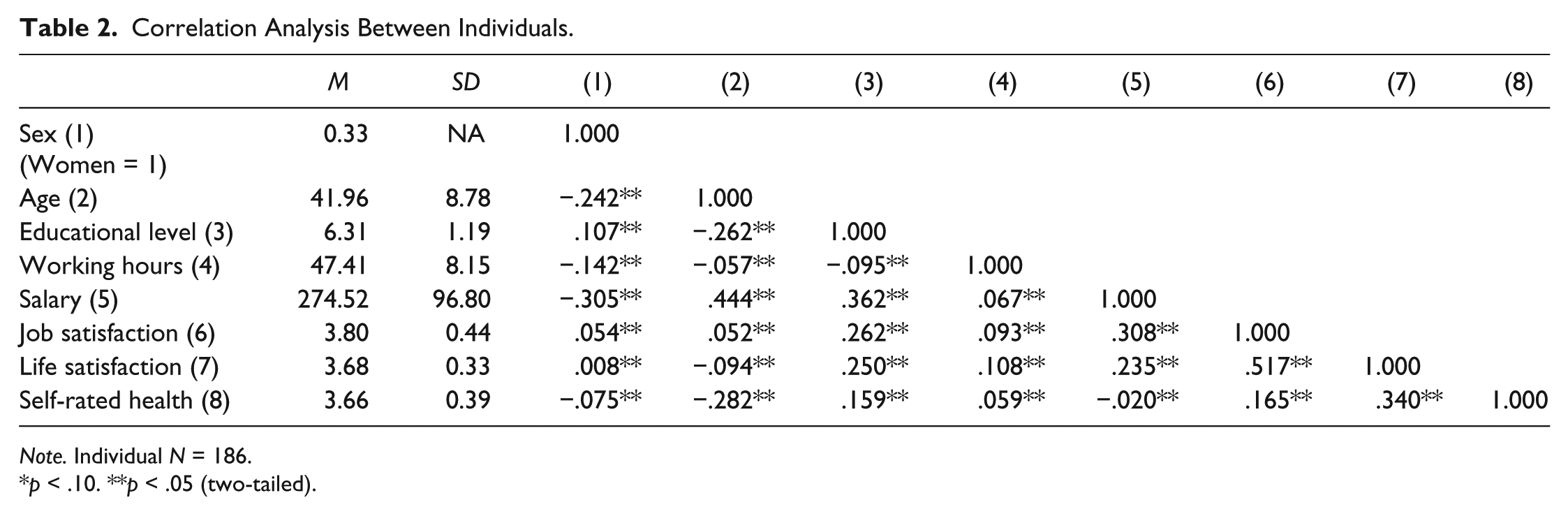
Table 2 shows the means, standard deviation, and bivariate correlations between the variables. For the control variables, being female was positively and significantly associated with job satisfaction (r = .054, p < .05) and life satisfaction (r = .008, p < .05) but negatively associated with self-rated health (r = −.075, p < .05). Being older was positively related to job satisfaction (r = .052, p < .05) but negatively associated with life satisfaction (r = −.094, p < .05) and self-rated health (r = −.282, p < .05). As expected, higher educational level was positively and significantly associated with all well-being indicators (p < .05).
Correlation Analysis Between Individuals.
Note. Individual N = 186.
p < .10. **p < .05 (two-tailed).
Interestingly, having longer working hours was positively associated with all well-being indicators and ranged from 0.059 to 0.108 (p < .05). Having a higher salary level was significantly and positively associated with job satisfaction (r = .308, p < .05) and life satisfaction (r = .235, p < .05) but negatively related to self-rated health (r = −.020, p < .05). For the dependent variables, job satisfaction was more correlated with life satisfaction (r = .517, p < .05) than self-rated health (r = .165, p < .05).
Before analyzing the samples, the data were screened for outliers. No outliers were identified using Cook’s D. Moreover, variance influence factor (VIF) values indicated low multicollinearity problems; the highest VIF value was 1.62 for educational level. Autocorrelation concerns could be raised because the dataset had a longitudinal property. Thus, Durbin–Watson and Baltagi and Wu’s statistics were examined, and no serious autocorrelation problems were found; Durbin–Watson statistics ranged from 1.76 to 1.83, and Baltagi and Wu statistics ranged from 2.12 to 2.19.
Log likelihood ratio (LR) tests revealed statistically significant model improvements for time effects over 6 years:
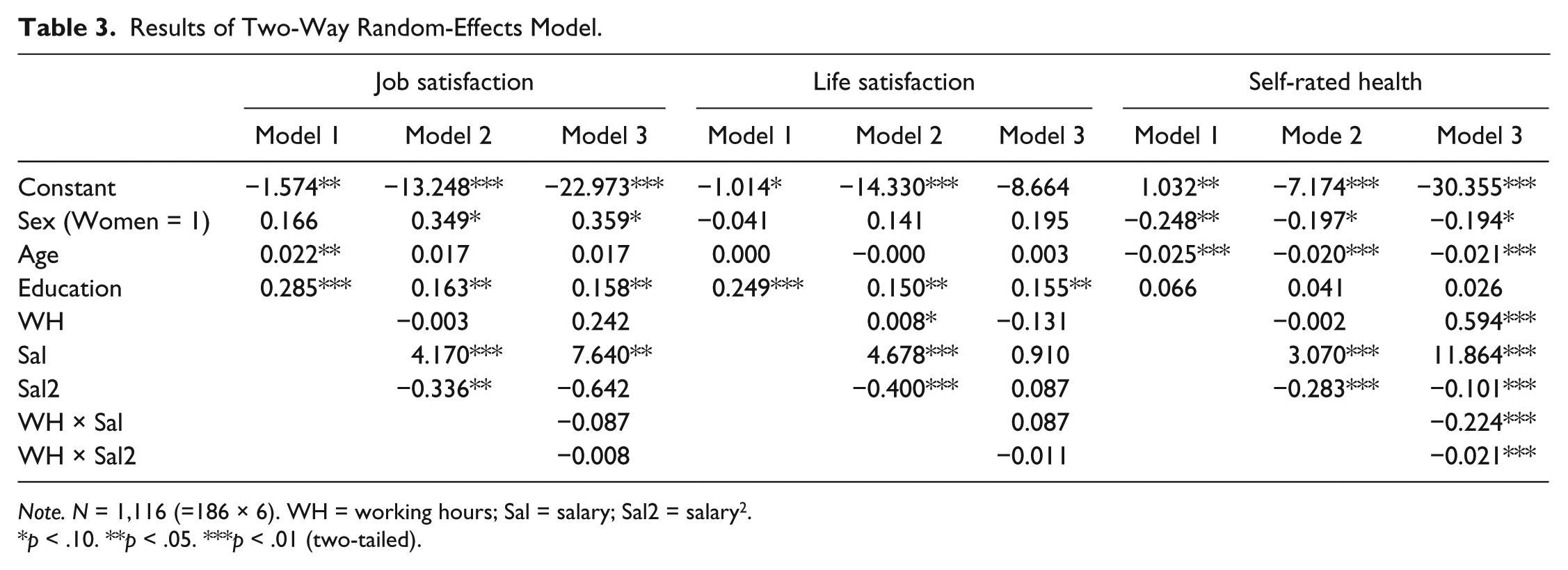
Table 3 presents the results of the two-way random-effects models. Model 1 considered only the direct relationship of the control variables with the well-being indicators, Model 2 included the linear relationship of working hours with the dependent variables and curved-linear relationships of monthly salary with the well-being indicators, and Model 3 examined the two-way interaction of salary and working hours on the well-being indicators.
Results of Two-Way Random-Effects Model.
Note. N = 1,116 (=186 × 6). WH = working hours; Sal = salary; Sal2 = salary2.
p < .10. **p < .05. ***p < .01 (two-tailed).
Hypothesis 1 predicted that having longer working hours would be significantly and negatively related to well-being. As shown in Model 2 in Table 3, however, it was not significantly related to job satisfaction and self-rated health. Unexpectedly, it instead positively affected life satisfaction. Thus, Hypothesis 1 was fully rejected.
Second, Hypothesis 2 posited that having a higher salary would significantly and positively affect employees’ well-being. It was significantly related to all the well-being indicators but showed a reverse U-shaped relationship with the well-being indicators. Hypothesis 2 was fully accepted.
Finally, Hypothesis 3 expected that having a lower salary and longer working hours would jointly and negatively affect employees’ wellness. Because higher salary showed a reverse U-shaped relationship with the well-being indicators, two interaction variables—in this case, Working hours (WH) × Salary (Sal) and WH × Sal2—were needed. Thus, Wald’s chi-square tests were used to determine the joint significance of salary and working hours on individuals’ well-being. Results showed that the two interaction terms of WH × Sal and WH × Sal2 were not jointly significant for job satisfaction (
When interpreting the interactional effects on dependent variables, it is very difficult to understand the relationship between interaction variables and dependent variables. Thus, many scholars have tried to visualize the relationship, showing the different coefficients between two different groups. It is possible to use the traditional visualization of the interaction effects, but the ERI model has the fundamental assumption that when employees have high-efforts but low-reward conditions, they suffer from higher levels of distress. Accordingly, this research used contour plots to explore the theoretical belief because the technique allows for showing a three-dimensional relationship between three variables (i.e., x, y, and z) on a two-dimensional space, x and y (Dupont & Plummer, 2005).
In this study, if the ERI model were supported, then the upper left corner of the contour plot shown in Figure 1 would show the lowest levels of job satisfaction, life satisfaction, and self-rated health because the model predicted that people with high efforts (i.e., longer working hours) and low rewards (lower salary) would have the lowest levels of well-being. As illustrated in Figure 1, the upper left corner of the figure is in fact dark blue, which indicates the lowest levels of self-rated health. In contrast, people with a higher salary and shorter working hour conditions had the highest levels of self-rated health (i.e., indicated by the red color in Figure 1). Accordingly, the results of the contour plot supported the theoretical argument that people who have an imbalance such as higher working hours and lower salary conditions experience adverse health effects.
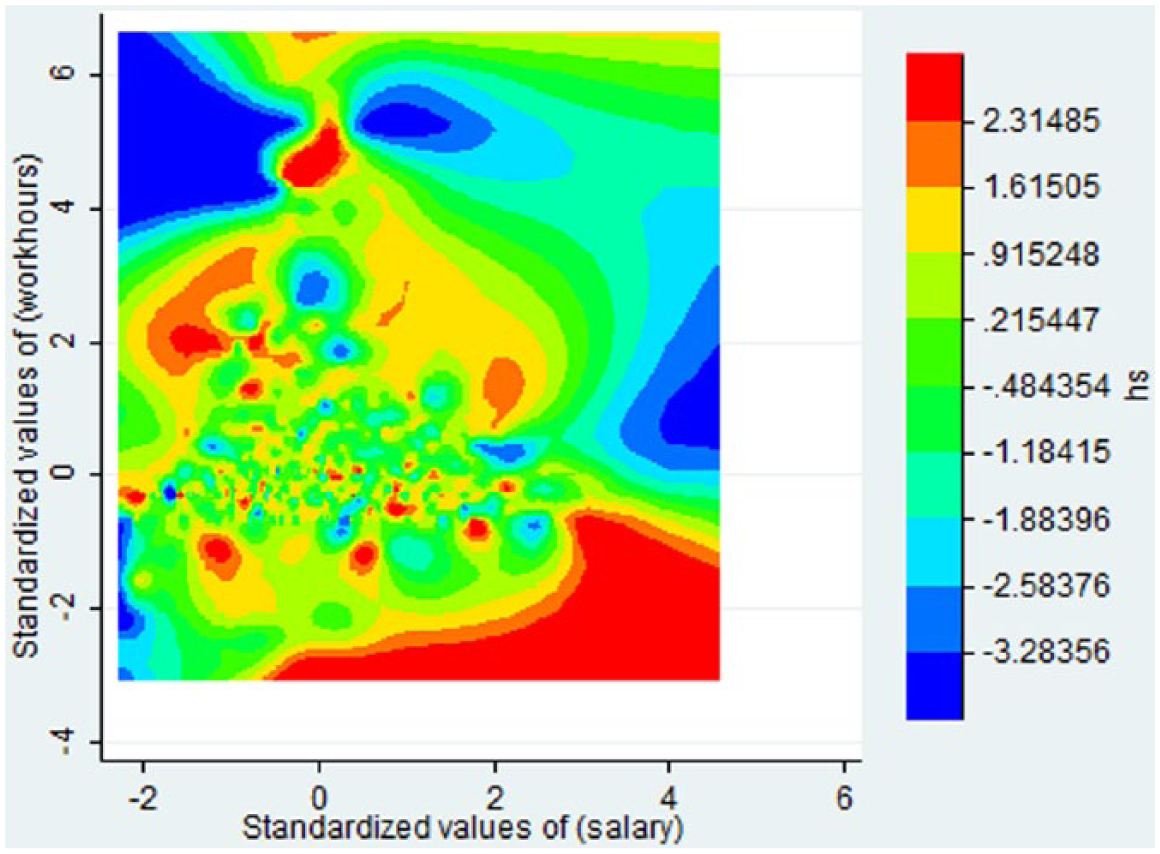
Result of contour plot for the effects of working hours and salary on self-rated health (Color version is available online).
Discussion
This research explored the effects of working hours and salary on public employees’ well-being. First, it was expected that having longer working hours would be significantly and positively associated with public employees’ wellness. However, the present study found that having longer working hours was not significantly associated with public employees’ wellness, which is not consistent with prior findings (e.g., Ala-Mursula et al., 2006; van Vegchel, de Jonge, Meijer, & Hamers, 2001). Furthermore, this finding was inconsistent with Lee and colleagues’ (2013) finding that long working hours significantly and negatively affected Korean employees working in the manufacturing industry.
There are three possible reasons for the rejection of Hypothesis 1. First, individuals who perceive that they work more hours than they prefer are more likely to feel overworked, which in turn leads to poorer health consequences (Barnett, Gareis, & Brennan, 1999; Galinsky, Kim, & Bond, 2001). Accordingly, perceived levels of working hours may be more significantly related to well-being consequences than actual working hours are. Second, one empirical study reported that public employees, who are highly motived to work in public service, place less value on working fewer hours than their private-sector counterparts (Houston, 2000). The different samples, thus, may have led to the different finding. Finally, there seems to be the possibility of reverse causality between working hours and well-being because employees who are satisfied with their job and life may be more likely to work more hours.
Second, the current study expected that having a higher salary would positively affect employees’ well-being due to the COR theory (Hobfoll, 1989, 2011), which argues that employees experience high stress when they have inadequate resources (e.g., salary). As expected, this study found that the higher salary public employees have, the better well-being consequences they have, which is consistent with prior findings by Conger, Rueter, and Elder (1999) and Rantakeisu and Jönsson (2003). In particular, this research also supported a reversely U-shaped relationship between salary and well-being (Wang, Pan, & Luo, 2015).
Finally, it was hypothesized based on the ERI model (Siegrist, 1996, 2005) that public employees who had a lower salary and longer working conditions would be more likely to experience stress than others. However, the interaction effects of working hours and salary on public employees’ job and life satisfaction were not found, although the interaction effects on self-rated health were found. Accordingly, this finding may indicate that working conditions are more closely related to individual healthiness rather than psychological satisfaction dimensions. In summary, the research partially supported the presumptions of the ERI model (Siegrist, 1996, 2005).
Theoretical and Practical Implications
This study has several theoretical implications. First, the ERI model asserts that when individuals have working conditions involving high efforts and low rewards, they experience poor subjective health. This research partially supported this basic assumption, which may imply that regardless of longer working hours and lower salary, employees’ distress levels may depend on the cognitive appraisal process (Lazarus & Folkman, 1984). Theoretically, when people perceive an imbalance between actual and preferred states of rewards based on their efforts, they may feel the working conditions are stressful. Therefore, future research should take into account the appraisal process as a mediator between working conditions and well-being.
Second, gender may moderate the relationship between working hours and public employees’ well-being consequences. Social role theory (Eagly, 1999; Eagly, Wood, & Diekman, 2000) presumes that social structure shapes individuals’ gender role, and as a result, men and women have different role salience: The work role is more central to men’s identity, whereas the family role is more essential to women’s identity (Cinamon & Rich, 2002). Because women have higher role salience with family caregiving at home, high working hours at work may more negatively affect women’s well-being than men’s. Thus, a future study should consider gender as an important moderator for the relationship between working hours and well-being consequences.
This research offers practical insight into how to enhance employee well-being. In the contour plots, first, public employees with lower salaries and longer working hours displayed the lowest level of healthiness. Public managers should pay particular attention to employees who have longer working hours and lower salaries and provide them with treatments to reduce their distress and activate their energy. Moreover, managers need to provide psychological supports to employees under these working conditions because leaders’ psychological supports (e.g., asking about subordinates’ personal problems and trying to help solve them, or showing personal concern for subordinates) have been shown to significantly decrease subordinate stresses (Cohen & Wills, 1995).
Public employees themselves also try to actively cope with their stress. There are two types of coping strategies to reduce individuals’ stress levels: problem-focused coping and emotion-focused coping (Taylor & Aspinwall, 1996). When employees have work- or family-related problems, they use problem-focused coping. In contrast, they rely on emotion-focused coping when they have a physically stress-related problem (Folkman, 1984). Because it is not easy to increase their salary levels or decrease their hours of working (i.e., their situation is not changeable), employees have to rely on emotion-focused coping strategies (e.g., emphasizing the positive side of the working situation) to reduce their stress (Vitaliano, DeWolfe, Maiuro, Russo, & Katon, 1990).
Strengths and Weaknesses of the Research
This study has several limitations that should be acknowledged. First of all, the findings may have external validity issues because the sample was from a single country: South Korea. Wharton and Blair-Loy (2006) reported that managers and other professionals in Hong Kong are more concerned with working hours than their counterparts in Western countries, such as the United States and the United Kingdom, because the national culture places a high value on family caregiving. South Korea has a similar national culture that places a high value on family in that, for example, South Korea has large family-owned companies, or chaebol, such as Samsung, Hyundai, and so on (Shim, 2006). Given that the different national-level culture may moderate the relationship between occupational stressors and employee well-being (Spector et al., 2002; Wharton & Blair-Loy, 2006); researchers should be careful in generalizing these findings.
This study may be susceptible to a common method bias because self-reported measurements such as job satisfaction and self-rated health were used, inflating correlations among variables (Campbell & Fiske, 1959). However, the research findings may suffer less from the bias than expected, not only because there have been empirical studies to support that the common method bias may be trivial (Spector, 1987) but also because the result of confirmatory factor analysis supported the reliability of the measurements. Finally, the measurement for life satisfaction in the current study may be weak because there have been reliable instruments for life satisfaction, such as the satisfaction with life scale developed by Diener and colleagues (Diener et al., 1985), which is strongly recommended in future research.
The limitations of this study are countered by some important strengths. First, the current study used a panel research design, which has a strength in dealing with heterogeneity issues, thus producing more reliable results (Halaby, 2004, 2006). Second, many prior studies have consistently measured people’s well-being by focusing on one dimension, such as subjective well-being, quality of life, health, and so on. However, the concept of well-being should be understood as a broader concept to include psychological happiness and healthiness (Kaplan et al., 1976). Accordingly, the current study is strong in its measurement of well-being because the concept of well-being was assessed via satisfaction with job and life domains as well as healthiness.
Footnotes
Declaration of Conflicting Interests
The author(s) declared no potential conflicts of interest with respect to the research, authorship, and/or publication of this article.
Funding
The author(s) received no financial support for the research, authorship, and/or publication of this article.