



Abstract
The wounded healer archetype predicts that people who suffer negative experiences in childhood would be motivated to enter helping fields as a way of self-healing. Developmental traumatology, however, suggests that people who have negative experiences in childhood may have their development stunted, particularly when it comes to caring for others. To test these competing theories, researchers test the effect of adverse childhood experiences (ACEs) on public service motivation (PSM) and find negative experiences in childhood are associated with a lower willingness to help others. However, some evidence suggests that a curvilinear relationship exists such that extreme levels of ACEs result in more PSM.
Public service motivation (PSM) has received much attention in academia. This may be owing to PSM’s “international, multidisciplinary, and multisectored” nature (Ritz, Brewer, & Neumann, 2016, p. 1). This area of research has grown considerably since the 1990s. “Scholarly work on public service motivation has blossomed, attracting scholars from all around the globe” (Pandey, Pandey, Breslin, & Broadus, 2017, p. 314). PSM has also been shown to have implications in not only the public sector (Gould-Williams, 2016) but the business (Battaglio & French, 2016) and nonprofit (Bright, 2016; Clerkin & Fotheringham, 2017; Houston, 2006) sectors as well.
Those individuals with high levels of PSM are defined as having “common focus on motives and action in the public domain that are intended to do good for others and shape the well-being of society” (Perry & Hondeghem, 2008, p. 3). They also value social rewards more than monetary rewards (Dilulio, 1994; Jurkiewicz, Massey, & Brown, 1998) and may be motivated into specific kinds of employment (Bright, 2016; Word & Carpenter, 2013).
While several studies have explored correlations between PSM and other factors, these studies have looked at PSM as an independent variable seeking to explain something else (Bright, 2016; Gould-Williams, Mostafa, & Bottomley, 2013; Word & Carpenter, 2013). Such studies do not, however, shed any light on what leads to higher levels of PSM. Currently, little is known about the underlying causes of PSM. There is a growing call to rectify this deficiency. Wright and Grant (2010) spoke to the need for a deeper understanding of PSM by determining if it is a cause or effect. They highlighted the fact that there is uncertainty if PSM is the cause or consequence of employee job decisions. In their critique of PSM, Bozeman and Su (2015) stated, “One charge against PSM research is that it has often been used as an independent variable, but much less often have researchers examined PSM as a dependent variable or, related, the causal mechanics leading to PSM” (p. 705). Despite these critiques, there has been some movement in that direction (Perry, 1997; Vandenabeele, 2010).
Interestingly, in the field of therapy, there is evidence that negative childhood experiences can unconsciously motivate someone to enter helping fields (Barnett, 2007), and that such events may better prepare people to help others because people heal through their own brokenness. This idea is the basis for the wounded healer archetype (Groesbeck, 1975). If the wounded healer is real, then negative childhood experiences would result in higher levels of PSM, and negative childhood experiences would thus be a predictor of PSM.
This research will test the idea of the wounded healer as it relates to PSM. Specifically, do adverse childhood experiences (ACEs) result in higher levels of PSM? The main contribution of this research relates to PSM theory. Better understanding the factors that precede or result in PSM can lead to a better understanding of the theory, thus answering the calls of Wright and Grant (2010) and Bozeman and Su (2015) to explore the determinants of PSM.
In this article, background information regarding PSM and ACEs is first presented. Then the first hypothesis, which is grounded in the wounded healer theory, is explained. In addition, a second and competing hypothesis, which is grounded in developmental traumatology, is also offered. Subsequently, the method, results, and discussion are presented. Finally, the conclusion and future research ideas are presented.
Theoretical Background
PSM
PSM is not a new concept and some have argued that it is one of the most important theories within public administration: One bellwether for assessing the foundation of a scientific discipline is its ability to produce original insights that are relevant both within and beyond the discipline. Public service motivation is one of the few scholarly developments in the field of public administration that may be substantial enough to meet this criterion. (Ritz et al., 2016, pp. 114-15)
The basic premise is that employees serving in the public sector are motivated, at least in part, by service to others (Perry & Hondeghem, 2008), more so than the generally profit-driven motives of their private (for-profit) counterparts (Dilulio, 1994; Jurkiewicz et al., 1998). Thus, public sector employees derive at least part of their compensation from emotional satisfaction of serving others.
PSM is rooted in motivational theory from the 1940s which seeks to determine why people behave in particular ways or make specific choices (Parsons, 1940). PSM theory took a significant step forward when Perry (1996) developed a quantitative measure based on 28 questions. These questions could be categorized into four primary dimensions. The first dimension, an attraction to public policy making, is motivated by a desire to be associated with a particular program. The second dimension, commitment to the public interest and civic duty, is rooted in patriotism or a sense of duty to one’s community. The third dimension, compassion, is an emotional decision based on one’s morals. The fourth dimension, self-sacrifice, is similar to compassion but focuses on the individual recognizing what they give up in pursuit of public service.
The ability to measure PSM allowed for a more systematic way to research the topic and has been commonly used in research. For example, Jacobson (2011) sought to evaluate practical implications of PSM and found that organizations can help to develop and frame employees’ PSM. Vandenabeele (2009) used a survey of Flemish state civil servants and found that job satisfaction and commitment to one’s organization had a significant impact on one’s PSM. Furthermore, Paarlberg and Lavigna (2010) found that leadership style was a strong indicator for levels of PSM within employee groups.
It is common in research to use PSM as an independent variable to see what correlates with PSM. Bright (2016) found that those with higher levels of PSM preferred careers in the nonprofit sector. Word and Carpenter (2013) found similar results. Also, Gould-Williams et al. (2013) found that PSM positively affects person–organization fit, which leads to improved organizational citizenship behavior and reduced quit intentions.
However, while most studies have looked to see what PSM can explain, others have called to see what explains PSM. Wright and Grant (2010) argued for the need to determine if PSM is a cause or an effect. Bozeman and Su (2015) took this argument further by calling for more research using PSM as a dependent variable. Some work has been done toward this effort. Jensen and Vestergaard (2017) made some progress in this area as they find PSM to be malleable, in part from tenure, though ultimately, they are still treating PSM as an independent variable that determines public service behavior. Perry (1997) looked at parental socialization, religious socialization, professional identification, political ideology, and individual demographic characteristics as antecedents of PSM while Vandenabeele (2010) considered work, family, political affiliation, education, gender, and age cohorts as antecedents of PSM. This study seeks to further answer that call by exploring if ACEs drive PSM.
ACEs and Childhood Impact
The first ACEs study was conducted in 1997 by Dr. Felitti at Kaiser and Dr. Anda at the Centers for Disease Control and Prevention (CDC; Felitti & Anda, 1997). They surveyed 17,337 volunteers and asked them about 10 specific forms of ACEs that can be grouped into three categories:
Abuse: emotional abuse, sexual abuse, and physical abuse
Neglect: physical and emotional
Family Dysfunction: incarcerated relative, mother treated violently, mental illness, parental divorce, and substance abuse
This template would be used to create a 10-question survey that is used across numerous academic studies (CDC, 2010).
Findings from the ACEs study showed that ACEs are common. Only 36% of individuals report not having experienced any ACEs. Twenty-six percent of the respondents reported one ACE, 16% reported two ACEs, 9% reported three ACEs, and 12% reported four or more ACEs (Felitti & Anda, 1997). These findings are significant because “adverse childhood experiences (ACEs) have the potential to profoundly impact the cognitive, social, and neurobiologic functioning of developing brains” (Iniguez & Stankowski, 2016, p. 1).
Developmental traumatology is the biological and psychological impacts of violence on children as they develop (De Bellis, 2001). Notably, researchers in this area acknowledge that there are specific periods or windows of brain development that, when impacted by ACEs, can produce negative results that can last throughout adulthood (Knudsen, 2004; National Scientific Council on the Developing Child, 2007).
Evidence is mounting that ACEs have negative long-term impacts that can touch on almost all facets of an individual’s adult life. Studies have evaluated ACEs and chronic diseases (Brown, Thacker, & Cohen, 2013; Dube et al., 2009), alcohol abuse (Strine et al., 2012), risky sexual behavior (Hillis, Anda, Felitti, & Marchbanks, 2001), depression (Edwards, Dube, Felitti, & Anda, 2007), suicidal tenancies (Dube et al., 2001), and multiple other factors (the CDC keeps a current list of selected studies using the ACEs tool that can be found on their ACEs website). Considering how deep the impact of ACEs run by “affecting brain development, the immune system, hormonal systems, and even the way our DNA is read and transcribed” (Harris, 2014, 0:11), the possibility is apparent that ACEs, in accordance with developmental traumatology, could impact an individual’s motivation to serve the public and care for others.
The impact of childhood environment has been minimally explored in relationship to management outcomes, though there is some evidence to suggest a relationship between upbringing and management behavior. This evidence focuses on positive upbringing and positive management outcomes, rather than negative upbringing that ACEs would represent. Schoar and Zuo (2017) examined families and found that a CEO’s childhood environment can be predictive in areas such as decision making and conservatism. Olson (2000) found that those whose upbringing included a family high in loyalty and subject to strict leadership and discipline may have trouble in a work environment that is team-based and decentralized. In addition, those raised in an entrepreneurial family are more likely to be entrepreneurial when they reach adulthood (Laspita, Breugst, Heblich, & Patzelt, 2012). Looking specifically at family-owned businesses, Dumas (1989, 1992) concluded that specific aspects of the parent–child relationship can result in irrational decision making.
Finally, Jaskiewicz, Combs, Shanine, and Kacmar (2016) advanced the need for researchers to further explore how childhood and family systems impact management and organizations: Whereas this research acknowledged that families do indeed impact organizational actors and key organizational outcomes, a deeper understanding of family is needed to help management researchers explain why organizational actors respond differently to organizational actions (e.g., new HR policies), how organizations influence actors’ families, and how these influences feed back into the organization. (p. 2)
This research will help to address this shortcoming by providing evidence of how PSM, a theory that has implications for employee morale and turnover, is impacted by ACEs or a negative childhood environment.
Two Competing Hypotheses
Two competing hypotheses emerge from current literature. The first hypothesis is that those with more ACEs will demonstrate higher levels of PSM. This hypothesis is grounded in the wounded healer theory.
Barnett (2007) sought to determine what unconsciously motivated someone to enter the helping field of psychology and determined that early loss and deprivation were recurring themes. In addition, of those therapists interviewed for the research, the majority experienced abandonment from fathers which resulted in depression-induced emotional abandonment from mothers. These early childhood experiences resulted in a lack of emotional intimacy and qualified as ACEs. The idea that these early ACEs subconsciously motivated the interviewees to seek occupations rooted in helping others reinforces the notion that those who are wounded are drawn to serving others and may experience benefit from doing so. “The wounded healer is an archetype that suggests that healing power emerges from the healer’s own woundedness (Nouwen, 1972; Sedgwick, 1994)” (Zerubavel & Wright, 2012, p. 482).
Similarly, Riessman (1965) developed the helper therapy principle, which calls attention to possible benefits the “helper receives from being in the helper role” (p. 32). This principle simply states that it may be more re-integrative to give help than to receive it because “‘those who help are helped most’ (Gartner & Riessman, 1984, p. 19)” (LeBel, Richie, & Maruna, 2015).
Howard et al. (2015) built upon this idea with a study of 192 social workers. Their sample of people, in professions dedicated to helping other, had high numbers of ACEs. They propose, (F)irst, traumatic events induce feelings of helplessness and lack of control (Beck, Jacobs-Lentz, Jones, Olsen, & Clapp, 2014). By entering into a helping profession, individuals can begin to perceive themselves as having some form of authority or control over situations very similar to the ones they experienced in their own childhood. Thus, such professions offer them an opportunity to face these situations from a position of strength, which may be alluring to populations with ACEs that is not present for other populations (Howard et al. 2015, p. 446).
Note that this is based on the idea that those who have experienced similar circumstances will be more likely to identify and empathize with others and thus provide aid or service them. Thus, the very act of the wounded individual providing aid to others allows for a form of self-healing. Therefore, with the wounded healer as a theoretical frame, the first hypothesis is that those with higher levels of ACEs will demonstrate higher levels of PSM.
The second hypothesis that emerges from literature is the inverse of the first. Specifically, those with more ACEs will demonstrate lower levels of PSM. There is evidence that positive childhood environments can result in higher levels of PSM: Material circumstances in the family of origin affect many [human] child outcomes, including religiosity, education, income and health and longevity. As these variables are all predictive of giving [which could be considered a proxy for PSM], it is likely that positive material conditions in childhood are correlated with higher giving in adulthood. (Bekkers & Wiepking, 2011, p. 16).
Thus, there is evidence to suggest that a positive childhood environment can correlate with higher levels of PSM. If those from a more positive childhood environment have higher PSM, then those from a more negative childhood environment should have lower PSM. This outcome is precisely what the competing hypothesis predicts: those with more ACEs will have lower PSM. This second hypothesis is supported by recent animal research.
Shors, Tobόn, DiFeo, Durham, and Chang (2016) evaluated the impact of unwanted sexual advancements from older male rats on the development of prepubescent female rats. The results showed an expected boost in the stress hormones of the female rats. Unexpected, however, was that the adverse events experienced before puberty resulted in the females not demonstrating specific behaviors, such as caring for offspring. An unwillingness to care for offspring could be considered a proxy for low levels of PSM and, more specifically, low levels of self-sacrifice, a key domain for PSM.
Some may question the link between experiments with rats and extrapolating that information to humans. However, the sciences, especially the medical fields, hold this as a common practice. For example, when testing the effectiveness of antidepressants (intended for humans), researchers will often give small doses to rodents and force them to swim in water. The effectiveness of the new drug is then calculated based on how long the animals try to swim (Cryan, Markou, & Lucki, 2002; Falcon, Maier, Robinson, Hill-Smith, & Lucki, 2015; Kokras et al., 2015; Post et al., 2016). Researchers go as far as to say, “Animal models are indispensable tools in the search to identify new antidepressant drugs and to provide insights into the neuropathology that underlies the idiopathic disease state of depression” (Cryan et al., 2002, p. 1).
The notion of using child care as a proxy for PSM comes from the Duty and Policy subdomain of PSM. Dworkin (1986) contended, “Political association, like family and friendship and other forms of association more local and intimate, is in itself pregnant of obligation” (p. 206). Horton (1992) continued along this thinking that duty to family is like duty to the public, while Collins (1990) equated child care with community activism.
Caring for family is clearly related to caring for the public. These caring and service behaviors, normally learned in a healthy environment at a young age, did not transfer into those animals from a more traumatic environment and they refused to fulfill their duty of caring for family. Thus, providing the grounding for our second hypothesis, those with more traumatic childhoods will demonstrate lower levels of PSM.
Research Questions
To evaluate these two competing hypotheses, we seek to determine the link between ACEs and PSM. Importantly, Perry’s measure for PSM, as used here, can offer a total score and a subscore in four unique dimensions of PSM. Kim and Vandenabeele (2010) pointed out that these dimensions are unique from each other and can have different causes and consequences. Therefore, in testing the hypotheses, each dimension of PSM will be evaluated. More specifically,
Method
Method Overview
This research uses four different approaches to examine our research question.
Study 1a: Overview
An online survey method (n = 386) was used that included PSM questions and the ACEs questions. Total ACEs was used as the independent variable and PSM, as defined by Perry (1996), was the dependent variable. Multiple regression analysis was used to determine the statistical significance between ACEs and PSM. Controls used include age, sex, and education.
Study 1b: Overview
Assuming that all ACEs impact the victim or PSM, the same would be myopic. For example, one cannot assume that parental divorce has the same effect as sexual abuse. Thus, cluster analysis was used with similar ACEs being grouped. ACE families of abuse, neglect, and family dysfunction were used as the independent variable while PSM was used as the dependent variable. Multiple regression was used with the controls of age, sex, and education.
Study 2: Overview
The second study sought to better understand why individuals would respond in specific ways when asked about PSM. For the second study, participants (n = 97) were posed with the ACEs survey and a group of open-ended essay questions designed to determine level of trust within a systems context. Responses were coded as 1 or 0 and logit regression was used with age, sex, and education acting as controls. It was considered that those with higher levels of ACEs would likely have been involved in government systems (i.e., foster care or court systems). Therefore, questions were designed to determine if participants with more ACEs provided evidence of distrusting systems. A distrust of systems would reflect in a lower level in the PSM policy domain.
Study 1a: Method
Three hundred ninety U.S. adults were recruited to participate in the survey, using Amazon.com’s Mechanical Turk (MTurk). As Marvel (2014) eloquently explained, MTurk is An online labor market in which people receive small payments in return for participating in market research, Academic surveys, and related work. While our sample is nonrandom and therefore not representative of the U.S. population (or any pre-specified population), MTurk samples tend to be more demographically diverse and representative than other nonrandom samples, such as those composed of college students. Moreover, scholars have replicated key experimental findings from political science and social psychology using MTurk samples, suggesting that these samples produce valid estimates in the context of survey experiments (Berinsky, Huber, & Lenz, 2012; Buhrmester, Kwang, & Gosling, 2011). (p. 717)
In the last few years, research regarding MTurk as a valid survey collection has grown and a consensus has formed that MTurk samples are just as valid as other sampling methods (Hauser & Schwarz, 2015; Heerwegh & Loosveldt, 2008; Smith, Roster, Golden, & Albaum, 2016). In addition, this method has been used in over 15,000 published papers and many of those papers have been in top academic journals (Chandler & Shapiro, 2016). Therefore, it was found to be reasonable for this project. Participants receive nominal compensation of less than a dollar for taking part in the survey.
A survey was created in Qualtrics and an advertisement was listed on MTurk. Within the survey, four attention checks were presented within the Likert-type scale questions. Each attention check consisted of a statement such as “please click agree to show you are reading the questions.” Four participants were removed from the dataset for failing two or more of the four attention checks, resulting in 386 respondents in the dataset.
Study 1a: Independent variable—Total ACEs
ACEs consists of a 10-question survey where respondents answer yes or no to questions of childhood abuse, neglect, or family dysfunction (Felitti et al. 1998). The survey is validated and normed and evaluates different forms of ACEs (i.e., sexual abuse, neglect, and witness to violence). It has become the gold standard in evaluating different forms of childhood abuse, and thus found to be the best tool for this research (CDC, 2010). For Study 1a, Total ACEs was used as the independent variable.
Study 1a: Dependent variable—PSM
Perry’s (1996) PSM questions were used as a measure for PSM. “Some researchers have strived to develop an improved measurement scale, but so far, more than three-quarters of all empirical studies [regarding PSM] have utilized dimensions and items of Perry’s (1996) scale” (Ritz et al. 2016, p. 422). Therefore, it was found to be an appropriate measure for this study. PSM acts as the dependent variable and was calculated as a total score and for each of the four PSM categories (policy making, civic duty, compassion, self-sacrifice) as outlined by Perry (1996).
Study 1a: Respondents
All respondents live within the United States and were 18 years or older, with a median age of 35 and a standard deviation of 13.21. Males made up 46.4% of the population and females 53.6%. Education levels are as follows: 16% hold advanced degrees, 39% hold bachelor’s degrees, 20% some college, the remaining 25% hold associates, high school degrees, or did not complete high school. Most, 42%, reported being married, 43% never married, and the remaining 15% identified as being separated, divorced, or widowed. The majority worked for for-profit companies (55%) while 11% worked for the government, 5% worked for nonprofits, and 29% were not working or preferred not to answer.
Study 1a: Analysis
Multiple regression analysis was conducted with PSM acting as the dependent variable and ACEs as the independent. The analysis was run using the STATA analytics software package and using the reg command. Drawing from other studies, specific demographic data were used as control variables in the regression analysis. Pandey and Stazyk (2008) cited many studies which show that age is positively correlated with PSM. Therefore, age is used as a control. Perry (1997) found a positive correlation between PSM and education, so education is also included as a control variable. DeHart-Davis, Marlowe, and Pandey (2006) hypothesized that specific domains of PSM, such as compassion, are thought to be a feminine trait; while others, such as attraction to policy making, are thought to be more masculine. While DeHart-Davis et al. (2006) did not find any particularly masculine domains, they did find domains that tended to be more feminine than others. Based on their findings, sex is included as a control variable.
Study 1a: Results
First, we looked at total PSM and total ACEs. Results are given in Table 2.
Study 1b: Method
The impact of specific kinds of ACEs could affect participants differently. We cannot assume that abuse suffered as a child is the same as neglect or family dysfunction. Therefore, clustering was used with similar kinds of ACEs grouped. The groups were clustered according to the model presented by Felitti et al. (1998; see “Study 1b: Independent Variables” section for more detail). Survey participants were recruited using Amazon’s MTurk (n = 386) and presented with the questions that composed the ACEs survey and the PSM survey. Attention checks and demographic information was also included.
Study 1b: Independent variables
ACEs were grouped in similar families and these families were used as the independent variable. 1 ACEs Abuse was calculated by determining the total yeses reported to questions of emotional, sexual, and physical abuse. The ACEs Neglect category included questions of physical and emotional neglect. Finally, ACEs Family Dysfunction included questions of divorce, substance abuse, mental illness, mother treated violently, and incarceration. Summary statistics are provided in Table 1.
PSM and ACEs Summary Statistics.
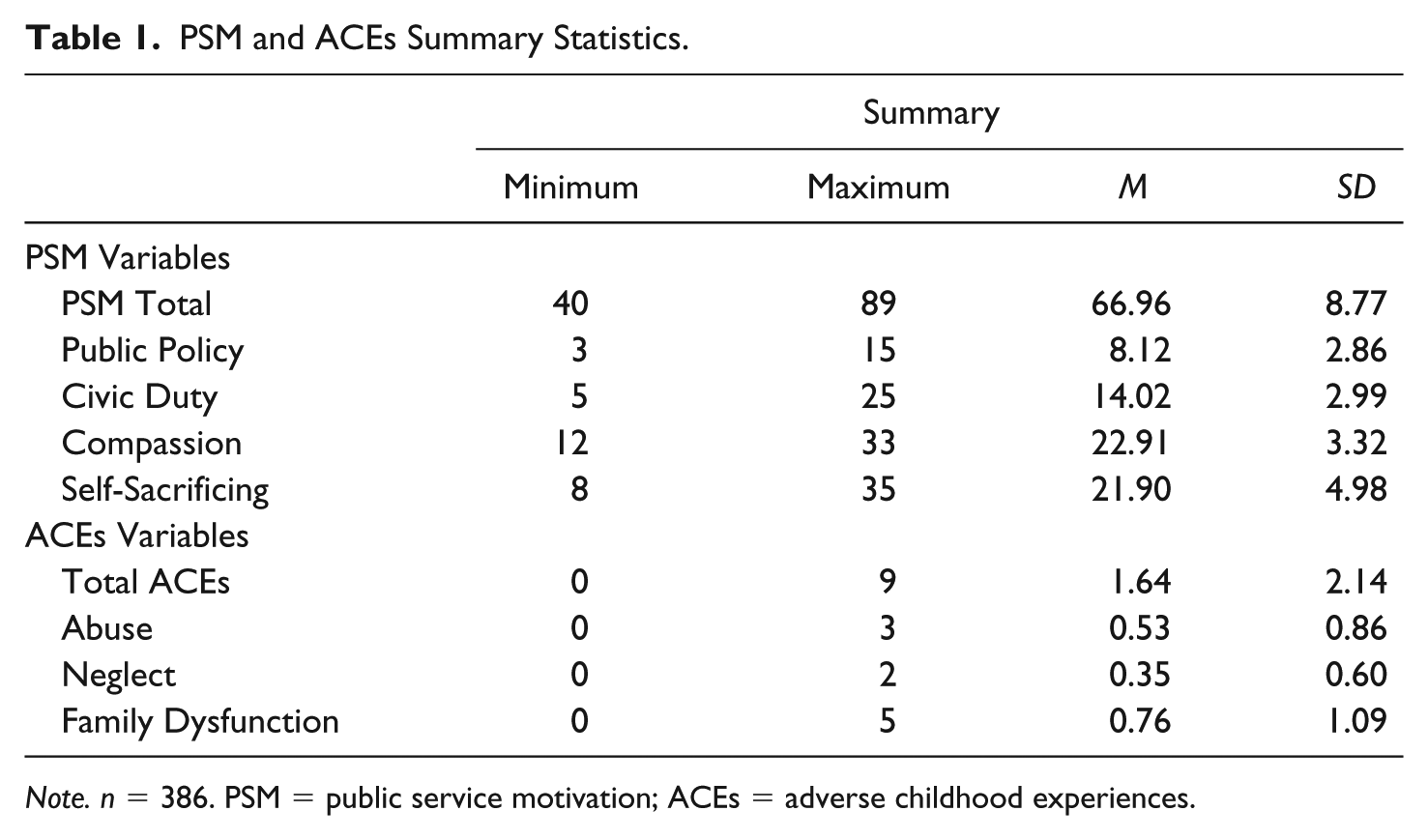
Note. n = 386. PSM = public service motivation; ACEs = adverse childhood experiences.
Study 1b: Dependent variables
PSM acts as the dependent variable and was calculated as a total score and for each of the four PSM categories (policy making, civic duty, compassion, self-sacrifice) as outlined by Perry (1996).
Study 1b: Analysis
Multiple regression analysis was used with each ace family acting as independent variable and PSM acting as dependent. Control variables of age, sex, and education were also used in Study 1b and the regressions were completed by using the STATA Analytics software package by using the reg command.
Study 1b: Results
Results of the cluster analysis are presented in Table 2.
Regression Results.
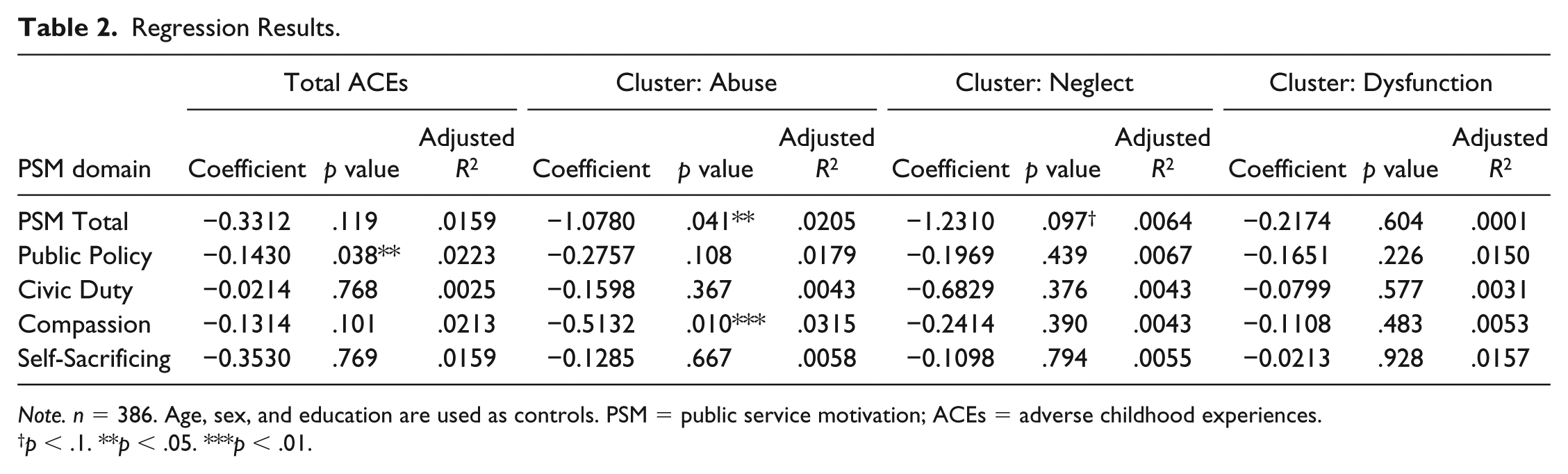
Note. n = 386. Age, sex, and education are used as controls. PSM = public service motivation; ACEs = adverse childhood experiences.
p < .1. **p < .05. ***p < .01.
Study 2: Methods
Ninety-seven participants were recruited using Amazon’s MTurk. These participants were first given the ACEs survey and then provided the following question: A specific community has determined that they have a high population of elderly individuals unable to drive to the grocery store or prepare their own meals. Some have suggested a free meal delivery service to insure these individuals are cared for. Should such a program be offered?
If participants said such a program should be offered, they were provided the following two follow-up questions. (1) Who should oversee administering this program? A multiple-choice option was provided with (A) being a government agency and (B) being a nonprofit organization. (2) If participants said the program should be offered by a government agency, the following question was provided: “Why do you believe a government agency should oversee the mentioned program instead of a nonprofit organization?” If the participant said a nonprofit should oversee the program, the same question was asked switching the government agency with nonprofit and vice versa.
These questions were intended to determine if those individuals with high levels of ACEs demonstrated mistrust of systems. By allowing for the program to be conducted by a nonprofit or a government, and asking why a participant feels that way, we open the door for those to share their level of trust or mistrust within systems. However, the question is also carefully designed to not persuade the participant or lead them into a conversation about trust or distrust. Therefore, the topic must be initiated by the participant. Before conducing the survey, different variations of this question were tested on graduate students to test for understanding and variance. The chosen question provided less leading of the participant and still resulted in conversational answers. Therefore, it was chosen for this study.
Study 2: Participants
Of the 97 participants, 49 were men and 48 women. The average age was 35.79 with a minimum of 20, maximum of 68, and a standard deviation of 11.78. We evaluated what percentage of respondents thought the public service program should not be offered. Next, percentage that felt the program should be offered by a nonprofit organization or a government agency were determined. Results are presented in Table 3.
Study 2 Participants.
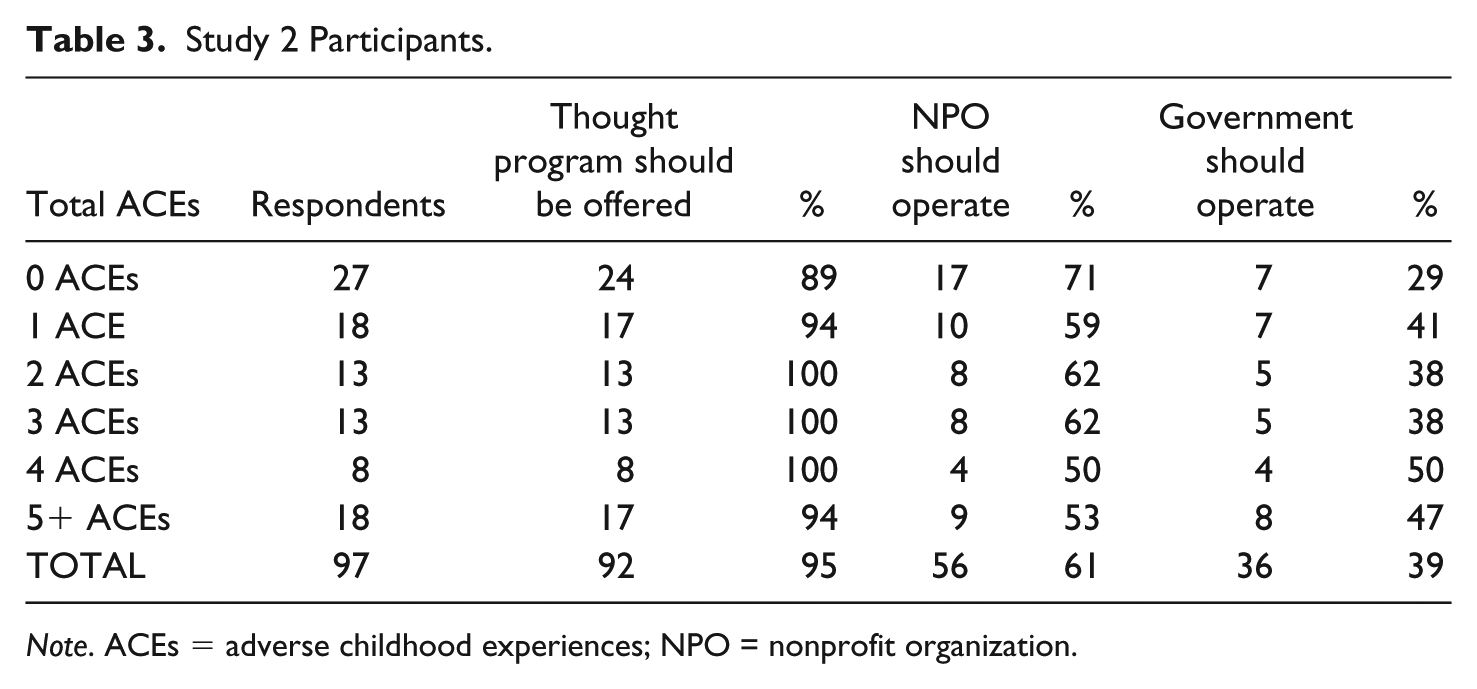
Note. ACEs = adverse childhood experiences; NPO = nonprofit organization.
Study 2: Independent variables
For Study 2, Total ACEs and Clustered ACEs were used as independent variables. Total ACEs was calculated as outlined in the “Independent Variable” section of Study 1a. The ACEs clustered or grouped by family were calculated as outlined in the “Independent Variables” section of Study 1b.
Study 2: Dependent variables
First, whether the participant thought the community service program should be offered, coded as 1 or 0, was examined. Next, whether the participant thought a government or a nonprofit should offer the program, coded as 1 or 0, was examined.
Study 2: Analysis
Because the dependent variables were coded as 1 or 0, logit regression was used through the logistic function in the STATA software package. Age, sex, and education were also included in the regression as controls.
Study 2: Results
When evaluating if ACEs predicted if participants thought the hypothetical social service program should be offered, results were not significant: total ACEs (p = .597), abuse (p = .667), neglect (p = .759), and dysfunction (p = .612). Again, results were not significant when determining if participants thought a government or nonprofit organization should oversee the hypothetical program: total ACEs (p = .207), abuse (p = .165), neglect (p = .137), and dysfunction (p = .639).
After conducting the logit regression, we grouped those participants with five or more ACEs. Their responses to the question “Why do you believe a government agency should oversee the mentioned program instead of a nonprofit organization?” are provided. Again, the goal was to see if those with high levels of ACEs spoke of mistrust.
Quotes From All Respondents With Six or More ACEs
Those who think the program should be offered by a government agency: I believe that a government agency would be better suited to oversee the mention program and not a nonprofit organization because the government has far more resources to support this kind of program and in a reliable way than a nonprofit organization. (6 ACEs) I believe the nation has a duty to serve disabled seniors. They spent their lives working and paying taxes. Necessities should be guaranteed you them. (7 ACEs) I think they would have adequate funding and resources more than a nonprofit. (7 ACEs) I think that non-profit organizations are most of the time not using the money in the way that they should and this is not giving quality care to those that need it. (8 ACEs)
Those who think the program should be offered by a government agency: They do a better job than government. Government screws up everything they touch. (6 ACEs) I think that when the government gets involved it only makes things worse. They tend to make rules and regulations that really don’t benefit the community or the general population. (6 ACEs) While there are many problems in non-profit organizations they are not as deeply entrenched and can be easily replaced for poor performance. (7 ACEs)
Discussion
Regarding Study 1a, the findings generally suggest a negative relationship between total ACEs and total PSM, though the relationship is not always statistically significant. Overall, having an additional ACE lowers a person’s PSM by 0.3312. This effect was on the outer edge of statistical significance.
The effect of total ACEs on public policy–making motivation was smaller, but still negative and statistically significant. Having an additional ACE lowers a person’s motivation in the realm of public policy making by 0.1430. This estimated effect is statistically significant with a p value of .038.
One possible explanation for this negative public policy-making motivation could be higher levels of systems avoidance. Having more ACEs also means having suffered a broader range of negative experiences. By this, these individuals are also more likely to have been in systems or been witness to systems (i.e., being involved with caseworkers, court systems, or child protective services). These early exposures to the power-dynamics within systems (and a possible lack of control over their own person) could result in avoidance and mistrust. In fact, Bartholet (2012) argued that the child welfare system is more about the adult and less about the child. As a result, these children may be re-victimized by the very system in place to aid them.
Child abuse has also been linked to posttraumatic stress disorder (PTSD; Cohen, Deblinger, Mannarino, & Steer, 2004; Dervishi, 2015; Kitzmann, Gaylord, Holt, & Kenny, 2003). Alisic et al. (2014) categorized adolescent trauma into non-interpersonal trauma (i.e., national disaster) and interpersonal trauma (i.e., abuse). They found that one in 10 adolescents developed PTSD for non-interpersonal trauma but this number increases to one in four when the form of trauma was interpersonal. Therefore, it is expected that levels of PTSD are higher for those with higher ACEs scores. Also, it is well documented that PTSD has been linked to mistrust of authority (Glover, 1988; Jordan, Nunley, & Cook, 1992; Walker & Cavenar, 1982) and this also lends support to the idea that these individuals may avoid systems.
The idea of systems mistrust is also supported by evidence found in Study 2 of this research were those respondents with higher levels of ACEs said things such as follows: “Government screws up everything they touch” (6 ACEs) and “I think that when the government gets involved it only makes things worse” (6 ACEs). “I think that nonprofit organizations are most of the time not using the money in the way that they should and this is not giving quality care to those that need it” (8 ACEs). These quotes demonstrate a distrust of systems and, while antidotal, help to provide a deeper understanding of the negative correlation found in Study 1a.
When evaluating the effect of total ACEs on PSM driven by civic duty, we see the smallest effect. While the effect is small and not statistically significant, the estimated effect is again negative, giving some support to the continued trend of a negative relationship between PSM and ACEs.
The estimated effect of total ACEs on PSM based on compassion is, again, negative. The estimated size of the effect is similar to the estimated effect for PSM based on public policy and is again negative. While the estimated effect for compassion-motivated public service is not as statistically significant as that for motivation based on public policy, it is just outside the 10% significance level with a p value of .101.
The estimated effect of total ACEs on PSM based on self-sacrifice is the largest estimated effect but also the effect with the least statistical confidence. Consistent with the other finding, though, the estimated effect is again negative.
After examining the effect of total ACEs on PSM, we then moved onto Study 1b and looked at clusters of ACEs to see how each of the different types of ACEs affected PSM. Abuse ACEs consist of questions regarding emotional, sexual, and physical abuse. Results for the effect of abuse-related ACEs on PSM are given in Table 2.
There are again consistent negative results with all of the estimated effects. The estimated effects when looking just at abuse-related ACEs are generally greater than when just looking at total ACEs. An additional abuse-related ACE is associated with a 1.078 decrease in total PSM. The result is also statistical significant with a p value of .041.
Abuse-related ACEs are associated with a 0.2757 decrease in PSM related to making public policy. While just outside the boundary of statistical significance with a p value of .108, this negative result further adds to the growing support that the ACEs have a negative effect on PSM.
Civic duty–driven PSM is negatively affected by abuse-related ACEs, though the result is not statistically significant. Similarly, abuse-related ACEs are estimated to negatively affect self-sacrificing motivation for public service, though the result is not statistically significant. These results, similar in magnitude at −0.1598 and −0.1285, respectively, further support the general trend of a negative relationship between ACEs and PSM.
With a p value of .01, abuse-related ACEs are statistically significantly related with compassion-motivated public service. An additional ACE is associated with a 0.5132 decrease in compassion-related PSM.
While it is not the intent of this article to evaluate each of the 10 forms of abuse separately, it is reasonable to evaluate sexual abuse individually because that is the basis of the second hypothesis. Results of sexual abuse on PSM are given in Table 4.
Regression Results.

Note. n = 386. Age, sex, and education are used as controls. PSM = public service motivation.
p < .1. **p < .05. ***p < .01.
The results continue the trend of negative estimated coefficients. A surprising result with the sexual-abuse ACE is the magnitude and statistical significance of the estimates. Sexual abuse is statistically significantly associated, at the 10% level, with three of five categories of PSM. The two results that lack statistical confidence are PSM driven by the desire to make public policy and compassion. The estimated effect on total PSM almost triples the estimated effect from general abuse.
The estimated effect of sexual abuse on self-sacrifice as a motivation for public service deserves particular attention. Neither the estimated effect for all ACEs nor for abuse-specific ACEs on self-sacrifice as a motivation for public service is statistically significant. The estimated coefficients are also relatively small at −0.3530 and −0.1285, respectively. The estimated coefficient for specifically sexual abuse, however, is −1.5508.
Results for two other ACE categories, neglect and dysfunction, are given in Table 1. These results are not particularly strong, but do continue the consistent trend of always yielding negative estimated coefficients. ACEs related to neglect are the most likely (p = .097) to have a relationship with total PSM and that effect is fairly large with an estimated coefficient of −1.231. The remaining coefficients are small and statistically insignificant.
When evaluating the impact that ACEs has on PSM, the overall fit of the models is generally poor, with the adjusted R2 for the research questions ranging from .0001 to .0315. The estimated effects are also modest. Based on the sample average PSM, an additional ACE would change PSM from a low of 0.1% to a high of 7.01%. Family dysfunction ACEs have the smallest average effect on PSM with an additional family dysfunction–related ACE decreasing average PSM from a low of 0.1% to a high of 2.03%. The high-end is a bit of an outlier, however, as the other average effects are 0.57% or less. Sexual-abuse ACEs have the greatest impact on PSM with the average effects ranging from a low of 2.03% to a high of 7.08%. There is consistency, however, in every estimated coefficient on the different groups of ACEs being negative for every type of PSM.
In addition, the constant negative pattern is still consistent but the effects are weaker when looking at family dysfunction. Considering the ACEs domains of abuse, neglect, and family dysfunction, it seems that ACEs inflicted directly upon the person through actions (i.e., abuse and neglect) result in the largest effect on PSM while environmental factors (i.e., family dysfunction) are not as strong. One possible explanation for this could be the resilience of children. “Resilience refers to the process of, capacity for, or outcome of, successful adaptation despite challenging or threatening circumstances” (Masten, Best, & Garmezy, 1990, p. 1).
Furthermore, individuals may employ different or multiple coping methods (Masten, Best, & Garmezy, 1990) to mediate negative impacts of childhood trauma. It is possible that specific forms of abuse may be mediated through specific coping methods or that those better able to cope could have higher levels of PSM. However, this initial study simply looked at having ACEs and PSM and did not include mediating factors such as therapy or coping.
Finally, age of the adverse experience may also have an impact. As shown in the Shors et al. (2016) study, which is the basis for Hypothesis 2, prepubescent animals were exposed to sexual assault resulting in an increase in stress hormones. Later, those animals did not show caring responses toward their own offspring. It is possible that these stress hormones adversely impact the child’s ability to develop (Anda et al., 2006; McCrory, De Brito, & Viding, 2011) and increase chances for pathology (Halevi, Djalovski, Vengrober, & Feldman, 2016). Therefore, it is possible that during the time that behavior traits associated with PSM and caring for others would normally be learned, that physical conditions due to environmental circumstances prevent these positive developments.
Overall, data support the second hypothesis. More specifically, those with more ACEs have lower levels of PSM. While the statistical value was not always consistent, the negative coefficient was present regardless of what form of ACEs (abuse, neglect, dysfunction) was being examined or what form of PSM (policy making, civic duty, self-sacrificing, compassion) was being considered.
These findings have striking implications for PSM theory. Through this approach, we see the effect that mistreatment of children has on service motivation later in life. When extrapolated to the larger community, we see the value in dedicating resources to child care to create a more cohesive community. These steps could be done by advancing positive child-centered systems such as head start programs, or advancing personal level programs such mentoring.
Worth noting is the fact that having two competing hypotheses that are the inverse of each other opens a possibility that they are both right—a curvilinear relationship occurs. To check this possibility, the square of total ACEs was added to the model. Including this quadratic term allows for the possibility that the effect of ACEs on PSM could change the more ACEs a person has. The estimated coefficient on the quadratic term is statistically significant and positive (coefficient = 0.208, p value = .014). The estimated coefficient on the linear term remains statistically significant and negative (coefficient = −1.712, p value = .003).
This means that it is possible that both hypotheses are true, but that it depends on how many ACEs an individual has. Based on the estimated effects, a person with eight fewer ACEs would have lower levels of PSM based on their ACEs. That is, Hypothesis 2 would hold. A person with nine or more ACEs would have higher levels of PSM based on their ACEs. That is, Hypothesis 1 would hold. While this finding is theoretically possible, practically speaking, the maximum number of ACEs an individual can have is 10, and in the sample data, out of 386 people, only four had nine ACEs and none had 10, so the actual occurrence of such effects is small.
With a better understanding of the link between PSM and ACEs, managers and organizations must consider the implications of these results. PSM has been shown to have many impacts within our organizations. For example, higher levels of PSM have been linked to the likelihood of whistle-blowing because it is a form of self-sacrifice for the greater good. In addition, higher PSM has been shown to influence employees’ innovative behavior (Miao, Newman, Schwarz, & Cooper, 2018). Luckily, while those with higher ACEs may be linked with lower PSM, studies also suggest that the right leadership can increase employee PSM (Andersen, Bjørnholt, Bro, & Holm-Petersen, 2018; Caillier, 2014; Wright, Moynihan, & Pandey, 2012). Therefore, organizations are encouraged to support those employees with higher levels of ACEs by providing more positive and transformational leadership.
Limitations and Future Research
While leadership was not a focus of this study, there are implications of this research that impact leadership studies. This research shows that those with more ACEs have lower levels of PSM, and more specifically, lower levels of self-sacrificing, a trait found in positive leadership (Mulder & Nelissen, 2010; Singh & Krishnan, 2008). Researchers may benefit from future exploration of this link by determining if there is a correlation between a leader’s ACEs and levels of corporate social responsibility within organizations or departments they govern. Also, others have found that subordinates whose leaders demonstrate lower levels of self-sacrificing will have lower levels of morale (Zhang et al., 2016). Based on the link between ACEs and self-sacrificing found here, evidence suggests that leaders with higher ACEs may have subordinates with lower morale. But again, further research would be needed to test this idea.
A limitation of this research is that of mental health intervention. In this research, respondents were asked if ACEs happened. However, no follow-up questions seeking to understand what role counseling or therapy interventions may have played in the lives of these individuals were asked. It is possible that those who sought aid from professional interventions may have seen the benefits of serving others and become more motivated toward helping others or scored higher in the PSM survey. It would be beneficial for future research to examine the role that such interventions may play as a mitigating factor in these findings. The same should be considered of specific coping methods used by those who suffered specific forms of ACEs because, like other interventions, specific coping methods may be able to mitigate negative consequences of ACEs. A related avenue for additional research would be to take a more holistic approach to childhood experiences to include both positive and negative experiences and how those different experiences may counteract the other.
Systems avoidance is suggested as a plausible reason for those with higher ACEs having lower PSM. More specifically, it is suggested that perhaps those with higher ACEs have been more involved in systems (i.e., court systems, caseworkers, child protective services) and feelings of lacking control within these systems could be why, as adults, these individuals avoid policy making. This idea of systems avoidance is backed by our Study 2 and other studies that show children who experience interpersonal abuse are more likely to suffer PTSD (Alisic et al., 2014). PTSD is linked to distrust of authority (Glover, 1988; Jordan et al., 1992; Walker & Cavenar, 1982). Future research may benefit from controlling for PTSD or determining what impact this important variable may have on PSM.
Another limitation of this study is the self-reporting nature of surveys. It is always possible that somebody did not answer all questions honestly. In addition, though MTurk has been extensively used in social science research, there would be a benefit to reproducing these studies with additional sampling methods (Hauser & Schwarz, 2016).
Footnotes
Authors’ Note
Gregory R. Evans is now affiliated with Bethel University, McKenzie, TN, USA.
Declaration of Conflicting Interests
The author(s) declared no potential conflicts of interest with respect to the research, authorship, and/or publication of this article.
Funding
The author(s) received no financial support for the research, authorship, and/or publication of this article.
