



Abstract
The purpose of this study is to examine whether the determinants of job satisfaction vary between male and female and between White and minority employees of the U.S. federal government. The study investigates nine potential determinants associated with existence, relatedness, growth needs, and organizational equity, based on data from the 2015 Federal Employee Viewpoint Survey. The study uses multiple regression analysis to assess and compare the strength of the relationships between these determinants and work satisfaction among each of four demographic subgroups (White males, White females, minority males, and minority females). Results indicate that there are no dramatic differences among these groups in terms of which factors have the strongest impact on satisfaction. However, a few subtle distinctions are apparent. In particular, employee development is a higher priority for men than for women, and recognition for good work is not as important to minorities as it is to Whites. There is also some evidence of intersectionality, in that pay satisfaction and diversity management are most important to minority women and least important to White men, and workplace participation is most important to White men and least important to minority women. The study provides potential explanations of these findings, and briefly addresses implications for research and practice.
Workforce participation by women and people of color has increased dramatically in the United States over the past few decades, affected by civil rights legislation and affirmative action programs (Choi, 2008). An estimate provided by the U.S. Bureau of Labor shows that changes in the demographic composition of the workforce have been especially significant since the early 1980s (Pitts, 2009). This demographic shift has resulted in much more diversity in organizations, with an even greater impact in public organizations compared with those in the private sector (Bond, Galinsky, & Swanberg, 1998; Pitts, 2005). The diversification of the public sector workforce helps to establish a representative bureaucracy (Kingsley, 2015; Selden, 2015) with its promise that governments can better realize democratic ideals when the public agency workforce is more representative of the demographic composition of the people it serves.
Greater workforce diversity poses both opportunities for and threats to public organizations. Employee heterogeneity has the potential to improve organizational decision-making because people from diverse backgrounds can apply divergent perspectives to help solve the problems at hand. This informational diversity increases creativity and leads to better performance (Jehn, Northcraft, & Neale, 1999). For example, McLeod, Lobel, and Cox (1996) found that groups composed of only Anglo-Americans produced fewer innovative ideas in brainstorming sessions than did groups with more diverse composition. However, heterogeneity in organizations can also lead to lower performance due to higher levels of emotional conflict among members (Pelled, Eisenhardt, & Xin, 1999). This can undermine workgroup cohesiveness by decreasing job satisfaction (Choi, 2008) and psychological attachment among members (Tsui, Egan, & O’Reilly, 1992). Demographic heterogeneity can also result in higher levels of employee turnover by lowering levels of social integration (O’Reilly, Caldwell, & Barnett, 1989).
The impact of workforce diversification thus hinges on how effectively organizational leaders prevent and/or address the potential problems that may arise in cooperative work processes among employees from different backgrounds. Some scholars have pointed to the need for “diversity leadership” (Chen & Van Velsor, 1996; Dreachslin, 1996), which requires leaders in heterogeneous organizations to understand the differences in minority cultures and ways of thinking. This employee-centered approach is distinguished from the typical emphasis on impartiality which assumes that fairness in an organization can be achieved only through impersonal execution of rules and regulations. This impersonal impartiality has been criticized as reflecting managerial ignorance (Ely & Thomas, 2001) or as simply an exercise of dominant culture values (Acker, 1989; Konrad & Linnehan, 1995).
An employee-centered approach to managing organizational diversity takes into account the fact that employees have different needs, interests, and values that influence their attitudes and behavior at work. While individual-level differences are important in this regard, successful diversity management also takes into account the cultural differences among demographic subsets of the organization’s workforce. In particular, it is based on recognition that traditional organizations are designed and operated based on dominant White male values and beliefs (Acker, 1989; Konrad & Linnehan, 1995), and that women and people of color often hold alternative perspectives that are distinct from, if not incompatible with, the dominant worldview driving organizational activity. Incongruence between organizational and individual preferences and priorities can undermine employee work motivation and job satisfaction (Judge, 1994), negatively affecting their behavior, performance, and organizational commitment. In contrast, successful management of cultural differences and diverse orientations can have positive effects for individuals, groups, and organizations (Ang et al., 2007; Sizoo, Plank, Iskat, & Serrie, 2005).
As understanding demographic differences is imperative for utilizing an employee-centered approach to managing diversity, the purpose of this study is to explore differences between demographic subsets of the federal employee workforce in terms of the factors that influence their overall satisfaction with work. The specific research question this study addresses is the following: Are there differences between men and women and between Whites and non-Whites in terms of the determinants of their job satisfaction? This study contributes to the literature on this topic in three ways. First, despite considerable interest in how individual characteristics and organizational conditions shape employee job satisfaction, there has been little effort to identify ethnic or gender differences regarding the relative importance of relevant factors. A few studies addressing issues of work/life balance (e.g., Saltzstein, Ting, & Saltzstein, 2001) and diversity management (e.g., Choi & Rainey, 2014; Pitts, 2009) have explored the role of demographic differences, but empirical evidence regarding how gender and ethnicity influence the determinants of job satisfaction is quite limited.
Second, this study improves upon previous research by simultaneously examining the effects of a wide variety of potential determinants. It is useful to include a number of viable factors in a single model because, as the literature suggests, the relative importance of any given factor may depend on the impact of others. For instance, the motivational “crowding out” hypothesis (Frey & Jegen, 2001) implies that the relative importance of intrinsic factors decreases as people place greater importance on extrinsic factors. Also, need hierarchy theory (Maslow, 1943) and frustration-regression theory (Alderfer, 1969) suggest that the salience of particular needs is dependent upon the deficiency or fulfillment of other needs. Thus, inclusion of multiple antecedents in the analysis allows this study to assess the relative strength of their impact on satisfaction while also providing more precise information regarding how much difference exists between various demographic subgroups of employees. Previous research has typically used moderation analysis to examine whether statistically significant differences exist between racial or ethnic and gender groups, but such analyses do not provide much insight as to whether such differences are large enough to warrant, for example, differential treatment of employees based on their race/ethnicity and/or gender. In other words, this question cannot be answered simply by testing for a significant moderating effect, but only by comparing the relative strengths of a comprehensive set of determinants for the various demographic subgroups.
Third, there has been little research on the effect of the intersectionality of ethnicity and gender on employee outcomes. Most studies in public administration and organizational behavior addressing minority issues have relied on the two independent dichotomies of male versus female and White versus non-White (Alvesson & Billing, 1992). In particular, scholars have exhibited little interest in a better understanding of how women of color, as the least privileged demographic group, differ in their motivational structure (Holvino, 2010). One of the goals of this study is to assess whether the determinants of job satisfaction are different for women of color than for White men, White women, and men of color, so as to better understand the role of intersectionality in shaping employee work attitudes.
To identify patterns regarding the differential priorities of these four demographic subsets of the federal workforce, the study uses multiple regression to analyze data from the 2015 Federal Employee Viewpoint Survey (FEVS). In the next section, the study summarizes the theoretical foundations for the hypotheses regarding the differences expected to be found, followed by a description of the methods used to conduct the analysis. The results of the analysis are presented and the article concludes with a discussion of these findings and their implications for future research and practice in the field.
Theoretical Foundations
Organizational scholars have had a long-standing interest in the issue of employee job satisfaction. Research has demonstrated that job satisfaction is associated with other important attitudinal and behavioral outcomes, such as work effort (Testa, 2001), organizational citizenship behavior (Lowery, Beadles, & Krilowicz, 2002), job performance (Judge, Thoresen, Bono, & Patton, 2001; Rich, Lepine, & Crawford, 2010), organizational commitment (Chordiya, Sabharwal, & Goodman, 2017; Lok & Crawford, 2001; Tett & Meyer, 1993), and turnover (Tett & Meyer, 1993; T. A. Wright & Bonett, 2007). By influencing such outcomes, job satisfaction can have an important impact on organizational performance, not only in the private sector but also in government organizations (Kim, 2004). A recent meta-analysis of public administration literature on job satisfaction (Cantarelli, Belardinelli, & Belle, 2016) found that it is significantly correlated with both individual and organizational performance, as well as other important consequences such as stress and teamwork.
Given its significance, a better understanding of the factors contributing to employee satisfaction has been an important research goal in the fields of organizational behavior and human resource management. Likewise, public management scholars have long investigated the antecedents of satisfaction among public employees (Ellickson & Logsdon, 2002; Gould-Williams, 2004; Ting, 1997; B. E. Wright & Davis, 2003). Recently, for example, Yang and Kassekert (2009) demonstrated that different types of public management reforms have different effects on federal employee job satisfaction; Wang and Yang (2015) found that informal participation increases job satisfaction among civil servants in China; and Masal and Vogel (2016) provided evidence that the job satisfaction of members of a German police is influenced by how their leaders use performance information. More generally, the Cantarelli et al.’s (2016) meta-analysis concluded that a variety of job and organizational characteristics are related to satisfaction among public employees, including mission valence, training opportunities, job significance, and adequate workload.
Although job satisfaction has received considerable attention as a variable of interest in organization and management research, there has been little effort to identify how the factors that influence satisfaction vary among different groups of employees. In particular, although some studies have explored demographic differences in levels of job satisfaction, little research has aimed to determine whether the antecedents of satisfaction vary as a function of employee ethnicity or gender. Demographic variables are sometimes included as moderator variables, such as the study by Tabvuma, Georgellis, and Lange (2015) that examined gender differences in the impact of job training on employee satisfaction, or the study by Lindorff (2011) that compared men and women in terms of the factors shaping satisfaction at different hierarchical levels. But given the paucity of research intended to clarify demographic differences in the determinants of satisfaction, the purpose of this study is to assess these differences among federal employees in the United States.
In this section, the study first explains why it is reasonable to expect there to be demographic differences in the factors that lead employees to be satisfied with their jobs. The study gives specific attention to the basis for both ethnic and gender differences, and addresses the role of intersectionality as well. The study then discusses four categories of potential determinants of job satisfaction, namely, those associated with existence, relatedness, growth needs, and with the issue of organizational equity. For each category, the study proposes a hypothesis regarding the expected difference between White males and three other demographic groups in terms of the importance of factors in that category as determinants of job satisfaction.
The Basis for Demographic Differences
Exploration of differences in the determinants of work satisfaction among different demographic groups rests on the assumption that members of these groups may, in general, have different needs, motives, and preferences that shape their perceptions of and reactions to their organizational experiences. This assumption can be justified by consideration of the processes through which human needs and desires develop and evolve. Traditionally, a dominant view among personality theorists is that stable personality characteristics such as motives form in early childhood. A psychoanalytic perspective holds that conscious and unconscious motives form as a result of attempts to resolve basic conflicts occurring in childhood, such as the deprivation or suppression of basic needs and desires. According to this view, preferences and priorities develop as a result of individual experiences, such that there would not be much reason to expect that a similar orientation would be shared by those in a particular demographic group.
In contrast, other scholars have argued that motives can continue to develop even into adulthood. McClelland (1965) defined a person’s motives as an “affectively toned associative network arranged in a hierarchy of strength or importance within a given individual” (p. 322). In other words, motives reflect emotionally charged patterns of thinking that lead a person to prioritize some behaviors over others, aimed at fulfilling particular needs. McClelland further argues that affective experiences in adulthood can change this motive structure. This implies that the strength of certain motives can be increased when certain clusters of behaviors are reinforced, for example, via provision of rewards, and declined when they are frustrated. Moreover, social learning theory (Bandura, 1977) suggests that this learning process can occur vicariously, not just through direct experience. In other words, learning can occur when people observe the consequences of others’ behavior in situations that are similar or relevant to their own. Although many factors may influence the perceived relevance of other situations, behaviors, and consequences, it is reasonable to think that the experiences of demographically similar others will be seen as more relevant than those who are demographically different. As a result, similar experiences and vicarious learning among those in a given demographic group can help to form a shared pattern of needs, motives, and expectations that influence their work experiences and reactions to them.
Ethnic differences
In his consideration of the conditions under which motive acquisition is facilitated, McClelland (1965) suggested that learning occurs more readily when “an individual perceives that developing a motive is consistent with the demands of reality” (p. 325). This suggests that individuals in minority groups may be motivated to act in ways that meet the expectations derived from socially constructed stereotypes of those groups. Indeed, these expectations can be the reality that affects the members of minority groups most strongly as racial or ethnic identification is the single most influential factor shaping one’s self-identity in American society (Green, 1999; Quillian & Pager, 2001). For example, Asian Americans are often viewed through the stereotype of the “model minority” (Takaki, 1996). This is a stereotype that both praises and derides Asian Americans as being hard working and diligent, yet shy, dull, and socially inept. Asian Americans are motivated to accept this socially constructed identity, and living up to this “model minority” identity becomes the strongest demand in their reality to the extent that they believe it will be beneficial for them in the workplace. For this reason, experiencing discrimination often results in paranoia for Asian Americans who have tried to overcome this barrier by faithfully adhering to their model identity (Kong, 2016).
McClelland (1965) also proposed that “changes in motives are more likely to occur and persist if the new motive is a sign of membership in a new reference group” (p. 330). Members of ethnic minority groups usually have two reference groups with which they want to affiliate: the majority group and their own ethnic group. In the United States, people of color face a significant amount of pressure to maintain an assimilated status. One way to do so is through the use of disidentifiers, such as speaking without an accent, associating with members of the dominant group, and dating or marrying someone outside of one’s ethnic group (Goffman, 1963). However, minorities are also induced to behave in ways that meet the expectations of their own ethnic group, with the result that Blacks, Latinos, and Asian Americans are often under pressure to assimilate into two different cultures (Thomas & Alderfer, 1989). Efforts to integrate the two sets of pressures typically result in the development of a bicultural identity (Nguyen & Benet-Martínez, 2007), although people vary in the extent to which they experience conflict between the two components of this identity. In any case, minorities are often judged in terms of the extent to which they do or do not display assimilation into the dominant culture, as well as how much they maintain an identity associated with their own ethnic culture.
As an example, Pyke and Dang (2003) examined the use of the terms “white-washed” or “fresh off the boat” (FOB) by Asian Americans to denigrate other Asian Americans for being either too assimilated or too ethnic. These two labels are at the opposite ends of the acculturation continuum that pits Asian Americans against each other. Those who strive to become acculturated within the dominant culture can face resentment from other Asians who view them as “selling out” to White people. On the contrary, those viewed as FOB are often criticized by more acculturated Asians for being too ethnic, implying that they are unsophisticated and uncultured. The goal for many Asian Americans is thus to project an assimilated and acculturated identity that casts them in the bicultural middle of the acculturation continuum. More generally, regardless of their generational status, and unlike African Americans, Asian Americans are not automatically considered “American.” Questions such as “Where are you really from?” highlight the status of Asian Americans as “perpetual foreigners” or “forever foreigners” living in America (Tuan, 1998). It is this kind of environment that motivates Asians to project an assimilated status using disidentifiers at the work place and society (Pyke & Dang, 2003).
In short, in dealing with two contradictory sets of expectations, minorities in American society are likely to experience a greater level of stress, as reflected in the greater probability of mental disorder among African, Asian, and Hispanic immigrants than their European counterparts (Burnett-Zeigler, Bohnert, & Ilgen, 2013). In this process of dealing with the pressures of assimilation and biculturalization, members of minority groups may share similar experiences and reactions that are often quite different from those of majority group members (Richard & Grimes, 1996).
Further theoretical explanation of differences among racial/ethnic groups comes from the theory of work adjustment (Dawis & Lofquist, 1984). According to this theory, worker satisfaction is determined by the correspondence between an individual’s needs and the reinforcements provided by the work environment. Low correspondence results in adjustment behaviors and/or turnover intentions, thus affecting job performance and tenure. As employees’ social and occupational values determine the level of correspondence (Leong & Serafica, 1995), evidence of differences in minority groups’ cultural and occupational values and needs (Brown, 2002) could easily translate into different reactions to workplace features and experiences.
Gender differences
Women and men may differ in the primary factors that influence their job satisfaction for a number of reasons, including different workplace values, lower labor-market attachment, and work-life conflict (Tabvuma, Georgellis, & Lange, 2015). Women employees in the United States usually have dual responsibilities (Scandura & Lankau, 1997) that can lead to work-life conflict that results in lower satisfaction (White, Hill, McGovern, Mills, & Smeaton, 2003) and reduced well-being in the workplace (Allen, Herst, Bruck, & Sutton, 2000). Studies consistently report that women take a significantly larger portion of family responsibilities than men (Dumas & Stanko, 2017), further reflected in the fact that most lawsuits concerning family responsibility discrimination are filed by women (Miller, Freeman, & Phan, 2008). As a result, women tend to be more sensitive to family-responsive benefits such as flexible work hours (Scandura & Lankau, 1997). Due to these differential obligations, different factors could influence job satisfaction for women than for men.
Women historically have also experienced barriers in terms of career development and advancement. As reflected in the notion of a “glass ceiling” (Bell, McLaughlin, & Sequeira, 2002), women constitute a small percentage of upper-level management positions in most organizations (Wynen, Op de Beeck, & Ruebens, 2015). According to Alderfer (1969), frustration resulting from unsuccessful attempts to satisfy higher-order (growth) needs can result in the strengthening of lower-order (existence and relatedness) needs. Confronted with the many explicit and implicit biases limiting their opportunities to advance in their careers, women may adapt by shifting their priorities to focus on other aspects of the organization and workplace. These could include, for example, the quality of relationships with managers and coworkers.
The socialization process that women go through in life results in the formation of a different self-identity for women than for men (Maccoby, 1990), providing a third explanation for why women may differ from men in terms of the factors shaping their job satisfaction. Women’s identity in the workplace has been influenced by different expectations than those for men. Acker (1990) argued that masculinity pervades organizational processes, marginalizing women in the workplace. Similarly, Ibarra and Petriglieri (2016) pointed out that task structures, practices, and patterns of interaction in organizations inadvertently favor men. Given that they are perceived as more cooperative, generous, dependable, likable, and polite (Prentice & Carranza, 2002), women in the workplace are often expected to play some roles that men cannot perform as effectively (D’Agostino, 2015), yet their unique contributions are often neglected when evaluated in terms of traditional notions of organizational performance (Schachter, 2008). Moreover, women are often perceived as less effective than men in certain roles, a typical example being organizational leadership positions (Eagly & Karau, 2002; Ely, 1995). To the extent that women have internalized such differences in role expectations, they are also likely to have different job-related needs and desires than men. For example, Clark (1997) found that one reason why women are more satisfied at work than men is because women have lower expectations.
Intersectionality
Traditionally, research on issues related to organizational diversity has focused on differential experiences or outcomes among groups defined by a single characteristic, usually either gender or race/ethnicity (Allison & Banerjee, 2014; Özbilgin, Beauregard, Tatli, & Bell, 2011). More recently, however, there has been growing awareness that such differences reflect the effects of membership in intersecting social categories (Acker, 2006) rather than in just a single category. Organizational research has made it clear that gender dynamics are often intertwined with those of other features such as race, class, and sexuality, and likewise, that race cannot be studied in isolation from other social categories (Boogaard & Roggeband, 2010).
For instance, African American women may experience greater negative stereotypes due to the combined effect of being female and African American (Hoyt, 2007). As a result, they are more likely to experience unfair treatment in training and advancement, more disengagement and discrimination, and lack of psychosocial and instrumental support (Bova, 2000). Moreover, African American women experience greater pressure to modify occupational roles, different predictors for advancement, lower promotion rates, and more negative career expectancies (Combs, 2003). Studies reveal patterns of occupational segregation and wage inequality in which White women hold more managerial and higher paid positions while women of color are employed primarily in lower paid jobs (Acker, 2006), often clustered in staff rather than line positions that preclude them from gaining the valuable line experience often required for career advancement (Combs, 2003). In short, the intersection of gender and race or ethnicity can have a more significant effect on work outcomes than either characteristic alone.
Despite increased recognition of the importance of intersectionality in shaping the experiences of different demographic groups, there has not been much research to date on how it influences organizational dynamics (Allison & Banerjee, 2014; Holvino, 2010). This has led to calls for more research on the intersectionality of race and gender (Acker, 2012; Metcalfe & Woodhams, 2012) and other factors as well (Tatli & Özbilgin, 2012), to better understand the impact on more marginalized individuals within gender and racial or ethnic groups. Despite the relevance of this topic, there has been little investigation of intersectionality issues in the context of the federal workforce. This study addresses this lacuna by examining the determinants of job satisfaction for four different groups of federal employees: White males, non-White males, White females, and non-White females. The goal of this study is to explore the differences among these groups in terms of the relative strength of the factors influencing their job satisfaction.
Determinants of Job Satisfaction
To examine differences between men and women and between members of the majority and minority groups, this study investigates four categories of potential determinants of job satisfaction. Three of these categories correspond to the three types of needs included in Alderfer’s (1969) needs theory, namely, existence, relatedness, and growth needs. The fourth category addresses the issue of organizational equity, as research on equity theory has demonstrated that employees’ behavioral and attitudinal responses at work are influenced by their perceptions of equitable treatment (Lawler, 1968; Mowday & Colwell, 2003). As explained below, a total of nine variables across these four categories are included in the analysis. Although extant literature does not necessarily provide adequate support for hypotheses pertaining to each of the specific variables, some of the general patterns expected to be associated with each of the four categories of determinants of satisfaction at work can be identified.
First, existence needs focus on maintaining the basic conditions necessary for human existence, including an adequate supply of food, water, shelter, and clothing. In modern society, organizations do not meet these needs directly, rather employees use the wages and salaries they are paid to acquire the necessities of life. As the size of their paycheck is likely an important factor influencing employees’ level of work satisfaction, satisfaction with pay is included as a determinant of overall satisfaction with work. Historically, women and minorities have had lower incomes and net worth than White males (Rodman & Voydanoff, 1978; Rotberg, Brown, & Ware, 1987; Slaney, 1980; Slaney & Brown, 1983; Swinton, 1992). Despite increased opportunities for education, the gender income gap is still considerable (Bobbitt-Zeher, 2007). Likewise, racial inequalities in income have continued to get worse, with wealth disparities between Whites, Blacks, and Hispanics exacerbated by the Great Recession (Kochhar & Fry, 2014). These inequalities frequently result in lower quality housing (Krivo & Kaufman, 2004) and significant health disparities (Nazroo, 2003).
In organizations, women and minorities are more likely than White men to work in jobs at lower levels of the hierarchy, with lower pay and/or less opportunity for advancement. Due to the intersectionality of race/ethnicity and gender, minority women are most likely to experience such limitations (Acker, 2006; Combs, 2003; Sanchez-Hucles & Davis, 2010), with resultant struggles to meet their basic existence needs. According to Maslow’s (1943) needs theory, a relative deficiency in terms of meeting existence needs should result in heightened attention to these concerns. For example, research has found that Chinese Americans put greater emphasis on money and job security than on decision-making responsibility (Leong, 1991). Thus, this study predicts that women and members of minority groups will, in general, put a higher priority on extrinsic rewards that allow them to meet their basic survival needs. The study also anticipates that satisfaction with pay will be a more important determinant of work satisfaction for minority women than for the other three groups.
Second, relatedness needs involve the extent to which an employee has good interpersonal relationships with others in the workplace. The study includes two variables to assess the importance of these factors, one focused on relationships with coworkers and the other on relationships with supervisors. Employees are likely to be more satisfied at work when they have a respectful supervisor and cooperative interactions with colleagues. Yet, this study expects these factors to have a weaker effect on the work satisfaction of White males than those in other demographic groups. This prediction is based in part on the fact that Western (especially Anglo) culture, grounded in a “white male” worldview, is more individualistic than other cultures around the world (Hofstede, 1998). This study anticipates that the work satisfaction of White men is less dependent on the existence of a friendly, positive social environment at work than is the satisfaction of those from a more collectivist cultural background. Likewise, evidence suggests that women are inherently more relational than men (Ford & Lowery, 1986; Gilligan, 1982), and are socialized to put greater emphasis on the importance of maintaining cooperative relationships (Maccoby, 1990). Thus, this study predicts that relational factors will be more important to others than they are to White males.
Third, growth needs refer to the human desire to develop beyond current capabilities and fulfill one’s potential. Schneider and Alderfer (1973) suggested that there are two types of growth needs: one is the confirmation of a person’s self-worth, similar to what Maslow (1943) referred to as self-esteem, and the other is the need for self-development to enable the realization of one’s potential, similar to what Maslow called self-actualization. For this study, four factors related to the category of needs are considered: recognition for good work and workplace participation are relevant to self-esteem, whereas employee development and intrinsic satisfaction are relevant to self-actualization. It is expected that each of these will have a positive effect on overall workplace satisfaction.
Predictions regarding ethnic and gender differences in the importance of factors related to growth needs are more tentative as there is some ambiguity regarding the likely effect of minority status on the impact of these factors on overall work satisfaction. For example, one argument, rooted in a deficiency model of needs motivation (Maslow, 1943), is that minority groups will place greater emphasis on fulfillment of their growth needs in the workplace due to the fact that, historically, they have had fewer opportunities for such growth than their White male counterparts. In the Unites States, women and people of color have faced greater obstacles than the White male majority in terms of realizing their full potential, as indicated by the notion of a “glass ceiling.” Scholars have found that the glass ceiling is real (Corsun & Costen, 2001), as indicated by the disproportionately greater number of White men holding managerial positions in most organizations, and maintained by the social connections between White male employees and the major decision-makers in organizations (Daley, 1996).
On the contrary, the frustration-regression hypothesis (Alderfer, 1969) supports the argument that women and minorities place less emphasis on having their growth needs met. According to this perspective, the difficulties women and minorities experience in meeting their higher-order growth needs will result in them focusing instead on meeting their lower-order existence and relatedness needs. In this case, job factors related to personal growth should be less important to women and minorities than to White males. As Hypotheses 1 and 2 predict that factors related to these lower-order needs will have a greater impact on the work satisfaction of women and minorities, the study hypothesizes here that factors related to growth needs will be less important to these demographic groups than to White males.
Finally, equity issues are concerned with the extent to which people are treated fairly in an organization. This study includes equity concerns in the analysis because of the important role they play in the context of organizational behavior as well as in contemporary society more generally. To examine the importance of these issues as determinants of work satisfaction, the study includes two antecedent variables. The first of these is organizational justice, which previous research has found to be related to employee satisfaction (Cohen-Charash & Spector, 2001; Colquitt, Conlon, Wesson, Porter, & Ng, 2001; McFarlin & Sweeney, 1992). The second is diversity management, which is included as many U.S. federal agencies have implemented organizational diversity programs and/or adopted human resource policies designed to reduce discriminatory practices and take advantage of growing workforce diversification (Kellough & Naff, 2004; Naff & Kellough, 2003). The job satisfaction of female employees in U.S. federal agencies tends to be affected by flexible or part-time work schedules to a greater degree than male workers under comparable conditions (Bagger, Li, & Gutek, 2008; Saltzstein et al., 2001). While some studies have found a positive effect of diversity programs on minority employees’ satisfaction (Choi, 2008; Pitts, 2009), other research has found a weaker effect for minorities than for White employees (Choi & Rainey, 2014). To the extent that such programs or policies are viewed as meaningful efforts to address historical inequities, the study predicts that they are a more important determinant of satisfaction for women and minorities than for White male employees.
Method
Sample and Data
The data for this study were obtained from the 2015 FEVS. The survey was administered in 2015 to U.S. federal employees, as part of an annual project of the Office of Personnel Management. A total of 848,237 federal employees were invited to complete the survey, and 421,748 returned it, for a response rate of 49.7%. Of these, 39.4% were from headquarters and 60.6% were from field offices. Regarding job level, 65.4% of the respondents were nonsupervisors, 13.4% were team leaders, 13.2% were supervisors, 6.1% were managers, and 2.0% were senior leaders. In terms of age, 0.7% were below 25, 3.1% were between 26 and 29, 17.9% were in the range of 30 to 39, 26.5% were in the range of 40 to 49, 36.4% were in the range of 50 to 59, and 15.4% were above 60 years. As for the two characteristics relevant to this study, male employees constituted 52.1% of the sample and females 47.9%, with 71.4% identifying as White and 28.6% as non-White.
Measurement
To measure the variables for this study, relevant items were selected from the pool of FEVS questionnaire items. The specific items used to assess each variable are identified in Table 1, along with the Cronbach’s alpha reliability coefficient for each scale. For the dependent variable, overall job satisfaction, this study selected three questions asking about the degree of satisfaction in terms of general referents, rather than those referring to specific organizational conditions. As for the predictor variables, pay satisfaction was measured by a single question; relationships with coworkers and relationships with supervisors were both measured using two items; recognition for good work, workplace participation, employee development, and intrinsic satisfaction were measured with two, two, four, and four items, respectively; and organizational justice and diversity management were each measured using four items. Responses to all of these items were based on a five-point Likert-type scale, and the scores on individual items measuring the same variable were averaged to create the index for that variable.
Questionnaire Items.
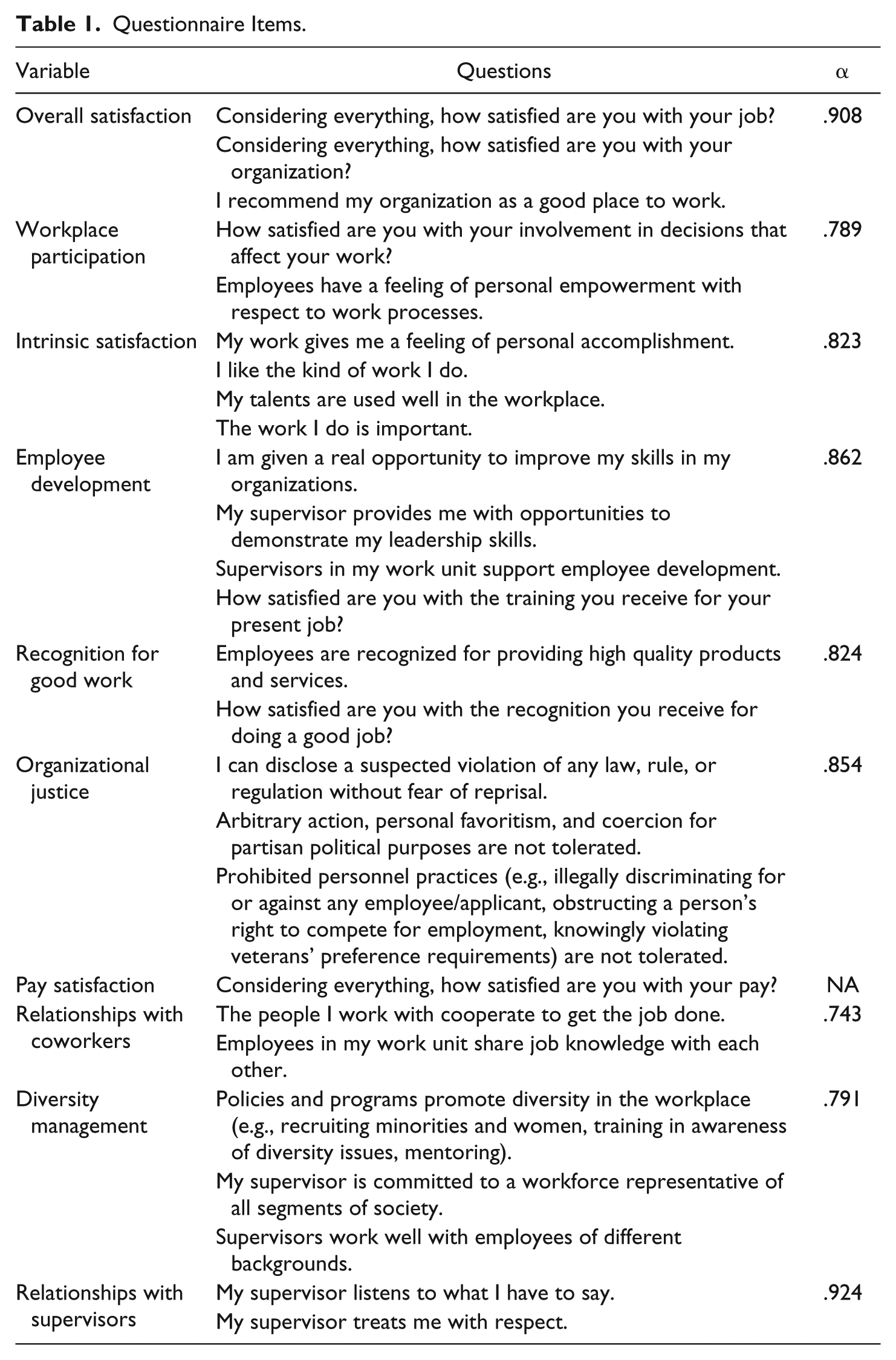
A number of control variables were also included in the model. The study controlled for age, job tenure, and education as Lee and Wilbur (1985) found that these characteristics are associated with significant differences in job satisfaction or in the relative strengths of the determinants of job satisfaction. In addition, supervisory status was included as a control variable; as work conditions frequently differ between supervisor and nonsupervisor positions, this study expects that job satisfaction and its determinants may differ between these two groups as well.
Analytic Strategy
The purpose of this study is to compare the relative strengths of the determinants of job satisfaction across different gender-ethnic groups, namely, White males, White females, non-White males, and non-White females. Admittedly, a binary distinction between Whites and minorities is less than ideal, given that the minority population consists of a variety of diverse racial and ethnic groups. However, the FEVS data do not include any additional information regarding respondents’ ethnicity. In any case, as the focus of this study is to examine whether minority employees differ from the majority in terms of the factors influencing their job satisfaction, an analysis of the above four groups will provide insights relevant to this question. Thus, following Daley (1996), who used the same binary distinction in his analysis of gender and ethnic differences in career advancement, the study divided the sample into the above four groups. For each group, the study ran a regression to examine the effects of the nine predictors on overall satisfaction, and then compared the effect sizes across groups as represented by the standardized regression coefficients.
It is typical for empirical studies using regression analysis to rely on significance tests to determine the importance of the coefficients without paying attention to actual effect sizes. However, the effect size (e.g., standardized regression coefficient) is generally believed to convey equally important, if not richer, information than the results of a significance test as to the association between predictors and a dependent variable (Durlak, 2009). Although significance test results are heavily influenced by sample size, an evaluation of effect sizes is free from that bias. As the FEVS sample size is so large that even small coefficients can be statistically significant, a comparison of the actual effect sizes will provide a more appropriate approach for accomplishing the goal of this study.
Results
Preliminary Analysis
The data for this study were obtained from a single survey, namely, the 2015 FEVS. When the data measuring both dependent and independent variables are from the same source, there is a danger of “common source bias,” wherein the true relationship between variables is inflated by respondents’ psychological tendency to maintain a consistent tone across different questions. This is a typical problem in studies using self-report survey methods, and it cannot be resolved statistically (Favero & Bullock, 2015). However, Harmon’s one-factor analysis provides a method to detect the severity of the problem: If an exploratory factor analysis (EFA) reveals that only one factor emerges and most of the variance is explained by that single factor, it indicates that the common source bias is severe enough to distort the results (Podsakoff & Organ, 1986). The study ran EFA with all the questions used in this study, with three factors emerging from the data and the factor with the greatest loading explaining only 30% of the total variance.
In addition, the study also ran a confirmatory factor analysis (CFA) with a nine-factor model assuming that all variables in the study are distinct from each other, and with a one-factor model assuming that a single factor underlies all the variables. The results of CFA reveal that the nine-factor model fits the data much better than the one-factor model. The fit indices for the nine-factor model were all satisfactory (chi-square statistic [CMIN] = 398,128.048, p = .000, standardized root mean square residual [SRMR] = .0534, comparative fit index [CFI] = .924, normed fit index [NFI] = .924, relative fit index [RFI] = .904, Tucker–Lewis index [TLI] = .904, root mean square error approximation [RMSEA] = .080), whereas the fit indices for the one-factor model were poor (CMIN = 1,089,967.240, p = .000, SRMR = .0638, CFI = .791, NFI = .791, RFI = .772, TLI = .772, RMSEA = .124). Thus, this study concluded that common source bias is not so severe as to invalidate the results. Also, the acceptable fit indices show that the measurements model of the study is valid.
Table 2 shows the descriptive statistics and correlation coefficients for the 10 study variables. High correlation coefficients among some of the study variables may indicate the possibility of a problem with multicollinearity. However, the existence of multicollinearity does not pose a substantial problem for this regression analysis, as some level of correlation among these variables is normal and to be expected. For instance, diversity management and organizational justice are closely linked to each other; those organizations that proactively implement diversity programs also tend to achieve organizational justice, as both of these policies aim to support democratic values. Acknowledging such natural correlations, Studenmund (2006) suggested that one of the options for dealing with multicollinearity is to do nothing.
Descriptive Statistics and Correlation Matrix.

p < .05. **p < .01.
The important question here is whether high correlations among some of the variables in this study cause biases that would invalidate the findings. Only if this is the case would there be a need to do something to address the issue. The potential for such biases can be checked using the variance inflation factor (VIF). VIF scores for the dependent variables ranged from 1.016 to 4.962, with most of them around 2.0. Hair, Anderson, Tatham, and Black (1995) suggested that VIF scores of greater than 10.0 indicate that multicollinearity biases the results. Thus, the study concludes that the level of multicollinearity in this study is not so severe as to invalidate the results.
Regression Analysis
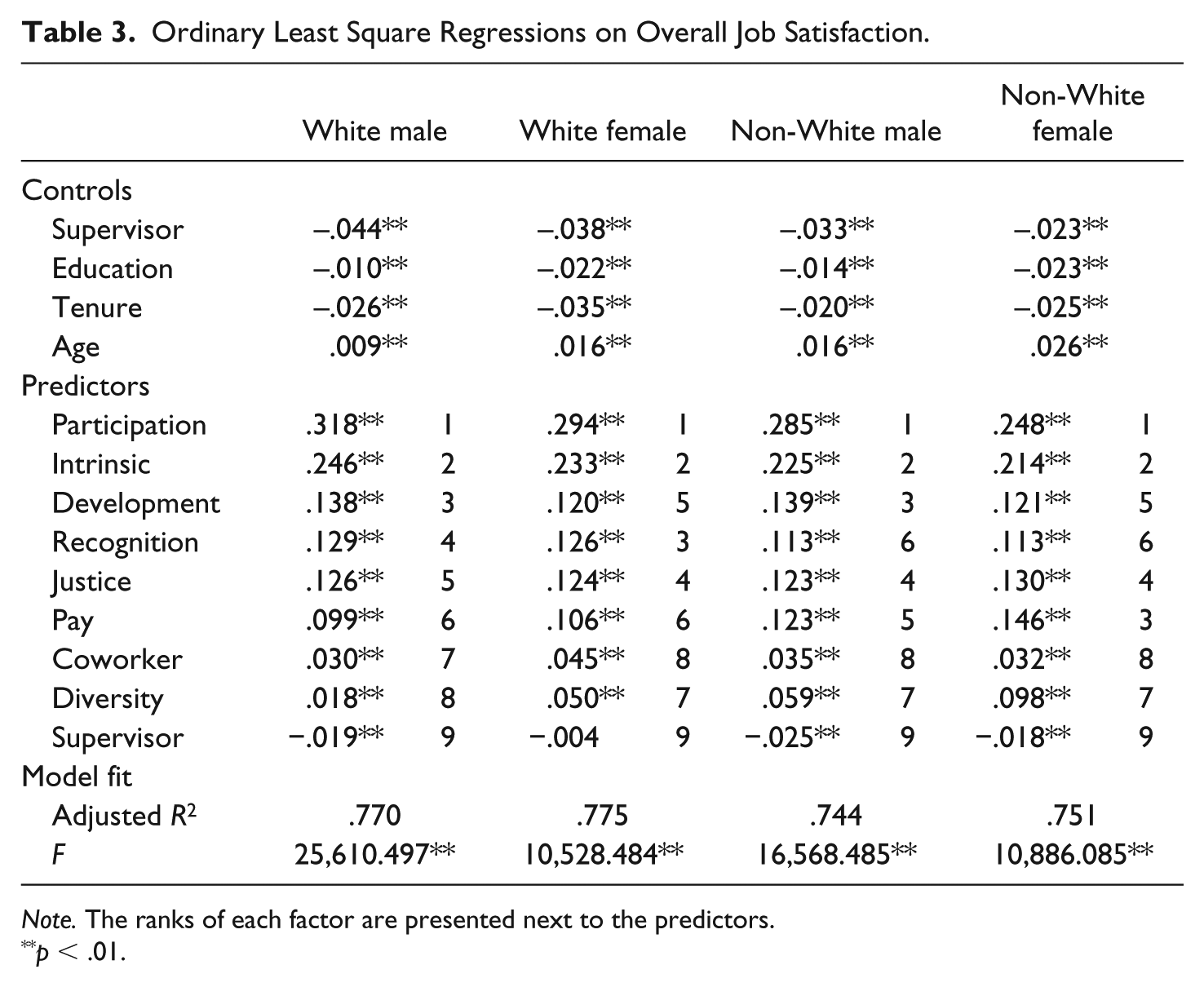
The results of the ordinary least squares (OLS) regressions are presented in Table 3. Results for each of the four demographic groups are presented separately, with the rankings of the predictor effect sizes also provided. The predictor variables explained a significant portion of the variance in overall job satisfaction in all four models, with adjusted R2 of .770 (White males), .775 (White females), .744 (non-White males), and .751 (non-White females). The F values for all models were significant (p < .01) as well.
Ordinary Least Square Regressions on Overall Job Satisfaction.
Note. The ranks of each factor are presented next to the predictors.
p < .01.
To examine the effects of the individual predictors, and better visualize the differences among the four groups, line graphs of the regression coefficients are depicted in Figure 1. A number of conclusions can be drawn from these results. First, participation and intrinsic satisfaction were the two strongest predictors of overall satisfaction for all four groups. However, the differences among the groups in terms of the actual effect sizes for participation were relatively large, with the biggest effect for White males (.318) and the smallest effect for non-White females (.248). More generally, there appears to be an interaction effect of ethnicity and gender on the participation effect size, with a bigger effect for men than for women and a bigger effect for Whites than for non-Whites. This same pattern is found for the intrinsic satisfaction variable, but the differences in effect sizes across the four groups are not as large.
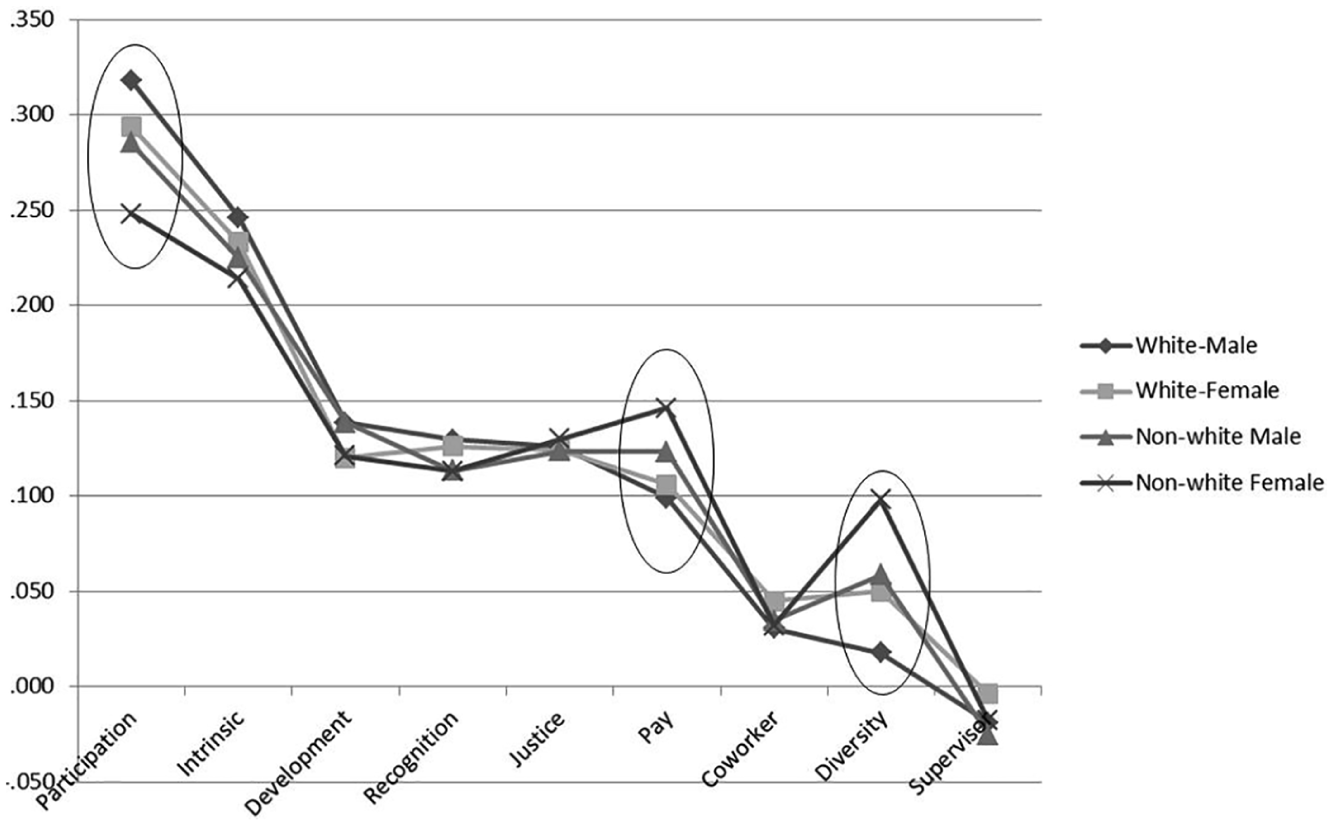
Regression coefficient of each predictor of overall job satisfaction.
A second key result is that both ethnicity and gender also have a notable effect on the importance of diversity management as a determinant of work satisfaction. Not surprisingly, it is more important to non-Whites than to Whites and more important to women than men. The result is that this variable demonstrates the biggest differences in effect sizes among the four groups, ranging from the largest effect for non-White females (.098) to the smallest effect for White males (.018). Despite these differences, it is also worth noting that diversity management was in the bottom three determinants of satisfaction for all four demographic groups, suggesting that many other factors have a more significant impact on work satisfaction regardless of demographic background.
Third, ethnicity appears to have some effect on the relative importance of pay and recognition as determinants of satisfaction. Recognition was a higher priority, with bigger effect sizes, for Whites than non-Whites regardless of gender, whereas pay was more important to non-Whites than Whites. Interestingly, there was a bigger difference between minority men and women on this variable than between White men and women, resulting in a clear difference between the effect sizes for non-White females (.146) and White males (.099). Another small effect is the impact of gender on the importance of development, with this factor being a more important predictor of satisfaction among men than women. Finally, it is notable that the relational variables were among the three least important predictors for all four groups, with coefficients for relationships with supervisors even turning negative for all groups other than White females.
Regarding the hypotheses, the study concludes that Hypothesis 1 is supported as the effect size for pay was lower among White males than among the other three groups, with the largest coefficient for non-White females. Hypothesis 2 is not supported, as the differences in effect sizes for the two relationship variables are quite small, with no clear impact of either ethnicity or gender. There is considerable support for Hypothesis 3, in that White males had the largest effect size among the four groups for three of the four factors associated with growth needs, and they were the only demographic group for which these four factors were ranked as the top four most important. Finally, there were mixed results pertaining to Hypothesis 4, in that diversity management was more important to women and minorities than to White males, and most important to minority women, while there were no differences among the four groups in terms of the importance of organizational justice.
Discussion
The purpose of this study was to examine the extent to which the determinants of job satisfaction differ among subgroups of U.S. federal employees defined in terms of both gender and ethnicity. One of the main strengths of this study compared with prior research on similar topics is that a more comprehensive model of job satisfaction was examined, enabling not only a comparison in terms of individual factors but also in terms of the overall patterns of the priorities given to the individual factors. The comprehensive nature of the model provides a bigger picture for analysis regarding gender and ethnic differences among these employees.
Conclusions
The graphs in Figure 1 indicate that, all in all, there are not many demographic differences in the strengths of the predictors of job satisfaction in this study. Even for those variables reflecting such differences, they are relatively small rather than being very remarkable. In particular, similar rankings of the factors across the four subgroups attest to the lack of significant demographic differences. In all four groups, for example, participation and intrinsic motivation are the top two factors, while diversity management and relationships with coworkers and supervisors are the bottom three factors. One possible explanation for this overall pattern of results is that human beings tend to share a similar need hierarchy or structure regardless of their gender and ethnicity. Despite other meaningful differences that exist between men and women and between Whites and non-Whites, this finding suggests that, when it comes to determinants of work satisfaction, what people share in common may be more important than any differences associated with demographic distinctions.
A second explanation could be that the organizational context of this research mitigates any demographic differences that otherwise exist among people in these four subgroups. Although race/ethnicity and gender may be dominant features that lead people to think, feel, and act in different ways more generally, such differences may be moderated in an organizational environment (Solomon, Bishop, & Dresser, 1986). This is because an organization generates strong situational forces that exert considerable influence on the nature of the human activity taking place in that context, thereby reducing the importance of individual differences (Davis-Blake & Pfeffer, 1989). For example, Kanter (1977) explained how apparent differences in the behavior of men and women, or majority and minority members more generally, resulted primarily from differences in how they were treated by the organization rather than from any inherent differences among the groups. Any racial/ethnic or gender differences could be further suppressed in U.S. federal government agencies, where institutional mechanisms preventing the discriminatory treatment of employees are stronger than in private firms.
Another reason the results of this study may be attributable to the particular context of the U.S. federal government is that only those with U.S. citizenship are legally qualified for federal positions. This suggests that federal employees are likely to be more assimilated into the majority U.S. culture and thus less likely to have retained the values, attitudes, and mind-set of their own ethnic group. Given that private organizations do not have the same legal constraints on hiring, their employees are likely to vary more in terms of the degree of assimilation to American culture. Hence, ethnic differences may be more relevant for private-sector employees. Regardless of the explanation, the implication for the management of U.S. federal employees remains the same: Gender and ethnic differences do not matter much in terms of the factors that lead to higher levels of satisfaction with work.
Although the relative importance of these factors is generally similar across the four groups, those in the middle of the rankings demonstrate the most variation across groups. Employee development, for example, is a higher priority for men than for women, which may reflect the more limited opportunities women have for upward mobility in many organizations. For example, given the existence of a glass ceiling, and the relatively small number of women in management positions, women are less likely to have mentoring relationships at work (Ragins & Cotton, 1991). As a result, women may expect less managerial support for their career development and, in turn, become less dependent on it as a determinant of their job satisfaction. Another consideration here is the fact that women—even in a gender-egalitarian country like the United States—usually take on the primary role for caregiving and meeting other family needs (Eagly & Steffen, 1984). For working women with families, this may reduce their desire to take on more responsibilities at work, such that employee development is not as relevant a factor in their satisfaction at work. In short, limits on both “supply” and “demand” may reduce the importance of employee development among female federal employees.
Another factor, recognition for good work, is less important to those with minority status than it is to Whites, which might be explained by the frustration-regression argument (Alderfer, 1969). In light of evidence that those evaluating performance tend to give more favorable appraisals to those of the same ethnicity (Kraiger & Ford, 1985), and given that most management positions are held by Whites, it is reasonable to posit that minority employees tend to receive less favorable appraisals and/or perceive the appraisal process as less fair than do their White counterparts. They may also believe that performance indicators are biased against them, focusing on attributes or abilities that favor Whites and thus result in lower evaluations for people of color. Given these potential concerns, it would not be surprising if minority employees were skeptical about performance evaluations and thus discounted the importance or value of receiving positive feedback in the form of recognition for good work.
Along with these differences in the relative importance of some of the determinants of satisfaction, there are also notable differences in terms of the absolute strength of a few of these factors, namely, pay, participation, and diversity programs. For these three factors, gender and ethnicity have similar effects in terms of differentiating responses from those of White males. In other words, in each case, the factor is more (or less) important for ethnic minorities than for Whites as well as more (or less) important for women than for men. This suggests that these differences are a consequence of having minority status rather than the effect of being either a woman or from a particular ethnic group (cf. Kanter, 1977). Moreover, these findings provide evidence of intersectionality in that the combined impact of gender and ethnicity resulted in the strongest (or weakest) effect for White males and the weakest (or strongest) effect for minority females.
Consistent with Hypothesis 1, the effect of pay satisfaction on overall job satisfaction was strongest for minority women and weakest for White males. This could reflect the depravity-elevation argument (Maslow, 1943) that, because minorities tend to have less income and wealth (Kochhar & Fry, 2014), they are more inclined to emphasize financial rewards. It could also reflect the frustration-regression argument (Alderfer, 1969) that minorities are likely to experience more frustration of their attempts to fulfill higher level needs (i.e., participation) which would lead them to regress to focus on lower level needs (i.e., pay).
The effect of workplace participation on job satisfaction was strongest for the White male subgroup and weakest for minority females, as predicted by Hypothesis 3. Women and minorities may be less interested in participation to the extent that they believe that important organizational decisions are based on White male values and priorities and inadequately recognize those of minority group members (Acker, 1989; Konrad & Linnehan, 1995). Rather than being able to influence organizational decisions in ways that help to realize their interests, preferences, and priorities, women and minorities may feel pressured to assimilate into the dominant cultural norms (Ely & Thomas, 2001) if they want to participate, knowing that they are likely to experience frustration if they advocate for their own agenda. Skepticism about being able to impact workplace conditions through participation could further reflect a lack of psychological meaningfulness, that is, the extent to which one feels worthwhile, useful, and valuable, which is an important antecedent of work engagement (Kahn, 1990). As many people of color report that they feel devalued and undermined as a result of life experiences (Stone, 2007), they may feel less need or desire for participation in workplace decisions.
Finally, as per Hypothesis 4, the effect of diversity management on job satisfaction was also the greatest for minority females and weakest for White males. This result can be contrasted with the effects of the other equity factor, organizational justice, which demonstrated a similar relationship to work satisfaction across all four demographic groups. Whereas organizational justice involves the practice of treating everyone the same regardless of their ethnicity or gender (i.e., identity-blind), diversity management involves the practice of giving differential treatment to minorities (i.e., identity-conscious). Choi and Rainey (2014) found that affected minority groups tend to be apathetic or even cynical about identity-blind approaches. They argued that minority employees prefer identity-conscious practices because they believe that identity-blind practices implicitly favor the values of the majority culture. Although this study found that diversity management does indeed have more effect on the satisfaction of women and minorities, and especially minority women, organizational justice is a more important determinant of work satisfaction for all four demographic groups.
Implications
The results of this study suggest a number of implications for managing public employees in the United States, at least in the federal government if not at the state and local levels as well. One notable finding is that there are more similarities than differences among demographic groups in the relative importance of the factors that determine their job satisfaction. This may suggest that people have similar need structures and motivational tendencies regardless of gender or ethnicity, such that management systems can focus on those factors that are most important to most people without being too concerned about demographic differences. In particular, participation and intrinsic motivation were the top two determinants of satisfaction in all four groups. Thus, managers can improve the satisfaction of their employees by taking steps to make their work more interesting and engaging and to make sure they have a say in relevant decisions. Of course, such recommendations are not new, but instead are compatible with a long history of organizational scholarship that provides theory and data supporting the value of these approaches.
In contrast, the study did find limited evidence regarding the effects of intersectionality, that is, the combined impact of being a woman and a minority. The three predictors of satisfaction with the most difference across groups in the absolute size of their regression coefficients were participation, pay, and diversity management (see Table 3), with the biggest differences in each case between White men and minority women. Although these differences are not surprising and, indeed, reflect the predictions of the study, they serve as an important reminder that there are still likely to be some differences within a diverse workforce regarding what matters to different people and groups. Although the study offers some thoughts as to the basis of these differences, effective managers should strive to know their employees well enough to be able to factor such differences into their decisions regarding how to motivate, reward, and develop their employees.
Somewhat surprising was the finding that diversity management was a relatively unimportant determinant of work satisfaction even for women and people of color. Previous research has found a positive relationship between diversity management and satisfaction, for example, among social workers in the United States (Acquavita, Pittman, Gibbons, & Castellanos-Brown, 2009) and among Dutch public sector employees (Groeneveld, 2011). More generally, diversity management is consistently related to positive outcomes in organizations when the focus is on promoting a climate of inclusion (Mor Barak et al., 2016), in contrast to earlier practices (e.g., Affirmative Action and Equal Employment Opportunity) that were oriented more toward overcoming patterns of exclusion (Jonsen, Maznevski, & Schneider, 2011). Research by Pitts (2009) found that diversity management moderated the relationship between minority status and job satisfaction, that is, the negative relationship disappeared after controlling for diversity management. On the contrary, Ashikali and Groeneveld (2015) demonstrated that diversity management leading to higher levels of inclusion had positive effects on the attitudes and behavior of both majority and minority groups (native and nonnative Dutch employees).
The clear implication from research on diversity management is that public managers should utilize human resource strategies to create a work environment that is inclusive for all employees. However, further research is needed to identify the kinds of practices that can be most effective. Most research to date has adopted a universalistic approach focused on identifying isolated best practices without consideration of contingent and contextual influences (Martín Alcázar, Miguel Romero Fernández, & Sánchez Gardey, 2013). Alternatively, a configurational approach focuses on a multifaceted bundle of practices that are internally coherent (Martín Alcázar et al., 2013), such as written policies for managing diversity and equality along with a reconsideration of training, recruitment, promotion, and pay practices (Armstrong et al., 2010). Mor Barak et al. (2016) suggested that a useful starting point for developing an inclusive workplace would be to minimize structural inequalities, exclusionary decision-making practices, and norms for accepting new employees into the organization that emphasize assimilation. In particular, they point out that opportunities for shared decision-making can foster inclusion through increased employee engagement and participation, as long as employees believe their input is taken seriously. This notion is compatible with the findings that participation is the primary determinant of satisfaction for all the demographic groups in the study.
Future research should help to clarify how diversity management practices impact the relationships between workforce diversity and relevant organizational outcomes (Jonsen et al., 2011). This could include further attention to the role of psychological processes, including employee perceptions of these practices, that mediate these relationships (Martín Alcázar et al., 2013; Mor Barak et al., 2016). Data should also be collected from a broader range of organizations and employees. For example, to better understand how different demographic groups respond to diversity management efforts, studies could explore these issues in state and local government agencies as well as private and nonprofit organizations. As workforces are becoming more heterogeneous in many places around the world, it would also be good to conduct this research in more countries outside the United States (Jonsen et al., 2011). Likewise, it would be valuable to collect better data on a broader range of the features that contribute to workplace diversity, that is, not just gender and race/ethnicity but also sexual orientation, age, tenure, education, nationality, and immigration status. Finally, longitudinal research would be useful, to track changes in attitudes and behavior over time and better clarify the causal relationships involved in diversity management dynamics.
The findings of this study suggest that there are not major differences between men and women and between Whites and non-Whites in terms of the determinants of their job satisfaction, and that diversity management—while a little more important to women and minorities—is not necessarily a primary factor for anyone. Effective management of a diverse workforce thus may require more focus on outcomes other than satisfaction, including other attitudinal (e.g., organizational commitment) and behavioral (e.g., organizational citizenship behavior) responses (cf. Ashikali & Groeneveld, 2015) as well as job, workgroup, and/or organizational performance. Likewise, as organizational culture does not necessarily mitigate, and may exacerbate, behavioral differences rooted in employees’ cultural backgrounds (Laurent, 1983), greater awareness of how background culture generates differential expectations regarding appropriate organizational and managerial practices could enable more effective responses to cultural heterogeneity. Ultimately, a better understanding of the various pathways through which organizational diversity influences key outcomes can inform and facilitate the design of workplace interventions that improve the functioning of diverse workforces (Mor Barak et al., 2016).
Footnotes
Declaration of Conflicting Interests
The author(s) declared no potential conflicts of interest with respect to the research, authorship, and/or publication of this article.
Funding
The author(s) received no financial support for the research, authorship, and/or publication of this article.
