




Abstract
The public sector requires job crafting from employees so that they can better cope with overdemanding jobs due to layer upon layer of public management reforms. Simultaneously, however, red tape and austerity constrain job autonomy. This study therefore tests how job crafting can be fostered in public organizations by studying social resources at work and, specifically, empowering leadership and social support. Multilevel analyses based on survey data from 1,059 nurses in 67 public elderly care organizations in Flanders, Belgium, show that empowering leadership and social support contribute to job crafting and, simultaneously, strengthen each other’s contribution. Additional analyses showed that empowering leadership, social support, as well as their interaction have differential relations vis-à-vis the different dimensions of job crafting. The implications for public management are discussed.
Keywords
New Public Management (NPM) reforms, as well as austerity regimes throughout the Western world, pose many challenges for the public sector, including the need to provide better services to citizens with fewer resources (Osborne & Brown, 2011; Walker, 2014). These challenges have led to organizational restructuring as well as decentralization of power within the public sector. As a consequence, public leaders need to adopt a new leadership style. Whereas public leaders had to resort to directive and transactional leadership styles in the past, they are now more and more expected to empower their employees so that they can behave proactively (Audenaert, Decramer, George, Verschuere, & Van Waeyenberg, 2019a; De Vries, Bekkers, & Tummers, 2016), which is labeled as an empowering leadership style (Vecchio, Justin, & Pearce, 2010).
Simultaneously, public-sector challenges have resulted in overdemanding jobs (Audenaert, George, & Decramer, 2019b), which require public-sector employees to proactively adapt to their job. Public-sector employees face increasing job demands—due to, for instance, performance management systems, parsimonious resource allocation processes, short-term employment contracts, and so forth—that may harm employees’ well-being (Jung, 2014). While job demands thus increase in public organizations, the possibility for burnout and other negative outcomes also increases (Bakker, van Veldhoven, & Xanthopoulou, 2010). Hence, job crafting is of the utmost importance for public organizations because it can help mitigate the negative effects of high job demands on employees’ well-being. Through job crafting, employees proactively redesign their own job to cope with the increasing job demands. This proactive behavior is crucial to their well-being at work (Demerouti, Bakker, Nachreiner, & Schaufeli, 2001). However, despite its argued importance (Wrzesniewski & Dutton, 2001) and the specific relevance of job crafting in the public sector, little is known about the determinants of job crafting in the public sector (for an exception, see Bakker, 2015). For the purpose of this study, data were collected among nurses in Flemish public elderly care organizations.
Although empowering leadership is clearly relevant to address contemporary public-sector challenges, its prevalence is subject to conflicting demands. In contrast with the increasing demands for empowering leadership, red tape constrains public leaders’ managerial autonomy. Leaders are expected to guard the established rules and procedures rather than the employees’ autonomy (Knies, Boselie, Gould-Williams, & Vandenabeele, 2018). Also, the dominance of austerity constrains the professional autonomy of employees, for instance, in health care organizations (Knies & Leisink, 2014). Nevertheless, job crafting is particularly relevant in the high-demand jobs, currently experienced by many public-sector employees worldwide (Noblet & Rodwell, 2009). The demands for empowering leadership to foster job crafting, on one hand, and the context of red tape and austerity in the public sector, on the other hand, thus suggest that public management research on this topic is particularly needed and salient.
Apart from constraining empowering leadership and job crafting, red tape and austerity also limit the extent to which jobs can provide resources that are motivational and positive to employees’ well-being (Morgeson & Humphrey, 2006). When jobs cannot be designed to entail motivational aspects, such as job autonomy and task variety, the relevance of job crafting becomes particularly apparent. Although employees with lower degrees of discretion have less opportunity to craft, even more rigid job designs allow for job crafting (Wrzesniewski & Dutton, 2001). In that situation, it becomes relevant to see whether social aspects of the job can provide employees with resources to deal with their demanding jobs (Humphrey, Nahrgang, & Morgeson, 2007).
This article thus makes several important contributions to public management literature by studying social resources for job crafting in the context of overdemanding jobs in the public sector. On one hand, this study adds to recent research insights on the linkage between empowering leadership and job crafting (Minseo & Beehr, 2018; Thun & Bakker, 2018) by studying the interaction of empowering leadership with social support. By doing so, this research adds to previous studies which demonstrate that multiple resources are likely to affect job crafting (Bakker, Demerouti, & Euwema, 2005; Diener & Fujita, 1995). On the other hand, by looking at the role of more situational, social resources, this article contributes to the understanding of how to foster job crafting in the public sector. This investigation thus adds to recent insights on how to manage overdemanding jobs in public organizations (Audenaert et al., 2019b), even under conditions where following rules and procedures linked to red tape and austerity constrain job autonomy (Knies et al., 2018; Knies & Leisink, 2014). In other words, this research is also answering the call for more context-specific public management studies. Context matters in public management (Meier, Rutherford, & Avellaneda, 2017; O’Toole & Meier, 2015; Pollitt, 2013), therefore caution is needed when extrapolating insights from other sectors. This study’s sample (i.e., Flemish public elderly care organizations) is confronted with austerity regimes and red tape, offers human services and is single purpose, and is publicly funded as well as scrutinized by political leadership—this research thus tests the applicability of general psychological theory in this specific setting. Moreover, most evidence has come from the United States; this Flemish sample experiences many different constraints compared with its U.S. counterparts—including a more extensive regulatory environment, a stronger influence from labor unions, less autonomy, stronger political control, and more regulated labor markets (George, Van de Walle, & Hammerschmid, 2019; Löfstedt & Vogel, 2001; Meier et al., 2017), again making it relevant to identify whether relationships hold.
In what follows, this article first explains why austerity decreases job autonomy and presents the hypotheses on the relationships between empowering leadership, social support, and job crafting in public organizations. Next, this research discusses the methods and presents the results of a series of multilevel analyses. This study’s findings clearly confirm the important role of empowering leadership and social support in stimulating job crafting among public-sector employees. In conclusion, this investigation elaborates on the implications of these findings for public management research.
Theory
Austerity and Job Autonomy
In the context of this research, that is, the public sector, the government has introduced several austerity measures (Osborne & Brown, 2011). These austerity measures create a strained employment relationship characterized by overdemanding jobs (Audenaert et al., 2019b). When austerity measures are combined with increases in red tape (i.e., rules and procedures), this leads to a reduction in the freedom of employees, especially in choosing how to perform certain tasks. This is because redundant red tape prescribes the steps to take to perform certain actions. In addition, when austerity measures increase, and employees have to fill in more reports about their actions (red tape), there is less time, more pressure, and subsequently less (mental) energy to engage in proactive behaviors like job crafting. Furthermore, when leaders feel these pressures too, they may resort more to directive and transactional leadership styles, which decreases employees’ autonomy as well. Research has shown that leader stress influences employee stress (Skakon, Nielsen, Borg, & Guzman, 2010), which may combine to further decrease employees’ resources. To help employees in these conditions, it is of paramount interest to investigate how leadership and social support may contribute to enhancing the freedom to engage in job crafting behaviors, which may increase their well-being and performance (Thun & Bakker, 2018).
Job Crafting
Job crafting refers to “the physical and cognitive changes individuals make in the task or relational boundaries of their work.” It is an individual behavior that differs between team members and involves “shaping the task boundaries of the job (either physically or cognitively), the relational boundaries of the job, or both.” Employees have latitude “to define and enact the job, (and) acting as ‘job crafters’ within the context of their defined jobs” (Wrzesniewski & Dutton, 2001, p. 179). By designing the job to their own needs, job crafting is distinct from behavioral coping, which entails “how worker stress translates into actions taken toward clients” (Tummers, Bekkers, Vink, & Musheno, 2015, pp. 1101-1102). In the latter, the employee takes actions toward clients, whereas job crafting is specifically about altering job demands or job resources. Job crafting thus represents a relatively new and promising concept in organizational psychology (Tims & Bakker, 2010). Scholars also indicate that job crafting is fundamentally proactive: “by means of job crafting, employees take an active role in customizing their job in order to do good for themselves” (Vanbelle, Van Den Broeck, & De Witte, 2017, p. 26). In addition, research also indicates that job crafting is correlated with active constructs, including proactive personality (Bakker, Tims, & Derks, 2012) and taking personal initiative (Tims, Bakker, & Derks, 2012).
Based on the job demands–resources theory, a low level of well-being in the workplace can be a consequence of high job demands combined with low job resources (Bakker et al., 2005). Following this line of thought, promoting employees’ job crafting behavior could be beneficial in work environments with high job demands. Job crafting refers to the self-directed efforts employees make to optimize their job demands and job resources (Tims et al., 2012). By applying job crafting, employees restore the balance between job demands and job resources in accordance with their own personal preferences, needs, and capabilities (Tims & Bakker, 2010). Indeed, previous research has demonstrated the positive effects of job crafting on improving employees’ well-being and other favorable outcomes at work both for employees and organizations (Bakker et al., 2012; Petrou, Demerouti, Peeters, Schaufeli, & Hetland, 2012; Tims, Bakker, Derks, & van Rhenen, 2013). Job crafting enhances employees’ felt meaning of work and fulfillment of valued identity at work. It improves employees’ work lives in many valued ways. Not only is job crafting beneficial to the employee but also coworkers and public organizations can benefit from it. For instance, research indicates that job crafting is helpful in adapting to changes (Peeters, Arts, & Demerouti, 2016).
Traditional motivation and performance theories (i.e., goal-setting theory and job design approaches) considered employees as passive respondents to the context (Parker, Bindl, & Strauss, 2010). However, the more recent approaches include employees’ volition and see them as active shapers and influencers of their environment (Parker et al., 2010). First, the role of a proactive personality was acknowledged (Parker et al., 2010), after which scholars recognized the motivational processes across types of proactive behavior on the work floor. This led to the conclusion that proactivity is conscious and goal-directed (Parker et al., 2010). In addition, organizations have also realized that redesign approaches are more effective when they also work bottom-up, that is, when they are initiated by employees themselves (Demerouti & Bakker, 2014). The concept of job crafting grew out of the unresolved problems with top-down job redesign (Demerouti & Bakker, 2014) and developments within the proactive work behavior literature (Parker et al., 2010).
Proactive behavior also relates to self-determination theory in that individuals will be more likely to be proactive when they are autonomously motivated, for example, based on the fulfillment of the basic needs for competence, autonomy, and relatedness (Deci & Ryan, 2000; Van Den Broeck, Vansteenkiste, De Witte, Soenens, & Lens, 2010). In addition, proactivity may also help fulfill individuals’ basic needs (Parker et al., 2010).
Research indicates that distal antecedents of proactive goal processes, such as job crafting, include leadership (Parker et al., 2010), as it may shape motivation for proactive goals. This article hypothesizes that especially empowering leadership has a large impact on job crafting because of its focus on granting autonomy. In addition, research indicates that social processes are an important antecedent of proactivity, as they generate positive effects and can influence the internalization of joint team goals, which leads to (greater) identified motivation (Parker et al., 2010).
Job crafting relates to the fulfillment of basic human needs. However, job features such as lack of autonomy in the job may lower the perceived opportunity to job craft (Wrzesniewski & Dutton, 2001). When employees conduct tasks that are highly interdependent, it becomes less easy to make some changes to the job because changes to one job imply changes to other interdependent jobs. Four strategies of job crafting can be defined, namely, increasing job resources, decreasing job resources, increasing job demands, and decreasing/hindering job demands (Tims & Bakker, 2010). When organizations have little possibility to alter task characteristics to extend task boundaries, they may still make changes to the social environment at work (Humphrey et al., 2007; Morgeson & Humphrey, 2006). In turn, this changes the meaning of the work. Conclusively, “[b]y altering their jobs, they fulfil prescribed work tasks but craft the job into something fundamentally different at the same time” (Wrzesniewski & Dutton, 2001, p. 183).
Leadership and Job Crafting
Previous research has linked positive leadership styles to job crafting, mostly by focusing on transformational leadership (Hetland, Hetland, Bakker, & Demerouti, 2018; Wang, Demerouti, & Le Blanc, 2017). In this research, it is posited that transformational leadership provides the motivational basis for job crafting and also imposes a positive image of the future, which helps employees to job craft (Hetland et al., 2018). In addition, transformational leaders expect high employee performance, which may also help employees to ask feedback and advice (i.e., resource-seeking) to augment their performance (Wang et al., 2017). Although transformational leadership may be an important antecedent of employee proactive behavior, empowering leadership may have a more straightforward influence on job crafting as it focuses specifically on empowering behavior from the leader, which enables the employee to experience more autonomy to job craft. Empowering leadership refers to leader behaviors that enable power sharing with subordinates (Vecchio et al., 2010). It emphasizes a top-down transfer of authority, autonomy, and responsibility, which enhances employees’ adaptability to their work circumstances (Gao, Janssen, & Shi, 2011).
Currently, there are only two very recent studies on empowering leadership and employee job crafting (Minseo & Beehr, 2018; Thun & Bakker, 2018). In these studies, it was shown that empowering leadership interacts with employee optimism to increase job crafting (Thun & Bakker, 2018), and that job crafting (enabled by empowering leadership) influences well-being and subjective career success (Minseo & Beehr, 2018). Mostly, these studies hypothesize that ‘the autonomy granted by empowering leaders “can trigger subordinates” job crafting behaviors’ (Minseo & Beehr, 2018, p. 3). As leaders transfer a part of their own power to employees and provide them with decision-making authority, this encourages self-development and proactive, self-directed activities (Thun & Bakker, 2018).
In job crafting, employees have to take control over certain aspects of their job. By doing so, job crafters fulfill a basic human need, namely, the need for personal control. This need is an important motivation for job crafting. However, “not all employees are motivated to fulfil needs for control” (Wrzesniewski & Dutton, 2001, p. 183). As a type of proactive behavior, job crafting is risk-taking in its very nature (Parker & Collins, 2010). This implies the necessity for a comfortable and secure work environment. By sending out a clear signal that self-management and taking charge of one’s own job are appreciated by the leader (Pearce et al., 2003), empowering leadership gives confidence to employees to craft their jobs. Empowering leadership is likely to foster job crafting as it provides power, autonomy, and felt control of tasks to employees by creating flexible work circumstances and removing structural constraints that hinder job crafting (Ahearne, Mathieu, & Rapp, 2005). In an empowered context, employees get the power to adapt their job to some extent based on their own knowledge. Job crafting thus becomes a viable option for them (Amundsen & Martinsen, 2014; Tims et al., 2012; Wrzesniewski & Dutton, 2001). Employees can alter their job in a way that they experience as meaningful. Previous research has indeed suggested that both power limits as well as a lack of opportunities to craft have greatly hampered employees’ job crafting incentives (Berg, Wrzesniewski, & Dutton, 2010), whereas employees with more autonomy and less controlling supervision are more motivated to take initiatives at their workplace (Audenaert et al., 2019a).
This article hypothesizes that an empowering leader has the unique position to have direct effects on job crafting because (a) the immediate supervisor spends a lot of his or her work time communicating with employees (Wajcman & Rose, 2011), and (b) an empowering leader influences the amount of freedom and meaning that an employee can experience, which directly influences employees’ ability, readiness, and motivation to job craft.
Social Support and Job Crafting
Social support refers to the extent to which colleagues offer helpful support at the workplace (Karasek & Theorell, 1990). It has been one of the most suggested resources in highly demanding work environments, given its prominent contribution in protecting employees against various organizational stressors (Bakker et al., 2005; Van der Doef & Maes, 1999).
Considering the salient effect of social support in reducing job demands (Bakker, Hakanen, Demerouti, & Xanthopoulou, 2007) and in compensating for missing resources (Hobfoll, 2001), it can be expected that social support is relevant and valuable for job crafting in public organizations as the core of job crafting is to decrease job demands and increase job resources (Tims et al., 2012). Past research has demonstrated that employees with higher levels of social support tend to incorporate more proactive strategies to deal with undesirable work environments (Greenglass & Fiksenbaum, 2009). Thus, it is reasonable to expect that employees are more likely to take initiative in improving and reshaping work boundaries (i.e., job crafting) when they receive strong social support. Moreover, although job crafting targets one’s own job, colleagues are often affected by the changes resulting from others’ job crafting. To change work boundaries, the help from, and interactions with, colleagues who may be affected could thus be critical. For example, Berg et al. (2010) interviewed employees in both for-profit and nonprofit organizations, and found that low-rank employees mainly stressed the support from social others, both leaders and colleagues, as the key sources in helping them seize the opportunity to craft their job. In fact, the role of supervisor support has been highlighted by many researchers for its effect in promoting feelings of intrinsic motivation and self-determination, and some other types of proactive behaviors (Ohly, Sonnentag, & Pluntke, 2006; Oldham & Cummings, 1996).
As for support from colleagues, previous research has shown that coworkers have been regarded as the most vital resource for employees’ positive adjustment at work. Employees very often count on coworker support in their endeavors to overcome constraints and existing barriers that limit their opportunities to craft their job (Berg et al., 2010; Bjarnadottir, 2011). Hence, increasing social support in the workplace could be crucial in promoting job crafting. Social support is an important coping mechanism that helps employees accumulate resources necessary for job crafting, particularly by mobilizing other resources from their network (Greenglass & Fiksenbaum, 2009). In support of this reasoning, qualitative work suggests that employees tend to consider the lack of formal power as one of the main challenges impeding their job crafting attempts, and winning support from others is one of the most often referred strategies that help them to overcome constraints and equip themselves with possible means to craft their job (Berg et al., 2010). Social support may help to clear up conflicts about tasks, and this particularly in contexts that are more volatile and subject to change (Rodriguez & Rodriguez, 2015). In the public sector, red tape may constrain professional autonomy, and tasks are often structured and clear, which is why this study proposes that the social support will be more helpful to overcome constraints and existing barriers that limit their opportunities to craft their job. Accordingly, this article hypothesizes the following:
Interaction Between Empowering Leadership and Social Support
Besides the hypothesized direct effects, this research also predicts that there is an interaction between empowering leadership and social support. Although both could be important in boosting job crafting, empowering leadership and social support may emphasize different facilitating effects. On one hand, empowering leadership focuses more on unleashing employees from structural constraints (Ahearne et al., 2005), thus creating more opportunities for job crafting. On the other hand, social support provides employees with possible social opportunities to craft their job (Bakker & Demerouti, 2007). In this respect, the impact of empowering leadership on job crafting could be enhanced among employees with high social support, as they function in the right social context to enable job crafting. As mentioned above, the interferences from others in the workplace could be influential. Others’ attitudes and responses could either facilitate or impede the implementation of job crafting. If employees suffer from weak social support, they could be confronted with great challenges in convincing their social environment at work to agree and/or to cooperate. As job crafting is a proactive behavior that requires sponsorship just like other innovation-oriented behaviors (Parker & Collins, 2010), colleagues who do not support the job crafter may resist, refuse, and counteract the job crafter’s intentions. Such resistances are likely to hinder the facilitating effects of empowering leadership. One’s job crafting behavior sometimes engenders unfavorable consequences for his or her colleagues (Tims, Bakker, & Derks, 2015). Colleagues may therefore be sensitive to employees’ intentions to craft their job and may act as a barrier.
Taken together, empowering leadership by itself may not always be sufficient to yield job crafting, particularly when the employees lack social support. This reasoning is supported by the finding that contextual factors determine the effectiveness of empowering leadership (Audenaert & Decramer, 2018). Accordingly, this investigation proposes that the impact of empowering leadership on job crafting is strengthened under high levels of social support.
Method
Public Elderly Care Organizations as Empirical Setting
Public elderly care organizations are funded by the government. As a consequence, they have to follow strict quality criteria and are subject to quality inspections by the government. NPM values such as efficiency, effectiveness, and accountability have been adopted by public elderly care organizations (Audenaert et al., 2019a; Verschuere, Moray, & Decramer, 2012). Input and output control has increased in health care organizations in general, resulting in “registration systems, the setting of performance targets, and the redesigning of healthcare service delivery” (Knies & Leisink, 2014, p. 113). In addition, nurses face notable resource deficiencies (Janssen, De Jonge, & Bakker, 1999). Nurses have little control over their job demands, which makes nursing a high-strain job that is prone to well-being issues. Indeed, the elderly care sector faces problems of job dissatisfaction, turnover intentions (Wall, 2010), and burnout among nurses (Engström, Skytt, & Nilsson, 2011). Nurses are faced with heavy workloads, with people in need of long-term care, with high physical demands, with shortages of staff, and shift work. They often have low job resources to deal with these demands due to the parsimonious resource allocation by NPM (Westermann, Kozak, Harling, & Nienhaus, 2014). The shift work entails changing schedules, so the team members who work together can vary from week to week.
The specific Flemish context also offers a relevant setting for the study.
First, extensive quality reporting systems to receive subsidies from the Flemish Regional Government, as well as the complex regulatory framework (i.e., regulations come from the Belgian Federal Government, the Flemish Regional Government, and even local government) have driven red tape among Flemish public elderly care organizations (Verschuere et al., 2012). Nurses have to measure, monitor, and report on a variety of quality indicators based on (sometimes conflicting or outdated) regulation from different levels of government, next to the core of their job: delivering care.
Second, the stress on nurses in Flemish elderly care has never been higher due to the growing number of elderly citizens. The shortage of nurses in the care sector increases by about 3,500 nurses annually—which is attributable to insufficient funding in contrast with growing demand. Austerity is thus also omnipresent. The impact on nurses working in elderly care cannot be neglected. The 2016 workability monitor (which is an annual monitoring effort that measures the workability of different jobs throughout Flanders) showed that only about 48.5% of employees in elderly care consider their job workable, a number that is significantly lower than the average across the health and care sector (54%).
Third, public elderly care organizations in Flanders experience different constraints from their private counterparts. Indeed, private elderly care organizations have to deal more with NPM pressures. An example relevant to this context concerns the type of clients served. Private elderly care organizations are less likely to focus on high-care residents compared with public ones. These high-care residents require more resources (in terms of time, funding, and human resources [HR]) and are thus less profitable in strict efficiency terms. Providing care to these residents constitutes an important societal outcome (one dimension of public service performance), and it also implies more strain on efficiency (another dimension of public service performance) (Verschuere et al., 2012).
Conclusively, it can be expected that the job autonomy of nurses in this particular setting is clearly hampered by red tape and austerity. First, the discussed red tape measures concerning quality reporting requirements, including many extensive “check-lists” to be filled out by nurses, have the effect that there is no operational freedom in how nurses deal with quality. Nurses have to follow a rigid list with often outdated or conflicting indicators and with little discretionary freedom for the nurse. Second, due to the fact of having more high-care residents (and thus more strain on efficiency), the work of nurses in public elderly care organizations specifically has been subjected to many “time-registering” activities, ranging from measuring how long it takes to execute specific tasks (and offering strict guidelines on how to minimize this) to actually using time clocks. Both thus clearly inhibit the job autonomy of nurses.
Data
Data were collected by conducting a cross-sectional survey of nurses in public elderly care organizations in Flanders, Belgium. The survey and data collection process followed the public administration research standards (Lee, Benoit-Bryan, & Johnson, 2012). First, the survey was pretested to avoid complex or poor questions. Second, the study’s population equaled the sample frame, and therefore, issues of sample representativeness are limited. Third, as a research incentive to enhance respondents’ commitment, a policy report was provided to those directors who agreed to cooperate in this study. Fourth, respondents were informed about the research goals in a cover letter that was attached to the questionnaire. The questionnaires were handed over individually by members of our research team. The procedure for anonymity and confidential treatment was explained when handing over the questionnaire. The respondents were left alone for 20 min while filling out the survey. The researchers then gathered the questionnaires in a sealed envelope. The envelope had a code that allowed us to link the questionnaires to the organization. The sample consisted of 1,059 nurses working in 67 elderly care organizations in Flanders, Belgium. The vast majority of the sample was female (92.8%). The age ranged between 21 and 62 years (M = 37.47, SD = 11.06). On average, this sample entailed 33.40 employees per organization (SD = 20.44), and the organizational tenure of the respondents was 11.31 years (SD = 9.84).
Measures
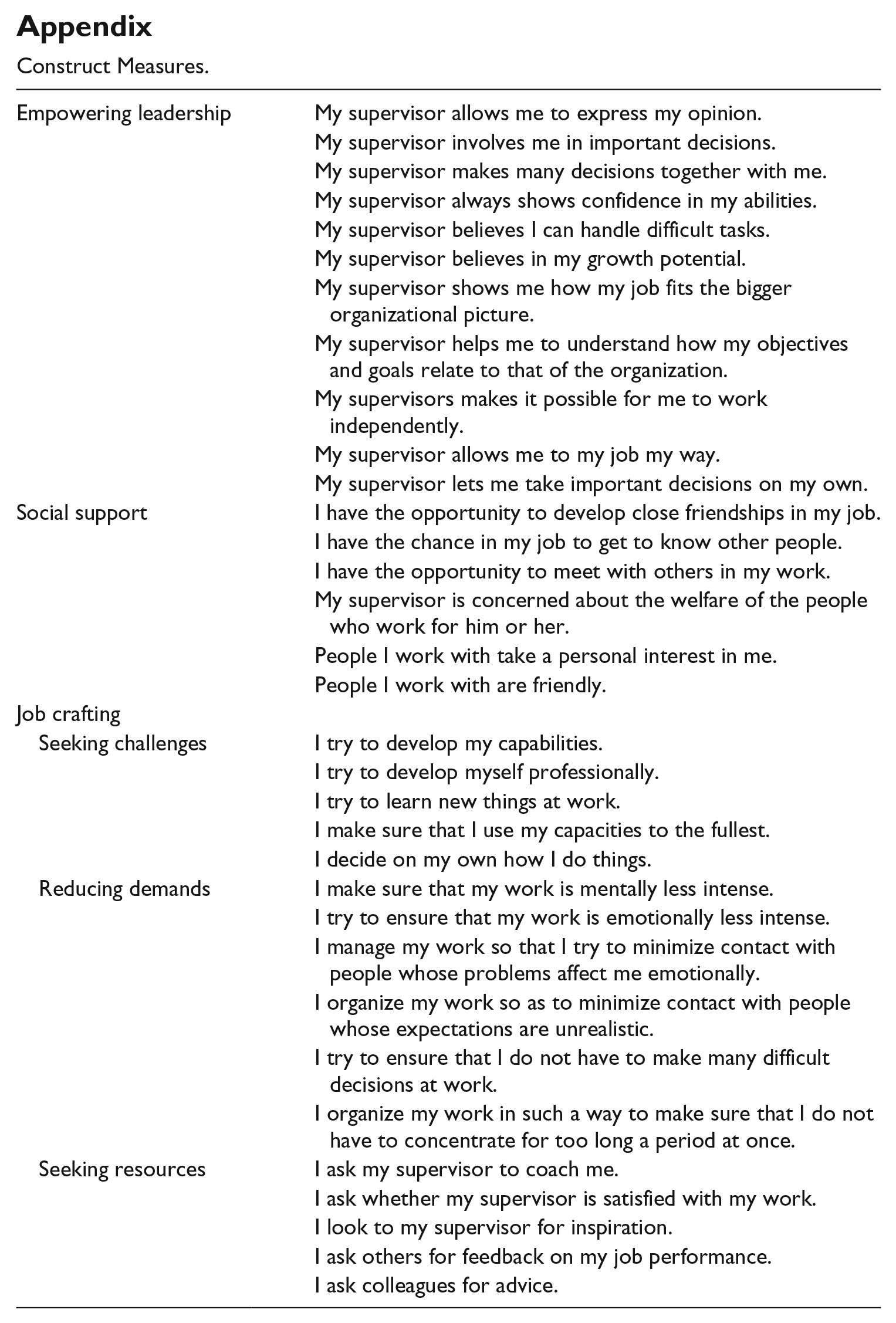
The questionnaire was constructed to measure job crafting, empowering leadership, and social support along with several control variables (see the appendix). After a procedure of translation and back-translation, the questionnaire was administered in Dutch. All items were scored on a 7-point Likert-type scale ranging from 1 (totally disagree) to 7 (totally agree).
Job crafting
This study combined the items from Tims et al. (2012) with the smaller Petrou et al. (2012) scale, which considers job crafting as three-dimensional: “seeking challenges,” “seeking resources,” and “reducing demands.” This approach is in accordance with the original threefold conceptualization by Wrzesniewski and Dutton (2001). Alpha was .77.
Empowering leadership
Empowering leadership was measured by 11 items (Ahearne et al., 2005) developed to measure leadership empowerment behavior. For the purpose of this study, employees’ perceptions of the leader’s empowering leadership were aggregated to the organizational level. This approach was supported by significant between-organization differences, F(67, 992) = 3.307, p < .001. Within organizations, there seemed to be a fair amount of consensus concerning the extent to which empowering leadership was employed (rwg = .82; Klein & Kozlowski, 2000). When aggregated, perceptions of empowering leadership were approximately normally divided, ranging between 3.57 and 5.79 (SD = 0.40).
Social support
This article used six items from the Work Design Questionnaire (Morgeson & Humphrey, 2006) that was developed to measure social support. Alpha was .79.
Control variables
At the individual level, the relationships examined in this study may be confounded by different degrees of discretion between employees (Wrzesniewski & Dutton, 2001). This research controlled for the specific function of caretaking (0 = caregiver, 1 = nurse) and employee’s tenure in the team. At the organizational level, the relationships examined in this study may be confounded by organizational slack resources that affect proactive behavior in public organizations (De Vries et al., 2016). Considering that the number of patients is a relevant indicator of size, this study controlled for the number of residents in the public elderly care organization as a proxy for resource slack.
Common Source Bias (CSB)
Because data for the dependent and independent variables are derived from the same source (i.e., a survey), CSB might be an issue. This research used the recent recommendations for public administration scholarship of George and Pandey (2017) as a way of dealing with, and reporting on, CSB concerns. First, this study followed several procedural remedies set out by Podsakoff, MacKenzie, and Podsakoff (2012) to avoid CSB in the survey design. The questionnaire exclusively used measures from which the psychometric properties were repeatedly demonstrated in previous studies—thus ensuring concurrent validity. Participants were assured about both the confidential and anonymous treatment of their responses. Furthermore, the survey was pretested. Intermediate questions were incorporated between the independent and dependent variables to create psychological separation. The referent of the scales were incorporated into the items (e.g., organizational leader for empowering leadership and employee himself or herself for job crafting). Second, all items were subjected to principal components analysis and restricted to load on one factor (Harman, 1976). This factor only explained 29.39% of the variance, which indicates that common method variance did not seem to be high enough as to create considerable CSB (Fuller, Simmering, Atinc, Atinc, & Babin, 2016). Third, the variables were perceptual by nature—making a survey the optimal means for data collection. Fourth, there were no archival data available to measure those variables of interest. Finally, this investigation included an interaction as an important focal point, and multilevel analyses were conducted. If interactions are found, this is unlikely to be the artifact of CSB (Siemsen, Roth, & Oliveira, 2010), and multilevel analysis lowers the opportunity of Type I errors (Hox, 2010). Moreover, Cronbach’s alphas were tested to assess the internal reliability of the scales and were acceptable (George & Pandey, 2017).
Data Analysis
The respondents were nested in several organizations. Accordingly, hierarchical linear modeling analysis with full maximum likelihood was used to test the hypotheses (Hox, 2010). Deviance is reported as a fit indicator according to the principle, “the smaller, the better the model” (Hox, 2010). Pseudo-R² indicates the proportion of unexplained variances at Level 1 and Level 2 (Snijders & Bosker, 1994). First, the control variables were entered into the regression equation of job crafting (Model 1), then empowering leadership and social support were added (Model 2), and finally the two-way interaction between empowering leadership and social support was added (Model 3). This study followed the recommendations of Aguinis, Gottfredson, and Culpepper (2013) by group mean-centering the predictors (with the exception of the interaction term).
Results
Table 1 reports the correlations of the variables examined in this study. These correlations indicate that social support is positively related with job crafting (r = .39, p < .01), and that team tenure is negatively related with job crafting (r = −.18, p < .01).
Correlation Matrix.

Note. n = 1,059 (individual level) and 67 (organizational level).
p < .01.
Table 2 reports the results of the hierarchical linear modeling. The intercept-only model showed significant between-organization variance for job crafting, which indicates that a multilevel analysis is appropriate (Hox, 2010). Model 1 showed a negative relationship of team tenure with job crafting (β = −.03, p < .001). This model accounted for 7% of the individual-level variance in job crafting (Pseudo-R21 = .07, Deviance = 1004). Model 2 showed a positive relationship of social support (β = .33, p < .001) and empowering leadership (β = .38, p < .01) with job crafting, thus confirming H1 and H2. Adding empowering leadership and social support resulted in increased explained variance both at the individual and the organizational level (Pseudo-R21 = .24, Pseudo-R22 = .33, Deviance = 930). Model 3 showed a significant cross-level interaction of empowering leadership and social support (β = .21, p < .05), thus confirming H3. Also in this final model, deviance went down, which indicates an improved fit (Deviance = 926), and the explained variance increased at both levels (Pseudo-R21 = .25, Pseudo-R22 = .34). Following the suggestions of Aiken and West (1991), the simple slopes of empowering leadership were plotted for low (1 SD below the mean) and high (1 SD above the mean) levels of social support. Figure 1 provides a graphical presentation of the interaction. This figure suggests that empowering leadership has a positive slope both for low and high levels of social support. The slope is steeper when social support is high.
Results of Multilevel Modeling Analysis for Job Crafting.

Note. n = 1,059 (individual level) and 67 (organizational level). Values in parentheses are standard errors.
p < .05. **p < .01. ***p < .001.
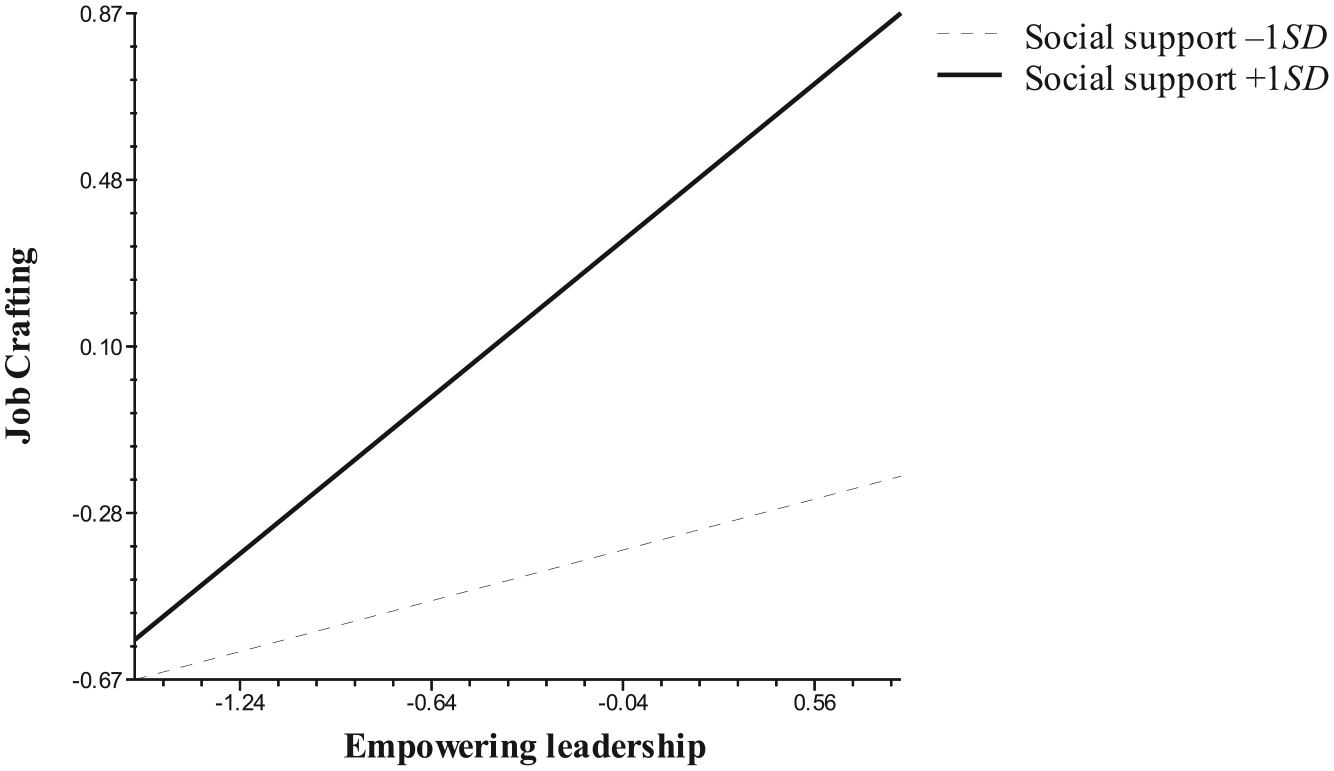
Cross-level interaction of empowering leadership and social support.
Table 3 reports the results of the additional analyses in which this research separately examined the three subdimensions of job crafting: seeking challenges, seeking resources, and reducing demands. For seeking challenges, the model showed a positive relationship of social support (β = .32, p < .001), and a significant cross-level interaction of empowering leadership and social support (β = .25, p < .05). For seeking resources, the model showed a positive relationship of social support (β = .25, p < .001) and empowering leadership (β = .36, p < .001). For reducing demands, the model showed a positive relationship of empowering leadership (β = .19, p < .10).
Results of Additional Test of Multilevel Analysis for the Subdimensions of Job Crafting.
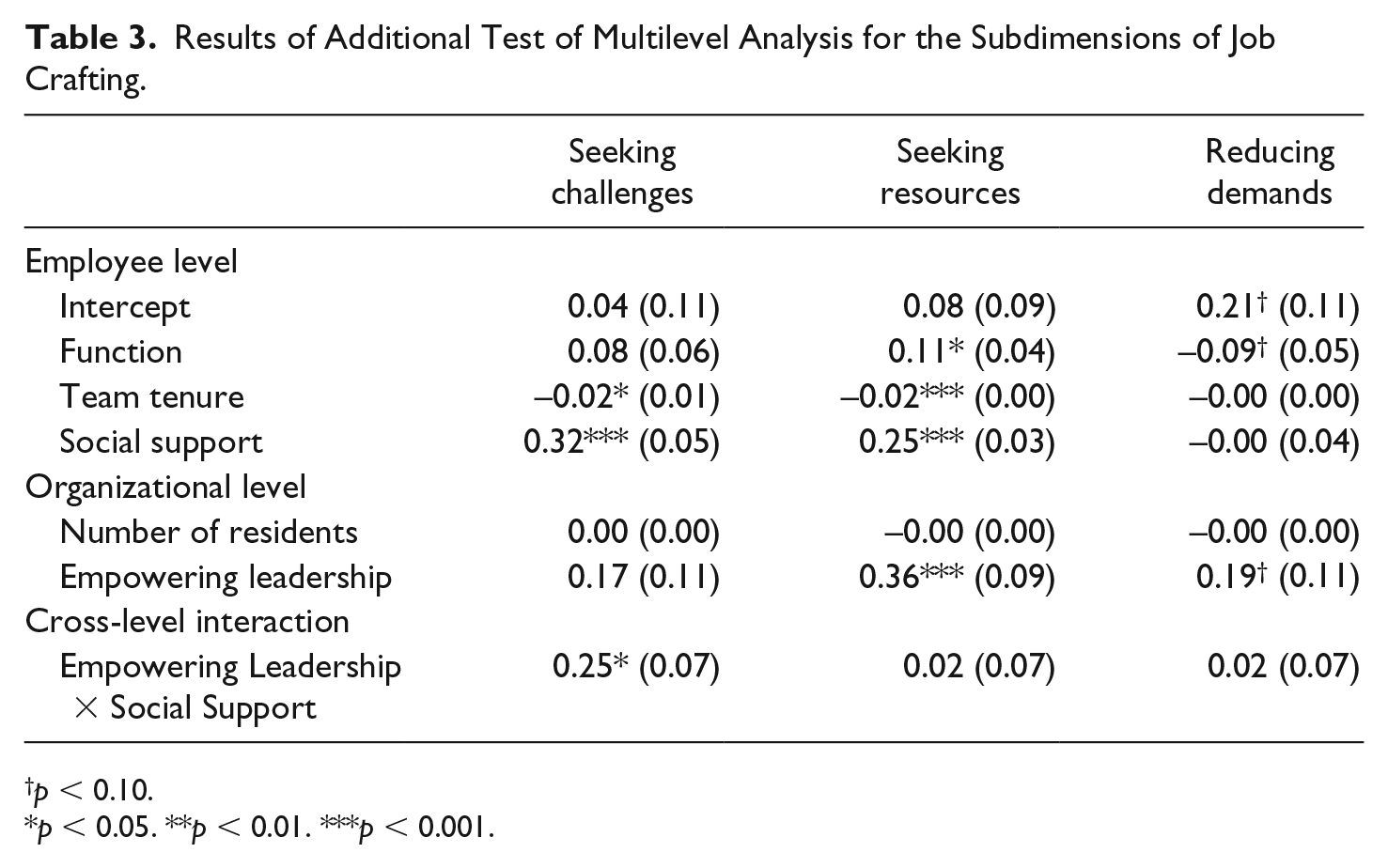
p < 0.10.
p < 0.05. **p < 0.01. ***p < 0.001.
Discussion
This article aimed to identify the determinants of job crafting in public organizations. Due to layer upon layer of reforms in the public sector, job crafting is particularly relevant for public-sector employees. Nevertheless, little is known on how to foster job crafting among public-sector employees who face an overdemanding job in the context of red tape and austerity.
Theoretical Implications
The findings of this study add to the understanding of how public organizations can cope with the conflicting demands on the need for empowering leadership coupled with decreasing job autonomy. As a result of NPM reforms worldwide, enhanced managerial control is installed resulting in lower job autonomy (Knies & Leisink, 2014). Job autonomy has been found to foster positive outcomes among public employees (Tummers, Steijn, Nevicka, & Heerema, 2016). However, the extent to which job autonomy can be granted is limited in some jobs in the public sector. Nevertheless, although job design may leave little room for fostering autonomy among employees in public organizations with high management control, employees can also take an active role in designing their job in accordance with their own preferences and motivation. The finding that empowering leadership can make a difference in the job crafting of nurses is particularly interesting because nurses face a high extent of managerial control. This finding provides empirical support for the view that also more rigid job designs still allow for job crafting under the right leadership conditions (Wrzesniewski & Dutton, 2001), even when employee autonomy has decreased as the result of control-based NPM reforms, red tape, and austerity. This research thus contributes to the understanding of how to manage employees in public-sector jobs that have become overdemanding (Audenaert et al., 2019b) and in which rules and procedures constrain autonomy (Knies et al., 2018; Knies & Leisink, 2014). Employees who have an empowering leader are more motivated to act upon their internal human need to take control of their own job. Hence, they are more inclined to perceive meaning in their work and to make the job their own.
Designing their job in accordance with their own preferences and motivation is not contrary to the public’s best interests. Job crafting differs from shirking that entails conducting other activities than those linked to the job, which may work against the expected contributions (Brehm & Gates, 1997). Job crafting is a concept from the positive psychology that enables “employees to fit their jobs to their personal knowledge, skills and abilities on the one hand and to their preferences and needs on the other hand” (Tims & Bakker, 2010, p. 1). By crafting a job according to their own preferences and motivation, nurses can deal with the stressors that are linked with the expected contributions in the job. Rather than avoiding the expected contributions or working against the expected contributions (such as in shirking), nurses can fit in their job and cope with the expected contributions by job crafting. For instance, the job crafting behavior can entail fostering job resources such as having social support at work. Coping with the expected contributions is not necessarily contrary to the public’s best interests. Instead, by means of job crafting, nurses will rather pursue the job’s goals, which may entail following standard operating procedures, in a way that fits their personal needs by increasing job resources, increasing challenging job demands, and decreasing hindering job demands. This proactive behavior feeds their positive work motivation (Tims & Bakker, 2010). In accordance with this reasoning, job crafting has been found to be intrinsically engaging by being able to adjust the work environment (Rastogi & Chaudhary, 2018). In contrast, the shirking hypothesis proposes that public servants are driven by self-interests rather than engagement (Pierre & Peters, 2017).
This article’s findings also contribute to the scarce body of knowledge on the determinants of job crafting and, in particular, the role of situational factors (Brenninkmeijer, Hekkert-Koning, Jawahar, & Jawahar, 2015; Petrou, Demerouti, Jawahar, & Jawahar, 2015; Tims & Bakker, 2010). Past research stressed some types of work characteristics and individual differences as facilitators of job crafting (Tims & Bakker, 2010). This investigation explored the role of social resources from work such as the leader and the colleagues. Consistent with previous findings that multiple resources are likely to have an effect (Bakker et al., 2005; Diener & Fujita, 1995), this study found that both empowering leadership and social support are suitable and beneficial in public organizations. Empowering leadership, on one hand, endows employees with power and autonomy, which creates more possibilities and opportunities to craft the job (Berg et al., 2010). Therefore, the more empowering leadership employees receive, the more likely job crafting becomes. On the other hand, social support helps employees seize useful resources and means that facilitate job crafting; thus, employees with strong social support may feel more confident to engage in job crafting. This is consistent with suggestions from past research that social support facilitates employees’ proactive coping in the workplace (Greenglass & Fiksenbaum, 2009).
In line with Tims and Bakker’s (2010) assertion that the leader’s influence on job crafting needs more research attention, this article’s findings suggest that empowering leadership has the largest impact on job crafting. Interestingly, this study also found that social support influences the relationship between empowering leadership and job crafting. This finding provides support for the suggestion that multiple social resources interact with each other and jointly change the extent to which employees craft their jobs (Bakker et al., 2005; Diener & Fujita, 1995). This finding is also in line with other research that shows that the impact of empowering leadership on proactive employee behavior depends on contextual aspects (Audenaert & Decramer, 2018).
Interestingly, the findings of the additional analyses showed that empowering leadership, social support, as well as their interaction have differential relations vis-à-vis the different dimensions of job crafting. First, these results add to existing knowledge of the leadership–job crafting nexus. While past research shows that transformational leaders stimulate employees to seek resources and challenges, but not to reduce their demands (Wang et al., 2017), this research finds instead that empowering leaders encourage employees to seek resources and reduce existing demands, but not to seek additional challenges. This leads to suggest that while various leadership styles might have a beneficial impact on job crafting, the underlying mechanisms (and effect sizes) might be different. To that end, future research will do well by comparing empowering leadership’s effects with that of different leadership constructs on job crafting dimensions and other proactive employee outcomes (Kim, Beehr, & Prewett, 2018).
In addition, the data provide support for the cross-level interaction of empowering leadership and social support. For seeking challenges, social support determines the effectiveness of empowering leadership, but not for seeking resources and reducing demands. Seeking challenges at work includes behaviors such as asking for more responsibilities or looking for new tasks once one finishes work (Petrou et al., 2012). This could be instrumental to remain motivated in the context of demanding elderly care work. It seems that especially the combination of an empowering leader with social support from colleagues furthers seeking challenges. This may be related to the “skills development” aspect of empowering leadership (Konczak, Stelly, & Trusty, 2000), which, arguably, will also be supported by knowledgeable colleagues. When skills are developed based on the support of the leader and colleagues, competence need satisfaction is satisfied (Deci & Ryan, 2008), which may, in turn, support the employee to seek more challenges. In addition, this particular relationship may be related to a sense of psychological safety (Kahn, 1990), which has been associated with both leadership (Kahn, 1990; Nembhard & Edmondson, 2006) and social support (Carmeli, Brueller, & Dutton, 2009). When psychological safety is high on the work floor, employees may feel “safe to fail,” which supports behavior related to seeking challenges (Kahn, 1990). While this study found no such similar cross-level interaction for seeking job resources, social support and empowering leadership still play an important role. Employees will ask more help from colleagues or the leader (Petrou et al., 2012) when they work in a socially supportive context. However, this research did not find support for a linkage between social support and reducing demands (Petrou et al., 2012). Further research could study whether this finding is specific for the demanding context of elderly care.
Practical Implications
Public organizations face many demands that are spilled over to the employees’ jobs (Audenaert et al., 2019b). As a consequence, many jobs in the public sector are characterized by low-discretion and demanding tasks. Public organizations thus risk lower well-being among employees, as well as many other undesirable outcomes at the workplace (Hakanen, Schaufeli, & Ahola, 2008; Nahrgang, Morgeson, & Hofmann, 2011). The job autonomy of these employees is constrained by red tape and austerity (Knies et al., 2018; Knies & Leisink, 2014). However, even more rigid jobs contain some space for job crafting (Wrzesniewski & Dutton, 2001). By fostering a social context in which employees can have room to craft their job, public managers can accommodate employees’ uniqueness. By using resources from the social context, job crafters find meaning in their work, which enhances well-being and job performance (Bakker & Demerouti, 2007). Public organizations that suffer from great job demands can foster empowering leadership and a positive social context among colleagues. By doing so, a mismatch between job demands and job resources is alleviated and a sustainable public workforce is fostered.
The present study specifically demonstrates the significant role of leaders and coworkers in promoting job crafting in public-sector jobs that have become overdemanding. Compared with social support, empowering leadership has the strongest link with job crafting behavior. The human resource management (HRM) cycle to manage leaders can entail formal and informal HRM practices, such as goal setting, appraisal, and strength-based feedback on empowering leadership behaviors. These practices can be framed in an empowering leadership development program that focuses on enhancing employees’ psychological empowerment (Lee, Willis, & Tian, 2018). These HRM practices should be framed in an enhanced managerial autonomy to provide supervisory support (Knies & Leisink, 2014). It also shows the importance to coach and guide employees to build positive and supportive relationships in the workplace, so as to create a work environment with strong social support. Furthermore, these results imply the need for maintaining high levels of both empowering leadership and social support, as empowering leadership is more effective for job crafting when employees experience high social support. It is important for public managers to notice that the impact of their empowering interventions may be restricted when there is low social support among coworkers.
Limitations and Future Directions
When interpreting the results of this study, there are certain limitations that should be taken into consideration. First, albeit self-reports are very useful to gain insight into employees’ perceptions, attitudes, and behavioral intentions (Conway & Lance, 2010), a cross-sectional questionnaire design is limited in two important ways. A cross-sectional design does not allow for causal explanations because it suffers from endogeneity issues. A longitudinal or experimental design in future studies may help unfold the impacts of empowering leadership and social support on employees’ job crafting behavior over time. Collecting data from single respondents could be a source of CSB and confound the interpretation of the results. However, this investigation tried to minimize CSB during the collection of the data and by including interaction and multilevel relations, and the ex-post estimation did not signal substantial CSB issues (George & Pandey, 2017; Siemsen et al., 2010). Nevertheless, future research should be encouraged to use multiple sources of data as an additional robustness check for potential CSB issues. Second, this article focuses on an empirical setting where both red tape and austerity measures are high. This implies that this study does not measure both variables in the survey but, rather, considers these as a given. However, this choice also means that this research is not able to assess whether perceptions of red tape and austerity could potentially moderate the identified relationships. Indeed, perceptions of red tape and austerity might not be homogeneous across organizations and future work should be encouraged to explicitly assess potential moderating effects of high or low degrees of perceived red tape and austerity. Finally, while this article’s findings offer important insights to public organizations that are experiencing austerity regimes and red tape, are single purpose, focus on human services, are largely funded by government, and are under the control of political leadership, this study is not able to generalize toward all public organizations as such. This investigation should encourage future research to assess whether this study’s findings hold in other contexts, for instance, in multipurpose public organizations such as municipalities or in public organizations offering more technical services (e.g., financial departments).
Conclusion
To alleviate the notable imbalance of job demands and job resources in public-sector jobs with little employee discretion under NPM regimes, red tape and austerity, promoting job crafting among public-sector employees is essential. This research contributes to public management literature by demonstrating significant effects of empowering leadership, social support, and their interaction on job crafting. If public organizations want to facilitate job crafting, it is important to adopt empowering leadership which endows employees with the necessary power and autonomy and, at the same time, fosters an atmosphere where employees feel supported by their colleagues. This allows employees to resourcefully craft their jobs. Job crafting is a way for employees to enhance their work enjoyment and meaning in work, and make valuable contributions to the workplace. When public organizations can get their employees to craft their jobs, they take an important step forward to ensuring a sustainable workforce and employee well-being.
Footnotes
Appendix
Construct Measures.
| Empowering leadership | My supervisor allows me to express my opinion. |
| My supervisor involves me in important decisions. | |
| My supervisor makes many decisions together with me. | |
| My supervisor always shows confidence in my abilities. | |
| My supervisor believes I can handle difficult tasks. | |
| My supervisor believes in my growth potential. | |
| My supervisor shows me how my job fits the bigger organizational picture. | |
| My supervisor helps me to understand how my objectives and goals relate to that of the organization. | |
| My supervisors makes it possible for me to work independently. | |
| My supervisor allows me to my job my way. | |
| My supervisor lets me take important decisions on my own. | |
| Social support | I have the opportunity to develop close friendships in my job. |
| I have the chance in my job to get to know other people. | |
| I have the opportunity to meet with others in my work. | |
| My supervisor is concerned about the welfare of the people who work for him or her. | |
| People I work with take a personal interest in me. | |
| People I work with are friendly. | |
| Job crafting | |
| Seeking challenges | I try to develop my capabilities. |
| I try to develop myself professionally. | |
| I try to learn new things at work. | |
| I make sure that I use my capacities to the fullest. | |
| I decide on my own how I do things. | |
| Reducing demands | I make sure that my work is mentally less intense. |
| I try to ensure that my work is emotionally less intense. | |
| I manage my work so that I try to minimize contact with people whose problems affect me emotionally. | |
| I organize my work so as to minimize contact with people whose expectations are unrealistic. | |
| I try to ensure that I do not have to make many difficult decisions at work. | |
| I organize my work in such a way to make sure that I do not have to concentrate for too long a period at once. | |
| Seeking resources | I ask my supervisor to coach me. |
| I ask whether my supervisor is satisfied with my work. | |
| I look to my supervisor for inspiration. | |
| I ask others for feedback on my job performance. | |
| I ask colleagues for advice. | |
Declaration of Conflicting Interests
The author(s) declared no potential conflicts of interest with respect to the research, authorship, and/or publication of this article.
Funding
The author(s) received no financial support for the research, authorship, and/or publication of this article.
