



Abstract
Today, public organizations face an increasing challenge of accommodating workplace religious expression by their employees. This article examines the impact of First Amendment workplace religious expression jurisprudence on workplace religious expression by public employees. The article also discusses the impact of Title VII of the Civil Rights Act of 1964, as amended, on the workplace religious expression rights of public employees. The article argues that the complexity of public workplace religious expression jurisprudence may make it difficult for public employers to understand the workplace religious rights of their employees and their rights to regulate the workplace religious practices of their employees to maintain the efficiency and effectiveness of their organizations. The article also argues that public organizations have the capacity to embrace the workplace religious diversity of their employees as part of more extensive efforts to enhance the diversity of their public organizations. Finally, the article analyzes the impact of the U.S. Supreme Court decision in Kennedy v. Bremerton Sch. Dist. (2022) on the workplace religious rights of public employees.
Keywords
Introduction
The U.S. Supreme Court recently held in Kennedy v. Bremerton Sch. District (2022) that a local school district violated the First Amendment freedom of religious expression rights of a part-time high school football coach when it directed that he stops going to the 50-yard line, after shaking hands with the opposing team, to pray (Kennedy v. Bremerton Sch. District, 2022, p. 2411). The coach did not ask anyone to join him. “Over time, however, a majority of the team came to join him, with the numbers varying from game to game” (Kennedy v. Bremerton Sch. District, 2022, pp. 2435–2436). Beyond the fact-specific issues related to the actions of coach Kennedy, the U.S. Supreme Court used the case to reinterpret the Establishment Clause of the Constitution to restrict workplace religious activities by public employees. The U.S. Supreme Court replaced the three-part Lemon test used by federal courts since 1971 to evaluate whether government agencies must prohibit or restrict certain religious activities on government property. In directing coach Kennedy to stop praying on the 50-yard line, the local school district took the position that unless they prevented coach Kennedy from holding prayer sessions on the 50-yard line, the school district would violate the Establishment Clause (Brannon, 2022, pp. 4–5).
The Kennedy v. Bremerton Sch. District case demonstrates the fluid status of public workplace freedom of religious expression jurisprudence. The article seeks to clarify the First Amendment freedom of religious expression rights of public employees in the workplace and the religious workplace rights of public employees under Title VII of the 1964 Civil Rights Act (U.S. Equal Employment Opportunity Commission, 2021a, 2021b, 2021c). Even before the Kennedy v. Bremerton Sch. District decision, First Amendment freedom of expression jurisprudence clarified that public employees had broad rights to engage in various workplace religious activities. And Title VII religious discrimination jurisprudence makes clear that public and private employers must accommodate the workplace religious practices of their employees unless such accommodations would work an undue hardship to an employer (Groff v. Dejoy, 2022).
First Amendment freedom of religious expression jurisprudence makes clear that public employers may not use the Establishment Clause to enforce broad bans on the workplace religious expression of their employees (Brannon, 2022). However, Title VII religious discrimination jurisprudence clarifies that public and private employers must protect their employees from religious harassment (Gregory, 2011, pp. 130–138). With federal courts consistently holding that public employers must allow their employees to express their religious faith in the workplace openly, one may expect an increase in complaints from other employees that they do not wish to be subjected to the religious activities of fellow employees. The fact that an employee may not want to be subjected to workplace religious expressions by another employee does not constitute grounds for a public employer to direct an employee to stop engaging in protected workplace religious activities. The complexity of First Amendment freedom of religious expression workplace jurisprudence and the complexity of Title VII workplace freedom of religious expression jurisprudence makes it essential for public employers to recognize that the vast major of workplace religious expression issues must be resolved on a case-by-case basis. Public employers must familiarize themselves with the issues that frequently arise concerning the workplace religious expression of public employees. When public employers can ask the right questions when deciding how to resolve workplace religious expression issues, the likelihood increases that public workplace religious expression issues may be resolved without costly and divisive litigation.
Recognizing the Role of Religion in the Lives of Public Employees
Public management scholarship has devoted little attention to the impact of public employees’ religious beliefs on public organizations’ operations (Houston et al., 2008). Several factors explain the apprehension of the discipline of public administration to explore this critical question. From its birth, the field of public administration embraced secularization (Lynch et al., 1997). This required keeping religion out of the public workplace. According to Houston, Freeman & Feldman, the discipline of public administration, embraced “rational professionalism” as a way to deal with widespread corruption related to the “spoils system” (Houston et al., 2008, p. 430). Cunningham (2005) writes that “[r]eligion deals with private spiritual matters of individuals. In contrast, public administration carries out the policy decisions of government in a generally transparent, public way” (p. 943). This made sense. Public employers sought to make clear to the public that the religious beliefs of their employees had no impact on the decisions taken by their employees. From this perspective, keeping the religious beliefs of public employees out of the public seemed similar to prohibiting government employees from engaging in any political activities while on duty (Novak, 2020).
When discussing the religious workplace rights of public employees, one must first examine the difference between spirituality and religion. Spirituality may or may not be tied to specific religious beliefs. Rahman defines spirituality as an individual/experiential sense of being connected with a higher entity that transcends the individual. Spirituality is individually/experientially, rather than institutionally, based. The spiritually oriented individual may be imbued with such values/virtues as benevolence, love for others, justice to others, altruism, compassion, etc. Spiritually oriented individuals may go through transcendental experience or connectedness with a higher entity (Rahman, 2018).
“Religion is attributed to traditional values and practices related to certain groups of people or faiths. A religious person is associated with a particular belief, God, sacred scriptures, values, and ethics” (Victor & Treschuk, 2020, p. 109). A growing number of Americans do not identify with any religion. A December 2021 Pew Research survey found that 29% of adult Americans define themselves as religiously unaffiliated (Smith, 2021). The growing number of Americans who do not identify with any religion has significant implications for the management of workplace religious rights. If this trend continues, it might result in a more substantial number of public employees expressing concern over the religious activities of other employees (Gregory, 2011, pp. 130–138). At a minimum, public employers will be forced to devote more time to educating their workforce about the growing faith diversity in their organizations (Gümüsay, Smets, & Morris, 2020; Hummel, 2008).
For organizations seeking to increase organizational efficiency, a growing body of research shows a relationship between the religiosity of public employees and job satisfaction and, arguably, organizational efficiency (Freeman & Houston, 2010; Houston & Freeman, 2021). Research demonstrates that “some people consider their work a sacred calling from God and consequently believe that the performance of their job duties encompasses a higher purpose” (Houston & Freeman, 2021, p. 1). Research also indicates that public employees with higher levels of religiosity have higher levels of public service motivation (Houston & Freeman, 2021, p. 1). From the 1960s through today, public workplace freedom of speech jurisprudence has undergone a significant transformation. This transformation has forced many public employers to make substantial changes in how they deal with workplace religious expression by their employees. This transition has proven difficult for some public employers. The U.S. Supreme Court decision in Kennedy v. Bremerton Sch. Dist. (2022) sends a clear message to all public employers that they must learn to manage faith diversity or face serious legal consequences. The management of faith diversity has become an essential element of modern public sector human resource management.
Evolution of the First Amendment Freedom of Religious Expression Jurisprudence
Before the late 1960s, public employees had few workplace rights. This included the right to engage in different types of workplace religious expression. From the late 19th century through the 1950s, federal and state courts vigorously enforced the so-called public employment “privilege doctrine” (Dotson, 1955). Like private employers, public employers had broad discretion to limit their employees’ on and off-the-job conduct even if it arguably involved exercising fundamental rights protected by the U.S. Constitution (Dotson, 1955). This included permitting public employers to sharply limit the First Amendment freedom of speech, association, and freedom of religious expression workplace rights.
Beginning in the 1960s, the United States Supreme Court started dismantling the public employment privilege doctrine. Before the Court completed this process, the U.S. Supreme Court sent a clear message that governments may not adopt policies that burden the free exercise of religion. In the landmark case of Sherbert v. Verner (1963), the Court struck down a state policy that denied individual unemployment benefits because the individual refused to work on Saturday due to the individual’s religious beliefs (Herman, 2009). The decision, however, did not have any immediate impact on the workplace religious activities of public employees because the U.S. Supreme Court had yet to grant public employee workplace First Amendment freedom of speech rights. This changed with the U.S. Supreme Court decision in Pickering v. Board of Education (1968), where the U.S. Supreme Court held that public employees had limited workplace First Amendment freedom of speech rights (Hudson, 2017; Rosenbloom, 2014, p. 143). Pickering required federal courts to apply a two-part balancing test when reviewing the First Amendment freedom of speech rights of public employees and arguably the First Amendment freedom of religious expression rights of public employees. A federal court first had to find that the public employee’s workplace speech involved a matter of public concern. If the employee’s speech involved a matter of public concern, then Pickering required the court to determine whether the speech unduly disrupted the efficient operation of the employee’s organization. Through the 1970s and well into the 1980s, few First Amendment freedom of religious expression cases found their way into federal court.
In Garman v. United States Postal Service (1981), for example, a Postal Service employee sued to block being required to help register individuals for military service because of his religious beliefs. The Federal District refused to grant an injunction because of serious staffing issues if the employee did not periodically work on Saturday.
The case of Tucker v. State of California Dept. of Educ (1996) has come to symbolize the beginning of a new era in First Amendment public workplace freedom of expression jurisprudence by the rejection of the argument by some public employers that the Establishment Clause required that they ban all religious workplace activity by their employees. The case involved a decision by the Child Nutrition and Food Distribution Division of the State of California to prohibit all of its employees from (a) storing or displaying any religious artifacts, tracts, information or other materials in any part of the workplace other than in their own closed offices or defined cubicles, (b) from engaging “in any religious advocacy, either written or oral, during the work hours or in the workplace
(3) and from placing “any personal acronym, title, symbol, logo, or declaration unrelated to the business of the Department on any official communication or work product” (Tucker v. State of California Dept. of Educ, 1996, p. 1208). The Ninth Circuit clarified that the total ban on religious speech violated the First Amendment right to freedom of religious expression in the public workplace. In reaching his conclusion, the Ninth Circuit rejected the argument that permitting employees to engage in workplace religious speech would work an undue hardship on the California agency by forcing requiring supervisors to spend hundreds of hours dealing with the religious activity of the agency’s employees.
The U.S. Supreme Court decision in Garcetti v. Ceballos (2006) transformed public employee First Amendment freedom of speech jurisprudence by holding that First Amendment did not protect the speech of public employees made in the course of performing their official duties because the employee engaged in speech as a public employee and not a private citizen (Hudson, 2009). The decision would have significant implications for the workplace religious practices of public employees. Take, for example, a public employee who goes to a mandatory meeting and, at the beginning of the meeting, says a prayer to everyone at the meeting. The employee’s unit head disciplines the employee for engaging in an open prayer at the beginning of the discussion by demoting the employee. The employee brings suit, arguing that the decision bans him from saying a prayer at the beginning of a unit meeting violated his First Amendment freedom of religious expression rights. One might say that a strict reading of Garcetti would require a Federal District Court to dismiss the First Amendment freedom of religious expression complaint because the employee spoke while performing their official duties, attending an official meeting.
Evolution of the Three-Part First Amendment Freedom of Speech Balancing Test.

The First Amendment and Symbolic Speech and the Public Workplace
The 1990s saw an increase in public employees willing to file suits to defend their right to attest to their faith in the public workplace (Berg, 1999, p. 974). This included seeking the right to wear religious jewelry or clothing to work. Public employees bringing such suits faced the immediate problem of persuading a federal court to recognize that the First Amendment protected the wearing of religious jewelry or clothing from working and that the wearing of jewelry constituted a matter of public concern. In Connick v. Myers (1983), the U.S. Supreme Court complicated this process of determining whether a complaint made by a public employer involved a matter of public concern. The U.S. Supreme Court held that common employee grievances did not typically qualify as a public concern. Gradually, federal courts reached a consensus that wearing religious jewelry constituted symbolic speech and involved a matter of public concern. These decisions would pave the way for public employees to gain greater freedom to wear religious jewelry and clothing to work.
In Nichol v. Arin Intermediate Unit 28 (2003), a Federal District Court held that the school district violated the First Amendment freedom of religious expression rights when it suspended an elementary school instructional assistant was suspended “for refusing to remove or conceal a small cross she regularly wore on a necklace” (p. 536). Applying Pickering to the case facts, the Federal District Court held that the cross constituted a form of religious speech, which involved a matter of public concern. The Federal District Court then turned to the issue of whether wearing the cross in any way disrupted the efficient operation of the school where the teacher’s aide worked. “Pertinent considerations on the employer’s side of the scale include speech which impairs discipline by superiors or harmony among co-workers, detrimentally impacts close working relationships, or impedes the performance of the speaker’s duties or interferes with the regular operation of the employer’s business.” explained the court (Nichol v. Arin Intermediate Unit 28, 2003, p. 560)
Applying its disruption test to the facts of the case, the Federal District Court failed to find evidence that wearing the small cross had caused or would cause any disruption to the efficient operation of the school that employed the teacher’s assistant. In adopting the ban on religious jewelry, the school relied upon the Establishment Clause to justify the policy. The federal court rejected the argument that allowing employees to wear religious jewelry would constitute an endorsement of religion by the school district.
In Draper v. Logan County Public Library (2003), another Federal District Court struck down a general ban on employees wearing religious jewelry to work. (Draper v. Logan County Public Library, 2003, p. 611). The library feared that if it allowed employees to wear religious jewelry, it might be sued for violating the Establishment Clause. Applying the Pickering/Connick balancing test, the District Court held that wearing religious jewelry constituted symbolic speech for purposes of the First Amendment and therefore constituted a matter of public concern. The District Court then found that wearing symbols at work did not unduly disrupt the efficient operation of the public library. Finally, the court rejected the library’s Establishment Clause defense. Allowing an employee to wear a cross pendant was an endorsement of a particular religion by the public library (Draper v. Logan County Public Library, 2003, p. 261).
By the end of the 2000s, a consensus developed in lower federal courts that the First Amendment protected the symbolic religious speech of public employees and that public employers may not enforce an outright ban on public employers wearing religious jewelry.
These decisions sealed the fate of the secular public workplace.
The First Amendment and the Public Workplace Religious Speech of Public Employees After Garcetti and Kennedy
Workplace religious speech takes many forms. A public employee may engage in a conversation with another employee about religion. A public employee may open and read a sacred text in the workplace. Public employees may pray silently in a shared workplace or out loud. Several public employees may gather together to discuss a religious text or pray. One employee may invite another employee to attend a worship service at their church although the employee making the invitation knows the other employee has expressed hostility to organized religions. In a lunch room, one employee tells another employee that God demands that all of us protect the unborn. An employee displays a picture of Jesus and the text of the Lord’s Prayer in her private work area. A group of employees holds a Bible study, on their own time, in a conference room that management allows employees to use.
As noted, the U.S. Supreme Court decisions in Garcetti v. Ceballos (2006) seriously complicated First Amendment public workplace freedom of religious expression jurisprudence. Garcetti arguably denies First Amendment freedom of speech protection to any workplace religious activity a public employee engages in while performing their official duties. Federal courts have sometimes found it difficult to determine whether a public employee engaged in a workplace religious activity as a public employee or as a private citizen. Also, a public employer with a sufficient understanding of everyday religious practices. In the case of Shatkin v. Univ. of Tex. at Arlington (2009), for example, three employees of a university development office had a personality conflict with a fourth development office employee.
After the end of the workday, at 5.30 p.m., the three employees, upset with the fourth employee, met in front of the cubicle of the fourth employee, who had gone home for the day, to pray about how to handle the situation. A nonreligious person might regard such conduct as strange. Due to the belief in the power of prayer, a profoundly religious person might have few problems with such behavior. One of the employees who participated in the prayer session “dabbed olive oil on the doorway to” the fourth employee’s cubicle (Shatkin v. Univ. of Tex. at Arlington, 2009, p. 3). The prayer session took place without the fourth employee being present.
One of the employees who had participated in the prayer session reported the session to his supervisor. The supervisor told the university’s human resource department about the prayer session. The HR investigation confirmed that the prayer session had taken place. The HR department then recommended firing two of the three employees who had participated in the session (Shatkin v. Univ. of Tex. at Arlington, 2009, p. 4). The supervisor of the two employees then provided written notice to the two employees “that he intended to fire them because they displayed conduct unbecoming a UT Arlington staff member, harassment of a co-worker, and blatant disregard for the property of the university” (Shatkin v. Univ. of Tex. at Arlington, 2009, *4). The supervisor subsequently fired the two employees. Applying the Pickering/Connick/Garcetti balancing test, the Federal District Court found that the fired employees had spoken out as private citizens, not public employees. However, it also found that the prayer session did not involve a matter of public concern. Because of this finding, the District Court dismissed the two employee’s First Amendment freedom of religious expression rights. The result concerning the First Amendment did not preclude the two employees from proceeding with a separate Title VII religious accommodation lawsuit (Shatkin v. Univ. of Tex. at Arlington, 2010). Significantly, a Federal District Court refused to dismiss the Title VII complaints of the two employees fired for participating in the prayer session because their decision to practice their religious faith constituted the sole reason for their dismissal.
In Faulkner v. Univ. of Cincinnati (2015), the Garcetti decision directly impacted the outcome of a First Amendment freedom of religious expression lawsuit. While serving on the steering committee for a university IT department, an employee accepted an invitation to give a lecture on servant leadership at an off-campus meeting site. In his talk, he used several “Biblical references to illustrate his ideas and explain his views about servant leadership” (Faulkner v. Univ. of Cincinnati, 2015, p. 2). An employee attending the event filed an anonymous complaint with the university regarding the speaker’s use of religious references in his talk. A few months later, the university directed the employee to “refrain from using biblical quotations during presentations and work-related interactions.” The university also required the employee to attend a departmental training session on “Sensitivity and Cultural Differences” (Faulkner v. Univ. of Cincinnati, 2015, p. 4). The employee filed a First Amendment freedom of religious expression lawsuit because they ordered him not to use “biblical quotations during presentations and work-related interactions” (Faulkner v. Univ. of Cincinnati, 2015,p. 4). Due to Garcetti, the employee faced an uphill battle prevailing in his First Amendment religious freedom claim. The first part of the Pickering/Connick/Garcetti test required that the employee prove he spoke as a private citizen and not a public employee. He could not do so. He made the biblical reference during an official university function. Because of that fact, Garcetti blocked him from challenging the “discipline” “that resulted—his attendance at a ‘sensitivity’ seminar” (Faulkner v. Univ. of Cincinnati, 2015, p. 17). However, the Federal District Court allowed his lawsuit to continue concerning the constitutionality of the ban imposed by the university on his workplace religious speech.
After an attempt to mediate the dispute between the university and the employee failed, the university modified the “corrective action” letter previously sent to the employee. The new wording stated that “[g]oing forward, Mr. Faulkner should be mindful of how his comments can be interpreted by his colleagues and be respectful that they may have different views” (Faulkner v. Univ. of Cincinnati, 2016, p. 580). Although the employee retired from the university, the university retracted its broad ban on using biblical references. A Federal District Court subsequently sharply criticized the university for its initial broad ban on the employee using biblical references at work.
It is difficult to conceive of a broader prohibition than one limiting speech in “all workplace interactions.” Accepting Faulkner’s description of his Christian faith and religious practices . . .. . .this broad ban infringed on his ability to exercise his faith as he had always done, without problem or objection from anyone in any “workplace interaction.” The University has not argued that anyone interpreted Faulkner’s speech as an official position of the University. Indeed, Bowman’s “corrective action” letter specifically acknowledged that Faulkner made it clear that his comments and his presentation to the Leadership Academy were his personal views, and not those of the University (Faulkner v. Univ. of Cincinnati, 2016, p. 582). The University’s asserted interest in avoiding an employee’s discomfort at hearing biblical references (or in another context hearing references to Buddhist teachings or the Quran, or the principles of atheism) simply and plainly do not outweigh Faulkner’s interests in free speech and the free exercise of his religious principles (Faulkner v. Univ. of Cincinnati, 2016, p. 583).
“This is especially true because of Faulkner’s lengthy tenure at UC, and the utter lack of evidence that anyone on any previous occasion felt “uncomfortable” enough about Faulkner’s speech to complain about it,” continued the Federal District Court (Faulkner v. Univ. of Cincinnati, 2016, p. 583). The U.S. Supreme Court decision in Kennedy v. Bremerton Sch. Dist. (2022) will significantly impact the First Amendment freedom of religious expression jurisprudence. A review of the majority opinion written by Justice Gorsuch and a dissenting opinion authored by Justice Sotomayor finds a massive disagreement over the facts of the case. One may accurately conclude that in 2015, part-time varsity football coach Kennedy began to go to the 50-yard line after each game to kneel and pray after shaking hands with players from the opposing team (Kennedy v. Bremerton Sch. Dist., 2022, p. 2416). One may argue that the fact that no complaints about this conduct have little to do with the resolution of the case. Over time some football players joined him on the 50-yard line. An employee of another high school brought the coach’s actions to the principal of Bremerton high school because he approved of the coach’s behavior (Kennedy v. Bremerton Sch. Dist., 2022, p. 2416). To make a very long story short, the Bremerton Sch. Dist. believed that if they allowed the prayer sessions to continue, the school might violate the Establishment Clause.
The Kennedy v. Bremerton Sch. District majority faced a significant problem upholding the prayer sessions. The Garcetti majority made clear that the First Amendment did not protect the speech of a public employee earned in the course of the performance of official duties. The U.S. Court of Appeals for the Ninth Circuit (Ninth Circuit) dismissed the case because the coach had prayed as a public employee, not a private citizen. More than two decades earlier, the U.S. Supreme Court ruled in Santa Fe Independent School District v. Doe (2000) that it violated the Constitution’s Establishment Clause for a school district to allow a student to lead a Christian prayer over the public address system before each home football game. Early in January 2020, the U.S. Department of Education released guidance concerning religious expression in public elementary and secondary schools (U.S. Department of Education, 2020). The guidance directive direction stated that “[w]hen acting in their official capacities as representatives of the State, teachers, school administrators, and other school employees are prohibited by the First Amendment from encouraging or discouraging prayer, and from actively participating in such activity with students” (U.S. Department of Education, 2020).
During the controversy, school district officials tried to diffuse the situation by clarifying the official duties of the coach.
“You may continue to provide motivational, inspirational talks to students before, during, and after games and other team activities, focusing on appropriate themes such as unity, teamwork, responsibility, safety, endeavor, and the like that have long characterized your very positive and beneficial talks with students” stressed the school board (Kennedy v. Bremerton Sch. Dist., 2021, p. 1016)
Because the Ninth Circuit found the assistant coach had conducted the prayer meeting in his official duties, the football coach did not have a First Amendment constitutional cause of action under Garcetti. Because of this finding, no need existed to determine whether he spoke out on a matter of public concern or considered the impact of the ad hoc prayer sessions on the efficient operation of his school or the school district. The U.S. Supreme Court subsequently agreed to hear an appeal to the decision of the Ninth Circuit (Kennedy v. Bremerton Sch. Dist., 2022).
How did the Kennedy v. Bremerton Sch. Dist. majority get around Garcetti? They found that the coach prayed as a private citizen rather than a public employee. “When Mr. Kennedy uttered the three prayers that resulted in his suspension, he was not engaged in speech “ordinarily within the scope” of his duties as a coach,” argued Justice Gorsuch (Kennedy v. Bremerton Sch. Dist., 2022, p. 2424).
He did not speak under government policy. He was not seeking to convey a government-created message. He was not instructing players, discussing strategy, encouraging better on-field performance, or engaged in any other speech the district paid him to produce as a coach, continued Justice Gorsuch (Kennedy v. Bremerton Sch. Dist., 2022, p. 2424).
Moreover, the Kennedy majority argued that his employer had effectively authorized him to engage in this private conduct by adopting a policy that permitted coaches “a private moment after the game to call home, check a text, socialize, or engage in any manner of secular activities” (Kennedy v. Bremerton Sch. Dist., 2022, p. 2425).
Besides finding a way around Garcetti, the Kennedy majority effectively made it impossible for a government employer to invoke the Establishment Clause to limit the workplace religious activity of their employees unless the employer has hard evidence that an employee has engaged in workplace religious harassment or coercion (Brannon, 2022, p. 5). According to the reasoning Kennedy, a public employer had little reason to block the workplace religious activities of one of their employees.
A rule that the only acceptable government role models for students are those who eschew any visible religious expression would undermine a long constitutional tradition in which learning how to tolerate diverse expressive activities has always been “part of learning how to live in a pluralistic society maintained Justice Gorsuch. (Kennedy v. Bremerton Sch. Dist., 2022, pp. 2415–2416)
In her dissent, Justice Sotomayor stayed away from debating Justice Gorsuch concerning whether the coach had prayed as a private citizen or public employee. Instead, she directed her criticism at the decision of the Kennedy majority to rewrite Establishment Clause jurisprudence effectively.
[W]hile the Court reaffirms that the Establishment Clause prohibits the government from coercing participation in religious exercise, it applies a nearly toothless version of the coercion analysis, failing to acknowledge the unique pressures students face when participating in school-sponsored activities. This decision does a disservice to schools and the young citizens they serve, as well as to our Nation’s long-standing commitment to the separation of church and state (Kennedy v. Bremerton Sch. Dist., 2022, p. 2434).
The Kennedy v. Bremerton Sch. Dist. case presents public employers with several challenges related to the management of the workplace religious expression rights of their employees. Many public employers no longer have strict policies prohibiting their employees from contacting family members and friends during the workday. A public employee may have downtime during a typical work day. The Kennedy decision implies that a public employee that engages in various workplace religious activities during downtime conducts those activities as a private citizen and not a public employee. And downtime goes beyond the time a public organization gives an employee to have lunch. A public employer may permit employees to engage in a wide range of private activities while also performing their official duties, making it much more difficult.
As necessary, the Kennedy majority sent a clear message that public employers may not use the Establishment Clause to place bans on workplace religious activities of a public employee unless the employer shows such activity involves some time off workplace religious coercion. What does religious coercion look like? “An employee repeatedly makes derogatory remarks to other employees with whom she is assigned to work about their faith or lack of faith” constitutes one example of workplace religious coercion. (Naval Postgraduate School, 2022). A group of employees that share a common faith “engage in a pattern of verbal attacks on other employees who do not share their views, calling them heathens, sinners, and the like” constitutes another example (Naval Postgraduate School, 2022).
Conflicting Rights, Religious Freedom, and the First Amendment
Recently, a growing conflict has emerged over the right of public employees to refuse to follow specific workplace policies directed at providing groups historically subject to pervasive discrimination with civil liberties protection for religious reasons. Historically, public employers have had broad discretion to set and enforce the terms and conditions of employment. A public employee had a choice. Comply with the terms and conditions of employment or face termination. Many public employees argue that a public employer may not force them to choose between keeping their job and violating deeply held religious beliefs.
In Meriwether v. Hartop (2021), a public university required all faculty members to “refer to students by their “preferred pronoun” (Meriwether v. Hartop, 2021, p. 498). A long-time professor and Christian expressed reservations to his department head about the policy. He explained to university officials that his religion prohibited him from using such pronouns. University officials rejected his request to be exempted from the preferred pronoun mandate. At the beginning of the next semester, the professor referred to a question from a student by responding “Yes, sir” based on the outward appearance of the student. After the class, the student requested that the professor use a female pronoun when talking to the student. The professor told the student that his sincere religious beliefs “prevented him from communicating messages about gender identity that he believes are false” and, therefore, “he wasn’t sure if he could comply with Doe’s demands” (Meriwether v. Hartop, 2021, p. 499). The faculty member subsequently agreed with his department head to refer the student by the student’s last name. After the student objected to this compromise, the university told the professor he must refer to the student by her preferred pronoun. The professor then proposed another compromise where he agreed to use the student’s preferred pronoun. Still, the faculty member would be permitted to place a “disclaimer in his syllabus, noting that he was doing so under compulsion and setting forth his personal and religious beliefs about gender identity” (Meriwether v. Hartop, 2021, p. 500). The university rejected this compromise.
The conflict between the faculty member and the professor intensified. The university placed a written warning in the professor’s employment file directing him to change how he addressed transgender students or face disciplinary action (Meriwether v. Hartop, 2021, p. 501). Fearing he might be fired, the professor brought suit, alleging that the university violated his First Amendment freedom of religion rights. Applying Garcetti, a Federal District Court found that because he spoke to the student as a public employee and not a private citizen, the professor had no First Amendment freedom of religious expression cause of action. Much like the problem faced by the U.S. Supreme Court required the Sixth Circuit to find a way around Garcetti. It found one.
The Sixth Circuit held that the Garcetti decision did apply to First Amendment freedom of speech rights of college and university faculty. When the U.S. Supreme Court decided on Garcetti, it left open the question of whether Garcetti applied to the classroom speech of faculty members at public universities. The Sixth Circuit then turned to whether the professor had spoken out on a matter of public concern. “When speech relates “to any matter of political, social, or other concern to the community,” it addresses a matter of public concern,” explained the Sixth Circuit (Meriwether v. Hartop, 2021, p. 508). Before the decision, the Ninth Circuit and Fourth Circuits had held that Garcetti did not apply to the classroom speech of university faculty. Getting over this hurdle, the Sixth Circuit then found that “in-class speech about ‘race, gender, and power conflicts’ addresses matters of public concern” (Meriwether v. Hartop, 2021, p. 508). Finally, the Sixth Circuit found that the professor’s action did not inhibit “Doe’s education or ability to succeed in the classroom” (Meriwether v. Hartop, 2021, p. 508).
It remains to be seen how many other Federal Circuit Courts will join with the Fourth, Sixth, and Ninth Circuits in exempting the classroom speech of public university faculty from Garcetti.
Title VII and Religious Accommodations in the Public Workplace
In 1972, Congress passed the Equal Employment Opportunity Act, which prohibited most public employers from discriminating against public employees based on race, religion, and national origin. Much like the recognition of the First Amendment freedom of expression rights of public employees, it took time for the federal courts to apply Title VII to workplace religious discrimination (Brown, 2007; King, 2007; Schott, 2007). In Johnson v. United States Postal Service (1973), for example, a Federal District Court found that the Postal Service had not violated the Title VII rights of an employee by firing him after it refused to allow him Saturday off because the church he belonged to “observed Saturday as its Sabbath” (Johnson v. United States Postal Service, 1973, p. 40). The court found that the Postal Service did not have the workforce to accommodate the employee’s request. Title VII stated that private and public employers need not make workplace accommodations if the accommodation would work an undue hardship to the employer. In 1978, the U.S. Supreme Court issued the landmark decision which significantly reduced the burden on private and public employers to provide Title VII workplace religious accommodations. In Trans World Airlines v. Hardison (1977), the U.S. Supreme Court defined undue hardship as “more than de minimis cost,” essentially meaning employers “don’t have to accommodate a worker if it would cause more than a trivial burden on them” (Mulvaney, 2021). The “more than de minimis cost” rule means that public employers, like private employers, frequently prevail when public employees sue under Title VII seeking various types of religious accommodations. Today, most Title VII workplace discrimination complaints involve allegations of nonverbal religious discrimination (Selznick, 2020). Nonverbal religious discrimination often involves conflicts between an employee’s work schedule and religious practices. It sometimes requires grooming standards that may prohibit an employee from having facial hair. And it may involve clothing issues. An employee wishes to wear religious clothing that may conflict with a dress code that an employer mandates.
First Amendment freedom of speech lawsuits had several advantages over Title VII religious discrimination lawsuits. Section 42 U.S.C. 1983 (including First Amendment lawsuits) does not place a time limit on bringing this so-called constitutional tort lawsuit. As a result, federal courts have held that federal courts must apply the appropriate state statute of limitations for similar types of state cases to a federal 42 U.S.C. 1983 action (Owens v. Okure, 1987). This typically means 2 to 3 years, depending upon state tort statutes. In contrast, public employees, applicants for a public job, and former public employees usually have 180 days to file a Title VII complaint with the Equal Employment Opportunity Commission.
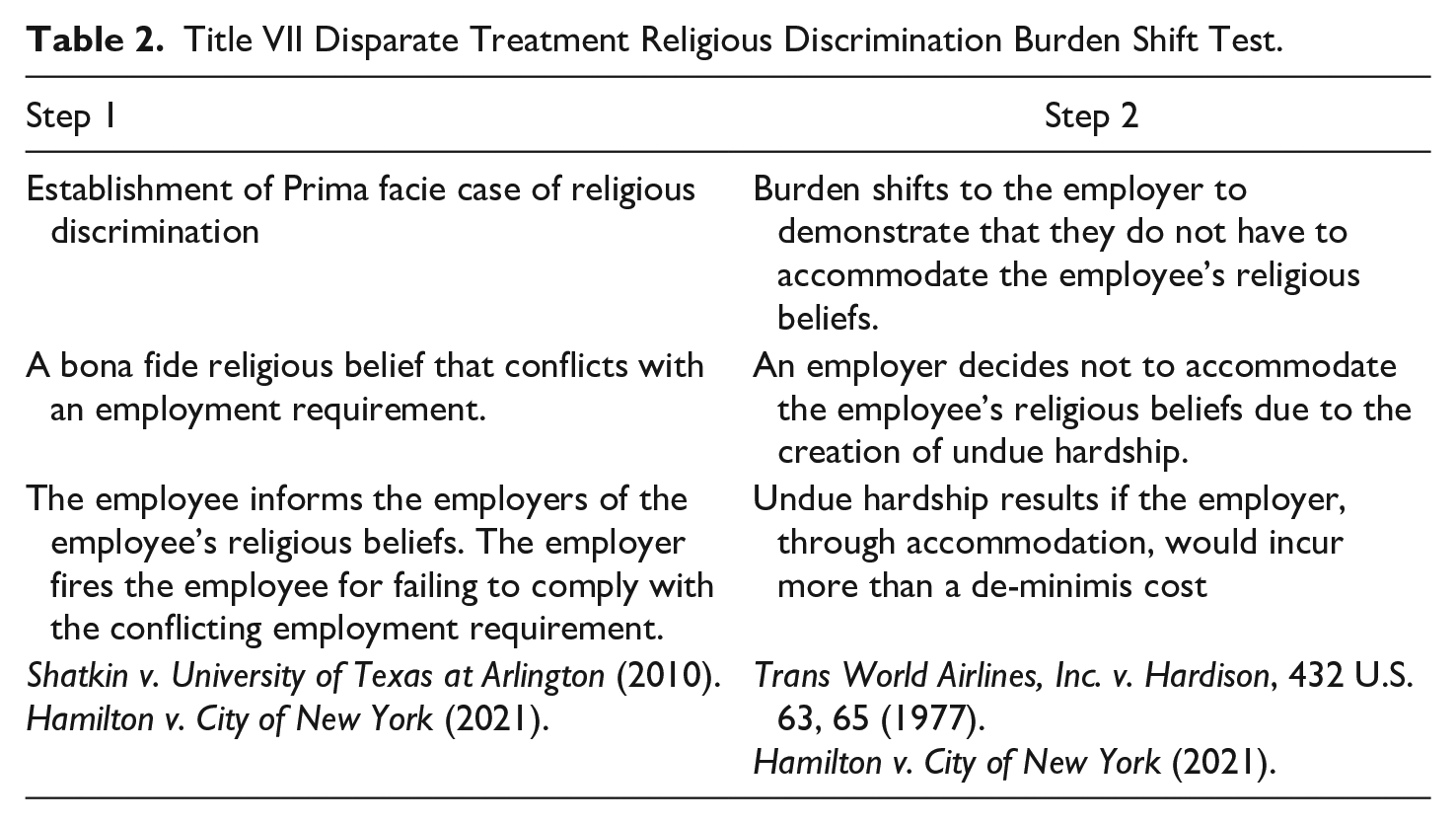
Title VII provides for disparate treatment and disparate impact employment discrimination lawsuits (Selznick, 2020). Disparate treatment workplace religious discrimination lawsuits require that an employee establish the existence of a prima facie case of workplace religious discrimination. This requires that the plaintiff present proof that a bona fide religious belief conflicted with an employment requirement and that an employer punished the employee for failing to comply with an employment requirement. If an employee meets this burden of persuasion, the employer must demonstrate that providing the employee with a religious accommodation would work an undue hardship on the employer.
Title VII Disparate Treatment Religious Discrimination Burden Shift Test.
Disparate impact discrimination constitutes the second category of Title VII workplace religious discrimination. It occurs when a neutral work requirement hurts members of a protected group. This includes an adverse impact on religious individuals. The most common type of adverse impact involves requirements that employees work on Saturday, Sunday, or a religious holiday. Disparate impact discrimination also occurs when an employer’s dress code may conflict with the employee’s religious beliefs. When faced with a conflict between their religious beliefs and arguably neutral job-related requirements, employees often ask their employers to modify their work schedule to permit the employee to attend religious services on Sunday or to respect a specific religious holiday and exempt them from a dress code. When a private or public employer refuses to make an accommodation, a public employee has the option of bringing a Title VII lawsuit.
In 1976, the U.S. Supreme Court dealt with the authority of public employers to impose grooming standards on public employees. The Supreme Court held in Kelly v. Johnson (1976) that public employers had broad authority to require public employees to comply with grooming standards, such as restricting the length of hair on male employees. In reaching this decision, the U.S. Supreme Court rejected the argument of a police officer that limiting the length of his hair impinged upon his First Amendment freedom of speech and his Fifth and Fourteenth liberty interests. The decision, however, did not address the issue of the grooming practices of employees based on religious beliefs. Police and fire departments would and continue to impose some of the strictest dress codes and grooming standards. This has led to extensive litigation over whether police and fire departments must adjust grooming standards to accommodate individuals of different religious faiths.
In Fraternal Order of Police Newark Lodge No. 12 v. City of Newark (1999), the Newark City Police Department sought to apply a ban on officers wearing beards to Sunni Muslim male officers. The Suni Muslim religion required males to grow beards (Schott, 2007, p. 25). The United States Court of Appeals overturned the beard ban because the police department permitted officers to grow beards for medical reasons but did not permit officers to grow a beard for religious reasons. The Third Circuit found that the Newark police department did not have a rational basis for providing medical exceptions from the beard ban but would not provide religious exceptions from the beard ban (Fraternal Order of Police Newark Lodge No. 12 v. City of Newark, 1999, p. 366). The police department defended the beard ban because the ban contributed to the esprit de corps of the department, much like military grooming standards.
In Lewis v. New York Transit Auth (2014), the NYTA fought a long and drawn-out battle over whether the NYTA must exempt a Muslim-American employee from the Transit Authority dress code. In 1989, the NYTA hired a Muslim-American woman as a bus driver. From the day she began work, she “wore a khimar whenever she was in public, including at work” (Lewis v. New York Transit Auth., 2014, p. 427). Her khimar was the same color as her Transit Authority uniform. When she returned from medical leave in 2003, the Transit Authority informed her that she must wear an approved transit authority cap or face discipline. She refused. The transit authority then transferred her to work in a bus depot “where the headgear policy did not apply because she would be out of the view of passengers” (Lewis v. New York Transit Auth., 2014, p. 428). Her new position required her to perform janitorial tasks such as washing windows and cleaning buses—tasks not typically performed by bus drivers (Lewis v. New York Transit Auth., 2014, p. 429). Due to the dispute, she contacted several media outlets to complain about her treatment. Subsequently, she qualified for a position as a station agent. The NYTA then issued new dress code guidelines that permitted uniformed employees to wear a headscarf or khimar as long as the employee placed the Transit Authority logo on the part of the Khimar that covered the employee’s forehead. She refused to comply with this requirement on religious grounds and lost her position as a station agent. In June 2005, the Transit Authority fired the employee because she did not qualify for other jobs within the Transit Authority (Lewis v. New York Transit Auth., 2014, p. 457). Lewis brought suit under Title VII and the First Amendment. Her Title VII lawsuit alleged that the NYTA transferred her from her position as a bus driver in retaliation for her seeking dress accommodation. After her death, her estate continued the lawsuit against the NYTA. She denied that her transfer constituted retaliation. Defending their decision not to allow her to wear “her khimar without a Transit Authority cap on top or a logo on her forehead,” the NYTA argued that allowing the employee to wear her khimar would work an undue hardship on the NYTA. The District Court rejected this argument. It left “a parade of horribles” put forward by the NYTA, such as compromising the public image of the NYTA (Lewis v. New York Transit Auth., 2014, p. 445). Because of this finding, the District Court ruled that permitting the employee to wear her khimar would not have worked and undue hardship on the NYTA. After her death, her estate continued the lawsuit. Ultimately, the employee’s estate and the NYTA entered a settlement agreement to end the litigation (Lewis v. New York Transit Auth, 2015).
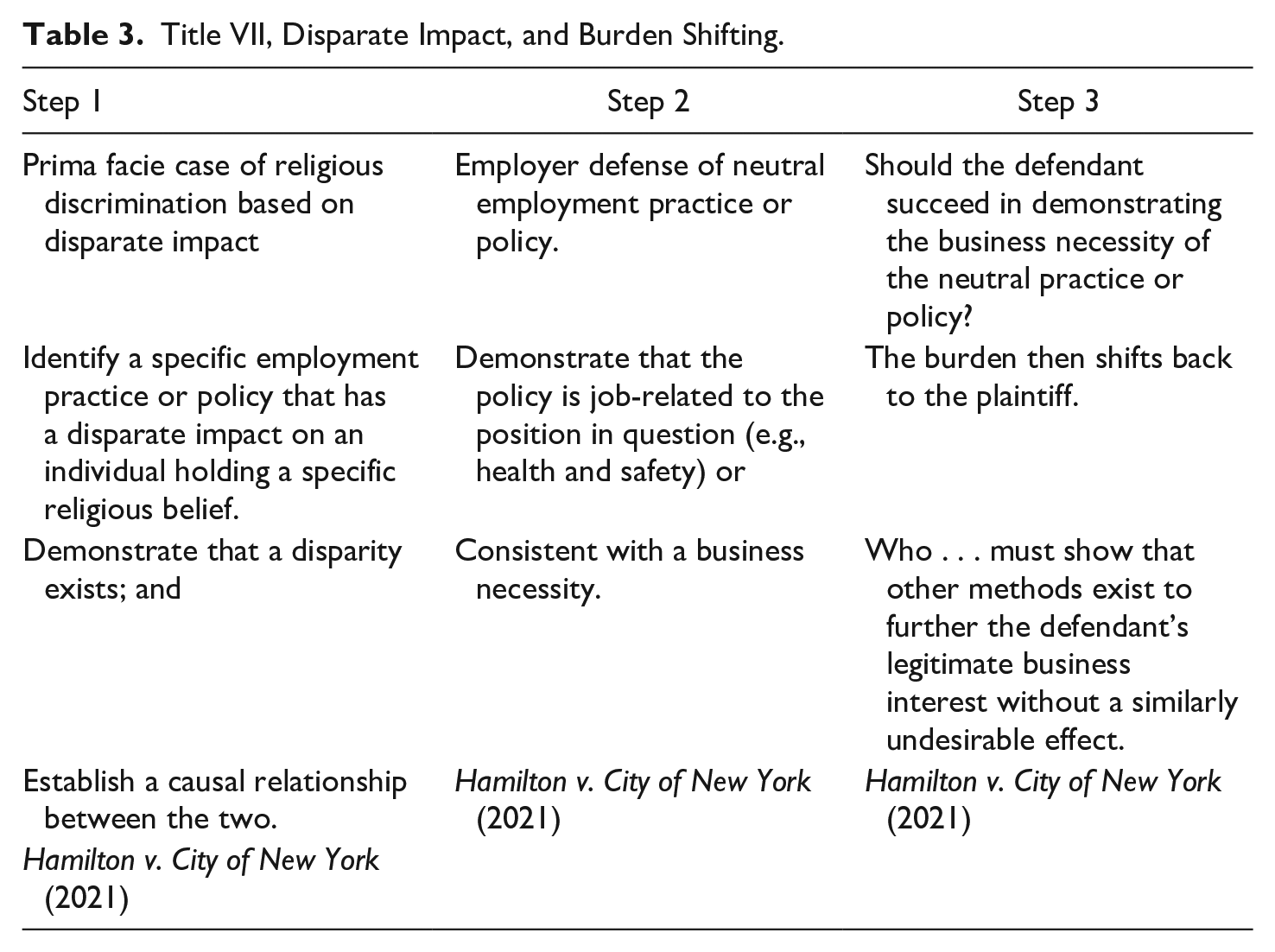
Much like Title VII disparate treatment litigation, Title VII disparate impact litigation require a plaintiff and defendant to undertake a burden-shifting process (Table 3). This requires a plaintiff employee to demonstrate that the challenged policy has a disparate impact on protected group members—for example, individuals holding a specific religious belief. If the plaintiff meets this burden of proof, then the burden shifts to the employer to demonstrate that the policy or practice is related to the position held by the plaintiff.
Title VII, Disparate Impact, and Burden Shifting.
In Sides v. NYS Div. of State Police (2005), for instance, an applicant for a position as a New York State trooper brought suit against the New York State Division of State Police for refusing to exempt him from serving on Saturdays and other Jewish holidays. The Division of State Police argued that a negotiated provision in a collective bargaining agreement prohibited the State Police from permitting probationary state police officers to use shift swaps.
The District Court found that forcing the NY State Police to modify its system for covering weekend shifts would work an undue hardship on the NY State Police because it would have to seek a modification to the collective bargaining agreement that covered many state police officers. It might force some state police officers to work more weekend shifts. Effectively managing staffing issues required all newly hired state police officers to work weekend shifts, including Saturdays. No alternative existed to meet the staffing needs of the State Police.
As the Federal District Court explained, requiring more experienced officers to take the shifts “could be a possible source of co-worker animosity, as well as a violation of the CBA/A&C seniority system” (Sides v. NYS Div. of State Police, 2005, *17). Also, argued the District Court, “juggling assignments to make each compatible with the varying religious beliefs of a heterogeneous police force would be daunting to managers and difficult for other officers who would be called on to fill in for the objectors” (Sides v. NYS Div. of State Police, 2005, 17*).
In Hamilton v. City of New York (2021), as another example, the City of New York Fire Department (NYFD) required all full-time firefighters to be clean-shaven. The fire department adopted this requirement due to concerns that a beard might interfere with the efficient operation of respiratory equipment used by firefighters while fighting fires. The NYFD previously had exempted a Jewish firefighter from the clean shave requirement as a religious accommodation. In May 2018, NYFD Fire Commissioner Daniel Nigro ended Department’s accommodation program because of the need to fully comply with the federal government’s OSHA’s Respiratory Protection Standard. The OSHA had adopted the standard to assure that firefighters and other emergency service personnel respirators provided the highest level of protection. As a result, the FDNY revoked all existing accommodations (Hamilton v. City of New York, 2021, p. 6). The FDNY then reassigned the firefighter to other duties after he refused to comply with the shave policy. The District Court found that the NYFD had to “comply with a binding federal regulation” (Hamilton v. City of New York, 2021, p. 28). Federal law prohibited fire departments from exempting the firefighter from the clean shave mandate.
Conclusion
From Pickering v. Board of Education (1968) and the passage of Title VII of the 1964 Civil Rights Act, workplace freedom of religion jurisprudence has undergone a significant transformation. Early in this period, some public employers believed that the Constitution’s Establishment Clause required that they maintain a religious-free workplace. During the 1990s, lower federal courts made clear that the Establishment Clause did not require that public employers prohibit all workplace religious activities of their employees, concerning First Amendment freedom of religious expression jurisprudence, the Kennedy v. Bremerton Sch. Dist’s (2022) decision makes it next to impossible for public employers to invoke the Establishment Clause to justify restricting the workplace religious practices of public employees without substantial evidence of religious coercion of other employees (Brannon, 2022, p. 5).
The Garcetti decision does provide public employers considerable authority to regulate the workplace religious activities of their employees when they engage in activities such as public employees and not private citizens. But Kennedy v. Bremerton Sch. Dist. has created a great deal of uncertainty regarding when a public employee acts as a public employee and a private citizen. Kennedy v. Bremerton Sch. Dist also raises the bar for public employers to prove that workplace religious practices would unduly disrupt the efficient operation of their organizations. Coach Kennedy drew national attention to his fifty-yard line prayer sessions. The controversy surrounding his prayer sessions created a nightmare for the Bremerton Sch. Dist. The Kennedy v. Bremerton Sch. Dist decision spent little time discussing the disruption caused by coach Kennedy’s prayer sessions. What would it have taken for the U.S. Supreme Court to find that coach Kennedy’s conduct did disrupt the operations of his high school and the school district?
Although the Kennedy decision makes it much more difficult for public employers to regulate the workplace religious activities of public employees, the U.S. Supreme Court has not moved to modify Title VII jurisprudence concerning what constitutes an undue hardship for purposes of requiring public employers to accommodate the workplace religious practices of an employee (Mulvaney, 2022). Because of this, lower federal courts must continue to apply the De Minimus standard when ruling on whether a public employer must accommodate the workplace religious activities of an employee. Dress codes, grooming standards, and shift change requests. One may make a persuasive argument that although a court might not require that an employer make a workplace religious accommodation for an employee, it should, if possible, try to reach an agreement with an employee concerning a mutually acceptable religious accommodation. Typical workplace religious accommodations include flexible work schedules and dress and grooming policies as long as such modifications do not create a health or safety risk (Society for Human Resource Management, 2022).
Some public employers have experienced difficulty transitioning from a secular workplace to a workplace that embraces religious diversity. Apart from complying with the law, a public employer should create an atmosphere that welcomes employee requests for religious accommodations (White, & Jeter, 2002, p. 272). Being open to requests for religious accommodations demonstrates to members of the organization a commitment to religious diversity in the workplace (Héliot et al., 2019). And a commitment to religious diversity reflects a commitment to cultural diversity.
Does it make sense for a public employer to provide their employees with examples of permissible and impermissible workplace religious activities? Yes, from the perspective of familiarizing employees with the difference between noncoercive and coercive workplace religious activities. What are examples of noncoercive workplace religious activities? Employees “may keep a Bible or Koran on their private desk and read it during breaks” (National Postgraduate School, 2022). An employee may discuss their religious faith with other employees. During breaks, an employee may pray with other employees. An employee may wear religious jewelry in the workplace. What are examples of coercive workplace religious activities? An employee repeatedly makes derogatory remarks to other employees about their faith or lack of faith (National Postgraduate School, 2022). A supervisor requires an employee to attend a prayer session after the formal work day ends. A supervisor makes preferential assignments to employees that go to church regularly.
Defending the decision to provide constitutional protection to a football coach holding voluntary prayer sessions at the 50-yard line after high school football games, Justice Gorsuch argued that high school students and arguably public employees must learn to live in a pluralist society (Kennedy v. Bremerton Sch. Dist., 2022, p. 2415). This includes public organizations which have a workforce with increasing religious diversity and a growing number of public employees who do not hold any formal religious beliefs. Public employers must prepare for increased workplace issues involving their employees’ religious beliefs. A Christian employee, for instance, invites a Muslim employee to attend church with his family. The employee that makes the invitation believes he must bring the word of his God to as many people as possible. The Muslim employee takes great offense at being invited by a fellow employee to attend a Christian church service. He believes the employee who made the invite wants to convert him to the Christian faith. How should the Muslim employee respond to such an invitation? Report the invitation to their supervisor. Walk away without saying anything. Tell his fellow employee he should not have made the invitation. Respectfully decline the invitation. How might an employer handle such a situation? Warn all employees not to invite fellow employees to attend church with them. Of course not. An employer might expand religious diversity training stressing the importance of all employees respecting the religious differences of their fellow employees or that some of their fellow employees may not follow any established religion. As one religion in the public workplace scholar points out, it is important for public sector managers to make sure that the workplace remains a tolerant and respectful place for those of all religious affiliations. This may also encourage public servants to increase their knowledge and tolerance of other faiths and better understand their coworkers. (Bednarczuk, 2019, p. 270)
This new era of workplace religious diversity will create challenges for public employers. But public employers can create a more welcoming and inclusive workplace.
Footnotes
Declaration of Conflicting Interests
The author(s) declared no potential conflicts of interest with respect to the research, authorship, and/or publication of this article.
Funding
The author(s) received no financial support for the research, authorship, and/or publication of this article.
