




Abstract
Drawing from a sociocultural life course perspective, this study examines the linkages between two age-related family transitions: young adult children leaving home and parental retirement. A sample of 580 ethnically diverse parents aged 50+ with at least one adult child aged 19–35 living in Metro Vancouver, British Columbia, Canada, was used in this study based on four cultural groups: British–, Chinese–, Persian/Iranian–, or South Asian–Canadian. Separate survival analyses are used to predict the timing of, and associations between children’s leaving home and parents’ retirement. Later timing of adult children’s leaving home is associated with delays in retirement of parents and is influenced by a number of predictors. Main and interaction effects were supported for ethnicity, where belonging to the Persian/Iranian ethnic group (compared to British) delays home leaving, and belonging to Persian/Iranian and South Asian ethnic groups (compared to British) delays retirement timing.
The contemporary landscape of aging family life is increasingly characterized by ethnic diversity and a general delay in pivotal “milestone” life course events such as youth leaving home and the timing of their parents’ retirement. Over the past several decades, the ethnic and cultural mosaic of North American family life has dramatically shifted due to changing immigration origins and trends. For instance, according to the Canadian 2016 Census, 21.9% of the total population were foreign-born immigrants, the highest proportion ever recorded in history (Statistics Canada, 2017). In the United States, 13.7% of the population in 2017 were immigrants (US Census Bureau, 2018). Against this backdrop and in tandem with other sociodemographic and economic changes (e.g., later family formation, a more precarious labor market, and high housing costs), there has been a tendency for young adult children to take longer to transition to adult roles and statuses, including the attainment of residential independence.
Resultantly, young adult children often continue to be dependent upon their parents and are living at home until later ages (Kornrich & Furstenberg, 2013; Maroto, 2017). This coresident living arrangement typically occurs at a time when their parents are in the process of either planning, or completing, their final transition to retirement. Moreover, rising numbers of older parents are remaining in the workforce and/or are returning to the paid labor market (Boveda & Metz, 2016; Klassen, 2013; McDonald & Donahue, 2011). Although research is sparse, delayed retirement appears to be more likely for those from non-White racialized backgrounds due to job discrimination, wage inequality, and lower retirement incomes (Block et al., 2019). In light of these patterns of young adult coresidence/home leaving and their parents’ retirement timing, these two intrafamilial life course events may be linked, albeit variable, among certain ethnic groups.
Surprisingly, while a burgeoning body of literature has examined population and individual-level patterns in relation to home leaving, retirement, and empty nest transitions (e.g., see Bea & Yi, 2019; Stoiko & Strough, 2019), no research to date has specifically focused on whether, to what degree, and how these pivotal marker events interdigitate. The vast literature on retirement determinants has mainly concentrated on health and wealth precursors to labor force exit (Miller et al., 2018). In addition, spousal retirement timing and caregiving circumstances have been demonstrated to play a significant role in retirement decisions and planning (e.g., see Boveda & Metz, 2016; Matthews & Fisher, 2013). Yet, other family transitions may also be important, such as patterns of coresidence/home leaving among young adults.
There may also be unique ethnocultural or racialized variations in family life course trajectories (e.g., see Ho & Park, 2019) that warrant consideration; albeit, more research exists on home leaving than for retirement. For instance, ethnically- based norms and expectations can influence family social timetables by defining and guiding what is deemed to be the “proper” timing and circumstances of home leaving (Mitchell, 2007; Mitchell & Lovegreen, 2009; Goldscheider & Goldscheider, 1993, 1997 ). In some ethnic groups, children are expected to remain at home until marriage rather than to leave home earlier to seek independence, which could also affect parental retirement timing.
Clearly, this area of research inquiry has significant implications for our understanding of aging and human development and modern family life in a rapidly changing and precarious global society. In particular, theory and research on this topic can contribute to improved knowledge of timely age-related family issues ranging from ethnically diverse immigrant (and nonimmigrant) family patterns, labor market behaviors, to multigenerational housing patterns and socioeconomic transfers. Moreover, specific issues related to aging family life, intergenerational relations, and family life course intersections are increasingly significant given their salience to many local and worldwide family trends in migration and diaspora. Notably, North American urbanized society is undergoing dramatic transformations due to relatively high rates of immigration from highly diverse countries. Yet, a paucity of research exists as to how these diverse, yet increasingly common, family systems experience and mold current work and family-related transitions.
In recognition of these significant research gaps, the purpose of this article is to examine the following two questions: (a) What are the key predictors of home leaving and retirement timing among ethnically diverse families? (b) To what extent are these two major life course transitions related?
A Life Course Framing of Research Hypotheses
A life course perspective directs our attention to the interdependence of life domains and the contextual embeddedness of family developmental life transitions (Bengtson & Allen, 1993; Elder, 1995; Mitchell, 2007; Moen, 1996). As Szinovacz et al. (2001: S20) assert, the interconnectedness of life spheres means that work and family contexts are integrally linked over the life course. Life experiences in one domain (e.g., labor force attachments) are also connected with experiences in other domains (kin responsibilities), suggesting that this interdependence derives not only from individual circumstances but also from the family situation. Conceptually, this idea implies that home leaving or retirement decisions not only occur on an individual level, but they are also negotiated according to one’s placement in the social structure, including the economic and care obligations for other family members. In short, the lives of children and parents remain interwoven as children take on adult roles and statuses and parents navigate transitions associated with aging (Elder et al., 2003). As Szinovacz (2013) notes, events in family members’ lives can serve as anchor points for individual retirement decisions. This anchoring may be voluntary (e.g., when children are no longer dependent on them) or it can be unplanned or involuntary (e.g., due to an illness or to meet the pressing care needs of other family members).
Indeed, the concept of “linked lives” has enormous significance for this particular area of inquiry, since societal and individual experiences are interconnected and funneled through the family and its network of shared relationships (Elder, 1998). Notably, the intensity and length of reliance of children on their parental capital has grown, stemming from significant sociodemographic and economic changes (Kornrich & Furstenberg, 2013). However, this dependency creates additional financial cost and caregiving burden for parents. Coresidence can be conceptualized as one form of support from parents to grown children since these children tend to save money, food, or other forms of everyday support (Fingerman, 2017), although it is recognized that parents can continue to support nonresident children in many significant ways. Yet, research shows that having at least one coresident child has a large effect on financial transfers, as well as on parental retirement expectations and realizations (Miller et al., 2018). Therefore, we hypothesize that there will be an association between home leaving and retirement timing.
Moreover, there may be other salient characteristics that predict both leaving the parental home and parents’ retirement timing. In theory and research evidence, life course transition decisions are made within the context of life circumstances and are affected by the interaction of various forms of life course capital (e.g., such as human, economic, social, and health capital). These decisions may also be influenced by racially/ethnically shaped opportunity structures (e.g., see Brown & Warner, 2008; O’Rand, 2005) and normative values and attitudes. In the following section, we review the literature to identify the principal factors that have been shown to influence the timing of these transitional behaviors and present a number of supplementary research hypotheses.
The Timing of Leaving the Parental Home
Studies focused on predictors of home leaving consistently reveal that age is an important predictor of timing. Although we have witnessed changing norms regarding the desirability of longer parental coresidence more generally (South & Lei, 2015), older aged young adult children tend to be less likely to live at home than younger-aged children. Moreover, females tend to leave home earlier than males, partly because of their earlier age of partnership/family formation and also due to generally greater maturity to support independent living (Krahn et al., 2018).
Number of siblings and parental socioeconomic status are additional family background variables found to affect the timing of home leaving (e.g., see Fingerman et al., 2015). Number of siblings is found to influence the probability of remaining at home until later ages because of limits to and competition over parental resources or because of household crowding (Mitchell et al., 1989). More highly educated parents and those in white-collar jobs (versus blue-collar jobs) generally expect their children to complete their high school education and attend college/university (Stull, 2013). In the geographical urban locale under study, it is also very common for postsecondary students to live with their parents due to cultural and economic factors (e.g., it is highly multicultural region; housing is very expensive). Thus, we expect that children whose parents are in white-collar jobs will leave home later than those in blue-collar jobs to pursue postsecondary credentials.
Turning to ethnocultural factors, it is expected that fewer years spent residing in Canada and being a member of a collectivist (compared to an individualist) ethnocultural group would decrease the likelihood of leaving home early. Coresidence is generally less normative in Westernized societies and traditional ethnic groups typically view leaving home “too early” as a sign of family dysfunction. Therefore, we expect that children from British ethnic backgrounds will be less likely to display later ages of home leaving compared to those from Chinese, Iranian, or South Asian backgrounds.
Moreover, we also anticipate that the health-related and relationship characteristics of parents will be associated with home leaving timing. Parents in poorer health are expected to have children who remain at home longer, possibly to help their parents (South & Lei, 2015). Furthermore, home leaving timing is also found to be affected by intergenerational relationship quality in that closer parent–child relationships result in more “social capital” and children staying home longer (Aquilino & Supple, 1991; Gillespie, 2020; Goldscheider et al., 2014; Mitchell, 2007). Similarly, children who are a source of stress or conflict (i.e., due to other adverse external events) will be expected to leave home earlier than those who are not (e.g., see Mitchell et al., 2019; South & Lei, 2015).
The Timing of Retirement
Retirement is a complex, multilevel process and phenomenon (Klassen, 2013; Szinovacz, 2013). At the individual level, it is well documented that age has been consistently found to influence a person’s ability to continue to work. The older the individual becomes, the more unlikely it is that one will be engaged in the formal work sector, although this age has been increasing (Carrière & Galarneau, 2011). Women also tend to retire earlier than men. Given such factors as the cultural emphasis on the husband’s provider roles, the generally younger age of wives, and the norm of joint retirement, we anticipate that women will retire earlier than men (e.g., Stoiko & Strough, 2019; Szinovacz, 2013). Moreover, personal health status has been found to be one of the most powerful factors affecting the decision to retire (e.g., see von Bonsdorff & Ilmarinen, 2013 for review). Similarly, the poorer health of a spouse is found to affect retirement timing. It is common for a partner to take on a caretaker role and this creates an interruption in paid labor force attachment (Stoiko & Strough, 2019).
Education is also associated with retirement timing since it is related to employee skills and the ability and preference to perform work (Carrière & Galarneau, 2012). For instance, a low education can limit the ability to adapt to changes in working life, while higher education is associated with employee desire to engage in bridge employment (Carrière & Galarneau, 2012; von Bonsdorff & Ilmarinen, 2013). Moreover, early retirement also tends to be related to occupation; blue-collarjobs tend to be more physically demanding than white-collar jobs and these workers generally retire earlier (Hayward et al., 1998). Additionally, it is anticipated that parents who are more satisfied with their financial situation are more likely to be retired. Research shows that older workers’ negative perceptions or low satisfaction of financial security and their consideration of future financial expenses are associated with a lower probability of labor force exit. These expenses, which may include out of pocket health care costs and providing financial assistance to children, are associated with a lower probability of labor force exit (Johnson, 2013; Miller et al., 2018).
With regard to immigration and ethnocultural factors, those who have resided longer in a country of destination tend to retire sooner, as well as nonracialized groups (e.g., Britishdecent), due to greater accumulated social and economic capital and access to government pensions (e.g., see Brown & Warner, 2008). It is therefore expected that parents who self-identify as British will have the earliest ages of retirement compared to the other ethnic groups since they have the longest settlement pattern in Canada. Conversely, members of the Iranian/Persian community (the most newly arrived group) are expected to be less likely to retire earlier due to fewer savings from greater labor market discrimination and less access to pensions or other forms of government support. Moreover, we also expect that having more children will be associated with greater delays in retirement due to greater costs or transfers, an effect that is found for both men and women (Reitzes et al., 1998).
Methods
Data
The data used in this article are based on a Social Sciences and Humanities Research Council of Canada funded study entitled Intergenerational Ties and Transitions to Retirement Study, which was conducted in the Metro Vancouver area of British Columbia, Canada, between 2015 and 2017. The primary purpose of the study was to examine midlife/later life parental transitions to retirement and its nexus with other family transitions. To be included in the study, participants needed to be aged 50 or older; have at least one adult child aged 19–35 (focal child); and primary self-identification with one of four ethnocultural groups: British– (English, Scottish, Welsh, and Irish), Chinese–, Persian/Iranian–, or South Asian–Canadian (including India, Pakistan, Sri Lanka, Bangladesh, Afghanistan, Nepal, Bhutan, and Maldives). The rationale for the selection of these ethnocultural groups was guided by the fact that they represent either significant and/or rapidly rising visible minority populations living in large Canadian urban centers. In addition, this sampling method allows for comparative research among diverse ethnic groups.
The present study utilizes quantitative data collected between March 2015 and November 2016, which entailed a telephone survey with the 588 parents (although approximately 4% preferred to have the interviewer conduct the interview in person due to concerns about privacy or convenience). All interviews were administered in the participant’s preferred language of choice and were 30–40 min in duration on average. Recruitment occurred through two methods: “cold calls”—via random (using random number charts) selection of numbers based on local telephone directories (47.4%, n = 279), and through referrals/snow-ball sampling, posters, visits to local churches or community organizations (e.g., community centers and immigrant service societies), coffee shops, or shopping malls (52.6%, n = 309). It was necessary to use this blended data collection approach due to the recent transition from having landlines to cell phones with new or unknown numbers, coupled with the fact that many new immigrants to Vancouver (i.e., Persian/Iranian, South Asian, and Chinese groups) posed challenges using a “cold call” recruitment strategy due to language and cultural barriers. In addition, direct telephone recruitment was constrained by a significant decline in public trust created by marketing harassment and fraud by phone, as well as fear of reprisal among the Persian/Iranian community, some of whom left their country under political duress.
Participants were classified according to three living arrangements: (a) full nest (all children currently reside in the parental home); (b) emptying nest (at least one child has left home for 4 or more months and is currently not living at home; and (c) empty nest (all children have left home for at least 4 months and none currently lives at home). In addition to retrofitting the questionnaires for each living arrangement type, participants were administered preretirement/retirement modules, depending on their stage of retirement. Finally, if the respondent had more than one child eligible to serve as a focal child, the interview randomly selected a “study child” (SC) so that specific questions related to having an adult child could be asked. Given time constraints, we were only able to collect detailed information on one child.
Given that one of the foci was ethnic diversity in family transitions, approximately equal quotas were sampled for mothers and fathers and for the four ethnic groups: mothers (57%, n = 336); fathers (43%, n = 252); British (21%, n = 125); Chinese (21%, n = 125); Persian/Iranian (25%, n = 144); and South Asian (n = 33%, n = 194). With respect to ethnic origin, the majority of “British” respondents were born in Canada and the Persian respondents in Iran. Most of the “Chinese” sample were born in either Mainland China or Hong Kong, whereas the majority of the South Asian sample emigrated from India. A separate analysis also showed that the mean number of years in Canada among immigrants varies by ethnic group: Persian/Iranian (18.56 years); Chinese (26.65); and South Asian (23.34). Only 25/125 of the British sample identified as immigrants. The average age of the SC at the time of the survey was (M = 28.16, SD = 4.8). The parents ranged in age from 50 to 86 (M = 59.6, SD = 6.64). Almost equal proportions of sons/daughters were included as an SC: daughters (47.4%, n = 279) and sons (52.6%, n = 309). Virtually all were biological children, given that divorce was rare in the non-British. Slightly more than half or 56% (n = 331) of parents were not retired at the time of the survey.
Measurement
Dependent Variables
Age of Last Home Leaving. The duration between age 15 and age of the last home leaving experience of the SC was used as one of two primary dependent variables. SCs who had not yet left home were censored (using their age at the time of the survey) for the survival analyses. A total of 400 respondents had experienced the event of leaving home and 180 respondents were censored for the overall study period.
Age of Retirement. The duration between age 30 (an arbitrary event start date) and age of the last retirement of parents was used as the second primary dependent variable. Parents who had not yet retired were censored (using their age at the time of the survey) for the survival analyses. We observe 242 retirement events and 338 censored cases (current age) in the study.
Independent Variables
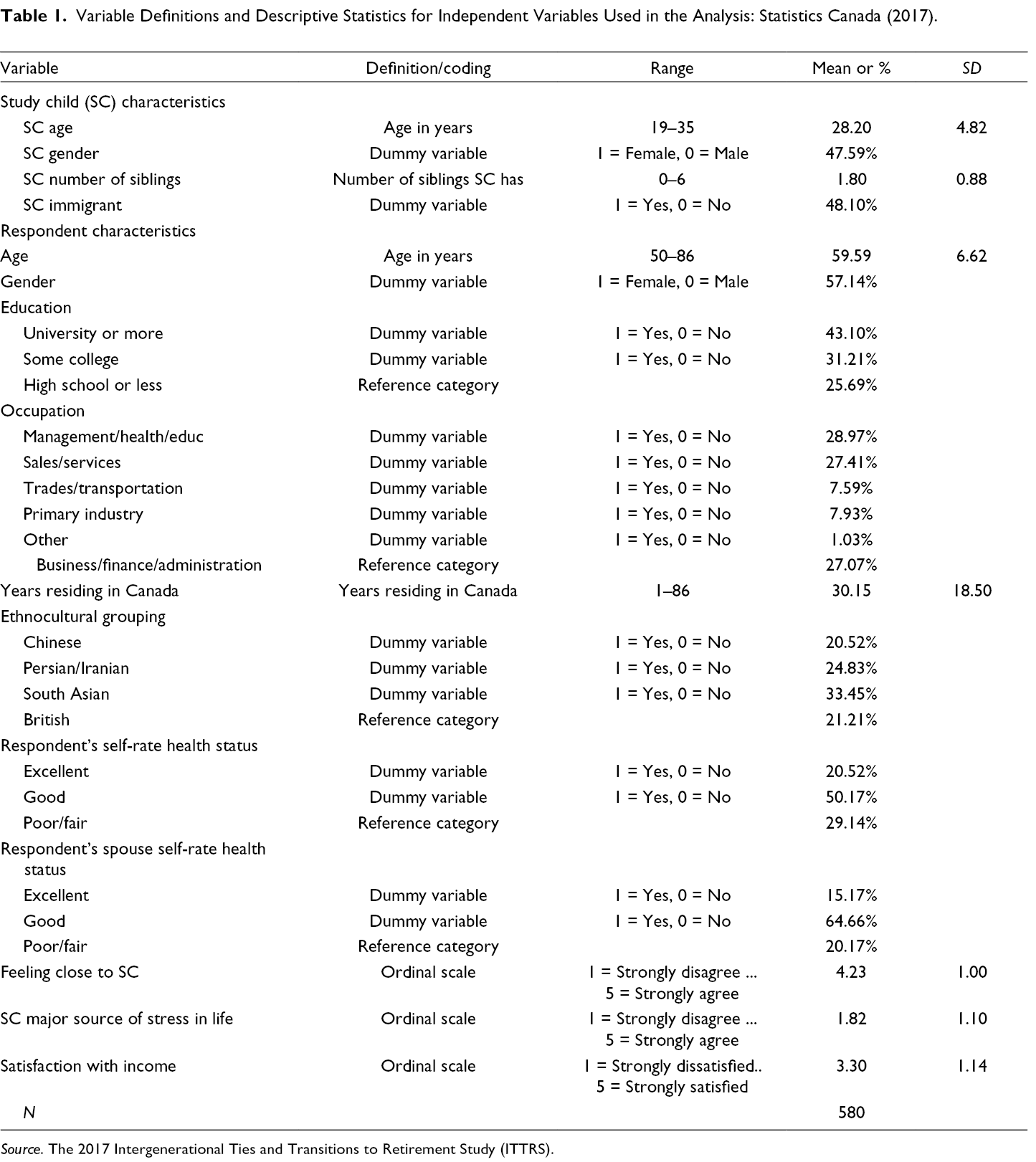
We used a similar set of independent variables in the survival models of home leaving and retirement timing. These were separated into variables associated with the SC and those associated with the parents/family environment. Variable definitions and descriptive statistics for these variables are presented in Table 1.
Variable Definitions and Descriptive Statistics for Independent Variables Used in the Analysis: Statistics Canada (2017).
Source. The 2017 Intergenerational Ties and Transitions to Retirement Study (ITTRS).
SC Independent Variables. Four demographic characteristics of the SC were incorporated: (a) Age ranged from 19 to 35 (M = 28.20, SD = 4.82). (b) Gender included the categories “male” (52.41%) or “female” (47.59%). No respondents selected the available “other” gender category. (c) Number of siblings used counts of siblings that were alive at the time of the survey (M = 1.80, SD = 0.88). (d) Immigrant status was categorized as foreign born (48.10%) and native born (51.90%).
Parental Independent Variables. Nine parental predictors of home leaving and retirement were incorporated into the analyses. Age of parent ranged from 50 to 86 (M = 59.59, SD = 6.62). Parental gender included “male” and “female” with a slightly higher (57.14%) proportion of female parents. Education was created from responses to the question: “What was the highest level of education that you have attained”? The responses were trichotomized into “high school or less” (25.69%), “some college” (31.21%), “and” university or more” (43.10%). Occupational status was measured based on the question: “What is [was] your main occupation?” Several dummy variables were created (Table 1) based on the categories: “management/healthcare/education” (28.97%), “sales/services” (27.41%), “trades/transportation” (7.59%), primary industry” (7.93%), “other” (1.03%), and “business/finance/administration” (27.07%). Years Residing in Canada was measured in number of years (M = 30.15, SD = 18.50). The high variability in this measure reflects the diverse ethnocultural groups targeted in the study with respect to immigration histories. Ethnocultural grouping included our four diverse ethnic groups: “Chinese” (20.52%), “Persian/Iranian” “(24.83%),” South Asian” (33.45%), and “British” decent (21.21%), using the question: “Compared to people your own age, how would you rate your overall physical health at the present time”? Answers to this question were trichotomized into “poor or fair” (29.14%), “good” (50.17%), and “good or excellent” (20.52%). We also included the respondent’s assessment of their spouse/partner’s health using the same question applied to this individual, if applicable. Responses were also trichotomized into “poor or fair” (20.17), “good” (64.66%), and “good or excellent” (15.17%).
Closeness to SC was measured using the question “How close are you to your SC?” and included a 5-point Likert response set ranging from “strongly disagree” to “strongly agree” (M = 4.23, SD = 1.00). The amount of perceived stress that parents report experiencing with their focus child was also measured on a 5-point Likert scale ranging from 1—no conflict at all to 5—a great deal of conflict (M = 1.82, SD = 1.10). Finally, income satisfaction was measured based on responses to the question, “On a scale of 1 to 5 with 1 being ‘not at all satisfied’ and 5 being ‘extremely satisfied’, how satisfied are you with your financial situation at the present time?” (M = 3.30, SD = 1.14). This variable was included to capture perceived income adequacy, which has been shown to be a stronger socioeconomic status measure than actual income level for new immigrant groups, since they are reluctant to reveal accurate income data.
Starting with 588 participants, we further excluded those with age of retirement less than 30 (n = 8) as outliers, leaving a final sample size of 580. There were very few missing cases for all variables. Multiple imputations were used to fill in missing observations with the R package MICE. In order to assess this method, we also repeated all analyses removing the missing cases. All findings were replicated and we report on the former.
Analytic Strategy
We begin by examining the effects of the measured covariates on the timing of retirement and timing of home leaving using two separate Cox proportional hazards models (Cox, 1972).
The standard Cox model applies to univariate survival data when there is a singular event of interest and event times are assumed to be statistically independent (Klein et al., 2016; Moore, 2016). Since we aim to examine two linked survival processes (timing of retirement and timing of home leaving) of parent and child in family clusters, the two basic assumptions under the Cox model are violated, requiring a different approach. Considering dynamic and complicated survival processes, we highlight and justify how to employ survival analysis for correlated survival data. This research not only examines risk factors for the timing of home leaving and timing of retirement but also extends our knowledge by adopting an analytical strategy to quantify the association between the event times of study child’s home leaving and parent’s retirement.
The analysis of correlations of bivariate survival times in a cluster is of interest to many aging-related topics in order to explicate the significance and strength of event dependence. The multivariate survival data arise when a cluster of multiple, possible correlated failure times, are collected (Klein et al., 2016), especially in family studies in which the lifetimes of several individuals, such as twins, or parent and child, are related in some way. Associations between the survival times of parents and children for potentially related events, such as child home leaving and parental retirement, have relevance to understanding families in an aging and human development context. Therefore, to evaluate the dependence between survival times is a fundamental task in multivariate survival data analysis.
Traditionally, dependence is reported as a correlation coefficient, assuming normal distribution models for continuous variables to estimate linear dependence. For survival data, the marginal distributions are not normal, and the dependence structure is nonlinear, and therefore a more general measure of dependence is needed (Hougaard, 2012). The dependence of bivariate survival times is assumed monotonic, and thus, quantification by rank correlation coefficients is a more appropriate approach (Kendall & Gibbons, 1990; Schemper et al., 2013). We employ Spearman rank correlation coefficient
Following the framework by Schemper et al. (2013), we first transform individual survival times into uniformly distributed survival probabilities using copulas. These functions are continuous distributions on the unit square

where
Second, the parameter of the copula distribution is estimated under normal copula.

with
Lastly, the Spearman correlation coefficients can be obtained by integrating the copulas. The estimated value of

For additional details, refer to the article by Schemper et al. (2013). We estimate the correlation coefficient for bivariate time-to-event data using an R package SURVCORR, which is available at https://cran.r-project.org/web/packages/SurvCorr/index.html.
Results
Cox Regression of Home Leaving
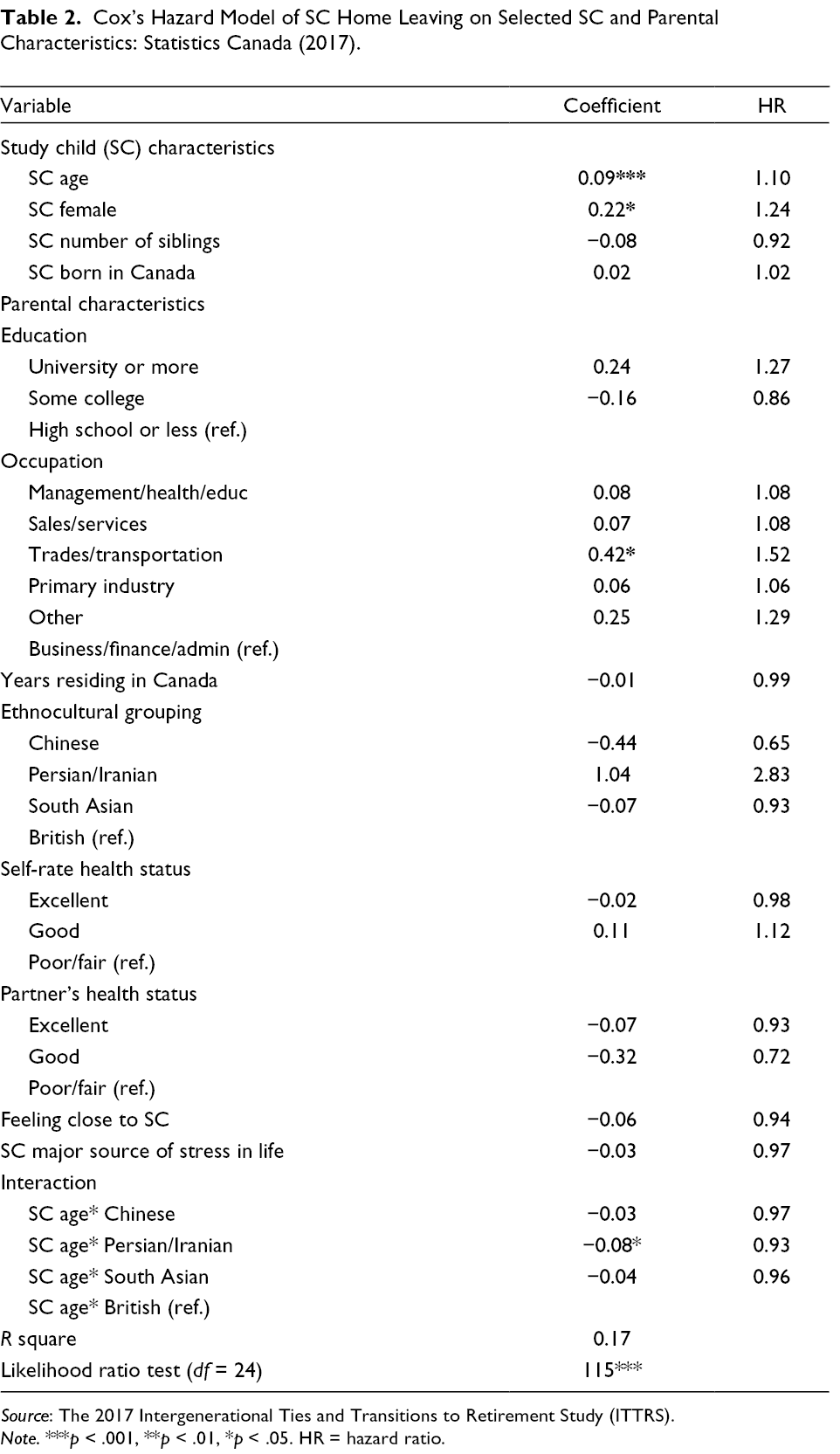
Table 2 includes the results of the Cox regression model with the timing of leaving home as the dependent variable. We report hazard ratios (HRs) of the risk of home leaving for statistically significant coefficients, interpreted similarly as odds ratios. The model shows that the study child’s age is significantly associated with the risk of leaving the parental home, where we observe a hazard ratio or factor of 1.10. Female respondents tend to leave home at a 1.24 higher rate than males. Parents’ occupation is also significantly associated with the children’s timing of leaving home. The risk of the SC leaving home is increased by a factor of 1.52 if their parents work in trades/transportation industry in comparison to the business/finance/administration industry. The number of siblings, immigrant status, parental education, years in Canada, ethnocultural group, health status, closeness to adult study child, and stress associated with the SC did not result in statistically significant associations with home leaving. It should be noted that we incorporated living arrangement (empty nest, emptying nest, and full nest) and marital status of parent as covariates, but removed these time-varying variables for two reasons. First, they were measured only at the time of the survey and not at the time of the event (home leaving or retirement). Second, they showed no associations with either dependent variable and did not alter any of the supported associations.
Cox’s Hazard Model of SC Home Leaving on Selected SC and Parental Characteristics: Statistics Canada (2017).
Source: The 2017 Intergenerational Ties and Transitions to Retirement Study (ITTRS).
Note. ***p < .001, **p < .01, *p < .05. HR = hazard ratio.
In addition, in Figure 1, we plot a statistically significant multiplicative interaction between age and ethnic grouping in relation to the timing of home leaving, in which the Persian/Iranian ethnic group are at a lower risk to leave home (i.e., they stay at home longer) than members of the mainstream British group, and this risk is more pronounced as age increases. The other age times ethnocultural group interactions are also distinct from the British group and in the hypothesized direction, but the interaction effects are borderline in terms of statistical significance.

Hazard ratios of age and ethnicity for home leaving.
Cox Regression of Retirement
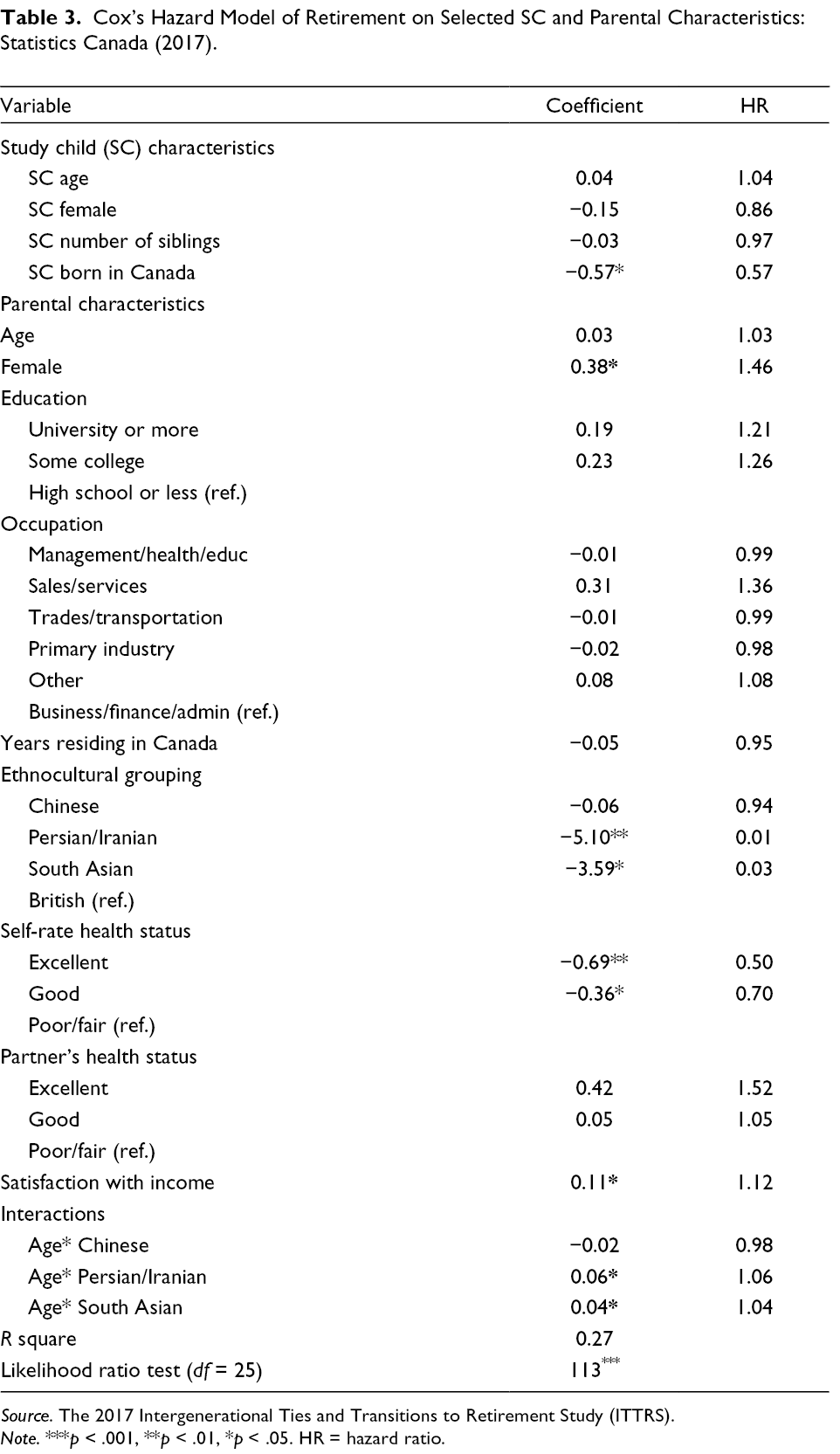
Table 3 shows results from Cox’s hazard model on the timing of retirement. If an SC was born in Canada (compared to foreign-born), the risk of retirement timing of the parent was decreased by a factor of .57, or about half. Thus, respondents have lower propensities of withdrawing from the labor force if their children are females. Not surprisingly, the risk of retirement is heavily determined by the parent’s age. There is a 3% increase in the expected risk of retirement relative to a 1 year increase in age. In addition, women are at a 1.46 higher rate of retirement when compared with men. Also, both Persian (HR = .01) and South Asian (HR = .03) have a considerably lower risk of retirement when compared to the British. Better self-rated health of the parent is also negatively associated with retirement risk (HRs = .50 and .70, for excellent and very good, respectively, compared to poor). Also, satisfaction with income clearly influences a respondent’s decision to retire. The risk of retirement increases by 1.12 times with greater financial security. The coefficients for SC age, SC female, number of siblings, parental education, occupation, years in Canada, and spouse’s health were statistically not supported.
Cox’s Hazard Model of Retirement on Selected SC and Parental Characteristics: Statistics Canada (2017).
Source. The 2017 Intergenerational Ties and Transitions to Retirement Study (ITTRS).
Note. ***p < .001, **p < .01, *p < .05. HR = hazard ratio.
The interaction term for age and ethnic grouping resulted in a significantly significant association with retirement timing (Figure 2). The combination of being an older Persian/Iranian or an older South Asian parent (compared to younger British parents) delays retirement. The hazard ratios for the Persian/Iranian and South Asian groups are lower at the younger and middle ages than the British groups. This reflects a delay in retirement for the Persian/Iranian and South Asian groups across age (compared to British parents across age).
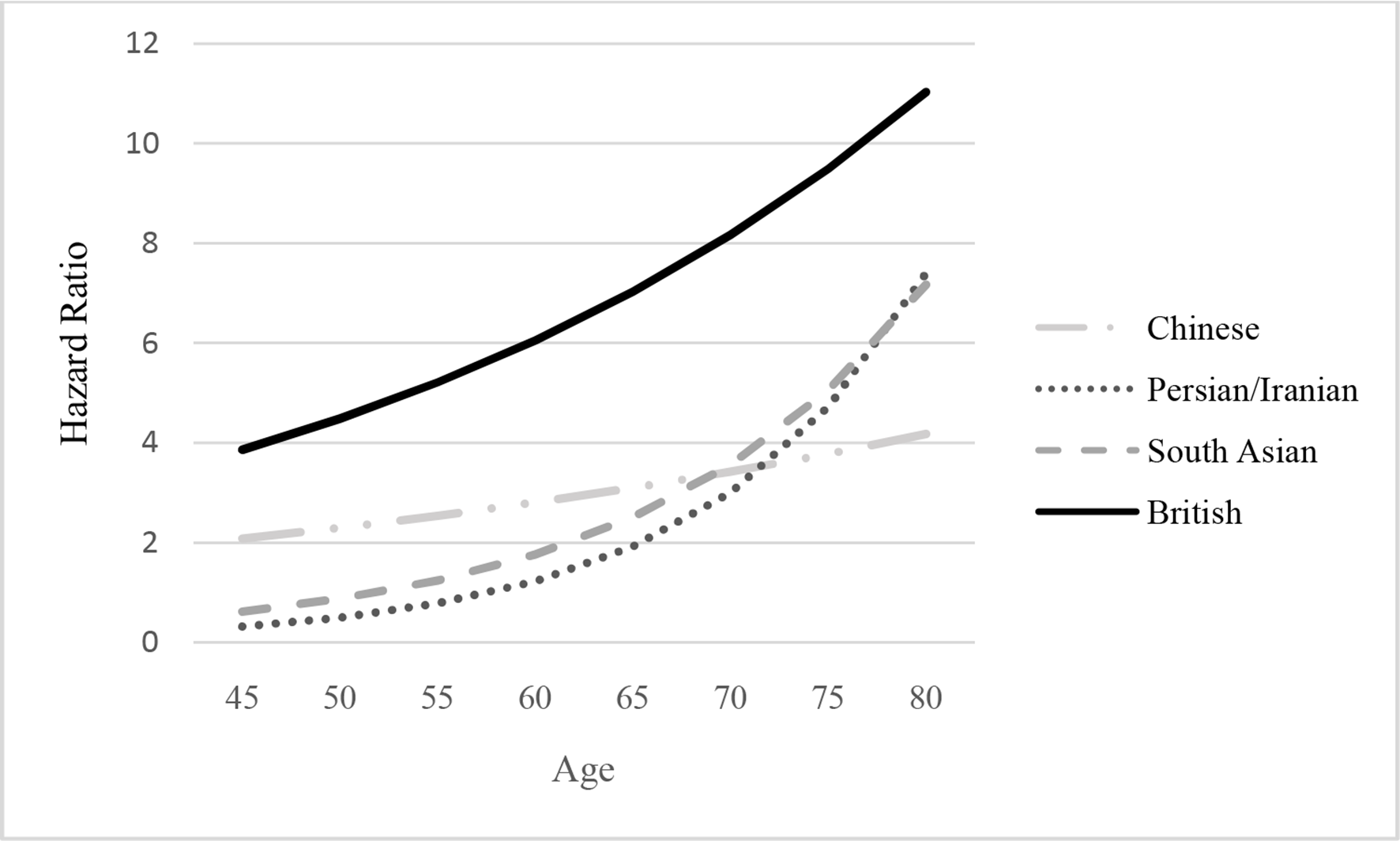
Hazard ratios of age and ethnicity for retirement.
Bivariate Survival Probabilities of Home Leaving and Retirement
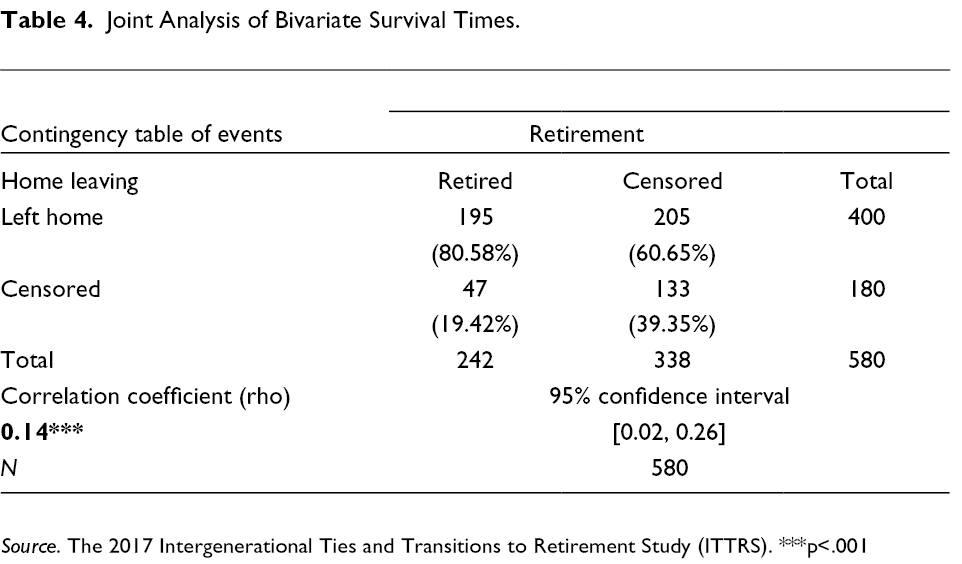
Table 4 presents the bivariate relationship between the two survival processes, given our primary research question pertaining to linkages between child leaving home and parental retirement timing. The data show that there exists a large variation in patterns of parental retirement by child’s leaving home behaviors. Among all respondents who are retired, 81% of their children have left home. For the respondents who are still in the labor force, the comparable number is 60.7%. The overall relationship between the retirement process and home leaving process is statistically significant (correlation coefficient = 0.14, 95% CI [0.02, 0.26]). The positive and statistically significant correlation provides evidence that respondents are more likely to exit the labor force if their children had left home already or vice versa. A scatterplot of bivariate survival times is also presented to pictorialize this notable positive association (Figure 3). The first survival outcome (focal child home leaving) is plotted on the y-axis and the second survival outcome (parental retirement) is on the x-axis.
Joint Analysis of Bivariate Survival Times.
Source. The 2017 Intergenerational Ties and Transitions to Retirement Study (ITTRS). ***p<.001
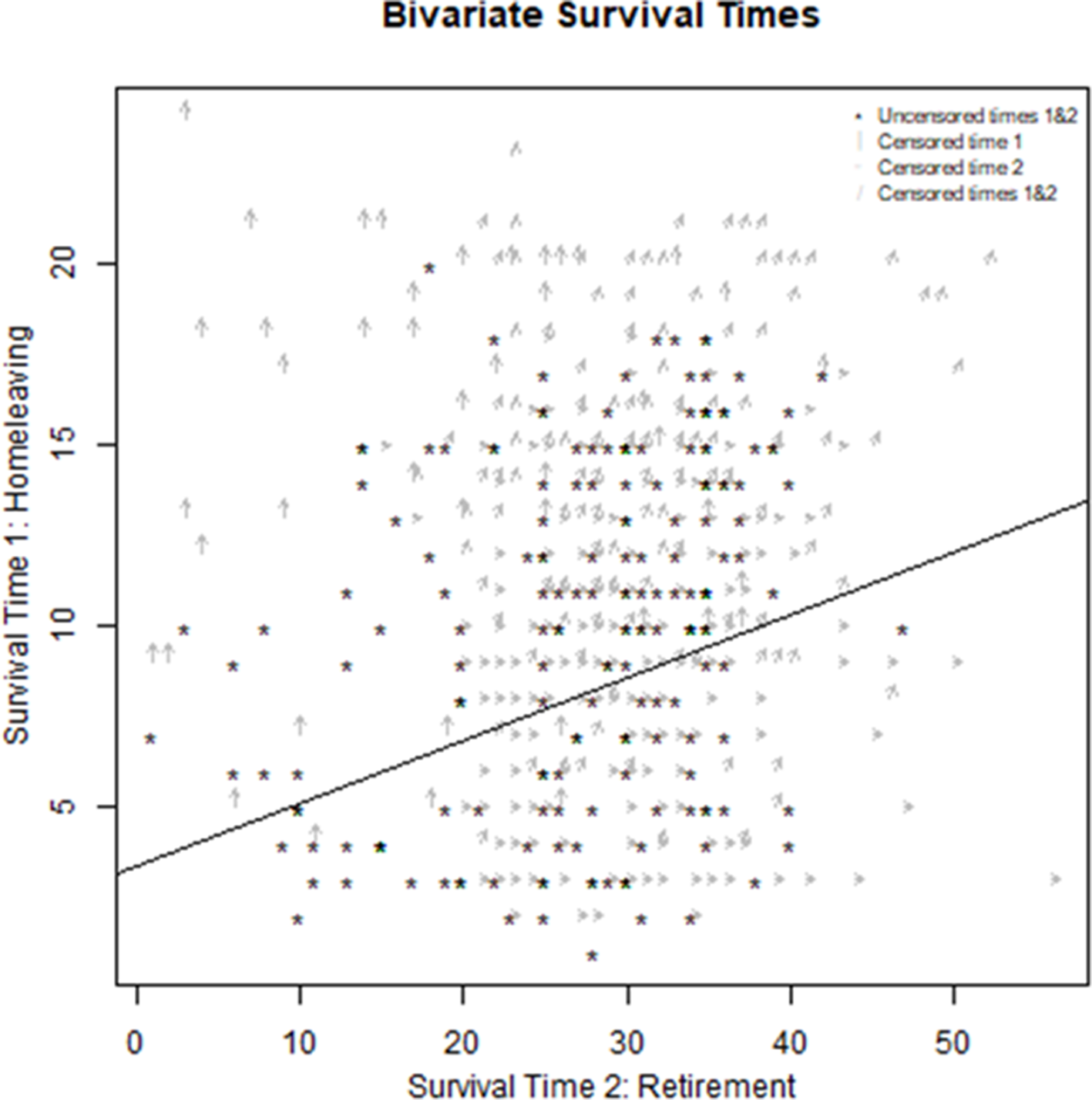
Correlated bivariate survival times.
Discussion
Prior studies on a variety of family transitions reveal how sociodemographic, family contexts, and economic factors can influence their timing (e.g., see Goldscheider & Goldscheider, 1993; Szinovacz, 2013; Mitchell, 2007; Mitchell & Lovegreen, 2009; Mitchell & Wister, 2015). To our knowledge, this is the only study that statistically links home leaving timing among young adults and their parents’ retirement timing. Indeed, these seemingly separate transitions appear to be related to one another, which challenges researchers to elucidate a more complex set of interrelationships among a variety of family and human developmental processes. This important discovery that retirement timing decisions are integrally tied to the nest leaving behavior of their children signifies how family researchers should focus more on the interconnections of these transitions, rather than considering them as basically independent family patterns. Specifically, the parents in our research were more likely to have exited the labor force if their child had already left home, and conversely, delay retirement during periods of coresidence.
This generational dimension of transitional timing provides direct support for the life course perspective applied to family-related research. Specifically, a basic tenet is that life course transitions are influenced by family and social relationships, as well as the transitions of these members (Leopold, 2012). Moreover, an individual’s life is embedded within the lives of their family members, including those from other generations (Elder, 1994; Macmillan & Copher, 2005). Thus, our research supports a conceptualization of transitional pathways and interdependence by documenting clear associations across and between aging parents and child generations (e.g., see Gilligan et al., 2018). Based on available literature, we suggest that it is more likely that later nest-leaving of children delays retirement of parents more than the opposite, although future research is required. While these transitions may have some similar underlying predictors (e.g., both are age-related, gendered, and have normative cultural dimensions), there are also different sets of factors that contextualize each transition. For instance, later home leaving is associated with having a parent in the business/financial/administrative occupations (versus trades/transportation), and parents are more likely to delay retirement if they are less financially satisfied and have better perceived health, consistent with our hypotheses and research on this topic (e.g., see Johnson, 2013; Miller et al., 2018; von Bonsdorff & Ilmarinen, 2013).
Furthermore, the strong finding for the ethnicity main and interaction effects with age of focal child/parent for the home leaving and retirement analyses could be indicative of an important ethnocultural context to these linked lives. While our study does not afford an opportunity to conduct separate transition correlational analyses for home leaving and retirement within ethnic groups, it is likely that there may be unique patterns. There are also other family transitions (e.g., elder care and grandparenthood) that need to be considered in future research that will help to reveal the full set of linkages connecting generational circumstances across the life course.
Our research also builds upon this body of research by emphasizing the value of a sociocultural life course theoretical lens for better understanding linkages among ethnically diverse family life course trajectories. Notably, our analyses reveal how the timing of retirement is shaped by ethnocultural/racialized environments, as well as ethnocultural and age interactions of parents. In particular, Persian/Iranians and South Asians, groups that have more recent immigration histories and diaspora in this study, are considerably more likely than the mainstream British group to remain in the work force. Although somewhat speculative, this may be due to workforce/income constraints connected to marginalization/discrimination, language or other cultural norms and barriers, type of job sector, or a stronger need to achieve success and security in a new society (Mitchell et al., 2019). In addition, the combination of being older Persian/Iranian parents (compared to younger British parents) results in delayed retirement. This may reflect different effects of aging experiences and perceptions across cultures, or cohort effects, both of which require future research.
Turning to home leaving, adult children are also affected by ethnocultural interactions with age of the study child. Here, the Persian/Iranian group again stands out, with older children from this group remaining home longer than younger British children. Overall, this research makes a notable contribution to this area of research by uncovering a more nuanced picture of home leaving and retirement timing among ethnically diverse families and how two pivotal family transitions interdigitate. These observations are consistent with a sociocultural life course perspective that emphasizes cultural diversity, as well as the concept and centrality of linked family lives.
Limitations of this research illuminate the need for analyses of larger, longitudinal nationally representative samples with a broader array of family structures and partnership statuses. Our sample was not powered to detect a full range of small effects. Of course, analyses of diverse ethnic groups often pose limitations on these studies due to small numbers or under-sampling. More detailed paid work and child launching/relationship histories and their timing would also help to better understand and elaborate the interconnections between home leaving and retirement transitions. Moreover, our study utilizes data primarily focused on a single study child. It would be valuable to have more complete data from all children, including factors related to distance, support patterns, and sibling relationships. In addition, the events of interest (child home leaving and parental retirement) had already occurred prior to the time of the survey, and many time-varying independent variables (living arrangement) were only collected only at the time of the survey. Some of the information that was collected reflects the situation of respondents at the time of the survey rather than at the time of the event. Therefore, only a limited number of risk factors could be considered in the model. This study is also constrained by the inclusion of only four cultural groups. Future research would benefit by having greater representation of additional groups, including more attention to variations within ethnic/racialized groups (e.g., see Ho & Park, 2019), parents in biracial partnerships, religious factors, migration, and geographical location.
Finally, results of this study highlight many timely and relevant social and economic implications for better understanding aging family life in contemporary society. Although not studied directly, our findings allude to key issues related to generational relations and solidarity, inequality, structural barriers, and cumulative advantage that warrant additional consideration. These areas of focus build upon prior work (e.g., see Gilligan et al., 2018) suggesting that flows of family assistance and resource sharing within families are becoming increasingly complex, thus producing new generational opportunities and challenges (e.g., Silverstein & Giarrusso, 2010). On the one hand, delayed transitions (i.e., coresidence) within aging families and some ethnic groups may result in many social benefits, such as the preservation of cultural traditions and building resilience with stronger bridges across the generations (e.g., see Leopold, 2012). Conversely, the prolonged dependency of children on parents with limited means may force parents into later retirement involuntarily, which may perpetuate economic inequities and adversely affect health and well-being. Indeed, coresident living arrangements and racial/ethnic disparities can profoundly shape experiences over the life course (e.g., see Brown & Warner, 2008). Therefore, our findings have important policy implications and can also offer theoretical contributions with regard to a newly revised Intergenerational Systems in Context Model (see Fingerman et al., 2020).
In conclusion, with improved understanding of the heterogeneity in ethnically diverse family transition timing, discussions of family-related strengths and weaknesses embedded in these transitions can be better informed. For instance, a change in one transition such as later home leaving may have particular positive effects for the adult child. But concurrently, there may be negative ones for their parents in cases in which they delay retirement in order to provide support to their offspring. In this way, we can provide valuable information to family professionals, policy makers, and community programmers concerned about both the strengths and challenges that increasingly diverse families face in a rapidly aging, precarious, and ever-changing globalized society.
Footnotes
Acknowledgements
This paper is dedicated to the memory of Professor Zheng Wu, who passed away suddenly during the writing of this paper. His technical expertise and sociological insights are greatfully acknowledged.
Declaration of Conflicting Interests
The author(s) declared no potential conflicts of interest with respect to the research, authorship, and/or publication of this article.
Funding
The author(s) disclosed receipt of the following financial support for the research, authorship, and/or publication of this article: The first author would like to acknowledge the funding support for this project from a Social Sciences and Humanities Research Council of Canada grant (No. 435-2014-0197).
