




Abstract
We conducted a quantitative, interdisciplinary study that investigated how financial concerns and varying family connections influence the retirement choices of Latiné immigrants in terms of returning to their country of origin. We hypothesized that being worried about one's finances for retirement, and having strong transnational ties, would lead to familial expectations to return to one's country of origin. Through data collected from a survey through Qualtrics, we found that higher levels of financial worry significantly affected greater familial expectations to return to their country of origin. The transnational ties that influenced the families’ expectations to return to their country of origin was having children, friends, and family not residing in the U.S. Following our findings, we discuss potential future directions and implications relating to transnational ties, remittances, and older Latiné immigrants.
Throughout the life course, adults plan their retirement. Extensive research on planning for retirement has focused on the level of preparedness prior to leaving the workforce (Hershey & Mowen, 2000; Kim & Hanna, 2015; Lusardi & Mitchell, 2007). Specifically, the lack of understanding in planning for retirement has been studied in which individuals compare themselves to others, such as their peers, on their own perceptions of their retirement savings (Koposko et al., 2016; Quine et al., 2006). In addition, scholarly work on retirement has emphasized how lower socioeconomic status is associated with putting off retirement planning. A study by Blanco et al. (2017) found that Hispanics are less likely to prepare for their futures, possibly because they are more focused on their work, and delay planning. This could be due to a lack of financial knowledge or not knowing where to start with their savings decisions.
In retirement planning, there are differences between immigrants and nonimmigrants, with immigrants possibly having plans to return to their country of origin (Rogers, 1991; Vega & Hirschman, 2019). Therefore, planning for retirement is an essential part of the decision-making process for moving back to their country of origin. The decision to migrate back is not made individually, as the family plays a pivotal role in immigrants opting to return (Yahirun, 2014). As a result, immigrants proactively aim to maintain their social ties with their families and their communities abroad. Relationships in the country of origin diminish depending on the length of time, however many maintain some form of connection. The new economics of labor migration theory posits that the household decides for its members to migrate in order to diversify their income portfolio and protect against income losses (Stark, 1991; Taylor, 1999). Other reasons for immigration are due to social and economic inequalities, political instability, violence, and established social networks in order to seek a better life (Brown & Bean 2005; Massey & Espinosa, 1997). Immediately, immigrants need to adapt and cope with the new environment, situation, and culture to reduce stress and increase their social and economic success in their new environment (Zuniga, 2002).
In general, research on the psychosocial aspects of retirement has been studied in multidisciplinary fields (Hardy, 2011; Kiso et al., 2019; Rote et al., 2015). It has also been examined in various contexts, such as time perspective (Gupta & Hershey, 2017), retirement worry (Gutierrez & Hershey, 2013), as well as in cross-cultural differences (Franca & Hershey, 2018; Gupta & Hershey, 2016; Hershey et al., 2010). However, this study will focus on Latiné (a gender-neutral term for the word Latino/a/x) retired immigrants who have been neglected in the postretirement literature. Researchers have found that the principal determinant that dictates immigrants’ retirement decisions is having a financial safety net where they decide to reside (Thieme, 2014).
This study will examine how financial inhibition and transnational ties shape the Latiné retired immigrants’ family expectations for them to return to their country of origin. Specifically, we aim to answer the following research questions: (1) How do financial planning worries affect retirees’ likelihood to return to their country of origin based on their families’ expectations? We expect that being worried about one's finances can lead immigrants to be expected to return to their country of origin. (2) Will individuals who maintain strong transnational ties with their loved ones in their country of origin be expected to return by them? We also expect that those who continue to have transnational ties will be expected to return by their family members.
Literature Review
The literature on retirement has provided a global view on how citizens from various countries prepare to leave the workforce. Cross-cultural studies have compared Americans with Indians, Dutch, and Brazilians, and how they focus on different retirement goals. For instance, in India, working adults emphasize financial stability, whereas in the U.S., the focus is more on leisure activities (Gupta & Hershey, 2016). When comparing Dutch and American workers, Dutch workers were more likely to feel they had adequately saved for retirement than Americans. Yet, Brazilians were more likely to engage in similar financial planning activities as their American counterparts (Franca & Hershey, 2018). These findings could be due to different economic circumstances, as Americans are more likely to be involved in greater financial planning activities (Hershey et al., 2007).
International retirement literature does not encompass the retirement planning process of returning to their country of origin, particularly the family's potential role in their decision-making affairs. Studies taking a neoclassical economic approach emphasize that immigrants make rational calculations concerning the benefits (i.e., earnings), the risks (i.e., crossing the border), and the costs (i.e., travel) of migrating (DaVanzo & Morrison, 1981; Todaro & Maruszko, 1987). For instance, in Germany, immigrants, especially younger ones, perceive that the costs of staying in a host country outweigh the overall financial gain and are more likely to return to their country of origin (Dustmann, 1997, 2003; Kirdar, 2009) compared to older immigrants. Similarly, older immigrants are less likely to return to their country of origin than younger immigrants due to labor unemployment (Yahirun, 2014). The decision to return to their country of origin is perceived to be very individualistic.
Noneconomic factors, such as the family, influence immigrants’ decision to return to their country of origin (Constant & Massey, 2002). For instance, Irish returnees explained that family, tradition, and missing the countryside were the primary reasons for returning to Ireland from Britain and the U.S. (Laoire, 2007). Similarly, both elite and less-skilled migrants from Cote d’Ivoire and Ghana returned to their respective countries due to family reasons (Tiemoko, 2004). Some research shows that those with family in their countries of origin or who are single are more likely to return to their home country (Massey & Espinosa, 1997). But females are less likely to return due to the higher risks of crossing the border (Ortiz, 1996; Reyes, 2001). Additionally, the probability of returning decreases as individuals establish a family in their host country, which can prolong or eliminate family reunification. Family plays a significant role in the decision of immigrants to return to their home country. More specifically, family expectations of returning to the country of origin are often used as a control variable; however, this study will utilize it as the dependent variable (Reyes, 1997). This will support the idea that the decision planning process is not solely individualistic.
The Latiné populace is often depicted as being distinctly oriented toward the family as a cultural, social, and economic unit. Latiné individuals report higher expectations surrounding family responsibility compared with non-Latino whites (Fuligni et al., 1999). This is emphasized by the cultural value of familism, “the importance of family closeness and getting along with and contributing to the well-being of the family” (Cauce & Domenech Rodríguez, 2002, p. 12). Familism and collectivism are associated with higher levels of loyalty, obligation, duties, to the family, and to the community (Arevalo et al., 2016).
When immigrants consider returning to their country of origin, financial inhibition can play a role in decision making. Financial inhibition assesses individuals’ concerns regarding their finances and fears relating to retirement planning (Neukam & Hershey, 2003). To our knowledge, financial inhibition as a measurement in the migration literature has been neglected. Yet, it can aid in the further understanding of the decision-making process of retired immigrants.
Transnational ties enhance individuals’ sense of community and belonging in their new environment and assist them in obtaining prosperity in their host country (Mooney, 2003; Muñoz & Collazo, 2014). Transnational ties can influence immigrants and their families on where to reside postretirement. These networks allocated in their country of origin are a crucial key source of information regarding jobs and safety. Immigrants’ remittance behavior strengthens, creates, and maintains transnational ties. An estimated 63% of Latiné immigrants demonstrate a moderate level of attachment to the native country based on their engagement with transnational activities (i.e., sending remittances) (Waldinger, 2008). For immigrants, investment occurs via remittances, which have been linked to return migration (Constant & Massey, 2002). For example, migrants are less likely to plan to retire in the U.S. if they have real estate or if they send remittances (Aguilera, 2004). However, family dependence on remittances can hinder retirement planning, as earnings are split between two households. This means that the family might expect their retirees to stay longer in the host country in order to send more money. Remaining in the U.S. allows for higher earnings, enabling their targeted income to be met faster. Yet, economic downturns and the cost of living can slow their accumulated earned wages, prolonging their stay (Yahirun, 2014).
Hypotheses
As stated earlier, to our knowledge, the Latiné decision-making process relating to retirement has not been examined, specifically regarding financial inhibition. Return migration has been explored as an individual process, yet this study finds that familial expectations impact decision making. Based on this, we hypothesize that being worried about one's finances for retirement would lead to familial expectations to return to one's country of origin. We also expect that retirees with transnational ties are more likely to be expected by family members to return.
Method
Participants
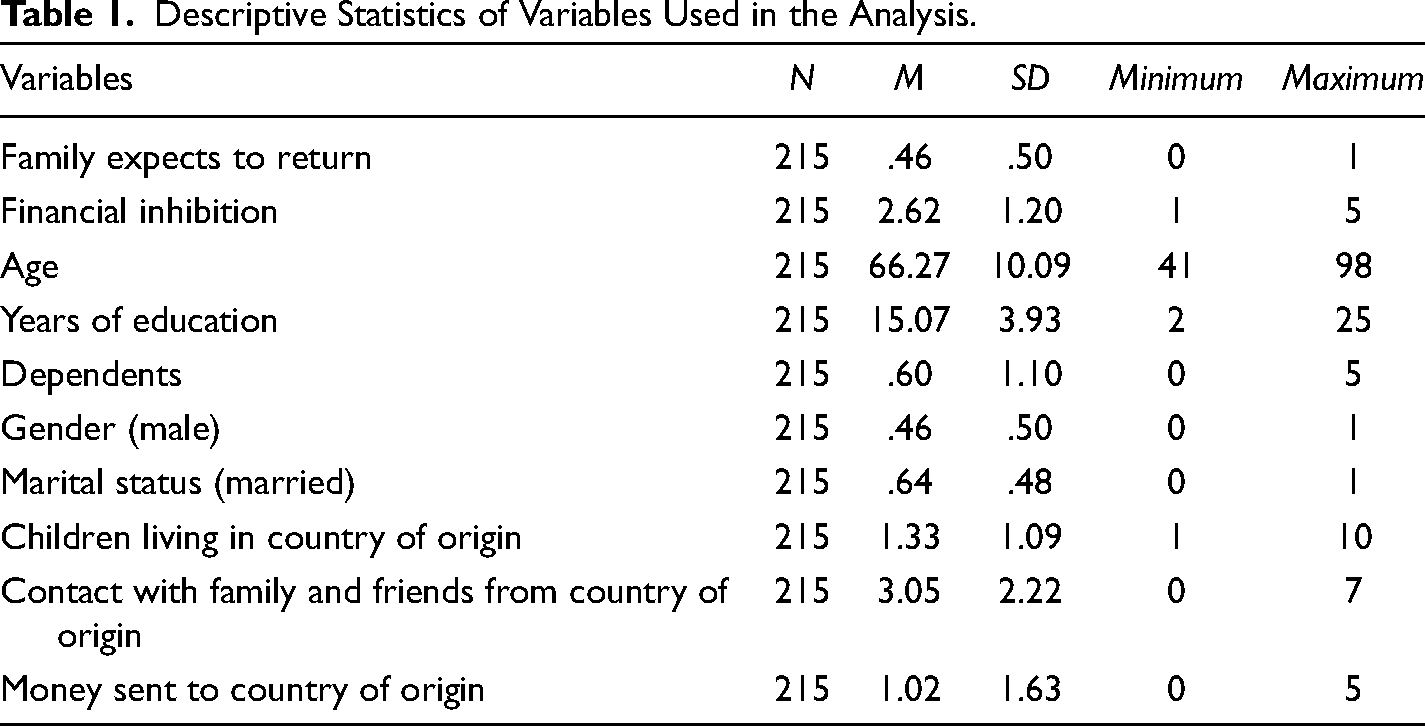
The requirements for participating in the study included: (a) being retired; (b) having been born in a Latin American country; (c) reading and writing in English or Spanish; and (d) worked for a minimum of five consecutive years in the U.S. We selected 5 years for consecutive work as it is the minimum requirement to become a U.S. citizen (U.S. Citizenship and Immigration Services [USCIS], 2023). The participants were removed from the study if they did not meet the criteria. The final number of participants in the study was 215 (originally 316) with an age range of 41 to 98 (M = 66.27; SD = 10.09). There were 116 (53.9%) women and 99 (46.1%) men, and the average years of education were 15.06 (SD = 3.93). Other descriptive statistics can be found in Table 1. Regarding participants’ country of origin, there were 20 countries represented. However, given the sample size, all were combined for this analysis. This study utilized the categorization from the U.S. Census (Marks & Rios-Vargas, 2021) in which those from Cuba (24.15%), Mexico (21.74%), Puerto Rico (20.77%), or anyone from a Latin American country are identified as one group.
Descriptive Statistics of Variables Used in the Analysis.
Procedure
The data were collected using the Qualtrics Online Panel through the Qualtrics Research Services. Collecting data through Qualtrics has been shown to have strong validity with the quality of the data (Belliveau et al., 2022). The data were collected through online-research panels that include, but are not limited to, websites, social media, member referrals, etc. Specifically, the Qualtrics Panel sent out a link to possible participants, and after completing the informed consent, they were brought to the screening questions. They were removed from the survey if they did not meet any of the criteria requirements. However, eligible participants could proceed to complete the rest of the survey. The survey consisted of questions relating to (a) financial inhibition; (b) transnational ties; and (c) demographic information. Originally the sample size was 316 participants; however, individuals were removed if they did not answer all questions, completed the survey in less than 5 minutes, or failed the attention checks. We included attention checks to ensure participants were actively reading and understanding what was being asked of them. The average time it took to complete the survey was 15 minutes. The study was administered in two languages, English and Spanish. The survey was translated and back-translated to ensure the meaning of the questions and statements remained accurate for both languages. All participants were required to complete the informed consent and were debriefed at the end of the survey. Funding for this study was received through an internal grant from the first author's institution to help fund the Qualtrics service and participant fees.
Measures
Dependent Variable
The dependent variable in this study was a single-item indicator. They were asked, “Now that you have retired, does your family expect you to return to your country of origin?” The options were: (1) Yes, to return permanently; (2) Yes, to return to visit; (3) No, to never return; and (4) Other. The responses were recoded and dichotomized with 0 = No, to never return permanently, and 1 = Yes, to return permanently. Anyone who did not respond to “Yes, to return permanently” was recoded to “No, to never return permanently.”
Independent Variables
The critical independent variables used to test hypotheses 1 and 2 were the Financial Inhibition Scale and the Transnational Ties variables, respectively. The Financial Inhibition Scale (Neukam & Hershey, 2003) is a nine-item scale with items such as, “I worry about my finances in retirement” and “Compared to my friends, I have a lot of fears involving financial planning for retirement.” This was on a Likert-type scale with 1 = strongly disagree and 5 = strongly agree. Neither item was reverse-coded, and this scale has strong reliability (Cronbach's alpha = 0.90).
The participants were asked three separate questions encompassing their transnational ties to test hypothesis 2. The first question asked, “How many children do you have living in your country of origin? Please indicate a numerical value for the number of children.” The responses ranged from 0 to More than 10. The second question asked, “How often do/did you have contact with friends and family from your country of origin?” The responses included: Never, Once a year, Once every few months, Once a month or more, Once a week or more, Once every few days, Once a day, and A few times a day. The third question asked, “How often do/did you send money to your country of origin?” The responses included: Less than once a year, Once a year, Once every few months, Once a month, and Twice a month. These transnational ties illustrate the importance of immigrants maintaining a connection with their country of origin. Beyond transnational ties, the immigrants’ demographic characteristics influence their likelihood of returning.
They were also asked demographic questions such as age, total years of education, number of dependents, gender, and marital status. For age, the respondents were asked, “What year were you born?” Utilizing the birth year, we subtracted it from the year they completed the survey, which provided us with their age. For total years of education, the respondents were asked, “In your lifetime, how many years of education have you completed?” with a range of responses to select from 0 to 25 years of education. The participants self-reported their education, which is consistent with other immigration studies’ measurements (Cheong & Massey, 2019; Downer et al., 2018). The next demographic question we asked was, “How many dependents do you have?” with a range of 0, 1, 2, 3, 4, and more than 4. “How would you describe your gender?” was also asked, with response options being male, female, other, and prefer not to say. All participants identified as either male or female. Therefore, we dichotomized the responses with males being the reference group. In the final demographic question, they were asked, “What is your marital status?” The options given were married, consensual union, divorced, separated, never married, and prefer not to say. This measure was dichotomized into not married and married. We combined consensual union, divorced, separated, never married, and prefer not to say as not married. The response for consensual union was not labeled as married because most immigration research identifies it as not married due to its legal implications (Massey & Riosmena, 2010; Orrenius & Zavodny, 2009).
The inclusion of demographic characteristics is important because they influence the probability of return migration. For instance, the measurement of age has been shown to affect the probability of returning to one's country of origin, with mostly older adults returning (Rogers, 1991; Vega & Hirschman, 2019). In addition, the years of education have been positively associated with return migration (Rooth & Saarela, 2007). Some research has shown that those who are married or have dependents are less likely to return to their country of origin (Massey & Espinosa, 1997). Regarding gender dynamics, females are less likely to return due to the higher risks of migration (Reyes, 2001). The descriptive statistics of the variables used in the analysis can be found in Table 1.
Results
Logistic Regression
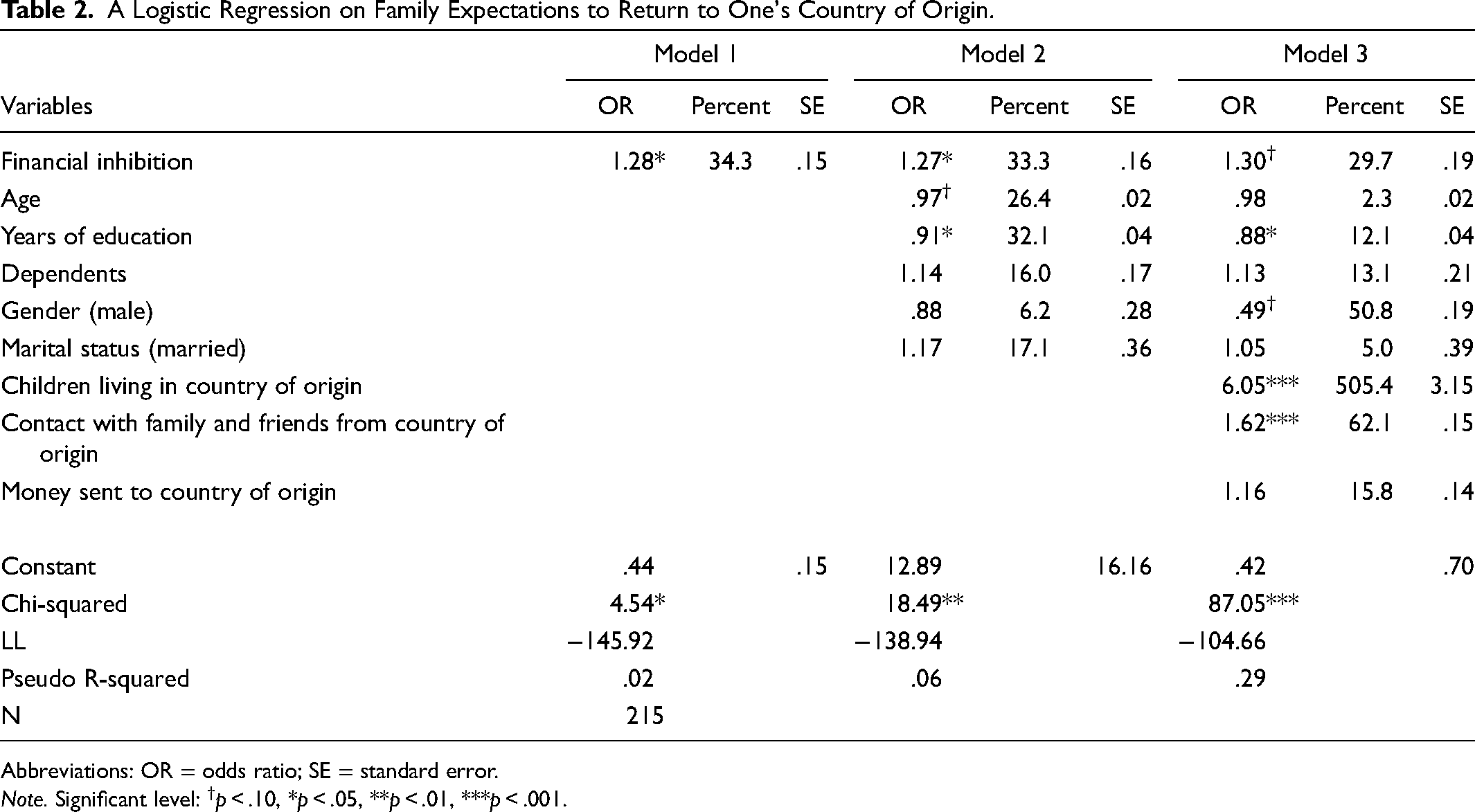
Hypotheses 1 and 2 were tested using logistic regression (see Table 2). We hypothesized (hypothesis 1) that having fears or worries about one's finances in retirement could lead to one's family to expect them to return to their country of origin. The higher the financial inhibition scale score, the greater the worry. Financial inhibition was found to be statistically significant in model 1. If the respondents scored high on the financial inhibition scale, they were 34.3% more likely to have their family expect them to return to their country of origin (p = .035). This supported our first hypothesis.
A Logistic Regression on Family Expectations to Return to One's Country of Origin.
Abbreviations: OR = odds ratio; SE = standard error.
Note. Significant level: †p < .10, *p < .05, **p < .01, ***p < .001.
In the second model, the demographic variables—age, years of education, dependents, gender, and marital status—were used as control variables. The critical variable, financial inhibition remained statistically significant (p = .049); therefore, the first hypothesis was still supported. Respondents who scored higher on the financial inhibition scale were 33.3% more likely to be expected by the family to return to their country of origin, compared to those who scored lower on the scale. Older respondents may be less likely to be expected by the family to return to their country of origin; however, the finding is only marginally significant (p = .051). Likewise, the respondents’ years of education played a significant role in their decisions to return to their country of origin based on their families’ expectations. Those with higher years of education are 32.1% less likely to be expected by the family to return to their country of origin (p = .011).
Lastly, in the third model, hypotheses 1 and 2 were tested. Hypothesis 2 specifically examined how families’ expectations of returning to their country of origin were based on their transnational ties. The connection variables (children living in the country of origin; contact with family and friends from their country of origin; money sent to their country of origin) were included, which rendered the financial inhibition scale marginally significant (p = .077). Respondents who scored higher on the financial inhibition scale were 29.7% more likely to be expected by their family members to return to their country of origin. Like model 2, higher years of education lower the likelihood of family members expecting their return to their country of origin (p = .011). Regarding gender, while marginally significant, males are 50.8% less likely to be expected to return by their family compared to females (p = .070). However, retired Latiné with children living in their country of origin are 505.4% more likely to be expected by their family to return to the country of origin than those who do not have children abroad (p = .001). Likewise, those who have continuous contact with family and friends from their country of origin were 62.1% more likely to be expected to return to their country of origin (p = .000). Hypothesis 2 is partially supported because only those with children residing in the country of origin and those who frequently communicated with family and friends was statistically significant.
Discussion
Overall, the first hypothesis was supported, and the second hypothesis was partially supported. For hypothesis 1, we were keen to understand the effect of financial worry on family expectations of their retired family members to return to their country of origin. Financial inhibition made a difference in family expectations but was marginally significant when transnational ties were considered. Hypothesis 2 tested how transnational ties influence families’ expectations for their retirees to return to their country of origin. The transnational ties that made a difference in expectations to return to their country of origin were having children, friends, and family still residing there.
This study adds to the growing literature that retirees will likely return to their country of origin. We believe that this provides further understanding of how fearing and worrying about retirement might lead them to return to their country of origin as their “safety net” (Thieme, 2014). This could be true if they maintain those ties with their loved ones still residing in their country of origin. Retirees living in a new country might have difficulties assessing their finances as they might not know what resources are available to them (Stewart et al., 2008). Therefore, making the most optimal decisions regarding managing their finances can become challenging, such as saving, spending, and/or investing. Also, depending on their country of origin, the currency exchange rate might allow their finances to stretch more (Beaton et al., 2017).
If retirees decide to repatriate, family members can support them further with resources to help them reduce their financial worries (Ayón & Naddy, 2013). This can be incredibly beneficial to help retirees live more comfortably in their postwork years. Social support is essential for individuals to continue to live productive and healthy lives, which can help enhance their overall life satisfaction. The familial support can be explained due to the strong Latiné values of familism and collectivism. A central feature of familism is the subjugation of one's individual needs to those of the family (Steidel & Contreras, 2003). Therefore, it involves the extended family aiding in the responsibility of companionship for lonely or isolated members, sharing in the financial responsibility, problem solving, and nurturing children.
Transnational ties play a significant role in families expecting the participants to return. Immigrants’ transnational social ties, a form of social capital, in home and host country allow them to gain access to a broad range of resources, such as information on migrating successfully and available jobs in the area (Amuedo-Dorantes & Mundra, 2007). If migrants expect to benefit from these relationships and avoid being sanctioned, they must fulfill their obligations to network members (i.e., family and friends) and their community (Muñoz & Collazo, 2014; Portes, 1998). Overall, there is still a need for immigrants to meet the families’ and communities’ expectations in order to preserve their ties and facilitate the process of returning.
On the other hand, immigrants might return, but not by choice (Aguilera, 2004). Some retirees and their loved ones might have already established a new life. However, if they do not make enough to save for the future, they might not be able to afford their lifestyle in retirement and therefore move back to their country of origin out of necessity. Though, if they have remained in contact with their loved ones, hopefully, the transition will be smoother by receiving social support. Transnational theory, which focuses on “multiple ties and interactions linking people or institutions across the borders of nation-states” (Vertovec, 2009, p. i), supports the idea that individuals can maintain direct ties with their loved ones residing in their country of origin.
Limitations
The study is not without its limitations. First, the participants were recruited using nonprobability sampling. Though research has demonstrated that online platforms like Qualtrics for data collection are similar to nationally representative surveys like the general social survey (Zack et al., 2019). The data in the study is not representative of the populace. An additional limitation is that we categorized all Latin American countries as one group. We acknowledge that there is variation between these different countries. Also, we cannot assume causality or indicate the respondents who return to their country of origin have decided to stay permanently.
Another limitation of this investigation is that the dependent variable does not capture the retiree returning to their country of origin. The dependent variable only captures their family's expectation of returning to their country of origin. Therefore, the intent is different from the actual action.
Future Directions
Despite the interdisciplinary scholarship on immigration, retirement, and policies, the effects of the migration experience are limited. More studies should be done focusing on the retirement decision of older Latiné immigrants. Future studies will contribute to the understanding of Latiné immigrants’ decisions to return to their country of origin. Scholars should analyze the impact of the portability of Social Security, medical insurance, family connection, and economic goals on an individual's retirement choices. This will shed light on how an immigrant's retirement plan changes during their time in the United States.
The literature on retired Latiné immigrants lacks an extensive examination of the relationship between remittances and retirement decisions. By understanding the relationship, scholars can determine a retiree's purpose for the amount of remittances sent. Also, the remittance behavior might affect the retiree's decision to stay in the U.S. or return to their country of origin (Loschmann & Siegel, 2015). Qualitative and quantitative research has not focused on Latiné immigrant retirees. The literature on retirement has used primarily quantitative methodology. However, changes and experiences throughout one's life cannot be captured through a quantitative lens.
The need for qualitative investigations can be fulfilled with oral histories. Oral histories provide a discourse in understanding the cultural practices, familial ties, and political strategies shaping immigrants’ decisions regarding retirement (Kropp, 2006; Otero, 2010; Ruiz, 1998). Scholars can utilize oral histories to understand the immigration experience and its uniqueness. In addition, it can also aid in comprehending the usage of remittances. By having a first-hand account, scholars can analyze why individuals immigrate and when financial priorities change. More importantly, researchers can understand how immigrants navigate their future with familial needs and how various events can change their plans.
Implications
Once retired, the next step has implications at the micro and macro levels. At the micro level, there can be a form of interdependence between the retiree and the family members by resolving the infrastructure issues at the local level (i.e., poverty). At the macro level, remittances are one of the main contributors to their home countries’ gross domestic product, which might influence countries to implement policies to best attract retirees (Ratha, 2018). However, the host countries might want to retain their retirees as their taxes aid their local economy.
This study can shed light on migration patterns among Latiné individuals and the motivations to move back to their country of origin. The decision to retire is important not just for the individual but also for their respective family members. Based on our findings, family ties play a role in opting to repatriate. By understanding individuals’ financial worries and social ties, we can learn how to help this group of individuals once they leave the workforce.
Footnotes
Declaration of Conflicting Interests
The author(s) declared no potential conflicts of interest with respect to the research, authorship, and/or publication of this article.
Funding
The author(s) disclosed receipt of the following financial support for the research, authorship, and/or publication of this article: This work was supported by Susquehanna University (Faculty Research Grant).
