




Abstract
This study examines the mediating effect of social network size on depression among older adults in Japan in association with the Big Five personality traits: extraversion, agreeableness, conscientiousness, neuroticism, and openness. Cross-sectional data were obtained from 739 older adults (Mean age = 75.13, SD = 6.86) residing in Tokyo. Multiple mediation analyses estimated total, indirect, and direct effects between personality and depression. Extraversion was associated with the number of kin and friend networks and agreeableness with the number of kin networks. Moreover, these social networks partially mediated the effects of extraversion and agreeableness on depression. The findings show that personality traits such as extraversion and agreeableness are associated with social network size, which contributes to better mental health in old age.
Social relationships play a critical role in the maintenance and promotion of mental health among older adults. This topic has attracted the attention of scientists and practitioners in many disciplines (Cohen, 2004). Research exists on both direct and indirect influences of social network size and contact frequency on mental health. Receiving positive feedback from relatives and friends is regarded as an essential source of self-concept, and social support may buffer the negative effect of stressors by influencing coping strategies (Pinquart & Sörensen, 2000). Conversely, social networks may also be a source of negative interaction, criticism, and excessive demands (Rook, 1984). As the socioemotional selectivity theory posits (Carstensen, 1992), choosing, maintaining, and developing close network members is essential in old age.
Psychological and clinical concerns have also driven empirical research into the relationship of mental health outcomes with personality, which have been particularly defined via the Big Five personality traits. The results of a meta-analysis of all age groups indicated that the incidence and severity of mood disorders, including depression, were associated strongly with high neuroticism, low extraversion, and low conscientiousness, and more weakly with low agreeableness (Malouff et al., 2005). Furthermore, there is growing evidence of the important role of personality in the occurrence, onset, and severity of depression in older adults (Hayward et al., 2013; Koorevaar et al., 2013).
Despite these well-documented associations between personality, social network size, and mental health, studies integrating all these variables are rare. Especially in the case of older adults, it is necessary to examine how personality is related to the social networks that influence mental health. This study's goal was to examine the mediating effects of social network size on depression among older adults in association with the Big Five personality traits. Figure 1 shows the conceptual model of the study. This model shows how personality traits directly impact kin and friend network size and mental health, as measured by depression. It also assumes that kin and friend networks mediate the association between personality and depression.
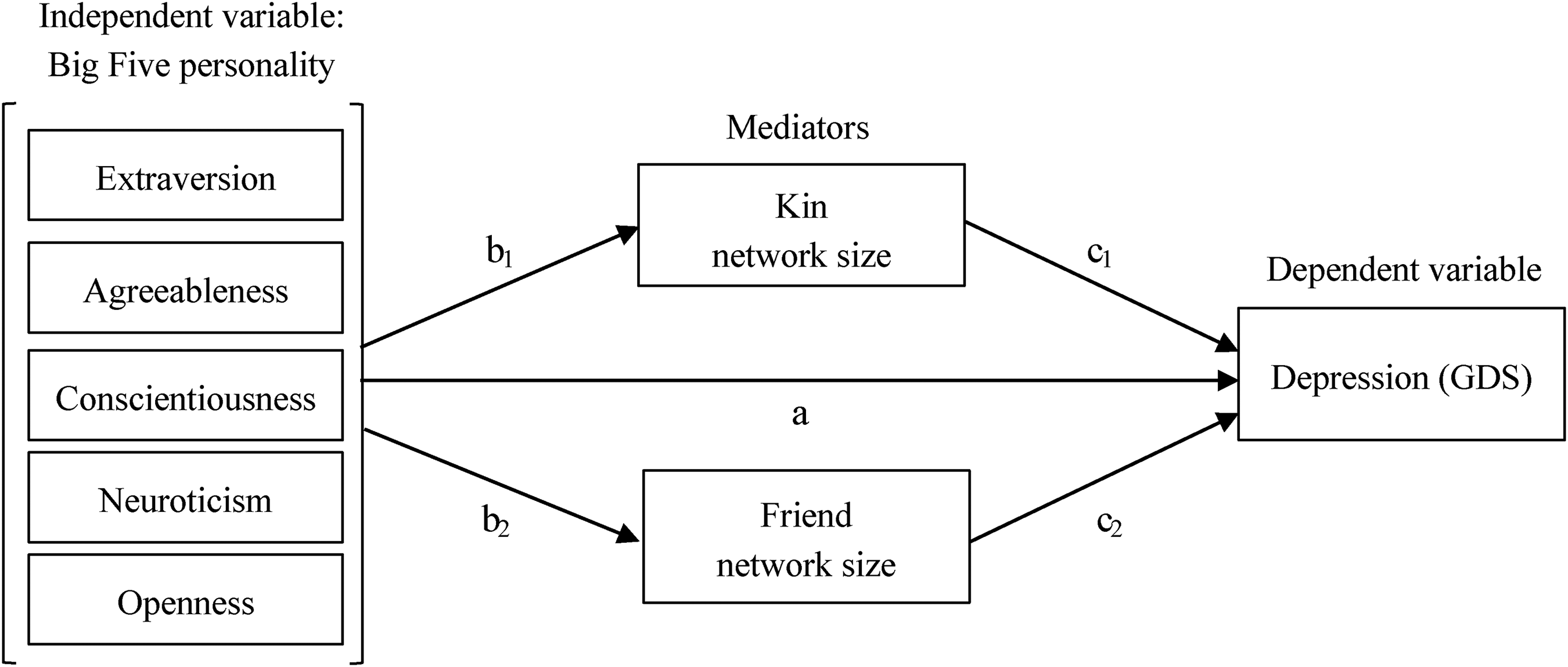
Conceptual model of the mediating effects of social networks on the associations between personality and depression. Note. GDS = Geriatric Depression Scale.
The significance of analyzing a non-western sample based on this model is, first, that as shown by cross-cultural studies of the Big Five personality traits (da Rosa et al., 2021; Schmitt et al., 2007), East Asia—including Japan—has lower scores for extraversion, agreeableness, conscientiousness, and openness and higher scores for neuroticism than western countries.
Second, Japan is a unique case because it has experienced the fastest population aging in world history over the last few decades. The aging rate reached 28.8% in 2020 (Cabinet Office, 2021). In recent years, the percentage of elderly people living with their children has been declining, the number of single-person households has been increasing, and social isolation in urban settings has become a problem. Therefore, in Japan, relatives living apart and friend networks have become increasingly important.
Literature Review: Mediating Effects of Social Networks on the Associations Between Personality and Depression Among Older Adults
Several meta-analyses have emphasized the importance of understanding the direct effects of personality on depression (see path A in Figure 1) (Kotov et al., 2010; Malouff et al., 2005). In studies of older adults, as in the general adult population, lower extraversion, lower conscientiousness, and—in particular—higher neuroticism have been shown to be associated with depression (Hayward et al., 2013; Koorevaar et al., 2013, 2017; Steunenberg et al., 2006). Although not consistently, lower extraversion, agreeableness, and conscientiousness have also been suggested to be associated with depression in old age (Hayward et al., 2013; Koorevaar et al., 2013, 2017). Existing research in Japan has focused more on the relationship between personality and mortality and centenarian personality characteristics (Iwasa et al., 2008; Masui et al., 2006), but less is known about the effect of personality on depression among older Japanese adults.
In recent years, research on the effects of personality traits on network structure (see path B in Figure 1) is documented in the form of linking network analysis in sociology and psychology. According to the review by Selden and Goodie (2018), extraversion is related to both size and composition of networks, mainly due to the additional inclusion of non-kin ties. Agreeableness is positively related to network centrality in personal networks. Although few studies focus on older adults, prior research has shown that extraversion, openness, and neuroticism are associated with overall network size (Lang et al., 1998) and that extraversion is associated with friend network size (Iveniuk, 2019). In Japan, it has been suggested that extraversion and neuroticism are associated with network size in the adult population (Ishiguro, 2016); however, personality–network size relationships have not been fully examined among older adults.
Studies on the direct effects of social networks on depression, corresponding to path C in Figure 1, have accumulated for many years (Berkman et al., 2000; Cohen, 2004). Among the measures of network structure, the number of close relatives and friends is a factor related to the well-being of older adults. According to a meta-analysis by Pinquart and Sörensen (2000), the quantity of friend networks is measured by the number of people the respondent socializes with or the frequency of contacts, which was more closely related to subjective well-being in later life than the quantity of family network. It has been indicated that older people with friendless networks have higher levels of depression and those with diverse networks have lower levels of depression (Fiori et al., 2006); however, the effect of the size of kin and friend networks on depression is not well understood. In Japan, previous studies suggest that interaction with relatives and friends results in lower levels of depression among older adults (Okabayashi & Hougham, 2014; Sugisawa et al., 2002).
We reviewed previous studies on the relationship between personality, social networks, and depression among older adults, but few have examined all three concepts. A previous study that considered social network indicators as mediating variables (Zhu et al., 2013) found network size to be an important factor linking extraversion and agreeableness to subjective well-being in a sample of first-year university students. Lincoln (2008) found that the associations between personality traits and depression in American adults were mediated by social support and negative interactions. Dumitrache et al. (2018) found that emotional and affectionate support constituted important explanatory mechanisms for the indirect effect of extraversion on life satisfaction among older adults in Spain.
In light of these previous studies, more research is essential on social networks that mediate the relationship between personality and depression in older samples. Young and old people experience different types of life events and have different opportunities to develop kinship and friendships. Therefore, social networks as mediators may perform different functions for them. Furthermore, these previous studies are from western countries, and it is necessary to accumulate data in non-western countries with different cultural backgrounds. In Japan and other western countries, kinship is maintained by different social norms, and the effects of social ties with spouses, children, and other relatives on depression are different (Sugisawa et al., 2002). From this perspective, it is meaningful to verify the network mediation effect using the older Japanese sample.
Therefore, this study aims to address two research questions:
Question 1: Do personality traits have a direct effect on depression and kin and friend network size? Question 2: Does social network size mediate the associations between personality and depression among older adults in Japan?
Although findings from previous studies have been inconsistent, it is likely that older adults with lower extraversion and neurotic tendencies are more likely to exhibit depressive tendencies. We also assume that those with higher extraversion will tend to have more intimate relatives and friends. Furthermore, unlike the culturally individualistic west, in collectivistic Japan, those with higher levels of agreeableness may have larger kinship/friend networks and lower depressive tendencies. In collectivist cultures, people are interdependent with their in-groups, prioritize the goals of their in-groups, and behave in a communal way (Triandis & Suh, 2002).
Methods
Sample
Data were obtained from a survey of residents from two wards in Tokyo Prefecture. Using a two-stage random sampling procedure, we identified 2,000 men and women aged 65 years and over. In the first stage, 65 primary sampling units (PSUs) of the National Census were selected by systematic sampling in each ward. Systematic sampling is a type of probability sampling method in which the target areas (PSUs in this study) or individuals are extracted following a randomly selected start number and a fixed extraction interval. In the second stage, 1,000 men and women aged 65 and over were selected from the basic resident registration by systematic sampling in each ward. In total, 868 men and 1,132 women were selected from the two wards.
Face-to-face home interviews were conducted with each participant in 2016. To increase participation rates, we re-visited those who were unavailable or missed at least three interviewer visits. The final number of completed surveys was 761, resulting in a response rate of 38.1%. Social surveys in Japan have experienced a substantial decline in response rates during the 21st century, and the response rate of this study is not low for a survey in metropolitan areas (Rindfuss et al., 2015). The 2015 Population Census of Japan indicated that the age and gender distribution in the sample were representative of the population. Nonparticipation rates included refusal (41.3%), absence (13.3%), poor health (3.4%), relocation (2.4%), death (0.6%), and other reasons (0.9%). Participants with a high probability of cognitive impairment were excluded from the analysis because of the unreliability of their responses. Cognitive impairment was measured using the Short Portable Mental Status Questionnaire (Pfeiffer, 1975). Using the original item cut-offs (Liang et al., 1996), we excluded those with more than three errors based on their answers to the Short Portable Mental Status Questionnaire. The final number of participants included in the analysis was 739.
The average age of the participants was 75.1 years (range 65–99 years), with 50.5% young-old and 49.5% old-old, where 45.5% were male and 54.5% were female. The average number of years of schooling was 12.7 years, with 20.1% of the participants having graduated from junior high school, 41.9% from high school, and 38% from junior college or university. Further, 63.3% of participants had a spouse and 37.9% lived with their children.
Measures
Depression
The dependent variable, depression, was measured using the Japanese version of the Geriatric Depression Scale (GDS) short form (Niino et al., 1991). This scale has been widely used in previous studies with Japanese community samples (Imai et al., 2015; Tsuboya et al., 2016). The GDS short form, developed by Sheikh and Yesavage (1986), uses 15 items to measure the extent of depressive symptoms. Responses were coded as follows: 1 = yes, has symptoms, and 0 = no, producing a score within a range of 0–15. Higher scores indicated more depressive symptoms. The α reliability of this scale was .72.
Personality
The independent variables, the Big Five personality traits, were measured using the Japanese version of the Ten Item Personality Inventory (TIPI-J) (Oshio et al., 2012; Oshio et al., 2013). The TIPI, developed by Gosling et al. (2003), is a widely used measure of the Big Five personality dimensions. This scale is useful for reducing the burden on older respondents in general social surveys, where interview times tend to be long. The TIPI-J consists of ten items, with two items assessing each dimension. For each one, one item is a positive statement, and the other is a negative statement. Items were scored on a 7-point scale ranging from 1 = disagree strongly to 7 = agree strongly. With-in-scale correlations between the positively and negatively keyed items on each scale were − .35, − .29, − .22, − .23, and − 29 for extraversion, agreeableness, conscientiousness, neuroticism, and openness, respectively. Each item was designed to minimize content overlap. Therefore, the correlation coefficients in this study are appropriate in terms of the perspective of bandwidth-fidelity trade-offs and are similar to those in previous studies (Oshio et al., 2013, 2014). For each personality trait, after reversing the negative items, the total score of the two items was entered into the analysis.
Social Networks
The mediator variable was measured using the social network size. As previous studies have suggested that the effect of network size on mental health varies by domain, such as relatives and friends (Iveniuk, 2019; Pinquart & Sörensen, 2000), the numbers of relatives and friends in social networks were entered into the analysis. Kin network size was measured by asking, “How many siblings, cousins, grandchildren, or other relatives of yourself or your spouse do you interact with on a regular basis (excluding those who live with you)?” Friend network size was measured by asking, “How many friends do you interact with on a regular basis?” Because network size tends to be positively skewed, log-transformed values are sometimes used in its analysis (Fischer, 1982). When conducting the analyses for this study, we, therefore, ran duplicate analyses using log-transformed values. However, as this made no difference to which indirect effects showed significant associations, we have reported the results obtained using untransformed data below.
Control Variables
In previous studies on social networks and mental health, age, sex, education, and functional disability have been included in the analyses as control variables (Fiori et al., 2006), and spousal presence and co-residence with children have been associated with depressive symptoms among Japanese older adults (Sugisawa et al., 2002). Age was measured in years. Sex was coded as 0 = female and 1 = male. Education was measured in completed years of schooling. Functional disability was assessed by Activities of Daily Living (ADLs) and Instrumental Activities of Daily Living (IADLs). Disability in ADLs was measured based on whether respondents needed assistance with eating, dressing, bathing, toileting, and walking; disability in IADLs was measured by asking whether they needed assistance with money management, shopping, medication management, meal preparation, and cleaning and laundry. If assistance was needed for any one activity, the respondent was considered to have a functional disability. The effects of having a spouse and co-residence with children were also controlled for.
Analytical Procedures
To assess whether the relationship between the Big Five personality traits and depression was mediated by social network size (see Figure 1), we performed a multiple mediation analysis as outlined by Preacher and Hayes (2008) to estimate total, indirect, and direct effects. This analytical design, which has received attention in the methodological and applied literature, involves simultaneous mediation by multiple variables. This study examined whether two mediating variables, kin and friend network size, explain the relationship between the Big Five personality traits and depression in a single model. A bias-corrected bootstrapping approach was used to estimate the mediating effects. Bootstrapping is a nonparametric resampling procedure and is advocated as an additional method for testing mediation that does not impose the assumption of sampling distribution normality (Preacher & Hayes, 2004, 2008). To determine whether mediation occurs, point estimates and 95% confidence intervals (CIs) were determined according to the null hypothesis; if zero is contained within the 95% CIs, then a lack of significance is assumed. A full-information maximum-likelihood approach to handling missing data was employed in the analysis (Enders, 2010). Data analysis used Mplus version 8.4. (Muthén & Muthén, 1998–2017).
Ethical Considerations
The study complied with the guidelines of the Declaration of Helsinki. The research ethics board at J.F. Oberlin University approved all procedures (No. 15040). All participants received a letter of invitation explaining the aim and content of the present survey. The face-to-face interviews were conducted only by those who provided consent to participate. Data collection and storage management procedures ensured confidentiality. Participation was entirely voluntary, and confidentiality was fully guaranteed.
Results
Descriptive Analysis
Table 1 presents means, standard deviations, and correlations among the variables in the study. Results showed that extraversion was positively associated with kin network size (r = .11) and friend network size (r = .17). Agreeableness was positively associated with kin network size (r = .10). Neuroticism was negatively associated with friend network size (r = − .11). Openness was positively associated with friend network size (r = .16).
Means, Standard Deviations, and Correlations among all Study Variables (n = 739).
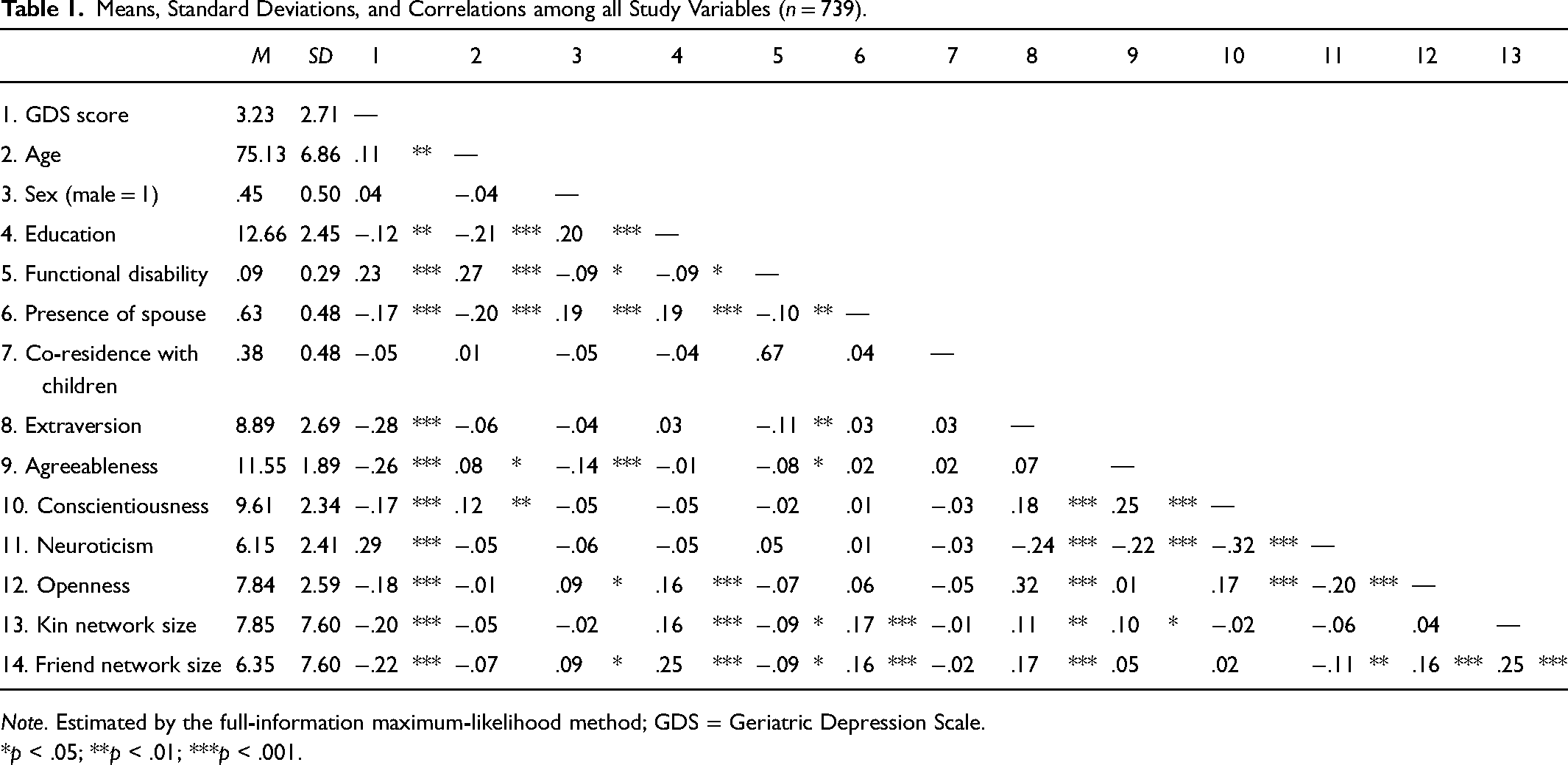
Note. Estimated by the full-information maximum-likelihood method; GDS = Geriatric Depression Scale.
*p < .05; **p < .01; ***p < .001.
There are substantial correlations among the Big Five personality traits and mental health. Extraversion (r = − .28), agreeableness (r = − .26), conscientiousness (r = − .17), and openness (r = − .18) were negatively and neuroticism (r = .29) was positively associated with depression. Moreover, kin network size (r = − .20) and friend network size (r = − .22) were negatively associated with depression.
Multiple Mediation Analysis
Table 2 presents the coefficients for the effects of personality on social network size and depression. Results of the analysis showed that extraversion had a positive effect on kin (β = .099, p < .05) and friend network size (β = .133, p < .01). Agreeableness also had a positive effect on kin network size (β = .079, p < .05). Furthermore, extraversion (β = − .148, p < .001) and agreeableness (β = − .168, p < .001) had a negative effect on depression, while neuroticism (β = .172, p < .001) had a positive effect on depression. In addition, kin (β = − .090, p < .01) and friend network size (β = − .097, p < .01) had a negative effect on depression.
Model Coefficients for the Effects of Personality on Social Network Size and Depression (n = 739).
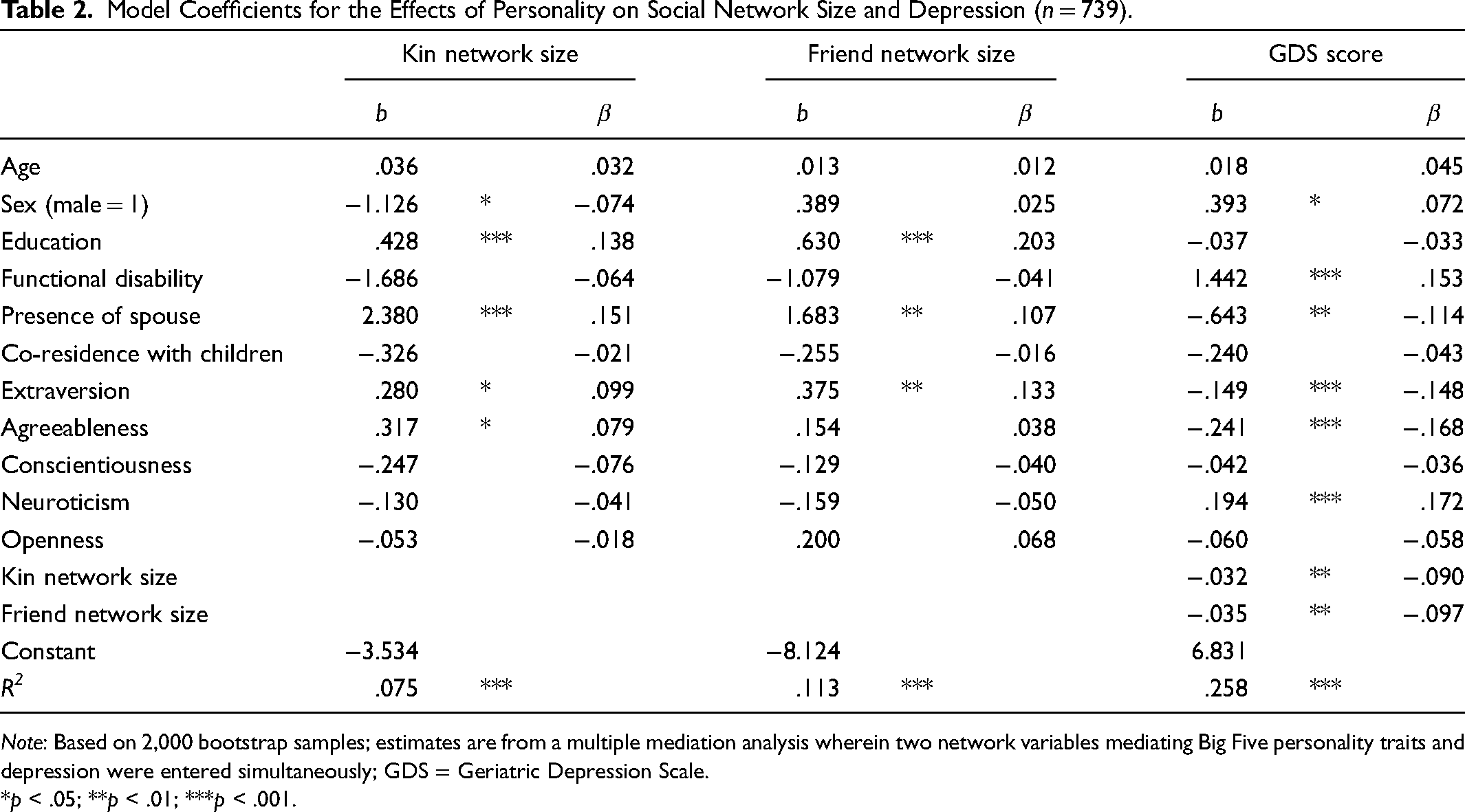
Note: Based on 2,000 bootstrap samples; estimates are from a multiple mediation analysis wherein two network variables mediating Big Five personality traits and depression were entered simultaneously; GDS = Geriatric Depression Scale.
*p < .05; **p < .01; ***p < .001.
Table 3 shows the standardized total, indirect, and direct effects of associations between personality and depression. Results of the bias-corrected bootstrapping showed that the total indirect effect of extraversion on depression through social networks was significant (point estimate − .022 [ − .039, − .009]). Regarding the specific indirect effect of mediators, kin network size (point estimate − .009 [ − .021, − .001]) and friend network size (point estimate − .013 [ − .027, − .004]) were significant. Moreover, the total indirect effect of agreeableness on depression through social networks was significant (point estimate − .011 [ − .025, − .001]). Regarding the specific indirect effect of mediators, kin network size (point estimate − .007 [ − .017, − .001]) was significant.
Standardized Total, Indirect, and Direct Effects of the Associations Between Personality and Depression (n = 739).
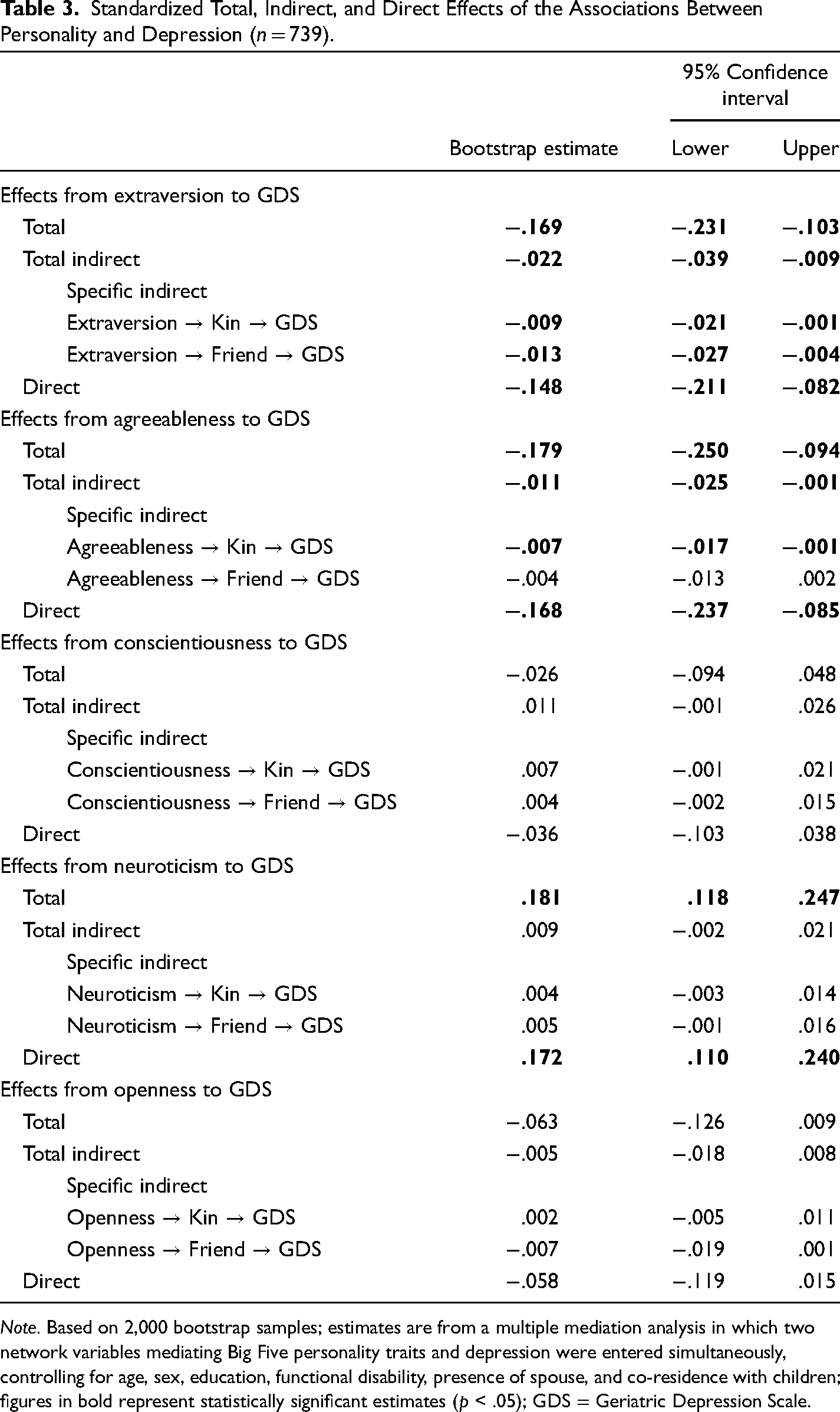
Note. Based on 2,000 bootstrap samples; estimates are from a multiple mediation analysis in which two network variables mediating Big Five personality traits and depression were entered simultaneously, controlling for age, sex, education, functional disability, presence of spouse, and co-residence with children; figures in bold represent statistically significant estimates (p < .05); GDS = Geriatric Depression Scale.
Discussion
This study is one of the first to examine the mediating effects of social network size on associations between the Big Five personality traits and depression among older adults in non-western societies.
The first research question was whether personality traits directly affect kin and friend network size and depression. The study results show that extraversion was associated with a higher number of close relatives and friends. This finding is also consistent with the association between extraversion and network size that has been highlighted in previous network analyses (Selden & Goodie, 2018). Finally, our results are consistent with Iveniuk (2019), who found an association between extraversion and the number of friends in gerontological studies. According to socioemotional selectivity theory (Carstensen, 1992), as people age, they strategically construct their social networks to maximize emotional gain and minimize risk. From this perspective, extroverted older adults are more likely than introverted older adults to maintain close relatives and friendships, and even pursue new, intimate friend networks.
This study shows that agreeableness is related to the number of close relatives. Previous research in network analysis shows mixed results (Selden & Goodie, 2018), with some results showing a positive association between agreeableness and network size (Zhu et al., 2013). Older adults who are more agreeable spend more time with their confidants and spouses and share a higher level of intimacy (Iveniuk, 2019). In this analysis, the agreeableness effect was confirmed only for the number of relatives. Differences like kinship and friendship should be taken into account when interpreting the results. Friendships are essentially voluntary relationships in which people share hobbies and lifestyles, whereas kin relationships include more or less predetermined relationships such as siblings and cousins of spouses (Huxhold et al., 2014). Collectivists in conflict situations are primarily concerned with maintaining relationships with others, whereas individualists are primarily concerned with achieving justice (Triandis & Suh, 2002). Thus, to maintain stable kinship over such a long period of time, agreeableness is a beneficial personality trait for older Japanese.
Furthermore, extraversion and agreeableness are associated with lower depression and neuroticism with higher depression. All five personality traits directly correlate with depression; however, when the personality and control variables are entered simultaneously, openness and conscientiousness disappear. Previous research in western countries has shown that higher neuroticism is associated with higher depression and higher extraversion with lower depression (Hayward et al., 2013; Koorevaar et al., 2013). Koorevaar et al. (2017) suggest an association between agreeableness and depression, but few studies have reported such an association in western countries. In this study, the association between agreeableness and depression was significant even after controlling for the effects of socioeconomic status and social networks. Further investigation is needed to determine whether this is a common tendency in Japan and other Asian countries.
The second research question was whether social network size mediates the association between personality traits and depression. Our results show that kin networks mediate the effects of extraversion and agreeableness on depression, and friend networks mediate the effects of extraversion on depression. The finding is consistent with Lincoln's results (2008), which showed that kin support mediated the association between extraversion and depression. The results also align with Dumitrache et al. (2018), which showed that emotional and affectionate support mediates the effect of extraversion on life satisfaction. The direct and indirect effect of agreeableness on mental health was more pronounced in older Japanese adults than in western countries. It suggests that agreeableness, which reflects gentleness and empathy, caring for others rather than putting personal interests first, is a significant characteristic of mental health among older Japanese adults.
From a theoretical point of view, our mediation analysis elucidates the psychological mechanisms preceding the benefits of social networks on mental health among older adults. From a practical point of view, it suggests the need to take personality traits into account when considering social relationship interventions promoting mental health among older adults (Dumitrache et al., 2018). For instance, extroverted older adults who seek opportunities to be with others may require a different intervention approach than introverted older adults (Lincoln, 2008). However, the direct effect of extraversion and agreeableness on depression remains significant, and mediation by social network size is only partial. Further research is needed to examine the socio-psychological factors that mediate personality and mental health (Dumitrache et al., 2018; Lincoln, 2008).
This study has several limitations starting with its cross-sectional design. A panel study is necessary to examine the causal effect of personality on the development of kin and friend networks and the impact of these social relationships on mental health. Although this study examined a model in which personality influences network size, changes in the social environment, including networks, may affect individuals’ personalities throughout the course of their lifetime. Therefore, the reciprocal relationship between personality and network requires further study. Second, regional differences exist in the family and kin relationships of older adults, including the rate of co-residence with children (Takagi et al., 2007). Since the study sample was limited to the Tokyo metropolis, the results need validation based on samples from other Japanese regions and other countries. Third, this study focused only on the size of relative and friend networks among the mediating factor indicators. In the future, it is necessary to analyze indices such as density, centrality, and homophily, especially regarding personality, as well as instrumental and emotional support, the functional aspects of social relationships.
In conclusion, this Japanese study of older adults shows that extraversion is associated with a larger number of kin and friend networks and agreeableness with a larger number of kin networks. Further, these social networks partially mediate the effects of extraversion and agreeableness on depression.
Footnotes
Declaration of Conflicting Interests
The authors declared no potential conflicts of interest with respect to the research, authorship, and/or publication of this article.
Funding
The authors disclosed receipt of the following financial support for the research, authorship, and/or publication of this article: This work was supported by the JSPS KAKENHI (grant no. 26245062).
