



Abstract
Community colleges are the mass educators of American higher education, teaching a wide range of students for a low cost. In fall 2012, 45% of undergraduates in the United States were enrolled in community colleges (American Association of Community Colleges, 2013a), and given President Obama’s recent announcement of America’s College Promise, an initiative to make 2 years of community college free for many students, that percentage could increase in the coming years (Obama, 2015). Yet, community colleges struggle with retention, and many students who aim to earn an associate’s degree or transfer to a 4-year college never do (e.g., Aud et al., 2011; Braxton, Hirschy, & McClendon, 2004; Rosenbaum, Deil-Amen, & Person, 2006). What can community colleges do to improve their students’ educational outcomes?
Tinto (1993) theorized that most students who withdraw from higher education do so because of a lack of social or academic integration into their institution, where integration is defined as a student’s sense of alignment with and belonging to the school community. Tinto’s work, however, focused on students at 4-year colleges. Deil-Amen (2012) extended his theories into community colleges and found that for community college students, moments of combined socio-academic integration are of highest importance for alignment, belonging, and academic outcomes. By applying these theories to program implementation and improving the socio-academic integration of community college students, colleges may improve students’ academic outcomes.
However, socio-academic integration can be difficult to foster at community colleges. Although the number of institutions with on-campus housing is growing, only 1% of community college students in the United States live on campus (American Association of Community Colleges, 2013b), making for a very different college experience than that of their peers in residential, 4-year institutions. Living off campus limits community college students’ access to the social networks that develop through dorm residence (Festinger, Schachter, & Back, 1950; Schudde, 2011), whereas work and family obligations limit on-campus time. These and other institutional characteristics of community colleges limit students’ exposure to the socio-academic exchanges that Deil-Amen (2012) observed to be particularly impactful.
To overcome these challenges, some community colleges are implementing new tools in an effort to better foster socio-academic integration: online social networks. Online social networks, such as Schools App, the Facebook-based application we analyze in this study, provide a well-defined and omnipresent space in which students at 2-year colleges can interact and integrate. Online social networks offer a mobile opportunity for student involvement, defined as a student’s active participation in the school community (Astin, 1984). The characteristics of online networks specifically offset barriers to involvement and integration that are present in community colleges: Although students work and live away from other students, they can contact one another through the network.
In our study, we analyzed the content of online posts and found that socio-academic intentions and interactions are present on Schools App, an online network implemented for students at a college we call the Community College (CC). Because involvement in Schools App gives students additional opportunity for socio-academic moments, we hypothesized a positive relationship between involvement in the online network and academic outcomes. Specifically, we tested three research questions:
To answer these questions, we estimated a series of regression models using data from the 2011-2012 academic year and modeled the relationships between online network involvement and two academic outcomes: credit completion and grade point average (GPA).
Our study fills a gap in the research literature with respect to understanding the socio-academic integration of students at community colleges. Prior analyses of integration (Bers & Smith, 1991; Thomas, 2000) and socio-academic integration (Deil-Amen, 2012) at community colleges focused on students’ offline friendships. This study is the first to consider online social networks as a forum for socio-academic integration at a community college and the relationship between involvement in the network and student academic outcomes. As a relatively new forum for socio-academic integration in community colleges, online social networks merit empirical testing. Our study provides evidence for administrative decision making about the implementation and influence of online networks at community colleges.
Socio-Academic Integration and Online Networks
Tinto’s theories have become paradigmatic in the study of student persistence (Bensimon, 2007), but Braxton et al. (2004) contended that Tinto’s theories may not apply evenly to students across all types of postsecondary institutions. Indeed, Deil-Amen (2012) found that Tinto’s distinction between social and academic forms of integration is a false dichotomy for students at 2-year colleges. Instead, she found that blended, socio-academic moments are especially impactful for the integration of community college students.
Deil-Amen’s interviewees preferred socio-academic relationships that focused on school and gave them academic support, but were social in nature and also gave students better access to procedural information and opportunities for goal sharing with others. Similarly, Karp, Hughes, and O’Gara (2010) found that information networks that originate in the classroom offer community college students a stronger sense of belonging and greater abilities to navigate the institution.
The literature on socio-academic integration derives from the study of in-person interactions. In our study, we considered an online social network as a forum for socio-academic integrative moments. Can socio-academic integration occur on an online platform? Wellman and Hampton (1999) argued that social exchange of information happens online, just as it does in person, and that widespread Internet access has made computer-mediated communication a part of everyday life and social networks (Wellman, 2001). In the past, social networks were place-based: Students interacted with peers at school and family at home. Older communication technologies, too, emphasized places. For example, the postal service and landline telephones both necessitated contacting a specific place to communicate with a specific person. With wireless technology, people engage in networked individualism, in which individuals directly contact one another, independent of place, and rapidly switch between—or simultaneously and separately engage with—multiple social communities (Wellman, 2002).
Certainly, students engage in networked individualism, and social media is a key technology that allows students to communicate with multiple communities, independent of place. Researchers found that around 90% of college undergraduates use Facebook (Dahlstrom, de Boor, Grunwald, & Vockley, 2011; Junco, 2012b), and Ellison, Steinfield, and Lampe (2007) reported that students maintain and intensify relationships through Facebook. Undergraduates reported that they spend more than an hour each day on the site (Ellison, Steinfield, & Lampe, 2011; Junco, 2012a, 2012b). Although Junco (2014) found that students’ self-reported Facebook usage is greater than their actual usage, the overestimation in the self-reports may speak to a heightened attention to the social network: Subjectively, Facebook is a larger part of students’ lives than it objectively is. Researchers found that the hours spent using online networks help shape identity, achieve status, and learn norms, all of which can be important for integration (e.g., Boyd, 2008; Valkenburg & Peter, 2007). In addition, Liu and Larose (2008) found that perceived online social support has positive effects on school life satisfaction.
Network Involvement and Academic Outcomes
Prior research shows that only specific kinds of online network interaction are positively associated with student experiences and outcomes. Junco (2012a, 2012b), in particular, has examined the relationships among particular kinds of Facebook involvement and academic outcomes among college students. Using samples of undergraduates from 4-year residential colleges, Junco (2012a, 2012b) finds that, on the whole, spending more time on Facebook is a negative predictor of GPA, time spent studying, and measures of student engagement. However, this summary finding hides a complex story in which the associations between different social media behaviors and student outcomes vary widely. For example, Junco (2012a) found that creating events, responding to event invitations, and commenting on others’ posts were positively related to students’ sense of engagement and self-reported on-campus involvement. In addition, “checking up on friends” was positively related to GPA (Junco, 2012b, p. 193). However, these positive forms of online involvement were counterbalanced by other forms of online involvement, such as using the “chat” feature or playing games, which were negatively associated with engagement (Junco, 2012a, p. 168).
These findings, though in residential, 4-year institutions, suggest the importance of not only thinking that students are online, but also considering what they are doing online and how specific behaviors are related to academic outcomes. As a result, we tested multiple forms of network involvement when testing our first hypothesis:
Based on Junco’s (2012a, 2012b) findings, we tested three different forms of involvement within the network: (a) joining the network, (b) forming friendship ties, and (c) joining interest groups. For each network activity, we measured the relationship between the behavior and two academic outcomes: full credit completion and GPA.
Joining the network is the weakest form of involvement, but one that has been shown to have a relationship with academic outcomes. Passive network participation occurs when students join an online network and observe the actions and comments of others, but do not comment or make friends themselves. Fagioli, Rios-Aguilar, and Deil-Amen (2015) found that passive use of a community college’s social network is positively related to persistence. Even if students are not actively posting or making friend connections, they may still gain access to socio-academic information through their network membership.
Making friend ties reflects greater student involvement in the online network. Ellison et al. (2007) found that making online network ties helps maintain and create social capital in a college community. Complementary to this finding, Junco (2012b) found that “checking up on friends” (p. 193) on Facebook is positively associated with student GPA, suggesting that as students increasingly access this network, they may see positive academic returns. Used to maintain or intensify offline relationships (Ellison et al., 2007), online friendships may provide additional opportunities for socio-academic contact and increased access to the knowledge and socio-academic information available from peers.
The inclusion of interest group memberships as a variable in our analysis draws on Junco’s (2012a) finding that commenting on content, creating events, or committing to events (RSVP) is positively predictive of student engagement. On Schools App (as we describe in greater detail below), interest groups are specifically created to help foster conversations and meetings among students with similar interests. For those students who are hesitant to reach out to specific individuals online, interest groups offer a low-risk setting in which they can comment on topics or access group-specific events.
By differentiating among these three forms of online network involvement and analyzing each separately, we gained a finer grained understanding of the mechanisms of the online network and the relationship between network involvement and two academic outcomes: credit completion and GPA.
Socio-Academic Exchanges
The online network variables used to test our first hypothesis describe network participation, but not the content of that participation. To analyze the content of online interactions, we examined the text posted to home feeds or profile feeds during fall semester of 2011. As we describe in greater detail below, we coded all posts from this time period, noting socio-academic exchanges in particular. Like socio-academic moments (Deil-Amen, 2012), these exchanges coupled relational, social integration with academic content and “enhanced students’ acquisition of the knowledge to make more effective choices and better strategize their college careers, both academically and procedurally” (Deil-Amen, 2012, p. 73). Students’ socio-academic inquiries are akin to the information seeking on Facebook that Junco (2012a) found to have a positive relationship with student engagement. This led to our second hypothesis that participation in socio-academic exchange is related to better academic outcomes:
Network Peers
With a third hypothesis, we explored a source of socio-academic influence that is reflected in the network, but not explicitly in the text that students post. Feld and Grofman (2009) argue that friendships lead to greater similarity, as people are influenced by their peers and become more like them. Empirical work suggests the importance of peer influence among students. For example, prior research shows that roommates can influence each other’s academic performance (Hasan & Bagde, 2013; Sacerdote, 2001), and Mayer and Puller (2008) found that the average GPA of a student’s Facebook friends is predictive of the student’s GPA.
If online friendships can influence a student’s academic behavior, the past academic achievements of a student’s friends may be predictive of a student’s academic outcomes after she joins the network and makes these friendships. To examine this, we tested a third hypothesis for students in the network:
Data
CC provided the research team with data from the 2011-2012 academic year. CC is a large, accredited, non-residential community college in the Midwest that enrolled approximately 30,000 students in fall 2011 (U.S. Department of Education, National Center for Education Statistics, Integrated Postsecondary Education Data System [IPEDS], 2012). It has multiple campuses, all located in an urban setting. There is no on-campus housing, but 75% of the students live within 10.1 miles of a CC campus. CC offers associate’s degrees, workforce training, college credits that transfer to 4-year institutions, and program certificates. Sixty-five percent of the students in 2012 were part-time students, carrying an average course load of 8.8 credit hours.
We studied CC not because it is representative of all community colleges nationwide, but rather because it is a particularly good case for exploring online, socio-academic integration at a 2-year college and its relationship to academic outcomes. More than the average community college, CC faces challenges related to students’ academic outcomes. In 2011-2012, CC had a retention rate for full-time students 9 percentage points (0.89 standard deviations) below the mean for public 2-year colleges in the United States (U.S. Department of Education, National Center for Education Statistics, Integrated Postsecondary Education Data System, 2012), and from 2003 to 2006, CC had a combined transfer and graduation rate of only 15.5%. The college’s current strategic plan seeks to address these issues, focusing on credit completion and student engagement as primary metrics of progress. CC’s implementation of the online network was an effort to both foster engagement and improve academic outcomes. Given the college’s interest in increasing credit completion and its implementation of the online network, CC was an excellent setting for investigating our research questions.
The online network at CC is Schools App, an application that operates on Facebook and is available for purchase from an engineering firm in San Francisco. The application is advertised as being able to “build community” and “engage students” (TargetX, 2016, “Schools App”) but has not yet offered empirical evidence that it does so. Schools App is similar in structure to the larger Facebook site but is limited to a college’s students and faculty. Students join the network to see public postings, ask questions, and interact with peers. Schools App offers users the opportunity to “friend” other users, either to virtually reflect offline relationships or contact new people. Users may search for friends, or the app suggests potential friends, all of whom are also students or faculty at the college and Schools App users. Schools App also offers the opportunity to join interest groups, which are forums based on a wide variety of topics, activities, and identities. If a user joins an interest group, open-ended questions based on the group’s topic appear on their home feed and provide a low-risk way to engage with other students. Students also use these groups to post events or meetings related to the group’s focal topic. Schools App is available to students and faculty at the college, free of charge, and is separate from the online system used by faculty for coordinating class discussions and group work.
Schools App was launched at CC in August 2011. All students—both newly admitted and returning—and an unspecified number of faculty were invited to join Schools App via an email solicitation. As of May 2012, 3,003 students from the 2011-2012 year had joined the Schools App network, which was 11.1% of enrolled students (N = 27,040). A greater proportion of students joined Schools App during the fall semester when the app was launched (14.2% of enrolled students), as compared with during the spring semester (4.3% of enrolled students who had not been enrolled in the fall). Only 19 faculty, staff, and administrators joined Schools App.
Data Analysis
We used multiple and logistic regression models to examine the relationships between network involvement and academic outcomes, as measured by GPA and full credit completion.
Dependent Variables
Our first academic outcome of interest is based on credit completion. In all of the credit completion analyses, the dependent variable is a binary value based on the percentage of attempted credits that a student completed in her first semester of network exposure. A student does not receive credits if she either fails or withdraws from a course. If a student completed all of her attempted units, she receives a value of 1; if she completed under 100%, she receives a value of 0. In our analysis, we included both developmental education credits and credits that count toward transfer or a degree, because both are important for longer term academic outcomes. Our results are the same if we lower the cut point to 90% or 80% completion.
Full credit completion was an outcome of interest for reasons both conceptual and based in our data. First, conceptually, completing credits is a foundation of academic success. Credits must be passed and completed to move out of developmental education classes, transfer to a 4-year institution, or complete a degree. Credit accrual (even without degree completion) is associated with better hourly wages and annual earnings for students who attended 2-year colleges (Carnevale, Smith, & Strohl, 2010; Kane & Rouse, 1995). Credit accumulation is a predictor of a student’s likelihood of earning a degree (Adelman, 1999, 2006) and could factor into planned programs for midpoint degrees (Bragg, Cullen, Bennett, & Ruud, 2011) and reverse transfer credits (Taylor et al., 2013).
Although some studies interested in academic outcomes examine credit accumulation (e.g., Calcagno, Bailey, Jenkins, Kienzl, & Leinbach, 2008), we chose to examine credit completion percentages due to the characteristics of CC’s students. Like many community college students, 65% of CC students were part-time. Measuring credit completion as a percentage of attempted credits acknowledges and respects the fulfillment of part-time academic progress, rather than having a bias toward full-time students. In addition, CC was interested in credit completion as a measure of progress toward its strategic plan goals, and our data came from a single academic year, limiting our ability to examine credit accrual over a longer time period.
We chose to dichotomize our outcome variable because the distribution of credit completion was strongly bimodal. Figure 1 is a histogram of the credit completion percentages for all students at CC during their respective first semesters of network exposure. The figure shows that 57% of students (n = 15,528) completed all attempted units during their first semester of network exposure, but that for students who failed to complete all of their units, the modal outcome is that they completed none. This pattern is similar for both full- and part-time students. Given the “all or nothing” shape of the distribution, we chose to dichotomize our outcome variable with a cut point of 100% credit completion. All significant relationships between network involvement and credit completion were the same at cut points ranging from 100% to 80%.
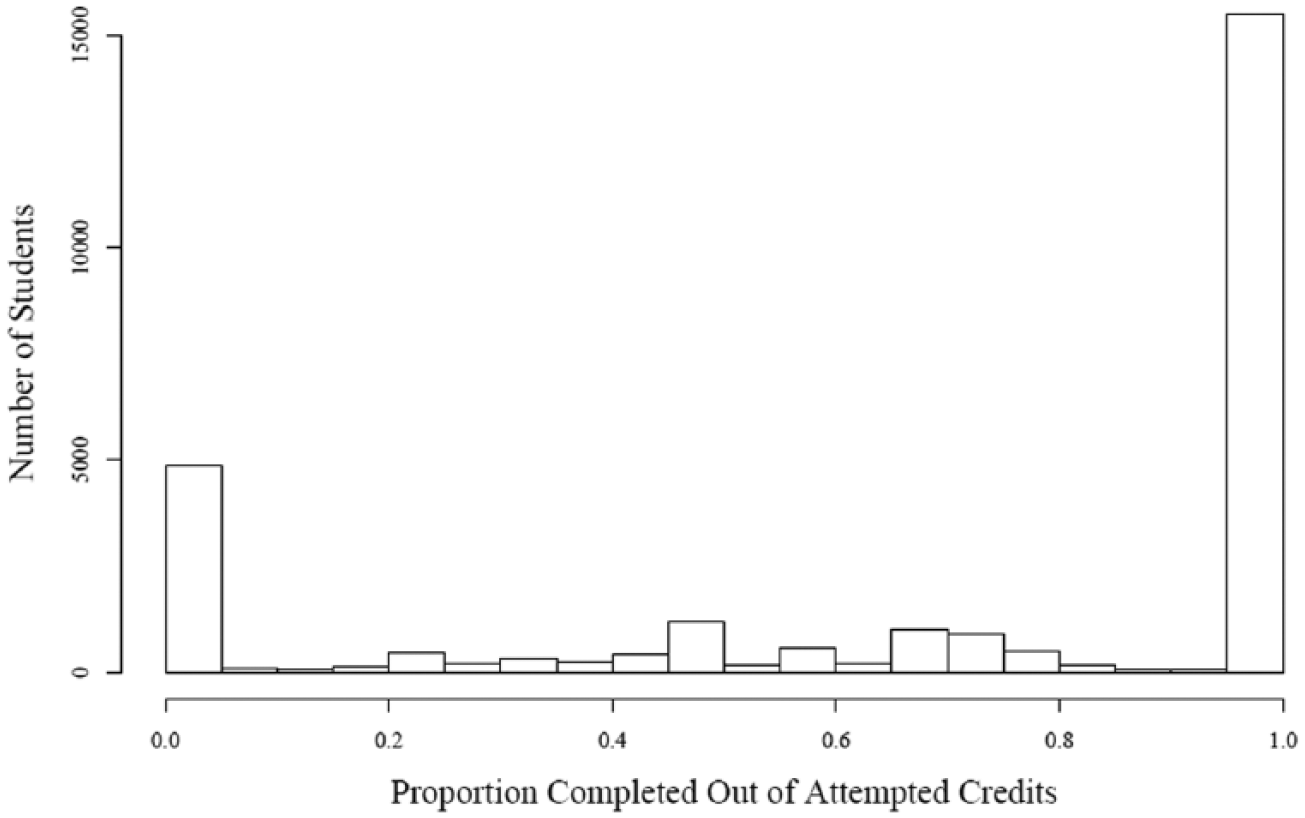
Distribution of credit completion percentages in first semester of network exposure, fall and spring 2011-2012.
Our second academic outcome of interest is GPA, measured on a 0.0- to 4.0-point scale. In all GPA analyses, the dependent variable is a student’s GPA from her first semester of network exposure. Analyzing GPA as an outcome variable gives us a more fine-grained measure for comparing the academic outcomes of students that speaks to performance in their courses, in addition to completion.
Network Variables
In Table 1, we present descriptive statistics of our sample, differentiating between the students who did and did not join Schools App. The t test values listed in the fourth column test for differences between network joiners and non-joiners. Because participation in the network was voluntary, we anticipated and did, in fact, see that the network joiners are statistically different from the non-joiners (see Fagioli et al., 2015, for a greater discussion of selection bias and propensity score matching in social media studies at community colleges). We keep this selection bias in mind in the discussion of our results.
Descriptive Statistics of All Students, Network Non-Joiners, and Network Joiners.
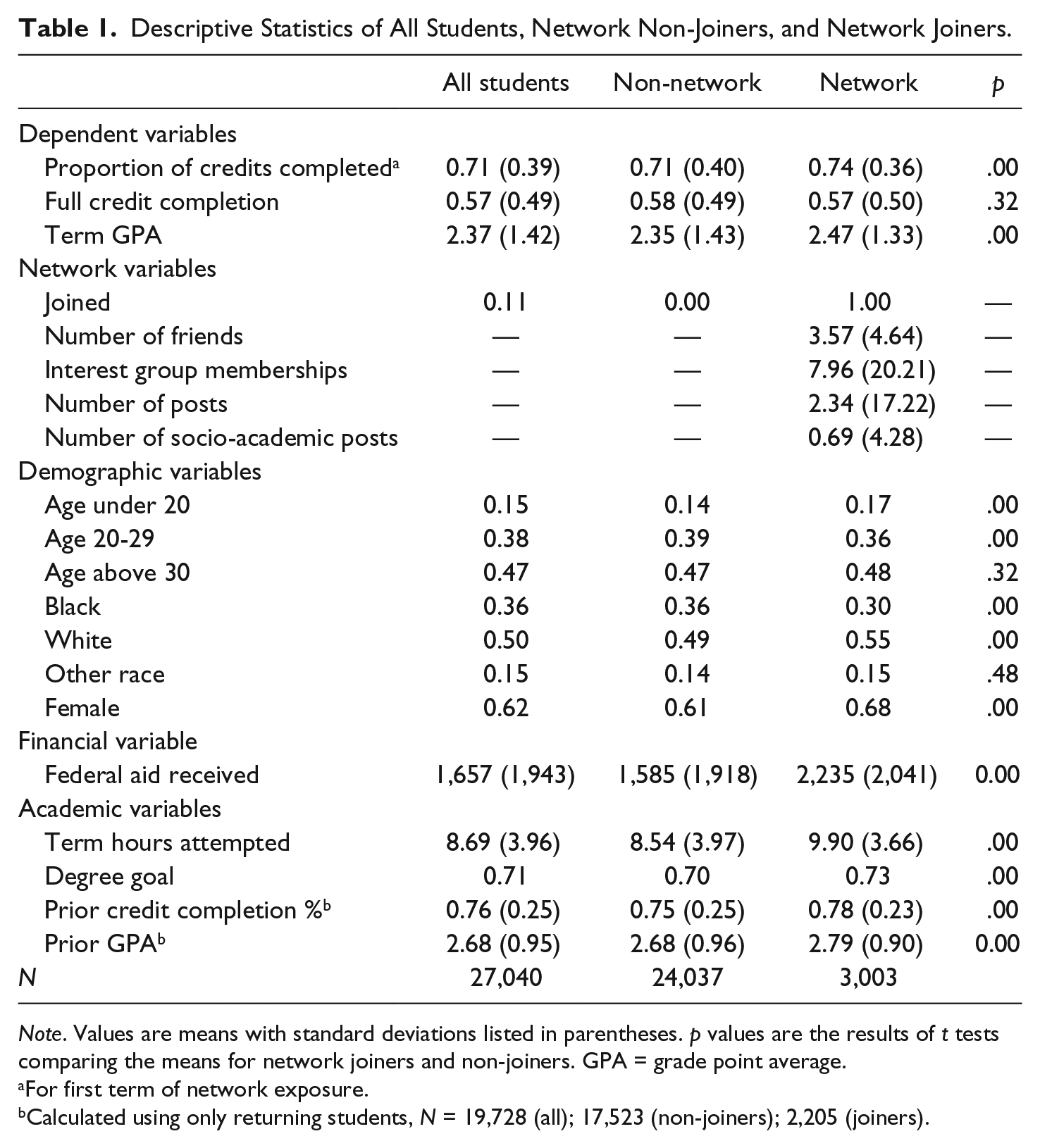
Note. Values are means with standard deviations listed in parentheses. p values are the results of t tests comparing the means for network joiners and non-joiners. GPA = grade point average.
For first term of network exposure.
Calculated using only returning students, N = 19,728 (all); 17,523 (non-joiners); 2,205 (joiners).
The network variables include “Joined,” a binary variable for whether or not a student joined the network, which captures the most basic form of network involvement. “Number of friends” describes the total number of friends a student has on Schools App. Friend ties on Schools App are mutual: If Student A was a friend of Student B in the network, B was also a friend of A. The distribution of the number of friends was right skewed—as are most distributions of social network ties—so we log transformed the values in our analysis. “Interest group memberships” describes the number of active interest groups a student joined on Schools App. Among network joiners, 48.4% joined at least one active interest group, which we defined as having at least two members and one post or comment. The distribution of number of memberships had a strong right skew. As a result, we log transformed the number of interest group memberships in our models.
Students who joined the network posted an average of 2.34 messages during fall semester of 2011. In total, there were 8,749 bodies of public text posted on Schools App during fall of 2011. Fifty-three posts were authored by administrators, faculty, or staff; all others were written by students. A member of the research team coded these posts into one of five content categories: academic, social, socio-academic, market, or other/unknown.
Our coding of the text posts was both deductive and inductive. In our first iteration of coding, we deductively coded posts using the academic, social, and socio-academic categories suggested by the different forms of integration discussed in the literature (e.g., Deil-Amen, 2012; Tinto, 1993). We defined academic posts as those that assert academic interests or engagement, but do not simultaneously seek a social connection or socio-academic exchange. For example, statements such as “management 10 is the last class before my degree!” or “algebra 2 is hard” are coded as academic. However, when posts sought to make socio-academic connections or leverage the social resources of the network for academic purposes, we coded them as socio-academic. The socio-academic category includes statements such as “who else is taking management 10?” or “who is a good algebra 2 teacher?” Compared with the socio-academic posts, the social posts were purely focused on social topics and connections, such as meeting for video games, parties, or dates, and contained no references to academic topics.
Having identified and coded the academic, social, and socio-academic posts, we performed a second iteration of coding in which we inductively coded the remaining posts, allowing the content to dictate the remaining two categories: market and other/unknown. Market posts offered books for sale, posted job opportunities, or placed advertisements. Other/unknown posts did not contain enough content to reveal their purpose.
The socio-academic posts were the posts of interest to our research questions. As summarized in Table 2, we found that the text in the network was primarily social (48%), but that socio-academic text (29%) was second most common. Within the socio-academic content, the most frequent posts were those that sought to create a socio-academic connection with a fellow student who shared the poster’s campus, class, or program of study, showing the network as a forum for building socio-academic community.
Descriptive Statistics and Examples of Coded Text on Schools App, August 2011 to January 2012.
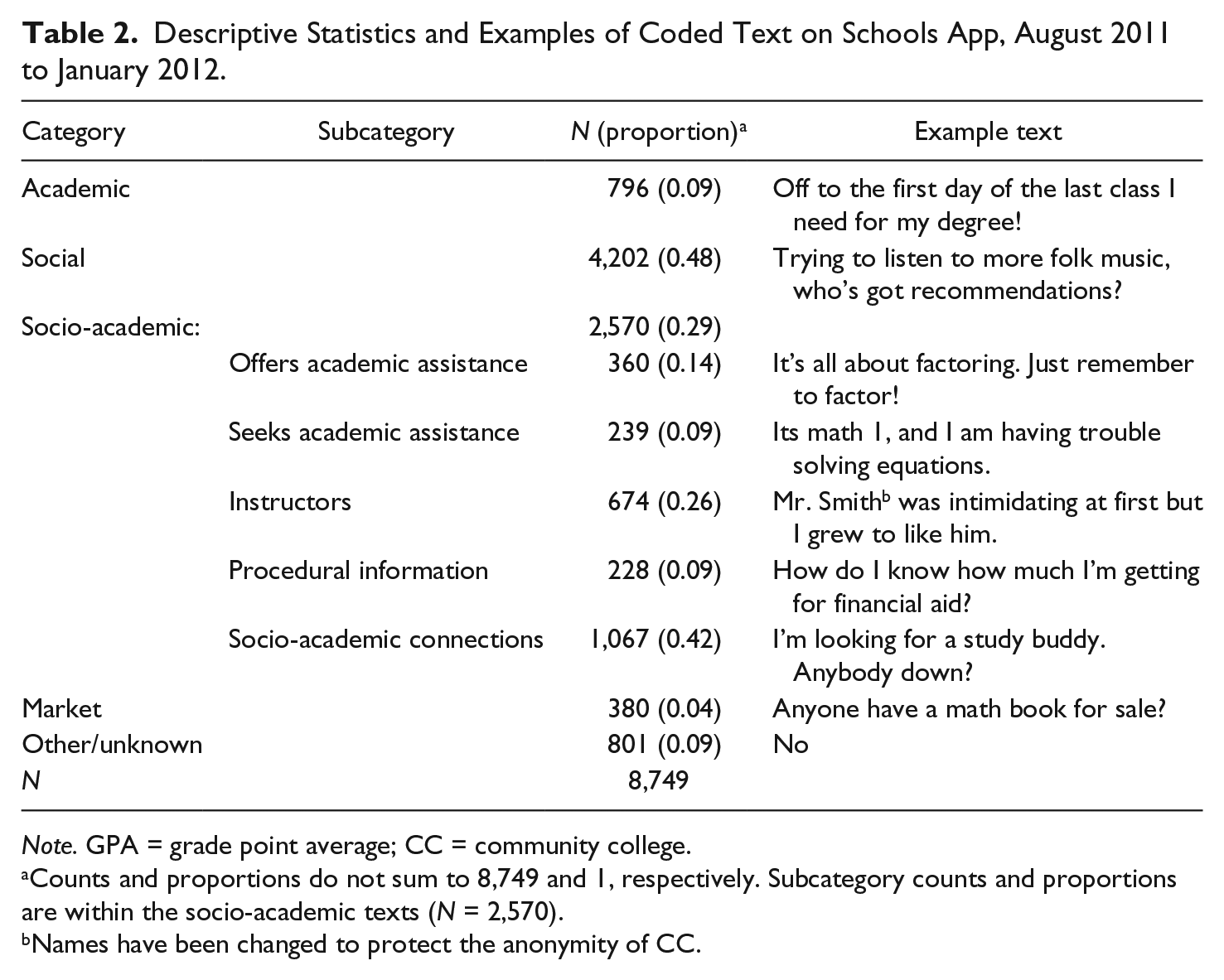
Note. GPA = grade point average; CC = community college.
Counts and proportions do not sum to 8,749 and 1, respectively. Subcategory counts and proportions are within the socio-academic texts (N = 2,570).
Names have been changed to protect the anonymity of CC.
Controls
We included demographic, financial, and academic variables as controls, because prior literature has shown that they are related to collegiate academic outcomes. Older (Burton, Taylor, Dowling, & Lawrence, 2009), White and Asian (Fischer, 2007), female (Buchmann & DiPrete, 2006; Sax & Harper, 2007), and wealthier (Walpole, 2003) students tend to outperform their younger, Black and Hispanic, and male counterparts. Because it is more difficult to succeed academically when taking more credits, we included a control for the term credit hours attempted. We also include terms for prior completion percentage, prior GPA, degree goal, and full- or part-time status to control for the prior academic performance and academic intentions of students.
Results
To test the association between online network involvement and credit completion, we estimated a series of logistic and multiple regression models, presented in Table 3. In the base models (Credit Completion, Model 1, and GPA, Model 1), joining the network without making any friends or joining any interest groups was associated with a 0.06 increase in the probability of full credit completion, or a 0.28-point increase in GPA. However, additional network involvement is associated with a decrease in the likelihood of full credit completion and lower GPAs. Making network friendships and increasing interest group memberships are both associated with a decline in the probability of full credit completion, whereas increasing numbers of friendships is associated with a lower GPA.
Predicting 100% Credit Completion and Semester GPA for a CC Student During the First Term of Network Exposure, Network Variables.
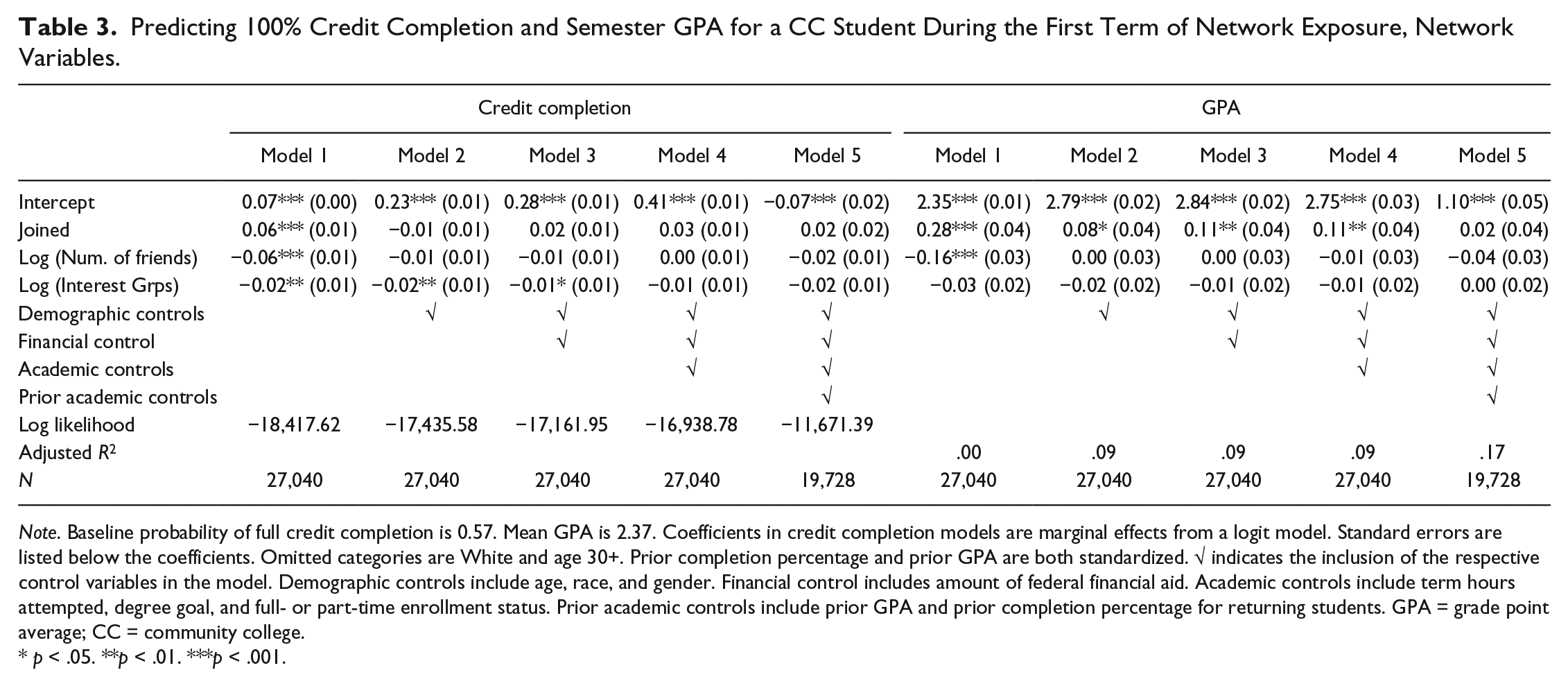
Note. Baseline probability of full credit completion is 0.57. Mean GPA is 2.37. Coefficients in credit completion models are marginal effects from a logit model. Standard errors are listed below the coefficients. Omitted categories are White and age 30+. Prior completion percentage and prior GPA are both standardized. √ indicates the inclusion of the respective control variables in the model. Demographic controls include age, race, and gender. Financial control includes amount of federal financial aid. Academic controls include term hours attempted, degree goal, and full- or part-time enrollment status. Prior academic controls include prior GPA and prior completion percentage for returning students. GPA = grade point average; CC = community college.
p < .05. **p < .01. ***p < .001.
The negative relationship between increasing interest group memberships and the likelihood of full credit completion persists with the inclusion of demographic and financial controls (Credit Completion, Models 2 and 3). However, after the inclusion of controls for prior academic outcomes, it is no longer significant. For GPA, the positive relationship between joining the network and GPA is robust to the inclusion of demographic, financial, and current academic controls (GPA, Models 2-4) but is no longer significant after the inclusion of controls for prior academic outcomes (GPA, Model 5).
Our next set of logistic and multiple regression models tested for the relationship between participating in socio-academic exchange on the network and each of our academic outcomes. We use only the students enrolled in fall 2011 for this analysis, because we do not observe text exchanges from spring semester of 2012. In our preliminary analysis, we quantified socio-academic exchange in various ways: a continuous variable capturing the number of posts, a proportion of total exchange, and a binary variable for any or no participation in socio-academic exchange. We found that a binary variable representing socio-academic participation had the strongest relationship with full credit completion, and so we operationalize it in this way in our analysis (Table 4).
Predicting 100% Credit Completion and Semester GPA for a CC Student During the First Term of Network Exposure, Socio-academic Exchange.

Note. Baseline probability of full credit completion is 0.58. Mean GPA is 2.42. Coefficients in credit completion models are marginal effects from a logit model. Standard errors are listed below the coefficients. Omitted categories are White and age 30+. Prior completion percentage and prior GPA are both standardized. √ indicates the inclusion of the respective control variables in the model. Demographic controls include age, race, and gender. Financial control includes amount of federal financial aid. Academic controls include term hours attempted, degree goal, and full- or part-time enrollment status. GPA = grade point average; CC = community college.
p < .05. **p < .01. ***p < .001.
We found that participation in socio-academic exchange is not significantly related to the likelihood of full credit completion after the inclusion of all controls (Table 4, Credit Completion, Model 5). In the GPA models, however, there is a significant positive relationship between participation in socio-academic exchanges on Schools App and a student’s GPA. Students who participated in socio-academic exchange on the network have, on average, a semester GPA 0.16 points higher than their peers after controlling for demographic, financial, academic, and prior academic controls (Table 4, GPA, Model 5).
In Table 5, we present six models that examined how the academic history of a student’s network friends was related to her academic outcomes in her first semester of network use. To measure the prior academic outcomes of a student’s network friends, we calculated the credit completion percentages of the student’s friends in prior semesters and took the mean of these values. We also calculated their mean GPA from previous semesters and obtained similar results when substituting this measure into the analysis. In the interests of space, we only present the analyses using the prior credit completion of a student’s friends.
Peer Influence on Probability of 100% Credit Completion and Semester GPA During the First Term of Network Exposure.

Note. Baseline probability of full credit completion is 0.73. Mean GPA is 2.44. Coefficients in credit completion models are marginal effects from a logit model. Standard errors are listed below the coefficients. Omitted categories are White and age 30+. Prior completion percentage is standardized. √ indicates the inclusion of the respective control variables in the model. Demographic controls include age, race, and gender. Financial control includes amount of federal financial aid. Academic controls include term hours attempted, degree goal, and full- or part-time enrollment status. Prior academic controls include prior GPA, which is standardized. GPA = grade point average.
p < .05. **p < .01. ***p < .001.
For this analysis, we examined only the students within the network who have a record of prior enrollment at CC and who have network friendships (n = 1,514). We found that a student’s friends’ prior credit completion was positively associated with the student’s likelihood of completing all attempted credits (Credit Completion, Models 1-3). This positive association persisted after controlling for the student’s own prior completion percentage and the demographic, financial, and academic controls. In the final model (Credit Completion, Model 3), an increase of one standard deviation (SD = 0.17) in the friends’ credit completion mean was associated with an increase of 0.03 in the probability that a student completed all attempted credits. When modeling GPA as an outcome, the relationship between friends’ prior completion percentage and the student’s GPA was not significant after the inclusion of all controls (GPA, Model 3).
Discussion and Implications for Practice and Future Research
Online interactions have changed the way people communicate, get information, and connect with others (Wellman, 2002; Wellman & Hampton, 1999). This is especially true for college students. More than 90% of college undergraduates use Facebook (Dahlstrom et al., 2011; Junco, 2012b) and spend more than an hour each day on the site (Ellison et al., 2011; Junco, 2012a, 2012b). Social media offers the opportunity to leverage tools that students already use toward academic goals. Indeed, the 2009 Community College Survey of Student Engagement found that the more students use social networking tools to communicate with other students, instructors, and college staff regarding coursework and other academic purposes, the higher their levels of engagement (Saenz et al., 2011).
We learned from this study that there is a relationship between using Schools App—a specific form of social media—and students’ academic outcomes. Participation in socio-academic exchange on the network is positively related to students’ GPAs during their first semester of network use. In addition, the academic histories of a student’s online friends are predictive of the student completing all attempted credits. Other forms of network involvement (joining the network, making friends, and joining interest groups) were not significantly related to students’ academic outcomes after controlling for demographic, socio-economic, and academic controls. It is important to remember that our findings do not describe causal relationships, due to the selection bias inherent in a voluntarily joined online network. As a result, more research is needed to better understand the ways in which social media and online friendships may influence and affect students’ academic success in community colleges.
This study is the first to examine online social networks as a forum for socio-academic integration at a community college. Our study fills a gap in the research literature with respect to understanding the socio-academic integration of community college students and the potential of social media—especially new, unknown forms of social media—to foster integration at community colleges. Much of the prior literature on social network use in higher education focuses on 4-year colleges and Facebook (e.g., Dahlstrom et al., 2011; Ellison et al., 2007, 2011; Junco 2012a, 2012b, 2014). The focus on 4-year colleges fails to shed light on the particular challenges and benefits of implementing this kind of technology at a community college. In addition, Facebook may not be the best social media app for fostering student engagement, as it is widely understood to be social rather than academic (Watson, Smith, & Driver, 2006). Lester and Perini (2010) suggest that separate social media groups or platforms may better foster student engagement.
This study’s focus on community colleges and a lesser known app allows it to contribute insights and recommendations about the use and implementation of social media—especially new social media—in community colleges that are unavailable in the prior literature. We describe these insights and recommendations below as we detail aspects of the introduction, implementation, and analysis of Schools App at CC. Aspects of our study suggest that colleges need to think specifically about these following issues when considering using social media technology to better serve students.
First, colleges must consider how to introduce the technology. The focus on Facebook in prior literature rendered this question moot: Facebook is already widely used and known, and colleges do not need to introduce it to students. Evidence from our study suggests that lesser known apps will require clear and continuous introduction to establish wide uptake among students. The impact of Schools App was restricted by low student exposure to it: Only 11.1% of students even joined the app. Even if colleges promote the use of these new technologies when they are first introduced, low persistence and high stop-out rates at community colleges make it so that the students actually enrolled and using the app could change drastically each semester. In our sample, 14.2% of students joined Schools App during the fall semester when it was introduced. However, in spring semester, only 5 months later, the rate of joining Schools App dropped to 4.3% among students who were newly exposed to Schools App in the spring. Consequently, colleges need to think carefully about continuously introducing and marketing social media technologies. Sending emails to students or having a Facebook page announcement is not enough: Colleges need to develop comprehensive marketing strategies to reach out to all students at different points in time.
Second, colleges should intentionally cultivate appreciation of the app’s value. In our setting, students may not have understood how the app could serve them. Generally, social media is used for social purposes (Watson et al., 2006), and students may have been unaware of the multiple purposes the app could serve to meet various community college needs. If deployed strategically, social networks could help students navigate organizational complexities such as financial aid matters and course-taking decisions. Although previous work shows community college students exchanging this kind of information through in-person networks (Deil-Amen, 2012), this study is the first to directly observe and measure students leveraging an online network to seek and exchange this information. We observed these exchanges in the socio-academic posts, which were associated with better academic outcomes. Colleges can take purposeful steps in future implementations to educate all students about the value and potential uses of the app, opening the socio-academic exchanges and their potential benefits to more students.
Third, there is a need for constant engagement with the app. The app (like all social media) relies heavily on constant and widespread usage by an entire school, college, or community. For a single user to reap benefits, other college users must be present for social interactions and information sharing to occur. The relatively low proportion of active users in our research setting (11.1%) limited the opportunity for routine engagement with other students at the college. Again, the focus on Facebook in prior literature has rendered this issue invisible: Because students report that they spend more than an hour each day on the site (Ellison et al., 2011; Junco, 2012a, 2012b), student engagement is not a concern. Here, we see that in the implementation of newer social media, administrators must take active efforts to create content and cultivate frequent engagement. Offering incentives (e.g., raffles, giveaways, and contests) to use the app may be a way to increase the frequent engagement of students in these technologies. Active and ongoing information sharing by administrators on the app can also motivate student participation and uptake. In our analysis of text on the app, only 53 of the 8,749 text exchanges on Schools App were authored by administrators, faculty, or staff at the college. Increasing the volume of faculty and staff participation in the network could serve to increase the usage rate of the app and steer exchanges toward socio-academic topics.
Last, colleges should consider how to best foster productive relationships within the app. The peer influence models testing our third hypothesis suggest that students may benefit academically from online connections with academically higher performing peers. Active efforts by college administrators can help to shape friendship patterns and promote friendships along academically beneficial lines. Actively fostering connections between students in the same major or same classes can help focus academic connections among peers. The interest group data from Schools App suggest that majors may be fruitful avenues by which students can connect with academically advantageous peers. Among the interest groups in our study, some of the most popular were related to majors (for example, nursing). Students exchanged information in these groups about schedules, study partners, and courses. Administrative efforts to create these groups and even connect them with faculty could better serve students. This recommendation is applicable to institutions using both new and well-established social media apps.
A broader understanding of online networks and their relationship with academic outcomes at community colleges could contribute to national goals for higher education and human capital development. Increasingly, community colleges are an important player in the politics of higher education. In 2009, President Obama proposed spending an additional US$12 billion on community colleges (Shear & de Vise, 2009), and the proposed America’s College Promise will likely channel an enormous number of students through these institutions (Obama, 2015). If their weak track record of retention and academic outcomes for students continues, however, community colleges are going to have a hard time capitalizing on these federal investments and initiatives. Online social networks, with strategic implementation and an increased emphasis on socio-academic integration, could help to improve student performance and be an inexpensive and feasible way for community colleges to both help their students and improve their educational leverage against the human capital needs of the nation. However, the findings from this study suggest the importance of further research into the effectiveness and impact of these tools.
Footnotes
Declaration of Conflicting Interests
The authors declared no potential conflicts of interest with respect to the research, authorship, and/or publication of this article.
Funding
The authors disclosed receipt of the following financial support for the research, authorship, and/or publication of this article: This material is based upon work supported by the National Science Foundation Graduate Research Fellowship Program (No. DGE-114747). Any opinion, findings, and conclusions or recommendations expressed in this material are those of the authors and do not necessarily reflect the views of the National Science Foundation. This work was also supported by the Stanford Graduate Fellowship Program and the Bill & Melinda Gates Foundation (No. 0PP1029879).