




Abstract
Keywords
One of the key functions of community colleges is to provide lower division education to prepare students to transfer to bachelor’s degree programs at 4-year institutions. Although a large volume of studies document the benefits of attaining a bachelor’s degree among native 4-year entrants (see a review in Oreopoulos & Petronijevic, 2013) as well as among transfers (Belfield & Bailey, 2011), relatively few community college students attain a bachelor’s degree. Of the nearly two million students who enter higher education through community colleges each year, 80% indicate that they intend to transfer and earn a bachelor’s degree (Horn & Skomsvold, 2011). However, only about a third of community college entrants ever transfer to a 4-year institution and ultimately fewer than 15% complete a bachelor’s degree within 6 years (Jenkins & Fink, 2016; Shapiro et al., 2017).
Yet, given the large number of community college enrollees who seek a bachelor’s degree, the community college to 4-year institution transfer pathway has significant potential for increasing baccalaureate attainment nationally. For example, a simple extrapolation suggests that a 5-percentage-point increase in the rate at which students transfer from community colleges to 4-year institutions would yield an estimated 42,000 additional bachelor degrees each year, given the current bachelor completion rate among transfers; the number would be even larger if the baccalaureate completion rate for transfer students was improved as well. 1
Moreover, compared with 4-year institutions, community colleges enroll proportionately more students from underrepresented demographic groups including racial minorities, and low-income, first-generation, and nontraditional-age college students (Cohen, Brawer, & Kisker, 2014). Strengthening the community college transfer pathways to bachelor’s degrees is, therefore, a potentially important strategy for helping address inequities in baccalaureate attainment nationally (Olson & Labov, 2012).
Although the academic preparation of students to transfer successfully to 4-year colleges has been traditionally viewed as the major responsibility of the home institution (community colleges), there is a growing consensus on the equally critical role of the receiving institutions (4-year colleges) in supporting students’ academic success after transfer. To smooth the transition from one institution to the other and provide necessary support throughout the whole process, 2-year and 4-year institutions must work together more effectively as partners. As Bahr, Toth, Thirolf, and Masse (2013) point out in their extensive review of the literature on the experience and outcomes of community college students who transfer to 4-year institutions, “To quote an old adage, ‘it takes two to tango.’ Both the community college and the four-year institution share responsibility for the outcomes of community college transfer students” (p. 461). The goal of improving the transfer partnerships cannot be fully achieved, at least not to scale, until colleges nationwide are provided with commonly accepted metrics and methods for measuring the effectiveness of 2- and 4-year institutions in serving transfer students and receiving help with identifying scalable and sustainable practices that improve students’ transfer outcomes.
Evaluating college performance is a complex task. Above all, practical outcome indicators such as raw transfer or graduation rates among transfer students can be misleading if they are not adjusted for inputs. This is largely because educational outcomes are the joint product of entering student characteristics, resource inputs, and institutional practices (Bailey & Xu, 2012). Using a raw graduation rate, for example, policy makers can determine which community college are transferring more students. What they will not know, however, is whether such an outcome is due to better prepared entering student population and greater resources to the institution or, instead, due to college practices and policies that are effectively improving transfer rates. The inherent complexity of the transfer process and the institutional relationships, the variation in program requirements, and the lack of data that would actually capture all the movement among the institutions involved have made it difficult to measure the effects of transfer on student outcomes.
In this article, we take an initial step toward addressing this issue by presenting a novel approach to measuring the effectiveness of community college and 4-year institution transfer partnerships. To accomplish this, we used individual term-by-term college enrollment records from the National Student Clearinghouse (hereafter referred to as Clearinghouse) for the entire 2007 fall cohort of first-time-in-college community college students nationwide and develop a two-stage analytical framework for identifying effective partnerships between 2- and 4-year institutions that enable bachelor’s degree attainment in a timely fashion. To enable fair comparisons across institutions, we used a value-added approach, comparing residuals for each institution in a transfer partnership from regression equations that control for observable student and college characteristics.
Through this analysis, this article makes two unique contributions to the existing literature on vertical transfer. First, using information on all students who entered any community college in the fall semester of 2007, this study provides valuable descriptive detail on the general transfer patterns and performance of 2- and 4-year transfer partnerships nationwide by key institutional characteristics. In addition, the analytical framework used in this study provides a novel strategy for identifying effective partnerships, as well as for benchmarking the performance of 2- and 4-year institutions in serving transfer students.
Literature on Transfer Benchmarks and College Partnerships
Despite the critical role of the community college to 4-year college pathway as a route to baccalaureate attainment, neither the federal government nor most states collect data on the performance of 2- and 4-year colleges in enabling community college students to transfer and earn bachelor’s degrees. According to a College Board report on student transfer, “community colleges and four-year institutions are rarely acknowledged for the work they do on behalf of transfer, and where transfer-related metrics exist, they are often imprecise, inadequate, or misapplied” (Handel & Williams, 2012, p. 59). Under the federal Integrated Postsecondary Education Data System (IPEDS) student right-to-know statistics, to which all institutions whose students receive federal financial aid are required to contribute, community colleges report the rate at which students transfer to 4-year institutions. However, these statistics have been criticized because of the variation in the methods by which institutions track transfer students (Albright, 2010).
Merely tracking transfer rates does not give an indication of how many transfer students succeed in earning bachelor’s degrees. Transfer students are not included in the statistics that 4-year institutions report to IPEDS but some 4-year institutions voluntarily report on the baccalaureate success of their transfer students through the Student Achievement Measure (SAM). 2 Yet, SAM is neither comprehensive of all undergraduates at 4-year institutions nor inclusive of community college outcomes on transfer student bachelor completion.
As a part of the College Scorecard data, 3 released in September 2015, the federal government published institutional performance metrics for student transfer and completion among federal financial aid recipients at community colleges and 4-year institutions. However, as discussed in the accompanying technical report (Office of the President, 2015), the College Scorecard transfer and completion metrics are admittedly weak measures of institutional performance, given problems with data quality prior to 2012 (namely, institutional misreporting on Pell-only aid recipients), an estimated 70% accuracy in placing students into starting cohorts, and the bias of a student sample limited to solely financial aid recipients.
Some state higher education agencies periodically look at transfer outcomes, but generally, like the federal government, their accountability measures do not include transfer students. For example, a 2013 review of performance funding in eight states that are considered to be national leaders in such policies found that only two—Missouri and Tennessee—include measures related to successful transfer from 2- to 4-year institutions. In both cases, the measures apply to community colleges, not 4-year institutions (Dougherty & Reddy, 2013).
General Literature on Determinants of Baccalaureate Success
As we will explain in more detail in the methodology section, our article uses an input-adjusted approach that examines the performance of a transfer partnership between a 2-year and a 4-year college in graduating transfer students within this particular partnership, controlling for student characteristics and fixed institutional characteristics. The first step toward input-adjusted institutional comparisons is to identify key institutional characteristics that have an impact on baccalaureate graduation rates and should be adjusted in the model.
Researchers have developed extensive empirical literature to explore the impact of individual and institutional factors on baccalaureate graduation rates. These factors generally fall into one of the three major categories: financial variables, student composition variables, or fixed institutional variables. Existing studies focusing on financial variables typically use expenditures, such as per full-time equivalent (FTE) expenses, to measure institutional resources and generally identify a significantly positive impact of greater expenditure on graduation rates (e.g., Hamrick, Schuh, & Shelley, 2004; Ryan, 2004; Scott, Bailey, & Kienzl, 2006), highlighting the importance of adjusting for the resource levels in evaluating and comparing college performance.
Student compositional variables include gender and race composition, selectivity, and socioeconomic status (SES) indicators for an average student in an institution. Measures of institutional selectivity and academic capacity of the student population are consistent and significant predictors of graduation rates across studies (e.g., Cunha & Miller, 2009; Goenner & Snaith, 2004; Mortenson, 1997). Although not as strong predictors as selectivity, other student demographic characteristics are generally found to be related to graduation rates. Specifically, colleges with higher percentages of female students and lower percentages of ethnic minority students are associated with higher baccalaureate graduation rates (e.g., Goenner & Snaith, 2004; Scott et al., 2006).
Fixed institutional variables include variables such as location of the college and program emphasis. Researchers have included a variety of institutional characteristics in analyses of determinants or correlates of graduation rates, and the most important predictors include whether the college is private or public; religiosity of the college; the college’s location in an urban, suburban, or rural area; and college program emphasis. Researchers (e.g., Mortenson, 1997; Pascarella & Terenzini, 1991, 2005; Scott et al., 2006) found that private and religious institutions (e.g., Catholic colleges) tend to have higher graduation rates, and such an advantage persists even after controlling for student selectivity and resource availability. However, the impacts of institution location are less consistent in the literature, with some studies finding a higher graduation rate at a more urbanized location (e.g., Scott et al., 2006), whereas others (e.g., Goenner & Snaith, 2004) finding the opposite. Finally, program emphasis is particularly critical in evaluating baccalaureate attainment rates among transfer students in community colleges. Given the diverse missions that community colleges assume, many students enrolled in occupation-oriented programs may not seek transfer to a baccalaureate institution (Xu, Jaggars, & Fletcher, 2016). Because institutional-level data typically do not provide information on the educational intention of the students, failure to take into account program emphasis of an institution may unfairly punish 2-year colleges that have a heavier occupation rather than transfer focus.
Studies Focusing on Transfer Partnerships and Success
Much research on transfer students has focused on the student experience of transfer and less on the institutional structures, policies, and practices that promote degree attainment by community college transfer students (Bahr et al., 2013). Extensive research has been done on the difference in probability of completing a bachelor’s degree starting at a community college and transferring versus starting at a 4-year institution (Alfonso, 2006; Doyle, 2009; Gross & Goldhaber, 2009; Leigh & Gill, 2003; Long & Kurlaender, 2009; Melguizo & Dowd, 2009; Roksa & Keith, 2008; Rouse, 1995; Sandy, Gonzalez, & Hilmer, 2006; Xu et al., 2016). Very few studies have sought to estimate the effects of individual pairing between a 2- and a 4-year institution on transfer student bachelor completion rates.
One such study was conducted by Ehrenberg and Smith (2002), who developed a model that includes fixed effects for the sending and receiving institutions to estimate how each institution differentially affected transfer student outcomes. Using data on a sample of students who transferred from the State University of New York’s (SUNY) 2-year schools to its 4-year institutions, these researchers ranked 2-year SUNY’s institutions based on how well each 2-year SUNY’s institution was preparing its students to transfer to public 4-year institutions in the state. They similarly ranked 4-year institutions based on how successful each 4-year college in the state was graduating students from 2-year colleges who transferred. They found that transfer students from different 2-year SUNY’s institutions appeared to have different probabilities of completing their 4-year degrees and of dropping out within 3 years after transfer. Similarly, students who transferred to different 4-year SUNY’s institutions had different probabilities of completing a bachelor’s degree. Ehrenberg and Smith argued that their methodology “could be used either in summative evaluations that relate to resource allocation decisions, or more preferably, in formative evaluations in which knowledge of the best practices of the most successful institutions are transmitted to their sister institutions in the state” (p. 3).
In a more recent study of community college transfer performance, Carrell and Kurlaender (2016) tracked multiple cohorts of former high school students who subsequently enrolled at California’s community colleges and transferred to one of the California State Universities (CSUs). The authors measured community college performance with transfer in two ways: How productive the college was at transferring its students to one of the CSUs and how successful the college’s transfer students were in completing bachelor’s degrees? Adjusting for student and institutional inputs, the authors found that some of the community colleges were more effective than others at both transferring students to CSUs and preparing their transfer students for success. The authors also found small positive associations between these measures of success and community colleges that had larger student populations and were located closer to a CSU. That study did not account for the effects of practices by CSU institutions in enabling transfer students to earn a bachelor’s degree.
In 2016, the Community College Research Center (CCRC), the National Student Clearinghouse (Clearinghouse) Research Center, and the Aspen Institute published a report that addressed the lack of comparable measures of institutional performance with respect to transfer students. The report also introduced measures for community college and 4-year institutions (Jenkins & Fink, 2016). Specifically, using student-level data from the Clearinghouse on a cohort of degree-seeking students who started higher education in a community college, the authors calculated rates of transfer to 4-year institutions (vertical transfer rate), rates at which transfer students transferred with a community college award (transfer-with-award rate), and bachelor’s completion rates for vertical transfer students (transfer bachelor’s completion rate) as measures of community college and 4-year institutional performance. The authors found that 33% of entering, degree-seeking community college students transferred to a 4-year college, and only 14% completed a bachelor’s degree within 6 years. 4 Average performance did not vary much by the type of community college students first attended; instead, there were larger differences in average completion rates based on the type of 4-year transfer destination in favor of more selective colleges, public colleges, and colleges serving higher SES students. The study also showed wide variation in individual institutional performance as well as wide variation in average performance by state.
Although the Ehrenberg and Smith (2002) and Carrell and Kurlaender (2016) studies, and the study conducted by the Jenkins and Fink (2016) have taken important initial steps toward measuring how different institutions influence students’ transfer outcomes, these studies focused separately on the performance of 2- and 4-year institutions, leaving unstudied the effectiveness of partnerships between pairs of 2- and 4-year institutions. Students who transfer have to navigate through both types of institutions.
Data and Descriptive Information
Sources of Data
To measure the performance of 2- and 4-year institutional partnerships in enabling community college students to transfer and earn degrees, we used data on institutional enrollment and degree completion by individual students from the Clearinghouse. We followed the progress and outcomes of students who entered higher education for the first time at a community college in the fall semester of 2007 and tracked them until the summer of 2014, or 7 years since their initial college enrollment. We excluded students who were enrolled in college courses through dual high school–college enrollment arrangements by limiting the cohort to students of ages 18 or older at their first enrollment. We also excluded students who were enrolled in either for-profit or private nonprofit 2-year colleges. The final data set includes 1,275,697 students.
We derived characteristics of the community college and 4-year institutions participating in each transfer partnership prior to data analysis. Among the institutional characteristics, 4-year institutional sector, selectivity, and urbanicity were merged from IPEDS institutional characteristics data set, and the distance between each pair of partner institutions was derived using the Google Maps Distance Matrix API. The derivations of average student SES and community college program mix are described further below.
Average student SES
We created a student-level SES variable by using U.S. Census data to derive a standardized composite of the median household income, educational attainment, and occupational profile of each student’s home Census tract. We then created institution-level SES variables by taking the median student SES score for either all enrolled students (community colleges) or all transfer students (4-year institutions) from the fall 2007 cohort. Each institution was then placed into quintiles based on the median SES score of its student population, which, for interpretability, we labeled as higher SES serving (top two quintiles), middle-SES serving (middle quintile), and lower SES serving (bottom two quintiles).
Program mix
We categorized community colleges based on each institution’s mix of academic and occupational associate degrees awarded. We used data from IPEDS to group institutions into primarily academic associates and primarily occupational associates categories based on the ratio of academic to occupational associate degrees awarded by the institution. We created these two categories based on our observation of two large clusters of institutions in the distribution of program mix. Approximately 60% of the 2-year institutions awarded near 0% of associate degrees in occupational fields (as opposed to associate of arts, associate of science, or associate of general education fields), and the rest of the institutions awarded 50% or more occupational associate degrees.
Definitions of Key Measures of Transfer Partnership and Outcomes
Although we relied primarily on IPEDS data to categorize institutions as community colleges and 4-year institutions, we revised the IPEDS categorization for some institutions that offer relatively few bachelor degree programs—and, therefore, are listed as a public 4-year institution in IPEDS—but are more accurately categorized as community colleges based on their history, mission, and degree mix. 5 We used IPEDS data on Carnegie Classifications, program offerings, mix of associate versus bachelor’s degrees awarded, mission statements, and membership in national associations to categorize institutions as community colleges or 4-year institutions. We excluded institutions in the U.S. Virgin Islands and Puerto Rico. Below, we explain how we define each key measure in our analysis.
Transfer student
These are defined as students who entered higher education for the first time in a 2-year college and transferred directly to only a 4-year college, that is, these students could enroll in only two institutions. A substantial proportion of students attend multiple institutions. Among students in the Clearinghouse fall 2007 first-time-ever-in-college (FTEIC) community college cohort who transferred, 42% transferred to more than one 2- or 4-year institution. We excluded these students because we want to focus on the effectiveness of dyads of 2- and 4-year institutions; including students who swirled among more than two institutions would have made it harder to attribute credit for student outcomes to any specific institution.
Partnership
Partnership is defined as a pairing of a community college and a 4-year institution where at least one student transferred from the community college to the 4-year institution. The transfer partnership definition 6 we use in our final analytical sample restricts the pairing to a community college and a 4-year institution with at least 30 transferring students.
Completion rate among transfers (for 2-year institutions only)
This is defined as the number of transfer students (from the 2007 fall FTEIC community college cohort) who earned a bachelor’s degree within 7 years since initial college enrollment divided by the total number of transfer students in the 2007 fall cohort. Importantly, students who transferred but attended more than two institutions are excluded from the denominator as well.
Completion rate among transfers (4-year institutions only)
This is defined as the number of community college students who transferred to a given 4-year institution and earned a bachelor’s degree from that 4-year institution within 7 years since initial college enrollment divided by the total number of community college students who transferred into that 4-year institution.
Completion rate (measured for each partnership)
This is defined as the number of students (from the 2007 fall FTEIC community college cohort) who transferred from a given 2-year college (College A) to a particular 4-year university (University B) and who completed a bachelor’s degree within 7 years since initial college enrollment divided by the total number of students who transferred from College A to University B.
Description of Transfer Patterns
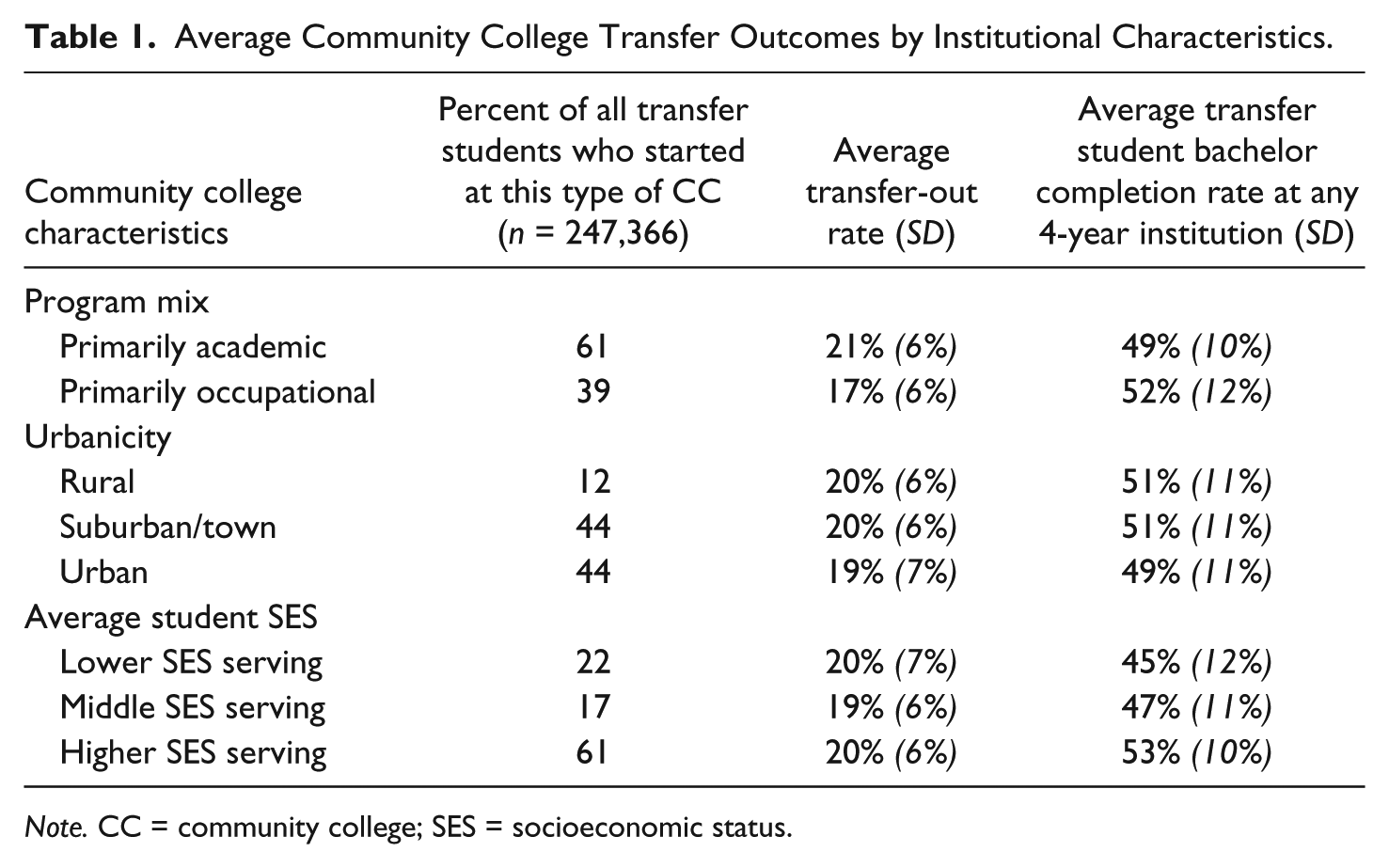
Overall, there were 938 community colleges and 1,908 4-year institutions in the Clearinghouse data sets. Nationally, a greater share of community college transfer students start at primarily academic institutions (61%) compared with primarily occupational institutions (39%), as shown in Table 1. Transfer students more commonly start at community colleges located in urban (44%) or suburban locations (44%) compared with rural locations (12%), and they also more frequently start at community colleges that serve a higher SES student population (61%) than community colleges with middle-SES (17%) or lower SES (22%) student populations. Averaging all the community college’s vertical transfer rates weighted by the number of transfer students, community colleges had a national transfer rate of 20% (SD = 6%). 7 The transfer rate differed less than one half of a standard deviation comparing across institutional characteristic categories, with the exception of the community college’s program mix. On average, primarily academic community colleges transferred out 21% of the starting cohort, compared with the 17% average vertical transfer rate for primarily occupational community colleges (SD = 6%).
Average Community College Transfer Outcomes by Institutional Characteristics.
Note. CC = community college; SES = socioeconomic status.
On average, 50% (SD = 11%) of community college transfer students completed bachelor’s degrees at 4-year institutions. 8 Differences among institutional characteristics on the transfer student bachelor’s completion rate were less than one half standard deviation with the exception of average student SES. Fifty-three percent (SD = 10%) of students transferring from community colleges that serve higher SES students completed a bachelor’s degree, whereas 45% (SD = 12%) of students from lower SES serving and 47% (SD = 11%) of students from middle-SES serving community colleges completed bachelor’s degrees.
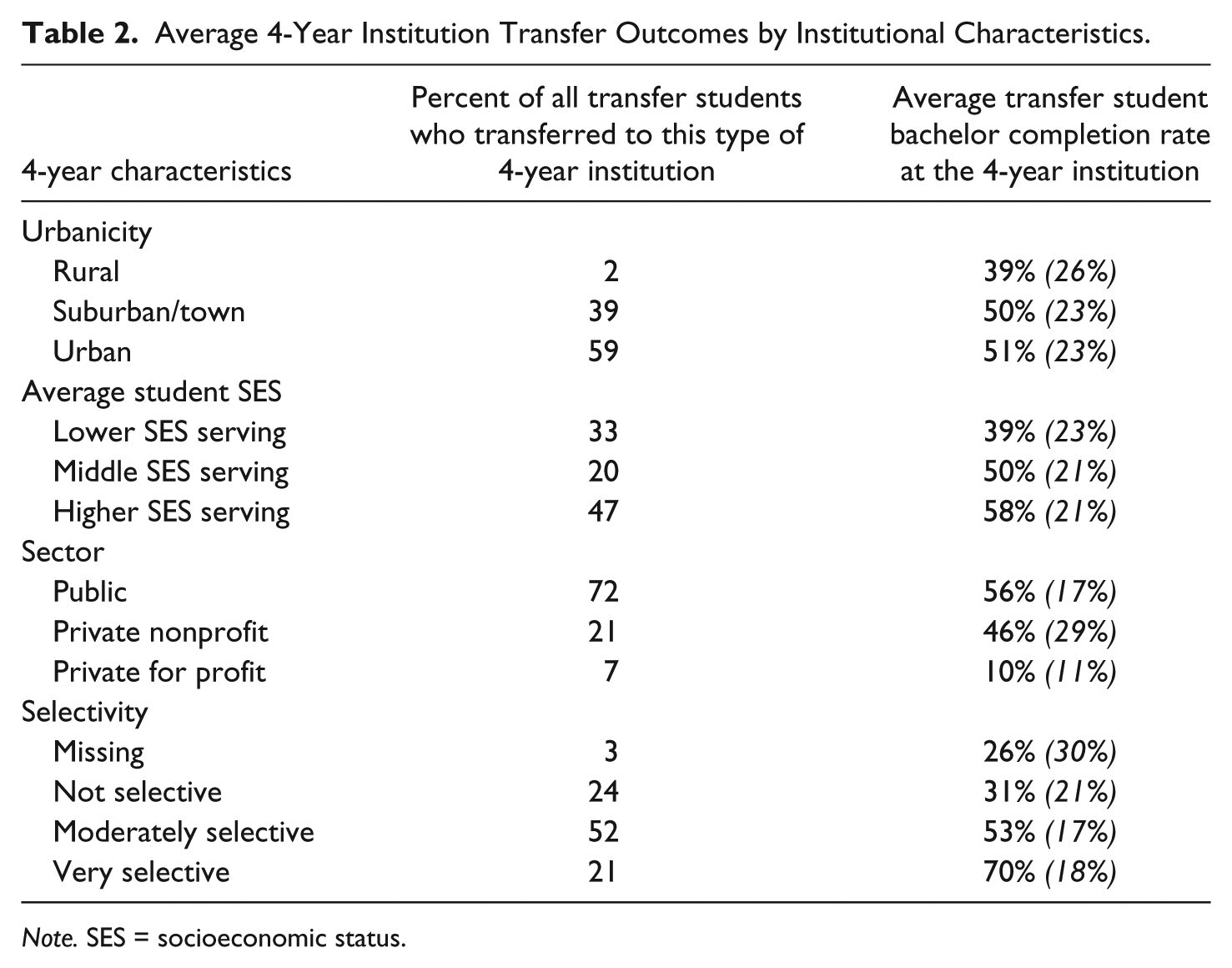
Table 2 provides descriptive information on the institutional characteristics of 4-year destinations for community college transfer students. On average, more students transfer to urban (59%) 4-year institutions compared with suburban (39%) and rural (2%) institutions, and more students transfer to higher SES serving institutions (47%) compared with middle- (20%) or lower SES serving institutions (33%). Seventy-two percent of community college transfers matriculated at public 4-year institutions compared with 21% to private nonprofit and only 7% to private for-profit 4-year institutions. In addition, most community college transfer students matriculated to moderately selective 4-year institutions (52%), with fewer transferring to nonselective (24%) or very selective institutions (21%).
Average 4-Year Institution Transfer Outcomes by Institutional Characteristics.
Note. SES = socioeconomic status.
Overall, public 4-year institutions (56%, SD = 17%) and private nonprofit institutions (46%, SD = 29%) tended to have higher completion rates compared with private for-profit institutions (10%, SD = 11%), and on average more selective institutions had higher bachelor completion rates averaging 70% (SD = 18%), 53% (SD = 18%), and 31% (SD = 18%) for very, moderately, and nonselective institutions, respectively. Urban (51%, SD = 23%) and suburban (50%, SD = 23%) 4-year institutions tended to have higher bachelor completion rates compared with rural institutions (39%, SD = 26%), and 4-year institutions serving higher SES transfer students (58%, SD = 21%) tended to have higher bachelor completion rates than those serving lower SES students (39%, SD = 26%). Overall, readers should be cautious about the magnitude of average differences among institutional characteristics given the large variation in individual institutional performance.
Sample Description for Identifying Effective Partnership
To identify effective partnerships, we apply several restrictions to the sample. Specifically, among all the institutions included in the Clearinghouse data set, 133 community colleges and 105 4-year institutions did not enroll any transfer students. The remaining 803 community colleges and 1,803 4-year institutions resulted in 44,135 combinations of institutional partnerships, wherein at least one student transferred from the community college to the 4-year institution. To focus on partnerships with a significant number of transfer students between a 2-year college and a 4-year college, we further restricted the data to partnerships with 30 or more transfer students, which resulted in a final analytical sample that consists of 1,458 combinations of institutional partnerships with at least 30 transfer students, involving 564 unique community colleges and 527 unique 4-year institutions. 9
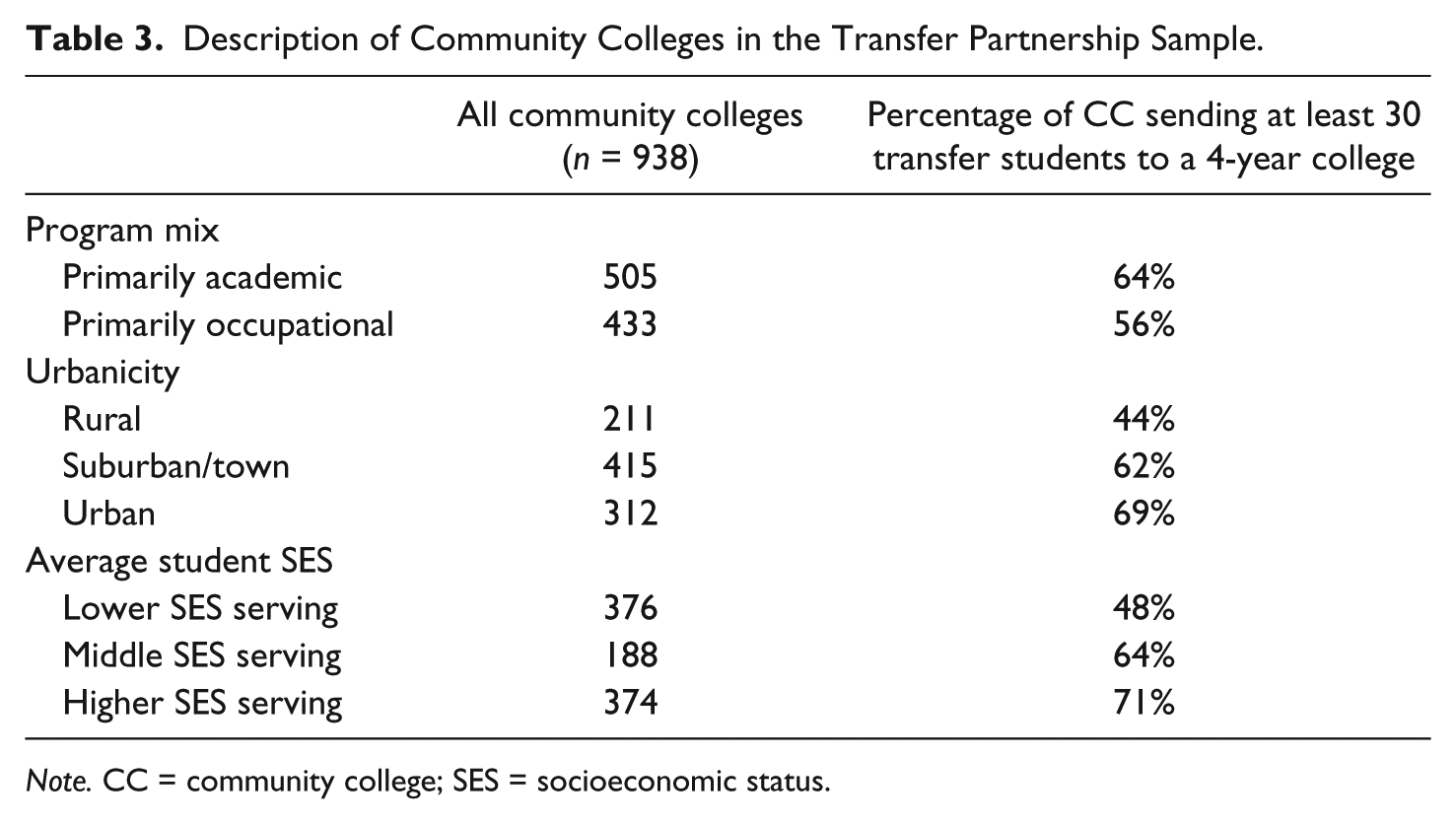
Tables 3 and 4 show the percentage of community colleges and 4-year institutions remaining after we restricted the sample to partnerships with 30 or more students transferring between the 2- and 4-year institution. As shown in Table 3, some types of community colleges became overrepresented in the sample when the sample was restricted to community colleges, which at minimum transferred out 30 students to a particular 4-year partner. For example, 69% of urban community colleges were retained in the restricted sample, whereas only 44% of rural institutions were retained. Similarly, 71% of higher SES serving community colleges were retained in the final analytical sample, and only 48% of lower SES serving community colleges were retained.
Description of Community Colleges in the Transfer Partnership Sample.
Note. CC = community college; SES = socioeconomic status.
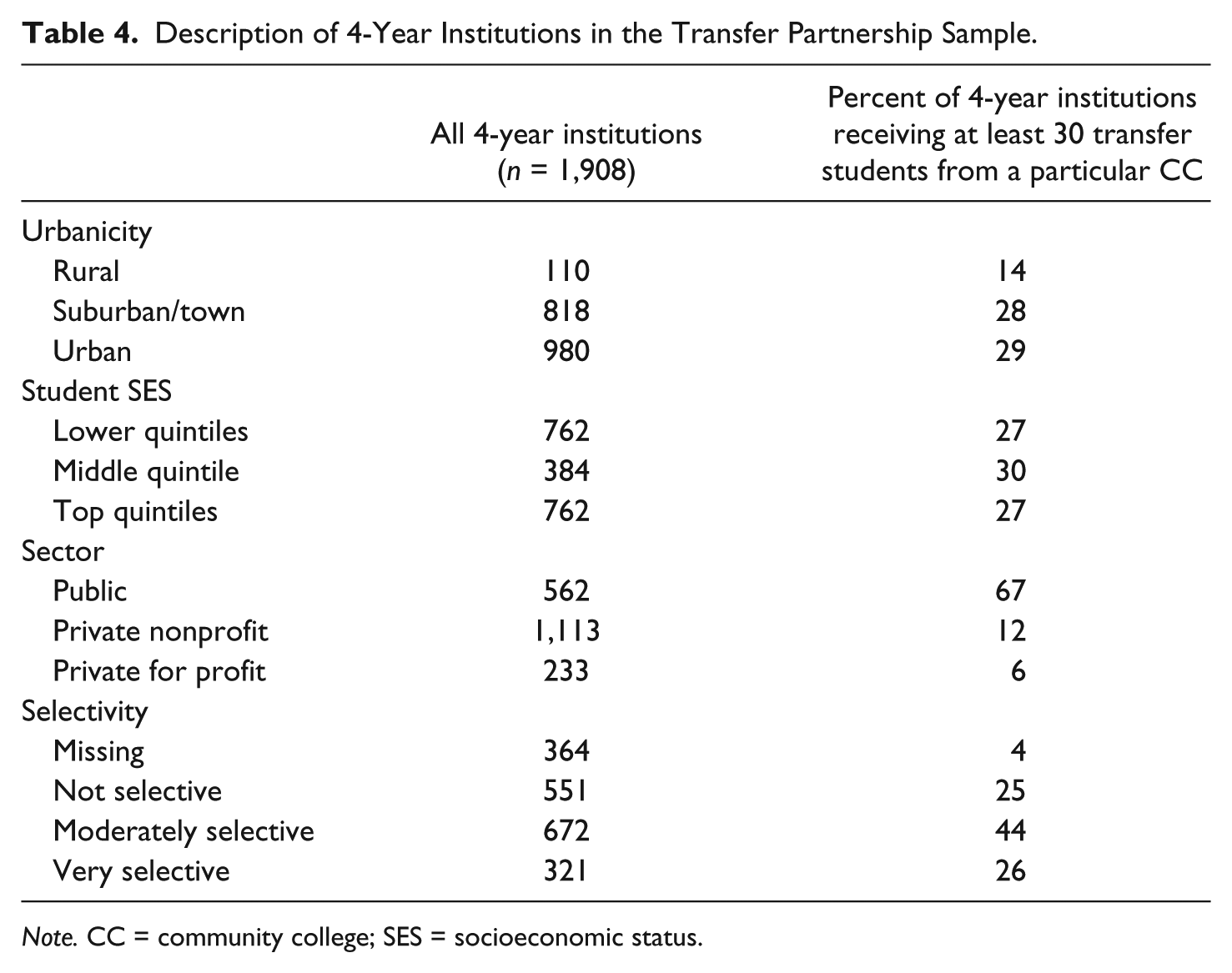
Description of 4-Year Institutions in the Transfer Partnership Sample.
Note. CC = community college; SES = socioeconomic status.
As shown in Table 4, public, urban, and suburban 4-year institutions were overrepresented when the sample was restricted to 4-year institutions that received at least 30 transfer students from a particular community college. In contrast, rural, private, nonselective, and very selective institutions were less represented in the restricted sample used for analyses because these types of institutions enrolled fewer community college transfer students.
Identifying Effective Transfer Partnerships
Analytical Framework
Although raw outcome measures such as baccalaureate attainment rates are important measures of institutional performance, evaluating an institution solely based on unadjusted raw outcome measures is not ideal. Institutional performance is a product of institutional policies and practices, as well as inputs from students, college resources, and external factors, many of which are beyond the control of the institution. For example, 4-year receiving institutions with more selective admissions have higher transfer student graduation rates on average than less selective 4-year institutions (Jenkins & Fink, 2016). Such differences in institutional performance may be attributed to student inputs rather than how much added value the institution provides in the ways it serves students.
Based on this reasoning, we used an input-adjustment approach that carries out analysis of outcomes conditional on student demographic and fixed institutional characteristics, so that reasonable comparisons can be made among the outcomes of different institutional partnerships. We drew on the large volume of literature on college ranking (see a comprehensive review in Bailey & Xu, 2012) and used a value-added model that evaluates institutional performance based on residuals from a regression equation that controls for average student population demographic characteristics, such as SES status, SAT scores, as well as fixed institutional characteristics such as resources, location, and admission selectivity. In this approach, an institution with a positive residual or better-than-expected outcomes given its student population and resources would be adding greater value to student outcomes.
Considering that a transfer partnership involves two parties, we conducted a two-stage evaluation process that takes into account the performance of both the community college and the receiving 4-year institution. A summary of the analytical framework for identifying high-performing partnerships is presented in Figure 1. Specifically, the first stage of the analysis identified effective community colleges that produce a high volume of transfer students and a better-than-expected (i.e., with positive residual) 7-year bachelor’s degree completion rate for its students who transfer to any 4-year institution, after accounting for student demographics and institutional resources. Focusing on these community colleges, in the second step, we further identified effective transfer partnerships where the 4-year institution not only is a major transfer destination for students from the 2-year college but also has a higher-than-expected 7-year bachelor’s completion rate among transfer students from a particular partner community college after controlling for available institutional and individual characteristics.
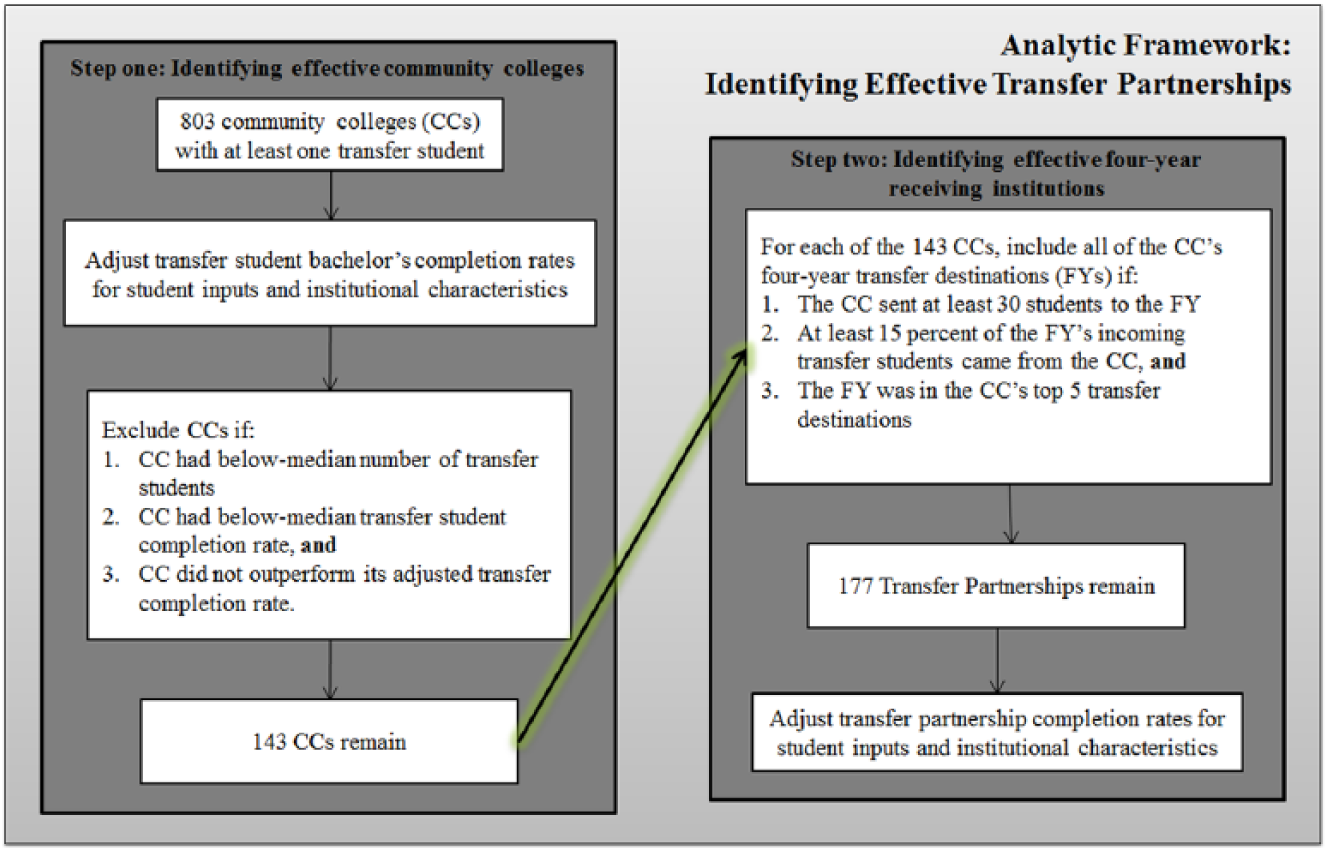
Two-step analytical framework for identifying effective transfer partnerships.
Identifying Effective Community Colleges
The purpose of the first step regression is to identify community colleges with relatively high transfer volumes as well as better-than-expected bachelor’s degree completion rate among transfer students. The reason why we included bachelor completion rate among transfers from community colleges is to identify community colleges that were effective not only in helping students transfer to 4-year colleges but also in adequately preparing these transfers to succeed in bachelor’s programs at 4-year institutions.
In the first step regression, we computed a model-adjusted prediction of the 7-year bachelor completion rate among transfers for each community college, and then subtracted it from the actual bachelor completion rate for each 2-year institution, yielding a residual of 7-year bachelor completion rate for each community college. The expected completion rate among transfers for each institution was predicted based on a regression controlling for the following college-level characteristics: average student census tract SES (occupation, education level, and median income of census tract), location (indicators for city, suburban), state (state dummies indicating the state where the college is located), selectivity (categorical variable retrieved from IPEDS), percentage of each ethnic group, percentage of female students, percentage of Pell Grant recipients, total number of full-time students enrolled, percentage of degree-seeking students, program mix (liberal arts vs. occupational—or a dummy indicator for missing this measure), spending per FTE student, distance from each 2-year college to the nearest 4-year institution. 10
Based on the results from the regression, we restricted community colleges to a smaller pool that met the following thresholds. First, the community college had a total number of transfer students that was above the median among all community colleges. This criterion is to guarantee that we focus on colleges with a substantial number of transfer students. Second, the bachelor’s completion rate among transfer students is above the median for all community colleges in our sample. Third, the community college has a positive residual from the regression, that is, the institution performs better in terms of baccalaureate completion rate among transfer students given its student demographic characteristics and fixed institutional characteristics. Applying these thresholds identified 143 community colleges for the second-stage analysis.
Identifying Effective Transfer Partnerships
The purpose of the second step regression is to identify receiving 4-year colleges with better-than-expected baccalaureate completion rates for students from the community colleges we identified in the first step. To focus the analysis on transfer partnerships, we calculated the baccalaureate completion rate among transfer students for each pair of partner 2-year and 4-year institutions.
Because there were substantial variations in the number of transfers between pairs of institutions, we restricted the analytical sample based on three criteria before running the second-stage regression on baccalaureate completion: (a) at least 30 students in the fall 2007 FTEIC cohort transferred from the community college to the 4-year institution, (b) the 4-year institution received at least 15% of all transfer students from the given community college, and (c) the 4-year institution was among the top five transfer destinations for the given community college. These three criteria were applied to ascertain that a given receiving institution is among the important partners in taking in transfer students from a particular community college.
For partnerships that remained in the pool, we ran a regression to predict baccalaureate completion rate for students who transferred from a specific community college to a particular 4-year institutional partner. That is, the outcome measure is calculated only among transfer students within a particular pair of transfer partners, and a community college may have had multiple partner 4-year colleges that satisfy the three thresholds mentioned above. We then subtracted the expected baccalaureate completion rate from the actual baccalaureate completion rate, yielding a residual of baccalaureate completion rate for each pair of transfer partner institutions.
The expected partnership bachelor completion rate predictions are based on a regression model controlling for the following characteristics of the receiving institution: average student census tract SES (occupation, educational level, and median income of census tract), institutional sector (indicator for public schools), location (indicators for city, suburban), state, selectivity of 4-year partner (categorical variable retrieved from IPEDS), percentage of each ethnic group, percentage of Pell Grant recipients, total number of full-time students enrolled, percentage of degree-seeking students, spending per FTE student, and distance between each partnership 2-year and 4-year colleges. Finally, we ranked partnerships based on the size of the residual on baccalaureate completion rate.
Results
Overall Patterns of Transfer Partnerships
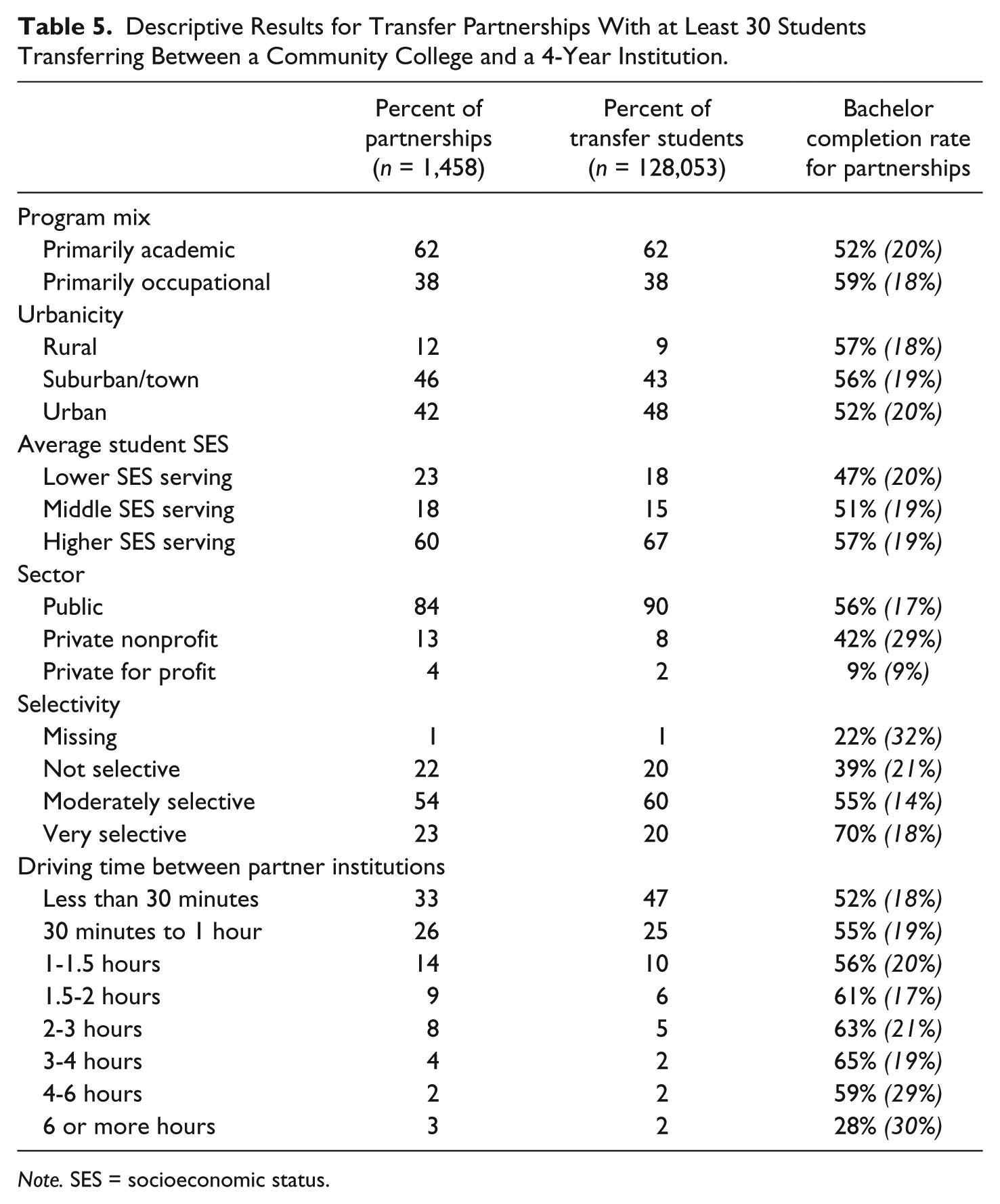
Before reporting the results from the two-stage regression analysis that we conducted, we first describe the descriptive patterns of direct transfer partnerships in our analytical sample, including 1,458 transfer partnerships with at least 30 students in each partnership, totaling 128,053 transfer students. As shown in Table 5, a majority of the partnerships and transfer students in the final sample started at primarily academic, urban or suburban, and higher SES community colleges. Public 4-year institutions comprised 84% of the transfer partnerships and 90% of the transfer students in the final sample, and moderately selective and urban 4-year institutions comprised a majority of both institutions and students in the final sample. In addition, most of the transfer partnerships in the final sample were within 1 hour’s drive of one another.
Descriptive Results for Transfer Partnerships With at Least 30 Students Transferring Between a Community College and a 4-Year Institution.
Note. SES = socioeconomic status.
Overall, the bachelor completion rate of transfer students within the partnerships in the final analytical sample was 54% (SD = 20%). The bachelor completion rates are consistent across types of starting community colleges, with no differences in rates greater than one half standard deviation. Descriptively, there were larger differences in partnership bachelor’s completion rate for different 4-year institutional types than for different types of community colleges. For example, partnerships with a public 4-year institution averaged a 56% (SD = 17%) completion rate compared with the 9% (SD = 9%) completion rate among partnerships with a private for-profit 4-year institution. Partnerships with very selective 4-year institutions averaged a 70% (SD = 18%) bachelor completion rate, whereas the completion rate of partnerships with nonselective 4-year institutions was 39% (SD = 21%).
In addition, transfer students performed relatively well in partnerships with suburban or rural 4-year institutions (compared with urban institutions) as well as higher SES serving 4-year institutions. With regard to distance between transfer partner institutions, transfer student bachelor completion rates tended to increase with the driving distance between institutions, to a point. Transfer student bachelor completion rates were lower, on average, among the few partnerships with 6 hours or more driving distance between institutions. One possible explanation is that students who are willing to travel further or relocate to attend a 4-year institution may be willing to do so because the 4-year institution is more selective. In other words, institutional selectivity may explain why students who transfer to 4-year institutions further away have higher graduation rates than students who attend their local 4-year institution.
Factors Predicting Effective Community Colleges
Table 6 presents the results from the first-stage analysis using a standard regression that regresses the baccalaureate completion rate among vertical transfer students in community colleges on a set of institutional characteristics. A total of 800 community colleges are included in the analysis. The regression, F(18, 781) = 14.71, R2 = 0.57, p < .0001, indicates that almost three fifths of the variations across the 2-year institutions in BA degree attainment among transfer students can be explained by the observed institutional-level characteristics.
Regression Results for First-Stage Model: Factors Predicting Effective Community Colleges.
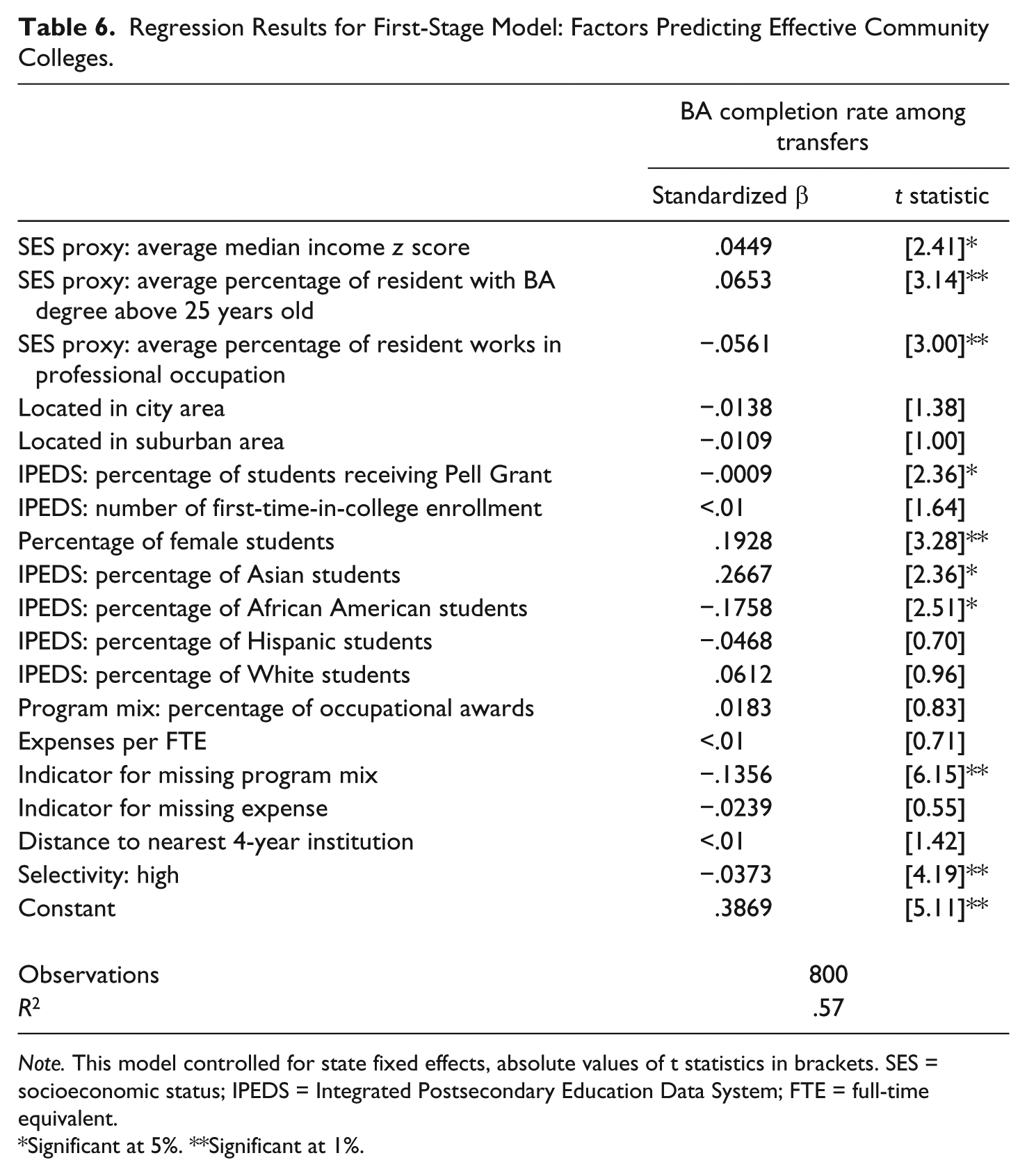
Note. This model controlled for state fixed effects, absolute values of t statistics in brackets. SES = socioeconomic status; IPEDS = Integrated Postsecondary Education Data System; FTE = full-time equivalent.
Significant at 5%. **Significant at 1%.
As expected, colleges with students who are coming from a more advantaged socioeconomic background (as measured by average median household income, average percentage of residents with BA degree or above, and average percentage of residents who work in professional occupations) are more likely to have higher baccalaureate completion rate among transfer students. Colleges with fewer Pell Grant recipients and higher percentages of White and Asian students are also associated with higher baccalaureate completion rate among transfers. We should note that the top effective community colleges selected was based on the residual from the first-stage regression model and are the ones that are preparing transfer students to complete a bachelor’s degree after controlling for these observed institutional characteristics. This means that there are some unobserved institutional efforts that make them particularly effective in preparing transfer students to baccalaureate completion.
Factors Predicting Effective Transfer Partnerships
Table 7 presents the second-stage regression model for identifying effective partnerships for bachelor’s degree completion among transfer students. The sample for this second stage in our selection method includes 177 transfer partnerships between the highly effective community colleges identified in the first-stage regression and their respective 4-year partners that met the thresholds detailed in the previous sections. Thus, the outcome measure (i.e., the BA completion rate) is calculated only among transfer students within a particular pair of transfer partners. The regression, F(18,158) = 3.91, R2 = .64, p < .0001, indicates that the model is able to capture almost two thirds of the variations in BA degree attainment among the 177 pairs of transfer partnerships. The regression model suggests that selectivity of the 4-year institution and percentage of Pell Grant recipients are the most important predictors. Again, the effective partnerships we identified from the second-stage regression model are the ones that supported transfer students toward degree completion after controlling for these institution-level resources and characteristics.
Regression Results for Second-Stage Model: Factors Predicting Effective Transfer Partnership.
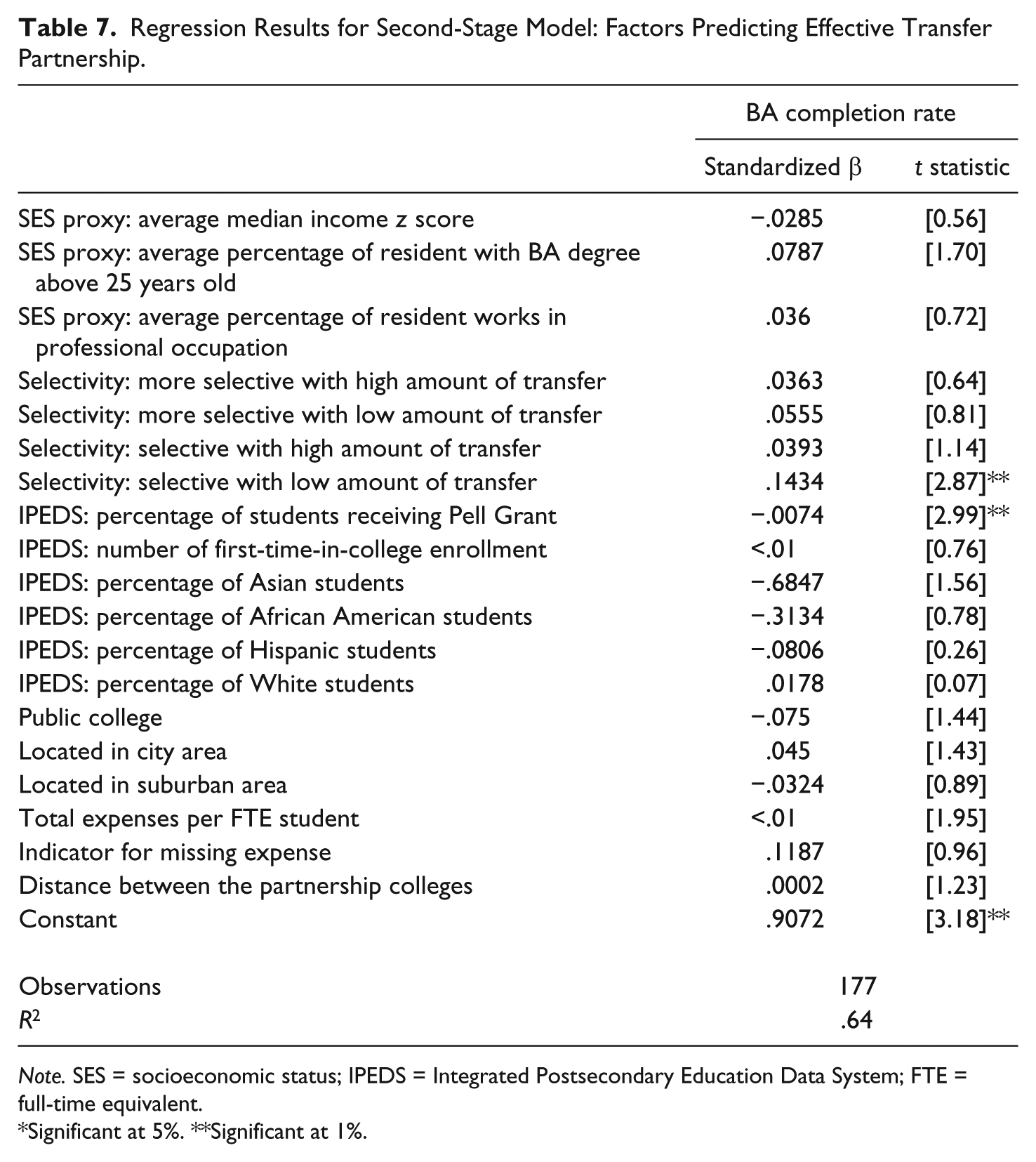
Note. SES = socioeconomic status; IPEDS = Integrated Postsecondary Education Data System; FTE = full-time equivalent.
Significant at 5%. **Significant at 1%.
Implications for Policy and Practice
Given the growing desire of federal and state governments to hold higher education institutions to new standards of accountability, combined with widespread awareness of the inefficiency of the transfer process, the focus on transfer effectiveness and outcomes is likely to increase. Whether the purpose is for general accountability, outcome-based funding, or research efforts to identify effective transfer partnerships, assessing institutional performance without accounting for the characteristics of the students served and the resources available to the institutions involved may result in misleading conclusions. Adjusting assessments of institutional performance using these “inputs” conveys a more precise message on how colleges influence students’ outcomes to policy makers, researchers, and the public.
In this article, we introduce a method that is intended to evaluate and benchmark institutional performance in terms of supporting the academic success of vertical transfers for baccalaureate attainment. To take into account the responsibility of both home institution and receiving institution in this process, we conducted a two-stage assessment, evaluating the performance of community colleges and receiving 4-year institutions, respectively, through a value-added approach to adjust for the characteristics of students entering each institution and resources available to it. For each stage of the analysis, we evaluate the performance of either a 2-year or a 4-year institution after taking into account demographic and institutional characteristics that are often beyond the institution’s control.
Although the analytical framework introduced in this article provides an important first step for identifying effective transfer partnerships and benchmarking institutional performance, there are several important caveats and limitations that policy makers and researchers will need to bear in mind when using this approach. First, the community colleges were chartered to serve multiple student needs including nondegree objectives (Cohen & Brawer, 1996). Yet, neither the Clearinghouse data nor most of the available national data on institutional characteristics record information on students’ educational intent or objectives. The absence of precise information to identify baccalaureate-seeking students has, thus, made college performance assessment in vertical transfer less accurate. For example, the results from our analyses indicate that primarily occupational community colleges are associated with lower vertical transfer rate compared with primarily academic colleges. However, this does not necessarily indicate that these more occupation-oriented colleges perform less effectively in preparing transfer students; instead, it may be because students enrolled in occupational programs are less likely to be transfer oriented. This possibility highlights the importance for future research that benchmarks transfer partnerships to control for students’ education intent upon college enrollment.
In addition, there can be substantial swirling between a community college and a nearby 4-year university, where 4-year entrants may attempt a few courses at a community college. Counting these students as transfer students would falsely inflate the graduation rates. Even among students who started in a community college, they may also swirl among more than two community colleges or multiple destination institutions, making it harder to attribute credit for student outcomes to any specific partnership. In the analysis reported here, we excluded community college students who attended more than two institutions from our analysis. Future studies may wish to expand our analytical framework to capture such enrollment behavior.
The methodological approach presented in this article used a standard linear regression in input adjustment. It is intuitive and easy to implement, and will allow the analyst to judge performance among colleges with distinct student populations and level of resources. Although the input-adjusted approach has been widely used in the college ranking literature, most of these studies count transfer out of college simply as dropout. This makes school evaluations particularly difficult in community colleges, as vertical transfer aligns closely with the mission of 2-year colleges. In this study, we contribute to the literature by demonstrating how the input-adjusted approach could be adapted to measure the effectiveness of transfer partnerships between 2- and 4-year institutions that enable community college entrants to transfer to a 4-year college and earn a bachelor’s degree in a timely fashion. We would caution, however, that this approach makes arbitrary decisions about variable inclusion, and is based on strong assumptions about model specification. States wishing to use the input-adjusted approach for benchmarking the effectiveness of transfer partnerships and for accountability purposes may wish to use local data to identify a unique set of locally appropriate “inputs” instead of relying on the model specification based on national data sets or data sets from other states. It would also be worthwhile to test a variety of model specifications, especially those that either allow for more complex relationships between each input and graduation rate (such as nonlinear relationships), or use a nonparametric procedure that relaxes the assumptions about the functional form.
It is worth noting that although the focus of this article is to develop a method of identifying effective transfer partnerships, we also provided a description of the general transfer patterns nationwide for a better understanding of the potential variations in transfer behaviors and outcomes by key institutional characteristics. In the course of developing this method, we identified a number of interesting national transfer patterns. For example, we found more than 40,000 unique community college to 4-year college direct transfer partnerships through which at least one entering student transferred, and 1,800 partnerships through which 30 or more students transferred. Our findings also showed that, among the larger direct partnerships with more than 30 transfer students, the more than one third of transfer students who started at community colleges with primarily occupational programs and rural community colleges were at a disadvantage compared with students who started at community colleges with more of an academic focus or those in urban or suburban areas.
Finally, a major contribution as well as goal of our analytical framework is to help states and researchers to delve into effective partnerships and identify scalable and sustainable practices that could improve students’ transfer outcomes. As a follow-up to this research, the CCRC and Aspen Institute’s College Excellence Program conducted field research at the top performing transfer partnerships identified using the methodology in this article. Through interviews and observations at highly effective partnerships in six different states during fall 2015, the researchers described a set of essential transfer practices for 2- and 4-year colleges that aligned within one of three broad strategies among these institutions: (a) prioritizing transfer, (b) creating clear programmatic pathways with aligned high-quality instruction, and (c) providing tailored transfer student advising. The resulting report (Wyner, Deane, Jenkins, & Fink, 2016; see also Fink & Jenkins, 2017) provides evidence-based recommendations to college leaders on how to help more community college students transfer and earn bachelor’s degrees. Future studies may wish to conduct similar research in different state contexts to increase the generalizability of these findings, as well as to identify distinct policies that speak only to a particular state context.
Conclusion
The focus on college outcomes is only going to increase. Overall, our results are broadly consistent with the general literature that compares institutional performances in graduating students, in that student characteristics and fixed institutional attributes and inputs are significantly related to baccalaureate attainment rates. As a result, whether the purpose is for general accountability, judging institutional performance, or benchmarking the effectiveness of transfer partnerships, using unadjusted baccalaureate graduation rates is meaningless at best and is likely to unfairly penalize institutions that are underfunded and serve academically underprepared student population. Our analyses that focus on the pairing of 2-year and 4-year institutions also highlight the importance of effective partnerships in supporting the progress and success of vertical transfer students.
Footnotes
Acknowledgements
We would like to thank all the staff at the Community College Research Center for their support during this research project. We are also indebted to Joshua Wyner, Doug Shapiro, Thomas Bailey, Judith Scott-Clayton, and Shanna Smith Jaggars for their valuable input on the research design and comments on this article.
Declaration of Conflicting Interests
The authors declared no potential conflicts of interest with respect to the research, authorship, and/or publication of this article.
Funding
The authors disclosed receipt of the following financial support for the research, authorship, and/or publication of this article: The research reported here was a collaboration between the Community College Research Center at Teachers College, Columbia University; the National Student Clearinghouse Research Center; and the Aspen Institute’s College Excellence Program with support from the Carnegie Corporation of New York, the Bill & Melinda Gates Foundation, and the Leona M. and Harry B. Helmsley Charitable Trust.