




Abstract
Dual enrollment commonly referrers to a broad set of programs and policies that permit high school students to enroll in an institution of higher education and earn college credit prior to high school graduation (An & Taylor, 2019). More than 1.2 million high school students enrolled for post-secondary credit in 2011 to 2012 (Marken et al., 2013). More than 25% of the students who entered a post-secondary institution in 2012 reported that they completed a college course while in high school (National Center for Education Statistics [NCES], 2012), up more than 4% from data collected in 2004 (NCES, 2004). The sector of American higher education that has seen the most substantial growth with dual enrollment implementation is community colleges. By the 2002 to 2003 academic year, 98% of public, 2-year institutions were enrolling high school students to earn college credit while completing their high school credentials (Cohen et al., 2014). Fink et al. (2017) reported that dual enrollment students comprised 15% of the national full time equivalent (FTE) enrollment of community college students in 2011 to 2012.
Several scholars have suggested that dual enrollment implementation can be a viable policy lever to achieve the completion milestones called for in the Completion Agenda, a large-scale policy initiative aimed at increasing the total number of associate degrees and credentials earned by 50% (Hoffman, 2012; Karp, 2015; McPhail, 2011). Despite this assertation, the research on dual enrollment and credential completion is only starting to emerge (An & Taylor, 2019). While the nascent results suggest positive outcomes for bachelor’s degree obtainment, less research focuses on associate degree and credential obtainment. Prior research has focused on a cohort or sample of high school students who took dual enrollment courses, measuring their matriculation into and graduation from college against similar students who did not take dual enrollment courses. Less research has focused on dual enrollment students after they have matriculated to college. This study adds to the growing literature surrounding dual enrollment and credential obtainment by utilizing data from the NCES to analyze how taking college classes while in high school affects post-secondary credential obtainment. The findings are interpreted against the backdrop of the Completion Agenda and Performance-Based Funding 2.0 (PBF 2.0), two large-scale policy frameworks currently shaping the direction of the American community college. Finally, recommendations for future research and policy implementation are discussed.
Review of Literature
While dual enrollment programs began as bi-lateral agreements between secondary institutions and their local community colleges during the 1970’s (Lichtenberger et al., 2014), many states have specified policies that govern how dual enrollment programs are operated and funded within a given state (An & Taylor, 2019; Borden et al., 2013; Zinth, 2015). The first of these state-policy initiatives began in 1985 with the implementation of Minnesota’s PSEO program (Borden et al., 2013). An and Taylor’s (2019) analysis of the literature on state policy implementation of dual enrollment programs suggests that states with large enrollments in 2-year institutions are more likely to have state adopted policies surrounding dual enrollment. While state-implemented policies may allow dual enrollment students to take courses at 4-year institutions, just under 75% of all dual enrollment credit is generated through community colleges (Lochmiller et al., 2016; Marken et al., 2013).
While state policy varies greatly, a common theme in most state policy implementations surrounds admissions requirements and student eligibility (An & Taylor, 2019; Borden et al., 2013; Karp et al., 2004). Early iterations of dual enrollment policy focused on expanded curriculum options for academically advanced students (Borden et al., 2013; Western Interstate Commission for Higher Education, 2006). Zinth (2015) explained that more recent policy trends have focused on program options for traditionally underrepresented populations in higher education and students from lower-socioeconomic backgrounds. Emerging research suggests that these student populations do make academic gains via dual enrollment programs, but that their gains are smaller when compared to students in more privileged positions (Taylor, 2015).
Concurrent Enrollment
The use of the term “dual enrollment” is broad and non-technical, often used interchangeably within a variety of policy contexts (Borden et al., 2013). One subset of dual enrollment, defined as "concurrent enrollment” by The National Alliance of Concurrent Enrollment Partnerships (NACEP), refers to dual enrollment courses that are taught directly in the high school environment by qualified high school-instructors (NACEP, n.d.). The growth of dual enrollment throughout the country has coalesced around the concurrent enrollment model (Marken et al., 2013; Waits et al., 2005). Marken et al. (2013) found that 64% of post-secondary institutions awarded concurrent enrollment credit. Waits et al. (2005) found that 74% of all dual enrollment courses are taught within the high school environment, while early data from the state of Ohio’s College Credit Plus program revealed that 45% of all dual credit awarded was taught under the concurrent enrollment model (Ohio Department of Higher Education, 2019).
Specific research on dual enrollment within the high school environment has produced mixed results (Burns & Lewis, 2000; D’Amico et al., 2013; Smith, 2007). Burns and Lewis (2000) found that dual enrollment students who took their college curriculum within their high school reported feeling less satisfied with their experience and less prepared to transition to college when compared to students who took dual enrollment course on a college campus. Smith (2007) found that those students who completed dual enrollment courses within a high school environment reported weaker college-going aspirations than their peers who attended a college campus. D’Amico et al. (2013) reported that dual enrollment students who completed their curriculum within the high school had lower matriculation rates to South Carolina technical schools when compared to dual enrollment students who took their coursework on a college campus. Other studies suggest that taking college courses within the high school environment can produce positive student outcomes (Hébert, 2001; Peterson et al., 2001). Hébert (2001) found that those students who took a dual enrollment math class from a high school instructor performed better in a subsequent math class post-matriculation when compared to their peers who took a dual enrollment math class from a college instructor. Peterson et al. (2001) reported that students who were enrolled in concurrent enrollment courses were more satisfied than their peers who were enrolled in traditional high school courses.
Research on dual enrollment outcomes, both concurrent enrollment and traditional enrollment, has generally shown positive results for students who participate, such as post-secondary matriculation, year-to-year retention, and college GPA (An, 2013; Bailey & Karp, 2003; Lichtenberger et al., 2014). Bailey and Karp’s (2003) review of the literature found that dual enrollment participation increased first-semester college GPA, first-to-second year retention rates, and college graduation. Many of these early studies failed to control for student characteristics; however, more recent studies controlling for student demographics have found similar results. Multiple studies and interviews with students suggest that students who participate in dual enrollment courses before high school graduation are better prepared to navigate the transition between the K-12 system and a college campus (Bailey et al., 2002; Burns & Lewis, 2000). Both Hoffman (2012) and Karp (2015) argued that dual enrollment is an essential pillar of the Completion Agenda in that it provides students, especially those that are at a higher risk of not matriculating or dropping out without a credential after matriculation, tangible experience in a college environment that can spurn their confidence and academic self-concept.
Dual Enrollment and Credential Completion
While the literature surrounding dual enrollment participation and college completion is just starting to emerge (An & Taylor, 2019), the early results show a positive correlation between the two (An, 2013; Blankenberger et al., 2017; Speroni, 2011; Struhl & Vargas, 2012). An (2013) utilized data from the NELS: 88 federal dataset and found dual enrollment students were 8% more likely to earn a college degree when compared to other college matriculated students. An’s findings also held when controlling for lower socioeconomic status and parental income. Blankenberger et al. (2017) utilized state data from Illinois and found that dual enrollment participants were 7% more likely to earn a college degree when compared to non-dual enrollment students and were 8% more likely to earn a bachelor’s degree. Speroni (2011) found that completing college algebra as a dual enrollment course was associated with a significant increase in associate and bachelor’s degree obtainment for Florida students. Struhl and Vargas (2012) found that Texas dual enrollment graduates completed a bachelor’s degree at a 47.2% rate, while non-dual enrollment students completed a bachelor’s degree at 30.2% rate. Struhl and Vargas (2012) also found an increase in associate degree completion for dual enrollment students when compared to non-dual enrollment, but the percentage increase was much smaller at 8.9% to 6.8%, respectively.
Several studies have shown a potential null or negative effect between dual enrollment participation and credential obtainment (Cowan & Goldhaber, 2015; Lawrence & King, 2019; Speroni, 2011). Cowan and Goldhaber (2015) did find that dual enrollment students were more likely to be enrolled at any college after high school graduation when compared to their peers who did not participate; the researchers also found that dual enrollment students were 8.1% less likely to be enrolled full-time at a 4-year institution when compared to non-dual enrollment completers. Cowan and Goldhaber (2015) cautioned that broader state policy frameworks around bachelor's degree transfer students could increase the percentage of dual enrollment completers over time. Lawrence and King (2019) utilized institution-level data and found that students who participated in dual enrollment were less likely to earn an associate degree from the community college where they completed dual enrollment courses compared to non-dual enrollment students. Speroni (2011) utilized a regression discontinuity design based on Florida’s high school GPA program requirement for dual enrollment participation and found that students were less likely to complete a bachelor’s or associate degree when compared to college-bound students just below the GPA cutoff. Taken together, these studies suggest that dual enrollment can have a positive influence on post-secondary credential aspirations. It is less clear if overall credential completion is increased by all types of post-secondary credentials or just bachelor’s degrees. While An’s (2013) analysis did find an increased likelihood of associate degree obtainment, Fink et al.’s (2017) report showed that a significant number of community college students matriculate to a 4-year institution after high school, but that overall post-secondary matriculation after high school varies greatly by state. The variance in matriculation rates for dual enrollment students suggests that state policy design influences what high school populations gain access to these early college options and, subsequently, who enrolls in college and in what sector after graduating high school with dual credit.
Completion Agenda and Performance-Based Funding 2.0
In 2009, President Barack Obama called on America’s community colleges to produce five million additional graduates, setting the stage for a large-scale policy initiative designed to move the mission of community colleges away from mere access toward student success and completion (Brandon, 2009). In 2010, six leading policy organizations for the advancement of community colleges committed to assisting the colleges they serve in increasing the number of associate degrees and credentials earned by 50% (McPhail, 2011). The American Association of Community College’s (AACC) (2012) cemented this policy goal with the publication of Reclaiming the American Dream: Community Colleges and the Nation’s Future, a policy report proposing several fiscal and structural reforms to the American community college to achieve the 50% credential obtainment goal by 2020. Harbour and Smith (2016) explained that the impetus beyond the policy was the economic stigmatization of the globalized American economy at the beginning of the 21st century and that a higher percentage of the American workforce with certificates and degrees would slow the widening economic gap in American society.
To achieve these credential obtainment goals, Reclaiming the American Dream (AACC, 2012) recommended that states award a substantial portion of community college appropriations by student success outcomes and not just enrollment. This policy objective paralleled the growth in what is conceptually understood as Performance-Based Funding 2.0 (PBF 2.0). While the early iterations of performance funding offered institutions bonus appropriations for specified outcome metrics in addition to their base subsidy, PBF 2.0 refers to recent policy implementations that have moved base subsidy awards away from mere enrollment to outcome metrics. The most common metrics for appropriations are retention, degree completion, graduation rates, and transfer rates (D’Amico et al., 2014). While some states award most or all of their subsidy via performance metrics, Li (2017) reported that a majority of performance funding only accounts for 5% to 10% of the state’s subsidy award.
Several studies have noted that the overall number of bachelor’s and associate degrees awarded in states that have implemented PBF 2.0 policies has not increased and that the number of associate degrees awarded in states with PBF 2.0 have declined (Hillman et al., 2018; Tandberg & Hillman, 2013). Hillman et al.’s (2018) difference-in-difference analysis utilized data from Tennessee and Ohio, the two states that award the most significant percentage of their state subsidy via performance outcomes. Tandberg and Hillman’s (2013) analysis compared completion rates between 20 states that had implemented PBF 2.0 policies and states that had not. While PBF 2.0 is not associated with increases in bachelor’s or associate degree obtainment, it is associated with a rise in short-term certificate obtainment (Hillman et al., 2018; Li & Kennedy, 2018; Thornton & Friedel, 2015). Both Hillman et al. (2018) and D’Amico et al. (2014) explained that the shift in funding to outcome-based metrics has influenced institutional behavior to incentivize students to complete the college credential that requires the least amount of time, which explains the rise in short-term credential obtainment. However, Li and Kennedy (2018) explained that the overall number of credentials awarded by community colleges are not on the rise and speculated that the rise in short-term credential obtainment is explained by the reduction in associate degree obtainment.
Methods and Data
The primary research question guiding this analysis was:
(1) What is the relationship between taking college classes while in high school and post-secondary credential obtainment?
To answer this question data were collected from a federal data set, and completion percentages were disaggregated between dual enrollment students and non-dual enrollment students. These completion percentages were also disaggregated by credential type (certificate, associate degree, and bachelor’s degree) and were collected both 3 and 5 years after students began their post-secondary career. In addition to these completion percentages, four binary regression models were constructed to calculate the odds that students with dual enrollment credit would graduate from a post-secondary institution with any credential, with a bachelor’s degree, with an associate degree, or with a certificate. Data were coded as “yes” in the model where the phenomenon was present (obtaining the credential under analysis). These models were conducted on student outcome data in 2009, 5 years after students began their post-secondary careers.
Data were utilized from the Beginning Postsecondary Students 04/09 (BPS 04/09) dataset, a longitudinal study by the National Center for Education Statistics (NCES) that collected data on 18,640 full-time college students from 2,620 Title IV institutions who began their post-secondary careers during the 2003 to 2004 academic year. These students were surveyed in 2006 and again in 2009 (Cominole et al., 2007). After all data collection was completed, 16,680 students from the original 18,640 eligible were included in the final dataset. Several survey weights were designed in a two-tier structure to account for a variety of institutional and student characteristics. The NCES recommends employing different survey weights based upon the variables of interest in a given analysis, the specific years in which the data was collected, and whether the data source comprised of student responses or administrative data. Per NCES recommendations, this analysis utilized a survey weight consisting of 16,100 students (Wine et al., 2011).
Students in the sample were asked if they earned credits for courses at a college while in high school at the onset of their post-secondary careers. This binary (yes/no) variable was sufficient for this analysis because it differentiated between other types of early college credit options such as Advanced Placement or tech-prep credit, which are captured by other variables in the dataset. However, a limitation to this variable is that it did not specify the specific location where the college class was located. Of the 16,100 students included from the survey weight selected for this analysis, 79.4% of students responded “yes” or “no” when asked if they earned credits for a course at a college while in high school. Thus, the regression models included a sample of 13,500 students from the weighted sample selected for the analysis.
All full-time college students who began at a post-secondary institution in 2003 to 2004 were eligible for inclusion in the BPS 04/09 dataset, regardless of when they graduated from high school. I was interested to learn if recent state policy implementation changed post-secondary graduation outcomes for students who graduated high school closer to 2004.Thus, I collected the completion percentages and ran the four regression models a second time, filtering the original weighted sample data to include only those students who graduated high school in 2003 to 2004. These high school graduates represented 64.7% of the original weighted sample and yielded a sample of 11,600 for the second set of regression models.
Previous research on higher education matriculation and graduation guided the selection of several control variables included in the regression models (Klasik, 2012; Holzman et al., 2019; Snyder et al., 2019). NCES data revealed that post-secondary outcomes were diminished for students of color and lower socioeconomic students when compared to white students and higher socioeconomic students, respectively (Snyder et al., 2019). Thus, student demographic information was included in the model, as well as a variable identifying students’ household income. High school academic performance was also correlated with post-secondary credential obtainment, so high school GPA information was integrated into the model (Snyder et al., 2019). Both Klasik (2012) and Holzman et al. (2019) found that post-secondary credential aspirations changed throughout a student’s high school career and that aspirations were influenced by the student demographic backgrounds mentioned above. Exposure to environments that encouraged and valued higher education also influenced matriculation into a post-secondary institution. Data identifying the highest degree ever expected at the time of enrollment in 2004 was also included in the model.
Limitations
There are limitations to this analysis. As was mentioned above, the federal dataset utilized only asked students if they completed college credit at a college while in high school, without specific information as to what sector of higher education was responsible for the credit, or the educational environment in which the course was taught. Without disaggregated data from the federal dataset, it cannot be determined what aspects of dual enrollment programs might be leading to increased or diminished student returns. Another limitation of this study is that the data utilized in this analysis is not disaggregated by state or policy location. Various state legislators and governing boards have implemented a wide variety of dual enrollment programs targeting different student populations (An & Taylor, 2019). Readers should be cautious when interpreting the results without considering the specific policy environment in which their dual enrollment program was implemented. Finally, the dataset included only first-time, full-time students. A larger dataset including more part-time students might yield different results.
Findings
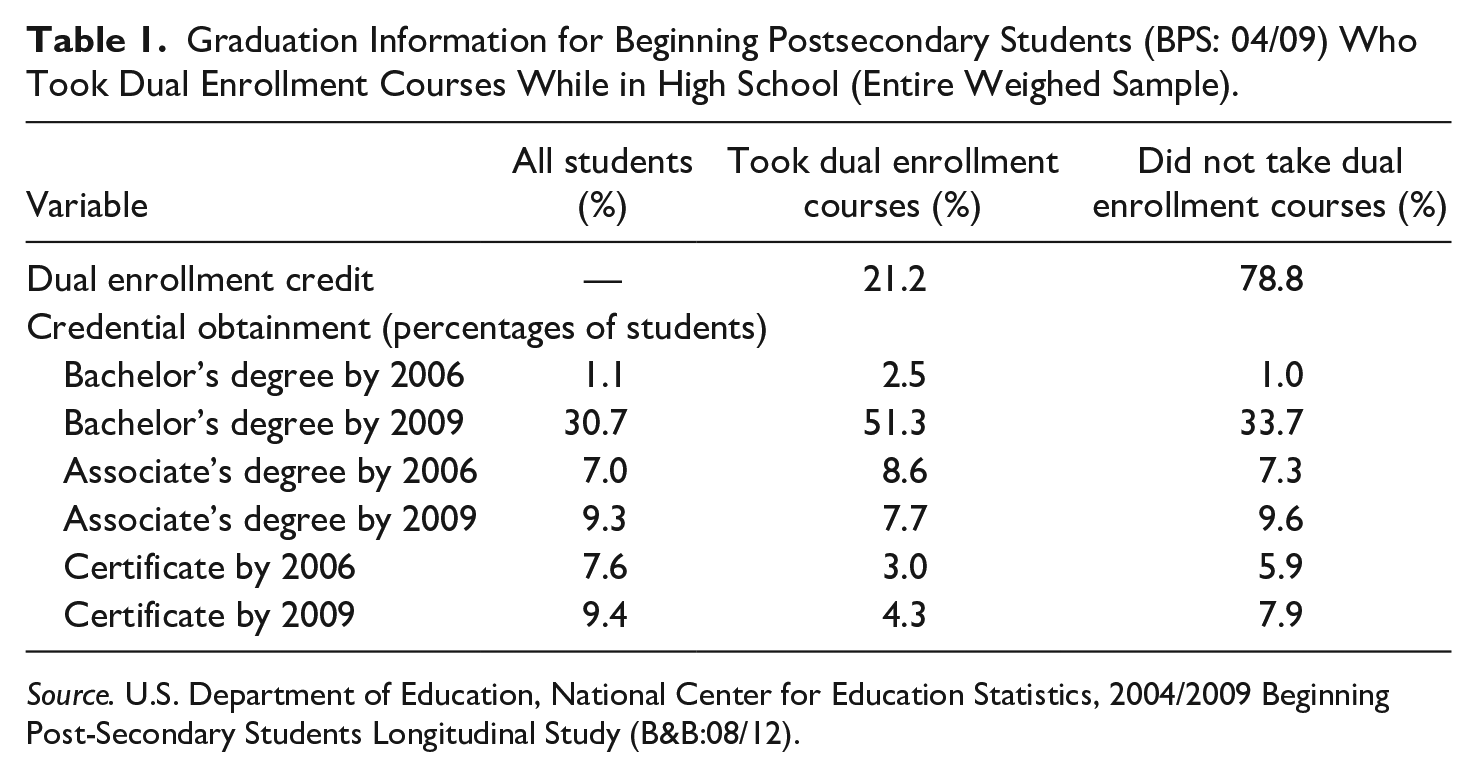
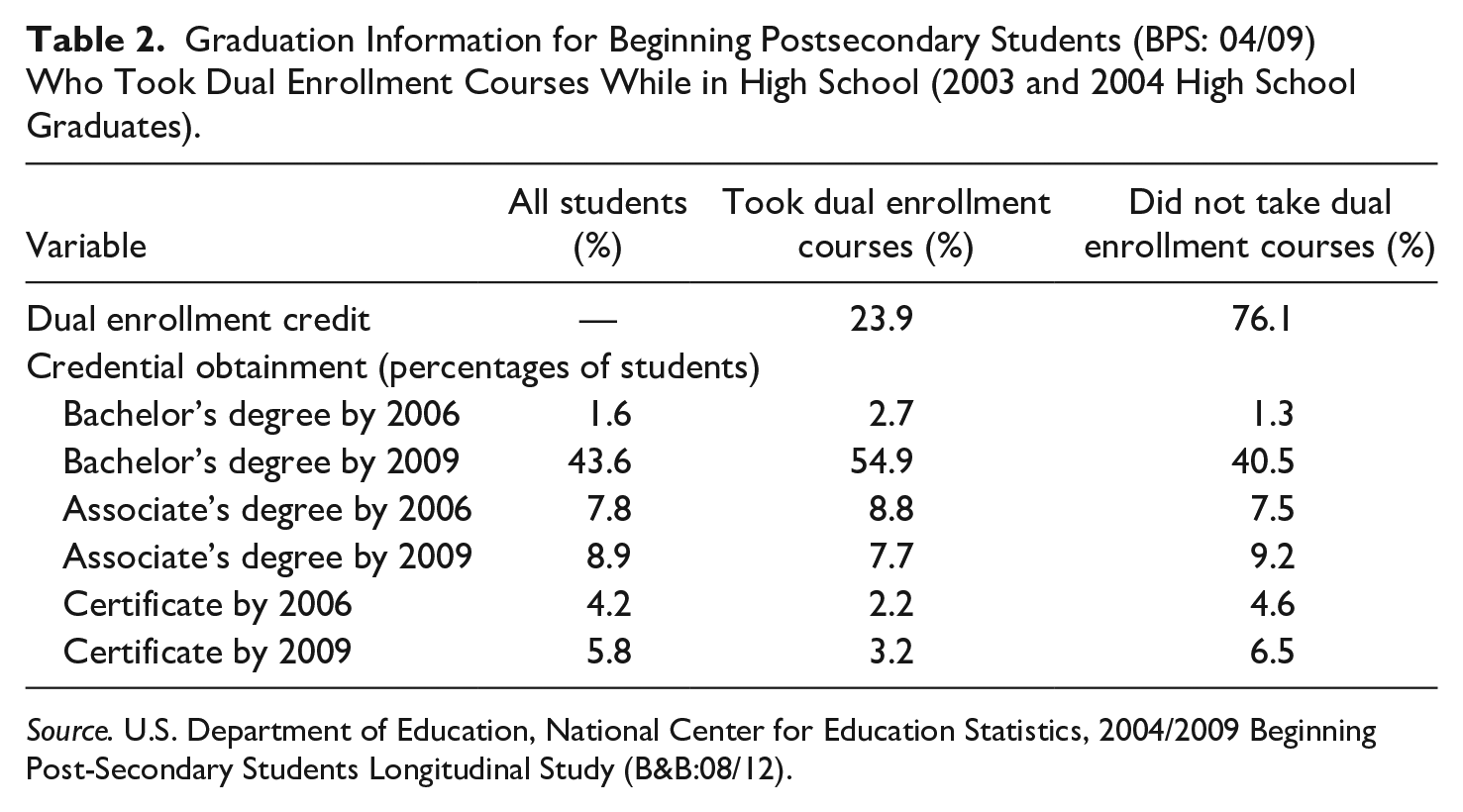
Tables 1 and 2 include the percentage of students who attained a post-secondary credential, associate degree, and bachelor’s degree both 3 and 5 years after entering a post-secondary institution. When compared to students who did not complete dual enrollment courses while in high school, students who took dual enrollment courses have a higher percentage of bachelor’s degree completion both 3 and 5 years after beginning their post-secondary careers. More than 51% of the entire weighted sample completed a bachelor’s degree 5 years after beginning at a post-secondary institution in 2004, compared to only 33.7% of students who did not take dual enrollment courses. When the sample is restricted to recent high school graduates, 54.9% of dual enrollment students completed a bachelor’s degree, compared to only 40.5% of non-dual enrollment students. While dual enrollment students complete a higher percentage of associate degrees 3 years after beginning their post-secondary career, those students who did not take dual enrollment courses complete associate degrees at a higher percentage 5 years after beginning their post-secondary career when compared to their dual enrollment peers. For the entire weighted sample and high school graduates in 2003 and 2004, 7.7% of dual enrollment students have earned an associate degree 5 years after beginning at a post-secondary institution, while 9.6% of non-dual enrollment students have earned an associate degree during the same timeframe. Finally, non-dual enrollment students complete a higher percentage of certificates both 3 and 5 years after beginning their post-secondary career when compared to dual enrollment students. For the entire weighted sample, 7.9% of non-dual enrollment students completed a certificate 5 years after beginning at a post-secondary institution, compared to only 4.3% of dual enrollment students. When the sample is restricted to recent high school graduates, 6.5% of non-dual enrollment students have completed a certificate, compared to only 3.2% of dual enrollment students.
Graduation Information for Beginning Postsecondary Students (BPS: 04/09) Who Took Dual Enrollment Courses While in High School (Entire Weighed Sample).
Source. U.S. Department of Education, National Center for Education Statistics, 2004/2009 Beginning Post-Secondary Students Longitudinal Study (B&B:08/12).
Graduation Information for Beginning Postsecondary Students (BPS: 04/09) Who Took Dual Enrollment Courses While in High School (2003 and 2004 High School Graduates).
Source. U.S. Department of Education, National Center for Education Statistics, 2004/2009 Beginning Post-Secondary Students Longitudinal Study (B&B:08/12).
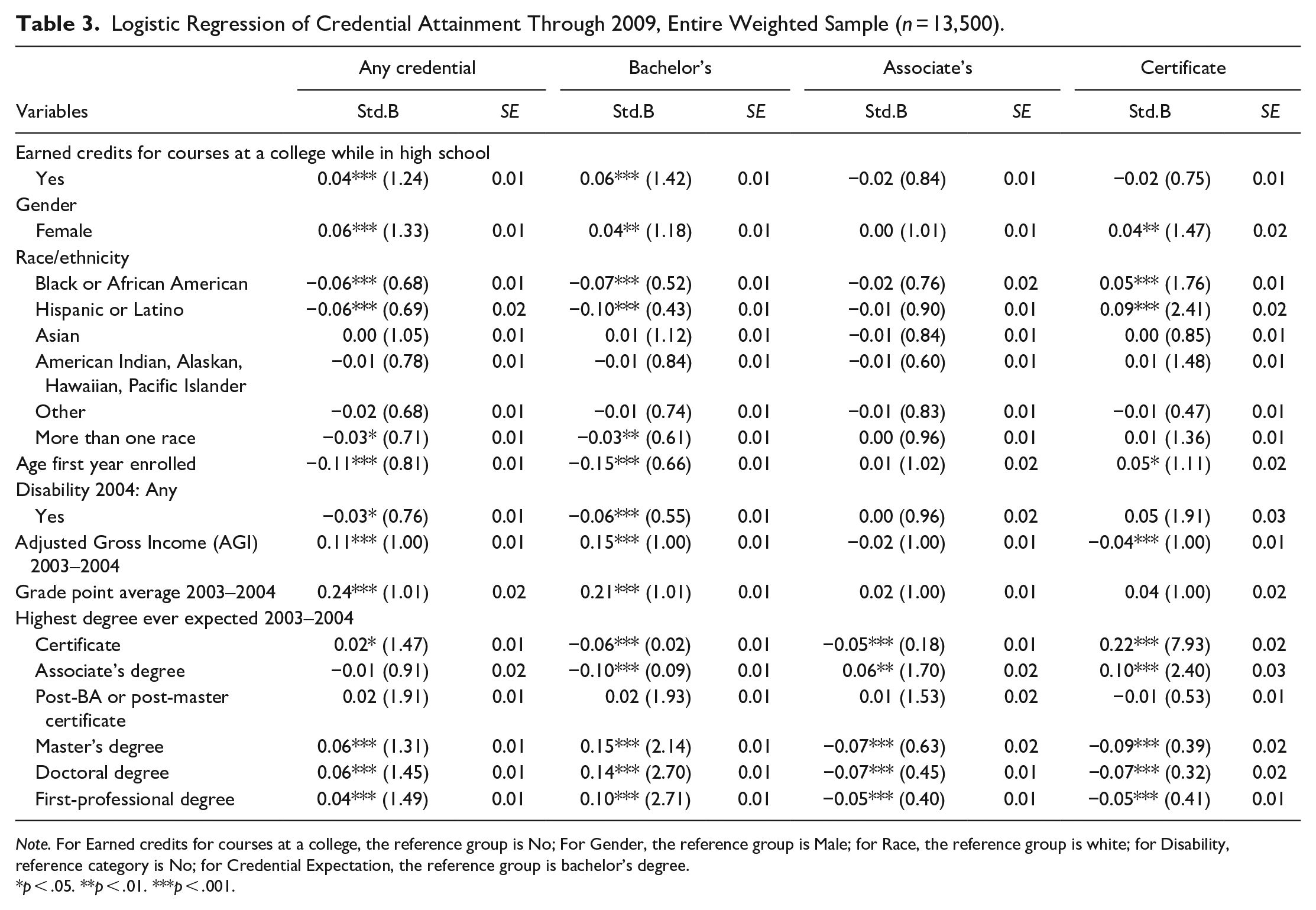
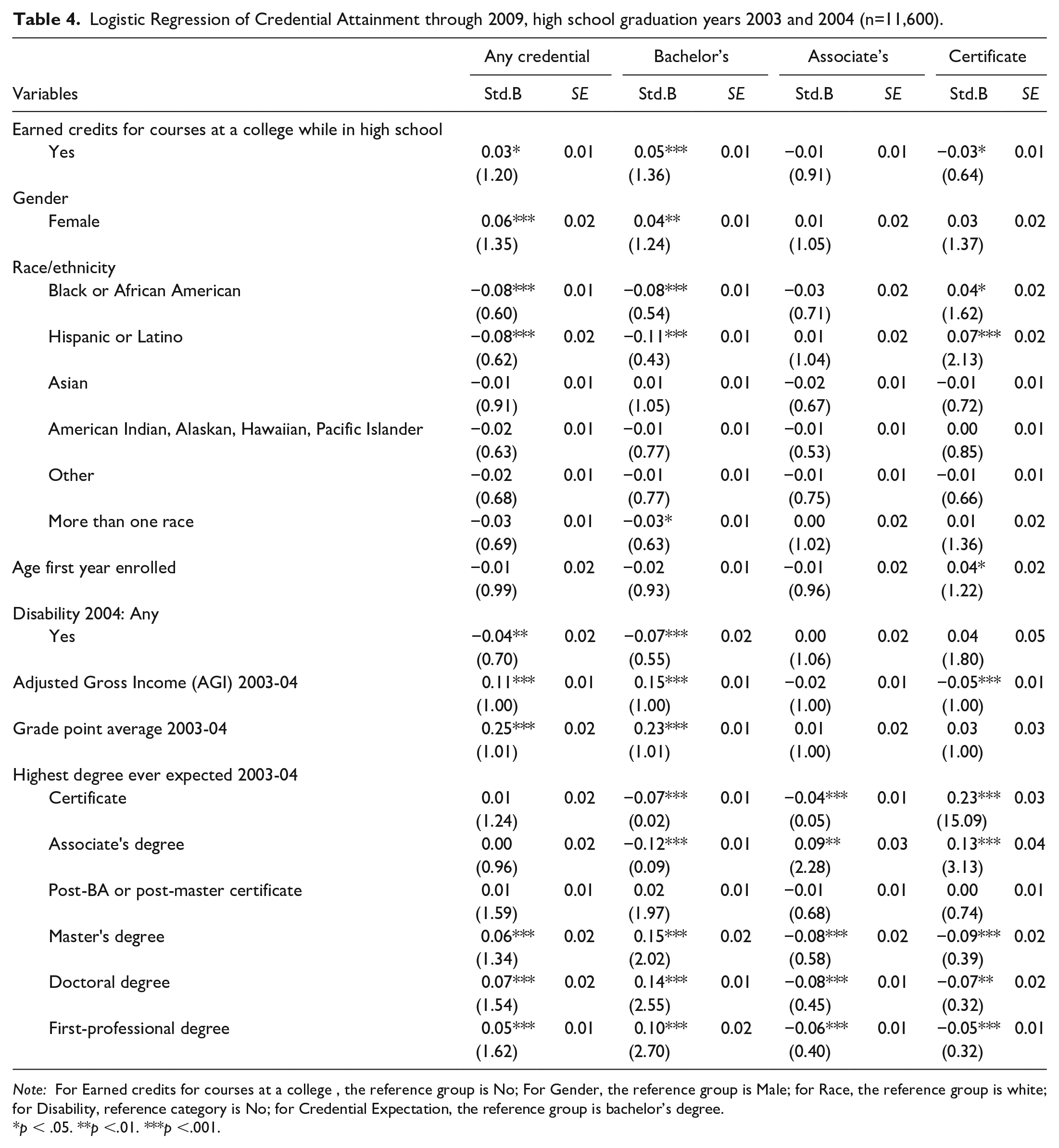
Tables 3 and 4 include the logistic regression coefficients and odds ratios calculating the relationship between dual enrollment participation and post-secondary credential obtainment 5 years after beginning at a post-secondary institution. When controlling for student demographics, socioeconomic status, high school academic performance, and college credential aspirations, students who took dual enrollment courses were at higher odds of completing any post-secondary credential and completing a bachelor’s degree when compared to students who did not take dual enrollment courses. Students from the entire weighted sample had 1.24 higher odds of obtaining any post-secondary credential, while high school graduates from 2003 and 2004 had 1.2 higher odds. Likewise, students from the entire weighted sample had 1.42 higher odds of obtaining a bachelor’s degree, while high school graduates from 2003 and 2004 had 1.36 higher odds. All four of these findings were statistically significant at the .5 level or higher.
Logistic Regression of Credential Attainment Through 2009, Entire Weighted Sample (n = 13,500).
Note. For Earned credits for courses at a college, the reference group is No; For Gender, the reference group is Male; for Race, the reference group is white; for Disability, reference category is No; for Credential Expectation, the reference group is bachelor’s degree.
p < .05. **p < .01. ***p < .001.
Logistic Regression of Credential Attainment through 2009, high school graduation years 2003 and 2004 (n=11,600).
Note: For Earned credits for courses at a college , the reference group is No; For Gender, the reference group is Male; for Race, the reference group is white; for Disability, reference category is No; for Credential Expectation, the reference group is bachelor’s degree.
p < .05. **p <.01. ***p <.001.
When controlling for student demographics, socioeconomic status, high school academic performance, and college credential aspirations, students who took dual enrollment courses had diminished odds of completing an associate degree or certificate. Students from the entire weighted sample had 0.84 less odds of completing an associate degree, while high school graduates from 2003 and 2004 had 0.91 less odds. Students from the entire weighted sample had 0.75 less odds of completing a certificate, while high school graduates from 2003 and 2004 had 0.64 less odds. Only one of the four findings (certificates for 2003 and 2004 graduates) were statistically significant at the .05 level.
When controlling for dual enrollment, socioeconomic status, high school academic performance, and post-secondary credential aspirations, Black or African American students, as well as Hispanic or Latino students, are far less likely to earn any college credential or a bachelor’s degree when compared to their White peers. Black or African American students had 0.68 less odds of completing any post-secondary credential and had 0.52 less odds of completing a bachelor’s degree when compared to White students. In comparison, Hispanic or Latino students had 0.69 less odds of completing any post-secondary credential and 0.43 less odds of completing a bachelor’s degree when compared to White students. However, Black or African American, as well as Hispanic or Latino students, are far more likely to earn a certificate when compared to their White peers when controlling for dual enrollment, socioeconomic status, high school academic performance, and post-secondary credential aspirations. Black or African American students had 1.76 increased odds of completing a certificate when compared to their White peers, while Hispanic or Latino students had 2.41 increased odds of completing a certificate.
Discussion
This analysis adds to the growing literature on dual enrollment and post-secondary credential completion by analyzing a sample of matriculated college students and their likelihood of completing specific types of post-secondary credentials. Consistent with previous research, this analysis suggests that dual enrollment students are more likely to complete a post-secondary credential when compared to similar peers who did not participate in dual enrollment (An, 2013; Blankenberger et al., 2017). By running regression models by specific credentials, this analysis reveals that overall credential obtainment is spurned by an increased likelihood of completing a bachelor’s degree. While An’s (2013) analysis did find an increased likelihood that dual enrollment students complete an associate degree, several reports showed that students who participate in dual enrollment matriculate and graduate from 4-year institutions at higher percentages than 2-year institutions, even if they participated in dual enrollment at a community college (Fink et al., 2017; Ohio Department of Higher Education, 2019; Struhl & Vargas, 2012). This supports Lawrence and King’s (2019) finding that students who took dual enrollment courses at a community college are less likely to earn an associate degree from that very community college.
This analysis differed from other studies on dual enrollment and credential obtainment in that it utilized a dataset of post-secondary students who had already matriculated to a post-secondary institution. Most of the studies cited in the manuscript employed datasets constructed from a high school population, tracking their matriculation into post-secondary education through credential obtainment. Educational researchers and policymakers need to employ various forms of research designs that designate control and treatment groups at various stages of the student enrollment lifecycle to ascertain the influence that dual enrollment participation has on credential completion. A concern of designing a study around post-matriculated college students is the inability to control for selection bias into college (Speroni, 2011). By employing this design with the literature that utilizes control and treatment groups of high school graduates, researchers, and administrators can better understand the specific influence that dual enrollment has on post-secondary matriculation and completion. What is left unclear from this analysis is if dual enrollment programs are specifically designed to help students achieve a 4-year degree, or if students are uniquely influenced by early access to a college curriculum in their internal aspirations to achieve a bachelor’s degree. Consistent with previous research, this analysis found that the level of post-secondary credential aspired to at the time of matriculation is strongly associated with the type of post-secondary credential achieved (Holzman et al., 2019; Snyder et al., 2019). More research is needed to understand how dual enrollment participation influences the motivations and aspirations surrounding credential obtainment.
Coupled with the emerging literature surrounding dual enrollment and credential obtainment, the findings from this analysis contrast both Hoffman’s (2012) and Karp’s (2015) assertions that dual enrollment implementation can be a viable policy lever to achieve the credential obtainment goals outlined in the Completion Agenda. Assisting students on their pathway to a bachelor’s degree is an admirable goal, particularly in the context of affordability issues. However, simply assisting students on their pathway to a 4-year degree will not yield the specific credential outcomes called for in the Completion Agenda. Redistributing students away from a 4-year degree to an associate degree or certificate, if that were the goal of dual enrollment programs, would not increase the net total of educated Americans entering the workforce. The Completion Agenda’s aim is to increase the net total of educated citizens with the specific credentials often offered by community colleges; dual enrollment implementation does not appear a viable policy level to do that.
Implications for Research and Practice
An additional benefit to employing various research designs with pre- and post-matriculated students is that enrollment managers tasked with first-year admissions, particularly at a 4-year institution, might find the disaggregated completion percentage a useful variable in granting admissions, given the increased likelihood of completion. Those professionals tasked-with year-to-year retention efforts may assume that dual enrollment students who have matriculated are at an increased likelihood of completion given their experiences of college coursework in high school. This is not true for African American and Hispanic or Latino students. While these students may be targeted by additional retention efforts, matriculated dual enrollment students may not be a student population that that institution strategically targets in educational interventions and retention efforts. The results of this analysis would suggest that excluding these students would be a mistake
From a programmatic perspective, state policymakers should be clear on both the intended educational outcomes in their dual enrollment policy design choices and their plans for evaluation and assessment of said outcomes. State policymakers have traditionally been more equipped to articulate who they hope to benefit through early access programs (An & Taylor, 2019; Borden et al., 2013; Zinth, 2015) but have been less clear on how to properly measure those intended outcomes, particularly in the context of other state policy priorities, such as PBF 2.0. Those states with robust dual enrollment programs and outcome-based funding models may have clear intentions on what each of these policy priorities are intended to achieve but will neglect how these policy priorities may produce conflicting outcomes. Ascribing certain policy outcomes to one policy initiative over another may be done so in error and will cause state policymakers to implement future policy initiatives with unrealistic expectations regarding their outcomes. An increasing trend in short-term credential completion may be attributed to the increased access to post-secondary education made possible by the implementation of a robust dual enrollment program. Those results may be better explained by the implementation of outcomes-based funding metrics.
Increasing the probability that a student will pursue a short-term credential might be beneficial to the state’s workforce agenda under the Completion Agenda but doing so by only increasing this probability of traditionally underrepresented students has crucial implications for equitable social outcomes. This analysis cannot determine if exposure to dual enrollment programs causes Black or African American, as well as Hispanic and Latino students, to lower their post-secondary credential aspirations to a certificate; however, it does demonstrate that dual enrollment opportunities do not increase the likelihood of bachelor’s degree completion in Black or African American, as well as Hispanic or Latino, students. Researchers investigating the influence of dual enrollment participation on post-secondary degree aspirations should pay close attention to race and ethnicity.
In an environment of scarce financial resources, institutions will prioritize enrollment management strategies around student populations that will yield the largest net benefit between tuition and subsidy revenues. In an environment of PBF, these student populations will be those whose academic aspirations and capabilities mirror the specific outcome metrics tied to subsidy awards. While dual enrollment students often have the academic capabilities desired by enrollment managers, this analysis suggests that dual enrollment populations are less likely to pursue the specific credentials tied to community college subsidy in a performance-based environment (D’Amico et al., 2014). Thus, dual enrollment students are less likely to receive institutional priority when compared to other student populations that stand to yield the larger campus subsidy awards. As dual enrollment implementation becomes an even larger staple of state policy priorities, community college leaders at the institutional level need to be mindful about how the influx of dual enrollment students will influence the budgetary restrictions faced at their particular college. While the access created by dual enrollment promises new avenues for tuition revenue, dual enrollment programs often discount tuition for the entity responsible for covering the tuition cost, whether that be the students, the state, or secondary institution. As a result, the institutional resources devoted to implementing a robust dual enrollment program might not yield the initial return on the investment.
Conclusion
In an era of increased scrutiny surrounding issues of access and affordability, higher education institutions will continue to innovate new programs and policies aimed at serving an ever-increasing diverse student population. As these programs and policies are implemented, institutional leaders and policymakers need to be sensitive to the intended consequence of each initiative and how they might have consistent or conflicting consequences. This paper has added to the growing literature surrounding dual enrollment and credential obtainment by interpreting the results against the backdrop of performance-based funding and the Completion Agenda. Despite the rise in state policy implementation of dual enrollment programs throughout the nation, more research is needed to better understand how participating in these programs leads to post-secondary credential obtainment. While it is true that dual enrollment students are generally successful while enrolled in their college classes, this analysis suggests that dual enrollment implementation will not increase the overall number of post-secondary credentials. Readers should be cautioned against interpreting these results over and above the research conducted on specific state programs. While national trends can illuminate certain phenomena within a state context, they cannot account for specific policy implementations that may produce outcomes different than produced in this analysis.
The intention of this paper was not to endorse or critique the obtainment goals of Reclaiming the American Dream or the broad policy-framework of the Completion Agenda; numerous resources exist to help scholars and policymakers think through such issues. This analysis accounts for the proliferation of performance-funding metrics as one of several structural reforms of the Completion Agenda and interprets how dual enrollment participation can yield the specific credential outcomes called for with this initiative. Reclaiming the American Dream cemented the policy ideal of an American workforce educated with quality certifications and associate degrees, and has become a central policy in the direction of the American community college in the early parts of the 21st century. As completion and accountability continue to become the norm for operation expectations, state legislators and policymakers need to have a clear understanding of how dual enrollment participation is influencing post-secondary credential obtainment within their states. While it is true that dual enrollment students are successful in the specific courses they take, it is unclear if dual enrollment participation can help with the increases in credential obtainment called for by Reclaiming the American Dream.
Footnotes
Declaration of Conflicting Interests
The author declared no potential conflicts of interest with respect to the research, authorship, and/or publication of this article.
Funding
The author received no financial support for the research, authorship, and/or publication of this article.
