




Abstract
The decline in college enrollment and persistence due to the COVID-19 pandemic was particularly significant in the community college system. Enrollment estimates from the National Student Clearinghouse Research Center (2020) show that between fall 2019 and fall 2020, community college enrollment decreased by 10.1%, representing a loss of 544,000 students. Racially minoritized students were disproportionately impacted. During the same time period, Latinx community college enrollment decreased by nearly 230,000 (15%; Mora, 2022). In many ways, the pandemic only exacerbated persistent inequities in Latinx community college student persistence and transfer.
In addition, 63% of all Latinx college students are of immigrant-origin (Batalova & Feldblum, 2020). Immigrant-origin individuals are born outside (first generation) and inside the United States (U.S.; second generation). They are a diverse group that includes students with a “regularized” status—authorized to be in the U.S. (e.g., documented and refugees)—and students with a “liminal status”—uncertain of being deported (e.g., undocumented and asylum seekers; Suárez-Orozco & Osei-Twusami, 2019). Research notes that Latinx immigrant parents and their children (immigrant-origin) have high college aspirations (Aragon, 2017; Langenkamp, 2019). While many of them aspire to obtain a bachelor’s degree, they might first enroll in a community college for reasons that include a lack of navigational support, affordability, and staying close to family (Murillo & Takagi, in press; Vega, 2018). Moreover, community college students’ pathways are highly nonlinear, filled with systemic barriers (in- and out-of-school) that impact their educational trajectories (Jabbar et al., 2021). Some of these challenges include economics (e.g., financial costs and supporting family), working part- or full-time, lack of navigational support (i.e., relationships and social networks), language barriers, legal status, racism, and xenophobia.
Although college persistence and transfer rates among Latinx immigrant-origin students are low, there are some who overcome systemic and institutional roadblocks. As such, we need to better understand the experiences, supports, and resources Latinx immigrant-origin students draw upon to persist and transfer to a 4-year college. Kiyama and Rios-Aguilar (2017) note that postsecondary educational systems and scholarship have yet to deeply examine, embrace, and capitalize on students’ and families’ unique cultural assets (i.e., Funds of identity). To date, most research on college persistence and completion has focused on students at 4-year colleges despite a large portion of students in higher education being enrolled at community colleges (Jabbar et al., 2021). As such, this study focused on the funds of identity and experiences Latinx immigrant-origin students in California draw upon to persist at community colleges as well as transfer to a 4-year college. Through qualitative methods, students’ lived experiences (in- and out-of-school) were examined to understand the skills, knowledge, networks, and resources they utilize to navigate the educational system. Given this focus, the study was guided by the following research question: In what ways do Latinx immigrant-origin community college students utilize their funds of identity to persist at a community college and transfer to a 4-year college?
Literature Review
The literature review focuses on community colleges and the role academics, cultural and social challenges, and institutional supports and barriers impact student persistence and transfer. Studies centering the experiences of Latinx and immigrant-origin students are noted.
Community Colleges, Student Persistence, and Transfer
Community colleges are commonly seen as democratizing access to higher education. As open access institutions, their student demographics are diverse and they enroll students with varying needs and goals. Community colleges are more likely to serve low-income, first-generation, and racially minoritized students (Bailey et al., 2015). Many of these students aspire to transfer and complete a bachelor’s degree; however, only a small portion do so. Scholarship has pointed to the structural inefficiencies of community colleges, calling for the need to redesign academic programs, counseling supports, and financial aid (Bailey et al, 2015; LaSota & Zumeta, 2016; Nuñez & Elizondo, 2013). Recent research has questioned the inability of colleges to adapt and respond to a more racially diverse student body (Alcantar & Hernandez, 2020). This counter perspective has revealed numerous environmental and institutional factors that hinder students’ persistence and transfer (Jain et al., 2020). For example, enrolling in developmental courses may decrease the likelihood to transfer (Crisp & Delgado, 2014; Hawley & Harris, 2005. Yet research shows that counselors and administrators who question Latinx students’ academic abilities may sort them into developmental courses and constrain transfer opportunities (Acevedo-Gil et al., 2015; Ornelas & Solórzano, 2004; Maldonado, 2019). Moreover, minimal to no exposure to college information, confusing transfer requirements, financial constraints, work and family responsibilities, and inaccessibility to campus supports may also diminish persistence and transfer (Crisp & Nora, 2010; Hart, 2019; Tovar, 2015; Vega, 2018). Given these barriers, it is important to consider how supports and resources are disseminated in ways that reflect the students institutions serve.
Community college persistence and transfer may increase when institutions exhibit student-centered commitments and behaviors (Hart, 2019; Ornelas & Solórzano, 2004). At an institutional level, proactive and visible college leaders and staff are important in creating a transfer culture (Gándara et al., 2012). Within colleges, transfer champions consist of administrators and faculty committed to educational equity and who advocate for transfer supports (Dowd et al., 2006). Additionally, transfer agents are those individuals who help students navigate the complexities (e.g., bureaucracies and sense of belonging) of the transfer process (Bensimon & Dowd, 2009). Both are needed to advance a culture of persistence and transfer, especially for students who must overcome informational barriers to navigate higher education. For example, Gándara et al.’s (2012) multiple case study in California examined institutional practices at community colleges that disproportionately transferred Black and Latinx from low-performing high schools. They found that the presence of transfer champions, strong counseling supports, and specialized programs such as Puente and Ujoma that target Latinx and Black students helped increase transfer. These findings support previous research demonstrating the role of college support programs such as Puente in validating students’ educational goals and ability to transfer (Rendón, 2002).
A growing body of work has centered the experiences of racially minoritized students in higher education through asset-based perspectives (Kiyama & Rios-Aguilar, 2017). For example, Rendón’s (1994) validation theory has been applied to examine the role of institutional agents (e.g., college staff and faculty) in student persistence, noting how faculty can affirm students’ academic self-concept and contribute to their personal development (Alcantar & Hernandez, 2020). Caring instruction as practiced through mentoring and letting students know they are valued may be particularly important for students’ academic integration (Barnett, 2011). Similarly, institutional agents beyond faculty play important roles in students’ academic and social well-being by disseminating critical information, cultivating relationships, and supporting students’ transfer goals (Tovar, 2015). They do this work in multiple ways such as sharing about their own college journey with students, affirming students’ academic abilities during difficult moments, and helping them navigate confusing institutional policies (Museus & Neville, 2012; Sandoval-Lucero et al., 2014). Concurrently, they help grow the social capital (i.e., networks) students need to complete a college degree.
Yosso (2005) notes that racially minoritized students possess forms of capital that go unrecognized by institutions. These forms of capital (i.e., wealth) allow students to sustain college aspirations, build networks that help them navigate higher education, resist forms of oppression, and draw on family to enter, persist in, and complete college (Aragon, 2017; Murillo et al., 2017). Moreover, Latinx students’ transfer goals are often driven by a desire for personal growth, familial support, and institutional environments that encourage and support transfer (Jabbar, et al., 2019; Lukszo & Hayes, 2020; Suarez, 2003; Vasquez et al., 2020). Recent research has developed additional lines of inquiry related to the experiences of Latinx and immigrant-origin students (see Harris, 2017; Suárez-Orozco & Osei-Twumasi, 2019). Suárez-Orozco and Osei-Twumasi’s (2019) edited volume showcases the range of identities immigrant-origin community college students bring with them and how campus settings (i.e., classrooms) shape positive (e.g., faculty relationships) and negative (e.g., microaggressions) academic experiences. In addition, a growing body of research has documented the importance of family in Latinx immigrant-origin students’ higher education experience such as feeling validated, developing transfer aspirations, and providing direct and in-kind financial supports (Covarrubias, 2021; Jabbar et al., 2019).
Higher education is more racially, ethnically, and culturally diverse than ever before. Yet institutions of higher education are struggling to support students to persist and complete a 4-year college degree. Community colleges present an ideal context for study, yet few studies have examined the experiences of immigrant-origin students in these settings (Suárez-Orozco & Osei-Twumasi, 2019). Building on this work, the present study foregrounds Latinx immigrant-origin students’ identities, noting the interplay between individuals, family, school systems, and institutional agents supporting persistence and transfer. In particular, this study aims to capture the complexity in students’ identities, noting how they ground students’ educational goals at different moments and how institutions can better design curriculum, supports, and spaces.
Theoretical Framework
Esteban-Guitart (2012) concept of Funds of Identity (FI) provides a framework to examine students’ identities. FI is composed of the people, spaces, things, and activities that are most important and relevant in defining individuals. FI builds on Funds of Knowledge (FK)—the historically accumulated knowledge, resources, and skills that exist in students and families—by focusing on the FK that individuals identify as important to their sense of self.
FI draws on the Vygotskian concept of perezhivanie (lived experience) by recognizing that identity is dynamic, mediated, and distributed over time and across multiple people, contexts, activities, and artifacts (Esteban-Guitart & Moll, 2014a). Esteban-Guitart (2012) describes FI as a “box of tools” subdivided into five major components: (a) Geographical, any area or territory; (b) Practical, any activity that holds importance (e.g., work and hobbies); (c) Cultural, artifacts (e.g., ethnicity, religious symbols, gender, legal status); (d) Social, significant others (e.g., relatives, friends, teachers, colleagues); and (e) institutional, social institutions (e.g., marriage, higher education, family). These five components of FI are not mutually exclusive and can converge across time and space.
The development of FI is an interactional process involving people and things. According to Hogg and Volman (2020), FI centers student experiences by focusing on a multitude of contexts (e.g., in and out of school/family interactions) across time that shape their identity. FI’s temporal component also highlights the malleability of an individual’s identity as it is reshaped and recreated across the lifetime (Esteban-Guitart & Moll, 2014a). Esteban-Guitart and Moll (2014b) note that educational systems should be interested in students’ FI because they are tasked with connecting learning (i.e., contextualizing) to students’ lives.
Scholars have applied FI to higher education contexts. For example, Esteban-Guitart et al. (2020) described a class project in an educational psychology course that helped students link their FI to course material, providing an opportunity to explore and deepen content knowledge in relation to their interests and selves. Gutzwa (2021) also utilized FI to examine how trans undergraduate students experience classroom settings. The findings demonstrate how intersecting identities (e.g., being trans and from a racially minoritized group) and direct experiences with oppression shape students’ classroom experiences and decisions about how to engage with the curriculum, peers, and faculty. This scholarship demonstrates an ongoing need to understand students’ multiple selves and critically examine institutional structures and practices that fail to account for how students, especially those from minoritized groups, experience this setting.
This study extends FI scholarship by connecting students’ FI (acquired prior to and developed during college) to community college students’ persistence and transfer. In doing so, it provides a basis to move beyond static and dichotomous metrics (e.g., did or did not persist) by delving into students’ lived experiences, how they make meaning of them, and how it shapes their college experience. It also centers how students’ identities inform the way they locate themselves in higher education and how institutions may draw on these identities to better serve students. Moreover, it contributes to asset-based research in higher education that recognizes the way Latinx immigrant-origin students utilize their cultural wealth to navigate institutions not designed with them in mind (Yosso, 2005).
Methodology
A multimethodological qualitative approach was employed to illuminate the dynamic processes that shape participants’ identity development and support college persistence and transfer (Esteban-Guitart, 2012). Specifically, the identities students’ draw upon to navigate higher education to persist and transfer (e.g., supports and challenges).
Context
California is home to the largest population of Latinx and immigrant-origin students with half of all children having immigrant parents (Data points, 2017). In addition, nearly half (46%) of students enrolled at 2-year community colleges identify as Latinx (California Community Colleges, 2023). Despite a high proportion of Latinx students at 2-year colleges who indicate an intent to transfer to a 4-year, only 10% do so within 4 years (Johnson & Mejia, 2020). To address these challenges, policymakers have targeted efforts to support community college enrollment, persistence, and transfer. In 2018, Assembly Bill (AB) 705 was passed to end the use of high-stakes tests in favor of multiple measures to make course placement decisions (Acevedo, 2022). Additionally, in 2019 Governor Newsom signed AB 19, also known as the College Promise Program. The bill allows community college districts to provide direct financial aid for 2 years to first-time students who are enrolled full-time (Rios-Aguilar & Lyke, 2020). Although these efforts are promising, they are limited in scope and reach. For example, tuition support does not cover additional costs such as housing or books. And, part-time students—a large portion of the community college population—are not eligible (Rios-Aguilar & Lyke, 2020). Community college districts may also utilize the funds to develop and implement college support programs. More recently, as part of COVID-19 relief efforts, the California community college system received millions of dollars in emergency funds to support students by increasing and expanding financial support as well as addressing food insecurity. These efforts are ongoing and reflect a need for long-term, systemic investments and changes.
Participant Recruitment and Data Instruments
After obtaining study approval from the Institutional Review Board (IRB), purposive sampling was utilized to recruit participants across California community colleges. Recruitment flyers were shared on social media (e.g., Instagram and Facebook). Institutional programs focused on student supports (e.g., Puente and Extended Opportunity Programs and Services, EOPS) were contacted to share the study with students. Individuals who were interested in participating completed a short demographic questionnaire on Qualtrics, an online survey platform.
Twenty Latinx immigrant-origin community college students in California completed the self-portrait and testimonio in spring 2022. A Zoom meeting was scheduled for participants to complete their self-portrait in Google Slides, and then engage in a testimonio of their community college experience. Table 1 describes participant characteristics (all names are pseudonyms). Twelve participants were women and eight were men. Participants’ age ranged between 18 and 23 and most were born in the U.S. (second generation). All but one participant was a first-generation college student and 11 received direct financial assistance through the College Promise Program. All participants were transferring to a 4-year college in California in fall 2022.
Study Participants.

All students planned to transfer to a university in California. The institutions are a part of three different university systems: University of California (UC), California State University (CSU), and Private universities.
Self-portrait
A self-portrait is an arts-based technique that allows participants to reflect and think holistically about themselves (Hogg & Volman, 2020). Self-portraits help participants express ideas or feelings they might have difficulty sharing in a traditional narrative form. During the Zoom meeting participants were given access to a private Google Folder to complete their digital self-portrait. The researcher shared with them a prompt that asked them to depict by any means (e.g., pictures, words, drawing, maps, etc.) what defined them. Examples of personal characteristics (e.g., gender, ethnicity), people, hobbies, spaces, etc. were provided. The prompt was adapted from Esteban-Guitart et al.’s (2020) work with undergraduate students and took between 15 and 25 minutes to complete. After completing the self-portrait, participants were prompted to describe their visual to the researcher.
Testimonios
Immediately after completing the self-portrait, testimonio interviews were conducted. A testimonio provides participants an opportunity to share and reflect on their educational experiences with consideration to issues of race, gender, immigration, language, etc. (Perez Huber & Cueva, 2012). Testimonios are frequently utilized to build collective narratives that foreground the complex experiences of success, struggle, and resilience. This methodological approach works as a counternarrative to challenge existing deficit discourses of traditionally marginalized students (Delgado Bernal et al., 2018). The testimonio interview was conducted in four parts: (a) family, (b) high school experience and college choice, (c) community college experience, and (d) transfer process. The testimonio was used to probe about students’ self-portraits and its relevance to their educational experience, goals, persistence, and transfer. Testimonios took between 35 and 90 minutes.
Positionality
As a Latinx, immigrant-origin and first-generation college student I come to this work committed to improving postsecondary educational experiences and outcomes for Latinx students. I also share multiple identities with the study participants, creating a common ground for them to share their stories. However, I did not enroll at a community college and enrolled in higher education at a different time than participants. As such, I am mindful of the ways my journey deviates from that of participants. This also intersects with my current faculty status. Although recognizing my perceived insider and outsider status is important, the knowledge and awareness I bring to this work is instrumental in the study design, data collection, analysis, and presentation of findings. Care has been taken to ensure that self-portraits and testimonios center participants’ stories in accurate and credible ways.
Data Analysis
Data analysis began at the start of data collection (Merriam & Tisdell, 2016). After each interview, notes were reviewed to detail participants’ narratives. In addition, throughout the data collection process reflective memos were written to detail emergent findings. All interviews were transcribed and uploaded to MAXQDA, a software utilized for qualitative analysis. Data were then coded in two steps. The first step included deductive and inductive coding. Deductive codes included the five components in the FI “box of tools” framework (e.g., cultural, social, etc.) as well as codes about college persistence (e.g., programs and services) and transfer (e.g., decision and challenges). Inductive codes were generated during initial review of participants’ testimonios. Some of these codes reflected the role of family (e.g., emotional support and tension) as well as college experience (e.g., interest development and positive/negative experiences; Saldaña, 2016). The second step included axial coding to describe the properties of each FI component alongside community college persistence and transfer (Saldaña, 2016). Axial coding helped identify the properties (e.g., conditions, interactions, experiences) that shaped the way participants persisted in community college and transfer. For example, students’ ethnic (e.g., Latinx) and first-generation college student identities were mapped onto the cultural domain of FI. Instances in which participants discussed their ethnic and first-generation college student identity were then connected to their persistence and transfer. Some examples included enrolling in Chicano Studies courses or seeking help from institutional agents who were affiliated with college success programs. The context (e.g., class or office, type of interaction (academic or counseling), and overall experience (positive or negative) were also noted.
Credibility and trustworthiness occurred in multiple ways following Toma’s (2006) recommendation when conducting qualitative research. First, using multiple data sources helped triangulate data findings. For example, coded segments revealed that participants most commonly referenced family in their self-portraits while testimonios provided an opportunity for participants to expand on the role of family in their college experience. In addition, including two main data sources helped capture information that could have potentially been missed had only self-portraits been used. For example, while institutional agents (social FI) were not included in participants’ self-portraits, their role in the transfer process was salient in testimonios. Second, interview transcripts and findings were shared with all participants to gather their thoughts and confirm interpretations of the data (Toma, 2006). However, only a few participants responded to the invitation to review the findings. Those who reviewed the findings and shared their thoughts approved the interpretations. Finally, an iterative process of self-reflection and consultation with field experts on community college and Latinx students helped address potential bias.
Findings
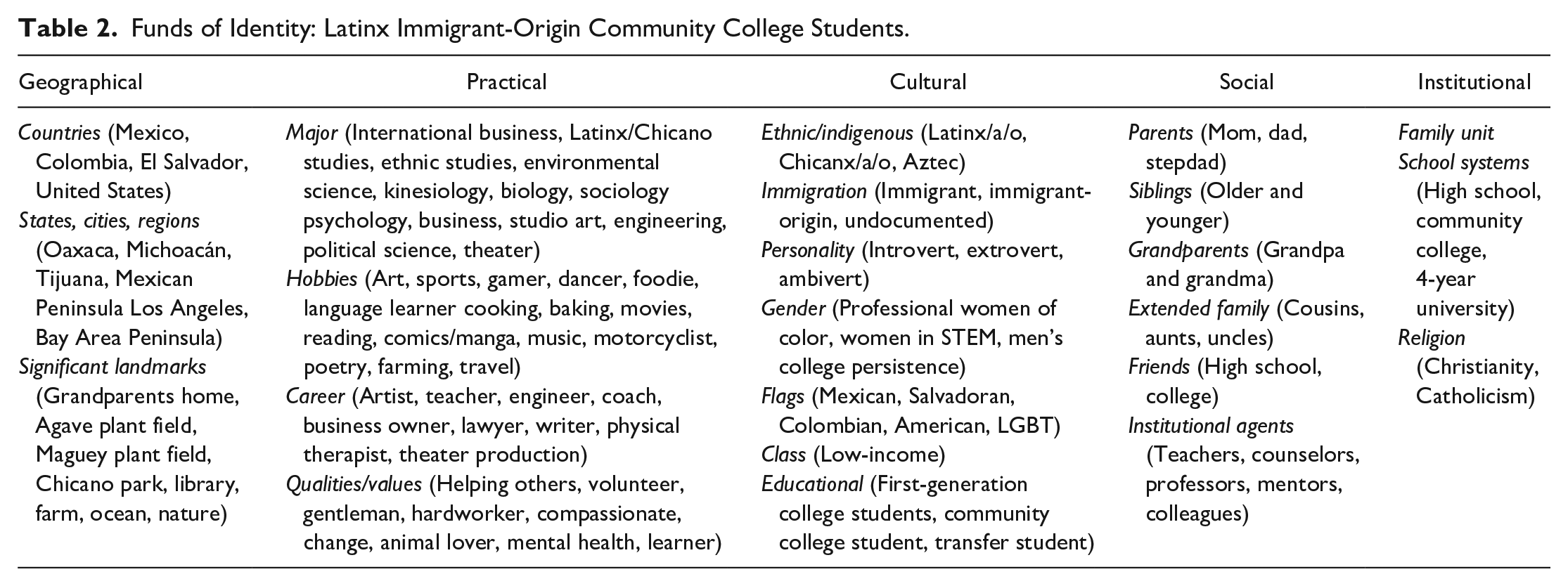
Participants’ self-portraits and testimonios revealed a range of funds they brought to and developed in community college (see Table 2). It is important to note that some funds were discussed more frequently in connection to persistence and transfer. For example, while hobbies were important for stress relief or associated with academic interests, a full examination of these funds is not possible due to space limitation. Still, the findings demonstrate how students’ funds of identity across domains plays a role in helping students build networks and navigate community college to persist and transfer. Three themes in Latinx immigrant-origin community college students’ persistence and transfer are described. The first describes how family ties alongside other forms of FI shape students’ aspirations and college journey. The second theme examines the role of culturally affirming programs that align with students’ FI to support persistence and transfer. The third theme centers the ways academic interests and career exploration operate as motivating factors for students to reach their future goals. It is important to note that FI are not mutually exclusive to one theme. Rather, they weave across a student’s college journey.
Funds of Identity: Latinx Immigrant-Origin Community College Students.
Family Ties, Funds of Identity, and the Community College Journey
Students’ journey into higher education began long before stepping onto a college campus. As the children of immigrants from Latin America (a few of them immigrants themselves), the students featured in this study have a desire to enter higher education, persist in community college, and transfer to a 4-year college. The study revealed that their desires are tied to their families’ immigration journeys, sacrifices, and hopes. As such, parents and siblings play an essential role in students’ college experience. In this way, students get to pave the way for others in their life to follow along with their college journey.
Students drew on familial Funds of Knowledge (FK) to forge Funds of Identity (FI) that helped them persist and transfer. These funds (e.g., geographical, social, and institutional) include immigration stories of departing home countries (i.e., regions, cities, and states) and leaving behind family (e.g., grandparents, parents, uncles/aunts, cousins, and friends). They also include stories and experiences in the U.S. about growing up in low-income households, watching parents in physically demanding labor, and, for some, worrying about parents’ undocumented status (i.e., cultural identities). These moments imprinted on students and served to shape who they were and what they wanted to accomplish. For example, Amanda, grew up in a low-income household with both parents, her self-portrait included a graphic depicting different forms of hard labor. She explained how the graphic depicts her as a child helping her parents with their janitorial work. Amanda described a childhood memory of her parents working: [My dad] was so sleepy and didn’t have time to rest. So, he would sleep on the ground of this office that we had to clean. . .He would do that because he would be so tired, and he had two jobs. That image is something that really hurts me ’cause I never want to see my dad go through that again or my mom. . .I remember my mom being pregnant and working. . .I don’t want them to ever work again in their lives. So that image is what’s stuck with me and it’s like, “You have to continue, not only for you, but for your parents.”
Growing up in a low-income household with immigrant parents, Amanda’s early years were pivotal in developing her college aspirations. And, like most participants, her educational drive was shaped by a desire to help support her parents. Parents’ immigration journeys and struggles were also used to overcome the educational challenges students encountered in community college. Esmeralda, the daughter of Mexican immigrants, recognized the challenges her parents encountered to provide a better life for her and her siblings. She shared, “They immigrated and they started their life here for us to have a better future. And I feel that’s another thing that plays a major role into me not giving up because they did so much.” As such, for most participants, a college degree meant fulfilling parents’ dream for their children to be financially stable and lead happy lives. Emmanuel, who had been encouraged by both his parents to enter community college and transfer, described the feeling: “It means everything, the world. They unfortunately weren’t able to go to college themselves, so they passed that expectation on to me, and so it feels good that I was able to deliver and finally meet their goal.” For students like Emmanuel, completing a college degree meant parents’ sacrifices were worth the struggle of immigrating and working in low-wage jobs.
Familial FK also included siblings, both older and younger. For example, Andrea’s three older sisters attended a community college before transferring. Given their community college experience, Andrea felt confident following their footsteps. Her sisters were also able to use their FK and navigational capital to suggest who to talk to once at the institution: I think having [my sisters] in my life as positive role models, I knew that it was possible and they were completely helpful also. They would tell me, “oh, you need to meet with the counselor or you need to do this.”
Sibling navigational support also extended to the transfer experience and decision. Leticia and her sister attended the same community college. In addition to providing support while taking community college courses, Leticia’s sister helped Leticia plan her transition to a 4-year college. Leticia shared, “She’s really helped me, with what classes to take. She gave me a tour of the campus, all the resource centers, and all the other organizations I should join.” Altogether, siblings inspired and motivated students to persist and transfer. Javier mentioned, “Just seeing [my older sister] get her degrees inspired me to get one and I hope to do the same for my younger siblings. . .I wanna show my younger siblings that it definitely can be done.” Ultimately, these social funds helped create generational knowledge to navigate community college.
For many students, persisting and transferring meant being part of a collective experience. Many participants drew upon their family struggles to create meaning out of their educational pursuits. For example, Marlene saw her ability to transfer as a victory for herself, her family, and the immigrant community. She shared: I always keep in mind my people because they are some hard workers. I feel like immigrants, every immigrant that works really hard is the backbone of this country. . . it’s something we simply take for granted. And now that I’m going to transfer to a four year. . .I take it as another win for not only myself, not only my family, but my community, my people, which are essentially immigrants.
Although Marlene was born in the U.S., she grew up with undocumented family members and felt connected to the immigrant community. Her education was one way to show the success of immigrants. Forging a college path also meant others could come along. Camila, an only child, had strong ties to both her mom and grandmother. Her self-portrait featured a graphic of a graduation cap with individuals at the top, helping others climb it too. To Camila, the people on top represented the support from her family: I liked that picture of the graduation path and people building it for someone because I feel like I’m not the only one getting my degree. It’s also my mom and my grandmother, like my community too in a way, you know, like my family back at home.
Students not only dreamed about a familial college path, but in some cases, they also embodied it. For example, Benjamin’s self-portrait included a picture taken in 2021 at his older brother’s graduation from a 4-year college. At the event, Benjamin and his mom wore a cap and gown because Benjamin’s high school graduation in 2020 had been cancelled due to the pandemic while his mom was celebrating completing an associate’s degree. They reasoned it was an appropriate moment to celebrate the accomplishment of all three family members. In this way, students’ college journeys were a part of something larger than themselves. Victoria’s comment illustrates the idea: [Transferring] means everything. I love seeing those videos on Instagram and Twitter of people getting their diplomas and then passing on their cap and their diploma to their parents. And then just seeing their parents cry. I think that’s a really big milestone because you’re literally watching the cycle of poverty break right before your eyes.
Ultimately, persisting at a community college and transferring to a 4-year college was both a victory for students and family. And, was also a part of a journey that crossed physical borders.
Culturally Affirming Institutional Supports: Persisting to Transfer
Despite being highly motivated to enter higher education and having family support, students found navigating community college was difficult. All students utilized institutional supports (e.g., college support programs) in or out of the community college to persist and to transfer. It was most common for students to find support in programs and among individuals who affirmed students’ multiple FI, including being Latinx, a first-generation college student, and other interests (e.g., major, careers, and social issues). Students most commonly attributed their ability to persist and to transfer to enrolling in relevant coursework and participating in college support programs such as Puente and EOPS as well as other initiatives intended to support first-generation college students. The positive impact of coursework and program supports was facilitated through institutional agents (e.g., faculty, counselors, and mentors) who met the role of transfer agents, helping students to navigate difficult moments while in college as well as the bureaucratic and emotional challenges of the transfer process.
Community college courses were frequently described as supportive learning environments. However, there were some exceptions, especially during the initial shift to online learning at the beginning of the COVID-19 pandemic (e.g., losing motivation and not having an adequate study space at home). Despite these challenges, course content and assignments that encouraged students to explore and include their identities was empowering. Some of these courses were major specific while others were electives, often selected through the recommendation of a counselor or mentor affiliated with a college support program. According to students, coursework was engaging and meaningful when they were able to explore their interests, as Marlene noted: “What I didn’t have in high school was a voice. So, I was able to express who I was; my identity, my culture, and the professors were all open to it.” While in high school, Marlene’s teachers discouraged her from centering immigration issues in her work. In contrast, some college courses encouraged her and other students to draw on their ethnic, cultural, immigrant-origin, and other identities. So rather than having students align their identity to college, the college curriculum aligned with who students were. For students like Yareli, being able to see herself in the course material helped redefine her narrative. She shared: I feel like as a first-gen student, the way we would describe ourselves or people would describe you was very like, “que triste pobrecita [how sad, poor little you].” I never learned to use empowering words about myself and my experience. . .So taking Women of Color and Chicano Studies allowed me to rewrite my experience to represent, “I did that. Not pobrecita [poor little you]. I literally did that, and I worked harder than most people.”
Culturally relevant and affirming course content helped Yareli identify and foreground her strength as a first-generation, immigrant-origin Latina navigating college. It also served to resist deficit narratives, and centered the strength in her lived experience.
A majority of faculty and counselors that helped students persist were affiliated with college support programs and students’ majors. These individuals helped students stay motivated and to build community, something that was difficult while attending college online due to the COVID-19 pandemic. While some enjoyed the flexibility of online courses, others struggled to adjust, which sometimes resulted in taking a leave of absence to help provide for the family, pursue another interest, and/or rest from the stress of their academic and home lives. For example, Alfredo’s transition to community college was difficult. During his first year, he worked long hours and his grades suffered. With encouragement from a professor he prioritized school over work in his second year. However, just as he was finding his academic stride classes were moved online because of the pandemic. Alfredo lost motivation and dropped most of his courses. He shared, I wasn’t able to click with that online course thing, it was just extremely hard for me. . .I had four [classes], I dropped three of them. My sociology professor, she [also] helps the [Latinx] club I’m in and she was just like, “No, no, no, you ain’t dropping it, you’re going through with it,” and that was the only reason I got a grade in that class. I wasn’t even supposed to go to school the next semester because I know I wasn’t gonna do anything.
It was Alfredo’s sociology professor and club advisor who encouraged him to persist, complete the course, and return in the fall. Other students noted that some of the reasons why they never paused their education or why they returned to school was because of a love of learning, support from faculty and counselors who encouraged them to persist and/or return, family support, and their personal commitment to their education. Although participants did not name specific institutional agents in their self-portraits, students’ testimonios revealed their positive role in helping students persist and transfer. Amanda’s story was similar to Alfredo’s. Moving to an online modality led her to question her abilities. She credited the Puente program and her English professor for helping her persist: I was part of Puente and I remember [my English professor] telling me “Amanda, I’m waiting for you next year.” And I’m like, “No” ’cause I stopped believing in myself, and I was like, I can’t give up on her, she’s believing in me. . . I’m so grateful for her because it’s thanks to her that I was able to graduate.
College support program staff served multiple roles in helping students persist and transfer, including emotional and motivational support as well as technical support, all while affirming students’ FI. Many students commented they felt comfortable asking questions and sharing personal information with college staff and faculty. It also helped that the majority of staff they encountered were Latinx/a/o and shared similar college pathways and experiences. As such, many participants indicated feeling seen and validated by community college staff. For example, Leticia had difficulty connecting with counselors until she met one through Puente: My [Puente] counselor, Antonio, I felt comfortable with him. . . The first two counselors that I had were white and they didn’t really get me. And [Antonio] specifically [is] Latino and we had the same old story, like our parents came here for a better life, yada yada, it’s a lot to handle.
Although students did not indicate expecting institutional agents to have a similar ethnic and cultural background, it helped when counselors could make connections to students’ stories.
Altogether college support programs and affiliated institutional agents played a pivotal role in students’ community college and transfer experiences. It is also important to note that the counseling and support students received often made up for the lack of support offered from institutional agents (e.g., counselors and administrators) unaffiliated with these college support programs. Many students recalled feeling that meetings with some academic counselors were ineffective and transactional. Esmeralda shared her experience with a counselor, “I feel they don’t really get the time to hear your background or understand your situation, and it’s just like, ‘This is what you need to go through.’ But they didn’t guide me through it, so it was tough.” In contrast, college support program staff were more likely to get to know students and make recommendations based on this knowledge. For example, a counselor from an off-campus college support program recommended a new course schedule for Elizabeth. The counselor noticed that Elizabeth would not be able to attend an 8am class because she lived far and rode the bus. She shared, “I remember [my program counselor] being like, ‘This [person] doesn’t know that you can’t drive, that you don’t have a car, that you have to take three buses to get to campus.’” For students like Elizabeth having a counselor who knew them beyond their transcripts was important in making decisions.
Many participants mentioned that one of the most difficult parts of the transfer process was meeting transfer requirements, especially ensuring their community college courses were transferable to the 4-year college they planned to attend. This meant cross checking course plans with counselors and making sure all requirements were completed. Julia shared the benefits of being in EOPS: “I would say telling me that the credits are transferable, because I feel like that’s often missed with community transfer students. So that was most important for me.” They also helped most students complete transfer applications and select the colleges to which they planned to apply. The information and support was particularly valuable to students because most needed help across the multiple steps of the transfer process. Benjamin commented, They also do well in making sure that for transferring, you fill out the FAFSA correctly, that you narrow down your options to which one is your favorite, which one is the one that you really wanna go to, and which one is your favorite top school as well as which one also gives you a budget that you can work with in order to pursue the [degree].
College support programs not only ensured students met transfer criteria. They also helped students complete financial aid applications and encouraged them to think about their college choice alongside their finances.
Academic Interest Alignment and Career Exploration
College persistence and transfer was associated with students’ academic interests and career exploration (i.e., practical FI). Students’ majors represented a diverse set of fields (see Table 2). These fields of study reflected aspects of who students were and what they wanted to be. In addition, attending community college allowed students to develop new interests or pursue existing ones. Many of them drew on their lived experiences in and out of school to make decisions about majors and develop career aspirations. Moreover, many students felt that attending a community college allowed them to explore their interests without the financial pressure to expedite a decision since community college costs were mostly covered through financial aid. Andrea shared the sentiment, I don’t have to worry about [finances]. I also kind of didn’t know what I wanted to do. I didn’t know what I wanted to study. It felt crazy to me. If I went from high school to a four year you’re spending all that money and you don’t even know what you wanna do.
As such, for some participants community colleges allowed them to discover a new passion and explore a new field of study.
Some students entered community college not knowing what to study. Recommendations from college staff, mentors, and extended family networks helped them settle on a major and potential career path. For example, Elizabeth declared Chicano Studies as a major after an advisor from a regional college support program recommended it. The classes were engaging because she saw herself and her family reflected in the course content. For one class project Elizabeth chronicled U.S. interference in Central America: So basically, figuring out that Chicano studies major connects to my own identity, my paths and my heritage. . .I really like doing research. I enjoy doing research and I enjoy studying. And so, the fact that I was doing something that I enjoyed and connecting it to my own life was pretty awesome for me.
As an immigrant from El Salvador, Elizabeth gravitated to courses about Central America. She also considered pursuing law as a career. She continued, “I only became a citizen probably three years ago because of a non-profit that helped people get citizenship.” Drawing on her personal experience, she debated whether to be a paralegal or lawyer. Although she was exploring career options, Elizabeth knew she wanted to work with immigrant communities, especially those arriving from Central America.
Other students changed their major and career prospects. Marlene was passionate about art, but after taking a few graphic design courses she “hated it.” At the onset of the pandemic she was asked by a neighbor if she could tutor their child. Soon after she was tutoring a few neighborhood kids. This led Marlene to declare her major in early childhood education to become a teacher. She shared it was her tutees who inspired her to become an educator, “. . .they were the ones that got me into wanting to educate and become a teacher, so I kind of do it for them and I’ve always kept up with them.” Marlene even did her student placement while in community college at her former elementary school and hoped to work in the community (i.e., geographical FI) after completing her bachelor’s degree and teaching credential.
Entering community college, persisting, and transferring also meant students were defying expectations and outcomes. Latina students were more likely to note the importance of pursuing higher education and a career as a means to resist negative stereotypes as well as increase the number and representation of “professional women of color.” Amanda recalled a high school counselor who did not believe in her. While initially a disappointing experience, it also motived her. She shared, “You know what, one day he’s gonna see my name somewhere. One day he’s gonna be like, ‘Oh yeah, that was the student who I told you’re not gonna get anywhere, you’re gonna be cleaning toilets out here.’” Defying negative ethnic and cultural perceptions made transferring and pursuing a career more meaningful. Esmeralda chose to major in mechanical engineering after participating in a high school engineering internship. Her dad was also a mechanical engineer, but without a formal education in the U.S., he could not advance at his job. Describing her self-portrait, she shared, [I am] emphasizing women in STEM, and you can see all these women in different areas in STEM. . .the picture up above is like a generation barrier that I’m like going over because the generation before [me], they didn’t have the opportunity.
Esmeralda mentioned she was often one of only a few women in her courses. Fortunately, she found a group of women that supported one another “without judgment.” Other students also noted wanting to challenge the low rates of college completion among Latinx students. For example, Javier withdrew from classes at the start of the pandemic to work and learn to code. After coding did not work out he re-enrolled and declared Ethnic Studies as a major. He mentioned, “A lot of Latino males drop out of college to go to work and I feel like I’m proving those statistics wrong getting this degree.” Moreover, Javier planned to become an athletic director because he enjoyed working with youth and serving as a role model.
Giving back was also an important aspect of students’ decision to pursue a specific major or career. As noted above, Javier wanted to be a role model and make a difference. The following comment reflects how Javier and other students considered majors and careers: And my career goals, I’m not really focusing on the money aspect of it. I just wanna find a career that I’m passionate about and I genuinely love as opposed to dreading going to work and making all that money. I’d rather be happy and helping my community.
Although wealth, passion, and giving back are not mutually exclusive, students wrestled with the decision to pursue prestige, high paying jobs, or something meaningful to them. Raul, a biology major, was initially hesitant about becoming a teacher. He originally wanted a career with more “prestige like a doctor.” In addition, his parents were also teachers in Mexico so he was hesitant to follow a similar path. However, after helping other students in his science class, he changed his mind. Raul shared, “It’s really one of the most pleasant things that I have ever experienced in my life, to help someone to get that perspective of what you’re trying to get them to understand.” For many participants pursuing their passion while making meaningful contribution was important. Similarly, Victoria declared Chicano Studies but was unsure about her future career. However, she was certain about wanting to serve the Latinx/a/o community: And I just know that with my major and with my career choices, it’s gonna take me there to give back to the Latino community and teach them like, “This is how you work through immigration policies, this is how you. . . Don’t let them take advantage of you. Learn about all those things.” So, I know I’m not done learning about the issues and I wanna go to a four-year for that reason.
Victoria’s goals reflect most participants’ aspirations, which included completing a bachelor’s degree and making a meaningful contribution to their community.
Discussion
This studied applied Funds of Identity (FI) to understand how Latinx immigrant-origin community college students’ identities shape how they persist in and transfer from community college. Utilizing an FI framework provided an opportunity to examine how students see themselves and how these identities are reflected across their community college experience. Three major findings emerged from students’ self-portraits and testimonios.
First, family ties were pivotal in students’ decision to enter and persist in higher education. This finding aligns to previous research that notes how immigration journeys, parental sacrifices, and hope shape students’ educational goals (Dueñas & Gloria, 2024). Yet while students drew on familial Funds of Knowledge (FK) and Community Cultural Wealth (CCW; e.g., parent emotional support and sibling navigational support), they also developed their own FI to persist in college and transfer (Moll et al., 1992; Yosso, 2005). Specifically, while initial college aspirations often derived from a desire to make their family and community proud, it also became an accomplishment for themselves to pursue their passions. For example, as the older sibling or cousin they hoped to model a college path (Kaczynski, 2012). And, as they entered new spaces and institutions, they forged a meaningful and symbolic college pathway that included family. As such, for these students, persistence and transfer were not a perfunctory process; rather, the process allowed students to achieve an accomplishment embedded within a sociopolitical (e.g., immigration) and cultural lived experience.
Second, testimonios showed how instrumental institutional agents were in helping students persist and transfer. Institutional agents consisted of faculty, counselors, program staff, and mentors who helped them navigate the intricacies of the transfer process (Jain et al., 2020). Some institutional agents served as transfer agents by ensuring that students enrolled in transfer courses and providing information (e.g., financial) and guidance (e.g., application) to ensure a successful transfer (Bensimon & Dowd, 2009). These supports were most common in courses and college support programs that reflected students’ experiences, allowing them to explore aspects of their family’s immigration stories, culture, and self. Some students also developed identities that resisted negative perceptions of Latinxs and immigrants (Yosso, 2005). Despite these supports, many students noted that counseling services outside of these affirming spaces were seldom helpful. Students understood that counselors had high caseloads and a short window of time to meet with them. However, it constrained the counselor’s recommendations because they did not know the students and their needs. This finding supports previous research that demonstrates the importance of relationships in supporting students’ decisions (Perez & McDonough, 2008). It also calls for institutions to ensure they structure courses, counseling supports, and other supports that reflect students’ lived experiences (Jain et al., 2020). This means creating opportunities for students to build relationships with institutional agents beyond technical information exchanges.
Finally, students’ academic interests and career exploration motivated them to complete a bachelor’s degree. Students indicated that in order to achieve their career goals a college education was necessary. Many of them drew on personal experiences to declare a major. This included being Latinx and navigating the educational system as a first-generation college student, creating representation for Latina women in professional fields such as engineering, and serving as role models (i.e., giving back). Although this list is not exhaustive, it demonstrates the range in students’ interests, calling for a need to understand the varied and diverse interest of students and how they come to make major and career decisions. Moreover, they show the way Latinx immigrant-origin community college students look toward the future as a way to persist and transfer (Hedges, 2021). As such, contextualizing students’ pasts (e.g., family immigration journeys), present (e.g., Latinx and/or first-generation students), and future (e.g., career or professional) identities and experiences is important for persistence and transfer.
Through an FI framework, the findings illuminate the range of identities students tap into to navigate community college and transfer. Within students’ Latinx immigrant-origin identities exists a rich and collective set of funds that form who students are. Rather than seeing Latinx immigrant-origin students as a static identity marker, community colleges as well as other educational institutions must work to capture, recognize, and affirm the diversity in students’ FI. The responsibility to adapt should be placed on institutions by learning and deepening their understanding of who students are, recognizing the diversity in their lived experience, and creating opportunities to leverage these experiences for persistence and transfer.
Limitations
There are some study limitations that are important to note. First, this study only focused on Latinx immigrant-origin students in California. As such, students’ FI and how they function may look different for Latinx immigrant-origin students across the U.S., especially in contexts that are antagonistic toward the Latinx and immigrant community. Second, the study did not include Afro-Latinx students. Therefore, future research should center the FI of these students. Third, the data were collected at one point in time, making it difficult to more precisely capture pivotal moments across students’ educational pathways that require them to tap into and develop their FI. Finally, all participants were within the traditional college age (18–24), missing the perspective of adult learners who bring with them additional life experiences.
Implications for Research, Policy, and Practice
The findings from this study provide implications for research, policy, and practice. Future research would benefit from longitudinal studies that capture the ways students’ FI develop over time and how they tap into them across different educational spaces (e.g., classrooms, services, peer interactions, etc.). Specifically, future research should study how different educational stages may foreground some identities over others (e.g., high school to college or community college to 4-year college). However, while centering FI is important, it must also be placed in conversation with systems of power that promote and/or hinder persistence and transfer (e.g., financial aid, class availability, presence of transfer champions, etc.; Neri et al., 2023). For example, in this study, students’ FI had strong connections to CCW (Yosso, 2005). As such, future work should interrogate how FI complements and extends CCW. In understanding what works for students across institutions, contexts, and life stages researchers, policymakers, and practitioners may be better equipped to design and implement supports that are congruent with the rich and complex identities of Latinx immigrant-origin students.
The COVID-19 pandemic exacerbated existing and persistent inequities across the educational system. Community college systems across the country saw a significant drop in student course completion and enrollment (Bird et al., 2022; C. A. Perez et al., 2022). Research shows that racially minoritized students may experience community college and the transfer process differently from their white peers (Bragg, 2020). Equity policies and supports geared toward transfer must be intentionally designed and implemented with Latinx immigrant-origin students in mind and continue to work to remove curricular, informational, and counseling barriers (Acevedo, 2022; Felix et al., 2022). These policies also need to provide the flexibility to accommodate student diversity (e.g., being of immigrant-origin, first-generation, family responsibilities, etc.). Moreover, community colleges should continue to support and expand college support programs (e.g., Puente and first-generation programs) that encourage transfer.
Equity policies and initiatives are important but alone they are insufficient to improve outcomes. It is institutional agents who often interpret, implement, and champion them (Viennet & Pont, 2017). Moreover, as the findings from this study show, the guidance students received as part of college support programs like Puente and EOPS are important in helping students to persist and to transfer. For this reason, institutions should create opportunities for institutional agents to grapple with and understand how students’ identities shape educational experiences and opportunities (Felix & Ramirez, 2023). The dissemination of information cannot be neutral. It should speak to who students are, taking their strengths and needs into account. To achieve this, community colleges need to provide institutional agents the skills, tools, and time to support and validate Latinx immigrant-origin students (Alcantar & Hernandez, 2020).
The present study’s findings indicate that when students see themselves and their stories as part of the curriculum and have access to counseling support services, they are more likely to develop the connections they need to persist and transfer. One way to align practice to students’ lives is by acknowledging and integrating family in students’ college journeys. For example, some institutions are creating programming and services that help integrate family in students’ college journeys (Chen, 2022). These efforts can include initiatives that invite families onto campus, and also help students and their families recognize the concrete and powerful ways their family histories and experience support college success (Aragon, 2017).
As community colleges wrestle with the challenge of attracting both current high school students and those who have paused their studies, it is critical they recognize students’ FI and create opportunities for them to draw upon these FI to persist and transfer. Given community college students’ ethnic and cultural diversity, culturally affirming experiences must be present at all levels of the college experience. By aligning services to Latinx immigrant-origin students’ FI, community college faculty and counselors will be better equipped to develop culturally relevant institutional and pedagogical practices.
Footnotes
Declaration of Conflicting Interests
The author declared no potential conflicts of interest with respect to the research, authorship, and/or publication of this article.
Funding
The author disclosed receipt of the following financial support for the research, authorship, and/or publication of this article: This research was supported by a grant from the American Educational Research Association Division G.
