



Abstract
Several explicitly Christian doctoral psychology programs exist in the United States, providing training in the integration of psychology and Christianity. The purpose of this study was to conduct a program evaluation of student and faculty perspectives on the Christian integration training in six explicitly Christian doctoral psychology programs. A total of 299 students and 51 faculty completed the Daily Spiritual Experiences Scale and a questionnaire consisting of quantitative and qualitative questions about various aspects of their program’s Christian-integrative training. Quantitative analysis revealed that faculty tend to perceive their program’s Christian-integrative training as more positive and effective than do students. Qualitative grounded-theory analysis revealed that students desire more contextual, relational, and applied learning to be incorporated into their Christian-integrative training. Training and research implications are discussed, such as moving integration toward a postmodern frame that includes increased emphasis on clinical application, diversity, and contextual learning.
Though the term integration predates its popularization, it became a common term in the 1960s and 1970s as emerging doctoral training programs sought to provide a pathway and framework for bringing together the fields of psychology and Christianity, which were often in a polemical relationship. These training programs, and newer ones, became the epicenter of the so-called integration movement whose mission it is to train psychologists from an explicitly Christian worldview (Johnson & McMinn, 2003).
Much of the early integration literature and training was birthed in the context of modernism and reflects its ideals. Thanks to early integration thinkers the pathway for integrating psychology and Christianity was created, but what is next for the integration of psychology and Christianity? Ripley (2012) reflects that while philosophy and theology will remain important aspects of integration there is increased need to focus on “things relevant to the field of psychology, Christendom and society” (p. 152). Ripley’s push toward increased relevancy of integration is similarly reflected in more recent suggestions that integration is moving toward inclusion of theologically and culturally diverse voices as well as increased emphasis on case conceptualization and experiential learning (Strawn, Bland, & Flores, 2018). Contemporary integration emphasizes contextual, relational, and dialogical dimensions (Bailey et al., 2016; Neff & McMinn, 2020; Sandage & Brown, 2018), leading us to wonder what may be next for training in the integration of psychology and Christianity.
The contemporary integration movement is situated within larger cultural shifts that appear paradoxical. On one hand, since the “relational turn” in philosophy and the social sciences, we have seen an increase in interdisciplinary dialog across disciplines over the last 20 years (Sandage & Brown, 2018; Shults, 2003). Sandage and Brown suggest that today’s culture (both inside and outside the academy) is marked with an “integrative impulse” as we see an increased desire to work collaboratively and interdisciplinarily (p. 4). This integrative impulse is reflective of our changing relationship to knowledge as we move more fully into a postmodern, context-as-frame reference point. We are moving away from binary constructs toward more continuous and contextual models of knowledge where new learning is more embodied, relational, process- and experientially-oriented than was once the case (Geller & Porges, 2014; Schore, 2014).
On the other hand, we live in a time of relational strain, with substantial polarization and conflict (Pew Research Center, 2014). These tensions are evident in higher education as they are elsewhere (Eck, White, & Entwistle, 2016). Eck et al. (2016) conducted research with undergraduate faculty teaching integration courses and identified a growing trend toward disconnection in worldviews between professors and students. They reported faculty as having difficulty transitioning to teaching a postmodern, millennial generation. Faculty tended to rank understanding content such as integration models, worldview, Bible, and theology as more important whereas they perceived students would rate application of integration (applied to sexuality, gender, and student life) as more essential to their learning. Problematically, what faculty deemed as the most essential areas for learning integration were constructs they perceived students having the least amount of interest in. Another notable demographic difference observed by Eck et al. (2016) is the tendency for students to be more progressive in political-social views and to hold more negative views of the church than previous generations of students. Faculty also perceived students as having less knowledge of theology and the Bible as well as philosophical concepts. Even as the demographics and interests of learners shift, the demographics of faculty teaching integration courses have largely remained the same. Undergraduate courses taught in integration continue to be predominantly taught by white men, potentially limiting the exposure to diverse worldviews (Eck et al., 2016).
Whereas research has previously evaluated student outcomes at explicitly Christian APA-accredited programs in regard to clinical training (McMinn & Hill, 2011), research training (McMinn, Hill, & Griffin, 2004), and training in religious and spiritual diversity (McMinn et al., 2015), evaluation of integration training and outcomes remains limited (see McMinn & Goetsch, 2013). We attempted to address this by engaging in a program evaluation of six integrative doctoral programs, considering both student and faculty perspectives.
In designing the instrument for this study, we drew from Sorenson’s (1997) and Hall, Ripley, Garzon, and Mangis’s (2009) research showing the importance of attachment to professors, relevant and applicable curriculum, and attachment to learning environments. We began with the assumption that integration is mediated relationally, as Randall Sorensen (1994) articulated so evocatively: “integration of psychology and Christianity is caught, not taught” (p. 342). Sorenson conceptualized the learning of integration as occurring through an attachment lens and provided compelling empirical data to support this view (Sorenson, 1997). Similarly, Hall et al. (2009) examined graduate and undergraduate student perspectives and found them to be consistent with Sorensen, Derflinger, Bufford, and McMinn’s (2004) findings of graduate students’ best experiences with integration: (1) faculty being open, transparent, and self-revealing; (2) kindness and receptivity; and (3) openness and dedication to integration conversation and open-mindedness. Other salient factors that facilitated learning of integration included curriculum content that was intentional, balanced, and diverse, followed by attachment to learning environment, which included safety in discussing faith, a sense of community, and corporate expressions of faith (Hall et al., 2009). While Hall et al.’s study included a broader demographic than does the study proposed here, it is expected that integration training done at the undergraduate level will have overlapping factors for graduate training in integration.
Method
Participants and procedure
Participants were recruited among faculty and students at several APA-accredited programs that explicitly integrate psychology and Christianity. To assure a substantial history with questions of Christian faith integration, we selected the same programs that were represented in a 2013 special issue of Journal of Psychology and Christianity featuring a series of articles authored by faculty and alumni (McMinn & Goetsch, 2013): Azusa Pacific University, Fuller Theological Seminary, George Fox University, Regent University, Rosemead School of Psychology at Biola University, and Wheaton College. During the Fall of 2018 information and survey links were sent to faculty liaisons willing to disseminate the surveys. A series of follow-up emails were sent to faculty liaisons throughout the duration of data completion. Respondents completed the questionnaires between September, 2018 and November, 2018.
Parallel online surveys were constructed for students and faculty to assess inputs and outputs of training, and were disseminated to faculty and students through research collaborators. A total of 350 doctoral students and doctoral-level faculty participated in the survey, including 299 students and 51 faculty. As part of our agreement with each program we determined not to compare results between programs, so all the data reported here are in the aggregate. Student participation within the various programs ranged from 24 to 86 individuals and faculty participation ranged from 4 to 15 individuals. Of the final participant pool, 103 identified as male (29.4%) and 221 female (63.1%). Another 8 participants (2.28%) preferred not to identify their gender, 1 (0.28%) preferred to self-describe, 1 (0.28%) identified as non-binary, and 16 (4.57%) did not respond. Students ranged in age from 20 to 53 years (M=27.1, SD=4.97) and faculty ranged from 29 to 74 (M=50.6, SD=10.7). Participants identified as White (62.5%), Asian/Asian-American (7.14%), African-American or Black (6.35%), Hispanic or Latinx (6.00%), Multiracial (3.43%), Native Hawaiian (.06%), and Middle Eastern (.03%). Among the doctoral students, 278 of the 299 students reported their year in training. Of these, 76 (27.3%) were in their first year of graduate school, 74 (26.6%) in their second year, 44 (15.8%) in their third year, 57 (20.5%) in their fourth year, 21 (7.55%) in their fifth year, and 6 (2.16%) in their sixth year.
Instruments
Parallel online surveys were constructed for students and faculty. Both surveys consisted of 64 questions. Though the two surveys mirrored one another in content, the questions were asked differently based on the participant’s role. One survey assessed faculty perception of teaching and learning of integration while the other assessed the students’ perspectives. Questions include scaled questions and qualitative open response questions that related to students’ and faculty members’ experiences of learning and teaching integration.
The surveys were divided into eight sections. The first section, Relational Community, consisted of 13 items and used 5-point Likert-type response options ranging from Strongly Disagree to Strongly Agree. The second section, Community Satisfaction, consisted of 4 items and used 5-point Likert-type response options ranging from Very Dissatisfied to Very Satisfied. The third section, Curriculum Effectiveness, consisted of 6 items and used 5-point Likert-type response options ranging from Ineffective to Very Effective. The fourth section, Integration Topics, measured importance of specific learning content when integrating psychology and Christianity and consisted of 14 items using 5-point Likert-type response options ranging from Unimportant to Very Important. The fifth section, Intersectionality, measured the use of reflective intersectionality of faith within clinical work, consisting of 5 items using 5-point Likert-type response options ranging from Strongly Disagree to Strongly Agree.
The sixth section consisted of the Daily Spiritual Experience Scale (DSES; Underwood, 2011). The DSES is a 16-item self-report instrument that assesses spirituality related to a variety of lived experiences, such as gratitude, awe, mercy, sense of connection, compassion, and love (Underwood, 2011). This was included to look for differences between faculty and students on spiritual experiences and also to see if the spirituality of the student related to their reported awareness of intersectionality in clinical work. The DSES is psychometrically robust, demonstrating stability over time and strong estimated internal consistency of scores. An estimate of temporal stability was 0.85 over two days (Underwood, 2011). Cronbach’s alphas were .94 and .95 for the 16-item version (Underwood & Teresi, 2002). In the current study the internal consistency was similar, with an alpha of .92 among the 317 participants who answered all 16 items. Possible responses on DSES items range from 1 (Many times a day) to 6 (Never or almost never). To be consistent with other sections of the questionnaire, we reversed the order of the rating scale so that higher numbers reflected more positive experiences.
The seventh section consisted of qualitative items. Students were asked about formative experiences and areas of growth/areas of increased coverage. Faculty were asked about opportunities for growth in their program’s integration training and were additionally asked about barriers they experience in being transparent and open about their spiritual/integrative journey with students.
Finally, in the eighth section participants completed basic demographic information. Participants self-identified the importance of their religious and spiritual commitments using 5-point Likert-type response options (1 = Not at all important; I have none, 2 = Not very important, 3 = Somewhat important, 4 = Quite important, and 5 = Extremely important; it is the center of my life). Participants indicated the following: sex, age, ethnic identity, training program, and year or role in their program.
Results
Quantitative findings
In Table 1, we summarize agreement with items related to Relational Community, rank ordered by overall level of agreement. Rather than just assuming that one item on the rank-ordered list is higher than the adjacent item, we conducted a profile analysis, which allows us to state with some confidence when one item is higher than another on a rank-ordered list. The first step of profile analysis is to conduct an overall repeated-measures multivariate analysis of variance to demonstrate overall differences among items. If overall differences exist, then paired samples t-tests are computed to identify specific items that differ from adjacent items. The repeated-measures test demonstrated overall differences among items, Wilks’s
Relational Community (ordered by overall endorsement).

Notes. Items show wording of both student and faculty (in parentheses) versions. RM = repeated measures difference; overall ratings on this item are significantly lower than the preceding item, p < .05. F = Faculty ratings. S = Student ratings.
Community Satisfaction items were analyzed through a similar profile analysis method (see Table 2). Repeated-measures test demonstrated differences among items, Wilks’s
Community Satisfaction (ordered by overall endorsement).
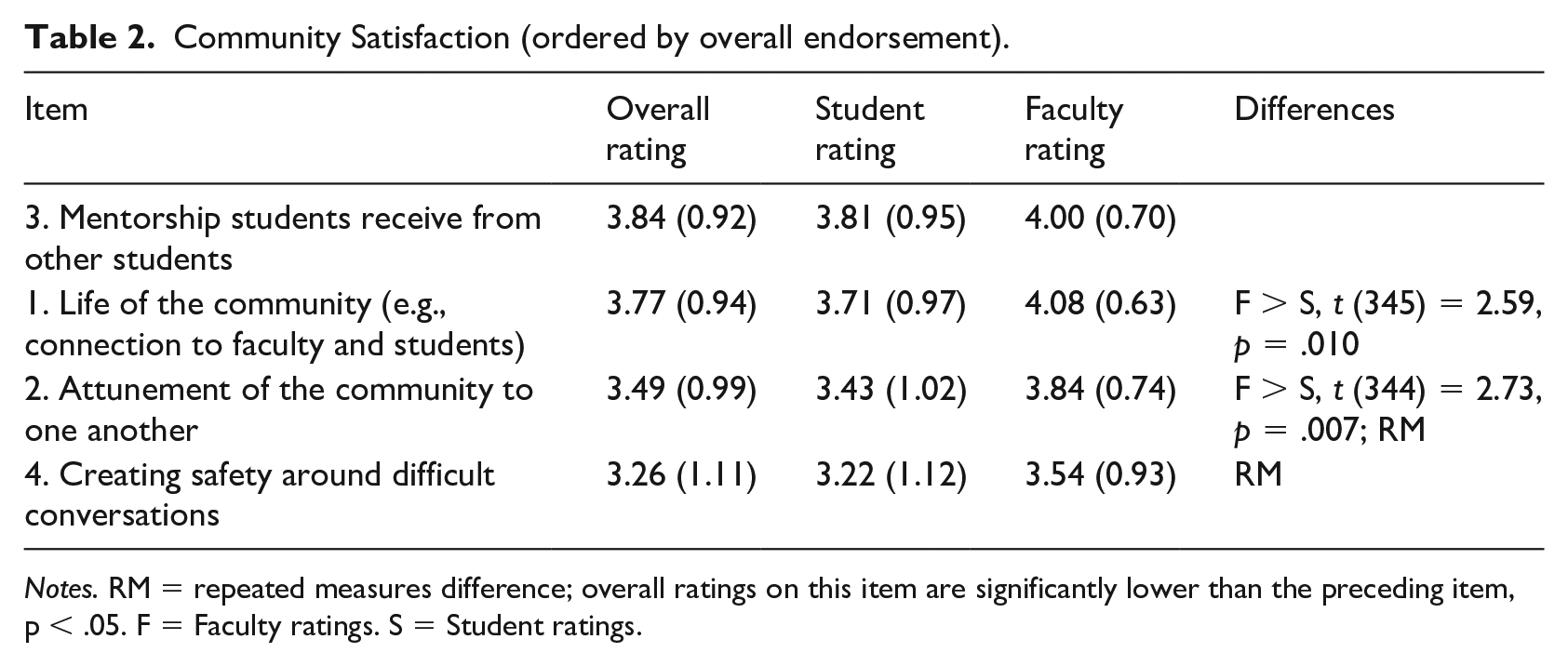
Notes. RM = repeated measures difference; overall ratings on this item are significantly lower than the preceding item, p < .05. F = Faculty ratings. S = Student ratings.
Curriculum Effectiveness was analyzed through similar methods (see Table 3). The repeated-measures test demonstrated differences among items, Wilks’s
Curriculum Effectiveness (ordered by overall endorsement).

Notes. RM = repeated measures difference; overall ratings on this item are significantly lower than the preceding item, p < .05. F = Faculty ratings. S = Student ratings.
Intersectionality (ordered by overall endorsement).
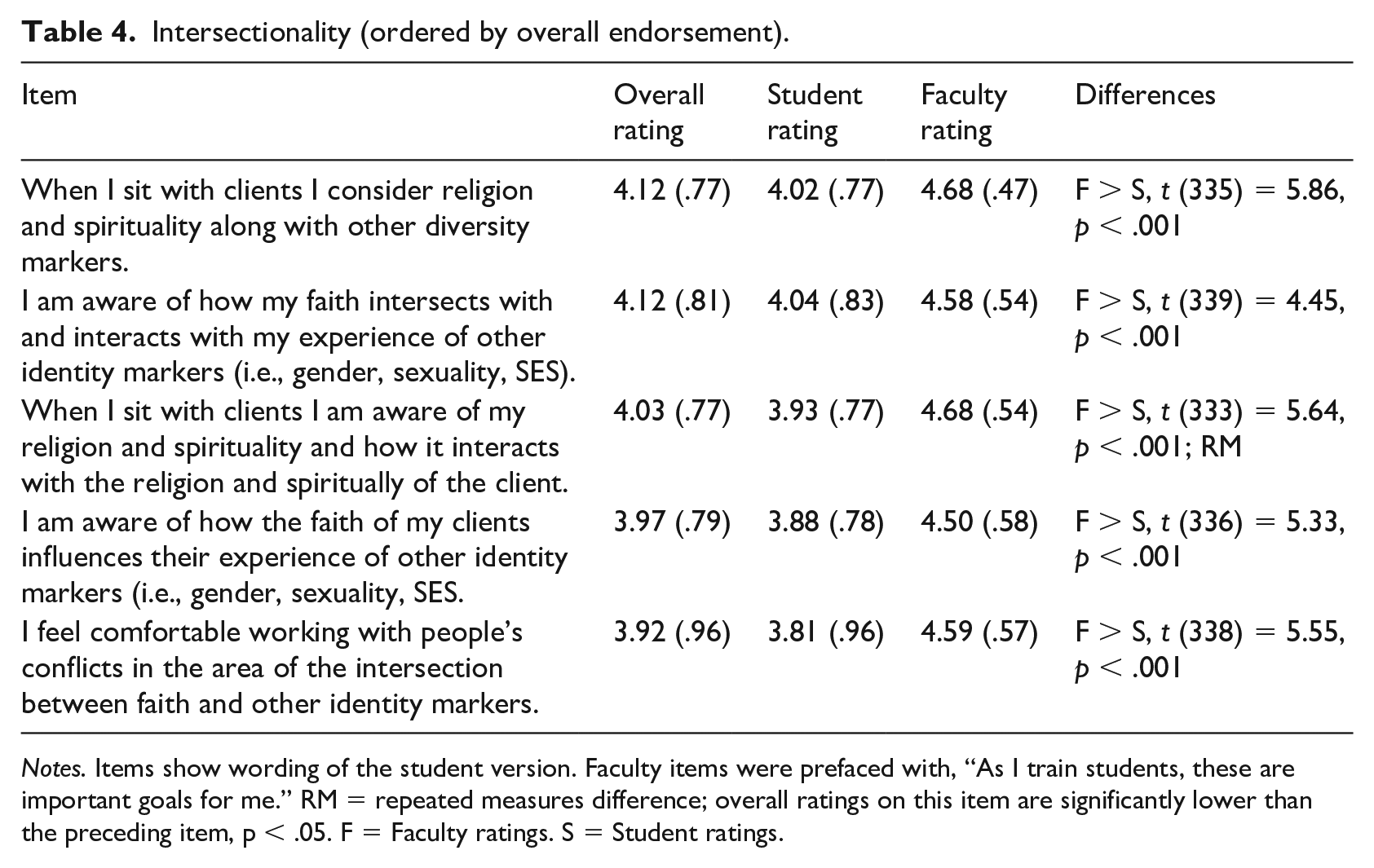
Notes. Items show wording of the student version. Faculty items were prefaced with, “As I train students, these are important goals for me.” RM = repeated measures difference; overall ratings on this item are significantly lower than the preceding item, p < .05. F = Faculty ratings. S = Student ratings.
Integration Topics (ordered by overall endorsement).
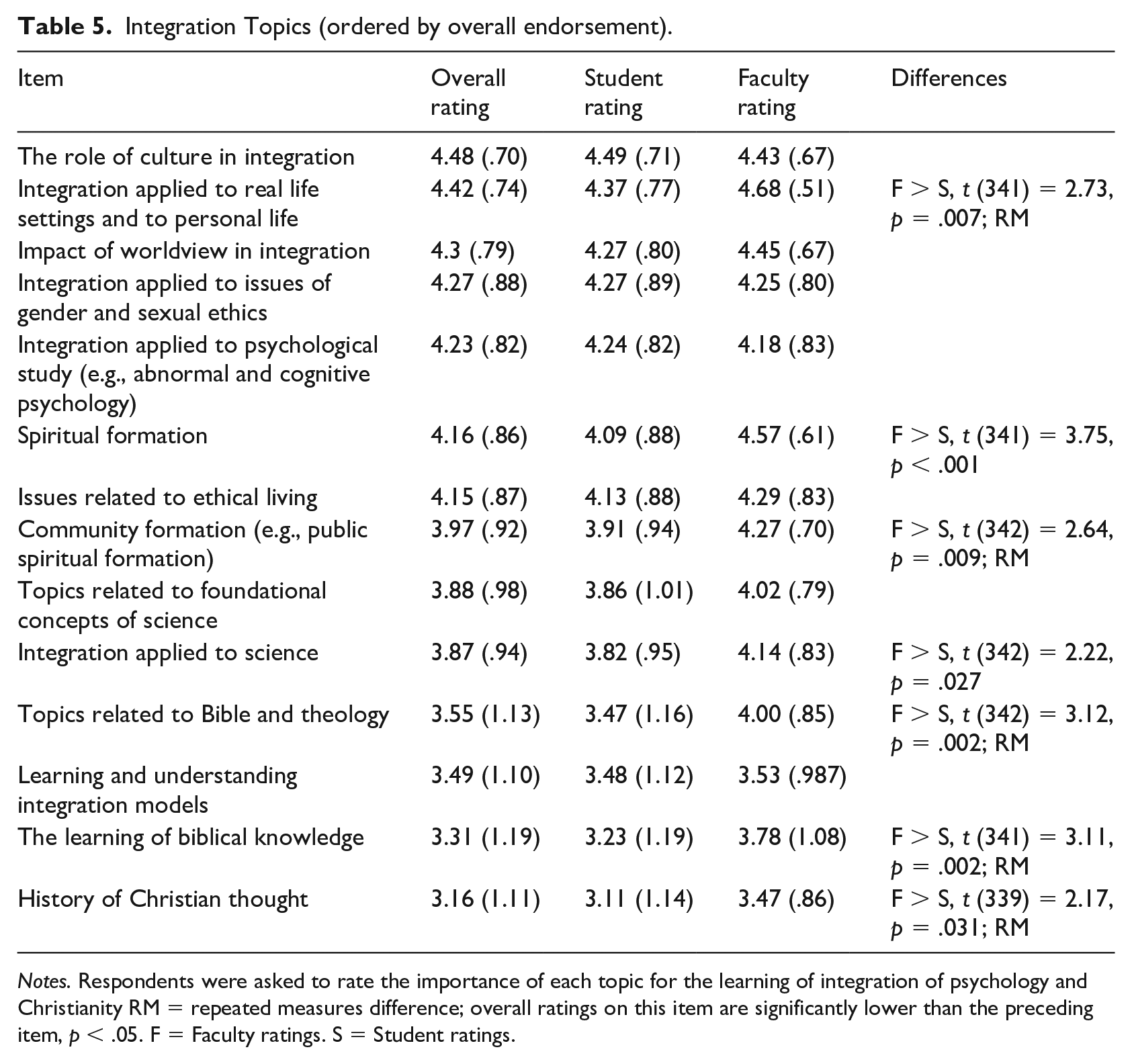
Notes. Respondents were asked to rate the importance of each topic for the learning of integration of psychology and Christianity RM = repeated measures difference; overall ratings on this item are significantly lower than the preceding item, p < .05. F = Faculty ratings. S = Student ratings.
Differences between students and faculty on religious and spiritual constructs were analyzed through the use of independent sample t-tests. Faculty reported more spiritual experiences (DSES M=66.69, SD=12.67) than did students (M = 61.22, SD =13.68), t (340) = 2.65, p = .008. Similarly, faculty rated religion as more important (faculty M=4.70, SD=.54; student M=4.04, SD=.99), t (331) = 4.64, p < .001. Faculty reported integration to be more important than students when considering which program to affiliate with (faculty M=4.33, SD=.79; student M=3.79, SD=1.25), t (331) = 2.98, p = .003. No differences on these variables were observed among students when compared by year of training. The differences between faculty and students should be viewed cautiously as some integrative programs hire only Christian faculty but admit students who may or may not identify as Christian.
Pearson product–moment correlations indicated that student DSES scores were positively related to how much they reported considering faith and intersectionality (computed as the mean of items reported in Table 4) in their clinical work, r = .281, p < .001, and the importance students place in integration as part of their training, r = .282, p < .001. Similarly, the self-report importance of religion correlated with the importance of integration for students, r = .498, p < .001.
Qualitative findings
Students were asked open-ended questions pertaining to formative moments within their program (question 1), growth areas for their program (question 2), and issues they wished would have been covered more within their training (question 3). As with the quantitative responses, data from all programs were combined. Consistent with grounded theory analysis, a subset of 20 responses for each of these three questions was reviewed by two raters who derived a set of themes that emerged in relation to the three questions. Once the themes were established, the raters went through 50 responses on each question and rated them independently. The two sets of independent ratings were then evaluated for inter-rater reliability. The kappa coefficients for the major themes ranged from .57 to 1.00. After confirming adequate inter-rater reliability, the two raters divided the rest of the responses (approximately 235 responses per question) and coded them independently. Table 6 shows the three questions, examples of how each theme emerged in the student responses, and a frequency count for how often each theme was mentioned.
Themes on Qualitative Items.

Notes. The formative moment question was worded, “has there been one particularly formative experience or relationship in your training? One formative class or aspect of your program? What was formative about it?” The growth areas question was worded, “What are some opportunities for growth in your program’s integration training?” The more attention question was worded, “What do you wish would have been given more attention in your integration training?
Formative moments
When asked about formative experiences they have had throughout their programs, relational topics were identified by about half the respondents. Students reflected on the importance of the cohort models (learning through being exposed to different worldviews, emotional support, sense of community), the importance of significant mentorship (relationship with professors and advisors where students felt seen, understood, and supported), and transparency of professors in discussing their integrative and faith journeys. Curriculum was also identified often in student responses. Key classroom experiences that were identified often included experiential or process-oriented activities that resulted in greater reflection and development of the person of the therapist. Students tended to highlight class experiences that encouraged deeper reflection and application of one’s spiritual experience with their personhood and clinical work.
Growth areas for programs
When asked about areas of growth for their programs, just under one-third of the respondents mentioned curricular issues. Many reflected on the abstract nature of integration theory and models and reported a desire to have more awareness of how to concretely apply and conceptualize integration within clinical settings. Nearly half of the respondents encouraged more contextualized education, with a desire for increased experiential and relational learning. We are using the term contextualized to depict a learner who is emerging from a particular sociocultural background and becoming a psychotherapist. This is a person in motion—constantly evolving through dialogical, experiential encounters both inside and outside the classroom. Students also reported a desire for increased openness around diversity, both in content as well as in attitude. This included increased exposure to religious diversity (within Christianity and across religions), multicultural training and awareness, and more attention to LGBTQ theology and concerns. In addition to desiring increased access to new ideas (content), students also reflected a desire for increased openness as demonstrated through faculty attitudes (psychological flexibility). Some students reported feeling pressured to have “right answers” in order to join integration conversations, preferring instead to have opportunities for ambiguous spaces where students could ask difficult questions and hold uncertainty. Notably, students across an ideological range desired more openness around the substrates of integration (e.g., psychology, theology, spirituality) as well as the outcomes of integration (e.g., the degree of agreement they must have with their peers and faculty). This is not just a matter of students leaning left of faculty with regard to theological and/or political beliefs. Students on both ends of the conservative–liberal spectrum had experiences of feeling excluded and desired more space for dialoging across difference. Finally, students reflected on a desire for increased transparency from professors about their faith journeys, their changing views of integration, and so on.
Wishes for greater coverage in programs
Similar themes to the ones just described emerged in response to question 3 about what students wished could have been covered more in their training programs. Themes related to contextual learning, exposure to increased cultural and faith diversity, and increased safety in dialogue emerged. When discussing what went “uncovered” even more respondents (approximately two-thirds) identified experiential, contextual, applied learning as underdeveloped.
Discussion
As Sandage and Brown (2018) argued, we are currently witnessing a resurgence of the “integrative impulse” (p. 4). Interdisciplinary dialog and systemic collaboration are on the rise, yet we are also living in a fragmented moment. At the same time that increased systemic and theoretical integration may be occurring, we are also observing increased polarization and ideological isolation and fragmentation (Pew Research Center, 2014). Underlying the overt and observable polarization is an important epistemological shift. Kuhn (1962/1979) explored how a cultural paradigm shift is a long process, emerging out of crises and tension. Our culture is living in a “world out of joint” (Kuhn, 1962/1979, p. 70) as the theoretical premises, methods, and applications of a modern paradigm give way to the emergence of a postmodern or contextual frame of reference.
Findings from this study align with this larger cultural and paradoxical story: integrative training communities are living amidst the excitement of today’s integrative impulse, and at the same time are struggling to adapt amidst polarization and the crises of a major epistemological paradigm shift. The integrative impulse in these programs can be observed through respondents’ emphasis on community, relationship, and meaningful application of knowledge. At the same time, many of the challenges identified by respondents are consistent with tensions one would expect to see in a culture living amidst a paradigm shift.
Integration in a postmodern frame
Overall, relational engagement is a relative strength of integrative programs. While some students expressed desire for increased connectivity and openness of professors (transparency and attitude to new ideas), overall attachment, mentorship, and rapport within the community as a whole surfaced as a relative strength of integration programs (see Table 1 and Qualitative Response 1). The highest-rated item in Table 1 pertains to having a strong working alliance with peers, which speaks well to the relational nature of these integration training environments. Similarly, the two highest-rated items in Table 2 are student-to-student mentoring and connections between faculty and students.
A postmodern frame also posits integration as something that is experientially learned and “embodied” in the integrator as opposed to specific techniques and interventions cognitively taught. Our research findings resonate with Sorenson’s (2004a) work on therapists’ use of God-image. Sorenson demonstrated how student therapists’ God concept influenced how they worked with their clients’ religious issues (e.g., those with distant and cold images of God had less comfort addressing religious issues). However, most notably, Sorenson’s findings in a program where personal psychotherapy is required revealed that students’ experiences of how their own therapists handled religious and spiritual issues in the students’ personal therapy were more important than students’ God concepts in determining how they worked with religious and spiritual issues with their clients. The relational experience with their personal therapist, and how they handled issues of spirituality had the largest influence in shaping these future integrators (Sorenson 2004a). Our correlational findings support the idea that integration has a formative, experiential, and transformational element. We presume something similar can happen in integration classrooms, but it likely requires dialogical, conversational approaches rather than lecture-based approaches that place cognitive content above curiosity and discovery.
The experiential nature of integration training also aligns with best practices in current theory on adult education. Malcolm Knowles coined the term “andragogy,” referring to the art and science of adult learning. Knowles highlights the importance of accommodating training to the self-directed nature of adults, with increased focus on process and less on content (Smith, 2002). Adults value understanding why they are learning something, learn experientially, and learn best when the topic aligns with their goals or holds immediate value (Peterson, 2019). Blair (1997) has done similar work looking at adult learning in the context of theological education. In addition to the above themes she suggests adult learners do best when their learning environment feels safe and supportive and when their minds are engaged in holistic learning—learning that speaks to the mind, heart, and soul (Blair, 1997).
Consistent with current best practices in andragogy, our qualitative findings suggest that students prefer integration on an embodied and experiential level more than cognitive models, and the correlational data demonstrates a modest relationship between the value students place on integration and how it shows up in their clinical work. Though speculative, this may suggest that a shift from teaching integration (i.e., integrative models, philosophical arguments, and so on) toward training integrators (i.e., developing people who have ears to hear spiritual themes and who embody integrative principles) could be beneficial while also aligning with best teaching practices. As integration programs continue to support reflective and spiritual practices, work/life/being balance, and community life, this may help support students’ spiritual well-being, which may in return positively influence the reflective intersectionality from which they approach their clinical work. Potentially, continuing to support healthy spiritual and emotional development may be integral toward “training integrators.”
Current findings are somewhat mixed with regard to andragogy in integrative programs. While students and faculty appreciate the overall relationality of their training sites (see Table 1), identify important topics that are contextualized, such as cultural nuance and applicability in clinical settings (see Table 5), and see embodied intersectional nuance of integration as essential (see Table 4), some of the lowest-rated items regarding their community satisfaction pertain to talking about difficult topics, personal transparency of professors, and emotional support from faculty (see Tables 1 and 2). Indeed, all of the student ratings around perceived effectiveness (Table 3) hover around the midpoint on 5-point Likert-type responses, suggesting that more effective instruction is both possible and desired. Interestingly, faculty ratings are somewhat higher but not strikingly higher, perhaps indicating that both faculty and students recognize that integration training could be stronger.
Significant differences were found between faculty and student perception of integration training in almost every section of the questionnaire. Across the board, faculty perceive their programs as doing better than students perceive them to be. Overall, students reported satisfaction with attachment and relational qualities of training while reporting concerns around curriculum, a desire for more contextual learning and more exposure to diversity. These areas of concern are consistent with cultural shifts that make teaching challenging in today’s shifting context. Three particular themes that emerged included desires for (1) increased applied learning, (2) more diversity of content and increased openness to new ideas, and (3) more contextual-experiential learning. Although these themes emerged from the research, it would be unwise to assume they are categorically different or unrelated because they have overlapping elements. Still, for the sake of parsimony we will explore these three as separate areas.
Applied learning
A key feature of contemporary adult learning is a desire for experiential learning that is goal-oriented and will translate to the job market (Blair, 1997). This impulse is likely exacerbated by the financial crises of 2008. Higher education institutions face increased public scrutiny as many question their ability to appropriately prepare students with skills needed for today’s workforce (Strohmetz et al., 2015). Academic courses often focus on content and knowledge acquisition, whereas today’s students and their future employers are looking for instruction and training that help bridge content to skills. As such, professors may experience difficulties engaging students when the content is not connected to skills students perceive as useful for the workforce. The American Psychological Association’s (APA) shift toward competency-based education illustrates this turn toward applied learning (Fouad et al., 2009). Similarly, a consistent theme that emerged within the qualitative data was a desire for increased applicability and contextualization of knowledge (Qualitative responses 2 and 3; Table 5).
Although our findings are consistent with larger conversations occurring in higher education around the current purpose and goal of education, two facets of our particular findings are worth noting. First, the desire for more applied learning is not relegated to student perception. Both faculty and students are interested in integration concepts that bring application and personal transformation (see Table 5). Second, it is also notable that responses move beyond simple concern for workforce preparedness. Both in quantitative and qualitative responses, students reported a desire for increased training that would cultivate reflection of self-of-therapist and spiritual formation, and faculty appear to concur. The programs we surveyed share an interest in moving beyond workforce preparedness and desire to engage transformative education.
Diversity and openness
Respondents expressed a desire for increased exposure to diverse content and increased openness to diverse perspectives. Concerns around openness to differing perspective was also reflected in the reported satisfaction around the ability to navigate difficult dialogues, ranked lowest on the Community Satisfaction items (see Table 2), and at about the midpoint of the 5-point rating scale. Students reported a desire for more dialogue, conversation, and the freedom to openly disagree (Qualitative question 2 and 3). Consistent with Sorenson’s (1997) research, students reported positive experiences when faculty demonstrated an ability to be open to new and diverse ideas. They appreciate when a professor is open to new ideas, and many express dismay when there are “right beliefs” one must hold to as a trainee (Qualitative response 2 and 3).
This theme is likely reflective of today’s changing relationship with knowledge. A contextual approach to knowledge takes seriously that knowledge is historically and socially embedded and emerges from a complex intersection of historical, social, and cultural landscapes. Such an approach to knowledge emphasizes the importance of the interplay between theory, ideas, and the various social-cultural contexts from which they emerge. Moreover, as the demographics of students shift, and as higher education becomes more accessible, students are increasingly coming with diverse economic, social, cultural, and religious backdrops. Many institutions struggle to adapt to an increasingly heterogeneous student population (Rowan & Grootenboer, 2017). In addition to increased socio-cultural-economic diversity, integration communities are increasingly religiously diverse. Themes around inclusion of more cultural, economic, and sexual diversity were prevalent. These broader multicultural themes intersected with a desire for increased theological diversity (e.g., non-evangelical traditions, inclusions of queer and liberation theologies, inclusion of more conservative theologies, and so on).
Contextual experiential learning
Students reported a desire for learning environments with more space for ambiguity, and for increased opportunity to learn from one another as co-learners through conversation and dialogue. Consistent with a postmodern, relational epistemology, trainees desire classroom spaces where they are invited to participate as co-learners and where education is treated as a process of becoming more than a transaction where knowledge is transfused. These themes were noted in qualitative data and also reflected in the integration constructs students are most interested in learning about (see Table 5) where the conceptual categories were ranked lower among students (church history, Bible and theology, integrative models) and contextual categories were ranked higher (cultural, gender, applied to psychological study). These findings are consistent both with current andragogy and with the broader cultural shift toward inclusion of more experiential, relational, dialogical epistemologies. Interestingly, faculty demonstrated similar preferences to students in this regard.
With both faculty and students desiring a change toward more contextual learning, two observations seem fitting. First, it seems likely that these changes are occurring and will continue in the near future. Second, because the qualitative themes indicated that students and faculty want more change in these areas (see Table 5), it is possible that the resistance to change is not in the faculty, per se, but in the academic systems and traditions that tie training and education to course content and all that comes with that, such as credits used to collect tuition and grades assigned to demonstrate success in learning. Academic systems that train psychologists are also embedded in other systems such as accrediting agencies, licensing boards, state regulations, and third-party payers that have particular ways of assessing accountability. Thus, even if faculty are inclined toward more contextual learning, these changes may be challenging to accomplish within the infrastructures where integrative training occurs.
While our findings are consistent with research on educational best practices (Blair, 1997; Sorenson, 1997; Sorenson et al., 2004), they are also likely reflective of the epistemological shifts of postmodernism. This poses difficulty for higher education systems because systemic changes take time, collaboration, and persistence. Education institutions were developed in the height of modernity and in response to modernist needs (e.g., to meet needs of the industrial revolution). Furthermore, these six institutions have all developed from within the Evangelical traditions. Evangelicalism arose alongside the modernization of society and was therefore conditioned by modern developments in significantly ways (Hindmarsh, 2018). Given this history, many Evangelical institutions (and individuals) experience tensions between evangelical commitments and postmodern commitments. Over the last several years evangelical theologians and religious thinkers have grappled with the tension between the implications of Christian claims and commitments in the context of a pluralistic, post-foundationalist world (Erickson, 1999; Yong, 2015). As such, it is likely that many evangelical institutions experience mission–culture tensions as society moves toward a more postmodern and pluralistic reference point. Adapting to a contextual frame of reference while maintaining commitment to one’s institutional overarching mission will be a process that will require patience, persistence, and wisdom.
Within modernity, our relationship to knowledge was largely conceived as an attempt to understand and get at “objective” reality, with an inevitable gap between the objective reality and the observer (Palmer, 1997). The educational system, built at the height of modernity, is understandably a reflection of these values. Drawing from a modern epistemology the teacher becomes the expert whose role it is to pass on expert knowledge to his or her students, helping them to get at this objective reality. This is what Brazilian educator and philosopher Paul Friere (1970/2015) refers to as a “banking” model of education where the expert exports the content into the “container” or “receptacle” that is the student (p. 71). The teacher is successful if she or he has filled the student. Friere then juxtaposes this with a problem-centered model, which engages the whole learner in critical reflection, drawing on the particulars of the learner’s socioeconomic context. Education becomes much more than a transaction of knowledge, as it engages the whole self of the learner within systems of complexity, emphasizing that knowledge is lived in the specific and concrete, contextualized experience of learners. In this, education is not merely an exchange, it is transformational. Freir’s work, which echoes in Palmer’s (1997) work, aligns with best practices emerging from andragogy and the cultural shift toward a more contextually, embedded relationship to knowledge.
Recommendations
Several recommendations can be offered from this research. First, explicitly Christian APA-accredited psychology programs can continue efforts to build relational communities marked with mentorship, communal gatherings, and intentional shared time together. Second, keeping spiritual formation in focus while building learning environments that contribute to the spiritual and holistic thriving of trainees is an important part of integration training. Third, it will be important to increase conversation and training among faculty that focus on the process of teaching and the person of the teacher in addition to curriculum content. Fourth, it may be wise to look for meta-models or transtheoretical frames of integration that are inclusive of different Christian theologies and theoretical orientations. In this way integration takes on new opportunity and challenge because it is no longer just a matter of integrating theology and psychology. Rather, as institutions include more dialogical and contextual approaches to learning, we will naturally move toward larger integration conversations that include the relationship between postmodern epistemologies and the theological commitments of the institutions. While the first impulse may be to feel threatened by this more complex integrative task, it also seems important to see adventure and possibility here. Fifth, it will be helpful to look for increased relational, dialogical, contextual, and experiential learning methods inside and outside the classroom. This may include use of clinical vignettes, case conceptualizations, and particular practices applying integration views to clinical work. Finally, it will be useful to address fears among students that inhibit learning (Shults, 2003). This may entail building intentional cultures and training around engaging in conversations and addressing uncertainty.
Given the increasingly religious, cultural, and ethnic diversity of students, programs will benefit from learning how to best host difficult dialogues and navigate differences. Additionally, continuing efforts to build strong relationships among faculty and students will help address the fears students experience when expressing differing views.
Limitations
There are a number of limitations to this study. We were unable to attain a consistent response rate among various institutions, so some of the institutions had only a few respondents and some had many. For the sake of integrity and harmony among the six programs involved, we chose not to analyze or report program-by-program findings. This raises the possibility of differential response bias where some who chose to respond may have chosen to participate due to having a specific experience with the integration training at their institution. A second limitation is that the study relied on the self-report responses regarding perceptions of relational and training effectiveness. This approach may not yield an accurate reflection of training efforts of these institutions. A third limitation is regarding the measurement of outcome of integration training. Given that integration competencies and benchmarks have not fully been developed across training programs, establishing measurable outcomes of effective integration posed difficulty. A fourth limitation involves the scope of participants. This study was geographically limited, as four of the six schools represented are geographically located on the West Coast. Additionally, there are other integrative accredited programs that were not included in this study. Demand characteristics may also be a limitation, as it may have been difficult for respondents to distinguish actual educational practices from desired practices.
Conclusion
As early as 2004, Sorenson anticipated the future challenges of the integration movement: As evidence of the dizzying and crisscross contradictions surrounding integration’s future, I have mentioned 10 topics that surface in the literature. Integration must become more academic (1), or more clinical (2), more theological (3) or more quantitatively empirical (4). Greater sophistication is needed in the philosophy of science (5) or neurobiology (6). What is required is greater attention to the church and missions (7), to the underserved (8), to spiritual warfare (9) or to contemplative spirituality (10). (Sorenson, 2004b, p. 185)
Integration is replete with competing demands and expectations, and while these are not all mutually exclusive neither are they all compatible. The different demands tend to move “centrifugally in many different directions, often with little bearing on one another” (Sorenson, 2004b, p. 185). The shift toward postmodernism that has escalated since the time of Sorenson’s prophetic words has almost certainly made the integration task even more difficult than it was at the beginning of the century.
The current study shows strengths and challenges for integration programs moving forward. Mentorship, community building, and relational attachment are relative strengths of integrative doctoral programs as demonstrated by both quantitative results and qualitative results. At the same time these programs experience growing pains, not necessarily unique to them, reflective of larger cultural shifts that pose challenges to higher education in general. Some of the salient themes that emerged as challenges include increased desire for inclusivity (in content and attitude), and a desire for applied, contextualized, dialogic, experiential, and relational education. As institutions move toward more postmodern educational methods, including contextual-experiential learning, and relational-dialogical pedagogy, this may help address some of the challenges highlighted in these findings.
Footnotes
Funding
The author(s) received no financial support for the research, authorship, and/or publication of this article.
