




Abstract
Female religious leaders often face more obstacles in their occupation than male religious leaders, yet research on the gender double standard has yet to be examined in the field of religious leadership. The current study explored the gender double standard in religious leadership by examining perceptions of male and female religious leaders and whether leaders will face similar consequences post-transgression. Christian participants were asked to read fictional vignettes: first a brief description of a male or female religious leader and then a fictitious news article describing the leader committing a transgression (financial or personal). Through questionnaires, participants evaluated the leader and indicated their intentions to attend the leader’s church before and after being exposed to the transgression. Participants then rated the sinfulness of the transgression and if the leader should be punished. Additionally, participants completed measures of intrinsic/extrinsic religious orientation, quest orientation, and post-critical beliefs. Regression analyses revealed no significant differences in evaluations of leaders based on gender alone. However, religious characteristics like intrinsic religiosity and a literal interpretation of religious content did predict greater intentions of church attendance for the male leader compared to the female leader pre-transgression. Additionally, regardless of the leader’s gender, the financial transgression was rated more negatively than the personal transgression. The findings of this study can be used to help bridge the gap between attendance of male and female-led churches by focusing on certain beliefs that lead to this gender bias.
Keywords
Background
Men and women have more similarities than differences (Hyde, 2014); however, they are often held to different standards, a phenomenon known as a double standard. A gender double standard can be seen in a variety of different areas: professional (Jonsen et al., 2010), domestic (Gaunt, 2012), and political (Cucchi et al., 2021). This double standard is especially pronounced in leadership positions (Keck, 2019). Given traditional gender role expectations of leadership being associated with masculinity (Gibson, 1995), female leaders are often at a disadvantage, with women being seen as not as capable or competent as their male counterparts (Jonsen et al., 2010). Previous researchers have acknowledged that gender differences impact the structure of organized religion (Francis, 1997). Whether it is biased interpretations of scripture positioning women as submissive in church or gender double standards of leadership roles in general, gender stereotypes related to religious leadership positions have not been sufficiently researched. This study explores the gender double standard in Christian religious leadership.
Despite women being more religious overall and more likely to be part of organized religion (Ploch & Hastings, 1994), past qualitative research has found that most Christian denominations continue to hold traditional gender role beliefs and deny women leadership positions (Rugwiji & Masoga, 2017). For women to embark on religious leadership positions, they must work harder than men to obtain and keep that position (Cafferata, 2020). When experiencing a church closure, it takes women a significantly longer time to find a new religious leadership position than it takes men (Cafferata, 2020). Finally, due to the higher moral standards held for Christian women than Christian men (Foddy & Smithson, 1999; Foschi, 2000), transgressions may be perceived more negatively when committed by a female leader than by a male leader. This study examines how evaluations of religious leaders are impacted by their gender and the type of transgression they committed.
Leadership and gender
Due to evolutionary origins and traditional division of labor, men and women tend to possess different roles in patriarchal societies (Hyde, 2014). This can be understood through the lens of social role theory, which suggests that societal expectations and norms shape individuals’ behavior and opportunities based on their gender roles (Eagly et al., 2000). Those who hold more traditional gender role beliefs view women’s competence and agency to be lower than men’s, which leads to women being viewed as less efficient leaders even when possessing the same qualifications (Lerchenmueller & Sorenson, 2017; Ridgeway, 2011). In addition, Guant (2012) reported that those holding traditional gender role beliefs viewed full-time working (“breadwinning”) women as possessing more negative moral emotions and a higher level of guilty conscience. The negative moral emotions for the breadwinning women, compared to the nonworking (caregiving) women, attest to the traditional caregiving stereotype often held of women (Guant, 2012).
These stereotypical patterns are prevalent in corporate worship as well. When examining religious leadership, there exists an evident gender gap in how accepted the leaders are by their new church (Price et al., 2009; Zikmund et al., 1998) with women finding it harder to attain religious leadership positions compared to men (Cafferata, 2020). For example, women in the Episcopal church report less assistance from Bishops in their leadership job search compared to men (Price et al., 2009). This inequality was also reported in terms of income, access to senior positions, and being able to achieve work–life balance (Price et al., 2009). Because of this, we predict that a female religious leader will be evaluated more negatively than a male religious leader (Hypothesis 1).
Leadership and transgressions
The gendered characteristics assigned to leaders may not only impact general evaluations but also influence how the leaders are evaluated after committing a transgression (Cucchi & Cavazza, 2020; Cucchi et al., 2021; Egan et al., 2022). Due to the “gender punishment gap,” women might be at a disadvantage (Egan et al., 2022). When men and women commit a transgression, women are 20% more likely to lose their jobs and 30% less likely to find new jobs compared to men (Egan et al., 2022). In the field of medicine, after losing a patient, female surgeons experience a greater drop in referrals than male surgeons (Sarsons, 2017). This gender punishment gap (Egan et al., 2022) may be exacerbated in corporate worship leadership due to women being held to higher moral standards than men (Foddy & Smithson, 1999; Foschi, 2000). Therefore, women may be viewed more negatively if they were to commit a transgression and violate moral expectations. Thus, we predict that following the transgression, female religious leaders will endure more negative consequences compared to their male counterparts (Hypothesis 2).
The different moral standards set for men and women may also depend on the type of transgression committed and how it aligns with traditional gender roles assigned to men and women. Since men are more often seen as the “financial breadwinners” of the family (Höfner et al., 2011), a financial transgression may be perceived less favorably for the male leader than the female. Women, on the other hand, are seen as more responsible for familial and marital satisfaction (Gaunt, 2012). In fact, women are expected to be the primary moral teachers for their children by being an example themselves (Nelsen & Nelsen, 1975). Men, on the other hand, are assigned roles that are less concerned with problems of morality (Nelsen & Nelsen, 1975). Therefore, a personal transgression may be seen less favorably for the female leader than the male. Because of this, we predict that the male religious leader will face more negative consequences than the female religious leader after a financial transgression, while the female religious leader will have more negative consequences after committing a personal transgression (Hypothesis 3).
Religious characteristics that may impact leadership evaluation
Rather than assuming all Christians are identical in their individual beliefs and values, it is important to note personal religious beliefs may influence one’s evaluations of men and women as religious leaders and their committed transgressions. Personal characteristics such as reasoning for practicing religion, interpretation of religious content, and questioning of religious beliefs may be factors that influence Christians’ endorsement of the gender double standard.
Reasoning for practicing religion
One’s reasoning for practicing Christianity might be a contributing factor to how one evaluates religious leaders and their actions. Specifically, there are two main types of reasoning: intrinsic and extrinsic orientation. Intrinsic religious orientation focuses on the importance of religion in one’s life solely for a spiritual connection with God (Allport & Ross, 1967). For example, believers who are intrinsically oriented would pray and practice religion primarily because it strengthens their faith and their relationship with God. Extrinsic orientation, on the other hand, focuses on religion as a means to a secular end (Allport & Ross, 1967). For example, believers who are extrinsically oriented would go to church to gain business contacts or to make their families satisfied.
When examining transgressions in a general sense, studies have shown that highly intrinsically motivated individuals have more negative attitudes and lower behavioral intentions of helping an outgroup member who commits a moral transgression compared to highly extrinsically motivated individuals (Herek, 1987; Mak & Tsang, 2008). Furthermore, some research indicates that if an ingroup member behaves in a manner that is reflected badly on the group, intrinsically oriented members of the group members are likely to ostracize the said ingroup member (Altholz & Salerno, 2016). When examining specific transgressions, most research has focused on sexual sins, such as sex before or outside of an established marriage. This research has suggested that those with an intrinsic orientation have a more punishing view of God when recalling a sexual sin (Bélanger et al., 2019). Therefore, those who hold a higher level of intrinsic religious orientation may evaluate the leader and their transgression more negatively than those who hold a higher level of extrinsic orientation, especially if the religious leader is an outgroup member (e.g., the opposite gender).
Questioning of religious beliefs
After the development of the constructs of intrinsic and extrinsic religious orientation (Allport & Ross, 1967), Batson (1976) later proposed a type of religious orientation called the quest orientation. This orientation focuses on resisting the urge to have final answers to existential questions and honestly facing the question’s complexity while still maintaining faith (Batson, 1976; Batson et al., 1993). In other words, those with a quest orientation deem these complex questions as important but understand that they will probably never know the true answers. Batson and Schoenrade (1991) later specified three dimensions of the quest orientation: complexity, doubt, and tentativeness. Complexity refers to one’s ability to face existential questions without simplifying the questions’ importance, doubt is described as thinking critically about one’s religion and viewing doubts as growth in one’s faith, and tentativeness is described as an openness to change in one’s religious beliefs. Research has found that while those with a quest orientation do not exhibit many discriminatory behaviors regarding gender, their attitudes are more tolerant than favorable (McFarland, 1989). However, given that research on these constructs has not been examined in over three decades, quest religious orientation is of value to explore.
Interpretation of religious content
In addition to one’s orientation toward religion, one’s belief and interpretation of religious content may also impact how one views leaders. Overall, religiosity can be viewed as an interaction between the religious symbolic system and how one adheres to that system (Hutsebaut, 1996). Wulff (1991) constructed four basic attitudes (or types) of religion: orthodoxy, external critique, relativism, and second naivete; however, these four types of religiosities can also be reduced to two basic dimensions: Exclusion versus Inclusion of transcendent reality and Literal versus Symbolic interpretation of religious expression (Duriez & Soenens, 2006). The first dimension, Exclusion versus Inclusion of transcendent reality, refers to the degree to which an individual believes that a transcendent reality exists. In other words, it is a belief in a reality beyond what we can directly observe. The second dimension, Literal versus Symbolic interpretation of religious expression, is described as interpreting religious content literally or symbolically.
No research has examined interpretations of religious content or belief in transcendence and how these facets of faith influence views on gender and/or religious leaders; however, studies have examined how women are portrayed in the Bible and their positions as leaders. While the Bible does include women who played significant roles, it does not mention women who were in pastoral leadership capacities after Exodus (Rugwiji & Masoga, 2017). In addition, certain scriptures within the New Testament have been popularly misinterpreted as prohibiting women from taking leadership positions within the church (Harrison, 2011). Because of this, one’s interpretations of the Bible might impact evaluations of religious leaders and their transgressions.
Participant’s gender
Finally, past research has found participant gender differences in evaluations of leaders. For instance, while male peers rated female managers’ job performance as much lower than that of male managers, female peers did not discriminate between genders in their job performance (Szymanska & Rubin, 2018). Similar patterns may be evident with respect to religious leaders.
In addition, when examining gender differences with respect to evaluations of transgressions, research focusing on gender differences in forgiveness of various transgressions found mixed results. Most studies have found no significant difference between men and women in their ability to forgive (Toussaint & Webb, 2005); some have found that women are more forgiving than men (Miller et al., 2008; Root & Exline, 2011), while others found men to be more forgiving (Kaleta & Mróz, 2021). This study seeks to examine whether participants’ gender will influence their overall evaluation of the transgressions and whether the leader’s gender may impact that evaluation.
Overview and hypotheses
With no previous experimental examination of this phenomenon, this study aims to shed light on the challenges faced by women wanting to obtain or attain leadership positions in Christian corporate worship, including how they may be perceived by a variety of Christians and what individual religious characteristics may particularly endorse this gender double standard. Specifically, we examined how the gender of the Christian religious leader as well as the type of committed transgression impacts people’s evaluations of the leaders. Evaluations of religious leaders were operationalized with four dependent variables: evaluations, behavioral intention to attend that leader’s church in the future, if and how the leader should be punished for their transgression, and the level of sinfulness of the transgression.
Hypothesis 1 (H1): Female religious leaders will elicit more negative evaluations and lower behavioral intentions to attend church in the future than male religious leaders.
Hypothesis 2 (H2): Following the transgression, female religious leaders will endure a more substantial drop in evaluations, will face more aggressive punishment, and will experience lower behavioral intentions of future church attendance compared to their male counterparts.
Hypothesis 3 (H3): The male religious leader will have a more substantial decline in evaluations and less future church attendance than the female religious leader after a financial transgression, while the female religious leader will have a more substantial decline in evaluations and less future church attendance after a personal transgression. In addition, the female leader will be more likely to be recommended additional punishment and her transgression will be viewed as more sinful compared to the male leader.
Research Question 1 (RQ1): How does participants’ Intrinsic and Extrinsic orientation influence the evaluation of the religious leader and their transgression?
Research Question 2 (RQ2): How does participants’ level of complexity, doubt, and tentativeness (quest orientation) influence the evaluation of the religious leader and their transgression?
Research Question 3 (RQ3): How does participants’ Inclusion versus Exclusion of transcendence and Literal versus Symbolic interpretation of religious expression (post-critical beliefs) influence the evaluation of the religious leader and their transgression?
Research Question 4: How does participants’ gender influence the evaluation of the religious leader and their transgression?
Materials and Methods
Participants
A priori power analysis indicated that in order to detect a small to medium effect size at 80% power, approximately 200 participants were required. Participants were recruited from Prolific, an online survey platform. Only Christian Protestant participants older than 18 years who reside in the United States were recruited. Specifically, only denominations which allow women to hold leadership positions in the church were recruited. The list of Christian denominations included in our demographic criteria is listed in Table 1. The study was approved by the Texas A&M University-Corpus Christi Institutional Review Board.
Frequency Statistics of the Sample’s Demographic Characteristics.
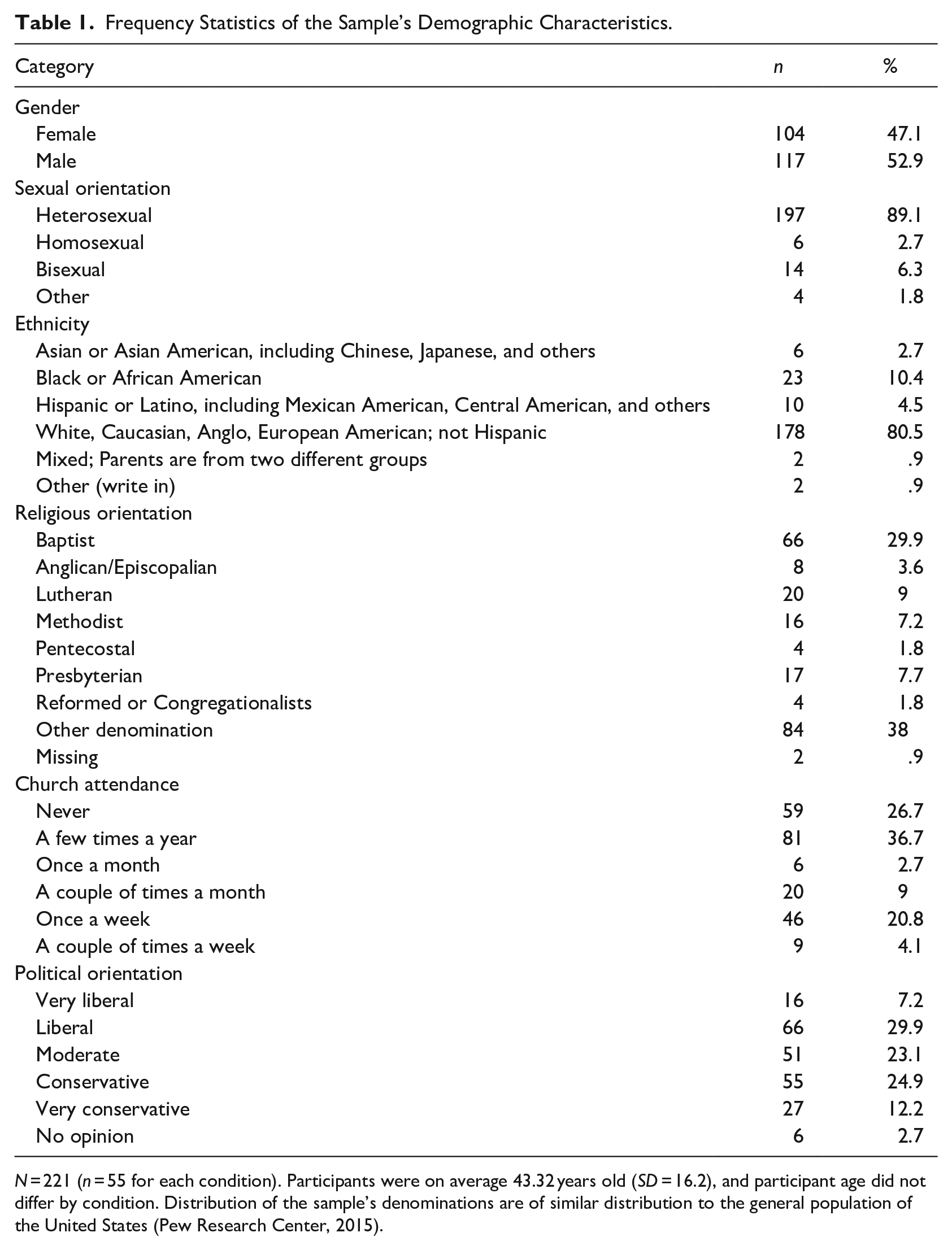
N = 221 (n = 55 for each condition). Participants were on average 43.32 years old (SD = 16.2), and participant age did not differ by condition. Distribution of the sample’s denominations are of similar distribution to the general population of the United States (Pew Research Center, 2015).
Of the 240 participants recruited, 19 participants were excluded due to failure to correctly answer one or more attention check questions (i.e., “If you are reading this, select 3”). The final sample consisted of 221 participants (52.95% women) with a median age of 43 years old (M = 43.32, SD = 16.2). The sample was predominately heterosexual (89.1%) and Caucasian (80.5%). There was an equal balance of participants who identified as very liberal (37.1%) and very conservative (37.1%). When asked to identify their religious affiliation, most participants selected “Other” (38%) from a list of eight Christian denominations. However, most participants reported attending church only a few times a year (36.7%). See Table 1 for full frequency statistics of the sample’s demographics.
Procedure and design
We employed a 2 (leader’s gender: female or male) by 2 (transgression type: personal or financial) between-subjects design. After giving informed consent, participants were randomly presented with a short biography describing a male or female religious leader (all vignettes created for the study can be found on the Open Science Framework [OSF] at the following address: https://osf.io/jd3qa/). Participants were then asked to imagine that the leader is their church’s leader and to indicate their perceptions of the leader and their intention to attend the church. Then participants read a fictitious news article about the religious leader and a transgression they have been involved with. Participants were randomly assigned to read either a financial transgression (the leader was accused of stealing a large sum of money from the church) or a personal transgression (the leader was accused of infidelity toward his or her spouse). Drawing from past studies utilizing vignettes with both leaders (Cucchi & Cavazza, 2020; Cucchi et al., 2021) and transgressions of religious leaders (Kane & Jacobs, 2013), the authors created simple vignettes of religious leaders committing a certain transgression. Participants were once again asked to indicate their perceptions of the leader, how sinful they believed the transgression was, and their intention to continue attending the church. Participants were also asked to indicate if they believe the punishment described post-transgression (to take a leave from the church) was sufficient, and if not, what additional punishment should be imposed. Participants then completed four questionnaires concerning intrinsic orientation, extrinsic orientation, quest religious orientation, and post-critical beliefs. Finally, participants completed a basic demographic questionnaire.
Measures
Perceptions of the religious leader
The perceptions scale, adapted from Marks and Fraley (2005), is a 20-item scale that assesses participants’ perceptions of a target individual on four different domains: values, popularity, success, and intelligence. Sample items include, “This person is careless” (reversed coded), “This person has a bright future,” and “This person is good at analyzing situations.” Participants responded on a 5-point scale (1 = Strongly disagree to 5 = Strongly agree) twice, once pre-transgression (α = .94) and once post-transgression (α = .94).
Behavioral intention of future church attendance
Participants indicated on a percentage scale (0% = Not at all to 100% = Very much) if they would consider continuing to attend the leader’s church. Participants completed this measure twice, once pre-transgression and once post-transgression.
Perception of transgression
After reading about the religious leader’s transgression, participants were asked to note how sinful the transgression was according to their interpretation of the Bible. Participants indicated their response on a percentage scale (0% = Not at all sinful to 100% = Very much sinful).
Punishment perception
After reading about the religious leader’s transgression, participants were asked whether the leader should endure additional punishment after they returned from a couple of months away. If the participant chose “yes” to additional punishment, they decided if the leader should take additional leave or be removed from their leadership position.
Intrinsic and extrinsic religious orientation
This 11-item scale was designed to assess people’s intrinsic and extrinsic religious orientation (Gorsuch & McPherson, 1989). Sample items include “It doesn’t much matter what I believe so long as I am good” (extrinsic) and “My whole approach to life is based on my religion” (intrinsic). Participants responded on a 5-point scale (1 = Definitely disagree to 5 = Definitely agree). An average score was calculated for each participant’s intrinsic (α = .87) and extrinsic orientation (α = .77).
Quest religious orientation
Quest religious orientation was measured using a 12-item scale created by Batson and colleagues (1993) and amended by Maltby and Day (1998). The amended scale was created to reach both religious and nonreligious samples. Three subscales consist of quest orientation: complexity, doubt, and tentativeness. Sample items for complexity include “My life experiences have led me to rethink my religious convictions” and “I was not very interested in religion until I began to ask questions about the meaning and purpose of my life.” Sample items for doubt include “It might be said that I value my religious doubts and uncertainties” and “For me, doubting is an important part of what it means to be religious.” Finally, sample items for tentativeness include “As I grow and change, I expect my religion also to grow and change” and “I am constantly questioning my religious beliefs.” Participants responded on a 4-point scale (1 = Strongly disagree to 4 = Strongly agree). An average score was calculated for each participant for complexity (α = .705), doubt (α = .624), and tentativeness (α = .778).
Post-critical religious beliefs
The post-critical religious beliefs, developed by Hutsebaut (1996) and shortened by Duriez and Soenens (2006), is an 18-item scale designed to assess how people experience religion in a Christian context. There are four subscales that comprise the main scale: Orthodoxy (“I think that Bible stories should be taken literally, as they are written”), External Critique (“I experience God as an impersonal power somewhere”), Relativism (“Each statement about God is a result of the time in which it was made”), and Second Naivete (“For me, God is neither necessary nor useful, but significant”). This study combined these four subscales into two dimensions as described by Fontaine and colleagues (2003): Inclusion versus Exclusion of a transcendent reality and Literal versus Symbolic representation of religious expression. Participants responded on a 5-point scale (1 = Strongly disagree to 5 = Strongly agree), with higher scores representing more inclusion of transcendent reality and symbolic representation of religious expression, respectively. Reliability analyses for the two dimensions were high to moderate, Inclusion versus Exclusion (α = .843), and Literal versus Symbolic (α = .647).
Data analysis
Data were analyzed using Statistical Package for the Social Sciences (SPSS). To examine the relationships between the study variables, a correlation analysis was used. See Table 2 for correlations between variables of interest.
Pearson Correlations Among Participants’ Religious Characteristics.
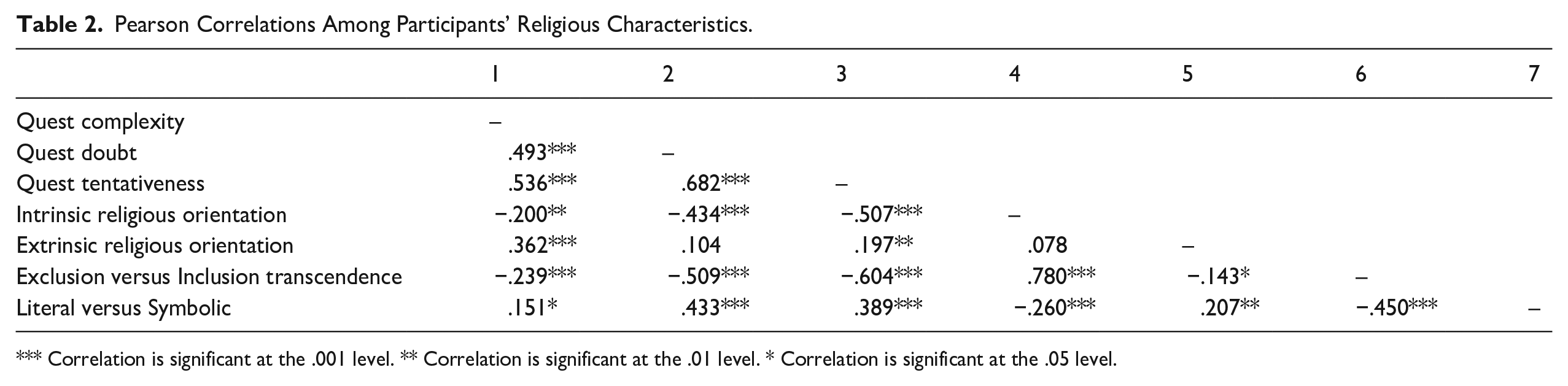
Correlation is significant at the .001 level. ** Correlation is significant at the .01 level. * Correlation is significant at the .05 level.
To examine the hypothesized effects and proposed research questions, a set of regressions were performed. The categorical variables were dummy coded such that “female participant” and “female leader” conditions were coded as 1, and “male participant” and “male leader” conditions were coded as 0. Centered versions (based on scale means) of participants’ variables (intrinsic and extrinsic orientation, complexity, doubt, tentativeness, Exclusion versus Inclusion of transcendence, and Literal versus Symbolic interpretation of the Bible) were created. There were no multicollinearity violations with any of the reported results below; all variance inflation factors were under 5.
To examine our first hypothesis and the research questions, the dummy coded variables of the leader’s gender and participant’s gender were entered in Step 1. All the participants’ variables were entered in Step 1 as well. The two-way interactions between the dummy coded variables and participant variables were entered in Step 2. The above regression was performed twice, once for perceptions of the religious leader pre-transgression and once for behavioral intention of future church attendance pre-transgression.
Results
Religious leader’s gender
We predicted less favorable evaluations of female leaders compared to male leaders (prior to the transgression; H1). There was no effect of the leader’s gender on pre-transgression perceptions, β = .09, p = .22, f2 = .01, or future church attendance, β = −.10, p = .16, f2 = .007. Therefore, our hypothesis was not supported. We did, however, find a two-way interaction between the leader’s gender and the participant’s intrinsic motivation for future church attendance, β = −.32, p = .04, f2 = .0002. Specifically, participants with high intrinsic motivation were more likely to attend the leader’s church in the future when the leader was a man compared to a woman (t = −2.55, p = .01; see Figure 1). In addition, we found a two-way interaction between leader’s gender and participant’s Literal versus Symbolic interpretation of the Bible for future church attendance, β = .29, p = .015, f2 = .07. Specifically, participants with a more literal view of the Bible were more likely to attend the leader’s church in the future when the leader was a man compared to a woman (t = 2.457, p = .015; see Figure 2).
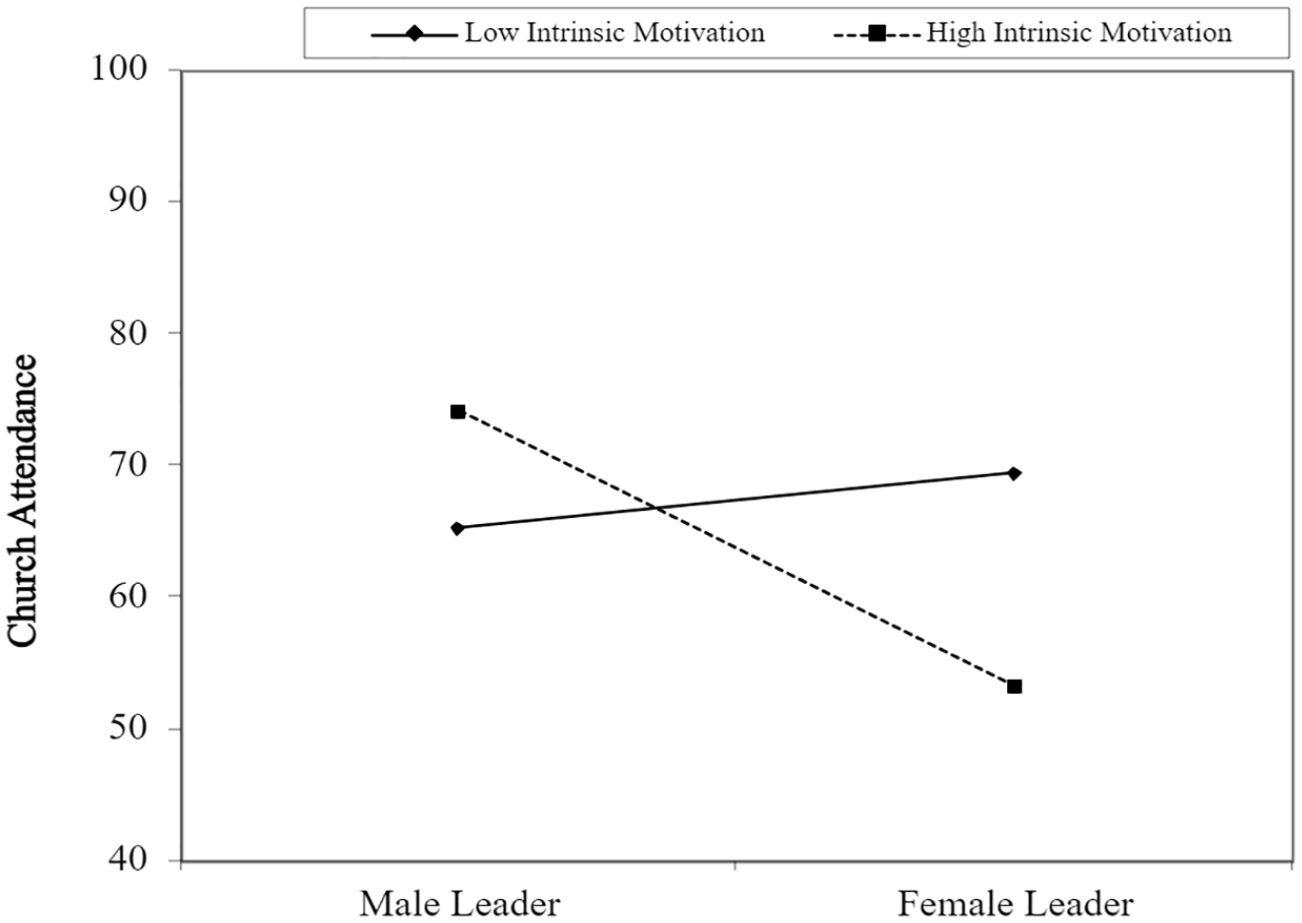
Interaction between intrinsic orientation and leader gender on intentions of future church attendance (pre-transgression).
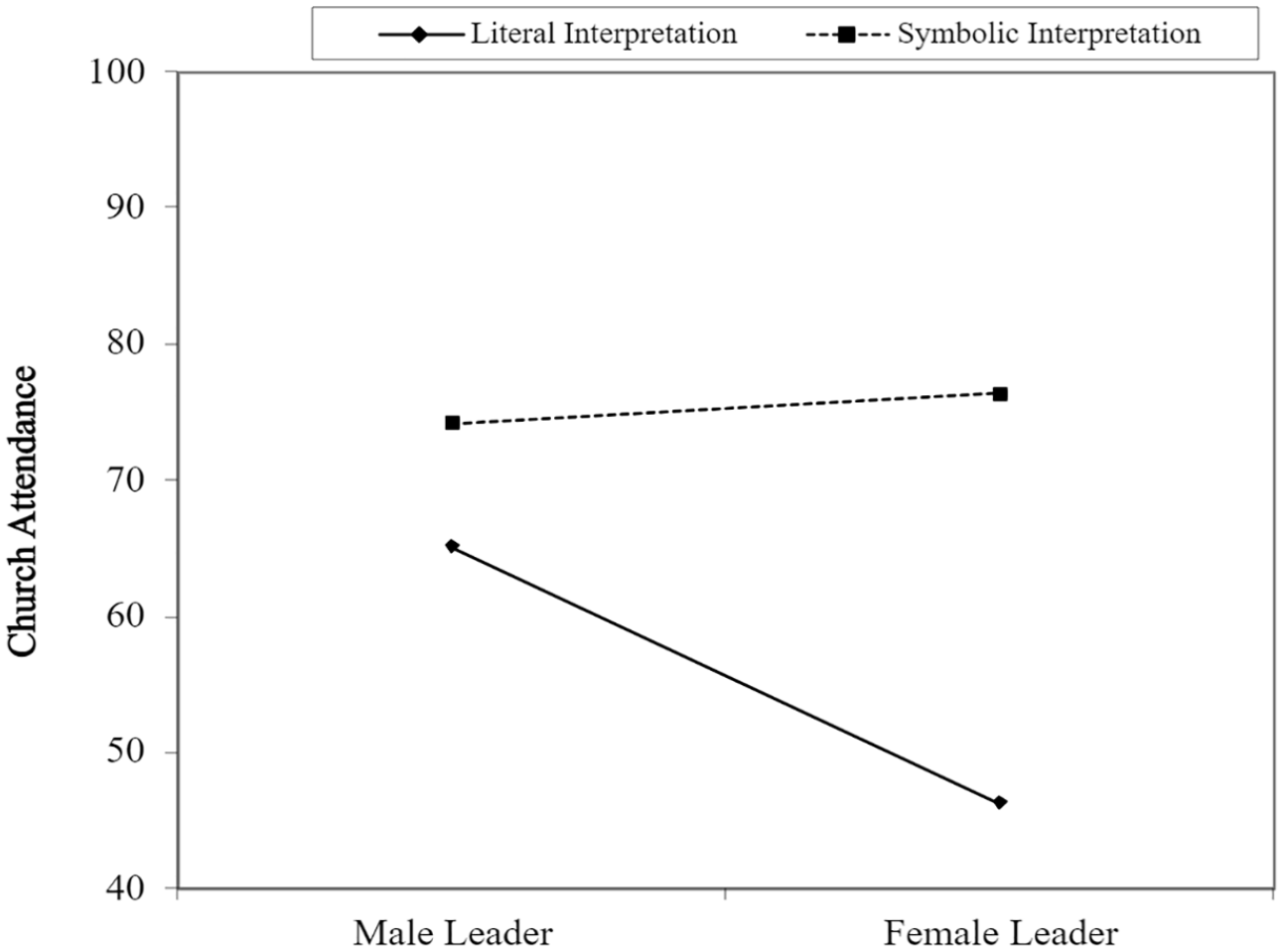
Interaction between Literal versus Symbolic interpretation of religious content and leader gender on intentions of future church attendance (pre-transgression).
Transgression and transgression type
To examine our second and third hypotheses and the research questions, the dummy coded variables of the leader’s gender, transgression type, and participant’s gender were entered in Step 1. The categorical variable of transgression type was coded such that the “personal transgression” condition was coded as 1, and the “financial transgression” condition was coded as 0. All the participants’ variables were entered in Step 1 as well. The two-way interactions between the dummy coded variables and participant variables were entered in Step 2. The above regression was performed three times, once for change in perceptions of the religious leader from pre-transgression to post-transgression, once for change in behavioral intention of future church attendance from pre-transgression to post-transgression, and once for perceptions of sinfulness of the committed transgression.
We predicted that after a transgression was committed, female leaders would experience a more substantial decline in evaluations and future church attendance compared to male leaders, regardless of transgression type (H2). There was no effect of the leader’s gender on change in perceptions, β = −.07, p = .34, f2 = .007, change in future church attendance, β = −.02, p = .82, f2 = .0001, or perceptions of the sinfulness of the committed transgression, β = .06, p = .41, f2 < .0001. Moreover, none of the participants’ characteristics were found to influence this pattern of results.
Finally, regarding the type of transgression (personal or financial) committed, we predicted an interaction between the leader’s gender and transgression type. Specifically, we predicted a more substantial decline in evaluations for a female leader who committed a personal transgression compared to the male leader and a more substantial decline in evaluations for a male leader who committed a financial transgression compared to the female leader (H3). There was no interaction between the leader’s gender and transgression type for either change in perceptions, β = .17, p = .22, f2 = .02, change in future church attendance, β = −.15, p = .24, f2 = .03, or perceptions of the sinfulness of the committed transgression, β = −.10, p = .43, f2 = .02. Neither hypotheses 2 nor 3 was supported.
Though not hypothesized, we did find a strong and consistent effect of transgression type for change in perceptions, β = .26, p < .001, f2 = .08, change in church attendance intentions, β = .30, p < .001, f2 = .11, and general perceptions of the committed transgression, β = −.242, p < .001, f2 = .04. Specifically, financial transgression led to a more substantial decline in participants’ perceptions of the leader, intentions of future church attendance, and resulted in higher ratings of sinfulness compared to the personal transgression.
In order to examine participants’ perceptions of the punishment provided to the leader post-transgression, two logistic regressions were performed. Once again, the manipulated variables and participants’ variables were entered in Step 1. The two-way interactions between the dummy coded variables and participant variables were entered in Step 2. First, the logistic regression was performed on whether additional punishment was needed with “No” being coded as 0 and “Yes” being coded as 1. The second logistic regression was performed only on participants who selected additional punishment and were then asked to select between “additional leave,” which was coded as 0, and “being fired from their leadership position,” which was coded as 1.
When examining whether the leader should endure additional consequences, we found that the overall model was statistically significant, Chi-square value (10) = 47.27, p < .001, with Nagelkerke R-squared value of .30. Only transgression type was found to be statistically significant in predicting the odds of a participant believing that the leader should endure additional consequences, β = −2.262, S.E. = .403, Wald = 31.444, Exp(B) = .104, p < .001. Specifically, the odds of a participant recommending additional consequences were 89.6% lower when the leader committed a personal transgression than a financial transgression.
When considering only participants who believed that additional consequences were needed (71.0%), to examine if they recommended termination, we found that the overall model was not significant, Chi-square value (10) = 15.46, p = .12, with Nagelkerke R-squared value of .20. Nevertheless, transgression type was once again found to be a significant predictor of additional punishment type, β = −1.543, S.E. = .646, Wald = 5.706, Exp(B) = .214, p = .017. The odds of participants recommending termination were 78.6% lower when the leader committed a personal transgression than a financial transgression (see Figure 3).
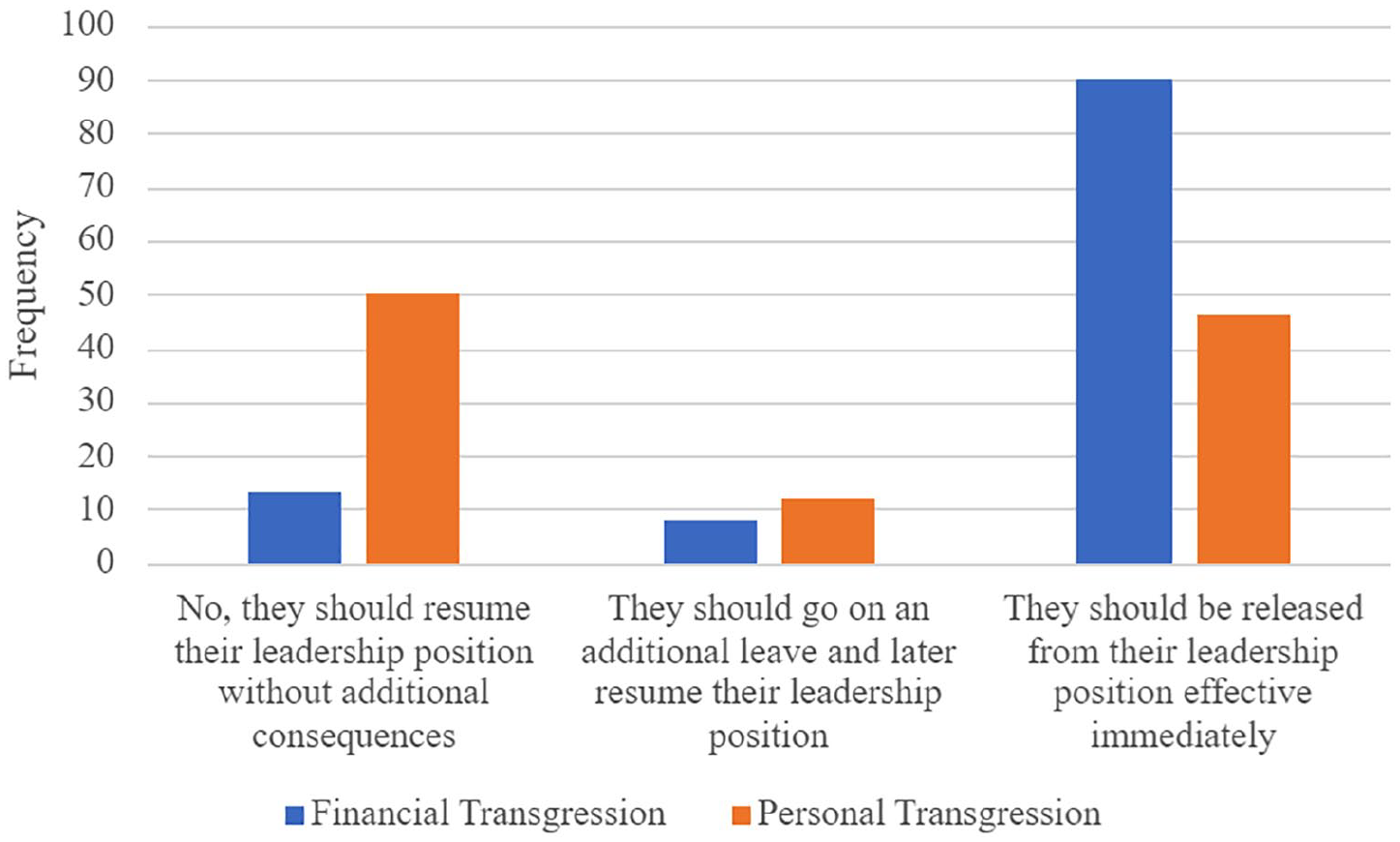
Punishment recommendation as a function of transgression type.
Individual religious characteristics
In addition to the above results, we also found main effects for extrinsic orientation, β = .19, p = .015, f2 = .04, Exclusion versus Inclusion, β = .26, p = .04, f2 = .05, and Literal versus Symbolic, β = .246, p = .003, f2 = .02 for pre-transgression perceptions. Similar effects for extrinsic orientation, β = .17, p = .024, f2 = .02, Exclusion versus Inclusion of transcendence, β = .295, p = .018, f2 = .02, and Literal versus Symbolic interpretation, β = .338, p < .001, f2 = .04 were observed for future church attendance. Specifically, those who were more extrinsically motivated had a higher degree of inclusion of transcendence, and more symbolic interpretation of religious content was more likely to have more favorable perceptions of the religious leader and more likely to attend church in the future (regardless of the leader’s gender).
Furthermore, we found the main effects for intrinsic motivation, β = .264, p = .023, f2 < .001, and Exclusion versus Inclusion of transcendence, β = −.329, p = .01, f2 = .02 for change in future church attendance. Specifically, participants who were more intrinsically motivated saw an increase in their intended church attendance post-transgression, while those who had a higher degree of inclusion of transcendence reported a decrease in their intended church attendance post-transgression.
Finally, we saw a main effect for Literal versus Symbolic interpretation of religious content, β = −.18, p = .03, f2 = .05 for perceptions of the sinfulness of transgression. In other words, participants who have a more literal interpretation of religious content viewed the transgression as more sinful (regardless of transgression type).
Discussion
This study examined how religious leaders may be treated differently on the basis of their gender. Primarily we were interested in whether female leaders are evaluated differently than male leaders. In addition, we sought to explore whether these perceptions differed based on the type of transgression the leader committed: personal (i.e., infidelity) or financial (i.e., theft). We also examined participants’ religious characteristics as possible explanations of these perceptions: post-critical beliefs, intrinsic and extrinsic orientation, and quest orientation. We did this by measuring perceptions of the leader before and after committing a certain transgression, behavioral intention of future church attendance, additional punishment of the leader, and how sinful the transgression is according to the participant’s interpretation of the Bible. There has been no prior quantitative research examining the issue of the gender double standard in Christian corporate worship, as well as how certain religious characteristics play a role in the endorsement of the gender double standard.
Religious leaders before a transgression
We hypothesized that after reading a biographical description of a male or female religious leader, the female leader would be rated less favorably and have lower intentions of future church attendance than the male leader (H1). Ultimately, we did not find a significant difference in perceptions based on the leader’s gender alone. This contradicts past research in areas outside of religion finding female leaders to be evaluated less favorably than male leaders (Aziz et al., 2017; Lerchenmueller & Sorenson, 2017; Ridgeway, 2011). Perhaps, because of the religious context of this study, the nature of this leadership position requires a different set of desired characteristics less distinguishable between men and women. We did, however, find that those who are more extrinsically motivated, have a higher degree of inclusion of transcendence, and have a symbolic interpretation of religion were more likely to have favorable perceptions of the religious leader and greater church attendance, regardless of the leader’s gender. Perhaps those with a more symbolic interpretation of religion and view of God as transcendent are not as specific or strict with where they attend church compared to those who do not. In addition, those who are more extrinsically motivated are described as having a strong desire to be an ingroup member (Maltby & Day, 1998), and therefore may be more willing to join a church they are not completely familiar with compared to those with low extrinsic motivation.
Religious leaders after a transgression
Second, we predicted that after a transgression was committed, female leaders would experience a more substantial decline in evaluations, greater likelihood of additional punishment, and less future church attendance compared to male leaders, regardless of transgression type (H2). We did not find a significant main effect regarding the leader’s gender on our dependent variables. This contradicts findings from several past studies examining the gender punishment gap, showing that women are viewed less favorably and punished more severely in their occupations after making a mistake (Egan et al., 2022). One possible explanation of this finding is the influence of ingroup versus outgroup favoritism on perceptions of the religious leader. Ingroup versus outgroup favoritism is described as the tendency to view one’s own group (ingroup) more positively and attribute more favorable qualities and characteristics to its members, while simultaneously perceiving members of other groups (outgroup) more negatively and attributing less favorable qualities to them (Brewer, 1999). This study utilized a sample of Christians that ascribed to denominations that allow for female religious leaders in order to capture a realistic relationship between a hypothetical leader and a congregation member. However, ingroup bias may limit the scope of how religious leaders are viewed and treated after committing a transgression. Future research can expand on this gender double standard by having a mixed sample of nonreligious and religious persons rate the leaders or by having a Christian sample rate a male/female nonreligious person after committing a transgression.
Although not hypothesized, we did find that those who had higher levels of intrinsic orientation were more likely to attend the church after the transgression was committed than those low in intrinsic orientation. This aligns with what research has described about intrinsic orientation; although the church’s leader committed a transgression that may reflect badly on their church and congregates, those who go to church solely for the purpose of faith will continue attending compared to those who are less intrinsically motivated. Second, while those with higher levels of inclusion of transcendence were more likely to attend the church pre-transgression, they experienced a significant decrease in intended church attendance after the transgression was committed. Past research has not touched on post-critical beliefs, specifically the inclusion of transcendence, and forgiveness of transgressions. Future research should examine how one’s view of a transcendent God influences perceptions of those who commit certain transgressions.
The type of transgression committed
Finally, we predicted that after reading about the transgression, the female leader would be rated less favorably after committing the personal transgression (infidelity), and the male leader would be rated less favorably after committing the financial transgression (theft; H3). This is the first quantitative study that examined religious leaders and how they are viewed after committing different types of transgressions (financial versus personal), with past research primarily using data from interviews with religious leaders themselves. We did not find a significant interaction regarding the leader’s gender and the type of transgression committed. In fact, the financial transgression was consistently rated much more negatively than the personal transgression regardless of the leader’s gender. The financial transgression had a substantially more negative impact on all dependent variables. Specifically, regardless of the leader’s gender, the financial transgression led to more negative evaluations, less future church attendance, a greater likelihood of additional punishment, and an overall higher level of sinfulness than the personal transgression. In addition, those who hold a more literal interpretation of religion viewed the transgression as significantly more sinful. There are a few possible reasons for this overall finding.
First, theft is an action taken against both religious beliefs and federal law; this may lead theft to be viewed as more of a “black and white” transgression compared to infidelity. Second, a leader stealing money from his or her own church directly impacts the congregates (in this case, our participants) given that they are likely the ones who donated the money. On the other hand, the infidelity of the leader, while still a sin in the Bible, does not directly impact the congregation, possibly leading to a less substantial decline in evaluations. Finally, although most Americans agree that infidelity is unacceptable, many still take part in this transgression (approximately 32% of men and 21% of women; Spitzberg & Cupach, 2009). Past research has found that those who commit a certain transgression are more understanding of others who have committed the same transgression (Jordan et al., 2015), and so it is conceivable that participants may have felt more empathetic toward the leader who committed infidelity rather than theft.
The religious factors leading to gender bias in religious leadership
While we did not find clear main effects of the gender double standard alone, we did find that certain religious characteristics did, in fact, predict a preference to attend the church of the male leader. These characteristics included intrinsic motivation for practicing religion and literal interpretation of religious content.
When examining future intended church attendance based on the leader’s gender (pre-transgression), those who had high intrinsic motivation were more likely to attend the church of a male leader rather than a female leader. Past literature has not examined religious orientation and views of leadership and gender, but there has been some investigation of religious orientation and gender attitudes such as sexism. Benevolent sexism views women as pure beings that are meant to be protected and submissive toward men, while hostile sexism views women as a threat to traditional gender roles and male domination (Glick & Fiske, 2001); overall, studies have found that intrinsic orientation is related to high levels of both benevolent and hostile sexism (Burn & Busso, 2005; Özdemir, 2016). Because a woman occupying a leadership role in a typically male-dominated profession (Rugwiji & Masoga, 2017) may violate the norms and beliefs of benevolent and hostile sexism, those with higher levels of intrinsic religious orientation may view women less favorably than men for a religious position.
The study also found that those who had a more literal interpretation of religious expression were more likely to attend the church of a male leader than a female. Past research has not examined literal interpretations of religion (or post-critical beliefs in general) and how those relate to views of gender or leadership. There has been theological research examining biblical scripture that commands women to not be allowed to lead the churches; this scripture has been a controversial message in the Christian community, with theologians commenting on its misinterpretation from the time it was written (Harrison, 2011). Those who have a more literal interpretation of the Bible may be more likely to believe that the scripture truly prohibits women from leading churches, regardless of the time or context it was written. In addition, women are rarely mentioned as leaders throughout scripture in comparison to men (Rugwiji & Masoga, 2017). Because of these theological findings, those with a more literal view of the Bible may be less inclined to attend the church of a female religious leader than a male.
Limitations and future directions
The results of this study should be considered in light of certain limitations. First, the realism of this study’s scenario was limited due to participants needing to give their evaluations of the leader immediately after reading a short vignette. Scenarios like this in real life may include the influence of time spent with the religious leader, how they felt about the leader’s specific teachings, and so on. The participants’ evaluations may have also shifted over a prolonged period after reading about the transgression committed. Future research can examine an increasingly realistic setting of this phenomenon by interviewing congregates directly after a situation similar to this ensues. In addition, future studies could utilize exposure to videotaped sermons in order to further humanize the scenario while controlling for confounding variables.
Second, there was a lack of reported church attendance by our sample, with most of our sample consisting of participants who never or only sometimes attended church. Although participants were asked to imagine this leader as the leader of their current (imagined) church, it may be more beneficial to interpret the reported evaluations and intentions of future church attendance of leaders as coming from a general, external Christian view instead of a more invested, internal Christian congregate view. This is because those who attend church regularly may show differences in gender role beliefs, interpretation of religious content, and more than those who only attend church occasionally or not at all. Future research should systematically examine responses to transgressions of a sample with a higher church attendance rate or directly survey church congregates.
Third, we found that there may have been a possible ceiling effect when participants rated how sinful they believed the financial or personal transgression to be. We found that while the means of the financial scandal (M = 90.84, SD = 12.85) were not rated significantly more sinful than the personal scandal (M = 84.19, SD = 22.37), the sinfulness of the personal transgression had a much wider range (IQR = 0–100) than the financial transgression, which began at the midway point (IQR = 50–100). This introduces the possibility of a ceiling effect, where participants’ responses reached the upper limit of 100%, potentially causing a loss of sensitivity and precision in the measurement. This may be due to the difference in magnitude between the personal and financial transgression, with the financial transgression stating that the leader allegedly stole a “large sum of money.” Therefore, in order to have a more equal comparison between the transgressions, future research could rephrase the financial transgression in which the leader steals a smaller sum of money.
Practical implications
A practical implication of our findings for corporate worship relates to the differences between the cognitive component (perceptions) and the behavioral component (intention of future church attendance) of congregates toward religious leaders both before and after committing a transgression. Specifically, while those with certain religious characteristics evaluated the female leader just as favorably as the male leader, they did not have the same intentions to attend the church of the female leader compared to the one of the male leader. In other words, while people may say that the female leader is just as likable and qualified as the male leader, they appear to feel more comfortable and willing to attend the church of the male leader instead. This may have to do with the normalcy of a male religious leader, considering the finding that both the male and female were rated similarly on perceptions. Churches should reflect on how hiring more women for pastoral and other leadership positions could increase the exposure of female leadership to their congregation, helping to close this gender gap.
In addition, those who are religious leaders or teachers themselves should consider the religious characteristics related to the endorsement of this gender double standard: intrinsic orientation and literal interpretation of religious expression. By examining what leads these people with these characteristics to prefer a male leader over an equally qualified female leader, religious teachers could help correct any misinterpreted scripture and/or misconceptions regarding beliefs of men’s superiority over women for religious leadership positions.
Conclusion
This study sought to examine the gender double standard toward religious leaders and their transgressions in Christian corporate worship. We found that, regardless of leader’s gender, the financial transgression (theft) was viewed much more negatively than the personal transgression (infidelity). While we did not find a gender double standard between the male and female religious leaders overall, those who hold certain religious characteristics were more likely to attend the church of a male leader rather than a female leader. Future research should further examine the characteristics associated with this gender double standard as well as how the actual behavior of church attendance of male and female religious leaders differs from perceptions of capability.
Footnotes
Acknowledgements
The authors would like to thank Dr. Collin Scarince for his assistance with the methodology and data analysis, as well as Dr. Amy Houlihan for consultation on the creation of study materials and feedback on earlier drafts.
Declaration of Conflicting Interests
The author(s) declared no potential conflicts of interest with respect to the research, authorship, and/or publication of this article.
Funding
The author(s) disclosed receipt of the following financial support for the research, authorship, and/or publication of this article: This work was supported by the Psi Chi International Honor Society [grant number 3790384].
Ethics approval and consent to participate
This study was approved by the Institutional Review Board at Texas A&M University-Corpus Christi (IRB Number: TAMUCC-IRB-2022-0639) in January 2023. All participants indicated consent to participate before beginning the study.
