



Abstract
The discussion on missions in the Old Testament has led to an unsatisfying diversity of results. In order to let the Old Testament speak for itself as an independent voice of the Christian Bible, foreign concepts like “missions” have to be replaced by theological concepts inherent to the Hebrew Bible itself. The Torah and Former Prophets develop four theological lines within the theme-field of a positive (blessing) mandate to the nation of Israel concerning others: (1) the mandate as mediator of blessing to all the families of the earth; (2) the mandate as mediator of knowledge of God to non-Israelites; (3) the mandate as royal priesthood mediating between Yhwh and the Gentiles; (4) the mandate as host people for strangers. These mandates cannot be subsumed under one single organizing concept like (passive or centripetal) “missions,” “witness,” or “messenger.” Instead they have to be understood as situational specifications of the original blessing mandate to Abraham. The theological intention of these Old Testament texts is to actualize a vision of worldwide knowledge of God in the hearts of their readers.
On the quest for “missions” in the Hebrew Bible: a missing mandate?
Particularly since the 1990s many books and articles have been published which deal with the question of whether and in how far there is “missions” in the Hebrew Bible. The answers to this question could not be more diverse. Michael Grisanti already uses the title of his article to emphasize the controversial situation: “The Missing Mandate” (2000). In his comprehensive survey of many (German) Protestant approaches Erich Scheurer (1999) comes to the conclusion that the idea of missions in the Hebrew Bible is agreed to as well as denied. Some scholars “find” the theme of missions at many places in the Hebrew Bible, others conclude that it does not appear at all.
The reason for the disparity in the results, can be found in differing definitions of what scholars understand “missions” to be. 1 Many of them do not even seem to be conscious of this problem (Scheurer, 1999: 312).
The discrepancy between the concept of “missions” and the Hebrew Bible
If one takes a closer look at the different approaches to the theme, it becomes obvious that the concept of missions, which is perhaps taken out of the New Testament or of modern missiology, turns out to be problematic. Such a concept can hardly be brought in line with the calling of the Old Testament nation of Israel. There are many approaches in the literature dealing with that problem. The patterns are often alike: the foreign concept and the reality found in the Old Testament are specified, then opposed to each other on a certain level and finally brought in relation to each other. Out comes a diversity of dualistic solutions. In his critique of the current textbooks on missions Alfred Neufeld talks about “artificial help constructions,” which only partly turn out to be useful (1994: 35). 2
As long as the scholar prefers another concept over that of missions, one which is foreign to the Hebrew Bible—like “universalism” (cf. already Riehm, 1880), “idea of missions” (Scheurer, 1999: 417) or “centripetal missions” 3 —the solution is not very helpful. It does not help to specify the concept of missions concerning the subject (“God as missionary,” Bosch, 1956), concerning the relationship between subject and object (passive instead of active, Wolff, 1951; centripetal instead of centrifugal) or the time (eschatological instead of historical, Bosch, 1956; Scobie, 1992).
Despite of all these attempts the concept of missions stays foreign to the Hebrew Bible because of its origin. If the expected idea of missions cannot be found in the Hebrew Bible, it can lead to conclusions with problematic consequences. On the one hand, statements come up in the 1950s to 1970s like, “This ought not to be called a ‘missionary idea’” (von Rad, 1965: 249, referring to Isa 45:22; 51:5). A second even more problematic conclusion is that Israel has failed to solve the (assumed) mission mandates. This can lead to an inadequately negative view of the Old Testament history and a devaluation of the people of Israel. 4
The quest for theological lines inside of a broader frame
If there is no satisfying answer to the question of “missions” in the Hebrew Bible, it is not because the Hebrew Bible has nothing to say about this theme. The problem is in the posing of the question. If one wants to let the Old Testament speak as an independent voice of the Bible, which Gerhard Hasel (1991: 204) demands for all theological research on the Old Testament, it is necessary to broaden the question of “missions.” The New Testament Church may be called to one quite specific mission in the world. The Old Testament, on the contrary, may report several mandates to the people of Yhwh, which can be traced as “longitudinal themes” through the biblical books (205–6).
The mandates of Yhwh to his people concerning foreign nations can basically be positive or negative—blessing or curse. We want to limit our posing of the question to the blessing mandate and take into consideration the curse only where it is mentioned in direct context of the blessing. Instead of looking for “missions,” it seems to be more useful to search for this mandate or mission (and only in that sense “missions”).
The focal point of this investigation shall be a short outline of the four blessing mandates of God which can be found in the Torah. In conclusion we will ask how far the mandate was realized and take a short look at the further development of the theme-field in the Prophets and Writings.
The four blessing mandates of God to his people in the Torah
Abraham’s family as mediator of blessing
The blessing promises of Gen 12:2–3 form the transition from the primeval history to the patriarchal narrative. The centrality of this text is confirmed by the extreme stress put on the blessing of Abraham (Abram). By this the narrator clarifies that a new beginning is set—equivalent to creation and post-flood new beginning. Nevertheless Gen 12 is not the place, where Yhwh “says goodbye” (“sich verabschiedet,” Kasdorf, 1981: 49) to the nations. On the contrary the promises deliberately revert to the primeval history (cf. Dumbrell, 1984: 61). The families of the table of nations, who suffer from the consequences of the “curse stories” (Wolff, 1982: 54), are confronted in v. 3b with a concluding promise of deliverance in terms of blessing.
Not easy to understand is the Niph’al in Gen 12:3b וּכְרְבִנְו wəniḇrəḵû “and they will be blessed.” 5 Against a reciprocal understanding in the sense of “to wish each other being blessed like you” and just as in Gal 3:8, the Septuagint and many older exegetes prefer a passive translation here. A receptive understanding oriented on the Greek medium like “to find blessing for themselves in you” resembles the passive understanding, but puts more stress on the active search of the nations—a nuance that is less likely in a speech directed to Abraham. If the families of the earth shall be blessed through Abraham, this mandate implies the promise that Abraham will become a blessing for them in a real, effective sense, if he stays obedient.
The promises of Gen 12:2–3 are confirmed and extended in the patriarchal narrative, as they refer to Abraham, but also to his descendants Isaac and Ishmael, as well as Jacob. 6 Gen 12:2–3 focuses on the theme of “blessing.” The further passages show which implications this blessing promise of God has for the patriarchs themselves. They are promised to have a numerous and noble offspring, own land and have a special way of support by God (covenant).
The immediate obedience of Abraham after the commandment of God leads to the expectancy that the fulfilment of the promise is going to be visible in the course of the subsequent patriarchal narrative. Gen 12:2–3 sets the patriarchal narrative into the light of this question: How will Abraham and his descendants manage to mediate the blessing of God to the families and nations that they are going to meet?
At this point only some examples of a realization of the blessing in Gen 12–36 can be mentioned:
Blessing for the house community of the patriarchs. Intercession for Ishmael, son of the Egyptian maid Hagar (Gen 16 and 21), mediation of a personal relationship of the oldest servant to God (Eliezer of Damascus? Gen 15:2; 24), purification of the house community (35:1–5).
Blessing for the relatives of the patriarchs. Deliverance of and intercession for Lot (Gen 14 and 19:29), wealth for Laban (30:27).
Blessing for the inhabitants of the land, especially the covenant partners of the patriarchs. Victory for the Amorite Mamre (Gen 14:13, 23), confession and intercession for Sodom (14:18–20; 18:22–33), blessing (and curse) for the Philistine Abimelech (20–21; 26), Blessing through public confession by the means of altar building and giving of names (Zwickel, 1992: 537–38; Riecker, 2006).
The narrative of Joseph (the toledoth of Jacob in Gen 37–50) is as a self-contained “family narrative” connected to the preceding patriarchal narrative by many references. Here the blessing through Jacob (47:7) and Joseph (39:5; cf. vv. 21–23) is mentioned explicitly. As ruler of the whole country of Egypt (41:41, 43; 45:8, 26) and part of the Egyptian priest clan (41:45, 50; 46:20) Joseph—alongside the king and priest Melchizedek—becomes prototype of the royal priest in Exod 19:5. Furthermore the story of deliverance of “the whole earth” (41:56–57) through Joseph refers explicitly to the blessing promised to Abraham. 7
Israel as mediator of knowledge of God
Very often the Hebrew Bible talks about God being known, or that he should be known by someone. In every case the so-called recognition formula (cf. Zimmerli, 1963) includes the matter of relationship—“knowledge” has an existential, relational aspect (Schellenberg, 2002: 8–9). Knowledge is about the encounter with God and the experience of God, from which a personal relationship grows. Knowledge of God is followed by faith and deeds. Correspondingly “not to know God” means unfaithfulness and guilt, even though there are cases of guiltless ignorance (cf. Gen 28:16; 1 Sam 3:7). Therefore the superiority of knowledge of a prophet or carrier of blessing most of the time is connected to an important responsibility before God (cf. Deut 7:6–8; Amos 3:2; Ezek 33:1–9; Jer 4:19; 6:11; 20:9).
If one understands the three books of Exodus, Leviticus, and Numbers as one literary work (Koorevaar, 2008; Wenham, 1981: 14–18), ten statements can be found in this complex dealing with knowledge of God by Israel and ten statements dealing with knowledge of God by other nations. 8 All statements of the second group are located in the passage dealing with the deliverance of Israel out of Egypt and the journey to Mount Sinai (Exod 6:27–18:27). The number ten of the “plagues” (most of the time the narrative calls them “signs” or “wonders”) as the number of perfection hints at the resolve of God to set his people free. The number ten of the recognition formulas points to the resolve of God to mediate knowledge to Egypt. Could it be that the primary aim of these particular “plagues” is not the deliverance of Israel, but the knowledge of God in Egypt (cf. Blackburn, 2012; Kegler, 1990: 70)? Does God want to give the Pharaoh a real chance to change? Is he fighting for his heart?
The books of Exodus to Numbers underline God’s concern for the knowledge among the nations. The book of Deuteronomy answers the question, how the particular carrier of blessing can contribute. It portrays the nations like an audience, watching the people of Israel on the stage of world history (Millar, 1998: 149; Wright, 1996: 12, 48–49). The most prominent text advocating this image can be found in Deut 4:6–8. Here we see that the Old Testament not only bears a “public inspection and comparison” with other religious texts, when it is compelled to, but expects it and welcomes it. Second, these verses point to the fundamental significance of the ethical behavior of Yhwh’s people, so that Yhwh can attract the other nations through his people.
Israel as royal priesthood
The third great mandate of God to bless the nations can be found in Exod 19:4–6. On the basis of the deliverance out of Egypt, Yhwh offers a new identity to the former slaves which is connected to obedience towards a covenant that is still to be established. This offer is presented at the beginning of the greater unit Exod 19–34 in a short speech (Exod 19:4–6a): “And You, You will be for me a kingdom of priests and a holy nation” (v. 6). The question is, What does the term םִנֲהֹכּ kōhænîm “priests” mean here, since such an institution does not exist at that time in Israel?
The only priests mentioned before are Melchizedek (Gen 14:18), Egyptian priests (Gen 41:45, 50; 46:20; cf. 47:22, 26) and Jithro (Exod 2:16; 3:1; 18:1). Melchizedek and Jithro doubtlessly serve the true God of creation, Yhwh. In all three cases the patriarchs, respectively Israelites, treat the priests with high esteem and respect. If one takes a look at the development of the concept of priesthood after Exod 19, it is astonishing that all qualities of the concept can be found at least to some extent also before Exod 19, that is, as qualities of the patriarchs and Moses (Riecker, 2007: 243–51). Therefore, the description of a priest that is given after Exod 19 can be transferred cautiously to Exod 19:6 as a larger background of understanding.
The many different suggestions for an understanding of the term “kingdom of priests” cannot be discussed here in detail. הָכָלְמַמ mamlāḵāh “kingdom” should not be understood in a geographic sense (territorial kingdom), but in a royal sense of an (inheritable) kingship. In reference to the addressed children of Israel, the translation “kings” should be chosen for reasons of comprehensibility. These rulers are not Levite priests (Fohrer, 1963; Moran, 1962: 17–18; Schenker, 1996: 370–1) or even God himself (Wildberger, 1960: 83), but all Israelites. It is possible to justify the connection of the kingdom to the whole nation with the promises given to the patriarch (Van Zyl, 1992: 267–68; cf. Keil, 1878: 496), namely that kings will come from them (Gen 17:6; 35:11), but also with the prophecy of Jacob that the “Shiloh” will be given obedience of the nations (Gen 49:10; cf. Num 24:8, 17ff.; Deut 33:29). When the nation of Israel is called a kingdom of priests, it does not make too much sense to exclude a part of the particular shades of meaning of the word “priests” (Mosis, 1978: 12, 24–25). If all qualities of a priest are transferred to Israel, the mandate toward the Gentiles can be understood as follows: representation of Yhwh, call to sanctification, blessing and intercession, teachings and instruction, praise of Yhwh, and reception of gifts (Riecker, 2007: 251–62).
Israel as host people
It would be too much to engage in the complex discussion of the position of the רֵגּ gēr “stranger” in the law texts and the Israelite community. Since the 1990s several large monographs have been published on that topic (Awabdy, 2014; Bultmann, 1992; Enger, 2006; Haarmann, 2008; Kidd, 1999; Van Houten, 1991; Zehnder, 2005; cf. Achenbach, Albertz, and Wöhrle, 2011; Riaud 2007). Nevertheless some “stations” on the stranger’s way into the community of Israelites shall be outlined with help of the different terms that are used in the Torah.
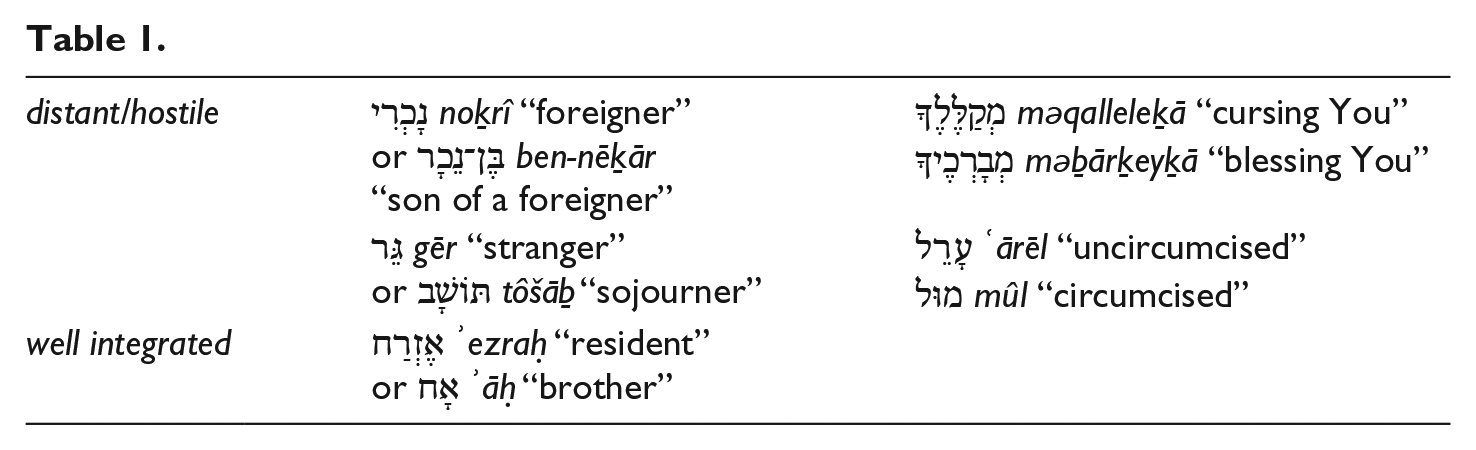
As ִרְכָנ noḵrî “foreigner” or רָכֵנןֶבּ ben-nēḵār “son of a foreigner” the non-Israelite stays beyond the borders of the covenant. Even there he may profit from the just and pious behavior of the (obedient) covenant people. But he is not going to be forced into a relationship with Yhwh. “JHWH überfährt die םִרְכָנ nicht mit seiner Liebe” (“Yhwh does not run the foreigners over with his love,” Bustillos, 2002: 62). The foreigners can be subdivided into two basic groups: the ֶלֶלּקְַמ məqalleleḵā “cursing You” (i.e. the covenant people) and the יֶכְרָבְמ məḇārḵeyḵā “blessing You.” 9
If the foreigner decides to settle down in Israel, he is designated as רֵגּ gēr “stranger” or בָשׁוֹתּ tôšāḇ “sojourner.” The stranger can live as לֵרָע ʿārēl “uncircumcised” (Exod 12:48) and abstain from Passover and voluntary offerings. But he has to keep the commandments for purity of the land (Milgrom, 2000: 1417; cf. 1496–99). As לוּמ mûl “circumcised” the stranger can take part in the Passover. With voluntary offerings he can express his praise and thankfulness to Yhwh and experience forgiveness of guilt (Lev 17:8; 22:18; Num 15:14, 22–31).
Inclusion in the הָוהְי לַהקְ qəhal yhwh “assembly of Yhwh” equals an acceptance as an Israelite. Important here are the physical state and attitude of blessing of his own people toward Israel (Deut 23:2–9). Therefore the movement shown in Table 1 of the stranger from distant/hostile (top row) to well integrated (bottom row) can be illustrated (see Table 1).
In the fifth request of the temple dedication prayer, Solomon pleads for the individual foreigner who wants to pray at the temple, an international building. 10 The request in 1 Kgs 8:41–43 amounts to the desire “that all peoples of the earth shall know Your name.” The surprising changeover from one particular foreigner to the multitude of “all peoples of the earth” points to the far-reaching consequences an answer to prayer can have. The foreigner, who comes “from a far country,” is predestined to bring back to his home the gained knowledge of God. Examples of such foreigners with a “bridge” function (Poganatz, 2000) are Naaman and the queen of Sheba.
Realization deficient? The phenomenon of individual case reports in the Former Prophets
Exemplary partial realization of the vision of worldwide knowledge of God
Not only in the book of Genesis but also in the rest of the Old Testament we find an astonishing number of narratives that portray an individual Israelite mediate blessing or knowledge of God to a non-Israelite. 11 Examples for such individual case reports are the narratives of the spies and Rahab (Josh 2), Solomon and the queen of Sheba (1 Kgs 10:1–13), Elijah and the widow of Zarephath (1 Kgs 17:7–24), and Elisha and Naaman (2 Kgs 5).
These exceptional elaborate reports do not serve to describe the increase of number of Gentiles with a relationship to Yhwh, because seen from this angle they would give a (quantitative) poor impression. Instead the reports serve as a model and exemplary stimulus to develop the vision of worldwide knowledge of God in the heart of the reader.
Elisha and Naaman—an example
The narrative of Elisha and Naaman can serve here as a very skillful example. Already in the first verse the actual hero of the miracle narrative is introduced in a surprising way: “Yhwh had given victory to Aram.” Not Rimmon, but Yhwh is presented as architect of the fortune of Aram. Opposed to this, we find in the literary center of 2 Kgs 5 the wrong expectation of Naaman, who hopes for a magic rite, a prophet, who waves his hand and murmurs incantation formulas (v. 11). The aim of the story is to disappoint any expectation of a human being. On his search for healing Naaman is handed over from person to person—the Israelite maid, his wife, the king of Syria, the king of Israel, the messenger of Elisha, and the servant of Naaman. The famous prophet Elisha even refuses to meet Naaman. Because in regards to the healing expectation of Naaman, Elisha is the greatest rival to Yhwh. Starting from 2 Kgs 5:2 the reader searches in vain—or at a wrong place (v. 11)—for the name “Yhwh.” Likewise Naaman is sent on a long ordeal, until he finally meets Yhwh and confesses him as the one and only God.
After his healing, Naaman formulates his insight very specifically: there is no other God on the whole earth than the God of Israel (v. 15). The three connected requests show how much the life of Naaman is changed by the encounter with Yhwh. Naaman subdues himself in three dimensions: personal, national, and theological: with his generous gift (cf. v. 5) he wants to honor the representative of God and therefore God himself (cf. Gen 14:20; 1 Kgs 10:10, 25). The request for soil is a result of the conclusion that the one true God can be found only “in Israel.” Even if he has to submit to the authority of his king and “bow down” to a foreign God (v. 18), he does not want to steal the honor which belongs to Yhwh alone and begs for forgiveness. “The prophet of Israel, the land of Israel, and most of all the God of Israel, all command Naaman’s submission and respect” (Moore, 1990: 80).
It is astonishing how elaborately the narrative traces the change in the individual traits of Naaman. In the beginning we see the proud Aramaean conqueror, combustible and easy to enrage (vv. 9–12). Then the encounter with Yhwh changes him into a man of humility, much concerned for the well-being of others (Rofé, 1988: 127). This development clarifies that the mediation of knowledge of Yhwh is not a purely intellectual matter, but can change the whole personality of a human being.
Outlook of the Later Prophets and Writings
The oracles against the nations as mission sermons?
The writing prophets of the Old Testament have a lot to say about several nations of their time. Oracles against the nations can be found in Jeremiah 46–51, Ezekiel 25–32, Isaiah 13–23, Zephaniah 2, and the whole book of Obadiah and Nahum (cf. Schirrmacher, 2001: 34–35). Here God presents himself not only as lord of his own nation, but of all nations. However, the first of these oracles are proclaimed to Israel and should not be understood as mission sermons towards Gentiles (Schultz, 1996: 45). As can be observed with Noah and Abraham, God is interested in informing his chosen people about the fate of the world (Gen 17:18). Abraham uses this knowledge to intercede for Sodom. Two examples (Isaiah and the Psalms) will clarify the role of the blessing mandate of God in the later parts of the Old Testament canon.
Isaiah—go and get the brothers from the nations!
Many have noticed the fact that the nations are promised salvation by Zion and a messianic servant (cf. Schultz, 1995: 154–59). But is it possible to discern a mandate to the people of God? First of all Israel is portrayed as a blind and disobedient “servant,” a deaf “messenger” and therefore a dubious “witness” (41:8; 42:19; 4:10). 12 Richard Schultz (1996: 50) suggests an interpretation according to which a “messianic” servant changes the unfit servant nation Israel through his sin offering death in Isa 53. The word דֶבֶע ʿeḇeḏ “servant” in plural can be found only in Isaiah 54: the blind servant (collective for the disobedient people) has been changed into useful servants.
Many scholars suppose that the witness of the people of Israel is only meant to be passive (Bosch, 1956: 21; Wolff, 1951: 11). But in the thanksgiving psalm in Isaiah 12 the “remnant” of Israel (11:16), which has survived the judgement of Yhwh, acknowledges the mandate, to make God known among the nations: “declare his doings among the people!” (Isa 12:4–5). Isaiah 66 describes the realization of this task. Yhwh will send the “escaped” ones, the remnant of Israel, 13 to the nations. They will proclaim the glory of God among the nations and bring back “all Your brothers from all nations” (66:19–20; cf. 19:24–25; 56:8). God will add more people to the outcasts of Israel. Egypt, Assyria, and the other nations will belong to the people of God, like Israel itself. The promise of Exod 19:6 will be broadened, and Yhwh will appoint priests and Levites not only from his people Israel, but also from these foreign brothers. The harvest terminology in Isa 66:21 can be understood in the context of Psalm 67:5–7 (Kaiser, 2000: 31).
The Psalms—multiply God’s honor among the nations!
In the Psalter there are many appeals to all the people of Israel, to testify to their God among the foreign nations. Psalms 2, 33, 66, 67, 72, 96, 98, 100, 117, and 145 have been called “mission psalms” (cf. Hedlund, 1985: 83–6; Kaiser, 2000: 30; Peters, 1972: 116; Wright, 2006: 478–84). These psalms are not to be only understood as inactive proclamations of the universal kingdom of Yhwh, but they lay the groundwork for what later will be called “missions.” It would be schizophrenic to use these psalms in liturgy without practical effect to the witness among gentiles. 14 Piper (1993: 185–88) divides the statements of the Psalter into four categories: (1) admonition to Israel (9:11; 96:3, 10; 105:1) and the nations (47:1; 66:8; 96:7; 117:1); (2) promises (2:8; 45:17; 47:9; 86:9; 87:6; 102:15, 22; 111:6); (3) prayers (67; 72:11, 17); and (4) plans of the psalmist (18:49; 57:9; 108:3).
The great number of appeals of the psalmist to the nations, to God in prayers, to his readers and to himself points to a clear message of the Psalter. It is the promise that at one time God will be king above all nations and they will worship him. Until that day the admonition is valid to let God’s honor steadily grow among the nations.
Missiological challenges
Even though the Old Testament will not answer the quest for the New Testament concept of “missions” in a sufficient way, its texts give an astonishingly broad, forthright, and creative contribution to the theme-field of the positive (blessing) mandate of God to his people of Israel (cf. Riecker, 2007: 377–96).
If we ask about the behavior of the patriarchs that leads to the blessing of Gentiles, we not only find a call to turn back to God, but a broad area of “being” (passive qualities) and “doing” (active habits) of the mediator of blessing: the need for help and the willingness to accept support, that is, “blessing,” in order to “activate” the principle of mutuality (Gen 12:3a); acceptance or rejection of gifts, 15 nearness, relatedness, confederation; blessing community, joint cleaning (circumcision); personal effort for the stranger; wisdom shown in practice; salvatory action; intercession for deliverance and healing; founding of holy places, giving of names, public offering; explanation of God’s deeds; explanation of wealth as blessing; consolation through promise of assistance and deliverance; priestly blessing; declaration of belief in Yhwh; mediation of knowledge of God. Much of this overlaps with the function of a priest, as could be expected from the mandate in Exod 19:6.
Likewise many are the consequences for the recipient of blessing. They can be portrayed in order from simply material to spiritual blessing: material blessing, goods, and reputation, protection and salvation, special offspring, purification and by this protection from judgement, knowledge of Yhwh and his greatness, personal relationship with Yhwh.
A successful mediation of mostly relational knowledge of God often leads to some of the following: joy, testimony of knowledge by a recognition formula, praise of Yhwh, offerings, presents, consciousness of guilt, development of a humble and selfless character.
In search for recipients of blessing and knowledge the mediator of blessing is not to be misled by human categories, because nobody is too mighty or too inconsiderable for the blessing of Yhwh. Most of the recipients in the texts can be found in one of the following categories: (1) the mighty (the kings of Egypt, Sodom, Gerar, Gad, Tyrus, and Sheba, as well as Naaman; (2) the inconsiderable (Rahab and the widow of Zarephath); and (3) the “neighbors” (relatives, house community, neighbors).
The human mediator of blessing is not the only one who is responsible for a success of his or her mission. The main responsibility lies with Yhwh, whose intervention is indispensable. If the potential recipient refuses to enter into a relationship with Yhwh, even extensive mediation of cognitive knowledge is pointless. Often, one only finds a superficial consent of the recipient, which can be clearly distinguished from a choice of loyalty of the heart (cf. Rahab, Josh 2). The distinctive mark of persistence in one’s old belief system is the attempt to utilize Yhwh for one’s own interests through manipulation (cf. Laban, Gen 30–31). The repeated empty promises of the Pharaoh towards Moses show that it is not the testimony of knowledge but the further behavior of the recipient is the essential sign of a real change.
Through these and other insights and stimulations the Hebrew Bible intends to “infect” its reader with the love of God (cf. Deut 10:18–19) and the vision of worldwide knowledge of God (cf. Isa 11:9), to find a way in his own time to the hearts of those who need his guidance—as many generations of servants of Yhwh before him.
Footnotes
Funding
This research received no specific grant from any funding agency in the public, commercial, or not-for-profit sectors.