



Abstract
In this article, I will argue that US mission practitioners, more than at anytime in the last century, need missiologists to bring research, writing, and teaching to bear on mission as practiced by US Christians, local parishes and congregations, and mission agencies, in part because of the profound changes in the nature and composition of what constitutes mission leadership today and the methodologies employed by those leaders. This need is rendered all the more urgent by what I will describe as the crisis in US mission practice which I will outline in detail. To respond to this sobering description of our engagement with God’s mission, I will propose the adoption of an “activist missiology,” along the lines of the growing school of activist anthropology pioneered by Charles Hale, Nancy Scheper-Hughes, and others.
Keywords
If you want to understand what a science is, you should look in the first instance not at its findings or its theories, and certainly not at what its apologists say about it; you should look at what the practitioners of it do.
Introduction
Recent gatherings of the American Society of Missiology (ASM) and much missiological writing have been dedicated to the current state of missiology: its status as a discipline within theology, its place in the curriculum of theological education, its relationship with other academic disciplines and, as noted at last year’s annual meeting, its intersection with the wider society via public missiology. 1 ASM President Paul Kollman graciously, and somewhat courageously, invited me to bring a perspective from the world of mission practitioners about how missiology and mission practice interact. The missiological reflections I would like to share are grounded in “what the practitioners of (missiology) do” because I would agree with Geertz that current mission practice is the most accurate indicator of the state of the discipline that we call missiology. The concern I share with you this morning is that, if Geertz and I are correct, I believe we are facing a crisis in mission as practiced by Christians in the United States.
In this article, I will argue that US mission practitioners, more than at anytime in the last century, need this academy to bring missiological research, writing, and teaching to bear on mission as practiced by US Christians, local church donors, and mission agencies, in part because of profound changes in the nature and composition of what constitutes mission leadership today and the methodologies employed by those leaders. This need is rendered all the more urgent by what I will describe as the related crisis in US mission practice which I will outline in detail and whose implications on God’s mission and the global church I will describe. To respond to this sobering description of our engagement with God’s mission, I will propose the adoption of an “activist missiology,” along the lines of the growing school of activist anthropology pioneered by Charles Hale, Nancy Scheper-Hughes, and others. I will conclude the article with some reflections on where we are seeing elements of activist missiology today and what it might look like.
I raise these concerns as a result of 31 years of mission practice as a Presbyterian Church (USA) mission co-worker and mission administrator, the last 10 years of which were spent working as our denomination’s director of World Mission. My rather eclectic academic record in missiology and anthropology in three languages in the USA, France, and Peru was grounded in the practice of cross-cultural mission in each chapter. If my professors formed me as a mission anthropologist, it was my Congolese and Peruvian colleagues who shaped me into a mission practitioner and gave me eyes to see the ethical contradictions in what passes for God’s mission today.
The Chasm between the Academy and Mission Practice
ASM membership is composed overwhelmingly of academics, with fewer practitioners. In May 2017, I conducted a survey of US mission decision-makers by sending a set of questions to two Catholic missionary congregations, one network of local Catholic mission leaders, nine independent mission agencies, and seven mainline Protestant denominational mission agencies, asking them to forward the survey to their mission decision-makers, that is, the persons responsible for deciding on the allocation of human or financial resources to mission activities. The 116 mission decision-makers who responded included mission agency executives, long- and short-term missionaries, local church/parish mission leaders and short-term mission trip participants. They expressed an absence of connection from the missiological academy: 86% had not attended a meeting of any missiological society in the past five years; 63% had read two or fewer books on mission in the last year, and 62% had not read a single article in any of the three most important US missiological journals (i.e., Evangelical Missions Quarterly, International Bulletin of Mission Research, and Missiology: An International Review) in the last three years (Farrell, 2017).
The survey results suggest that the majority of the people making decisions regarding the allocation of human and financial resources for mission operate with little or no awareness of the body of missiological research to which the ASM is dedicated. This is important because of the extremely significant and understudied shift in mission practice in this country as the landscape of mission leadership, power, and decision-making all decentralize. These new mission leaders are the decision-makers who are allocating human and financial resources to mission activities and pushing mission practice into new directions and new forms. As the number of US long-term missionaries decreases and the number of short-term missionaries increases (Moreau, 2008: 3–4), a growing number of decisions is being made by this increasingly influential group of short-term mission participants, and volunteer mission committee leaders and members. This growing group of part-time, unpaid leaders appears to be even less connected with or informed by missiological research: 93.6% of the part-time leaders had not attended a single missiological society meeting in the past five years; 92.3% had read two or fewer books on a missiological topic in the past year; and 83.9% had read no article published in any of the three most important US missiological journals in the past year (a full 80% were unaware of the journals’ existence).
In order to probe more deeply around this sense of disconnect between missiologists and mission decision-makers, I created one word cloud (Fig. 1) formed by the words used most frequently by the US mission practitioners surveyed as they identified the subjects about which they need missiologists to research and write and juxtaposed it to a second word cloud (Fig. 2) representing what US missiologists have, in fact, written about in the past three years, as determined by the tags of the articles published (2014–2016) in the three missiological journals referenced above. Here are the results:
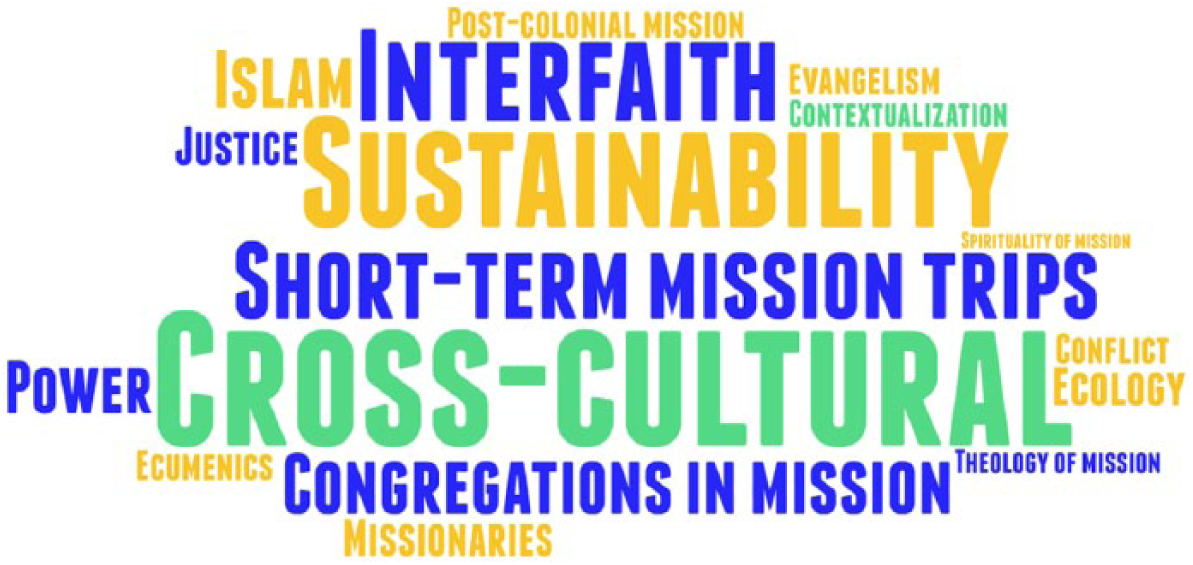
Mission decision-makers’ research needs.
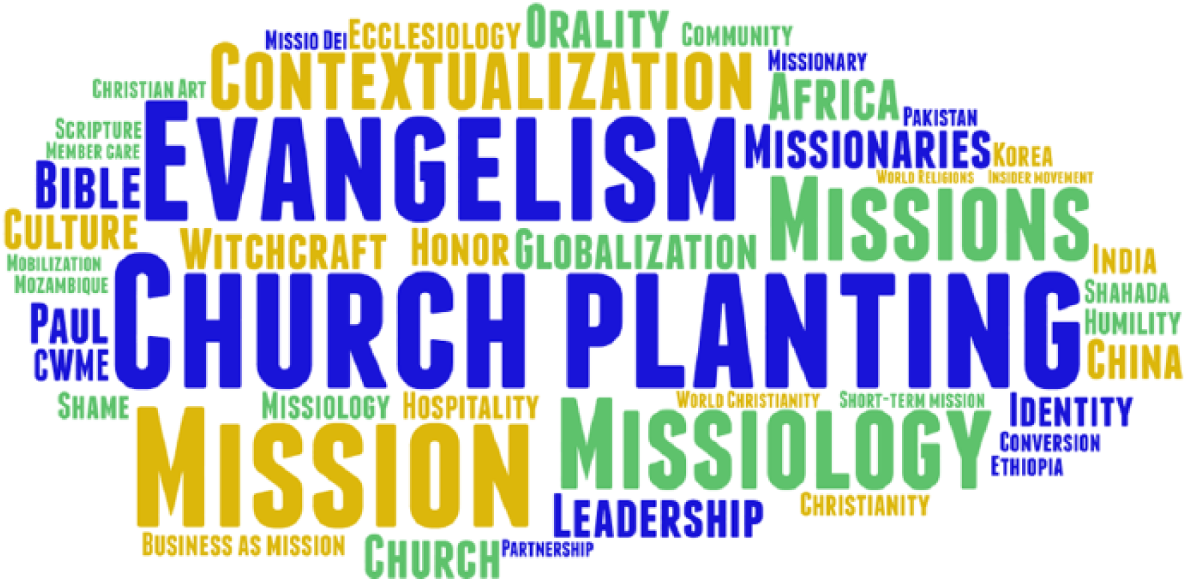
Subject tags of articles published in three major US missiological journals (2014–2016).
While there are some topics shared by both lists, by and large, mission practitioners are primarily asking for research in three areas: cultural competence (the culture concept, cross-cultural communication, cross-cultural conflict transformation, etc.), sustainability (avoiding dependency, basic development practices, “exit strategies,” etc.) and the programmatic (short-term mission, best practices, how congregations can improve the effectiveness of their mission work, etc.). Each of these stated needs arises out of the lived experience of mission practice: intercultural misunderstandings, partners perceived to be dependent on outside resources, a desire to improve less-than-optimal mission programs, especially short-term mission trips. 2 During the three years analyzed, the three missiological journals reduced their focus on short-term mission, provided only modest attention (only in EMQ) to “business as mission” as an emerging mission strategy, and gave very little attention to other specific mission strategies or intercultural communication or partnerships. The data suggests a gap between what mission practitioners need and what missiology is offering.
The Growing Significance of the Chasm
Why does this gap between the academy and the agents of mission decision-making matter so much? In the last half century, there has been a profound shift in the locus of mission decision-making from the mission professionals to primarily part-time, often unpaid local leaders. To get a sense of the scope of this great reversal, consider this item: In 2009, I presented to the members of our denomination’s General Assembly Council the statistic that, even though Presbyterians were giving more per capita to international mission in 2000 than they had given in 1960, 3 in 1960, more than 95% of the people funding Presbyterians sent overseas passed through the General Assembly offices (subject to the guidance and decision-making of professional staff and elected councils accountable to the church). By 2000, in contrast, less than 5% passed through the denominational offices (Bailey, 2009).
While this example describes changes in a mainline denominational mission agency, I would argue that the well-documented US cultural trend of increasing designation of charitable giving and the resulting increase in donor-control has in a similar manner shifted the locus of decision-making from trained, professional mission agency leaders to “every donor”—whether Catholic, Conciliar, or Independent—and to the often volunteer, part-time leadership at the congregation/parish level.
What are the implications of this shift in the demographics of who is primarily responsible for mission decision-making? At the time of the 1910 Edinburgh Missionary Conference, the primary mission decision-makers were denominational and specialized missionary society leaders responsible for assessing global needs, strategically allocating financial and human resources to mission work around the world, and collaborating with their sister churches/agencies for the optimal use of scarce resources. The comity agreements of that era served to reduce competition among foreign mission agencies. While they were almost exclusively white
European and North American males, almost all were full-time mission professionals and were often considered world-class experts on the missionary enterprise. Together, they spoke a dozen languages, had dedicated their lives to the study of theology, mission history, and comparative religions and cultures, and brought together the learning from on-the-ground mission experience on six continents.
Today, more than a century after the Edinburgh “World Missionary Conference,” the “flattening” of the world through globalization with its unimagined advances in communications, travel, and technology has transformed the nature of mission practice in this country, resulting in a massive decentralization of leadership. Today, the primary mission decision-makers in the United States are local Christians—mission committee leaders, mission pastors and directors, short-term trip leaders—most of whom volunteer their time to organize and lead short-term mission trips, mobilize and train recruits for cross-cultural service, and manage many volunteers for projects ranging from meal-packaging for hungry communities to house construction projects.
Some of these new mission leaders have seminary training and are hired as “mission pastors” or “mission directors” though US seminary curricula generally only require one course in “mission and evangelism” and offer almost no preparation for leading STM teams (Priest, 2008: v). The vast majority are volunteer mission committee leaders, mission mobilizers, or simply Christians who, without academic or professional preparation, are moved by the needs of the world to give of themselves to make a difference. According to a 2014 survey of 735 Presbyterian Church (USA) congregation mission leaders, 85% work as unpaid, part-time volunteer leaders (Farrell, 2014a). Today’s mission leaders tend to be less missiologically trained, less connected to each other, and operate within the constraints of shorter time frames (Farrell, 2017).
The positive aspect of this fundamental shift is that the decentralized, “bottom-up” structure of mission decision-making engages a growing number of individuals at the congregational level. Mission is no longer in the exclusive purview of a few mission professionals: mission is for everyone. This explosion of mission engagement outside the neat boundaries of denominational structures has grown to include even non-Christians who, in a spirit of service offer professional skills from home construction to primary school teacher training to cleft palate repair. Whereas in the past, church members’ participation in “foreign missions” was limited to prayer, financial support, and occasional hospitality for visiting missionaries, today the expanding opportunities of hands-on, direct engagement—from international mission trips to child sponsorship to prepared meal-packaging—has galvanized hundreds of thousands of volunteers, helped many US Christians develop a deeper commitment to mission, and led to increases in financial giving and short-term travel in support of international mission causes. Short-term mission trips in the USA have mushroomed into a more than $5 billion annual business. In addition, the involvement of a larger group of motivated volunteers increases the array of gifts and skills available to the causes of international mission. The surging popularity of the idea of “mission” in the US church today suggests that there is a large swath of the church interested in giving of their time, talents, and treasure to the cause of mission. Or at least what they perceive that mission to be.
One negative result of this tidal shift toward decentralized mission is that it appears that most mission decision-makers are not trained for their work, don’t speak even one foreign language, and are not informed by mission history or advances in intercultural communication, or the body of missiological knowledge—a situation which condemns them to repeat the painful mistakes of the past (Farrell 2014b, 2017).
A second negative consequence of the decentralization trend is the reduced time-frame of mission involvement. Even as funding for long-term missionary service decreases and short-term trips multiply, mission relationships for many US congregations have a shortened lifespan: the pressure to provide parishioners with a variety of international experiences results in constant movement and a sequence of multiple, short-term relationships where parishioners and global partners simply do not have the time to assess what is working well in their relationship and in their shared work—and what needs correction (Farrell, 2014b). A shorter time-frame allows the North American cultural project-orientation to trump the valuing of human relationships and reduces the chance that mission partners can address deeper, more complex, contextually embedded issues. Whereas a poorly conceived charity project can be implemented in a matter of days with little reference to the surrounding community, the more complex elements of God’s mission—the evangelism that occurs from the intimate sharing of lives and is facilitated by language and cultural proficiency or the justice work that comes from the deep analysis of the root causes of injustice and the methodical organizing, alliance-building, and campaign planning required for such complex interventions or the years of shared life that the mission of accompaniment entails. These deeper elements of God’s mission require a “long obedience in the same direction,” to use Eugene Petersen’s classic phrase (1980), and not the collapsed time-line of a summer vacation mission project.
This trend towards shorter-term mission work helps explain the powerful allure of disaster relief projects, rather than the longer time commitments required for development work or the preventive work of justice that identifies and addresses the root causes of the visible symptoms, whether hunger, homelessness, or conflict. The current decentralized mode of mission practice limits mission decision-makers to acts of charity and prohibits them from “going deeper.” In the 2014 survey of 735 Presbyterian congregational mission leaders, disaster relief proved the most popular mission activity engaged in personally by 57% of the leaders; “advocacy or campaign for social justice” was engaged in by only 27%, and “preaching, evangelistic campaigns or evangelism training” by a mere 18% (Farrell, 2014a: 1–2).
The Current Crisis in US Mission Practice
What Burton and Barnes say about American philanthropy is true for US mission philanthropy around the world: Historical injustices—perpetuated by racial and cultural conflicts, and exacerbated by a lack of empathy—are at the heart of America’s growing economic, social, and political inequalities. Nowhere is this gap of authentic empathy and justice more pronounced than in the American philanthropic sector, where often well-intentioned people make decisions for communities they do not come from, may not understand, rarely interact with, and almost never step foot into. (2017)
The authors then quote Martin Luther King, “Philanthropy is commendable, but it must not cause the philanthropist to overlook the circumstances of economic injustice, which make philanthropy necessary.” A tragic irony of current US mission practice is that, hundreds of thousands of US Christians will this year spend billions of dollars to travel to communities around the world adversely affected by hunger, human trafficking, and environmental degradation. They will dine on the hospitality of their Christian brothers and sisters in places like Mexico, Haiti, Ethiopia, India, and Thailand. They will worship with them. They will pray with them. And though these US Christians possess powerful social, political, and economic capital and could partner with their brothers and sisters to make a measurable impact in addressing these global issues, by and large, most will return to the USA without ever realizing their part in the global problems or solutions—or even perceive the concrete, courageous, and prophetic action that following Christ requires in a globalizing world.
Instead, many US Christians will invest their time, energy, creativity, money, and social capital in a variety of projects made in their own image which critics say are designed more for donor satisfaction than for their effectiveness in addressing the global problems:
Even though some highly inefficient child sponsorship programs 4 spend up to 88% of the donor’s contribution on administrative costs in the US (Anonymous, 2014), and they have exploded into a $4 billion a year “resource engine” (Wydick, 2013: 393). Some 46% of PC (USA) congregational mission leaders surveyed in 2014 personally supported a child through a sponsorship program. The inefficient and expensive sponsor-letter writing and sponsor-care operations required to satisfy donors is justified by at least one mission agency as “the only way to capture the donors’ attention” (O’Neill, 2013: 209);
Prepared-meal packaging projects have grown in popularity among US Christians, especially among mission conference attendees and youth and college groups, as evidenced by the growth in both the number of institutions providing this service 5 and the volume of their operations. Since 2005, Rise against Hunger (formerly Stop Hunger Now) has mobilized more than 350,000 volunteers annually to package a total of more than 331 million meals in 74 countries “with a mission to end hunger in our lifetime.” 6 Packaged meals can save a life when delivered to a disaster zone but ignore the root causes of hunger and can depress market prices in post-disaster or non-disaster contexts, driving local farmers out of business and reducing food sovereignty. One international hunger expert lamented, “We are inoculating an entire generation of college students to believe they are doing something to combat hunger by giving a few hours to package rice and beans” (Nodem, 2013).
Orphanages and institutionalized “orphan care” depend on an expensive institution that was largely discredited in this country years ago. In numerous contexts in the Global South, orphanages often ignore the very people who are best suited to respond to the child’s needs—the child’s extended family—who may only need a temporary helping hand to provide for their child. Yet the attractiveness to the donor of supporting an orphanage makes these programs extremely popular with churches.
In each of these examples, just as for the often-criticized short-term mission experience, the pressure to provide a pleasurable experience that satisfies the clients of mission proves to be a force not easily ignored. While the secular media and social scientists have published numerous critical studies on popular mission strategies such as child sponsorship, institutionalized orphan care, and meal packaging, missiologists have been largely silent on the contours of these mission strategies or their impacts on local communities. This is the crisis in US mission practice: having all of the possibilities to partner deeply with Christians around the world combining their emic and etic perspectives and their considerable social, economic, political, and spiritual capital to address critical global issues, billions of dollars and untold numbers of human hours are used annually in mission strategies of questioned effectiveness that critics say serve primarily to increase donor satisfaction rather than advance God’s mission.
The emergence of the “new mission leaders” has resulted in lessened accountability and effectiveness (it is more difficult for less-informed, distant donors to assess project impacts than for long-term professionals), a more short-term and superficial focus, and an increase in the new mission leaders’ sense of power and entitlement over the right of local Christians and communities to chart their own development.
This is one of our greatest challenges: Can missiology re-form itself to respond to the changed landscape? This upending of the last century’s stable pyramid of mission decision-making parallels the experience of several US service and information industries: the structural shift from a centralized Yellow Cab to a decentralized Uber, from the twentieth-century American Automobile Association’s printed “triptiks” 7 to the twenty-first-century Waze navigational app, from the elite Encyclopedia Britannica to the populist Wikipedia. Uber, Waze, and Wikipedia dared to imagine a decentralized, “bottom-up” structure where knowledge is generated at the local level and fed into a matrix which provides and interprets data in real-time. Can missiology attend to the crisis in US mission practice by listening to the needs of practitioners, both US and in the global communities they seek to serve? What would missiological research and teaching look like in a decentralized, user-sensitive system that reconnects new mission leaders with the academy and returns to missiology’s roots as that most practical of theological disciplines, located at the intersection of the church and the world, informing and shaping the current mission practice of today’s new mission decision-makers? What would it look like to re-member missiology—reconnecting our mind and hands?
Activist Missiology: Use-inspired, Collaborative, Purpose-driven
In 1997, Donald E. Stokes’s book, Pasteur’s Quadrant, challenged the long-held dichotomy between pure and applied science and postulated a hybrid “third way” between basic or “curiosity-driven” research (as typified by Niels Bohr’s work on quantum physics) and applied research (such as Thomas Edison’s problem-oriented research). According to Stokes, French microbiologist Louis Pasteur never undertook a study that was not applied, yet his contributions to theoretical knowledge in microbiology powerfully impacted our understanding of the cause and prevention of disease. Pasteur illustrates a research posture where scientific rigor and objectivity are not opposed to the application of the research findings to solve human problems. Figure 3 illustrates this “third way” of “use-inspired basic research.”

Use-inspired basic research.
In the realm of the social sciences, anthropologist Charles R. Hale found inspiration in the possibility of this hybrid posture as he developed a posture of research and teaching for what would become “activist anthropology” (Hale, 2001: 13): [A]ctivist research: a) helps us to better understand the root causes of inequality, oppression, violence and related conditions of human suffering; b) is carried out, at each phase from conception through dissemination, in direct cooperation with an organized collective of people who themselves are subject to these conditions; c) is used, together with the people in question, to formulate strategies for transforming these conditions and to achieve the power necessary to make these strategies effective.
Activist research, then, is “use-inspired,” it engages “informants” as co-researchers (collaboratively, rather than hierarchically), and it anticipates the research’s use in the resolution of the human problems studied. Numerous anthropologists have addressed the benefits, contradictions, and challenges of activist scholarship (Hale, 2008; Scheper-Hughes 1993, 2002; Biehl, 2005, et.al.). Activist research “has the potential to produce deeper and more thorough empirical knowledge of the problem at hand” (Hale, 2001: 13) by engaging as co-researchers persons suffering from the injustice being studied, it has also generated some controversy around the issue of research “objectivity” as an activist researcher explicitly identifies at the start of the research project his or her political commitments and frames the research within a larger effort to combat the structure of injustice or oppression to reduce human suffering. For example, an activist anthropologist would study the plight of a community of children suffering from lead poisoning, allegedly due to the illegal toxic emissions of a US-owned metal smelter in their city, naming from the start his or her ethical commitments and intention to provide a “thick description” (Geertz, 1973: 3) of the community, its history, actors, and culture in order to provide the children’s parents—organized in a local movement to protect their children’s health—with information and tools with which to nonviolently advocate for justice: a decrease in toxic emissions and an improvement of children’s health.
Hale, Scheper-Hughes, and other leaders of the activist school of current anthropological research argue, with George Marcus’s notion of “the myth of objectivity” (1986), that a researcher’s personal narrative and social location already contribute to their assumptions and the framing of their research questions and that integrity requires that the researcher acknowledge their assumptions, intentions, and biases. I don’t believe it necessary for us to trip over the notion of objectivity in research. In a very real sense, we missiologists have it much easier than do anthropologists: we are already “activists.” Many of us have deep lifelong commitments to using our professional skills to advance God’s mission in the world. We teach mission in local churches; we train short-term mission groups in cultural competence; we serve on the boards of mission agencies. To what extent do we maintain scientific objectivity in our missiological research and to what extent is our objectivity already relativized to the space of our personal commitment to extending the Reign of God? In this sense, we serve as bridges between the body of missiological research and the growing band of new mission leaders. The concern I raise is that mission practitioners across the country are signaling their desire for more input from missiologists; for the academy to reach across what Robert Priest, in his study of short-term mission, called the “marked divide”: [P]rior to 2003, very little actual research had been done on short-term missions and its role in the contemporary global mission scene. That is, there was a marked divide between the world of missiological research and the practice of short-term mission. (2008: v)
The surging popularity of books like Toxic Charity, When Helping Hurts, Serving with Eyes Wide Open, and other books on short-term mission, cultural proficiency, sustainability/dependence in human development, the role of congregations in global mission all point to a growing recognition on the part of today’s new mission leaders that they view the “marked divide” as unhelpful and seek missiologically sound information, insights, and training. Whereas one is tempted to assume that few Americans are willing to dedicate time to serious missiological study and reflection, it is worth noting that a full 10% of the mission leaders surveyed wrote-in responses to indicate that they had taken the 15-session “Perspectives on the World Christian Movement” course, a course taken by more than 130,000 in this country alone (Farrell, 2017). The numerical success of the Perspectives course indicates there is clearly a large group of people ready to study and reflect on mission in a deeper way.
In the April 2014 survey of 735 Presbyterian congregational mission leaders, 56% sought to understand missiologically sound “best practices” implemented effectively by other congregations; 46% expressed a need for help to evaluate the effectiveness of their mission activities; 37% sought help organizing their congregation’s mission leadership team/committee (organizing mission programs, assessing partner needs/assets, etc.); and a third (31%) expressed the need for mission resources (theological reflection, web-based curricula, access to mission consultants, etc.) (Farrell, 2014a).
In summary, what if missiologists considered engaging in “activist missiology,” an activist posture for research and teaching which begins by listening to the felt needs of new mission leaders and the communities they serve, admits its a priori commitment to furthering God’s Reign, engages new mission leaders in research, reflection, and diffusion of missiological knowledge, and explicitly contributes to the growth of God’s Realm by helping the different parts of Christ’s Body to enhance the faithfulness and effectiveness of their engagement in God’s mission?
A New Landscape for Missiological Research
A new activist missiological research consortium is formed as mission practitioners signal their needs for research and agree to partner in research efforts, adjusting their activities to align with the insights and knowledge produced by the consortium, as missiologists, for their part, would favor “use-inspired” research needs and seek out partnerships with mission practitioners to not only gather and analyze missiological knowledge, but to diffuse the knowledge through teaching, training, speaking, and writing, extending missiologists’ reach via practitioners’ innumerable social and professional networks.
Robert Priest’s groundbreaking work in short-term mission (2006a, 2006b, 2007, 2008a, 2008b) illuminates the path of this new activist research posture in several helpful ways. His attentiveness to the concerns of mission practitioners and the communities they serve; his transparency of purpose in seeking to generate missiological knowledge to improve a burgeoning mission practice of questioned effectiveness; and his collegial engagement with US and international mission practitioner-scholars, like me (Farrell, 2007), as co-researchers in a research consortium to collect, analyze, and diffuse missiological knowledge. Priest sounded a call for missiologists to attend to mission as practiced by organizing two theme issues in Missiology, organizing mission conferences on the STM issue, and more importantly, by engaging younger scholars in researching the issue. The multiplier effect of this kind of leadership of a scholar bridging the “marked divide” between the academy and practitioners is exemplary. Priest’s more recent work on witchcraft and witchcraft issues, “the #1 pastoral concern for many African churches,” according to Rev. Dr. Mulumba Mukundi Musumbu, the late General Secretary of the two million-member Presbyterian Community of Congo (1990, 2011), has opened a door for the shaping of a similarly impactful research consortium on a critically important issue for God’s mission.
An urgent task not addressed in this article is the critical need to listen to global Christian leaders to understand their perspective on the impacts of current US mission practice on their churches and communities. I have limited the scope of this paper to identifying and addressing missiology’s “marked divide” in this country. But this is an important first step. For it is only by re-membering missiology—by adopting an activist research posture that attends to practitioners’ needs, acknowledges our assumptions and biases, and creates a collaborative space of academy-practitioner research consortia—that we will be able to address the current crisis in US mission practice.
