



Abstract
Content analysis is a valuable research tool for social scientists that unfortunately can prove challenging to teach to undergraduate students. Published classroom exercises designed to teach content analysis have thus far been predominantly envisioned as lengthy projects for upper-level courses. A brief and engaging exercise may be more beneficial for introductory social science courses in which less time can be allotted to any one topic, such as content analysis. With this in mind, this article presents a highly engaging and temporally compact classroom exercise designed to teach introductory social science students about content analysis. In the exercise, students are guided through a content analysis of the music in Harry Potter films. An evaluation study suggests that the exercise improves students’ understanding of content analysis and that students find it both highly helpful and enjoyable.
Introductory social science courses typically expose undergraduate students to a suite of research methods. This serves both to begin training the next generation of researchers and to help students understand how social science knowledge is shaped by the methods used to acquire it. Content analysis is one of the more challenging research methods to teach. Teachers often lament that students have difficulty grasping qualitative analysis in general (e.g., Blank 2004; Clark and Lang 2002; Hood 2006), and, piling on this confusion, content analysis exists in a gray area that is neither distinctly qualitative nor quantitative (see Dougherty 2005; Krippendorff 2004). One possible solution for teachers is to have their classes engage in the complete content analysis process, from a literature review, to study design, sampling, coding, and finally, theory development (for example, see Carpenter 2009; Finley 2004; Papademas 1983; Taylor 2003). While this is viable for specialized courses using a content analysis to illustrate a point, introductory courses require a compact approach to leave time for other pressing topics. With this in mind, the present article introduces a temporally compact, engaging content analysis project in which students analyze Harry Potter film music. In addition, a quasi-experimental classroom evaluation study illustrates the effectiveness of this exercise.
Defining Content Analysis
Content analysis is conceptually straightforward: It is the study of social artifacts (human creations, such as books, laws, art, and media). Highly detailed data from social artifacts (e.g., a book) can be made more manageable to analyze by selecting a small, random sample of units within the social artifact (e.g., randomly sampled chapters from the book). These data are then coded (divided into categories), a process that typically involves counting the frequency of and/or comparing the co-occurrence of categories. Often, the goal is to develop theories inductively that can help explain patterns in the data. (For a more in-depth description of content analysis and its many variations, see Krippendorff 2004; Neuendorf 2002.) Understandably, it may be harder for students to visualize content analysis than other research methods they have encountered more frequently in their everyday lives, such as survey research.
Teaching Content Analysis
This may be a topic that students will grasp best when going beyond a textbook by actually performing a content analysis. However, the type of course being taught in part determines the best format of such a content analysis student project. In the case of a specialized course, students could conduct a content analysis on the course’s main topic, thereby justifying an extension of the level of detail and time required for the project. For example, in line with the core purpose of her Introduction to Criminal Justice course, Finley (2004) dedicated three weeks to a student content analysis of film, television, and music portrayals of the various types of players in the criminal justice system, and then students compared these public personas with more realistic data. Likewise, Papademas (1983) dedicated an entire semester of his Sociology of Communications and Media course to a mixed-methods content analysis on the mass media. In reflecting on the success of the project, Papedemas (1983:394) aptly noted, “Done well, the context/content analysis projects are time-consuming both in and out of class, sometimes taking time away from other teaching modes.” Indeed, the full process of content analysis projects—from literature reviews to data selection, sampling, coding (possibly iteratively), and data analysis—can be quite time-consuming, but this may be acceptable in topic-specific courses wherein the content analysis illustrates a core course concept.
It is less feasible to allot so much time to covering content analysis in an introductory-level course where many other topics still need to be addressed. In an example striking a balance between detail and temporal brevity, in his Introduction to Sociology course, Taylor (2003) devoted one class period and a short take-home assignment to a content analysis his students conducted on gender stereotypes in children’s books. To enhance adoptability of such exercises for introductory social science courses, the ideal content analysis project could be even briefer, as many core sociology textbooks—and in turn, most likely, many sociology teachers—devote only a handful of paragraphs to teach this concept.
Why Harry Potter?
In designing a temporally brief, highly engaging content analysis exercise for lower-level social science courses (e.g., Introduction to Sociology, Methodology, etc.), Harry Potter film music is an excellent data source for three key reasons: This data source should be an appealing and therefore memorable data source for students, its reliance on musical rules lends itself to coding, and a social science research goal can be illustrated.
Regarding the first point, a memorable data source has the potential to make an exercise more impactful for students. Not surprisingly, engaging students through movie-related exercises has a rich tradition in the social sciences (e.g., Berg 1992; Demerath 1981; Finley 2004), as do exercises focusing on music (e.g., Ahlkvist 1999; Albers and Bach 2003; Armstrong 2001; Walczak and Reuter 1994). The Harry Potter franchise’s overwhelming popularity makes it a particularly ideal data source: More than 400 million of the books have been sold worldwide (BBC 2008), and not adjusting for inflation, the movies based on the books represent the highest-grossing film series ever (Box Office Mojo 2011). The Harry Potter book-movie franchise has been employed in classroom exercises to teach students about a wide range of topics, such as forensic science (Palmer 2010), political science (Deets 2009), copyright infringement (Striphas 2009), the empirical use of reflexive journals (Gerstl-Pepin and Patrizio 2009), underage drinking (Welsh 2007), and linear modeling (McShea, Vogel, and Yarnevich 2005).
Beyond its potential for making an exercise more memorable, Harry Potter film music also employs composition rules that lend themselves well to coding. The composer of the music for the first three Harry Potter films, John Williams, is one of the most accomplished, award-winning Hollywood composers of all time (The Internet Movie Database 2011). His success in part draws from the music rules he uses to aid in a film’s storytelling. For example, as Webster (2009) noted, among many other techniques used in the early Harry Potter films, Williams regularly employed (1) visual-matching music (music that closely mirrors and therefore emphasizes movements on the screen), (2) dialogue rules (music is either mute or soft during character script lines to make them audible), (3) leitmotifs (musically reoccurring themes usually attached to a certain character or idea; see Darby and Du Bois 1999), and (4) music rule breaking (breaching a previously established music rule, such as the above, so as to emphasize another rule). Students may be able to treat these first three techniques as coding categories for a “music type” variable, and they can then discern when and why the fourth technique, rule breaking, occurs.
Last, a content analysis of this data source can illustrate the use of this method in the service of achieving a social science research goal. Specifically, students can employ content analysis to illuminate the types of national and gender stereotypes displayed by the Harry Potter film music. These findings have particular social science relevance, given that cultural norms can shape the creation of films as well as socialize media consumers (Dowd 1999; Hoeckner et al. 2011). It is with these points in mind that I designed a content analysis classroom exercise.
The Harry Potter Content Analysis Exercise
In addition to detailing the content analysis exercise, this section also reports on a quasi-experimental classroom evaluation study of the exercise.
Sampling
In 2010, at a New York City four-year college, with the approval of its institutional review board, I contacted faculty members teaching sections of Introduction to Sociology. After receiving permission from two instructors—neither of whom had yet taught research methods and content analysis to their students—I met their students in their classroom in the second half of a regularly scheduled class meeting time. To decrease the possibility of perceived coercion on the part of students, I required that the instructors leave the room for the duration of the exercise. I orally introduced the study’s purpose to the students (to conduct the exercise with them and test its effectiveness through two brief questionnaires), after which I distributed consent forms. Of the 59 total students in attendance at these two classes, 49 were at least 18 years of age and consented to participate.
Study Design
Pretest questionnaires given to students included closed-ended items on gender, year in college, whether they are majoring or intending to major in sociology, whether they have taken a research methodology course before, their likelihood of taking research methods courses in the future (ranging from 1 = very unlikely to 6 = very likely), and their level of understanding of qualitative analysis, content analysis, social artifacts, and coding (ranging from 1 = very unfamiliar to 6 = very familiar). After collection of the pretest questionnaires, the exercise (detailed below) was conducted for 30 to 35 minutes, and then posttest questionnaires were distributed that, through closed-ended questions, inquired about the respondents’ interest in taking future research methods courses and their familiarity with qualitative analysis, content analysis, social artifacts, and coding. Posttest questionnaires also asked how enjoyable it was to participate in the exercise (ranging from 1 = not at all enjoyable to 6 = very enjoyable), how helpful the exercise was in adding to their knowledge of content analysis (ranging from 1 = very unhelpful to 6 = very helpful), and whether they would recommend this exercise for other courses.
Given that some professors may wish to provide additional content analysis practice for their students, an optional extension of the exercise that takes approximately 30 to 40 minutes is also discussed in this article. However, in light of the previously stated importance of brevity for class exercises in introductory social science courses, the posttest questionnaire was distributed after completion of the main exercise, and the extension was excluded from evaluation.
The Exercise
Between questionnaires, the exercise was conducted, which began with a five-minute lecture defining qualitative analysis, content analysis, social artifacts, and coding. I then explained that we were going to conduct a content analysis on a scene from a Harry Potter film. I briefly explained how music can play an important role in supporting the visual storytelling in a movie, but film music is often consumed almost subconsciously. Content analysis is an excellent tool to uncover the messages of such music. I then handed out a coding sheet vertically listing labels representing the 10 segment “events” in the first scene of the film Harry Potter and the Sorcerer’s Stone (Columbus 2001), and horizontally displayed next to each segment were three music types: “theme,” “fits,” and “quiet” (see Figure 1). To help the students recognize the three music types, I hummed for them what I termed theme on the coding sheet (which John Williams calls “Hedwig’s Theme” and is the main theme of all of the Harry Potter films); I described how at other times, music will fit the action on the screen, which I labeled as fits on the coding sheet, and at times the music will be low in volume, which I labeled on the coding sheet as quiet. I then instructed the respondents to circle one music type for each event in the film scene I was about to play. Discussing the subconscious power of movie music, distributing the coding sheet, and providing instructions on its use took approximately five minutes. We then watched the four-minute opening scene of the movie. During the viewing, I notified the students when we had reached the next event so that they were prepared to listen to the music and to circle the appropriate music type on their sheet. To remind them of their goal, for the first several events, I provided them with prompting by asking, “Are we hearing the theme, music that fits the actions on the screen, or quiet music?”
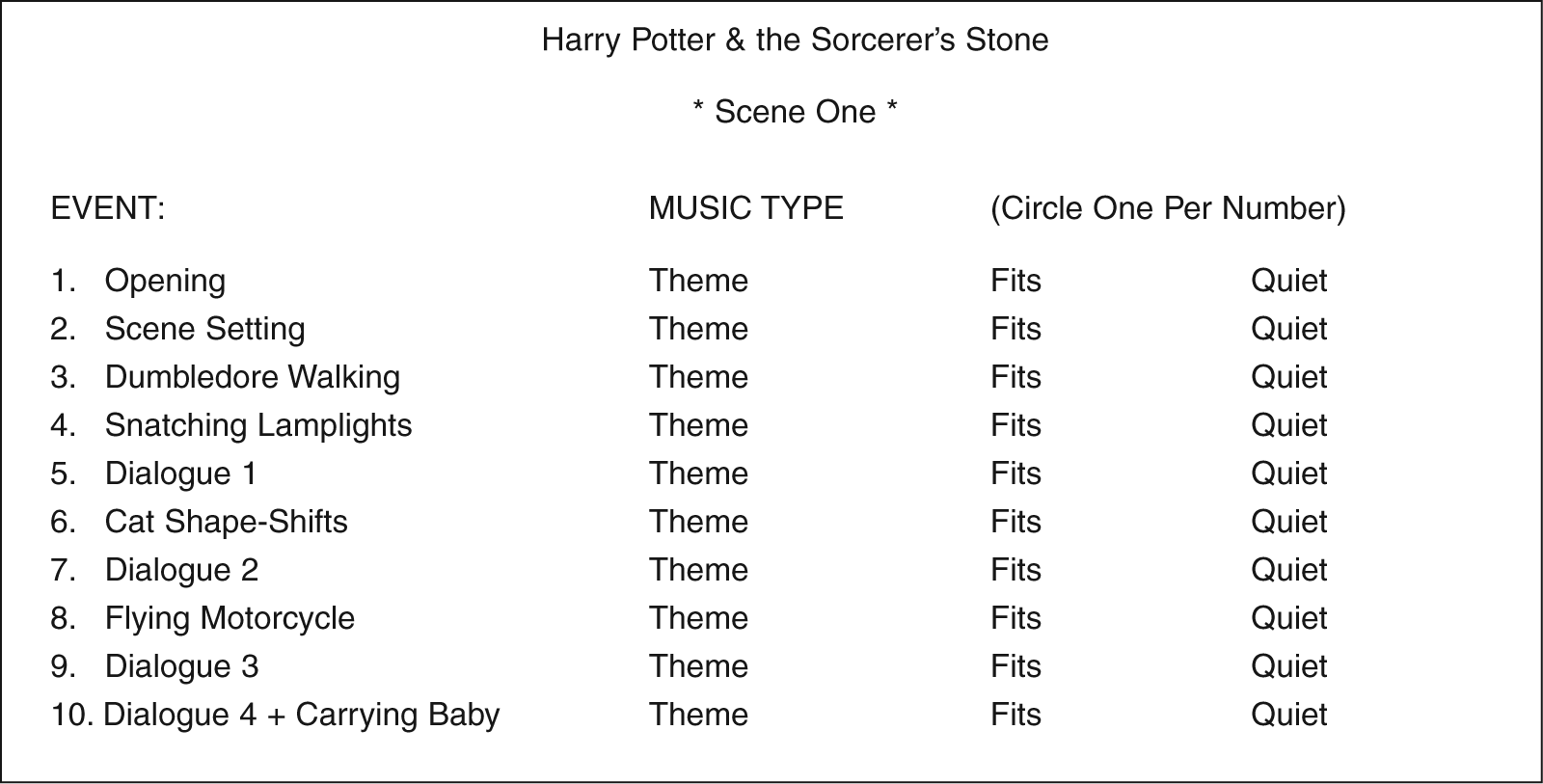
Coding sheet for Harry Potter content analysis exercise
The first 15 seconds (00:00 to 00:15), which is when the Warner Bros. logo appears, is labeled on the coding sheet as “Opening,” the first event. This is where we first hear the theme music. To ensure that the respondents recognize this music type later on in the scene, I pointed out that we were listening to the theme and that they should circle this next to the first event, “Opening.” The “Scene Setting” event (00:16 to 00:35) involves an owl sitting on the Privet Drive sign in the dark and then flying around a dark, misty, forested, suburban area while listening to eerie music involving what sounds like chimes. While the music is certainly quieter in this event than in the opening, it is still quite noticeable, and furthermore, the music’s eeriness matches the eerie visuals on the screen; thus, the music here fits the visual actions. The “Dumbledore Walking” event (00:36 to 00:51) involves the wizard Dumbledore walking around the dark suburbs, with music that slowly and repeatedly ascends and descends in pitch, suggesting movement like walking—again, music that fits the visual actions. In the “Snatching Lamplights” event (00:52 to 01:18), Dumbledore sucks the balls of light from the suburban lampposts into a handheld magical device, with an ascending rush of chimes and music accompanying each lamplight he takes; this music, again, fits the visual actions. When Dumbledore stops to speak to a cat in “Dialogue 1” (01:19 to 01:26), the music gets so quiet as to be almost nonexistent; this should be labeled on the coding sheet as quiet. The cat shape-shifts into the wizard Professor McGonagall in the “Cat Shape-Shifts” event (01:27 to 01:37), with ascending instrumental and choral music in the background that fits the size increase and supernatural actions on the screen. Dumbledore and Professor McGonagall have a discussion in “Dialogue 2” (01:38 to 02:03), and just as in “Dialogue 1,” the music is quiet. In the “Flying Motorcycle” event (02:04 to 02:23), Hagrid’s flying motorcycle appears from the sky and lands in front of the two wizards, carrying what we will soon learn is a baby; the music here is the same theme we hear in the “Opening” event. There is another discussion that occurs in “Dialogue 3” (02:24 to 02:43), for which the music is quiet. Now Hagrid hands the baby to Dumbledore, and Dumbledore and Professor McGonagall carry the baby to the doorstep of the Dursleys’ home while continuing their discussion (02:44 to 04:04); the music, although faint, is distinctly the theme.
We then collectively discussed the students’ answers on the coding sheet. For each event, after reminding them what happened in that scene, I polled the class on their answers. We attempted to arrive at a mutually agreed-upon resolution for any disagreements. Finally, we discussed what conclusions we could draw from these data. Specifically, I asked them in what types of events does John Williams use music that “fits” the scene (answer: generally when nondialogue actions occur) and why (to emphasize the visual actions), and when does he use “quiet” music (when dialogue occurs) and why (to enable the audience to better hear the dialogue). I also asked when does he use the “theme” (beyond the Warner Brothers logo, only when Hagrid flies in on his motorcycle and the wizards walk to the Dursleys’ front door while talking). Despite the presence of visual actions and dialogue, the two previously established music rules were broken to play the theme. In noting this, I asked the students what is distinct about these two events that might explain this. The connection is that the baby is present in those events, and in that situation, all other music rules are ignored while the theme is played. Subconsciously, this signals to the audience that this baby is important—indeed, because the baby is none other than Harry Potter. This discussion of their results lasted approximately 10 minutes.
To reaffirm their understanding of these study results, we watched the four-minute scene again. Last, I ended the exercise discussing with them the process it took to create the coding sheet they were provided with (taking approximately five minutes). In particular, I talked about how qualitative data are so detailed that unless one knows exactly what one is looking for in advance (e.g., the number of times characters say “Harry Potter”), one needs to begin by looking for any pattern at all. To find these three eventual music types, I explained, I began by breaking the scene down into events or periods and then listed the music type in each event. I initially found 10 distinct types of music, which were then merged into fewer, similar categories. (As a simple example, I merged events in which the theme was played, irrespective of whether the theme was played loudly or quietly). This iterative coding process (sometimes referred to as grounded theory method) allows one to construct variables and, ultimately, to test hypotheses or develop theories out of highly complex, qualitative data. To help students understand coding beyond content analysis, I suggested that a very similar iterative coding process can be used for other types of qualitative analysis, such as when trying to make sense of lengthy, typed interview transcripts. Not including the time spent on recruitment, consent, and data collection, the exercise itself took approximately 30 to 35 minutes.
Supplemental Exercise Extension
If time permits, instructors may wish to add an optional extension of the exercise that both can highlight the use of content analysis in achieving a social science goal and can provide students with an opportunity to practice developing coding categories. After completion of the previously described exercise, students can be shown a key scene (16:55 to 19:12) in Harry Potter and the Goblet of Fire (Newell 2005) in which Harry Potter’s wizard school, Hogwarts, is introduced to the “lovely ladies from the Beauxbatons Academy of Magic” and the “proud sons of Durmstrang,” students from what are alluded to as all-female French and all-male Eastern European wizard schools. Either in small student groups or collectively as a class, students could break the scene down into events (e.g., by camera cuts). The various music types heard can be listed and iteratively combined into broader music-type categories (e.g., military march vs. romantic period, use of percussion, music pace, the diegetic utterances of “huh” and “ahh” by the visiting students during the music, etc.). After several film scene viewings, students should be guided in a discussion regarding the ways in which gender is made salient in this scene both visually and musically, with the Beauxbaton students being painted as hyperfeminine, Durmstrang students as hypermasculine, and both sets of students as objects of the heterosexual romantic gaze (Webster 2009).
Thus, for these foreign-born students viewed as “others” within the context of the largely white, British environment of Hogwarts, their minority status appears to be made musically visible, not necessarily through emphasizing their national origin but through emphasizing their abnormally extreme gender performances. By comparison, the theme music associated with Harry’s white, British, male character—as illustrated in the scene watched for the first part of the exercise—does not allude to Harry’s gender, thereby reinforcing his insider status. In many respects, this pattern reflects the research literature on the invisibility of privilege. Scholars have posited that dominant demographic groups often appear to lack a gender, race, ethnicity, class, and sexual orientation—they are just human beings. Conversely, minority demographic groups often view themselves and are viewed by others in terms of their minority status (Lucal 1996). This can serve simultaneously to render the privilege of dominant groups (e.g., Harry Potter) invisible and to enhance the stigma and discrimination of minority groups (e.g., Beauxbaton and Durmstrang students). It is recommended that an additional 30 to 40 minutes of class time be reserved for this supplemental exercise extension.
Results
Given the decreased power from the small sample size, and given the study’s focus on temporal changes for outcome measures, only descriptive statistics and bivariate analyses are reported regarding the evaluation study. Of the 49 students surveyed, two-thirds were female; most were sophomores (60 percent) or freshmen (24 percent), with few juniors or seniors (16 percent); only one student had declared as a sociology major, and only two had taken a research methods course. On the key measures of student learning, after completing the exercise, respondents self-reported greater familiarity with the concepts of qualitative analysis (Time 1 [T1], M = 2.31; Time 2 [T2], M = 4.22), social artifacts (T1, M = 2.21; T2, M = 3.88), coding (T1, M = 1.81; T2, M = 3.82), and content analysis (T1, M = 2.19; T2, M = 4.22). For the most part, therefore, self-reported familiarity with content analysis and its component concepts increased from unfamiliar (coded as 2) to somewhat familiar (coded as 4). The exercise did not affect students’ interest level in taking research methods courses in the future (T1, M = 3.51; T2, M = 3.58). However, in answering 4 or higher on a measure ranging from 1 to 6, 71 percent of students reported that the exercise was helpful in learning content analysis (M = 4.19), and 74 percent of students found the exercise enjoyable (M = 4.22). Only one student did not recommend the exercise for future courses.
Discussion
As with all studies, this evaluation is not without limitations. In particular, the small sample size limits generalizability. Relatedly, the small sample size precluded the possibility of a control group in which only the initial lecture was provided; however, the exercise was specifically designed to include the initial minilecture because without it, the video-based exercise would lack context and purpose. Additionally, students were not asked to write out descriptions of concepts in part because their understanding of the overlap between taught concepts would have been difficult to assess in a standardized measure, but at the same time, the reliance on measures of self-reported familiarity with key concepts may possibly inflate actual concept familiarity for some students. Last, because the aim of this temporally brief exercise is to increase comprehension of content analysis rather than breadth of knowledge of or competency in conducting content analysis, the exercise’s lecture component is focused on only core concepts, and students are not asked to conduct the full content analysis process. Therefore, while the exercise is well tailored for an introductory-level course, it may be less suited for upper-level courses, which may require covering the different types of content analysis and having students engage in a complete content analysis study.
Content analysis is a valuable research tool for social scientists that can prove challenging to teach to undergraduate students. This article presents a classroom exercise designed to teach students about content analysis in a highly engaging and temporally compact manner well suited for introductory social science courses: Students are guided through a content analysis of Harry Potter film music. The evaluation reported on in this article suggests that the exercise can improve students’ understanding of content analysis, and furthermore, students generally found the exercise highly helpful and enjoyable and would recommend its implementation in other courses.
Footnotes
Notes
Bio
References
Supplementary Material
Please find the following supplemental material available below.
For Open Access articles published under a Creative Commons License, all supplemental material carries the same license as the article it is associated with.
For non-Open Access articles published, all supplemental material carries a non-exclusive license, and permission requests for re-use of supplemental material or any part of supplemental material shall be sent directly to the copyright owner as specified in the copyright notice associated with the article.
