



Abstract
Growth in large courses, particularly in public higher education institutions, poses a number of critical challenges within the context of dramatic increases in Internet use in the larger society. Now students find it easy to copy others’ work without citation, extension, or application of critical thinking skills. If not appropriately addressed, such plagiarism threatens the very authenticity of the educational experience, with such concerns as quality and effectiveness of instruction seeming almost irrelevant. This research focuses on the design of writing assignments to detect and prevent plagiarism. Three types of writing assignments were examined using the “Turnitin” detection system to gauge potential plagiarism. The conclusion is that faculty can design assignments to mitigate plagiarism.
Getting college students to write a good sociology paper can be a challenging task for instructors. Instructors want to see well-written papers and, of course, to have students produce their own work. The issues of academic integrity and academic misconduct are complex. Students may justify cheating, copying, and plagiarism by dismissing the significance of these actions because everybody does them (Brezina 2000). Faculty may be reluctant to react to cheating because of concerns about student evaluations of their teaching (Albas and Albas 1993). Change in access to higher education has influenced university cultures so that behavioral expectations of students, faculty, and staff may or may not be shared (Van Valey 2001). Institutional context may be important, as some universities may increase penalties for misconduct whereas others may increase the availability of writing centers so students can learn about proper writing and citation styles.
This paper provides a brief review of the literature on academic misconduct, describing its nature and extent. The current study uses data from three different weekly writing assignments to foster critical thinking skills to evaluate how assignment design can be used to both detect and prevent plagiarism. This inquiry will address how instructors may design their own assignments to mitigate plagiarism.
Nature and the Extent of Academic Misconduct
Studies of various forms of academic misconduct in the United States date back to the 1940s. Drake (1941) found that almost one-fourth of students surveyed admitted to cheating in one form or another. In fact, by most accounts, instances of academic dishonesty in higher education increased during the last few decades and remain high (Bernardi et al. 2008; Macdonald and Carroll 2006; McCabe 2001). Plagiarism constitutes a significant segment of academic misconduct and is of particular concern, since incidences of this type of cheating are steadily increasing (Tackett et al. 2010). Authorities speculate that the contemporary academic environment and computer technologies heavily contribute to the increasing rates of plagiarism (Anderman, Freeman, and Mueller 2007; McCabe 2005; Vowell and Chen 2004).
Commercialization of higher education represents the latest trend that, among other variables, has affected the academic environment. Factors that began during the enforcement era (1945-1999) in higher education—larger and less personalized classes, emphasis on learning as product rather than process—have become even more accentuated (Pulvers and Diekhoff 1999). At least two issues have contributed to the commercialization trend: financial difficulties of colleges and universities caused by decreases in funding to higher education from the 1970s to the 1990s and a shift to “universal access” to higher education (Milliron and Sandoe 2008; Slaughter and Rhoades 2004; Thelin 2004).
The development of computer and Internet technology, with its instant access to information and cut-and-paste technology, also creates an optimal climate for plagiarism (Dee and Jacob 2010; Walker 2010). Researchers note that in the past, plagiarism required a lot of work: going to the library, searching, reading, and copying. However, a paper can now be put together by using online sources within a short period of time (Batane 2010; Tackett et al. 2010). Adding to the problem, the body of evidence indicates that digital or Internet plagiarism has surpassed these conventional forms of copying (Butakov and Scherbinin 2009; Tackett et al. 2010). Martin, Rao, and Sloan (2009) found that instances of digital plagiarism were actually higher than students were willing to admit in self-report surveys.
Effects of Internet Technology
Observers point to computer technology and the rise and spread of the Internet as now playing a major role in both student behavior and institutional responses to issues of academic integrity (Maruca 2005; Townley and Parsell 2004; Ward 2003). The new trend is “cooperative cheating,” whereby students attempt to help themselves while helping others through the sharing of resources via the Internet and divvying up the work required on assignments using computer technology (Bertram-Gallant and Drinan 2010:25). Students of today’s Internet generation “have been immersed in a culture that revels in trying on different personae and sharing freely” (Blum 2009:2).
Two trends of instruction in higher education trace their genesis, at least in part, to Internet technology. One that both reflects and compounds the issues of the current commercialization phase in higher education is the distance education movement. Initially geared largely toward the adult learner and those in rural areas without easy access to higher education, distance education is expanding as Internet technology gives higher education officials the opportunity to extend their institution’s reach. Realizing that public universities in particular can no longer rely on state revenues and traditional students, administrators see the potential of online courses to increase their enrollments and funding streams substantially (Sileo and Sileo 2008; Tate 2010). Another Internet technology-driven trend is the increasing use of “hybrid” courses (i.e., conventional courses with a significant online component). These are considered to be efficient generators of student credit hours production; large numbers of students can be taught with small numbers of faculty (Sileo and Sileo 2008; Tate 2010).
Institutional Response
The emerging institutional response to academic misconduct has advanced from an enforcement emphasis to a more holistic approach (Bertram-Gallant and Drinan 2010; Sutherland-Smith 2008). The idea is to balance the threat of punishment of the institution with sound pedagogy of the faculty (Compton and Pfau 2008; Long et al. 2009; Sutherland-Smith 2008). Faculty–student interaction is an important component of the holistic approach. Students report that they are less likely to cheat when they perceive instructors to be friendly, approachable, and respectful in their interactions (Garavalia et al. 2007). Faculty at institutions of higher education have an important role in preventing, allowing, or even encouraging academic misconduct (Roache-Fedchenko 2009; Sutherland-Smith 2008).
A second component of the holistic approach is problem recognition. That is, recognition by the instructor of the nature and extent of plagiarism and acceptance of responsibility for deterring it are pivotal in reducing it (Howard and Davies 2009; Staats et al. 2009). Crown and Spiller (1997:127) point to the implications of not addressing the cheating issue, noting that “when cheating is not addressed, students may perceive the environment as unfairly weighted towards those who do not play by the rules, and respond by either refusing to participate or joining the rule breakers.”
The holistic approach depends upon social control within the classroom, which is also in the hands of the faculty (Lovett-Hooper et al. 2007; Tackett et al. 2010). An instructor’s reputation in regard to how he or she deals with cheating incidences contributes to this factor (Faucher and Caves 2009; Sutherland-Smith 2008). Disincentives for academic dishonesty, likelihood of being caught, and perceived severity of penalties by the institution were all found to be factors in mitigating plagiarism (Dee and Jacob 2010; Tackett et al. 2010). When students perceived the instructor to be vigilant and fair, they were less likely to cheat (Ledwith and Risquez 2008; Lemons and Seaton 2011; Milliron and Sandoe 2008).
In sum, faculty have the most important role in mitigating plagiarism in higher education (Van Gundy et al. 2006). To the topic of this research, the first line of defense for faculty is course design. In fact, some authorities maintain that faculty can and should be “designing out” plagiarism (Gannon-Leary, Trayhurn, and Home 2009:446).
The Case for Assignment Design
Numerous researchers point to course design as a potentially important factor in preventing plagiarism (e.g., Compton and Pfau 2008; Gannon-Leary et al. 2009; Parameswaran and Devi 2006; Samuels and Bast 2006). Among the most integral elements of course design are assignment strategy and structure. Specific strategies include designing assignments for collaborative work (Hart and Friesner 2004; Kasprzak and Nixon 2004; McCord 2008; Pedersen 2010), having students turn in the actual sources used in research assignments (McCord 2008; Samuels and Bast 2006; Sterngold 2004), collecting students’ field notes (Pedersen 2010), having students submit work through plagiarism detection software (Batane 2010; Gannon-Leary et al. 2009; Walker 2010), having students turn in progressive work products for large projects (Gibson et al. 2006; McCord 2008; Samuels and Bast 2006), varying the nature and frequency of assignments (Batane 2010; Bernardi et al. 2008; McCord 2008; Sutherland-Smith 2008), and developing assignments that require evaluation and reflection of material rather than collation of materials (Batane 2010; Howard and Davies 2009; Sutherland-Smith 2008).
Since the aforementioned design strategies were inferred from students’ self-reports of cheating, research assumptions, or student and faculty perceptions for reducing cheating behaviors and were not tested, there appears to be a dearth of empirical evidence to support specific strategies. The research hypothesis for this study is that the more students are required to evaluate critically and to apply the content that they read about, the less they will plagiarize assignments. In the context of the cognitive tasks, these types of assignments necessitate hands-on activity (or active manipulation of information) and are not laid out for the student on the Internet or in a book. Students have to operate on the information, not just regurgitate it.
Plagiarism Detection
A key problem in researching plagiarism has been the lack of reliable empirical data on the frequency, nature, and extent of plagiarism in written assignments. With the development of “plagiarism detection” programs (e.g., Turnitin, My Drop Box, EVE, Safe Assign, PlagiServe, CopyFind, and Wordcheck), a widely used array of tools for operationalizing plagiarism have emerged (Ledwith and Risquez 2008). Although not detecting all plagiarism, these services provide a way to measure the level of similarity between students’ work and material publicly accessible online. An advantage to the instructor is that the searching and reporting are automated, so time is saved in presenting the results and in determining the plagiarism source. However, the instructor needs to understand that a computerized detection system is an imperfect tool with results that must be read and interpreted by the instructor (Gillis et al. 2009).
“Turnitin” detection software is the most globally used plagiarism detection service available (Batane 2010; Butakov and Scherbinin 2009). The system compares submitted papers to papers from its database and provides a report that indicates the percentage of similarity between the two (Butakov and Scherbinin 2009; Davis and Carroll 2009; Sutherland-Smith 2008). Although not all studies support the accuracy and effectiveness of this text-matching software (e.g., Potthast et al. 2010), a large body of evidence suggests that this software can be an effective tool in detecting plagiarism (e.g., Batane 2010; Ogilvie and Stewart 2010; Tackett et al. 2010; Walker 2010).
The Present Study
Empirical data on mitigating plagiarism through assignment design appear to be largely absent or nonexistent; therefore, the present study sought to investigate plagiarism using Turnitin overlap scores across three assignment designs. Specifically, we sought to investigate the extent to which plagiarism occurs and how these respective strategies compare in instances of plagiarism. The primary hypothesis was that assignment types requiring critical thinking and personal involvement (i.e., sociological quasi-experiment) with the course material would have fewer incidences of plagiarism.
Methods
Sample
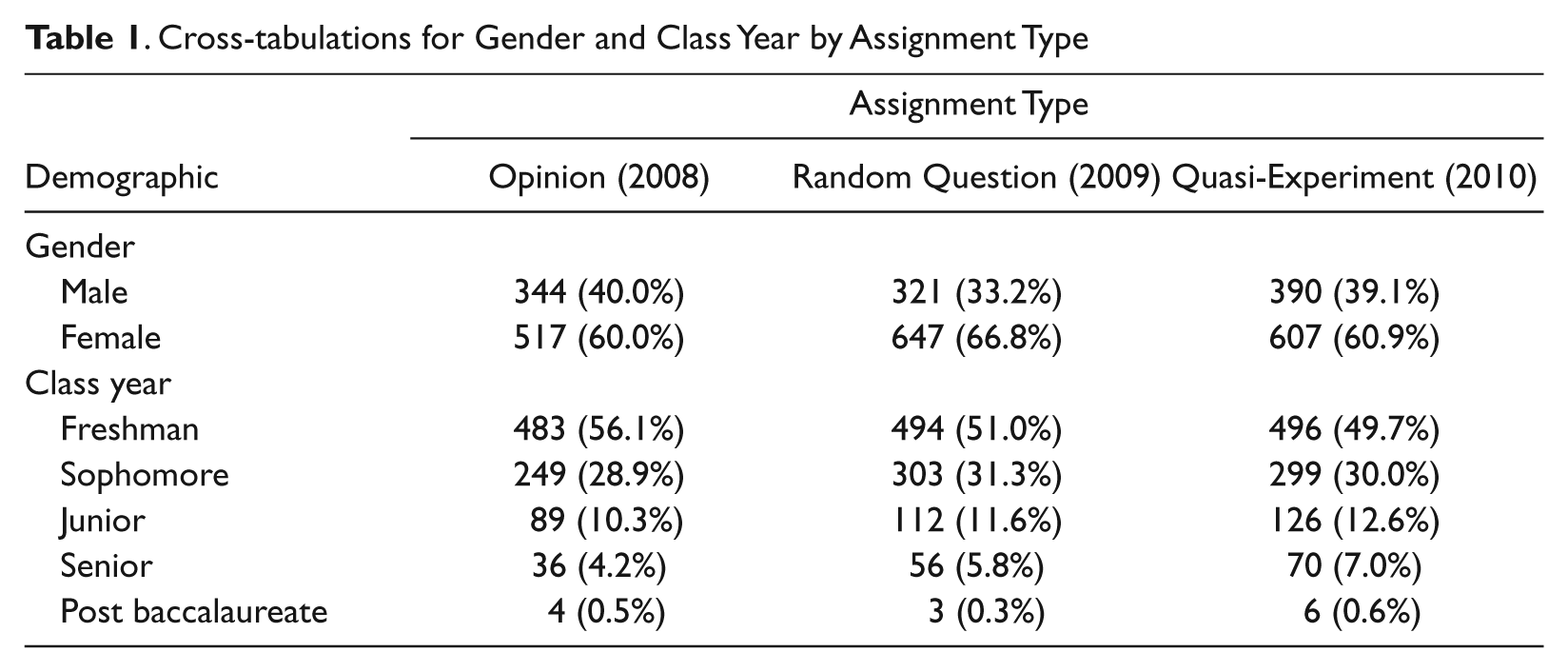
There were 2,826 participants enrolled in Introduction to Sociology classes at the University of Alabama; all were taught by the same instructor. The university has a student handbook that describes a student honor pledge where students promise not to be involved in cheating, plagiarism, or misrepresentation of their work. For plagiarism, academic misconduct will be dealt with at a departmental level. For repeat offenders, a department will send a student to the dean’s office, who may report a guilty finding to central administration. Anecdotal evidence within the College of Arts and Sciences showed that the dean’s office most often sent a student back to the faculty member and requested a new assignment for the student to complete in lieu of getting a reduced grade. However, in more severe cases, the student will also be sent to a campus writing center to learn about proper citation styles. The class sizes for this study were 861 students in fall 2008, 968 in fall 2009, and 997 in fall 2010. Participants included 1,055 (37.3 percent) males and 1,771 (62.7 percent) females. There was a marginally significant difference in student enrollment by gender across the years, χ2(2) = 11.09, p < .01, due to a slight (6 percent) increase in females in 2009. The 2008 participants included 483 (56.1 percent) who were classified as freshmen, 249 (28.9 percent) as sophomores, 89 (10.3 percent) as juniors, 36 (4.2 percent) as seniors, and 4 (0.5 percent) as post baccalaureate. The 2009 participants included 494 (51.0 percent) who were classified as freshmen, 303 (31.3 percent) as sophomores, 112 (11.6 percent) as juniors, 56 (5.8 percent) as seniors, and 3 (0.3 percent) as post baccalaureate. In 2010, participants included 496 (49.7 percent) who were classified as freshmen, 299 (30.0 percent) as sophomores, 126 (12.6 percent) as juniors, 70 (7.0 percent) as seniors, and 6 (0.6 percent) as post baccalaureate. There was no significant difference in class standing in college, χ2(8) = 14.31, p > .05 (see Table 1).
Cross-tabulations for Gender and Class Year by Assignment Type
Procedure
The participants submitted weekly written one-page assignments partially to fulfill requirements for a hybrid Introduction to Sociology course. The researchers obtained permission to use three semesters of archived data from the Institutional Review Board of the University of Alabama to examine students’ papers to identify potential plagiarism. Students in each semester were provided identical instruction regarding the academic integrity policy of the university in the class syllabus; no changes to the policy were made during the study. The results of the study were not used for grading purposes.
Three weekly assignments were randomly chosen from each semester, and the same week was used for all three semesters. Accordingly, the 2008 student population generated 1,429 submitted papers, 2009 generated 1,588 submitted papers, and 2010 generated 1,614 submitted papers, for a total of 4,631 submitted papers.
Dependent Variables
The Turnitin plagiarism detection system was used to operationalize plagiarism. The detection system compares submitted papers to the ones from its database and provides a report that indicates the percentage of similarity between the two and categorization based on the possible source of the overlap. In brief, Turnitin functions in the following way: Once a text is uploaded to Turnitin’s system, the software provides an originality report. The report provides an overall percentage of the student’s text that matches sources within the database and indicates the level of match with a percentage score. Turnitin reports four categories of overlap, based on the source of the material with which it is found to overlap: overall overlap, Internet overlap, publication overlap, and student paper overlap.
Turnitin’s system reports originality scores using ranges: 0 percent, 1-24 percent, 25-49 percent, 50-74 percent, and 75-100 percent. However, for the purpose of this study, researchers created a separate group for the papers that scored 100 percent to form an individual group to test for complete plagiarism. Thus, the groupings used in this study were 0 percent, 1-24 percent, 25-49 percent, 50-74 percent, 75-99 percent, and 100 percent. These groupings were also collapsed at a second step in the analyses, grouping them as no overlap (0-24 percent) versus likely overlap (25-100 percent).
Independent Variable
The independent variable for this study was the type of essay, which varied across the three semesters. The goal was to analyze how the type of essay assignment influenced plagiarism. The first assignment type (2008) was designed to elicit students’ opinions in relation to the sociological concepts presented in the textbook. The second assignment type (2009) used different randomized questions within the assignment; that is, questions were assigned randomly by the computer to prevent students from receiving the same questions (Batane 2010; McCord 2008; Sutherland-Smith 2008). These questions centered on textbook content, and references to the text were required. The third assignment type (2010) consisted of assignments requiring application of concepts and personal involvement with the material (Batane 2010; Howard and Davies 2009; Sutherland-Smith 2008). These assignments involved students conducting mini-sociological quasi-experiments and then analyzing the data using sociological concepts and theories from the textual material. References to the text were required.
Analyses
Analyses were performed using SPSS for Windows Version 19 (SPSS). Frequencies and percentages were used to describe the data, and a chi-square test for independence was used to assess whether there were differences in percentages of plagiarism by assignment type.
Results
Table 2 displays the cross-tabulation of submitted paper overlap across the three assignment types reporting cell counts and column percentages. Overlap of some sort (1-100 percent) was identified in 34.2 percent of the opinion assignment used in 2008, 65.1 percent of the randomized question assignment used in 2009, and 65.9 percent of the sociological quasi-experiment assignment used in 2010. A chi-square test for independence was conducted to determine whether there was a relationship between the assignment types and overall overlap, that is, whether the distribution of overall plagiarism differed across assignment types. Results indicated a significant relationship between these variables, χ2(10) = 523.2, p < .001, such that there were greater percentages of overlap in the randomized question and in the sociological quasi-experiment than in the opinion assignment. Table 2 also showed similar results, χ2(2) = 172.9, p < .001, when publication overlap was grouped as 0-24 percent versus 25-100 percent. There was substantially less overall overlap for assignments when students were asked to write their “opinions.”
Cross-tabulations for Percentage of Overall Overlap by Assignment Type
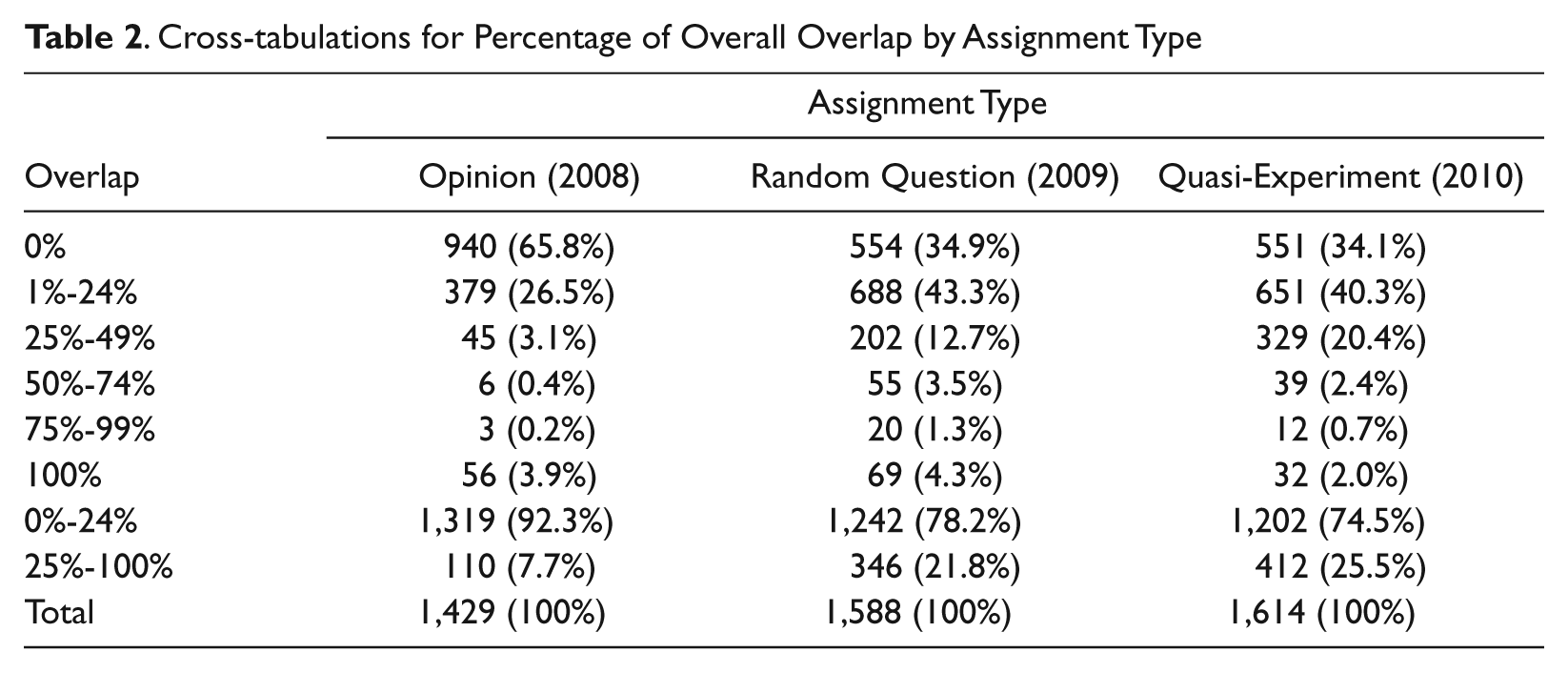
Table 3 presents the cross-tabulation of submitted assignments categorized by Turnitin as having overlap from publications. A chi-square test for independence was conducted to determine whether there was a relationship between assignment type and percentage of publication overlap, that is, whether the distribution of overlap of publications differed across assignment types. Results of this analysis indicated a significant relationship between the variables, χ2(10) = 200.1, p < .001, as publication overlap was more likely to be found in the randomized question and the sociological quasi-experiment compared with the opinion assignment. When we grouped the data as 0-24 percent versus 25-100 percent, the results indicated a significant relationship, χ2(2) = 52.0, p < .001, such that more overlap was generated by the randomized question compared with the opinion or quasi-experimental assignment, which both produced no overlap.
Cross-tabulations for Percentage of Publication Overlap by Assignment Type

Table 4 displays the cross-tabulation of submitted papers categorized by Turnitin as having overlap from Internet sources. A chi-square test for independence showed that there was a relationship between assignment type and percentage of Internet overlap, χ2(10) =453.0, p < .001, with higher overlap in the randomized question and sociological quasi-experiment compared with the opinion assignment. Comparing the 0-24 percent category to 25-100 percent, we found a significant relationship, χ2(2) =. 100.9, p < .001, with more overlap generated by the randomized assignment than in the opinion or sociological quasi-experiment assignments.
Cross-tabulations for Percent of Internet Overlap by Assignment Type
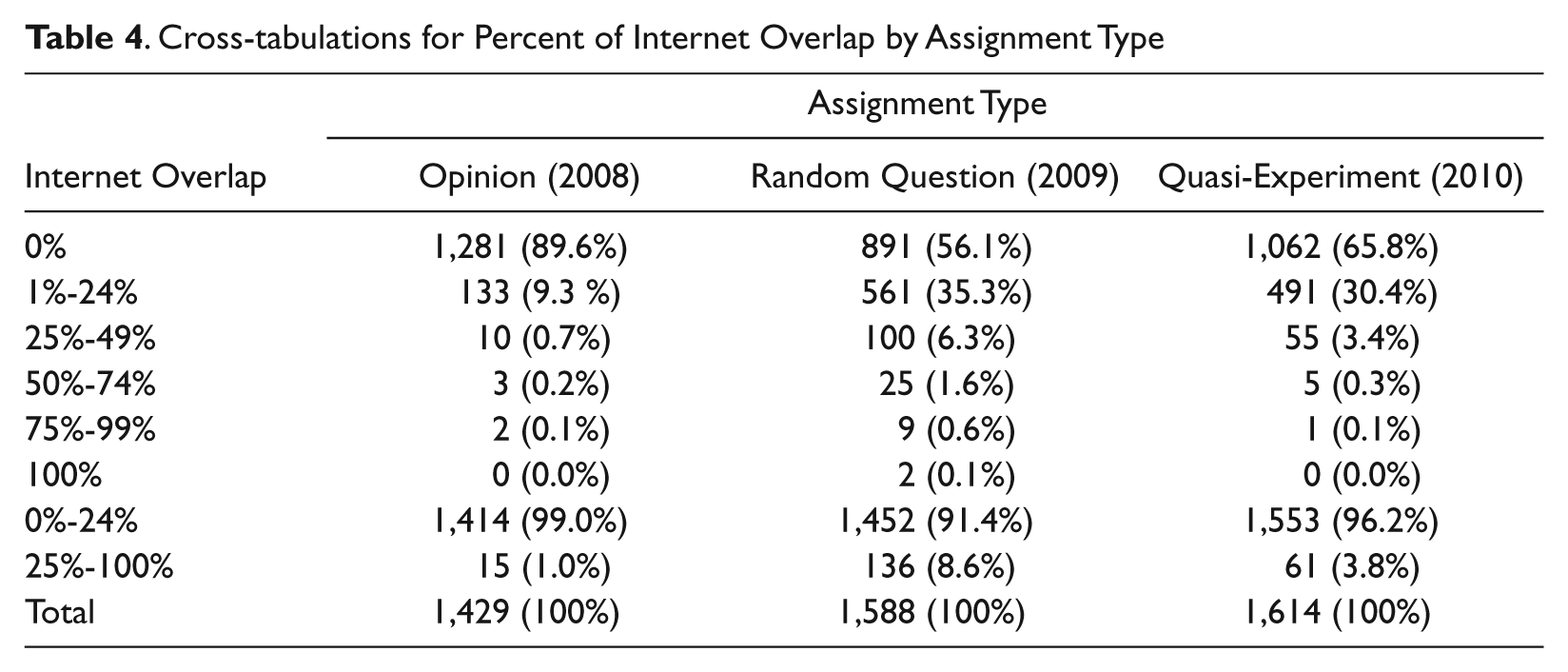
Table 5 reports the cross-tabulation of assignments categorized by Turnitin as having overlap from student papers. A chi-square test for independence found a significant relationship between assignment type and percentage of student paper overlap, χ2(10) = 498.8, p <.001, with higher overlap in the randomized question and sociological quasi-experiment assignments compared with the opinion assignment. When the categories were collapsed as 0-24 percent versus 25-100 percent, we found a similar significant relationship between these variables, χ2(2) =166.4, p < .001, such that the sociological quasi-experiment and the randomized questions produced more overlap than the opinion assignment.
Cross-tabulations for Percent of Student Paper Overlap by Assignment Type

Discussion
This study used archived writing assignments from a large Introduction to Sociology course to evaluate how the design of the written assignment was related to the extent and type of plagiarism in student work. The analysis of results from the Turnitin plagiarism detection system very clearly showed that plagiarism varies by the design of the assignment. By implication, instructors can prevent plagiarism by designing writing assignments to discourage it.
Consistent with prior literature, less plagiarism was found when students were asked to write their opinions in their own voice. Nonetheless, we found that students still do copy or plagiarize from other students’ opinions, confirming that it would be useful to keep electronic copies of students’ work from semester to semester (Van Gundy et al. 2006) even if notes were expected to be unique (Pedersen 2010).
The type of assignment also affect the type of overlap that will be found. The results of this study showed that randomized question sets were most likely to yield publication overlap. It should not be a surprise to instructors that when students were asked to document their answers using source publications, students’ papers run through Turnitin software had higher percentages of publication overlap. The Turnitin software, in many cases in the 1-24 percent range, probably identified false positives on plagiarism as students drew from published sources (the textbook) to support their cases. The questions really were, first, how much citation is enough citation and, second, at what point does overlap of sources constitute plagiarism. Gillis and her colleagues (2009) remind us that high percentages in overlap results are troubling but that these overlaps are a hint that many students are making an effort to cite published works. As such, it shouldn’t be too much of a surprise to faculty that plagiarism of publication sources was found most often in this study when the instructor required citation of sources. The Turnitin software identified a relatively large number of false positives in the 1-24 percent category, but nearly one in five of these students submitted work that a more conservative measure of overlap (25-100 percent) would classify as potentially serious plagiarism. Based on these findings, we suggest that instructors better prepare students to understand proper citation of publications in order to avoid plagiarism. For smaller classes, submission of cited work to the instructor would assist in providing formative feedback to students learning effective citation. For larger web-based classes, formative feedback may be assisted by plagiarism detection systems. These systems have an option to give students the opportunity to view their original report, rewrite, and then submit their work to the instructor. If a problem or question arises, the instructor can provide formative feedback to the student. Instructors can then follow the paper trail and work systematically to evaluate whether students learn from their experiences (Van Gundy et al. 2006).
Looking at the use of Internet sources on assignments, we observed that overlap using Internet sources was an insubstantial issue when students were asked to submit their own opinions. However, potential plagiarism using Internet sources was prevalent in almost 1 in 10 assignments when students were asked to document sources. It was also present, but less common, when students were given access to a published source and then asked to apply sociological concepts to their own experiences. These results on plagiarism using Internet sources are consistent with the growth of the Internet and technology-driven courses, as students will be more likely to use publication sources from their classes using Internet-based materials (Maruca 2005).
The most prevalent form of plagiarism found in this study was students plagiarizing material from other students. Plagiarism using published sources and Internet-based sources occurred, but the relative prevalence of these kinds of overlap was considered to be low compared with student-to-student overlap. Technology using web-based instruction can facilitate interactive and collaborative learning (Van Gundy et al. 2006), but it also enables sharing of materials. Active and collaborative learning is a desired goal for enhancing student learning outcomes with proven success in statistical and methods courses (Van Gundy et al. 2006), sociological theory (Pedersen 2010), and many other areas (e.g., Parameswaran and Devi 2006). The critical issue is how to enhance the learning experience with greater participation in large classes (e.g., clickers; Mollborn and Hoekstra 2010) while maintaining academic integrity.
The results of this study showed that asking students to think critically may lower the incidence of plagiarism, generally, on weekly assignments. Simply asking students for their opinions does not prevent plagiarism. It is no surprise that in the randomized question and quasi-experiment assignments, when students were required to provide sources to support their arguments, issues of proper citation and potential plagiarism came into play.
Commercialization and Computer Technology: Implications for Faculty
When using plagiarism detection software to investigate rates of plagiarism, faculty should work with their students to minimize textbook referencing or allow for a small increase of overlap percentage. As noted in this study, overlap rates appeared to increase overall until one evaluated the assignment design (i.e., textbook referencing), which is not accounted for within the detection software. Since detection systems are unable to distinguish proper referencing, false positives occur. Therefore, faculty should use plagiarism software as an initial mode of assessing student plagiarism and should not use it as the final determining factor.
Previous research suggests that use of the Internet contributes to higher rates of plagiarism (Lovett 2009; Scanlon 2003). In this research when we compared publication overlap and Internet overlap, Internet overlap scores were substantially higher. Internet overlap was most prevalent on randomized assignments where students were required to provide documentation of a source, less common when students were asked to apply a sociological concept to their own experiences, and quite rare when students were simply asked to state their opinions. Interestingly, Internet access for assignments did not lead to high levels of plagiarism using published sources.
Contributing to the problem of Internet overlap was the ease of cut-and-paste technology and easy access to Internet-based sources including papers from students worldwide. Although many faculty rotate assignments from year to year or rotate assignment types within large classes, structuring assignments around current events would minimize plagiarism. Ideally when teaching large courses, faculty will also incorporate quasi-experiments that require application of material to a personal example or an individualized example.
Limitations
In the current study, we found that assignment design influences both the types and extent of plagiarism. A potential limitation of the findings is that we only examined students’ writing assignments from very large classes at the University of Alabama. To some degree, as classes become larger, the time and effort necessary to monitor overlap increase. It is also just as likely that for smaller classes, assignment design might not mitigate plagiarism, because instructors in small classes can more closely monitor assignments and are more likely to be able to mentor students to cite materials more effectively in their assignments.
Electronic plagiarism checkers are imperfect tools for identifying plagiarism (Gillis et al. 2009). We mention the issue of false positives at several points in our study because electronic plagiarism tools such as Turnitin may not include references to textbooks and because the extent of overlap does not indicate a student’s inability to properly reference a source. We sought to control for false positives in identifying plagiarism by comparing different ranges of overlap as potential measures of plagiarism (e.g., 0 percent versus 0-24 percent). Setting a benchmark of “zero” overlap would be overly stringent, generating many false positives, because even the smallest repetition of a phrase or restatement of an aspect of the assignment in the student’s submission would generate a warning of potential plagiarism. Using 0 to 24 as a benchmark meant that up to one-quarter of a student’s written submission could be common to other sources before it was classified as potential plagiarism. Instructors may wish to raise (or lower) the cut-point for their benchmark depending on their knowledge of the abilities of their students and the type of writing assignment the instructors choose to design.
In addition, although students were informed about the student honor pledge, it is possible that plagiarism may have been better deterred if students had been told the software was going to be used. The assignments for this study were not originally designed to prevent plagiarism or to be analyzed using Turnitin. The weekly assignments chosen for this study were run through Turnitin after completion of the semester for instructor evaluation. Since this study was focused on providing empirical data for assignment designs and not on teaching proper citation, students were not given the option of viewing their original reports and resubmitting work. If the course is a writing course, this option may be ideal for teaching proper citation. In future research, it would be interesting to see how and whether students change their writing when they are told by an electronic detector that potential plagiarism exists.
Conclusions
Since responsibility for preventing plagiarism is being shifted predominantly to faculty (Van Gundy et al. 2006) and class sizes continue to expand, it is imperative that assignment designs be reevaluated. It is not enough to ask opinions, randomize questions, or conduct quasi-experiments. These strategies when independently applied in this study still indicated that one-third of submitted papers showed overlap. Therefore, several strategies must be incorporated simultaneously in each assignment to mitigate plagiarism.
As the trends toward increased computer technology use and the commercialization of higher education continue, faculty must prepare assignments for this generation of students. Recycling assignments or avoiding the Internet revolution is no longer an option for faculty. Although it is important to know why students will cheat, copy, or plagiarize (Brezina 2000), faculty must also recognize that they can design writing assignments to mitigate plagiarism. Assignment design influences how students will collaborate, share, and learn concepts. This is especially true in the current educational environment where computer technologies and the commercialization of higher education play a large role in institutional response. With increased use of the Internet as a resource by students, instructors increasingly rely on plagiarism detection systems in order to be effective educators in higher education. Nonetheless, faculty still have ultimate responsibility for the design and types of assignments to prevent plagiarism.