




Abstract
Although images are often used in the classroom to communicate difficult concepts, students have little input into their selection and application. This approach can create a passive experience for students and represents a missed opportunity for instructors to engage participation. By applying concepts found in visual sociology to techniques identified in the scholarship of teaching and learning, I created an image-based learning model to address this disconnect. I used discussion board image selection, posting and critique exercises (image-posts), and personal meaning maps (PMMs) as core assignments. This combination increased student comprehension, challenged and altered perceptions of key topics, and gave them a greater sense of agency through reflexive learning. Additionally, students’ reception of this model was favorable, with 97 percent reporting that the course met or exceeded their expectations and 95 percent reporting that they learned more in this class than in any previously taken college-level course.
Images can effectively illustrate difficult or challenging subject matter (Wetzel et al. 1993), making them ideal tools for postsecondary instructors. Indeed, images are increasingly used to communicate course concepts, though this is often done in a limited capacity. For instance, using PowerPoint as a lecture aid may be an intentional move by instructors to increase student engagement, but this intentionality may not extend to a consideration of the quality and content of images in an assigned text. Importantly, in both of these examples, the instructor (intentionally or unintentionally) selects the visuals students are exposed to without student input and often without a clear understanding of how students interpret these visuals. This approach can create a passive experience for students and represents a missed opportunity for instructors to engage participation.
Visual sociologists have long been interested in the use of images and tactile representations and how individuals make meaning from them. Broadly speaking, visual sociology is the process of incorporating viewable components into data gathering and analysis procedures (Burri 2012; Cipriani 2012), an approach that fits nicely when investigating the use of images in the classroom. For instance, techniques such as photo elicitation can be used to gather visual representations of cultural phenomena in an attempt to draw together information about a target population. Many visual sociologists ask populations to describe these images so that the meaning remains connected with the culture in which they are situated. These same tools and techniques can be used in the classroom to identify student comprehension of course materials. In this study, I demonstrate that when students are required to select and critique images that relate to course content, they are able to connect their understanding of key concepts, apply class materials, and use their situated cultural context in a way that encourages engagement. I used techniques outlined by Clark-Ibanez and Scott (2008), combined with current research on discussion-based learning and concepts from visual sociology, to develop an image-based learning model adapted to an online Youth and Society course.
I had three research goals in designing and implementing this study, which aligned with the learning outcomes for the course. First, I wanted to identify if a visual sociological approach could be used to increase comprehension (goal one: comprehend). To accomplish this task, I selected two image-based learning techniques to be implemented as course assignments: a modified personal meaning map (PMM) and discussion board image selection, post, and critique exercises (image-posts). Second, given that this was a Youth in Society course, I wanted to assess how students’ understanding of youth changed during the term and if they were able to examine visual images of youth using course concepts (goal two: examine). Finally, I wanted to understand how students would respond to the use of image-based learning techniques and assignments; specifically, whether they found the assignments effective and whether they were engaging in reflexive learning (goal three: self-reflect).
Social Context of Image-Based Model Application
The image-based learning model was applied to an undergraduate junior-level online Youth and Society course taught for seven weeks during the summer of 2011 in the Department of Sociology at Michigan State University (MSU). A total of 110 students participated in my course; however, 4 students (3.6 percent) opted not to have their work used in this analysis, for a sample of 106 students (96.4 percent). There were no prerequisites for this course, so students came from a variety of disciplines and majors. The majority of students were social science majors (73.5 percent) and had completed about three years of college, though only 3 students (2.8 percent) were sociology majors. On average, students had previously taken at least three online courses. Thirty-eight students (35.8 percent) identified as male and 68 identified as female (64.2 percent). Seventy students identified as white (66 percent), 22 as black (21 percent), 8 as Asian (7.5 percent), and 6 (5.5 percent) as multiracial or other.
Course Design and Application
The course was taught entirely online and required students to have regular Internet access. The three research goals listed previously were used to assess if students met the learning outcomes for the course. The learning outcomes were:
acquire an understanding of key concepts related to youth (outcome one: comprehend);
examine critically the position of youth in society by applying sociological concepts to text, multimedia, and visual imagery (outcome two: examine);
recognize their own development through engagement in reflexive learning and self-evaluation (outcome three: self-reflect).
Two youth-related themes were covered each week, which included: theory and identity; race, ethnicity, and family; gender and sexuality; education and work; delinquency and health; technology and postmodern identity; and revolution and social movements. I assigned readings from the course textbook, Youth and Society: Exploring the Social Dynamics of Youth Experience (White and Wyn 2008), and supplemental chapters from Youth Subcultures: Exploring Underground America (Greensberg 2007); Goths, Gamers, & Grrrls: Deviance and Youth Subcultures (Haenfler 2010); and Generation Me: Why Today’s Young Americans Are More Confident, Assertive, Entitled and More Miserable Than Ever Before (Twenge 2006). Each theme also had a corresponding lecture with an interactive feature, including: short videos, music, art, guest presenters (video), recordings, and links to interactive websites.
Course grades were based on five components: image-posts (35 percent), weekly quizzes (20 percent), a cumulative final exam (15 percent), pre- and post-course surveys (15 percent), and pre- and post-course PMMs (15 percent). Weekly quizzes and the final exam were graded for correct answers. The surveys and PMMs were not graded for accuracy; students were given credit for completion, half credit if they only completed one. Image-posts were graded based on a rubric adapted from A Revision of Bloom’s Taxonomy of Educational Objectives (Anderson and Krathwohl 2001). I completed all of the grading with help from a graduate teaching assistant. The image-post rubric is featured in Figure 1. Student image-posts were also graded for mechanics and the use of relevant sources.
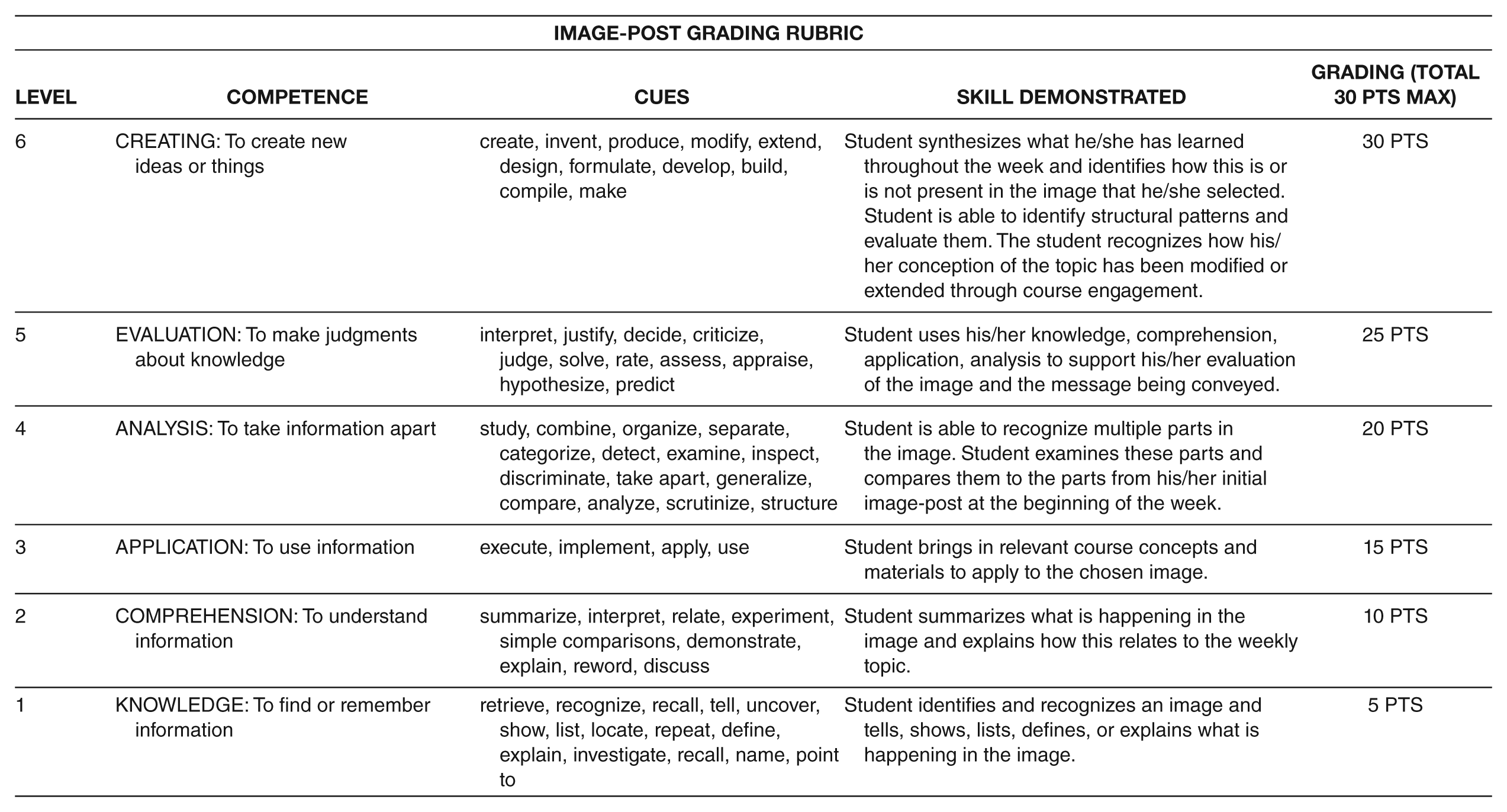
Image-post grading rubric.
On the first day of class students were required to take a pre-course survey, complete a PMM, and submit an image that represented their understanding of youth to the discussion board. Not only did these assignments serve to establish students’ baseline understanding, but they also provided an introductory, low-stakes task to enhance the learning experience and establish a discussion board community (see e.g., Tu and Corry 2003). Students were also asked to complete these three tasks again during the final week of the course. I followed Institutional Review Board–approved procedures and obtained informed consent from students for the use of their survey responses, assignments, and grades. Additionally, all student materials, including grades, surveys, and assignments, were given a randomly generated identification number so that names would not be associated with individuals.
Personal Meaning Map Application
A visual tool that has gained attention in teaching and learning is concept mapping, which originated in the natural sciences in the 1980s (Novak and Gowin 1984) and has roots in Ausubel et al.’s theory of meaningful learning (Ausubel, Novak, and Hanesian 1978). Broadly, the goal of concept mapping is to organize and document relationships among concepts. While the use and application of concept mapping in the classroom is varied, concept maps have been recognized as a teaching tool that not only increases comprehension (Hall, Hall, and Saling 1999) and improves test performance (Hall and O’Donnell 1996), but also boosts cooperative learning (Patterson, Dansereau, and Newbern 1992). Yen, Lee, and Chen (2011:310) explain that “The process [of concept mapping--> includes observation, identification and capturing, followed by cognitive elaboration through comparing, selecting, hierarchically classifying, combining and arranging photos using concept mapping to achieve the objectives of concept learning.” The combination of text and images further solidifies understanding since material is presented in different formats (Paivio 1991).
A variant of the concept map is the personal meaning map (PMM), developed for museum learning by John Falk of the Institute for Learning Innovation (Falk 2003; Falk and Dierking 1992, 2000; Falk and Gillespie 2009; Falk, Moussouri, and Coulson 1998). The purpose of the PMM is to establish how individuals think about and organize their thoughts around a particular topic. Often PMMs are used as pre- and post-intervention tools (e.g., Leinhardt and Gregg 2002; Morine-Dershimer 1993). Prior to engaging in an intervention, students are given a sheet of paper with a short (one- to three-word) prompt placed at the center. Individuals are then asked to write or draw anything that comes to mind in relation to the word(s). In contrast to traditional concept mapping, there is no right or wrong answer. The use of pre- and post-course mapping can demonstrate how the organization of information has changed after the intervention. Traditionally, individuals are given back their PMM and asked to make changes based on their experiences. However, this application as an assessment technique has received criticism since intervention-based use only establishes short-term changes, rather than long-term modifications in conceptualization (e.g., Kagan 1990; Ruiz-Primo and Shavelson 1996).
I wanted to overcome this shortcoming by using PMMs as pre- and post-course reflexive assessments in the classroom. For the purpose of this study, students were given a blank sheet of paper with the word youth in the center and asked to “write or draw anything that comes to mind when thinking about this term.” Because this was an online course, students were given the option of completing the PMM in one of three formats: Word, Powerpoint, or PDF. Students uploaded completed PMMs to an online drop box. At the end of the semester, students were asked to fill out a new PMM, which was then compared to the first PMM as a means to identify changes in students’ thinking around the concept of youth. Although this is a slight change from the suggested use, it is a significant one. By expanding the time between the initial and final PMM, and by requiring students to do a second PMM instead of simply altering the first one, it is possible to evaluate changes in use and recognition of key concepts. To return their first PMM rather than requiring them to do a second one restricts student creativity. For instance, if a student wanted to make large changes to the arrangement of words or include a number of additions in a post-course PMM this process would be limited by the structure and layout of the student’s first PMM. Additionally, students were encouraged to compare their first and second PMMs and reflect on their own development.
Discussion Board Image Selection, Post, and Critique Application
Discussion boards have achieved a prominent place in secondary education. Wang and Gearhart (2006) found that very little information (5 percent) is retained from lecture, whereas peer interaction increases retention rates significantly. Benefits are also generated from peer collaboration and collective learning; this suggests that the format of class discussion is central to creating engaging communities (Persell 2004). Following Clark-Ibanez and Scott’s (2008) suggestions for online teaching, students were broken up into online discussion groups with 10 students in each group. This was also done to minimize passive posting in discussion forums.
Before engaging in class activities each week (readings and lectures), students were asked to find an image that related to the week’s topic and post it to their discussion board with a 250-word minimum description and proper citations. Students were discouraged from posting material that could be considered offensive, threatening, or pornographic. The image could be photographic or artistic, generated by the student or from an outside source with proper citation credit. During weeks two through six, students were asked to find a new image of the same week’s topic and to write a short paragraph (250-word minimum) using class concepts introduced during the week to describe their post-week image-post, while also critically evaluating their pre-week image-post of the same topic. Because not all of the class themes could be covered with image-posts during the seven-week period, students were required to make posts on the following five topics in relation to youth: family, homelessness, education, health, and technology. This constituted 10 image-posts, completed during weeks two through six. Additionally, students selected an image to represent their understanding of youth during week one and again during week seven. This particular analysis will only focus on week one and week seven image-posts of youth.
Available Data
Discussion Board Image Selection, Post, and Critique Data
Throughout the course students were instructed to do 12 image-posts. If students had completed all required posts, 1,272 image-posts would have been submitted. While my students did not complete all posts, 1,165 image-posts were submitted for a 91.5 percent completion rate. This demonstrates that students were actively involved in this component of the course. Nearly all students (98.1 percent) completed both the week one and week seven image-post for a total of 208 images. The accompanied text for all week one and week seven images of youth was coded and assessed to identify the evolution in student perceptions of the term.
Personal Meaning Map Data
A total of 95 students (89.6 percent) completed both the pre- and post-course PMMs and chose to have them used for data analysis. I used a variation of content analysis methodology to identify a coding and analysis procedure for all words and images listed on the PMMs. I predetermined 10 themes based on concepts covered in the course, which included: education, relationships, work/class, delinquency, health, gender/sexuality, technology, race/ethnicity, politics/social movements, and identity. Words and images that did not fit into one of the 10 themes were coded into one of 5 additional categories: age, emotions/characteristics, naïve/carefree, activity/adventure, and social influences. Two graduate students and I independently coded for themes. Differences in coding were discussed until 100 percent consensus could be reached. This is similar to the approach used by others employing PMMs in studies on changes in cognitive perception (e.g., Kalof, Zammit-Lucia, and Kelly 2011).
Survey Data
The pre-course survey involved 10 questions. The selected questions were designed to establish baseline knowledge, assess previous experience with online courses, and determine expectations for the course. The final survey involved 15 questions. Questions were designed to identify changes in student understanding of course concepts, perceptions of course elements, and opportunities for course improvement. In taking the final survey, students were informed that the instructor would not have access to the results until the class had ended. All 106 (100 percent) students completed both the pre- and post-course survey.
Findings
Personal Meaning Map Findings
By analyzing the pre- and post-course PMMs, I was able to identify how course concepts were made front and center for students in their perceptions of the term youth (outcome two/goal two: examine). Data revealed substantial differences between pre- and post-course themes. Table 1 lists the count, percentage, and percentage change of the 15 themes.
Personal Meaning Map (PMM) Themes in Counts, Percentage, and Percentage Change (N = 95)
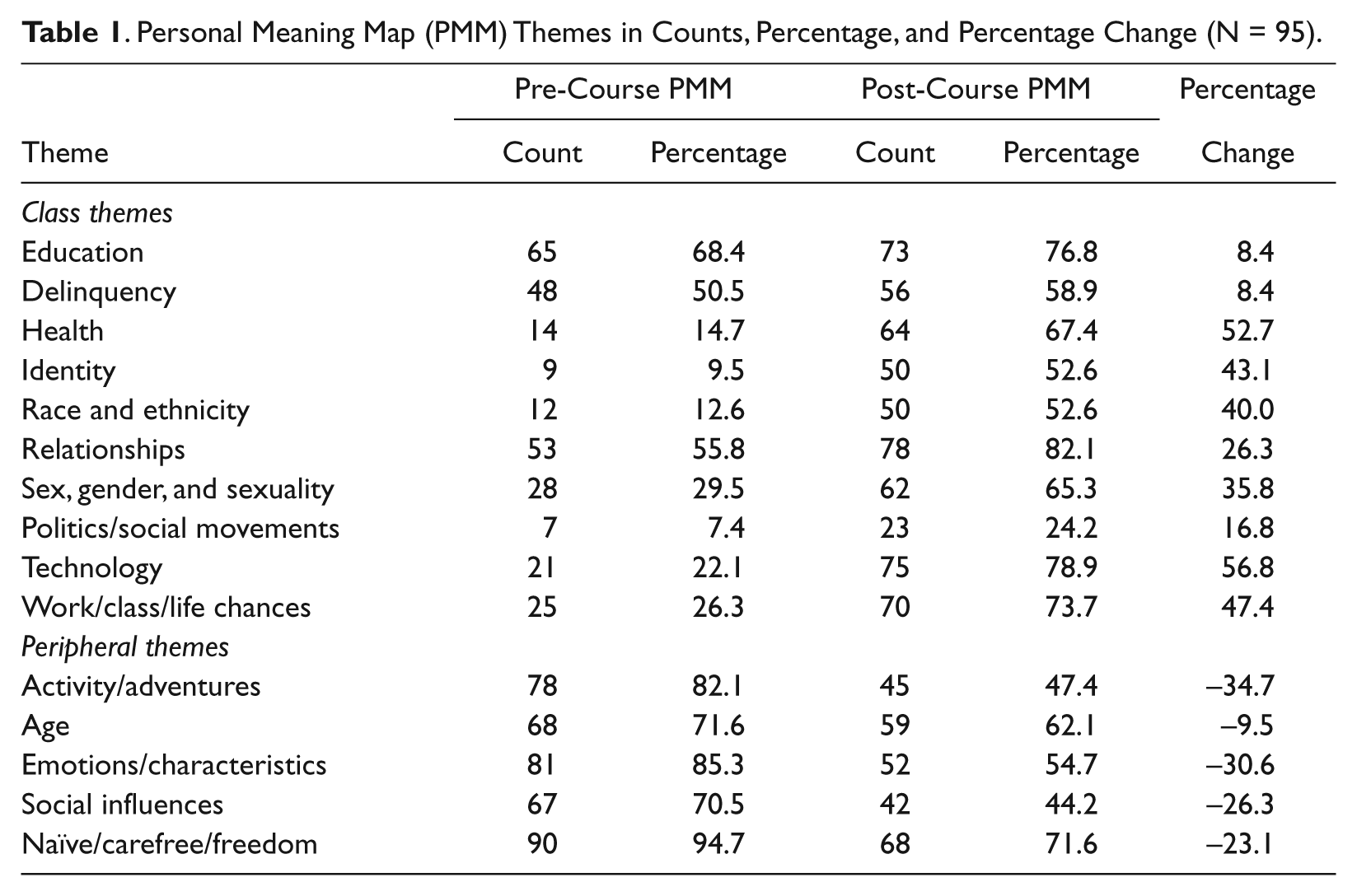
The three most prominent themes that emerged in the pre-course PMMs analysis were naïve/carefree/freedom, which were mentioned by 90 students (94.7 percent); emotions/characteristics, mentioned by 81 students (85.3 percent); and activity/adventure, included by 78 students (82.1 percent). These dominant themes from the pre-course PMMs are reminiscent of a romanticized or idealized view of youth, a theme that also surfaced when assessing the image-posts, which will be discussed in the next section. Alternatively, the three prominent themes for the post-course PMMs were relationships, mentioned by 78 students (82.1 percent); technology, listed by 75 students (78.9 percent); and education, reported by 73 students (76.8 percent). All three of these themes were predetermined extensions of class concepts. The listing of course concepts increased for all 10 thematic categories, with the percentage change ranging from 8.4 percent to 56.8 percent. The listing of the peripheral themes decreased across all five categories. The percentage change ranged from −9.5 to −34.7, with the greatest change in activity/adventure. These findings demonstrate that student perceptions of youth not only changed, but by engaging in the class, course-specific concepts were made front and center in students’ minds.
When asked about their favorite aspect of the course, the majority of students mentioned both image-posts and PMMs. Two themes can be drawn from student responses. First, students mentioned their enjoyment in using the PMMs to track their learning, a demonstration that the PMM assignment assisted in developing reflexive learning skills (outcome three/goal three: self-reflect). For instance, student number 200 reported, “I enjoyed the personal meaning map most because I thought it was interesting to see how my thoughts changed throughout the course.” Second, students took pleasure in the creative component of the assignment. Student number 100 noted, “I enjoyed doing the personal meaning maps the most because it allowed me to think more about the word youth and be creative.” Beyond the application of PMMs for assessing student perception of key concepts, these data indicate that PMMs can be used as reflexive learning tools (outcome three/goal three: self-reflect).
Discussion Board Image Selection, Post, and Critique Findings
Students uploaded a variety of images corresponding to the weekly themes; however, for this article, I have chosen to focus on the pre- and post-course images of youth submitted during weeks one and seven. By analyzing these images and the corresponding text narratives, I can assess how students were able to apply and examine youth in society using sociological concepts (objective two/goal two: examine). Finally, an analysis of the post-course survey gives insight into how students made meaning out of this assignment (objective three/goal three: self-reflect).
Analysis of Week One Youth Image-posts
Similar to the themes from the pre-course PMMs, week one image-posts adhered to a romanticized view of youth. These images included young people engaged in play or among friends smiling and laughing. To describe their images, students used terms like: carefree, happy, freedom, energy, enthusiasm, and innocence. For instance, student number 194 selected an image with shadow youth figures jumping rope. He wrote, “I selected this image because the attribute I think of most when I think of youth is energy and enthusiasm.” Similarly, student number 183 posted an image of young people playing in a park. To describe her selection, she wrote that the people in the image “look carefree and happy, which are qualities I associate with youthfulness. They look to be having fun and simply enjoying themselves and each other, with no worries of work responsibilities or unpaid bills.” Another student, number 182, chose an image of youth laughing. In his narrative he suggested that the image represents youth because “it brings to mind a feeling—a feeling of being carefree, joyous, and full of elation.”
In the image-posts from week one, students rarely mentioned the social and structural challenges such as restricted access to health care, lack of viable work options, and developmental changes faced by youth. Additionally, diversity in ascribed status (race, ethnicity, class, religion, gender, and sexuality) was nearly obsolete, except when a student held a minority status identity and selected an image that represented this identity. An example of this was student number 202’s post, which was an image of a gay teen in a school locker room. To describe this image he wrote, “I myself am homosexual and came out when I was in 9th grade. . . . [It is] being unique, being different, not fitting in, bullying, teasing, suicide, etc. . . . So when I think of youth, teens, adolescents whatever you want to call it, these are things that come to my mind, not being afraid to be who you are.” Related to this, many women noted that their selected image had both men and women, while those who identified as non-white often selected images with multiple races and ethnicities. As is demonstrated with the examples presented earlier, what is largely absent from the pre-course image-posts is any reflexive or critical analysis of the term youth, what this term may mean to different people, how it has been constructed in society, and how the conception of the term has changed over time.
Analysis of Week Seven Youth Image-posts
An analysis of the week seven image-posts of youth demonstrates that students were able to meet or exceed learning outcomes. Meaning that at the end of the course, the majority of students were able to demonstrate comprehension (outcome one/goal one: comprehend), critically examine the term youth using sociological concepts (outcome two/goal two: examine), and reflect on their own learning process (outcome three/goal three: self-reflect).
First, given that this was a sociology course, students were expected to identify and apply sociological concepts to their chosen images. Among concepts and terms listed in post-course image-posts, the most prominent was an understanding of youth as a social construct. Student number 147 writes that the selection of just one image to represent youth is difficult because “youth is a socially constructed label or status and not a biological state of being young.” Furthermore, the majority of post-course image-posts mentioned youth in relation to larger social issues, which included: homelessness, drug and alcohol addition, lack of opportunities in education, work and health care, racism, homophobia, and sexism. For instance, student number 102 selected a cartoon image of a young person growing old living with his parents. The description by the student noted that not all youth have access to the same opportunities and “this image shows the increasing rate of unemployment in our society.” He continued, “race, gender, sexuality, class, culture, sense of community, and society in general contribute [access by youth].”
Another major theme in the post-course submissions was an increased recognition of the social expectations and pressures that young people face. An example of this is found in student number 163’s post. He wrote, “I have now learned that more and more youth are becoming depressed and anxious about the demanding nature of postmodern society. . . . A society increasingly focused on the self may add freedom to the individual, but it also has led individuals to take on more pressure in the quest to stand alone in success.” Another example is found in student number 199’s selection of a pre-course image of 10 young people outside in a circle holding hands playing a game. He described this image, stating that “Youth is not knowing what the future holds, and not really caring what it holds either. . . . It is about having fun. . . . I also tend to associate the word youth with sports.” At the end of the course, the same student selected an image of four young people all with laptops and cell phones. To describe this image he wrote, “Youth are often restricted from the political process due to age. Because of this, social networking and community organizing through the use of digital technology is essential.” He went on to discuss how technology is important for youth as a means to gain access to power. He continued by asserting that access by youth can lead to social movements and political changes, much like what happened in the Middle East during the Arab Spring. Student number 199’s post is only one of the many examples demonstrating not only a change in perception of the term, but also an ability to examine and evaluate the social and political context in which the term is applied.
Second, the majority of students demonstrated an ability to not only identify and examine the term youth, but also to reflect on their conceptual development. By reflecting on their images, students were able to recognize their pre-course image-posts as “romanticized,” “unblemished,” “naïve,” or “pristine.” While self-reflection is seen in a limited capacity in the aforementioned comparison posts, a more direct example is found in the following statement by student number 182: “Before, it [my initial image] was pristine and unblemished, a naive imagining. . . . I feel that this image [post-class image-post] reflects the progression of my understanding of youth as a multilayered concept.” Similarly, student number 129 wrote, “Topics like homelessness, youth and technology, and youth depression brought to light issues that I was aware of, but did not regularly associate with youth culture in general. . . . I simply thought of young people [as] having a good time.”
Over 90 percent of students reported that the use of image-posts helped to solidify their learning of key concepts. Additionally, in the post-class survey, students were asked to list their favorite aspects of the course and the reasons for selecting these aspects. Ninety-nine students (93 percent) listed image-post exercises. Three themes were identified from student responses for why image-posts were their favorite part of the course: ability to be creative, engagement with other students, and instant recognition of learning. In terms of creativity, student number 124 reported, “I enjoyed the picture posts and trying to be creative with the topic given for that week.” Student number 104 extended this sentiment in writing, “I enjoyed the free range on the picture posts, I enjoyed being able to say whatever we want but still incorporating class concepts.” Student assessment of creative freedom is interesting given that the assignment was highly structured and the text narrative was graded using a detailed rubric. However, as many students noted, they have never been asked to identify, examine, and critique visuals related to class concepts.
As is consistent with literature on utilizing discussion boards, students enjoyed the engagement with fellow classmates; an example of this was mentioned by student number 101. She wrote, “I liked posting to our class page and being able to go back and see what other people wrote about my post. It makes me go the extra mile when writing posts because I’m interested in what my classmates think about what I post.” Students did not simply find this an enjoyable activity; they actually made posts and comments to fellow students that far exceeded the required two response posts each week. There is no doubt that the size of the online groups was an added benefit in increasing student participation as students were able to build a small community with 10 other students while taking a large online course.
By a wide margin, students most often identified learning as the reason they regarded image-posts as the best aspect of the course. Students noted that in doing the assignment they engaged in multiple levels of learning and self-reflection. For instance, student number 139 reported, “The assigned posts allowed me to explain what things meant to me and how the week’s lecture clarified my representation of the theme. I think that helped me maintain interest and learn better than reading and tests did.” Student number 130 explained, “I enjoyed the picture posts. It was interesting to learn the course material by reflecting on an image. I thought it was a great idea to have us explore our own thoughts about terms before reading course material and then seeing how we progressed our knowledge after reading the course material.” Students also mentioned that in thinking about the upcoming image-posts for the week they thought about class concepts when engaged in other activities. Student number 137 reported, “I found myself constantly looking for an image that would relate to the class topic. . . . I also had friends and family members interested in the assignments as well.” This particular statement reflects an extension of the proposed learning outcomes, where course materials begin to inform and challenge thinking outside of the classroom.
Conclusion
Burri (2012) argues that sociology has neglected to investigate the visual world, a tendency that is also evident in how sociology is taught in postsecondary environments. While sociological research may largely avoid visuals, visual sociologists assume that visuals denote the values, beliefs, and norms of a particular group of people. Thus, identifying the visual components of a culture is a central mechanism for understanding how people conceptualize social phenomena (Burri 2012; Cipriani 2012). Although research posits that visuals are powerful tools when used in the classroom to present challenging subject matter (Wetzel et al. 1993), visuals are most often selected and implemented into the curriculum by instructors with little student input. This disconnect represents a missed opportunity for instructors to engage student participation and to extend course materials and concepts into the social and visual worlds of their students.
Drawing on literature from the scholarship of teaching and learning and concepts found in visual sociology, I developed and implemented an image-based learning model using image selection, post, and critique exercises (image-posts) and personal meaning maps (PMMs) as course assignments. I had three research goals, which aligned with the course learning outcomes. First, I wanted to identify how a visual sociological approach could be applied to increase student comprehension (comprehend). Second, I was interested to see if students’ understanding of youth changed during the term and if they were able to examine visual images of youth using course concepts. The final goal of the study was to assess student perceptions of the image-based learning model and to determine if students engaged in reflexive learning. Data from the PMMs and image-posts demonstrates that course concepts became front and center as students examined visual representations of youth in relation to various social structures. Overall, students were extremely satisfied with the course. In fact, 103 students (97 percent) reported that the course met or exceeded their expectations, and 101 students (95 percent) reported that they learned more in this course than in any other course previously taken at the college level. Additionally, students were given space to elaborate on their perspective on learning as it related to course activities. For instance, student number 166 wrote, “I liked how much I actually learned. I took the class because it was different and ended up learning a lot more than I expected.” Students also mentioned that the assignment engaged them outside of the classroom as they searched for images in their daily lives and that they enjoyed the structure, creative nature, and “real world” application of the course.
Although the image-based learning model could be applied in a traditional face-to-face classroom, it was piloted in an online course. By applying the model to an online course, I was able to demonstrate that the image-based learning model can help enhance student interaction even in a constrained, online environment. Additionally, this application is critical, as universities are increasingly using online instruction as a long-term strategy to deal with budgetary constraints (Thompson 2004). Roughly 5.6 million students were enrolled in an online course in 2009, which is an increase of nearly 1 million over the previous year (Allen and Seaman 2010). With a growing share of the education market directly connected to technology, there is greater need to assess how technology impacts learning (Benson et al. 2002). Heeding this call, informed scholarship on teaching and learning has examined the benefits and challenges of online instruction (e.g., Clark-Ibanez and Scott 2008), recommended the use of discussion forums (e.g., Clark-Ibanez and Scott 2008), and encouraged the incorporation of blogs (Pearson 2010). While studies have identified the potential of a variety of tools for online education, none have examined how a visual sociological perspective can be used as an integral part of course development. Not only was this structure an excellent platform to teach undergraduates, but it is also applicable to a variety of disciplines and could be broadly implemented in most courses.
Footnotes
Acknowledgements
The author would like to thank the 2011-2012 Future Academic Scholars in Teaching (FAST) Fellows, CIRTL Steering Committee, MSU Animal Studies, Eleanor Hubbard, Natasha Hubbard, Melanie Bowers, Kathleen S. Lowney, and the anonymous reviewers from Teaching Sociology for their helpful comments on earlier drafts.