




Abstract
Effectively teaching sociological theories to undergraduate students is challenging. Students often enroll in theory courses due to major requirements, not personal interest. Consequently, many students approach the study of theory with anxiety. This study examined the effectiveness of an experiential learning activity designed to teach Karl Marx’s theory of alienation. Based on pretest/posttest surveys, responses to open-ended questions, and observational data, students reported that the activity helped them gain a clearer understanding of Marx. They also reported finding the activity interesting, enjoying being able to apply theory, and being able to see how Marx’s theory related to real life. Assessment data revealed that students were confident in demonstrating their understanding of Marx’s theories on assignments but not always effective in doing so. The findings contribute to literature on active and experiential learning techniques as successful methods for teaching abstract sociological concepts.
Students in undergraduate sociological theory classes are often not there by choice and may regard the content as obscure, irrelevant, and difficult. Many students are apprehensive about theory curricula owing to dense readings, dated and unfamiliar content, and possibly their own lack of interest. They may dread taking theory courses and enter them with anxiety (Holtzman 2005; Lowney 1998). These preconceived notions present challenges for instructors. In response, some scholars recommend approaches that center on more active or applied learning to successfully teach theory (Holtzman 2005; Pedersen 2010).
Active learning includes methods of teaching that use experiential techniques that require students to “do” as they learn. These techniques involve students in learning in ways that go beyond cognitive processes. Through experiential learning exercises and activities, students physically and psychologically engage with the content in ways that invoke material and visceral engagement (Wills, Brewster, and Fulkerson 2005). These activities require that students actively participate in their own learning, and the success of experiential learning has been documented in different disciplines (e.g., McClanahan and McClanahan 2002).
Within sociology, research has shown the effectiveness of different types of experiential learning techniques. For example, Grauerholz and Bubriski-McKenzie (2012) documented students’ abilities to examine the ways their consumption habits related to broader social contexts. In another study, Edwards (2010) found that having students paint and wear nail polish helped them to make connections between gender expectations and homophobia. These applied techniques can also be used to teach content that students believe is less relatable, such as classical sociological theory. In one case, Lippmann and Aldrich (2003) used observational field exercises to illuminate Max Weber’s theory of rationalization. Another study by Hoop (2012) demonstrated how asking students to go on a “technology fast” enabled them to understand classical theory concepts. Like the present study, Parrotta and Buck (2013) conducted an experiential activity to teach Marx’s theory of alienation. They designed an exercise that directed students to labor under predetermined conditions. They measured students’ ability to distinguish between alienated and nonalienated labor and found that their mock work activity increased students’ abilities to understand Marx’s theory.
In undergraduate social theory classes and introductory sociology classes, students can expect to encounter Karl Marx’s theory of alienation, as conflict theory is a foundation of classical theory that remains present in contemporary studies. This article presents research on the effectiveness of an experiential learning activity—working in a simulated factory—in teaching Marx’s theory of alienation. Based on pretest/posttest surveys, responses to open-ended questions, and observational data, students reported that the activity helped them gain a clearer understanding of Marx. They also reported finding the activity interesting, enjoying being able to apply theory, and being able to see how Marx’s theory related to real life. Assessment data somewhat support these findings. This research contributes to literature on active and experiential learning techniques as effective methods for teaching abstract sociological concepts.
Application of the Activity
Students in an undergraduate sociological theory class at a small liberal arts college were assigned to read Marx’s essay, “Estranged Labour,” which outlines his theory of alienation under capitalism (Marx [1844] 2010). The second author, an undergraduate student, designed an activity to illustrate Marx’s theory for an assignment to lead part of the first author’s class. The first author thought the activity was successful and invited the second author to co-design a research study to measure its effectiveness on learning. The activity was implemented in the first author’s Sociological Theory class over four semesters between 2012 and 2014. The course was required for sociology majors and had one prerequisite, Introduction to Sociology. Students in this class typically varied in their sociological background. Although advisors recommend taking the class during the second year, students often postponed taking the class, possibly due to anxiety in taking the theory course (Lowney 1998). Consequently, many students in this study were familiar with basic sociological concepts before taking theory, in contrast to the more novice learners sampled in the study by Parrotta and Buck (2013).
For the activity, the researchers created a mock factory wherein the students and second author labored as members of the proletariat while the professor played the part of the bourgeoisie boss. Workers in the factory were tasked with writing their dreams on scraps of paper and then folding the scraps into origami dogs. Table 1 provides an overview of the activity, and complete details are available by contacting the first author. To prepare for the activity, the researchers arranged the classroom to represent distance between workers, limit interaction between students, and promote solitary working conditions. For our study, class began with the researchers first administering the pre-activity form and then commencing immediately into the activity. The professor announced that the classroom had transformed into a 19th-century factory wherein the students were the workers and the professor was the factory boss. As the boss, the first author acted to make the task of folding dogs unpleasant and alienating. The boss also distributed handouts about workers’ wages, schedule, monthly expenses, and family size—details provided to reinforce the reality of being alienated in the factory under capitalism. About 20 minutes into the activity, the second author took on the role of disgruntled worker and attempted to engage other workers about the unfair system. In completing this activity over four semesters, workers exhibited a range of responses: They ignored the second author and continued working, agreed with the second author but continued working despite also complaining, revolted with the second author and left the factory, or demonstrated a range of these reactions without acting as a collective group. Based on their response, the boss then reacted to the workers and, after enough time in the factory or after a collective walkout, ended the activity.
Overview of steps and features of activity.
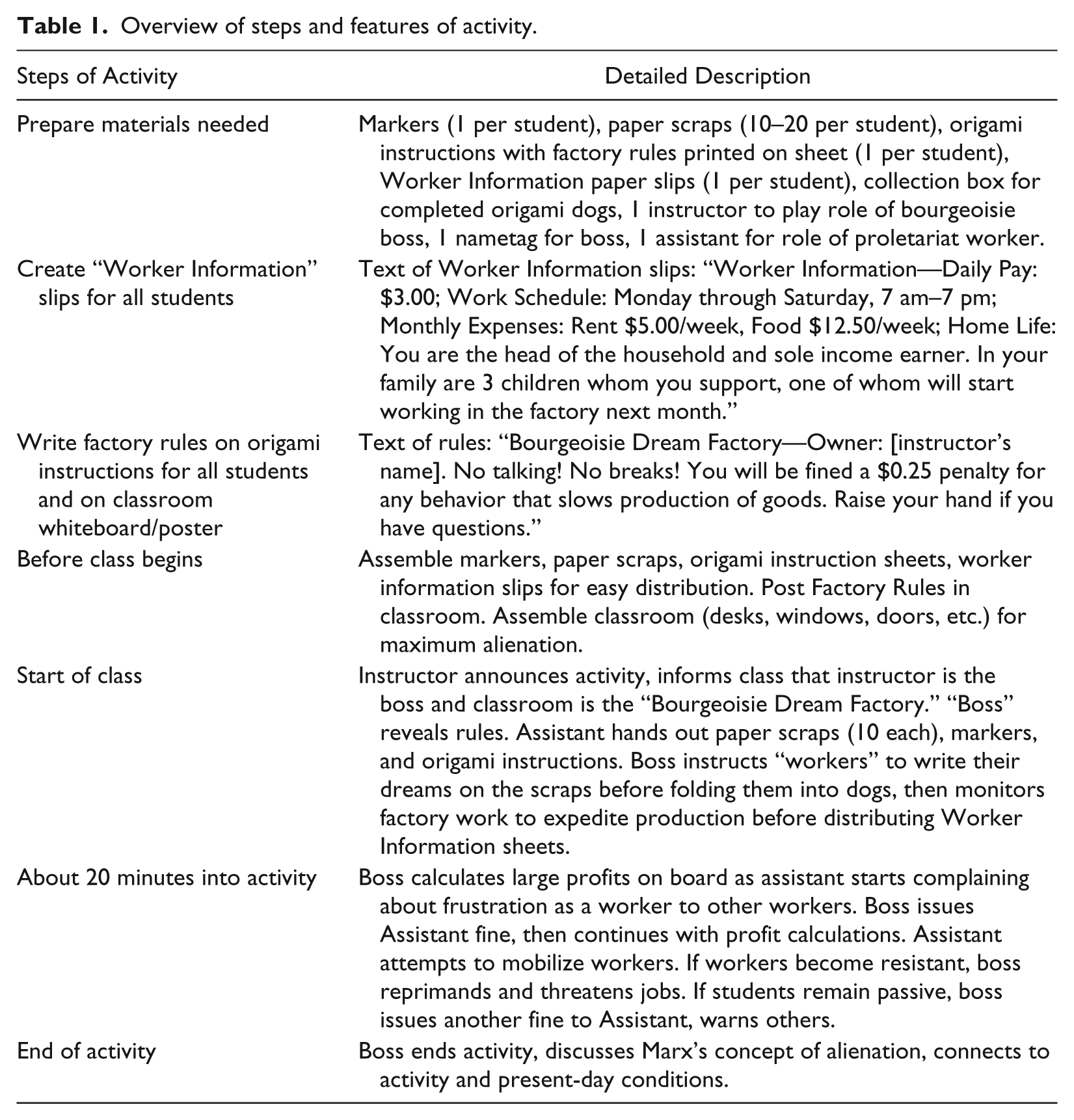
While the second author took notes about what happened during the activity, the first author reviewed Marx’s theory of alienation, connecting the activity to the concept. The first author explained how the purpose of writing one’s dreams on the paper was to illustrate how under capitalism, proletariat workers sacrificed their dreams in order to survive on low wages that barely paid the bills. The class then discussed examples of similar conditions in present-day life, such as the experiences of Chinese factory workers who assemble iPhones under alienating conditions so oppressive that nets have been installed around factory buildings to reduce worker suicide (Students & Scholars Against Corporate Misbehaviour 2010). After reviewing the concept, the researchers administered the post-activity forms, then class resumed to further examine Marx’s theory on class conflict.
Assessment
The researchers obtained Institutional Review Board (IRB) approval for the study. Students received points for participating in the activity but were not rewarded or penalized for completing the pre- and post-activity forms, which were the basis for the research. Over the duration of all four semesters, 1 student declined to participate in the study, leaving a sample size of 48 students. Our sample included 48 students enrolled in fall 2012 (15), spring 2013 (9), fall 2013 (8), and spring 2014 (16) semesters. Among these students, 6 were first years, 15 were sophomores, 16 were juniors, and 11 were seniors. Twenty-three students were aged 18 to 24, 5 were 23 to 29, 10 were 30 to 39, 8 were 40 to 49, and 2 were over 50. Most students (36) were sociology majors, and most (45) were women. Two students identified as transgender or genderqueers and one as a man. Twenty-three students were white, 16 were African American, 6 were multiracial, and 3 were Latino.
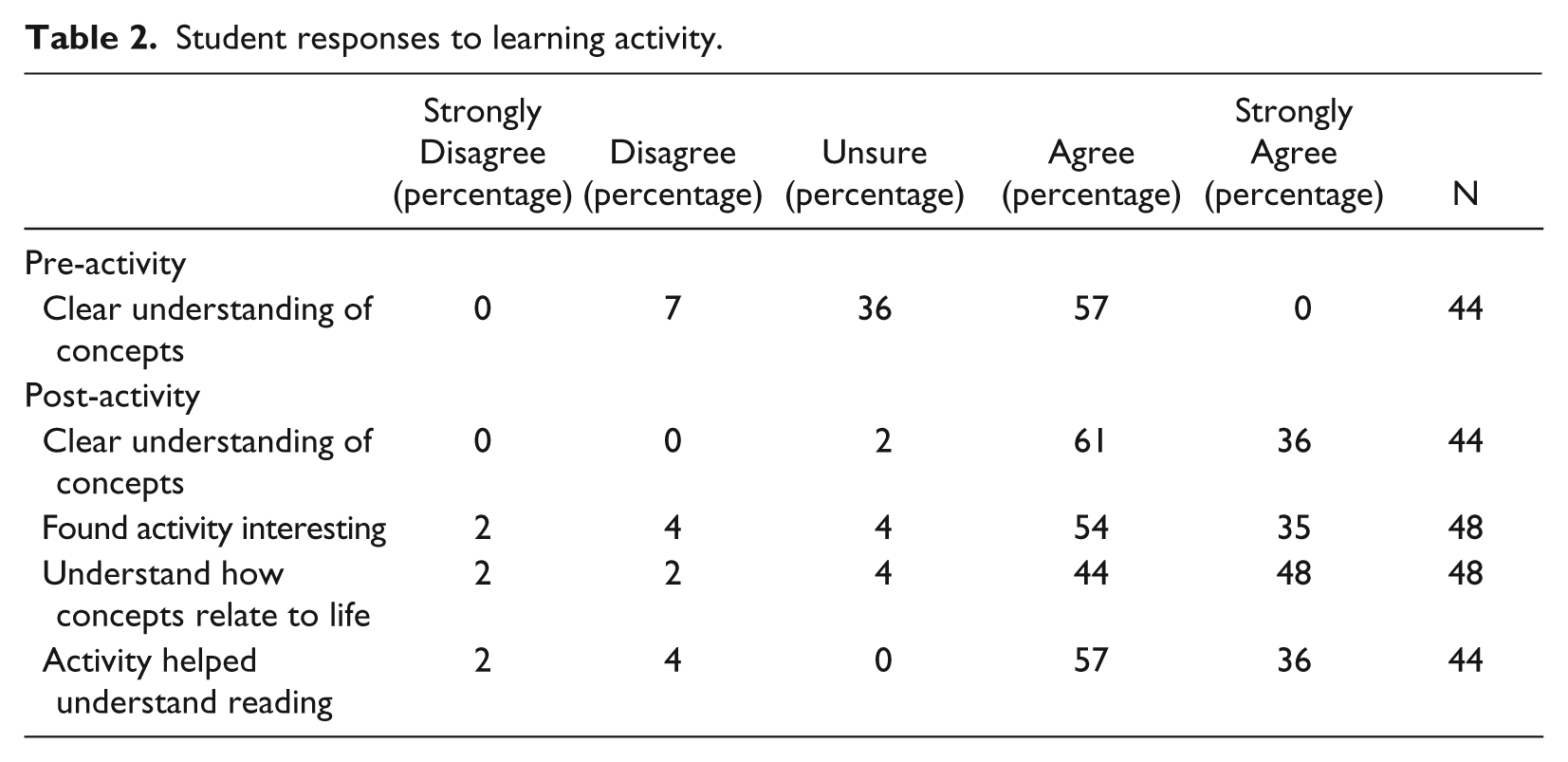
Our central research question was, How does this experiential learning activity help students understand Marx’s theory of alienation? To measure outcomes, we relied on quantitative results from a pretest/posttest design and qualitative data from open-ended questions and observational notes. Pre- and post-activity forms asked participants to relay basic demographic information and circle one of five responses to the statement “I have a clear understanding of the concepts reviewed in the reading.” Responses included five choices: strongly disagree, disagree, unsure/don’t know, agree, or strongly agree. Additional post-activity items inquired about the students’ interest in the activity, their understanding of how concepts in the reading related to everyday life, and whether the activity helped provide a clearer understanding of the concepts in the reading. We analyzed quantitative results based on percentage distribution of answers and percentage change. We analyzed qualitative results based on emergent themes and coded responses into these themes (Charmaz 1983). These results were based on answers to four items where students relayed what they liked best about the activity, what they liked least about the activity, suggestions for improving the activity, and other comments. We report the most common themes in the following.
The results from the pre-activity and post-activity forms found that students typically reported enjoying the activity and believing it helped them understand Marx’s theory. Table 2 shows that 89 percent of students found the activity interesting, 92 percent understood how concepts in the reading related to everyday life, and 93 percent believed the activity gave them a clearer understanding of the reading (based on students agreeing or strongly agreeing with statements). Comparing the pre-activity and post-activity results yielded a 72 percent change in students reporting they had a clearer understanding of the concepts in the reading, with 57 percent reporting clear understanding before the activity and 97 percent reporting so afterward. These results show that most students reported that the activity helped them to understand Marx’s theory and relate it to real life. This finding was supported by students’ ease in offering current examples of worker alienation during the discussion that followed the activity.
Student responses to learning activity.
Results from open-ended responses provided additional insight on these findings. The most common reasons why students reported liking the activity was due to finding the activity interesting, being able to apply Marx’s theory, and finding the concept relatable to real life (all exhibited by 19 students each). These findings were illustrated in comments such as the following from five students: This activity was very entertaining first of all. It makes you feel like you’re in Karl Marx’s position and it gives you a clearer image of what he writes about. It was engaging and you had the opportunity to either rebel or conform. I enjoyed it and I was in a better position to understand the reading. I like that it gave me a concrete experience to relate the reading to. It helped me to really feel what factory conditions can be like. It brought to light the meaning of the reading and the issues of that time. It also made many aware of the fact that these issues do still exist today. Instead of hearing a lecture, the activity put us in the “factory” where we could better understand Marx’s theories. Activities like these definitely help to grasp a hard-to-understand reading selection.
Students also reported that the activity helped them imagine the conditions that Marx saw as well as relate theory to current situations. For example, one student reported, “It was illustrated that just because the manager had authority, [the manager] penalized a worker. That happens a lot.” One semester while the first author explained the relevance of writing dreams on the paper scraps, a student noted that she was able to see how meaningless her dreams became as she labored on. She said this revelation led her to lose hope in fulfilling her dreams as the activity wore on without mercy.
Typically, students did not report disliking the activity. When asked what they liked least about the activity, the most common response was that the environment was uncomfortable. This response occurred during one semester when the authors were able to close the door and windows in a steadily heated room. One student’s comment was indicative: “Well, obviously it was hot, uncomfortable. I needed to blow my nose and use the restroom and couldn’t, but these are perfect illustrations of assembly line work conditions.” Students were able to explain how these uncomfortable conditions were part of what Marx rallied against. Other students suggested changing the rules of engagement, such as making different kinds of origami shapes or providing information about workers’ wages in the beginning of the shift. Overall, students seemed engaged throughout the activity and excited to participate. After the professor called an end to the “work” day, students often commented on how humorous the role playing was.
Analyses of Assessment
To determine whether the activity helped students demonstrate learning, the authors examined assessment data based on two assignments. We obtained scores from a paper that required students to apply classical theories to the 1999 Hollywood film Fight Club. We also examined data from final exam questions on classical theory.
For the paper assignment, students applied classical theories from Marx, Weber, and Durkheim to the movie Fight Club. The first author spent equal time on all three theorists prior to the assignment. Based on analyzing the scores from four semesters of papers among students who completed the activity, we found that the average scores for Marx, Weber, and Durkheim were 23.3, 23.1, and 19.2, respectively, out of 30 points maximum. The difference in scores was greater when comparing Marx to Durkheim than to Weber. The close mean scores for Marx and Weber may be attributed to the film’s focus on the experiences of one character who has an alter ego. This individualistic focus may have made it easier for some students to apply the Weberian ideas of the iron cage and charismatic authority due to the relative ease of relating the concept to the individual character’s experience, whereas alienation refers more to collective struggles between proletariat and bourgeoisie groups. Similarly, Durkheim’s theories on group solidarity may have been less obvious in the film. The collective group themes in the theories of both Marx and Durkheim were both challenging, yet students applied Marx’s theories more effectively.
For the final exam, we analyzed two measures of assessment data. We identified students’ confidence in answering classical theory questions. On the exam, students had to answer at least one question about classical theory from a choice of three, but they could answer up to two questions total. One question was about Marx’s concept of alienation and class conflict, one was about Weber’s iron cage and the spirit of capitalism, and one was about Durkheim’s theories on solidarity, anomie, and suicide. Of all four semesters, 57 percent of students chose to answer the Marx question, compared to 55 percent and 51 percent who chose to answer Weber and Durkheim questions, respectively. Thus, students seemed confident in answering the Marx question even though Marx was furthest from memory due to being taught first. Still, one limitation of this assessment item is that we were unable to identify individual students’ answer choices for three of the four semesters, and so this measure includes students who were absent on the day when we conducted the mock factory.
Although records of prior semesters’ individual item scores were unavailable due to exams being returned to students to aid them in preparing for the Senior Seminar course, we reviewed exam data for the final semester in the study more closely. Among students who completed the activity, 69 percent chose to answer the Marx question, 54 percent chose to answer Durkheim, and 23 percent chose to answer Weber. This distribution suggests that students were most confident in their ability to answer the Marx question. Out of 25 maximum points for each, students’ mean scores were highest for Weber (22.7 points), compared to 17.8 points for the Marx question and 14 for Durkheim. We attribute this result to the effects of a small sample. With measurements for a small sample of only 13 students, outliers impacted scores: of the 23 percent, or 3 students, who chose to answer the Weber question, the range of scores was 21 to 25, a remarkably higher scoring group compared to the range for Marx (4–25) and Durkheim (0–20). Although more students felt confident in answering the Marx question, not all performed well, which points to a limitation of the study. Most students reported that the activity helped them understand Marx in the posttest survey, but their exam scores did not always support their claims. In looking closely at students with exceptional low scores (i.e., under 10 points) for the Marx question, the first author observes that these students tended to struggle with theory throughout the semester and had difficulty passing other assignments. Although these students reported that the activity helped them understand Marx, it is likely that they required additional support or instruction to solidify their understanding. For them, the mock factory learning activity was insufficient.
In sum, the 13 students in the final semester did not score higher on the final exam in answering the Marx question, but their scores were still above average. In addition, the total sample of 47 students was able to effectively apply Marx’s ideas in the paper assignment. Finally, students who participated in the mock factory were most confident in their abilities to understand and apply Marx’s theories in their assignments. These assessment data offer some support for students’ self-reported data in the posttest, but with limitations.
Conclusion
Findings in this study suggest that the mock factory is a useful way to teach Marx’s theory of alienated labor under capitalism. Most students in this study reported enjoying the activity and found that it helped them understand the concepts in the reading. Based on quantitative and qualitative data, students believed “The Bourgeoisie Dream Factory” was a successful way to enliven a dense reading. By participating in an exploitative factory setting where they were quickly alienated, students could experience the relevance of Marx’s points firsthand, if only momentarily. Students’ assessment data partially affirmed their self-reported responses to the activity. These findings provide some evidence for the effectiveness of experiential learning techniques and add to pedagogical literature on effectively teaching social theory (Hoop 2012; Lippmann and Aldrich 2003; Parrotta and Buck 2013).
This activity is not without limitations. We implemented the mock factory in classroom sizes ranging from 8 to 16 students. Although we believe the activity could work in classrooms with up to 50 students, instructors of much larger classes would likely need to amend the activity. Yet, doing this activity in larger classrooms increases the possibility of a student acting as a defector, which could eliminate needing the assistant to agitate the workers and frees this person to handle logistics of implementing the activity in a larger setting. Professors without assistants may also elect to plant a student agitator in the crowd to instigate rebellion. Although we conducted the activity at a women’s college with traditional and nontraditional age students who majored or minored in sociology, we believe the activity would work well in more mixed settings. In addition, role playing requires comfort with performance. Both authors of this study have some experience with theatrical performance, but instructors and assistants who are leery of role playing may not be as successful. Also, professors with more authoritarian teaching styles should consider whether playing the role of “boss” would impede the effectiveness of the activity, as we advise instructors to have established an approachable level of rapport beforehand.
The greatest limitation of this study is that the assessment data do not align with students’ self-reported data. In addition to our aforementioned explanations for these findings, we cannot isolate the mock activity as the most effective strategy. Our data suggest that the teaching of Weber was also effective. The high scores for both Marx and Weber on the paper and the higher exam scores for Weber on the exam may be explained by the success of teaching these two theorists over Durkheim. In teaching Weber’s theory of the iron cage, the first author distributed a pop culture–style quiz designed to gauge students’ own position within the iron cage. Although the quiz was not experiential like the mock factory, it was a type of active learning that may have been similarly memorable and effective. The teaching of Durkheim did not employ experiential or active learning exercises but instead relied on small- group exercises in deep reading. In hindsight, a better study design to demonstrate the effectiveness of the mock activity would have implemented a pre-activity quiz on the theory of alienation to contrast with paper and exam scores.
Although we acknowledge the limitations of the activity and study, we believe these do not preclude sharing the mock factory as a teaching tool. Overall, this study builds on literature that highlights the importance of applying concepts in the classroom. The activity can be applied not only in theory classes but in other sociological classes that center on conflict theory or the experience of work under capitalism, such as the Sociology of Work. It may also be useful in disciplines like political science and economics or even high school social science classes. Furthermore, the activity may be adapted to become even more alienating, such as by having each student complete only one fold of the origami dog before passing the paper scrap to the next student. By completing repetitive, incomplete tasks, this step-by-step construction would emphasize Marx’s alienation from the process of labor as the worker’s pride in a finished product is diminished. In addition, classes can discuss how these alienating conditions persist, often in poorer countries outside of the United States and within present-day U.S. workplaces such as factory farms, telemarketing call centers, fast food preparation sites, and data entry facilities. Making these connections prevents students from dismissing the relevance of 19th-century theory and the gravity of such exploitative workplace conditions.
Footnotes
Acknowledgements
We thank the Teaching Sociology outgoing editor Kathleen Lowney for her insights and guidance in the review process.