




Abstract
Prior research measuring service-learning program successes reveals the approach can positively affect students’ attitudes toward community service, can increase students’ motivation to learn and ability to internalize class material, and can change their view of social issues. Studies also suggest that college students sometimes enter and leave a field site in ways that contribute to the reproduction of inequality. In this paper, we draw on three years of data from a service-learning project that involves sending college-age students (most of whom are white and materially privileged) into local, predominantly black, high-poverty neighborhoods to participate in community gardening. Using data generated by student assignments, we draw on service-learning research and critical race/whiteness scholarship to explore whether altering service-learning pedagogical tactics influences how students conceptualize and talk about race or if status factors, such as a student’s own race, gender, and/or class, intersect to have greater impact on the racial logics they employ.
Service-learning scholarship indicates that the pedagogy has numerous positive impacts on students. It increases engagement, enhances learning outcomes and attitudes toward community service and social justice, and helps cultivate professional skills. It can also impact understandings of the structural causes of social problems, like poverty and concentrated disadvantage. Some scholars of service learning, however, worry that the approach can further entrench discriminatory belief systems. This is especially a concern for biases and stereotypes relevant to race. In what many see as a “postracial” America, racism is often cloaked in coded language or color-blind rhetoric that protects speakers against accusations of prejudice while simultaneously reinforcing racial inequality. Critical race theorists, critical race feminists, and scholars of whiteness have a long tradition of exposing these ostensibly neutral racial logics and explicating their connection to a system of racial inequality. Their work has identified the discursive devices, interactional “micromoves,” and selective silences people use to express racially discriminatory sentiment while protecting themselves from accusations of racism.
In this analysis, we draw on research traditions in service-learning scholarship and critical race studies to examine how students talk about race in a course where they conduct service hours in community gardens situated in a high-poverty, predominantly black neighborhood. Building on studies of service learning that examine the impact specific pedagogical tactics have on student outcomes, we explore whether altering course structure and requirements influences how students conceptualize and talk about race. Utilizing research from the field(s) of critical race and whiteness studies, we also examine whether status factors, such as a student’s race, gender, and/or class, intersect with one another to impact the racial logics they employ.
Service Learning and Students’ Belief Systems
Studies of service-learning initiatives reveal how the pedagogical approach can positively affect students’ attitudes toward community service (Hironimus-Wendt and Wallace 2009; Knapp, Fisher, and Levesque-Bristol 2010) and social justice (Mobley 2007; Seider, Gillmor, and Rabinowicz 2012) and can increase students’ motivation to learn (Love 2008). Studies also find that service learning helps students accumulate social and human capital (D’Agostino 2010; Scharff 2009; Stewart 2011) and enhances their understanding of course material (Bach and Weinzimmer 2011; Berman and Allen 2012; Hattery 2003; Huisman 2010). Furthermore, scholarship demonstrates how community-based service-learning courses impact students’ understanding of social issues. For example, these service experiences can change college students’ preexisting negative beliefs about marginalized populations, such as immigrants (Mitschke and Petrovich 2011), homeless persons (Mobley 2007), or imprisoned juveniles (Nurse and Kraine 2006). Service learning can also help them identify race, class, and/or gender oppression (Lum and Jacob 2012) and understand the structural and institutional origins of poverty rather than relying on victim blaming or individualistic explanations (Davidson 2009; Hollis 2002, 2004; Seider, Rabinowicz, and Gillmor 2011).
However, some scholars express concern about service learning potentially further entrenching bias, discriminatory belief systems, prejudice, stereotypes and individual-level explanations for social inequality (Foos 2004; Marullo, Moayedi, and Cooke 2009; Sulentic Dowell 2011). As Sulentic Dowell (2008:14) states, one could argue that the approach “promotes paternalistic, charitable, [or] even missionary orientations” among students. Power imbalances in student/community partner status positions mean that students adopting these orientations risk reproducing problematic notions of their own/service recipients’ relative moral worthiness and presumed capacity for self-reliance. As such, when students are asked to engage critically with racial inequality as part of a service-learning course, it has to be done carefully or it risks further entrenching an “us-versus-them” mentality that fuels racism (Foos 2004; Lum and Jacob 2012).
Critical Race Studies and Color-Blind Racism
Critical race theorists, critical race feminists, and whiteness scholars have a long tradition of interrogating mentalities that fuel racism by valuing whiteness and devaluing people of color (Crenshaw 2011; Du Bois 1903; Fanon 1967; Montiero 1994; Zuberi 2011). Critical scholarship challenges the established racial hierarchy by complicating the way we talk about, see, and understand race (Feagin 2009; Leonardo 2009; Twine and Gallagher 2008). Researchers working in this tradition often examine how the rhetorical devices (or logics) people utilize to make sense of race help reproduce racial inequalities. In the context of what many see as a “postracial” America, where overt bigotry, segregation, and discrimination are not publically acceptable, this often means examining the subtle or covert logics that exist around race (Bobo, Kluegel, and Smith 1997; Bonilla-Silva 2002).
By identifying the use of color-blind or coded “race talk,” scholars have documented how racist discourse clandestinely unfolds in everyday public and private conversations (Bonilla-Silva 2002; Castagno 2008; Edsall and Edsall 1991; Myers and Williamson 2002; Pollock 2005). For example, Bonilla-Silva’s (2002) research on color-blind racism revealed five stylistic mechanisms individuals use to negotiate their internalized racist views while openly denying any racist tendencies: (1) avoiding direct racial language; (2) using verbal strategies to claim nonracism (e.g., “I’m not prejudiced but . . .”), then making a racist statement following the disclaimer; (3) projecting racism onto people of color by framing them as racist; (4) using diminishing tactics to lessen the impact of an expressed racial belief; and (5) becoming verbally incoherent when discussing race.
Whiteness scholars have contributed to the literature on color-blind language by identifying additional conversational strategies white people use to avoid being labeled racist, like masking racial overtones of distress and hardship with happiness and cheer (Trainor 2008). Researchers have focused on how white people selectively use silence (or become “color mute”) (Pollock 2005) to “avoid objecting to oppression” and thereby veil the existence of systemic racism (Castagno 2008; Wildman and David 1995:890). Moreover, scholars have illustrated how white people in the post–civil rights era frame the United States as a meritocracy and engage in victim-blaming techniques to justify the racial order (Fine 2004; Gallagher 2003b). For example, Fine (2004:245) identifies how white people use “micromoves” to accumulate privileges that reinforce the racial hierarchy through the guise of hard work and merit-based achievements. Utilizing these techniques alleviates white guilt about inequality by denying white privilege and unequally placing the blame for lack of success on people of color rather than identifying the systemic origins of inequality (Castagno 2008; Feagin 2009; Fine 2004; Gallagher 2003b).
Discursive devices, silence, and an emphasis on merit-based privilege are just a few of the “stylistic tools available to [help people] save face” when “navigating the dangerous waters of America’s contemporary racial landscape” (Bonilla-Silva 2002:62). This project builds on two research traditions to explore the prevalence of these “tools” in college students’ narratives of their service-learning experiences in a predominantly black, high-poverty neighborhood. We draw on the work of critical race theorists who have uncovered the color-blind rhetorical tactics people use to reproduce racist ideology and on the work of service-learning scholars who seek to interrogate how service work impacts students’ perceptions of inequality. Using three years of data from a teaching/research/community engagement project that involves sending majority-white, materially privileged college-age students into predominantly black, high-poverty Louisiana neighborhoods to participate in community gardening, we explore whether altering service-learning pedagogical tactics influences how students conceptualize and talk about race or if personal demographic factors, such as race, gender, and class, have greater impact on the racial logics they employ.
Context
The Metro Garden Coalition (MGC) is an informal, not-for-profit networking organization that connects gardeners with one another across the metropolitan area that it is situated in, helping them share resources like plants and seeds, information about grant opportunities, and access to pools of volunteers. Students who took the service-learning courses that are part of this analysis spent between 15 and 20 hours working alongside residents of all ages in five community gardens that belong to the MGC. These gardens are situated in high-poverty, predominantly black neighborhoods near the university they attend. While there are nearly 50 gardens affiliated with the MGC, students do service hours in only five of those gardens, for three reasons: (1) the gardens are run by founding members of the MGC, (2) they serve residents of structurally disadvantaged neighborhoods in the city, and (3) they employ a model of gardening that depends on collective work. Unlike many community gardens—where area residents rent one small portion of the garden and maintain it personally—volunteers at these gardens collaborate to care for the site in its entirety.
Each garden has a regular weekly meeting time and an advocate who is in charge of the site. This person shows up to supervise work every week, facilitates garden planning, plays a central role in securing resources for the garden (e.g., seeds, plants, tools, and soil), and is the location’s contact person. Depending on time of year, weather, and factors like the intensity of the advocate’s recent volunteer recruiting efforts, anywhere from 1 to 20 neighborhood residents show up to garden together. Children (as young as 3) and adults (as old as 85) attend these community gardens. During the fall, spring, and summer semesters, students enrolled in Sarah’s service-learning courses work alongside them.
The gardens are located in neighborhoods that have been designated food deserts by the United States Department of Agriculture (USDA). This means they are without ready access to fresh, healthy, and affordable food. Instead of supermarkets and grocery stores, these communities may have no food access or are served only by fast food restaurants and convenience stores that offer few healthy, affordable food options. (USDA 2015)
More specifically, a neighborhood is a USDA-designated food desert when it is a low-income census tract (i.e., it has a poverty rate of 20 percent or greater or a median family income at/below 80 percent of the area median family income) that also qualifies as “low-access” (USDA 2015). Low-access means that at least 500 people or 33 percent of the urban census tract’s population live more than one mile from a supermarket or large grocery store (USDA 2015). While advocates’ motivations for starting and/or maintaining one of these five garden sites vary, many are interested in addressing the neighborhood’s food desert status by increasing access to healthy food for area residents.
A typical day at each site involves the advocate announcing a set of tasks that need to be completed and either letting people select what they prefer to do or, if participants seem hesitant, assigning tasks. When children are present, advocates frequently make efforts to make sure they are kept engaged in gardening work or playtime. Often, this means one or more volunteers or students are put in charge of supervising and working alongside a small group of children (or, when there are enough adults, one child each). At the end of the week’s work session, volunteers often hang around and chat informally or have a formal “circle time” where they share highlights from the day’s experience and reintroduce themselves to one another by telling their name, their age, and some random fact the advocate chooses. The advocate might ask them to say what their favorite vegetable is or what they learned in the garden that day. At many of the garden sites, advocates make efforts to keep people engaged by occasionally planning events outside the workdays, too. At one garden, for example, the advocate sometimes brings a folding table and cards for people to play. Many of the gardens have events, like cookouts, once a semester.
With the exception of using weed killer on the pathways that are out of reach of edible plants and the occasional use of pesticides to kill fire ants (also located away from edible plants), the gardens use organic farming methods. Garden advocates and core volunteers therefore do a lot of weeding by hand. Work also typically involves planting, harvesting, cutting grass when possible, and maintaining garden beds or improving the garden site by painting or decorating. Garden advocates demonstrate considerable ingenuity securing resources for each site, since there is no dedicated funding stream for any of them. The majority of core volunteers (i.e., residents who regularly show up to help) and garden advocates are either lower-middle-class or working-poor individuals. Three of the advocates are black women from the neighborhood who are past retirement age but remain in the paid labor force and/or are very civically active in the metropolitan area. All three are founding members of the MGC. Two garden advocates are young black men. One lives in the neighborhood near the garden he took over after the former leader (his friend) had her first child. The other grew up next to one of the garden sites. He decided to restart that garden after taking Sarah’s service-learning course. The final garden advocate is a young white mother and founding member of the MGC. She helped build and continues to help maintain each of the garden sites. The five gardens included in this analysis have been in existence for anywhere between one and four years and are sustained by local community leaders, resident and student volunteers, the advocates, and members of the MGC.
The Service-Learning Project
A significant number of service-learning scholars have recently focused attention on the need for a more robust approach to enhancing the community development outcomes associated with service-learning pedagogy. Many call for a more social justice–oriented approach or a “counter-normative response to conventional service-learning pedagogy” that shifts focus from heavily concentrating on student learning outcomes to providing increased attention to research, policy, and community development (Swords and Kiely 2010:150). Scholars offer various suggestions for how to accomplish this goal. As public sociology and civic engagement gain more traction in the field, some argue it makes sense to connect pedagogical projects to a strong social movement or to community partners who are deeply engrained in local politics, for example (Morton et al. 2012). Community-based research can also work as a means to increase the concrete benefits community partners get in exchange for entering service-learning agreements with university partners and hosting students (Marullo et al. 2009; Rosner-Salazar 2003).
The model of service learning employed for this project builds on this emerging tradition of community-based scholarship. It fits closely with what Lewis (2004) calls “place-based” service learning—a pedagogical approach that involves investing significant time building relationships with community partners and that is oriented around social justice rather than charity (Marullo et al. 2009). Sarah has spent four years conducting ethnographic research and working alongside local leaders who are involved in the community gardens that are a part of this project. She involves graduate research assistants and undergraduate students as collaborators on the project using participatory action research methods and service-learning pedagogy. As part of an institutional review board–approved research design, undergraduate students contribute to ongoing data collection efforts by completing course assignments that parallel field notes, reflexive memos, and analytical memos. They complete a human subjects research course and undergo research/service orientation at the beginning of the semester. In this orientation, Sarah and representatives of the MGC briefly explain the history of the community these gardens are situated in and its (previously tenuous) relationship with the university, census demographics on the tracts each garden is located in, and the MGC’s mission, history, and approach. Sarah stresses viewing the gardens, their advocates, and local volunteers as partners who do the difficult work of hosting university students rather than simply framing them as recipients of service charitably provided by those students. The goal of the project is to assist in community development while also enhancing students’ learning outcomes. The work centers on “asset-based development,” where existing neighborhood resources are utilized, supported, and strengthened in order to produce sustainable social change (Bucher 2012; Lewis 2004).
The 93 students whose work is a part of this analysis completed 15 to 20 service hours in the MGC gardens while enrolled in either a sophomore-level introductory Women’s and Gender Studies (WGS) course (three sections) or a junior-level WGS feminist theory course (one section). Over half (55 percent) were white women; about one quarter (26 percent), black women; and 16 percent, white men. Two black men and one Asian woman were also enrolled in the courses. As Table 1 illustrates, in addition to course topic varying, course structure varied. For two courses (two sections of Introduction to WGS), service learning was optional. Only students who chose the service option are included in our data set. It was required in the other two courses (Feminist Theory and one section of Introduction to WGS). MGC gardens were the only service option for the class, so students did all of their hours at those sites.
Course Requirements, by Semester and Topic.
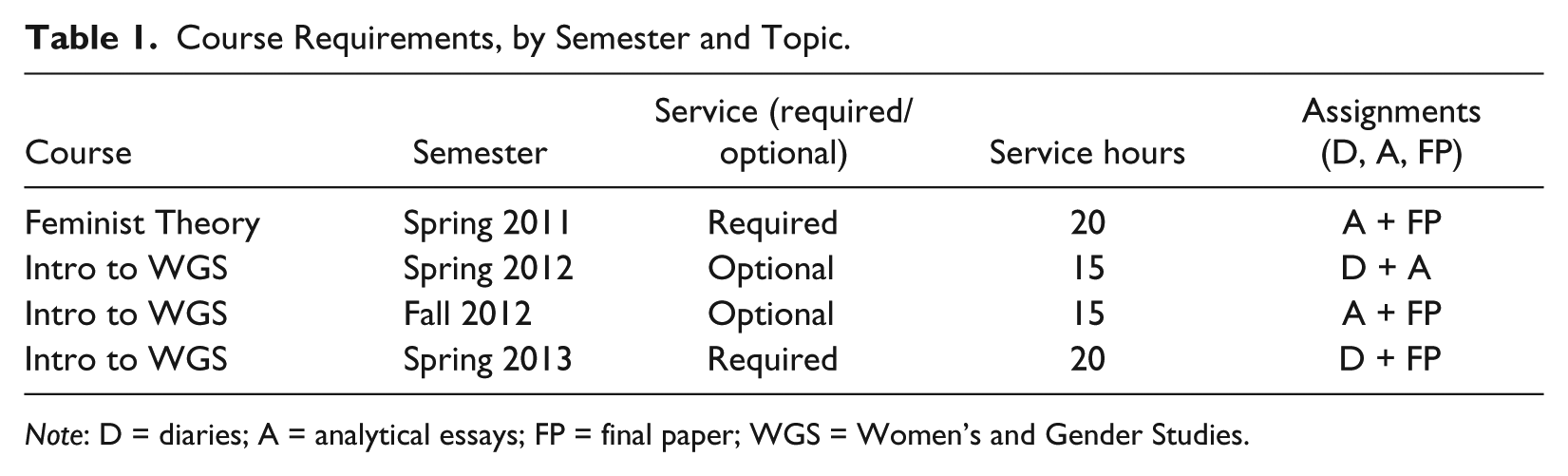
Note: D = diaries; A = analytical essays; FP = final paper; WGS = Women’s and Gender Studies.
Students were trained in ethnographic data collection methods while simultaneously providing service and learning course material. As Table 1 shows, course assignments varied. The diaries, analytical notes, and final papers students wrote paralleled field notes, analytical memos, reflexive memos, and early data analysis (Emerson, Fretz, and Shaw 2011). For example, diary assignments required students to carefully document their experiences like ethnographers do in the field. In class, Sarah stressed that learning to write detailed diaries (which she also referred to as field notes) involved training yourself to “use your brain like a video recorder.” She asked students to write down observations and to reflect on them, as this sample from her syllabus illustrates: In order to fine-tune your writing and observational skills, you will write diary entries for each of your visits to the gardens. The entries involve documenting: a) the events that happened (i.e. what kind of work was done, who was there, who you interacted with, what people talked about while working, and the like) and b) your reflections on and/or thoughts about what happened.
This captured students’ descriptions of events from garden visits (i.e., their observations) and their subjective assessment of those experiences (i.e., reflexive memos) (Hertz 1997).
Students also subjected their garden experiences to critical analysis in short analytical essays during the semester (Introduction to WGS spring/fall 2012 and Feminist Theory) and/or in a final paper (Feminist Theory, Introduction to WGS fall 2012 and spring 2013). Analytical essays paralleled the analytical memos ethnographers write while collecting data (Emerson et al. 2011). Here, students drew together service experiences and major themes from the course material in ways that subjected both to careful, critical analysis. They were not directed to talk about any particular topic or issue. Instead, students had the freedom to draw connections in creative ways. They could choose the readings they found most applicable and use them to analyze their garden experiences. Final papers were students’ attempts at preliminary guided ethnographic data analysis. Paper topics varied by course. In Feminist Theory, students wrote an autobiographical paper focusing on their changed relationship with or understanding of feminist activism and theory at the end of the course. In Introduction to WGS, they focused on their changed definition of the concept of privilege.
Assessment
Assessing the impact of course structure and social status on students’ race talk involved three stages of data analysis. First, we organized all the assignments individual students completed into one text file per student and loaded the documents into Atlas.ti, a qualitative data analysis (QDA) software program. The documents were grouped according to course/section and according to student background characteristics (race and gender) to facilitate comparative analysis. We changed names of organizations and individuals participating in them (including students) in order to preserve confidentiality. In the second stage, we conducted preliminary coding with three a priori codes that allowed us to identify sections of text where students talked about race. We coded selections where students explicitly discussed race and selections where they referred to race with coded language as “race talk.” In order to decipher coded references to race, we drew on the work of critical scholars, such as Bonilla-Silva (2002, 2010) and Bobo et al. (1997), who have identified common forms of racially coded speech in “postracial” America (Applebaum 2006; Becker 2013; Myers and Williamson 2002) and on critical criminological works that demonstrate how people talk about crime as a means of racial commentary (Becker 2014; Dvorak 1999; Hurwitz and Peffley 2005; Russell-Brown 2004).
We also coded selections of text where students talked about the neighborhood they were working in or the people who live there. Including these textual samples with those coded as race talk allowed us to examine how students talked about race generally and how views of race were embedded in their discussion of high-poverty, predominantly black neighborhoods and their residents. In sum, the race talk and neighborhood/people codes captured 177 instances of students talking about race in connection with their experiences in the gardens. These selections came from a subset of 54 students whose work contained relevant excerpts: 61 percent were white women; 26 percent, white men; and 13 percent, black women. The race talk code also captured over 100 excerpts where students discussed readings and other course materials without linking them to the garden work. These excerpts were not connected directly to the students’ service-learning experiences. We were looking to capture the views of race and racial inequality students present when talking about their garden experiences, so we do not include them in our analysis.
In the third stage of analysis, we conducted two rounds of more focused coding. We utilized an open coding strategy to identify patterns in how students talked about race, the neighborhood, and its residents. In this stage, five coding categories emerged as consistent patterns in the ways students talked about race: critical resistance, defensiveness, fear, stereotyping, and attempting to erase difference. We employed axial coding (Strauss and Corbin 1998) to examine relationships between concepts and to construct a theoretical explanation for how students either reproduce or challenge color-blind racist logics in their talk about race. In the analysis that follows, we examine how students, in their discussion of garden experiences, reproduce racism or work to challenge it critically.
Reproducing/Challenging Color-Blind Racism
Color-blind racism is a post–civil rights era form of racism that has a “suave, apparently nonracial character” but nonetheless “is still about justifying the various social arrangements and practices that maintain white privilege” (Bonilla-Silva 2010:211). Color-blind racism carries with it specific linguistic manners and rhetorical strategies, or types of race talk (Bonilla-Silva 2010:53). While the rhetorical strategies themselves can vary, they fit within a few central frames that involve (1) abstract claims about liberalism (e.g., equal opportunity), (2) naturalization (i.e., explaining away racial difference as natural), (3) cultural racism (e.g., blaming inequality on people of color’s assumed cultural practices), and (4) minimizing racism (Bonilla-Silva 2010; Feagin 2009). As Table 2 illustrates, in over half (55 percent) of the textual samples pulled from their assignments, students employed rhetorical practices that fit in color-blind racist frames and therefore qualify as reproduction of racism. A little less than half (45 percent) of their race talk critically resists color-blind racist logics by connecting observations about race in the gardens to sociological research or using them as a means to explicate the social and structural origins of racial inequality.
Course Structure and Racial Logics Employed.

Note: WGS = Women’s and Gender Studies.
Consistent with traditions in service-learning scholarship that involve identifying specific pedagogical tactics that best enhance student learning outcomes, we examined whether changing course structure impacted the racial logics students employ. As Table 2 illustrates, altering course structure marginally influenced the prevalence of reproducing/challenging logics. For example, students in courses where service was required were less likely to use reproducing frames when talking about race (49 percent vs. 57 percent in courses where service was optional). While most studies of student outcomes compare students who choose a service option to those who do not, those that compare courses where it is required to those where it is optional have contrary findings. They indicate that cognitive gains are greater for students who choose service learning as compared to those who take courses where it is required (Yorio and Ye 2012). However, these studies also suggest that requiring/choosing service is less important when looking at changes in students’ understanding of social issues or development of “personal insight” (Yorio and Ye 2012:22). The pattern we found supports that conclusion. Studies consistently reflect that engaging in written reflection on experiences (like the diaries students wrote) positively impacts student outcomes (Celio, Durlak, and Dymnicki 2011; Conway, Amel, and Gerwien 2009; Eyler and Giles 1999), as does being immersed in the field for at least 20 hours (Gray et al. 1998; Mabry 1998) and being further along in one’s educational career (Conway et al. 2009). Similarly, we found that students challenged color-blind racism through their race talk in courses where they did more reflection (in diaries) (58/42 percent vs. 43 percent), where more service hours were required (51 percent vs. 42 percent), or where they were enrolled in an upper-division class (54 percent vs. 44 percent).
While these differences echo patterns in the broader service-learning literature, altering course format did not produce much variance in the frequency with which students employ understandings of race that challenge color-blind racial frames. We therefore drew on the tradition of critical race/whiteness scholars and examined whether or not student positionality impacted their likelihood of employing particular racial frames when engaging in race talk. Similar to studies that suggest student outcomes vary according to individual-level factors such as gender, religion, or parental support of service-learning work (Pragman, Flannery, and Bowyer 2012; Seider 2012), we found uneven outcomes by race and gender. White students disproportionately chose to talk about race in connection to their garden experiences. They account for 71 percent of our full sample (N = 93) but 87 percent of the subsample (n = 54) whose work contained eligible race talk excerpts. Black women were 26 percent of the overall sample but only 13 percent of the subsample. The two black men and one Asian woman enrolled in these classes did not engage in race talk connected to their garden experiences and therefore do not appear in the results presented in Table 3.
Student Race/Gender and Racial Logics Employed.
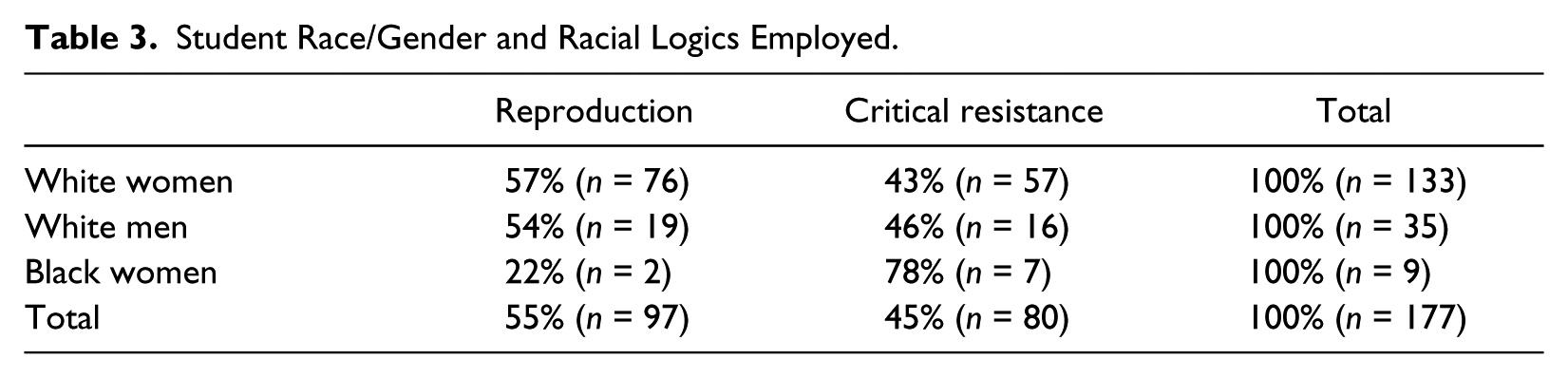
In addition to bringing up race disproportionately, white students dramatically differed from black women in the content of their race talk, as Table 3 illustrates. White students employed “critical resistance” logics in 43 to 46 percent of their comments about race and garden experiences, but black women did so nearly 80 percent of the time. In the rare circumstance where black women used reproducing logics, it involved their class status influencing how they discussed race. In the analysis that follows, we explore how white men and women (and, rarely, black women) in service-learning courses employ racial logics that reproduce color-blind racism. Four such logics emerged from our data: expressing racialized fear, stereotyping, attempting to erase racial difference, and defensiveness. Finally, we explore how black women (and, less frequently, white men/women) employ racial logics that challenge racism.
Fear: “Don’t Get Killed in the Ghetto”
Critical criminological works illustrate how color-blind racist logics can be employed in coded conversation about crime (Alexander 2012; Dvorak 1999). While they rarely linked it directly to race, white students frequently talked about fear in their written assignments. On occasion, students expressed critical orientations to fear of the neighborhood. For example, they might discuss other people’s fear of the neighborhood or its residents but their own lack of fear. Most, however, made comments that sustained an impression of the neighborhood and its residents as unequivocally and uniformly dangerous. As James, a young white man, wrote, . . . there is just one thing. This one thing will always make me feel uneasy, this one thing no matter how hard I try, I will never feel one hundred percent comfortable about it. This one thing is where the garden is located. In my eyes I see this area as the hood, ghetto, below poverty, abandon. Every corner there are rundown buildings with graffiti on them that look as if they were shut down thirty years ago. Just beyond the wall towards the back of the garden that separates—or should I say that protects me from the ghetto—is a really run down motel. Along with all the rundown buildings, the area is populated with African Americans. At the garden, the same is true for the children. All of those who show up from the area are African American.
In this excerpt, James indirectly asserts that race is part of the reason he feels “uneasy” in the neighborhood he qualifies as “hood” or “ghetto” and that the garden’s brick wall “protects [him] from.” He implicates race by mentioning the fact that African Americans populate the area and that all the children who show up to the gardens are African American as well when listing factors that contribute to his fear. This sort of indirect linking of race and fear, couched in explicit discussion of race, was rare, however. Typically, students expressed fear without acknowledging or insinuating that race played a role in why they felt fearful. Diana, for example, a young white woman, wrote, “To be honest, I was beyond excited about initially going to the garden but petrified for my life when driving through the neighborhoods to get there.” Jill, another young white woman, expressed a similar sentiment when discussing how people talk to her about the garden work: “When I tell people that I am going to the garden and where it is located their response is usually ‘don’t get killed in the ghetto’ or ‘be safe.’”
As another young white man’s narrative illustrates, this fear was often intractable—sustaining itself even after students had become integrated into garden networks where advocates and volunteers treated them well, praised them for their work, and made them feel welcome in the community: After texting Dr. Becker that I was [at the garden], I knew something was up. My text read from her, “Cool—Ms. Lucy is having people over to eat today.” After seeing this, I was a bit confused. Everyone else received the same text message and we started to question whether we should go to Ms. Lucy’s house or if we should just leave before she gets here. To be honest, I was a little nervous about going to Ms. Lucy’s house. I had no idea where she lived, who all was over there, and I for damn sure didn’t feel safe in the area which I was in.
As these examples illustrate, students most frequently expressed worry about “get[ting] killed” or report being “petrified for [their] life” without directly acknowledging that race played a part in their fears. However, research on how people’s impressions of crime and dangerousness are racialized and, specifically, linked to black people (especially men) in the United States substantiates the assumption that race played a central role in producing their fears (Chiricos and Eschholz 2002; Quillian and Pager 2001). Though they normally do not mention it, the factors James identifies in his diary (a “run down” environment and the presence of a majority-black populace) were likely linked to students experiencing fear while completing their service hours.
Stereotyping: “Kids From Broken Families”
The second way white students wrote about their garden experiences in ways that contribute to the reproduction of racist logics was through stereotyping. On occasion, this involved framing black women according to stereotypes about their toughness or their racially-specific mothering characteristics (i.e., the “mammy”) (Harris-Perry 2013; Kelley 2011) or talking about black men’s laziness/criminality (Madriz 1997). Most often, however, white students reproduced racial stereotypes by making two sets of linked assertions: first, that children in the neighborhood are not properly cared for by their parents, and second, that garden leaders and college students like themselves were the solution to problems plaguing families in this community. For example, Chris, a young white man, said in one diary entry that it is not “fair” for kids in the neighborhood to have “no support because their parents made bad decisions” and that the garden is a place for them to “get the support that they may be missing.” Laura, a white woman, argued in her diary that the garden she attended is a good place because it provides “kids from broken families” a place to “know they are getting taken care of by good people.”
As we see in both of these examples, students frequently made co-occurring claims about black families’ assumed deficiencies and their own (or a garden leader’s) ability to help address them. Laura and Chris talk about alleged emotional, moral, and structural deficiencies of black families. Devin, a white man, made similar assumptions, but about their physical care. He argued that children in the garden were not properly fed at home after seeing them eat vegetables postharvest. “After we finished the work, the kids divided up the produce that was ready to bring home,” he wrote. “What caught my attention was that some of the kids immediately started eating their food right away before it was even cooked,” and this “made me realize how much these kids must suffer for food.”
As we can see in these examples, students often make assumptions about the families of children who attend the gardens—about their decision making, support for their kids, family structures, or their moral character(s)—without specific information about an individual child’s home circumstances and without acknowledging intracommunity variance in disadvantage. Typically, students also position garden participants (including both leaders and, more typically, college students like themselves) as the solution to the perceived problem. In the gardens, they argue, kids can access people who are different from their families—“good” people who offer them “the support that they may be missing.” As Chris put it, “Myself as well as everyone else is [at the garden] to support and try to fill in that empty space in the children’s lives.” Or as Matthew, another white student, wrote, the gardens offer him “the privilege to be a role model,” which “enlightens [him] to strive to be a great person to everyone and act in [his] best behavior possible no matter who may be watching.”
While garden advocates encourage students to build ties with youth and to do things like occasionally help them with homework, those practices being tied to overgeneralized stereotypical (and negative) impressions about families and adults in the area is problematic. When students make sense of their experiences with garden youth through a lens of assumptions about their failing families, it reinforces the idea that while some black people (those who attend the gardens) are “good people” and “role models,” the rest (those they do not know or interact with in the neighborhood) are uniformly negative forces in the lives of neighborhood children. In addition, it promotes the perception that college students (most of whom are white) are all “role models” or “good people” who work alongside a handful of exceptional black residents to provide what black children are missing: support, love, models for good behavior, or even food. Understanding community partners through stereotypes like this could be a risk of the pedagogical approach itself (Sulentic Dowell 2008). It reinforces a black deficiency–white savior dynamic (Cole 2012) that contradicts the reality of inequality and social activism in the neighborhood (Sulentic Dowell 2011).
Defensiveness: “All That Matters Is Your Social Class Status and What You Have”
White (and, more rarely, black women) students employed defensive logics around race. The first of these—arguing that class matters more than race (Wilson 1978)—fits neatly into a central frame of color-blind racism: the minimization of racism (Bonilla-Silva 2010) and could be found in white and black students’ race talk. The second, found only in white students’ narratives, involves them making accusations of reverse racism or “projecting” negative racial motivations onto black people (Bonilla-Silva 2010:63). For example, when Christina, a young white woman, discussed her experiences with whiteness, she framed racism as something black people could potentially engage in and that would negatively impact her. “If I was to describe who I am,” she wrote, “I don’t believe that ‘being white’ would be one of the first things that would come to my mind. I think I would start by talking about my personality and interests. I don’t see the color of my skin as changing who I am as a person or who I am to other people.” She added, “After learning so many things about race, I have come to realize that racism is unavoidable.” Christina then went on to express that some people might judge her for believing that being white does not affect her. She categorized their hypothetical judgment as racism, stating, “I don’t believe that [growing up in an all-white community] has changed me much and made me more racist,” and added, “but the opinions of others are unavoidable.”
Tina, a young white woman, expressed a similar view when she framed people who call at her with the phrase “Hey, white girl” at the gas station or grocery store as racist. “It still takes me by surprise when I hear that even though it happens time and time again,” she wrote. “I can never understand why they must throw in the ‘white’ instead of just saying ‘hi’ or ‘hey girl.’” She added, “I never understand why some people find it okay to call someone out for their race,” said she feels like people judge her because she is white, and then lamented that she agrees with an author of one of the class readings who said “nothing short of a national revolution will suffice” for confronting racism because “racism has become [so] big that nothing may ever change what it has come to be.”
While scholarship on intersectionality reveals that different aspects of our social status (like gender, race, or class) can matter more/less (or be “activated”) in specific situations (Acker 2006; Allison and Risman 2014; Crenshaw 1991), arguing broadly that class matters more than race is one way people dismiss the reality of racism in the United States (Bonilla-Silva 2010; Gallagher 2003a). Students who employed this logic illustrated how difficult it was for them to acknowledge that race matters for people’s life experiences. A young white man named Frederick, for example, writing about how privilege works in the garden spaces, mentioned an experience he had as a teenager in Detroit. He talked about a white friend of his who lived in a “very nice area” that “was considered a ‘white’ neighborhood,” then explained, When our black friend would enter this part of town he was often stopped and questioned. The police would ask what he was doing and where he was going. This was an example of how social class can have a negative [e]ffect on a person. Police would racially profile him because of his car and the way he looked.
In this example, Frederick acknowledges racial profiling but attributes the experience to “how social class can have a negative [e]ffect on a person.”
Attributing black people’s experiences with inequality to class rather than race was the only time black women engaged racial logics that worked to reproduce color-blind racism when talking about their garden experiences. Janee, a young black woman, when discussing social class differences among black Americans and how she sees it in the gardens, wrote that today, “it’s like [black Americans] are competing against one another.” Unlike the past, when race mattered more, “[t]oday all that matters is your social class status and what you have.” Or, as another young black woman argued, “In order to tackle bigger issues like racism we must first get rid of classism.” These two assertions about the importance of social class relevant to race can be tied to their experiences being raised in solidly middle-class environments. In addition, both students were writing in response to bell hooks’ (2010) essay on the black middle class’s recent out-migration from high-poverty communities, which encourages being attentive to the class divisions that exist in black neighborhoods. Both of these students employed more critical interpretations of racial inequality elsewhere in their assignments.
Erasing Difference: “It Didn’t Seem Like Race Mattered”
A fourth way that white students employed logics defensive of racism is located in their attempts to erase difference or to frame people of different races as equal. They did not do this by arguing that all black people experience equality with white people in the same way that they made broad arguments about social class being more important than race or that all kids in the neighborhood were being poorly cared for by their families. Instead, white students attempted to erase difference by arguing that color blindness is good/necessary or by emphasizing feelings of equality associated with their garden experiences. For example, Brennan, a young white man, started out talking about Collins’ (2012) work on intersectionality. Latching on to her criticism of simplistic categories for human beings (i.e., the notion that people are “just” white or “just” women), he took her point in a very different direction.
Instead of reiterating Collins’ (2012) point about how identities and experiences are intersectional and therefore complex (i.e., how race/gender/class intersect in ways we cannot neatly divide), Brennan argued categories are bad because they make us focus on differences: Our world tries to focus on our differences between each other, but in all reality we are all equal. We are all privileged and no matter on what we look like, what social background we came from, we are all equal. The relation I saw this point relating toward the gardens is how no matter what color our skin is or what background we come from, Mrs. Lucy called us [her] children. Even though Mrs. Lucy has a different color skin than ours, it shows that we are all equal and we should all be treated the same way.
Tina, the young white woman who resented people calling her “white girl” instead of just “girl,” expressed a similar sentiment: “Working in the garden has been one of the only situations I have been in so far where it didn’t seem like race mattered [emphasis added],” she asserted, adding, “It is extremely comforting to me. When we are all there as a group I feel like no one is thinking about race.” Tina frequently expressed discomfort over acknowledging her race and resisted the notion that it granted her privilege. In addition, she wrote that “people judge [her] because [she is] white.” “Feel[ing] like no one is thinking about race” in the gardens therefore provided her respite from what she experienced as burdensome: acknowledging inequality.
Critical Resistance: “I Was Judging These Women Without Noticing I Was Doing It”
White students were more likely than black women to stereotype, express fear, exhibit defensiveness, or attempt to erase difference when discussing race. Black women, on the other hand, were much more likely than white students to engage in critical analysis of inequality that challenged racist logics. As shown in Table 3, 78 percent of their discussion of race in connection to garden experiences is classified as critical resistance. For white students, the proportions are smaller (43/46 percent, respectively). When engaging in critical resistance, students frequently talked about the same things others did (fear, inequality and disadvantage in the neighborhood, or social class, for example) but did so with a very different lens—one that connected clearly with data and social science research on inequality from course materials.
For example, Elle, a young white woman, critically examined how fear operated in the garden sites. “When I first got [to the garden],” she wrote, “two girls from my class were sitting in their car, and one black girl was in the garden talking on her phone. The black girl looked like she was getting instructions on what to do in the garden today. It was odd to me that the two girls had not come out of their car.” Elle got out of her car and “the other girls got out of their car right after I got out of mine.” She did not ask them why they waited to get out of their car because she “didn’t want to put them in an awkward situation,” but “it seemed to [her] that they weren’t comfortable being at the garden.” She concluded, “I believe that if the gardens were in a familiar neighborhood with the same class and race as them, then they wouldn’t have felt uncomfortable to get out of their car.”
Another young white woman critically examined her own tendency to view people in the gardens through the lens of preexisting stereotypes or racial tropes. She said being at the garden made her realize that she does this. As an example, she wrote, I found myself relating some of the older black women to the “black mammy” stereotype. The type that gives you advice and cooks you a delicious southern style supper. At the time I did not realize I was doing it because I had not read Springer’s (2012) essay yet. I read the essay when I got home from the garden that day, and I realized I was judging these women without noticing I was doing it.
Tara, another white woman, shared a story in her diaries about how she came to realize the existence of what scholars call racial microaggressions: “brief and commonplace daily verbal, behavioral, or environmental indignities, whether intentional or unintentional, that communicate hostile, derogatory, or negative racial slights and insults towards people of color” (Sue et al. 2007:330). One day, a garden leader’s daughter (Pris) told Tara about a time she jokingly asked another white girl at the garden, who had been tanning, “What color are you trying to be, black like me?” The girl responded, “No, I want to be a pretty brown.” Pris then “talked briefly [to Tara] about how that made her feel uncomfortable and how the girl insinuated that her skin color was not pretty.” Tara concluded, “This made me really think and now makes me aware about how the comments we make, even completely unintentional can have a lasting effect on someone else.”
A black woman named Rose similarly documented an example of a microaggression, but rather than indicating that it made her realize how the comments people make to one another carry hidden risk of psychological injury—especially for people from marginalized backgrounds—she connected it with her own past experiences. During “circle time” at the end of a garden session, she overheard two boys talking, and one of them “said something about the other one’s shoes being old.” This caused her to have a “flashback” to when she attended the local middle school in this neighborhood. It is a magnet school and therefore “they had lower and higher middle class people there.” She recalled that “back then my dad was laid off and I could only get one pair of shoes for school, and I had to make them last that whole year. Of course they got old and tired looking and someone who was in a higher middle class teased me and called me poor and broke. It really hurt my feelings.” After that, she “hung out with people who were in [her] social class because they would understand [her] ‘struggle.’”
Another black woman, India, discussed the experiences neighborhood kids had with inequality in one of her diaries as well. Like those who engaged in stereotyping, she framed the youth as being subject to disadvantage, but the way she went about it had some important differences. First, rather than generalizing about all kids in the neighborhood, she focused on one that she “[paid] very close attention to” when doing her service hours. “He’s always at every garden and knows more about them than anybody out there,” she said, adding, “He always has his homework at the garden, while also doing things that are needed to be done in the garden.” She called him “diligent” and argued that his behavior illustrates that he has “passion” and “wants to succeed in life.” Linking her view of him to a course reading on alumni college admissions, she wrote that “his chances of getting into Duke, Yale, or Harvard are slim. I am pretty sure his parents did not attend either of these prestigious colleges because of the area they live in. But who am I to know or give my opinion?” Rather than assuming anything about his parents, India makes it clear that while it is not likely, it is possible his parents attended college (even an elite college). Because it is unlikely, however, she concludes that he probably has little chance of getting into an elite college, “even though he might have put in more work than any of the applicants that will apply and make it because of their parents.”
Oscar, a white man in his late 20s, used metaphor to engage in critical analysis of his garden experiences. He started out one of his essays talking about two pit bulls at the garden that day. “As the owner of an American pit-bull terrier myself, I always enjoy seeing the breed buck its sensationalized reputation,” he said, mentioning how they played sweetly with one another. “The breed is often kept at a distance,” he wrote, because many people do not want “to get close enough to learn the true nature of the breed. Seen as something dangerous, not worth saving, or maybe simply can’t be saved, many individuals do not even allow one of the breed to get close enough to lick them.” He then compared the reputation of the breed to the reputation of “this side of town and its residents,” who are often disregarded as nothing more than a danger to be dealt with, or an issue to be fixed. Rather than treat them as people and give them an opportunity to succeed, to set them up to improve their own situation, some would rather stay at a distance and bemoan the blight that they perceive.
Oscar then argued that the class forced people to “get [their] hands dirty” and did not give them “any opportunity to keep anyone or anything at a distance.” After seeing children in the neighborhood exhibit “enthusiasm” for both work and play and “the determination of older individuals” who work in the gardens, he argued that students see “people attempting to fix a situation from the bottom up, not the other way around.” In other words, by virtue of interacting in the garden spaces, stereotypes about the neighborhood and its residents were debunked for him and could be for other people, too. He came to see area residents as enthusiastic, hardworking, determined, and—perhaps most importantly—capable of addressing problems in their area themselves (“from the bottom up”) rather than needing outsiders to fix them.
Discussion
In this analysis, we drew on service learning and critical race research traditions to examine how students talk about race in a course where they work in community gardens in a high-poverty, predominantly black neighborhood. We explored whether altering specific pedagogical tactics, like number of service hours required, course topic, or assignments, influenced how students conceptualize and talk about race. We also examined whether status factors, such as a student’s race, gender, and/or class, intersect with one another to impact the racial logics they employ. Our findings suggest that altering course structure modestly affected the prevalence of fearful, stereotyping, or defensive logics and/or students’ attempts to claim racial equality. Even while completing assignments where they are asked to critically analyze their service experiences using course materials on the sociological study of race, gender, class, and multiple other forms of inequality, students use identifiable logics that correspond with a color-blind racist frame. Our findings also indicate that this pattern does not apply to all students, however. With the exception of a small number of occasions where black middle class students talked about class being more important to matters of inequality than race is, black women consistently employed a critical lens in their discussion of race.
What this means is while service learning can increase student engagement, learning outcomes, attitudes toward community service and social justice, and mastery of professional skills, it also risks further entrenching racial stereotypes and bias. In what many claim is a “postracial” America, these beliefs are often cloaked in coded language or color-blind rhetoric and can be located in the discursive devices critical race theorists, critical race feminists, and scholars of whiteness have exposed as expressions of racism. Our findings suggest that changing course structure by (for example) requiring service rather than making it optional only marginally impacts students’ use of such discursive devices. Factors that professors and instructors cannot control—like students’ race, gender, and class backgrounds—have a much stronger effect on their use of color-blind racial logics.
The implications of these findings for service-learning pedagogy are challenging. Finding ways to connect white students to students of color, because the latter are more adeptly making connections between course materials and their service experiences, is one potential strategy for addressing the issue. Adopting a peer review mechanism in class, where students read and comment on each other’s work, for example, might increase white students’ exposure to examples of critical analysis of service experiences—especially relevant to race. However, studies already suggest that the experience of being in a service-learning course is more burdensome for students of color, who often feel pressure to “do service” in the classroom by helping educate their peers about racial inequality in addition to completing their on-site service hours (Mitchell and Donahue 2009). Such an approach risks aggravating that disproportionate service burden. Employing former students as peer facilitators, teaching assistants, or what Chesler and colleagues (2006) call “border crossers” is another potential solution. In this case, students who more consistently engage in the critical analysis required of them for course assignments would gain additional professional experience rather than being asked to do more in class without proper compensation for their work. A third solution might involve employing a pedagogical approach that allows students to learn more about structural inequality in the actual community they do service hours in rather than just abstractly (Gaughan 2002) or to employ critical service-learning pedagogy (Mitchell 2008).
While this study yields important findings about white students’ use of color-blind racist logics when interpreting their service-based experiences with race, it has some important limitations. First, it did not involve a pre-/posttest of racial beliefs and did not examine the progression of students’ attitudes throughout the semester. Future research could utilize such approaches in order to look at students’ understandings of race and whether or not/how they change over the course of a semester. Studies might also employ a longitudinal approach to explore whether any measured changes to students’ understandings of race persist after a course ends or whether or not those shifts in understanding are diluted with the passage of time. This study is also limited by the racial demographics of the students enrolled in the courses—something instructors have very limited control over. Future research could follow the tradition of critical race theorists and critical race feminists and put women/men of color at the center of analysis. This is especially important, given our findings about how race and gender influenced students’ critical discussion of race (or lack thereof). The experience of doing service learning is different for students of color (Mitchell and Donahue 2009) and therefore deserves additional analysis by scholars interested in deconstructing how the pedagogical approach influences students’ experiences with and understandings of race.
Footnotes
Acknowledgements
We would like to thank our reviewers at Teaching Sociology and members/coordinators of the 2014–2015 Community Engaged Research Scholars Program at Louisiana State University (Jacqueline Bach, Birgitta Baker, Sarah Bartolome, Marybeth Lima, Kristin Menson, Hyojung Park, and Margaret-Mary Sulentic Dowell) for their feedback and support.
Editor’s Note
Reviewers for this manuscript were, in alphabetical order, Angel Hoekstra and John Zipp.