




Abstract
This study examined the effectiveness of the Star Power simulation for teaching stratification and inequality to students of the net generation. The data for this study were obtained through the use of survey methodology and content analysis of 126 course papers from introductory sociology classes. Papers were analyzed for identification and application of class concepts, recommendation of the simulation, and perceived value of the simulation as a learning tool. Analysis of data revealed 100 percent of students found Star Power worthwhile, and 98 percent recommended it be used in future classes. The most common concepts students linked with their simulation experience were inequality, stratification, and social structure. Finally, six themes were identified illustrating students’ perceived value of the simulation.
Developed by Gary Shirts in 1969, Star Power is a face-to-face real-time simulation used to illustrate inequality and stratification through the use and abuse of power (Simulation Training Systems 2013). Star Power has been experienced by over 3 million people in over 100 different contexts from business to educational settings (Simulation Training Systems 2013). During the game, participants are divided into a three-tiered society in which wealth is distributed unevenly. The groups are marked with square, circle, and triangle pins, with the squares being the top group and the triangles being the bottom group. Once the society is established, the group with the most wealth makes the rules for the game (Dorn 1989).
Numerous researchers (Allen 2008; Carranza 1974; Dukes 1986; Dundes and Harlow 2005; Humphrey 1970; Jackson 1979) have examined the use of Star Power. Several trends have emerged when examining the actual simulation. First, the group in power always makes rules that protect their own power while stopping all other groups from advancing (Allen 2008; Carranza 1974; Dukes 1986; Dundes and Harlow; 2005; Humphrey 1970). Dundes and Harlow (2005) report that in the more than 20 times they have conducted the simulation, the squares (the group in power) always structure the game in their favor. Second, the lower groups (circles and triangles) typically pretend to follow the rules while actually defying them (Allen 2008; Dundes and Harlow 2005; Humphrey 1970). Finally, it is common for the simulation to result in hostility and anger among the groups (Carranza 1974; Dundes and Harlow 2005). These common occurrences allow for discussion of privilege versus merit, arbitrary rulemaking in society, maintaining the system in society, status symbols, and the possibility of inequality leading to surrender or rebellion (Carranza 1974; Dundes and Harlow 2005; Humphrey 1970). More importantly, Star Power provides an opportunity for students to experience social inequality and stratification in a way they may have never experienced it before (Davis 1992). Often, students are sorted differently than they are in larger society. For example, a female student may end up in the top group and be given the power to exploit males in the lower groups. It is incredibly rare that students do not take advantage of this opportunity (Davis 1992).
Overall, studies have found that students enjoy Star Power and find participation in the simulation to be beneficial (Allen 2008; Carranza 1974; Dundes and Harlow; 2005; Humphrey 1970). Allen (2008), who used Star Power to teach ethics in management and leadership, found that 100 percent of respondents found Star Power to be an educational activity and 100 percent recommended that it be used again by the instructor in future classes. Corbeil (2011), who used Star Power in a history class and limited play to five rounds, found that limiting time of the simulation reduced tension in students and helped make a clear connection to actual historical processes. This is similar to a study by Carranza (1974), who found that 100 percent of participants believed that some useful knowledge about the generation of conflict can be obtained from Star Power. Dundes and Harlow (2005), who used Star Power over 20 times in introductory sociology classes, found that Star Power is continuously cited in course evaluations and used as an example on exams when explaining structural limitations on mobility. Humphrey (1970), who ran Star Power in a review session and then discussed the experience with the players and an observer, found that 77 percent of participants said the game was worthwhile and 94 percent reported they enjoyed playing the game.
Similarly, Jackson (1979) found that undergraduate students, in general, voiced very positive reactions to participation in the Star Power simulation. However, results from a quasi-experimental design found that only 4 of the 26 predicted hypotheses were supported and “the conclusion is inescapable that these particular runs of these games had very little—certainly less than expected—effect on students on the attitudes, cognitions, and affects measured” (Jackson 1979:133). Despite these findings, Jackson (1979:134) encouraged future research to utilize other measures in order to capture “the transition of the pleasure taken in simulations into educational benefits.”
The current study builds on the existing literature in two important ways. First, this study aims to update and replicate previous research on student perceptions of Star Power. While three studies (Allen 2008; Corbeil 2011; Dundes and Harlow 2005) have examined the net generation and Star Power, Allen (2008) used Star Power to teach ethical leadership and management, Corbeil (2011) examined the use of Star Power in a modified format to teach history, and Dundes and Harlow (2005) utilized mainly observations and reports on course evaluations to measure the effectiveness of Star Power. However, this study moves beyond previous research by focusing not only on student perceptions of value of the simulation and recommendation for future classes but by examining the reasoning behind student satisfaction with the simulation. We examine survey results to gauge perceived level of worthwhileness of the simulation and utilize content analysis of course papers to identify themes for why students found value in Star Power. Second, this study adds to existing literature by not only examining students’ perceptions but also their application of class material to their simulation experience. We utilize content analysis of course papers to examine students’ ability to apply and integrate class concepts to their Star Power experience.
Data and Methods
The data for this research were obtained through mixed methodology. Institutional Review Board approval was obtained from Elizabethtown College. Students were given a pre- and posttest to assess attitudes toward factors affecting upward mobility and value of the simulation. Only results from the perceived value of the simulation from the posttest are presented here. Following completion of the simulation, students were required to write a three- to five-page paper describing their Star Power experience (Part A) and linking the simulation experience with introductory sociology concepts (Part B). This paper accounts for 12 percent of the course grade and is due at the final exam. A content analysis of Part B of the papers was conducted in order to identify terms used by students, application of class material, perceived value of the simulation, and recommendation of continued use of Star Power. The assignment instructions for Part B of the paper are as follows: Analyze what you have learned from the simulation. In your analysis, identify and define at least 3 different class concepts (from social interaction, social structure, deviance, stratification, inequality, poverty, discrimination, etc.) that you can relate to the simulation experience. You may use any class concept from social interaction through the last day of class. After defining the concept, give concrete and specific examples of how the simulation illustrated the concept. Finally, discuss what you thought about the simulation as a learning tool. What did you personally learn about social interaction, social structure, deviance, social power, inequality, status symbols, status, roles, and inequality? Do you recommend that I use Star Power next semester? Please give examples of why or why not. Again, please give specific examples to support your opinion. If completed with sufficient detail, this section should take you at least 2 pages.
Star Power is used as a precursor to the Stratification and Inequality unit and occurs approximately three-quarters of the way through the semester. It is the second simulation used in the coursem with the first being Barnga, a simulation about culture. The remainder of the course is predominately lecture and discussion based. The Star Power simulation and debriefing lasts approximately two hours and is held outside of the regularly scheduled class time. Students are told the date and time of the simulation on the first day of class and in the syllabus. The majority of the courses at Elizabethtown College are four-credit classes with the expectation that on average, one hour of supervised learning will occur outside of the classroom each week. To fulfill this requirement, faculty often assign out-of-class–based activities such as lectures, films, and other forms of experiential learning.
The sample for this research consisted of all students enrolled in SO101: Discovering Society at Elizabethtown College during the 2012 fall semester, 2013 spring semester, and 2013 fall semester. Elizabethtown College is a private comprehensive college located in south central Pennsylvania with approximately 1,900 undergraduate students. Students enrolled in SO101 are required to participate in the Star Power simulation and debriefing as part of the course requirements. Furthermore, the Sociology major at Elizabethtown College has been identified as one of a select few gold standard programs in sociology nationally and an aspirational model (Sweet, McElrath, and Kain 2014).
Demographically, the student body at Elizabeth-town College is majority female (65 percent), white (88 percent), and in-state (69 percent) (CollegeBoard 2013). Discovering Society is listed as a Social Science core course and is required of three majors. One section of SO101: Discovering Society was offered during the 2013 spring semester and 2013 fall semester, while two sections were offered during the 2012 fall semester. The same instructor taught all four sections of SO101: Discovering Society. The average class size for all four sections was 29 students, and all students were between the ages of 18 and 24. Given that the simulation is designed for 18 to 35 players (Dundes and Harlow 2005; Shirts 1993), the class size and small college setting was ideal.
Quantitative Analysis
The total sample size for the posttest was 110. The majority, 63.6 percent, of the sample was female. This is consistent with the demographic composition of the institution where the study was conducted. Not surprisingly, 37.3 percent of the sample were first-year students, and 40.9 percent were sophomores. This was to be expected since the study was conducted in a 100 level, introductory class. Figure 1 shows that Star Power was found to be perceived as an effective and worthwhile teaching tool for sociological concepts by students of the net generation with 100 percent of respondents reporting it was worthwhile. Results of cross-tabulations (not shown) revealed no statistical or substantive differences by class standing, gender, or shape (square/triangle/circle) when starting and finishing the simulation when examining perceived worthwhileness of the simulation.
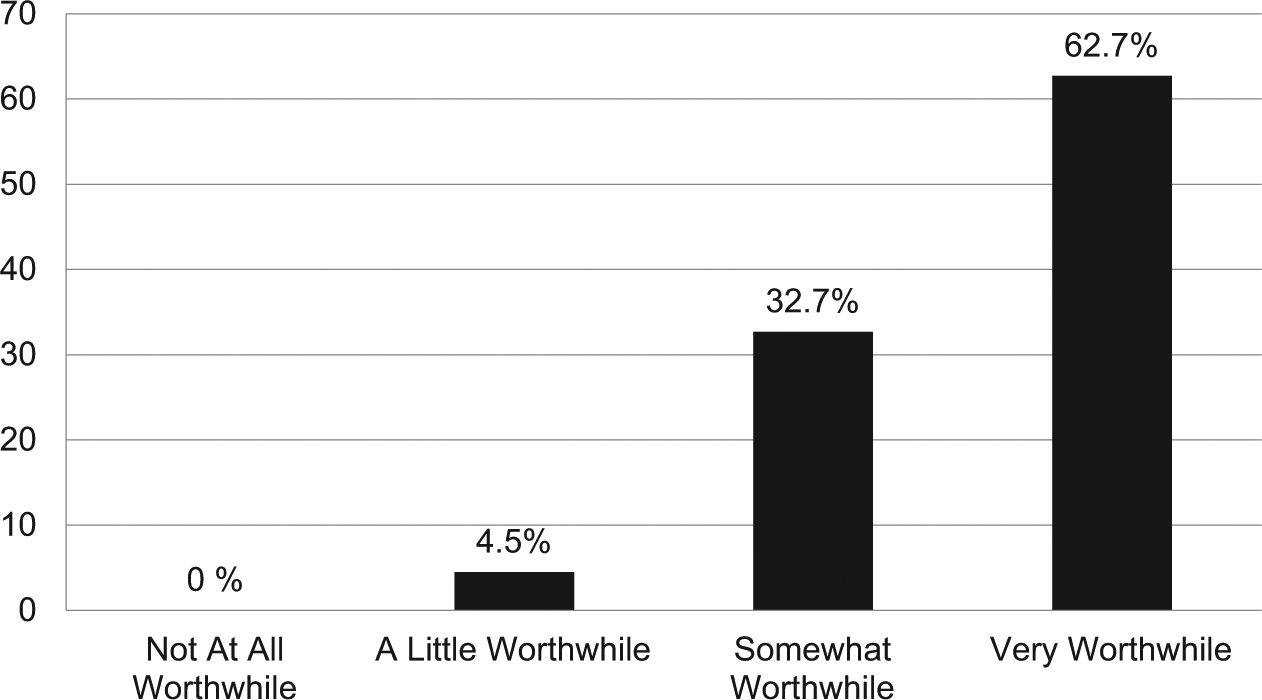
How worthwhile do you think Star Power was? N = 110.
Qualitative Analysis
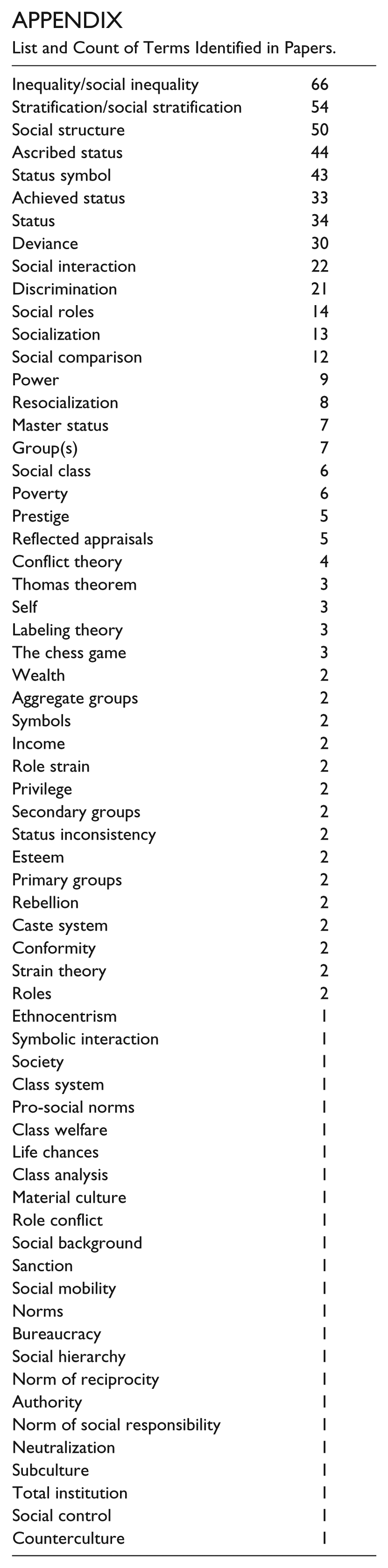
All students enrolled in SO 101: Discovering Society were required to write a paper following their participation in the Star Power simulation and after being exposed to assigned stratification/inequality readings, discussion, and lectures. For Part B of the paper, students are asked to define and connect at least three class concepts to their simulation experience. From a review of 126 papers from four sections of the course, 66 different terms were identified in connection with Star Power (see appendix for a complete list of terms).
The most common term connected with the Star Power simulation was inequality or social inequality, with 52.4 percent of students including it in their paper. A typical example of how inequality was connected to the simulation and included in the paper is as follows: The final class concept that I saw during this simulation was that of social inequality. Social inequality is a condition in which members of a society have different amounts of wealth and prestige. I knew there was going to be some amount of inequality once the concepts of chips and points was brought into play but it took until the game really got going for me to see the real extent of the inequality between groups. There were some huge differences in the abilities of the groups that brought out the extent of these inequalities to its fullest. As soon as the squares started getting bags with better chips and the ability to make their own rules they were put in a class of their own, un-paralleled by the other two groups. . . . Once people from the higher levels saw that circle pin all they assumed was that your chips cannot be good because they do not have many points so why should I trade with them. Towards the end the social inequality between groups was so great that there was hardly any movement between groups and the rich just kept getting richer and the poor just kept getting poorer.
The next most common term was stratification or social stratification, with 42.9 percent of students including it in their paper. A typical example of how stratification was connected to the simulation and included in the paper is as follows: Another class concept that was touched upon in the simulation was stratification. Stratification is a structured ranking of groups that perpetuates unequal rewards and power in society. This was obviously displayed during the Star Power simulation. The triangle, circle, and square pins were the groups that were structurally ranked. The squares being the highest class, triangles the middle class, and circles the lowest class. Due to these rankings the squares got unequal economic rewards, such as the ability to make game rules and picking from a more lucrative coin stack. These things led to the stratification during Star Power.
It is important to note that in the official rules of Star Power, triangles are the bottom group, but for this sample, circles were the bottom group.
The third most common term identified by students was social structure, which was included in 39.7 percent of papers. A typical example of how social structure was connected to the simulation and included in the paper is as follows: Social structure, which refers to the organization of a society into predictable relationships, was a very prominent theme throughout this simulation (class notes). The players took the three possible shapes and assigned meaning to each in order to create a society that was divided into three different parts. There was a structural hierarchy of social classes formed which lasted throughout the simulation. In the beginning, the overall goal of the players seemed to be to either move into or remain in the square group. However, as the simulation continued, the ties between members of the same group began to strengthen as the differences in point values, strategic beliefs, purposed of the game and even enjoyment of the game began to differ between groups. For example, the “squares” continued to want to shut everyone else out of our group, while the “triangles” began to view the game as a revolution against the “squares,” and the “circles” just became tired of the game. The relationships between group members were predictably friendlier than trading relationships between members of different groups. This became especially true as the conflict between groups began to increase when the “squares” began to make unfair rules.
These examples show how students are successfully linking their simulation experience with concepts and class material from the unit for which it was intended (stratification and inequality). In fact, 100 percent of students included at least one concept from the Stratification and Inequality unit in their paper. In addition to inequality, stratification, and social structure, some of the most commonly identified terms were ascribed status, status symbol, and achieved status. Interestingly, ascribed status was mentioned in 34.9 percent of papers while achieved status was only mentioned in 28.6 percent of papers. This may be because discussion following the simulation focuses on how statuses are ascribed during the game and how it influences individuals throughout the remainder of the simulation.
Students were also asked to describe their perceptions of Star Power as a learning tool and explain if they would recommend the simulation be used in future classes. All but two students (98 percent) recommended that Star Power be used again in future classes. Even the students who did not recommend that Star Power be used again mentioned it helped them learn and that they saw some value in the simulation. Aside from the two students, all other students recommended the simulation be used again, with the majority of students being very adamant that Star Power be used in future classes. For instance, Star Power should be used next semester and every semester to come because this game will enlighten students and make them aware of the sickening conformity in which we participate in. This game will shed light on a system which we know is enacted but do little to change, and it may motivate people to do something different every day. Even if a student walks away from Discovering Society having participated in these simulations they will forever be changed, because whether they agree with systems enacted in our society or not, or whether students care or not, they will always be aware of what is going on in their environment. Once one’s eyes have been opened to the society in which we live more thoroughly, that cannot be undone, and students will be able to deeply think about the decisions they make in their daily lives instead of unconsciously going through every day norms with no thought or meaning.
Furthermore, the following six major themes related to student perceptions of the value of Star Power as a learning tool were identified. The first, and most common theme, was that students believed Star Power was a valuable learning tool because it allowed them to “experience the concepts.” For example, the largely middle-class student population stated that they were able to personally experience what it was like to be a member of the lower or upper social classes. One student said, After doing the star power simulation I would recommend that you use it again next semester because learning about social power and social groups does not always make complete sense in class because I always said I would never be like that if I was rich I would give back a lot more than most rich people but I was a square and I had a part in making sure the lower class could not move up. This was a good experience to see that I thought differently when I actually had power.
This is consistent with research by Davis (1992), who mentions that Star Power provides a way for students to experience social inequality and stratification in way that they may never have before and that it is incredibly rare that students do not take advantage of their opportunity to use power to exploit other groups. Overall, the students were able to relate to and experience a social class situation different from their own which they found extremely valuable.
The second most common theme mentioned by students was that they enjoyed the simulation because it was fun and different from “normal” class. Many students expressed that they thought the simulation should be used again because they had a lot of fun playing. Many stated that the simulation enabled them to learn and apply the material instead of just memorizing. The Star Power simulation provides an experience that is different from passive lecture and note taking, which allows students to be active and more hands-on.
The third most common theme that students mentioned about their perceptions of the value of Star Power was the utility of the experience for increasing their understanding of class concepts. A circle from the simulation wrote, “Without this simulation, I believe that I would still not fully understand the different statuses and would not have gotten the first-hand experience of the relationship and interaction of each class.” Furthermore, students reflected on the long-term impact of the simulation. As one student commented, “Personally, I know that I will remember the terms that I learned from this unit because of this simulation.”
The fourth theme to emerge was a noted change in self-awareness, with Star Power being referred to as eye-opening, thought-provoking, or a wake-up call. As one student mentioned, “I learned there is a lot of inequality in our society. The fact that some have so much power and wealth and others are forced to scratch and claw their way to survive was mind boggling.” Students also mentioned how surprised they were at their own behavior and the behavior of their classmates. One woman commented, It is sick how a bunch of young college students can turn against each other in a matter of an hour and a half. It surprised me how emotionally invested and driven the individuals in this class got over a game. It was like the Zimbardo Prison Experiment, everyone played their given role. It became real for the players. For example the squares really believed they were the best and the circles were looked down on. After the debriefing this is when things started to come back to normal.
For members of racial or ethnic minority groups, the simulation wasn’t just a game. One such student commented, To me, this simulation was more than just a game. It represented the racial discrimination that I face each and every day of my life. For the majority of the simulation, I was a part of the circle group. People were moaning and groaning for when the game would be over. It is true what they say that all comes to a halt with time. Such being the case, these individuals, at the very strike of 4 pm will have regained social justice. But what about me? Unfortunately, the same does not apply. I will serve this sentence for life, unlike a majority of the population. I will be dragging the shackles on my feet for life, but I have always done so with a smile. That being said, I honestly think that Dr. Koz should continue using this simulation for years to come.
Similarly, the fifth most prevalent theme was individuals who had a negative view of the simulation or personally had a negative experience but would still recommend that Star Power be repeated in future classes. This is one area where the group an individual participated in during the simulation (circle, triangle, square) impacted their overall feelings toward the game. One circle (lowest class) stated, The meaning of inequality really hit hard when I was personally affected by the worst of it during the simulation as a circle. I really felt terrible when the squares were laughing having a great time while the circles seemed down in the dumps and depressed due to how unfair they were being treated. . . . Although being a circle for the entire time of the simulation may have been a downfall of the actual game, it definitely opened my perspective of the reality in which we live today.
This same sentiment was echoed by the majority of the students in the circle group. It should be noted that students who were participants in the square (upper class) group identified that they were significantly happier during the simulation than those in the circle or triangle groups. Likewise, those from the circle groups (lower class) were much more likely to comment that they did not enjoy the simulation but recognized the benefit of that experience as well. In contrast to the negative feelings voiced by the aforementioned circles, most squares wrote about feelings of elation and positivity toward the simulation.
The sixth and final major theme that emerged in the papers was increased social interaction and cohesion within and between members of the sections of the course as a beneficial outcome of the simulation. Several students stated that they enjoyed being able to meet and interact with people that they wouldn’t have if it weren’t for the simulation. For example, “It [Star Power] can help students interact amongst each other, seeing that I was the more social during this simulation than any other time in class, also people definitely got to know others a bit more during this activity.”
Overall, although personal feelings about the simulation itself may vary, the overwhelming majority of students perceive Star Power as beneficial and a valuable learning tool that they recommend should continue to be used in future classes. Analysis of the papers revealed remarkable comprehension, application of the material, concept identification, changes in self-awareness, and increased social interaction.
Discussion
This research builds on the existing literature in two important ways. First, this research examined the perceived value of Star Power as a teaching tool. This study found that 100 percent of students find Star Power worthwhile, and all but two (98 percent) recommend it be used in future classes. In addition, a content analysis of course papers revealed the following six themes in relation to perceived value of the simulation: (1) being able to “experience the concepts”; (2) different from a normal, lecture-based class; (3) increased understanding of the concepts; (4) change in self-awareness; (5) negative personal experience but still recommend; (6) increased class cohesion.
Second, this study examined the ability of students to identify and apply class concepts to their Star Power experiences. After participation in the simulation, 100 percent of students were able to successfully and accurately link their simulation experience with class concepts related to stratification and inequality. While 66 distinct terms were identified by students, the most common concepts were inequality (52.4 percent), stratification (42.9 percent), and social structure (39.7 percent). While the survey data assessed student perceptions of the simulations, the papers assessed students’ understanding of the material. One possible rationale for increased understanding through the papers can be framed in cognitive dissonance.
According to Piaget (cited by Adcock 2014), cognitive dissonance is a means to facilitate the cognitive process of accommodation and assimilation, which are central to the development of knowledge. In order for students to learn and make meaning of what they are learning, they must be placed in situations that challenge their thoughts/beliefs. When their thoughts/beliefs are challenged, they feel uncomfortable and experience dissonance. Star Power induces this dissonance. The papers are a necessary task to help students develop these new perspectives and a way to engage students in making meaning of their experience. While Star Power creates cognitive dissonance, the concepts then have to be placed in a context with time for reflection. This suggests that Star Power is a useful tool in the instructor’s arsenal; however, it is not sufficient in teaching the core concepts of sociology on its own. The paper component is an essential piece of the simulation package.
Given the central role that stratification and inequality play in the discipline of sociology and the unique characteristics of students of the net generation, it is vital that instructors find innovative and effective ways to teach these concepts in a way that students remember and understand. The findings of this research will be beneficial for Sociology 101 instructors, instructors of other courses where stratification and inequality are taught, as well as diversity offices and programs by providing an example of a classroom activity and assessment that can be utilized. It is clear that students of the net generation perceive Star Power as a worthwhile experience and are able to apply class concepts to their experience. In addition, students enjoy participating in the simulation and have linked their experience with increased knowledge and understanding of the concepts beyond what they gain from reading or lecture alone. It is expected that these learning styles and preferences of the net generation will continue into the next generation as well. While elements of the passive nature of the standard format of classes such as lecture are still vital to learning, simulations such as Star Power can help bring the concepts to life for the experientially based net generation.
Footnotes
Appendix
List and Count of Terms Identified in Papers.
| Inequality/social inequality | 66 |
| Stratification/social stratification | 54 |
| Social structure | 50 |
| Ascribed status | 44 |
| Status symbol | 43 |
| Achieved status | 33 |
| Status | 34 |
| Deviance | 30 |
| Social interaction | 22 |
| Discrimination | 21 |
| Social roles | 14 |
| Socialization | 13 |
| Social comparison | 12 |
| Power | 9 |
| Resocialization | 8 |
| Master status | 7 |
| Group(s) | 7 |
| Social class | 6 |
| Poverty | 6 |
| Prestige | 5 |
| Reflected appraisals | 5 |
| Conflict theory | 4 |
| Thomas theorem | 3 |
| Self | 3 |
| Labeling theory | 3 |
| The chess game | 3 |
| Wealth | 2 |
| Aggregate groups | 2 |
| Symbols | 2 |
| Income | 2 |
| Role strain | 2 |
| Privilege | 2 |
| Secondary groups | 2 |
| Status inconsistency | 2 |
| Esteem | 2 |
| Primary groups | 2 |
| Rebellion | 2 |
| Caste system | 2 |
| Conformity | 2 |
| Strain theory | 2 |
| Roles | 2 |
| Ethnocentrism | 1 |
| Symbolic interaction | 1 |
| Society | 1 |
| Class system | 1 |
| Pro-social norms | 1 |
| Class welfare | 1 |
| Life chances | 1 |
| Class analysis | 1 |
| Material culture | 1 |
| Role conflict | 1 |
| Social background | 1 |
| Sanction | 1 |
| Social mobility | 1 |
| Norms | 1 |
| Bureaucracy | 1 |
| Social hierarchy | 1 |
| Norm of reciprocity | 1 |
| Authority | 1 |
| Norm of social responsibility | 1 |
| Neutralization | 1 |
| Subculture | 1 |
| Total institution | 1 |
| Social control | 1 |
| Counterculture | 1 |
Editor’s Note
Reviewers for this manuscript were, in alphabetical order, Jessica Collett and Paul Dean.
Authors’ Note
The authors would like to thank the two anonymous reviewers, the previous editor, and the current editor for their constructive and informative comments and suggestions. The authors would also like to thank the discussant, Katherine Rowell, and participants of the thematic session on Interrogating Inequality in the Classroom at the 2013 American Sociological Association Annual Meeting for their feedback and suggestions. Finally, the authors would like to thank Melissa Latimer and Amy Hirshman for their feedback on earlier versions of this manuscript.
Funding
The author(s) disclosed receipt of the following financial support for the research, authorship, and/or publication of this article: The authors acknowledge funding received from the Department of Sociology and Anthropology at West Virginia University to transition a master’s thesis into this manuscript.