




Abstract
In this article, we describe an adaptation of Nichols, Berry, and Kalogrides’s “Hop on the Bus” exercise. In addition to riding the bus, we incorporated a visual component similar to that developed by Whitley by having students conduct a sociological, photographic exercise after they disembarked. Qualitative and quantitative assessment data show that taken together, these exercises enhance students’ awareness and sociological understanding of social inequalities, especially income inequalities. Specifically, the activities make abstract concepts real to students, make more obvious inequalities that often go unnoticed, help students better understand how structural barriers affect individuals’ daily lives and contribute to broader social inequalities, and to some degree, dispel stereotypes of marginalized groups.
In “Hop on the Bus,” Laura Nichols and two students (Nichols, Berry, and Kalogrides 2004) describe an innovative experiential learning assignment designed to teach students about inequalities. Students were asked to ride a bus from their campus to a shopping mall, a nine-mile trip that exposed them to different economic neighborhoods and diverse individuals. Students made observational notes, recorded their insights, and were asked to consider such things as whether the bus was on time and how long it took to get to their destination. Based on students’ comments in writing and class discussions, Nichols et al. (2004) suggest that the exercise was effective in helping raise students’ awareness of the structural conditions facing disadvantaged groups and bringing course material to life.
In this article, we describe an adaptation of Nichols et al.’s (2004) exercise. Similar to Nichols et al., each student rides the bus (in our case, to downtown), but when he or she arrives at the destination, he or she conducts a sociological, photographic exercise. We believe this adaptation adds an important dimension to Nichols et al.’s already effective assignment; the introduction of a visual pedagogical component brings students in closer contact with the environment and people. The visual exercise is similar to that developed by Whitley (2013), in which students obtain or create images related to topics being studied and analyze these images using their sociological perspectives, or the “visual culture walk” developed by Janice Miller and Sina Shamsavari (cited in James and Brookfield 2014:78), in which students search their environment for evidence of issues introduced in class. We offer qualitative and quantitative assessment data to show that taken together, these symbiotic exercises enhance students’ awareness and sociological understanding of social inequalities, especially income inequalities. The activities bring the topic to life by making abstract concepts real to students and help them to understand how barriers that impede on individuals’ daily lives contribute to large social inequalities; they make inequalities that often go unnoticed more visible and to some degree, dispel stereotypes of marginalized groups.
Teaching about Inequalities
The topic of social inequality is at the heart of sociological instruction yet challenging to teach. Davis (1992) suggests that what makes such courses exciting—students’ passion for and identification with the topic—is what also can make them challenging. Students’ attitudes and beliefs in self-determination and individualism cloud their vision and ability to recognize the social causes and consequences (social harms) of inequalities (Kleinman and Copp 2009). It is not uncommon for instructors teaching topics of racism, sexism, ageism, ableism, and so on to face intense student reactions—resistance, paralysis, and rage (Davis 1992).
Simply talking about inequalities does little to confront students’ deeply held ideas about privilege and (in)equality. Letting students see or experience privilege and power(lessness) for themselves is likely to be more effective. Indeed, experiential learning—learning that engages students “directly in the phenomena being studied” (Cantor 1997:1)—helps students see the connection between their own lives and larger social forces as well as encourages a sense of social responsibility (Abelev, Vincent, and Haney 2008; Greenfield, 2006; Hironimus-Wendt and Wallace, 2009; Huisman 2010; Nichols et al. 2004; Simpson and Elias 2011). Experiential learning is in line with Dewey’s (1938) notion of a “progressive education” in which experience and learning are intimately connected. Experiential learning can be classroom based (e.g., simulations that help students learn about stratification and inequalities; see e.g., Coghlan and Huggins 2004; Dundes and Harlow 2005; Fisher 2008; Norris 2013; Steck et al. 2011) or involve out-of-class, community-based learning (see e.g., Burke and Banks 2012). There are challenges to both approaches. In-class exercises can seem contrived, are difficult to implement in large classes, and typically focus on just one form of inequality (social class or income). Community-based projects put students in the “real world” but often require extensive preparation and monitoring over one or more semesters, although even short-term experiential assignments can be highly effective (Wright 2000).
We were attracted to the project developed by Nichols et al. (2004) because it incorporated out-of-classroom experiential learning that could be accomplished in a few hours. However, our concern with the basic “Hop on the Bus” exercise as it was originally presented was that students might take the detached observer perspective during their bus rides, watching from a sanitized distance, which could actually reinforce stereotypes (Grant et al. 1981; Scarce 1997). We also wanted our students to get off the bus—to engage with the environment and people as well as apply their sociological imaginations in other ways. Thus, we incorporated a visual component that we believe adds value to the original assignment and can appeal to students who are more visually oriented.
Surprisingly, there has been little written on the use of visual sociology as a pedagogical tool other than discussion of using film, printed media, or PowerPoint in the classroom. Whitley (2013) notes that when images are used in these ways, they are selected by instructors so that students tend to be only passively engaged. Whitley (2013:189) makes a strong case for requiring students to select and critique or reflect on images that relate to the course, noting that by doing so, students “are able to connect their understanding of key concepts, apply class materials, and use their situated cultural context in a way that encourages engagement.” Grady (1996:19) also makes a strong case for having students generate visual images, noting that “looking for an image to represent a concept . . . is a marvelous way for students to begin to explore concepts and arguments.” Thus, we asked students to generate images (photographs) to encourage them to be engaged and keen observers of social life.
By combining these pedagogical methods (experiential and visual), we hoped to create a powerful learning experience for students. Although both of the components—experiential learning (bus riding) and visual documentation (photographic essay)—represent different experiences and hone different skills, they all were intended to produce certain learning outcomes. Our overarching goal was to enhance students’ awareness and sociological understanding of social inequalities, especially income inequalities. More specifically, we expected the experiential aspect of the assignment to make concepts and topics they learned in readings and lecture more clear and real. Another objective was to help students understand how social features shape individuals’ lives and contribute to social stratification. Here, we expected the bus ride to make barriers to social equality more obvious and help students see the connection between individual efforts and larger social inequalities. Further, by asking students to search for concrete evidence of inequalities and photograph these, we hoped to make what is often unseen or ignored more noticeable to students. Finally, we hoped that requiring students to interact with individuals with whom they would not normally interact (perhaps through conversations but also visually and on the bus) would help dispel stereotypes of marginalized groups.
The Exercises: Teaching Context and Procedures
The exercise we describe here has been used in two courses: an honors section of Introductory Sociology (taught by Grauerholz) and a section of Social Problems (taught by Settembrino). For both courses, the assignment included an experiential and observational component (bus ride), a visual exercise (photographing inequalities), and a final paper.
Students from a variety of majors were enrolled, the vast majority of whom had no prior courses in sociology. Both courses were taught in the same university, characterized as a public, large, HU (high undergraduate) and RU/H (research university with high research activity) (www.carnegiefoundation.org). Nonwhites comprise 39 percent of students, and 55 percent are women, which is similar to the characteristics of our university, although our classes enrolled more women overall.
This assignment was used toward the middle or end of the semesters, by which time we had discussed structural inequalities as related to gender, race, class, age, ethnicity, nationality, and other social divisions. In the Introductory Sociology course, about four weeks were focused on inequalities. In the Social Problems course, about three weeks were devoted to reading and discussing general inequalities and another four weeks to discussing specific manifestations.
Required readings varied, depending on the class. In the Introductory Sociology course, students read two chapters from Sharon Hays’s (2003) Flat Broke with Children, two chapters from Barbara Ehrenreich’s (2001) Nickel and Dimed, and chapters from the class textbook (Ruane and Cerulo, 2012; Second Thoughts) that dealt with various forms of social inequalities. In the Social Problems course, students read all of Michael Schwalbe’s (2007) Rigging the Game and chapters from Diana Kendall’s (2012) Social Problems in a Diverse Society that dealt with social inequalities.
The Bus Ride
Similar to Nichols et al. (2004), students ride the bus to a designated point. While on the bus, students were instructed to observe the other bus riders and the neighborhoods they traveled through and take notes. We posed questions for students to consider during their ride: What are the characteristics of individuals who ride the bus? Do they appear to be going to work or home or somewhere else? Are there parents with children and if so, how easy is it to navigate the bus with children? Are there riders with disabilities or other limitations? What’s it like for them? How easy/difficult was it for you to get information about the bus route, to catch the bus, navigate the bus/system, etc.?
To ensure that students completed the assignment, they were asked to provide a copy of their bus ticket (we also provided information about bus fare and where to purchase the pass). Whereas Nichols et al. (2004) had students ride to a shopping mall, our final destination was downtown Orlando, about a 14-mile (45-minute) ride. Any destination would be appropriate, assuming it provides a glimpse into social class differences along the way. We selected this route because it traverses through less affluent parts of the city (mostly businesses and neighborhoods with higher rental rates and lower taxes than the city or state averages), and its final destination is downtown, where students would be able to complete the second part of the assignment.
Photographing Inequalities
Upon arriving at the downtown bus station, students were instructed to locate and photograph at least three things that illustrate social inequalities. Students were free to observe and photograph any such inequalities. They were told that the photographs could be of physical spaces, objects, or people. We also permitted students to take the bus to surrounding areas (e.g., there is a large public park nearby) to make their observations and take photographs. After completing the visual exercise, students rode the bus back to campus.
One critical aspect of this assignment is sensitizing students to photographing in public spaces, especially photographing individuals. Even though photographs are taken in public spaces, and therefore legal, it is important to stress to students the broader and important question of whether it is appropriate to photograph people. Meisel (2008:203) reminds us that “instructors are the ethical guardians of their curriculum” and provides key questions to guide instructors in considering the ethical dimensions of experiential exercises. If students are allowed to photograph individuals, they must be sensitized to the vulnerability of marginalized groups. Assume that most students have not considered that individuals who live in poverty do not have the same protections and privacy as those who are more affluent. We instructed students to be discreet and respectful of others’ privacy, providing guidance as we do when we train students to conduct qualitative interviews or observations. Just as “participants’ comfort level has higher priority than obtaining juicy data” (Charmaz 2006:30), we stressed to students that if there is ever a question or possibility of doing harm to others, no photograph/datum is worth such harm. Not surprisingly, students are adept at discreetly using their phones as cameras in public. One student wrote: “I remained inconspicuous by leaving my headphones on, which gave people the impression that I was changing songs every time I lifted my phone to eye-level to take pictures.” In our experience, this project causes minimal harm to others in large part because cell phones are so commonplace that their use (for photographing) in public spaces draws little notice. However, we acknowledge that follow-up with individuals who have been photographed has not occurred (nor would it be feasible or appropriate to do so). A few students did take close-up photos of individuals but only after meeting and interacting with them and gaining permission.
Written Report and Reflection
We provided specific points for students to cover in the written portion of the assignment:
Description of your experience and observations riding the bus. What did you observe? How did you feel? When and to what location(s) did you go? Did you go solo or with a friend? Do you think that affected your experience?
Discussion of the types of social inequalities you observed/photographed. How do these photographs reflect/reveal social inequality? Embed or attach photographs. Also use information from lecture or readings to support your claims. 1
Does this exercise give you any insights into the lives of individuals you read about in class? Thinking about your own weekly schedule, would you be able to rely on public transportation for work, school, leisure? What would change, if anything, for you if you had to rely on public transportation?
Application of your sociological imagination: Describe how reliance on public transportation might contribute to social inequalities. What other structural features of society contribute to social inequalities?
Appendix including: 1) your notes from the bus ride, 2) bus pass (you can turn this in during class), and 3) at least 3 photographs illustrating social inequalities (unless these are embedded into your text).
Obviously the specific points could vary, but we found these to guide students well in using their sociological imaginations and explore aspects of social inequalities they had previous not considered.
Method
In Social Problems, 28 students completed the assignment (20 women, 8 men). In honors Introductory Sociology, 18 students completed the assignment (12 women, 6 men). We draw on three sources of data to assess the effectiveness of this assignment. First, self-reported learning and satisfaction was obtained via a survey distributed in classes. Students in both courses were asked the degree to which they agree or disagree (1 = strongly disagree, 2 = disagree, 3 = neither disagree/agree, 4 = agree, 5 = strongly agree) with statements such as “This assignment helped me see connections between concepts discussed in class and the real world” and “Overall, this assignment provided me with real world examples of inequalities.” The specific wording varied slightly between the two courses. Students were asked (yes or no) if (1) they were glad they completed the assignment, (2) whether they would recommend that other students complete this assignment, and (3) if they had previous experience using public transportation (and if so, what types and where). Additional assessment measures were used in the Introductory Sociology course to assess particular aspects of the assignment; for example: “Was there one specific part of the assignment (bus ride, photographing, writing) that was particularly helpful in learning about social inequalities? If so, what it was and why?” Students in the introductory course were also asked which part of the assignment they enjoyed the most. Second, we content analyzed students’ writings beyond photographic interpretations, looking for evidence that learning objectives were met.
Third, students’ photographs and interpretations of photographs were analyzed for manifest and latent content. Here, the unit of analysis is the photograph/interpretation. Overall, there were 291 photographs presented in students’ papers, 80 were from papers written for the honors Introductory course and 211 from those written for Social Problems. Of these, 80 depicted economic inequality; these 80 photographs and their interpretations are analyzed in this study. Each photograph and its corresponding interpretation was coded by Grauerholz and an undergraduate student familiar with the study; Settembrino resolved discrepancies when they emerged.
We coded for manifest content by noting the object in the photograph (e.g., building, sign, person). Latent content was coded using students’ interpretations or descriptions of the photographs. First, we coded whether students appeared to be merely “looking” or actually “seeing.” We drew on James and Brookfield’s (2014) work to distinguish the two: Looking involves scanning and taking in the first images that impose themselves on our consciousness, while seeing engenders detailed, deeper understanding. This might be understanding better what is being surveyed, or being able to interpret a scene in a particular way by focusing on matters of color, shape, focus, symbolism, inference, relationship, scale, and so on. (James and Brookfield 2014:69)
Photographs/interpretations were coded Looking (only a photograph was provided and no description), Superficial (discussion provided but no evidence of deeper seeing), or Seeing (deeper analysis offered). One way such a deeper analysis could occur was by students recognizing and emphasizing ironic or contrasting realities; thus, we coded for ironic or contrasting realities (yes/no). We also coded whether the student made direct connection to course concepts (yes/no), the degree to which their explanations emphasized individual versus structural factors (values ranged from 1 to 5, with 1 = individual traits only were emphasized to 5 = social structural features such as power or institutions emphasized), and whether the student relied on stereotypes, for example, did they make generalizations that were not based on evidence such as “people at bus station are poor.” This variable was coded yes/somewhat/no. Finally, as an overall measure, we coded whether students provided a sociological interpretation (yes/no). Students approved the use of their responses and papers/photographs for this study.
Assessment of Learning
The results of both the quantitative and qualitative assessments indicate that students gained greater understanding of social inequalities, especially income inequalities. Nearly 9 out of 10 students in both classes agreed that their insights or understandings of social/structural inequality were enhanced (89 percent). In terms of helping students see connections to concepts discussed in class or between these concepts and the real world, all students in Social Problems and 78 percent in Introductory Sociology agreed that the project was valuable. More specifically, the assignment appeared to bring abstract concepts learned in class and the readings to life. Students in both Introductory Sociology and Social Problems overwhelmingly agreed (89 percent and 86 percent, respectively) that the project provided real-world examples of inequality (see Table 1). Students in Introductory Sociology were specifically asked if the project brought the concept of social inequalities to life, and 83 percent agreed that it did.
Student Perceptions of Effectiveness of Pedagogy.
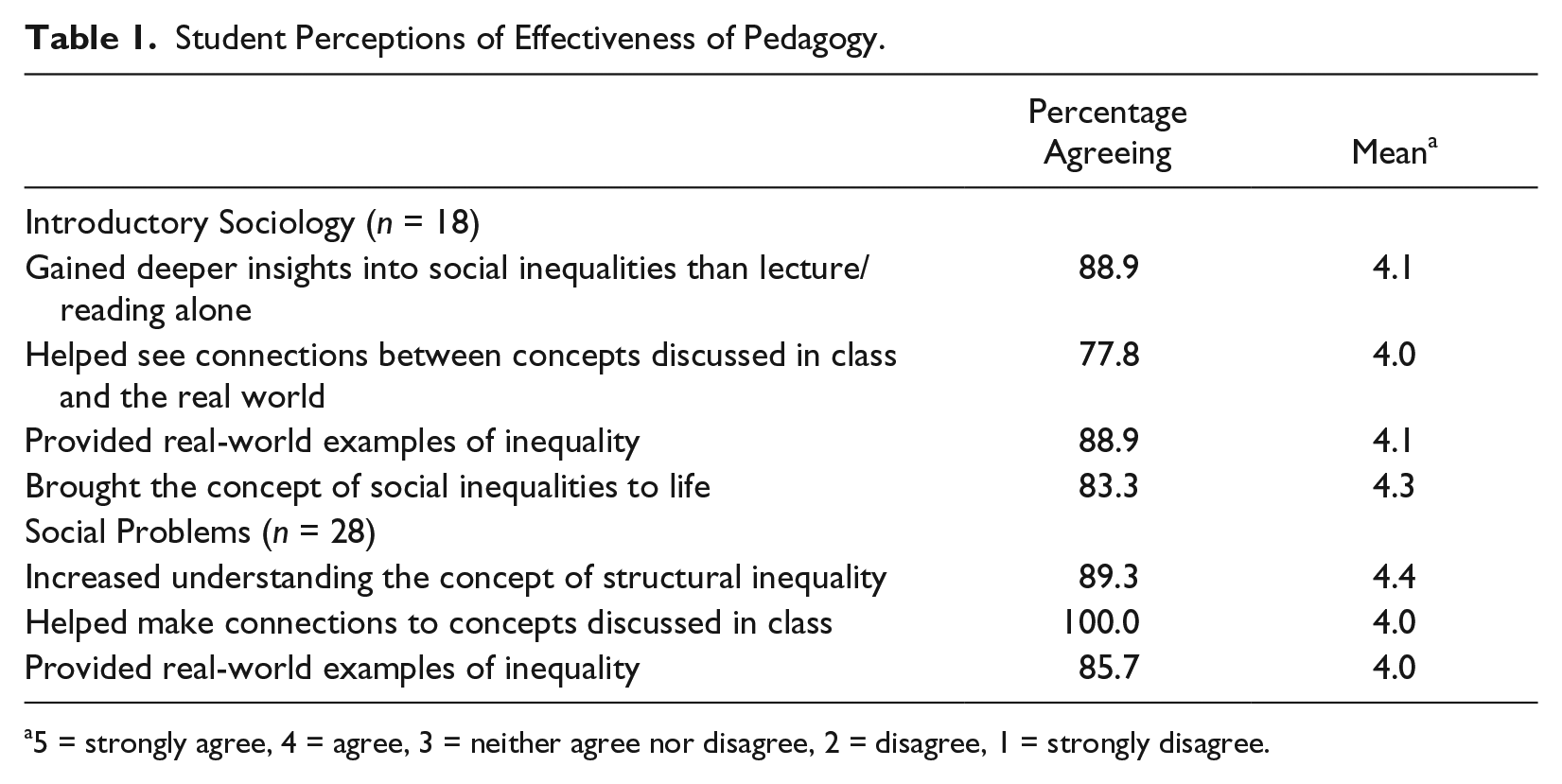
5 = strongly agree, 4 = agree, 3 = neither agree nor disagree, 2 = disagree, 1 = strongly disagree.
Our analysis of students’ photographs and their interpretations of their photographs suggest that this component of the exercise provides students an opportunity to go beyond simply looking at their signs of inequality in the environment and seeing on a deeper level. On a manifest level, the most common symbols of inequality captured by students were buildings (e.g., banks, abandoned shops, private clubs) and people (about one-third of the photographs were of homeless individuals) (see Table 2). The remaining photographs were classified as “other” and included such things as parking lots, streets, and signage.
Manifest and Latent Content of Photographs and Interpretations (Percentages Unless Otherwise Noted).
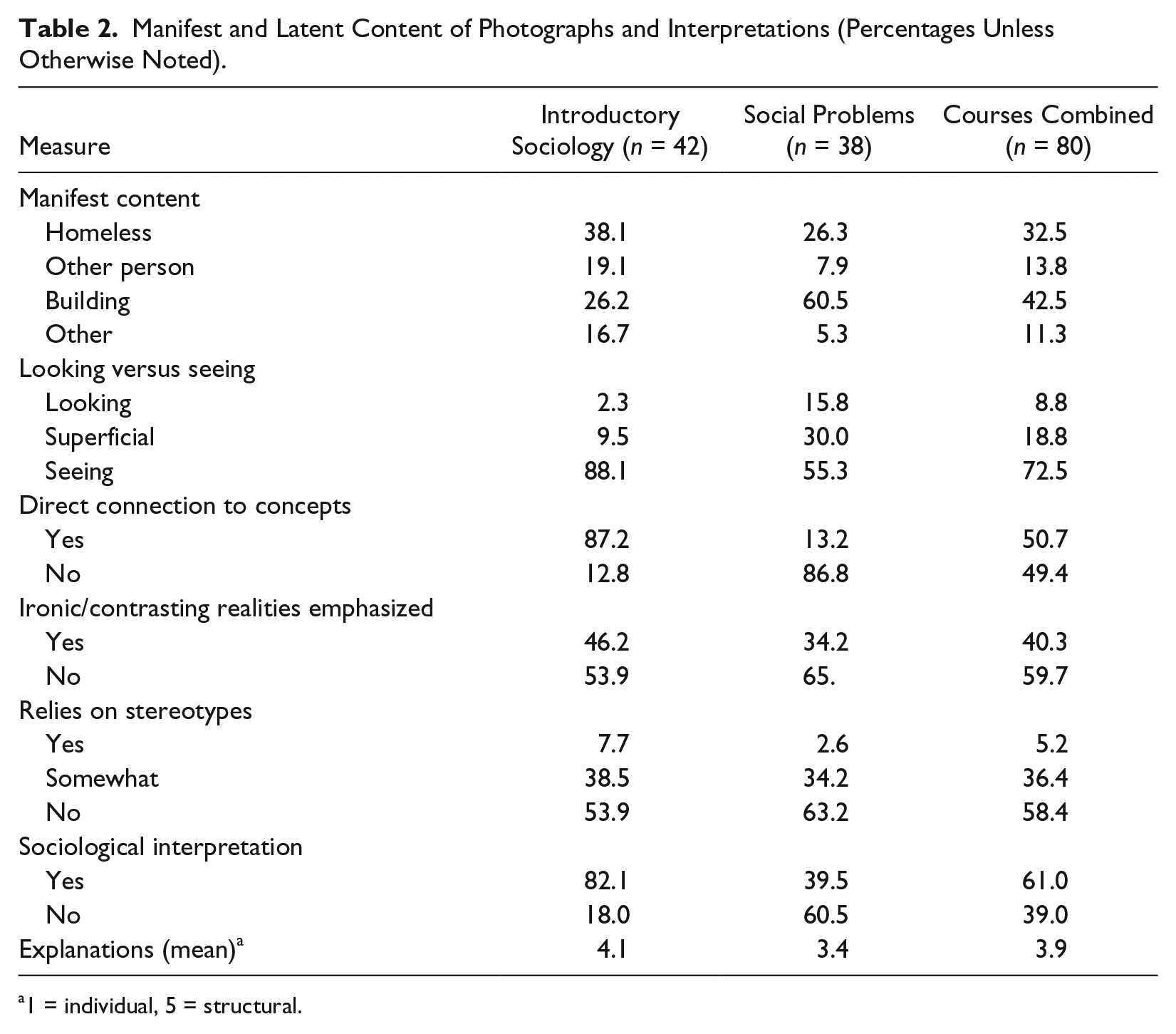
1 = individual, 5 = structural.
Beyond the manifest content, most students (73 percent overall) went beyond superficial descriptions and were able to interpret scenes from a deeper and more sociological perspective. For example, one student wrote: The banks downtown stand high above all other business in its area. This can be seen as a metaphor to those who control and majority of America’s money while others control much smaller amounts.
Although we did not prime students to do so, one strategy employed by nearly half that suggests a deeper seeing was to contrast two stark realities. For example, a student in the Introductory Sociology course photographed a seemingly homeless, disabled man seeking shelter outside an abandoned warehouse that was directly across the street from a bank. This student wrote: [T]he fact that he has no way to obtain money from the bank that is literally across the street from where this photograph was taken shows that a disability would make it impossible for an individual to obtain a sense of social mobility and move up even one social class.
Another student who noticed a high-rise bank building in the background and a small business building in the foreground wrote: The Regions building is the obvious subject of the picture but if one were to look closer, under it is a little brick building nearly covered with vines. The Region’s corporation has more money to support and grow its business compared to the smaller, most likely individually-owned building and whatever business was being ran there.
Another student contrasted photographs of a luxury hotel and a public area where individuals who were homeless had congregated: Comparing the homeless who seek shelter on the streets to a hotel is a prime example of economic inequality. The Grand Bohemian Hotel is a luxurious hotel. . . . Just a few blocks away there were several homeless people taking shelter under a bridge and who obviously could not afford a hotel and don’t even have a home.
Other students photographed homes from affluent and poorer neighborhoods as well as luxury cars next to inexpensive ones.
Our analysis suggests that students relied more on structural rather than individual explanations in their interpretations, avoided making stereotypical comments, and about half made direct connections to sociological concepts. For instance, one student who juxtaposed a Bank of America building and a small business linked these images to the class lecture on social mobility: “It is easier for a wealthy individual with a pre-established corporation to get wealthier than it is for a middle-class individual with an idea to establish a business, compete in the same market and climb the social ladder.” Although about half of the students made connections to course concepts, there was a notable difference between the two courses on this skill. The same was true for whether students were coded as using a sociological interpretation in general—82 percent did so in honors Introductory Sociology compared to 40 percent in Social Problems. These differences in application and sociological interpretation are likely due to the way the assignment was structured differently in the courses, as noted previously and in Note 1.
The photographic component of the project required students to pay attention to how inequalities are manifested within society and to see how they are abundant but largely ignored. Students reported that they paid closer attention to signs and people whom they would often not notice, in part because the exercise took them to places they don’t regularly frequent. One student spotted a sign at the downtown bus terminal that said “Please NO Panhandling, Loitering, Sleeping in the Terminal . . . ” while another photographed a “Private: Members Only” sign. Thus, the visual component drew students’ attention to manifestations of inequalities that often go unnoticed.
The bus ride component of the project also seemed to open students’ eyes and encouraged deeper comprehension and application of concepts and realities related to social inequalities. From the content analysis of students’ writings, we found that almost all students demonstrated skill in linking their experiences with the course readings and class discussions. For example, the following excerpt from a student in Introductory Sociology is typical of students’ abilities to apply readings in a concrete way and reflect on how their own lives are shaped by privilege (owning a car): I understand now the significance of Barbara Ehrenreich’s refusal to sacrifice a car in her study. . . . Being forced to rely solely on public transportation severely limits your opportunities and makes fulfilling commitments especially difficult. . . . I could very well rely on public transportation . . . but I would have to make many lifestyle changes. . . . I would purchase a meal plan because carrying . . . grocery bags by myself on a public bus would prove extremely difficult. . . . My leisure activities would also campus-based. . . . Most importantly, the internships and research positions I look for will have to be close to campus if not on campus. Relying on public transportation will drastically limit my opportunities.
The previous quotation also highlights how the assignment helped students recognize structural barriers that profoundly shape individuals’ lives. Students seemed to understand that the bus system represents a structural barrier because riders usually have little control over bus schedules, routes, and fares. There are, of course, two groups of bus riders: (1) those who choose to ride the bus and (2) those who have to ride the bus. The first group may consist of individuals who are able to absorb the inconveniences of bus riding, such as taking longer and indirect routes, limiting the number of places one can travel, and restricting the items that can be carried. The second group of bus riders may actually be disadvantaged by the bus system. For example, they may endure limited employment opportunities and greater difficulty accessing health care or public services and may face additional burdens associated with parenting and self-care. For such riders, the bus system represents a structural barrier because they have little control over a system that creates additional burdens in their lives. We found that students were able to both identify the inconveniences of bus riding and also confront the structural barriers that disadvantage people who must rely on the busses as their sole means of transportation: The bus ride, in particular, seemed to drive this point home for students. For example: It can become exhausting and demotivating for those searching for jobs or who rely on the bus to take them across town. If the bus is late, the person headed to their job will be late too. (Social Problems) Having the bus as your only means of motor transportation affects your entire life tremendously. Planning a life around a bus schedule involves an array of decisions from simple ones like getting place to place in a timely manner to large choices such as housing and opportunities for employment. (Social Problems) I started out my day a bit nervous, hesitant and unsure of what expect but in many ways it opened my eyes to the struggles people face on a regular basis. (Social Problems)
Those who rely on public transportation, by choice or by necessity, must conform to the pre-established pick-up and drop-off times and locations. We were especially pleased to see that many students understood that these restrictions and barriers—commonplace in the lives of many—not only complicate daily activities but also reinforce social stratification: This system was meant to help those that were less fortunate get around, however it can also effectively keep the poor segregated and in poverty due to lack of reliability and efficiency. (Introductory Sociology) Reliance on public transportation will inevitably contribute to social inequality. If the bus is running late one too many times, that could cost someone their job. Furthermore, jobs are moving away from city centers and further out into the suburbs, where public transportation is lacking. (Introductory Sociology) [The bus system] actually reinforces inequality by creating a cycle that traps people being forced to rely and be dependent on a bus and its pickup and drop-off schedule. (Social Problems)
Judging from students’ writings, the bus ride component was effective in terms of helping students understand how low income and reliance on public transportation would shape one’s daily life and reproduce social inequalities.
One objective we had for the overall project was to help dispel stereotypes of marginalized groups. The results from this assessment are mixed. On the one hand, students seemed highly sympathetic to the struggles of the poor, as seen in the previous comments. Also, some students were clear about their stereotypes and how the exercise forced them to rethink them: I am one of the many people who usually thought of homeless people as being lazy or wasting their money on drug and alcohol use. . . . After taking the bus, I understand that many people might find themselves without jobs due to simply being dependent on the bus and . . . the driver schedule. (Introductory Sociology)
We were pleased to find that many students engaged with fellow passengers and individuals they met while walking around downtown. For example, one Introductory Sociology student wrote, “I had the pleasure of actually talking to the lady next to me while going downtown. She was [an] average single mother with a minimum wage job and just couldn’t afford a car.” Conversations centered on the mundane (“a fellow bus rider had to show me where the information desk at the downtown central station was”) and the serious (“after speaking to a family living off of disability, they explained to me that disability only helps them get through the first half of the month’s expenses”). Consistent with the contact hypothesis (Allport 1954), these interactions did seem to broaden and humanize students’ perceptions of others: [While buying the ticket] I realized that I only had $4 and I needed $4.50 for the all day pass. I wanted to buy the all day pass because I was worried that I’d have problems coming back to [school] after work. One of the people, who looked really poor, actually offered 50 cents to buy my ticket. I was shocked that the same person I was afraid of actually was very helpful and extremely nice. My fear of the bus went away at that point. (Introductory Sociology)
On the other hand, some students employed stereotypes when describing others they encountered (as seen in Table 2, about 40 percent of photographic interpretations relied somewhat or exclusively on stereotypes). Consider this example: “I saw a homeless man, the single mother with five kids, the ‘gangsta/hood’ boy, and a disabled individual” or “a slightly belligerent mentally disabled man sat next to me for a while and made me a bit uncomfortable.” Their language also reflected a sense of “we versus they”: For me, this was an experiment . . . [f]or others this is life. . . . [The two men who sat near me] worked grueling hours probably, outside and now have to take a crowded bus home that takes twice as long than driving yourself because in all likelihood they have to. They can’t afford not to. (Social Problems)
Although some students realized they were not so different from others they met, others highlighted differences: I most certainly prefer utilizing my car over the bus. The ease of access, privacy, and ability to go where I want or change routes mid trip allows me to maintain my preferred lifestyle. (Social Problems) If I had to rely on the bus as my form of transportation I’d have a lot of problems because I wouldn’t be able to freely go to the places that I want to whenever I want. I also wouldn’t be able to work as much as I do now because I wouldn’t be able to get to work on time. (Social Problems)
Thus, the project seemed to dispel stereotypes in some ways but reinforce them in others.
Overall, the assignment appeared to raise students’ awareness of social inequality, especially social class. Many students reported that their perceptions of the world had been altered and admitted to having a much better understanding of the reality of social stratification. Both components of this exercise—the bus ride and photography—offer different strengths. The bus ride, for example, pushed students out of their comfort zones. Although most students had used public transportation, this was mostly restricted to campus shuttles and subways or taxis in large cities. Thus, riding the bus with individuals with whom they would normally not interact and through neighborhoods/areas they would normally not traverse was eye opening for many students. The photographic component encouraged students to look more closely and more deeply than they might have if they were only observing bus riders. The rich descriptions offered by several students suggested that the photographs allowed students to apply course concepts in interesting ways and heightened their abilities to see features of social life that often go unnoticed.
When students in the Introductory Sociology course were asked which part of the exercise—bus ride, photographing, writing/reflection—was most helpful in learning about inequalities, 64 percent said the bus ride was most helpful, 21 percent said photographing, and 14 percent said both were equally helpful. Students’ enjoyment with the assignment was also high. In the Introductory Sociology class, 83 percent agreed or strongly agreed that they were glad they completed the assignment, compared to 68 percent in Social Problems. Students also said they would recommend the assignment to others (83 percent in Introductory Sociology; 92 percent in Social Problems).
Discussion and Conclusion
Experiential learning is a powerful pedagogical tool that can help drive home important sociological lessons. The assignment described here combines community-based learning and visual sociology into one powerful experiential learning exercise to teach about social inequalities. It is low cost (students do need to buy bus passes) and not especially time-consuming (most students completed bus ride and photographic assignment in about three hours). All of our students had access to personal cell phones, making the visual/photographic component easy to accomplish, although this might not be the case for all students.
Although students did not seem to prefer the photographic component as much as the bus ride, we believe the photographic component adds value to the bus-riding exercise developed by Nichols et al. (2004). It forced students to provide photographic proof that they understood how to apply sociological concepts in real life. It also has the potential to make students better observers of social life, indeed, better sociologists. As Grady (1996:21) reminds us, When many of us were trained in sociology we were often told about how important it was to “get the feel” of a setting and to become aware of the “sounds,” the “smells,” and, of course, the “look” of our subjects, their worlds and their interactions. . . . Visual sociologists were the first to explicitly explore those dimensions of experience that had often provided generations of sociologists with their most valid and reliable information.
We believe there is great value in having students experience their environments in a visceral way by using all their senses. As seen here, it also provided opportunities to relate what they saw to course material and make sociological connections. This study also suggests that even one-time photographic exercises can be effective in helping students learn. One important lesson we learned was that the framing of the exercise is important in helping students get the most out of the experience. The exercise was first used in Social Problems, and the instructor incorporated the photographic component primarily as a way to ensure that students did not simply stay on the bus and return to campus without exploring their environments. The descriptions received were briefer and less sociological. Asking students to link photographs with course concepts appears to be beneficial in helping students make sociological connections.
We have focused on income inequalities in this report, but it would be easy to adapt this assignment to other forms of inequality; indeed, the assignment is written to allow students to observe and focus on any form of inequality. The bus riding was very much a gendered experience for students; it would be easy to adapt this assignment to highlight this point. For example, students could be asked to focus on where men and women sit on the buses, who tends to be traveling with children or carrying groceries, and so on, and then photograph manifestations of the gendered social world (a shopping mall would be a promising destination). Without explicit instruction to focus on a specific type of inequality, students are likely to focus on income inequality. Thus, it may be interesting to discuss with students why other types of inequality are less obvious to them. The assignment also opens the door to discussions of how race, class, and gender intersect, as many of the observations and photographs capture such intersectionalities. Some instructors may also wish to highlight the political nature of public transportation (i.e., policies and budgets for public transportation vs. other public goods) and the implications this has for social class. Another way in which this assignment could be enhanced is by creating a more public venue (even if just among students in the course) via a blog or online discussion board to allow students to share insights and photos with other students and generate a broader discussion about the issues as students comment on others’ photos (Whitley 2013).
There are some limitations to be considered. The “Hop on the Bus” portion is probably best suited for those teaching in moderate-sized cities or semi-urban areas rather than very small areas that lack public transportation or very large cities where the use of public transportation is common across social classes (especially among students) and inequalities are more obvious throughout the city. The photographic component could be adapted to nearly any environment. However, visual exercises such as the one introduced here must be modified to accommodate students who are visually impaired (a suitable alternative might be to find representations of inequality in songs).
There are important ethical issues surrounding photographing in public spaces that must be considered. These issues are even more pressing given the rise in urban decay tourism “whereby curiosity-seekers search out the remnants of the decaying and abandoned infrastructure of industrial America as a source of artistic expression or thrill-seeking” (Bachin 2015:1075) Although this exercise is not framed in this way (students do not go in groups, do not visit the poorest areas, and are being trained to focus a sociological rather than voyeuristic lens), asking relatively advantaged students to observe and photograph less affluent areas, and especially individuals who appear to be economically disadvantaged, can be problematic. These issues are not unique to this exercise—any assignments that ask students to observe in public spaces, gather data from people, or engage in service-learning with disadvantaged groups can reproduce inequalities they intend to challenge (Becker and Paul 2015). It is important to be aware of the ethical issues surrounding these practices and sensitize students to these issues. Instructors who are uncomfortable having students photograph people and objects in public spaces could ask them to locate visual images from the Internet, but doing so may sacrifice the opportunity to get students engaged in a direct and immediate way with their environments. Perhaps a better solution would be to ask them to photograph objects; doing so may actually highlight the structural rather than individual nature of social inequality.
Safety issues are another concern or challenge to conducting this assignment. Some women expressed concerns over riding the bus and completing the assignment alone. One student in the Social Problems course remarked, “At the station I felt harassed, males look at you like they have never seen a woman, and they stare at you even when you are looking at them straight into their eyes.” Another Social Problems student wrote, “I did not feel comfortable doing this assignment alone. I am a young, Caucasian woman and I feel that being on a bus and wandering the streets of downtown alone would be unsafe.” Another noted, “I don’t think I would have been brave enough to do this alone; being a petite Caucasian female can make me a target in certain areas of town.” These issues arose in the Social Problems course, where students were instructed to conduct the exercise alone, so we modified it in the Introductory course to allow students to ride the bus and conduct the visual exercise with a friend (classmate or other). In this course, time was spent discussing safety precautions with students before they rode the bus (ride the bus during daylight hours, ride with a friend if desired, sit near the bus driver if anything occurs that you find problematic). The route we chose was also one that is relatively straightforward and has a history and reputation as being safe. Beyond safety issues, these comments remind us how riding the bus is a gendered experience. While not all of the women who completed the assignment expressed concerns for their safety, it is noteworthy that none of the men expressed similar concerns. Another potential issue with the bus riding is that students who are relatively disadvantaged economically and who may rely on public transportation may feel uncomfortable with the exercise. Of course, this is always a risk when we teach about inequalities, but instructors should be aware of this possibility.
Social inequalities are central to sociological instruction but often challenging to teach. Experiential learning and visual pedagogy, especially in combination, actively engages students in the learning process and forces them to confront social realities in more direct ways. Instructors are then better able to drive the lessons home by debriefing in class after the bus ride and using the visual images students generated to analyze social inequalities in deeper ways. Above all, it helps students become more skilled observers of their social worlds.
Footnotes
Acknowledgements
We wish to thank Lauren Gilmore, Kaitlyn Henderson, Elena Correa, and McKenzie Everett for their assistance in coding and especially our students who participated in this project and agreed to let us use their work. An earlier version of this paper was presented at the 2013 Southern Sociological Society annual meetings. Authors are listed alphabetically to denote equal contribution.
Editor’s Note
Reviewers for this manuscript were, in alphabetical order, Sergio Cabrera, Whitley Cameron, and Laura Nichols.