



Abstract
Group research projects frequently are used to teach undergraduate research methods. This study uses multivariate analyses to examine the characteristics of higher-achieving groups (those that earn higher grades on group research projects) and to estimate the effects of participating in higher-achieving groups on subsequent individual learning (grade on final paper). The sample includes 257 students who completed a sociology research methods course at a small liberal arts institution between 2004 and 2015. Group achievement (grade on group research project) is predicted by group size, gender composition of the group, and group’s average grade on midterm exams. Group achievement on the research project contributes to subsequent individual learning (grade on final paper) even after controlling for individual characteristics (student’s gender, race, and average grade on midterm exams) and group characteristics. The findings support claims that group research projects are an effective pedagogy for undergraduate sociology research methods courses and point to some guidelines for instructors’ composition of groups for research projects.
The group research project is a frequently used pedagogy for undergraduate research methods courses (Earley 2014). Group research projects combine experiential learning (“learning by doing”) and collaborative learning (“learning in groups”) and require students to engage in several of the components of the full arc of the research process: reviewing literature, defining the research question, designing the research project, collecting and analyzing data, and writing up the research findings. Those who promote the use of group research projects argue that this pedagogy can concretize abstract and complex concepts, allay students’ anxiety about mastering difficult and/or technical material, foster student engagement with course material, and acquaint students with the actual challenges of social scientific research as a process and practice of inquiry (Caulfield and Persell 2006; Macheski et al. 2008; Schutt, Blalock, and Wagenaar 1984).
This study reviews the literatures on experiential and collaborative learning and the use of group research projects to teach undergraduate research methods courses. It draws on a sample of 257 students who completed a research methods course that included a group research project and uses multivariate analyses to address two questions: (1) What group characteristics are associated with groups that earn higher grades on the research project? and (2) Does the achievement of a student’s group on the research project predict the student’s subsequent achievement on the final paper in the course, even after controlling for other predictors of individual achievement (e.g., performance on midterm exams)?
Teaching Research Methods through Group Research Projects: Learning by Doing, Together
Experiential and Collaborative Learning
The view that students learn best by doing is axiomatic in most discussions of appropriate pedagogy for research methods courses. One widely cited analysis of the best means for achieving various instructional goals in research methods courses includes an examination of what kind of hands-on research experience to require of students, not whether to require such an experience (Schutt et al. 1984). They argue strongly for requiring students to experience the full arc of the research process, although they acknowledge that shorter (10-week) terms and class sizes of more than 20 students may make this approach unworkable (Schutt et al. 1984). A recent review and synthesis of the literature on research methods education found that “the main lesson . . . is teachers need to use active learning approaches . . . [and] hands-on exposure to research methods. . . . For most of the articles in this synthesis, this meant students completing, either in part or in full, an actual research study” (Earley 2014:248). A review of best practices for all core sociology courses urges instructors to foster a “community of learners” in their classrooms; for research methods courses, they endorse “campus-community research projects that take the design and conducting of student research out of the realm of the ‘hypothetical’ and shift it to the real world . . . [thus locating] students as active participants in their learning of research methods” (Macheski et al. 2008:45).
Collaborative pedagogy is a common approach to research projects and in twenty-first-century higher education more generally. Cohen (1994:3–4) defines it as “students working together in a group small enough that everyone can participate on a collective task that has been clearly assigned” and emphasizes that a “true group task” involves an “ill-structured problem,” one that individuals cannot solve by working alone. Thus, collaborative learning positions students as problem solvers in a team of peers rather than isolated and passive recipients of teachers’ authoritative expertise; students learn by trying out and discussing their ideas with one another and then with the instructor (Caulfield and Persell 2006; Rau and Heyl 1990; Schreiber and Valle 2013).
Positive associations between collaborative learning and students’ academic and/or social success are well documented (see Rau and Heyl 1990). For example, one carefully designed evaluation found that students’ final exam scores in the introductory sociology course were correlated with the midterm exam scores of their learning group, even after controlling for students’ individual scores on midterm exams (Zipp 2007). But some instructors find that collaborative activity does not have the expected benefits for students’ learning, even when it has positive effects on students’ preparation for class, attitudes about the course, and/or social interaction with the instructor or classmates (Huggins and Stamatel 2015; Slusser and Erikson 2006). One instructor found that a collaborative learning assignment in his statistics course had no effect on students’ exam scores in one instance but positive effects in another, and he speculated that the positive effects in the second instance might be attributable to students’ self-selection into different groups because of free-rider problems in the first instance (Delucchi 2006:246).
Evidence suggests that collaborative group composition can influence how groups function and whether these groups contribute to student learning. Fiechtner and Davis (1984) identified several group characteristics associated with students’ negative experiences with collaborative learning groups: self-selected groups, homogenous groups, group size of fewer than four or more than seven students, and groups that are temporary (i.e., formed and then disbanded after a discrete activity or task). However, their study did not include an assessment of how student learning is affected by these group characteristics. In contrast to Fiechtner and Davis’s finding that students are more likely to have negative experiences with homogenous groups, a study that randomly assigned students in a college psychology course to collaborative learning groups that were either homogenous or heterogeneous on early achievement in the course found that students assigned to homogenous groups scored higher on the final exam (Baer 2003). But this pattern did not hold for students with the lowest levels of early achievement in the course, who performed equally well on the final exam regardless of their assignment to homogenous or heterogeneous collaborative groups.
Group Research Projects: Evidence of Effectiveness, Challenges, and Remaining Questions
Most analyses of the effectiveness of group research projects in undergraduate research methods courses are case studies that report on the use of group research projects in a single course. Almost without exception, instructors claim that group research projects have impressive effects on student learning in research methods courses. As evidence, they relate inspiring tales of student engagement, transformation, and achievement. Many also draw on quantitative and/or qualitative data from student evaluations (Keen 1996; Potter, Caffrey, and Plante 2003) or other surveys or focus group interviews of students (Broughton 2011; George 2012; Raddon, Nault, and Scott 2008; Winn 1995) in which students comment on their own learning and/or experiences with the group research. However, there is little evidence that student learning results from the experience of group research projects in the form of pre- and posttest research designs or regression analyses that estimate effects on student learning while controlling for other predictors of learning gains (Earley 2014).
Nearly all of these case studies acknowledge the time- and labor-intensive character of group research projects for instructors and students alike. Some of these case studies discuss the challenges of using group projects to teach specific (usually qualitative) methods, such as whether and how ethnographic research methods can be taught using group projects in the span of a typical semester-long methods course (Keen 1996). Many of the challenges described in these case studies center on one or more aspects of the group collaboration, such as the logistics of managing and assisting multiple small groups of students over the arc of a full research project (Potter et al. 2003; Takata and Leiting 1987); how to minimize and respond to problems of group dynamics, such as free riders (Longmore, Dunn, and Jarboe 1996; also see Schreiber and Valle 2013); and how to assign and use individual versus group grades (Crull and Collins 2004; Potter et al. 2003). Some instructors found it necessary to develop instructional materials expressly for the purpose of teaching students how to work effectively in groups (Caulfield and Persell 2006).
The particular challenges of incorporating complete group research projects in large class settings are often noted (Crull and Collins 2004; Raddon et al. 2008; Schutt et al. 1984; Winn 1995). Some instructors of larger research methods classes design experiential learning exercises or miniprojects that deemphasize the use of collaborative groups and eliminate the most time-consuming aspects of data collection. These exercises typically give students hands-on experience with specific components of the research process, such as sampling, measurement, or coding (Crull and Collins 2004; Pfeffer and Rogalin 2012; Rushing and Winfield 1999). One exception is a meticulously planned and closely coordinated qualitative research methods course with large enrollments (n = more than 100) that includes a complete research project, albeit solely with the method of interviews; the instructors comment, with impressive understatement, on the “heightened intensity” of the work involved in such a course (Raddon et al. 2008:146).
In sum, an instructor of research methods considering the use of group research projects might well be inspired by the testimonial case studies of this pedagogy and persuaded by findings that collaborative learning and experiential learning have generally positive impacts on students’ academic success. However, they will find little guidance in the sociological literature about how to compose student groups or which methods of data collection to assign in order to minimize some of the challenges associated with group research projects and maximize students’ learning gains from this pedagogical approach.
For example, there are conflicting findings on the optimal group size for group research projects. Fiechtner and Davis (1984) find that collaborative groups of fewer than four and more than seven students are associated with students’ negative experiences. Rau and Heyl (1990) agree that groups of three are too small and recommend collaborative groups of five to six students. Caulfield and Persell (2006) find that groups of three in research projects are problematic in entry-level sociology courses but not in more advanced courses. Other questions about group composition for research project groups are also relevant. Instructors have used collaborative groups that were self-selected (Delucchi 2006; Huggins and Stamatel 2015; Winn 1995); randomly assigned by instructors to achieve diversity (Potter et al. 2003); purposely assigned to manage heterogeneity by gender, prior academic achievement, or learning styles (Slusser and Erickson 2006; Zipp 2007); and so on. Almost no studies of research methods courses address which group characteristics are correlated with group success and individual students’ learning gains. Finally, instructors who use group research projects sometimes incorporate multiple methods (Broughton 2011; Takata and Leiting 1987; Winn 1995) and sometimes utilize only self-administered questionnaires (SAQs; Longmore et al. 1996; Potter et al. 2003), interviews (George 2012; Raddon et al. 2008), or field observations (Keen 1996). But no studies of group research projects have compared the effects of different data collection methods on students’ learning gains, although one analysis of students’ self-reported experiences with the group project found no differences by method used (Winn 1995).
Several changes in the landscape of higher education make these questions especially pertinent for instructors who want to use group research projects to teach research methods. There are mounting challenges involved with securing institutional review board (IRB) approval for student research projects that do not rely solely on unobtrusive methods or the observation of public behavior (Haggerty 2004). The twenty-first-century undergraduate student population is increasingly diverse by race-ethnicity (National Center for Education Statistics 2015), and several studies find positive effects on student learning in racially diverse campuses (Chang 1999; Pascarella et al. 2001) or diverse classrooms (Pitt and Packard 2012; Terenzini et al. 2001). It is not clear whether these effects also are found in racially diverse collaborative learning groups. Additionally, twenty-first-century students increasingly rely on online and virtual communication, but these skills may not equip them for the face-to-face interaction patterns required for successful group work or for some methods of data collection, such as in-depth interviews. Finally, undergraduates are devoting more hours to extra- and co-curricular activities, which can make it difficult for larger project groups to schedule meeting times. Instructors can create smaller groups for project work to mitigate scheduling difficulties, but as noted above, there are conflicting findings on “how small is too small” for effective collaborative groups (Caulfield and Persell 2006; Fiechtner and Davis 1984; Rau and Heyl 1990).
Earley’s (2014) recommendation that the literature on research methods education move beyond anecdotal evidence of the effectiveness of project-based pedagogy echoes Grauerholz and Zipp’s (2008) call for stronger evidentiary standards in claims of effectiveness of particular teaching methods, by utilizing (among other things) larger sample sizes, data from multiple sections of a course or multiple courses, and multiple measures of outcomes. These sorts of analyses generally are not possible with case studies but are necessary in order to understand whether particular sorts of groups are more successful in group research projects and whether particular sorts of students experience greater or lesser learning gains from group research projects. This study draws on 11 years of data on student learning outcomes in an undergraduate research methods course that utilized group research projects.
Data and Methods
Course, Project, and Students
The subjects for this study are 257 undergraduate students who completed one of the 14 sections of an intermediate-level sociology research methods course (Sociology 211) I taught between fall 2004 and fall 2015 at Hobart and William Smith Colleges, a small, private, liberal arts institution in the Northeast. This course is a prerequisite for the senior capstone course in sociology and is one option for fulfilling a methods course requirement in several interdisciplinary majors. It enrolls mainly juniors and some sophomores and seniors. Enrollment is capped at 25 students, and the average class size is 19 students. Sixty-eight percent of the subjects in this study are women, and 16 percent are nonwhite students, which reflects the characteristics of our sociology majors. Thus the modal student in this study is a white female junior sociology major.
Each term, the entire class selects a research topic to study. The only constraint on the topic is that it must be about our campus and/or local community. In the second week of the term, each student contributes a research topic to a “pool,” and over the next several weeks, the class discusses and gradually narrows down the various options. In order to cultivate students’ ownership of and investment in the research topic and projects, I am fairly nondirective throughout their discussions, offering only occasional comments (e.g., “It’s usually best to pick a topic you actually are interested in rather than one you think will be ‘easy’ to do”) and prompting them to narrow down the list of topics at appropriate moments. After much discussion and debate the class reaches some consensus. Topics have included town-gown relations, hook-up culture, classroom climate, and the like. 1
Midway through the term, usually right after the second midterm exam, I assign students to small groups of three to five students that are heterogeneous in their achievement on the midterm exams. My goal is to minimize variation across groups on their overall average exam grades. Occasionally I have taken other considerations into account, such as placing close friends in different groups. There are typically five groups in a given class, but this has ranged from three to six groups depending on enrollment. Each group designs and carries out a research project on the class’s selected topic using a different method of data collection: SAQs, experiment, content analysis, field observations, or in-depth interviews. In a class with six groups, one of these five methods is used by two different groups. Each group tailors the research topic as needed to fit its method of data collection.
The schedule of course topics is divided into three parts. In the first part of the course (weeks 1–8), I use a standard research methods textbook and more than a dozen journal articles to teach core concepts in sociological research (objectivity and reality, theory and research, ethics, politics, research design, causality, measurement, and sampling). I assess student learning by two or three midterm exams (worth 50–60 percent of the course grade), which include a mix of multiple-choice and short-answer questions. I also assign daily homework problems and give weekly in-class quizzes, but I do not collect these. Instead, I go over the quizzes and homework assignments in class to give students low-stakes feedback on their grasp of the course material and to telegraph the kinds of questions to expect on the exams. Throughout the term I keep track of individual students’ level of preparation for and participation in class meetings (worth 5–10 percent of the course grade).
In the second part of the course (weeks 9 and 10), I continue using the textbook and other assigned readings to teach particular methods of data collection: SAQs, experiments, content analysis, field research, and in-depth interviews. By this point in the course, there are no more exams and the students’ project groups have formed. To encourage students to complete the assigned reading even though the exams have ended, I require the groups to compete with one another for the privilege of selecting their preferred method of data collection for the projects. The group with the highest average quiz score on the day’s reading can opt to select or pass on the method under discussion that day. I do not record these scores in the grade book.
In the final part of the course (weeks 11–14), all the student groups are fully engaged in finalizing their research projects’ design, collecting and analyzing data, and presenting their findings to the class as a whole. 2 I continue to use the textbook and other assigned readings to teach some of the basics of quantitative and qualitative data analysis, but most class meetings are partly or wholly devoted to group project work. During this period, student groups also meet with each other outside of class several times a week and are required to meet with me very frequently as well. During my meetings with student groups, I offer support and critical feedback on their emerging research designs, data collection and analysis efforts, and ideas for the in-class presentation. I also remain alert to any emerging problems with group dynamics.
In the final week of the term, each group presents its project design and findings in class. The presentations highlight the advantages of a multimethod approach to research topics and are an important element in the students’ experience of the sociological research process as dialogical (Caulfield and Persell 2006). Students collectively decide which members of the wider campus community to invite to these presentations. Audience members have included faculty from sociology and other disciplines, student deans, staff from the offices of admissions and student life, leaders of student clubs, and—once—the president of the colleges. Every audience member has the opportunity to ask questions of each group of students immediately following its presentation. The project and presentation is a group grade, worth 15 percent of the course grade.
As their final exam in the course, students write individual research reports and proposals (worth 20–25 percent of the course grade) in response to an extensively detailed prompt. 3 They are required to describe and critique their research project’s design and execution, summarize their findings, and propose a follow-up study using a different method of data collection. This is a comprehensive assessment of the sum total of their learning in the course, since students have to address every set of research concepts covered on the midterm exams as well as the information about specific methods of data collection covered after the midterm exams. I give students strict instructions that they must not collaborate on the final papers with their group members and warn them that evidence of collaboration will result in disciplinary action and failure of the course.
Dependent Variables: Group Achievement, Individual Student Learning
I use the grade on the research project as a measure of group achievement and the grade on the final paper as a measure of individual learning. Group project and individual paper grades were converted to continuous variables on a 4.0 scale (where A = 4.0).
Independent Variables: Individual Characteristics, Group Characteristics
My records included information for each student’s gender, race, and grades on midterm exams. The midterm exams are scored on a 100-point scale and then curved before assigning a letter grade to a range of scores. I converted the letter grades on midterm exams to a continuous variable on a 4.0 scale (where A = 4.0) in order to calculate a mean midterm exam grade for each student. I grouped individual students’ average midterm exam grade into three categories: 1.8 and lower, 1.85 to 2.70, and 2.77 and higher. These categories reflected naturally occurring gaps of at least .05 at those points in the frequency distribution and resulted in three roughly equal-sized subgroups of lower-achieving, moderate-achieving, and higher-achieving students (n = 82, 84, and 91, respectively).
My records also included information on each research group’s size, gender and racial composition, and method of data collection. I recoded the gender composition variable into three categories that allowed me to compare gender-homogenous groups (100 percent women) with groups that were “somewhat gender diverse” (included just one man) and with groups that were “more gender diverse” (included two or more men). I did the same kind of recode with the racial composition variable. I also calculated each group’s overall average midterm exam grade.
I have records on student grades and research project groups’ composition for 257 (98 percent) of the 263 students who had completed the course between fall 2004 and fall 2015. I received IRB permission for conducting research using these data. Data for all 257 students were entered into a data file and analyzed using SPSS.
Results
Group Composition and Group Achievement
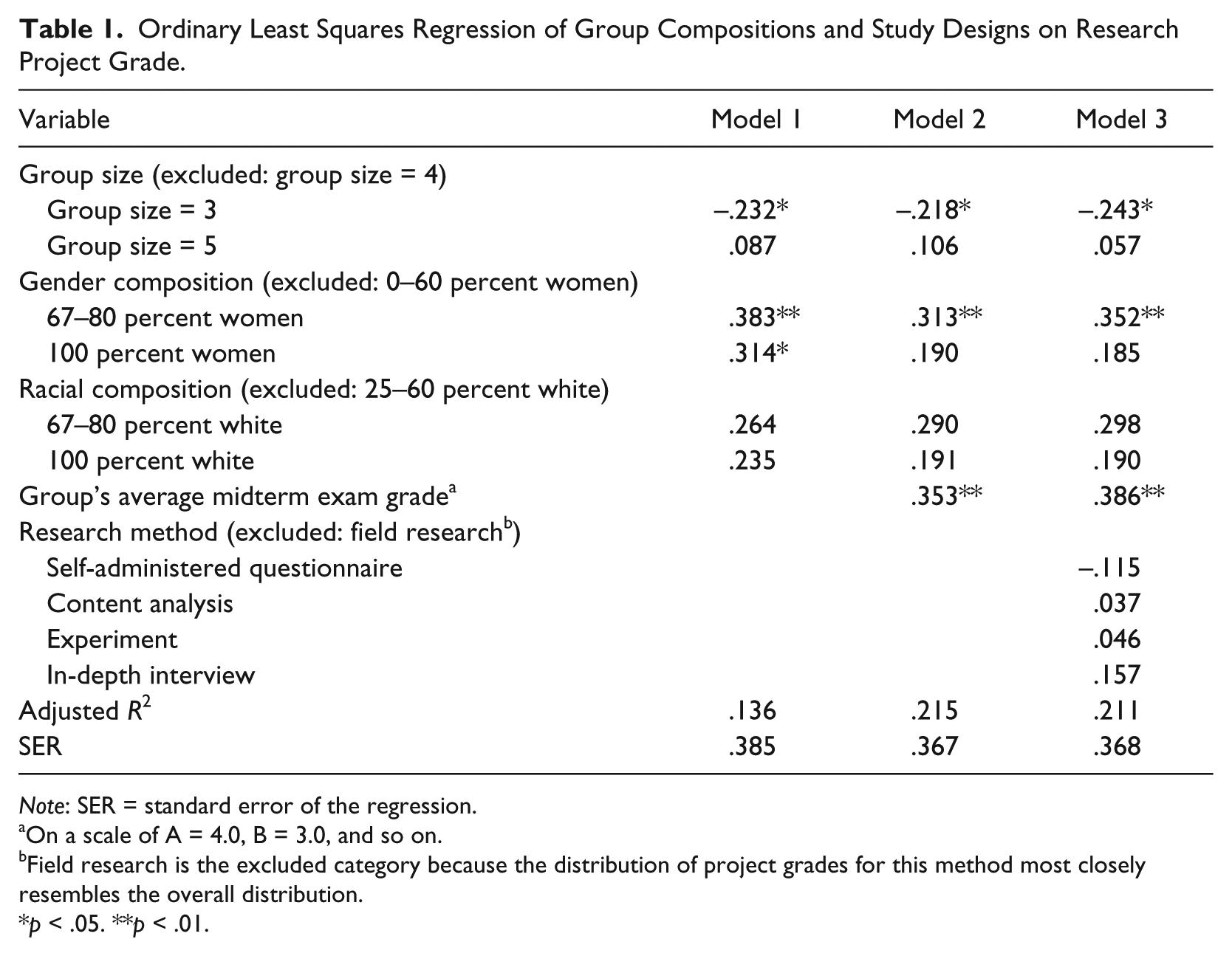
To examine the influence of group composition on group achievement, I ran a regression of the group research project grade using three different specifications (Table 1). The first specification includes only the group composition variables of size, percentage women, and percentage nonwhite. The results indicate that (compared to four-person groups) three-person groups have a disadvantage of somewhat less than a fourth of a letter grade (–.232, p < .05) on the research project. Compared to groups that include two or more men, groups composed of all women and groups that include just one man have an advantage of about a third of a letter grade (.314 with p < .05 and .383 with p < .01, respectively) on the research project. There are no statistically significant differences in achievement on the group research project for groups of differing racial composition.
Ordinary Least Squares Regression of Group Compositions and Study Designs on Research Project Grade.
Note: SER = standard error of the regression.
On a scale of A = 4.0, B = 3.0, and so on.
Field research is the excluded category because the distribution of project grades for this method most closely resembles the overall distribution.
p < .05. **p < .01.
The addition of the group’s average grade on the midterm exams in the second specification improves the adjusted R2 to .215. The coefficient for this variable is .353 (p < .01), indicating that after controlling for the group composition variables of size, percentage women, and percentage nonwhite, a one-unit (one-letter-grade) increase in a group’s average midterm exam grade yields a third-of-a-letter-grade advantage on the group research project grade. In this model, three-person groups are still disadvantaged relative to four-person groups (although the effect size is slightly smaller than in Model 1). Groups that include just one man are still advantaged relative to groups that include two or more men (although this effect size also is slightly smaller than in Model 1). But in this model, groups of all women are not advantaged relative to groups that include two or more men. Although it seems plausible to conclude that some gender heterogeneity has a positive impact on the research project grade once the group’s average midterm exam grade is controlled for, when I reran this model with 100 percent women as the excluded category, the coefficient for 67 to 80 percent women was not significant.
The variable of research method used was added in the third specification. None of the coefficients for the research methods were significant, and the R2 declined slightly (to .211). Thus, the preferred specification is Model 2: group size, gender and racial composition of groups, and groups’ overall average grades on midterm exams together explain about 22 percent of the variation in group achievement on the research project.
Does Group Achievement Predict Individual Learning? For Whom?
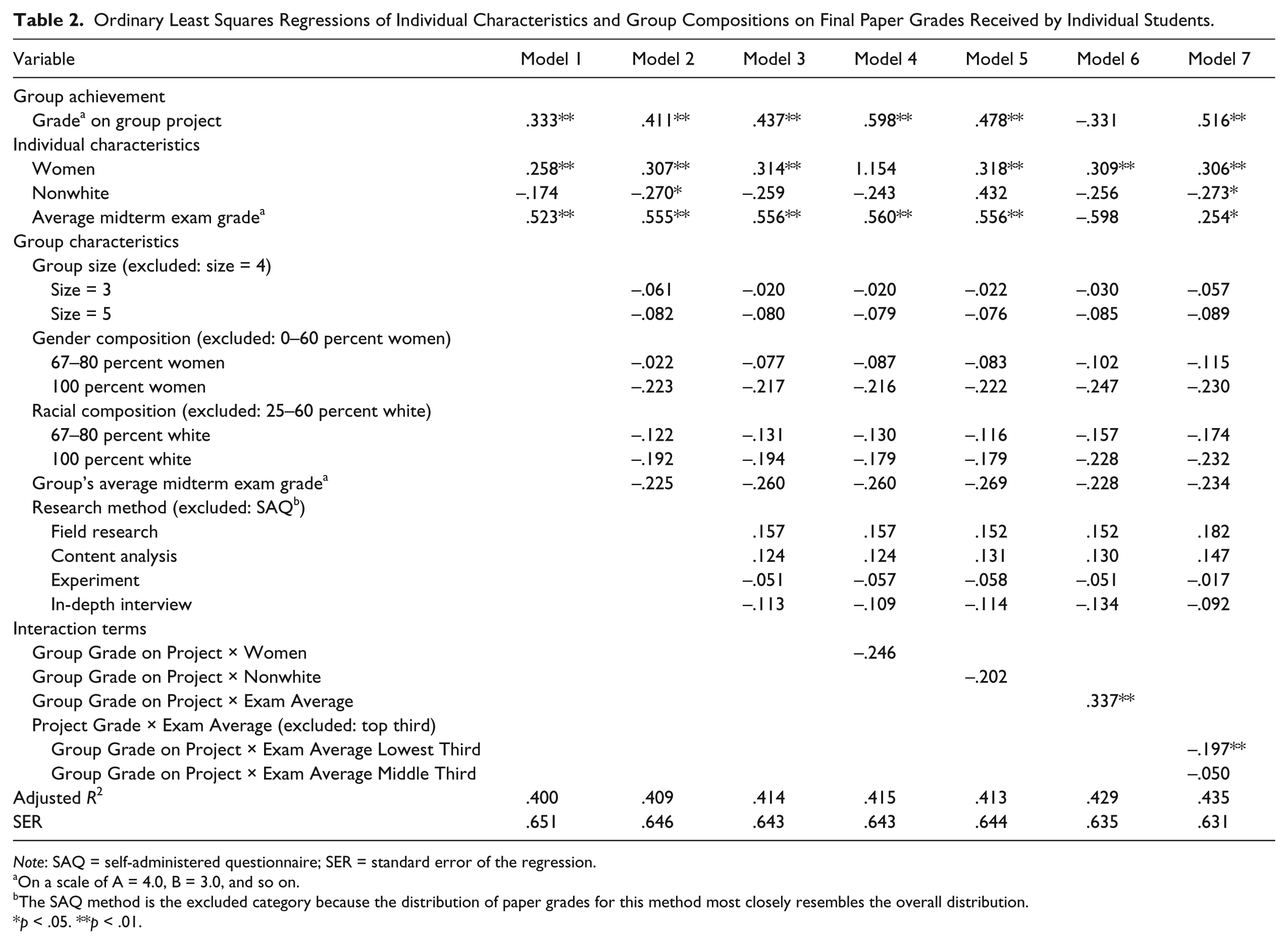
To estimate the relative influence of individual characteristics, group characteristics, and group achievement on students’ learning, I ran a regression of the individual student’s grade on the final research report and proposal using seven different specifications (see Table 2). The first specification includes group achievement (grade on group project) and the individual characteristics of gender, race, and student’s average grade on midterm exams. The results indicate that after controlling for the student’s gender, race, and midterm exam grades, a one-unit (one-letter-grade) increase in the grade on the group research project was associated with a third-of-a-letter-grade increase on the student’s final paper grade (.333, p < .01). By comparison, a one-unit (one-letter-grade) increase in a student’s average midterm exam grade was associated with slightly more than half-of-a-letter-grade increase on the student’s final paper (.523, p < .01). There were no significant differences between white and nonwhite students’ final paper grades after controlling for the other variables in the model. But even after controlling for these variables, on average, women had about a fourth-of-a-letter-grade advantage on the final paper (.258, p < .01) when compared to men.
Ordinary Least Squares Regressions of Individual Characteristics and Group Compositions on Final Paper Grades Received by Individual Students.
Note: SAQ = self-administered questionnaire; SER = standard error of the regression.
On a scale of A = 4.0, B = 3.0, and so on.
The SAQ method is the excluded category because the distribution of paper grades for this method most closely resembles the overall distribution.
p < .05. **p < .01.
The addition of group characteristics (size, percentage women, percentage nonwhite, and the group’s overall average grade on midterm exams) to the second specification improves the adjusted R2 slightly (to .409). None of the coefficients for these variables are significant. But after controlling for these group characteristics, the effect on the final paper grade of a student’s gender, average midterm exam grade, and the group’s grade on the research project are all intensified. The coefficients for each of these variables are all larger than in Model 1. In addition, the coefficient for nonwhite is now –.270 and significant at p < .05, indicating that after controlling for group characteristics, group and individual average grade on midterms, gender, and the grade on the group research project, nonwhite students have a fourth-of-a-letter-grade disadvantage on the final paper when compared to white students.
The addition of dummy variables for research method in the third specification improves the adjusted R2 slightly (to .414). None of the coefficients for research method are significant, indicating that after controlling for the other variables in the model, there were no differences in learning gains from the research project between students whose groups used the SAQ method (the excluded category) and students whose groups used any other method. After controlling for research method as well as group characteristics, the effect on final paper grade of students’ individual characteristics of gender, race, students’ average midterm exam grade, and students’ research project group grade remains roughly the same as in the prior model. Finally, in this model, the coefficient for the group’s overall average grade on midterm exams is now negative (–.26) and significant at p < .10, suggesting that (net of other variables in the model) a one-unit (one-letter-grade) increase in the group’s overall average grade on midterm exams is associated with a fourth-of-a-letter grade decrease in the student’s grade on the final paper. Since the model already controls for the student’s own average grade on midterm exams, the effect of the group’s average grade on midterm exams reflects the achievement levels of the other group members. Perhaps a student does not work as hard on—and thus learns less from—the group project when in a group of higher-achieving peers. This result is inconsistent with Baer’s (2003) finding that low-achieving students did equally well on a final examination whether they were assigned to homogenous or heterogeneous collaborative groups, indicating the need for further research.
To examine whether group achievement on the research project had different effects on individual learning for students in various subgroups, Model 3 was reestimated with several different interaction terms (Models 4–6). The coefficient for an interaction term for project grade and women was not significant (Model 4), nor was the coefficient for an interaction term for project grade and nonwhite (Model 5), and neither interaction term improved the model specification. These results suggest that there were no significant differences between women and men, or between nonwhite and white students, in the individual learning gains from the group research project. The addition of an interaction term for project grade and the student’s average midterm exam grade (Model 6) did improve the specification (the adjusted R2 increased to .429), and the coefficient for this interaction term was positive and significant (p < .01). This result suggests that students with higher average midterm exam grades benefited more than students with lower average midterm exam grades from participating in group research projects of a given level of achievement. The question is whether this differential benefit is distributed in a linear way.
Thus, a final specification (Model 7) included a set of dummy variables for interaction terms for project grade and students’ average midterm exam grade, using the three-category recoded version of this variable (students whose average midterm exam grades were in the top third of the frequency distribution was the excluded category). This improved the specification (the adjusted R2 increased to .435). The coefficient for the interaction between project grade and exam grades in the lowest third is negative and significant (p < .01). The coefficient for the interaction between project grade and exam grades in the middle third is close to zero and not significant. These results suggest that there is no difference in the effect of group project grade on students’ final paper grade for the students in the middle third versus those in the top third of the midterm exam distribution and that this effect is large—half a letter grade (.516)—and significant (p < .01). The effect of group project grade on students’ final paper grade is smaller—but still positive and significant at p < .05—for students in the bottom third of the distribution of average midterm exam grades as compared to students in the top third.
Discussion
This study asked two questions: (1) What group characteristics are correlated with group achievement on research projects? and (2) Does the group research project contribute to individual students’ learning (net of other contributing factors, including students’ gender, race, and achievement on midterm exams)? With respect to the predictors of group achievement on research projects, it is not surprising that a group’s overall average midterm exam grade predicts group achievement on the research project (and one might expect an even stronger effect if groups are composed without attempting to minimize between-group variation on this variable). But even after controlling for this variable, group size matters. Consistent with Fiechtner and Davis (1984), these results suggest that instructors should avoid three-person project groups. Simmel’s insights about the unique properties of interaction in triads may be operant here (see Wolff 1950), or it may simply be that these sorts of research projects are too much work for a group of only three students to manage successfully.
The evidence concerning the effects of gender composition of groups on group achievement is less clear-cut than the evidence regarding the effects of group size. There is some evidence that limited gender heterogeneity (groups with just one man) has positive effects on group achievement, at least as compared to groups with more than one man. Instructors may need to weigh the trade-offs between some level of gender heterogeneity within a group and the overall average prior academic achievement of the group, since these aspects of group composition may contribute in cross-cutting ways to the group’s achievement on the research project. My experience in teaching this course for nearly two decades has been that groups that are heterogeneous on prior academic achievement, gender, and race (when they work together well) often come up with more interesting research questions and/or generate richer sociological analyses of their data (see Packard 2011), and these in turn result in better grades on the group project. But it is important to keep in mind that these results are from a course that enrolls predominantly white and female students at a small liberal arts institution, and results may vary in other institutional contexts.
With respect to the effects of group projects on individual learning, the results suggest that group achievement on the research project does predict individual learning, as measured by grade on the final research report and proposal, even after controlling for individual characteristics that also predict individuals’ final paper grade (student’s gender, race, and average midterm exam grade). This confirms the evidence from case studies that group research projects are an effective pedagogy for teaching undergraduate sociology research methods courses.
Group characteristics (size, gender composition, racial composition, and overall average grade on midterms) do not contribute to individual students’ achievement on the final paper over and above their impact on the group grade on the research project. Similarly, students’ learning gains from research projects using field research and content analysis methods are not significantly different from their learning gains from research projects using the SAQ method. This suggests that instructors who are unable to secure IRB approval for student research projects utilizing SAQs can assign those two unobtrusive methods of data collection without sacrificing student learning gains.
Subgroup analyses suggest that women and men realize similar individual learning gains from the group research project (Model 4), as do white and nonwhite students. There is some validity to concerns that lower-achieving students (those with lower midterm exam scores) may not learn as much from group research projects as higher-achieving students do. Nevertheless, the results suggest that even students whose midterm exam scores place them in the bottom third of the overall distribution still realized learning gains from the group research project. Moreover, if group research projects get higher-achieving students excited about sociological research, this can motivate them to pursue honors projects, graduate study, and research-related careers in sociology.
Several questions remain to be explored in future research. Because the present study does not include a control group of students who did not complete a research project, estimates from the regression analyses provide suggestive rather than direct evidence of a causal relationship between group research projects and individual student learning. In addition, it is not clear to what extent the estimates of the positive effects of group research projects on student learning can be attributed to experiential learning, collaborative learning, or the combination of the two pedagogies, and future research should examine this question. Additional research also is needed to understand the effects of the interrelated variables of gender composition and group members’ prior academic success on collaborative learning groups’ achievement.
In sum, I would advise instructors who want to assign group research projects to use groups of no fewer than four students. Instructors with course enrollments of more than 30 students might experiment with groups of up to seven students (Fiechtner and Davis 1984), limit the number of methods assigned, and/or utilize teaching assistants for help with managing the logistics of student research groups (see Raddon et al. 2008). Instructors should compose the groups themselves in order to select for the desired levels of between- and within-group heterogeneity on prior academic achievement and gender. If the IRB process is prohibitively cumbersome at their institution, assigning only unobtrusive methods of data collection is not likely to diminish student learning. Finally, although I have limited my discussion of these findings to the use of group research projects when teaching courses on research methods, the findings also may be useful for instructors who assign group research projects in introductory sociology courses (see Caulfield and Persell 2006).
Footnotes
Acknowledgements
Portions of this research were presented at the 2016 Annual Meeting of the American Sociological Association and the 2016 Annual Meeting of the Eastern Sociological Society. I thank Phil Gleason, Jim Sutton, the editor, and three anonymous Teaching Sociology reviewers for thoughtful comments that improved the manuscript. I thank Benny Calderon for research assistance.
Editor’s Note
Reviewers for this manuscript were, in alphabetical order, Liz Grauerholz, Chris Huggins, and Mary-Beth Raddon.
Funding
The author disclosed receipt of the following financial support for the research, authorship, and/or publication of this article: Partial funding for this research was provided by the Sills Family Fellowship and the Office of the Provost at Hobart and William Smith Colleges.